A Dying German Shepherd Was Found Beside a Country Road With Four Puppies Screaming Against Her Body—Then One Man Stopped and Exposed the Secret Everyone Else Had Driven Past
PART3:
A German Shepherd.
Even half-collapsed, there was no mistaking her.
She was large.
Sable.
Dark along the spine.
Tan beneath.
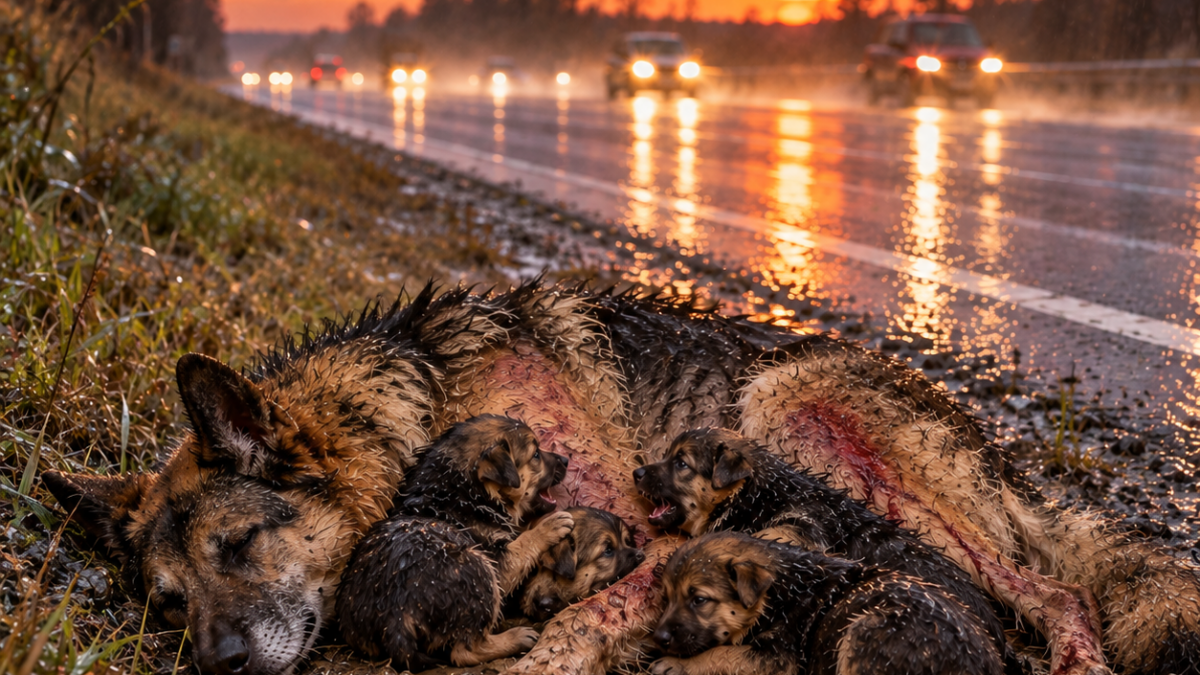
Her coat was soaked flat enough that I could see every rib.
One ear stood.
The other sagged sideways, torn near the tip.
She was lying on her side close enough to traffic that another foot might have put her in the lane.
And around her body were puppies.
Four of them.
Tiny.
Maybe four or five weeks old.
One black-and-tan.
One sable.
One almost completely black except for tan toes.
The smallest had a little white mark beneath his throat.
They were crawling over her.
Crying.
The smallest one had both front paws against her neck.
His mouth opened again and again.
A sharp, desperate puppy scream.
The mother tried to lift her head.
Could not.
The pickup behind me honked.
I pulled off the road so suddenly my grocery bag tipped over.
Apples rolled across the passenger floor.
“Damn it.”
The pickup roared around me.
Its headlights washed over the Shepherd.
The driver did not stop.
Another car passed.
Then another.
Nobody stopped.
I sat there with both hands on the steering wheel.
For perhaps five seconds.
Maybe ten.
I wish I could say there was no debate.
There was.
A practical voice inside me said somebody else would handle it.
Animal control.
Police.
A farmer.
The next driver.
Someone who knew dogs.
Someone who owned a crate.
Someone better prepared.
Then the Shepherd looked at me.
Even through rain and distance, I saw her eyes.
Dark brown.
Exhausted.
Terrified.
Not asking for herself.
That is what destroyed my excuse.
She looked at me.
Then at the puppies.
I turned on the hazard lights.
“Fine.”
I said it like I was angry with her.
I was really angry with myself.
Cold rain hit my face the second I stepped out.
A semi passed and pushed air hard enough against my jacket to move me.
I walked slowly toward the ditch.
The puppies cried harder.
The mother tried to move.
One front paw dragged forward.
Her claws scraped gravel.
Her chest lifted.
She collapsed again.
Then, with almost nothing left in her body, she twisted herself just enough to put her shoulder between me and the puppies.
I stopped.
That was the moment.
Not the road.
Not the rain.
Not even the puppies screaming.
A dying German Shepherd had almost no strength remaining, and what little she had, she was still spending on protecting them.
“Easy.”
Her lips pulled back.
A growl came out.
Thin.
Broken.
But unmistakably serious.
“Okay.”
I crouched.
“You don’t know me.”
Another weak growl.
“Fair.”
I stayed still.
She tried to rise.
Her front legs shook.
Her back legs folded beneath her.
For one terrible second I thought she might have a broken spine.
Then the smallest puppy crawled beneath her chin.
Her mouth closed.
She licked the top of his head once.
Slowly.
Like it cost her something.
My chest tightened.
“I’m not leaving you.”
I had no idea how true that sentence would become.
Behind my truck I kept an old moving blanket.
Jumper cables.
Tow strap.
Toolbox.
Flashlight.
First-aid kit.
Things practical men carry because practical things are comfortable.
I ran back for the blanket and called the first emergency veterinarian I could find.
Briar Glen Animal Clinic.
Closed.
Emergency number.
A woman answered after four rings.
“Briar Glen emergency line, Dr. Elena Ruiz speaking.”
“I’m on County Road 18. There’s a dog.”
My words came too fast.
“German Shepherd. Female. Four puppies. She’s barely moving.”
“Are you safe from traffic?”
The question cut through the panic.
“Yes.”
“Any obvious bleeding?”
I looked.
“No heavy bleeding. Her legs are scraped. She’s soaked. Really thin.”
“Can she stand?”
“She tried.”
“Rear legs moving?”
“I think so.”
“Can you transport them?”
“I don’t have a dog crate.”
“What do you have?”
“Truck. Blanket.”
“Use the blanket. Keep the puppies with her. Cover her first if possible. Stay away from her face. She’s scared and protecting them.”
“She growled.”
“That’s good.”
“Good?”
“She still has enough strength to warn you.”
That was a miserable definition of good.
“I’ll meet you at the clinic.”
I hung up.
The Shepherd watched me approach with the blanket.
“Okay.”
Her ears flattened.
“I know.”
I laid part of the blanket on the ground first.
No movement.
I edged closer.
She growled.
Then coughed.
Her head dropped.
That frightened me more.
“Stay with me.”
I eased the blanket over her back.
Her body jerked.
One puppy squealed.
The mother turned toward him immediately.
Protect.
Check.
Count.
Even then.
I slid my arms beneath the blanket.
She tried to snap.
There was no power behind it.
“I know.”
My voice cracked.
“I know.”
She weighed almost nothing.
That is something I will never forget.
She looked like an eighty-pound dog.
She probably should have been seventy-five.
She weighed fifty-three pounds when Dr. Ruiz checked her later.
All that fur.
All those bones.
Four puppies.
And almost nothing left.
I gathered the puppies into the blanket with her.
One rolled toward the edge.
I caught him with my elbow.
“I got you.”
The mother’s head fell against my forearm.
“No.”
Her eyes closed.
“No, no, no.”
One eye opened.
Angry.
Exhausted.
Alive.
“Good.”
I carried them to my truck.
The passenger seat was useless for a Shepherd that size, so I folded down the rear bench and spread the blanket across it.
The groceries went wherever they landed.
Apples.
Chicken.
Milk.
Nothing mattered.
I placed the mother down.
The puppies immediately crawled against her belly.
She tried to curl around them.
Could not fully manage it.
I turned the heater up.
Then I drove.
Every pothole felt criminal.
Every red light felt personal.
At one stop, the black puppy began crying.
The Shepherd lifted her head.
She nudged him toward her with her nose.
Her head dropped again.
“You’re almost there.”
She watched me through the mirror.
People argue about how much animals understand.
Words?
Maybe very little.
Tone?
Fear?
Pain?
Threat?
Safety?
Absolutely.
A dog knows the difference between a hand reaching to hurt and a hand reaching slowly.
A dog knows when a vehicle means danger.
A dog knows when a door leads to food or punishment.
A mother knows the sound of her puppy crying.
And that dog knew she did not trust me.
But she also knew I was all she had.
Dr. Ruiz opened the clinic door before I got there.
She was small.
Early forties.
Dark hair tied up badly.
Sweatshirt under her white coat.
Behind her came a young technician in purple scrubs.
“Maddy,” Dr. Ruiz said. “Warm room. Towels. Oxygen ready.”
I carried the blanket inside.
The Shepherd growled when I placed her on the table.
Dr. Ruiz did not flinch.
“Oh, sweetheart.”
She crouched lower.
“You fought hard enough.”
The Shepherd stared.
“Let us take over.”
Maddy began checking the puppies.
Temperature.
Gums.
Breathing.
Weight.
The smallest pup with the white throat was coldest.
“Heat pad.”
Maddy moved quickly.
The Shepherd tried to follow.
Her front paw slid.
Dr. Ruiz steadied her.
“Easy.”
The dog showed teeth.
Dr. Ruiz smiled faintly.
“You can hate me later.”
She listened to the Shepherd’s heart.
Checked lungs.
Abdomen.
Legs.
Spine.
Hips.
Mouth.
Pupils.
The dog flinched when her left hip was touched.
“No obvious fracture.”
I exhaled.
Dr. Ruiz glanced at me.
“That doesn’t mean she’s fine.”
“I know.”
“Severe dehydration. Malnutrition. Soft-tissue injury. Road abrasions. Possible impact trauma.”
“She got hit?”
“Maybe. Or thrown.”
The word stopped me.
“Thrown?”
Dr. Ruiz did not answer immediately.
She examined the dog’s teats.
Her expression changed.
“What?”
“She’s had more litters than these puppies.”
“How can you tell?”
“Her body.”
She looked closer.
“Probably many.”
Maddy glanced up.
Dr. Ruiz ran the scanner over the Shepherd’s shoulders.
Nothing.
“No chip.”
Then she looked inside one ear.
Stopped.
“What?”
Dr. Ruiz tilted the dog’s head gently.
There was a small faded tattoo.
Letters.
Numbers.
Almost unreadable.
Maddy photographed it.
“This could be a breeder ID.”
I looked at the dog.
“She belongs to somebody?”
“Maybe.”
Something about that felt worse than stray.
Dr. Ruiz started fluids.
The Shepherd did not fight.
“She’ll live?”
Dr. Ruiz met my eyes.
“I think she has a real chance.”
The sentence went through me like heat.
“What about the puppies?”
“Cold. Underweight. One mildly dehydrated. But stronger than I expected.”
“Can she nurse?”
“We’ll see.”
Maddy settled the warmest puppy beside the Shepherd.
The mother opened her eyes.
The pup crawled toward her belly.
Latched.
Maddy whispered, “Come on.”
Second pup.
Third.
Then the smallest.
He struggled.
Maddy guided him.
The Shepherd lifted her head.
She licked his back.
One long stroke.
Then her eyes closed.
This time differently.
Not collapse.
Relief.
Dr. Ruiz noticed me staring.
“You stopped at the right time.”
“Anybody would have.”
She looked at me.
“No.”
I did not know what to say.
I looked at the floor.
“What happens now?”
“Tonight she stays here.”
“Then?”
“Animal control technically needs to be notified if she’s abandoned or stray. We’ll try to identify the tattoo. If there’s an owner, that complicates things.”
My stomach tightened.
“You’d give her back?”
Dr. Ruiz’s expression became firm.
“Not if we believe abuse occurred.”
“Good.”
“But that requires evidence.”
She removed her gloves.
“The puppies need a quiet foster home once everyone stabilizes.”
“Shelter?”
“Possibly.”
I looked through the glass.
The mother had one front leg curved around two pups.
“What happens at the shelter?”
“Depends on space.”
“That means something bad.”
“It means shelters are overwhelmed.”
I stared at her.
“I have a spare room.”
Dr. Ruiz blinked.
“Dan.”
“How do you know my name?”
“You gave it when you called.”
“Oh.”
“You realize this is not bringing home one friendly adult dog.”
“I understand.”
“You have a traumatized nursing German Shepherd, four puppies, unknown medical history, possible parasites, likely behavioral issues, and expenses.”
“I own a hardware store.”
“That qualifies you for lumber.”
“I can follow directions.”
Maddy hid a smile.
Dr. Ruiz crossed her arms.
“You have other pets?”
“No.”
“Children?”
“No.”
“Anyone home who would object?”
“No.”
The last answer stayed in the air.
Nobody waiting.
Nobody to ask.
Nobody to complain.
The house suddenly felt larger in my mind.
Too large.
“Fine,” Dr. Ruiz said eventually. “If she stabilizes.”
Maddy grinned.
Dr. Ruiz pointed at her.
“Do not encourage him.”
“I didn’t say anything.”
“You’re smiling.”
“I have a face.”
The first absurd laugh escaped me.
Dr. Ruiz almost smiled too.
Maddy said, “She needs a name.”
“She has a breeder tattoo.”
“That’s not a name.”
“You name everything.”
“The possum looked like Kevin.”
Dr. Ruiz closed her eyes.
I looked at the Shepherd.
Even asleep, her ears twitched when one puppy cried.
“What about Mercy?”
Maddy looked at me.
I shrugged.
“Seems appropriate.”
The dog’s ear moved.
Maddy pointed.
“She agrees.”
“She’s sedated.”
“Still counts.”
Mercy stayed overnight.
I went home alone.
The house was silent.
I opened the spare-room door.
That room had once been supposed to become something.
Hannah and I never had children.
We discussed it.
Then postponed it.
Then stopped discussing it.
After the divorce, I kept the room shut.
There was an old single bed inside.
Boxes.
Tax records.
A folding table.
Curtains Hannah chose years ago.
I stood in the doorway.
Then started moving things.
At midnight, I built a low barrier.
At one, I found old quilts.
At two, I drove to the twenty-four-hour farm supply store.
Puppy pads.
Food bowls.
High-calorie dog food.
Washable bedding.
By three-thirty, the room no longer looked abandoned.
I sat on the floor.
For the first time in years.
Not thinking about Hannah.
Not thinking about what the room had failed to become.
Thinking about a Shepherd I barely knew.
The clinic called at seven.
“She made it through the night,” Dr. Ruiz said.
I sat up.
“And the puppies?”
“Hungry and obnoxious.”
“That sounds good.”
“It is.”
Mercy came home that afternoon.
She did not want to leave the crate.
I opened the door.
Sat across the room.
Waited.
One puppy crawled out.
Mercy immediately stood.
Her legs shook.
She stepped over him.
Nosed him backward.
The other pups followed.
One was sable and loud.
One black.
One darker sable.
One tiny male with the white throat.
I named them by accident.
The loud one became Ranger because he kept escaping the blanket nest and exploring.
The black one became Shadow.
The female sable pup became Annie.
The little white-throated male became Scout.
I told myself names were temporary.
My sister Claire laughed so hard when I said that she had to put down the coffee she was holding.
“You have already failed fostering.”
“I have not.”
“You named them.”
“So veterinarians can tell them apart.”
“You could have used colors.”
“I hate color coding.”
“You named one Ranger.”
“He ranges.”
“You’re keeping dogs.”
“I am not.”
Mercy watched her from the corner.
Claire lowered her voice.
“Oh.”
Mercy was different around women.
Still afraid.
But less tense.
Claire crouched.
“Hi, mama.”
Mercy did not move.
“You did good.”
One ear lifted.
Claire stayed where she was.
After five minutes, Mercy lowered her head.
Claire’s face softened.
“Oh, Dan.”
“Yeah.”
I started noticing things.
Mercy flinched at raised hands.
Not every time.
Fast hands.
If I reached suddenly for a shelf above her, she dropped.
Flat.
If a belt buckle clinked, her eyes changed.
If something metal struck concrete outside, she would run to the puppies.
Then there were engines.
Pickup trucks did not bother her.
Diesel delivery vans did not bother her.
But one particular engine sound did.
A newer SUV.
Deep, smooth idle.
The first time it happened, I was upstairs changing puppy pads.
A vehicle slowed beyond the house.
Mercy froze.
Her entire body dropped over the puppies.
Ears back.
Pupils wide.
Growl.
Not warning me.
Warning whatever was outside.
I looked through the window.
Dark blue SUV.
Tinted windows.
Stopped near my mailbox.
Thirty seconds.
Then gone.
Mercy did not relax for almost an hour.
I called Dr. Ruiz.
“She recognizes something,” I said.
“Could be road trauma.”
“The road had every kind of vehicle.”
“Yes.”
“But that one was different.”
Dr. Ruiz went quiet.
“What?”
“Dan, mothers don’t usually choose to lie beside highways with puppies that young.”
“So?”
“So someone may have dumped them.”
Anger came fast.
“Who dumps four puppies and their mother?”
“People.”
“Why?”
“Because the litter didn’t sell. Because the mother got sick. Because veterinary bills cost money. Because someone didn’t want them. Because cruelty usually begins with somebody deciding another life is inconvenient.”
I looked upstairs.
“What do I do?”
“Camera.”
“I have three.”
“Use them.”
I installed one facing the mailbox that night.
Two days later, the SUV returned.
I was unloading lumber.
It slowed.
The driver wore a baseball cap.
He looked directly at me.
Then accelerated.
The rear plate was covered in mud.
Too perfectly.
I walked into the road after it.
Could not read the plate.
My mother stood on my porch.
She had arrived unnoticed.
“Who was that?”
“No idea.”
She looked at me.
“You think he knows the dog.”
“I don’t know.”
“That is your second ‘I don’t know.’”
“Come inside.”
Mom brought old towels and boiled chicken.
She spent forty minutes sitting quietly on the spare-room floor.
Mercy watched her.
My mother did not reach.
Did not make baby sounds.
Did not stare.
She simply sat.
After twenty minutes, Mercy sighed.
Mom looked at me.
“That dog has been hit.”
I stiffened.
“How do you know?”
“She expects hands to hurt.”
My mother was seventy-one.
Ruth Mercer had spent thirty-eight years married to my father.
She was not sentimental in obvious ways.
She never called animals fur babies.
Never dressed dogs in sweaters.
But she understood fear.
“Dad rescued animals?” I asked.
“Constantly.”
“He never told me.”
“He preferred people to think he was harder than he was.”
She smiled.
“Once kept an injured owl in our bathtub for three nights.”
“What?”
“It hated him.”
“I would too.”
“He said it was gratitude.”
Mom looked at Mercy.
“Your father used to stop for everything.”
“Why did he stop?”
She looked toward the puppies.
“Not completely.”
“What changed?”
“Age.”
“That made him less compassionate?”
“Fear.”
She folded her hands.
“The older you get, the more you understand how many things you cannot save.”
I waited.
“Some people turn that knowledge into wisdom.”
“And Dad?”
“He fought becoming hard.”
“Did he win?”
“Some days.”
Mercy eventually let me touch her.
Eight days after I found her.
I was sitting near the door answering emails.
The puppies were chaos.
Ranger had discovered shoes.
Shadow attacked his own tail.
Annie was chewing the blanket.
Scout had climbed halfway onto my boot and fallen asleep.
Mercy finished eating.
Walked toward me.
Stopped.
I lowered my hand.
She smelled my knuckles.
Once.
Twice.
Then pressed her forehead against them.
I stopped breathing.
She pressed harder.
I touched the top of her head.
She closed her eyes.
That first contact lasted maybe five seconds.
It felt like being handed something fragile enough to ruin with one careless motion.
Trust.
Not affection.
Not yet.
Trust.
Measured in ounces.
That night I posted one photograph.
Mercy lying with the four pups around her.
I wrote that I found them beside County Road 18.
That a veterinarian was treating them.
That they were safe.
That puppies would eventually need homes.
Nothing dramatic.
By morning the post had been shared two hundred times.
By afternoon, half the county knew.
Most people were kind.
Someone brought blankets.
Someone offered puppy food.
Someone offered money for veterinary care.
A trucker commented that he had seen them but had been hauling equipment and could not safely stop.
A woman wrote that she passed ten minutes earlier and thought Mercy was already dead.
Her message ended:
I’ve been sick over it since. Thank you for stopping when I didn’t.
Then came the other comments.
Why waste money?
Probably diseased.
Should’ve called animal control.
Dogs breed every day.
Everyone wants to be a Facebook hero.
The last one bothered me.
Then a name appeared.
Ricky Vance.
Looks staged. Nobody just finds a whole Shepherd litter beside a road.
Vance.
The name meant something in Briar Glen.
Not criminal legend.
Nothing dramatic.
Just the kind of family people lowered their voices about.
Landscaping.
Cash breeding.
Dogs for “security.”
One old animal-control complaint.
Rumors about pit bulls.
Nothing anyone wanted to swear to.
The next morning my camera caught the SUV.
6:13 a.m.
Dark blue.
Stopped by the mailbox.
Twelve seconds.
Rear window sticker visible.
VANCE OUTDOOR SERVICES.
I watched the footage three times.
Then called Sheriff Tom Avery.
Tom and I went to high school together.
He was two years older and had looked forty since he was seventeen.
“Dan.”
“Tom.”
“Please tell me this is not about your internet-famous dog.”
“Maybe.”
He sighed.
“What happened?”
I told him.
Mercy’s reaction.
SUV.
Covered plate.
Sticker.
Comment.
Tom stopped joking.
“Send video.”
I did.
Two hours later, he called.
“Vehicle belongs to Blake Vance.”
“Ricky?”
“Cousin.”
“And?”
“I’m talking to him.”
“You think he dumped her?”
“I think obscuring a plate and circling someone’s property gives me enough reason to ask why.”
That afternoon Blake Vance walked into my store.
Early thirties.
Broad shoulders.
Clean work boots.
Baseball cap.
Confidence that entered rooms before he did.
He set zip ties on the counter.
“Dan Mercer.”
“Blake Vance.”
Tiny flicker.
He had not expected recognition.
“That Shepherd story yours?”
“Apparently.”
“Popular.”
“People like puppies.”
He smiled.
Not warmly.
“Heard people are saying somebody dumped them.”
“I said I found them.”
“Same thing once folks start talking.”
I scanned the zip ties.
“People were talking before Facebook.”
He leaned closer.
“Accusations can hurt people.”
“I haven’t accused anyone.”
“Keep it that way.”
The store became quiet.
Earl Stinson stood in aisle three pretending to inspect copper fittings.
Blake lowered his voice.
“You don’t know anything about that dog.”
“I know she was starving.”
“You don’t know where she came from.”
“No.”
I looked at him.
“But you seem worried I might.”
His jaw tightened.
For one second something moved behind his eyes.
Fear.
Then anger.
He grabbed the zip ties.
“Watch yourself.”
“You forgot your change.”
He left.
Earl came around the aisle holding a copper elbow.
“That young man is guilty of something.”
“You heard that?”
“I am old, not deaf.”
“You willing to repeat it to Tom?”
Earl looked personally offended.
“Dan, I have spent seventy-one years preparing to be officially nosy.”
Tom took statements.
Then he pulled road-camera footage.
There was the blue SUV.
4:52 p.m.
The afternoon I found Mercy.
It stopped near County Road 18.
Hazards came on.
A man stepped out.
Opened the back.
Dragged a large plastic transport crate into the ditch.
Then another smaller crate.
He opened both.
He got back in the SUV.
Drove away.
Twenty-three minutes later, camera footage showed my truck passing toward town.
I watched the video in Tom’s office.
My hands became fists.
“That’s her.”
“We believe so.”
“He opened the crate?”
“Yes.”
“He just left them?”
“Yes.”
“Mercy got out.”
“Looks like it.”
I pictured it.
Rain.
Traffic.
Puppies crying.
A starving Shepherd pushing out of a crate.
Trying to move them away from the road.
Maybe she carried one.
Maybe another followed.
Maybe she collapsed before she could finish.
“She was trying to save them.”
Tom said nothing.
“Why would he do this?”
Tom leaned back.
“We executed a warrant this morning.”
My stomach tightened.
“Vance property?”
“Yes.”
“And?”
“Thirty-one animals alive.”
The word alive hit wrong.
“Alive?”
Tom’s silence filled in what I had not asked.
“Dogs?”
“Mostly German Shepherds and Shepherd mixes. Some other breeds.”
“Breeding?”
“Looks like it.”
“How bad?”
“Bad.”
“Define bad.”
Tom looked tired.
“Outdoor pens. Poor shelter. Limited water. Several females with mammary infections. Untreated injuries. Parasites. We found paperwork suggesting repeated litters.”
My mind went to Mercy.
The tattoo.
“How many dead?”
“Dan.”
“How many?”
“Six remains recovered so far.”
I stood.
My chair scraped backward.
“Mercy came from there.”
“We believe so.”
“Why dump her?”
“We found a breeding ledger.”
Tom opened a folder.
I did not want to look.
I looked.
A code.
M-14.
Female sable.
DOB estimated.
Litters.
Dates.
Numbers.
Prices.
“Is that her?”
“Tattoo matches.”
My mouth went dry.
Six litters.
Maybe seven.
Some entries incomplete.
“Her name?”
“Not listed.”
“Nothing?”
“Just M-14.”
I stared.
Mercy.
M-14.
A life reduced to inventory.
Tom continued.
“Final note says ‘poor producer, mastitis, remove.’”
“Remove?”
He looked at me.
“That’s what it says.”
Something cold moved through me.
The puppies.
“Were they hers?”
“Most likely.”
“Why not sell them?”
“Four pups. Smaller litter than expected. One male apparently had white marking. Not considered desirable for their buyers.”
Scout.
The tiny one.
“Mercy was sick.”
“Yes.”
“Vet bill.”
“Probably.”
“So he dumped all five.”
“That appears to be the case.”
I put both hands on the desk.
“Charge him.”
“We are.”
“Today.”
“We do cases carefully, Dan.”
“He left them to die.”
“Yes.”
“Then why are you calm?”
Tom stood too.
“Because if I build a bad case, he gets them back.”
I went quiet.
Tom stepped closer.
“You stopped for them.”
He pointed toward the window.
“You did your part.”
“I almost didn’t.”
“But you did.”
“That doesn’t feel like enough.”
“It rarely does.”
The Vance property seizure changed everything.
News vans came.
Rescues came.
Photos spread.
Rows of kennels.
Thin Shepherds.
Females with enlarged mammary glands.
Dogs too frightened to approach humans.
Puppies with parasites.
People became furious.
The same town where countless drivers had passed Mercy beside the road suddenly wanted punishment.
I understood.
I also resented it.
Anger afterward is cheap.
Mercy had been there before the story.
Before outrage.
Before shares.
Before anyone cared what M-14 meant.
She had been dying quietly.
Mercy continued healing.
She gained weight.
Her coat became thick.
Her eyes changed.
That was the greatest difference.
When I found her, she watched everything as if danger was simply late.
After a month, she began sleeping with her back toward the door.
The first time I saw it, I stood there for a long while.
Trust is sometimes nothing more than an animal deciding it does not need to watch the entrance.
The puppies grew.
Ranger became fearless.
Shadow liked to carry socks.
Annie followed Mercy everywhere.
Scout, the runt, became an opinionated tyrant who barked at the vacuum cleaner and slept against my neck whenever I sat on the floor.
My mother visited constantly.
One afternoon, I found her with Scout asleep in her lap.
She was crying.
“Mom?”
“I’m fine.”
The Mercer family religion.
Fine.
I sat beside her.
Mercy lay near the window.
Mom stroked Scout’s ear.
“Your father would’ve kept one.”
“No chance.”
“All four.”
“That I believe.”
She smiled.
Then looked at me.
“I worried about you.”
“I know.”
“No.”
Her voice changed.
“I worried after Hannah because you stopped needing people.”
“That sounds healthy.”
“It isn’t.”
I looked away.
“You became careful.”
“I’m still alive.”
“So is a locked house.”
Mercy raised her head.
Mom continued.
“You confused being protected with being empty.”
“That sounds like something Claire would say.”
“She gets it from me.”
Scout shifted.
“Your father did that after his brother died.”
“What?”
“Worked. Fixed things. Helped everyone. Never said he was hurting.”
“What changed him?”
Mom smiled.
“You.”
I looked at her.
“When you were born, you needed him without asking permission.”
Her hand covered mine.
“It is hard to hide from love when something small depends on you.”
I looked at Mercy.
At Scout.
At the room that used to represent everything my marriage never became.
Blankets.
Chewed toys.
Puppy pads.
A damaged baseboard.
Life.
“I don’t know what I’m doing.”
Mom squeezed my hand.
“No decent person ever does at first.”
At eight weeks, adoptions began.
I hated all of them.
Ranger went to a retired state trooper named Bill Hardin who had lost his Shepherd the previous year.
Ranger climbed into Bill’s truck before the paperwork was complete.
Shadow went to a young married couple who lived outside town and sent me pictures every day for the first month.
Annie went to Claire.
That was absolutely not the plan.
Claire brought my niece Emma to “say goodbye.”
Annie curled into Emma’s lap and fell asleep.
Emma looked at Claire.
Claire looked at me.
I raised both hands.
“Not my fault.”
Claire whispered, “I hate you.”
Annie went home with them.
Scout had an approved adopter.
Nice man.
Retired teacher.
Fenced yard.
Excellent references.
Scout met him.
Accepted three treats.
Then walked back to Mercy.
The man tried again.
Scout returned to me.
The man laughed.
“I think the dog made his choice.”
“No.”
Scout sat on my foot.
The rescue coordinator, Niamh, looked at me.
“Dan.”
“No.”
“You know.”
“I do not.”
Scout leaned against my leg.
Mercy watched.
“I can’t keep two Shepherds.”
Niamh smiled.
“Of course.”
“I work.”
“So do millions of dog owners.”
“My house is not set up.”
“You own a hardware store.”
“That is not relevant.”
“You built a whelping box in four hours.”
“Temporary.”
“You installed washable flooring.”
“Practical.”
“You bought a six-foot privacy fence.”
“Security.”
“You are keeping the dogs.”
“I am fostering.”
Mercy stood.
Walked toward me.
Pressed her forehead against my knee.
Niamh said nothing.
She did not need to.
Mercy stayed.
Scout stayed.
That was that.
The Vance case went to court in March.
I testified.
Dr. Ruiz testified.
Tom testified.
Animal-control officers described the property.
Veterinary experts described overbreeding.
One female had produced eight litters before age six.
Another had a leg injury that had healed crooked.
Mercy’s records were entered.
M-14.
Six confirmed litters.
Possibly seven.
No veterinary care documented after the second.
Her final litter had four puppies.
Final notation:
Poor producer.
Mastitis.
Remove.
The defense attorney said Blake had become overwhelmed.
That the breeding operation started small.
That costs rose.
That animals multiplied.
That he panicked.
That he made bad choices.
Maybe some of that was true.
The truth about cruelty is not always satisfying.
People want monsters.
Monsters make ordinary people feel safe.
Most cruelty does not begin with someone waking up and deciding to become evil.
It begins with shortcuts.
Neglect.
Money.
Pride.
Inconvenience.
One untreated infection.
One missed meal.
One dog left outside.
One litter too many.
Then another.
Eventually suffering becomes normal.
Then disposing of a dying mother and her puppies beside a highway becomes something a man can do before dinner.
When the prosecutor asked me what would have happened if I had not stopped, I looked at Blake.
He looked down.
“They would have died.”
Nobody moved.
The plea agreement came days later.
Multiple animal-cruelty counts.
Abandonment.
Improper breeding operations.
Obstruction for the plate.
Probation after county confinement.
Fines.
Restitution.
Long-term ban on owning or breeding animals.
People said it was not enough.
Maybe it was not.
But thirty-one surviving animals went to rescues.
The property was shut down.
Breeding records became evidence.
People started reporting backyard breeders they had ignored for years.
The county increased inspections.
A local rescue created a fund for seized animals.
And in open court, a judge looked at Blake Vance and used the word he had spent months avoiding.
Cruelty.
That mattered.
Afterward, I stood on the courthouse steps.
Dr. Ruiz walked over.
“You did well.”
“I hated it.”
“Good.”
I looked at her.
“Good?”
“The day people enjoy testifying in cruelty cases is the day I worry.”
Maddy approached carrying a cardboard carrier.
I held up one hand.
“No.”
She laughed.
“Empty.”
“Why are you carrying it?”
“Because I work at a veterinary clinic.”
“Feels suspicious.”
Dr. Ruiz smiled.
“How are Mercy and Scout?”
“Mercy owns my house.”
“And Scout?”
“My left shoe.”
“And you?”
Normally I would have said fine.
The word reached my mouth.
Stopped.
I looked across the courthouse parking lot.
“I’m better.”
Dr. Ruiz nodded.
Like that was enough.
Spring came.
Slowly.
County Road 18 turned green again.
The ditch grew over.
For months, I hated driving that road.
Every time I passed the place, I saw Mercy in the rain.
Thin body.
Puppies pressed against her.
One eye watching traffic.
Then one Sunday, I stopped.
Not because anything was wrong.
Because something needed to be remembered.
I parked safely.
Walked into the grass.
The ditch looked ordinary.
That bothered me.
Tragedy should leave permanent evidence.
It does not.
Rain washes blood.
Grass grows.
Cardboard rots.
Roads forget.
People forget faster.
I found a flat stone.
Set it beside the grass.
Nothing written.
No plaque.
No name.
Just a marker.
Someone noticed here.
Someone stopped.
When I returned home, Mercy was in the front window.
Beautiful.
There is no other word.
Not because the scars disappeared.
They did not.
Her torn ear remained.
One hip stayed stiff in cold weather.
Her belly showed the history of litter after litter.
But she stood strong.
Thick coat.
Clear eyes.
Scout beside her.
He barked when my truck door closed.
Mercy waited.
I opened the house.
Scout came sliding across the floor.
Mercy walked behind him with the dignity of a queen entering property she already owned.
She stopped in front of me.
Leaned her forehead into my chest.
“Hey, mama.”
Her tail moved.
Once.
Then faster.
That evening we sat on the porch.
Mercy beside my chair.
Scout asleep under it.
The fields turned gold.
My mother’s gutter had been repaired months earlier.
The hardware store would open at seven.
Bills still existed.
My divorce still happened.
My father was still dead.
Mercy did not erase grief.
Scout did not cure loneliness.
That is not how healing works.
Healing did not make my old life disappear.
It made room beside it.
For years, I thought mercy was a feeling.
Something soft.
Something kind people possessed naturally.
I was wrong.
Mercy is inconvenient.
Mercy interrupts dinner.
Mercy ruins groceries.
Mercy costs money when the truck needs brakes.
Mercy makes you kneel in cold rain beside an animal that might bite you.
Mercy means driving to an emergency clinic when you are exhausted.
Mercy means opening a room you kept shut because it held too many failed dreams.
Mercy means calling police when it would be easier not to get involved.
Mercy means testifying.
Mercy means allowing your quiet life to become noisy because something helpless needs room.
And sometimes mercy is nothing more dramatic than one foot moving from the gas pedal to the brake.
That was all I did.
I stopped.
I did not know there was a breeding compound.
Did not know about M-14.
Did not know thirty-one animals were waiting behind fences.
Did not know a man had written “remove” beside Mercy’s existence.
Did not know the puppies would survive.
Did not know three would grow up in homes where they were loved.
Did not know Scout would become mine.
Did not know Mercy would eventually sleep stretched across my bedroom doorway because she liked knowing where I was.
I knew only what I saw.
A dying dog.
Four babies.
Rain.
Traffic.
And a choice.
Keep moving.
Or stop.
Months later, Tom told me something I still think about.
“One complaint is noise,” he said.
“Two complaints are paperwork.”
I looked at him.
“Three complaints become a pattern.”
“What does that mean?”
“It means people had called about Vance before.”
“How many?”
“Enough.”
“Then why wasn’t something done?”
He sighed.
“Not enough evidence. Some callers backed out. Some said they didn’t want trouble. Some said it was none of their business.”
None of their business.
I hated those words.
“How many people knew?”
“Bits.”
That was the cruel secret.
Not that an entire town knew everything.
That would have been simpler.
Everyone knew one piece.
Someone smelled the kennels.
Someone heard barking all night.
Someone saw too many litters advertised.
Someone saw sick dogs.
Someone heard rumors.
Someone passed a thin Shepherd in the back of a truck.
Someone thought about calling.
Someone called once.
Someone stopped asking.
Cruelty survives that way.
Not because everybody approves.
Because nobody believes their small piece is enough to matter.
Mercy had needed dozens of people to look away before she ended up beside County Road 18.
She needed only one person to stop.
I do not say that proudly.
I almost became another car.
That truth keeps me humble.
Two years later, the county rescue invited Mercy to a fundraising event.
I almost declined.
Then they told me the money would help investigate illegal breeding operations.
So I brought her.
Mercy wore no costume.
No fancy bandana.
I refused both.
She sat beside me on a plain black leash.
People came over.
Some cried.
Some knew the story.
Some did not.
An older man knelt.
“Is this her?”
“Yes.”
“M-14?”
I hated hearing it.
“Mercy.”
He nodded.
“Mercy.”
He touched his chest.
“My Shepherd came from Vance.”
I looked at him.
“What?”
“Bought him three years before the seizure.”
His eyes filled.
“He died at five. Genetic heart problem.”
I did not know what to say.
The man looked at Mercy.
“Maybe they were related.”
Maybe.
Mercy sniffed his hand.
Then placed her nose beneath his palm.
The man began crying.
That happened more than once.
People came with stories.
Dogs bought cheaply.
Puppies that became sick.
Females they had seen once and never again.
One woman told me she had gone to the Vance property to buy a puppy and noticed a thin Shepherd mother behind the barn.
“She was nursing.”
“What did she look like?”
“Sable.”
My chest tightened.
“Torn ear?”
The woman covered her mouth.
“I think so.”
“Did you do anything?”
She cried.
“No.”
I could see what she expected.
Condemnation.
I thought of my truck.
My warm heater.
My hand on the steering wheel.
“I almost didn’t either.”
She looked up.
“That doesn’t make it okay.”
“No.”
“But maybe it tells us what to do next time.”
Mercy leaned against my leg.
The woman nodded.
Years passed.
Scout grew enormous.
Eighty-seven pounds.
Still believed he was small.
Still had the white mark.
Mercy aged faster.
Too many litters.
Too much neglect.
Her hips worsened.
Dr. Ruiz said her body had been asked to do too much too young.
That sentence enraged me every time.
But Mercy did not spend her life angry.
That privilege belonged to me.
She became gentle.
Not with everyone.
Men in baseball caps remained suspicious.
Dark SUVs never became acceptable.
If one slowed near the house, she stood between the window and Scout even when Scout outweighed her.
Motherhood does not always end when children grow larger.
My mother adored Mercy.
Every Sunday she came with boiled chicken and claimed she was not spoiling her.
Claire brought Annie.
Mercy always recognized her.
The first reunion lasted fifteen minutes and made every adult present cry.
Annie rushed into the house.
Mercy froze.
Then Annie dropped low.
Tail moving.
Mercy smelled her.
Face.
Ears.
Neck.
Then she began grooming Annie’s muzzle.
Just like the road.
Just like when Annie was tiny.
Scout joined them.
Three German Shepherds filled my living room.
Claire looked at me.
“Remember when you said you didn’t want a dog?”
“I never said that.”
“You said five dogs was insane.”
“It was.”
“And now?”
“Three in one room is objectively too many.”
Mercy rested her head on my knee.
Claire smiled.
“Sure.”
Ranger visited too.
Shadow visited once and immediately stole Scout’s toy.
Every reunion was different.
Mercy knew them.
I cannot prove memory the way people demand proof.
But I watched her body soften around them in a way it never did with unfamiliar dogs.
She had fought to keep them alive beside that road.
Now she watched them walk back through my door strong.
Healthy.
Loved.
I wish Blake Vance could have seen that.
Not because I wanted him hurt.
Because I wanted him to understand what “remove” had become.
Mercy reached twelve.
Then thirteen.
For a German Shepherd with her history, every year felt borrowed.
She began sleeping more.
Her face grayed.
Scout slowed with her.
If Mercy needed extra time getting up, he waited.
If she stopped during walks, he stopped.
If she slept downstairs instead of following me upstairs, Scout stayed beside her.
One evening I found them in the living room.
Mercy asleep.
Scout’s head across her back.
I stood there longer than necessary.
I remembered four puppies climbing across her in the rain.
The smallest one at her neck.
Screaming.
Scout.
Now nearly ninety pounds.
Still touching his mother.
The last winter was gentle at first.
Then Mercy stopped finishing food.
Dr. Ruiz ran tests.
Kidneys.
Liver.
Cancer.
Spleen.
The diagnosis was hemangiosarcoma.
Aggressive.
Advanced.
I sat in the same clinic where I had first carried her wrapped in a wet moving blanket.
Dr. Ruiz spoke carefully.
“We can operate.”
“Will it cure her?”
“No.”
“How long?”
“Could be weeks.”
“With surgery?”
“Possibly months.”
“Comfort?”
“Recovery would be difficult.”
I looked at Mercy.
She lay beside Scout.
Her muzzle gray.
Eyes calm.
For years, humans had decided what her body was worth.
How many litters.
How many puppies.
How much food.
Whether medical care cost too much.
Whether she was worth keeping.
I asked one question.
“What would you do if she were yours?”
Dr. Ruiz swallowed.
“I would take her home.”
So I did.
My mother came.
Claire came.
Annie came once.
Ranger’s family sent pictures.
Shadow’s family sent a video.
Ridiculous, maybe.
Mercy did not understand phones.
I watched anyway.
The last week, she spent most afternoons on the porch.
Scout beside her.
Cold sunlight.
I moved blankets wherever she wanted.
One evening a dark SUV drove past.
Mercy’s ears lifted.
Her body tensed.
For one second I saw the old fear.
Then Scout stood.
I put my hand on Mercy’s shoulder.
The SUV continued.
Mercy looked at me.
Then lay back down.
That felt important.
The final morning came in March.
Clear.
Cold.
Dr. Ruiz drove to the house.
Mercy could no longer stand without help.
I carried her to the spare room.
The room where she had raised her puppies.
I had changed it over the years.
Office desk.
Bookshelves.
Dog beds.
But I still kept the original moving blanket.
Washed a hundred times.
Frayed.
Stained permanently in one corner.
I laid Mercy on it.
Scout settled beside her.
Dr. Ruiz sat on the floor.
“I’m sorry.”
“I know.”
Mercy looked at me.
Her breathing was tired.
I touched the torn edge of her ear.
“You know, you ruined my groceries.”
Dr. Ruiz laughed softly through tears.
Mercy blinked.
“You cost me a fortune.”
Her tail moved once.
“You destroyed the spare room.”
Another breath.
“Your son ate my boots.”
Scout lifted his head.
“That one is true.”
I pressed my forehead against Mercy’s.
“I almost didn’t stop.”
That was the confession I had carried longest.
“I almost left you there.”
Her nose moved against my cheek.
“I’m sorry.”
Dr. Ruiz whispered, “Dan.”
“I know.”
I took a breath.
“But I did stop.”
Mercy looked at me.
“And you stayed.”
The first injection relaxed her.
Scout began licking her ear.
Mercy’s eyes half closed.
I held her face.
“You did enough.”
Her breath moved slowly.
“You don’t have to guard anybody.”
Scout stopped licking.
“You don’t have to protect the puppies.”
Mercy’s chest rose.
Fell.
“They’re okay.”
Another breath.
“Ranger’s okay.”
“Shadow’s okay.”
“Annie’s okay.”
I put my hand on Scout.
“And this idiot is definitely okay.”
Scout pressed closer.
Mercy’s eyes moved toward him.
“Everybody made it.”
My voice broke.
“You got them all through.”
Dr. Ruiz gave the final medication.
Mercy exhaled.
Her body softened.
Scout nudged her face.
Once.
Then again.
He whined.
I started crying.
Not gracefully.
Not quietly.
The way grief comes when it has waited years for permission.
I wrapped one arm around Scout.
The other remained on Mercy.
No road.
No rain.
No traffic.
No box.
No engine leaving her behind.
She died in the room she had turned from a place of failure into something alive.
She died with her son beside her.
With a human hand on her head that had never once hit her.
With nothing left to protect.
Weeks later, I drove County Road 18.
Pulled over.
Walked to the stone.
Still there.
Grass around it.
I crouched.
For a long time I did not say anything.
Then I placed Mercy’s old collar beside it.
Only for a moment.
I could not leave it.
I picked it back up.
Some things belong home.
When I returned, Scout waited at the window.
The house felt wrong without her.
That never fully stopped.
But it did not become empty again.
That mattered.
Mercy had taught me something I had spent most of my adult life avoiding.
Love does not make you safe.
It makes you responsible.
Responsible to notice.
Responsible to stop.
Responsible to care when caring becomes inconvenient.
Responsible to speak when cruelty survives because everyone else has only one small piece of the truth.
I used to think the opposite of cruelty was kindness.
Now I think it is attention.
Cruelty grows where nobody looks long enough.
Where barking becomes background noise.
Where thin dogs become somebody else’s problem.
Where a strange truck in a ditch becomes none of your business.
Where everyone knows one small thing and nobody joins the pieces.
Mercy survived because one evening, exhausted and irritated and thinking about chicken thawing in my truck, I looked twice.
That is all.
I looked twice.
Then I stopped.
Four puppies lived.
Thirty-one animals came out of locked kennels.
A breeding operation ended.
A county changed inspection rules.
People started calling sooner.
Some stopped buying puppies from parking lots and cash-only breeders.
A little fund at Dr. Ruiz’s clinic eventually paid emergency care for seized animals.
They named it the Mercy Fund.
I objected.
Nobody cared.
Scout became its unofficial mascot.
He hated the bandana they made him wear.
I approved.
My mother donated every Christmas in my father’s name.
Claire volunteered with Annie at school reading programs.
Ranger’s owner trained him for wilderness search.
Shadow became the spoiled dog of a couple who sent birthday cakes.
Mercy never knew any of that.
She did not need to.
Her story was never important because people shared it.
It mattered because she lived it.
She had been bred until her body was used up.
Reduced to M-14.
Marked “remove.”
Driven to a road.
Left with four puppies in rain.
And still, with almost nothing left, she crawled over them.
Still protected.
Still licked their heads.
Still tried.
I do not know whether mercy began when I stopped.
Sometimes I think it began earlier.
Maybe it began with her.
A dying German Shepherd refusing to let her puppies face the road alone.
Maybe she showed me what mercy looked like before I had the courage to choose it myself.
All I know is that I almost kept driving.
And if that sentence makes anyone uncomfortable, good.
It should.
Because somebody always almost keeps driving.
Past an animal.
Past a child crying.
Past a neighbor who suddenly stopped coming outside.
Past something that looks inconvenient.
Past something that would ruin the evening.
Most of the time, cruelty does not require everybody to participate.
It only requires enough people to continue.
I was almost one of them.
Then one small puppy screamed against his mother’s neck.
The Shepherd lifted her head.
Our eyes met.
And I touched the brake.








