A Disabled Teen Fixed a Hells Angel’s Harley in the Rain—Then 200 Bikers Showed Up at His Prom
PART2:
A cruelty so casual it looked like confidence if you were not the one being crushed under it.
He did not always hit me.
That was the trick.
Sometimes he only blocked ramps.
Sometimes he put my backpack on high shelves and laughed while I tried to figure out how to ask someone for help without giving him the satisfaction.
Sometimes he rolled my chair backward with one hand while pretending he had only bumped me by accident.
Sometimes he leaned close enough that I could smell his mint gum and whispered things nobody else heard.
“Prom’s coming, wheels. You gonna dance?”
The worst part was not that Brandon hated me.
I do not think Brandon hated me.
Hate would have required effort.
I was entertainment.
A way to make his friends laugh.
A place to put whatever ugly thing lived inside him so he did not have to carry it alone.
My mother knew some of it.
Not all.
Moms know more than you tell them, but less than they fear.
Diane Mitchell had spent seventeen years learning the difference between helping me and hovering over me, and I had spent seventeen years making that lesson difficult.
She worked double shifts at a pharmacy and still came home with groceries, bills tucked inside her purse, and a smile she put on before opening the front door.
Her hands were always dry from sanitizer.
Her eyes were always tired.
She loved me with the kind of fierce quiet that made me feel safe and guilty at the same time.
That Tuesday evening, she was in the kitchen making soup from leftovers while I rebuilt a carburetor for Mr. Jensen’s lawnmower.
Rain hammered the garage roof.
Thunder rolled over town.
Water ran under the big garage door in thin silver lines, and I had shoved towels against the crack to keep it from soaking the floor.
Then came the roar.
Deep.
Heavy.
Wrong for any car on our street.
The sound cut through the rain like something alive.
I froze with a screwdriver in my hand.
The engine stuttered again.
Not random.
Not empty.
A sharp misfire.
Then the backfire hit.
I rolled to the fogged garage window and wiped condensation away with my sleeve.
Under the flickering streetlight, in the middle of the flooded road, sat a classic 1968 Harley-Davidson Shovelhead.
Even dead in the rain, it looked powerful.
Stripped-down frame.
Custom tank.
Long chrome pipes.
Black leather saddle.
A machine old enough to have earned every scar and beautiful enough to make my chest ache.
Whoever had built it had known what he was doing.
Whoever maintained it did too.
Sitting on it was the largest man I had ever seen.
He wore heavy black boots, rain-soaked jeans, and a leather vest over a thick hoodie.
His beard was gray.
His shoulders were massive.
His face was hard in the yellow streetlight.
On the back of his vest was a winged skull patch and red-and-white rockers that made every neighbor on our block remember something urgent inside their house.
Porch lights blinked off.
Blinds snapped shut.
Nobody wanted trouble with a stranded outlaw biker in a storm.
Inside our house, Mom appeared at the kitchen window, face pale, both hands waving frantically.
Stay inside.
I knew what she was saying without hearing her.
I should have listened.
But I was not looking at the patch.
I was looking at the bike.
The rider kicked the starter again.
The engine coughed, caught half a breath, then died.
He swore loud enough to challenge the thunder and kicked the front tire.
I knew that sound.
Water in the ignition points.
The gasket on the points cover was probably torn or missing, and rain had worked its way in. If he kept kicking it over, he would flood the cylinders and make a twenty-minute fix into a nightmare.
My hands moved before my fear could vote.
I grabbed my canvas tool roll, threw a cheap yellow poncho over my shoulders, and shoved the garage door open.
The storm slapped rain into my face immediately.
Cold water ran down my collar and across my hands.
My wheelchair wheels hit the wooden ramp, skidded once, then caught.
I pushed into the street, arms burning as water splashed up around the rims.
“Hey!” I shouted.
The biker turned.
Even from ten feet away, his stare felt like a locked door.
“Go back inside, kid,” he growled. “This isn’t a spectator sport.”
“It’s your ignition points!”
His face changed.
Not much.
But enough.
I pushed closer until I was beside the steaming chrome of the exhaust. Rain hit the hot pipe and rose in ghostly white ribbons.
“The gasket on your points cover is torn,” I said. “Water got in. It’s shorting out.”
The biker’s massive hands tightened on the handlebars.
“What do you know about Shovelheads, kid?”
“I know if you keep kicking it, you’ll flood the cylinders and we’ll be standing out here all night.”
For a long second, he stared at me.
Most people looked at my chair first.
Then my legs.
Then my face, if they remembered.
He looked at my hands.
That was the first thing I liked about him.
I slapped the tool roll onto my lap and unrolled it.
Wrenches.
Screwdrivers.
Test light.
Tape.
Wire.
Tiny tube of silicone.
Spare points file.
Everything had a place.
Everything was clean enough to trust.
“Let me take a look,” I said. “I can fix it.”
Lightning flashed.
The biker looked from the tools to me.
“My Harley,” he said finally. “You touch my paint with those tools and I’ll throw your wheelchair in the river.”
“I’m Ethan,” I said. “And my hands don’t slip.”
Something moved through his expression.
It might have been amusement.
It might have been respect.
It might have been the realization that nobody in his right mind should argue mechanical theory with a soaked teenager in a wheelchair who had rolled into a thunderstorm voluntarily.
“They call me Bull,” he said.
“Good for them. Hold the flashlight.”
For the next twenty minutes, Bull Hess, a man who looked like he could break a parking meter with his forehead, stood in the pouring rain holding a waterproof flashlight while I worked on his Harley.
My fingers went numb almost immediately.
I ignored them.
The cover screws fought me, but not for long.
I removed the points cover, wiped out the moisture, checked the contacts, and cleaned and dried them with a rag I kept tucked beneath my seat.
The gasket was torn exactly where I thought it would be.
I adjusted the gap by feel, used electrical tape and silicone from my kit to make a temporary seal, then tightened everything down carefully.
Bull watched the whole time.
No talking.
No hovering.
No fake advice.
Just watching.
That mattered too.
“Try it,” I said, rolling back a few inches.
He gave me one doubtful look, then turned the ignition key, set the choke, and drove his boot down on the kickstarter.
The Harley roared to life on the first kick.
Not coughed.
Not sputtered.
Roared.
The sound filled the street and pushed the storm back. The idle settled into that deep, uneven rhythm that makes old V-twins sound like they have a heartbeat bigger than the men who ride them.
Bull let it run for ten seconds.
Then cut the engine.
The sudden quiet felt enormous.
Rain drummed around us.
He turned toward me.
For the first time, I saw something other than warning in his face.
Respect.
“I don’t believe it,” he muttered.
“You should. It’s fixed.”
He reached into his soaked leather vest and pulled out a thick money clip. He peeled off two hundred-dollar bills and held them out.
“You’ve got a gift, Ethan. Take it.”
I stared at the money.
We needed it.
That was the honest answer.
Mom stretched every paycheck until it should have screamed. My wheelchair had rust on the spokes. Half my tools came from yard sales and junk bins.
Two hundred dollars was not nothing in our house.
But I shook my head.
“No charge.”
Bull frowned.
“Don’t insult me.”
“I’m not. It was an honor to work on one. You don’t see many Shovelheads survive without being stripped for parts.”
He studied me.
I could feel him seeing things I wished he would not.
The frayed cuffs of my jacket.
The old tape on my chair.
The cheap poncho.
The bruise fading along my cheekbone from where Brandon had shoved me sideways in the school parking lot three days earlier.
Bull’s face changed.
Not soft.
Worse.
Dangerous.
“Who hit you?”
I touched my face before I could stop myself.
“Nobody.”
His eyes narrowed.
“I tripped.”
“Wheelchairs don’t trip, kid.”
I looked away.
Rain gathered in puddles around my wheels.
“It’s just high school.”
Bull said nothing.
“It doesn’t matter.”
Still nothing.
“I keep my head down.”
Bull leaned the motorcycle onto its kickstand and crouched in the flooded street until he was eye level with me.
Up close, he was terrifying.
Scars cut through one eyebrow.
His beard hid half his jaw.
His hands were huge, the knuckles swollen and marked from a lifetime of violence or hard work, probably both.
But his eyes held something strange.
Not pity.
Recognition.
“In my world,” he said, “loyalty and respect are the only currencies that matter. Out here in the civilized world, people are cruel because they can get away with it.”
I swallowed.
“You did my charter a favor tonight,” he said. “I don’t forget things like that.”
Before I could answer, his gaze dropped.
Something hot pink and wet was caught in the spokes of my wheelchair.
I had forgotten about it.
That was not true.
I had tried to forget about it.
Bull reached out and pulled the paper free.
“No, don’t—”
But he had already unfolded it.
Rain had blurred some of the ink, but the bold letters were still readable.
HAVEN HIGH PROM
HANDICAPPED PARKING ONLY FOR FREAKS
STAY HOME
My face burned hotter than the storm was cold.
Bull’s jaw tightened.
“Who printed this?”
“It’s nothing.”
“Who?”
I stared at the water running down the street.
“Brandon Pierce.”
“What is it?”
“A joke.”
“That’s not what I asked.”
I forced air into my lungs.
“Prom’s Friday.”
Bull looked at the paper again.
I hated the silence.
“They think it’s funny,” I said.
“Are you going?”
I laughed once.
It sounded bitter, even to me.
“No.”
“Why not?”
“Who would I go with?”
He waited.
“My mom bought me a suit from the thrift store,” I said, and for some reason that hurt worse to admit than the bullying. “But I’m not going. I’ll just stay in the garage.”
Bull folded the wet pink paper and tucked it into his vest.
He did not say things would get better.
He did not tell me high school did not matter.
He did not call me brave.
Outlaws, I would learn later, do not waste much time on comforting lies.
“Stay dry, Ethan,” he said.
Then he swung one leg over the Harley, kicked it alive, and rode off into the rain.
His taillight bled red down the street until the storm swallowed it.
I went back inside soaked to the bone.
Mom was waiting in the kitchen with a towel and a face halfway between fury and fear.
“What were you thinking?”
“I fixed it.”
“You went into the street during a storm with a strange man wearing—”
“I fixed it.”
Her mouth closed.
She saw my face.
Not the bruise.
Not the rain.
The tiny, dangerous spark that had been missing from me for months.
For a few minutes, I was not the broken boy.
I was the mechanic who had saved a Hells Angel’s Harley.
Mom wrapped the towel around my shoulders and kissed the top of my wet hair.
“You scared me to death,” she whispered.
“I know.”
“Was he awful?”
I thought of Bull crouching in the rain, looking at my bruise like it offended him personally.
“No,” I said. “Not to me.”
The spark lasted until Wednesday.
High school is good at killing sparks.
I found the envelope taped to my locker after second period.
Cream-colored paper.
Careful handwriting.
My name on the front.
For one wild second, I thought maybe it was from the office.
Then I opened it.
Ethan,
I know we don’t talk much outside biology, but I don’t have a date for Friday. Would you want to go to prom with me? Meet me in the cafeteria at lunch?
Harper
My chest forgot how to work.
Harper Lane sat two rows ahead of me in biology. She had dark blond hair she usually tied back with a ribbon, quiet eyes, and the rare ability to speak to me without bending her voice around my chair.
She shared notes when I missed something.
Asked about engines once and actually listened to the answer.
Once, when Brandon made a comment under his breath, she turned around and said, “Do you ever get tired of being obvious?”
I had loved her for six minutes after that.
Then for three months.
I read the note five times.
Every instinct I had screamed trap.
But hope is crueler than caution.
Hope does not ask whether it is safe before it enters.
By lunch, I had bought a single red rose from a senior doing a fundraiser outside the gym. It was slightly crushed from being carried in my lap. I kept touching the folded note in my pocket like it might disappear.
I texted Mom.
Might need the suit after all.
She replied almost instantly.
Really?
Then:
I’m smiling at work and everyone thinks I’m crazy.
I rolled into the cafeteria with the rose across my knees.
The room was crowded. Loud. Smelling of fries, milk, cheap pizza, and too many bodies.
I scanned the tables for Harper.
I did not see her.
I did see Brandon.
He stood on a chair near the center of the cafeteria, white practice jersey stretched across his chest, grin wide enough to show all his teeth.
My hands went cold.
“Ladies and gentlemen!” he shouted. “Look who showed up for his big date!”
Laughter rippled.
Not from everyone.
That matters, I guess.
Some people looked down.
Some looked away.
Some seemed confused.
But enough laughed that the room became a wall.
I stopped moving.
The rose trembled in my lap.
Brandon jumped down from the chair and walked toward me, three of his teammates behind him.
“Where’s Harper?” I asked.
My voice barely worked.
Brandon put a hand dramatically over his heart.
“Oh, man. You believed that?”
The cafeteria tilted.
He reached into his pocket and pulled out another copy of the note.
Same paper.
Same handwriting.
Not Harper’s, I realized too late.
Copied.
Forged.
He waved it in the air.
“You should’ve seen your face, Mitchell.”
“Leave me alone.”
“I will,” Brandon said. “I’ll leave you exactly where you belong.”
He snatched the rose from my lap, snapped it in half, and dropped it to the floor.
Then one of his friends lifted a half-full cafeteria trash can.
I understood what was coming one second before it happened.
Not enough time to stop it.
Sour milk, wet napkins, pizza crusts, half-eaten apples, and cafeteria sludge poured into my lap. It splattered across my shirt, my hands, my wheels.
The smell hit me so hard my stomach lurched.
The cafeteria erupted.
Laughter.
Gasps.
One girl shouted, “Brandon, stop!”
A teacher near the far doors turned too late.
I did not cry.
I could not.
Shock locked everything inside me.
Brandon leaned close.
“Happy prom, freak.”
My hands found the push rims.
Food smeared under my fingers.
I backed away.
Nobody stopped me.
That might have been the worst part.
Not the trash.
Not the rose.
The path opening because everyone was too horrified, too amused, or too afraid to stand in it.
I rolled through the double doors, down the hallway, out of the school, and into the gray afternoon.
Rain had stopped, but the sidewalks were still wet.
The two miles home took forever.
My arms burned.
My chair dragged from the garbage caught near one wheel.
Sour milk dried on my pants.
Cars passed.
Nobody stopped.
By the time I reached the garage, my hands were shaking too hard to unlock the side door.
Mom found me in the laundry sink scrubbing my clothes with dish soap.
The suit she had bought from the thrift store hung from the doorframe in a plastic garment bag.
Charcoal gray.
A little too big in the shoulders.
She had pressed it twice already.
She saw my lap.
The food.
The broken rose on the counter.
My face.
“Oh, Ethan,” she whispered.
That broke me more than Brandon did.
I told her everything.
The note.
The cafeteria.
The trash.
The laughter.
She sat on the closed dryer and cried into both hands.
I hated that I had made her cry.
I hated Brandon for doing it.
I hated myself for believing the note.
Most of all, I hated hope.
I shoved the suit into the deepest corner of my closet.
“I’m never going back there again,” I said.
Mom wiped her face.
“You have school tomorrow.”
“No.”
“Ethan—”
“I mean it. I’m done.”
The words came out flat.
Not dramatic.
Not angry.
Finished.
That was how I felt.
Like something inside me had finally accepted the shape everyone else had been pushing me into.
Brandon won.
Prom was Friday evening.
By seven o’clock, Oakhaven High’s gym had probably transformed into exactly the kind of cheap magic teenagers pretend not to care about.
Streamers.
String lights.
A rented sound system.
Girls in dresses taking pictures under balloon arches.
Boys in tuxedos acting bored because excitement might make them vulnerable.
Brandon would be there.
Of course he would.
White tuxedo, probably.
Perfect hair.
A king in a kingdom that had never asked what kind of person it was crowning.
I sat in the dark garage with a wrench in my hand, tightening a bolt on an engine block that did not need tightening.
The garage lights were off except for the workbench lamp.
The suit stayed in the closet.
Mom was inside pretending not to watch me through the kitchen window.
I did not blame her.
I would have watched too.
Silence pressed against the garage walls.
It was not peaceful.
It was the sound of defeat.
At exactly 7:45, the silence changed.
At first, it was vibration.
Deep.
Far away.
I felt it through the concrete floor, in my hands, in the push rims, in places below my knees that could not feel touch but somehow seemed to understand thunder.
I lifted my head.
The hum grew.
Then became a rumble.
Then a roar.
Not one motorcycle.
Not ten.
The garage windows rattled in their frames.
The tools on my bench trembled.
The sound rolled through our quiet neighborhood like an approaching war.
I pushed toward the garage door.
My heart pounded so hard it hurt.
Outside, the sky was clear for the first time in a week. Wet pavement reflected streetlights. Neighbors opened doors. Dogs barked behind fences.
Headlights crested the hill.
At the front was the unmistakable 1968 Harley-Davidson Shovelhead.
Bull sat high in the saddle, leather vest clean, beard tucked against the wind, the engine I had revived roaring beneath him like it remembered me.
Behind him came more motorcycles.
Two by two.
Then more.
And more.
And more.
The street filled with chrome, leather, black helmets, denim, patches, headlights, and the rolling thunder of heavy V-twins.
They poured down the hill in formation until the entire block shook.
There had to be two hundred riders.
Local charter.
Nomads.
Brothers from other towns.
Maybe other states.
I did not know then.
I only knew our street had disappeared beneath an army of motorcycles.
Neighbors stood frozen on their lawns.
The same people who had shut off porch lights when Bull broke down now watched with open mouths as the entire convoy stopped in front of our house.
The engines idled.
The sound was enormous.
Bull kicked down his stand, cut his engine, and walked up the driveway.
My mouth opened.
Nothing came out.
He stopped in front of me.
Looked at the grease on my hands.
Looked at my face.
“Put on your suit, kid,” he roared over the engines. “You’ve got a prom to get to, and we’re your ride.”
I stared at him.
My brain refused the information.
“What?”
He leaned closer.
“The Hells Angels pay their debts.”
Mom ran onto the porch with a dish towel pressed to her chest. She looked from Bull to the sea of bikers filling the street.
Bull removed his gloves and gave her a respectful nod.
“Ma’am.”
Mom blinked.
“Your boy did our charter a favor last week,” he said. “We heard he was skipping prom because of a few local cowards. We’re here to make sure he goes safely and with proper respect.”
Mom’s eyes filled immediately.
She knew about the cafeteria.
The trash.
The note.
The way I had pushed the suit into the closet like burying something.
She looked at me.
For a second, I was sure she would ask if I wanted this.
I did not know the answer.
Then Bull spoke again.
Not loud this time.
“For the record, kid, you don’t have to go. Nobody here makes that choice but you.”
That was what decided it.
Not the engines.
Not the leather.
Not revenge.
Choice.
Brandon had taken my choice when he made the cafeteria a stage.
Fear had taken it when I shoved the suit away.
Bull handed it back.
I looked at Mom.
“Ten minutes?” she whispered.
My hands shook as I dressed.
The suit was too big in the shoulders and a little short at the wrists.
The tie was from a thrift-store rack and had a small pull in the fabric.
Mom straightened it three times because her fingers needed something to do.
“You don’t have to prove anything,” she said.
“I know.”
“Do you?”
I met her eyes in the mirror.
For once, maybe I did.
“I’m not going for them,” I said.
Her hand rested on my shoulder.
“Then hold your head high.”
She kissed my forehead.
“You are worth ten of those boys.”
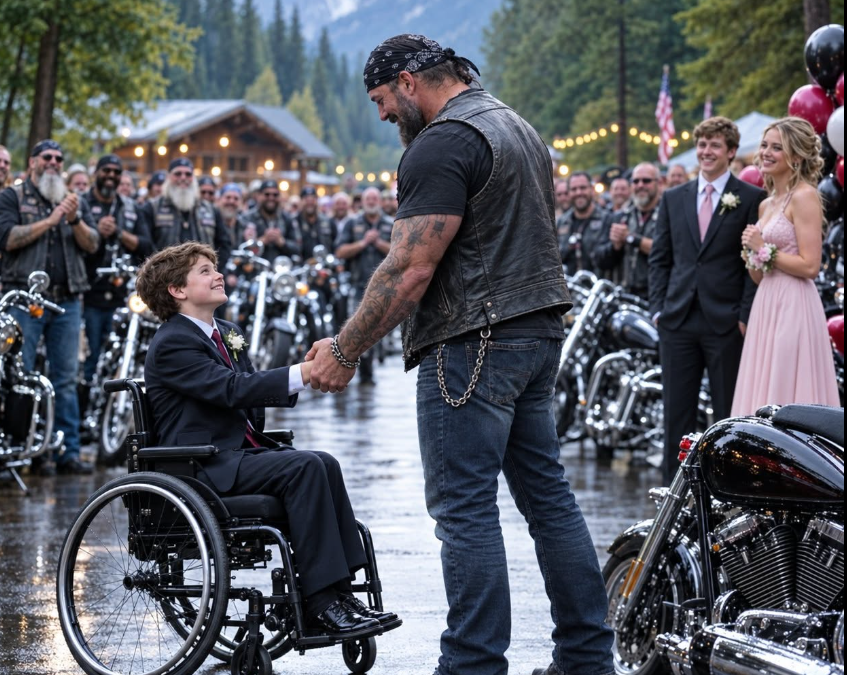
When I rolled back onto the driveway, the bikers erupted.
The sound hit like a physical force.
Two hundred outlaws cheering for me.
Not because I was inspirational.
Not because I was tragic.
Because I had fixed a bike in the rain, refused money, and apparently earned something I had never expected from men like them.
Respect.
Bull pointed to a midnight-black Harley trike that had pulled to the front. The rear passenger area had been removed and replaced with a custom flatbed, reinforced with steel, heavy ratchet straps, and a ramp wide enough for my chair.
“Built it yesterday,” he said, tapping the metal. “Figured you might want to ride on your own throne.”
I could not speak.
Two bikers lowered the ramp. One had a spiderweb tattoo crawling up his neck. The other was missing half his left ear.
They were terrifying and careful, which is an underrated combination.
They helped guide my chair up the ramp, then strapped the wheels down securely.
Bull checked each ratchet himself.
“No hero nonsense,” he said. “You stay locked in.”
“Yes, sir.”
He handed me a heavy leather vest without official patches.
“Put that over the suit. Gets cold when we ride.”
I slipped it on.
It smelled like exhaust, tobacco, rain, and something I did not have a name for then.
Freedom, maybe.
Bull swung onto his Shovelhead and kicked it alive.
The engine exploded beneath him.
He raised his right fist.
Every engine answered.
The ground shook.
Car alarms began screaming up and down the block.
Bull lowered his hand, released the clutch, and the convoy moved.
We rode through Oakhaven like judgment.
I sat elevated in the center of the formation, strapped to the trike platform, leather vest over my thrift-store suit, wind pushing my hair back, engines thundering around me.
The heat from the bikes kept the night chill away.
Headlights stretched ahead and behind like a river of fire.
People poured out of diners, gas stations, and grocery stores.
Traffic stopped.
A patrol car sat at an intersection with its lights off. The officer inside watched the convoy pass and made no move to interfere.
Maybe he understood this was not a riot.
It was an escort.
For the first time in my life, I did not lower my head when people stared.
I sat upright.
I let them look.
Two miles from the high school, I could already hear the music from the gym.
Then I could not.
The engines swallowed it.
The parking lot was packed with sedans, minivans, and a few rented limos.
Students began spilling out of the gym doors, dresses fluttering, tuxedos bright under the entry lights, faces shifting from confusion to fear as the biker convoy turned into the lot.
Bull rode straight to the main entrance and stopped his Shovelhead on the concrete plaza in front of the double doors.
The rest of the motorcycles flooded the parking lot.
Not crashing.
Not reckless.
Precise.
Controlled.
Terrifying.
They surrounded the limos, filled the empty spaces, and formed a steel-and-leather wall around the entrance.
The engines died in a rolling wave.
Silence fell afterward.
Not real silence.
Hot metal ticked.
Leather creaked.
Someone’s bracelet jingled.
But compared to the roar, it felt like the world holding its breath.
The ramp lowered.
The straps released.
I rolled down onto the asphalt wearing my oversized suit and borrowed leather vest.
At the top of the steps stood Brandon Pierce in a white tuxedo.
He had probably chosen white because he thought it made him look rich.
Now he looked like a scared kid in a costume.
His friends stood behind him, but not close enough.
That distance told me everything.
Bull stopped beside me.
“That him?”
I nodded.
Bull pulled the wet pink paper from his vest.
He had kept it.
The prom insult.
The paper was dry now, but wrinkled and stained from rain.
“Ready for prom?” he asked me.
My hands gripped my wheels.
For one second, I thought of going home.
Then I thought of the carburetor on my bench.
My mother’s fingers fixing my tie.
The rose snapped in half.
The trash in my lap.
Bull crouching in the rain.
My hands not slipping.
“Yes,” I said. “I’m ready.”
The gym fell silent when I rolled through the doors.
I was not alone.
Bull flanked my right side.
The biker with the spiderweb tattoo walked to my left.
Behind us came forty patched riders, boots heavy on the polished floor.
The rest remained visible through the glass doors, a hundred and sixty more standing by the bikes outside like a storm waiting for permission.
The contrast was absurd.
Pastel streamers.
Balloons.
Disco lights.
A glittering arch for photos.
And hardened outlaws in leather and denim walking through the middle of it all as if prom had always needed a security detail from hell.
The principal, Mr. Harrison, rushed toward us.
He was bald, nervous, and sweating through his tuxedo shirt.
“Excuse me, gentlemen,” he said, hands raised. “This is a private school event. You can’t—”
Bull stopped.
The principal stopped too.
“We are Ethan’s guests,” Bull said. “We came to see him dance. Do you have a problem with that?”
Mr. Harrison looked past Bull.
At forty bikers.
At the one with no left ear.
At the one cracking his knuckles.
At the leather.
At me.
Then through the doors at the 160 outside.
“No,” he said quickly. “No, sir. Enjoy your evening.”
He backed away into the crowd.
Students parted as I rolled toward the center of the gym.
Fear radiated from them.
But so did something else.
Shame, maybe.
Recognition.
The people who had laughed in the cafeteria were seeing me in a new frame, and the picture did not flatter them.
Brandon stood across the dance floor.
His grin was gone.
Bull walked toward him slowly.
The whole room held its breath.
Brandon tried to stand taller.
He was used to being the biggest guy in the room.
That night, he was not even close.
Bull stopped inches from him and held up the pink paper.
“I heard you like jokes.”
Brandon’s throat moved.
“I don’t know what—”
Bull pressed the paper flat against Brandon’s white tuxedo jacket, leaving a damp gray mark on the lapel.
“Ethan fixed my bike in the pouring rain while everybody else hid behind their curtains. He is a man of value.”
Bull leaned closer.
“You are a bully picking on a guy in a wheelchair because it makes you feel big.”
The room stayed dead silent.
“So here’s how this goes,” Bull said. “If I hear you look in his direction wrong, if I hear his name come out of your mouth with anything but respect, my brothers and I come back to Oakhaven.”
His voice dropped.
“And we won’t be here for a dance. Do we understand each other?”
Brandon nodded fast.
“Yes, sir.”
“Use words.”
“Yes, sir.”
Bull looked at him with complete contempt.
Then turned his back.
That was the part that hurt Brandon most, I think.
Not the threat.
The dismissal.
Bull walked back to me.
The tension in the gym loosened slightly.
Then a voice called from the edge of the crowd.
“Ethan?”
I turned.
Harper Lane pushed through a cluster of girls near the punch table. She wore a simple dark blue dress, hair tied back, cheeks flushed from confusion or nerves.
Her eyes moved from the bikers to me and stopped there.
She was not laughing.
She looked worried.
She walked straight past Bull.
He stepped aside with a small, oddly respectful bow.
Harper stopped in front of my chair.
“I looked for you in the cafeteria on Wednesday,” she said.
My stomach dropped.
“What?”
“My note,” she said softly. “I didn’t know if you read it.”
The room blurred for half a second.
“It was real?”
Her eyes filled.
“Of course it was.”
Behind her, Brandon looked suddenly sick.
“He copied it,” she said, turning toward him. “I gave it to Lily to put in your locker. Brandon must have taken it.”
The fake note had not been completely fake.
The invitation had been real.
Hope, the thing I had sworn off two days earlier, entered again.
More gently this time.
“You really wanted to go with me?” I asked.
Harper smiled.
“You’re the smartest, kindest guy in our grade. Everyone else is just too blind to see it.”
She glanced at the wall of bikers around us.
“Though I see you brought a large entourage.”
I laughed.
Actually laughed.
It came out shaky, but real.
“Is it okay,” she asked, “if I steal you for a dance?”
I could not answer.
I nodded.
Bull snapped his fingers and pointed at the terrified DJ.
“Play something slow.”
The DJ nearly knocked over his own table making it happen.
A soft acoustic song filled the gym.
Harper stepped close.
She did not lean over me awkwardly.
Did not pat my shoulder like a teacher.
Did not make my chair feel like a wall between us.
She took my hands.
Then she moved with me.
I turned my wheels subtly, adjusting to her rhythm, letting the chair become part of the dance instead of proof I did not belong there.
Harper smiled like we were the only two people in the room.
At the edge of the dance floor, forty Hells Angels stood with crossed arms, silent sentinels beneath paper streamers and balloons.
Nobody laughed.
Nobody whispered.
For one song, the boy who had been treated like trash all year stood in the center of his own life.
Not standing on legs.
Standing in dignity.
That is something people without chairs sometimes misunderstand.
They think standing is only about feet.
It is not.
When the song ended, the gym erupted.
At first, I thought it was the bikers.
They started it, sure—heavy hands clapping loud enough to shake the decorations.
But then others joined.
Students.
Teachers.
Even the principal, timidly from near the wall.
Applause rolled through the gym.
I looked at Harper.
Then Bull.
Then the crowd.
And I realized something inside me had changed permanently.
Not because two hundred dangerous men had scared Brandon.
That was satisfying, and I will not pretend otherwise.
But that was not the thing.
The thing was this:
Somebody powerful had decided publicly that I had value, and for the first time, I believed I was allowed to agree.
Bull gave me a rare smile from the edge of the floor.
The debt was settled.
But the story did not end that night.
Stories like that never do.
By Monday morning, everyone at Haven High knew the prom story.
The video had gone everywhere.
The convoy.
The entrance.
Bull confronting Brandon.
Harper and me dancing.
Some student posted it with the caption:
Don’t bully the mechanic.
By noon, half the town had an opinion.
Some parents complained that the school had allowed criminal intimidation at a student event.
Other parents asked why the school had ignored months of documented bullying until outlaws did what administrators would not.
Mr. Harrison called a school assembly and used words like respect, inclusion, community, and accountability.
I did not believe him.
Not fully.
But I believed the suspension notice on Brandon’s locker.
I believed the fact that his friends no longer blocked ramps.
I believed the way teachers suddenly noticed when students “joked” too loudly.
I believed the quiet apology from the girl who had laughed in the cafeteria and then cried while saying she wished she had stopped it.
I believed Harper sitting beside me at lunch on Monday as if prom had not been a one-night act of charity.
“It’s loud around you now,” she said, opening her biology notes.
“What is?”
“Your life.”
I looked at the cafeteria.
People still stared.
But differently.
Some scared.
Some curious.
Some ashamed.
Some admiring in a way that made me uncomfortable.
“I don’t know what to do with it,” I admitted.
Harper smiled.
“You don’t have to know today.”
That was the beginning of us.
Not a movie romance.
Not perfect.
She was seventeen too. I was awkward, guarded, and still angry enough to test kindness when it got close.
But she kept showing up.
In biology.
At lunch.
At the garage, where she learned the difference between a carburetor and a starter even though she said both looked like metal intestines.
Mom adored her immediately and tried not to be obvious about it.
Bull came by again two weeks after prom.
Not with two hundred bikes.
Just his Shovelhead.
I was in the garage rebuilding a dirt bike engine when I heard the familiar idle roll up the driveway.
He walked in carrying a cardboard box.
Mom froze in the kitchen window until he gave her another respectful nod.
“Brought something,” he said.
“You already brought an army.”
“That was transport.”
He set the box on my workbench.
Inside were tools.
Good ones.
Not shiny gifts from a hardware-store display.
Real tools.
Used, maintained, broken in by hands that knew work.
Micrometers.
Feeler gauges.
A timing light better than anything I owned.
Specialty Harley tools wrapped in oilcloth.
A small brass badge from some old machine shop.
“I can’t take these,” I said.
“You refusing another debt payment?”
“I fixed one gasket.”
“You fixed a bike no one else would touch in a storm. Then you refused money. That kind of stupid honor gets expensive.”
I stared at the tools.
“Who did they belong to?”
Bull’s face shifted.
For a moment, I thought he might not answer.
“My brother.”
“Blood brother?”
“Club brother.”
He ran one finger along the edge of the box.
“Road name was Monk. Best mechanic I knew. Died three winters ago. Tools have been sitting in my shed making me feel like a coward.”
“Why give them to me?”
Bull met my eyes.
“Because tools hate sitting unused. And Monk would’ve liked your hands.”
I could not speak.
Bull understood silence better than most people.
He looked around the garage.
“You ever want work, real work, come down to the shop. Not charity. I pay mechanics. I don’t pay mascots.”
“I’m still in school.”
“Good. Finish.”
He pointed at me.
“And don’t let those soft-handed cowards make you small again.”
After he left, I sat in the garage with my hands resting on the box.
Mom came out quietly and stood beside me.
“What are you thinking?”
I looked at Monk’s tools.
“That maybe I’m not finished.”
She put one hand over her mouth.
I did finish school.
Not easily.
Not gracefully.
But I finished.
Brandon did not disappear from my life right away.
People like him rarely do you the favor of vanishing cleanly.
He came back after suspension quieter but not changed at the core, at least not at first.
He avoided me.
Avoided Harper.
Avoided eye contact with every biker jacket in town, which became harder when half the local mechanics started wearing leather vests to school fundraisers just to watch him sweat.
But something had shifted.
Bull’s arrival had not made me brave forever.
No single night can do that.
What it did was interrupt the story I had been telling myself.
That I belonged in corners.
That keeping my head down was survival.
That invisibility was the best safety I could hope for.
Prom did not fix my life.
It gave me evidence.
When old fear returned, I could point to one undeniable truth:
I had been seen.
I had been valued.
I had entered the room.
Nobody could erase that.
After graduation, I took Bull’s offer and worked part-time at the motorcycle shop while taking community college classes in mechanical engineering.
The shop sat on the edge of town near the highway, big bay doors open in summer, oil stains on the floor older than some apprentices, rock music playing low unless Bull was angry, which meant loud.
At first, customers stared when they saw me roll out from under a lift.
Some asked if I was “the kid from the prom video.”
Some looked uncertain about handing their machines to someone in a chair.
Bull handled that efficiently.
“You want your bike fixed or your prejudice polished?” he asked one man.
The man handed me the keys.
I fixed his transmission.
He came back three months later and asked for me by name.
That mattered.
Slowly, my world expanded from school hallways and my garage to workbenches, lifts, machines, customers, road stories, and men who were not gentle but were fair.
The club was not a fairy tale.
I knew that.
I saw enough to understand there were shadows around them I did not need to romanticize.
But Bull never let those shadows touch me.
Not once.
He treated me like a mechanic.
That was the gift.
Not protection.
Not revenge.
Respect.
Respect is not applause.
It is not pity in better clothes.
It is not people calling you inspiring because you made them feel guilty for complaining.
Respect is being expected to do good work.
Respect is someone trusting your diagnosis before checking whether your legs work.
Respect is being corrected when you are wrong and paid when you are right.
Respect is a massive biker tossing you a carburetor and saying, “Tell me why it’s running rich,” with no trace of doubt in his voice.
Harper went to college two towns over and came home most weekends that first year.
We did not become forever in the way teenage movies promise.
Life changed us.
We loved each other, then grew in different directions, and somehow managed not to turn that into failure.
She remains one of the reasons I trust kindness when it arrives quietly.
Years later, when she married a teacher with terrible posture and a good heart, I rebuilt an old Honda CB for them as a wedding gift.
Bull attended the reception in a clean black shirt and made half the bride’s family nervous until he cried during the father-daughter dance and ruined his outlaw credibility.
He blamed allergies.
Nobody believed him.
Brandon’s story took longer.
I wish I could tell you he became a better person immediately after prom.
He did not.
Shame often makes people meaner before it makes them honest.
But consequences have a way of doing what lectures cannot.
He lost scholarships after the videos and bullying reports surfaced.
Not all of them.
Enough.
His father shouted at school board meetings.
His mother cried in parking lots.
Brandon spent senior spring discovering that being feared and being respected were not the same currency.
Three years later, he came to the shop.
I knew him before he reached the bay door.
He had lost some weight. His shoulders were still broad, but not invincible anymore. He wore a delivery uniform and carried himself like someone used to being ignored.
Bull saw him first.
The whole shop went still.
Brandon stopped at the entrance.
“I’m not here for trouble,” he said.
Bull looked at me.
My choice.
That was another kind of respect.
I rolled forward.
“What do you need?”
Brandon swallowed.
“My truck won’t start. I asked around. They said you’re the best.”
The sentence hung there.
Once, hearing him admit that would have felt like victory.
In that moment, it felt heavier.
“What’s it doing?”
He explained badly.
I diagnosed a starter issue before he finished.
“Tow it in,” I said. “We’ll look.”
He nodded.
Then stood there too long.
“I was a piece of garbage in high school,” he said.
Bull made a sound behind me.
Not disagreement.
Warning.
Brandon flinched but kept going.
“I don’t expect you to forgive me. I just needed to say it where you could hear it.”
I looked at him.
I thought of sour milk.
The snapped rose.
The pink sign.
My mother crying beside the washing machine.
The roar of two hundred engines.
“I heard it,” I said.
He nodded once.
“Thank you.”
“I didn’t say it fixed anything.”
“I know.”
His truck came in the next morning.
I fixed it.
Charged full price.
He paid without complaint.
That was enough.
Some stories do not need dramatic reconciliation.
Sometimes the best ending is simply becoming someone the person who humiliated you has to respect professionally.
Bull died when I was twenty-eight.
Heart attack.
Fast.
Unfair.
He would have hated the size of his funeral.
Hundreds of motorcycles stretched down the highway for miles.
Club brothers.
Mechanics.
Customers.
People he had scared.
People he had saved.
People who would never admit which category they belonged to.
I rode in the procession on a custom adaptive trike he and I had built together over two summers.
My wheelchair locked into the rear platform, but the controls were mine.
Hand clutch.
Modified brake.
Twist throttle adapted for my grip.
The first time I rode it, Bull had pretended not to cry and threatened to punch anyone who noticed.
At his funeral, I wore the same leather vest he had given me on prom night.
It was older, softer, and still carried a faint smell of smoke no amount of time had erased.
After the service, his daughter handed me a folded piece of paper.
Bull’s handwriting was terrible.
Ethan,
Tools go where hands know what to do with them.
Shop’s got a corner for you as long as you want it.
Don’t keep your head down. Makes it harder to see what needs fixing.
—Bull
I read it three times before the words steadied.
Then I went back to work.
That is what he would have wanted.
Years later, people still ask about the prom video.
It resurfaces online every once in a while, usually with some dramatic caption written by someone who was not there.
Disabled Teen Gets Hells Angels Escort to Prom.
Bikers Destroy Bully’s Confidence.
Outlaws Protect Wheelchair Teen.
People love clean stories.
The bullied kid wins.
The bully shakes.
The girl dances.
The engines roar.
The crowd applauds.
I understand why that version travels.
It is satisfying.
But it is not the whole truth.
The real story began before the engines.
It began in a garage where a lonely kid learned that machines could be kinder than classmates because machines did not lie.
It began with my mother buying a thrift-store suit she could barely afford because some part of her still believed I deserved to be seen.
It began with a dangerous-looking stranger letting a teenager touch his Harley because skill mattered more than appearance.
It began in rain.
Cold, humiliating, relentless rain.
The night Bull broke down, everybody else saw a threat in the street.
I saw a machine in pain.
Bull looked at me and saw a mechanic.
That was the first repair.
The prom was the loud one.
The public one.
The one with two hundred engines and everyone watching.
But the first repair happened in the rain when one man asked, “What do you know about Shovelheads, kid?” and waited long enough to hear the answer.
That is what changed my life.
Not the revenge.
Not the fear on Brandon’s face.
Not even the dance with Harper, though I will treasure that memory until the day my hands stop working.
What changed me was respect offered before the world approved it.
Respect can rebuild a person.
Slowly.
Like an engine that has sat too long.
You clean what is corroded.
Replace what is truly broken.
Adjust what has slipped out of alignment.
Listen.
Try again.
There is a rhythm when a motor finally catches.
A deep, living sound.
I heard it first from Bull’s Shovelhead on a flooded street.
Later, I heard it in myself.
The day I graduated from college, Mom cried so hard she missed half the ceremony.
The club sent a small delegation.
By small, I mean thirty-seven motorcycles.
The dean looked concerned until I explained they were with me. That did not make him less concerned, but it did make him quieter.
I opened my own shop three years after that.
Mitchell Custom Motorworks.
Specializing in vintage motorcycles, adaptive vehicle modifications, and machines other people gave up on.
That last part was painted on the wall behind the front counter.
Bull would have called it sentimental.
Then he would have stood under it all day pretending not to like it.
A framed photo hangs in my office.
Not the viral shot from prom.
A different one.
My mother took it from the porch before the convoy left our house. In the photo, I am sitting on the trike platform in my oversized suit and borrowed leather vest. Bull stands beside me, one hand on the ratchet strap, checking it for the third time.
Behind us, motorcycles fill the street.
Most people notice the bikes first.
I notice my face.
I look terrified.
And alive.
That is what courage looked like on me then.
Not fearless.
Not confident.
A terrified seventeen-year-old boy choosing to go anyway.
When young people come into my shop now—kids with scars, chairs, braces, anxiety, anger, silence, and all the ways the world convinces them to apologize for taking up space—I try to remember Bull’s first gift to me.
Not advice.
Not pity.
A chance to prove what my hands could do.
I give them work.
Real work.
Not busywork.
I teach them to listen to engines.
To label parts.
To respect tools.
To understand that broken does not mean worthless and stuck does not mean finished.
Sometimes I catch myself saying things that sound like Bull.
“Your hands don’t slip if your mind stays where it belongs.”
“Don’t guess. Listen.”
“Respect the machine or walk away from it.”
“Keep your head up. Hard to fix what you refuse to look at.”
The kids roll their eyes.
Good.
That means they are listening.
Every spring, around prom season, someone asks if I ever went to another dance.
No.
One was enough.
But sometimes, late at night, when the shop is closed and rain hits the roof just right, I can still feel Harper’s hands in mine.
I can hear the soft song playing under the silence of a gym full of stunned teenagers.
I can smell leather, oil, and cheap streamers.
I can see Brandon’s white tuxedo, marked by the dirty paper he thought would make me disappear.
I can hear the applause.
But more than anything, I hear the engines.
Two hundred of them.
Not coming to rescue me exactly.
Coming to remind me I had already done something worth honoring.
That matters.
People think dignity is something others give you.
It is not.
But sometimes another person can stand close enough, loud enough, fiercely enough, for you to remember where you dropped it.
Bull did that for me.
My mother did that too, with a thrift-store suit and trembling hands on my tie.
Harper did it by asking for the dance like my chair was part of the rhythm, not an obstacle to it.
And I try, every day, to do it for someone else.
One machine.
One kid.
One honest moment at a time.
So yes, I remember the rain.
I remember Brandon.
I remember the trash and the laughter and the long push home with sour milk drying on my clothes.
I remember wanting to vanish.
But I also remember rolling into the street because a Harley was hurting and I knew how to fix it.
I remember looking up at a man the whole neighborhood feared and saying, “My hands don’t slip.”
I remember him believing me.
That is the part I keep.
Because long before two hundred outlaws surprised my prom, long before the whole town learned my name, long before I understood what respect could sound like when amplified through V-twin engines, I was just a boy in a storm with a wrench in his hand.
And for the first time in a long time, someone looked at me and saw what still worked.








