A Diner Waitress Covered 30 Cents for a Hungry Biker at 4:17 A.M.—Hours After She Was Fired, Over 100 Harleys Pulled Up Outside Her Home
PART3:
He looked at it without seeing it.
“Morning.”
He nodded.
“Coffee?”
“Yeah.”
His voice sounded scraped raw by cold air and too many highway miles.
“Just coffee.”
Maren poured.
Steam curled upward.
The man wrapped both hands around the mug before drinking, soaking in the heat.
After a minute, he reached into his jacket pocket.
Coins.
No wallet.
No card.
Just coins.
He spread them on the counter.
Quarters.
Dimes.
Pennies.
Counted once.
Then again.
A third time.
His jaw tightened.
“Thirty cents short.”
He said it quietly.
To himself.
Maren looked at his hands.
Grease beneath the nails.
Old scars across the knuckles.
One thumbnail split near the edge.
Hands that fixed things because hiring someone was probably not an option.
She knew those hands.
Her mother had them.
Maren had them too now.
She thought about her savings jar.
Then about all the mornings she had poured coffee while hungry customers stared at menus and calculated what dignity cost.
She opened the register.
Took three dimes from the small tip cup she kept beside it.
Slid them onto the counter as casually as she could.
Then went to the pie case.
Yesterday’s apple pie.
One slice left.
Dry at the crust.
Still good.
She put it on a plate and set it beside the coffee.
The man looked up sharply.
“I didn’t order that.”
“I know.”
“I can’t—”
“You’re good.”
His expression tightened.
Not anger.
Pride.
Maren understood that too.
“The coffee’s having a rough morning,” she said. “Pie keeps it company.”
His eyes stayed on hers.
“I didn’t ask for anything free.”
“I know.”
“Then why?”
She shrugged.
“That’s why it’s easier.”
Something changed in his face.
Not much.
Enough.
He looked down at the pie.
Then the coins.
Then her.
“Thank you.”
The words were heavier than thirty cents.
He ate slowly.
Too slowly.
Like someone who had learned food sometimes disappeared before the next meal arrived.
Maren stayed busy.
Refilled napkins.
Wiped the counter.
Pretended not to notice when he scraped every crumb from the plate with his fork.
When he finished, he sat another minute with both hands around his mug.
Then stood.
“You didn’t have to do that.”
“Sometimes people do.”
He seemed to consider the sentence.
“My name’s Cole.”
“Maren.”
“I know.”
He nodded toward the name tag pinned to her apron.
That made her smile.
Cole reached into his pocket and put two pennies on the counter.
Everything he had left.
Maren started to protest.
He lifted one hand.
“For the pie.”
“It cost more than two cents.”
“Then I still owe you.”
There was a strange weight in the way he said it.
Maren shook her head.
“No debts.”
Cole studied her.
Then leaned slightly closer.
“If the world ever pays you back for this…”
He paused.
“I hope it pays you back loud.”
He walked into the rain.
Maren watched through the glass as he crossed the parking lot toward an old black motorcycle she had not noticed before.
He climbed on.
The engine coughed twice before catching.
Then he disappeared down the road.
By 7:30, she had mostly forgotten him.
The diner filled.
Truckers.
Construction crews.
Hospital employees coming off nights.
Office workers staring at phones.
Maren moved between booths with coffee in one hand and plates balanced on the other.
Then Brent Kline walked in.
Brent treated rules like scripture and kindness like inventory loss.
Forty.
Pressed shirt.
Perfect hair.
Clipboard.
Red pen.
He had been promoted eight months earlier and had spent all eight months behaving as if the Bluebird Diner were a nuclear facility requiring constant regulatory enforcement.
He went directly to the register.
Checked receipts.
Counted the drawer.
Compared waste logs.
Maren noticed but kept working.
Then came the tapping.
Red pen against clipboard.
“Maren.”
Something in his voice told her.
She approached.
“Yes?”
Brent held up a receipt.
“Explain this.”
She looked.
Coffee.
Pie.
Payment short by thirty cents before adjustment.
Her stomach dropped.
“A customer was short.”
“And?”
“I covered it.”
“With what?”
“My tips.”
Brent smiled faintly.
Not humor.
Satisfaction.
Like a man who had finally found the mistake he woke up hoping someone would make.
“That does not matter.”
“Why?”
“You cannot alter a sale.”
“I didn’t alter it.”
“The product left before full payment.”
“I put in the thirty cents.”
“After.”
Maren stared.
“The diner got paid.”
“That isn’t the issue.”
“Then what is?”
“Procedure.”
Maren nearly laughed.
Instead, she lowered her voice.
“He was hungry.”
Brent’s face sharpened.
“This is not a charity.”
“It was one coffee and one slice of pie.”
“That pie is inventory.”
“It would have been thrown away today.”
“Not your decision.”
Maren glanced around.
Customers were pretending not to listen.
That hurt more than Brent.
People had a special talent for hearing cruelty and increasing the volume of their chewing.
“It cost the diner nothing,” she said.
Brent’s voice rose.
“It cost discipline.”
There it was.
Not money.
Control.
Maren felt something inside her settle.
Maybe exhaustion.
Maybe courage.
“You’re serious.”
“Completely.”
“Over thirty cents?”
“Over ignoring policy.”
Brent lowered the clipboard.
“Take off your apron.”
Maren blinked.
“What?”
“You’re done.”
The diner seemed to lose sound.
“You’re firing me.”
“I’m terminating your employment.”
“For feeding someone.”
“For policy violation.”
“Same thing.”
“No, it isn’t.”
Maren’s hands trembled.
Two years.
Double shifts.
Christmas mornings.
Thanksgiving nights.
Working sick.
Covering coworkers.
Taking verbal abuse from customers and apologizing because the Bluebird believed employees should “de-escalate.”
All of it.
Reduced to thirty cents.
She untied the apron.
Folded it.
Placed it beside the register.
Brent pointed toward the back.
“Clean out your locker.”
Maren looked at him.
Something inside her wanted to beg.
Rent.
Medication.
Electricity.
Her mother.
The unopened nursing letter.
She swallowed it all.
“Keep the final check.”
Brent frowned.
“What?”
“You said you’d mail it.”
“Oh.”
“I know how mail works.”
She walked to the employee room.
Her locker contained almost nothing.
A spare shirt.
Cheap hand lotion.
Two granola bars.
A photo of Gloria in nursing scrubs from fifteen years earlier.
Maren took the photo.
Left the rest.
Then walked out the front door.
No one stopped her.
Outside, the rain had ended.
The pavement shone.
The neon Bluebird sign continued flickering as if nothing had happened.
Maren stood under it for several seconds.
Then walked home.
Gloria called from the bedroom when she heard the door.
“Baby?”
Maren forced brightness into her voice.
“Yeah, Mama.”
“You’re home early.”
“Slow day.”
“How was work?”
Maren stood in the hallway.
There were lies told to protect yourself.
And lies told to protect someone you loved.
They tasted different.
“Fine.”
Gloria smiled from the bed.
“Told you not to pick up another double.”
Maren smiled back.
“I know.”
She escaped to the kitchen before her face changed.
Bills covered the table.
Pharmacy receipts.
Utility notice.
Rent reminder.
Gloria’s follow-up appointment.
The acceptance envelope remained beneath the lighthouse magnet.
Maren pulled the savings jar from behind the radiator.
Counted.
Two hundred thirty-seven dollars and eighty-five cents.
Same as Sunday.
Still tiny.
She put the lid back on.
Sat at the table.
Stared at the envelope.
Did not open it.
By evening, she still had not told Gloria.
Instead, she made canned soup.
Checked her mother’s medication.
Washed dishes.
Took the trash out.
Everything ordinary felt suddenly temporary.
At 7:46, Maren sat on the porch steps with her elbows on her knees.
She thought about tomorrow.
No shift.
No paycheck.
No plan.
She thought about Cole.
Thirty cents.
Ridiculous.
Thirty cents had cost her job.
Did it matter to him?
Was he somewhere warm?
Was the bike still running?
Then she felt vibration through the porch.
At first, she thought thunder.
But the sky was clear.
The sound grew.
Low.
Mechanical.
Deep enough to enter through the soles of her shoes.
Maren stood.
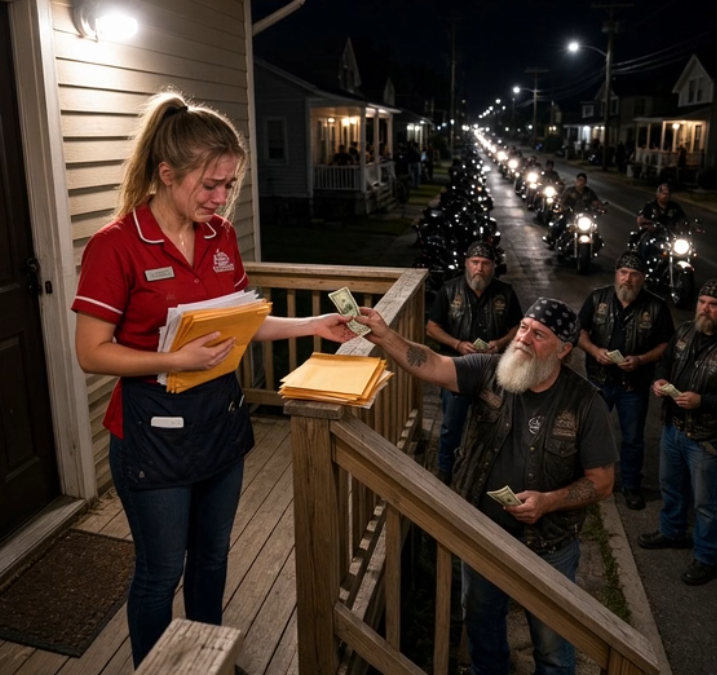
Headlights appeared at the end of Maple Haven Road.
One.
Then five.
Then fifteen.
Then more.
Motorcycles.
They came slowly.
Carefully.
A long river of light and chrome moving into her neighborhood.
Porch lights switched on.
Curtains moved.
A dog barked two houses down.
Maren gripped the railing.
The first motorcycle stopped at her curb.
Then another.
Another.
The line extended down the block.
Dozens of riders.
Men and women.
Leather vests.
Helmets.
Road dust.
No yelling.
No reckless revving.
Just engines dropping into silence one by one.
The lead rider dismounted.
Tall.
Late fifties.
Gray hair.
Weathered face.
He removed his helmet.
“Ma’am?”
Maren stared.
“Are you Maren Calloway?”
“Yes.”
The man approached slowly.
Hands visible.
“My name is Wyatt Rourke.”
He nodded toward the riders.
“Cole’s my brother.”
Maren’s mouth opened.
“Cole?”
“The man from your diner this morning.”
Behind Wyatt, several riders dismounted.
One carried grocery bags.
Another held a padded envelope.
Another had a toolbox.
Maren looked around, overwhelmed.
“I don’t understand.”
Wyatt stopped at the bottom of the porch.
“Cole called us.”
“He told you about thirty cents?”
Wyatt’s expression softened.
“He told us about being two hundred miles from home with a dead debit card, twelve dollars left in his tank, and no food since yesterday morning.”
Maren blinked.
“He didn’t say—”
“He wouldn’t.”
“Why?”
“Pride.”
That made sense.
Wyatt glanced at the house.
“He also told us a waitress covered his coffee, fed him pie, and acted like it wasn’t a big deal.”
“It wasn’t.”
“That’s what he said you’d say.”
Maren crossed her arms, suddenly self-conscious.
Then Wyatt’s face hardened slightly.
“He called again this afternoon.”
Her stomach dropped.
“He went back?”
“He did.”
She understood before Wyatt finished.
“He heard you got fired.”
“Yes.”
Maren looked down.
Wyatt said, “We’re not here to cause trouble.”
“Good.”
“We’re not here to intimidate your boss.”
“Also good.”
“Cole specifically made me promise that.”
Maren almost smiled.
Wyatt gestured toward the riders.
“We’re here because kindness should not become the reason somebody can’t pay rent.”
A rider stepped forward carrying two grocery bags.
Set them on the porch.
Another placed an envelope beside them.
Then another.
Maren lifted both hands.
“No.”
Wyatt stopped.
“I can’t take this.”
“Why?”
“Because I didn’t give him pie so people would show up with money.”
“We know.”
“That feels wrong.”
Wyatt nodded slowly.
“Then don’t think of it as payment.”
“What is it?”
“Community.”
Maren looked down the street.
Motorcycles stretched past the corner.
“Most of these people don’t know me.”
“No.”
“Then why?”
Wyatt smiled faintly.
“Because almost every person here remembers the time someone helped them when there was nothing in it for the other person.”
That quieted her.
An older woman rider stepped forward.
“My name’s Rosa.”
She placed a pharmacy gift card on the porch.
“A nurse paid for antibiotics for my son when I was twenty-one.”
Another man approached.
“Dale.”
He set down a grocery card.
“A mechanic fixed my car for free when I was sleeping in it.”
Another.
“Marcus.”
An envelope.
“My high school teacher bought my graduation shoes.”
One by one.
Stories.
Not charity.
Memory.
A debt being carried forward.
Maren stopped trying to refuse.
Inside the house, Gloria appeared at the living room window.
One hand against the curtain.
“What on earth…?”
Maren turned.
“Mom, stay inside.”
That command guaranteed Gloria opened the door.
She stepped onto the porch in a cardigan.
Maren rushed to steady her.
“Who are all these people?”
Wyatt removed his cap.
“Mrs. Calloway?”
“Yes?”
“Your daughter fed one of our brothers this morning.”
Gloria looked at Maren.
“Maren?”
“It was pie.”
“And apparently a revolution.”
Wyatt laughed.
Gloria did too.
Then coughed.
Wyatt’s expression changed when he saw how Maren’s hand instinctively moved to support her mother’s elbow.
“You were a nurse?” he asked.
Gloria looked surprised.
“How’d you know?”
“Old habit.”
She glanced down.
Even now, Gloria stood like a nurse.
Straight when she could.
Alert.
“No longer.”
“Still counts.”
Gloria smiled.
Wyatt gestured toward the groceries.
“We heard things are tight.”
Maren shot him a look.
He raised both hands.
“Cole noticed the pharmacy receipt sticking out of your apron pocket.”
Maren closed her eyes.
Of course he had.
Gloria looked between them.
“What happened at work?”
Silence.
Maren felt caught like a teenager.
“Mama…”
“What happened?”
She sighed.
“I got fired.”
Gloria stared.
“For what?”
Maren looked down at the bags.
“For giving someone pie.”
Gloria’s face changed.
“Maren.”
“It was thirty cents.”
“You lost your job?”
“Yes.”
“And you came home and said work was fine.”
“I didn’t want you worrying.”
Gloria’s eyes filled.
“I’m your mother. Worrying is in the contract.”
“I know.”
“No, apparently you don’t.”
Maren laughed despite herself.
Then cried.
Just once.
One sudden broken breath.
Gloria pulled her close.
Wyatt looked away.
So did half the riders.
Bikers, Maren learned, were surprisingly respectful about tears.
An hour later, most of them were still there.
Not because they needed to be.
Because someone discovered the porch railing was loose.
Then someone else noticed the front tire on Maren’s old Toyota was bald.
Then the kitchen faucet.
Then the porch light.
Men and women who had arrived with envelopes suddenly turned the Calloway house into a work site.
One rider drove Maren’s car to a tire shop owned by another rider.
Another fixed the railing.
Someone changed the porch bulb.
Rosa sat with Gloria in the kitchen and talked about medication assistance programs.
Wyatt drank coffee.
Maren stood among strangers wondering how thirty cents had turned into all of this.
Then another motorcycle approached.
One bike.
Old.
Black.
Engine sounding rough.
Cole.
He parked near the curb.
Removed his helmet.
For a moment, he looked embarrassed by the scene.
Maren walked down the steps.
“You.”
He winced.
“Me.”
“You did this.”
“Technically Wyatt did.”
Wyatt called from the porch, “Coward.”
Cole ignored him.
Maren folded her arms.
“You came back to the diner.”
“Yes.”
“Why?”
“To repay thirty cents.”
She stared.
“You’re kidding.”
“I told you I owed you.”
“And found out I got fired.”
His jaw tightened.
“I heard Brent talking.”
“What did you do?”
“Nothing.”
“Nothing?”
“I wanted to do several things.”
Wyatt shouted, “He called me instead.”
Maren looked at Cole.
“Good choice.”
“Debatable.”
For the first time, Cole smiled.
Then his eyes moved toward the house.
“Your mom?”
“Gloria.”
“She okay?”
Maren hesitated.
“No.”
Cole nodded.
Did not ask for details.
That mattered.
He reached into his jacket.
Pulled out an envelope.
Smaller than the others.
He held it toward Maren.
“No.”
“You haven’t seen what it is.”
“Money?”
“No.”
She took it carefully.
Inside was a business card.
Rourke Custom Cycles & Restoration.
Below Wyatt’s name was another.
Cole Rourke.
Operations Manager.
Maren looked up.
“You work at a motorcycle shop.”
“Family business.”
“You were counting pennies.”
“My wallet got stolen outside Knoxville two days ago.”
“Oh.”
“Bank froze my cards.”
“Oh.”
“My phone died.”
“You were having a great week.”
“It had room for improvement.”
“Why didn’t you call your brother?”
Cole looked toward Wyatt.
“I had.”
“And?”
“He told me not to leave Nashville until he came with the trailer.”
Maren began understanding.
“You left anyway.”
“My bike runs.”
“Barely.”
“It runs.”
Wyatt shouted, “It coughs!”
Cole shouted back, “Mind your business.”
Maren laughed.
It surprised her.
Cole looked at the business card.
“We need someone in the office.”
“What?”
“At the shop.”
Maren’s expression changed.
“Cole—”
“Not pity.”
“It sounds exactly like pity.”
“Our office manager is leaving next week.”
Wyatt appeared behind them.
“He’s telling the truth.”
Maren looked at him suspiciously.
Wyatt nodded.
“My niece is moving to Denver.”
Cole continued.
“Scheduling. Parts invoices. Customer calls. Vendor orders. Basic books.”
“I wait tables.”
“You also noticed I was short thirty cents without embarrassing me, handled a morning rush alone, and I watched you calculate three tickets in your head before the register finished printing.”
Maren frowned.
“You were watching me?”
“I was sitting at the counter.”
“Creepy answer.”
“Fair.”
Wyatt smiled.
“Starting pay is better than the diner.”
“How much?”
He told her.
Maren stared.
“That is significantly better.”
“Health insurance after sixty days.”
She stopped breathing.
Gloria’s medical needs flashed through her mind even though coverage would be employee-only at first.
Cole added, “Predictable hours.”
“What’s the catch?”
Wyatt said, “You’d have to see Cole most days.”
Cole looked offended.
“Rude.”
Maren looked at the card.
“I don’t know anything about motorcycles.”
Cole shrugged.
“I didn’t know anything about apple pie this morning. Worked out.”
She nearly smiled.
Then shook her head.
“I can’t say yes tonight.”
Wyatt nodded.
“Good.”
Maren looked surprised.
“Good?”
“I don’t hire people who accept life-changing decisions from strangers standing in their driveway.”
Cole pointed toward him.
“He practices saying things like that.”
“I’m older. Wisdom happens.”
Before Maren could answer, Gloria called from the porch.
“Maren.”
Something in her tone changed everything.
She held the white envelope.
The nursing envelope.
Maren’s heart stopped.
“Mama.”
Gloria had found it beneath the lighthouse magnet.
“You haven’t opened this?”
“No.”
“Why?”
Maren looked around.
At Cole.
Wyatt.
The motorcycles.
The groceries.
All these people witnessing the one thing she had managed not to face.
“Because I can’t afford for it to say yes.”
Gloria’s face crumpled.
“Oh, baby.”
“And I can’t afford for it to say no either.”
For a moment, nobody moved.
Then Gloria held out the envelope.
“You wanted to become a nurse since you were twelve.”
Maren looked away.
“That was before.”
“Before what?”
“Before you got sick.”
Silence.
Gloria stared at her daughter.
“Maren.”
“No.”
“You listen to me.”
Her mother’s nurse voice.
Weak body.
Same authority.
“You do not bury your life inside mine.”
“Mama—”
“I did not raise you for twenty-six years so you could turn my illness into your future.”
“I’m taking care of you.”
“Yes.”
Gloria’s eyes filled.
“And I am grateful.”
She stepped closer.
“But caring for someone is not the same as disappearing for them.”
Maren’s throat closed.
Gloria held the envelope toward her.
“Open it.”
Maren’s hands shook.
“I can’t.”
“Then I will.”
“No.”
Maren snatched it.
Everyone waited.
Even the riders working on the porch seemed to become quiet.
She slid one finger beneath the flap.
Pulled out the letter.
Her eyes moved across the first line.
Then stopped.
Cole watched her face.
Gloria whispered, “Well?”
Maren read it again.
Then a third time.
“I got in.”
Gloria covered her mouth.
Maren stared at the page.
“I got in.”
Her voice broke.
Gloria hugged her.
“I knew it.”
“No, you didn’t.”
“I absolutely did.”
“You said nothing.”
“I’m your mother. I’m allowed revisionist history.”
Maren laughed into her shoulder.
Then she pulled back.
The joy lasted perhaps five seconds.
Reality returned.
“Tuition.”
Gloria’s face changed.
Maren looked down.
“I still can’t—”
“Excuse me.”
Wyatt’s voice.
Maren turned.
He was looking toward the riders.
Then at the envelopes already stacked on the porch.
“How much?”
“No.”
“Maren.”
“No.”
“This is what the money is for.”
“You didn’t even know about nursing school.”
“No.”
“Then it’s groceries. Rent. Medicine.”
“It is whatever gets you from where you are to where you’re trying to go.”
She shook her head.
“I cannot let strangers pay my tuition.”
Cole spoke quietly.
“Then don’t.”
Everyone looked at him.
Maren frowned.
Cole pointed toward the business card.
“Take the job.”
Wyatt looked at him.
Cole continued.
“We reimburse approved education.”
Wyatt’s eyebrows rose.
“We do?”
Cole looked directly at his brother.
“We do now.”
Wyatt stared.
Then slowly nodded.
“We do now.”
Maren nearly laughed again.
“That is ridiculous.”
Wyatt shrugged.
“Family businesses are agile.”
“This is not normal hiring.”
“No.”
Cole stepped closer.
“But neither was thirty cents.”
Maren looked at him.
He was not smiling.
“I’m not asking you to let anybody save you.”
His voice lowered.
“I’m offering you a job.”
He pointed toward the letter.
“And if you work hard enough to become a nurse, that’s you saving yourself.”
The words settled.
Maren looked at Gloria.
Her mother nodded.
Slowly.
“Take the interview.”
“Interview?”
Wyatt smiled.
“You didn’t think we were skipping the interview, did you?”
Maren stared.
After a moment, she laughed.
“Tomorrow?”
Cole said, “Ten?”
“I need to find interview clothes.”
Rosa called from the porch, “I own a boutique!”
Maren covered her face.
“This is insane.”
Gloria smiled.
“No.”
She looked down the street filled with motorcycles.
“This is loud.”
Cole heard her.
His expression softened.
The world paying Maren back loud.
Exactly what he had said that morning.
The next day, Maren interviewed.
A real interview.
Wyatt made sure of it.
Cole asked questions.
Two other employees sat in.
Maren answered honestly.
She knew nothing about motorcycle parts.
She knew customer service.
She knew schedules.
She knew spreadsheets from community college.
She knew how to stay calm when three people wanted different things at the same time.
She knew how to stretch a dollar.
She knew how to talk to angry people without becoming angry herself.
And she knew how to notice who was standing quietly in the corner being ignored.
Wyatt hired her.
Not because of pie.
Because she was good.
That distinction mattered to her.
The Bluebird Diner found out by lunchtime.
Not because the riders returned.
They did not.
No threats.
No confrontation.
No mass boycott organized by the club.
But people talked.
The story spread.
Waitress fired over thirty cents.
Customers made their own decisions.
Some stopped eating there.
Others asked Brent why the diner threw away food but fired someone for giving away a slice scheduled for disposal.
One longtime customer posted the receipt online.
Another former employee described how Brent treated staff.
The owner, who lived in another county and rarely visited, came in personally.
Three days later, Brent Kline was suspended pending review.
A week later, he was gone.
Maren heard through an old coworker.
She felt no triumph.
Only distance.
The Bluebird had already become part of a life she was leaving.
Work at Rourke Custom Cycles was strange at first.
Engines everywhere.
Parts catalogs thick as phone books.
Customers who could describe a sound as “sort of a metallic clack with an angry little whine” and expect everyone to understand.
Maren learned.
Fast.
She reorganized invoices.
Fixed scheduling errors.
Discovered the shop had been overpaying one parts supplier for eight months.
Wyatt stared at the spreadsheet.
“How’d you catch this?”
Maren shrugged.
“Thirty cents.”
He blinked.
“What?”
“Small amounts matter.”
Cole laughed from the doorway.
Within three months, Maren started nursing school evenings.
Work during the day.
Class three nights a week.
Clinical training later.
It was exhausting.
There were mornings she woke before the alarm and genuinely hated everyone who had ever told her to follow her dreams.
Gloria improved somewhat.
Not cured.
Not magically healed.
But more stable after Rosa helped them connect with a medication assistance program.
The motorcycle community quietly became part of their life.
Not constantly.
That would have been unbearable.
But reliably.
Someone checked the porch railing after storms.
Rosa brought soup after Gloria’s treatments.
Wyatt pretended he happened to have extra groceries whenever the refrigerator looked thin.
Cole never brought charity.
He brought coffee.
Usually bad coffee.
Sometimes pie.
Months after they met, Maren finally asked him why he had looked so broken that morning.
They were closing the shop.
Rain tapped against the garage doors, almost like the morning at the Bluebird.
Cole wiped his hands with a rag.
“My wife died.”
Maren went still.
“Three years ago.”
“I’m sorry.”
“Cancer.”
He leaned against the workbench.
“I was riding to my brother’s place because it was the anniversary.”
Maren listened.
“I do that.”
“Ride?”
“Run.”
He looked down.
“Same thing when the engine’s involved.”
She understood more than she wanted to.
“The wallet really got stolen?”
“Yeah.”
“Phone?”
“Dead.”
“Debit cards?”
“Frozen.”
“Pride?”
“Terminal.”
That made her smile.
Cole continued.
“I could have waited for Wyatt.”
“But you didn’t.”
“No.”
“Why?”
“Because grief makes you stupid in very specific ways.”
Maren nodded.
“Fair.”
He looked at her.
“That pie was the first thing I ate that day.”
She said nothing.
“And the first thing anybody had done for me in a long time that didn’t feel like they were trying to fix me.”
Maren’s expression softened.
“I gave you old pie.”
“You gave me a way to sit there without being ashamed.”
That answer stayed with her.
Years later, it would become one of the lessons she carried into nursing.
People remember dignity.
Often longer than medicine.
Maren graduated three years after the morning Cole walked into the diner.
Gloria sat in the front row.
Walker beside her.
Rosa on one side.
Wyatt on the other.
Cole two seats down wearing a suit that made him look uncomfortable and suspicious.
Behind them sat nearly thirty riders.
Not hundreds.
Maren had threatened to leave her own graduation if they turned it into a parade.
When her name was called—
“Maren Elise Calloway, Bachelor of Science in Nursing”—
Gloria stood.
It took effort.
Wyatt moved to help.
She waved him away.
She stood on her own.
And clapped.
Maren saw her from the stage.
For a second, everything blurred.
The diner.
The bills.
The savings jar.
Thirty cents.
Pie.
Brent’s red pen.
The motorcycles on Maple Haven Road.
The acceptance letter.
All of it.
A chain reaction.
After graduation, Maren accepted a position in the emergency department at St. Anne’s Memorial.
The same hospital where Gloria had spent most of her career.
On Maren’s first day, Gloria gave her an old pin.
Small.
Silver.
Worn.
“I wore this my first year.”
Maren took it.
“Mama…”
“Don’t cry. You’ll make me start.”
“I’m already crying.”
“Then stop.”
They both laughed.
Two months later, at 4:12 one rainy morning, a man entered the emergency department wearing work boots and a soaked jacket.
He was not badly injured.
Cut hand.
Needed stitches.
But while checking him in, Maren noticed something else.
He was staring toward the vending machines.
Not casually.
Hungrily.
“Have you eaten?”
He looked embarrassed.
“I’m fine.”
That answer.
She knew that answer.
Maren finished the paperwork.
Then returned with a sandwich from the staff refrigerator.
“I didn’t ask for that.”
“I know.”
The man frowned.
“I can pay.”
“I know.”
“Then why?”
Maren smiled.
“Sometimes people do.”
He looked at her.
Confused.
Grateful.
Maybe a little ashamed.
She placed the sandwich in his hand.
“No debts.”
Later that morning, when her shift ended, Maren walked through the hospital parking lot.
Cole waited beside his motorcycle holding two coffees.
He had been doing that for almost a year now.
Their relationship had not begun with fireworks.
Neither trusted fireworks.
It started with coffee.
Then dinners.
Then arguments over music.
Then Gloria openly asking whether Cole planned to marry her daughter before she died of old age.
Cole nearly choked on lasagna.
They were not married yet.
No rush.
Some things deserved time.
Maren took the coffee.
“You’re early.”
“You’re late.”
“Emergency room.”
“Excuses.”
She leaned against him.
Rain had stopped.
Morning light began pushing through clouds.
Cole looked toward the hospital doors.
“Bad night?”
“Busy.”
“Anyone interesting?”
Maren smiled.
“One guy was thirty cents short.”
Cole stared at her.
“No.”
“Figuratively.”
“You gave him food.”
“Maybe.”
He shook his head.
“You haven’t learned anything.”
“I learned plenty.”
“Apparently not about inventory control.”
She laughed.
Then looked at him.
“You know something?”
“What?”
“That morning at the diner, I thought I was helping you.”
“You were.”
“No.”
She shook her head.
“I mean, yes. But I thought the story was about you needing thirty cents.”
Cole waited.
“It wasn’t.”
“What was it about?”
Maren looked toward the rising light.
“It was about what happens when somebody decides another person matters for thirty seconds.”
Cole said nothing.
She continued.
“You were hungry.”
“I noticed.”
“I was scared.”
“Of me?”
“Of my whole life.”
He understood.
“I didn’t open that nursing letter because I thought hoping for something bigger would punish me.”
Cole took her hand.
“And then?”
“And then I gave away thirty cents like it was nothing.”
She smiled.
“And somehow that tiny thing became the first domino.”
Cole looked at her.
“Technically, I think Brent was the first domino.”
“Don’t ruin the metaphor.”
“Sorry.”
They stood quietly.
Across town, the Bluebird Diner still operated.
New supervisor.
New owner eventually.
Same cracked booths.
Same neon sign.
Maren went back once.
Not for revenge.
For breakfast.
The waitress serving her was nineteen and nervous.
She spilled coffee near the table and apologized six times.
Maren left a twenty-dollar tip.
Under the receipt, she wrote:
Small kindnesses count.
Then walked out.
At home, Gloria still kept the old lighthouse magnet.
Behind it now was a copy of Maren’s nursing license.
The original acceptance letter lived in a frame near the kitchen table.
And beside it sat a tiny plastic bag.
Inside were three old dimes.
Cole had found them months later in the bottom of his jacket pocket.
He swore they were not the same coins.
Maren claimed they were.
Truth did not matter.
The symbol did.
Thirty cents.
Not enough to change a life.
Except sometimes it was.
Not because money has magic.
Because attention does.
Because somebody notices.
Because one tired person sees another tired person.
Because dignity passes from hand to hand in ways no register can track.
Maren spent years believing that only big things counted.
Tuition.
Rent.
Medical bills.
Degrees.
Careers.
Illness.
Loss.
But the turning point in her life did not arrive as a scholarship check or dramatic rescue.
It arrived before sunrise.
Wet boots.
An empty stomach.
A handful of coins.
And one slice of apple pie that was going stale anyway.
Cole once told her he hoped the world would repay her loudly.
He was wrong about one thing.
The world did not repay her.
People did.
One rider.
Then another.
A mother who refused to let her daughter surrender her future.
A brother willing to create a job but still make her earn it.
A community that understood being helped once could become helping someone else later.
And Maren learned something larger than any repayment.
Kindness was never supposed to be a transaction.
The point was not to receive back what you gave.
The point was to keep it moving.
Thirty cents became groceries.
Groceries became stability.
Stability became school.
School became a nursing license.
And years later, that license put Maren beside another frightened stranger at exactly the moment he needed someone to notice.
That was how the debt disappeared.
Not by being paid.
By being passed forward.
One cup of coffee.
One piece of pie.
One person at a time.








