A Deputy Suspected a Disabled Veteran Nurse of Stealing Controlled Medications—Then a Police K9 Broke Formation, Ran Straight to Her, and Exposed the Truth Behind Her Past
PART3:
I scratched lightly beneath the dog’s chin only after he leaned first.
“I let him decide I was safe.”
Naomi stood in the doorway.
She had seen me do that a hundred times.
Still watched every time.
Animals liked me.
Not every animal.
I am not magical.
But frightened ones often did.
Maybe because I never approached fear like something embarrassing.
Fear had information inside it.
Pain too.
I understood both.
Years earlier, I had worn different scrubs.
Military issue.
Different life.
Different leg.
I had served as a trauma nurse attached to humanitarian medical teams overseas.
The work put me near places that did not make the evening news anymore but were still dangerous enough to destroy people long after treaties were signed.
Then came Kosovo.
Then the explosion.
Then surgeries.
Then rehabilitation.
Then a carbon-fiber brace on my left leg.
Then the polite phrase:
Medical retirement.
People heard retirement and imagined an ending.
It did not feel like one.
It felt like being told the version of yourself you understood best was no longer employable.
I did not handle that gracefully.
I just handled it quietly.
After recovery, I went back to school for veterinary nursing.
Some people thought that was strange.
Why animals?
Because they never asked me to explain what happened.
Because a dog does not stare at a brace and immediately decide whether to pity you.
Because pain in animals is honest.
They do not pretend it is gone to make other people comfortable.
Humans do.
I certainly did.
Clients occasionally asked about the brace.
“What happened to your leg?”
My standard answer:
“Life happened.”
Usually they laughed.
Usually they stopped asking.
That morning, just after ten, the front doors opened.
The entire waiting room changed.
Uniforms do that.
Deputy Mason Briggs entered first.
County sheriff.
Mid-forties.
Broad shoulders.
Close-cropped hair.
Leather folder beneath one arm.
Another deputy followed carrying evidence bags.
Naomi walked toward them.
“Can I help you?”
Briggs showed his badge.
“We’re conducting inspections at several regional veterinary clinics.”
“For what?”
“Missing controlled medication.”
That sentence always changes a medical room.
Owners looked up.
Technicians slowed.
Reception staff stopped typing for half a second.
Naomi stayed calm.
“We’ll cooperate.”
“I need controlled-medication logs, automated dispensing records, and the person responsible for narcotics inventory.”
Naomi looked toward me.
“Harper.”
Of course.
I walked over.
“This is Nurse Harper Ellis. She maintains the medication documentation.”
Briggs looked at me.
Then down.
His eyes stopped briefly on the brace.
Not long.
Long enough.
“You handle narcotics inventory?”
“Yes.”
“Show me.”
The medication room was narrow.
Too warm.
I unlocked the cabinet.
Bent to retrieve one of the inventory binders.
My left leg locked halfway down.
Sharp pain shot behind the knee and up my thigh.
I stopped breathing for maybe one second.
Straightened.
Waited.
Then continued.
Briggs noticed.
“You all right?”
“I’m fine.”
“You hesitated.”
“My brace locked.”
He watched me.
“You seem nervous.”
That irritated me.
Not enough to show.
“I’m uncomfortable.”
“Because?”
“My leg hurts.”
His expression said he did not believe that was the whole answer.
“That different from nervous?”
“Yes.”
I placed the binder on the counter.
Very carefully.
Standing still is harder for me than walking.
Movement helps.
Static weight turns my leg into a vise.
But explaining disability to strangers becomes exhausting.
You start choosing which misunderstandings are worth correcting.
Briggs opened the binder.
“When was the last count?”
“Yesterday evening.”
“Who verified?”
“I did.”
“Alone?”
“Dr. Foster confirmed electronically.”
He flipped pages.
Stopped.
“These entries don’t match.”
I leaned closer.
There it was.
Duplicated withdrawal line.
Same drug.
Same quantity.
Two timestamps seconds apart.
“We’ve reported that.”
“To who?”
“Software manufacturer. Supplier. State veterinary board.”
I reached for the maintenance folder.
Briggs stepped in front of it.
“I’ll take those.”
“They contain patient records.”
“I need the originals.”
Naomi entered behind us.
“No.”
Briggs looked at her.
She remained polite.
“We’ll provide access and copies. Original patient records do not leave without appropriate documentation.”
He considered.
“Fine. We review them here.”
Good.
That should have reduced tension.
It did not.
More staff had gathered outside.
More clients had noticed.
I pulled the requested records.
My hands started shaking.
Not fear.
My left quadriceps was beginning to spasm.
The brace had held the joint too long.
Briggs noticed immediately.
“Something bothering you?”
“My leg.”
“Or paperwork?”
I looked at him.
“My leg.”
“You’re shaking.”
“Yes.”
“Convenient timing.”
I felt Naomi stiffen.
I did not.
Or I tried not to.
“I have answered every question.”
He held my gaze.
“So far.”
From the computer terminal, another deputy called:
“Sir.”
Briggs turned.
“More duplicate entries.”
He walked over.
I followed.
There they were.
Controlled medication withdrawals that appeared repeated.
Overlapping timestamps.
Amounts that made it look like inventory had vanished.
I pointed.
“That is exactly the bug.”
Briggs folded his arms.
“Convenient.”
Naomi said, “No. Documented.”
“How long?”
“Weeks.”
“Then why isn’t it fixed?”
“Ask the vendor.”
He wrote something down.
My stomach tightened.
Not because I had stolen medication.
Because I knew how stories are built.
Discrepancy.
Narcotics.
Employee visibly shaking.
Disabled staff member who worked too much.
Maybe access to medication.
Maybe financial pressure.
People do not need complete evidence to begin writing a story in their heads.
They just need enough details that look like they belong together.
Clients in the waiting room could hear fragments.
One elderly woman whispered:
“Is Harper in trouble?”
I looked down.
That hurt more than Briggs.
I hated public attention.
Especially suspicion.
I had spent years building a life where I was useful without being examined.
Now every movement felt observed.
The brace.
My limp.
My hands.
My face.
I wanted to sit.
Would not.
That was mistake number three.
Pride hurts disabled people in very practical ways.
Almost an hour later, the front doors opened again.
This time several vehicles had arrived.
Two patrol units.
Then an SUV marked:
COUNTY SHERIFF K9 UNIT.
Chief Evan Torres entered carrying a limping Belgian Malinois puppy.
Behind him came handlers with several working dogs.
Training injury.
Shoulder strain.
Routine enough.
I moved automatically.
“We’ll take him.”
I reached toward a stretcher.
Then everything stopped.
Not the clinic.
One dog.
Large German Shepherd.
Dark saddle.
Gray around the muzzle.
He stood three handlers back.
Completely still.
Chief Torres turned.
“Atlas.”
The name struck somewhere in me before memory caught up.
Atlas.
The dog’s ears rose.
His eyes locked on me.
My chest tightened.
No.
Impossible.
“Atlas. Heel.”
Nothing.
Handlers looked at each other.
Briggs glanced over.
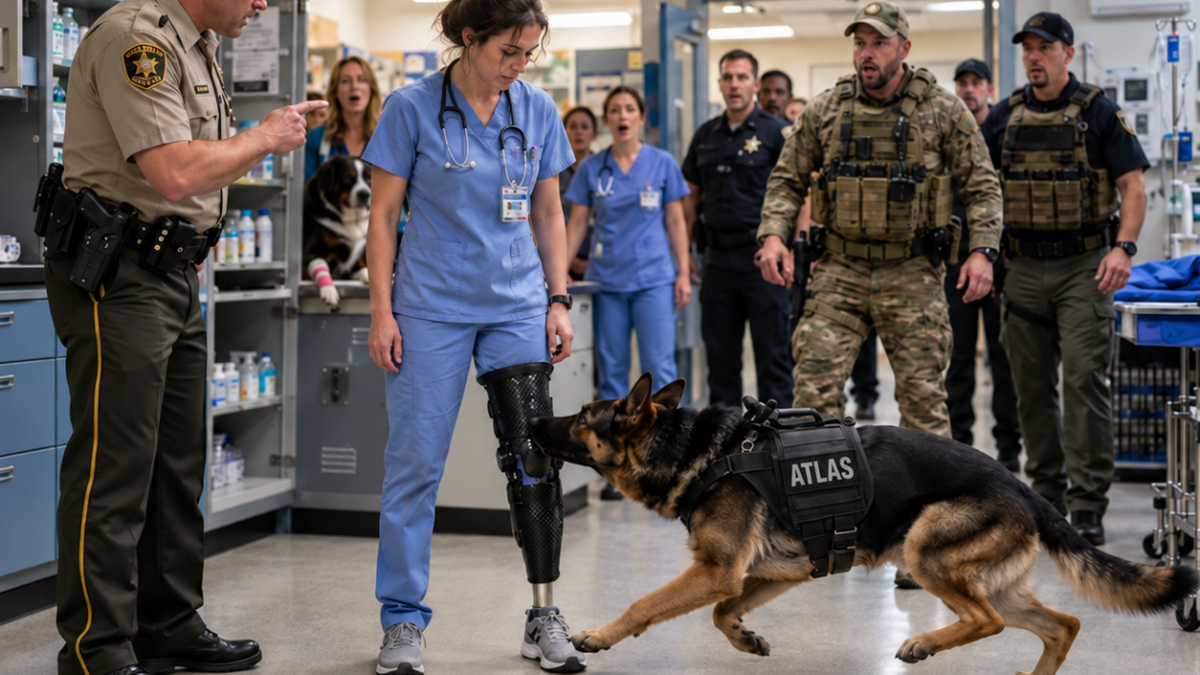
The dog broke formation.
Not frantic.
Fast.
Powerful.
Direct.
Someone gasped.
Briggs moved instinctively.
“Watch out!”
Atlas ran straight toward me.
I did not move.
Could not.
At the last second, he slowed.
His whole body changed.
Shoulders lowered.
Tail moved.
And then the German Shepherd pressed himself gently against my injured leg.
The exact leg supported by carbon fiber.
The leg I had been hiding pain from all morning.
I looked down.
His face had changed with age.
The muzzle grayer.
Scar near the left ear almost invisible beneath fur.
But I knew.
“Atlas.”
His head came up.
My hands found him.
Behind the left ear.
The place where the old scar still ran beneath the coat.
His eyes closed.
A sound came from him.
Soft.
Almost a whine.
I bent as far as my leg allowed.
“Easy.”
My voice broke.
“You’re safe now.”
The clinic went silent.
Chief Torres looked as if somebody had punched him.
His face drained.
He whispered:
“Only one person ever said that to him.”
I closed my eyes.
The years disappeared.
Canvas walls.
Cold air.
Dust.
Blood.
Portable lights.
A terrified eighteen-month-old German Shepherd refusing to leave his injured handler.
I was twenty-six again.
Torres stepped closer.
“You know Atlas.”
I stroked the scar behind his ear.
“I knew him when he was smaller.”
Briggs stared.
“What is going on?”
Torres looked at me.
Then said one word.
“Kosovo.”
Every muscle in my body went tight.
I looked up.
“How do you know about Kosovo?”
“My predecessor trained Atlas later.”
Torres swallowed.
“He talked about his early field reports.”
I wanted him to stop.
He did not.
“He mentioned a trauma nurse.”
No.
“A nurse they called the Steady One.”
I looked away.
“That wasn’t important.”
Torres’s voice softened.
“It was to them.”
Years earlier, in Kosovo, the war had technically ended.
People like clean words.
Ended.
Over.
Peace.
Reality did not cooperate.
Collapsed buildings remained unstable.
Unexploded ordnance stayed beneath roads and fields.
Rescue teams were injured.
Children were pulled from damaged homes.
Medical helicopters came in day and night.
Our humanitarian field hospital operated outside a village where winter seemed to have decided it disliked humans personally.
I was twenty-six.
Quiet.
Shorter than most of the soldiers around me.
Easy to ignore until someone started bleeding.
People called me Steady because I rarely raised my voice.
The nickname embarrassed me.
I was afraid constantly.
I simply learned something early.
If medical staff panic, patients borrow that panic.
So I moved calmly.
Spoke calmly.
Worked quickly.
One evening, rescue workers arrived carrying a German Shepherd.
Atlas.
Eighteen months.
Young.
Huge energy.
Terrified.
His handler had been trapped during a structural collapse.
Atlas had stayed beside him beneath falling debris.
Shoulder gashed by twisted metal.
Front paw torn.
Every veterinarian who approached got teeth.
Not because he wanted to attack.
Because fear had nowhere else to go.
Someone said sedation.
I said wait.
I sat on the floor of the treatment tent.
Several feet away.
Did nothing.
Five minutes.
Ten.
Fifteen.
People became impatient.
Atlas watched.
I kept my hands visible.
Eventually he moved.
One step.
Then another.
Until he lowered his head onto my knee.
I remember whispering:
“You’re safe now.”
His shaking slowed.
We treated him.
His handler, Corporal Daniel Rhodes, survived the collapse.
That should have been the end of my relationship with Atlas.
It was not.
Three weeks later, a convoy entered an abandoned industrial district searching for families reported trapped there.
An explosion ripped through the street.
Vehicles overturned.
Communications failed.
The first casualties reached us before the radio reports were complete.
I worked almost eighteen hours.
Children.
Rescue workers.
Soldiers.
Dogs.
Everybody.
Near midnight, Daniel arrived critically injured.
Atlas beside him.
Refusing food.
Refusing rest.
I treated Daniel.
Then Atlas.
Then another patient.
Then another.
Then came the second explosion.
Closer.
Near the hospital entrance.
Glass shattered.
Metal tore through canvas and temporary walls.
I saw Daniel.
Atlas.
Directly in the path.
There was no time for decision.
I ran.
Covered them.
The blast lifted me.
Then nothing.
When I woke, doctors told me Daniel was alive.
Atlas was alive.
My leg was not going to be the same.
Multiple surgeries.
Reconstruction.
Months of rehabilitation.
Nerve damage.
Permanent weakness.
Brace.
Medical retirement.
I could have stayed stateside in military medicine in another capacity.
Everyone told me that.
I could not.
Maybe I should have.
At the time, the smell of antiseptic was enough to put me back inside that field hospital.
So I disappeared into a different life.
Veterinary nursing.
Blue Ridge.
Animals.
Routine.
Useful work.
I had never seen Atlas again.
Until the morning a deputy thought my shaking meant guilt.
Back in the clinic, Chief Torres stared at my brace.
“That was the blast.”
I nodded.
Briggs had gone completely silent.
Torres asked, “You stayed after?”
“There were still patients.”
“How long?”
“Until evacuation was complete.”
Naomi stared at me.
“You never told us any of this.”
I shrugged.
“It wasn’t relevant.”
Her expression said she strongly disagreed.
Atlas leaned into my leg.
Carefully.
As if age had taught him the precise amount of pressure the brace could tolerate.
Then the computer chimed.
One of our technicians came running with printed reports.
“Dr. Foster.”
Naomi turned.
“I think we found it.”
Briggs came over.
“What?”
“The inventory discrepancies.”
The tech spread the sheets across the counter.
“Automated dispensing update bug. Every time the network dropped during sync, the system duplicated withdrawal records.”
Briggs studied the timestamps.
Same medication.
Same quantities.
Same network interruptions.
Exactly.
The software had created duplicate entries.
Not missing drugs.
Bad data.
Then came the maintenance records.
My reports.
Three separate documented requests.
Immediate inspection requested.
System duplicating controlled medication withdrawals.
Possible compliance risk.
Sent to software vendor.
Sent to supplier.
Sent to state board contact.
Ignored.
Briggs read them slowly.
Then looked at me.
“You reported every one.”
“Yes.”
“Three times.”
“Yes.”
His eyes dropped to my hands.
Still trembling.
Then to my brace.
“You were telling the truth.”
“Yes.”
He looked genuinely ashamed.
“I thought…”
I finished for him.
“You thought my shaking meant guilt.”
“Yes.”
“My leg locks if I stand too long.”
His face tightened.
“I wasn’t hiding anything.”
“No.”
“I was hurting.”
Naomi crossed her arms.
“I told you.”
Briggs nodded.
“You did.”
He closed his notebook.
Then looked at me.
“I owe you an apology.”
I did not answer immediately.
Apologies given too quickly are often just a way for people to escape discomfort.
He seemed to understand.
“I judged what I saw before I understood what I was seeing.”
I looked at Atlas.
“That happens.”
“I confused pain with deception.”
“Yes.”
He swallowed.
“I’m sorry.”
Chief Torres stood beside him.
“Atlas didn’t.”
The German Shepherd’s tail moved against the floor.
Torres smiled.
“He remembered the person.”
Then he looked at Briggs.
“We should have done the same.”
Briggs extended his hand.
I looked at it.
Then shook.
“I can’t undo this morning,” he said.
“No.”
“But I can learn from it.”
I believed he meant that.
So I gave him something better than forgiveness.
I gave him a responsibility.
“Then promise me something.”
“What?”
“Next time somebody looks nervous, don’t decide why.”
He listened.
“Ask whether they’re frightened.”
I touched the brace.
“Or whether they’re carrying pain you can’t see.”
Briggs nodded.
“I will.”
Someone started clapping.
I turned.
An elderly client in the waiting room.
Then another.
Then several staff members.
I hated it.
Absolutely hated it.
Naomi knew.
She smiled anyway.
Atlas stayed beside me.
That was enough.
After the investigation formally cleared us, Briggs remained in the lobby longer than everyone else.
The warrant folder under his arm seemed heavier than before.
I was rebandaging Atlas’s paw.
Not because it needed much.
Because touching him made the years between Kosovo and Blue Ridge feel less impossible.
“You healed well,” I whispered.
Atlas looked at me.
Chief Torres laughed softly.
“He hasn’t looked this relaxed in years.”
“He always liked pretending he was tougher than he felt.”
“Still does.”
Briggs approached.
“I’ve been thinking.”
I glanced up.
“Dangerous.”
He smiled faintly.
“I’ve questioned hundreds of people.”
“Congratulations?”
“I thought I was good at reading body language.”
“Most people do.”
“Today I realized I’m good at reading body language through assumptions I already have.”
That was more insightful.
He continued.
“You were shaking. Avoiding standing still. Moving carefully.”
“Yes.”
“And I decided those things meant guilt.”
“Yes.”
“I never asked if they might mean injury.”
“No.”
He looked toward the brace.
“That shouldn’t happen.”
“It does.”
“That’s not good enough.”
I liked that answer.
Chief Torres pulled a weathered folder from his bag.
“Harper.”
I looked over.
“I think you should see this.”
Across the front:
ATLAS REHABILITATION FILE.
I opened it.
Old veterinary notes.
Behavior reports.
Recovery photographs.
A younger Atlas.
His handler.
Me.
I stopped.
One line appeared repeatedly.
Nurse Harper Ellis successfully calmed patient prior to treatment.
Another:
Responds positively to phrase: “You’re safe now.”
Briggs read over my shoulder.
“That’s why he ran to you.”
I nodded.
“He wasn’t remembering the explosion.”
Briggs looked confused.
“What was he remembering?”
“Recovery.”
Chief Torres smiled.
“Dogs don’t remember rank.”
He scratched Atlas’s neck.
“They remember trust.”
The next afternoon, another vehicle entered the clinic parking lot.
Pickup.
Disabled veteran plates.
A tall man climbed out using a walking stick.
Atlas saw him through the window.
One bark.
Then another.
Excited.
My stomach dropped.
The man entered.
Older.
Gray in his beard.
Scar near his jaw.
But unmistakable.
“Hello, Harper.”
I stared.
“Daniel?”
Corporal Daniel Rhodes.
Atlas’s original handler.
The man I had thrown myself over in Kosovo.
He smiled.
“I’ve been trying to find you.”
“I wasn’t hiding.”
“You disappeared.”
“I started over.”
“You always were stubborn.”
Atlas shoved himself between us.
Daniel laughed.
“There he is.”
I hugged Daniel.
I do not hug easily.
That day, I did.
Naomi stood nearby.
“You two served together?”
Daniel looked at her.
“She never told you?”
“Almost nothing.”
He looked at me.
“Of course.”
Then Daniel told them what I never would.
How the field hospital used to calm when I entered a treatment tent.
How medics sent frightened patients toward me.
How Atlas once refused sedation until I sat beside him.
How, after the blast, I woke in surgery asking whether everyone else had survived before I asked about my own leg.
I hated every second of it.
Not because it was false.
Because praise has always felt like wearing someone else’s coat.
Too visible.
Too warm.
Naomi looked at me afterward.
“You let us think you were just private.”
“I am private.”
“You were a military trauma nurse.”
“Yes.”
“You saved a K9.”
“I treated him.”
“You threw yourself over him during an explosion.”
“And Daniel.”
Daniel raised one hand.
“Appreciated.”
Naomi stared.
“You are impossible.”
“That has also been documented.”
Briggs came back a week later.
Not with a warrant.
Coffee.
Three cups.
He sat in the break room.
“I spoke with the sheriff.”
“That sounds ominous.”
“We’re changing some training.”
“For medication investigations?”
“For people.”
I looked at him.
He explained.
Trauma-informed communication.
Invisible disability awareness.
Veteran interaction.
Interpreting pain behaviors.
De-escalation.
Bias in behavioral assumptions.
He said:
“I want you involved.”
“No.”
Immediate.
Automatic.
Briggs blinked.
“Harper.”
“I work here.”
“I know.”
“I like working here.”
“I’m not asking you to leave.”
“You’re asking me to stand in front of police officers and explain disability.”
“Yes.”
“No.”
Chief Torres joined later.
Traitor.
“Atlas will be there.”
I looked at him.
“That is manipulative.”
“Yes.”
I agreed.
Not because I suddenly enjoyed attention.
Because Briggs said one sentence that mattered.
“Apologies matter less if nothing changes afterward.”
That got me.
The first training session was terrible.
For me.
Probably useful for everyone else.
Twenty-six deputies.
Six K9 handlers.
Three supervisors.
Daniel attended.
Atlas lay beside my chair.
I stood only as long as my leg allowed.
Then sat.
That alone became part of the lesson.
I told them:
“If I sit, the presentation is not becoming less professional.”
Nobody moved.
“If I shift my weight, I’m not trying to escape.”
A few faces changed.
“If my hands shake, I may be in pain.”
Briggs stood at the back.
Listening.
I continued.
“Behavior without context is data without interpretation.”
That line ended up on their training materials.
I hated that too.
We built scenarios.
A veteran avoids eye contact.
Possible guilt?
Possible PTSD.
Possible hearing issue.
Possible cultural norm.
Possible pain.
Possible exhaustion.
A woman’s hands shake during questioning.
Fear?
Medication?
Neurological condition?
Injury?
Withdrawal?
Guilt?
You do not know until you ask.
Atlas became the best instructor in the room.
Chief Torres demonstrated how trained working dogs respond to patterns of stress, familiarity, scent, and prior reinforcement.
“Dogs do not make moral conclusions,” he said.
“They react to information.”
Briggs added:
“Humans could use more of that.”
Six months later, Blue Ridge Veterinary Trauma Center opened a rehabilitation garden.
The idea began with Naomi.
Expanded with Daniel.
Funded partly by veteran groups, county donations, and community organizations.
Accessible paths.
Low ramps.
Exercise stations.
Benches.
Quiet fountain.
Space for injured veterans.
Retired working dogs.
First responders.
Animals recovering from orthopedic surgery.
People recovering beside animals recovering.
That mattered to me.
Healing without separation.
A bronze plaque near the entrance read:
HEALING BELONGS TO EVERYONE.
SEEN WOUNDS. UNSEEN WOUNDS. EVERY LIFE DESERVES DIGNITY.
They asked me to cut the ribbon.
I said no.
Naomi sighed.
“Of course.”
Instead, I invited Olivia Chen.
Twenty-three.
Nursing student.
Car accident two years earlier.
Leg brace similar to mine.
She looked horrified.
“I don’t belong up there.”
I recognized the sentence.
Maybe because I had lived it.
I smiled.
“I used to think that too.”
We cut it together.
Applause filled the garden.
This time I tolerated it.
Barely.
Briggs found me afterward.
“I wanted to thank you.”
“For what?”
“You could’ve filed complaints.”
“I could still.”
He looked alarmed.
I laughed.
“Kidding.”
“Not funny.”
“A little.”
He smiled.
Then became serious.
“You could have tried to punish me.”
“Would that teach you?”
“Maybe.”
“Shame makes people defensive.”
I looked around.
Deputies talking with veterans.
Children petting retired K9s.
Nurses explaining mobility equipment.
Handlers discussing canine rehabilitation.
“People learn better when they’re invited.”
Briggs nodded.
“You really believe that?”
“Most days.”
Atlas walked toward us.
Older now.
Slower.
Still dignified.
He came to me.
Leaned against the carbon-fiber brace.
Exactly where he had leaned the morning we reunited.
I rested one hand on his head.
“We’re both still standing.”
Chief Torres came up behind us.
“And both still serving.”
Later, Olivia sat beside me near the fountain.
She looked at my brace.
Then hers.
“Can I ask something?”
“You just did.”
She smiled.
“Were you ever afraid your injury would define you?”
I thought about Kosovo.
The surgeries.
The day the medical board told me I was done.
The first time I saw the brace.
The years I answered Life happened because anything more felt too large.
Then I looked at Atlas.
“No.”
Olivia seemed surprised.
“What were you afraid of?”
“That it would stop me from helping.”
I looked around the garden.
“It didn’t.”
That answer became truer with time.
The sheriff’s department kept the training.
Then neighboring departments asked for it.
Blue Ridge developed a joint program for veterans with working animals.
Daniel began volunteering.
Atlas attended demonstrations whenever his joints allowed.
Briggs became one of the instructors.
That part mattered most.
Not because he became perfect.
Because he told the story himself.
“I saw shaking and assumed guilt.”
No excuses.
No self-protection.
“I was wrong.”
Then he explained why.
Officers listened differently when another officer admitted error without pretending it was unavoidable.
One year after the investigation, Briggs came into Blue Ridge carrying no folder.
Just a leash.
At the other end was a nervous rescue shepherd.
“Personal dog?”
“Trying.”
The dog refused to enter treatment.
I knelt.
Several feet away.
Briggs laughed.
“I know this part.”
“What part?”
“You let him decide you’re safe.”
I smiled.
“Look at you learning.”
The shepherd came closer.
Slowly.
Briggs watched.
Did not pull the leash.
Did not hurry.
That was change.
Small.
Real.
Years later, people remembered the dramatic part.
Atlas breaking formation.
Running across the clinic.
Refusing to leave my side.
They liked that part because it was visible.
Cinematic.
Easy to understand.
A dog remembered a nurse.
A suspect became a hero.
A deputy realized he was wrong.
But life is rarely that clean.
I was not innocent because I once served overseas.
I was innocent because I had not stolen medication.
Those are different things.
Briggs was not wrong because he questioned me.
He was wrong because he decided the meaning of my behavior before he understood it.
Also different.
Atlas did not “prove” my character.
He revealed history nobody in that room knew.
The software records proved what happened.
Documentation proved I had reported it.
Facts cleared the investigation.
Atlas did something else.
He interrupted the story people had already written about me.
That interruption gave everyone enough time to look again.
Sometimes that is all people need.
A reason to look again.
At a veteran who seems angry.
At a woman who seems nervous.
At a person who moves differently.
At a dog who reacts strangely.
At anyone whose behavior makes sense only after you learn what their body has survived.
I still work at Blue Ridge.
Still arrive too early.
Naomi still complains.
My brace has been replaced twice.
Atlas eventually retired fully.
He spent his last years with Chief Torres.
Daniel visited him often.
So did I.
The last time I saw Atlas, he was lying beneath a maple tree in the rehabilitation garden.
Gray muzzle.
Slow breathing.
Too tired to stand.
I sat beside him.
No uniform.
No emergency.
No explosion.
No investigation.
Just an old dog and an older nurse than the one he remembered.
I scratched behind his left ear.
Scar still there.
He opened one eye.
His tail moved once.
“Easy.”
I leaned closer.
“You’re safe now.”
He closed his eyes.
That sentence had once calmed a terrified young working dog in a field hospital thousands of miles away.
Years later, it brought him running across a veterinary clinic.
By then, I finally understood why.
He remembered what safety felt like.
Maybe that is what all of us are trying to find.
Not someone who sees no wounds.
Someone who sees them without deciding they make us less.
Atlas never cared that I limped.
Never cared that my hands shook.
Never cared that I had left military medicine.
He remembered the hands that waited.
The voice that stayed calm.
The person who sat on the floor until he chose to come closer.
And because one old K9 remembered what everyone else had forgotten to ask, a deputy changed the way he questioned people.
A sheriff’s office changed its training.
A veterinary hospital built a place where injured people and animals could recover together.
A nursing student stopped thinking her brace disqualified her from leadership.
And I stopped pretending being invisible was the same thing as being humble.
The investigation began because somebody saw my shaking and wrote the wrong story.
It ended because evidence corrected the facts.
But the future changed because Atlas walked across a room and remembered me before anyone else knew there was anything worth remembering.
People sometimes call that loyalty.
Maybe.
I think it was something even simpler.
Trust.
The kind built years earlier on a cold floor, when a frightened young German Shepherd learned that not every person approaching him intended to hurt him.
The kind that survives distance.
War.
Age.
Pain.
And time.
That is why, whenever someone asks what I learned from Atlas, I never talk first about Kosovo.
Or the blast.
Or the investigation.
I tell them this:
Do not rush to decide what another person’s pain means.
You may be looking at guilt.
Or fear.
Or grief.
Or an old injury burning beneath clean blue scrubs.
Ask.
Listen.
Look again.
Because courage is not measured by how steadily someone stands.
Sometimes the bravest person in the room is the one whose leg is shaking—
and who stays anyway.








