A Decorated Marine Colonel Mocked Me at a Family Dinner, Refusing to Believe I Was a Navy Pilot—Then a Retired Four-Star Admiral Asked One Question That Made His Smile Disappear.
PART2:
He was seventy, tall despite the slight bend age had placed in his shoulders, with silver hair trimmed neatly enough to look inspected.
He wore dark slacks and a navy sweater.
No medals.
No rank.
Nothing theatrical.
But some people spend long enough being listened to that the room seems to understand them before they speak.
Jonathan had that.
“Mara.”
He offered his hand.
“Good to finally meet you.”
“You too.”
His grip was firm without turning the handshake into an endurance event.
Then he looked at me for perhaps one second longer than ordinary politeness required.
Not staring.
Assessing.
That extra second stayed with me.
Inside, Susan was moving between the dining room and kitchen with the focused intensity of somebody coordinating a military operation she would have denied was military.
Leah arranged wineglasses.
A fire burned in the den.
PART3:
The house smelled like rosemary, onions, coffee, and old wood warmed by heat.
Photographs covered one wall.
Ships.
Ceremonies.
Daniel and Leah as children.
Jonathan in uniform.
Jonathan shaking hands with people I recognized from newspaper photographs.
No one asked what I did for a living.
That suited me.
For most of my adult life, people had been surprisingly comfortable filling blank spaces themselves.
If I said I worked for the Navy, many pictured administration.
If I mentioned aviation, they imagined scheduling, civilian contracting, or perhaps maintenance.
Because I was thirty-six, soft-spoken, five foot seven, and more likely to listen than dominate a room, almost nobody’s first assumption was cockpit.
That had bothered me when I was younger.
Eventually it became useful.
Daniel knew I flew.
Obviously.
He knew I disappeared for stretches of training.
He knew my shoulders sometimes hurt after long flights.
He knew I could sleep almost anywhere if given ten uninterrupted minutes.
He knew I kept a flight bag packed with obsessive precision.
He knew there were subjects I did not discuss outside secure spaces.
But even Daniel knew the ordinary version of my career.
That was intentional.
There are experiences you tell because telling them makes the weight lighter.
There are other experiences that become smaller and cheaper every time you convert them into a story for somebody who was not there.
I had learned early which category mine belonged to.
That first Mercer dinner was easy.
Jonathan asked about my engineering degree.
Susan wanted to know how Daniel and I met.
Leah mostly observed.
Jonathan spoke less than anyone else, but whenever he did, attention shifted toward him without being requested.
I noticed things for a living.
I noticed him watching me too.
When I mentioned Pensacola in passing, his eyes sharpened.
When Daniel joked that I hated commercial turbulence because I had “control issues around airplanes,” Jonathan almost smiled.
Later, somebody mentioned a squadron I knew.
Jonathan glanced at me.
I wondered whether he knew.
Naval aviation looks enormous from outside.
Once you’ve lived inside it long enough, it becomes strangely small.
Names travel.
Reports travel farther.
Sometimes a decision made over black water in weather nobody wants to remember lands six years later on the desk of a man you will eventually meet in a suburban dining room.
Still, Jonathan said nothing.
Neither did I.
Three weeks later, Leah invited me for coffee without Daniel.
We met at a small café in Alexandria.
Halfway through her second drink, she leaned back.
“What do you actually do?”
I smiled.
“I work for the Navy.”
“That’s the answer you give strangers.”
“Are we not strangers?”
“Not anymore.”
There was no entitlement in her voice.
That mattered.
Curiosity is different when the person asking understands you can refuse.
“I fly.”
Her eyebrows rose.
“Planes?”
“Usually more useful if they fly.”
She laughed.
“Military aircraft?”
“Yes.”
“What kind?”
“The kind I don’t discuss over cappuccino.”
She nodded immediately.
“Fair.”
No pushing.
No suspicion.
No wounded pride because I had withheld detail.
That made me like her more.
When we reached the parking lot, however, she stopped beside my SUV.
“Dad knows something about you.”
That caught me.
“What makes you say that?”
“He does the same thing around you that he does when he recognizes somebody and wants to see whether they’ll say it first.”
Cold wind pushed hair across her face.
I shoved my hands into my coat pockets.
“Maybe he recognizes the type.”
Leah smiled.
“You don’t have a type.”
“Everybody has a type.”
“No.”
She studied me.
“Everybody thinks you have a type. That’s different.”
I thought about that sentence longer than I expected.
Over the next three months, I saw the Mercers regularly.
Football Sundays.
Thanksgiving brunch.
Two dinners.
One charity reception.
Jonathan never confronted me.
Never asked for my résumé.
Never cornered me with operational questions.
Sometimes I caught him watching.
That was all.
I began to relax.
Then Daniel told me his father was turning seventy.
The dinner would be larger.
Twenty guests.
Old friends.
Former officers.
People who had served with Jonathan across several commands.
“Do I need armor?” I asked.
Daniel laughed.
“Just something nicer than flight boots.”
I looked at him.
His smile faltered.
“I’m kidding.”
“You’re improving.”
“At what?”
“Survival.”
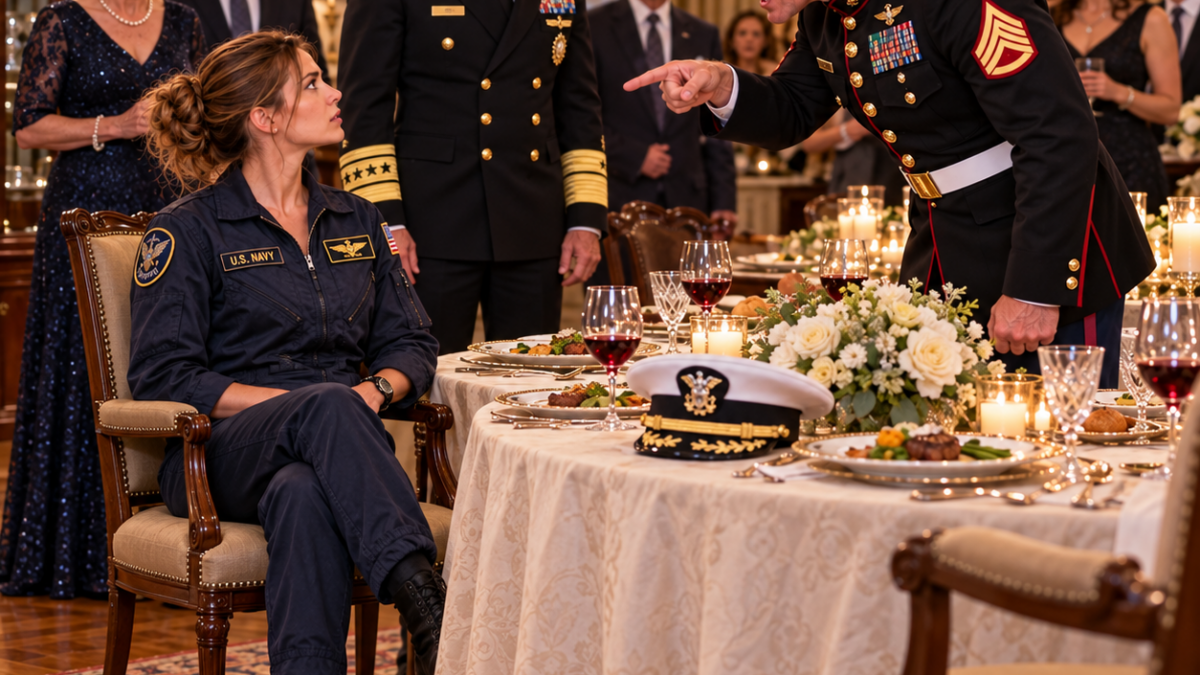
The restaurant was in Washington.
Private elevator.
Thick carpet.
Heavy doors.
Menus without prices.
The sort of place where somebody folds your napkin if you stand up for thirty seconds.
I wore a dark blue dress, small earrings, and civilian shoes that began hurting before appetizers.
Daniel looked relieved when he saw me.
“Beautiful.”
“That better be worth these shoes.”
“I’ll carry you to the car.”
“Romantic.”
The private dining room was already loud.
Men who had commanded ships, squadrons, battalions, task groups, and thousands of people were telling stories over whiskey.
Their spouses exchanged looks suggesting they had heard every story at least twenty times.
Then a voice boomed across the room.
“Daniel!”
A broad-shouldered man with white at his temples crossed toward us carrying bourbon.
His handshake with Daniel looked competitive.
Daniel smiled.
“Grant. Good to see you.”
Then he turned.
“Mara, Colonel Grant Holloway. Old friend of my dad’s.”
Holloway looked at me.
Fast.
Assessing.
Not like Jonathan.
Jonathan observed.
Holloway categorized.
“Marine Corps,” he said.
As if I might have mistaken him for a florist.
“Mara Ellis.”
“What do you do, Mara?”
I could have given him the long version.
Rank.
Qualification.
Aircraft.
Assignments.
Hours.
Deployments.
Instructor work.
Things I was not allowed to discuss.
Things I simply chose not to discuss.
Instead:
“I fly for the Navy.”
His eyebrows rose.
Then he smiled.
I knew that smile.
It was the smile of a person who had already reached a conclusion and was now looking forward to watching you fail to fit it.
“What do you fly?”
“Aircraft.”
Daniel coughed into his hand to hide a laugh.
Holloway grinned.
“Careful. We’ve got a comedian.”
“I have my moments.”
“Helicopters?”
“Sometimes.”
“Fixed wing?”
“Sometimes.”
“That classified?”
“Some things are.”
I picked up a glass of water from a passing tray.
“Some things are just boring dinner conversation.”
His smile shifted.
That was the first moment he decided I was being evasive because I lacked an answer instead of because I did not owe him one.
Dinner started.
Jonathan sat at the head of the long table.
Susan beside him.
Daniel next to me.
Leah across.
Holloway ended up only two seats away.
For ten minutes he was charming.
Funny.
Almost delightful.
Men like Holloway rarely begin with an insult.
Direct contempt makes people defensive.
He preferred making people collaborate in their own humiliation.
He asked where I trained.
I answered generally.
He asked how long I had been in.
I answered.
Then:
“So what do you actually fly?”
I smiled.
“We’re back to that?”
“Professional curiosity.”
“Then remain professionally curious.”
A retired Navy captain across from us laughed.
Holloway did too.
But not fully.
Appetizers arrived.
Conversation split.
I thought he might move on.
Then someone mentioned carrier landings.
Holloway immediately turned.
“You ever put one down on a deck?”
“Yes.”
“What ship?”
“More than one.”
“Come on.”
He laughed.
“You can give me a ship name.”
“I could.”
“But you won’t.”
“Correct.”
Daniel leaned closer.
“You okay?”
“Perfectly.”
Holloway heard.
“She’s fine, Daniel. We’re talking shop.”
No, I thought.
You’re trying to establish ownership of the shop.
I had met his type before.
Rank does not automatically create that personality.
Some senior officers carry authority so comfortably they rarely need to display it.
Others spend careers collecting proof of importance and then become irritated when somebody fails to request access to the collection.
Holloway loved his collection.
By the main course I knew where he had served.
Which generals liked him.
Which operations he believed he had rescued from incompetent leadership.
Which commanders he considered overrated.
Which younger officers lacked the toughness of previous generations.
He was an excellent storyteller.
I will give him that.
His timing was superb.
His listening was terrible.
A retired Navy captain named Paul Keegan began telling a story about a difficult rescue years earlier.
Holloway interrupted him before the point.
“Weather scares people who haven’t learned to trust training.”
Keegan looked at him.
“Weather kills trained people too.”
“Not the good ones.”
I looked down at my plate.
There are sentences that can take you places you have spent years learning not to go.
That was one.
Six years earlier, rain had hit my windscreen so violently it sounded like gravel.
Instrument readings jumped.
The horizon vanished.
A voice broke through static.
Fuel became arithmetic.
Distance became arithmetic.
Human survival became arithmetic.
Everybody waited for somebody to make a decision nobody wanted to own.
I remembered making it.
I did not remember feeling brave.
Mostly I remembered being terrified the numbers would stop working before we reached them.
Holloway tapped the table.
“What do you think, Mara?”
I looked up.
“About?”
“Training versus instinct.”
“Depends on the problem.”
He smiled.
“Safe answer.”
“Accurate answer.”
“Pilots usually have stronger opinions.”
“Some do.”
“And some apparently don’t.”
Daniel’s fork paused.
Leah lowered her wineglass.
Jonathan said nothing.
Holloway continued.
“How many flight hours?”
I almost laughed.
Pilots ask each other about hours constantly.
Context can transform an ordinary question into a weapon.
By then, the context was obvious.
“Enough.”
Holloway leaned back.
“There it is again.”
“What?”
“The vague answer.”
The nearest conversations softened.
He sensed attention.
His voice became friendlier.
“I’m not accusing you of anything.”
“Good.”
“I’m genuinely curious.”
“Stay curious.”
A woman at the far end covered a smile.
Holloway noticed.
Pride notices everything that might be laughter.
He turned toward me more fully.
“You know, I spent thirty-one years around aviators.”
“I’m sure.”
“I know the personality.”
“That sounds exhausting.”
Several people laughed.
This time he did not.
He set his water down carefully.
“I’m saying you don’t exactly fit the profile.”
Daniel’s jaw tightened.
I felt a familiar tiredness settle across my shoulders.
Not anger.
Anger has heat.
This was older.
Colder.
The exhaustion of standing before another gate somebody had invented after you already completed the journey.
Leah asked:
“What profile?”
Holloway looked at her.
“You know.”
“No.”
She leaned forward.
“I’m asking.”
He waved a hand.
“Confidence. Presence. The way somebody carries themselves after being responsible for serious operations.”
I watched Leah’s face close.
Daniel started speaking.
I touched his knee.
Not yet.
Holloway saw my silence.
Mistook it for retreat.
That encouraged him.
“I’m not saying she’s lying.”
He was addressing the table now.
“Maybe support aviation. Maybe reserve work. Maybe she’s being modest. I’m just saying the story and the person don’t quite match.”
Someone shifted in a chair.
Jonathan stopped eating.
I noticed.
Holloway didn’t.
Then he looked at me with sympathy.
That irritated me more than contempt.
“Sweetheart, nobody here expects you to impress us.”
Daniel’s chair moved.
I pressed his knee harder.
I had spent years being told my calm made other people comfortable.
That night I stayed calm for the opposite reason.
Because Holloway wanted a performance.
And I had decided he was not important enough to receive one.
I cut another piece of chicken.
Ate it.
Across the table, Leah stared at me.
Then something changed in her expression.
She understood.
At the head of the table, Jonathan’s face remained unreadable.
But his fork was no longer moving.
There was a version of me at twenty-six who would have destroyed Grant Holloway in less than sixty seconds.
She would have listed qualification dates.
Hours.
Deployments.
Instructor certifications.
Aircraft.
Awards.
Operational assignments.
She would have needed the table to know immediately that he had underestimated the wrong woman.
I remembered her.
I also remembered what she learned.
People who demand proof after deciding you are unworthy rarely become fair when you provide evidence.
They move the standard.
Question your evidence.
Call you arrogant for answering questions they forced you to answer.
Winning becomes impossible because the argument was never about facts.
It was about control.
So I kept eating.
Holloway waited.
When I didn’t respond, he turned toward Daniel.
“You’ve actually seen her fly?”
Daniel’s expression hardened.
“Grant.”
“It’s a question.”
“No.”
Daniel looked directly at him.
“It isn’t.”
Holloway appeared genuinely surprised.
Daniel was gentle by nature.
One reason I loved him.
People who confuse gentleness with weakness sometimes spend years learning the difference.
“I’ve known Mara two years,” Daniel continued. “I don’t need her to prove anything to me.”
“That’s admirable.”
“It wasn’t intended as a compliment to you.”
Silence.
I squeezed Daniel’s hand.
Holloway exhaled.
“Fine.”
He spread his hands.
“Maybe I’m old-fashioned.”
Leah said:
“That’s one word.”
“Leah,” Susan warned.
Holloway smiled.
“All right. Everyone suddenly thinks I’m attacking her, so let me explain.”
Nobody asked him to.
He looked at me.
“I’ve been around the military longer than you’ve been alive.”
“Probably.”
“I’ve watched young officers exaggerate experience.”
“I’m sure.”
“Civilians claim affiliations they never earned.”
“So have I.”
“And I’ve spent enough time around actual operational pilots to know they don’t usually dodge basic questions.”
There it was.
The accusation finally stepped into daylight.
Daniel pushed his chair back.
I put my fork down.
For half a second, Holloway looked satisfied.
He thought I was finally entering his arena.
Instead I took a drink.
“Do you know what I find interesting?”
His eyes brightened.
“What?”
“You’ve asked me eleven questions.”
He waited.
“You haven’t listened to one answer.”
His mouth tightened.
“I listened.”
“No.”
I looked at him.
“You compared every answer to the answer you wanted and treated the difference as evidence.”
He started to speak.
I raised one finger.
Not aggressively.
Just enough.
“You said you weren’t accusing me of lying, then spent ten minutes describing exactly why you think I’m lying.”
The room went still.
“If you want to accuse me, Colonel, have the discipline to use the correct word.”
Holloway stopped smiling.
Jonathan looked at me.
Something changed behind his eyes.
Recognition, perhaps.
Holloway recovered.
“All right.”
Hands open.
“You’re Navy?”
“Yes.”
“You fly?”
“Yes.”
“Operationally?”
“Yes.”
“You’ve flown missions?”
“Yes.”
“Then prove it.”
The room changed.
Not with a gasp.
No glasses dropped.
It was quieter than that.
Twenty adults collectively realizing politeness could no longer pretend nothing ugly was happening.
A waiter entered.
Saw us.
Placed two plates almost silently.
Left.
Susan spoke first.
“Grant, this is Jonathan’s birthday.”
“I know.”
“Then stop.”
He ignored her.
Eyes on me.
“One unit.”
Nothing.
“One aircraft.”
Nothing.
“One deployment. Give me anything.”
I picked up my fork again.
His eyebrows lifted.
I cut chicken.
Leah looked down to hide a smile.
Holloway stared.
I ate.
The absurdity started working on him.
“You’re not going to answer?”
I swallowed.
“No.”
“Why?”
“Because you’re not entitled to an answer.”
He laughed.
Short.
Brittle.
“Convenient.”
“Is it?”
“Extremely.”
I looked toward Daniel.
Furious.
Leah.
Fascinated.
Then Jonathan.
He had not touched dinner for several minutes.
Our eyes met.
Something passed between us.
Months of glances.
Half-recognition.
The suspicion I had refused to name.
He knew.
Or knew enough.
Holloway continued.
“Real service members understand verification. Accountability.”
That almost made me smile.
Accountability mattered deeply to me.
But accountability does not mean submitting yourself for inspection to every insecure retired colonel over chicken.
“I’m accountable to my chain of command.”
I put down the knife.
“You are not in it.”
Someone laughed into a napkin.
Holloway’s jaw flexed.
“You have a call sign?”
My hand paused.
Barely.
But he saw it.
“There.”
He leaned closer.
“Every Navy pilot has one. At least every real one I’ve known.”
There were several wrong things in that sentence.
I let them pass.
Call signs are funny.
Civilians imagine they’re awarded because you’re dangerous or mysterious.
Usually they begin as jokes.
Mistakes.
Embarrassing stories.
Habits.
Mine was different.
Mine came after Meridian.
I hated that word.
Not the call sign.
Meridian.
The name of the rescue.
It sounded clean.
Elegant.
Something printed on a chart.
Nothing about that night had been clean.
The memory hit me.
Black water.
Storm bands.
Warning tone.
Voices through static.
One fading.
My left hand tightened around the fork.
Jonathan saw.
Holloway did not.
“Come on.”
Holloway smiled.
“You’re Navy? Prove it.”
Daniel stood.
Completely.
Every chair suddenly seemed too close.
“Enough.”
Holloway leaned back.
“Sit down, Daniel.”
Daniel looked at him.
“You don’t speak to her like that.”
I caught Daniel’s wrist.
Not because I didn’t appreciate him.
Because I was still in control of my own moment.
He looked at me.
I shook my head.
Slowly, reluctantly, he sat.
Holloway smiled.
Then Admiral Jonathan Mercer placed his fork beside his plate.
The metallic click against porcelain was soft.
Somehow it silenced the room more completely than Daniel standing had.
Jonathan wiped his mouth.
Then looked directly at me.
Not Holloway.
Me.
“Mara.”
His voice was ordinary.
“What’s your call sign?”
Four words.
That was all.
The vents still hummed.
Silverware clinked faintly in the restaurant beyond our private room.
But around our table, nobody seemed to breathe normally.
Holloway turned toward Jonathan.
Confusion crossed his face.
I placed my water glass down because my hand had begun trembling enough that the ice might betray me.
Jonathan waited.
He wasn’t exposing me.
That distinction mattered.
He was asking.
I could refuse.
He had spent months allowing my history to remain mine.
He had never announced anything at Thanksgiving.
Never turned me into a dinner story.
Even now, he had given me the choice.
That earned an answer.
“Lantern.”
One second.
Nothing.
Then Jonathan’s eyes changed.
Not surprise.
Recognition.
Immediate.
Complete.
He leaned back.
“Lantern.”
Holloway looked between us.
“What?”
Jonathan watched me.
Suddenly every glance from our first dinner made sense.
Pensacola.
Aviation references.
The silence.
He had known.
Maybe not all of it.
Enough.
Jonathan lifted his water.
“Meridian.”
Holloway’s smile vanished.
Entirely.
The word hit him before anybody else.
His shoulders drew inward.
His mouth opened.
Closed.
Jonathan took a drink.
“You remember Meridian, Grant?”
Holloway stared at me.
“Of course.”
His voice had become smaller.
Jonathan nodded.
“I’d hope so.”
Pause.
“You briefed part of the after-action review.”
Someone whispered:
“Jesus.”
Susan looked at Jonathan.
Leah’s eyes widened.
Daniel turned toward me with the expression of somebody realizing there was an entire room inside a person he loved whose door he had never seen.
My chest tightened.
This was exactly why I avoided it.
Once Meridian entered a room, Mara disappeared.
People saw the event.
Jonathan understood.
His explanation was brief.
“Two naval officers went into the water during an extraction off the Atlantic coast.”
Nobody moved.
“Severe weather. Visibility near zero. Multiple aircraft redirected.”
He looked at Holloway.
“Most couldn’t safely reach the recovery point.”
Then at me.
“One crew did.”
My pulse filled my ears.
Holloway swallowed.
“That was you?”
A younger me might have enjoyed him asking.
I didn’t.
“I was aircraft commander.”
Jonathan added quietly:
“And the pilot who made the final approach.”
I looked toward him.
He knew more than I expected.
Holloway rubbed his thumb along his glass.
“I remember that report.”
“I’m sure.”
Jonathan’s voice contained no anger.
That made it worse.
Holloway said:
“The crew was ordered to hold.”
“We were advised to hold.”
Everyone looked at me.
I had not intended to explain anything.
But if we were going to discuss it, accuracy mattered.
“Conditions were changing faster than the recommendation.”
I heard my own voice become technical.
That happened when memory got too close.
“Fuel margin was narrowing. The people in the water were deteriorating. We had a window.”
Jonathan said:
“You took it.”
“Yes.”
Holloway looked down.
Jonathan continued.
“Two officers came home.”
That was true.
Hero stories usually stop there.
Mine didn’t.
One crew member carried injuries from the operation that ended his flying career six months later.
Another had nightmares.
I spent months answering questions about a decision that succeeded and still caused damage.
That was why I hated clean stories.
They edit out the invoices.
Holloway inhaled slowly.
“I didn’t know.”
Jonathan looked at him.
“You didn’t ask.”
The room changed again.
Holloway raised his eyes.
Jonathan folded his napkin.
“You decided.”
Nobody spoke.
“You spent twenty minutes explaining who she couldn’t be because she didn’t present herself the way you expected.”
Holloway looked genuinely ashamed now.
I felt no triumph.
Only fatigue.
Jonathan continued.
“Thirty-one years in uniform should have taught you the difference between verification and assumption.”
“Jonathan—”
“No.”
One word.
Quiet.
Final.
“You demanded she perform her record for you at my table.”
Holloway shifted.
“I was out of line.”
“Yes.”
“I thought—”
“That was the problem.”
Leah looked down.
Not smiling anymore.
Daniel still watched me.
Questions building behind his eyes.
Why didn’t you tell me?
That would come later.
Holloway cleared his throat.
“Mara, I owe you—”
I lifted one hand.
“Not tonight.”
He stopped.
I did not want an apology because the audience had changed.
I didn’t want a performance of remorse any more than I wanted a performance of proof.
Jonathan looked at me.
Something like gratitude crossed his face.
Then he picked up his fork.
“Finish your dinner, Grant.”
So ordinary I almost laughed.
Conversation slowly restarted.
Someone asked about potatoes.
A woman ordered more wine.
Silverware moved.
But the room would never return to what it had been.
Holloway barely ate.
Leah watched me differently.
Daniel touched my hand under the table.
This time uncertain.
I squeezed once.
Later.
Then I looked toward Jonathan.
No triumph on his face.
No pleasure in humiliating an old friend.
Only respect.
I thought the worst part was over.
I was wrong.
Because when dinner ended and we stepped outside beneath cold white entrance lights, Daniel didn’t ask about Grant Holloway.
He asked:
“Why didn’t you tell me?”
He didn’t sound angry.
I almost wished he did.
Anger is simple.
You push against anger.
Hurt asks you to explain choices you barely understand yourself.
Cars hissed across wet Washington pavement.
Guests moved around us beneath umbrellas.
“I told you I flew.”
Daniel stared.
“You know that’s not what I mean.”
“Yes.”
“You were part of Meridian.”
“Yes.”
“My father knew your call sign.”
“Apparently.”
“He knew the report.”
“Apparently.”
“And I’ve been dating you two years.”
There it was.
I looked toward the street.
“I wasn’t keeping it from you because I don’t trust you.”
“It feels exactly like that.”
“I know.”
He shoved his hands into his coat pockets.
“Did Leah know?”
“No.”
“My dad?”
“I suspected he knew something. Not how much.”
Daniel nodded.
For a second he looked more like Jonathan than I had noticed before.
“You could have told me.”
“I could have.”
“Why didn’t you?”
I searched for a clean answer.
There wasn’t one.
“Because every time I tell that story, I watch people rearrange who they think I am.”
His expression softened slightly.
I kept going.
“They hear Meridian and suddenly I’m not the woman who leaves coffee cups in the car or loses her keys. I’m the pilot from Meridian.”
“You think I would’ve done that?”
“I think everyone does it a little.”
“I’m not everyone.”
“No.”
I moved closer.
“You’re not.”
“Then why didn’t I get the chance to prove it?”
That hurt.
Because he was right.
Not entirely.
Enough.
“Because I was tired.”
He waited.
“The operation was reviewed. Then reviewed again. Interviews. Recommendations. Commendations. Questions about risk. Questions about decisions. People wanted the technical version. Civilians wanted the heroic version.”
My throat tightened.
“I didn’t want a version with you.”
Daniel said nothing.
“I wanted dinner.”
Pause.
“Groceries.”
“Bad movies.”
“Your socks under my couch.”
The corner of his mouth moved.
“I wanted one place where I wasn’t Lantern.”
Rain drummed against the awning.
Daniel nodded slowly.
“I understand that.”
I exhaled.
“But understanding doesn’t mean it doesn’t hurt.”
“I know.”
That was the difference between Daniel and Holloway.
Holloway thought feelings created entitlement.
Daniel understood you could be hurt without making the hurt somebody else’s debt.
We drove home quietly.
Two days later Jonathan called me.
Not Daniel.
Me.
“I owe you a conversation.”
“You don’t.”
“I disagree.”
We met at a diner near Arlington because he said he’d had enough private dining rooms for a week.
He arrived early.
Of course.
Black coffee.
Window booth.
I sat across from him.
For several seconds we said nothing.
Then:
“I read the Meridian report six years ago.”
“I gathered.”
“I was still serving.”
“I know.”
A faint smile.
“Of course.”
He folded his hands.
“The report crossed my desk because of two officers involved in the recovery.”
Pause.
“One had previously served under my command.”
I remembered the name instantly.
Commander Ellis Ward.
No relation.
He had been semiconscious when we reached him.
I had never seen him again.
“He recovered?”
Jonathan’s eyes softened.
“Yes.”
I waited.
“Retired three years later. Maine. Grandchildren everywhere.”
Something loosened inside my chest.
I had never asked.
Maybe that sounds strange.
Sometimes survival stories need distance on both sides.
Jonathan continued.
“Your call sign stayed with me.”
“Unfortunately.”
“Why Lantern?”
“You didn’t read the appendix?”
“I don’t read personnel trivia.”
“Good.”
He waited.
I looked toward traffic.
“Crew said I kept announcing visual references nobody else could see.”
“Lights?”
“Shore markers. Reflections through weather.”
He nodded.
“And after we landed, somebody said I could probably find a porch light from orbit.”
“That sounds more plausible than versions I’ve heard.”
“What versions?”
“One says you landed blind.”
“I did not.”
“Another says you disobeyed a direct order.”
“I did not.”
“One claims you lost both engines.”
I stared.
“That would’ve made the rest considerably more difficult.”
Jonathan laughed.
Really laughed.
Then became serious again.
“I recognized you the first night Daniel brought you home.”
“Name?”
“Name. Background. Timing.”
He hesitated.
“And you have the same habit the report described.”
I frowned.
“What habit?”
“You get quieter when everybody else gets louder.”
That unsettled me more than praise.
Jonathan moved his untouched coffee spoon.
“I chose not to say anything because it was your history.”
Pause.
“Not mine.”
“Thank you.”
“But I should’ve stopped Grant earlier.”
I considered.
“Maybe.”
His eyebrows rose.
“I was waiting to see if you wanted me to.”
“That’s what Leah thought.”
“Leah notices too much.”
“Apparently genetic.”
A faint smile.
I asked:
“Why the call sign?”
He knew what I meant.
“Because I knew it would end the conversation.”
“That simple?”
“Precision usually is.”
That answer made me understand Daniel better too.
Jonathan said:
“Grant is ashamed.”
“His problem.”
“He wants to apologize.”
“He tried.”
“Properly.”
“I’m not interested.”
Jonathan nodded.
No pressure.
No lecture about forgiveness.
No old-friend defense.
That earned more respect than anything he had said at dinner.
“He’s spent his career believing judgment and discernment are the same thing.”
“They aren’t.”
“He may be learning late.”
“Then I hope the lesson helps whoever meets him next.”
Jonathan studied me.
“Not you?”
“No.”
I took a drink.
“I don’t need him to become better for me. I needed him to stop treating me like I was less.”
“And did he?”
I thought about the table.
The smile disappearing.
“Yes.”
“Then perhaps that’s enough.”
When I left the diner, Daniel was waiting by my SUV.
I hadn’t told him where I was meeting Jonathan.
I immediately became irritated.
“Your father sent you?”
“No.”
“How’d you know?”
“Leah.”
I groaned.
“That woman is a national-security weakness.”
He almost smiled.
Then became serious.
“I came because I need to tell you something.”
“What?”
He glanced toward the diner.
“My dad told me why Meridian mattered to him.”
“Mattered?”
“The officer you pulled from the water wasn’t just somebody who served under him.”
My stomach tightened.
“He was the man who once saved my father’s life.”
I stared.
“What?”
“Commander Ward.”
Daniel nodded.
“Years before Meridian, he was Dad’s XO during an accident aboard ship. Fire in a maintenance space. Dad got trapped.”
Jonathan appeared behind the diner window paying the bill.
“He never told me.”
“I know.”
“Why?”
Daniel gave me a tired smile.
“Probably same reason you didn’t tell me Meridian.”
That landed.
“He knew immediately when he saw Ward’s name?”
“Yes.”
“And never contacted me.”
“He wanted to.”
Daniel looked at me.
“Then he decided you didn’t need one more stranger turning the worst night of your life into something he needed from you.”
For a few seconds I could not speak.
That was the moment my understanding of Jonathan Mercer changed.
Before that, I respected him.
After that, I trusted him.
The difference mattered.
That night, Daniel and I ate takeout on my couch.
For the first time, I told him more.
Not classified details.
Not names that weren’t mine to share.
Human things.
The smell of hydraulic fluid.
Wet gear.
Coffee somebody spilled before launch.
How cold my hands felt after we landed even though the aircraft interior was warm.
How one crew member vomited behind a hangar because the adrenaline had nowhere else to go.
How strange the commendation ceremony felt because everybody said courage while I kept remembering every possible ending that would have made the same decisions look reckless instead.
Daniel listened.
He did not interrupt.
Did not call me heroic.
When I finished, he said:
“Thank you.”
Not for Meridian.
For telling him.
I leaned against his shoulder.
“I should have trusted you sooner.”
He kissed my hair.
“You trusted me with who you are now.”
Pause.
“Maybe I should’ve understood that mattered more.”
That didn’t erase the hurt.
It made the hurt useful.
There is a difference.
Word about the dinner traveled.
Of course it did.
Nobody officially spread anything.
Military communities specialize in information moving without anybody admitting to transportation.
At the next gathering, people treated me differently.
I hated some of it.
A retired aviator who barely noticed me before wanted my opinion on everything.
Somebody introduced me to his wife as “the Meridian pilot” before using my name.
I pulled Jonathan aside.
“This is exactly why I don’t talk about it.”
He grimaced.
“I know.”
“Can you stop them?”
“I commanded fleets. Gossip remains beyond my authority.”
“Useless.”
“Retirement has reduced my powers.”
Leah joined us.
“I can start a worse rumor.”
“What?”
She thought.
“Secret astronaut.”
Jonathan closed his eyes.
“This is why your mother worries.”
Leah handed me wine.
“They’ll get bored.”
She was right.
By Christmas, I was mostly Mara again.
Holloway did not attend.
I noticed.
Didn’t ask.
Then in January, he texted me.
Mara, I owe you a sincere apology. I behaved badly at Jonathan’s dinner. I made assumptions, embarrassed you publicly, and allowed pride to turn curiosity into disrespect. There is no excuse. I hope someday you can forgive my behavior.
I read it twice.
Waited for anger.
Nothing.
Satisfaction?
Nothing.
Mostly distance.
For weeks I’d imagined what I might say if he apologized properly.
Teach him a lesson.
Tell him what men like him had cost women like me.
Now that the apology existed, I wanted none of it.
Daniel asked:
“What will you say?”
“I don’t know.”
“You don’t have to answer.”
“I know.”
Leah suggested:
“Tell him forgiveness is classified.”
Jonathan said nothing.
That helped.
Eventually I replied:
Thank you for acknowledging what happened. I accept that you regret it. I don’t have anything further to discuss, but I hope you treat the next person differently.
He replied:
Understood.
That was enough.
I did not forgive him in the sentimental way stories often demand.
I did not decide the humiliation had somehow been good for me because a lesson came afterward.
Some things do not need to become gifts.
I simply stopped carrying him.
That spring, I was called into Captain Avery Rhodes’s office.
Rhodes was compact, precise, and had the kind of expression that caused junior officers to confess mistakes before she asked.
“Sit down, Ellis.”
I sat.
She slid a folder toward me.
Inside:
Promotion.
I stared.
“Congratulations.”
Then I saw the second document.
Advanced aviation instructor assignment.
A position training the next generation of pilots.
Rhodes watched me.
“You’ve spent years making difficult decisions in aircraft.”
Pause.
“Now I want you teaching other people how to make them.”
Six years earlier, I had believed Meridian might define my entire career.
For the first time, I saw a future where it would not.
Then Rhodes pushed one more document across the desk.
“There’s another thing.”
Incoming class roster.
One surname tightened every muscle in my back.
Holloway.
Lieutenant Emily Holloway.
Grant’s daughter.
For five seconds I considered refusing.
Not because I feared him.
Because I didn’t want an ugly dinner infecting somebody who had not been there.
Rhodes noticed.
“Problem?”
“No.”
“You know her?”
“No.”
Technically true.
Rhodes had served too long to accept technically true.
“You know the family.”
“Yes.”
“Will that affect how you evaluate her?”
“No.”
That answer came easily.
Rhodes nodded.
“Good.”
Then:
“Because her file says she’s excellent.”
I smiled.
“Then I hope she makes me work.”
She did.
Emily arrived three weeks later with eleven other pilots.
Intelligent.
Ambitious.
Exhausted.
Trying not to reveal which instructors intimidated them.
She looked enough like Grant that I recognized her instantly.
She recognized me too.
Neither of us said anything.
She was technically strong.
Disciplined.
Harder on herself than any instructor needed to be.
Mistakes made her jaw tighten as if errors were moral failures.
That worried me more than the errors.
After one simulator session I called her back.
“What happened on final approach?”
“I misread the change.”
“Why?”
“I should’ve caught it.”
“Not an answer.”
She stiffened.
“I failed to maintain appropriate situational awareness.”
“That’s a report sentence.”
She blinked.
“Why did you miss it?”
Finally:
“I was thinking about the mistake before it.”
“There.”
She looked at me.
“You were flying backward.”
Almost a smile.
I pointed to the simulator.
“The aircraft does not care what happened thirty seconds ago.”
Pause.
“It cares what you do now. Learn from the previous mistake after you land.”
“Yes, ma’am.”
She reached the door.
Then:
“Commander Ellis?”
“Yes?”
“My father told me what happened.”
There it was.
“I’m sorry.”
“You didn’t do anything.”
“I know, but…”
She looked uncomfortable.
“He was wrong.”
“Yes.”
Her eyes widened slightly.
I didn’t soften it.
Truth doesn’t require cruelty.
It also doesn’t require pretending.
Emily nodded.
“He talks about you differently now.”
“That isn’t relevant here.”
“No, ma’am.”
“In this building, you’re Lieutenant Holloway.”
I pointed toward myself.
“I’m Commander Ellis.”
Then toward the door.
“Your father is a man who does not appear on my training schedule.”
She smiled fully.
“Understood.”
She turned.
“Lieutenant?”
“Yes?”
“You’re good.”
Something shifted in her face.
“But being good doesn’t exempt you from mistakes. If you begin believing it does, eventually you’ll make one you cannot recover from.”
She nodded.
“Yes, ma’am.”
Over four months, Emily became one of the strongest pilots in her class.
Not because she stopped making mistakes.
Because she stopped being afraid to admit them.
I watched her learn the lesson her father had failed at Jonathan’s table.
Certainty and competence are not the same.
Sometimes competence starts with:
I may be wrong.
Daniel and I changed too.
Not into the kind of couple who claims conflict made everything magically stronger.
Some things grew stronger.
Others simply became more honest.
He asked more questions.
I answered more.
When I said:
“I can’t discuss that.”
He learned not to hear rejection.
In May, he asked me to marry him.
Six in the morning.
My kitchen.
Bad coffee.
Bare feet.
No restaurant.
No crowd.
He placed a small box beside my mug.
I looked at it.
Then him.
“Is that what I think?”
“Depends what you think.”
“A very inconvenient object before sunrise.”
He laughed.
Then his hands started shaking.
That was how I knew he was terrified.
“Mara, I don’t need every version of your past.”
His voice cracked.
“I just want whatever future you’re willing to build with me.”
No speech about destiny.
No promise to protect me.
No demand for access to every locked room.
Partnership.
I opened the box.
“Yes.”
His whole face collapsed into relief.
“You didn’t let me finish.”
“Precision.”
He laughed loud enough that the upstairs neighbor hit the floor.
Two weeks before our wedding, Emily graduated from advanced training.
Her family attended.
I knew Grant would come.
I spotted him near the hangar.
Dark suit.
Older somehow.
Or perhaps quieter.
Emily hugged him.
Over her shoulder, he saw me.
We stood there for one second.
Then he approached.
Daniel beside me.
Jonathan too.
“Commander Ellis.”
“Colonel.”
“Retired.”
“So I hear.”
A small smile.
He glanced at Emily.
“Thank you.”
“For?”
“Teaching her.”
“That’s my job.”
“I know.”
Silence.
Then:
“She says you taught her not to confuse certainty with competence.”
I looked toward Emily.
“She talks too much.”
Grant almost laughed.
“I wish somebody had gotten that lesson through my head thirty years ago.”
There were many possible answers.
I chose:
“Better late than never.”
He offered his hand.
I looked at it.
Then shook it.
That wasn’t friendship.
It wasn’t forgiveness.
It was acknowledgment.
Two people on the far side of one ugly moment agreeing not to recreate it.
Grant left.
Jonathan stepped closer.
“That was almost generous.”
“Don’t spread rumors.”
His mouth twitched.
Then he looked toward the flight line.
“Lantern.”
I turned.
He had never called me that since the birthday dinner.
“What?”
He nodded toward the sky.
“Do you ever miss being only that?”
I considered.
Then looked at Daniel.
My students.
Leah in the crowd.
The life that had expanded beyond one storm.
“No.”
For the first time, I meant it.
Our wedding was in October at a restored farmhouse outside Charlottesville.
Orchard behind it.
Eighty guests.
Leah called that tiny.
I called it negotiated settlement.
Jonathan wandered around in a dark suit looking uncomfortable without a seating chart to command.
Susan cried before the ceremony, during it, and while telling everyone later that she had not cried.
Grant did not attend.
Appropriate.
Emily did.
She hugged me.
Then immediately stepped back.
“Sorry, ma’am.”
“If you call me ma’am at my wedding, I am retroactively failing you.”
She grinned.
“Congratulations, Mara.”
“Better.”
Daniel and I wrote our own vows.
Short.
I had heard too many speeches from people who believed length created meaning.
He looked at me beneath the trees.
“I promise not to ask you to prove what you’ve already shown me.”
My throat tightened.
“And I promise to believe you when you tell me who you are.”
Some sentences sound simple until you’ve lived enough to understand the cost.
My turn.
“I promise not to mistake privacy for strength when what I really mean is fear.”
Daniel’s eyes filled.
“And I promise to let you know me without requiring you to earn access.”
No perfect language.
No dramatic ending.
Two people admitting the exact ways they could hurt each other and promising to try not to.
Later, Jonathan found me near the orchard.
Two glasses.
“Champagne?”
“Trying to impair a serving officer?”
“I’m retired. My standards have collapsed.”
I accepted.
We watched Daniel dance terribly with Susan.
Jonathan cleared his throat.
“Commander Ward sent something.”
The name reached a place inside me few others could.
Jonathan removed an envelope.
“Only if you want it.”
I stared.
“What?”
“A letter.”
My instinct:
No.
Then curiosity.
Six years earlier, I would have refused it.
Three years earlier, accepted and hidden it.
That day:
“Thank you.”
Jonathan nodded.
“I haven’t read it.”
“Obviously.”
“Leah tried.”
I looked at him.
“She did not.”
“No. But I enjoy accusing her.”
I laughed.
He left.
I opened the envelope beneath an oak tree.
Commander Ellis Ward wrote exactly the letter I once feared.
Not dramatic.
Not worshipful.
Human.
He told me about Maine.
His wife.
Three grandchildren who believed he had always been an old man.
He sometimes woke during storms remembering the water.
Then:
For years, I thought I needed to find the pilot who came for us and say something worthy of what she did. Eventually I understood there are no worthy words. You were doing your job. I was trying to survive. Two truths can exist without either becoming smaller. So instead of thanking you for giving me a life, I’ll simply tell you what I did with the life that continued.
The rest was ordinary.
That was the gift.
He coached baseball.
Built a deck badly and rebuilt it.
Argued with a neighbor about a fence.
Took his wife to Alaska.
Learned breadmaking during the pandemic and remained terrible at it.
Became a grandfather again.
At the bottom:
I hope your life became ordinary in all the ways mine did.
I read that sentence four times.
Then cried.
Not because Meridian became beautiful.
It never would.
Not because a circle closed.
Life is rarely neat enough for circles.
I cried because for years I believed I had only two choices:
Be defined by Meridian.
Or pretend it meant nothing.
Ward gave me a third.
It could matter without owning me.
I folded the letter.
Returned to the reception.
Daniel saw my face.
He didn’t ask.
Just held out his hand.
I took it.
Years later, when I became a full-time instructor, I began every new class with one rule.
I never told them about Meridian.
Never displayed medals.
Never introduced myself by listing accomplishments.
I walked in.
Wrote one sentence on the board.
Waited for silence.
COMPETENCE DOES NOT NEED AN AUDIENCE.
Then underneath:
BUT IT DOES REQUIRE ACCOUNTABILITY.
Some students understood instantly.
Others needed time.
A few reminded me of Grant Holloway.
Brilliant.
Confident.
Accustomed to assuming certainty proved experience.
Those often became my favorite students.
Not because I wanted to humble them.
Because confidence is valuable when it serves judgment instead of replacing it.
Grant and I never became friends.
That matters.
Stories often pretend growth requires reconciliation.
It doesn’t.
Emily told me he became slower to dismiss junior officers afterward.
More careful around people whose experience did not resemble his expectation.
Good.
I was glad.
But his growth belonged to him.
I did not need to reward it by pretending his disrespect never happened.
We crossed paths occasionally.
Hello.
Hello.
Enough.
Leah became one of my closest friends.
Jonathan became family before Daniel and I legally made him so.
Susan never fully understood why that birthday dinner mattered so much, but she understood something had changed.
Daniel learned the difference between moments when I wanted his defense and moments when I needed room to defend myself.
And I stopped confusing silence with peace.
That was the lesson I carried longest.
Sometimes silence is confidence.
Sometimes silence is strategy.
And sometimes silence is simply the easiest way to avoid making other people uncomfortable.
I became better at telling the difference.
New pilots occasionally ask how I got the call sign Lantern.
Usually I give them the ridiculous answer.
“Porch lights visible from space.”
If they push:
“The longer version isn’t necessary.”
Most respect that.
The good ones always do.
Every few years, though, I still remember Jonathan’s seventieth birthday.
The private room.
Lemon.
Chicken.
Daniel’s hand beneath the table.
Leah watching Holloway walk toward a cliff only she could see.
And Grant Holloway leaning toward me with that confident little smile.
“You’re Navy? Prove it.”
For a long time, I believed the important part of the story was what happened afterward.
Jonathan’s fork touching the plate.
His question.
“What’s your call sign?”
My answer.
“Lantern.”
Grant realizing exactly who had been sitting across from him.
Age changed my understanding.
The important moment came before Jonathan spoke.
It happened when I knew precisely who I was and refused to let another person’s disbelief become an emergency.
That was the victory.
The call sign only made it visible.
I once believed strength meant having the perfect answer ready whenever somebody doubted me.
I know better now.
Sometimes strength means answering.
Sometimes it means leaving.
And sometimes it means sitting calmly at a crowded dinner table, cutting another piece of chicken while a decorated colonel demands proof you have absolutely no intention of giving him.
Because truth does not become less true when somebody fails to recognize it.
And you do not become smaller because somebody else lacks the imagination to see your full size.








