A Deaf 5-Year-Old Girl Signed “Hello” to Every Shelter Dog—Then the Dog in Kennel 14 Sat at Her Hand Signal and Revealed Why He’d Been Overlooked for 5 Months
PART3:
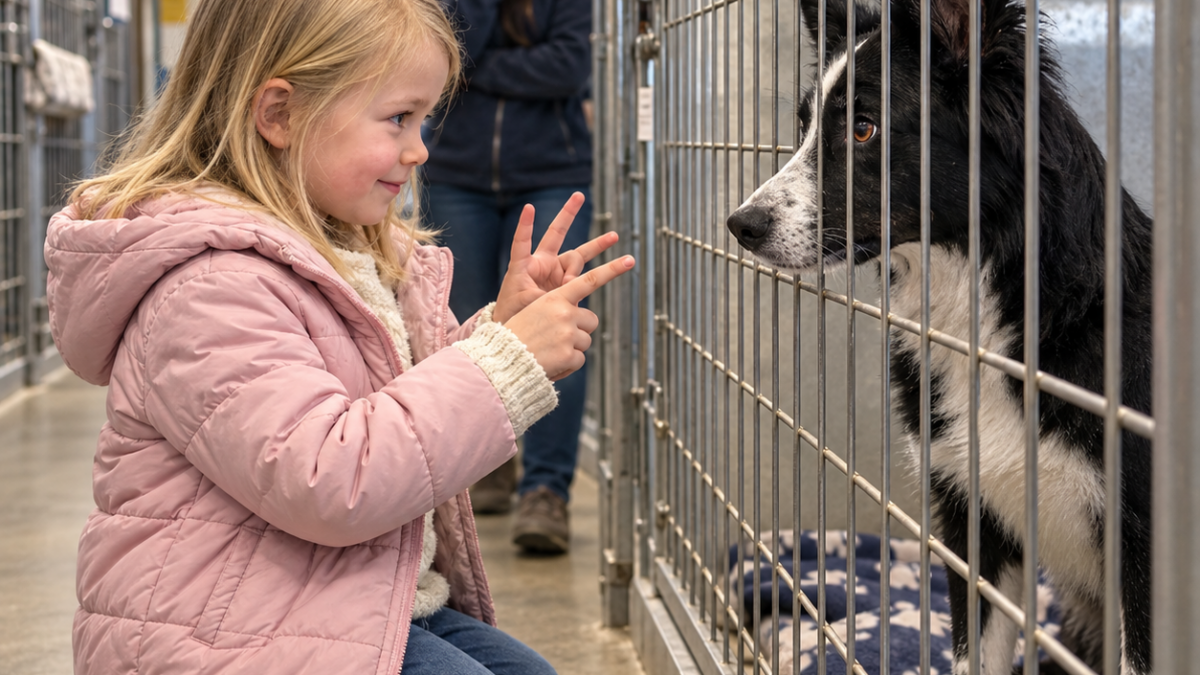
She raised her hand.
Signed:
Hello.
The dog looked toward a volunteer holding treats.
Ellie waited.
Signed again.
Hello.
Nothing.
She moved to the next kennel.
Another dog barked repeatedly at the group.
Ellie signed hello.
The dog paced past her.
Third kennel.
Hello.
Fourth.
Hello.
Fifth.
Hello.
I watched from several feet behind her.
At first, I smiled.
Then something began hurting inside me.
Not because the dogs were rejecting her.
They were dogs.
They did not know.
But I had watched my daughter do this with people.
Approach.
Try.
Wait.
Try again.
Move on.
She had learned remarkably young how to survive being unanswered.
That did not mean I liked watching it.
A shelter volunteer named Marissa noticed Ellie too.
She had been taking photographs of the class for the shelter’s private school-visit page.
Eventually she started filming Ellie.
Not because anything extraordinary had happened.
Because Ellie moved differently from the rest.
No shouting.
No banging on gates.
No trying to make the animals perform.
Just one careful greeting after another.
Hello.
Hello.
Hello.
Kennel nine.
Nothing.
Ten.
Nothing.
Eleven.
A dog briefly sniffed her fingers through the bars but followed another child with treats.
Ellie smiled anyway.
Twelve.
Thirteen.
Then fourteen.
I almost missed what changed.
Kennel fourteen held a black-and-white Border Collie mix.
Medium size.
Lean.
Alert ears.
Narrow face.
Bright brown eyes.
His name card read:
SCOUT
AGE: APPROX. 4 YEARS
NEUTERED
HOUSETRAINED
CALM HOME PREFERRED
Five months at shelter.
That last line caught my attention.
Five months was a long time.
Especially for a healthy, handsome dog.
Scout was not barking.
He stood several feet back from the kennel door.
While the other dogs reacted to movement around them, Scout seemed almost detached.
Then Ellie approached.
His head moved.
Not toward her face.
Toward her hands.
Ellie stopped.
Scout stared.
She slowly raised one hand.
Hello.
Scout’s ears came forward.
His whole body changed.
It was subtle.
But unmistakable.
Marissa lowered her phone.
Then raised it again.
Ellie looked at Scout.
Scout looked at Ellie’s fingers.
She signed:
Sit.
Scout sat.
Immediately.
No treat.
No spoken command.
No trainer.
My breath caught.
One of the teachers stopped talking.
Ellie blinked.
Then signed:
Stay.
Scout remained perfectly still.
A staff member farther down the hallway turned.
“What just happened?”
Ellie repeated sit.
Scout remained sitting.
Then she gave the hand signal she used whenever we met dogs belonging to deaf friends.
Good.
Scout’s tail moved.
Once.
Slowly.
Ellie looked at me.
Her eyes were huge.
I stepped closer.
“What did you do?” Marissa asked softly.
I signed the question to Ellie.
She answered with her hands.
I talked to him.
Scout was still watching.
Not me.
Not the volunteer.
Not the children.
Ellie.
More specifically, her hands.
She stepped toward the gate.
I almost told her to wait.
Then stopped myself.
Scout showed no tension.
No fear.
Just attention.
Ellie placed her palm flat against the wire.
Scout came forward.
Slowly.
He raised one paw.
Pressed it against the other side.
My hand flew to my mouth.
The hallway went quiet.
Not literally.
I knew dogs were still barking.
Children were still breathing.
Someone probably dropped something behind us.
But visually, everything seemed to stop.
One small hand.
One black-and-white paw.
Wire between them.
And my daughter looking at a dog as if she had finally discovered someone who had been waiting for exactly the language she carried.
Marissa whispered:
“Get Susan.”
Susan Hale, the shelter director, came quickly.
“What happened?”
Marissa pointed toward Scout.
“She gave him hand signals.”
Susan frowned.
“He knows basic commands.”
“With hand signals?”
“Some.”
Ellie signed sit again.
Scout obeyed.
Stay.
Scout stayed.
Come closer.
Scout moved toward the gate.
Susan’s expression changed.
“Wait.”
She crouched.
Tried a verbal command.
“Scout, sit.”
Nothing.
He glanced toward her.
Then back at Ellie.
Susan repeated louder.
“Scout. Sit.”
Nothing.
Ellie lifted two fingers and gave the visual cue.
Scout sat.
Susan stood slowly.
“Oh my God.”
I looked at her.
“What?”
She did not answer immediately.
Instead, she hurried toward the office.
Ellie sat cross-legged outside Scout’s kennel.
Scout lay down on the other side.
His nose nearly touching the wire.
The rest of the class eventually moved to another room.
Ellie refused.
I stayed.
Marissa stayed.
Scout stayed.
When Susan returned, she carried a thick paper file.
“We missed something.”
“What?”
She opened it.
“Scout came to us almost five months ago.”
“I saw.”
“He was surrendered.”
“Why?”
“Owner’s health.”
She scanned the pages.
“He’s never shown aggression. No major behavior problems. House-trained. Excellent health.”
“Then why hasn’t anyone adopted him?”
Susan sighed.
“That’s been frustrating.”
Families liked him initially.
Then something happened.
They called his name.
He often barely reacted.
Used verbal commands.
Sometimes he responded.
Sometimes not.
Tried cheerful voices.
Whistles.
Baby talk.
Nothing consistent.
“He seemed distant.”
I looked through the bars.
Scout was now watching Ellie sign something about her school lunch.
Distant was not the word I would have chosen.
Susan continued.
“People thought he wasn’t connecting.”
Then she pointed to one intake note.
Small.
Almost an afterthought.
RESPONDS BETTER TO VISUAL CUES.
My heartbeat changed.
“Visual cues.”
“Yes.”
“Who surrendered him?”
Susan read.
“Walter Keene.”
“Can you contact him?”
“We should.”
She looked again.
“Notes say owner is deaf.”
Everything clicked so quickly I felt dizzy.
I looked at Scout.
Then Ellie.
“His owner was deaf?”
“Yes.”
Susan flipped another page.
“Apparently Walter trained him himself.”
“How?”
“I don’t know.”
We found out twenty minutes later.
The shelter contacted Walter through a relay service.
He was sixty-eight.
Living in an assisted-care facility outside Butler after congestive heart problems and worsening mobility made caring for Scout impossible.
Susan spoke while a relay interpreter communicated.
I watched her expression change.
“Yes.”
Pause.
“I understand.”
Another pause.
“No, he’s healthy.”
Pause.
Then Susan’s eyes filled.
“He’s still here.”
Long silence.
She swallowed.
“I’m sorry.”
Later she told me Walter had believed Scout would be adopted within days.
Smart.
Calm.
Beautiful.
Well-trained.
He never imagined five months.
Then Susan explained what had happened with Ellie.
The relay interpreter conveyed Walter’s response.
He asked:
Does the child sign?
“Yes.”
ASL?
“Yes.”
Another long pause.
Then:
Scout watches hands.
Walter had raised Scout from adolescence.
He trained him with visual commands because speech was not part of Walter’s world.
Sit.
Stay.
Come.
Wait.
Food.
Walk.
Outside.
Bed.
Good.
No.
Friend.
Walter communicated through movement, routines, eye contact, and touch.
Scout had learned to study hands before faces.
When families came to Laurel Hill calling his name and talking constantly, Scout was not rejecting them.
He was waiting for information he understood.
“He wasn’t stubborn,” Susan whispered.
“No.”
“He wasn’t shutting down.”
“No.”
He was listening.
Just differently.
Exactly like Ellie.
I turned toward the kennel.
My daughter was signing to him.
My name Ellie.
Scout watched.
She pointed toward his name card.
Then signed something I could not see from the angle.
His tail began wagging.
Something inside me cracked.
For five years, I had watched people work to communicate with Ellie.
Some wonderfully.
Some impatiently.
Some after explanation.
Some only when forced.
Scout needed no explanation.
He understood her before anyone told him she was deaf.
I stepped into the hallway.
Needed air.
Marissa followed.
“You okay?”
I nodded.
Then immediately started crying.
So clearly I was doing wonderfully.
“I’m sorry.”
“Don’t apologize.”
I covered my mouth.
“It’s stupid.”
“It’s not.”
I looked through the observation window.
Ellie was still sitting with Scout.
“You don’t understand.”
Maybe she did.
Maybe not.
But once I started talking, I could not stop.
“People are kind to her.”
My voice broke.
“Most people really are.”
Marissa nodded.
“But they always need a second.”
I wiped my eyes.
“They need someone to say she’s deaf. Or explain the signs. Or tell them how to get her attention.”
I looked back at Scout.
“He didn’t.”
That was it.
That was why I cried.
My daughter had spent her entire life entering rooms where communication began with an explanation.
For once, she met someone who required none.
No adjustment period.
No pity.
No confusion.
She spoke.
He understood.
When I went back inside, Ellie stood.
She ran toward me.
Her hands moved quickly.
Mom.
He knows.
Then slower.
Making sure I understood every word.
He knows what I’m saying.
I knelt.
“Yes.”
Her eyes filled.
Can he come home?
There it was.
The question I had already answered that morning.
No.
Responsible answer.
Sensible answer.
Single mother.
Work schedule.
Vet bills.
Food.
Training.
Insurance.
A million reasons.
I looked toward Scout.
He had stood when Ellie stood.
Now he watched her.
Waiting.
I asked Susan:
“What does adoption involve?”
Ellie’s entire face changed.
Paperwork began less than an hour later.
I did not take Scout home immediately.
Despite the emotional story everyone was already beginning to tell, Laurel Hill had procedures.
Good.
I wanted them.
Background information.
Home check.
Veterinary history.
A supervised introduction outside the kennel.
Then a trial interaction room.
That was where I saw something even more remarkable.
The moment Scout entered, he looked for Ellie.
She was sitting on the floor.
He walked directly to her.
Stopped.
Waited.
She signed:
Come.
He came.
Sit.
Sat.
Down.
Down.
Then Ellie signed:
Friend.
Scout tilted his head.
She repeated it.
Friend.
Then touched her own chest.
Then pointed toward him.
Scout moved forward and placed his chin in her lap.
I lost whatever composure remained.
One of Ellie’s teachers cried too.
Marissa definitely cried.
Susan pretended she had something in her eye.
Before we left, the shelter called Walter again.
They told him we were beginning the adoption process.
After a long relay pause, Walter asked one question.
Can I meet the little girl?
Three days later, we returned.
Walter arrived in a transport van from his care facility.
He was thinner than I expected.
White hair.
Glasses.
A cane.
He moved slowly.
But when Scout saw him, the dog exploded.
Not aggressively.
Pure recognition.
Scout surged across the meeting room.
Rose onto his hind legs.
Put both paws against Walter’s chest.
Walter nearly lost his balance.
A staff member moved forward.
He waved them away.
Then wrapped both arms around Scout.
I had never seen a person cry so silently.
His whole face folded.
Scout licked his chin.
Pressed against him.
Whined—a sound Ellie could not hear, though she saw his body trembling.
Walter signed against Scout’s shoulder.
My boy.
Scout stared at his hands.
Still understood.
Of course.
Ellie stood behind me.
Nervous suddenly.
I touched her shoulder.
Go.
She approached Walter.
Tapped his arm gently.
Correct way to get his attention.
He turned.
Ellie signed:
Hello.
Walter stared.
Then his hands rose.
Hello.
Ellie’s mouth fell open.
Another adult who spoke her language.
She signed her name.
Walter signed his.
Scout moved between them.
Looking from one pair of hands to the other.
Walter asked:
You like Scout?
Ellie answered:
Very much.
He likes you.
Ellie looked at Scout.
Then back at Walter.
She signed something.
Walter began laughing.
Silent.
Tears running down his face.
I could not see her hands.
“What did she say?” I signed.
Ellie repeated it.
I will take good care of him.
Walter stopped laughing.
His face crumpled.
He took Ellie’s hands gently between his.
Then signed:
That is all I wanted.
I turned away because there are moments a stranger deserves privacy even when you are standing five feet away.
Walter told us Scout’s story.
His wife had died six years earlier.
He had gotten Scout after.
“At first,” he signed through the interpreter, “I thought I was training him because I needed a dog who understood visual commands.”
He smiled.
“Then I realized he was training me not to disappear.”
Walter lived alone for years.
Scout became routine.
Morning walks.
Medication reminders.
Company.
Presence.
When Walter’s heart condition worsened, he fell twice.
The second fall kept him on the floor almost five hours before help arrived.
That was when his doctor said living alone was no longer safe.
Walter resisted.
Until he looked at Scout.
He knew he could no longer give the dog proper exercise.
So he surrendered him.
“It was the hardest responsible decision I ever made,” he signed.
“I thought someone would see what I saw.”
He looked toward Scout.
“They saw a quiet dog.”
I thought about Ellie.
How often people saw a quiet girl.
Not because she had nothing to say.
Because they did not know how to listen.
The adoption became official the following week.
Scout entered our house cautiously.
He inspected the living room.
Kitchen.
Hallway.
Ellie’s bedroom.
Then returned to Ellie.
She showed him his bed.
He ignored it.
That first night, he slept on the floor beside hers.
By the fourth night, he was at the foot of her bed.
Within a week, our house had changed.
Not loudly.
Scout was not a noisy dog.
It changed through movement.
Ellie came home from school and immediately had someone waiting for her hands.
She signed stories.
Scout watched.
Did he understand every sign?
Of course not.
But he understood attention.
Routine.
Emotion.
And far more visual language than I would have believed possible.
Walter gave us a list.
More than forty signals.
Walk.
Water.
Eat.
Outside.
Stop.
Come.
Stay.
Car.
Toy.
Wait.
Bathroom.
Bed.
Good.
Finished.
Soon Ellie started adding her own.
School.
Mom.
Cookie.
Love.
Scout learned cookie suspiciously fast.
He also became protective of Ellie in ways that were never aggressive.
At playgrounds, he watched.
At crowded events, he stayed close.
If Ellie became overwhelmed by too much visual movement, he pressed against her leg.
Not trained service behavior.
Simply Scout.
The first major change in Ellie happened three months later.
Her school held a family reading night.
Usually Ellie avoided group activities involving turn-taking conversations.
Too many people speaking.
Too many mouths to track.
Too much missed information.
That evening, Scout was allowed to attend a classroom demonstration about shelter adoption.
Ellie stood in front of fifteen children.
Scout beside her.
And she taught them five signs.
Hello.
Dog.
Friend.
Good.
Thank you.
Children copied her.
Badly.
Enthusiastically.
Ellie corrected them.
Patiently.
One boy signed dog incorrectly three times.
Ellie finally grabbed his fingers and repositioned them.
Everybody laughed.
Including her.
I sat at the back crying into a paper cup of terrible coffee.
Her teacher leaned over.
“You okay?”
“No.”
She smiled.
“Good tears?”
“The expensive kind.”
Scout had not given Ellie language.
She already had language.
He gave other people a reason to enter it.
That distinction mattered enormously to me.
The video from the shelter eventually spread around town.
We did not post it ourselves.
Laurel Hill asked permission.
I agreed only if the focus remained adoption and accessibility.
People responded.
Some wanted to meet Ellie.
I said no.
She was five.
Not a mascot.
But something useful happened.
Families started asking the shelter about visual training.
Volunteers began learning basic hand signals.
Kennel cards changed.
Instead of simply listing “good with children” or “house-trained,” staff documented communication preferences.
Visual responder.
Hand-signal trained.
Noise sensitive.
Touch motivated.
Slow approach.
Suddenly dogs that had been called stubborn were being described more accurately.
One older dog named Benny had been considered “unresponsive.”
Turned out he had significant hearing loss.
A volunteer began using visual cues.
He was adopted three weeks later.
Another dog shut down around loud voices.
Staff changed how introductions were conducted.
She found a home.
Susan told me one afternoon:
“Scout changed the way we look at every dog here.”
I corrected her.
“Ellie did too.”
Susan smiled.
“They changed us together.”
Walter remained part of our lives.
Once a month, when his health allowed, I drove Ellie and Scout to visit him.
Scout always knew when we were close.
Ten minutes before arriving, he became restless.
At the facility entrance, he pulled gently.
Then the moment Walter appeared, he transformed.
Old relationship restored instantly.
Ellie and Walter became friends too.
Real friends.
Not symbolic.
They argued.
Walter thought Ellie was spoiled.
Ellie thought Walter’s cardigans were ugly.
He taught her older regional signs she had never seen.
She taught him modern ones.
Once they spent almost ten minutes debating whether Scout deserved part of Walter’s sandwich.
I asked what they decided.
Ellie signed:
Walter is wrong.
Walter signed:
Child is dictator.
Scout got the sandwich.
A year passed.
Then another.
Walter’s heart worsened.
He entered hospice shortly after Ellie turned seven.
I debated whether to tell her everything.
Then remembered the promise I had made myself after her diagnosis.
Never confuse protecting her with hiding truth from her.
So I explained.
Walter was dying.
His body was tired.
Doctors could not fix it.
Ellie stared at me.
Then signed:
Will Scout understand?
That question broke me.
“I don’t know.”
We visited the next day.
Walter looked smaller.
Scout moved slowly toward the bed.
For the first time in years, he did not jump.
He simply placed his chin beside Walter’s hand.
Walter’s fingers found his head.
Ellie stood on the other side.
Walter opened his eyes.
Saw her.
Signed weakly:
Good girl.
Ellie shook her head.
Pointed at Scout.
Good dog.
Walter smiled.
Then signed:
Good family.
Ellie cried.
She climbed carefully onto the edge of the bed.
Walter took her hand.
With great effort, he signed:
Thank you.
Ellie answered:
For what?
Walter looked toward Scout.
Then back at her.
For speaking to him.
Ellie frowned.
As if the answer were obvious.
He spoke first.
Walter stared.
Then laughed silently.
That was the last conversation they had.
Walter died two days later.
The assisted-living facility called me before breakfast.
I sat at the kitchen table.
Scout was beneath it.
Ellie came in.
Saw my face.
She knew.
Children always know before adults are ready.
Walter?
I nodded.
She stood still.
Then went to Scout.
Knelt.
Put both arms around him.
Scout licked her cheek.
Ellie signed into his fur even though he could not see her hands.
He loved you.
That was the first time I understood that sign language did not require an audience to carry love either.
We attended Walter’s memorial.
His family was small.
A niece from Ohio.
Former neighbors.
Staff from the care facility.
Susan from Laurel Hill.
Scout lay beside Ellie.
Near the end, Walter’s niece approached us with a box.
“He wanted Ellie to have this.”
Inside was Scout’s first collar.
Old leather.
Worn smooth.
A stack of photographs.
Scout as a puppy.
Scout beside Walter’s chair.
Scout wearing a ridiculous winter sweater.
Scout asleep beneath a table.
And a handwritten note.
Walter had written it before his hands became too weak.
The note was short.
Ellie,
People thought Scout was difficult because they kept speaking in ways he did not understand.
Never let anyone convince you that being misunderstood means you have nothing worth saying.
You recognized each other.
Take care of my boy.
And let him take care of you.
Walter.
I read it aloud for myself.
Then signed it to Ellie.
By the end, I could barely see my hands through tears.
Ellie took the note.
Pressed it against her chest.
Scout placed his paw on her shoe.
Years have passed since kennel fourteen.
Ellie is older now.
More confident.
Still deaf.
Still entirely herself.
Scout is older too.
Gray beginning around his muzzle.
He no longer jumps as quickly.
He sleeps more.
But every morning, Ellie comes downstairs and signs the same thing she signed through the shelter gate all those years ago.
Hello.
Scout looks at her hands.
Every single time.
Then his tail moves.
He answers in the language he has always known best.
Attention.
Presence.
Trust.
People still occasionally tell me Scout “gave Ellie a voice.”
I correct them.
He did not.
My daughter had always had one.
Her hands were her voice.
Her face was her voice.
Her entire body could tell a story if someone cared enough to watch.
Scout simply understood that before most of us did.
And Ellie did something equally important for him.
She proved he had never been distant.
Never stubborn.
Never broken.
He was not waiting for someone louder.
He was waiting for someone who knew how to listen with their eyes.
Sometimes I think about that first shelter morning.
The dogs spinning.
Children shouting.
Teachers trying to maintain order.
Ellie moving quietly from kennel to kennel.
Hello.
Hello.
Hello.
Thirteen dogs did not answer.
Then number fourteen looked at her hands.
One small moment.
Easy to miss.
But lives often change that way.
Not with dramatic speeches.
Sometimes change begins because someone notices the way another person is trying to communicate.
A child.
A dog.
An old man.
Anyone.
I spent years telling Ellie the right people would wait long enough to understand her.
I was wrong about one thing.
Scout did not have to wait.
He understood immediately.
And maybe that is why, even now, whenever I see him watching my daughter’s hands, I remember the sentence she signed to me in that shelter hallway.
He knows what I’m saying.
Yes.
He did.
And from the very first moment at kennel fourteen, I think Scout knew something too.
He had finally found someone who understood exactly what it felt like to live in a world that kept mistaking silence for having nothing to say.








