A Combat Nurse Was Left Alone With 3 Battle-Tested Military K9s to “Teach Her a Lesson”—Then One Dog Retrieved a Lost Medic Pouch and All Three Sat Beside Her
PART3:
His knees were not the main injury.
I smiled.
“No.”
He looked at me.
“What really hurts?”
That irritated him.
Good questions sometimes do.
He stared at the floor.
Then said:
“My granddaughter thinks heroes don’t need wheelchairs.”
There it was.
Not pain.
Shame.
He had promised his seven-year-old granddaughter he would walk into her school when he came home.
Now he was imagining her seeing him seated.
Nobody had asked.
They saw refusal.
He was seeing failure.
That afternoon, I arranged a video call.
His granddaughter appeared wearing a superhero cape.
She held up three drawings.
Every hero had a wheelchair.
One had rockets attached.
Hal cried.
Pretended he had dust in his eye.
The next morning, he volunteered for extra physical therapy.
That story traveled faster through Falcon Point than I wanted.
Then came Petty Officer Marcus Hale.
Burn recovery.
Every dressing change became a fight.
Not violent.
Panic.
His pulse spiked.
Breathing changed.
He snapped at nurses.
Someone recommended light sedation.
I noticed something during rounds.
A corpsman mentioned jazz.
Marcus smiled for half a second.
“What song?”
He frowned.
“What?”
“What were you listening to?”
“When?”
“Deployment.”
He looked at me like I had lost my mind.
Then answered.
“My mom had this old jazz playlist.”
“What kind?”
“Ella Fitzgerald. Coltrane. Stuff she liked.”
Next dressing change, we played it.
No miracle.
He still hurt.
He still gripped the bedrail.
But the panic never took over.
Afterward he whispered:
“Can we do that again tomorrow?”
Little observations.
Little changes.
That became my reputation.
Not medicine.
Listening.
Some people admired it.
Some thought it was soft.
The military working dog instructors were mostly in the second category.
Falcon Point had one of the most respected K9 assessment programs in the region.
Handlers came through with dogs returning from deployment.
Some needed medical clearance.
Some behavioral evaluation.
Some reassignment.
Some retirement.
The people who ran that program were disciplined, experienced, and justifiably protective of what they knew.
They did not especially care that I had opinions about stress behavior.
One instructor joked within earshot:
“She’s probably excellent with patients, but dogs don’t care about bedside manner.”
I looked up from a chart.
He realized I heard.
I smiled.
“Good thing I don’t have bedside manner.”
He laughed nervously.
I went back to work.
The following Monday, three military transport vehicles arrived.
The dogs inside had reputations.
Even I knew the names.
Viper came out first.
Belgian Malinois.
Lean.
Amber eyes.
His entire body seemed built around forward motion.
He had spent years detecting explosive compounds during special operations missions.
Viper did not simply look around.
He processed.
Sound.
Movement.
Airflow.
Objects.
People.
When his attention shifted, handlers paid attention too.
Next came Kodiak.
Sable German Shepherd.
Massive.
Calm.
Where Viper reacted in fractions of a second, Kodiak seemed to collect information before deciding it deserved a response.
His handler described him this way:
“Kodiak thinks while the rest of us are still reacting.”
He had a reputation for loyalty so strong that retired handlers still received recognition from him years later.
Then Echo.
Dutch Shepherd.
Smaller than Kodiak.
Quieter than Viper.
Somehow more unsettling.
Echo specialized in casualty search.
He had worked environments where there were no clean paths and no one could explain what needed finding.
Collapsed structures.
Combat zones.
Mass casualty scenes.
His handlers had a saying:
“You don’t tell Echo what happened. Echo tells you.”
I liked him immediately.
Which was unfortunate because the instructors decided the three dogs would be my introduction to their world.
Master Chief Alden Pierce ran the program.
Fifty-two.
Silver beginning in his hair.
A career built on experience, rules, and a deep refusal to tolerate sloppy thinking.
I respected him.
He respected me in the abstract.
Meaning he believed I was probably a competent nurse.
He did not believe competence transferred across disciplines.
Fair.
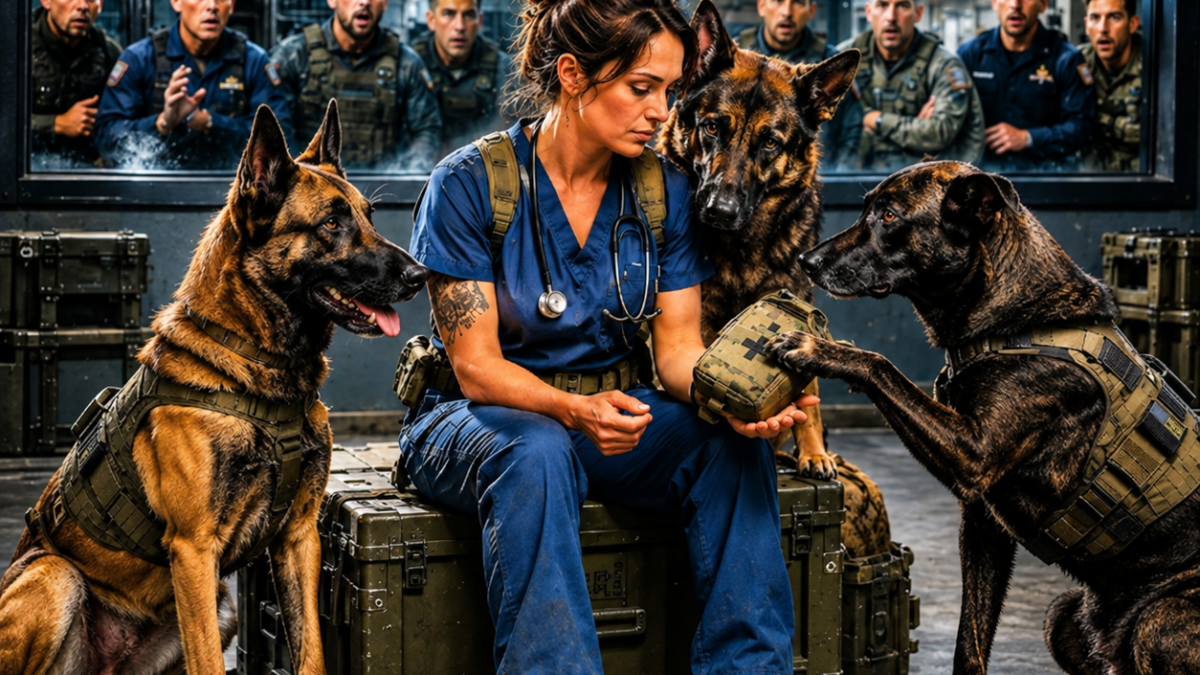
The evaluation arena was enclosed by reinforced fencing and an observation room behind thick glass.
More than twenty instructors gathered.
Veterinarians.
Handlers.
Behavior specialists.
Pierce stood at the front.
“Today’s scenario is simple.”
I already disliked that sentence.
“No handlers inside.”
He continued.
“No spoken commands.”
Good.
“No reward toys.”
Fine.
“No food.”
Also fine.
He looked toward me.
“You enter.”
I raised an eyebrow.
“The dogs decide.”
One young instructor whispered:
“Three minutes.”
Someone beside him said:
“Maybe.”
I removed my watch.
Placed it in a locker.
Pierce noticed.
“Why?”
“People behave differently when they’re measuring time.”
“So do dogs.”
“I know.”
The steel gate opened.
I entered.
Then it closed behind me.
Viper moved immediately.
Circle.
Fast.
Silent.
Not threatening.
Evaluating.
Kodiak stayed several yards away.
Seated.
Eyes on me.
Echo walked toward the equipment section.
Then disappeared.
I did not follow.
Outside, someone said something through the observation microphone.
I could not hear the words clearly.
Did not care.
I pulled an empty medical supply crate toward the wall.
Sat.
Hands relaxed on my knees.
No direct staring.
No reaching.
No talking.
Nothing.
That was apparently disappointing.
People often expect interaction to mean action.
Sometimes action is the problem.
Viper made another circuit.
I kept breathing normally.
He came closer.
Three feet.
Two.
Moved past.
I did not turn.
Another circle.
Then slower.
Kodiak remained seated.
Watching.
My left shoulder started itching.
I ignored it.
Five minutes may feel short outside an arena.
Inside, while twenty professionals watch you do nothing, it feels significantly longer.
Viper stopped circling.
Sniffed near the crate.
Then lay down.
Behind the glass, heads moved.
Kodiak stood.
Walked toward me.
Slowly.
I did not move.
He came to my right side.
Sat.
No command.
No invitation.
Simply chose the space.
I breathed out.
“Hello,” I whispered before remembering the rule.
No verbal commands.
Hello was not a command.
Still, I shut up.
Kodiak’s ear moved.
He stayed.
Echo had not returned.
That bothered the instructors more than it bothered me.
I could see movement through the glass.
Someone checking monitors.
Pierce speaking sharply.
Then Echo emerged from the storage section.
Something was in his mouth.
Fabric.
Olive green.
Faded.
Old.
He carried it carefully.
Not a toy.
Not random equipment.
A tactical medic pouch.
The moment I saw it, something in my chest tightened.
Military medical gear has a visual language.
Wear marks.
Field repairs.
Tape.
Faded blood-type patches.
The pouch Echo carried had lived a life.
He walked past Viper.
Past Kodiak.
Straight to me.
Placed it beside my boot.
Then sat.
Three dogs around me now.
Viper lying several feet ahead.
Kodiak at my side.
Echo in front.
Nobody outside spoke.
I looked at Echo.
“Thank you.”
The rule was officially dead.
I picked up the pouch.
Pierce entered through the gate almost immediately.
“No.”
His face had changed.
“What?”
He stared at the pouch.
“That can’t be.”
I held it out.
“You recognize it.”
He did not answer.
He crouched.
Touched the worn fabric.
“Where did he get this?”
I nodded toward Echo.
“You have cameras.”
Pierce looked toward the storage room.
Then back.
“That cabinet hasn’t been opened in months.”
The arena door opened again.
A senior veterinarian entered.
Then another instructor.
The dogs stayed relaxed.
That detail mattered.
Pierce opened the pouch.
Field notebooks.
Casualty cards.
Blood type references.
Handwritten treatment notes.
Weather damage.
Faded ink.
He picked up the first notebook.
His face lost color.
Across the front:
SENIOR CHIEF ELLIS GRANGER.
Pierce sat back on his heels.
“I remember these.”
Someone behind us said:
“Granger?”
Pierce flipped pages.
Airway procedures.
Evacuation sketches.
Improvised stabilization techniques.
Notes on working-dog trauma.
Field observations.
“This disappeared two years ago.”
I looked at Echo.
He stared back as if everyone else was unusually slow.
Pierce continued.
“Equipment transfer after the crash.”
“What crash?”
“He was medevaced after a helicopter accident. His personal field gear was packed and transferred between facilities.”
Pierce turned another page.
“He thought this was gone.”
An instructor whispered:
“How did Echo know?”
Nobody answered.
I had an idea.
Not certainty.
Dogs do not solve mysteries because stories need symbolism.
They follow information.
Scent.
History.
Pattern.
Maybe Echo had encountered Granger’s gear before.
Maybe that cabinet retained scent.
Maybe he had been searching the arena because something familiar existed where nobody else remembered to look.
Whatever the exact mechanism, he had found it.
Pierce looked at me.
“We brought you in here because we thought the dogs would teach you a lesson.”
I smiled.
“I think they did.”
Someone asked:
“Why are they all sitting with you?”
Before I could answer, Commander Paul Merrick, the senior military veterinarian, spoke from behind us.
“I know.”
I turned.
He looked at me.
“I served with Captain Rowan overseas.”
I closed my eyes briefly.
Here we go.
Merrick continued.
“After combat medical shifts, she used to volunteer in our veterinary stabilization tent.”
Pierce looked at me.
“You never mentioned that.”
“It wasn’t relevant.”
Merrick laughed.
“It appears extremely relevant.”
He looked toward the instructors.
“She cleaned wounds.”
I stared at him.
“Paul.”
“Sat with dogs after anesthesia.”
“Paul.”
“Stayed through the night when handlers were injured.”
“That is enough.”
“No, actually.”
He pointed toward Viper.
“Dogs like these learn patterns in people.”
Then Kodiak.
“Predictability.”
Then Echo.
“Emotional regulation.”
He looked back at me.
“She never rushed them.”
The room became quieter.
I said, “They don’t remember me.”
“Not individually,” Merrick replied. “Probably not.”
Exactly.
This mattered.
I did not want the moment turned into magic.
“These dogs have never met me,” I said.
Pierce nodded.
“So why this?”
“Because trust has ingredients.”
I looked at Kodiak.
“Body language.”
Viper.
“Pressure.”
Echo.
“Predictability.”
I gestured toward the crate where I had sat.
“They were asked to evaluate me.”
“So I let them.”
Pierce considered that.
“You didn’t try to establish control.”
“No.”
“Why?”
“Because you told me they decide.”
For the first time, he smiled.
The next morning, I was summoned to address the K9 instructors.
I objected.
Pierce ignored me.
“I think you invited the wrong person.”
“I don’t.”
“I am not a dog trainer.”
“Exactly.”
That was not comforting.
The old pouch sat inside a temporary evidence case while military historians verified its chain of custody and contents.
I stood in front of the instructors without notes.
“I don’t have a technique.”
Several faces said they did not believe me.
“I mean it.”
A younger handler raised his hand.
“Then what happened yesterday?”
“I sat down.”
Light laughter.
I continued.
“When I worked forward surgical teams, I helped veterinary personnel after my medical shifts.”
“Why?”
“Because wounded working dogs were patients.”
Nobody laughed.
“I noticed something.”
I looked around.
“Commands mattered.”
A few handlers nodded.
“Training mattered.”
More nods.
“But when an animal was injured, disoriented, or frightened, commands were not the first thing deciding whether treatment could happen.”
“What was?”
“Safety.”
Someone asked:
“You mean calming them?”
“No.”
I shook my head.
“Calm is an outcome. Safety is a perception.”
That got their attention.
“A dog under stress is asking questions before you ever issue a command.”
I counted them.
“What are you?”
“What do you want?”
“Will you force me?”
“Can I predict you?”
“Are you listening to what I’m telling you?”
Pierce folded his arms.
One handler said:
“Training should override that.”
“Sometimes.”
I nodded.
“But training works through the nervous system, not outside it.”
Silence.
“If the animal is so overwhelmed that it cannot process normally, repeating commands louder does not necessarily create obedience.”
The handler frowned.
“So you’re saying commands are irrelevant?”
“No.”
“Then?”
“Trust determines how much training remains available under stress.”
That sentence became the center of everything that followed.
Pierce said:
“How do you earn trust?”
“Consistency.”
I held up one finger.
“Patience.”
Second.
“Predictability.”
Third.
“Respect for intelligence.”
Fourth.
“No tricks?”
“Plenty of technical skill.”
I smiled.
“But no shortcut.”
Pierce looked at the room.
“We spend years teaching obedience.”
Then at the three empty kennels visible through the glass.
“Maybe we should spend equal time teaching people what trust looks like.”
That afternoon, Falcon Point began rewriting its evaluation model.
Not because three dogs sat beside a nurse.
That would have been ridiculous.
Because the incident exposed a gap.
Handlers evaluated performance.
Veterinarians evaluated health.
Medical staff understood trauma physiology.
Behavior specialists evaluated stress.
But those groups often worked sequentially.
Not together.
We proposed an interdisciplinary model.
Handlers.
Veterinarians.
Behavior specialists.
Combat nurses.
Rehabilitation teams.
One dog.
One picture.
Not four isolated opinions.
Pierce became the strongest supporter.
That surprised me.
I told him.
“You expected resistance?”
“Yes.”
“Why?”
“You enjoy being right.”
“So do you.”
“True.”
He smiled.
“Difference is I enjoy fixing things more.”
Three weeks later, Ellis Granger came to Falcon Point.
Retired Senior Chief.
Helicopter crash had ended his career.
He walked with a limp.
Carried himself like a man who still measured rooms automatically.
The medic pouch sat on a conference table.
When he entered, he stopped.
For several seconds, nobody spoke.
Then Granger whispered:
“I thought that was gone.”
He approached.
Touched it.
Did not open it immediately.
His hand stayed on the fabric.
“Where?”
Pierce pointed toward Echo.
The Dutch Shepherd lay beside my chair.
Granger looked at him.
“You?”
Echo’s tail moved.
The room laughed softly.
Granger opened the pouch.
One notebook.
Then another.
His fingers slowed at every page.
Weather stains.
Folded corners.
Handwriting pressed into paper during places where desks did not exist.
“I was going to submit these after retirement.”
“What happened?” I asked.
“Crash.”
He shrugged.
“Then recovery. Transfers. Gear missing.”
He smiled without humor.
“Life.”
Military medical researchers reviewed the notebooks.
Most contained personal observations.
Some outdated.
Some incomplete.
But several recommendations had never entered formal manuals.
Field airway stabilization.
Movement of casualties in confined spaces.
Improvised positioning when standard equipment failed.
Working-dog trauma notes.
Evacuation sequencing.
Not revolutionary theories.
Practical improvements written by someone who had done the work enough times to know where procedure and reality diverged.
After formal review, several concepts were incorporated into updated training.
Granger hated being called a legacy.
“I’m not dead.”
Pierce said, “Then stop writing like a ghost.”
He laughed.
Something else happened during Granger’s visit.
Echo kept returning to him.
Not constantly.
Just enough.
Granger noticed.
“Did we ever work together?”
Pierce checked records.
Years earlier, Echo had trained briefly with a unit that shared staging areas with Granger.
Maybe scent.
Maybe memory.
Again, no magic.
Just information surviving longer than people expected.
That became a theme at Falcon Point.
Viper’s evaluation revealed he was not “hypervigilant” in every environment.
He struggled specifically with unpredictable metallic impacts behind him.
Once trainers isolated that, they changed desensitization work.
He returned to explosive detection.
Kodiak showed a different problem.
After deployment, he remained excellent operationally but increasingly attached himself to injured personnel during rehabilitation visits.
Instead of treating that as distraction, the team realized his temperament suited outreach.
He transferred into a military rehabilitation program.
Veterans trusted him almost immediately.
Echo entered advanced casualty response training.
Of course he did.
He was built for questions nobody had answered yet.
Before the dogs left Falcon Point, their handlers arranged one final visit.
I did not know.
I was outside in the rehabilitation courtyard teaching new combat nurses battlefield assessment.
Viper came first.
Walked away from his handler.
Straight toward me.
Sat.
I scratched behind his ears.
“Good boy.”
He returned.
Then Kodiak.
Massive body.
Calm eyes.
He came close.
Leaned against my shoulder for several seconds.
Then walked back.
Finally Echo.
No pouch.
No dramatic discovery.
He simply approached.
Placed his head beneath my hand.
Waited.
I touched him.
Then he returned to formation.
The recruits stared.
One whispered:
“They’re saluting her.”
Pierce stood behind them.
“In their own way.”
I heard him.
“Don’t encourage that.”
He laughed.
The interdisciplinary program grew.
First inside Falcon Point.
Then other military hospitals asked for training materials.
Rehabilitation centers wanted demonstrations.
Veterinary teams visited.
Combat nurses began participating in K9 stress evaluations.
Handlers sat in human trauma simulations.
Veterinarians joined mass casualty exercises.
The walls between specialties became less useful.
Someone named the model the Rowan Protocol.
I objected violently.
By which I mean I sent three strongly worded emails.
Nobody cared.
The guiding line ended up on classroom walls:
TRUST IS ASSESSED BEFORE COMMANDS ARE GIVEN.
I could live with that.
Mostly.
Within a year, elements of the program were adopted across several military rehabilitation facilities.
Not every dog needed it.
Not every situation required it.
That mattered too.
Good systems do not turn one lesson into religion.
They add another tool.
Another question.
Another way to avoid misreading behavior.
I saw the value most clearly with a dog named Juno.
Young Malinois.
Excellent training scores.
Suddenly failing rehabilitation exposure.
Handlers thought she was becoming unreliable.
During evaluation, she repeatedly refused to enter one specific corridor.
Not all corridors.
That one.
Old model might have classified avoidance.
Interdisciplinary team checked everything.
Lighting.
Floor surface.
Airflow.
Noise.
One rehabilitation nurse noticed that a portable oxygen concentrator emitted a faint high-frequency tone.
Most humans barely noticed.
Juno did.
The machine was moved.
Behavior disappeared.
Not stubbornness.
Information.
That became one of my favorite cases.
Not dramatic.
No hero.
Just people paying attention before labeling failure.
Pierce changed too.
He became less interested in proving dogs could perform and more interested in understanding why performance changed.
One afternoon, I found him sitting outside Kodiak’s rehabilitation area.
No clipboard.
No evaluator posture.
Just sitting.
I smiled.
He looked over.
“What?”
“Nothing.”
“You look pleased with yourself.”
“I usually am.”
“I hate that.”
“So do I.”
He nodded toward Kodiak.
“Been here twenty minutes.”
“Why?”
“Removing pressure.”
I laughed so hard the dog looked at me.
“Careful, Master Chief. Someone may think you have bedside manner.”
He told me to leave.
Granger became a regular guest instructor.
His notebooks were digitized.
Originals preserved.
The pouch remained at Falcon Point for training ceremonies when he agreed to lend it.
He always insisted:
“The pouch isn’t important.”
Then touched it every time he walked past.
Humans are inconsistent.
Dogs probably find us exhausting.
One year after the original arena test, Falcon Point held graduation for new military medical officers.
I was asked to speak.
I tried refusing.
Pierce used the same argument as before.
“You don’t have to like visibility to be useful while visible.”
That annoyed me because it sounded like something I would say.
So I agreed.
The restored pouch sat on a table beside me.
I looked across the auditorium.
New physicians.
Nurses.
Corpsmen.
Rehabilitation officers.
K9 personnel.
People about to enter systems that would reward certainty.
I wanted them to remember uncertainty had value too.
“When I arrived at Falcon Point,” I began, “I was told three military dogs were going to teach me a lesson.”
Laughter.
“They did.”
I put one hand on Granger’s pouch.
“They reminded me that medicine sometimes becomes too interested in action.”
The room quieted.
“We intervene.”
“We correct.”
“We command.”
“We stabilize.”
“All necessary.”
I looked toward the doors.
“But before any person or animal trusts what we do, they make a simpler decision.”
“Do I feel safe with you?”
Silence.
“You cannot demand the answer.”
“You cannot outrank it.”
“You cannot rush it.”
I thought about Hal and his wheelchair.
Marcus and jazz.
Viper circling.
Kodiak watching.
Echo disappearing.
“You earn trust through small choices.”
“Consistency.”
“Patience.”
“Predictability.”
“Listening before deciding what behavior means.”
I paused.
“Sometimes the strongest thing you can do in a crisis is step forward.”
Then smiled.
“Sometimes it’s sit down.”
The applause embarrassed me.
Still does when I remember it.
Afterward, everyone moved into the courtyard.
Bright afternoon.
Handlers.
Families.
Graduates.
Viper was there.
Kodiak.
Echo.
Older.
Still working.
I was speaking with Granger when the courtyard changed.
Not dramatically.
Just movement.
All three dogs stood.
No visible command.
Their handlers looked at one another.
Viper moved first.
Kodiak beside him.
Echo last.
They crossed the courtyard.
Together.
Not perfectly military despite what people later claimed.
Dogs are still dogs.
But close enough that everyone noticed.
They stopped in front of me.
Sat.
Three pairs of eyes.
I looked toward the handlers.
Nobody had cued them.
Pierce folded his arms.
Smiling.
“Don’t.”
He said nothing.
I looked at Viper.
Then Kodiak.
Then Echo.
“Thank you.”
For several seconds, they stayed.
Then returned to their handlers.
Nobody in the courtyard seemed eager to speak first.
Granger leaned toward me.
“Not bad for bedside manner.”
I laughed.
That should probably have been the ending.
Stories prefer symmetry.
Nurse enters arena.
Dogs surprise everyone.
Lost pouch found.
Program changes.
Dogs offer final salute.
Beautiful.
Life kept going.
The program made mistakes.
We adjusted.
Some instructors resisted.
Some eventually agreed.
Some never did.
Not every dog responded to every technique.
Not every human learned the same lesson.
That was fine.
Trust is not a trick you perform.
It is a relationship between information and experience.
Years later, younger nurses sometimes ask how I knew what to do in that arena.
I tell them the truth.
I didn’t.
That disappoints them.
They want expertise to feel like certainty.
It rarely does.
I knew what not to do.
Do not crowd.
Do not stare.
Do not perform confidence.
Do not turn the animals into a test of ego.
Do not assume silence means nothing is happening.
So I sat.
Viper assessed.
Kodiak decided.
Echo searched.
That was enough.
The most important discovery that day was not Granger’s pouch.
Important as it was.
The notebooks preserved knowledge that helped future medics.
But objects can be recovered.
Procedures can be rewritten.
The deeper recovery happened inside the people watching.
They expected control to create trust.
Three dogs showed them the order often runs the other way.
Trust first.
Then cooperation.
Then performance.
That lesson changed Falcon Point because it was never really about dogs alone.
I saw it with patients every day.
The Marine ashamed of his wheelchair.
The corpsman terrified of dressing changes.
The veteran who refuses therapy because he is afraid improvement will never be enough.
The handler who cannot retire his dog because retirement feels like abandoning a teammate.
People are always telling you what they need.
Not always in words.
My entire career has been built around that.
Pay attention.
The old slogan from Falcon Point eventually disappeared from classroom walls during renovations.
Someone called me asking whether we should replace it.
I said yes.
But I changed one word.
The new version read:
TRUST IS UNDERSTOOD BEFORE COMMANDS ARE GIVEN.
Pierce called immediately.
“You changed my line.”
“It was never your line.”
“Why ‘understood’?”
“Because assessed sounds like something we do to them.”
Silence.
Then:
“Fine.”
“Thank you.”
“I still prefer assessed.”
“I know.”
He retired the following year.
At his ceremony, Viper was already fully retired.
Kodiak had slowed.
Echo still trained younger dogs occasionally.
Pierce thanked everyone.
Then surprised me.
He told the original arena story.
Badly.
Made himself sound more skeptical than he had actually been.
Made me sound wiser than I had been.
I corrected him afterward.
He said:
“That’s what retirement is for. Improving the story.”
Granger attended.
Walked with a cane now.
Carried the old pouch.
At the end of the ceremony, he gave it to Falcon Point permanently.
Not as a museum piece.
As a teaching object.
His note attached to it said:
These pages were nearly lost because everyone assumed lost meant gone.
Remember that about people too.
I stood in front of those words for a long time.
That might have been the best lesson any of us received.
People get labeled.
Difficult.
Noncompliant.
Aggressive.
Withdrawn.
Unmotivated.
Broken.
Dogs too.
Sometimes those labels are accurate descriptions of behavior.
They are almost never complete explanations.
Viper was not simply restless.
Kodiak was not simply passive.
Echo was not wandering.
Hal was not stubborn.
Marcus was not difficult.
And I was not a nurse with some mysterious gift for dogs.
We were all responding to information.
History.
Fear.
Pain.
Memory.
Trust.
That is why I still tell young clinicians the same thing I said before Falcon Point ever knew my name.
“I learned to pay attention.”
Not because attention fixes everything.
It does not.
Some patients die.
Some dogs cannot return to work.
Some injuries do not heal.
Some trust, once broken, takes years.
But attention gives you the chance to respond to what is actually happening instead of the story you invented too early.
The day they locked me inside that arena, twenty instructors thought they were observing three military working dogs evaluate a nurse.
They were.
They just misunderstood who else was being evaluated.
Viper watched me.
Kodiak watched me.
Echo watched me.
And behind reinforced glass, every human in that room revealed something too.
What they expected.
What they assumed.
What they believed leadership should look like.
Three dogs changed those assumptions without one command.
One circled until he decided I was not a threat.
One sat beside me because he chose to.
One disappeared into the past and brought back something everyone else had stopped searching for.
That faded medic pouch eventually helped shape future battlefield medicine.
The evaluation helped change working-dog rehabilitation.
The program brought professions together that had spent too long standing in separate rooms.
But when people ask what I remember most, it is not the applause.
Not the protocol.
Not the day all three dogs crossed the courtyard.
I remember the beginning.
An empty crate.
My hands on my knees.
Viper circling.
Kodiak watching.
Echo disappearing through a doorway.
And twenty people waiting for me to prove something.
I never did.
I simply gave three experienced animals enough room to tell us what they knew.
They did the rest.
And years later, long after ranks change, dogs retire, uniforms are folded away, and even the best commands fade from memory, I still believe the lesson they gave us that morning was the simplest one.
You cannot force another living being to trust you.
You can only behave in a way that makes trust possible.
Then you wait.
And if you have done enough right—
sometimes they choose to sit beside you.








