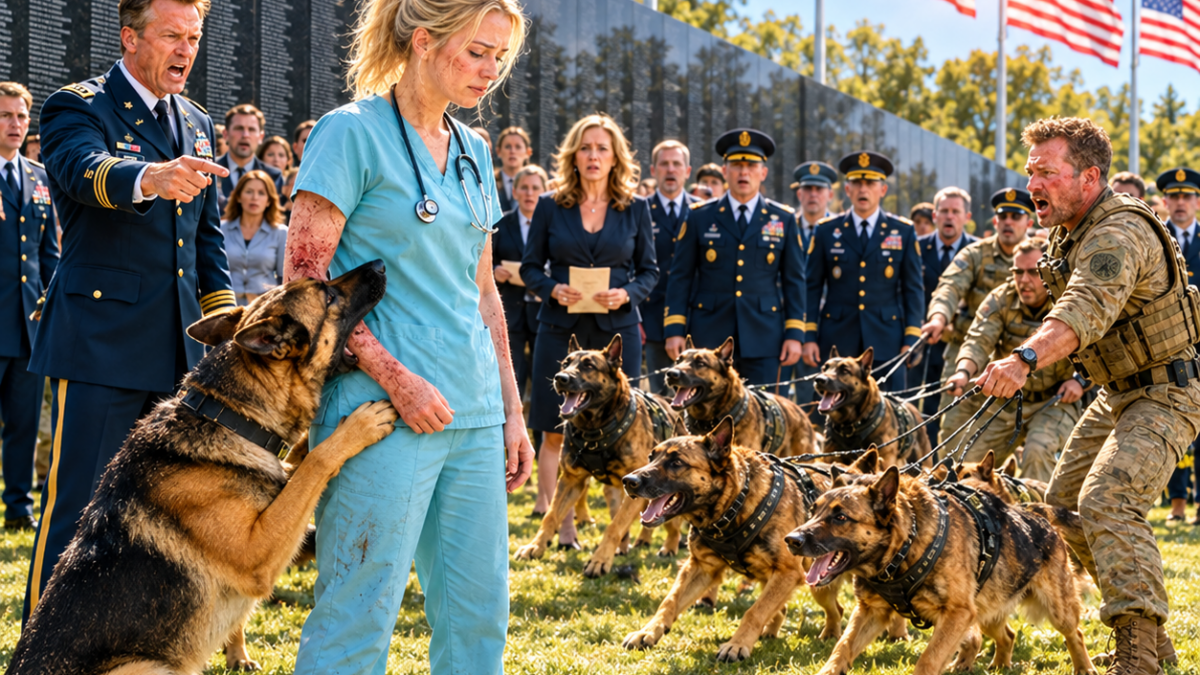
A Colonel Had a Scarred Civilian Nurse Escorted Out of a Military Memorial—60 Seconds Later, Eight K9s Broke Formation and Surrounded Her.
PART3:
Bright-eyed even while shock pulled color from his face.
He had asked me, while the medical vehicle burned around us, if I was scared.
I told him I did not have time to check.
That answer had been both a joke and the most honest thing I had ever said.
The third time I almost turned around was outside the main gate at Fort Caldwell.
The sign appeared ahead of me, clean and official.
For one second, my hands forgot what they were doing.
The car drifted slightly toward the shoulder.
I corrected.
Breathed.
Kept driving.
I reached Harwick Pines at 9:53.
Late by military standards.
Technically on time by civilian standards.
Emotionally, about eight years late.
The parking lot was nearly full.
Sedans with government plates.
Pickup trucks with veteran stickers.
A news van near the service entrance.
Families in dark clothes walked toward the memorial garden with the careful posture of people who had learned how to carry grief in public.
I sat in my car for a moment.
I was wearing pale blue scrubs because I had come off a twelve-hour shift the night before and driven through the night without packing civilian clothes.
A failure of planning.
That was what I told myself because it was easier than admitting I had not known how to dress for a room full of people who might believe I had failed their dead.
I got out.
The wind caught the edge of the invitation in my hand.
I held it tighter.
At the entrance, two young enlisted soldiers checked names against a printed list.
I gave mine quietly.
“Sorell. Lena Sorell.”
One of them looked down.
Found it.
Nodded.
Handed me a program.
No one stopped me.
For three whole minutes, I thought maybe that would be the hardest part.
The memorial garden was larger than I expected.
A wide rectangle of manicured grass bordered by flowering trees.
At the far end stood a black granite wall bearing the names of the fallen in carved white letters.
Rows of folding chairs faced the wall.
A podium stood to the left on a small raised platform.
And along the edges of the space sat eight military working dogs with their handlers.
German Shepherds.
Belgian Malinois.
One Dutch Shepherd.
All glossy coats, alert eyes, and the particular stillness that comes from training so deep it becomes part of the body.
I recognized that stillness.
I did not want to.
The dogs sat in formation, handlers loose-shouldered beside them, all watching the crowd with the practiced calm of teams that know how to wait.
One Malinois near the east side had a faded scar along his muzzle.
I looked away too quickly.
I found an open chair near the back and sat down.
The ceremony began two minutes later.
A chaplain spoke first.
Then a general whose name I did not catch.
Then a family representative talked about her brother’s service in a voice that shook but did not break.
I kept my hands folded in my lap and looked at the wall.
Ethan Callaway’s name was carved near the middle section, at eye level.
I read it once.
Then again.
Then a third time.
There is a strange cruelty in seeing a name made permanent when the story beneath it is wrong.
I had been looking at his name for maybe four minutes when I sensed someone approaching from my left.
He was tall, late fifties, silver-haired, wearing full dress uniform with more decorations than I could count without staring.
Colonel Warren Dech.
I knew his walk before I knew his face.
Some men do not enter a space.
They take possession of it.
He stopped beside my chair.
“Monroe.”
That had been my old name.
I changed it six years earlier.
Two hundred dollars.
Three weeks of paperwork.
One small attempt to stop being summoned by a life I was trying to survive.
“My name is Sorell,” I said.
He did not acknowledge the correction.
“You need to leave.”
His voice was quiet.
Controlled.
Designed not to carry.
That was one of the things I remembered about him. Colonel Dech rarely needed volume. He had spent decades learning how to make people obey him without looking like he had forced them.
“I have an invitation.”
“I don’t care.”
I held up the card stock.
“Ruth Callaway invited me.”
“Ruth Callaway does not run this memorial.”
He lowered his voice another degree.
“I am going to have you escorted out quietly. You can choose to make this harder than it needs to be, but I would strongly advise against it.”
My mouth went dry.
“This is a ceremony for the families of people who served and died,” he said. “You do not belong here.”
I should have answered.
I had spent the drive rehearsing what I would say if this happened.
Something measured.
Something factual.
Something that would not let him make me small.
But eight years is a long time to hear a man’s voice in your head, and when the real voice returned, standing over me in sunlight beside a wall of names, all my rehearsed sentences dissolved.
He turned before I spoke and nodded toward security.
Two men came over.
Polite.
Professional.
The kind of polite that leaves no room.
One asked me to accompany them.
The other positioned himself behind me at just enough distance that anyone watching could pretend I had chosen to leave.
That was the thing about power.
It rarely needed to announce itself.
I stood.
I walked with them past the rows of chairs, past the heads that turned fractionally, past the podium, past Ethan Callaway’s name carved in white, through the service gate on the east side of the garden.
The gate closed behind me with a mechanical click.
Quieter than I expected.
I stood there on the concrete service path outside the wall.
Somewhere behind me, the chaplain resumed speaking.
I could hear his voice but not the words.
My car was three hundred yards away across the parking lot.
I started walking.
Forty feet.
That was as far as I got.
Behind me came a sound.
Not barking.
Not growling.
Motion.
The sudden shift of large animals that had been still and then were not.
Then a handler’s voice.
Sharp.
Confused.
A command I could not make out.
Then another handler.
Then another.
The sounds multiplied.
The quality of the crowd noise changed.
Not panic.
Disruption.
People moving when they were supposed to remain seated.
I stopped walking.
The service gate opened.
All eight dogs came through it.
They moved fast, but not chaotically.
That was the first thing I noticed.
They were not loose in the way frightened people mean when they say a dog is loose.
They were not attacking.
They were not out of control.
They were moving with purpose.
And the purpose was me.
The first one reached my left side.
The scarred Malinois.
He stopped against my leg and pressed his flank to me with a deliberateness that felt nothing like aggression.
I stood absolutely still.
A shepherd sat on my right.
Two dogs positioned behind me.
Another moved slightly ahead and angled his body toward the path.
Within thirty seconds, all eight had arranged themselves in a loose formation around me.
Not crowding.
Guarding.
The only sound they made was the breathing of large, calm animals who had decided exactly where they were supposed to be.
Their handlers came through the gate after them.
They stopped ten feet away, staring at me with the expression of professionals whose entire understanding of control had just been publicly overruled by the animals they worked with every day.
“Call them off,” one handler said.
That was the wrong instruction.
“I didn’t call them.”
“They don’t do this.”
His voice was not angry.
It was unsettled.
“These dogs do not break formation for anything. We ran them in a live-fire exercise last month. None of them flinched.”
I looked down at the Malinois against my leg.
He looked back with steady amber eyes.
The scar along his muzzle pulled at something in my memory.
Heat.
Smoke.
A ramp.
A dog lying too still while I stitched with my left hand because my right was already broken.
I had not planned what I did next.
It came from somewhere deeper than planning.
From a part of my body that remembered radio static, burning fuel, and the weight of men who could not move themselves.
Quietly, without thinking, I said:
“Position hold.”
All eight dogs went completely still.
Not ordinary still.
Not simply trained.
Still in the way something becomes when it recognizes a language spoken under different circumstances a long time ago.
The handlers went silent.
The crowd beyond the service gate had started gathering.
Families.
Soldiers.
A news camera.
A few military police.
Then a stocky, close-cropped man in his mid-forties pushed through the cluster of handlers.
His name tape read BRIGGS.
Master Sergeant.
He stopped.
Looked at the dogs.
Looked at me.
“Who are you?”
“Lena Sorell.”
I swallowed.
“I used to go by another name.”
His eyes narrowed, not with suspicion exactly, but with recognition struggling through disbelief.
“Where did you serve?”
“I didn’t serve. I was a contracted civilian trauma nurse. Special operations support.”
A beat.
“Corveth Province,” I said. “Eight years ago.”
Something moved across his face.
Not full recognition.
Confirmation.
“These dogs trained in Corveth,” he said slowly.
“I know.”
“Three of them were on the Meridian Hill evacuation.”
My jaw tightened.
“I know that too.”
Briggs looked at the Malinois against my leg.
Then back at me.
“You were the nurse,” he said. “The one the official report—”
“Yes.”
He stopped himself.
From the back of the gathered crowd, Colonel Dech appeared.
He looked at the eight dogs, the handlers, the woman in scrubs standing at the center of it all, and something flickered behind his eyes.
Not fear.
Something next to it.
He recovered quickly.
Men like him practice recovery until it looks like character.
“This is a ceremony,” he said. “Get those animals back in formation.”
“Sir,” one handler said, “they’re not responding to commands.”
“Then physically move them.”
The handler looked at the Malinois.
Then at the other seven dogs.
“Sir, with respect, physically moving a Malinois that does not want to move is—”
“I will call animal control if I have to.”
The words were so absurd that for one second no one reacted.
Then someone pushed through the crowd.
Ruth Callaway.
I knew her immediately from the photograph she had included with her letter.
Late sixties.
Small.
Straight-backed.
Silver hair pinned at the nape of her neck.
She walked through soldiers, handlers, and security with the calm of a woman who had already buried the thing most people feared losing.
She carried a folded piece of paper.
She stopped in front of me.
“You came.”
“I almost didn’t.”
“I know.”
Then she turned to Colonel Dech.
“This is Ethan’s letter,” she said, holding up the paper. “His last letter home. Written four days before he died. I would like you to hear what is in it.”
“Mrs. Callaway,” Dech said, “this is not the time or place.”
“It is exactly the time and place.”
Her voice did not rise.
That made it stronger.
“My son’s name is on that wall. I think I have some standing to decide what is appropriate at his memorial.”
Dech looked at the crowd.
Then the news camera.
Then the dogs.
He did the calculation.
“This is a private matter,” he said. “We can arrange a proper—”
“There was a nurse,” Ruth said.
She unfolded the paper.
The crowd went quiet enough that I could hear the flags moving in the wind.
“Ethan wrote about her,” Ruth said. “He wrote about a woman who was still inside the burning medical vehicle after command had ordered everyone out. She had two critically wounded operators inside with her, and the vehicle was on fire, and she stayed.”
Colonel Dech said nothing.
“He wrote that she made three trips inside. Three trips while the fuel was burning.”
My right hand curled involuntarily.
Ruth continued.
“He said she had a compound fracture in her right hand from a collapsed support beam on her second trip, and that she wrapped it herself and went back in a third time.”
She lowered the letter and looked at my hands.
My right hand still showed the old misalignment across the third metacarpal.
No surgeon had ever made it look quite straight again.
“He wanted me to find her if he did not make it home,” Ruth said, “and tell her the soldiers she saved knew what she did mattered.”
“The letter is unverified,” Dech said.
“Whatever Corporal Callaway believed he witnessed—”
“What does the official account say, Colonel?”
The question came from an older K9 handler near the crowd, a woman with a sergeant major’s insignia and a face that suggested she had spent her whole career listening to official accounts and developing firm opinions about them.
Dech turned toward her.
“What?”
“What does the official account say?”
“It says the evacuation proceeded in accordance with command directives.”
“And?”
“That communications were compromised during extraction.”
“And?”
Briggs spoke this time.
“It says she delayed the withdrawal.”
His voice was flat.
Careful.
“It says she was responsible for extended exposure of the convoy.”
Then he stopped.
He looked at the dogs.
Then at me.
“It’s wrong.”
The words landed and did not move.
Dech turned on him.
“Master Sergeant—”
“I was on the comms that day, sir.”
Briggs’s voice remained the same.
Flat.
Careful.
Which somehow made it harder to dismiss.
“I was secondary on radio during the Meridian Hill operation. I heard the transmissions.”
He paused.
“All of them.”
Dech went very still.
“I think,” Briggs said, “there are some things that need to come forward.”
The dogs remained around me.
Redline—the scarred Malinois, I learned his name from a handler whispering it—pressed slightly harder against my leg.
I looked down at him.
The scar along his muzzle was old and white now.
I remembered a Malinois on the ramp of a medical vehicle, blood along one side of his face, his handler unconscious and unable to consent to treatment.
I remembered making the call myself.
Seventeen stitches.
No anesthesia.
Left hand only because my right hand was broken.
He had not made a sound.
I had never known whether he survived.
I reached down and placed my hand against the side of his head.
Redline leaned into it and closed his eyes halfway.
Something locked inside my chest for eight years shifted.
Not open.
Not free.
But moved.
Then Briggs stepped toward one of the junior handlers.
“Check Folio’s harness,” he said. “Inside panel.”
The handler blinked.
“What?”
“Inside panel.”
The young handler unclipped the nearest shepherd’s tactical harness and examined the interior lining.
A pause.
“There’s something here.”
Briggs did not look surprised.
He looked like a man who had been sitting on something for a long time and had finally decided he was done.
The handler held up a small rectangular object sealed in olive drab waterproof casing.
A military memory card.
Dech looked at it.
Then Briggs.
Then me.
For the first time, the careful blankness on his face cracked into something I recognized.
The look of a man watching what he buried start to come back up.
Nobody spoke.
Briggs took the casing with two fingers, like pressure might damage it or like he needed a second to make sure his hands were not shaking.
“That needs to go to my office,” Dech said. “Chain of custody requires—”
“Chain of custody requires witnesses,” Briggs said.
He looked at the news camera.
Then at the crowd.
“I think we’ve got enough of those.”
A woman pushed through next.
Major Pria Westfall.
JAG officer.
She had driven from Denver for the memorial and, as it turned out, carried evidence bags in her briefcase because, as she told one stunned captain, “You learn by your third year of practice.”
The card went into the bag.
Not Dech’s office.
Not some administrator’s drawer.
Into evidence.
Officially.
Publicly.
That was the moment the day changed from memorial into reckoning.
The dogs still did not move.
Redline stayed against my leg.
Ruth stood beside me without touching me.
Her presence was steady in a way I had not expected to need.
“Are you all right?” she asked quietly.
“I don’t know yet.”
“That is a reasonable answer.”
Briggs stepped close enough that only I could hear him.
“He’s going to try to get this classified before review.”
“Can he?”
“He knows the process.”
“How long?”
“Hours, if he gets the right people.”
“Then we have hours.”
“There’s more you should know,” Briggs said.
I looked at him.
“I knew the card was there.”
My face went still.
“I put it there two years ago when I realized the formal complaint process wasn’t going to move.”
“You hid evidence in a dog’s harness.”
“I preserved evidence in a place Dech would not search.”
“Why not come to me?”
“Because I needed a witness they could not dismiss before I could dismiss the alternative story.”
His eyes did not leave mine.
“It had to be you. And it had to be public.”
“You used me.”
His jaw tightened.
“Yes.”
I did not forgive him then.
It was not my job to forgive him.
But I understood pressure.
I understood bad choices made from limited options.
I had made a few myself.
“What’s on the card?” I asked.
“Everything.”
His voice lowered.
“GPS logs. Radio transmissions archived before they were pulled from the main system. Medical reports from the vehicle. Timestamps. Your voice. Fourteen transmission attempts from inside the vehicle requesting a six-minute hold before convoy withdrawal.”
I knew that.
I had lived that.
But hearing it said as documented fact rather than private memory did something to my chest.
“And his responses?” I asked.
“Seven of them. Clear signal.”
Briggs paused.
“There was no communications failure.”
Major Westfall moved fast.
Within an hour, I was in a conference room on the third floor of the hospital administrative wing with a digital recorder on the table and Westfall asking me to start from the beginning.
I had done this before.
Eight years earlier, when I still believed the process would work.
I had given a forty-two-page account.
Timestamps.
Call signs.
Patient status at first contact.
Patient status at evacuation.
Medical interventions.
Radio requests.
I had submitted medical logs.
I had requested radio transmission review.
None of it had mattered.
By the time the inquiry ended, my forty-two pages had become one summary paragraph describing me as acting outside directive parameters.
This time, Westfall let me talk.
Two hours.
She asked precise questions.
No performance.
No pity.
The recorder ran.
At some point, someone brought coffee.
I drank it without tasting it.
When I finished, Westfall sat back.
“When you hear the transmissions,” she said, “will your account remain consistent?”
“Yes.”
“No gaps?”
“I have been running those six minutes in my head for eight years.”
My voice did not shake.
“I know what I said. I know what order I said it in. I know what the fuel smelled like. I know the third operator’s blood pressure when I reached him. I know how many times I keyed the radio.”
I stopped.
“I will not contradict myself.”
Westfall nodded.
“Good. Because Dech will come for your credibility.”
“He already did.”
“This time he will do it publicly.”
The card survived.
Eight years sealed in a waterproof casing inside a dog’s tactical harness, and the data held.
Fourteen radio transmissions from the Meridian Hill medical vehicle.
The first at 14:47:23.
The last at 14:53:44.
Six minutes and twenty-one seconds of archived requests for a hold on convoy withdrawal.
My voice, younger than I remembered, came through the laptop speaker.
“Command, I have two critical casualties not stable for transport. Requesting a six-minute hold. Repeat, six-minute hold.”
Colonel Dech’s voice answered.
Clear.
Flat.
No static.
“Immediate negative. Convoy withdrawal is in effect. Clear the route.”
Again and again.
My transmissions gave patient status.
Blood pressure.
Airway risk.
Estimated stabilization time.
Dech’s replies remained clear.
Immediate negative.
Clear the route.
Withdraw.
The official report had said communications failure.
The signal log showed every exchange.
Dr. Farland, the medical records specialist, reviewed the file quietly.
“The casualty documentation is consistent with the radio calls,” she said. “The injuries described match post-evacuation medical reports.”
“So either someone fabricated across separate systems,” Westfall said, “or the radio calls happened exactly as logged.”
Dr. Farland nodded.
“And the official account of communications failure is factually impossible,” the signal specialist added.
Factually impossible.
Two words can be a hammer when placed correctly.
Then Dr. Farland found the document log.
Forty-two items received during the original inquiry.
Final file contained four.
Three administrative forms.
One summary page.
No medical documentation.
No radio review.
No source materials.
The evidence consolidation order bore one signature.
Colonel Warren Dech.
I had suspected that for eight years.
Suspected it with the certainty of someone who had lived through a story and then been handed a version that did not match its shape.
But suspicion and documentation are different.
Documentation lands harder.
It makes the thing real outside your own memory.
Westfall looked at me.
“We have enough.”
She was right.
And still, it was not enough.
Nothing involving men like Dech ends when truth first appears.
It begins another war.
By the time I left Fort Caldwell that afternoon, Dech had filed a formal countercomplaint alleging the data card had been fabricated and planted by Briggs, possibly with my involvement.
He named two witnesses.
Holt and Carver.
Both had been on the Meridian Hill convoy.
Both had reasons to keep the old story alive.
Westfall called me before I reached the highway.
“It changes things,” she said. “It does not stop anything.”
“What do you need?”
“Tomorrow morning, I need you to walk me through each casualty in medical detail. If Holt and Carver testify that they were non-survivable, I need your account aligned against the post-evacuation records so tightly their testimony cannot stand.”
So I did.
The next morning, in a borrowed JAG conference room, I opened the part of my memory I had kept sealed because the clinical details lived next to the heat and the smell.
Specialist Rowan Giri.
Twenty-three.
Penetrating abdominal trauma from shrapnel.
Conscious and in shock when I reached him.
Pressure dropping fast.
Four minutes before irreversible hemorrhagic shock, maybe less.
Packed wound.
Tourniquet on secondary thigh bleed.
Repeated his name twice to keep him oriented.
He told me his girlfriend’s name was Petra.
I told him it was a good name and kept my hands moving.
He survived eleven days post-extraction.
Staff Sergeant Dylan Marsh.
Blunt trauma to head and chest.
Unconscious.
Unequal pupils.
Probable intracranial bleed.
Airway compromised.
C-spine immobilization improvised with what I had.
Manual airway maintenance in a vehicle with fuel burning twelve feet away.
He survived sixteen months.
“Non-survivable?” Westfall asked.
“No.”
My voice was flat.
“Critical, yes. Urgent, yes. High risk, yes. But not non-survivable at point of contact. Not by anyone qualified to make that assessment.”
Holt and Carver had enough medical vocabulary to sound credible to people who did not have medical training.
The first inquiry board had been exactly that.
People without enough medical knowledge listening to men with enough vocabulary and too much reason to justify leaving.
The formal review board convened ten days later in Cheyenne.
Three senior officers.
One civilian legal expert.
Colonel Dech on the right with two attorneys.
Me on the left with Westfall.
I had bought a dark blue blazer the morning before because Westfall diplomatically suggested scrubs might not convey the optimal impression.
The sleeves were slightly too long.
I felt wrong in it.
I went anyway.
The transmissions were played.
Fourteen from me.
Seven from Dech.
Clear signal.
No degradation.
No communications failure.
His attorney challenged chain of custody.
The signal specialist testified about metadata timestamps, file structure, and hardware-level evidence showing the card had not been written to since the original recording date.
Dr. Serena Valk testified next.
Former Army forensic psychiatrist.
She had consulted on the original inquiry and submitted a minority report that had never made it into the final file.
Her report flagged the inconsistencies in Holt and Carver’s statements.
They had both described Giri and Marsh as non-survivable.
But Giri survived eleven days.
Marsh survived sixteen months.
“Non-survivable injuries,” Dr. Valk said, “do not survive.”
Holt testified.
He sat in the witness chair and gave his account with the calm voice of a man who had rehearsed the same lie until it no longer sounded rehearsed.
“Catastrophic presentation.”
“No viable medical option.”
“Withdrawal was the only reasonable course.”
Westfall opened one folder.
“Specialist Rowan Giri,” she said. “Do you remember him?”
“Yes.”
“You assessed him as non-survivable?”
“Yes.”
“Specialist Giri survived eleven days after extraction, including eight days during which he was conscious and gave a statement to his attending physician describing treatment by a female nurse in the vehicle. If his injuries were non-survivable at point of contact, how did he survive long enough to give that account?”
Objection.
Sustained.
Westfall rephrased.
“Is it possible your assessment was wrong?”
Holt’s jaw shifted.
“It’s possible.”
“And Staff Sergeant Dylan Marsh?”
“Same.”
“He survived sixteen months. He walked with assistance at month seven. Were you also possibly mistaken about Staff Sergeant Marsh?”
A longer pause.
“Yes.”
“So two critically injured men, both assessed by you as non-survivable, both survived extended periods following treatment by the nurse you described as ineffective.”
She closed the folder.
“No further questions.”
The room went quiet in the way rooms go quiet when air pressure changes and everyone feels it before understanding why.
Dech testified that afternoon.
Composed.
Complete sentences.
Careful operational language.
The kind of testimony men like him spend their whole lives preparing to give.
He acknowledged receiving communications from the medical channel.
He acknowledged ordering withdrawal.
He said the convoy’s exposure represented unacceptable risk.
Then the questioning officer asked about the evidence consolidation order.
“Your signature reduced the inquiry file from forty-two items to four.”
Dech’s attorney objected.
The board chair overruled her.
“Did you review Nurse Sorell’s documentation before signing the consolidation order?”
Dech paused.
“I reviewed materials submitted to the inquiry.”
“That is not the question.”
Another pause.
“Yes.”
“And you still removed her medical documentation from the inquiry file?”
“I made a command decision.”
“That is not an answer.”
“I made a command decision.”
The repetition was its own confession.
The preliminary findings came two hours and fourteen minutes later.
Radio evidence authentic.
Communications failure factually inconsistent with the documented record.
Evidence consolidation order a material alteration of the inquiry file.
Suppression of relevant testimony.
My account consistent with authenticated documentation.
Original procedural fault finding against me vacated.
Colonel Warren Dech referred for court-martial proceedings.
Relieved of command effective immediately.
I sat at the table and heard the words land out of order.
Not relief.
Not exactly.
More like a load-bearing wall inside me had been slowly collapsing for eight years and someone had finally placed it back upright.
Then my phone rang.
Unknown Denver number.
“Is this Lena Sorell, the nurse from Meridian Hill?”
“Yes.”
“My name is Dylan Marsh.”
I went still.
“I understand there was a hearing today,” he said. “I need to tell you something about the vehicle. About what I remember.”
His voice broke slightly.
The break of someone holding a thing in position for a long time.
“I was conscious for more of it than they know,” he said. “I need to give a statement. A full one. I need to know if it’s too late.”
I looked down the corridor at Westfall.
“It is not too late.”
Then another message came.
A photograph.
Low resolution.
Forwarded through too many hands.
But clear enough.
Inside a scorched military vehicle, a woman in torn scrubs crouched over a prone figure.
Me.
At the vehicle entrance stood a man in uniform.
Rank visible.
Posture unmistakable.
Colonel Warren Dech.
Standing eight feet from me.
Looking in.
He had seen.
He had known.
He had walked away and ordered withdrawal anyway.
The photo had been taken by Specialist Tomas Burke, a twenty-two-year-old medic carrying a personal device he was not supposed to have.
He kept the original phone in a fireproof box in Idaho for eight years.
When forensic teams retrieved it, the metadata held.
Timestamp.
GPS coordinates.
Original resolution.
The image placed Dech at the vehicle entrance fifteen seconds after my third radio request and thirty-two seconds before his final withdrawal order.
The case changed again.
Not from wrong report to buried evidence.
From buried evidence to full situational awareness.
He had not made a hard call with incomplete information.
He had seen the casualties.
Seen me working.
Known they were alive.
Then walked away and buried the proof.
Three months later, at the court-martial, he admitted it.
Not nobly.
Not cleanly.
Not because he had become a better man.
There was a second file, held by a records officer named Wayman Galt, who had used the suppressed evidence as leverage for years.
Dech confessed because the geometry of his situation finally made honesty useful to him.
I did not care about his motives.
Actions leave marks.
His confession left one too.
He admitted reading all forty-two pages of my report.
Admitted the documentation was accurate.
Admitted removing it because it contradicted the inquiry framing he needed.
Admitted seeing the casualties alive.
Admitted giving the withdrawal order anyway.
“Why?” the prosecutor asked.
Dech looked toward the middle distance.
“Because acknowledging what I knew would have required acknowledging what I chose,” he said. “And I was not prepared to do that.”
The verdict took two days.
Guilty on all primary charges.
Falsification of inquiry records.
Suppression of witness testimony.
Knowing dereliction of command resulting in preventable casualty risk.
When the finding came through, I expected satisfaction.
I did not get it.
What I felt was quieter.
A building that had been leaning for years finally settling correctly.
Not joy.
Not revenge.
Alignment.
The official record was corrected.
Ethan Callaway’s file was corrected.
Giri’s and Marsh’s records were corrected.
The Meridian Hill operational summary was rewritten to include what actually happened inside that burning vehicle.
My procedural fault finding was vacated entirely.
A commendation was recommended for sustained medical intervention under extreme field conditions resulting in preservation of life at significant personal risk.
Westfall told me I did not have to accept it.
“It’s not why I stayed,” I said.
“I know,” she said. “But it is why it matters that you did.”
The formal reinstatement ceremony was held at Harwick Pines in late March.
Not large.
Not theatrical.
Ruth Callaway came.
Tomas Burke flew in from Boise, uncomfortable in his own skin. I told him discomfort was appropriate, but keeping the device mattered too. Both things could be true.
Westfall came.
Briggs came with three handlers.
Redline was there.
Working lead.
Alert.
Professional.
He looked at me once when I arrived and then back to his handler, as if reminding everyone he was on duty.
A brigadier general who had not been involved in any part of the original failure read the corrected statement.
He acknowledged the institutional wrong in the careful language institutions use when trying to say something true without collapsing under the weight of it.
Then he read the commendation.
I accepted the certificate with both hands.
“Thank you,” I said.
My voice stayed level because the ceremony had a shape, and I intended to hold my part correctly.
Afterward, I stood at the granite wall.
Ethan Callaway’s name was still there.
Of course it was.
But the entry beneath it had been corrected.
The circumstances.
The account.
The truth.
Ruth stood beside me.
“He would have hated all this,” she said.
“The ceremony?”
“The attention. He was private.”
“He asked me about my scars while he was bleeding in a burning vehicle.”
Ruth almost smiled.
“What did you tell him?”
“That they were evidence of a decision I made.”
“He would have called that strange.”
“He did.”
She nodded.
“He made strange observations about things all the time.”
I reached into my blazer pocket and pulled out Ethan’s medal.
Ruth had given it to me in the JAG corridor months earlier.
She said Ethan had left it with a note:
Give it to whoever needs it most.
I had carried it through the hearings, the court-martial, the verdict, and the weeks between.
Now I looked at the wall.
“I’d like to leave it here,” I said. “If that’s all right.”
Ruth looked at the medal.
Then at her son’s name.
Then at me.
“It’s all right.”
I set it at the base of the granite beneath Ethan’s name.
Small against the scale of the wall.
That seemed correct.
Redline had been sitting eight feet away.
When I stepped back, he rose and moved to my side without command.
His handler noticed.
Everyone noticed.
No one corrected him.
I placed my hand on his head.
He leaned into it.
We stood there together in the March light, the grass beginning its slow return to green, the names above us, and for the first time in eight years the silence around me was not the silence of suppression.
It was just quiet.
I drove back to Kern Valley that evening.
Four hours and twenty minutes.
Same route.
Same highway.
Same mountains catching late gold light before the valley fell into shadow.
Ethan’s letter sat on the passenger seat beside the corrected record.
I thought about what a nursing student had asked me outside the courtroom.
“How do you keep doing the job after everything? After being told you did it wrong?”
I had not answered quickly.
Clinical questions usually came easily to me.
That one did not.
Finally, I had said, “The job was the thing I did correctly. That never changed.”
On the highway home, I decided that was mostly true.
But not complete.
The other part was this:
I kept doing the job because people still needed help in front of me.
And if I had the skill to help, then I had a responsibility I had never found a good enough reason to set down.
My phone buzzed near the Kern Valley exit.
A text from Briggs.
Adoption board confirmed. He’s yours if you want him. No rush.
Redline.
He still had active service left, but after retirement, civilian placement could be approved under documented prior contact.
And apparently “eight military working dogs demonstrated recognition behavior toward Nurse Lena Sorell at a memorial” was now in the formal record.
Permanently.
I drove the last three miles to my apartment.
Parked.
Sat in the quiet car with the engine off.
My phone was on the seat.
The letter was on the seat.
The night was cold and ordinary.
I thought about Redline sitting at the service path, watching me cross the parking lot months earlier as if he recognized something I had not yet been allowed to claim.
Then I picked up the phone.
Yes, I typed.
I want him.
I sent it.
Then I went inside.
I had a shift at six in the morning.
The record was corrected.
The wall had a medal at its base and a name above it that finally carried the right truth.
Colonel Warren Dech had once made me feel like nothing in a room full of decorated men.
But that had never been the truth.
I had only been temporarily recorded that way.
The difference took eight years, a dead soldier’s mother, one hidden memory card, a medic who kept a photograph, and eight military K9s who broke formation for a scarred nurse because they remembered what people tried to erase.
I had gone back.
That had always been enough.








