A Cat With Both Back Legs Broken Dragged Herself 40 Feet Across a Walmart Parking Lot at Midnight—Then a 19-Year-Old Employee Spotted Her Crawling Toward the Light. What He Did Next Broke Hearts.
PART3:
Just permanently stressed.
He was thirty-seven, recently promoted, and had developed the haunted expression of a man who had learned management mostly consisted of being blamed simultaneously by customers, employees, and people above him.
“Bring in what you can,” Kevin said.
“We close at twelve.”
Tyler headed back outside.
Later, he would remember almost every detail of those next few minutes.
The hiss when the automatic doors opened.
The cold air.
A pickup leaving from row six.
A cart wheel rattling somewhere to his right.
A country song playing faintly from somebody’s car.
The glow of the blue Walmart sign against low clouds.
He walked toward the far west edge of the lot.
There were seven carts near a corral.
Three beside a light pole.
One abandoned near the entrance road.
Tyler started with the farthest.
That’s when he saw movement.
Near the ground.
About halfway between the store and the road.
At first he thought it was a plastic grocery bag.
Wind had been blowing trash all evening.
But this didn’t move like windblown trash.
It moved forward.
Stopped.
Moved again.
Tyler squinted.
Maybe a raccoon.
He’d seen them near the dumpsters.
“Hey.”
Whatever it was stopped.
Tyler walked closer.
Ten yards.
Twenty.
Then he saw two small ears.
Cat.
“Hey, kitty.”
The animal moved again.
Something looked wrong.
Very wrong.
Its front half advanced.
The rear half didn’t.
Tyler stopped walking.
The cat hooked both front claws into the rough asphalt.
Pulled.
Its chest slid forward.
Both back legs dragged behind it.
Tyler felt his stomach drop.
“Oh, my God.”
The cat pulled again.
Maybe four inches.
Stopped.
Its head hung low.
Another pull.
Tyler ran.
Not directly at it.
He slowed as he approached because injured animals bite and scratch, something his mother had taught him after she spent years volunteering at a county shelter when Tyler was little.
But this cat did neither.
She barely lifted her head.
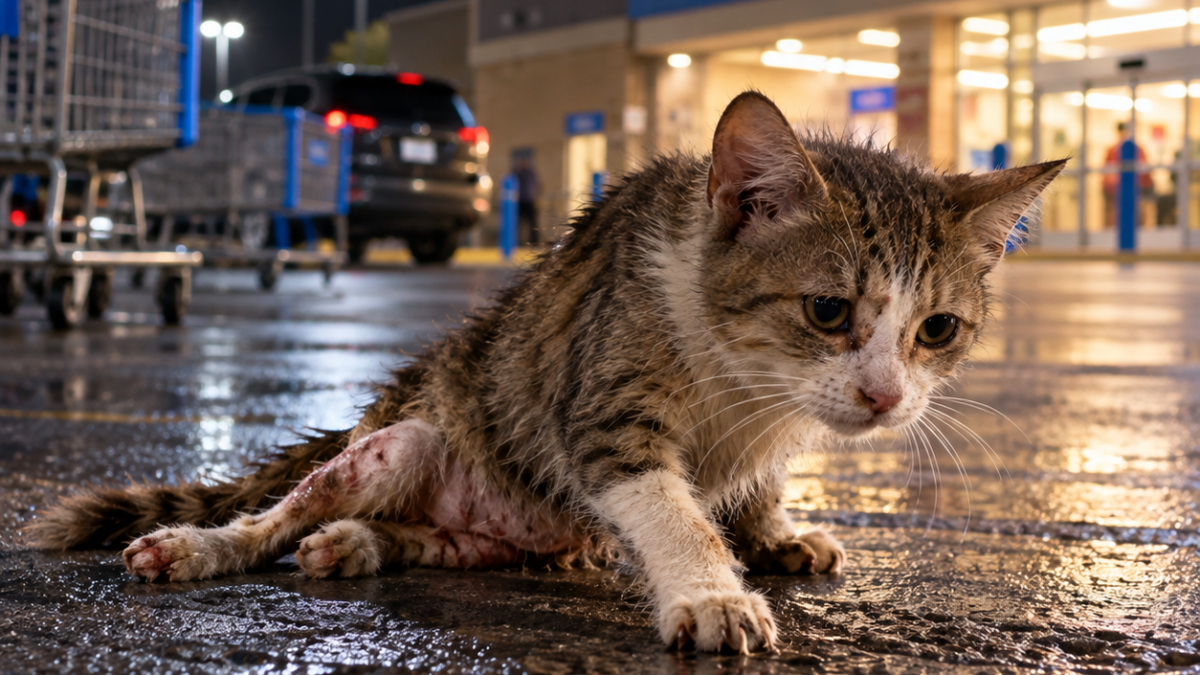
Small tabby.
Brown-gray stripes.
White around the mouth.
Maybe seven pounds.
Young.
Her breathing came in short, fast bursts.
The fur beneath her stomach looked wet.
Her back legs lay at wrong angles.
One twisted outward.
The other dragged completely flat.
“Oh, God.”
Tyler crouched.
The cat looked at him.
He would remember those eyes for the rest of his life.
Not because they were unusually beautiful.
Yellow-green.
Ordinary cat eyes.
He remembered them because of what wasn’t in them.
No fight.
No aggression.
No warning.
Only exhaustion.
Like she had reached the point where fear required energy she no longer had.
Tyler held one hand near her nose.
“Hey.”
The cat sniffed weakly.
Then lowered her head.
He looked behind her.
A dark streak on the pavement.
At first he thought water.
Then he realized.
Blood.
Not much.
Dots.
Tiny smears.
Extending backward.
Tyler followed the trail with his eyes.
Ten feet.
Twenty.
Farther.
Toward the access road.
His chest tightened.
She hadn’t been injured here.
She had moved here.
He stood and walked several yards backward.
More blood.
Faint scratches against the dirty pavement.
At the entrance to the parking lot, roughly forty feet from where he’d found her, there was a larger smear.
Fur.
One small patch of blood.
A broken piece of clear plastic, maybe from a light or reflector.
Tyler looked back.
Forty feet.
It didn’t sound far.
You could walk forty feet in seconds.
But not with two useless legs dragging behind you.
Not with your stomach scraping pavement.
Not while every movement forced broken bones to move.
He looked toward the store.
From that position, everything beyond the parking lot was dark.
Businesses across the highway had closed.
Streetlights were sparse.
Walmart’s entrance shone bright white and blue.
Tyler looked at the cat.
Then the doors.
She had been going straight toward them.
“Were you trying to get inside?”
The cat pulled forward one more inch.
That answered enough.
“No.”
Tyler knelt.
“You’re done.”
He removed his blue work jacket.
Placed it on the ground.
Then carefully slid one arm beneath the cat’s chest.
The second had to support her hips without letting the legs swing.
He moved as slowly as he could.
The moment he lifted her, she inhaled sharply.
Not a meow.
More like a broken gasp.
Tyler froze.
“Sorry.”
The cat looked at him.
“I’m sorry.”
He adjusted his grip.
Then something happened that Tyler would tell people about years later.
The cat stopped trying to crawl.
Completely.
Her front paws, which had been flexing against the pavement, relaxed.
Her head lowered.
She rested her cheek against his forearm.
As though the simple act of being picked up had communicated something her body understood before her mind could.
You don’t have to move anymore.
Somebody else is carrying you.
Tyler swallowed hard.
“I got you.”
He wasn’t sure whether he was promising too much.
But he said it anyway.
“I got you.”
He carried her toward the store.
The automatic doors opened.
Maya Lopez, who worked the self-checkout lanes, saw him first.
Maya was twenty-two, taking nursing prerequisites at the same community college Tyler planned to attend.
She looked at the bundle in his arms.
“What happened?”
“Get Kevin.”
“What is that?”
“Cat.”
She approached.
Then saw the legs.
“Oh, my God.”
“Maya.”
“Right.”
She ran.
Tyler carried the cat into the vestibule.
Warm air.
Fluorescent light.
The cat opened her eyes wider.
People.
Voices.
The place she had been trying to reach.
“You made it,” Tyler whispered.
Kevin arrived thirty seconds later.
“What happened?”
“Car hit her.”
“How do you know?”
“Look at her.”
Kevin did.
His face changed.
Then management instinct returned.
“You can’t bring an animal into the store.”
Tyler stared at him.
“What?”
“Health code. We can’t—”
“She has two broken legs.”
“I understand, but—”
“No, you don’t.”
Kevin lowered his voice.
“Tyler.”
The cat trembled.
Tyler’s anger rose so suddenly it surprised him.
“She dragged herself across the parking lot.”
“I’m not saying leave her outside.”
“Then what are you saying?”
“Put her in your car. We can call animal control.”
“At midnight?”
Kevin looked uncertain.
Tyler tightened his arms protectively.
“You put her back outside, I’m leaving.”
“I didn’t say outside.”
“If I have to clock out, I’ll clock out.”
“Tyler.”
“If that’s against policy, fire me.”
Maya stared at him.
Kevin stared too.
For several seconds nobody spoke.
Then Kevin exhaled.
“Nobody’s firing you.”
“Good.”
“Clock out.”
“I have carts.”
“Forget the carts.”
Kevin looked at the cat again.
His expression softened.
“There’s an emergency vet on Franklin Avenue.”
“I know it.”
Maya said, “Twenty minutes.”
Kevin pointed toward the office.
“Get towels.”
Maya ran.
Tyler looked at him.
“You just said she couldn’t stay inside.”
Kevin rubbed his forehead.
“I also haven’t slept right in six months.”
“Fair.”
“Don’t quote me on that.”
Maya returned with two towels.
They made a nest inside an empty produce crate.
Tyler placed his jacket underneath.
The cat immediately pressed her face into it.
Maya crouched.
“She needs a name.”
“She needs a vet.”
“You can do both.”
Kevin asked, “You got gas?”
“Quarter tank.”
He reached for his wallet.
Tyler shook his head.
“I can buy gas.”
“Take it.”
“Kevin.”
His supervisor shoved twenty dollars into Tyler’s hand.
“Don’t make me do a kindness twice.”
Tyler accepted.
Then looked toward the cat.
“I need to call my mom.”
Denise answered on the second ring.
“You finally coming home?”
“Not exactly.”
A pause.
“What happened?”
“Might be late.”
“Tyler.”
“I found a cat.”
His mother’s tone changed immediately.
“What kind of cat?”
“Injured.”
“How injured?”
Tyler looked down.
“Bad.”
“How bad?”
“Both back legs.”
Silence.
“Bring her home?”
“I’m taking her to emergency vet.”
“Good.”
“I don’t know how much it’s going to cost.”
Another silence.
His mother worked medical billing at an orthopedic clinic.
Money was not theoretical in their house.
Her husband—Tyler’s father, Michael—had died five years earlier after a construction accident.
Insurance had paid some.
Bills ate much of the rest.
Denise raised Tyler and his younger sister on one income.
There was no secret family fortune.
She knew exactly how much emergency veterinary treatment could cost.
“Do you have your credit card?” she asked.
Tyler blinked.
“Yeah.”
“What’s the limit?”
“Fifteen hundred.”
“Use it.”
“Mom.”
“Use it.”
“What if—”
“We’ll figure it out.”
“You haven’t even seen her.”
“I heard your voice.”
Tyler swallowed.
His mother continued.
“You wouldn’t sound like that unless it was bad.”
“Yeah.”
“Go.”
Twenty-four minutes later, Tyler carried the cat into Northside Veterinary Emergency Hospital.
It was 12:23 a.m.
The waiting room had three people.
A family with a vomiting Labrador.
A woman holding a rabbit carrier.
A man pacing while talking quietly on his phone.
The receptionist saw Tyler coming.
“What happened?”
“Hit by car.”
“How long ago?”
“I don’t know. Maybe thirty minutes before I found her.”
“Conscious?”
“Yes.”
“Any active bleeding?”
“Not much.”
A technician appeared with a stretcher.
Tyler didn’t want to let go.
That surprised him.
He had known the animal for less than an hour.
Still, when the technician reached for her, his arms tightened unconsciously.
“We’ve got her,” the woman said gently.
Same words he’d said.
Tyler nodded.
He transferred the cat.
Her head lifted.
She looked at him as they carried her through the doors.
Then disappeared.
Tyler stood with his empty jacket in his hands.
The receptionist slid a clipboard toward him.
“Owner?”
“I don’t know.”
“Is she yours?”
“No.”
“Stray?”
“I think.”
“Who will be financially responsible?”
Tyler looked at the form.
There it was.
The adult question.
Concern was free.
Treatment wasn’t.
He thought about his credit limit.
His savings.
$843.17.
He knew the exact number because he had checked before work.
He was trying to save for school.
For a better car.
For leaving home eventually.
For adulthood.
He checked the box.
Financially responsible: Tyler Bennett.
Then signed.
The veterinarian came out around 1:10.
Dr. Rebecca Singh.
Early forties.
Tired but focused.
“Tyler?”
He stood.
“How bad?”
She sat beside him.
Never a good sign.
“She’s stable.”
“Okay.”
“But she’s significantly injured.”
Tyler nodded.
“Both hind limbs have fractures.”
He felt his stomach tighten.
“The right tibia is fractured here.”
She showed him an X-ray on a tablet.
“The left femur has a break higher up.”
“And the pelvis?”
He remembered seeing the way her hips dragged.
“Hairline fracture.”
“Spine?”
“That’s the good news.”
Tyler waited.
“No spinal fracture.”
“Can she feel her feet?”
“Yes.”
“That’s really good.”
“Will she walk?”
Dr. Singh didn’t answer immediately.
“That’s our goal.”
“Will she?”
“I can’t promise.”
The sentence hurt.
Tyler looked down.
“What else?”
“Severe abrasions along her abdomen and hind limbs.”
“From dragging?”
“Some from impact. Some likely from dragging across pavement.”
She showed him shaved areas.
Raw pink skin.
Several open patches.
Tyler closed his eyes briefly.
“And her front paws…”
Dr. Singh hesitated.
“What?”
“Her claws are badly abraded.”
He looked up.
“How?”
“She appears to have pulled herself some distance.”
“I know.”
Dr. Singh stared.
“How far?”
“Forty feet.”
Her expression changed.
“With both fractures?”
“Yeah.”
“Are you certain?”
“There’s blood trail.”
He explained.
Dr. Singh looked toward the treatment area.
“My God.”
“How long would that take?”
“Hard to say.”
“She wasn’t moving fast.”
“No.”
“She’d pull. Rest. Pull.”
The veterinarian considered.
“With the pain and injuries?”
“Twenty minutes, maybe more.”
Tyler stared.
Twenty minutes.
He had imagined five.
Maybe ten.
Twenty minutes changed everything.
Twenty minutes of claws against asphalt.
Twenty minutes of broken bones shifting.
Twenty minutes alone in darkness.
“She was going toward the store.”
Dr. Singh looked at him.
“What?”
“Not toward the grass.”
“Not away from cars.”
“Straight toward the entrance.”
He rubbed his face.
“Lights.”
Dr. Singh said nothing for a moment.
Then quietly:
“Animals in distress sometimes seek familiar cues.”
“People?”
“Shelter.”
“Light.”
“Sound.”
Tyler imagined the parking lot from cat height.
Concrete.
Darkness.
Headlights.
Pain.
Far ahead, white rectangles opening and closing.
Humans walking through.
Maybe she understood none of it.
Maybe all she knew was dark behind.
Light ahead.
So she went toward light.
“What’s surgery cost?”
Dr. Singh pulled up the estimate.
Between $2,000 and $2,500 depending on fixation.
Tyler laughed once.
Not because anything was funny.
“Okay.”
“There’s also hospitalization.”
“How much total?”
“Likely around $2,200 if there are no complications.”
His credit card limit was $1,500.
Savings $843.
Total $2,343.
Every dollar he had.
He looked at the X-ray.
“Do it.”
Dr. Singh studied him.
“You understand—”
“Do it.”
“Tyler, are you her owner?”
“No.”
“Do you have family authorization to spend—”
“I’m nineteen.”
She smiled faintly.
“Right.”
“I know what it costs.”
“You may have rescue options.”
“How long?”
“We can contact organizations in the morning.”
“Will waiting hurt her?”
“We can stabilize tonight.”
“Will she need surgery either way?”
“Yes.”
Tyler nodded.
“Then do it.”
Dr. Singh’s expression softened.
“Let’s not drain your life savings at one in the morning.”
“She dragged herself forty feet.”
“I know.”
“She did her part.”
He looked through the glass doors.
“I can do mine.”
Dr. Singh was quiet.
Then she said, “Give me twenty minutes.”
She started making calls.
Tyler texted Maya.
Both legs broken. Pelvis cracked. Surgery about $2200.
Maya replied instantly.
HOLY SHIT.
Then:
WE’LL HELP.
Tyler typed:
Who is we?
No response.
At 1:32, his mother walked into the emergency clinic.
Tyler stared.
“What are you doing here?”
Denise wore sweatpants, a winter coat over pajamas, and her hair was tied badly at the back.
“You thought I’d sleep?”
“How’d you know where?”
“Location sharing.”
“You track me?”
“Since you were sixteen.”
“That’s horrifying.”
“Where’s the cat?”
He told her.
All of it.
When he reached the part about forty feet, Denise’s eyes filled.
“Mom.”
“I’m fine.”
“You’re crying.”
“I cry when I’m mad.”
“At who?”
“Whoever hit her.”
“We don’t know if they knew.”
“Then I’m mad at circumstances.”
Tyler smiled.
Dr. Singh returned.
A rescue group called Second Chance Animal Network could contribute up to $800 from an emergency fund.
The clinic offered reduced surgical pricing because the cat was a stray.
Projected remaining amount: approximately $1,400.
Tyler reached for his credit card.
His mother put a hand over it.
“Wait.”
“What?”
“You have coworkers.”
“No.”
“Why not?”
“I’m not asking people for money.”
“You’ll spend your college savings but won’t let somebody give ten bucks?”
“That’s different.”
“Why?”
He didn’t know.
Pride was strange like that.
It would let you make yourself poor to avoid admitting you needed help.
Denise pulled out her phone.
“Post it.”
“No.”
“Tyler.”
“Mom.”
“You’re nineteen.”
“I know.”
“Good. Learn this now.”
She looked at him.
“Helping isn’t only something you get to give.”
He said nothing.
“Sometimes you have to let other people do it too.”
Tyler hated when she sounded right.
At 2:06 a.m., he posted a photograph Maya had taken in the vestibule.
The cat wrapped in Tyler’s blue jacket.
Only her face visible.
He wrote:
Found this girl dragging herself through the Walmart parking lot tonight with two broken back legs. She pulled herself about 40 feet toward the store. She’s at Northside Emergency Vet and needs surgery. A rescue is helping but we still need around $1,400. Anything helps.
He almost deleted it.
Then posted.
By 2:30, coworkers had donated $185.
Maya: $25.
Andre from electronics: $20.
Grace from bakery: $15.
Jamal from overnight stock: $30.
Someone named Linda he barely knew: $10.
Then Kevin.
$100.
Tyler stared.
“He donated?”
Denise looked over.
“Your manager?”
“The one who told me I couldn’t bring her in.”
“People can say something stupid and then do something decent.”
He looked at her.
“Is that your inspirational quote for tonight?”
“Yes.”
“At two-thirty in the morning?”
“Especially.”
At 3:00, donations reached $420.
By the time Tyler finally went home at 4:15, they were over $600.
He slept three hours.
At 8:30, Maya called.
“You’re famous.”
“No.”
“Store group has it.”
“Oh, God.”
“Somebody printed a donation jar.”
“What?”
“Customer service.”
“No.”
“Too late.”
Tyler sat up.
His mother had left coffee outside his bedroom.
“What does it say?”
Maya laughed.
“HELP THE WALMART PARKING LOT CAT.”
“Terrible.”
“Kevin made them change it.”
“To what?”
“FORTY FEET FUND.”
Tyler paused.
“That’s worse.”
“I kind of like it.”
By noon, customers were contributing.
A cashier named Evelyn put in fifty dollars.
Evelyn had been the person who initially told Maya, “Animals can’t be inside the store.”
When Tyler heard, he texted her:
You didn’t have to.
She replied:
I was right about policy and wrong about what mattered more.
That sentence stayed with him.
At 1:40 p.m., the fund passed $1,400.
Second Chance confirmed it would cover everything else.
Tyler cried in his car.
He would deny that later.
His mother knew.
Mothers always know.
Surgery took place the following morning.
Right tibia stabilized with pins.
Left femur repaired with a plate and pins.
Pelvic fracture left to heal naturally.
Burns cleaned.
Front paws bandaged.
She was spayed during hospitalization once she was stable enough, because the rescue required it before placement.
The veterinarian estimated eight weeks strict confinement.
Maybe longer.
When Tyler visited the afternoon after surgery, he almost couldn’t look.
The small tabby sat inside a recovery kennel.
Both rear legs wrapped in white protective bandages.
Front paws bandaged too.
Belly shaved.
Pink abrasions exposed.
She looked like half her body had been rebuilt.
But her eyes were open.
Tyler crouched.
“Hey.”
Her ears lifted.
He put his fingers through the kennel bars.
She sniffed.
Then leaned forward.
Her forehead touched one finger.
That was it.
Tyler looked away before anybody saw his face.
Dr. Singh stood nearby.
“She knows you.”
“No, she doesn’t.”
“She recognizes your voice.”
“She heard me for like an hour.”
“Sometimes an hour matters.”
Tyler sat on the floor.
The cat lowered herself painfully onto his jacket.
Dr. Singh asked, “Does she have a name yet?”
Tyler shook his head.
“Maya keeps suggesting ridiculous ones.”
“Like?”
“Walmart.”
Dr. Singh laughed.
“Absolutely not.”
“Rollback.”
“Worse.”
“Spark.”
“That one’s not terrible.”
“Mom said Hope.”
Dr. Singh nodded.
“Classic.”
“Too classic.”
The cat stretched one front paw.
Bandage reached almost to the wrist.
Tyler remembered the blood trail.
Forty feet.
He looked at her.
“Forty.”
Dr. Singh frowned.
“Forty?”
“That’s how far she crawled.”
He smiled slightly.
“Forty feet.”
The cat blinked.
“Forty.”
Dr. Singh considered.
“I’ve heard worse.”
“She earned it.”
The name stuck.
Not because it was beautiful.
Because it measured something.
Not injury.
Effort.
Forty feet.
Twelve meters.
A distance most humans crossed without noticing.
For her, it had been a journey.
The security footage became important two days later.
Kevin called Tyler before his shift.
“Come early.”
“Why?”
“We found the accident.”
Tyler’s stomach tightened.
“What?”
“Camera 14.”
The parking lot cameras did not capture every angle clearly, especially near the roadway.
But the entrance lane appeared in the far corner of one camera.
Kevin, the store’s asset protection manager, and local police had reviewed footage after Tyler showed them the blood trail.
Tyler stood in a small security office while a man named Derek controlled the playback.
Timestamp:
11:18:07 p.m.
Tyler hadn’t found Forty until nearly 11:50.
“There,” Derek said.
A dark SUV entered.
Another car exited.
Forty wasn’t visible yet.
Then, at 11:18:12, something small appeared near the rear of the SUV.
The vehicle jerked slightly.
Stopped for less than two seconds.
Continued.
Tyler leaned forward.
“Back up.”
Derek did.
A tiny shape beneath the rear wheel area.
Impact wasn’t clear.
But the animal rolled.
The SUV’s brake lights illuminated.
Stopped.
One second.
Two.
Then accelerated.
“They knew,” Tyler whispered.
Kevin’s jaw tightened.
Maybe the driver hadn’t known what they’d hit before.
The brake lights changed that.
They had felt something.
Stopped.
Then kept driving.
Derek advanced the footage.
At 11:19, Forty moved.
Barely.
Front paws forward.
Body dragging.
At 11:21, another movement.
11:24.
11:27.
It was unbearable to watch in real time, so Derek increased speed.
But Tyler made him stop.
“No.”
Kevin looked at him.
“You don’t need to watch all of it.”
“Yes, I do.”
“Why?”
“I found her.”
“That doesn’t mean—”
“I want to know.”
Derek returned to normal speed.
They watched.
Not continuously moving.
That was the worst part.
Forty would pull herself several inches.
Stop.
Remain motionless.
Then pull again.
Sometimes a full minute passed.
Once almost three.
Cars came and went in distant rows.
Nobody saw her.
Or if they did, they didn’t understand.
She crossed one parking line.
Then another.
At 11:35, she turned slightly.
Not random.
Toward the entrance.
The lights.
At 11:40, she rested for almost four minutes.
Tyler thought she might have quit.
Then her front paws moved.
Again.
By 11:48, she reached the point where Tyler first noticed her.
At 11:49:37, his figure entered the frame.
Cart vest.
Blue jacket.
Walking.
He stopped.
Turned.
Approached.
The video showed Tyler kneeling.
Then lifting her.
Kevin looked away.
Derek cleared his throat.
Tyler stared at the screen.
Thirty-one minutes.
Forty had been on that pavement for thirty-one minutes.
Not twenty.
Thirty-one.
“Can police identify the SUV?”
Derek nodded.
“They’re working on plate enhancement.”
“Will they?”
“Maybe.”
Tyler looked at the frozen image of the vehicle.
Anger came differently than he expected.
Not explosive.
Cold.
The driver had stopped.
Two seconds.
Long enough to know something happened.
Then drove away.
He thought about Forty pulling herself forward while that person continued home.
Maybe ate dinner.
Watched television.
Slept.
At work that night, Tyler couldn’t stop thinking about it.
Every car in the parking lot irritated him.
Every driver going too fast.
Every person backing out without looking.
At 7:30, a customer nearly hit a cart.
Tyler yelled, “Slow down!”
The driver rolled down his window.
“Mind your business.”
Tyler stepped toward the car.
Maya grabbed the back of his vest.
“Don’t.”
“He almost—”
“I know.”
“He’s driving like an idiot.”
“I know.”
“Forty—”
“This isn’t the same car.”
That stopped him.
Maya looked at him.
“You can’t fight the entire parking lot.”
Tyler pulled away.
“I know.”
“Do you?”
“No.”
That night his mother found him sitting at the kitchen table at 1:00 a.m.
Laptop open.
Security footage playing.
Kevin had sent a copy after police approved sharing the relevant portion.
Denise closed the computer.
“What are you doing?”
“Watching.”
“Why?”
“I don’t know.”
“Yes, you do.”
Tyler stared at the table.
“She kept moving.”
“I know.”
“For thirty-one minutes.”
“I know.”
“What if I hadn’t gone out?”
Denise sat across from him.
“Somebody else might have.”
“Store closed ten minutes later.”
“Maybe overnight crew.”
“Hours.”
She nodded.
“Maybe she would’ve made it inside.”
“With two broken legs?”
“I don’t know.”
“Maybe she would’ve died.”
Denise didn’t answer.
Tyler looked at her.
“I almost skipped the last run.”
“What?”
“I told Kevin I had enough carts.”
“He said one more pass.”
His breathing changed.
“I almost didn’t go.”
Denise reached across.
“Tyler.”
“If I’d left five minutes early—”
“Stop.”
“But—”
“No.”
Her voice sharpened.
“Do not turn somebody else’s cruelty into your guilt.”
He stared.
“You went out.”
“You saw her.”
“You picked her up.”
“That is what happened.”
“Everything else is your brain trying to invent versions where you failed so it can feel like you controlled the outcome.”
Tyler was silent.
His mother had spent years after his father’s death doing something similar.
He realized that.
Michael Bennett had fallen from scaffolding when a support gave way.
For months, Denise replayed their final morning.
If she’d made breakfast slower.
If she’d asked him to stay home.
If his alarm hadn’t gone off.
If.
If.
If.
Tyler remembered hearing her cry in the laundry room when she thought the children were asleep.
“Is that what you did with Dad?”
Denise looked at him.
Long pause.
“Yes.”
Tyler swallowed.
“Did it help?”
“No.”
“Then why do brains do that?”
“Because accepting that terrible things can happen without our permission is frightening.”
She squeezed his hand.
“So we invent ways we could have controlled them.”
Forty’s accident cracked something open in their house that had been sealed for five years.
Tyler rarely talked about his father.
People assumed because he was fine.
He wasn’t.
He had simply gotten good at carrying grief where it didn’t interfere with daily tasks.
Work.
School.
Jokes.
Video games.
Groceries.
The anniversary date passed every year.
He acted normal.
That night, he asked his mother:
“Did Dad know?”
“What?”
“That he was going to die?”
“No.”
“How do you know?”
“Coworker was there.”
She hesitated.
“He was conscious for a minute.”
Tyler had never heard this.
“What did he say?”
Denise’s eyes filled.
“He asked whether you and Chloe had gotten to school.”
Tyler stared.
“That was it?”
“No.”
She smiled through tears.
“He said, ‘Tell them I love them.’”
Tyler left the kitchen because he couldn’t breathe normally.
He stood in the dark living room.
His father’s photograph on the shelf.
For five years he had resented that morning for not containing a proper goodbye.
Now he learned it had.
It had just taken five years to reach him.
The next day he visited Forty.
He sat beside the kennel.
“I found out something yesterday.”
Forty slept.
“My dad said goodbye.”
Her ear moved.
“You don’t care.”
Nothing.
“Fair.”
He rested his forehead against the cage bars.
“You know, I thought I saved you.”
Forty opened one eye.
“That sounds dramatic.”
He smiled.
“But you made me ask my mom something I should’ve asked years ago.”
Forty yawned.
Her chipped? No, this cat doesn’t have chipped tooth. Keep consistency. She stretched her bandaged paw.
“Maybe we’re even.”
Police identified the SUV four days later.
2018 Ford Escape.
Registered to a woman named Patricia Greene.
Sixty-three.
Local address.
Tyler was surprised.
He had imagined some reckless teenager.
Drunk driver.
Cruel person.
Someone easy to hate.
Patricia Greene was a retired elementary school secretary.
No criminal record.
Widowed.
Lived six miles away.
Police interviewed her.
The truth was less satisfying than anger wanted.
Patricia had been driving home from visiting her sister in the hospital.
Forty darted beneath the SUV from between two parked cars.
Patricia felt impact.
Stopped.
Saw something in her mirror.
Then panicked.
She later admitted she knew she’d hit an animal.
She told herself it was probably already dead.
She was afraid to get out alone at night.
Afraid someone would blame her.
Afraid of what she would see.
So she drove away.
No deliberate cruelty.
No malicious abandonment before the accident.
Just fear.
And selfishness.
Tyler didn’t know what to do with that.
He wanted a villain.
Instead he got an old woman who cried through most of her police interview.
She saw the news story afterward.
Recognized the Walmart.
Recognized the date.
Had already suspected.
But didn’t call.
That angered Tyler even more.
She had days.
She could have admitted it.
Didn’t.
Patricia received a citation for leaving the scene after striking a domestic animal under local ordinance and failing to report it.
The legal consequences were relatively minor.
Online, people wanted worse.
Tyler initially did too.
Then Patricia asked through police whether she could pay the remaining veterinary costs.
There were none.
Donations had covered them.
She asked to reimburse the rescue.
Then asked if she could visit Forty.
Tyler said no.
Immediately.
Kevin asked why.
“She left her.”
“She panicked.”
“For thirty-one minutes that cat crawled because she panicked.”
“I know.”
“She saw her.”
“You don’t know what she saw.”
“She said animal.”
Kevin let it go.
His mother didn’t.
“Why does she want to visit?”
“I don’t care.”
“You do.”
“No.”
Denise gave him the look parents use when they know their child is lying badly.
“Tyler.”
“What?”
“You don’t have to forgive her.”
“Good.”
“But you might want to hear her.”
“I don’t.”
“Then don’t.”
His mother stood.
“But make sure you’re saying no because that’s actually what you want, not because anger feels easier.”
“I hate when you do therapy without credentials.”
“Free service.”
A week later, Tyler changed his mind.
He told himself it was for Forty.
Mostly it was because he wanted to see Patricia.
Wanted to know what kind of human drove away.
They met at the veterinary clinic.
Patricia Greene was shorter than Tyler expected.
Gray hair.
Tan coat.
Hands gripping a purse.
She looked like someone’s grandmother.
Maybe because she was.
Dr. Singh brought Forty into a consultation room in a padded recovery bed.
One rear leg still heavily bandaged.
The other healing.
Front paw wraps removed.
Claws damaged but recovering.
Patricia saw her.
Her face collapsed.
She sat immediately.
“Oh.”
That was all.
Oh.
Forty watched her.
No recognition.
Probably none.
Patricia covered her mouth.
“I thought…”
Tyler stood against the wall.
“What?”
She looked at him.
“I thought I’d killed her.”
“So you left.”
“Yes.”
The honesty disarmed him.
“Why?”
Patricia swallowed.
“My husband died on the roadside.”
Tyler froze.
“What?”
“Seven years ago.”
She looked at Forty.
“Heart attack while driving.”
“He managed to pull over.”
“I got the call at night.”
“By the time I reached the hospital…”
Her voice broke.
“When I hit something, I stopped.”
“I saw movement.”
“Then I looked at the road and…”
She closed her eyes.
“I couldn’t make myself get out.”
Tyler’s anger returned.
“She needed you.”
“I know.”
“You were scared?”
“Yes.”
“So was she.”
“I know.”
“You got to leave.”
Patricia started crying.
“I know.”
There was no defense.
That made yelling harder.
Tyler wanted her to justify it.
Excuse it.
Say something stupid enough that he could hate her cleanly.
She didn’t.
“I’ve thought about her every night.”
He crossed his arms.
“That doesn’t fix anything.”
“No.”
“I could’ve missed her.”
“I know.”
“She could’ve died.”
“I know.”
“You had a phone.”
Patricia looked at the floor.
“I know.”
Those two words again.
No excuses.
Only recognition.
Tyler looked at Forty.
She had begun licking one front paw.
Apparently uninterested in human moral proceedings.
Patricia opened her purse.
“I brought this.”
Envelope.
Check.
$2,200.
Tyler stared.
“The bills are covered.”
“I know.”
“Then what is it?”
“For the rescue.”
“They don’t need—”
“Yes, they do.”
She pushed it toward him.
“Another animal will.”
Tyler did not touch it.
Patricia continued.
“I can’t change what I did.”
“No.”
“I can make sure being afraid doesn’t become the last thing I do about it.”
That sentence sounded like something Denise would say.
Tyler hated that.
He looked at Dr. Singh.
She stayed neutral.
Finally he took the envelope.
“I don’t forgive you.”
Patricia nodded.
“I didn’t come for that.”
“Good.”
“I came because I needed to look at her.”
Tyler’s jaw tightened.
“Why?”
“So I stop telling myself I didn’t know.”
Silence.
Patricia looked at Forty.
“I knew enough to stop.”
Her voice shook.
“I should have stayed.”
Tyler did not forgive her that day.
But hatred became harder.
That annoyed him.
Simple villains are convenient.
Real people are often worse and better at the same time.
Patricia’s $2,200 went into Second Chance Animal Network’s emergency fund.
Over the next year, it helped pay for treatment for a dog with a broken pelvis.
A kitten with pneumonia.
A senior cat needing dental surgery.
Tyler never told Patricia individually.
Dr. Singh did.
Maybe that mattered.
Forty’s recovery was slow.
At three weeks, she could move both rear feet.
At four, she stood briefly with support.
Tyler filmed it.
Five seconds.
Forty wobbling.
Rear legs shaking.
Dr. Singh’s hand beneath her belly.
Then sitting.
Tyler sent it to every coworker who had donated.
Maya replied with seventeen crying emojis.
Kevin wrote:
TELL HER SHE’S STILL NOT ALLOWED IN GROCERY.
Tyler showed Forty.
“He thinks he’s funny.”
She bit his hoodie string.
“Good point.”
At six weeks, she took four steps.
Not dragged.
Steps.
Awkward.
Uneven.
But steps.
Tyler cried openly this time.
No denial.
At eight weeks, the surgeon removed one pin.
X-rays showed strong healing.
The pelvic fracture had stabilized.
Prognosis changed from guarded to excellent.
“She’ll probably always have a slightly unusual gait,” Dr. Singh said.
“Pain?”
“Possibly arthritis later.”
“But walking?”
“Yes.”
Tyler looked at Forty.
She was trying to climb onto a counter despite strict instructions not to.
“She’s walking.”
“She intends to do much more than walking.”
The question of adoption had already been decided.
Tyler technically asked his mother.
He prepared an entire speech.
“I know we already have Pepper—”
Pepper was their twelve-year-old beagle.
“And cats cost money and I’m still living home, but I can pay for food and—”
Denise interrupted.
“Yes.”
He stared.
“You didn’t let me finish.”
“Didn’t need to.”
“You don’t even know what I was asking.”
“You’re asking if Forty can live here.”
“How?”
“Tyler.”
She pointed at the enormous cat carrier in their hallway.
“You bought a six-foot cat tree.”
“It was on sale.”
“You’ve been sleeping at the emergency clinic waiting room during surgery.”
“One time.”
“You have her photo as your lock screen.”
He looked at his phone.
“Temporary.”
Denise smiled.
“Yes.”
Tyler frowned.
“Yes temporary?”
“Yes, she can live here.”
He hugged his mother.
Then quickly stepped back because nineteen-year-old boys often believe hugs have strict time limits.
Forty came home eleven weeks after Tyler found her.
Maya, Kevin, Evelyn, Jamal, and three other employees waited outside the Walmart employee entrance before Tyler left to pick her up.
They had decorated a cardboard sign.
WELCOME HOME, FORTY.
Someone drew forty tiny paw prints.
“Who did this?” Tyler asked.
Evelyn raised her hand.
“This is deeply embarrassing.”
“You’ll survive.”
He looked at the sign again.
Forty tiny paw prints.
One for every foot she’d crawled.
He stopped joking.
“Thanks.”
Kevin handed him a bag.
Inside:
Cat food.
Treats.
Small blanket.
Two toys.
A Walmart gift card.
“Seriously?”
“Staff collection.”
“You guys already donated.”
Maya shrugged.
“Too late.”
Tyler looked around at coworkers he had previously categorized mostly by department.
Electronics.
Bakery.
Overnight.
Front end.
Management.
Now he knew who had stayed ten minutes late to put money in a jar.
Who had called rescues.
Who had shared posts.
Who had asked every shift how she was doing.
A store is a strange place.
Hundreds of people wearing matching vests can work beside one another for years while remaining almost strangers.
Forty changed that.
At least temporarily.
When Tyler brought her home, Pepper lost his mind.
The old beagle sniffed the carrier.
Howled.
Backed away.
Sniffed again.
Forty hissed.
Pepper sneezed.
This went on for two days.
By week two, they slept on opposite sides of the same rug.
By month three, Forty slept against Pepper’s back.
Tyler photographed everything.
Forty had a limp.
Very slight.
More noticeable when tired.
She couldn’t jump as high as other cats.
She solved this by climbing.
Curtains.
Chairs.
Tyler’s jeans.
Anything.
Her front claws grew back unevenly.
One remained short.
Her abdomen healed, leaving a patch where fur grew thinner.
None of that slowed her much.
What surprised Tyler was her relationship with light.
At night, when the house became dark, Forty preferred sleeping near illuminated places.
Under the kitchen night-light.
Near Tyler’s laptop.
Beside the glow from his alarm clock.
If every light in a room went out suddenly, she woke.
For months, Tyler kept a small lamp on.
His electric bill contribution increased.
He didn’t care.
Once, during a thunderstorm, power failed.
Forty panicked.
Ran low to the ground.
Dragging her back end slightly the way she had during early recovery.
Tyler found her beneath his bed.
He crawled underneath.
Turned on his phone flashlight.
“There.”
Forty’s eyes fixed on the light.
Tyler put the phone between them.
“See?”
She crawled forward.
He held her.
The power returned twenty minutes later.
But that night gave him the answer to a question he’d been carrying.
Why the store?
Light.
Maybe nothing more complicated.
Pain had reduced the world to one instruction:
Go where you can see.
Toward light.
Toward people.
Toward possibility.
Tyler eventually enrolled in community college.
Not economics.
Emergency medical technology.
His mother was surprised.
“So EMT?”
“Maybe paramedic later.”
“What changed?”
Tyler looked at Forty sleeping on the kitchen chair.
“I don’t know.”
His mother smiled.
“Liar.”
Tyler rolled his eyes.
But she was right.
Before Forty, he had thought helping people sounded admirable but abstract.
After Forty, he understood emergency care differently.
The moment between injury and rescue.
The minutes when somebody is frightened and doesn’t know whether anyone is coming.
That mattered to him.
He wanted to be the person who arrived.
School wasn’t easy.
Anatomy nearly destroyed him.
He failed his first pharmacology quiz.
Worked three evenings a week at Walmart.
Studied in the break room.
Forty sat on textbooks at home.
When Tyler complained, Denise said:
“She supports education differently.”
Maya transferred to nursing school.
They studied together sometimes.
Kevin eventually became store manager.
Evelyn retired.
The donation jar disappeared, but a photograph remained on the employee bulletin board.
Forty the day after surgery.
Four bandaged limbs.
Belly shaved.
Looking furious at the world.
Beneath it, someone had typed:
FORTY FEET TOWARD THE LIGHT.
Three years after the accident, Walmart renovated.
The bulletin board came down.
Tyler, who no longer worked there full-time, happened to visit during the remodel.
He found the photograph in a box of old employee materials.
“Can I take this?”
Kevin looked.
“Thought you already had copies.”
“Not this one.”
“Sure.”
Tyler framed it.
Not because he liked seeing Forty injured.
He didn’t.
He put another photograph beside it.
Healthy Forty sitting in the front window at home.
Rear legs slightly crooked.
Chest high.
Sunlight across her face.
Before.
After.
Not victim.
Survivor.
Patricia Greene stayed loosely connected to the rescue organization.
Tyler learned accidentally.
Four years after Forty’s accident, he attended a Second Chance fundraiser.
He was twenty-three then.
EMT certification completed.
Working ambulance shifts.
Still living at home because rent had become ridiculous and Denise pretended she appreciated the company more than the grocery money.
A volunteer table listed major donors.
Patricia’s name appeared.
Not once.
Repeatedly.
Small monthly donations.
$25.
$50.
Sometimes $100.
Tyler stood staring.
Dr. Singh came beside him.
“She never stopped.”
“You knew?”
“Yes.”
“Why didn’t you tell me?”
“Wasn’t my story to manage.”
Tyler looked at the list.
“Do you talk to her?”
“Sometimes.”
“How is she?”
“Older.”
“Still guilty?”
Dr. Singh considered.
“Probably.”
Tyler nodded.
“Good.”
Then immediately felt ashamed.
Dr. Singh didn’t scold him.
She just said, “Guilt can be useful for a while.”
“And after?”
“It either becomes responsibility or self-destruction.”
Tyler thought about his mother after his father’s death.
About himself replaying the last cart run.
“Which did hers become?”
Dr. Singh pointed toward the donor list.
“You tell me.”
Patricia attended that fundraiser.
Tyler saw her across the room.
Older.
Walking with a cane now.
For several minutes he considered leaving without speaking.
Then she noticed him.
Their eyes met.
Patricia approached.
“Tyler.”
“Hi.”
“How’s Forty?”
That was her first question.
“Good.”
“Still walking?”
“Running when she feels like destroying something.”
Patricia smiled.
“I’m glad.”
Silence.
Then Tyler asked:
“You still donate every month?”
She looked embarrassed.
“A little.”
“Why?”
Patricia glanced around the room.
“Because I still drive past that parking lot.”
Tyler waited.
“I can’t change the night.”
“No.”
“But I can change what I do on other nights.”
He understood.
More than he wanted to admit.
Patricia had joined a volunteer network transporting injured animals to emergency clinics.
She no longer drove at night because of her eyesight, but she coordinated calls.
Answered phones.
Matched rescuers with clinics.
The woman who once drove away because fear stopped her now spent Friday nights making sure other people didn’t.
That was not absolution.
Forty had still suffered.
Nothing erased thirty-one minutes on asphalt.
But consequences and change could coexist.
Tyler realized he had forgiven her sometime before the conversation.
Not because she deserved a clean record.
Forgiveness wasn’t a court ruling.
He simply no longer needed to carry anger on Forty’s behalf.
Forty wasn’t angry.
Forty was home probably attempting to steal cheese.
“I don’t hate you anymore,” Tyler said.
Patricia blinked.
He immediately regretted how dramatic it sounded.
“That’s a strange thing to say.”
Her eyes filled.
“No.”
She smiled faintly.
“It’s more than I expected.”
“I still think you should’ve stopped.”
“So do I.”
“Good.”
“Every day.”
Tyler nodded.
“Then maybe that’s enough.”
Neither hugged.
It wasn’t that kind of relationship.
They shook hands.
That felt right.
Tyler became a paramedic at twenty-six.
His first major highway call involved a rollover.
Family of four.
Rain.
One child trapped.
When he arrived, another motorist had stopped and was standing beside the overturned vehicle talking through a broken window to a terrified seven-year-old girl.
The stranger kept repeating:
“I’m right here.”
Tyler heard it while pulling equipment.
I’m right here.
Those words hit him.
After the child was freed and transported safely, Tyler thanked the motorist.
“I didn’t do anything,” the man said.
“You stayed.”
Tyler answered.
The words came automatically.
“You stayed.”
He understood later why they mattered.
Forty had crawled because nobody had picked her up yet.
Once Tyler did, she stopped.
Help begins physically sometimes.
A hand.
A jacket.
A voice.
But often what matters most is the message beneath the action:
You don’t have to do this alone anymore.
Years passed.
Forty grew from a skinny injured adolescent into a remarkably spoiled adult cat.
Denise called her “the most expensive free animal in America.”
Tyler corrected:
“Second Chance paid most.”
His mother replied:
“I’m counting furniture.”
Forty destroyed two chairs.
One curtain.
Three phone chargers.
A houseplant.
Part of a couch.
She developed an obsession with rotisserie chicken.
She learned how to open one cabinet.
She hated closed bathroom doors.
She tolerated Pepper until he died at fifteen.
That loss affected her.
For nearly a month, Forty slept where Pepper’s bed had been.
Denise bought another bed.
Forty ignored it.
Tyler came home from a night shift once and found his mother sitting on the floor beside Forty.
They were both facing the empty spot.
“Mom?”
Denise wiped her face.
“I’m fine.”
Tyler sat with them.
Pepper had belonged partly to his father.
Michael had chosen him from a shelter when Tyler was eleven.
Losing Pepper felt like losing another thread connecting them.
Forty climbed onto Denise’s lap.
His mother whispered:
“She always knows.”
Tyler smiled.
“She was looking for light.”
“What?”
“The night I found her.”
“I know.”
“Maybe she’s still good at finding people who need it.”
Denise kissed Forty’s head.
“Maybe.”
At thirty, Tyler moved into his own apartment.
That created a crisis.
Forty had always technically been his cat.
But she and Denise had become inseparable.
Tyler packed boxes.
Forty sat inside every one.
When moving day came, Tyler placed the carrier by the door.
Forty disappeared.
They found her in Denise’s bedroom.
On Denise’s pillow.
Tyler looked at his mother.
Denise looked at him.
“No.”
“What?”
“She’s yours.”
“I know.”
“You’re taking her.”
“I didn’t say anything.”
“Your face did.”
Tyler sat on the bed.
Forty rolled onto her side.
Her old leg stretched stiffly.
“She’s lived here nine years.”
Denise sat beside him.
“She waits for you when you’re on shift.”
“She sleeps with you.”
“She sleeps wherever the warmest blanket is.”
“Mom.”
Denise looked at Forty.
“Maybe she can stay weekdays.”
Tyler laughed.
“Are we doing shared custody?”
“Weirder things have happened.”
So they did.
Forty spent most weeks with Denise.
Weekends at Tyler’s apartment.
Except when Tyler worked long shifts.
Then Denise.
Holidays depended on chicken availability.
Forty had two homes.
Again.
She had once crawled toward a building full of strangers because she needed any human being.
Now she had too many humans arguing about who got her.
That fact never stopped amazing Tyler.
At eleven years old, Forty’s arthritis worsened.
Her old injuries finally started collecting interest.
Anti-inflammatory medication.
Joint supplements.
Heated bed.
Small ramp to Denise’s couch.
No more jumping from high places.
She ignored that rule whenever possible.
Dr. Singh still worked part-time at the same clinic.
When she saw Forty for the annual checkup, she smiled.
“There she is.”
Tyler placed the carrier down.
“You remember her?”
“Of course.”
“She remembers you too.”
Forty hissed.
Dr. Singh laughed.
“Clearly.”
X-rays showed significant arthritis around the repaired joints.
But no catastrophic problems.
“She may slow down.”
Tyler looked at Forty.
“She’s allowed.”
That sentence surprised him.
For most of Forty’s life, movement had represented survival.
Crawling.
Standing.
Walking.
Running.
Now slowing down didn’t mean giving up.
It meant she had made it far enough to become old.
That was a victory nobody had imagined at midnight in the parking lot.
At thirteen, she stopped climbing stairs.
At fourteen, her hearing declined.
At fifteen, kidney disease appeared.
Tyler knew what that meant.
He had spent years working emergencies.
He knew trajectories.
Still, medical knowledge is useless when love wants exceptions.
Subcutaneous fluids helped.
Special food.
Medication.
More appointments.
Good weeks.
Bad weeks.
Denise sent daily photos when Tyler was working.
Forty sleeping in sunlight.
Forty drinking.
Forty refusing breakfast.
Forty eating chicken she wasn’t supposed to have.
Then came a Sunday morning in January.
Tyler had finished a twenty-four-hour shift.
His mother called before he reached home.
“She’s not getting up.”
He didn’t ask who.
He drove straight there.
Forty lay in her bed near the living room lamp.
Always the lamp.
Her body looked small again.
Like the night he’d found her.
But peaceful.
Both rear legs stretched behind her.
No bandages now.
Just old scars hidden beneath fur.
Tyler sat on the floor.
“Hey, Forty.”
One eye opened.
Her head lifted barely.
He put his hand beside her face.
She leaned into it.
Same gesture.
Fifteen years collapsed.
Parking lot.
Fluorescent entrance.
Blue jacket.
Front claws on asphalt.
“I got you.”
He hadn’t said those words in years.
Forty purred faintly.
Denise sat beside him.
“She waited for you.”
Tyler hated that sentence because he believed it.
The veterinarian came to the house that afternoon.
Tyler refused to make Forty take one final car ride.
Dr. Singh no longer did emergency field calls often, but when Tyler called, she came herself.
She entered.
Saw Forty beside the lamp.
Her face softened.
“Still choosing the light.”
Tyler looked at her.
“You remember.”
“I remember everything about her.”
They talked.
Quality of life.
Pain.
Kidneys.
Mobility.
The kindest choice.
Tyler had explained these same concepts to families at accident scenes.
Not euthanasia, obviously, but the brutal reality of medicine.
What can be fixed.
What cannot.
When intervention becomes suffering.
Understanding did not make it easier.
He lifted Forty carefully.
Her head rested against his forearm.
Exactly where it had the first night.
She didn’t struggle.
Didn’t meow.
Didn’t need to crawl.
Tyler whispered:
“You don’t have to go anywhere.”
His mother cried beside him.
“You did forty feet.”
His voice broke.
“That was enough.”
Forty’s eyes remained half open.
“You made it.”
Dr. Singh administered the medication.
Forty’s body relaxed.
Tyler felt the last breath against his wrist.
Quiet.
Warm.
Safe.
Not asphalt.
Not cold.
Not dark.
In his arms.
Under a lamp.
With the people she had crawled toward before she even knew their names.
Tyler stayed there a long time.
Afterward, Denise brought out the old blue Walmart jacket.
Tyler stared.
“You kept this?”
“Of course.”
He hadn’t seen it in years.
The same jacket he placed beneath Forty at the veterinary hospital.
Small claw marks remained near one sleeve.
His mother folded it around her.
Tyler cried harder than he had since his father died.
Maybe harder.
Grief isn’t measured by species.
Love doesn’t check categories before it hurts.
They cremated Forty.
Tyler kept the ashes.
His mother kept the collar.
And inside Tyler’s apartment, above a small shelf, he hung two photographs.
The first:
Forty after surgery.
Rear legs in white wraps.
Front paws bandaged.
Belly shaved.
Eyes open.
Alive.
The second:
Forty at fourteen years old, asleep beneath the living room lamp.
No casts.
No bandages.
No visible scars.
Just old.
Safe.
Home.
Between the photographs Tyler placed a small brass plaque.
FORTY FEET TOWARD THE LIGHT.
Years later, Tyler became a field training officer for new paramedics.
Young EMTs rotated through his ambulance.
Some were brilliant.
Some terrified.
Some cocky.
Most a little of all three.
Tyler taught airway management.
Trauma assessment.
Medication.
Scene safety.
Documentation.
But there was one lesson he repeated more than anything else.
“People move toward whatever looks like safety.”
He said it after domestic violence calls.
After overdoses.
After homeless patients wandered into emergency departments.
After frightened teenagers called ambulances because they didn’t know where else to go.
“You might not understand why they came here.”
He told trainees.
“Maybe they made twenty decisions you wouldn’t have made.”
“Maybe they’re difficult.”
“Maybe they’re dirty.”
“Maybe scared.”
“Maybe drunk.”
“Maybe they waited too long.”
He paused.
“But if somebody spends their last bit of strength moving toward you…”
His voice often softened without him meaning it to.
“Try to deserve that.”
Most trainees assumed he’d learned the lesson from human patients.
Tyler rarely corrected them.
Sometimes, if the shift was quiet, he’d tell them about Forty.
The parking lot.
The blood trail.
Two broken hind legs.
Thirty-one minutes.
Forty feet.
A bright entrance in the distance.
One trainee once asked:
“Do you think she actually knew people could help?”
Tyler thought about that for a long time.
“No.”
“Then why go toward the store?”
Tyler looked through the ambulance windshield at the hospital entrance ahead.
Bright doors.
Opening.
Closing.
People moving through them.
“Maybe she didn’t know.”
He said.
“Maybe hope isn’t knowing.”
The trainee waited.
“Maybe it’s just choosing the direction that gives you one more chance.”
Years after Forty died, the Walmart on Route 17 was remodeled again.
The old entrance replaced.
Parking lot resurfaced.
Every trace of that night disappeared.
No blood.
No scratched asphalt.
No exact point where she’d been hit.
No path showing the forty feet.
Tyler visited after reopening.
He was thirty-six.
His mother walked beside him, slower now.
They had come for groceries.
Nothing sentimental.
At least that was what they told themselves.
Near the entrance, Denise stopped.
“What?”
She pointed down.
Embedded in a small landscaped strip beside the doors was a metal plaque.
Tyler hadn’t known.
Kevin had retired but apparently organized it with several longtime employees and the rescue group.
The plaque showed the outline of a small paw.
Underneath:
FORTY
FOUND HERE AFTER CRAWLING 40 FEET TOWARD THESE LIGHTS
HER STORY HELPED SAVE MANY MORE
Tyler stared.
His mother covered her mouth.
A young employee pushed carts past them.
Maybe nineteen.
Blue vest.
Headphones around his neck.
He noticed Tyler looking at the plaque.
“Cool story.”
Tyler turned.
“You know it?”
“Yeah.”
“The cat crawled across the parking lot with broken legs.”
“Some employee found her.”
Tyler smiled.
“Something like that.”
The kid nodded toward the plaque.
“They raise money every year now.”
“What?”
“Animal rescue fundraiser.”
Tyler hadn’t known.
“Started a long time ago.”
The employee shrugged.
“I’ve only worked here six months.”
Then he pushed the carts inside.
Tyler looked at his mother.
She was crying.
“Mom.”
“Don’t.”
“You’re crying in Walmart.”
“I’ve done worse.”
They stood beside the plaque while customers walked around them.
Some noticed.
Most didn’t.
That was fine.
Meaning doesn’t require an audience.
Tyler crouched and touched the metal paw print.
He thought about a night when he had been nineteen and exhausted and annoyed about carts.
He thought about a tiny shape moving close to the ground.
He thought about how easy it would have been to look away.
Plastic bag.
Shadow.
Nothing.
Instead, he walked closer.
That decision had changed more than one life.
Forty lived fifteen years after the parking lot.
Fifteen.
More than five thousand mornings.
Thousands of meals.
Sunlit windows.
Christmas trees climbed.
Chicken stolen.
Pepper’s warm back.
Denise’s bed.
Tyler’s textbooks.
Two homes.
Countless nights beneath lamps.
She became old enough to hurt from old injuries.
Old enough to lose hearing.
Old enough for kidney disease.
Old enough to die from age rather than the car that should have killed her as a kitten.
That was victory.
People often told the story wrong afterward.
They said Tyler saved Forty.
He always corrected them.
“I picked her up.”
That’s what he said.
Because the hard part happened before him.
Before warmth.
Before surgery.
Before donations.
Before anybody knew her name.
Forty was hit near the edge of a dark parking lot.
Both back legs broke.
Her pelvis cracked.
Skin tore.
Her front claws began bleeding.
She had no idea whether help existed.
No idea whether the building ahead was safe.
No guarantee she would reach it.
But somewhere through pain and shock, she saw light.
So she moved.
One pull.
Rest.
Another.
Her front paws found rough pavement.
Claws caught.
Body followed.
Broken legs dragged behind.
A few inches.
Then a few more.
Thirty-one minutes.
Forty feet.
People sometimes romanticized that.
Tyler didn’t.
There was nothing beautiful about an injured animal being forced to do that.
She should never have needed that strength.
Someone should have seen her sooner.
The driver should have stopped.
The accident should not have become a test of endurance.
But once it happened, Forty made a choice as simple as any living thing can make.
Not here.
Not yet.
Move.
Toward light.
And eventually someone saw her.
That part mattered just as much.
Because determination can only carry a wounded body so far.
Eventually survival requires another person.
Another pair of hands.
Somebody willing to interrupt their own plans.
Tyler had been thinking about homework.
His friends.
Getting home.
His wet shoes.
His shift ending.
He had no money to spare.
No plan for a cat.
No special training.
No idea what he was doing.
He simply saw something moving strangely in the dark.
And walked closer.
Maybe that’s why he spent his career telling young paramedics to pay attention.
Not because everyone can rescue everything.
They can’t.
Not because every story ends with fifteen extra years.
It doesn’t.
But because so many things disappear when nobody looks closely.
Pain can resemble inconvenience from a distance.
Fear can look like anger.
Exhaustion can look like laziness.
Desperation can look ugly.
A wounded cat can look like a plastic bag moving in the wind.
You have to get closer.
The night Forty died, Tyler dreamed about the parking lot.
But it wasn’t exactly how it happened.
In the dream, he saw the blood trail.
Saw the tiny body crawling.
Yet when he looked toward the store, the entrance wasn’t Walmart.
It was just light.
Bright.
Warm.
Forty pulled herself toward it.
Tyler ran.
But before he reached her, she stood.
Both back legs straight.
No limp.
No burns.
No bandages.
She looked at him once.
Then walked into the light on all four paws.
He woke crying.
Tyler didn’t believe dreams were messages.
He had seen too much death to make certainty out of things nobody could prove.
But he kept that dream.
Quietly.
Not because it told him where Forty went.
Because it reminded him where she started.
For all the years he knew her, people thought her story was about broken legs.
It wasn’t.
It was about direction.
Darkness behind.
Light ahead.
Pain everywhere.
Still, forward.
Tyler carried that lesson into every ambulance.
Every hospital entrance.
Every frightened patient who apologized for calling.
Every old person afraid of being a burden.
Every teenager who said nobody would understand.
Every person who had already traveled farther in pain than anyone around them realized.
And whenever one of them finally stopped fighting after Tyler placed a blanket over them, or took their hand, or said, “We’ve got you now,” he thought of a seven-pound tabby lowering her head against his arm in a Walmart parking lot.
She stopped crawling the instant he picked her up.
Not because she’d given up.
Because she finally didn’t have to do it alone.
There is a difference.
Forty taught him that too.
Strength isn’t crawling forever.
Sometimes strength is crawling only until you reach someone safe enough to carry you the rest of the way.
And on one cold night just before midnight, with two broken legs dragging behind her and her front claws bleeding against the asphalt, a tiny cat somehow found that person.
Forty feet away.
Under the brightest lights she could see.








