A Biker Threatened My Husband at Our 9-Year-Old’s Soccer Game—Then She Ran Past Her Father, Hugged the Biker, and Begged Him Not to Make Her Go Home.
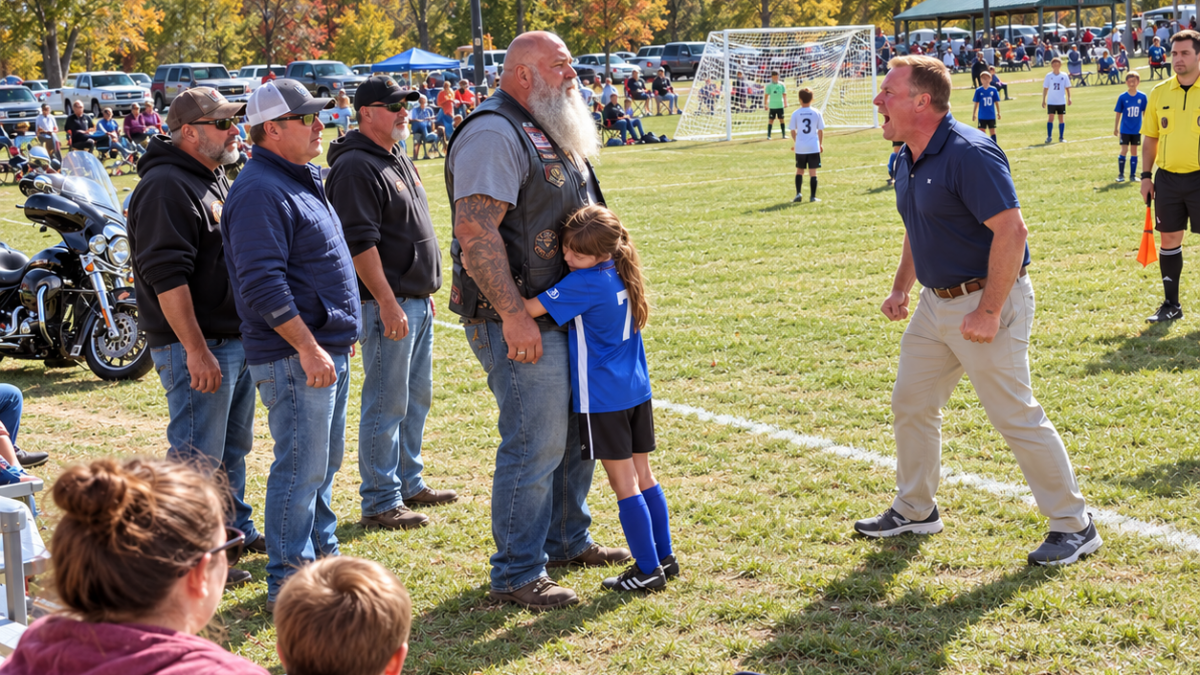
A Biker Threatened My Husband at Our 9-Year-Old’s Soccer Game—Then She Ran Past Her Father, Hugged the Biker, and Begged Him Not to Make Her Go Home.
My husband spent eight months convincing a judge, our church, our neighbors, and even some of my own friends that my six-foot-three biker father was the dangerous man in our family—until twenty parents watched Brian charge across a soccer field and punch him in broad daylight.
My father never hit back, even after Brian struck him twice; he simply raised his voice and asked why his nine-year-old granddaughter slept with a chair wedged beneath her bedroom doorknob if her father was really the victim.
Then Lily dropped her water bottle, ran straight past Brian, wrapped both arms around my father, and begged, “Grandpa, please don’t make me go home,” and the carefully polished life my husband had built around his lies began collapsing in front of everyone who had believed him.
My daughter was halfway through the first quarter when I heard the Harley.
You learn the sound of a motorcycle when you grow up with one.
Not motorcycles in general.
One motorcycle.
My father’s.
A dark green Harley Road King with pipes he insisted were “barely louder than stock” despite every dog within three blocks disagreeing.
I knew its idle.
I knew the low rumble when he rolled off the throttle.
I knew the slight unevenness in the exhaust note because Dad had once spent an entire winter rebuilding the motor himself and refused to admit one cylinder still sounded different.
And that Saturday morning, in the middle of a girls’ soccer game at Hawthorne Community Park, I heard that engine before I saw him.
My whole body went cold.
Not because I was afraid of my father.
Because I knew Brian would hear it too.
“Mom!”
One of the other mothers, Erica Jensen, nudged my arm.
“Lily’s got it.”
I forced myself to look at the field.
My daughter, Lily, was nine.
Number fourteen.
Green jersey.
Blond ponytail bouncing against her shoulders.
She had stolen the ball cleanly from another midfielder and was driving toward the sideline with the same aggression she had carried onto every soccer field since she was six.
On grass, Lily was fearless.
That was one of the things that broke my heart most.
She would challenge girls twice her size.
Slide for loose balls.
Shout for passes.
Argue with referees if she thought a call was unfair.
Then we would get home and Brian would walk into the kitchen, and my daughter would become quiet enough to hear the refrigerator hum.
People did not see that version of her.
They saw soccer Lily.
Church Lily.
Honor-roll Lily.
The kid who made handmade birthday cards for teachers.
They did not see the chair.
The wooden dining chair she had started dragging down the hallway every night.
The one she wedged beneath her bedroom doorknob.
The first time I found it there, I asked:
“Why is this here?”
Lily shrugged.
“Just because.”
I knew better.
She knew I knew.
Neither of us said the truth.
Not yet.
That morning, Brian stood ten yards away beside the team cooler.
Khaki shorts.
Blue polo.
Sunglasses.
A paper tray of orange slices in his hands.
PART2:
He had spent the first twenty minutes laughing with fathers from both teams.
He had helped Coach Ramirez carry folding goals from the storage shed.
He had brought extra bottled water.
When one little girl forgot shin guards, Brian jogged all the way to his SUV and found a spare pair.
That was Brian Mitchell.
Helpful.
Prepared.
Funny.
Good-looking.
The man who remembered names.
The man who shook hands firmly at church.
The man elderly women described as “such a gentleman.”
The man who had broken my wrist in February.
People imagine abusive men as visibly dangerous.
They want that.
It makes the world simpler.
They picture fists clenched all the time.
Drunken shouting.
Holes in drywall.
Neighbors calling police.
Some are like that.
Brian was not.
Brian ironed his shirts.
He donated to school fundraisers.
He coached Little League.
He sent thank-you cards.
He remembered to ask about your mother’s surgery three weeks later.
He never lost control in public.
Until the soccer field.
The Harley engine cut off.
I looked toward the far parking lot.
Dad stood beside the Road King.
Black leather vest.
Faded jeans.
Heavy boots.
Gray beard reaching halfway down his chest.
Arms crossed.
He was sixty-three then.
Six foot three.
About two hundred forty pounds.
Thirty-one years riding with the Iron Ridge Brotherhood.
Tattoos from wrists to shoulders.
One long scar beneath his chin from an accident when I was twelve.
To strangers, Dad looked like exactly the kind of man Brian had described in court.
Violent biker.
Unstable.
Intimidating.
A threat.
I saw something else.
The man who taught me to ride a bicycle by running behind me for six straight blocks because I refused to let him release the seat.
The man who learned how to braid hair after Mom died.
Badly at first.
Then surprisingly well.
The man who cried in the laundry room where he thought I couldn’t see him because he had accidentally shrunk Mom’s favorite sweater after she was gone.
The man who sat beside Lily’s hospital crib all night when she had pneumonia at eighteen months.
My father.
Thomas Callahan.
Dad did not walk toward us.
That mattered.
The restraining order prohibited him from coming within five hundred feet of our residence, Brian’s workplace, and Lily’s school.
It also prohibited direct contact with Brian.
The soccer park was not listed.
Public events were not automatically prohibited unless he used them to approach or harass Brian.
Dad knew every word.
He had paid a lawyer he could barely afford to make sure.
He parked on the far side.
Stayed there.
Watched his granddaughter play.
He had missed her ninth birthday.
Christmas morning.
School play.
Father-daughter dance where I went with Lily instead.
She had not seen him from closer than half a block in eight months.
Sometimes at night, Dad rode past our house.
Slow.
Never stopped.
Legally questionable perhaps, though technically outside the restricted radius if he stayed on the main road.
Brian called it stalking.
Lily called it:
“Grandpa checking the lights.”
She could hear the Road King from her bedroom.
Whenever she did, she ran to the window.
Waved into darkness.
Dad could not see her.
She did it anyway.
That motorcycle had become the sound of somebody remembering we existed.
Brian heard it now.
He turned.
The orange slices tilted in his hand.
For half a second, his face changed.
Only I noticed.
The smile vanished.
Jaw tightened.
Eyes narrowed.
Then the public mask returned.
He set down the tray.
“Stay here.”
He said it quietly to me.
I stood.
“Brian.”
He started walking.
“Brian, leave him alone.”
No answer.
He crossed behind our bench.
Then directly onto the soccer field.
The referee blew his whistle.
“Sir!”
Players stopped.
Brian kept moving.
Coach Ramirez called:
“Brian, what are you doing?”
Lily froze near midfield.
She saw where her father was going.
I saw fear hit her face.
“Brian!”
I followed.
He crossed the touchline.
Then midfield.
Dad remained beside the motorcycle.
Arms no longer crossed.
Hands visible at his sides.
He looked at Brian approaching.
Then at me.
Then Lily.
His expression changed when he saw her.
Just for a second.
Grandfather.
Then gone.
Brian stopped maybe three feet away.
“You son of a bitch.”
Parents were moving now.
Phones coming out.
Coach Ramirez jogged toward them.
Dad said:
“Morning, Brian.”
“You’re violating the order.”
“No.”
Dad’s voice was calm.
“You know damn well why you’re here.”
“Yes.”
“For Lily’s game.”
“You are stalking us.”
Dad looked around.
“Public park.”
“You’re obsessed with my family.”
Dad’s mouth tightened.
“My daughter is my family.”
Brian shoved him.
Hard.
Dad moved half a step.
Did not raise his hands.
People gasped.
Someone yelled:
“Hey!”
Dad said:
“Don’t.”
Brian shoved again.
“You stay away from my wife.”
Dad looked toward me.
I was maybe twenty feet away.
He saw my face.
Something in his eyes hurt.
“Your wife?”
He looked back at Brian.
“She stopped being yours to own the first time you put your hands on her.”
The field went silent.
Brian swung.
Wild.
Right hand.
Dad sidestepped.
Barely.
“Don’t.”
He said it like a warning to a dog near traffic.
“Not here.”
Brian’s face went red.
“You don’t tell me where.”
“Lily is watching.”
“Don’t say her name!”
Brian screamed it.
“My daughter.”
“MINE.”
Second punch connected.
Dad’s head snapped right.
His sunglasses flew.
A line opened on his cheek.
Dad did not hit back.
That was when I understood what he was doing.
My father had been in fights.
Plenty.
Less as he aged.
But I had seen him put a man on the ground.
If Dad wanted Brian down, Brian would have been down.
He chose not to.
Not because he was afraid.
Because he understood something I had not.
There were twenty parents watching.
Phones recording.
Referee.
Coaches.
Children.
Witnesses.
For once, Brian’s behavior would exist outside our house.
Dad wiped blood from his cheek.
Looked at his fingertips.
Then at Brian.
“That all you got?”
Brian stepped forward.
Dad continued.
“Because you hit a lot harder when it’s Katie.”
Brian stopped.
My stomach dropped.
Dad raised his voice slightly.
Not shouting.
Enough.
“You want to tell these people how she broke her wrist?”
Nobody moved.
Brian looked toward crowd.
Dad kept going.
“How about the ribs?”
My hand moved unconsciously to my side.
April.
Two cracked ribs.
I had told everyone I fell carrying laundry.
“You want to tell them about the fingerprints you left on Lily’s arm?”
Parents looked toward Lily.
She stood near midfield.
White.
Still.
Dad pointed nowhere.
Kept his hands open.
“Or why a nine-year-old girl sleeps with a chair under her bedroom doorknob?”
A mother behind me gasped.
Brian laughed.
Too loud.
“He’s insane.”
Nobody joined.
“He’s a violent biker.”
Dad stared.
Brian turned toward parents.
“This man has been stalking us for months.”
He pointed at Dad.
“There is a restraining order.”
That part was true.
Truth is useful inside lies.
Brian had always understood that.
“The court determined he was dangerous.”
Dad said:
“The court heard your story.”
Brian stepped toward him.
“You threatened to kill me.”
“No.”
“You broke into my house.”
“No.”
“You—”
“I walked into my daughter’s kitchen because she called me crying after you put fingerprints on your eight-year-old’s arm.”
Something changed around us.
People were no longer watching two men argue.
They were listening.
Then Lily ran.
Her water bottle hit grass.
She sprinted past the referee.
Past Coach Ramirez.
Past Brian.
Straight into Dad.
She wrapped her arms around his waist.
Dad’s face collapsed.
For the first time that morning, his hands moved quickly.
Not toward Brian.
Around Lily.
“Baby.”
Lily buried her face in his vest.
“Grandpa.”
Dad closed his eyes.
Eight months.
He had not held her in eight months.
Lily started sobbing.
“Don’t go.”
“I’m here.”
“Please don’t go.”
“I’m right here.”
Then she said the sentence that changed everything.
“I don’t want to go home.”
Every parent heard it.
Brian’s face changed.
“Lily Marie.”
She gripped Dad tighter.
“Come here.”
“No.”
Soft.
But clear.
Brian took a step.
“No?”
Lily flinched.
Dad moved.
One step.
Placed his body between them.
No fists.
No threat.
Just six feet three inches of grandfather.
Brian pointed.
“Get away from her.”
Dad said:
“Ask her what she wants.”
“She’s nine.”
“Yes.”
“She doesn’t know what she wants.”
Dad’s eyes hardened.
“She knows where she feels safe.”
Tom Peretti stepped forward.
I knew Tom casually.
His daughter played for the opposing team.
Insurance salesman.
Khaki dad.
Church volunteer.
Not someone Brian could dismiss as biker trash.
Tom stood beside Dad.
“Maybe everybody needs to wait for police.”
Brian stared.
“This is none of your business.”
Tom looked at Lily.
“Think it became everybody’s business when she said she was afraid to go home.”
Another father joined.
Then Coach Ramirez.
Then Erica.
One by one.
Not surrounding Brian.
Just forming distance.
Witnesses becoming people.
Someone had already called 911.
Seven minutes.
Longest seven minutes.
Brian regained himself halfway through.
I watched it happen.
Shoulders lowered.
Voice softened.
He picked up sunglasses Dad had dropped.
Held them.
“Tom.”
He almost smiled.
“You know me.”
Tom said:
“I thought I did.”
That landed.
Brian looked toward me.
“Katie.”
His voice became the one he used after hurting me.
Quiet.
Reasonable.
“Come here.”
I stayed.
His eyes sharpened.
“Katie.”
My body responded before mind.
One step.
Toward him.
Lily grabbed my hand.
That stopped me.
My daughter.
Nine years old.
Her fingers closed around mine.
Dad looked at me.
Did not speak.
He had learned.
No pressure.
My choice.
Brian said:
“We’re going home.”
Lily whispered:
“No.”
Brian heard.
His jaw twitched.
Then police arrived.
Two cruisers.
Four officers.
People parted.
Brian stepped forward immediately.
Of course.
“Officer.”
Clean voice.
Controlled.
“That man has a restraining order against him.”
He pointed at Dad.
“He showed up at my daughter’s game and attacked me.”
I almost laughed.
The lie came that easily.
Dad said nothing.
Officer looked at blood on Dad’s cheek.
Then Brian’s unmarked hands.
“Sir.”
He addressed Dad.
“Step over here.”
Dad complied.
Hands visible.
No argument.
Brian started talking.
“Eight months of stalking.”
“Threats.”
“Harassment.”
“My wife and daughter are terrified.”
Then Tom Peretti interrupted.
“No.”
Officer looked over.
Tom pointed.
“Brian walked across the field.”
“Other guy stayed by motorcycle.”
“Brian shoved him.”
“Twice.”
“Then swung.”
Officer asked:
“Did the biker strike him?”
“No.”
Coach Ramirez:
“I saw the whole thing.”
Erica:
“I recorded most of it.”
Another mother raised phone.
“Me too.”
Officer turned to Brian.
His face tightened.
“They’re friends with him.”
Tom laughed.
“I’ve never met the man.”
That mattered.
Officer asked:
“Who called 911?”
Three hands.
Then:
“Where’s the child?”
Lily stood against Dad’s side.
Officer crouched some distance away.
“Hi, Lily.”
She stared.
“My name is Officer Daniels.”
No response.
“Are you hurt?”
Lily looked at me.
I nodded.
“You can tell him.”
She whispered:
“No.”
Officer Daniels did not push.
He looked at me.
“Ma’am, can I speak with you privately?”
Brian stepped closer.
“I’m her husband.”
Officer held hand up.
“I asked her.”
There are ordinary sentences that can sound like doors unlocking.
I asked her.
Not him.
Me.
We walked twenty feet away.
Another female officer joined.
Officer Daniels said:
“What happened today?”
I looked toward Brian.
He was staring.
I could feel his eyes.
My body remembered everything.
The slap eight months after our wedding.
The first one.
How he cried.
How I comforted him.
That still disgusts me.
He had hit me and somehow I ended up telling him it was okay.
“I’m stressed.”
He said.
“I don’t know what came over me.”
He bought flowers.
Three weeks later:
another slap.
Then grabbing.
Shoving.
A fist into wall beside my head.
Years.
Escalation slow enough that I kept moving the line.
He didn’t mean.
He was angry.
He never hit Lily.
He only grabbed.
He never broke anything important.
Wrist healed.
Ribs healed.
He never did it in front of people.
He loves us.
He provides.
Nobody perfect.
Every year, my definition of unacceptable moved backward.
Until there was a chair beneath my daughter’s door.
Officer Daniels said:
“Ma’am?”
I realized I was silent.
Female officer’s name was Chen.
She said:
“Take your time.”
Brian called:
“Katie.”
Officer Chen looked toward him.
Then back.
“You don’t have to answer him.”
I started crying.
Quiet.
Ugly.
All the tears I had postponed because crying at home made Brian angrier.
“He hits me.”
My voice barely existed.
Officer leaned closer.
“What?”
I forced it louder.
“He hits me.”
The soccer field disappeared.
“He’s been hitting me for over ten years.”
Brian said:
“That’s a lie.”
Officer Daniels turned.
“Sir, stay where you are.”
I continued.
“He broke my wrist in February.”
Officer Chen asked:
“Medical treatment?”
“Yes.”
“Where?”
“St. Vincent ER.”
“Any records?”
“Yes.”
“April?”
I touched ribs.
“Two cracked.”
“Clinic?”
“Yes.”
“And your daughter?”
I looked at Lily.
“She grabbed her.”
I corrected myself.
“He grabbed her.”
“How?”
“Upper arm.”
“Bruises.”
“Four fingers.”
“When?”
“Eight months ago.”
“That led to your father coming over?”
I nodded.
Brian shouted:
“She’s being manipulated!”
Dad’s entire body tensed.
Officer near him said something.
Dad stayed.
Officer Chen asked:
“Why didn’t you report earlier?”
There was no judgment in her voice.
Still, shame answered first.
“I was afraid.”
“Of him?”
“Yes.”
“Anything else?”
I looked toward Dad.
“The restraining order.”
“How was that related?”
My throat closed.
“Dad came because I called him.”
“Brian grabbed Lily.”
“I panicked.”
“Dad told Brian never to touch us again.”
“Brian called police.”
“He said Dad broke in.”
“Dad didn’t.”
“Did you tell the court that?”
I started crying harder.
“No.”
“Why?”
Brian was twenty feet away.
I could still feel the hand on my knee.
Courtroom eight months earlier.
Judge.
Dad on other table.
Brian beside me.
His fingers on my kneecap.
Not painful.
Reminder.
He whispered while attorneys spoke:
“You embarrass me and you’ll regret coming home.”
I said nothing.
Judge granted order.
Dad stared at me afterward.
Not angry.
Heartbroken.
I had betrayed him.
Or believed I had.
Now Officer Chen asked again:
“Why didn’t you tell the judge?”
“Because Brian was squeezing my knee.”
She understood.
“And you were afraid.”
“Yes.”
Officer Daniels said:
“Do you want to make a report today?”
Brian called:
“Katie, think about what you’re doing.”
That did it.
Not threat.
That tone.
The one that had controlled every room of my life.
Think.
Meaning:
Remember consequences.
I turned.
Looked at him.
For the first time in eleven years, he looked small.
Not physically.
The illusion.
Small.
I said:
“Yes.”
Officer:
“Yes what?”
“I want to make a report.”
Louder.
“I want everything documented.”
Brian’s face emptied.
“I have medical records.”
“My wrist.”
“My ribs.”
“Pictures.”
His eyes widened.
He did not know about all the pictures.
That was my secret.
Six months earlier, after the wrist, I started sending photographs to an email account he did not know existed.
Dates.
Bruises.
Damage.
Screenshots.
Audio once.
I had never been brave enough to use them.
But I had kept them.
Survival sometimes looks like cowardice from outside.
Sometimes it is gathering receipts in darkness.
Officer Chen asked:
“Can you access them?”
“Yes.”
Brian stepped forward.
Two officers moved.
“Sir.”
He stopped.
Then mask cracked again.
“She’s insane.”
There.
Public.
“You have no idea what I live with.”
He pointed at me.
“She lies.”
“She provokes.”
“She—”
Officer Daniels:
“Turn around.”
Brian stared.
“What?”
“Hands behind your back.”
His face changed.
Fear.
Not of jail exactly.
Loss.
Control leaving.
“This is ridiculous.”
“Sir.”
“My attorney—”
“Hands.”
He complied.
Handcuffs clicked.
Lily watched.
She did not cry.
She exhaled.
I heard it.
Dad heard too.
Brian looked at Dad while officers walked him toward cruiser.
“This isn’t over.”
Dad said nothing.
Brian looked at me.
“You think he’s going to take care of you?”
I stayed silent.
He laughed.
“You’ll come crawling back.”
Dad moved one step.
Officer near him said:
“Mr. Callahan.”
Dad stopped.
Then Brian was placed in cruiser.
Door closed.
Only after car pulled away did I realize I was shaking.
Dad approached slowly.
“Katie?”
I looked at him.
Eight months.
Christmas.
Lily’s birthday.
My silence in court.
“Dad.”
He opened his arms.
I fell into them.
Not graceful.
Full adult daughter collapsing against leather vest.
He held me.
Lily joined.
Three people in middle of soccer park.
I said:
“I’m sorry.”
Dad pressed cheek against my hair.
“No.”
“I’m sorry.”
“No.”
“I should’ve told them.”
“Katie.”
His voice firm.
“You were surviving.”
“I let them call you dangerous.”
“So?”
“They believed him.”
“So did you.”
That hurt.
Dad corrected:
“You believed what you needed to survive.”
“I knew.”
“You were scared.”
“I should’ve—”
“Stop.”
He pulled back.
Looked at me.
“You got out today.”
“That’s what matters.”
I wish freedom started cleanly.
It does not.
That evening was worse than soccer field in different way.
Police escorted me to house.
Brian still held legal ownership too.
I could take essentials.
Dad stayed outside because restraining order technically remained active.
Two officers came in with me.
Lily.
Me.
Suitcases.
I walked through my home like archaeological site.
Kitchen.
Counter Brian shoved me into.
Hallway where he punched wall.
Bathroom where I covered bruises.
Bedroom.
Our bed.
Wedding photo.
I turned it facedown.
Lily went to her room.
Chair beneath doorknob.
Still there from night before.
Officer Chen saw.
She stopped.
Looked.
Did not say anything.
She photographed it.
That picture became evidence later.
Lily packed stuffed fox.
Soccer medals.
Three books.
Purple blanket.
Then asked:
“Can we take the chair?”
My throat closed.
“You won’t need it.”
She stared.
“Can we?”
I nodded.
“Yes.”
Dad’s house had two bedrooms upstairs.
Garage larger than kitchen.
Motorcycle parts everywhere.
Mom had died when I was fourteen.
Dad never remarried.
He claimed no woman deserved garage smell.
Truth was he never stopped loving her.
He converted his junk room into Lily’s room overnight.
Club brothers helped.
I did not know they had been waiting.
Purple curtains.
New sheets.
Small desk.
A motorcycle-shaped nightlight Big Eddie found at Target.
It was hideous.
Lily loved it.
First night:
I walked past her room.
Door open.
No chair.
The chair sat folded—Dad had found a folding one instead of bringing our heavy dining chair—against wall.
Unused.
I stood hallway.
Cried silently.
Dad came behind me.
No words.
Just hand on shoulder.
I whispered:
“She didn’t use it.”
Dad looked into room.
Lily sleeping.
“She knows.”
“What?”
“She knows she’s safe.”
That was almost unbearable.
Brian posted bail Monday.
Emergency protective order issued for me and Lily.
Dad’s old restraining order remained until separate hearing Friday.
Brian’s attorney called me.
I refused.
Then emails.
Mutual misunderstanding.
Escalated marital conflict.
Brian deeply regrets soccer-field confrontation.
Brian committed to counseling.
Brian wants family preserved.
Familiar language.
I had heard variations after every incident.
Flowers in lawyer form.
Dad’s attorney told me:
“Do not reply.”
I didn’t.
Church called.
Pastor Daniel.
“Brian says things have gotten out of control.”
I asked:
“Did he tell you he broke my wrist?”
Silence.
“Katie, marriage can become—”
I hung up.
That was the first boundary.
Felt terrible.
Did it anyway.
Friends split.
Some believed immediately.
Others:
“He never seemed…”
“I’ve known Brian fifteen years…”
“Are you sure…”
“Could there be another side…”
Another side.
There is always another side to an argument.
Not to a broken wrist.
Erica sent soccer video.
Three angles existed.
One mother had recorded from moment Brian crossed field.
Clear.
Shove.
Shove.
Swing.
Second punch.
Dad never struck.
Audio of Dad naming injuries.
Audio of Lily:
I don’t want to go home.
Those videos changed everything legally.
At Friday hearing, Brian wore a navy suit.
Dad wore button-down.
No leather.
His lawyer advised.
Dad complained.
“Clothes shouldn’t matter.”
Lawyer said:
“They shouldn’t.”
Dad grunted.
“But they do.”
“Yes.”
“Fine.”
He wore navy shirt and boots.
Brian’s attorney argued Dad provoked.
Public confrontation.
Harassing statements.
Dad’s attorney played video.
Silence.
Then introduced my statement.
Medical records.
Photo of Lily’s chair.
Photo of bruises.
Prior 911 call circumstances.
Judge looked toward me.
Same judge.
I recognized him.
Judge Harris.
The man who signed restraining order.
He looked older in five days.
Or maybe I saw him differently.
He said:
“Mrs. Mitchell, were you present at prior restraining-order hearing?”
“Yes.”
“Did you testify?”
“Barely.”
“Why did you not disclose these allegations?”
I looked at Brian.
Then judge.
“Because I was afraid of what would happen when we got home.”
Courtroom silent.
Judge looked down.
Dad’s attorney asked to dissolve order.
Granted.
Immediately.
Then Judge Harris did something unexpected.
He addressed Dad.
“Mr. Callahan.”
Dad stood.
“Yes, Your Honor.”
“I reviewed original filing.”
Dad waited.
“The court acted on evidence presented.”
“Yes, sir.”
Judge continued.
“It appears now that material information was absent.”
Dad glanced toward me.
Then:
“My daughter was scared.”
Judge looked at Brian.
“I understand that better today.”
Not apology.
Judges do not often apologize.
But close.
Order dissolved.
Dad walked out legally allowed to hug granddaughter.
Lily had waited outside.
When she saw him:
ran.
Again.
This time nobody could claim danger.
Criminal investigation expanded.
Domestic assault.
Child endangerment.
Evidence included:
medical records.
Photographs.
Audio.
Text messages.
Soccer witnesses.
Lily interview by trained forensic interviewer.
That was hardest.
I was not in room.
Dad not.
Brian not.
Child advocate.
Camera.
Lily told them about arm.
Doors.
Yelling.
One night Brian kicked her bedroom door.
That was why chair started.
I had not known.
That realization destroyed me.
I thought chair was general fear.
There had been event.
Brian stood outside Lily’s locked door because she would not stop crying after he yelled at me.
He kicked it twice.
Said:
“Open this damn door.”
Lily pushed desk chair against knob afterward.
Then every night.
I asked:
“Why didn’t she tell me?”
Therapist answered:
“Children protect parents too.”
I hated that.
Not therapist.
Truth.
Lily believed I had enough.
So she carried some alone.
Just like I had hidden injuries thinking I protected her.
Abuse turns family into people secretly protecting each other while abuser becomes only person not protecting anyone.
Trial happened four months later.
Four days.
Brian’s lawyer was sharp.
Very.
He attacked inconsistencies.
Why no earlier police reports?
Why return home after injuries?
Why attend parties smiling?
Why post anniversary photo three weeks after wrist fracture?
Why tell ER nurse I fell?
Why stay?
People think these are gotcha questions.
Survivors know answers are boring.
Fear.
Money.
Children.
Hope.
Shame.
Isolation.
Habit.
Love even.
Yes, love.
You can love someone hurting you.
That is one of the cruelest facts.
I testified.
Hands shaking.
Brian stared at me.
His lawyer asked:
“Mrs. Mitchell, you told your husband you loved him days after the alleged February assault?”
“Yes.”
“So despite claiming he broke your wrist, you expressed love.”
“Yes.”
“Does that make sense?”
I looked at jury.
Then:
“It didn’t make sense to me either.”
Attorney paused.
I continued.
“I loved the man he could be between the times he hurt us.”
“That was part of why I stayed.”
No dramatic objection.
Just truth.
Dad testified.
Prosecutor asked about soccer.
Brian’s lawyer brought up club.
“Your organization has members with criminal histories?”
Dad:
“Some.”
“Violence?”
“Some.”
“You personally threatened Brian Mitchell?”
“No.”
“You said there would be a problem.”
“Yes.”
“What did that mean?”
Dad looked at him.
“It meant if he hurt my daughter again, I would help her leave and call police.”
“That’s not how Mr. Mitchell interpreted it.”
Dad shrugged.
“Mr. Mitchell interpreted a lot of things conveniently.”
Judge told Dad only answer questions.
Dad apologized.
Jury smiled slightly.
Then Lily.
Not courtroom physically.
Remote room.
Counselor present.
Video link.
I almost could not watch.
Nine years old.
Hair braided.
Purple sweater.
She held stuffed fox.
Prosecutor asked simple.
“Why did you put chair under your door?”
“So Daddy couldn’t come in.”
“Why didn’t you want him to come in?”
“Because he got mad.”
“What happens when he gets mad?”
Lily looked down.
“He gets big.”
That sentence crushed me.
Brian was not physically huge.
Maybe six feet.
But in a child’s fear:
big.
“Did he hurt you?”
She nodded.
“How?”
“Arm.”
“Anything else?”
“He squeezed my face once.”
I did not know that either.
My vision blurred.
“What happened at soccer game?”
“I saw Grandpa.”
“How did that make you feel?”
“Safe.”
“Why?”
“Because Daddy doesn’t hit when Grandpa’s there.”
Brian looked down.
That was it.
Not leather.
Not threats.
Safety.
Defense tried carefully.
“Lily, do you love your father?”
“Yes.”
Everyone seemed surprised.
She continued:
“I don’t want him to hurt people.”
Children hold contradiction better than adults.
Love.
Fear.
Same body.
She said:
“I want him to be nice.”
Her father cried.
Real tears.
I think.
Maybe Brian loved Lily.
I believe he did.
That did not stop him from harming her.
Love without safety is not enough.
Jury returned guilty.
Domestic assault.
Child endangerment.
Additional count related to prior assault.
Sentence:
two years.
Likely fourteen months with credit and good time.
People ask if I was angry.
Yes.
Also relieved.
Not enough.
Also something.
Enough runway.
That was Dad’s phrase.
“Head start.”
He said.
“You don’t need forever.”
“You need time to build something he can’t control.”
We did.
Divorce finalized.
Full custody.
Supervised contact contingent on treatment after release.
I changed phone.
Bank.
Passwords.
Moved permanent address to small rental eventually, not Dad forever.
Important.
Dad wanted us to stay.
I needed life that was mine.
Therapy.
Lily therapy too.
Soccer continued.
First game after arrest:
Dad front row.
Leather vest.
Patches.
Coffee.
Other parents greeted him.
Strange reversal.
Months earlier some would cross aisle.
Now Erica brought extra coffee.
Tom Peretti sat beside him.
Tom bought used Sportster that winter.
Dad mocked it.
“Starter Harley.”
Tom said:
“I’m fifty-two.”
Dad:
“Still starting.”
They became friends.
Lily played better.
Not because trauma magically resolved.
Some weeks bad.
She started wetting bed for a while.
Nightmares.
Flinched at slammed doors.
At one game referee yelled unexpectedly and she froze.
Coach sat her.
Dad never pushed.
Therapist helped.
Slow.
Healing is not montage.
One afternoon, I found chair under Lily’s door again.
Three months after we left.
My heart broke.
I almost said:
“You don’t need that here.”
Then stopped.
Sat outside door.
“Can I come in?”
Pause.
“Yes.”
I entered.
Chair.
She looked ashamed.
“Bad dream.”
I sat.
“You can use it.”
She stared.
“I can?”
“If it helps tonight.”
“But Grandpa says safe.”
“You are.”
“Then why chair?”
I took breath.
“Sometimes your body remembers being scared even when your brain knows you’re safe.”
Therapist language.
Good language.
“That’s not your fault.”
Lily nodded.
“Can I keep it?”
“As long as you want.”
Two weeks later chair gone.
Her choice.
That mattered.
My own healing was uglier.
I missed Brian.
There.
I said it.
People hate that part.
How can you miss abuser?
Because eleven years contain mornings.
Vacations.
Inside jokes.
Lily’s birth.
Christmas.
Brian singing badly in car.
He was not violent every second.
If he had been, leaving might have been easier.
I grieved marriage I thought I had.
Man I kept waiting for.
Future.
House.
Identity.
Some nights I wanted to call him.
I never did.
I told therapist.
She did not shame me.
“Missing isn’t returning.”
Good sentence.
Dad struggled too.
Not with wanting Brian back.
With guilt.
“I knew.”
He said one night garage.
“Katie, I knew.”
“No.”
“At engagement.”
“You said something off.”
“I should’ve done more.”
“What?”
He had no answer.
“You couldn’t forbid me to marry.”
“I could’ve—”
“What?”
“Dragged me away?”
Dad sighed.
“No.”
“You warned me.”
“I dismissed you.”
“You were in love.”
“I was stupid.”
“You were twenty-five.”
He looked at motorcycle.
Then:
“I should’ve checked harder.”
I laughed sadly.
“Dad, people aren’t used cars.”
He almost smiled.
“No Carfax.”
“No.”
We sat.
Then I said:
“You believed me when it mattered.”
He looked at me.
“That’s what I remember.”
Dad cried.
Rare.
Quiet.
His club’s rule was real.
No abuse.
No second chance.
I had grown up around men outsiders considered dangerous.
Tattooed.
Loud.
Some rough histories.
But I had also grown up with strange moral clarity.
You hit a partner?
Out.
You hit a child?
Done.
One member twenty years earlier broke his wife’s jaw.
Club stripped patch before criminal trial even started.
Dad told me:
“We can’t control law.”
“We control who we stand beside.”
That stayed.
Not every biker noble.
Not every clean-cut man cruel.
That would simply reverse same prejudice.
Point was appearance told nothing.
Behavior did.
A year after soccer game, I went to church fundraiser.
First time back.
Pastor Daniel approached.
Nervous.
“Katie.”
“Pastor.”
“I owe you an apology.”
I waited.
“When you called…”
He looked down.
“I framed it as marital conflict.”
“Yes.”
“I should have asked whether you were safe.”
“Yes.”
He swallowed.
“I knew Brian.”
“So did I.”
That answer hurt both.
Pastor began domestic violence training afterward.
Church established confidential referral process.
No couples counseling if active abuse suspected.
Outside advocate.
Safety plan.
I appreciated.
Did not return regularly.
Some places remain attached to version of yourself you cannot inhabit again.
That’s okay.
Brian was released after sixteen months.
Close to prediction.
I panicked for two weeks before.
Nightmares returned.
Chair returned one night.
Lawyer filed protective order extension.
Granted.
Brian moved two counties away.
Completed mandated program.
Sent letters through approved channel.
I did not read first three.
Therapist helped me decide.
Fourth I read.
He said:
“I’m sorry.”
Then three paragraphs explaining stress.
Childhood.
Pressure.
Provocation.
Not apology.
I stopped.
Lily had supervised contact options.
She refused initially.
Court respected with therapist input.
At twelve, she chose one video call.
Brian looked older.
He cried.
Said:
“I miss you.”
Lily said:
“I miss when you were nice.”
That sentence left him speechless.
She asked:
“Are you still mad?”
He said no.
She said:
“Do you still blame Mom?”
Long pause.
“I’m working on that.”
Lily ended call.
Later:
“He didn’t answer.”
“No.”
“Then not yet.”
Twelve-year-old clarity.
Eventually Brian built some relationship with Lily.
Limited.
Supervised.
I know some readers will hate that.
Life is not revenge story.
He was her father.
She had agency.
Safety boundaries.
Professionals.
No forced forgiveness.
No reunion.
At fifteen, Lily met him twice yearly.
At sixteen, stopped for a year.
At seventeen, resumed.
Her decision.
Mine was different.
I never reconciled romantically.
Never considered.
I could forgive pieces without reopening door.
Dad aged.
Road King eventually harder to handle.
At seventy-one he traded for trike.
Pretended practical.
We all knew knees.
Still attended games.
Lily stopped soccer after middle school.
Track instead.
Dad complained no halftime snacks.
She rolled eyes.
Graduation.
Dad front row.
Leather vest over button-down despite my objections.
Lily wore honor cords.
After ceremony, she handed him one.
“What’s this?”
“For you.”
“Why?”
“You showed up.”
Dad looked at me.
Could not speak.
Lily tied cord around vest.
Photos exist.
Gray beard.
Tattoos.
Academic cord.
Perfect.
Years later, when Lily applied to college, essay prompt:
Describe a moment when your understanding of safety changed.
She wrote about soccer field.
Not abuse details.
Moment.
The line I remember:
“I learned that safety is not always the person with legal authority, the nicer clothes, or the more convincing story. Sometimes safety is the person who stands between you and fear without asking you to lie about why you’re afraid.”
She got scholarship.
Dad printed essay.
Framed it in garage.
Next to old motorcycle parts.
I remarried eventually.
Took nine years.
His name is Daniel.
Teacher.
Kind.
First six months I analyzed every tone.
Every raised voice.
Every disagreement.
One evening he dropped a glass.
Shattered.
Swore loudly.
I flinched.
Dropped to couch.
He saw.
Stopped.
Did not approach.
“Do you want space?”
That question nearly made me cry.
“Yes.”
He backed away.
No:
What’s wrong with you?
No:
I’m not Brian.
No:
You need to get over this.
Space.
Later, therapy helped us build.
Dad liked him.
Eventually.
First meeting:
Dad asked fourteen questions.
Daniel answered thirteen.
Fourteenth:
“If I ever hurt Katie, what happens?”
Dad asked.
I wanted floor to swallow me.
Daniel thought.
Then:
“She leaves me.”
Dad stared.
Daniel continued.
“And if she needs help, I hope she calls you.”
Dad shook his hand.
Passed.
Lily married before I did.
Tom Peretti’s son?
No.
People predicted.
Instead college friend named Marcus.
Quiet.
Engineer.
Dad inspected him.
Lily stopped.
“Grandpa.”
“What?”
“You don’t get to scare everybody.”
“Why not?”
“Because I learned boundaries.”
Dad looked offended by his own lesson returning.
“Fine.”
Marcus later asked Dad privately for blessing.
Dad said:
“You don’t need mine.”
“Need hers.”
Good.
At wedding, Dad danced with Lily.
Slow.
He had trouble walking by then.
She rested head against his chest.
I watched.
Thought soccer.
Nine-year-old sprinting.
Water bottle falling.
Grandpa don’t go.
All time collapsed.
Dad died two years later.
Heart failure.
Home.
I was there.
Lily.
Daniel.
Club brothers.
Road King had been sold but someone brought it for funeral procession.
Tom rode it.
At service, men in leather lined outside.
Pastor Daniel—same pastor—gave prayer.
Lily spoke.
She told story without naming Brian much.
“My grandfather taught me protection doesn’t always look official.”
Then:
“He also taught me that protecting someone doesn’t mean making decisions for them.”
That was Dad’s evolution too.
At first, he wanted to rescue us by force.
Then learned to stand available.
Wait.
Believe.
Show up.
When Lily was eight, he came immediately.
Threatened problem.
Got restrained.
When she was nine at field, he did something harder.
Did not hit back.
Let truth have witnesses.
His restraint saved us more than his strength.
After funeral, we found old notebook in garage.
Dad wrote mileage.
Parts.
Random reminders.
One page from year of restraining order.
December 24:
Rode past K & L. Lights on. L waved from window. Couldn’t wave back. Worst Christmas.
Another:
January 9:
Court says dangerous. Lily says Grandpa. Believe Lily.
I still have notebook.
That line.
Believe Lily.
Everything changed because people finally did.
The law did not initially.
Church did not.
Friends did not.
I barely believed myself.
Dad believed.
Then soccer parents believed.
Police.
Judge.
Jury.
But first:
Lily.
Children know fear even when adults argue definitions.
That is not to say every accusation is automatically proof.
Facts matter.
Evidence matters.
Process matters.
In our case, facts accumulated.
Medical records.
Videos.
Witnesses.
Photos.
A chair.
Bruises.
Texts.
Pattern.
Brian had used respectability like camouflage.
He knew people trust calm men in polos.
He knew they distrust angry women.
He knew biker father looked dangerous.
He knew I was scared.
He weaponized all of it.
That may be what I struggled with longest.
Not just violence.
Narrative.
Brian controlled story.
At ER:
I fell.
At church:
Katie is emotional.
In court:
Her father is unstable.
At home:
You made me do it.
He turned every event until I carried responsibility.
Soccer field broke narrative because he forgot audience.
Public Brian and private Brian occupied same space for seven minutes.
He shoved.
Swung.
Yelled ownership.
Called Lily “mine.”
People saw.
Then Lily chose.
Children do not understand courtroom optics.
She did not run to Dad to make a legal statement.
She ran where nervous system told her safety lived.
That was why the scene mattered.
Not because biker good, father bad.
Because her body told truth before she had vocabulary for everything.
The line formed beside Dad.
Tom.
Coach.
Other parents.
I have thought about that line often.
Nobody punched Brian.
Nobody threatened.
They simply stood.
A social wall.
That was enough.
Dad’s saying became famous among our strange extended family:
“You don’t need a badge to protect someone.”
But he always added later:
“You need to know what protection actually means.”
When younger, he thought protection meant fists.
At sixty-three, he learned sometimes it meant keeping hands at sides while man you hated punched you in front of everyone.
Sometimes it meant legal fees.
Riding past at midnight.
Waiting outside courtroom.
Purple curtains.
Coffee at soccer.
Believing without demanding proof first, while still helping gather proof for everybody else.
Showing up.
That was his gift.
Six months after soccer game, Lily scored winning goal in district semifinal.
Dad jumped up so fast his coffee went everywhere.
Tom yelled.
Erica screamed.
Lily ran sideline.
For one horrible second, old memory flashed.
Her running toward Dad.
But this time nobody chased.
Nobody afraid.
She hit sideline.
Dad opened arms.
She stopped.
Not because fear.
Because referee yelled:
“Stay on field!”
Everyone laughed.
Lily backed up.
Pointed at Dad.
“After!”
Dad shouted:
“I’ll be here!”
Three words.
I’ll be here.
Maybe that was the whole story.
Brian promised change repeatedly.
Dad promised presence.
One was language.
One was pattern.
The first night in Dad’s house, Lily slept without chair.
Years later, she told me why.
“I knew Grandpa would hear him.”
“Hear who?”
“Anybody.”
She said.
“If somebody came in.”
Safety was not lock.
It was someone listening.
I asked:
“Were you afraid at Dad’s?”
“No.”
“Then why did you think about somebody coming?”
She shrugged.
“I always did.”
Trauma does not disappear with geography.
But it can stop being reinforced.
Eventually nervous system learns new house rules.
Doors can slam because wind.
Footsteps can mean snacks.
Raised voice can mean football game.
Motorcycle engine can mean Grandpa.
Silence can be safe too.
I learned.
Lily learned.
Maybe even Brian learned something in prison and treatment.
I hope.
Not for me.
For everyone else he encounters.
Accountability without transformation protects temporarily.
Accountability with transformation can protect future.
But that part belongs to him.
My life no longer depends on whether he changes.
That freedom took years.
I used to think leaving Brian was day he was arrested.
It wasn’t.
Leaving was hundred smaller acts afterward.
Changing bank password.
Signing lease.
Saying no to pastor.
Telling friend truth.
Deleting anniversary photos.
Not answering lawyer.
Sleeping alone.
Buying couch without asking anyone.
Wearing red dress Brian said made me “look cheap.”
Going back to school.
Laughing loudly.
Letting Lily close her bedroom door because she wanted privacy, not because she was afraid.
Falling in love again.
Not checking another adult’s mood before speaking.
Those were exits.
Hundreds.
Dad walked beside many.
Not all.
Important.
At some point he had to let me become person, not daughter needing rescue.
He did.
That was real fatherhood too.
On anniversary of soccer game, I sometimes drive past Hawthorne Park.
Not intentionally every year.
But enough.
The far parking lot still there.
Dad’s old spot.
Field replaced turf.
Kids play.
Parents yell.
Life ordinary.
I can almost see him beside green Road King.
Arms crossed.
Waiting.
Brian walking.
Dad refusing punch.
Lily running.
Me standing in between lives.
If you freeze image right before Lily runs, it looks like disaster.
Biker bleeding.
Father angry.
Mother terrified.
Children staring.
911 calls.
But sometimes collapse of a lie looks like disaster before it looks like freedom.
That morning, Brian lost control of audience.
Then home.
Then story.
Then us.
He had spent years convincing me nobody would believe me.
He was almost right.
That is terrifying.
But he made one mistake.
He thought everyone would keep believing him after seeing him.
And he underestimated a nine-year-old girl.
Lily did not testify at soccer field.
She just ran.
Straight to man court had called dangerous.
Past man everyone called respectable.
Wrapped arms around leather vest.
Said:
I don’t want to go home.
That was enough to make people ask the right question.
Why?
Once people asked honestly, Brian’s entire structure became harder to maintain.
Why broken wrist?
Why cracked ribs?
Why fingerprints?
Why chair?
Why restraining order only after grandfather confronted him?
Why child afraid?
Why husband punching sixty-three-year-old man at game?
Questions are dangerous to abusers whose power depends on everyone accepting first explanation.
Dad never needed to kill Brian.
Never needed to threaten him.
Never needed revenge.
Truth did more damage than any fist could.
That is another lesson.
At beginning, my father wanted violence.
I know.
He admitted.
When I called crying after Lily’s arm bruised, Dad arrived ready to tear Brian apart.
He didn’t.
Then he paid price anyway.
By soccer field, he had learned.
He stood still.
Brian exposed himself.
The strongest thing my father did was refuse to become the man Brian said he was.
That gave rest of us room to see man Brian really was.
Today, Lily is twenty-three.
She coaches girls’ soccer on weekends.
Of course.
At first practice each season she has one rule:
“If you say you’re scared, we stop and listen.”
Parents think she means injuries.
Sometimes.
She means more.
One girl once told her she did not want stepfather picking her up.
Lily did not interrogate.
She found school counselor.
Called mother.
Followed safeguarding procedures.
Nothing criminal eventually.
But girl had reason.
Boundary being ignored.
Lily told me:
“I remembered everybody arguing about whether Grandpa was safe.”
“So?”
“So I don’t decide for kids before listening.”
Dad would have been proud.
Her team wears green.
Number fourteen still her favorite.
She keeps Dad’s vest in closet.
Too big.
On anniversary of his death, she wears it at home sometimes.
I asked once if she wanted motorcycle nightlight.
She rolled eyes.
“Mom, I’m twenty-three.”
“That’s not no.”
“It’s no.”
I kept it.
I have Dad’s notebook.
Green Road King photo.
Purple curtain scrap from when we moved.
And one old dining chair.
Yes.
The chair.
The original one from our house.
When property divided, I took it.
People find that strange.
Why keep object associated with fear?
Because it changed meaning.
At Dad’s garage, I sanded it.
Painted purple with Lily.
She was ten.
Dad wrote underneath seat:
NO DOOR NEEDS THIS HERE.
We used it at kitchen table for years.
Ordinary chair.
That mattered.
Fear object became furniture.
Sometimes healing does not require destroying symbol.
Sometimes you repaint it and sit down for dinner.
Dad used to say:
“You don’t need a badge to protect someone.”
I add something now.
You do not need leather either.
You need attention.
Courage.
Patience.
And willingness to believe something inconvenient before it becomes undeniable.
Some people protected us with uniforms.
Some legal degrees.
Some soccer jerseys.
Some cell-phone cameras.
Some coffee.
My father protected us with presence.
He rode past our house at midnight because he was legally forbidden from knocking.
He stood five hundred feet away and watched lights.
He missed holidays.
He missed birthdays.
He let granddaughter wave from window he couldn’t see.
Then Saturday morning, when he was finally somewhere law allowed, he showed up.
Brian called that dangerous.
Lily called it Grandpa.
And when everything finally broke open in front of twenty witnesses, my daughter did not hesitate for one second about which man she trusted.
She dropped her water bottle.
Ran past her father.
Straight into my father’s arms.
“Grandpa, don’t go.”
He didn’t.
That was difference.
He never did.








