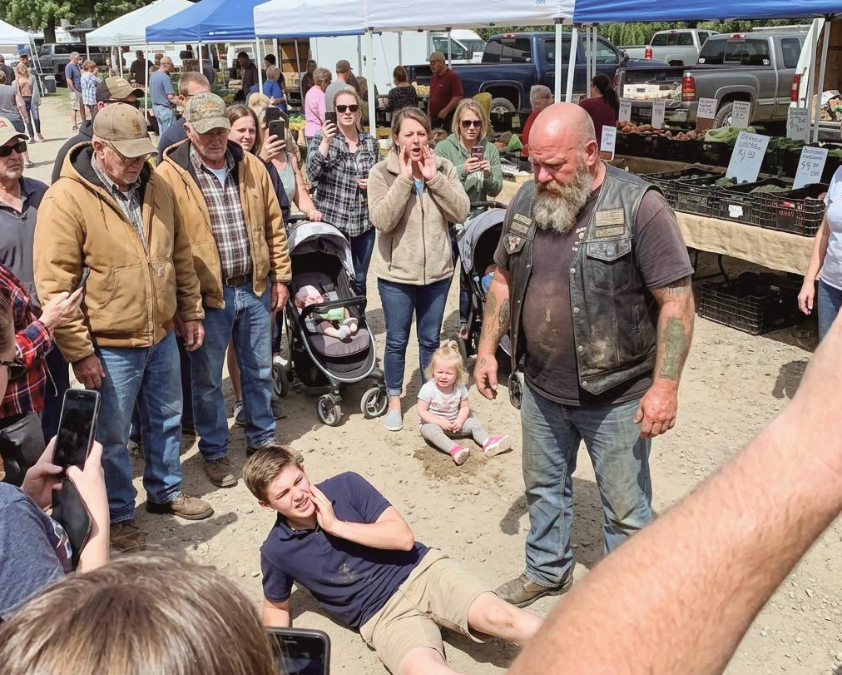
A Biker Struck a Teen in Front of 50 People and Everyone Called Him a Monster—Then Security Footage Revealed He Was the Only One Who Saw the Missing 4-Year-Old Girl Being Taken.
PART2:
She looped one hand through my arm.
“You steer. I criticize.”
“Marriage.”
“Exactly.”
We bought coffee.
Then bread.
Then something called goat-milk caramel that cost twelve dollars and tasted exactly like caramel.
Carol disappeared toward the peaches.
I stopped near a kettle-corn stand because a man in front of me was wearing an old Navy cap and arguing with the vendor about whether five dollars was a morally defensible price for popcorn.
Normal morning.
Normal people.
Then I heard a sound.
Small.
Sharp.
One little cry.
Not yelling.
Not tantrum.
Not the sound of a kid being told no.
If you have children, you understand the difference.
A child can produce seventeen different kinds of noise in under a minute.
Bored.
Angry.
Hungry.
Tired.
Manipulative.
Excited.
Fake injured.
Real injured.
Scared.
This was scared.
I turned.
For a second I saw nothing.
People moving.
Canvas bags.
A stroller.
Someone carrying sunflowers.
Then, between two vendor tents about fifteen feet away, I saw a teenager crouched over a little girl.
She was tiny.
Four, maybe.
Blonde pigtails.
Pink T-shirt.
Pink sneakers with white soles.
The teenager had one hand wrapped around her upper arm.
Not holding her hand.
Not guiding.
Squeezing.
Hard enough that his thumb was buried in her skin.
His other palm covered her mouth.
Her feet were planted in the dirt.
Her body leaned backward.
Trying to get away.
And her eyes found mine.
I have spent years trying to describe those eyes.
People expect dramatic language.
Terror.
Panic.
Desperation.
Those are accurate.
But the part I remember is recognition.
She saw me see her.
For one second, that child knew somebody had noticed.
I moved before I thought.
I crossed the distance.
Grabbed the boy’s wrist.
Pulled his hand off her mouth.
“Let go.”
He spun.
“What the hell?”
The little girl gasped.
The boy jerked his other hand away from her arm and shoved my chest.
Not hard.
Enough.
“Get away from us.”
I put myself between him and the girl.
“Who is she?”
“My sister.”
The answer came instantly.
No confusion.
No surprise.
Too ready.
“Then why were you covering her mouth?”
“She was screaming.”
“Why?”
“Because she’s four.”
He stepped toward me.
Clean-cut kid.
Brown hair.
Dark-blue polo.
Khaki shorts.
White sneakers.
Seventeen, I later learned.
At the time I guessed sixteen.
He looked like somebody who volunteered at church camp.
“I said back off.”
He shoved me again.
The slap happened next.
I wish I could tell you I made a reasoned calculation.
I did not.
He came into my space.
I was furious.
I hit him with an open palm across the side of his jaw.
Hard.
The sound cracked through the gap between tents.
He went down.
Not unconscious.
Not badly injured.
But on the ground.
And that was the moment everyone noticed.
A woman screamed.
Somebody shouted:
“Oh my God!”
Phones appeared.
The kettle-corn vendor leaned over his table.
A man grabbed my shoulder from behind.
I shook him off.
The teenager pushed himself up on one elbow.
“He attacked me!”
People came running.
Not toward the little girl.
Toward him.
“I didn’t do anything!”
he shouted.
“This psycho just hit me!”
A woman crouched beside him.
“Are you okay?”
Another man stepped between us.
“Back off, buddy.”
I pointed past him.
“Look at the girl.”
Nobody looked.
I swear to you.
Not at first.
The child had sat down in the dirt beside the tent stake.
Arms around herself.
Crying without making much noise.
“Look at her!”
I said again.
The teenager stood.
Held his jaw.
“That’s my sister.”
Someone said:
“You hit a kid?”
“He had his hand over her mouth.”
“She was having a tantrum!”
the boy shouted.
“She hits. She bites. She runs off.”
The crowd accepted that immediately.
Because children do those things.
And older brothers grab them.
And family disagreements happen.
And the explanation came from a frightened-looking clean-cut teenager with redness appearing on his cheek.
I looked like me.
The equation was simple.
A man near my age stepped forward.
“Leave the kid alone.”
“I’m trying to help the kid.”
“You just hit him!”
“He was hurting her.”
“You don’t know that.”
The teenager pointed at me.
“I’ve never even seen this guy before.”
That part was true.
“He walked up and started screaming.”
Not true.
“He grabbed me.”
True.
“He hit me for no reason.”
Not true.
The most effective lie is usually surrounded by enough truth that nobody bothers separating the pieces.
Then the teenager looked at the little girl.
His expression changed for maybe half a second.
A look only she could see.
She stopped crying.
Immediately.
That scared me more than anything.
He said:
“Lily.”
Her name.
The first time I heard it.
“Come here.”
She did not move.
His eyes hardened.
“Now.”
Her knees shifted.
She started to stand.
I stepped sideways.
“No.”
The crowd reacted to me.
A woman said:
“Stop intimidating them!”
Another:
“Somebody call police.”
Carol appeared at my side.
“What happened?”
“He had his hand over that kid’s mouth.”
Carol looked.
The teenager said:
“My sister.”
The little girl stared at the ground.
Carol knew me.
Thirty-two years.
She knows when I am angry.
Knows when I am reckless.
Knows when I am scared.
She looked at my face.
Then at Lily.
“Ray?”
“Something’s wrong.”
The teenager smiled.
That was the moment.
People ask me when I became certain.
Not when I suspected.
When I knew.
It was that smile.
Police sirens could already be heard somewhere beyond the library.
People were angry with me.
He had a red mark on his jaw.
And he smiled.
Not nervous.
Not relieved.
Satisfied.
He knew how this looked.
He knew he had won the first version of the story.
Police arrived seven minutes after the slap.
Two patrol cars.
Three officers.
Officer Jensen came first.
Maybe early thirties.
He took in the crowd.
Teenager holding his face.
Me in leather.
People filming.
Somebody yelled:
“That’s him!”
Jensen walked straight toward me.
“Sir, turn around.”
“Talk to the little girl.”
“Turn around.”
“The teenager—”
“Hands behind your back.”
“Officer, listen to me.”
“Now.”
I looked at Carol.
Her face had gone white.
I put my hands behind me.
Metal closed around my wrists.
Phones lifted higher.
Someone muttered:
“Knew it.”
That one I remember.
Knew what?
You had known me for forty seconds.
They sat me in the rear of the patrol car.
Door open at first.
I could see everything.
The teenager sat on a folding chair.
Someone brought him ice wrapped in a towel.
A vendor gave him water.
One older woman rubbed his shoulder.
Lily was placed on a bench beside the lemonade stand.
Somebody gave her a juice box.
She did not drink.
Her feet did not touch the ground.
She sat with both hands around the box.
Staring at the teenager.
Not her surroundings.
Not the crowd.
Him.
Carol came to the car.
“Ray.”
“Tell them to look at her arm.”
“What?”
“Upper left arm. He was squeezing. There’ll be marks.”
“I tried.”
“What did they say?”
“They’re interviewing witnesses.”
“Witnesses saw the slap.”
“I know.”
“They didn’t see before.”
“I know.”
“Tell them to ask why she was crying.”
“I did.”
Carol leaned closer.
“They say he’s her brother.”
“He isn’t.”
“You don’t know that.”
“Yes, I do.”
“How?”
I looked at Lily.
Because children do not look at brothers that way.
I did not say it.
Sounded too thin.
Too emotional.
Carol squeezed the car door frame.
“They’re saying you attacked a minor.”
“He’s almost grown.”
“He’s still a minor.”
“I know.”
One officer approached.
“Ma’am, step away from the vehicle.”
Carol turned.
“My husband saw that boy hurting the little girl.”
“We’re investigating.”
“Have you checked her arm?”
“We’re handling it.”
“She’s terrified.”
“Ma’am.”
Carol pointed.
“She hasn’t touched that juice.”
The officer glanced at Lily.
Then back.
“Please step away.”
Nobody likes the spouse of a person under arrest telling police how to do their jobs.
I understand that.
But the system was building momentum in the wrong direction.
And every minute mattered.
About twenty minutes later, a silver minivan pulled into the market.
Bald man driving.
Dark-haired woman passenger.
The teenager stood.
The woman rushed to him.
“Oh my God, Tyler.”
Tyler.
She touched his face.
Glared toward the police car.
The bald man spoke with officers.
Pointed at me.
Angry.
They hugged Lily too.
But something was wrong there.
The woman bent toward her.
Lily did not lift her arms.
The woman picked her up anyway.
Lily went stiff.
Not struggling.
Rigid.
Tyler watched.
Then looked toward me.
And smiled again.
I started kicking the inside of the car door.
“Officer!”
Jensen came back.
“What?”
“Who are those people?”
“His parents.”
“Are they hers?”
“Sir—”
“Are they the little girl’s parents?”
“He says they are.”
“Did you verify?”
His face tightened.
“We are handling it.”
“Check.”
“Sir.”
“Please.”
That word surprised both of us.
“Just check.”
He shut the door.
Twenty minutes later, they drove me away.
Through the rear window I saw the minivan still parked.
Tyler beside it.
Lily in the woman’s arms.
I tried to memorize the plate.
Could not see all of it.
That failure tortured me later.
At the station they took my belt.
Wallet.
Phone.
Boot laces.
Vest.
That hurt more than it should have.
My vest has thirty years sewn into it.
Trips.
Friends.
Men who died.
Carol made one patch herself.
A booking officer folded it and placed it into a property bin like an old jacket.
Charge:
Assault involving a minor.
I sat in an interview room with Officer Jensen and another officer.
“Want to tell me what happened?”
Jensen asked.
I told him.
Every second.
Cry.
Hand over mouth.
Grip on arm.
Fear.
Shove.
Slap.
Smile.
He wrote.
Then:
“Tyler Brennan says Lily is his younger sister.”
“He’s lying.”
“Why?”
“I don’t know.”
“Witnesses describe a different situation.”
“They witnessed after.”
“Multiple people say you approached him aggressively.”
“I approached because he had his hand over a child’s mouth.”
“He says he was stopping her from screaming and running into the crowd.”
“Check her arm.”
“We will.”
“Ask her.”
“She’s four.”
“Four-year-olds can answer who their mother is.”
“He says the adults who arrived are his parents.”
“And hers?”
“Yes.”
“Did anyone check ID?”
Jensen’s jaw tightened.
“That’s enough.”
“No, it isn’t.”
He stood.
“Sit tight.”
The door closed.
I sat there thinking about Tyler’s smile.
Not surprise.
Not a brother angry that a stranger had hit him.
A smile.
Patient.
Like he knew what happened next.
Four hours passed.
Carol bailed me out.
Two thousand dollars we did not have sitting around for emergencies involving me slapping teenagers at farmers markets.
She said nothing as we walked to the car.
Neither did I.
Once inside, she locked the doors.
Then put both hands on the steering wheel.
“I believe you.”
I closed my eyes.
First person to say it.
“But?”
“Nobody else does.”
I looked at her.
“I tried talking to the parents.”
“What happened?”
“The father said if I came near them again, he’d add a restraining order.”
“Did you see Lily?”
“Yes.”
“How?”
“The woman was carrying her.”
“How did Lily look?”
Carol stared through windshield.
“Stiff.”
I nodded.
“Exactly.”
“She wasn’t crying.”
“No.”
“Ray.”
“What?”
“What if you’re wrong?”
The question hurt because it was fair.
“I’ve been asking myself that for four hours.”
“And?”
“I’m not.”
“How do you know?”
“I don’t know.”
Carol looked at me.
“Then what are we supposed to do?”
I thought about Lily’s eyes.
“Find out who she is.”
Saturday evening I searched everything I could think of.
Millbrook missing children.
Local Amber alerts.
Child abduction.
Police posts.
Facebook groups.
Nothing.
Carol made dinner.
I did not eat.
At midnight she found me still on the computer.
“Come to bed.”
“Can’t.”
“You need sleep.”
“She could be somewhere with them.”
“Ray.”
“They said she was his sister.”
“I know.”
“She didn’t act like his sister.”
“People behave strangely when they’re scared.”
“Exactly.”
She touched my shoulder.
“Come upstairs.”
I did.
Did not sleep.
Every time I closed my eyes I saw Lily sitting on that bench while strangers put ice on Tyler.
Sunday morning I went back online.
Search changed slightly.
Millbrook market missing girl.
Nothing.
Millbrook child missing.
Then at 11:03 a.m., a Facebook post appeared in a local parenting group.
The photo loaded slowly.
Blonde pigtails.
Pink shirt.
Pink shoes.
My stomach dropped before I read a single word.
PLEASE HELP FIND MY DAUGHTER.
Her name is Lily Simmons.
Four years old.
She disappeared yesterday morning from the Millbrook Farmer’s Market.
I turned away for less than a minute at the honey booth. We have been searching since yesterday.
She was wearing a pink shirt, denim shorts, pink shoes.
Please call police.
Please help me bring my baby home.
I shouted:
“Carol!”
She ran downstairs.
“What?”
I pointed.
She read.
Hand over mouth.
“Oh my God.”
“That’s her.”
“You’re sure?”
“One hundred percent.”
“She’s missing?”
“That kid said sister.”
Carol sat.
“The police let them leave.”
I called 911.
Explained.
Transferred.
Explained again.
Transferred to county dispatch.
Explained a third time.
The woman said:
“Officers are actively investigating the missing-person report.”
“I saw her yesterday.”
“With whom?”
I gave Tyler’s description.
Silver minivan.
Bald man.
Dark-haired woman.
“What’s your name?”
“Ray Delgado.”
Typing.
Pause.
“You were involved in the market assault yesterday?”
“Yes.”
Longer pause.
“Sir, investigators are aware of the incident.”
“No, they aren’t aware. If they were aware, they’d know she left with the wrong people.”
“We’ll pass the information along.”
“Have someone call me.”
“We will.”
No call.
Ten minutes.
Twenty.
I called again.
Different dispatcher.
Same explanation.
She said:
“Mr. Delgado, you’ve already provided this information.”
“Then tell me somebody is going after them.”
“We cannot provide investigative details.”
“You let an abducted child leave a market.”
“Sir, calm down.”
I hate those words.
Not because she was wrong.
Because nobody has ever become calmer after being ordered to.
Carol took the phone.
“We’re coming in.”
She hung up.
Police station at noon.
Desk sergeant recognized me.
His expression showed it.
“Mr. Delgado.”
“I’m not here about my court date.”
“Then?”
I held up phone.
“Missing kid.”
I showed him Lily’s post.
He read.
Looked at me.
Back to screen.
“What are you saying?”
“That’s the girl.”
“You’re certain?”
“Yes.”
“The girl from yesterday?”
“Yes.”
He picked up desk phone.
First call.
Then another.
Then a third.
His voice changed.
Lower.
Faster.
He stood.
“Wait here.”
A detective came through secured door fifteen minutes later.
Mid-forties.
Dark blazer.
Hair pulled back.
Badge clipped to belt.
“Ray Delgado?”
“Yes.”
“Detective Lena Morrison.”
“Finally.”
She did not react.
“Your wife?”
“Carol.”
“Both come with me.”
Interview room.
Laptop.
Recorder.
Morrison said:
“Start from beginning.”
I did.
She interrupted only for details.
Distance.
Time.
Exact grip.
Which arm.
Words.
Where Tyler stood.
What Lily said.
Nothing.
She had barely spoken.
“How tall was the boy?”
“Five-ten.”
“Build?”
“Lean.”
“Hair?”
“Brown.”
“Shirt?”
“Navy polo.”
“Shoes?”
“White sneakers.”
Carol described adults.
Tall thin dark-haired woman.
Bald heavyset man.
Silver minivan.
Partial plate from what she remembered.
Morrison opened laptop.
Turned it.
Lily’s missing-child photograph.
“Is that the girl?”
“Yes.”
No hesitation.
Morrison leaned back.
For first time, emotion crossed her face.
“Mr. Delgado, why didn’t this get connected yesterday?”
I laughed.
“You tell me.”
She accepted that.
No defense.
“We’re pulling market security footage.”
“Good.”
“We’re checking bodycam.”
“Good.”
“We’re identifying the adults.”
“Good.”
“Now I need you both to go home.”
“No.”
Morrison met my eyes.
“If you stay here, you cannot help.”
“Then tell me you believe me.”
She paused.
“I believe we have a serious lead.”
Not enough.
But better than yesterday.
“Will you call?”
“Yes.”
“What if—”
“I will call.”
We went home.
Worst nine hours of my life outside a hospital.
At 2:30, Morrison called for one clarification.
Which side of Lily’s body had Tyler been on?
At 4:00, nothing.
Six.
Seven.
Carol made coffee.
Nobody drank it.
At 9:14 p.m., phone rang.
Morrison.
“Mr. Delgado.”
I stood.
Carol stood because I did.
“We found Lily.”
My legs stopped working.
I sat on kitchen floor.
“Alive?”
“Yes.”
“Alive?”
“Yes.”
Carol began crying.
“Where?”
“She’s at a hospital.”
“Is she hurt?”
“She appears physically stable.”
“Where was she?”
“I can’t discuss full investigation.”
“Tyler?”
“In custody.”
“The adults?”
“Also in custody.”
I closed my eyes.
Morrison continued.
“His name is Tyler Brennan. Seventeen.”
“Not her brother.”
“No.”
“Who are adults?”
“Not his parents.”
“What?”
“They are unrelated to Lily and unrelated biologically to Tyler.”
I stared at floor.
“Then who are they?”
“We believe this is part of a larger criminal investigation.”
Carol sat beside me.
“What kind?”
“I cannot discuss details tonight.”
“Morrison.”
“I know.”
Her voice softened.
“But Lily is safe.”
I breathed.
First full breath in more than a day.
“What about charges against me?”
“District attorney will be notified tonight.”
Pause.
“I expect they will be dismissed.”
“Expect?”
“They will be addressed Monday.”
I almost laughed.
“Great.”
“Mr. Delgado.”
“What?”
“I reviewed the market footage.”
Silence.
“You were telling the truth.”
I did not answer.
She continued.
“You saw something everyone else missed.”
Still nothing.
“I’m sorry.”
That was first apology.
Not enough to erase anything.
Enough to matter.
Monday morning Morrison came to our house.
Not required.
She brought two coffees.
One black.
One cream for Carol.
I let her inside.
She sat at kitchen table.
“What happened?”
I asked.
She folded hands.
“Market has six security cameras.”
I waited.
“One captured Lily and her mother near the honey vendor at 9:42.”
“Tyler?”
“Appears approximately forty seconds later.”
My jaw tightened.
“He watched them?”
“Yes.”
“How long?”
“Long enough to determine the mother was distracted paying.”
Morrison continued.
Tyler approached Lily.
Kneels.
Says something.
Lily follows him three steps.
Then stops.
He takes her wrist.
Guides her between tents.
At first not violently.
That is important.
People imagine kidnapping as somebody grabbing a screaming child and running.
Real predators sometimes depend on ambiguity.
A teenager leading a child by the hand does not look suspicious.
Looks like a brother.
Cousin.
Babysitter.
Nobody reacts.
Camera lost them briefly behind tents.
Second angle showed Lily trying to pull away.
Tyler tightened grip.
She cried.
He covered her mouth.
Then I entered frame.
“What did footage show?”
“Exactly what you described.”
“All of it?”
“Yes.”
“The slap?”
“Yes.”
Morrison almost smiled.
“That part is very clear.”
“Wonderful.”
“Ray.”
“What?”
“You hit him hard.”
“He shoved me.”
“I know.”
“So?”
“I’m not criticizing.”
“Sounds like criticizing.”
“I’m a detective. We ruin conversations.”
Carol laughed despite herself.
Morrison continued.
After my arrest, Tyler told responding officers adults coming to market were his parents.
They arrived.
Produced identification for themselves.
Nobody requested documents connecting them to Lily.
Nobody checked missing-person databases because Lily’s mother had not yet completed the report at that exact moment.
Andrea Simmons had been searching the market with staff and another officer on a different radio channel.
That detail made me furious.
“How does a child go missing at one side of a market while police on other side let strangers drive out with her?”
Morrison looked ashamed.
“Fragmented response.”
“That’s a nice phrase.”
“It’s an accurate one.”
“It’s a failure.”
“Yes.”
She said it.
No defense.
“Yes.”
The adults in minivan were Gregory and Marla Vance.
Tyler had communicated with them online.
They had been watching family-oriented public events.
Looking for opportunities.
Morrison did not give me every detail.
I did not need them.
“Was Lily first?”
“No.”
My stomach turned.
“How many?”
“Investigation is ongoing.”
“How many, Lena?”
First time I used her first name.
She looked at Carol.
Then me.
“We believe there are at least two previous incidents involving attempted or completed abductions.”
“Completed?”
She did not answer.
That answer was answer enough.
The Vances had not planned to take Lily exactly that day, Morrison said.
Tyler had been scouting.
Opportunity appeared.
He acted.
Then my intervention complicated timing.
When police arrived, he improvised the sister story.
Vances, already nearby, came in as “parents.”
Confidence carried them through.
That was the part that haunted Morrison.
Confidence.
Badges, uniforms, databases, procedures.
All defeated briefly by people who simply acted like they belonged.
“Why did Tyler smile?”
I asked.
Morrison looked at me.
“He had practiced.”
“What?”
“Being believed.”
She explained that Tyler appeared younger than he was.
Polite.
Well-spoken.
Clean record.
Honor-roll student until recently.
No visible reason to suspect him.
He understood adults tended to defer to explanations that preserved normalcy.
Younger sister.
Tantrum.
Strict parents.
Everything sounded ordinary enough.
“He knew I’d look worse.”
Morrison did not answer.
“He looked at me and knew.”
“Yes.”
That answer hurt more than denial would have.
“How’d you find them?”
“Traffic cameras helped.”
Silver minivan.
Partial plate from Carol.
Market exit footage.
Gas-station camera.
Eventually an address connected to Vances.
Lily was found in a rental property less than thirty miles away.
Thirty miles.
I imagined her there while I sat in a holding cell.
My hands curled.
Morrison noticed.
“She’s safe now.”
“Because we got lucky.”
“Because you noticed her.”
“And then your officers handed her back.”
Morrison absorbed that.
“I know.”
For several seconds nobody spoke.
Then she said:
“You have every right to be angry.”
I hated that sentence too.
But coming from her, it felt different.
Not dismissal.
Ownership.
The assault charge was dismissed Monday afternoon.
Not reduced.
Dismissed.
District attorney sent formal letter later.
The arrest remained visible until paperwork cleared.
My employer did not fire me.
My motorcycle club mostly treated the entire thing like a reason to buy me lunch.
Tiny said:
“You finally found a teenager you could beat.”
“I slapped him.”
“You knocked him down.”
“He weighed maybe one-fifty.”
“Still.”
Carol told him to shut up.
The news story broke Tuesday.
BIKER ARRESTED AT FARMER’S MARKET HELPED STOP CHILD ABDUCTION.
I hated headline.
Made me sound better than I was.
I had not “stopped” it.
Not completely.
Police still let them leave.
Investigators later recovered her.
But news likes clean verbs.
Reporters called.
I declined most.
Then Andrea Simmons called.
Lily’s mother.
I recognized grief before she spoke more than five words.
“Mr. Delgado?”
“Yes.”
“This is Andrea.”
I stood in garage beside Bertha.
My bike.
Black Street Glide.
“I know.”
She began crying.
“I don’t know what to say.”
“You don’t have to say anything.”
“They told me what happened.”
I closed eyes.
“They told me you tried to stop him.”
“Yes.”
“And everyone thought…”
Her voice broke.
“I’m sorry.”
“You didn’t do it.”
“I lost her.”
“No.”
“I turned around.”
“Andrea.”
“I turned around for maybe forty seconds.”
Her sob came hard.
“He was right there.”
I leaned against workbench.
“Listen to me.”
She tried to quiet herself.
“A predator chose you.”
Silence.
“You did not choose him.”
More silence.
“You bought honey.”
“I should’ve—”
“No.”
“You don’t know—”
“I know enough.”
I thought about all the things people say to parents afterward.
Watch closer.
Hold hands.
Don’t get distracted.
As though a mother should live every public second expecting somebody to steal her child.
“He did this.”
I said.
“Not you.”
Carol found me twenty minutes later still on phone.
She took it.
The two women cried together.
I went outside.
Sat on driveway.
Looked at sky.
I did not know where to put the anger.
Andrea sent a photo that evening.
Lily sitting on her lap.
Stuffed rabbit in Lily’s arms.
Not smiling.
She looked tired.
Small.
Safe.
Text beneath:
This is what you saved.
I stared at those words a long time.
Then wrote:
No. This is who you got back.
I did not want Lily turned into proof I was a hero.
She was not an ending to my story.
She was a child with her own.
The investigation grew.
Vances had targeted public places where adults expected children to move between groups.
Markets.
Fairs.
Community events.
Places where one more child beside one more adult did not look strange.
Tyler had been recruited online months earlier.
That was one of the darkest parts.
He was not simply some random bad teenager.
He had made choices.
Deliberate ones.
He had been paid small amounts.
Gift cards.
Cash.
He had practiced gaining children’s trust.
Pretending to know parents.
Pretending someone had sent him.
Sometimes nothing happened.
Sometimes adults intervened.
At least one earlier attempt had failed when a child screamed loudly enough.
The Vances adjusted.
Tyler learned to cover mouths.
Hold arms without making it obvious.
Smile when challenged.
Act offended.
Act normal.
Investigators searched phones.
Messages.
Photos.
Locations.
Two other families were contacted.
One missing-child case in another county was reopened.
I never learned every detail.
I did not want to.
Knowing enough was already heavy.
Security footage from Millbrook was shown during preliminary hearings.
Morrison warned me before I watched.
“You don’t have to.”
“I want to.”
“You already lived it.”
“I want to see what everyone else missed.”
The video had no sound.
That made it worse.
Lily beside honey stand.
Andrea paying.
Tyler at edge of frame.
Watching.
He approached.
Crouched.
Pointed somewhere.
Lily looked toward her mother.
Then followed.
Three seconds.
Four.
Between tents.
Second camera.
Lily stopped.
Tyler pulled.
She resisted.
His hand tightened.
She cried.
His palm covered her mouth.
People walked past.
A man carrying flowers.
A woman pushing stroller.
Two teenagers laughing.
Vendor rearranging jars.
Nobody noticed.
Then I entered frame.
My gray beard.
Vest.
Coffee still in one hand.
Saw.
Stopped.
Moved.
The footage showed me pulling his hand away.
Tyler shoving.
Me slapping.
And then—
every head turned.
It was almost synchronized.
People who had walked past the struggling child seconds earlier spun toward violence.
I watched twice.
Then turned it off.
Morrison said:
“You okay?”
“No.”
“What is it?”
“Everyone saw what they expected to understand.”
She nodded.
A biker hitting a teenager is easy to categorize.
A clean-cut teenager quietly restraining a small child is harder.
People’s attention goes where the story already makes sense.
Later, one of the women from the crowd messaged me.
Her profile picture showed a church picnic.
Kids.
Husband.
Golden retriever.
She wrote:
I was the woman who screamed after you hit him.
I called 911.
I told police you attacked a child.
I thought you were dangerous.
I watched the footage on the news and realized I had been standing less than twenty feet away when he had his hand over Lily’s mouth.
I never saw her.
I saw you instantly.
I am ashamed.
I read it twice.
Carol said:
“What are you going to say?”
I typed:
You saw what you expected to see. Most people do.
Then deleted it.
Too sharp.
Typed again:
I’m glad you called 911. The problem wasn’t calling. The problem was that none of us looked carefully enough before deciding what was happening.
Deleted that too.
Finally:
You were scared and reacted to what you saw. I reacted too. We all need to look longer before deciding who the danger is.
Sent.
She replied:
I will.
That mattered more than an apology.
Officer Jensen called me.
I almost did not answer.
“Mr. Delgado.”
“Officer.”
“I wanted to apologize.”
“You already did through your lieutenant.”
“No.”
Pause.
“I want to.”
I stayed silent.
“I cuffed you before asking enough questions.”
“Yes.”
“I saw the scene and decided what it was.”
“Yes.”
“I didn’t verify relationship before they left.”
“Yes.”
Each yes landed.
He deserved them.
He continued.
“I’ve replayed it.”
“Don’t.”
“What?”
“You’ll destroy yourself.”
He was quiet.
“Learn.”
I said.
“Don’t make it about feeling guilty forever.”
Another pause.
“That’s generous.”
“No.”
I looked at Lily’s photo on my phone.
“It’s practical.”
Guilt does not help the next kid.
Attention might.
Millbrook Police changed procedures.
Any incident involving uncertain child guardianship required identity verification before release if welfare concerns existed.
Separate child interview when age-appropriate.
Immediate cross-check against active missing-person calls from same event.
Market organizers created child-safety protocols.
Security volunteers.
Missing-child alert communication across entrances.
Small things.
Important things.
The kind of changes that should have existed before Lily.
Andrea hated crowds after that.
Not Lily.
Andrea.
Lily had nightmares.
Would wake screaming when somebody covered her face accidentally during play.
Stopped liking crowded playgrounds.
Did not want unfamiliar teenagers near her.
Therapy started.
Play therapy first.
Then trauma-focused counseling.
Andrea once told me:
“She asks why nobody helped sooner.”
I had no answer.
“What do you tell her?”
“That someone did.”
That hurt.
Because she meant me.
I said:
“Tell her lots of people made mistakes and then lots of people worked to bring her home.”
“I want her to know what you did.”
“When she’s old enough.”
“She knows biker Ray.”
I laughed.
“Great.”
“She calls you Motorcycle Grandpa.”
“I’m fifty-four.”
“You have gray beard.”
“This is discrimination.”
Andrea laughed.
First time I heard her laugh.
That mattered.
Tyler eventually took a plea agreement as a juvenile charged as an adult on some counts.
Details complicated.
He cooperated against Vances.
People online got angry.
Said he deserved life.
Maybe.
I do not know.
He was seventeen.
Old enough to know.
Young enough that adults had recruited him.
Both can be true.
I did not need to choose between seeing his responsibility and understanding how he got there.
The Vances received much heavier sentences.
Multiple charges.
Conspiracy.
Abduction.
Attempted abduction.
Other counts from recovered evidence.
When sentence was read, I attended.
Not because I needed revenge.
Because Andrea asked me to sit beside her.
Lily did not attend.
Good.
She had already given those people enough of her life.
Gregory Vance looked ordinary.
That is worth saying.
He did not look evil.
Neither did Marla.
That was the whole point.
Nobody wears criminal intent on their face.
They looked like a couple who might complain to HOA about trash cans.
That frightened me more than any tattooed villain ever could.
Afterward Andrea and I stood outside courthouse.
Reporters waited.
She ignored them.
I did too.
She said:
“Do you regret hitting Tyler?”
I thought.
“Yes.”
She looked surprised.
“Really?”
“I regret needing to.”
“But would you?”
“Again?”
“Yes.”
I answered immediately.
“Yes.”
“That doesn’t make sense.”
“It does to me.”
I regretted escalating.
Regretted that slap became only thing crowd saw.
Regretted giving Tyler evidence for his story.
But if I went back to the exact second with his hand over Lily’s mouth and no time to know what came next?
I would remove him.
Every time.
Maybe I would shove instead.
Maybe restrain.
Maybe yell first.
Age gives you wisdom mostly after moments where you needed it sooner.
The important thing was not whether I had chosen perfect force.
It was that somebody interrupted him.
I became mildly famous in town.
Hated it.
Market organizers invited Carol and me back.
Ceremony.
Certificate.
Gift basket.
I tried declining.
Carol accepted for both of us.
“Why?”
“Free peaches.”
Marriage.
At the market that fall, people shook my hand.
Some stared at vest differently.
That bothered me too.
I did not want approval because I had performed one acceptable act.
I wanted people to understand something harder:
appearance is weak evidence.
That includes mine.
A biker can be dangerous.
A clean-cut teenager can be dangerous.
A mother can be distracted without being negligent.
A police officer can make a bad decision without being irredeemable.
A person who gets something wrong can learn.
Human beings are not uniforms.
Lily came back to Millbrook the following spring.
Andrea told me ahead of time.
“Therapist thinks it might help if she wants to.”
“Does she?”
“She says yes.”
“Then good.”
“You’ll be there?”
I hesitated.
“You want me there?”
“She asked.”
So Carol and I went.
No vest ceremony.
No club.
Just us.
Lily arrived holding Andrea’s hand.
Five now.
Same blonde hair, longer.
Purple sneakers instead of pink.
Stuffed rabbit.
When she saw me, she stopped.
I crouched.
Old knees again.
“Hey, Motorcycle Grandpa.”
I groaned.
Andrea laughed.
“I told you.”
Lily looked at my beard.
“You got more gray.”
“This meeting is over.”
She smiled.
First time I had seen her smile in person.
She stepped closer.
Held out rabbit.
“His name is Mr. Buttons.”
“Good name.”
“He bites bad guys.”
“Useful.”
“Mom says rabbits don’t bite people.”
“They can.”
Andrea said:
“Do not encourage her.”
I held up hands.
Lily stared at my tattoos.
“Did those hurt?”
“Yes.”
“All of them?”
“Pretty much.”
“Why did you do it?”
“Question I ask myself every birthday.”
She giggled.
Then asked:
“Did you hit Tyler?”
The world narrowed.
Andrea looked at me.
Therapist had apparently prepared them for this.
“Yes.”
“Why?”
“Because he was hurting you.”
“Mom says hitting isn’t good.”
“She’s right.”
Lily frowned.
“Then why?”
There it was.
The kind of question adults make speeches around because simple truth feels inadequate.
“I got scared and angry.”
She listened.
“I wanted him to let go of you.”
“Did it work?”
“Yes.”
“Did you get in trouble?”
“Yes.”
She thought.
“Did you cry?”
I laughed.
“Not then.”
“Later?”
“Maybe.”
Carol said:
“He did.”
Traitor.
Lily took this seriously.
“Mom cried too.”
Andrea squeezed her hand.
I said:
“Lots of people did.”
Lily looked around market.
Families.
Honey booth.
Kettle corn.
Same tents.
Different day.
“Is Tyler here?”
“No.”
“Are the other bad people here?”
“No.”
“You sure?”
Andrea’s face tightened.
I answered carefully.
“There are police and people watching.”
“That’s not what I asked.”
Five years old.
Smart.
“No.”
I said.
“I can’t ever be completely sure who is everywhere.”
Andrea looked at me.
Probably wondering if I had just ruined therapy.
I continued.
“But if something feels wrong, you can yell.”
Lily nodded.
“You can run to your mom.”
Nod.
“You can tell a worker.”
Nod.
“You can tell a police officer.”
Nod.
“And you can make as much noise as you need.”
She gripped rabbit.
“Even scream?”
“Especially scream.”
Andrea’s eyes filled.
Lily asked:
“Will people look?”
I looked toward the spot between tents.
“Yes.”
Then corrected myself.
“They should.”
That difference matters.
We cannot promise children the world will always notice.
We can make adults responsible for learning to.
The market installed signs that year.
IF YOU SEE A CHILD IN DISTRESS, STOP AND CHECK.
Nothing sophisticated.
Some people called it overreaction.
Maybe.
I liked them.
The honey vendor remembered Andrea.
Gave Lily a tiny jar free.
Lily tasted it.
Made a face.
“I don’t like honey.”
Andrea laughed so hard she bent over.
The thing associated with worst day of her life.
Her daughter did not even like it.
There is mercy in absurdity.
Months passed.
Life got ordinary again.
That is what people misunderstand about recovery.
They expect a finish line.
Case closed.
Bad people sentenced.
Child safe.
The End.
There is no end.
Lily still had nightmares sometimes.
Andrea still panicked if she lost sight of her for ten seconds in a store.
I still watched teenagers differently.
Officer Jensen still called once a year around anniversary.
Morrison became captain eventually.
Carol still bought peaches.
The world keeps going while carrying what happened.
Andrea sent me school pictures.
First grade.
Then second.
Lily missing one front tooth.
Lily holding a science-fair ribbon.
Lily dressed as an astronaut for Halloween.
One year she sent a drawing.
Motorcycle.
Huge bearded rider.
Little girl behind him.
Caption:
RAY IS NOT SCARY.
I framed it.
Then after looking at it a while, added my own note underneath:
Sometimes I am.
Because that is the lesson too.
Judging me positively without evidence is still judging.
Hero stories flatten people.
I am not harmless because I helped Lily.
I am a man who once slapped a seventeen-year-old hard enough to drop him.
A man with a temper I have spent decades managing.
A man who made mistakes.
A man who happened to notice.
What saved Lily was not that I was secretly a saint beneath leather.
It was that for one moment, I looked at the child instead of the category.
Everybody else eventually learned to do the same.
The people around me saw:
Biker hits teenager.
Simple.
Police saw:
Adult male assaults minor.
Simple.
Tyler offered:
Older brother disciplining little sister.
Simple.
The truth was inconvenient.
A predator who looked safe.
A rescuer who looked dangerous.
Parents who were not parents.
A four-year-old whose fear was being explained away as misbehavior.
Life gets dangerous when simple explanations arrive before questions.
I learned that watching the footage.
Fifty people.
Not evil.
Not heartless.
Distracted.
Shopping.
Talking.
Living.
Then violence occurred and attention snapped into place.
Human brains are built for sudden movement.
Impact.
Noise.
Conflict.
Quiet distress is easy to miss.
Abusers depend on that.
Predators depend on that.
A hand gripping too tightly.
A child too still.
A partner who answers too quickly.
A person looking toward someone else before speaking.
Small signals.
You have to choose to notice.
Years later, Lily asked to interview me for a school project.
She was nine.
Topic:
“A Person Who Changed My Community.”
I told Andrea absolutely not.
“Why?”
“That title makes me sound dead.”
“You’re impossible.”
Lily called.
“Ray.”
“Yes?”
“You have to.”
“Why?”
“Because I already wrote your name.”
“Manipulation.”
“My teacher says interviews are primary sources.”
“Now you weaponize education?”
“Yes.”
I agreed.
We sat at their kitchen table.
Lily had notebook.
Recorder.
Mr. Buttons, rabbit, now repaired badly by someone.
I pointed.
“His ear.”
“Mom fixed it.”
“You said rabbits should stay damaged.”
“I was four.”
Fair.
First question:
“What did you think when you saw me?”
I answered:
“That something was wrong.”
“How?”
“You looked scared.”
“What did Tyler look like?”
“Normal.”
“What did I look like?”
“Like a little kid.”
“No. I mean clothes.”
“Pink shoes.”
She smiled.
“You remember.”
“I remember everything.”
She became serious.
“Did everyone hate you?”
“No.”
“They thought you were bad.”
“For a while.”
“Because of tattoos?”
“Partly.”
She wrote.
Then:
“Were you mad?”
“Yes.”
“At who?”
That was harder.
“At Tyler.”
“Police?”
“Yes.”
“People?”
“Yes.”
“Me?”
“No.”
“Mom?”
“No.”
“Yourself?”
I stared at her.
Nine-year-olds should not ask questions like that.
“Yes.”
“Why?”
“Because I wondered if I could’ve done better.”
She wrote slowly.
“What better?”
“Made everyone look at you sooner.”
She stopped writing.
“You did.”
“Eventually.”
“That counts.”
There are moments children forgive adults for things adults have not forgiven themselves.
I looked away.
She continued.
Last question:
“What do you want people to learn?”
I almost gave her something polished.
Do not judge books by covers.
Too cheap.
See something, say something.
Too slogan-like.
Trust instincts.
Dangerous without context.
So I said:
“Ask one more question before deciding you know what happened.”
She frowned.
“That’s it?”
“That’s it.”
“What question?”
“Any question.”
“Like why?”
“Why is usually good.”
She smiled.
Her report got an A.
She mailed me copy.
Title:
THE MAN EVERYBODY THOUGHT WAS BAD.
I called Andrea.
“Tell your daughter I object.”
“She predicted that.”
“What did she say?”
“She said you’d get over it.”
I did.
Mostly.
The arrest disappeared legally.
Never emotionally.
Sometimes when a police car pulled behind me, body remembered before brain did.
Tight chest.
Sweat.
Hands careful.
Carol noticed.
“You okay?”
“Yep.”
“You’re lying.”
Marriage again.
Morrison once asked whether I planned suing department.
I considered.
A lawyer said I had arguments.
Wrongful arrest questions.
Procedural failures.
Damages.
But lawsuits are long.
Complicated.
I did not need money from Millbrook.
I needed them to change.
They did.
Training.
Verification.
After-action review.
Jensen disciplined formally but remained officer.
Some people online wanted him fired.
I did not.
He made serious mistakes.
He also owned them.
That matters to me.
Maybe because I want same grace for my own.
At a public forum, Jensen stood in front of residents and said:
“I saw Mr. Delgado’s vest before I saw the reason he was pointing toward the child.”
No excuses.
“The next time I arrive at a confusing scene, I need to remember that the loudest narrative may not be the earliest truth.”
People applauded.
I did not.
Not because I disagreed.
Because applause makes accountability feel like performance.
Afterward I shook his hand.
Enough.
Tyler wrote me once.
That surprised everyone.
Letter came through his attorney.
I almost threw it away.
Carol said read.
I read.
He apologized.
Said Vances had manipulated him.
Said he needed money.
Said what began as errands became worse.
Said he told himself children were never really going to be hurt.
Said Lily’s face haunted him.
Said my slap was first time anyone had physically stopped him.
At end:
I hated you because you made me see what I had become.
I sat with that sentence.
Did not answer for months.
Finally sent one page.
I wrote:
What you did to Lily was wrong.
What the Vances did to you does not erase what you did to her.
What you did does not erase the fact that you were seventeen and being used by adults.
Both things can be true.
If you are sorry, build a life that proves it after you get out.
Do not ask Lily to forgive you.
Do not ask me to.
Do better because it is right.
I never heard back.
That is fine.
Not every apology needs relationship.
Some things should end with accountability and distance.
The Vances never contacted me.
Good.
Lily is older now.
Not grown.
Still a kid.
I will not tell every detail because the internet does not own her.
She likes horses now.
Real ones.
Andrea enrolled her in a therapeutic riding program.
First time she sat on horse, Andrea sent photo.
Lily helmet on.
Grinning.
No fear.
Text:
She says motorcycles are still cooler.
I replied:
Smart child.
Every time I look at original photo on my phone—the one Andrea sent after rescue—I remember what matters.
Lily on mother’s lap.
Rabbit in arms.
Not smiling.
Safe.
At first I kept that photo because it proved I had been right.
That embarrasses me.
For a while, after everyone had judged me, I needed evidence.
See?
I wasn’t monster.
See?
I saved her.
See?
You were wrong about biker.
Then one day I realized Lily’s picture should not exist to repair my pride.
So I stopped looking at it when strangers stared.
Stopped mentally saying:
You have no idea what kind of man I am.
Because they did not.
And I did not know what kind of people they were either.
The lesson goes both directions.
You cannot tell goodness from leather.
You cannot tell danger from polo shirt.
You cannot tell motherhood from one distracted second.
You cannot tell guilt from who looks nervous.
You have to look at behavior.
Facts.
Context.
Ask why.
That is why I tell story the way I do now.
Not:
A biker saved a child.
Too simple.
Not:
Fifty people were terrible.
They were not.
Not:
Police were corrupt.
They were not.
Not even:
Teenager was pure evil.
Life is messier.
The real story is that fifty ordinary people saw one moment and thought it explained everything.
So did police.
So did I, at first, in different direction.
The difference came from asking what happened before the visible moment.
Before the slap.
Before the crowd turned.
Before the cuffs.
There was a little girl.
A hand around her arm.
Another hand across her mouth.
A cry almost nobody heard.
That was where truth began.
Everything after was interpretation.
A few summers ago, Carol and I went back to Millbrook market.
Same kettle-corn stand.
Different vendor.
Peaches still overpriced.
Carol bought them anyway.
A young father walked past holding a little boy’s hand.
Boy stared at me.
Big eyes.
Then whispered something to father.
Father looked at vest.
I knew the sequence.
Child asks if biker is scary.
Parent decides how to answer.
The father leaned down.
I could not hear first part.
Then louder:
“You don’t know somebody just by looking, buddy.”
The boy looked at me again.
I smiled.
He waved.
I waved back.
Carol squeezed my arm.
“See?”
“What?”
“You changed people.”
“No.”
She smiled.
“You hate compliments.”
“I hate inaccurate ones.”
“Fine.”
She handed me peach bag.
“Carry these, community influence.”
I carried them.
At honey booth, I stopped.
Not intentionally.
Body remembered.
Same approximate location.
I could see gap between tents.
The place where Lily had been.
Four years old.
Pink shoes.
Eyes finding mine.
Carol stood beside me.
“You okay?”
“Yeah.”
She knew better than ask again.
We stayed maybe thirty seconds.
Then moved on.
That is what healing looks like sometimes.
Not forgetting a place.
Walking through it and continuing.
People still ask:
Would you hit Tyler again?
My answer has changed.
Years ago:
Every single time.
Now?
I would intervene every single time.
That distinction matters.
If I can pull the hand away without striking, I would.
If I can shout first, I would.
If I can put myself between them and call police, I would.
But I would not stand there worrying about whether strangers might misunderstand me while a child was in danger.
Because I learned something that day.
Being misjudged hurts.
Being arrested hurts.
Losing money hurts.
Being called monster hurts.
None of it compares to looking into a child’s terrified eyes and choosing reputation over action.
I can survive strangers thinking badly of me.
A four-year-old may not survive adults deciding her fear is none of their business.
That is the part I carry.
Not pride.
Responsibility.
Pay attention.
Not because every awkward scene is a kidnapping.
Most are not.
Not because you should attack strangers.
You should not.
But if something feels wrong, do not let the easiest explanation end your curiosity.
Ask.
Look.
Get help.
Observe the child.
Observe who they look toward before answering.
Notice who controls the story.
Notice who benefits when everyone accepts the first explanation.
The crowd thought it knew exactly what happened when my hand hit Tyler’s jaw.
They saw violence.
They were not wrong.
What they missed was context.
Police saw a tattooed adult and an injured minor.
Not wrong.
Incomplete.
Tyler said little sister throwing tantrum.
Plausible.
False.
Truth often loses the first round because lies are designed to be easier.
That is why evidence matters.
Security footage.
Marks on an arm.
A missing-child report.
Traffic cameras.
Time stamps.
Details.
Not vibes.
Not appearances.
Not confidence.
Facts.
Years after incident, Lily asked me one final question I still think about.
She was sitting on fence outside riding arena.
Boots muddy.
Helmet under arm.
Andrea talking to instructor nearby.
“Ray?”
“Yeah?”
“Were you scared when police arrested you?”
“Yes.”
She seemed surprised.
“You?”
“Why does everybody think beard removes fear?”
She smiled.
Then:
“Were you scared before?”
“Before what?”
“Before you hit Tyler.”
I thought.
“No.”
“Why not?”
“Didn’t have time.”
She nodded like that made sense.
Then:
“I was.”
“I know.”
“I thought nobody saw.”
That sentence cut deeper than anything else.
“I saw.”
“I know now.”
She looked toward horses.
Then said:
“That’s why I screamed.”
“What?”
“I saw you look at me.”
I had remembered it opposite way.
Thought her cry drew my attention.
Maybe both.
She said:
“When I saw you, I thought you might help.”
I could not speak.
She nudged boot against fence.
“Even though you looked scary.”
I laughed.
There she was.
Andrea’s daughter.
“You really know how to ruin a moment.”
She grinned.
Then jumped down.
Ran toward mother.
Alive.
Loud.
Unafraid to take up space.
That is the ending I keep.
Not Tyler in cuffs.
Not charges dropped.
Not apology letters.
Not news stories.
Lily running.
Because when I first saw her, somebody else’s hand controlled where she could move, how loudly she could cry, whether she could call for help.
Years later she ran across an open field because she wanted to.
Nobody holding her arm.
Nobody covering her mouth.
Nobody telling strangers she belonged to them.
Freedom rarely looks dramatic after you have it.
Sometimes it looks like a child running toward her mother with muddy boots.
I keep riding.
Gray beard is whiter now.
Vest older.
People still look.
Some pull children close.
Some wave.
I no longer take either reaction personally.
They do not know me.
That is the point.
And when someone asks what happened at Millbrook, I tell them:
Fifty people saw me hit a teenager.
Almost none saw what he had done thirty seconds earlier.
For one afternoon, a crowd decided the dangerous-looking man must be dangerous and the clean-cut boy must belong with the child beside him.
We nearly paid for that assumption with a four-year-old girl.
So judge me if you need to.
Judge the vest.
The beard.
The tattoos.
Just do one thing first.
Look at the child.
Ask why she is afraid.
Because sometimes the person who looks like he belongs does not.
Sometimes the person who looks dangerous is the one trying to stop the danger.
And sometimes one small cry in a noisy crowd is the most important sound anybody will hear all day.








