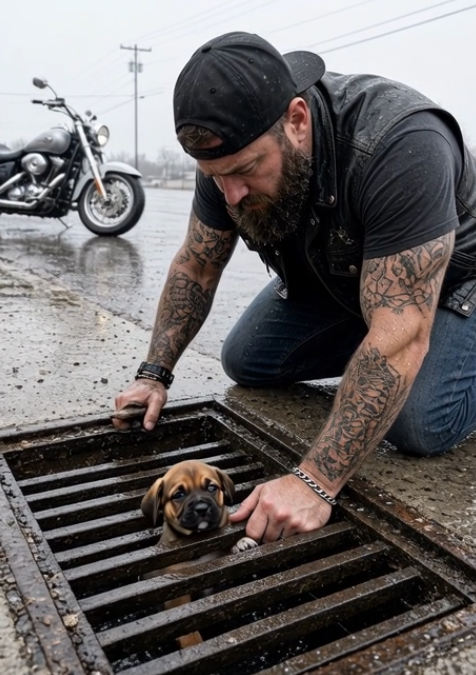
A Biker Pulled an 8-Week-Old Puppy From the Water Just in Time—Then at the Emergency Vet, She Wrapped Both Paws Around His Wrist and Refused to Let Go
PART2:
“She inhaled water,” Dr. Reid said quietly, not looking away from the puppy. “She’s hypothermic. Lungs sound wet. If you’d been a minute later…”
She did not finish.
She did not have to.
Cole sank down onto the floor beside the exam table.
He did not remember deciding to sit. His knees simply folded. The tile was cold through his wet jeans. His hands hung between his knees, palms open, useless.
Minutes passed.
Maybe three.
Maybe thirty.
The clinic sounds grew distant.
A phone ringing.
Rain against windows.
The soft murmur of the vet tech.
The oxygen machine.
The puppy’s faint, uneven breathing.
Then the puppy moved.
Just slightly.
One eye opened.
It turned its head.
And searched.
Cole lifted his head.
The puppy saw him.
Her small body shifted beneath the towel. She tried to crawl closer, paws trembling, dragging the oxygen line awkwardly as if even death had not taught her surrender.
Cole was on his knees before anyone could stop him.
“Don’t move too much,” Dr. Reid warned.
But her voice had softened.
Cole reached one hand toward the table.
The puppy wrapped her paws around his wrist again.
Weaker now.
But determined.
The room went silent.
Everyone understood what that meant.
A decision was about to be made.
And once it was made, neither of their lives would go back to what they were before the storm.
Dr. Reid examined the puppy again after she stabilized. Eight weeks old, maybe nine. Female. Undernourished. No collar. No microchip. No sign of anyone looking for her.
Dumped.
The word entered the room without anyone saying it at first.
Then the tech, a young woman named Casey, whispered it while checking the puppy’s temperature.
“Somebody dumped her.”
Cole’s jaw tightened.
Dr. Reid gave him a look.
“Don’t go hunting for whoever did it tonight.”
“I didn’t say anything.”
“You didn’t have to.”
Cole looked down at the puppy.
She had fallen asleep with her chin pressed against his scraped wrist. Every few seconds, her paws twitched, tightening as if she still felt water pulling at her.
“What happens now?” he asked.
“She needs to stay overnight,” Dr. Reid said. “Maybe longer. We’ll monitor her lungs, temperature, oxygen levels. She could still develop complications. Pneumonia is a concern.”
Cole nodded.
“How much?”
Dr. Reid hesitated.
He saw it.
The pause people made when they looked at his vest and decided whether to treat him like a threat, a wallet, or a charity case.
“How much?” he repeated.
“We’ll work up an estimate.”
“I asked how much, not whether I look like I can pay.”
Casey looked startled.
Dr. Reid met his eyes.
“Emergency care, oxygen, overnight monitoring, X-rays if needed, medication—it could be several hundred dollars. More if complications develop.”
Cole pulled out his wallet.
It was wet, like everything else.
He removed a folded emergency cash packet he kept behind his license, slapped it on the counter, and looked at the puppy.
“Start there.”
Dr. Reid looked at the money, then at him.
“You’re taking responsibility?”
Cole did not answer immediately.
Responsibility was a word he had spent years avoiding unless it involved engines, road brothers, or debts already earned.
The puppy’s paw shifted against his wrist.
He looked at her tiny face.
“She grabbed me first,” he said.
The overnight hours were long.
Dr. Reid told him he could go home, change clothes, come back in the morning.
Cole refused.
She told him the clinic had chairs in the waiting room.
He sat on the floor outside the recovery kennel instead.
At some point, Casey brought him a dry sweatshirt from the lost-and-found bin. It had a faded university logo across the front and smelled faintly of laundry detergent and dog treats.
Cole looked at it.
“I’m not wearing that.”
“You’re shaking.”
“I’m fine.”
“You’re dripping on our floor.”
He took the sweatshirt.
“Don’t tell anyone.”
Casey smiled.
“No promises.”
By midnight, the puppy’s breathing had steadied a little. She remained weak, but warmer. Dr. Reid let Cole sit beside the kennel as long as he did not touch the oxygen line.
The puppy woke every few minutes and searched until she saw him.
Each time, he said the same thing.
“I’m here.”
Around two in the morning, Dr. Reid came back with a clipboard.
“She needs a name for the chart.”
Cole stared through the kennel bars.
“I’m not good with names.”
“What do you call her when you talk to her?”
He looked embarrassed.
“I don’t.”
Casey appeared behind the vet with fresh towels.
“You called her sweetheart earlier.”
Cole shot her a look.
Casey raised both hands and backed away, smiling.
Dr. Reid waited.
The storm had weakened outside, but rain still tapped the windows. The puppy slept with one paw stretched toward the front of the kennel.
Cole looked at the small brown patch over her left eye. He thought about the drain. The rushing water. The way she had held on.
“Anchor,” he said.
Dr. Reid blinked.
“Anchor?”
“She didn’t let go.”
The vet wrote it down.
“Anchor Mercer?”
Cole opened his mouth to object.
Then the puppy sighed in her sleep, tiny and rough.
He closed his mouth.
“Yeah,” he said quietly. “Anchor Mercer.”
Morning came gray and wet.
Word traveled faster than Cole expected.
It started with Flint at the gas station, who told his wife, who told her sister, who worked at the diner, who told a customer, who happened to know three members of Cole’s motorcycle club.
By eight in the morning, the first bike pulled into the clinic parking lot.
Then another.
Then five.
Then twelve.
Dr. Reid stepped into the waiting room and stopped.
A line of bikers stood dripping on the floor, leather vests soaked, boots muddy, faces hard enough to frighten most people at first glance. Their patches read Iron Saints MC. Some had gray beards. Some had shaved heads. One held a grocery bag full of towels. Another carried puppy food. Another had a dog bed under one arm, still wrapped in plastic.
The biggest one, a man everyone called Preacher because he had once been anything but holy, walked up to the front desk.
“We’re here about the little girl.”
The receptionist blinked.
“The puppy?”
“That’s what I said.”
From the hallway, Cole appeared in the faded university sweatshirt, hair still wet, eyes bloodshot.
Every biker stared.
Preacher’s mouth twitched.
“Nice sweater.”
Cole pointed at him.
“Say one more word and I’ll bury you in it.”
Preacher lifted the dog bed.
“Brought supplies.”
“I didn’t ask for a parade.”
“No,” Preacher said. “But you rescued a puppy in a storm and stayed all night at a vet clinic. You think we were going to miss seeing that?”
A few of the men chuckled.
Cole’s jaw tightened, but the anger did not hold. He was too tired for it. Too scared, still, though he would rather have taken a punch than admit that out loud.
Dr. Reid watched the exchange with careful curiosity.
She had seen bikers before. Usually in connection with accident victims, occasionally in connection with community toy drives. But this was different. They stood rough and quiet, filling her clinic with leather, rain, and an unexpected gentleness.
One older biker named Mule stepped forward holding a small stuffed lamb.
“My granddaughter said the puppy needs this.”
Cole stared at it.
“You drove here in a thunderstorm with a stuffed lamb?”
Mule shrugged.
“Granddaughter outranks all of us.”
No one argued.
Anchor made it through the morning.
Her X-rays showed irritation in the lungs but no severe aspiration damage. She would need antibiotics, rest, monitoring, warmth, and careful feeding. Dr. Reid explained all of it to Cole while the Iron Saints pretended not to listen and listened to every word.
“She may cough,” Dr. Reid said. “She may be lethargic. If she struggles to breathe, you bring her back immediately. She’s underweight, so small meals. No rough play. Keep her warm.”
Cole nodded like he was receiving mission orders.
Casey handed him a printed instruction sheet.
“You can read that when you get home.”
“I can read.”
“I assumed.”
“Your face didn’t.”
“Your face says you might ignore medical instructions out of stubbornness.”
Preacher laughed.
Cole glared at him.
Dr. Reid unclipped Anchor’s oxygen line and gently lifted the puppy from the recovery kennel. Anchor was wrapped in a clean pink towel because Casey had decided the clinic’s gray towels were too depressing.
Cole held out both hands.
The second Anchor touched him, she tucked her head under his chin and wrapped both front paws around his wrist again.
The Iron Saints went silent.
Mule cleared his throat hard and turned away.
Preacher looked at the ceiling.
Casey wiped under one eye and pretended it was allergies.
Cole stood frozen.
He had held weapons.
Handlebars.
Wrenches.
Broken men.
His mother’s hand in hospice.
He had not held many things that trusted him this completely.
Dr. Reid’s voice softened.
“She chose you pretty clearly.”
Cole looked down at Anchor.
“Yeah,” he said. “I noticed.”
Taking Anchor home changed everything.
Cole’s trailer sat at the edge of town behind the auto body garage he owned. It was not dirty, exactly, but it was built for a man who did not expect visitors and did not care if the couch had a tear, the sink had two coffee mugs in it, or the only decorations were old motorcycle plates and a framed photograph turned face down on the shelf.
The first thing Anchor did was sneeze on his shirt.
The second was fall asleep inside his jacket.
The third was wake up crying when he tried to put her in the dog bed Mule brought.
Cole sat on the floor beside the bed.
“You have a bed,” he said.
Anchor cried harder.
“You’re supposed to like the bed. It has a lamb.”
Anchor crawled toward his boot, trembling from the effort.
Cole sighed.
“Fine.”
He lifted her carefully and placed her against his chest. She stopped crying at once.
“That’s manipulation,” he muttered.
Anchor sighed and slept.
For three days, Cole slept sitting up in his recliner because Anchor woke in panic whenever she realized she was not touching him. He fed her tiny meals on schedule. He gave her medicine wrapped in soft food. He checked her breathing more often than Dr. Reid had instructed. He drove to the clinic twice because he convinced himself her cough sounded worse.
The second time, Dr. Reid listened to Anchor’s lungs, checked her temperature, and looked at Cole.
“She’s stable.”
“She coughed.”
“She inhaled water. She’s going to cough.”
“It sounded bad.”
“She’s improving.”
Cole frowned.
“You sure?”
Dr. Reid removed the stethoscope.
“Mr. Mercer, did you sleep?”
“That’s not relevant.”
“It’s extremely relevant.”
Anchor sneezed.
Cole immediately looked alarmed.
Dr. Reid fought a smile.
“She sneezed because she stuck her nose in your wet beard.”
Cole grunted.
Casey appeared in the doorway.
“I made you a care chart.”
“I have the paper.”
“This one has boxes you can check.”
“I don’t need boxes.”
Casey handed it to him anyway.
He used it every day.
By the end of the first week, Anchor’s personality began to appear.
She was small, stubborn, offended by closed doors, and deeply suspicious of bath towels. She followed Cole everywhere, paws sliding on the trailer’s old linoleum. She barked exactly once at his motorcycle, then hid behind his boot as if embarrassed by her own courage. She fell asleep under the workbench at the garage while he repaired engines, waking only when customers came in, at which point she crawled into view, stared at them solemnly, and changed the tone of every conversation.
People who came to yell about repair bills lowered their voices.
Men who feared Cole asked if they could pet her.
Women who had crossed the street to avoid the Iron Saints bent down in the garage doorway and cooed.
Anchor became bad for business in the sense that nobody could maintain righteous anger while an eight-week-old puppy with oversized ears chewed on Cole Mercer’s shoelaces.
She also became good for business because half the town started stopping by to check on her.
Cole pretended to hate this.
He did not.
The trouble came on a Thursday afternoon.
Anchor had been with him nine days.
Cole was under a truck replacing a starter when Anchor growled.
Not a puppy play sound.
A real growl.
Low, sudden, wrong.
Cole rolled out from beneath the truck.
A man stood in the open garage bay.
He was thin, maybe thirty, with a patchy beard, nervous eyes, and a cigarette hanging from one hand despite the No Smoking sign two feet from his face. His hoodie was soaked at the cuffs, though it had not rained that day.
Anchor had backed under the workbench.
Every hair along her spine stood up.
Cole rose slowly.
“Can I help you?”
The man’s eyes flicked toward the bench.
“That your dog?”
Cole’s body went still.
“My shop. My dog. My question first.”
The man forced a laugh.
“Cute little thing.”
Anchor growled again.
Cole stepped between them.
“Don’t look at her.”
The man’s smile vanished.
“I think that pup might be mine.”
“No, you don’t.”
“You calling me a liar?”
“I’m calling you bad at it.”
The man’s face hardened.
“I lost a puppy last week.”
“In a storm drain?”
“I didn’t say that.”
“You didn’t have to.”
The cigarette trembled slightly between the man’s fingers.
Cole saw it.
So did Anchor.
She whimpered once, tiny and terrified.
Cole’s vision narrowed.
“Get out.”
The man lifted both hands.
“Hey, I’m just trying to get my property back.”
“She’s not property.”
“That ain’t what the law says.”
Behind him, three motorcycles pulled into the lot.
Preacher cut his engine first.
Then Mule.
Then a younger biker named Saint.
The man glanced back.
His confidence shifted.
Preacher removed his helmet.
“Problem?”
Cole did not look away from the man.
“This gentleman thinks Anchor belongs to him.”
Preacher’s face emptied.
That was worse than anger.
“Does he?”
The man backed toward the door.
“I’ll come back with proof.”
Cole stepped forward.
“You do that.”
The man left quickly.
Saint watched him hurry across the street and climb into a dented white van with no rear plate.
“Want me to follow him?”
Cole’s first instinct was yes.
His second was smarter.
“No. Get the plate if you can. Call Casey at the clinic. Ask if anyone reported a missing puppy matching Anchor. Then call Dr. Reid.”
Preacher looked at him.
“You think he dumped her?”
Cole looked down at Anchor, who was trembling beneath the workbench.
“I think she recognized him.”
That evening, Dr. Reid confirmed no missing puppy report had been filed. She also checked Anchor’s intake notes again. Undernourished. No chip. Signs of exposure. No evidence anyone had cared for her properly before the storm.
Cole filed a report with the police.
He expected nothing.
But Casey remembered something.
“A white van came by the clinic two weeks ago,” she said over the phone. “Guy asked if we took unwanted litters. I told him we could connect him with rescues but couldn’t just accept puppies anonymously without intake. He got angry.”
“Same guy?”
“I didn’t get a name. But I remember the van had a cracked taillight and a blue tarp in the back.”
Saint had photographed the van as it left Cole’s garage.
Cracked taillight.
Blue tarp visible through the rear window.
The police became more interested.
So did the Iron Saints.
Cole made one thing clear.
“Nobody touches him.”
Preacher looked disappointed.
Cole pointed at him.
“I mean it. We do this clean.”
“He dumped a puppy in a flood.”
“And if you beat him bloody, the story becomes about us.”
Mule crossed his arms.
“What’s it about then?”
Cole looked toward Anchor asleep in the corner of the garage, her paw resting on his boot.
“It’s about making sure he can’t do it again.”
Three days later, the man was identified as Darren Sykes. He had been evicted from a rental outside town where neighbors had complained about dogs barking in a shed. Animal control visited with police and found two adult dogs and four puppies in filthy conditions. All were alive. All were taken into care.
Sykes denied dumping Anchor.
Then the gas station camera footage surfaced.
It showed the white van stopping near the storm drain during the worst of the rain. It showed Sykes getting out with a cardboard box. It showed him looking around, then walking toward the culvert.
It did not show Anchor clearly.
It did not need to.
Cole watched the footage once.
Only once.
Then he walked outside and stood behind the police station with both hands braced against the brick wall, breathing like he was trying not to break something.
Dr. Reid found him there.
She had come because animal control asked her to help assess the seized dogs.
“You okay?” she asked.
Cole laughed without humor.
“No.”
She stood beside him.
For a while, neither spoke.
Then Cole said, “She kept holding on to me. In the drain. In the clinic. At home. I thought she was scared.”
“She was.”
He looked at her.
Dr. Reid’s eyes were kind but steady.
“But maybe she was also tired of being dropped.”
Cole looked away.
That sentence found a place inside him he had kept locked for years.
After his mother died, after his father drank himself into strangers, after every foster home that called him difficult and every adult who promised to come back and did not, Cole had built his whole life around not needing to be held.
Then a puppy abandoned in a flood had wrapped herself around his wrist and refused to believe he would leave.
“Damn dog,” he whispered.
Dr. Reid smiled faintly.
“She’s very inconsiderate that way.”
The court case was small.
Too small, Cole thought.
Animal cruelty charges. Fines. Probation. Ban on owning animals pending review. The seized dogs were sent to rescues. The local paper ran a short article with Anchor’s photo, though Cole refused to be in it until Casey cropped him badly from the edge of the frame.
But the town remembered.
So did the Iron Saints.
A month after Anchor’s rescue, Cole arrived at the garage to find the parking lot full of motorcycles, pickup trucks, dog crates, folding tables, and volunteers.
He stopped his bike slowly.
Anchor, now stronger and riding in a special front carrier Dr. Reid had insisted was safer than Cole’s jacket, lifted her head and barked once.
Preacher walked over holding a clipboard.
Cole stared at him.
“What is this?”
“Adoption event.”
“No.”
“Vaccination fundraiser.”
“No.”
“Storm Drain Rescue Benefit.”
“Absolutely not.”
Mule carried a banner past them.
ANCHOR’S SECOND CHANCE DRIVE.
Cole closed his eyes.
“I hate all of you.”
Preacher grinned.
“We know.”
Dr. Reid appeared from behind a table with Casey beside her.
“You signed the permit,” she said.
“I signed a paper you said was for parking.”
“It was. Event parking.”
Cole looked betrayed.
Anchor wagged her tail.
The event raised enough money to fund emergency care for dumped and injured animals for months. Three puppies from the seized litter were adopted that day. The adult dogs went to foster homes. The gas station installed a camera facing the storm drain. The town council agreed to add covered intake boxes at the shelter for emergency animal surrender, though Dr. Reid made sure everyone understood they were not a substitute for responsibility.
Cole spent most of the day pretending not to be involved.
He failed.
Children lined up to meet Anchor. She sat in his arms like a tiny queen, accepting gentle pats with solemn dignity. Whenever someone tried to take her from Cole, she leaned back into his chest and hooked one paw around his wrist.
By late afternoon, a little girl with braids asked him, “Why does she always hold your hand?”
Cole looked down.
Anchor blinked up at him.
He could have given a simple answer.
She’s clingy.
She’s scared.
She likes me.
Instead, he surprised himself by telling the truth.
“Because somebody let her go once,” he said. “And I think she likes knowing somebody else won’t.”
The girl thought about that.
Then she took her mother’s hand.
“Me too,” she said.
Cole had to walk behind the garage for a minute after that.
Seasons changed.
Anchor grew.
Not into a large dog, as everyone expected, but into a scrappy medium-sized mix with one ear that stood up and one that folded over whenever she was tired. Her coat turned out to be tan with black around her face and white on one paw. She remained stubborn, loyal, dramatic about baths, and deeply committed to supervising every repair at Mercer Auto.
She also remained attached to Cole’s wrist.
At first, people found it cute.
Then they noticed when it happened.
When a loud storm rolled in.
When a stranger with a cigarette stood too close.
When Cole’s breathing changed because memory, stress, or anger had tightened something inside him.
Anchor would appear from wherever she had been sleeping, press against his leg, and wrap one paw over his wrist.
Stay.
That was what it meant.
Not in words.
In weight.
In warmth.
In the quiet insistence that he come back to himself.
Cole started sleeping better.
Not perfectly.
He still had nights when thunder pulled him from dreams with his heart hammering. Still had mornings when he woke before dawn feeling like the world had left without him. Still had days when grief for things he refused to name sat heavy behind his ribs.
But now, when he opened his eyes, Anchor was there.
Sometimes snoring.
Sometimes chewing a toy she knew she was not supposed to have.
Sometimes staring at him as if she had been waiting for him to remember that he was not alone.
One year after the storm, Harbor Emergency Veterinary Clinic invited Cole to speak at the annual rescue fundraiser.
He said no.
Dr. Reid asked again.
He said no.
Casey asked.
He said no.
Preacher told him he was already listed on the flyer.
Cole threatened to move states.
Anchor sneezed.
In the end, he stood awkwardly behind a microphone in the community center with Anchor sitting at his feet wearing a blue bandana that said HOLD FAST.
The room was full.
Veterinarians. Bikers. Families. Shelter volunteers. Kids who had followed Anchor’s story online. People who had once crossed the street to avoid Cole Mercer and now waved at him in grocery stores like he was the town’s reluctant mascot.
Cole hated public speaking.
He stared at the microphone like it had personally insulted him.
Then Anchor placed one paw on his boot.
He looked down.
She looked up.
He exhaled.
“A year ago,” he began, voice rough, “I pulled this dog out of a storm drain.”
The room quieted.
“I thought I was saving her.”
He looked toward Dr. Reid, then Casey, then his brothers from the Iron Saints standing along the back wall.
“I was wrong. Not completely. She needed saving. She was cold, scared, dumped like trash by somebody who should’ve done better. But the thing is…”
He stopped.
Anchor leaned against his leg.
Cole swallowed.
“The thing is, I was pretty good at being left alone before her. I had a whole system. Keep people at a distance. Don’t ask for much. Don’t let anything small depend on you because small things break your heart faster.”
A few people wiped their eyes.
Cole looked embarrassed by that but kept going.
“She didn’t care about my system. She grabbed my wrist in that drain, and she’s been doing it ever since. Every time I think I’m fine and I’m not. Every time a storm gets loud. Every time I start forgetting that staying is something you do one day at a time.”
He looked down at Anchor.
“She held on until I learned how to hold on back.”
The room was silent.
Cole cleared his throat.
“So, donate money. Adopt if you can. Foster if you can. Report cruelty when you see it. And if something small reaches for you…”
His voice softened.
“Don’t be too proud to let it.”
Applause came slowly at first.
Then louder.
Cole stepped back quickly, face red beneath his beard.
Preacher clapped the hardest.
Mule cried openly and threatened anyone who looked at him.
Dr. Reid smiled with tears in her eyes.
Anchor barked once, offended that everyone had waited so long to recognize the obvious.
That night, after the fundraiser, Cole rode home with Anchor safely strapped in her carrier. The sky was clear. The road still held the smell of rain from earlier in the day, but there was no storm, only cool air and stars above the hills.
At the garage, he let Anchor down.
She trotted inside, checked her water bowl, investigated the office trash can, found nothing worth stealing, and returned to Cole’s side.
He sat on the old step outside the bay door.
The town was quiet.
A year ago, he had been riding through a storm, planning to go home alone.
Now there was a dog bed in his office, paw prints on his floor, tiny scratches on his truck door, a ridiculous stuffed lamb on his couch, and a puppy who had grown into the boss of every person who entered his garage.
Anchor climbed onto the step beside him and rested her head against his thigh.
Cole looked down at the scar on his wrist from the storm drain grate.
It had faded to a pale line.
Anchor placed one paw over it.
He smiled.
“Yeah,” he said softly. “I know.”
The puppy hadn’t let go when she was drowning.
She hadn’t let go when she was safe.
She hadn’t let go when she became strong enough to run, bark, eat, heal, and live.
And somewhere along the way, Cole Mercer—the man everyone thought was too hard to need anyone—had stopped trying to let go too.
Because sometimes rescue does not end when the water is gone.
Sometimes the one you save stays beside you long enough to save the parts of you nobody else could reach.
And sometimes a life changes forever because one terrified little creature wraps her paws around your wrist and decides, before you are ready to admit it, that you are home.








