A Biker Asked Why a 7-Year-Old Girl Had Been Standing for Nearly an Hour—Then She Whispered, “I’m Not Allowed to Sit Down.
PART2:
I did not know she was her mother yet, but they had the same nose.
Same brown hair.
Same pale skin.
The woman was maybe twenty-nine.
Thin.
Tired-looking.
Phone in one hand.
Across from her sat a man working through a plate of eggs and home fries.
Mid-thirties.
Broad shoulders.
Dark jacket still on even though the diner was warm.
He ate slowly.
The girl stood.
Nobody at that booth spoke to her.
I watched another minute.
Then two.
The woman never looked up.
The man looked at the little girl once.
Just once.
She immediately lowered her eyes.
That was when something inside me changed.
I am sixty-one.
I have two adult children and four grandchildren.
One of my granddaughters is seven.
Children stand funny when they are bored.
They swing one leg.
Lean against things.
Slide down walls.
Kick at chair legs.
Cross their feet.
Ask how much longer.
Complain that they are hungry even after eating half a plate of pancakes.
This child did none of that.
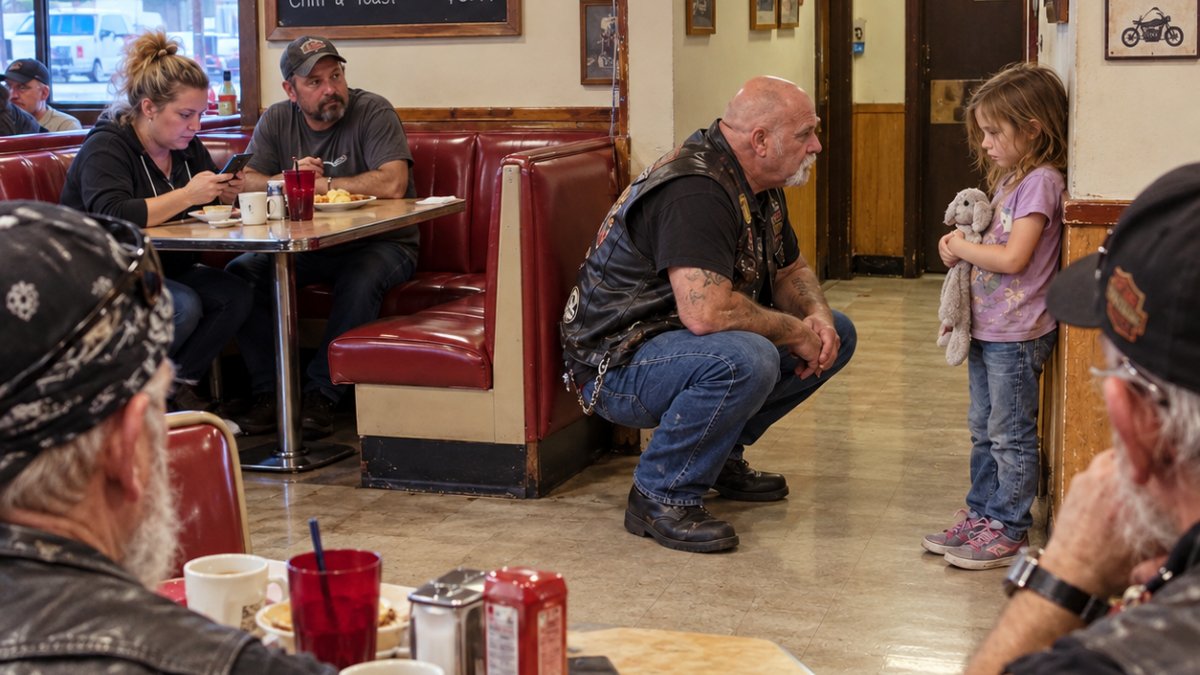
She stood flat against the wall.
Both feet planted.
Back straight.
Arms wrapped around the rabbit.
Barely moving.
There is boredom.
And there is stillness.
They are not the same.
I waited another ten minutes because I did not trust my first instinct.
Maybe she had chosen to stand.
Maybe she had spilled something on the booth.
Maybe she was playing a game.
Maybe there was a reasonable explanation that did not involve a sixty-one-year-old stranger sticking his nose into somebody else’s family.
My brothers noticed me watching.
Deke Pardo sat across from me.
Deke has ridden with me since 1994.
He hauls scrap metal with a flatbed.
Speaks rarely.
Remembers everything.
“What?”
he asked.
I nodded toward the girl.
“Kid’s been standing there since we came in.”
Ski glanced over.
“So?”
“Nothing.”
Deke looked.
Then back to his eggs.
“Don’t.”
“I didn’t say anything.”
“You got the face.”
“What face?”
“The face where you decide everybody else’s business became yours.”
“I don’t have a face.”
“You got that face.”
Marcus said:
“He does.”
I ignored them.
Five more minutes.
The girl still had not moved.
I pushed my coffee away.
Deke sighed.
“Ray.”
My name is Raymond Cole.
Most people call me Ray.
“Sit down.”
“I’m sitting.”
“You’re about to not be.”
“I’m gonna ask the kid a question.”
Ski said:
“Nope.”
I looked at him.
“Nope what?”
“You look like the villain on every stranger-danger poster made since 1982.”
He was not wrong.
Gray beard halfway to my collarbone.
Sunburned face.
Leather cut.
Old tattoos.
Scar over my left eyebrow.
Walking toward somebody else’s seven-year-old child in a restaurant is not something a man who looks like me should do casually.
“You go,” I told Ski.
“Absolutely not.”
“Why?”
“I look worse than you.”
True.
Deke said:
“Leave it.”
I should have.
Probably.
Instead I got up.
The child saw me immediately.
Her arms tightened around the rabbit.
I stopped four feet away.
Then crouched.
My knees complained violently.
I kept my hands open where she could see them.
“Hey, sweetheart.”
Nothing.
“You okay?”
Her eyes flicked toward the booth.
Not toward the woman.
Toward the man.
Then back to me.
I pointed at the empty seat.
“There’s a whole booth right there.”
No answer.
“How come you won’t sit down?”
Her lips moved.
I did not hear it.
“What was that?”
Her eyes went past me again.
The man continued eating.
She looked back.
“I’m not allowed.”
Something went cold behind my ribs.
Not anger yet.
Not exactly.
Recognition.
I had heard children talk about rules before.
No jumping on couch.
No dessert before dinner.
No staying up late.
Those rules come with annoyance.
Negotiation.
Testing.
This was different.
She said it like:
Water is wet.
Winter is cold.
Gravity pulls down.
I lowered my voice.
“Who says?”
She squeezed the rabbit.
No answer.
“Your mama?”
A tiny shake of the head.
“The man at the table?”
Still nothing.
Then she said:
“I’m not allowed to sit down until he says I’m done being sorry.”
I have been in some ugly rooms.
I spent years working heavy equipment around men who settled disagreements badly.
I served six years in the Army National Guard when I was younger.
I have watched fights develop from nothing.
I sat in a hospital hallway at two in the morning while a doctor operated on my son after a motorcycle accident.
I know what fear feels like when it enters your body fast.
Nothing has ever landed in me like that sentence.
“I’m not allowed to sit down until he says I’m done being sorry.”
She did not cry.
That made it worse.
“Sorry for what?”
She thought.
That was the detail.
She had to think.
A child who broke a lamp knows what she is sorry about.
A child who hit her brother knows.
A child who lied knows.
This little girl searched through possibilities.
“I spilled.”
“When?”
“Yesterday.”
Yesterday.
She had been punished into the next day.
My knees were burning.
I stayed down.
“What’s your name?”
“Josie.”
“That’s a pretty name.”
Nothing.
“What’s your rabbit called?”
For the first time, she looked down instead of toward the man.
Her face softened.
Only for a second.
“Pepper.”
“Pepper?”
She nodded.
“He looks tough.”
“He’s a boy.”
“Looks tough anyway.”
One corner of her mouth almost moved.
I said:
“Is Pepper allowed to sit?”
“Yes.”
“Lucky rabbit.”
“He doesn’t get in trouble.”
That sentence nearly finished me.
I wanted to ask a hundred questions.
Does he hit you?
Does he make you stand at home?
Are you hungry?
Has your mother tried to stop him?
Do you have bruises?
Are you safe?
But there are moments when asking the wrong question in front of the wrong person can make a child less safe.
I knew enough to know what I did not know.
So I stood.
My knees popped.
Josie flinched at the sound.
I stepped back.
“Okay, sweetheart.”
She watched me.
“You hang on to Pepper.”
She nodded.
I returned to my table.
That part surprises people when I tell the story.
They expect me to have confronted him immediately.
Maybe because I’m a biker.
Maybe because stories sound cleaner when the large angry man walks straight over and scares the bad guy.
I did not.
I sat down.
Picked up my coffee.
My hand was shaking.
Deke looked at me.
“What?”
I told him.
Not dramatically.
Nine sentences.
Maybe ten.
Kid’s name is Josie.
Seven.
Man told her she can’t sit.
Punishment since yesterday.
Spilled something.
Rabbit’s Pepper.
She looks scared of him.
Deke listened.
Then he turned his head.
Slow.
Looked at the booth four seconds.
Turned back.
“The woman.”
“What about her?”
“Watch the woman.”
I did.
And that is the part I missed.
The part I am ashamed I missed.
Her phone screen was black.
I could see the reflection of the overhead lights in it.
She had not been scrolling.
She had been holding a dead screen in the exact same position for nearly an hour.
Her face stayed pointed downward because it gave her somewhere safe to look.
The man reached across for ketchup.
The woman’s shoulders rose half an inch.
Flinch.
Fast.
Controlled.
She lowered them again.
He asked her something.
I could not hear.
She answered immediately.
No hesitation.
Did not look at him.
Then he pushed his coffee mug toward her.
She picked it up.
Checked it.
Flagged the waitress.
All without him asking again.
Deke said:
“You see it.”
I nodded.
I had spent almost an hour watching a child behave carefully and never asked who had taught her.
Now I knew.
The woman’s name, I later learned, was Dana Mercer.
Twenty-nine.
Josie’s mother.
The man was Ray Dunphy.
Thirty-six.
Not Josie’s father.
Her biological father had moved to Ohio when she was two and saw her occasionally in summer.
Ray had lived with Dana and Josie for fourteen months.
Fourteen months.
Long enough to rearrange a house.
A woman.
A child.
Ray looked up.
Saw me watching.
And smiled.
That smile matters.
People imagine cruel men looking cruel.
Sometimes they do.
Often they look ordinary.
Ray was clean-shaven.
Hair trimmed.
No obvious tattoos.
No drunken slur.
No dirty clothes.
He looked like a man who might coach Little League.
The kind of guy another dad would ask to watch his truck while he ran inside.
He gave me a pleasant little smile across the diner.
Almost friendly.
And in that moment I understood what he believed.
He had calculated the room.
On his side:
A woman.
A child.
A normal booth.
Normal clothes.
A plate of eggs.
On mine:
Fourteen motorcycles.
Fourteen leather vests.
Fourteen gray or thinning heads attached to men who looked like trouble even when ordering pie.
If this became a confrontation, who would strangers assume started it?
Ray had done the math.
And the worst part is that the math was probably right.
He leaned toward Dana.
Said something.
She stood immediately.
Walked to Josie.
Took her hand.
Josie followed.
No complaint.
No delay.
Ray slid from the booth.
Pepper remained beside his plate.
Josie looked at the rabbit.
Just once.
Ray saw.
“Leave it.”
She left Pepper.
My chair scraped backward.
Deke stood at the same time.
Then Ski.
Marcus.
Tiny.
One after another.
Fourteen men.
Nobody spoke.
We did not need to.
Fourteen bikers standing simultaneously inside a small diner is loud even in silence.
Ray stopped halfway out of the booth.
The entire restaurant noticed.
I walked toward him.
Stopped outside arm’s reach.
Hands visible.
“You forgot her rabbit.”
Ray glanced at Pepper.
Then at me.
“She doesn’t need it.”
“She’s seven.”
“She’s got a mouth on her.”
His tone stayed conversational.
“And she’s got consequences. That’s how parenting works.”
“You her father?”
His smile faded a fraction.
“Does it matter?”
“Asked a question.”
“I’m the man raising her.”
Dana stood beside Josie.
Eyes on floor.
Ray said:
“You got children?”
“Two.”
“Then you know.”
“Four grandchildren.”
“Then you definitely know.”
He placed one palm on the table to push himself fully upright.
“Kids test limits.”
I said nothing.
“They learn respect.”
Nothing.
“They need structure.”
Pepper sat between us.
One ear.
Dirty fur.
I wanted to hit him.
I want to be completely honest about that.
I wanted to hit Ray Dunphy so badly my jaw hurt from holding still.
I wanted to grab him by that nice clean jacket and put him through the window.
Not because that would have been justice.
Because rage feels good when you cannot fix what happened before you noticed.
But there is a difference between something feeling good and something helping a child.
Deke understood that before I did.
He had already moved toward the counter.
Carol, our waitress, had worked at Mill Creek nineteen years.
Red glasses.
Quick hands.
The kind of woman who can carry six plates and remember which trucker ordered rye toast.
She was holding the cordless phone.
Ray did not see her.
I did.
Carol pointed toward the door.
Tiny nod.
Police were coming.
I stepped back.
“Rabbit stays here?”
Ray shrugged.
“Throw it away.”
Josie heard that.
Her face did not change.
That hurt worse.
Deke came beside me.
“Enjoy your day,” he said.
Ray smirked.
“I plan to.”
They walked outside.
Fourteen bikers followed.
Not close.
Nobody surrounded them.
Nobody threatened him.
Marcus went to his Road King near the lot entrance.
Then something extraordinary happened.
His motorcycle developed a problem.
Terrible luck.
Marcus is a commercial electrician.
He can rebuild half a motorcycle beside a highway with three tools and profanity.
But suddenly his battery terminal had become the most confusing electrical system created by mankind.
Seat off.
Meter out.
Reflective vest on.
Bike positioned partly across the lot entrance.
Ray loaded Dana and Josie into his silver Silverado.
Started it.
Backed toward the exit.
Marcus remained bent over his bike.
Ray honked.
Marcus looked up.
Held one finger in the air.
One second, brother.
Went back to studying the battery.
The rest of us stood around our motorcycles.
Talking.
Laughing.
Helmets in hands.
Nobody within thirty feet of the Silverado.
Nobody blocking the passenger doors.
Nobody touching the truck.
Ray honked again.
Marcus scratched his beard.
Ray opened his door.
Deke whispered:
“Don’t.”
I had not moved.
“Wasn’t.”
“You were thinking.”
“I’m allowed.”
Ray stepped out.
“What the hell are you doing?”
Marcus looked genuinely surprised.
“Battery.”
“Move the bike.”
“Trying.”
“You’ve got ten seconds.”
Marcus looked at his watch.
“Hope battery understands.”
Ray took one step.
Then a patrol car entered from the service driveway on the opposite side.
Carol had told dispatch about that entrance.
Deputy Miguel Ruiz was twenty-six.
I learned that later.
At the time, he looked eighteen to me.
Clean uniform.
Young face.
Hand near his belt as he got out.
His eyes moved through the lot.
Fourteen bikers.
Blocked entrance.
Silver pickup.
Angry clean-cut man outside the driver’s door.
You could see him assemble the first version of the story instantly.
I did not blame him.
If I were twenty-six wearing his uniform, I might have assembled the same one.
“Everybody stay where you are.”
We did.
Ray raised both hands.
“Thank God.”
Perfect opening.
“These guys are harassing my family.”
Ruiz looked at us.
Then Ray.
“What happened?”
“We were trying to leave. They surrounded us.”
Nobody had.
“They confronted me inside.”
Technically one of us had.
“They’ve got the exit blocked.”
Technically Marcus’s motorcycle did.
Ruiz glanced at him.
“What’s wrong with it?”
“Battery terminal, sir.”
Marcus held up the meter.
Ruiz looked unconvinced.
Fair.
Ray continued:
“My girlfriend and her daughter are terrified.”
There it was.
Girlfriend.
Daughter.
Family.
He built the safest possible frame around himself.
I felt Deke beside me.
He barely moved his head.
Let it ride.
So we did.
Ruiz came toward us.
“Who spoke with him inside?”
I raised my hand.
“Me, sir.”
“What did you say?”
“That he forgot the little girl’s stuffed rabbit.”
“Anything else?”
“Asked if he was her father.”
“Did you threaten him?”
“No, sir.”
“Touch him?”
“No, sir.”
“Anyone here touch him?”
Fourteen nos.
Ray laughed from behind Ruiz.
“This is ridiculous.”
Ruiz looked back.
“I’ll get to you.”
Good.
The kid had some backbone.
He took our names.
Asked where we came from.
“Scranton.”
“Why?”
“Toy run at the children’s hospital.”
I pointed toward the donation sticker still stuck to my tank.
He looked.
Not enough to change his mind.
Shouldn’t have been.
Good people can still behave badly after charity events.
Ruiz wrote everything.
His shoulders were tight.
I could see suspicion leaning our direction.
Then he walked toward the Silverado.
Dana sat passenger side.
Josie in back.
Ray stayed near the hood while Ruiz spoke to Dana first.
I could not hear everything.
Only pieces.
“Okay?”
“Yes.”
“Anyone threaten you?”
“No.”
“You sure?”
“Yes.”
Fast answers.
Too fast.
Ruiz moved to the rear window.
Tapped glass.
Ray reached for the driver door.
Ruiz said:
“Leave it.”
Ray stopped.
Window came down.
Josie sat upright.
Perfectly upright.
Not touching the seat back.
Both feet flat.
Hands in lap.
No Pepper.
Ruiz smiled.
Different voice.
Adults do that around children.
“Hey there.”
Josie looked at him.
“What’s your name?”
“Josie.”
“I’m Miguel.”
She said nothing.
“You okay?”
Her eyes flicked toward Ray.
Ruiz noticed.
I saw the exact second.
He leaned slightly closer.
“You can relax, sweetheart.”
Josie remained rigid.
“Go ahead and sit back.”
She turned her head.
Looked through the windshield at Ray.
Did not move.
Did not speak.
Just waited.
Permission.
Ruiz straightened very slowly.
The entire atmosphere of that parking lot changed.
He looked at Ray.
Then Dana.
Then Josie again.
Ray said:
“She’s fine.”
Ruiz held one hand up without looking at him.
“Sir, don’t.”
That was all.
But his voice had changed.
He crouched beside the window.
“Josie?”
“Yes.”
“Are you allowed to lean back?”
Silence.
Ray said:
“This is getting insane.”
Ruiz stood.
“Sir, go stand by the front of my vehicle.”
“For what?”
“Please.”
“I haven’t done anything.”
“Front of my vehicle.”
Ray’s face hardened.
There.
First crack.
“You believing these people over me?”
Ruiz did not answer.
He keyed his radio.
Requested another unit.
Then a female deputy.
Then county child services.
Ray began talking faster.
“Dana.”
She looked at him.
“Tell him.”
Her lips parted.
Nothing came out.
“Tell him she’s fine.”
Dana whispered:
“She’s fine.”
Ray nodded.
“See?”
Ruiz looked at her.
“Ma’am, can you step out of the vehicle?”
Dana froze.
Ray answered:
“She doesn’t need to.”
Ruiz looked directly at him.
“I asked her.”
Ray’s jaw flexed.
For the first time, nobody in that parking lot saw an ordinary family man.
We saw control losing its footing.
Dana opened her door.
Ray said:
“Dana.”
She stopped halfway out.
One word.
Her name.
But it landed like a hand around her throat.
Ruiz heard it too.
He moved between them.
“Ma’am, come with me.”
Dana stepped out.
Ray moved.
Not much.
One step.
Ruiz put a hand up.
“Stay there.”
“This is my family.”
“Stay there.”
“You don’t know these people.”
“Sir.”
“They’re criminals.”
He pointed at us.
“They’re trying to kidnap my girlfriend.”
Nobody moved.
Deke whispered:
“Good.”
Not because Ray was right.
Because Ray was finally showing himself.
Second unit arrived.
Deputy Ellen Carver.
Forties.
Short hair.
She took Dana toward the side of the diner.
Away from Ray.
County car followed ten minutes later.
Woman named Alicia Grant.
Child advocate.
By then Ray was furious.
Still controlled enough not to swing.
Not controlled enough to hide anymore.
“They’re lying.”
“Who?”
“All of them.”
“Your girlfriend?”
“She’s confused.”
Ruiz said:
“Your girlfriend hasn’t accused you of anything.”
That stopped Ray.
Then he realized.
He had revealed more than anyone had said.
I saw Ruiz register it.
Ray tried to walk it back.
“This whole thing is harassment.”
Ruiz nodded.
“Okay.”
“Those bikers intimidated my daughter.”
“Not your daughter, right?”
Another pause.
“My girlfriend’s daughter.”
“Okay.”
“She has discipline issues.”
“What kind?”
Ray crossed his arms.
“Normal kid stuff.”
“Like?”
“Talking back.”
“What else?”
“Spilling things.”
My stomach turned.
Ruiz heard it.
“What happens when she spills something?”
Ray looked toward us.
That was the mistake.
Not toward Josie.
Not Dana.
Us.
As if measuring how much we had told police.
Ruiz said:
“Mr. Dunphy?”
“She gets a consequence.”
“What consequence?”
“Standing.”
“How long?”
“Depends.”
“On what?”
“Whether she learns.”
“How long has she been standing today?”
Ray laughed.
“You’re kidding.”
Ruiz did not.
“Today?”
“She’s not standing now.”
“How long inside?”
“I don’t know.”
Carol came through the door.
Order pad in hand.
“I do.”
Every head turned.
Carol looked at Ruiz.
“She was standing when they arrived at 1:47.”
She pointed toward us.
“It’s 2:59 now.”
Ray stared.
Carol continued.
“She was already standing when I started my shift at one.”
My chest went cold.
Not forty minutes.
Not an hour.
Possibly two.
Ruiz asked:
“You saw her before us?”
“Yes.”
“Any idea how long?”
“No.”
“Did you hear why?”
Carol looked toward Ray.
“Yes.”
His face changed.
“What?”
he snapped.
Carol flinched.
Then hated herself for flinching.
Straightened.
“You told her she could sit when she was done being sorry.”
Ray laughed.
“No, I didn’t.”
“You did.”
“You’ve got fourteen bikers intimidating you.”
Carol looked around.
“No, sir.”
She held up her order pad.
“And I wrote your license plate down ten minutes before that gentleman ever left his table.”
She pointed at me.
“Because I was already calling about you.”
That was when Ray understood.
We had not created the situation.
We had only noticed it late.
The diner had eyes before us.
The story was getting harder for him to control.
Alicia Grant approached the truck.
Crouched near Josie.
Talked quietly.
We could not hear.
Good.
We did not need to.
This was not ours.
I went inside.
Pepper still sat at the booth.
I picked him up.
The rabbit felt lighter than I expected.
Old fabric.
One loose button eye.
Missing ear.
There was a dark stain near one foot.
I wondered how many rooms that rabbit had stood in with her.
I stopped that thought before it went farther.
When I came back outside, Ray was in handcuffs.
Not because fourteen bikers surrounded him.
Not because he argued.
I never learned exactly what tipped probable cause at the scene.
There were statements.
Dana finally said something privately.
Josie apparently said enough.
Carol had observations.
Police had witnessed the control around the child firsthand.
Ray had an outstanding issue connected to a previous domestic call that complicated things further.
At 4:51, Deputy Ruiz put him in the rear of a cruiser.
Ray looked at us.
The smile was gone.
“You think you’re heroes?”
Nobody answered.
He focused on me.
“You ruined that family.”
Deke said softly:
“No.”
Ray looked at him.
Deke continued:
“You did.”
Ruiz shut the door.
That was the only sentence any of us gave him.
Dana sat inside the county vehicle.
Alicia beside her.
Door open.
Dana cried for forty minutes.
Sometimes doubled over.
Sometimes staring.
At one point she looked at us.
I expected gratitude.
There was none.
Only shame.
Fear.
Confusion.
That taught me something too.
People imagine rescue as relief.
The door opens.
Victim runs out.
Everyone hugs.
Abuse is rarely that clean.
Dana was losing the man who had frightened her.
Also the man she had loved.
The person who paid part of the rent.
The person who drove Josie to school some mornings.
The person who apologized after bad nights.
The person who told her nobody else would want her.
The person who had spent fourteen months shrinking her world until she could no longer tell where his rules ended and reality began.
Freedom can feel terrifying when captivity has been sold as stability.
I carried Pepper toward the county car.
Alicia stepped out.
“Is that hers?”
“Yes.”
“I can take it.”
I handed her the rabbit.
Then stopped.
“Can I give it to her?”
Alicia considered me.
Looked toward Josie.
“No.”
That hurt.
But she was right.
“Okay.”
She took Pepper.
A minute later, through the window, I saw Josie wrap both arms around him.
That had to be enough.
They took Josie to the hospital.
Not because anyone told us specific injuries.
A child welfare examination after concerns like that was standard.
I do not know exactly what doctors found.
I will never claim I do.
Some things belong to Josie.
Not me.
What I know is that Ruiz came out of the hospital a little before eight that night.
We were still there.
Not all fourteen.
Some had left.
Deke.
Me.
Marcus.
Tiny.
Carol had finished her shift.
We waited because going home felt wrong.
Ruiz walked across the lot.
Stopped near his cruiser.
Both hands on roof.
Looked down.
Stayed that way almost a minute.
I approached halfway.
“Deputy?”
He looked up.
His eyes were red.
“You got kids?”
he asked me.
“Two grown.”
“Grandkids.”
“Four.”
He nodded.
“I got a four-year-old.”
I did not ask what happened inside.
Instead:
“She okay?”
He took a long breath.
“She’s somewhere safe tonight.”
Enough.
“Her mom?”
“Working with an advocate.”
I nodded.
Ruiz looked toward our bikes.
“I owe you an apology.”
“No.”
“I came in assuming—”
“You came into a parking lot with fourteen bikers and an angry man.”
He almost smiled.
“Still.”
“You changed your mind when facts changed.”
That seemed to surprise him.
“Most people don’t.”
I shrugged.
“Most people are idiots.”
That got a laugh.
Small.
Needed.
Dana was not arrested.
I wrestled with that for a long time.
A lot of us did.
Carol especially.
“She let that child stand.”
“Yes.”
“She watched.”
“Yes.”
“She’s her mother.”
“Yes.”
I had the same anger.
Then Alicia Grant met me months later during a hearing and said something that changed my thinking.
“There were two people in that house being told what they were allowed to do.”
She paused.
“Only one was seven.”
That did not erase Dana’s responsibility.
A parent has obligations even while being abused.
But understanding something is not excusing it.
Dana had to face what she failed to stop.
She did.
That became the part that mattered.
Ray’s arrest opened fourteen months of things.
Neighbors who had heard yelling.
A teacher who had noticed Josie becoming quieter.
A pediatrician record documenting unexplained stomachaches.
Text messages.
Rules.
Punishments.
Control over money.
Control over Dana’s phone.
Where she went.
Who she saw.
What she wore.
How long she could stay at work.
When Josie could play.
What counted as disrespect.
Standing punishments.
Silent punishments.
Meals delayed.
Possessions removed.
Pepper had been taken more than once.
Dana later testified that whenever she challenged Ray about Josie, he turned it back on her.
“You’re raising a brat.”
“You want her to end up like you.”
“I’m the only one giving her structure.”
“You’re too weak to parent.”
Eventually Dana stopped arguing in front of Josie because arguments made things worse afterward.
Then she stopped arguing at all.
That is how a person disappears while remaining physically present.
One surrender at a time.
The criminal case took months.
Ray bonded out briefly under conditions.
No contact.
Monitoring.
Then violated an order by sending messages through another person.
Bond revoked.
He went back in.
Dana moved in with her mother outside Wilkes-Barre.
New phone number.
New job eventually.
Counseling.
Tuesday evenings.
Domestic violence support group.
Josie started therapy too.
None of that came to me directly at first.
I knew only pieces.
I went home that Saturday without saying goodbye.
That bothered me more than I expected.
For one hour, Josie had existed inside my life.
Then a county vehicle drove away with her.
No movie ending.
No hug.
No child running back to thank the biker.
I did not even know whether she remembered my name.
Probably not.
I had told her once.
Ray.
Which was unfortunate considering the other Ray.
She might have forgotten immediately.
I thought I had given Pepper back.
I was wrong.
When I opened my saddlebag at home, there he was.
Alicia must have handed the rabbit back to one of my brothers temporarily while Josie was being transferred, and somewhere in the confusion it ended up with our gear.
I stared at it.
Called the sheriff’s office.
They took my number.
Called back two days later.
Alicia said Josie had been given another comfort item at the hospital and had already left with family.
“Can I mail it?”
“We’re trying to keep their location private.”
“Understand.”
“I can arrange transfer.”
I should have done that.
Instead there was confusion with evidence intake, schedules, victim services, and I was told someone would call.
Nobody did.
I called again.
Different person.
Different answer.
Eventually Pepper stayed on a shelf in my garage.
I felt guilty every time I saw him.
Missing ear.
Button eye.
Sitting beside a coffee can full of bolts.
I considered repairing the ear.
Could not.
Something stopped me.
Maybe Josie would want him exactly the same.
Maybe repairing him would be another adult deciding what should be changed.
So I left him alone.
March came.
Ray’s trial began.
I testified only to what I saw.
That mattered.
The prosecutor warned us.
“Do not speculate.”
Fine.
I saw Josie standing.
I spoke to her.
She said she was not allowed to sit until Ray said she was done being sorry.
I observed Dana.
I spoke with Ray.
He described standing as a consequence.
That was it.
No speeches.
No pretending I knew what happened in that house.
Carol testified.
Deputy Ruiz.
Teachers.
Neighbors.
Medical professionals.
Dana.
Her testimony lasted most of a day.
I sat through part of it.
Not all.
Some testimony was closed or limited because Josie was a minor.
Dana wore a navy blouse.
Hair pulled back.
She looked healthier than the diner.
Also older.
Ray’s lawyer asked why she stayed.
That question is always waiting for abused people.
Why didn’t you leave?
Why didn’t you stop him?
Why did you keep returning?
Why didn’t you call police?
Dana answered honestly.
“At first because I loved him.”
Pause.
“Then because I believed him.”
Another.
“Then because I was afraid.”
“Afraid of what?”
“That if I tried and failed, he’d make it worse for Josie.”
The lawyer asked:
“But you did nothing while your daughter was punished?”
Dana closed her eyes.
“No.”
“You watched.”
“Yes.”
“You allowed it.”
Dana swallowed.
“Yes.”
The courtroom became still.
She did not defend herself.
That gave her answer power.
“I failed her.”
The lawyer paused.
Probably expected excuses.
Dana continued:
“I thought staying quiet was protecting her from worse things.”
Her voice broke.
“It wasn’t.”
She wiped her face.
“I know that now.”
That was the part Ray could never do.
Admit harm.
Everything was always someone else’s fault.
Josie was disrespectful.
Dana was weak.
The bikers were threatening.
Carol misunderstood.
Police overreacted.
Child services hated men.
Prosecutors needed headlines.
Judge was biased.
Never him.
That difference matters.
People can do terrible things while trapped.
What matters afterward is whether they face what they did.
Dana did.
Ray did not.
He was convicted on multiple counts related to child abuse, coercive conduct, unlawful restraint-type behavior, and violations tied to the later no-contact order.
The exact legal language became complicated.
The sentence was easier to understand.
Eight to fifteen years.
When the judge pronounced it, Ray looked at Dana.
Not sorry.
Betrayed.
As though she had broken a promise by telling the truth.
I remember thinking:
There it is.
Even at the end.
He still believed her job was obedience.
The judge said something I wrote down later.
“Discipline is not the same thing as domination.”
That was it.
No grand speech.
Enough.
Dana walked out of court holding her mother’s hand.
I did not approach.
She saw me.
Stopped.
Nodded once.
I nodded back.
That was all we owed each other.
Spring became summer.
Then September.
I still had Pepper.
Eleven months after the diner, a letter arrived at my house.
The return address was a town near Wilkes-Barre.
I almost threw it with junk mail because I did not recognize the handwriting.
Inside were two pages.
From Dana’s mother.
Her name was Elaine Mercer.
She thanked me.
I hated that immediately.
I had done almost nothing.
She said Dana and Josie were living with her.
Dana worked at a dental office.
Still went to Tuesday-night meetings.
Josie had started second grade.
She had a friend named Ani.
Loved science.
Hated spelling.
Had gotten in trouble for talking during reading time.
The teacher called home.
Dana went outside afterward and cried inside her car.
Elaine wrote:
Not because Josie was in trouble. Because my daughter had never been so happy to hear a teacher describe Josie as “chatty.”
I read that twice.
Then reached the final lines.
I still have the letter.
I can quote them exactly.
She sits down everywhere now. On everything. Curbs, floors, the porch stairs, the dog. I can’t get her to stand up for a photograph.
I sat in my garage holding that letter.
Pepper looked at me from the shelf.
“About time.”
I wrote back.
Very short.
I said I had something belonging to Josie.
Elaine called three days later.
“You have Pepper?”
“I do.”
There was a pause.
“You have no idea.”
“What?”
“She asked about him for months.”
My stomach dropped.
“I tried to return him.”
“I know. Alicia told us. Everything was chaos.”
“I should’ve tried harder.”
“Mr. Cole.”
“Ray.”
“Ray.”
Her voice softened.
“You did enough.”
I looked at Pepper.
“No.”
Then:
“Can I mail him?”
Another pause.
“You can.”
Something in her voice.
“But?”
“Josie asked if the biker man was real.”
I laughed.
“Real?”
“She remembers you as a giant biker who came out of nowhere.”
“I’m six feet.”
“To a seven-year-old.”
Fair.
Elaine continued.
“She asked whether you still have the rabbit.”
“How does she know?”
“We told her after I got your letter.”
“What did she say?”
“She wants you to bring him.”
I did not answer.
“You don’t have to.”
“I want to.”
“Then I want to meet you before you meet her.”
“Of course.”
We chose an October Sunday.
One hundred eighty miles.
I strapped Pepper carefully into my saddlebag.
Not loose.
Tiny blanket around him.
Deke wanted to come.
I said no.
“Why?”
“Fourteen of us scared enough people last time.”
Deke nodded.
“Call if you need.”
“Need what?”
“Company.”
That is Deke.
I rode alone.
Leaves had turned.
Red.
Orange.
Gold.
Cold enough that I wore two layers beneath my vest.
I had three hours to think about what to say.
I invented speeches.
Forgot them.
Made new ones.
Maybe:
You were brave.
No.
Children should not have to be brave to survive adults.
Maybe:
I’m sorry I didn’t notice sooner.
Too heavy.
Maybe:
Pepper missed you.
Stupid.
By the time I turned onto Elaine’s road, I had nothing.
She waited at the end of the driveway.
Gray hair.
Jeans.
Sweater.
Arms crossed.
Fair.
I stopped.
Killed the engine.
Took off helmet.
She looked me over.
“You’re Ray.”
“Yes, ma’am.”
“Dana says there were fourteen of you.”
“Yes.”
“You’re the one who talked to Josie.”
“Yes.”
“Why?”
I thought.
“Because she’d been standing too long.”
Elaine studied my face.
“You ever contact the press?”
“No.”
“Post her story online?”
“No.”
“Try to contact Dana?”
“No.”
“Ask child services where they moved?”
“No.”
“Why not?”
“Wasn’t my business anymore.”
That answer apparently mattered.
Her shoulders relaxed.
“Pepper?”
I opened saddlebag.
Held out rabbit.
Elaine touched its remaining ear.
“She’s had that since she was three.”
“I almost fixed the missing one.”
“Good thing you didn’t.”
“That’s what I thought.”
She smiled.
First time.
“Come on.”
House sat back from road.
Small blue place.
Wide porch.
Wind chime.
Old golden retriever asleep beside steps.
And there she was.
Josie.
Eight now.
Hair brushed.
Longer.
Red sweatshirt.
Bare feet even though it was cold.
Sitting on a porch swing.
Sitting.
Legs tucked beneath her.
A book open beside her.
For a second I could not move.
Elaine called:
“Josie.”
The girl looked up.
Saw me.
No recognition.
Not really.
Why would there be?
One hour.
One year ago.
Trauma distorts memory.
I was probably just a shape in leather.
She stood.
That almost hurt.
Then I remembered normal children stand when strangers arrive too.
Elaine said:
“This is Ray.”
Josie looked at me.
“The biker?”
“Yeah.”
I stayed near steps.
“Hi, Josie.”
“Hi.”
Polite.
Cautious.
Not afraid.
Different.
Elaine nodded toward my hand.
Josie saw Pepper.
Everything in her face changed.
No dramatic scream.
Her eyes widened.
Mouth opened.
“Pepper?”
I held him out.
She crossed porch fast.
Stopped two feet away.
Looked at me for permission.
That old carefulness stabbed me.
“He’s yours.”
She took him.
Both arms.
Pressed rabbit against her chest.
Then pulled him back to inspect.
Finger touched missing ear.
“His ear is still off.”
“I’m not real good with a needle.”
She looked at me.
Serious.
“You didn’t fix him?”
“No.”
“Why?”
I thought.
“Figured you’d know how he was supposed to look.”
Josie considered that.
Then hugged Pepper again.
“He’s supposed to look like this.”
“Good.”
The screen door opened.
Dana stepped out.
I barely recognized her.
At diner she had looked gray.
Not skin color.
Energy.
Now there was life.
Still tired.
Still cautious.
But present.
She stopped beside her daughter.
“Hi.”
“Hi.”
“Thank you for bringing him.”
“Should’ve done it sooner.”
“You tried.”
I nodded.
Nobody knew what else to say.
Elaine rescued us.
“Coffee?”
“Yes, ma’am.”
We sat on porch.
All except Josie, who settled back onto swing with Pepper.
Dana noticed me watching.
“She sits everywhere.”
I smiled.
“I heard.”
“Sometimes on the dog.”
The golden retriever opened one eye.
As if confirming.
Josie said:
“His name is Waffles.”
“Of course it is.”
“He likes it.”
Waffles sighed.
I said:
“He looks thrilled.”
That got a smile.
For twenty minutes we talked about ordinary things.
School.
Motorcycle.
Pepper.
Whether rabbits could technically ride motorcycles.
Josie decided they could if wearing helmets.
Then she asked:
“Why were you at the diner?”
“Eating.”
“No.”
I understood.
“Why did you talk to me?”
Dana went still.
Elaine watched.
I could have made myself a hero.
I did not.
“You looked like you wanted somebody to notice.”
Josie looked down at Pepper.
“Did I?”
“I think so.”
She thought about it.
“I was scared.”
“I know.”
“I wasn’t supposed to talk to you.”
“I figured.”
“He said bikers were bad.”
I laughed.
“Some are.”
“Are you?”
“Depends who you ask.”
She smiled.
Then:
“Did you beat Ray up?”
That surprised me.
“No.”
“Grandma said you didn’t.”
“She’s right.”
“Did you want to?”
Dana whispered:
“Josie.”
“It’s okay.”
I looked at her.
“Yes.”
Her eyes widened.
“Really?”
“Really.”
“Why didn’t you?”
That question deserved a careful answer.
“Because hitting him would’ve made me feel better.”
She waited.
“And?”
“It might’ve made things worse for you.”
She looked toward her mother.
Dana’s eyes filled.
Josie said:
“So you didn’t?”
“No.”
“Was that hard?”
I laughed.
“Very.”
She nodded as though filing this away.
Then:
“Mom says being mad doesn’t mean you get to hurt people.”
I looked at Dana.
“That’s a good rule.”
Dana swallowed.
“We’re learning rules again.”
There was something inside that sentence bigger than I could touch.
Later, while Josie showed Elaine something inside, Dana and I stood near the porch railing.
“I should’ve protected her.”
She said it without warning.
I did not answer.
“I saw you looking at me in the diner.”
“I remember.”
“You thought I didn’t care.”
“I didn’t know what to think.”
“I cared.”
“I know.”
“No.”
She faced me.
“I need you to understand.”
“All right.”
“I cared every second.”
Her voice shook.
“I just got to where everything I did made something worse.”
I waited.
“If I defended her, he punished her after.”
“If I argued, he broke things.”
“If I threatened to leave, he threatened custody.”
“He told me a judge would never give a broke woman with anxiety a child.”
“He controlled my bank card.”
“My phone.”
“My schedule.”
She looked toward the house.
“Then one day I realized I had started telling Josie to obey him before he even said anything.”
Tears came.
“Because I thought I was protecting her.”
I said quietly:
“You were surviving.”
“I was her mother.”
“Both can be true.”
She covered her mouth.
That sentence seemed to hurt.
So I continued.
“You testified.”
“Too late.”
“You left.”
“Because police came.”
“You stayed gone.”
She looked at me.
That mattered.
Leaving once is an event.
Staying gone can be a thousand decisions.
She nodded.
“I’m trying.”
“That’s all any of us get.”
She laughed through tears.
“You sound like my counselor.”
“Mine charges more.”
“You have a counselor?”
“Veterans center.”
She seemed surprised.
“People always think men in leather just punch walls.”
“Sometimes we pay professionals first.”
That got a real laugh.
The screen door opened.
Josie came out.
“Mom.”
“What?”
“Grandma says pie.”
“Okay.”
Josie returned to the swing.
Pepper in her lap.
I checked my watch.
Three hours since I arrived.
“Probably ought to head back.”
Elaine came outside.
“You can stay for dinner.”
“Long ride.”
“Next time.”
That phrase caught me.
Next time.
Like there could be one.
I stood.
Josie looked up.
“You leaving?”
“Yeah.”
“Okay.”
No sadness.
That was healthy.
Children should not be devastated every time a near-stranger leaves.
I walked toward steps.
Then heard wood creak.
“Ray?”
I turned.
Josie had moved to one side of the porch swing.
Eight inches.
Maybe ten.
She patted the open slats beside her.
“You can sit down.”
I had ridden one hundred eighty miles.
I had thought of a hundred sentences.
None survived those four words.
You can sit down.
The first time I met her, sitting had been permission controlled by a man who used discomfort as obedience.
Now she was offering the thing freely.
Her seat.
Her choice.
Her invitation.
I walked back.
Sat beside her.
Not too close.
Porch swing shifted beneath my weight.
She held Pepper.
We rocked.
Once.
Twice.
I could not speak.
Josie looked up.
“You okay?”
I cleared my throat.
“Yep.”
“You look like you’re gonna cry.”
“Allergies.”
“It’s October.”
“Bad season.”
She stared.
“You’re lying.”
“Maybe.”
She smiled.
Dana stood behind the screen door with one hand over her mouth.
Elaine looked away.
Nobody rescued me.
Good.
I sat there with a little girl who had once stood against a diner wall for hours waiting for a man to decide she had apologized enough.
Now nobody was telling her where to sit.
Nobody was telling her how long.
Nobody was deciding when she had earned comfort.
She leaned back.
Kicked one bare foot.
Waffles wandered over.
Josie put both feet on the dog.
“See?”
she said.
“I sit everywhere.”
I laughed.
“So I heard.”
She looked toward my motorcycle.
“Can Pepper ride?”
“Probably.”
“With a helmet.”
“Absolutely.”
“Purple.”
“Obviously.”
She thought.
“Can I ride one day?”
I looked toward Dana.
She gave me a look every mother in America knows.
Careful.
I said:
“When you’re thirty.”
Josie groaned.
“That’s forever.”
“My granddaughter says the same thing.”
We talked until the sun dropped behind trees.
Then I finally stood.
Josie did not.
That was the point.
She stayed sitting.
On her swing.
In her house.
Beside her mother.
Pepper tucked under one arm.
Nobody ordered her up.
Nobody required an apology.
Nobody decided she had taken too much comfort.
I rode home in the dark.
I thought about all the places the story could have gone differently.
If I had not looked up after forty minutes.
If Deke had not told me to watch Dana.
If Carol had not written down the license plate.
If Marcus had not developed the world’s most convenient battery problem.
If Deputy Ruiz had decided his first impression was enough.
If he had not told Josie to sit back.
If she had not looked toward Ray for permission.
If Dana had not eventually spoken.
If I had hit Ray.
That one stayed with me.
People hear the story and sometimes say:
“You should’ve beat him half to death.”
No.
I should not have.
I wanted to.
There is a difference.
If fourteen bikers beat a clean-cut man in a diner parking lot, the headline writes itself.
MOTORCYCLE GANG ASSAULTS FATHER IN FRONT OF CHILD.
Ray becomes victim.
We become threat.
Dana panics.
Josie learns another lesson:
Big men solve fear with violence.
Then eventually Ray gets out of hospital.
Maybe charges against him never happen.
Maybe he goes home angrier.
Maybe next time he makes sure nobody sees.
Restraint does not make a good viral ending.
It made Josie safer.
That is better.
Deke still reminds me.
“You almost ruined it.”
“I didn’t.”
“You wanted to.”
“So did you.”
“No.”
“Liar.”
He gives me that slow Deke look.
Then:
“I wanted Tiny to.”
Fair.
Carol got an award from the county the following spring.
She hated it.
Local paper photographed her holding a plaque.
Headline called her a hero.
She told reporter:
“I poured coffee and made a phone call.”
That was precisely why she deserved recognition.
Heroism is oversold.
People imagine flames.
Gunfire.
Dramatic confrontation.
Sometimes it is a waitress paying attention.
A license plate written on an order pad.
A dispatcher asking one extra question.
A cop noticing where a child looks before she moves.
A mother telling the truth even when the truth includes her own failures.
A biker deciding not to throw a punch.
Small choices.
Stack enough of them and a child goes home somewhere different.
Deputy Ruiz and I became friends, sort of.
He showed up at one toy run the next year.
No uniform.
His daughter with him.
Four years old.
Pink coat.
She was fearless.
Walked straight toward Tiny.
Asked:
“Are you a pirate?”
Tiny said:
“Yes.”
Ruiz looked at me.
“Thanks.”
“For what?”
“Now I have to explain pirates.”
“Parenting.”
He laughed.
Later he admitted he had almost sent us all away that afternoon.
“I thought you guys were the issue.”
“You had reasons.”
“I should’ve listened better.”
“You did eventually.”
He shook his head.
“That kid looking at the driver before leaning back…”
He stopped.
Years later, I suspect he will still remember it.
Some images do not leave.
Mine is Josie against the diner wall.
His is Josie in the Silverado.
Dana’s is probably something else entirely.
Maybe her daughter standing because she had helped teach her not to challenge Ray.
Maybe a courtroom.
Maybe that first teacher phone call.
Maybe something private.
Healing is not one picture replacing another.
It is giving the mind enough new pictures that the old one stops being the only thing you see.
I visited them again the next spring.
I brought nothing dramatic.
No cameras.
No club.
Deke came this time because Elaine liked him on the phone.
Josie remembered me immediately.
She ran down porch steps.
Then stopped before hugging.
Asked:
“Can I?”
That hurt in a better way.
“Yes.”
She hugged me.
Pepper came too.
Elaine had offered to repair the missing ear.
Josie refused.
“He’s supposed to look like this.”
Some things do not need to be returned to how they were before.
They need to become safe as they are.
Dana had changed jobs.
Better hours.
She had started taking community-college classes online.
Social work.
When I asked why, she shrugged.
“Maybe one day I can be the woman in the county car.”
Alicia.
I smiled.
“You’d be good.”
“I’ve got work to do first.”
“Everybody does.”
Josie interrupted.
“Ray.”
“Yes?”
“Watch.”
She climbed onto porch railing.
Dana said:
“Feet down.”
Josie groaned.
“You never let me do anything.”
I almost laughed myself to death.
Dana caught my eye.
Her face crumpled into a smile.
A child complaining about a normal rule.
There is beauty in ordinary conflict when you have seen the other kind.
“Feet down,” Dana repeated.
Josie climbed down.
Then muttered:
“Unfair.”
Dana said:
“Probably.”
No fear.
No silence.
No punishment extending into tomorrow.
Just a mother.
A daughter.
A boundary.
Life.
People sometimes ask if Josie remembers everything.
I do not know.
I never asked.
Trauma belongs to the person who lived it.
Not to the people who witnessed one piece.
I know she remembers the diner.
Pepper.
The bikers.
Some of Ray.
More than any child should.
But she also remembers other things now.
Ani sleeping over.
Getting a B-plus in math and celebrating like she won the lottery.
Breaking her wrist on monkey bars.
Learning to swim.
Joining Girl Scouts.
A dog named Waffles stealing half a birthday cake.
Ordinary memories.
That is what freedom eventually creates.
Room for ordinary.
Dana still has difficult days.
Elaine told me that.
Sometimes a slammed cabinet freezes her.
Certain men’s voices.
Someone blocking a doorway.
She still goes to Tuesday meetings.
Sometimes twice a week if she needs them.
She does not describe herself as “fixed.”
I like that.
People are not engines.
But she is building a life.
A life where nobody checks her phone.
Nobody controls her paycheck.
Nobody tells her daughter how long she must stand.
The first Christmas after Ray’s conviction, I received a package.
Inside was a photograph.
Josie.
Dana.
Elaine.
Waffles.
All sitting on a couch.
Every single one of them.
Josie held Pepper.
On the back she had written in purple marker:
EVERYBODY GOT TO SIT.
I framed it.
It hangs in my garage.
Above Pepper’s old spot.
The coffee can full of bolts is still there.
His space is empty.
I like the empty space.
Means he went home.
That is what I remember whenever people want to turn the story into one about bikers.
It is not.
Fourteen bikers did not save Josie.
We were there.
We helped.
But Carol noticed before we did.
Deputy Ruiz changed course when evidence changed.
Alicia knew how to talk to frightened people.
Doctors documented what needed documentation.
Prosecutors built a case.
Elaine opened her home.
Dana testified.
Josie survived.
Everybody carried one piece.
Even Ray carried one, though not willingly.
His arrogance exposed him.
He had become so confident nobody would challenge his rules that he enforced them publicly.
A seven-year-old standing against a diner wall for hours.
He no longer saw how abnormal it looked.
That happens with cruelty.
Practice turns it ordinary for the person doing it.
He thought:
She spilled.
She stands.
I decide when it ends.
Simple.
Reasonable.
Parenting.
He expected everybody else to accept his vocabulary.
Discipline.
Consequences.
Structure.
Respect.
Those are good words.
Cruel people love good words.
They hide inside them.
That is why actions matter.
A child standing for hours.
A mother staring at a black phone screen because eye contact feels dangerous.
A girl asking permission without speaking.
A man answering questions nobody had accused him of yet.
Reality beneath the vocabulary.
The older I get, the less impressed I am by what people call themselves.
Father.
Leader.
Protector.
Good man.
Tough man.
Christian.
Veteran.
Biker.
Whatever.
Watch what happens around them.
Do children relax?
Does a partner speak freely?
Can somebody disagree without paying for it later?
Can a seven-year-old sit down?
That tells you more.
I think about my first question often.
“How come you won’t sit down?”
At the time, I thought sitting was the issue.
It was not.
Permission was.
Ray had built a world where comfort had to be earned from him.
Food.
Rest.
Speech.
Affection.
Silence.
Everything flowed through permission.
That is why the porch swing mattered.
Not because Josie sat.
Because she decided.
She chose where.
She chose when.
She chose who could sit beside her.
“You can sit down.”
Four words.
A child giving permission instead of waiting for it.
I had no speech.
Still don’t.
Sometimes silence is the only respectful answer to getting exactly what you hoped for.
So I sat.
Years from now, Josie may forget my face.
I hope she does, in a way.
I hope that diner becomes one small chapter buried beneath graduations and friendships and bad haircuts and first jobs and whatever kind of life she chooses.
I hope she grows into a woman who has so many ordinary memories that standing against that wall becomes difficult to picture.
But I will remember.
I will remember the rabbit.
The black phone screen.
Deke saying:
“Watch the woman.”
Carol’s order pad.
Marcus studying a perfectly functional motorcycle battery with the concentration of a heart surgeon.
Ruiz telling a child:
“Go ahead and sit back.”
And her looking toward Ray first.
I will remember wanting violence.
And choosing not to use it.
Most of all, I will remember the porch swing.
An eight-year-old girl.
Bare feet.
Pepper tucked into one arm.
The October light.
The space she made beside her.
“You can sit down.”
I sat.
Because one year earlier, she had lived in a world where sitting required permission from a man who frightened her.
Now the permission belonged to her.
And that, more than the arrest, more than the courtroom, more than the sentence, was how I knew Ray Dunphy had finally lost.








