A Barefoot Little Girl Ran Into a Biker Bar at Dawn and Whispered, “They’re Hurting My Brother” — But When the Riders Followed Her to Room 17, They Uncovered a Family Nightmare No Child Should Ever Survive
PART2:
Clara climbed onto the toilet tank.
Pushed.
Nothing.
She pushed again.
The window moved half an inch.
Behind her, something hit the wall.
Noah made another sound.
Clara shoved with both hands.
The window opened.
Cold air rushed inside.
She climbed.
The metal frame scraped her knee.
She did not stop.
She dropped from the window onto gravel behind the motel.
Pain shot through her bare feet.
She nearly cried out.
Instead she ran.
Around the building.
Across the lot.
Toward the highway.
She knew there was a road there.
She also knew what stood beyond it.
RUSTLINE ROADHOUSE.
Her mother had pointed it out once when they drove through Mesquite.
Rows of motorcycles.
Men and women in leather.
Loud music.
Bright signs.
Her mother had said:
“That’s not a place for little girls.”
Clara had asked why.
Her mother answered:
“Because grown-ups make choices that aren’t always meant for children.”
Clara had accepted that at the time.
Now she did not care.
She ran.
Gravel cut her feet.
The air burned her throat.
A truck horn sounded when she reached the highway shoulder.
She stopped.
Cars moved in both directions.
Too fast.
The roadhouse was right there.
Maybe a hundred yards away.
Maybe a mile.
Distance becomes strange when you are six years old and terrified.
Clara waited for a gap.
Then sprinted.
A pickup swerved farther into its lane.
Someone shouted.
Clara kept going.
She reached the opposite shoulder, stumbled, caught herself with both hands, and continued.
The Rustline Roadhouse looked larger up close.
Wooden siding.
Dusty windows.
A row of motorcycles parked beneath the awning.
The neon sign still glowed red despite the sunrise.
Clara pushed the door.
It was heavy.
She tried again.
Inside, a dozen people had been talking over coffee.
Some had never gone to sleep.
Others had gotten up early for a ride toward Lake Mead.
A song played quietly from an old jukebox.
Someone laughed.
Then the door opened.
Every voice stopped.
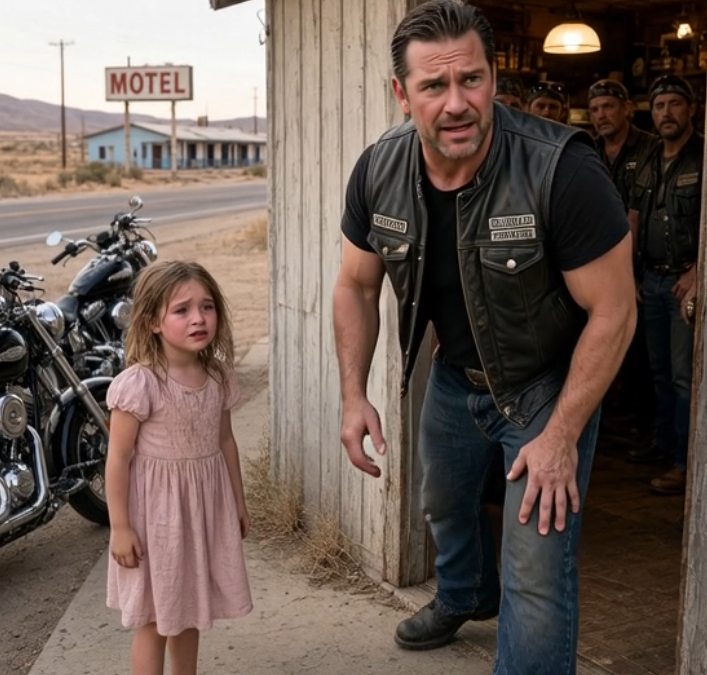
A little girl stood in the doorway.
Barefoot.
Dirty.
Breathing so hard her shoulders shook.
Blood marked the gravel cuts beneath one foot.
Her blond hair was tangled from crawling through the motel window.
No coat.
No shoes.
No adult.
Derek Mercer was the first to move.
Most people called him Stone.
Forty-seven.
Six foot three.
Broad shoulders.
Gray beginning at his temples.
President of the Iron Vale Riders, though he hated whenever strangers assumed that title automatically meant criminal.
Derek had learned long ago not to rush toward frightened animals or frightened children.
Both interpreted speed honestly.
He walked halfway across the room.
Then crouched.
“Hey.”
Clara stared.
Derek kept his hands where she could see them.
“You hurt?”
She shook her head.
A lie.
He could see blood beneath her feet.
“What’s your name?”
“Clara.”
“Clara, I’m Derek.”
She looked past him.
Ten riders.
Leather vests.
Boots.
Tattoos.
Large people.
Scary people, at least from a six-year-old perspective.
Derek noticed.
“You’re okay in here.”
Her lower lip began trembling.
Then the words came.
“They’re hurting my brother.”
Everything changed.
Derek’s voice stayed calm.
“Where?”
She pointed back toward the highway.
“Motel.”
“Which room?”
“Seventeen.”
“How old is your brother?”
“Fourteen.”
“Who’s with him?”
Clara’s breath hitched.
“Victor.”
“Victor who?”
“Hale.”
One rider near the bar looked sharply at another.
Derek noticed but did not address it yet.
“Anybody else?”
“Two men.”
“What are they doing?”
Clara shook her head rapidly.
“I don’t know. They want something.”
She started crying.
“Please.”
Derek stood.
He turned toward the room.
“Call 911.”
A rider named Mack already had his phone out.
Derek looked at Clara.
“Police are coming.”
Her face panicked.
“No.”
“Why?”
“Victor says police believe him.”
Derek crouched again.
“Maybe some did before.”
He kept his voice level.
“But we’re calling anyway.”
Clara grabbed his sleeve.
“You have to get Noah first.”
Derek glanced toward the motel through the window.
He had spent enough years around law enforcement, lawyers, bad tempers, and worse decisions to understand the problem.
Going across that highway with twelve riders and breaking into a motel room could become a disaster fast.
Not going could be worse.
He made his decision.
“Mack, stay on with dispatch.”
Mack nodded.
“Tell them we are approaching Room 17 because a child reported immediate danger. Tell them exactly who we are and what we’re doing.”
“Got it.”
Derek looked at two riders.
“Rosa. Ben. With me.”
The others began moving.
Derek held up one hand.
“Three.”
A younger rider frowned.
“Stone—”
“I said three.”
He looked around.
“We are not storming a motel.”
Nobody argued.
Derek looked back at Clara.
“You stay here.”
“No.”
“You’re safer here.”
“My brother—”
“Clara.”
She looked ready to run again.
Derek changed tactics.
“Rosa goes with me.”
Rosa Alvarez stepped forward.
Forty-two.
Former paramedic.
Mother of three adult sons.
“Your brother needs someone who knows first aid.”
Clara looked at her.
Rosa crouched.
“I’ll go get him.”
Clara hesitated.
Then whispered:
“Tell him I came back.”
Rosa’s face softened.
“I will.”
Derek, Rosa, and Ben crossed the highway in a pickup rather than motorcycles.
Faster.
Safer.
Less theatrical.
Mack remained on the phone relaying their movement.
Room 17 sat at the far end of the motel.
Curtains closed.
Door shut.
Derek stopped ten feet away.
He could hear voices inside.
One angry.
One lower.
Then something struck furniture.
Derek knocked.
Hard.
“Room 17.”
Silence.
He knocked again.
“My name is Derek Mercer. Police and medical help are on the way. We have a report of a child in distress.”
Movement inside.
Then Victor’s voice.
“Wrong room.”
Derek looked at Rosa.
She shook her head slightly.
They had both heard the fear beneath the confidence.
Derek raised his voice.
“Noah Whitmore?”
Silence.
Then, from inside:
“Derek?”
Barely audible.
A boy’s voice.
Derek moved closer.
“Noah?”
“Yes.”
“Are you hurt?”
Victor shouted:
“He’s fine. Get away from my door.”
Derek ignored him.
“Noah, can you get to the door?”
“No.”
That was enough.
Derek spoke loudly so dispatch could hear through Mack’s open call.
“Child says he cannot reach the door. We have audible distress.”
Ben checked the window.
Curtain movement.
Then Derek heard Noah say:
“Clara?”
“She’s safe.”
Something hit the floor.
Victor swore.
Derek tried the handle.
Locked.
He stepped back.
Rosa said:
“Police are four minutes.”
Then Noah cried out.
Derek looked at Rosa.
Four minutes became too long.
He kicked beside the lock.
Once.
The frame cracked.
Again.
Door opened.
The room became noise.
Victor stood near the center.
One man beside the dresser.
Another near the bathroom.
Noah lay on the floor next to the bed.
He was conscious.
Blood at his lip.
Hands protecting his ribs.
Derek did not charge anyone.
He stepped between Noah and the adults.
“Everybody stay where you are.”
Victor stared at him.
“You broke into my room.”
“You can explain that to the police.”
“This kid attacked me.”
Noah tried to sit.
Rosa moved directly to him.
“Don’t move fast.”
Victor stepped forward.
Ben blocked the path.
Not touching.
Just there.
Victor’s face changed.
“You know who I am?”
Derek answered:
“No.”
That bothered Victor more than fear would have.
Sirens grew louder outside.
One of the unknown men moved toward the door.
Derek pointed.
“Stay.”
The man stopped.
Police arrived ninety seconds later.
Then everything became procedure.
Hands visible.
Questions.
Separate statements.
Paramedics.
Clara came across only after an officer escorted her.
The moment Noah saw her, his face changed.
“Clara.”
She ran to him.
Rosa tried to slow her.
No chance.
Clara dropped beside the stretcher and wrapped both arms around his shoulders.
“I came back.”
Noah closed his eyes.
“I know.”
“You told me to go.”
“I know.”
“I found bikers.”
Despite everything, Noah laughed once.
Then winced.
“That was not what I expected.”
Derek almost smiled.
Paramedics transported Noah.
Clara went with him.
Victor and the two men were detained for questioning.
That should have been the end of Derek’s involvement.
It was not.
While police processed the room, an officer called Derek back inside.
“Mr. Mercer.”
Derek entered.
The officer pointed toward the table.
A thick envelope lay beneath an overturned chair.
Plain manila.
No markings.
“Did you touch this?”
“No.”
“Kid mention it?”
“Clara said they wanted something.”
The officer put on gloves.
Opened the envelope.
Cash.
Not a few bills.
Stacks.
Photographs.
Printed documents.
A list of names.
License plates.
Addresses.
Dates.
One photograph showed a man in a suit entering a county office building.
Someone had circled his face in red.
Another showed a woman speaking with Victor beside a storage facility.
A third showed two vehicles parked behind a business after midnight.
The officer’s expression changed.
“This isn’t family stuff.”
Derek looked toward Victor.
Victor was sitting against the exterior wall while another officer watched him.
He caught Derek’s eye.
Then laughed.
Not loudly.
Almost pityingly.
“You really don’t know what you stepped into.”
Derek walked toward the doorway.
“Then tell the police.”
Victor leaned his head back.
“Police?”
He smiled faintly.
“You still think that’s the game.”
Derek stared.
Victor said:
“Too late.”
The dark SUV parked at the far end of the motel lot drove away before anyone noticed it mattered.
At Silver Creek Medical Center, Elena Whitmore arrived thirty minutes after her children.
She came running.
Hair unbrushed.
Work uniform under a sweater.
Face drained of color.
She had been two towns away working a night shift at an assisted-living facility when the hospital called.
She found Noah in a treatment room.
Clara beside him.
Elena collapsed around both of them.
“I’m sorry.”
She kept repeating it.
“I’m sorry. I’m sorry.”
Clara buried her face against her mother.
Noah stared at the ceiling.
His eyes were wet.
Derek stood in the hallway with Rosa.
He considered leaving.
Then Elena saw him.
“You.”
Derek stopped.
She approached.
Fear first.
Then confusion.
“You’re the one Clara found?”
“Yes.”
“Why were you there?”
“Roadhouse across the highway.”
Clara spoke from the bed.
“They helped.”
Elena looked at Derek.
“Why?”
Derek shrugged once.
“She asked.”
Elena stared.
People always expected larger explanations.
Motive.
History.
Some personal connection.
There was none.
A child had asked.
That should have been enough.
Deputy Aaron Cole came down the hall.
He was forty, careful, and looked tired in the specific way good officers sometimes do when they realize paperwork has been used to bury obvious danger.
“Elena.”
She stiffened.
“You.”
Aaron nodded.
“I know.”
“You said there wasn’t enough.”
His expression tightened.
“I said what I was told.”
“I brought photos.”
“I know.”
“I brought messages.”
“I know.”
“I filed twice.”
“I know.”
Her voice cracked.
“Then why was he still near my children?”
Aaron did not defend himself.
That helped.
“I’m reviewing everything.”
“That doesn’t answer me.”
“No.”
He looked at Noah.
“It doesn’t.”
Derek watched.
Elena wiped her face.
“Victor wasn’t supposed to know where we were.”
Aaron’s eyes sharpened.
“You changed motels?”
“Three times.”
“Who knew this one?”
“My attorney. The school. Your office.”
Aaron went very still.
“And child services.”
Elena stared.
“You think someone told him?”
“I think we’re done assuming anything.”
That evening, detectives returned to the motel with a warrant.
The envelope became evidence.
So did two phones.
A ledger.
A motel-room keycard not registered to Victor.
One of the detained men turned out to be a private investigator whose license had expired.
The other worked security for a regional development company.
Victor was released pending further investigation.
Elena could not believe it.
Derek understood the legal reason.
Hated it anyway.
Two days later, Elena’s phone rang.
Unknown number.
She answered.
A man said:
“You should’ve stayed quiet.”
Then disconnected.
That same afternoon, a child-welfare investigator appeared at Elena’s temporary apartment.
A complaint accused her of leaving Noah and Clara unsupervised for extended periods.
The report contained dates.
Addresses.
Descriptions.
Some true.
Most twisted.
One signature claimed Elena had authorized Victor to supervise the children.
She had not.
Another form alleged she had refused medical care after Noah suffered an injury.
That injury had never happened.
Elena sat at her kitchen table staring at the papers.
“This is what he does.”
Derek stood near the window.
He had come because Rosa called him.
Elena looked up.
“He makes paper.”
“What?”
“He makes paper until the paper becomes more believable than you.”
Derek understood.
Victor’s power was not physical strength.
Not really.
It was records.
Relationships.
People willing to sign things.
People willing to look away.
Elena whispered:
“I’m going to lose my kids.”
“No.”
“You don’t know that.”
Derek did not lie.
“No.”
He sat across from her.
“But panicking helps whoever created this.”
She laughed bitterly.
“You say that like calm is a switch.”
“It isn’t.”
“Then what am I supposed to do?”
Derek thought.
“Document everything.”
“That’s what got me here.”
“Then document better.”
She stared at him.
“You sound like a lawyer.”
“I hate lawyers.”
“Good.”
“I know one anyway.”
The Iron Vale Riders did not surround Elena’s apartment.
They did not threaten Victor.
They did not follow witnesses.
Derek prohibited it.
Instead they did boring things.
Useful things.
Rosa drove Elena to meetings when she was too exhausted.
Ben installed a camera at the apartment after getting the landlord’s permission.
Mack kept a log of unfamiliar cars.
Another rider, Janet, who worked as a paralegal, organized every report by date.
A club member who owned a print shop copied records.
Someone brought groceries.
Someone watched Clara while Elena met attorneys.
Noah started sleeping at night again.
Slowly.
Then something happened.
A week after the motel incident, Elena walked Noah and Clara toward her car after a therapy appointment.
A white cargo van pulled into the lot.
Two men stepped out.
Both wore khaki pants.
Button-down shirts.
Lanyards.
One held papers.
“Mrs. Whitmore?”
Elena stopped.
“Yes?”
“We’re with Nevada Family Placement Services.”
Her stomach dropped.
“I wasn’t told about an appointment.”
“This isn’t an appointment.”
One man held out documents.
“We have an emergency removal authorization.”
Clara grabbed Elena’s hand.
Noah stepped closer to his sister.
Elena stared at the seal.
It looked real.
Her vision blurred.
“No.”
“Ma’am, please don’t make this difficult.”
Derek’s pickup was parked two rows away.
He and Rosa had brought them.
Derek saw the men.
Then saw Elena’s face.
He walked over.
One of the men frowned.
“This is a private matter.”
Derek looked at the papers.
“Elena?”
“They say they’re taking the kids.”
Derek did not touch the documents.
“Call Aaron.”
The taller man said:
“Sir, step away.”
Derek ignored him.
“Rosa.”
Already calling.
The shorter man raised his voice.
“We have a court order.”
Derek looked at Elena.
“Did your lawyer tell you about a hearing?”
“No.”
“Did child services?”
“No.”
Derek turned toward the men.
“What’s the judge’s name?”
The taller man hesitated.
Half a second.
Enough.
Derek’s expression changed.
“Rosa?”
She was speaking into the phone.
“Aaron says nobody move. Real deputies are coming.”
The two men looked at each other.
Then moved toward the van.
Noah stepped in front of Clara.
Derek moved sideways.
Not blocking.
Just memorizing.
License plate.
Company logo.
Driver.
Rosa raised her phone and recorded.
The men got into the van.
Left.
Deputies stopped it three miles away.
The documents were forged.
The agency did not exist.
One of the men had appeared in the photographs from the envelope.
That changed the investigation.
What had looked like a custody dispute became an organized fraud case.
The names in the envelope connected to property transfers, falsified child-placement records, coerced signatures, fraudulent guardianship documents, and a network of people who targeted vulnerable families already moving through messy court systems.
Victor’s role was not at the top.
That shocked Elena.
He was a recruiter.
Sometimes fixer.
Sometimes intimidator.
People in unstable situations were pressured.
Mothers in treatment.
Parents facing debt.
Families in temporary housing.
Documents were manipulated.
Children or property moved.
Money changed hands through companies that appeared legitimate.
The man circled in red in the envelope was a county contractor named Charles Weller.
He had spent years building a reputation as a family-services consultant.
He also controlled two shell companies connected to the fake placement documents.
The envelope had belonged to Noah.
Not originally.
To Elena.
She finally explained.
Months earlier, Elena worked an overnight shift caring for an elderly woman named Margaret Voss.
Margaret’s son worked accounting for one of Weller’s companies.
Before leaving the company, he discovered irregular files.
He became frightened.
He gave copies to his mother.
Margaret later gave them to Elena after learning she was struggling with Victor.
“She told me Victor was involved.”
Elena’s hands shook as she told Detective Aaron Cole.
“I didn’t believe her.”
“What happened to Margaret?”
“She died two months later.”
Natural causes.
At least officially.
Elena had hidden the envelope.
Victor somehow learned.
“That’s why he kept asking where it was.”
Noah looked at his mother.
“You hid it in my backpack.”
Elena closed her eyes.
“I panicked.”
Noah’s face hardened.
“You put us in danger.”
“I know.”
“You knew he wanted it.”
“I thought he wouldn’t search you.”
“That makes it worse.”
Elena began crying.
Derek stood up.
“This conversation needs family therapy, not an audience.”
He walked out.
Noah followed ten minutes later.
He found Derek beside the hospital vending machines.
“You think she’s a bad mother?”
Derek looked at him.
“No.”
“She put that thing in my bag.”
“Yes.”
“She lied.”
“Yes.”
Noah’s jaw tightened.
“You’re not defending her.”
“You didn’t ask me to.”
That surprised him.
Derek leaned against the wall.
“Adults can love you and still make terrible decisions.”
Noah looked away.
“That’s convenient.”
“It would be convenient if the bad decision didn’t matter.”
Derek paused.
“It mattered.”
Noah said nothing.
“But if you’re asking whether one terrible frightened decision erases every year she worked two jobs and tried to keep you safe, no.”
Noah stared at the floor.
“I don’t know how to forgive her.”
“Then don’t do it today.”
Noah looked up.
“You can do that?”
“Sure.”
Derek shrugged.
“You’re allowed to be angry while people improve.”
That answer seemed to help.
The investigation lasted months.
Weller was arrested first.
Then two county contractors.
Then the private investigator.
Victor disappeared before his scheduled interview.
For six days, nobody knew where he was.
Elena barely slept.
Iron Vale members increased their presence.
Again, not as vigilantes.
Transportation.
Witnesses.
Cameras.
Calling police when something looked wrong.
On the seventh day, Victor was arrested outside Phoenix.
He had cash.
Fake identification.
And copies of records investigators had not known existed.
Those records destroyed what remained of the network.
Trials followed.
Some pleaded guilty.
Others fought.
Victor tried to claim Elena invented everything because of a failed relationship.
Then prosecutors played motel security video showing Clara running barefoot from Room 17.
They showed photographs of Noah’s injuries.
They produced call records.
Forged documents.
Bank transfers.
Messages.
Victor’s own texts.
One read:
GET THE ENVELOPE BEFORE SHE TALKS.
Another:
THE KIDS KNOW MORE THAN THEY THINK.
Noah did not attend every hearing.
Clara attended none.
Derek told them both:
“You don’t owe a courtroom your pain just because adults finally decided to believe it.”
A year later, Elena moved into a small rental house in Henderson.
Nothing fancy.
Three bedrooms.
A backyard with gravel and one stubborn tree.
Clara picked the room facing sunrise.
Noah chose the room farthest from the front door.
Then changed his mind two months later and took the other one.
Elena noticed.
Did not comment.
Healing, Derek learned, often appeared as ordinary choices returning.
Which bedroom.
Which cereal.
Whether to leave headphones on a table.
Whether a child could sleep without shoes beside the bed in case running became necessary.
Clara stopped keeping her shoes beside the pillow after seven months.
The first time Elena noticed, she went into the bathroom and cried quietly.
Noah returned to school.
His grades were uneven.
He was behind in math.
Excellent in mechanical classes.
Derek offered him part-time work at the Iron Vale garage.
Noah said:
“I’m fourteen.”
“Exactly.”
“That sounds illegal.”
“Cleaning isn’t.”
“You want me to sweep?”
“Until you stop losing ten-millimeter sockets.”
Noah smiled.
It became a routine.
Saturday mornings.
Sweeping.
Organizing tools.
Watching repairs.
Eventually Derek taught him oil changes.
Then brakes.
Then electrical troubleshooting.
Clara spent those mornings at a table in the corner drawing.
Mostly horses.
Occasionally motorcycles.
One day she drew Derek with enormous arms and hair down to his waist.
He stared.
“I don’t have hair.”
“You do in the picture.”
“Why?”
“You look nicer.”
Derek was offended for three days.
Two years after the motel, the Rustline Roadhouse held a small charity breakfast.
Not for publicity.
For a new local emergency family fund created with social workers, lawyers, churches, schools, and several riding clubs.
It paid for things systems often took too long to provide.
Emergency motel rooms.
Shoes.
Food.
Bus tickets.
Replacement identification.
Lock changes.
Temporary phone service.
Small things.
The kind of small things that become enormous when someone is running.
Clara was eight.
She stood beside Derek near the doorway while volunteers carried boxes.
Her shoes were bright red.
Derek noticed them because Clara had chosen them herself.
“You remember this door?” he asked.
She looked at it.
“Yes.”
“You scared?”
“That day?”
“Yeah.”
She thought.
“I was scared outside.”
“Not inside?”
“At first.”
She smiled.
“Then Rosa gave me socks.”
Derek laughed.
“That’s what you remember?”
“My feet hurt.”
Fair enough.
Clara looked across the highway.
The Desert Ridge Motel had changed owners.
Room 17 had been remodeled.
New sign.
New paint.
To drivers passing through, nothing about it looked important.
Clara stared at it.
Derek watched her carefully.
“You okay?”
She nodded.
Then said:
“I thought Noah was going to die.”
Derek’s smile disappeared.
“You did the right thing.”
“I ran to the bad place.”
“What?”
She pointed at the roadhouse.
“Mom said this was the bad place.”
Derek laughed softly.
“I don’t think she said exactly that.”
“She said kids shouldn’t go there.”
“Different.”
Clara considered.
Then asked:
“Why do people think bikers are bad?”
Derek leaned against the doorframe.
“Some bikers are.”
“Are you?”
“Depends who you ask.”
“I’m asking.”
Derek smiled.
“I try not to be.”
Clara nodded.
“Good.”
She watched volunteers inside.
“Victor wore a suit.”
Derek turned.
“So did the man with fake papers.”
“Yes.”
Clara frowned.
“So clothes don’t tell you?”
“No.”
“Motorcycles don’t tell you?”
“No.”
“Tattoos?”
“No.”
“What does?”
Derek thought.
“What people do when nobody can reward them.”
Clara accepted that.
Then she walked inside and stole a donut before breakfast officially started.
Derek pretended not to notice.
Four years passed.
Noah turned eighteen.
He graduated high school.
Elena cried through almost the entire ceremony.
Derek sat two rows behind her with Rosa, Ben, Mack, and enough Iron Vale Riders to make the school principal visibly nervous.
When Noah’s name was called, the group remained quiet.
Derek had threatened all of them.
No revving engines.
No shouting.
No horns.
Then Clara screamed:
“THAT’S MY BROTHER!”
The entire gym laughed.
Noah covered his face.
After graduation, he told Derek he wanted to study automotive engineering.
Derek pretended this was a terrible choice because engineers “design bolts where human hands can’t reach.”
Noah applied anyway.
He earned a partial scholarship.
The Iron Vale emergency fund covered books his first year.
Noah did not know until the bookstore told him his balance was zero.
He called Derek.
“You did this?”
“Did what?”
“My books.”
“No idea.”
“Derek.”
“Could’ve been anybody.”
“There’s a note.”
“What does it say?”
“Stop losing ten-millimeter sockets.”
Derek hung up.
Clara grew too.
At twelve, she became obsessed with running.
The irony was not lost on anyone.
Cross-country.
Track.
She was fast.
Really fast.
Elena hated attending the first race because every time Clara sprinted, she remembered bloody footprints across motel gravel.
But Clara did not run from things anymore.
She ran toward finish lines.
At fourteen, she won a regional meet outside Las Vegas.
Derek attended.
So did half the club.
They stood near the final straightaway.
No leather colors at Clara’s request.
She said:
“I don’t want people thinking I have a biker army.”
Derek replied:
“You do.”
She rolled her eyes.
During the final lap, Clara fell behind.
Derek watched her face.
He knew that expression.
Determined.
Furious.
Unwilling to stop.
She accelerated.
Passed one runner.
Then another.
Finished second.
Afterward, Clara was disappointed.
Derek handed her water.
“You lost.”
She glared.
“Helpful.”
“You also ran faster than last month.”
“Still lost.”
“Sure.”
She drank.
Then looked at him.
“You really don’t do fake encouragement, do you?”
“Your brother complained about that too.”
She smiled.
Derek pointed toward the finish line.
“Sometimes second place is just proof you found somebody faster today.”
Clara nodded.
Then asked:
“Did you think I’d become a runner?”
Derek looked at her red shoes.
“No.”
“I did.”
“Why?”
She looked toward the distant mountains.
“Because running used to mean something bad.”
He waited.
“I wanted it to mean something else.”
Derek’s throat tightened.
Clara walked away before he had to answer.
Ten years after Room 17, the Iron Vale Riders celebrated the emergency fund’s anniversary.
Nothing formal.
A cookout.
Families.
Old bikes.
New bikes.
Social workers.
Teachers.
Attorneys.
Police officers.
People who once might have crossed the street to avoid one another sharing tables.
Noah was twenty-four.
Working for an electric-vehicle company in Reno.
Clara was sixteen and already talking about studying trauma psychology.
Elena looked older.
Happier.
She brought a cake.
Derek told her cake was unnecessary.
She told him to shut up.
At sunset, Clara stood outside with Derek.
Across the road, traffic moved steadily.
The motel still stood.
The roadhouse sign flickered.
Clara said:
“I remember the first thing you said to me.”
Derek frowned.
“What?”
“Hey.”
“That sounds like me.”
“Then you asked if I was hurt.”
“You said no.”
“I lied.”
“I know.”
She smiled.
For a while they watched the highway.
Then Clara asked:
“Do you ever think about what would have happened if the door was locked?”
Derek did.
More often than he admitted.
But he said:
“It wasn’t.”
“That’s not an answer.”
“You sound like Noah.”
She waited.
Derek sighed.
“Yeah.”
He looked at the door.
“I think about it.”
Clara’s expression became serious.
“Me too.”
Inside, somebody laughed loudly.
Music started.
A motorcycle engine turned over once, then shut off.
Clara looked through the window at the people inside.
“I thought I picked the wrong place.”
Derek smiled faintly.
“Why?”
“Because Mom told me not to go there.”
“And now?”
She shrugged.
“I think adults give kids simple rules because complicated rules are harder.”
“That sounds annoyingly smart.”
“Thank you.”
“I didn’t mean it as a compliment.”
“I know.”
She looked toward Room 17 again.
“I used to think I saved Noah because I ran.”
Derek waited.
“But I didn’t.”
“You did a lot.”
“I opened a door.”
She looked at him.
“You all decided what happened after.”
Derek shook his head.
“No.”
Clara frowned.
“You did.”
“We made calls.”
“You broke the motel door.”
“That was admittedly dramatic.”
“You helped.”
“Yes.”
Derek turned fully toward her.
“But none of us would have known without you.”
Clara looked down.
“You were six.”
“I know.”
“You ran barefoot across a highway.”
“I know.”
“You walked into a room full of strangers everyone had told you to fear.”
“I know.”
Derek’s voice softened.
“And you told the truth.”
Clara became quiet.
“That was the part that changed everything.”
She looked back through the roadhouse window.
Derek continued:
“People think courage means not being scared.”
Clara smiled.
“You’re about to give me a speech.”
“I hate speeches.”
“You’re giving one.”
He ignored her.
“Courage is knowing you’re scared and deciding something else matters more.”
Clara looked at him.
“Noah mattered more.”
“Exactly.”
They stood there until Elena called them inside.
Years later, people would remember the bigger parts.
The criminal case.
The forged records.
The arrests.
The envelope.
The men in suits exposed.
The riders who helped.
But Derek always remembered something smaller.
A wooden door.
Early morning light.
A six-year-old girl standing barefoot on a dirty floor.
Everyone else frozen.
Her breath shaking.
Five words.
“They’re hurting my brother.”
No speech.
No plan.
No guarantee anyone inside would listen.
Just a child telling the truth and hoping somebody would believe her.
And Derek came to understand that the most important doors in life were rarely marked.
They were simply there when someone desperate reached them.
Sometimes behind those doors were the people society trusted.
Sometimes behind them were people society warned you about.
And sometimes, on a cold desert morning near Mesquite, Nevada, the only thing separating a frightened child from another tragedy was a room full of bikers who stopped what they were doing when she asked for help.
Clara had run toward the one place she had been told to avoid.
What she found there was not danger.
It was people willing to listen.
And sometimes that was where rescue truly began.








