A 9-Year-Old Paid for Orange Juice With a Dollar Bill That Said “HELP ME”—By Sunrise Her “Uncle” Was in Cuffs, Her Mother Was Missing, and Someone Who Knew My Name Told Me to Walk Away.
PART2:
Whether you’ve got enough dry clothes packed.
The important thing appears beside all the ordinary things and hopes somebody notices.
I noticed the girl because she was too still.
That was all.
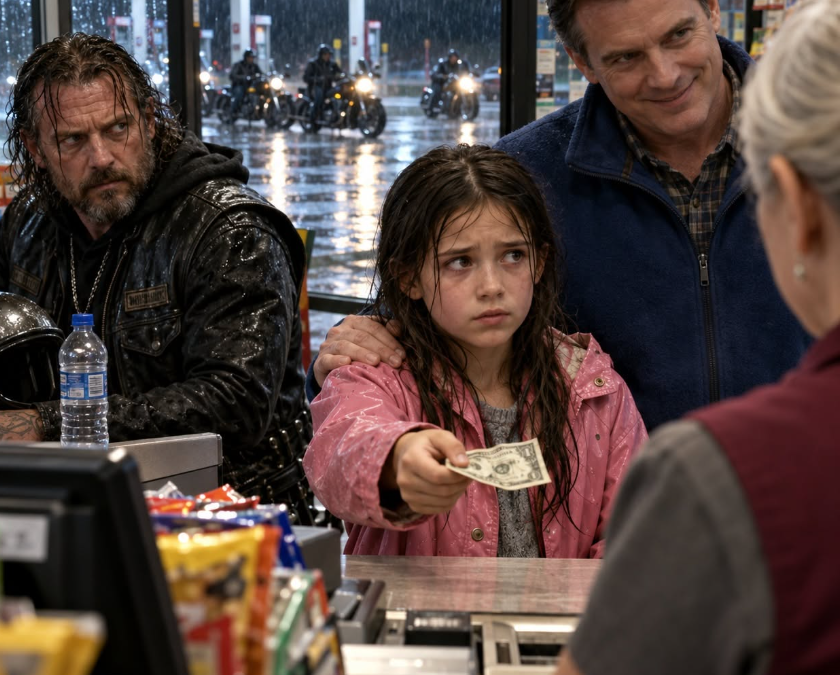
She stood at the counter in a pink raincoat.
Nine, maybe.
Her hood was down.
Dark hair stuck damply to one cheek.
One snap on the raincoat was broken so the left side hung crooked.
Her sneakers squeaked every time she shifted.
She held a small bottle of orange juice with both hands.
Behind her stood a man in his late thirties or early forties.
Thin.
Clean blue fleece over a gray shirt.
Khaki pants.
No raincoat.
His hair was wet around the edges.
One hand rested on her shoulder.
Not gripping.
Not obviously threatening.
Just resting there.
That was the first thing I noticed.
The second was her face.
As a former Army medic, I had learned to look at faces.
Not because medics are detectives.
We aren’t.
But fear changes people physically.
Shock does.
Pain does.
Children especially.
PART3:
You learn to look for whether expression matches situation.
A kid on a long road trip at a gas station usually looks at things.
Candy.
Toys.
Soda fountains.
The rotating rack of key chains no human being actually needs.
The ridiculous stuffed bears wearing Missouri shirts.
This girl looked at none of it.
Her eyes stayed on the man’s hand.
Not his face.
His hand.
Like it was a clock.
Like she was measuring what would happen when it moved.
The cashier was a silver-haired woman wearing a red vest over a gray T-shirt.
Her nametag said LORETTA.
She scanned the juice.
“Dollar eighty-nine, sweetheart.”
The girl reached into her raincoat.
Pulled out a crumpled one-dollar bill and a few coins.
Her fingers shook.
The man behind her smiled.
“She’s been carsick,” he said.
Loretta looked at him.
“Long drive?”
“Taking my niece up toward Kansas City.”
His hand squeezed the girl’s shoulder once.
“Her mom had an emergency.”
The girl stared at the counter.
Loretta took the dollar.
I was standing maybe six feet away near the coffee station.
I watched Loretta flatten the bill against the counter.
Her expression did not change.
That was what made me look harder.
Cashiers react to things.
A torn bill.
A twenty where they expected one.
A phone number.
A weird drawing.
Loretta did nothing.
She simply pressed the bill flat with her thumb.
Then her left hand disappeared below the counter.
I took one step closer.
The writing was faint.
Blue ink.
Block letters.
Four words.
HELP ME.
Below them:
HE ISN’T MY UNCLE.
Everything inside me became quiet.
Not calm.
Focused.
There is a difference.
The Army teaches you what adrenaline feels like when it has nowhere useful to go.
You feel your heartbeat.
Your hearing changes.
The body wants action before the brain has chosen one.
Training is mostly learning to buy yourself a few seconds between those things.
I opened the cooler beside me.
Took out a bottle of water.
Set it on the counter near the orange juice.
“This one’s mine.”
Loretta looked at me.
I let my eyes drop briefly toward the bill.
Then back to hers.
One tiny nod.
Nothing more.
The man noticed.
Of course he did.
People who control other people often become experts at reading rooms.
His smile widened.
Not friendliness.
Adjustment.
“Come on, Kayla.”
So now I had a name.
“We’ve got a ways to go.”
Kayla picked up the orange juice with both hands.
Her sleeve rode back.
There was a red mark around her wrist.
Not enough to prove anything.
Enough to remember.
I looked around.
Four civilians besides them and me.
Loretta.
A trucker eating something wrapped in foil near the windows.
A teenager stocking chips at the far aisle.
No other customers.
Through glass I could see the man’s car at pump three.
Dark sedan.
I had no idea whether he had a weapon.
I had no idea whether he was alone.
I had no idea whether Kayla had actually written the note herself.
You do not solve uncertainty by pretending it isn’t there.
You reduce risk.
My phone was in my jacket.
I stepped beside a rack of dusty road maps.
The man began guiding Kayla toward the door.
I texted Ray.
Ray Maddox had been riding five or six miles behind me with two other men from our club because he’d stopped earlier to adjust a saddlebag strap.
Ray was fifty-seven.
Former lineman.
Six-foot-one.
Gray beard.
Calm in emergencies because he believed panic wasted glucose.
My message:
Gas station Exit 89. Child in trouble. Come inside quietly. Do NOT confront.
Sent.
The man and Kayla were almost at the door.
I moved toward the trash can near the entrance.
Not blocking them.
Just existing along the path.
“Road’s flooding north of here,” I said.
The man looked at me.
“We’re fine.”
“State truck back there said water’s getting high.”
A lie.
I hated lying badly.
The Army had not improved my acting.
His eyes narrowed.
“We’re going south.”
“Then you’re good.”
I stepped aside.
He hesitated.
That hesitation bought maybe four seconds.
Then three motorcycle engines rolled under the canopy.
Not loud revving.
Just arrival.
Ray.
Tommy Price.
Deacon Bell.
All wearing black leather vests with our club patch.
The Iron Mesa Riders.
Nothing illegal.
Nothing especially glamorous.
Most members had mortgages, grandchildren, cholesterol medication, and strong opinions about breakfast.
But three large men in wet leather walking into a gas station can change the emotional temperature of a room.
The blue-fleece man looked through the window.
I hated that.
Too much pressure can make a dangerous person act.
Ray came inside without looking directly at me.
“Coffee any good?”
Loretta said:
“Depends how desperate you are.”
“Extremely.”
Tommy went to chips.
Deacon pretended to read lottery tickets.
Perfect.
I crouched near Kayla.
Not too close.
Pretended to retie my boot.
The man looked annoyed.
“Excuse us.”
I murmured without looking at Kayla:
“If you need us to stay, drop the bottle.”
I did not know whether she heard.
Her eyes met mine for one second.
Brown.
Huge.
Then she looked down.
The man pushed the door.
Kayla’s fingers opened.
The orange juice hit tile.
The plastic bottle bounced once.
Rolled beneath the bottom shelf.
“He’s not my uncle.”
Her voice was small.
But it was enough.
The man’s hand snapped around her wrist.
Hard.
Kayla cried out.
I stood.
Fast.
Hands open.
“Let her go.”
He looked at me.
“This is none of your business.”
“It is now.”
Ray stood by coffee machine.
Tommy stopped with chips in hand.
The trucker rose.
Deacon stayed near entrance.
Nobody touched him.
That was deliberate.
You do not turn suspected child abduction into a four-man assault case unless there is no safer option.
The man looked around.
He had gone from controlling one frightened child to standing in a room where every adult was watching him.
His expression changed.
Then the bell over the door rang.
“Sheriff’s office.”
A deputy stepped inside.
Young.
Maybe thirty.
Hand near his holster when he saw us.
Leather.
Bikers.
A crying child.
A man with his arm half-raised.
The blue-fleece man released Kayla instantly and lifted both hands.
“Thank God.”
He gave the deputy a relieved smile.
“These bikers have been frightening my niece.”
Beautiful.
Fast.
Plausible.
He knew exactly what picture to offer.
For one second the deputy looked at us first.
Not Kayla.
Us.
I could see the calculation.
Four bikers.
One civilian man.
One child.
Loretta saved the moment.
She put the dollar bill flat on the counter.
“She gave me this.”
The deputy moved closer.
Read it.
His face changed.
He turned toward Kayla.
“Sweetheart, come over here.”
Blue Fleece said:
“She has anxiety. Her mother—”
The deputy raised one hand.
“Sir, don’t.”
A second cruiser pulled under canopy.
Good.
The first deputy moved Kayla behind the counter with Loretta.
“What’s your name?”
“Kayla.”
“Kayla what?”
“Hart.”
“Do you know that man?”
She shook her head.
“No.”
Blue Fleece said:
“I’m her uncle’s friend. She’s confused.”
The deputy kept looking at Kayla.
“Did your mom say you could go with him?”
“No.”
Her voice cracked.
“He took me from my house.”
The second deputy came in.
The first pointed.
“Separate him.”
Blue Fleece’s easy smile stayed.
It stayed while they patted him down.
Stayed while they asked for identification.
Stayed while he said:
“This is a misunderstanding.”
Stayed while Loretta gave them the dollar.
Stayed until one deputy found zip ties in his jacket pocket.
Then it faded slightly.
They cuffed him.
Not because of the zip ties alone.
Because the child had reported abduction and circumstances supported immediate detention.
He looked at me on way out.
Not angry.
Interested.
That bothered me more.
Like he was remembering my face.
Deputy Alvarez arrived several minutes later.
He was older than the first two.
Forties.
Sergeant stripes.
Patient eyes.
He took control without making show of it.
Kayla sat on floor beside candy display because she refused chair.
Loretta gave her a blanket from back room.
The trucker sat farther away.
Ray and my guys stayed quiet.
Alvarez asked me what I saw.
I gave facts.
No theories.
Girl stood with man.
Hand on shoulder.
Bill message.
Red wrist mark.
Bottle signal.
Girl denied relation.
Man grabbed wrist.
That was it.
“You know her?”
“No.”
“You know him?”
“No.”
“You see vehicle?”
“Yes.”
“Touch it?”
“No.”
“Anybody from your group?”
“No.”
Good.
Clean.
They called Kayla’s mother.
Amelia Hart.
No answer.
Again.
Voicemail.
Kayla watched the phone every time.
Then looked away just before Alvarez spoke.
That was when I stopped feeling relief.
Finding child is one thing.
Knowing why she needed finding is another.
Alvarez called dispatch.
Registration on sedan came back to a woman in Tulsa.
Kayla’s aunt.
The aunt had already reported Kayla missing.
That made room colder.
Blue Fleece had borrowed or taken a familiar family vehicle.
He understood a child might get into Aunt Rachel’s car before a stranger’s.
That detail made me want to walk outside and put my fist through something.
I didn’t.
Former medics learn useless things.
Like how much damage anger can do to your own hands.
A deputy was sent to Amelia’s home.
We waited.
Rain hammered windows.
Store lights buzzed.
The teenage stocker had disappeared into back room.
Loretta kept cleaning counter that was already clean.
Ray stood beside coffee machine holding same cup for twenty minutes.
Kayla sat cross-legged near candy display.
She pulled a loose pink thread from her sleeve and wrapped it around her index finger.
Again.
Again.
Again.
I sat on floor about five feet away.
Not too close.
“You did good.”
She did not look at me.
“Did I?”
“Yes.”
“My mom told me never get in cars with strangers.”
“You’re nine.”
Her eyes lifted.
“He had Aunt Rachel’s car.”
There it was.
People give children rules as if danger agrees to follow them.
Don’t get in stranger’s car.
What if stranger arrives in familiar car?
Don’t open door.
What if he says your mother sent him?
Scream.
What if he has his hand over your mouth?
Children do not fail safety lessons.
Adults fail when we imagine safety can be reduced to one rule.
The radio crackled.
Alvarez answered.
His face changed before he said anything.
You learn that look.
Bad information travels through body before language.
He walked away toward door.
I listened anyway.
“Repeat.”
Pause.
“Signs of forced entry?”
Pause.
“Any victim?”
Pause.
“All right. Secure the residence.”
He ended call.
Kayla watched him.
“Is Mom there?”
Alvarez crouched.
“Kayla, officers are at your house.”
She hugged her knees tighter.
“Is my mom there?”
“No.”
Her face emptied.
Not cried.
Emptied.
“There are signs somebody was inside,” he said carefully.
“Your mom isn’t there right now.”
Kayla looked at floor.
“I know where they were taking me.”
I turned.
Alvarez froze.
“What did you say?”
“He thought I was asleep.”
“Who?”
“The man.”
“You heard him talking?”
She nodded.
“To somebody on his phone.”
Alvarez moved slowly.
“Tell me exactly what you remember.”
Kayla stared at orange juice bottle under shelf.
“He said my mom was handled.”
The words sounded wrong in a child’s mouth.
Not because she misremembered.
Because no child should have to repeat them.
“And they’d pay him forty-five thousand dollars when he delivered me.”
Nobody spoke.
Cooler compressor clicked on.
Rain hit glass.
Forty-five thousand.
Not random kidnapping.
Payment.
Delivery.
Network.
Alvarez asked:
“Anything else?”
Kayla rubbed thread.
“Mill Road.”
“Mill Road where?”
“I don’t know.”
“He said they couldn’t keep her there all night.”
Her.
Amelia.
I felt my stomach turn.
“What about the place?” Alvarez asked.
“Anything you heard?”
Kayla closed eyes.
Thinking.
“A red star.”
“Where?”
“He said something about red star door.”
Ray stepped forward.
“Sergeant?”
Alvarez looked.
“There’s an old grain mill east of here off Mill Road.”
“How far?”
“Twelve miles maybe.”
“Red star?”
“Used to be a feed co-op. Big red star painted on loading side. Faded now.”
Alvarez pulled map.
Ray showed turn.
My body moved before my brain.
I picked up helmet.
Kayla grabbed my jacket cuff.
Very lightly.
“You said you’d stay.”
I stopped.
I had said it.
If you need us to stay, drop the bottle.
I meant stay long enough to keep her from being taken.
She heard something else.
Stay.
Promises mean what frightened children think they mean more than what adults intend.
I put helmet down.
“I can stay.”
Ray looked at me.
“I’ll take them.”
Alvarez nodded.
“Show deputy entrance. Do not approach site ahead of law enforcement.”
Ray said:
“Understood.”
Tommy and Deacon started to follow.
“No,” I said.
They stopped.
“This isn’t our raid.”
Ray left with deputies.
Alvarez called county units closer to mill.
Requested medical staging.
State police notified.
He told me:
“Stay inside.”
“I planned to.”
“Good.”
He looked surprised.
Former soldiers who become bikers apparently develop reputations in his imagination.
I sat back down.
Kayla released my sleeve.
But her hands shook.
Ten minutes.
Maybe twelve.
My phone rang.
Unknown number.
Missouri area code.
I almost ignored.
Then answered because that night every phone mattered.
“Mason Cole?”
My body went cold.
“Yes.”
Male voice.
Calm.
Older maybe.
“The girl is safe.”
I said nothing.
“Take the good ending and walk away.”
“Who is this?”
“Her mother’s papers don’t concern you.”
The store disappeared around me.
I stood.
Walked several feet away so Kayla could not hear everything.
Alvarez’s partner, Deputy Collins, noticed my face.
I hit speaker.
“What papers?”
Silence.
Then:
“You don’t know what you’re standing next to.”
Line went dead.
Collins looked at me.
“Save number.”
“I am.”
Kayla was watching.
Too late.
She had heard enough.
“The blue folder.”
We turned.
“What blue folder?” Collins asked.
Kayla looked toward front windows.
Blue Fleece sat in back of patrol car outside.
“He can’t hear me?”
“No.”
“Promise?”
“Yes.”
“My mom has a blue folder behind the winter coats.”
“What’s inside?”
“I don’t know.”
“She told me if something happened, give it to somebody I trust.”
“When did she tell you?”
“A week ago.”
I looked at Collins.
His expression became professional stone.
He stepped outside to call Alvarez privately.
Then returned.
“We’re sending officers to secure it.”
“Through same sheriff’s office?” I asked.
He looked at me.
“Why?”
“The caller knew my name.”
“My name was taken for report maybe twenty minutes ago.”
His eyes narrowed.
“How many people have access to live report?”
“Dispatch.”
“Deputies.”
“Supervisors.”
Maybe more.
Collins pulled his phone.
“I’m calling state investigator directly.”
Good.
He did not get defensive.
That mattered.
If information was leaking through local system, trust needed containment.
Not accusation.
Containment.
Kayla drew knees up.
“Is that why they took Mom?”
“We don’t know,” I said.
I hated how often honest answer was disappointing.
“We don’t know yet.”
She stared.
Six years earlier, my younger sister Lena called me after an argument.
We had fought over our mother.
Nothing dramatic.
Who was visiting enough.
Who was carrying more.
Who had always carried more.
Family arithmetic.
Lena called later.
I saw phone.
Let it ring because I was still angry.
She died on an icy highway forty minutes later.
A drunk driver crossed centerline.
For years I tortured myself with fantasies.
If I’d answered, maybe she would have left later.
Maybe she would have stopped somewhere.
Maybe.
Maybe.
Maybe is a machine that runs forever if you keep feeding it.
Since then I answered phones.
Always.
Even telemarketers sometimes.
Waiting for phone to ring while Kayla sat there pulled Lena’s ghost close.
I could not find Amelia myself.
Could not ride to mill.
Could not fix system.
I could stay.
So I did.
Kayla told me Amelia burned grilled cheese deliberately.
“Why?”
“She likes crunchy part.”
“That’s criminal.”
Kayla almost smiled.
“We watch baking shows.”
“Those competition ones?”
“Yes.”
“We guess whose cake will fall.”
“Do you usually guess right?”
“Mom does.”
Then her voice broke.
“I called her before.”
“Before what?”
“Another gas station.”
My chest tightened.
“The man let you?”
“He said I could call because I was crying.”
“Did she answer?”
Kayla shook head.
“She always answers.”
There it was again.
Phones.
Promises.
Ordinary habits become evidence when they stop.
I moved closer.
Not touching.
Just enough she could see me without turning.
“I’m right here.”
She nodded.
Forty minutes after Ray left, phone rang again.
Alvarez.
I answered on first vibration.
“We have Amelia.”
The words hit like impact.
“Alive?”
“Yes.”
I closed eyes.
“She’s alive.”
Kayla stood.
“What?”
I handed her phone.
“Your mom.”
Alvarez put Amelia on.
“Mom?”
Silence.
Kayla listened.
Her entire body collapsed inward.
Then she began crying.
Not silent tears.
Not the controlled, old-looking fear she had worn all night.
Child crying.
Hard.
Messy.
She folded over her knees.
“Mom.”
Again.
“Mom.”
Loretta turned away.
Trucker wiped face.
I stared at floor.
Amelia had been found in storage room at old mill.
Hands bound.
Cut over eyebrow.
Dehydrated.
Alive.
Two men had been preparing to move her into white cargo van when deputies arrived.
They surrendered after brief standoff.
No shooting.
No biker rescue charge.
No movie.
Law enforcement did the job.
Good.
Amelia needed medical care before reunion.
Kayla had to wait.
That was cruelest part.
Safety confirmed.
Still wait.
Agent Priya Shah arrived from Missouri State investigation unit around midnight.
Late thirties.
Dark hair in low ponytail.
Plain dark jacket.
No dramatic entrance.
She showed credentials.
Spoke quietly.
She interviewed Collins first about threatening call.
Then me.
“What exactly did caller say?”
I repeated.
“The girl is safe. Take the good ending and leave her mother’s papers alone.”
“Exact?”
“Yes.”
“Anything else?”
“You don’t know what you’re standing next to.”
“Did he sound local?”
“I don’t know.”
“Accent?”
“American Midwest maybe. But that’s guess.”
She nodded.
“Good distinction.”
I respected her immediately.
“What does Amelia do?” I asked.
Shah paused.
“Family court services.”
“What kind?”
“Case coordination.”
“That folder?”
She looked toward Kayla.
“We’re finding out.”
She did not explain more.
Good investigators resist need to satisfy witnesses.
Around 1:00 a.m., word came that folder had been recovered.
Behind winter coats.
Exactly where Kayla said.
Blue expanding file.
Documents.
USB drive.
Not opened by local deputy.
Sealed and transferred.
Shah called someone out of state.
Then sat beside me near coffee machine.
“You said you were Army medic?”
“Yes.”
“How long?”
“Twelve years.”
“Combat?”
“Two deployments Iraq.”
“Then what?”
“Private ambulance for a while.”
“Then heavy equipment mechanic.”
“And biker?”
I smiled.
“That’s not job.”
“Depends club.”
“Fair.”
She asked why caller might know me.
“No idea.”
“Anyone in law enforcement know you?”
“Not here.”
“Criminal history?”
“Speeding ticket.”
She looked at my vest.
“That disappoints stereotype.”
“I work hard.”
At three in morning, Blue Fleece stopped smiling.
Investigators had photographs from mill.
White van.
Amelia.
Two associates.
Phone records starting to come.
He asked for lawyer.
That was his right.
Interview stopped.
Good.
People watching too much television think lawyer request means guilt.
It means lawyer request.
The larger story unfolded in pieces.
Amelia had spent eighteen months noticing patterns in family-court transfer cases.
Children moved temporarily across county lines under “emergency placement” paperwork.
Different cases.
Different families.
Same attorney name appearing unusually often.
Same handful of private transport vendors.
Several temporary guardians connected to shell companies.
Money moving through businesses with different names and one beneficial owner.
Some transfers may have begun legally.
Then documents altered.
Signatures copied.
Orders modified.
Children moved farther than approved.
Amelia kept notes.
Case numbers.
Dates.
Copies of forms.
Emails.
She raised questions internally.
Slow responses.
Then she sent duplicate materials to an attorney outside county because she no longer trusted local channels completely.
Someone learned.
Taking Kayla was leverage.
Taking Amelia was containment.
Forty-five thousand dollars was delivery payment in one link of chain.
At least that was theory investigators later built.
That night nobody had neat version.
Only fragments.
Kayla asked:
“Did they take me because Mom helped kids?”
Shah answered carefully.
“We think your mom found something people wanted hidden.”
“Did I make it worse?”
“No.”
“You don’t know.”
Shah crouched.
“No.”
“I know one thing.”
“What?”
“None of this is because of something you did.”
Children do not believe adults automatically.
Kayla looked at me.
I said:
“She’s right.”
That was all.
By dawn, Shah’s team identified something uglier.
A county employee had opened or queried an early incident report shortly before the threatening call reached me.
Not necessarily mastermind.
Access trail mattered.
The employee worked in administrative systems supporting court and law enforcement records.
That did not prove who called.
But it created a lead.
Information that should have remained limited had moved too quickly.
Shah did not dramatize.
“We’ll handle it.”
I believed she would try.
Around five-thirty, rain eased.
Black sky went charcoal.
Loretta brewed fresh coffee.
The trucker, whose name was Earl, offered Kayla his clean sweatshirt because she was shivering despite blanket.
She declined.
Then whispered:
“Thank you.”
Earl had to bend closer.
He later told me that “thank you” was hardest thing he heard all night.
At 5:58, headlights turned under canopy.
A gray sedan.
Passenger door opened.
Amelia Hart stepped out.
Borrowed coat.
Bandage above eyebrow.
One hand braced on roof.
Kayla saw her through window.
Everything else disappeared.
She ran.
Her untied shoelace slapped tile.
“Mom!”
Amelia dropped to knees before Kayla reached her.
They collided.
Not elegant.
Kayla nearly knocked her backward.
Amelia wrapped both arms around her.
Kayla tried talking and crying at same time.
No words worked.
Then finally:
“I thought they hurt you because I didn’t get away sooner.”
Amelia pulled back.
Held Kayla’s face.
“Listen to me.”
Firm.
“You kept yourself alive.”
Kayla shook head.
“You asked for help.”
“You got us both home.”
Kayla’s face crumpled again.
This time she let it.
I turned away.
Not because too emotional.
Because some reunions do not need witnesses even when room full of them.
After several minutes Amelia looked over Kayla’s shoulder toward me.
Her eyes found vest.
She started to say:
“Thank—”
I shook head.
No.
Not false humility.
Facts.
Loretta read dollar.
Ray came.
Trucker stood.
Deputies listened.
Kayla dropped bottle.
Ray knew Mill Road.
Amelia kept folder.
Shah protected chain.
No one person owned sunrise.
That mattered.
Hero stories simplify systems.
Then systems learn nothing.
The men at mill were charged.
Blue Fleece too.
His real name was Colin Reaves.
The county employee eventually lost job and was indicted after investigators tied unauthorized access and communications to broader scheme.
The attorney Amelia had noticed became subject of long investigation.
Charges came much later.
Some counts dismissed.
Others held.
Financial records took months.
Victim identifications were complicated.
Several children involved had family-court protections around names.
The case did not resolve in one headline.
That is real life.
Justice moves like paperwork because mostly it is paperwork.
People hate that until paperwork saves case.
I rode home the next afternoon.
Not morning.
Too tired.
Ray refused to let me leave before sleeping six hours in motel.
He was right.
Kayla and Amelia left with relatives and state victim-services staff.
Before they left, Kayla hugged Loretta.
Then Earl.
Then Ray.
When she reached me, she did not hug.
She held my jacket cuff.
Same place.
“You stayed.”
“I said I would.”
She nodded.
Then released.
That meant more than hug.
For months, I thought about caller.
Walk away.
Good ending.
He had been wrong about one thing.
There was no good ending yet.
Only good morning.
Endings take longer.
Amelia testified before grand jury eventually.
Kayla received counseling.
They moved temporarily.
Their names kept out of some reports.
My club got more attention than we wanted.
Local paper ran:
BIKERS HELP RESCUE ABDUCTED CHILD AT I-44 GAS STATION.
Ray hated headline.
“We stood around drinking terrible coffee.”
“You showed road.”
“Google Maps exists.”
“Apparently not for everybody.”
Club president refused television interviews.
Good.
We raised money for child advocacy center instead.
No photos with Kayla.
No victory ride.
No “hero biker” merchandise.
The world produces enough exploitation already.
One afternoon six months later, a letter arrived at our club garage.
No return address at first glance.
Inside was photograph.
Kayla holding birthday cake.
One corner collapsed.
Chocolate frosting on chin.
Amelia beside her with one arm around shoulders.
Back of photo:
Mom says I can tell you the cake was supposed to look like that.
Thank you for staying until she came back.
I taped it above my workbench.
Not public.
Where I could see.
Ray teased me for checking phone every time it rang.
He was right.
I still did.
Lena’s missed call never stopped existing.
But something changed.
Before Kayla, ringing phone only reminded me of one I had not answered.
Afterward, it also reminded me of a call I did answer.
A stranger saying walk away.
I had not.
Not because I chased him.
Not because I played investigator.
Because I handed information to people who could use it.
There is a difference between courage and needing to be central.
The Army took years teaching me that.
I had forgotten some of it after discharge.
Men like me sometimes romanticize being useful.
Medic.
Mechanic.
Biker.
Protector.
You start believing your value arrives only when there is emergency to solve.
That is dangerous.
Kayla did not need me to storm grain mill.
She needed me to sit on dirty tile and keep one promise.
Stay.
That was harder in a strange way.
Waiting while others acted.
Trusting.
Not controlling.
When you have spent years running toward wounded people, sitting still can feel like failure.
It wasn’t.
A year later, Amelia sent me a copy of public disposition from first convictions.
Not confidential details.
Just enough.
Colin Reaves pleaded guilty to kidnapping-related federal charges and conspiracy counts.
The two men at mill faced state charges plus federal coordination.
The county employee took agreement after providing information about how documents were accessed and forwarded.
The attorney fought longer.
Financial case took years.
Some alleged conduct involved legitimate family-law proceedings mixed with forged or altered documents.
That complexity mattered.
Not every case Amelia flagged was criminal.
Not every official was corrupt.
Not every transport suspicious.
Investigators had to separate real emergency placements from manipulated ones.
Slow work.
Necessary.
Amelia once called me because she was angry at pace.
“They know what happened.”
“Knowing and proving aren’t same.”
“I know.”
“Doesn’t help.”
“No.”
She sighed.
“How did you do this in Army?”
“Badly.”
She laughed.
Then cried.
People think strong parents stop being afraid after child comes home.
They do not.
Sometimes fear gets worse once immediate survival no longer occupies every hour.
Kayla had nightmares.
Did not like blue clothing on men for months.
Would not ride in back seat initially.
At gas stations, she watched exits.
Therapy helped.
Time helped.
Routine helped.
Amelia did not force.
That mattered.
At ten, Kayla joined school art club.
At eleven, started softball.
At twelve, decided orange juice was disgusting.
Loretta found that offensive.
They visited station once on anniversary.
Not ceremony.
Private.
Kayla stood by register.
Loretta still worked there.
Dollar bill had been entered into evidence and never returned.
Loretta kept photocopy provided later by prosecutors, folded in drawer.
She never displayed.
“Why not?” I asked.
“That’s hers.”
Good answer.
Kayla bought a grape soda.
Paid with five-dollar bill.
Loretta gave change.
No messages.
Ordinary transaction.
Sometimes recovery looks like boring purchase where nobody needs to read between lines.
My club changed too.
We added a short training session before long rides.
Not tactical nonsense.
Basic:
If a child or vulnerable person signals distress, don’t crowd.
Call 911.
Preserve evidence.
Avoid physical confrontation unless immediate harm demands it.
Assign one person to communicate.
Do not post photos.
Do not chase suspects unless directed.
Write observations separately before talking to each other too much.
Ray called it:
“Don’t screw up while trying to help.”
That was title.
It stuck.
State victim advocate later spoke to club.
One line stayed with me:
“Rescue does not entitle you to the rescued person’s story.”
I wrote it down.
Because people fail there.
They help once, then feel ownership.
Kayla owed us nothing.
Not updates.
Not gratitude.
Not appearances.
Her mother sent what she wanted.
Enough.
Years passed.
The pink raincoat disappeared somewhere in childhood.
Amelia told me she kept it in box anyway.
Broken snap and all.
The birthday cake photo yellowed slightly above workbench.
Ray’s beard got whiter.
Tommy sold bike after hip replacement.
Deacon started wearing hearing aids and blamed motorcycles even though we all knew age contributed.
I still rode.
Not as far.
Rain hurt more.
Every time I passed Exit 89, I noticed gas station.
Sometimes stopped.
Sometimes not.
Loretta eventually retired.
They replaced her with young guy who did not know story.
Good.
Places should not be prisons for memories.
Once I stopped there two years later.
Different cashier.
Same road maps rack, somehow.
I bought coffee.
Looked at floor near candy shelf.
No Kayla.
No orange juice.
Just wet-foot signs and chips.
I felt relief.
Nothing important happened.
Perfect.
The anonymous caller was eventually identified according to Amelia years later.
A man named Dennis Wade.
Administrative contractor connected to one shell business.
He had access to someone who could view initial incident data and thought intimidating a random biker witness might slow discovery.
He did not know me personally.
He had my name because report entry.
That detail mattered.
For months I had wondered:
Who knows me?
Old Army contact?
Somebody from club?
Something personal?
No.
Information leak.
Systems again.
Wade faced charges tied to obstruction and conspiracy.
He wasn’t mastermind.
Just one man helping bad system persist.
Most conspiracies disappoint people.
No dark room full of geniuses.
A handful of people each doing a piece.
Lawyer alters something.
Contractor moves someone.
Clerk opens record.
Driver transports child.
Money changes account.
Nobody owns whole monster, so each person tells himself his piece isn’t monster.
That is how terrible things become administrative.
Amelia had seen pattern because she looked across pieces.
Kayla survived because she wrote four words on a dollar.
HELP ME.
HE ISN’T MY UNCLE.
Simple.
Specific.
Actionable.
I kept thinking about that.
Children are often taught to scream.
Fight.
Run.
Good advice if possible.
Kayla could not.
So she wrote.
Folded.
Waited.
Passed.
Small action.
Enough.
I started speaking occasionally at veteran groups about attention under stress.
Not because of kidnapping.
Because former medics know tunnel vision.
We teach threat recognition.
We should also teach narrative humility.
What story are you telling before facts finish arriving?
Blue Fleece looked respectable.
We looked dangerous to first deputy.
Loretta looked like cashier.
She became first responder in every way that mattered.
Ray looked like biker.
He knew geography.
Kayla looked like child.
She carried most important intelligence in room.
Appearances organize attention if you let them.
Sometimes wrong.
Deputy Collins later wrote me.
He had transferred agencies.
Said case changed how he approaches family-dispute calls.
He stopped assuming adult with calmest voice had best information.
Good.
Calm can be practiced.
Fear can be truth.
Not always.
But enough to listen.
Amelia eventually returned to work.
Different role.
State-level child advocacy program.
She helped design better audit triggers for emergency placement records.
Multiple county transfers.
Repeated attorney names.
Duplicated signatures.
Vendors.
No system perfect.
But a folder hidden behind winter coats became policy.
That is something.
I asked once whether Kayla knew.
“Knows what?”
“That her mom changed process because of what happened.”
Amelia said:
“I don’t want her to feel responsible.”
Correct.
Children should not need trauma to justify reform.
Adults own reform.
At fourteen, Kayla wrote me an email herself.
Not through Amelia.
Mr. Cole,
Mom says I can call you Mason now but that feels weird.
I remember more about that night than people think.
I remember your boots were wet.
I remember Loretta’s nails were purple.
I remember the truck driver’s sandwich smelled bad.
I remember you didn’t touch me until I touched your jacket first.
Thank you for that.
I had to stop reading.
That detail.
I did not touch her.
I had not thought about it.
Medics touch.
We touch because work demands.
Pulse.
Wound.
Airway.
Pressure.
Children in danger often lose control over their bodies first.
Men grab.
Move.
Bind.
Pull.
Then rescuers sometimes arrive and also grab.
Even kindly.
I had sat nearby.
Maybe accident.
Maybe training.
To Kayla, it mattered.
I printed email.
Not wall.
Desk drawer.
Private.
Then she wrote:
Also orange juice is still bad.
That I shared with Loretta.
She agreed grape soda superior.
I never married.
People ask sometimes.
Lena used to ask before she died.
After her, nobody brave enough.
I had relationships.
None permanent.
Motorcycle club became family of choice.
Maybe I liked motion too much.
Maybe Army taught leaving.
Maybe not everything needs explanation.
The night at Exit 89 exposed something I already knew but rarely admitted:
I was better at emergencies than ordinary intimacy.
A child saying help?
Clear.
A sister saying call me?
Harder.
No manual for resentment.
No triage category for pride.
Lena’s call remained my own warning.
Do not wait for perfect emotional conditions to answer people you love.
Phones ring on imperfect days.
You answer anyway.
After Kayla, I got better at that.
Not perfect.
Better.
When Ray’s wife was hospitalized, I answered at 2:00 a.m.
When Tommy called drunk after his brother died, I stayed on phone.
When Amelia had panic after court hearing, I listened.
None heroic.
Good.
Maybe usefulness without emergency is what aging asked from me.
At forty-nine, I sold heavy-equipment job and opened small motorcycle repair shop with Ray.
Iron Mesa Garage.
Terrible business plan.
Lasted.
We put Kayla’s birthday photo in office, not public customer wall.
Over it no caption.
People who knew, knew.
At fifty-two, she came by.
Seventeen now.
Tall.
Hair longer.
Amelia with her.
Kayla walked into garage and said:
“Wow. This smells exactly like your jacket did.”
“Oil?”
“Yes.”
“That’s rude.”
She laughed.
Ray pretended not to cry.
We ate barbecue.
No speeches.
At one point Kayla stood beneath birthday photo.
“You kept it.”
“Yes.”
“Cake was really supposed to look like that.”
“Liar.”
She smiled.
Then serious.
“I don’t remember dropping bottle.”
“That happens.”
“I remember dollar.”
“Good.”
“I almost didn’t write it.”
“Why?”
“I thought he’d see.”
My stomach tightened.
“What made you?”
“Mom told me once if you’re scared and can’t yell, find another way.”
Amelia looked away.
She had probably said that casually years before.
Parents never know which sentences children store.
Kayla continued:
“I wrote while he was getting gas.”
“With what?”
“Pen from Aunt Rachel’s car.”
“Where’d you hide bill?”
“Shoe.”
“How did you get it out?”
“He told me I could buy drink.”
Every choice by captor created one opening.
Human control is never perfect.
That matters.
She asked:
“Were you scared?”
“Yes.”
“You didn’t look.”
“Army teaches lying with face.”
Amelia laughed.
Kayla said:
“I thought bikers were scary before.”
Ray leaned over:
“We are extremely scary.”
Kayla looked at his reading glasses on chain.
“Sure.”
We all laughed.
That sound stays.
Not rain.
Not sirens.
Laughing.
At sentencing of final major defendant, Amelia invited me.
I declined first.
Then went.
Not because vengeance.
Because she asked.
Courtroom documents described altered family orders, payments, transport, obstruction.
Dry.
Formal.
That dryness felt almost insulting compared with pink raincoat.
But law needs elements, not poetry.
One defendant’s attorney argued my gas-station observations were influenced by appearance and suggestion.
Fair defense tactic.
Cross-examination asked whether I could know Blue Fleece intended kidnapping before Kayla spoke.
“No.”
“Could his hand on shoulder have been benign?”
“Yes.”
“Could red wrist mark have innocent explanation?”
“Yes.”
“So you formed suspicion based on assumptions?”
“I formed concern based on mismatch.”
“What’s difference?”
“Concern asks questions. Assumption answers them.”
Silence.
That was truest thing I said.
I did not know.
So we created space for Kayla to communicate.
Not same as convicting man in aisle.
Court convicted based on much more than me.
Good.
Justice should not depend on biker intuition.
Years later, Priya Shah became supervisor.
We stayed in occasional contact.
She once told me the blue folder itself was less dramatic than legend.
No master list.
No smoking gun.
Mostly:
dates,
case numbers,
photocopies,
notes,
odd invoice references,
email printouts.
“Then how did it matter?”
“It showed pattern.”
One sheet rarely proves system.
Accumulation.
Same with child fear.
One still posture.
One wrist mark.
One false relation.
One note.
One grabbed arm.
Pattern.
I have come to distrust anyone who says:
“That alone proves nothing.”
Often true.
But nothing happens alone.
Good investigation asks what it joins.
Kayla finished high school.
Studied social work for one year.
Switched to environmental science.
Good.
I was secretly relieved.
Trauma does not owe career.
She did not need spend adulthood saving children because she had once needed saving.
That is another burden we put on survivors.
Turn pain into purpose.
Write book.
Start foundation.
Become advocate.
Maybe.
Or become botanist.
Accountant.
Mechanic.
Do nothing symbolic.
Live.
Kayla liked rivers.
She sent me pictures of frogs.
Excellent.
Amelia remained advocacy work because that was already her path.
Mother and daughter were allowed separate meanings.
At fifty-five, I finally stopped taking long interstate rides in heavy rain.
Wisdom.
Ray called cowardice.
His arthritis worse than mine.
Exit 89 station changed branding.
New canopy.
Different colors.
Road-map rack disappeared.
Probably for best.
Dollar bills increasingly digital transactions.
Sometimes I wonder what Kayla would do today if no cash.
Text?
Bathroom note?
Cashier whisper?
There will always be new constraints.
The deeper lesson stays:
Give people multiple ways to ask.
Schools.
Hospitals.
Shelters.
Public places.
Not everyone can speak plainly beside the person frightening them.
Safety systems should understand indirect speech.
Dropped bottle.
Look.
Code word.
Writing.
Silence.
Loretta understood without forcing disclosure at counter.
She did not say:
“What does this mean?”
She called help quietly.
That may have saved everything.
I visited her after retirement.
She lived with sister outside Lebanon.
We drank iced tea.
She said:
“I still think about if I hadn’t turned bill over.”
“You would have.”
“How do you know?”
“Because you did.”
She laughed.
“No philosophy?”
“No.”
Sometimes action is enough.
She kept no clipping.
No award.
Sheriff had given commendation.
In drawer.
She used plaque box to store coupons.
Perfect.
Ray died at sixty-seven.
Cancer.
Too young.
At hospital, near end, he asked:
“You gonna answer if I call after?”
“No.”
“Rude.”
“Roaming charges.”
He smiled.
We had months, unlike Lena.
Time to say things.
Not enough.
Never enough.
At funeral Kayla sent flowers.
Card:
He came quietly when I needed him.
That described Ray.
Huge man.
Quiet arrival.
I placed card inside his vest pocket before burial.
Iron Mesa Riders escorted.
No rain.
I still ride sometimes.
Short.
Sun.
Coffee stops.
At every gas station I watch people more than I used to.
Not suspiciously.
Just notice.
Sometimes child looks bored.
Good.
Sometimes exhausted parent snaps.
Normal.
Sometimes my old medic brain begins building emergency where none exists.
I remind myself:
Concern asks.
Assumption answers.
Then buy coffee.
Life mostly ordinary.
Thank God.
I am fifty-eight now.
Kayla nineteen.
Amelia still texts birthday.
Priya Shah sends holiday card because apparently investigations can produce weird friendships.
The man who called me is in federal prison.
The attorney too after later conviction.
Several officials never charged because evidence did not support rumors.
Important.
Bad systems produce suspicion wider than guilt.
Do not punish everyone because few corrupt.
Another lesson.
The case changed laws? Not exactly.
It changed procedures.
Audits.
Access logging.
Notification thresholds.
Small reforms.
People online prefer sweeping revolution.
Real safety often lives in boring software permission changes.
Who can open report?
When?
Logged?
Flagged?
That anonymous call taught agencies leakage.
Good.
I think about headline sometimes:
NINE-YEAR-OLD WRITES HELP ME ON DOLLAR.
That was true.
But headline misses what came before.
She had to keep dollar hidden.
Wait for purchase.
Trust cashier.
Trust stranger biker.
Drop bottle.
Speak.
Then trust deputies.
Then reveal Mill Road.
Then reveal blue folder.
One brave act is often many acts, each requiring new decision.
Calling children brave can hide what adults owe them.
Yes, Kayla was brave.
But she should not have needed to be that brave.
Our job is not admire child survival and move on.
It is make fewer children need it.
Amelia says same.
Maybe that is why we remain friends.
The birthday photo above workbench eventually faded.
I made copy.
Original returned to Kayla when she turned eighteen.
“You kept this for years.”
“Yes.”
“Why?”
“Promise.”
“What promise?”
I had no answer at first.
Then:
“That night, you were trying to decide if an adult’s word meant anything.”
She looked at me.
“So you kept photo?”
“It reminded me not to make promises casually.”
She nodded.
Then turned photo over.
Read her handwriting.
Thank you for staying until she came back.
She looked older suddenly.
“Do you know what I remember most?”
“What?”
“When my mom walked in, you moved away.”
“What?”
“You didn’t come with everyone.”
I had not remembered.
“You stood back.”
“Probably because reunion wasn’t mine.”
She smiled.
“Exactly.”
That was a good thing to be remembered for.
Not motorcycle.
Not medic.
Not threat call.
Making room.
At fifty-eight, that may be what I value most.
Emergency medicine taught intervention.
Age taught restraint.
Help, then move.
Protect, then release.
Stay when promised.
Leave when no longer needed.
Hard balance.
If I could go back to Exit 89, I would not change much.
Maybe call 911 myself instead of trusting counter alert? Loretta had.
Maybe position differently.
Maybe not tell Kayla to drop bottle because it created risk.
But it worked.
Retrospective certainty is dangerous.
We did best with information.
That must be enough.
The only thing I wish?
I wish Kayla never needed dollar.
But nobody gets to rewrite start.
Only what happens next.
When I remember night now, I do not picture Colin Reaves in patrol car.
I do not picture mill.
Not blue folder.
Not anonymous call.
I picture Kayla at gas station floor.
Pink raincoat.
Broken snap.
Loose thread around finger.
Looking at me.
Nine years old.
Trying to decide if “I can stay” meant anything.
That is why I answer phone.
That is why I show up when Ray’s widow needs oil changed.
Why I drive three hours to Amelia’s retirement dinner.
Why I sit through Kayla’s stories about river restoration projects I barely understand.
Because promises are not measured when easy.
They are measured during waiting.
I told her I would stay.
So I stayed until her mother came back.
Everything else was evidence.








