A 9-Year-Old Boy Whispered, “Don’t Knock—He’s Awake,” to a Biker—Weeks Later, the Biker Uncovered the 97-Year-Old Veteran’s Silver Star Secret in Court
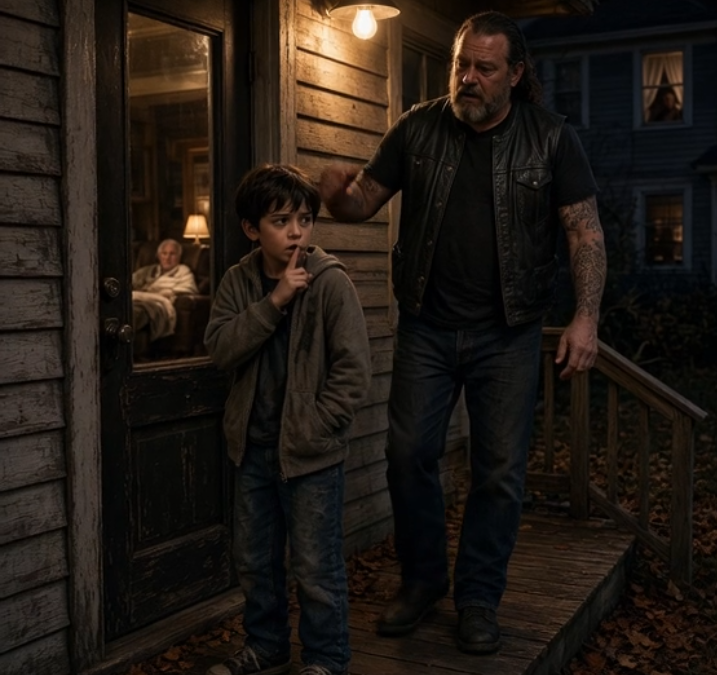
A Little Boy Whispered, “Don’t Knock—He’s Awake”—Then I Learned What His 97-Year-Old Grandfather Had Been Fighting for 80 Years
The nine-year-old boy stopped my fist an inch from the front door and whispered, “Don’t knock—he’s awake,” as if one careless sound could turn the quiet house behind him into a battlefield.
I had spent eleven years treating combat trauma and years before that as a Navy corpsman, but nothing prepared me for the ninety-seven-year-old Marine inside who had survived Okinawa, buried the war for nearly eight decades, and was now in danger of losing his home because one startled stranger believed he was dangerous.
By the time that boy held up five small fingers in a courtroom fight no child should have understood, I realized we were not trying to prove an old hero was harmless—we were trying to teach an entire town the difference between a violent man and a wounded one.
My name is Reed Stanfield.
Most people who meet me for the first time make at least three assumptions.
The first is that I ride motorcycles.
That one is correct.
The second is that I have probably been in more bar fights than graduate seminars.
That one is not.
The third is that a man my size, with tattoos covering both forearms and an Iron Veterans Riders patch across a leather vest, cannot possibly hold a doctorate in clinical psychology.
I have learned not to correct that assumption too quickly.
Sometimes you learn more about people by giving them ten extra seconds with the version of you they already invented.
I was forty-six the night I first stood on the Leadford porch in Bangor, Maine.
Two hundred eighty pounds after years of pretending my knees still enjoyed lifting what my twenty-five-year-old body had once considered reasonable.
Gray beginning in my beard.
Scar beneath my ribs.
More ink than my mother approved of.
And a Harley cooling in the driveway beside Garin Meeks’s bike.
Every curtain on Hammond Street had already moved.
I knew because I watched them.
Hypervigilance is useful when you can choose when to use it.
Less useful when it chooses for you.
That was one of the things Rosco Talmage and I would eventually understand about each other.
But before I met Rosco, I met Toby.
He was standing beneath a porch light that hummed like a tired fluorescent tube.
Small kid.
Nine years old.
Brown hair sticking up in a way that suggested nobody had won the morning argument with it.
Sweatshirt too thin for the October cold.
One finger pressed firmly against his lips.
I lifted my hand to knock.
His eyes widened.
“Don’t.”
My knuckles stopped an inch from the wood.
He whispered:
“He’s awake.”
I lowered my hand.
Across the street, a curtain shifted.
The boy noticed that too.
Interesting.
PART2:
Kids who grow up in unpredictable environments become excellent observers.
They should not have to.
But they do.
“You Toby?”
He studied me.
“You’re Reed.”
Not a question.
“Yeah.”
“The VA guy.”
“Sort of.”
“My mom said you help veterans.”
“I try.”
“She said you ride with a motorcycle club.”
“Also true.”
His eyes moved over my vest.
IRON VETERANS RIDERS.
Then back to my face.
“Grandpa doesn’t like surprises.”
“I heard.”
“You have to say something first.”
“Before I knock?”
“Yes.”
“What?”
He leaned closer.
“Semper Fi.”
That explained something.
“Marine?”
“My grandpa.”
I nodded.
“Say it loud enough for the door.”
PART3:
He pointed at me like a small instructor evaluating an incompetent recruit.
“But not loud.”
“Understood.”
I crouched until we were closer to eye level.
“What happens if somebody knocks loud?”
His entire face changed.
Children are not good at hiding the things adults wish they had never learned.
“He forgets.”
“For how long?”
“Sometimes a minute.”
He looked toward the door.
“Sometimes longer.”
“Where does he think he is?”
Toby shrugged.
“I don’t know.”
Then, after thinking:
“Somewhere bad.”
That was enough.
I stood.
Tapped the door softly with two knuckles.
Not a fist.
“Semper Fi, Mr. Talmage.”
Nothing.
I waited.
Toby watched me.
Then I heard movement.
Chain sliding.
Lock.
The door opened.
Amanda Leadford looked like exhaustion had become a person and learned how to wear hospital scrubs.
Hair falling out of its clip.
Eyes red from lack of sleep.
Coffee stain near one pocket.
She saw me.
Then Garin near the motorcycles.
Then the houses across the street.
“You found us.”
“Small town.”
“That has advantages.”
“And disadvantages.”
Her eyes went toward the Pratchett house.
Curtain moving again.
I did not need an explanation yet.
Amanda stepped aside.
“Come in.”
The front room was warm.
Old house warm.
Radiators clicking.
Wood furniture repaired rather than replaced.
Photographs.
Books.
A recliner positioned where the person sitting in it could see both the front door and the hallway.
That positioning mattered.
Rosco Talmage sat beneath a quilt with a metal coffee can balanced against one thigh.
Coins covered the side table.
Quarters stacked in groups.
Nickels separated.
Pennies in one shallow bowl.
He looked old in every ordinary way.
Thin white hair.
Skin folded by nearly a century.
Hands with enlarged joints.
Shoulders slightly curved.
But then he looked at me.
His eyes were not old.
That is not poetic exaggeration.
Some eyes remain operational long after the body holding them changes.
He looked at my hands.
My boots.
My vest.
The doorway behind me.
Then my face.
I stayed where I was.
“Mr. Talmage.”
He did not answer.
“My name is Reed Stanfield.”
Nothing.
“I know Dwayne Mercer from the Vet Center.”
His eyes shifted.
That name landed.
“He said you might tolerate company.”
One side of Rosco’s mouth moved.
Then he said:
“Corpsman?”
I looked down at the small Fleet Marine Force pin on my vest.
“Was.”
“Navy.”
“Yes, sir.”
“What war?”
That question can mean many things when one veteran asks another.
What war officially?
What war privately?
Which part still wakes you?
I answered the way I often did.
“The one they still don’t teach right.”
Rosco’s shoulders changed.
Barely.
But Toby noticed.
So did Amanda.
Rosco pointed at the couch.
“Sit.”
I sat.
No handshake.
Good.
People rush touch.
Particularly with old people.
As if age makes personal boundaries public property.
Rosco returned to his coins.
I watched for a while.
“How many?”
He looked up.
“Quarters?”
“All of them.”
“Why?”
“Need a purpose?”
“No.”
“Then mind your business.”
Toby covered a smile.
I laughed.
Rosco looked toward my vest.
“Motorcycle?”
“Harley.”
“What year?”
“2018 Road King.”
“Too much computer.”
“Probably.”
“Men used to fix their own motorcycles.”
“I fix mine.”
“Then why 2018?”
“Because I enjoy arriving.”
That got him.
Small laugh.
Rough.
But real.
Amanda’s hand stopped halfway toward her coffee.
I pretended not to notice.
For nearly an hour, I did not ask Rosco about Okinawa.
Or May.
Or the hearing.
Or PTSD.
I asked about coins.
Motorcycles.
Bangor winters.
Whether Marine Corps chow was worse in 1945 than Navy chow had been during my deployments.
He said yes.
I said impossible.
He called me ignorant.
The old joke still worked.
Eventually he drifted asleep.
His chin lowered.
Hands loosened around the coffee can.
Toby crossed the room.
Very slowly.
Removed it before it could fall.
No one told him.
He had done it before.
In the kitchen, Amanda closed the door halfway.
“He hasn’t talked to a stranger like that since before Mom died.”
“How long?”
She told me.
I nodded.
“Trauma doesn’t like unfamiliar people.”
“You make that sound like it’s alive.”
“Sometimes it behaves like it is.”
Amanda leaned against the counter.
“What did Toby tell you outside?”
“That loud knocks are bad.”
Her jaw tightened.
“He shouldn’t have to know that.”
“No.”
“I keep telling myself he’s resilient.”
“He probably is.”
“That doesn’t make it fair.”
“No.”
She looked surprised.
People often expect clinicians to rescue them from uncomfortable truths.
I stopped doing that years ago.
Resilience is not proof that hardship was acceptable.
It is proof somebody survived it.
The certified county envelope was attached to the refrigerator beneath a lighthouse magnet.
I saw the seal.
November 14.
Guardianship petition.
Least restrictive placement.
Risk assessment.
Words can sound neutral while carrying enormous consequences.
Amanda took it down.
Set it between us.
“It started in May.”
I listened.
New utility meter reader.
Evening.
Route he did not know.
Hard knock.
Then another.
Calling through the door.
Rosco asleep in the recliner.
He woke violently.
Not angry.
Disoriented.
Shouting.
Hands moving.
The meter reader stepped backward.
Missed the porch edge.
Broke his wrist.
Ambulance.
Police.
Report.
Nobody malicious.
Nobody criminal.
Which made everything worse in a way.
Rosco had not attacked a man because he wanted to hurt him.
A man had been injured because a ninety-seven-year-old veteran woke believing seventy-nine years had vanished.
“You know where he went?” I asked.
“No.”
“What does he say?”
“Nothing afterward.”
“Any words during it?”
Amanda thought.
“Orders.”
“What kind?”
“Get down.”
“Move.”
“Corpsman.”
“Something about mortars.”
That was enough to narrow.
“Pacific?”
“Okinawa.”
I looked toward the living room.
“Nineteen?”
“When he fought?”
“Yes.”
“Nineteen.”
There are ages that should not exist beside certain memories.
Nineteen and mortar fire.
Nineteen and bodies.
Nineteen and spending the next seventy-nine years pretending silence equals recovery.
Amanda continued.
“Mr. Pratchett saw the ambulance.”
The neighbor across the street.
The moving curtain.
“He called Adult Protective Services.”
“Once?”
“Repeatedly.”
“What’s his concern?”
“Dad is dangerous.”
“To Toby?”
“To me.”
“To himself.”
“To the street.”
She laughed bitterly.
“Basically civilization.”
“The meter reader was hurt.”
“I know.”
She said it too quickly.
Guilt.
Important.
“I know he was.”
Her eyes watered.
“I sent flowers.”
“Was he angry?”
“The meter reader?”
“Yes.”
“No.”
Interesting.
“He said he understood after the police explained.”
“Did he request charges?”
“No.”
“Pratchett?”
“Called again anyway.”
I turned the county letter.
“If the judge orders placement?”
“Locked memory care.”
“He have dementia?”
“Mild cognitive impairment. Nothing severe according to his neurologist.”
“Any wandering?”
“No.”
“Medication misuse?”
“No.”
“Falls?”
“One last winter.”
“Violence outside trauma episodes?”
“Never.”
“Frequency?”
“Before May?”
She thought.
“One serious one every few months.”
“After?”
“More.”
That made sense.
The May incident had likely sensitized the system further.
Fear of another event can increase vigilance.
More vigilance creates more arousal.
More arousal creates more triggers.
A feedback loop.
“What have you changed at home?”
“Toby announces himself if Dad’s sleeping.”
“No loud TV.”
“I tell delivery drivers not to knock.”
“Curtains stay partly open because Dad panics if he wakes and can’t see outside.”
Good.
They were already adapting.
“Does Toby ever physically restrain him?”
Amanda looked horrified.
“No.”
“Good.”
“I wouldn’t let him.”
“What does Toby do?”
She hesitated.
“You’ll think it’s strange.”
“Try me.”
“He holds up his hand.”
I remembered the porch.
“Five fingers.”
“Yes.”
“He says what day it is.”
“Where they are?”
“Yes.”
“Names himself?”
“Yes.”
“Touch?”
“Never until Dad recognizes him.”
I sat back.
“Who taught him?”
“No one.”
That was both impressive and heartbreaking.
“He started doing it after May.”
“Why five fingers?”
“Dad counts coins.”
I smiled despite myself.
Toby had built a grounding protocol from the material available to him.
Visual anchor.
Predictable sequence.
Orientation cues.
No sudden touch.
A nine-year-old had independently discovered principles adults spend continuing education hours learning.
“I’d like to observe it if it happens naturally.”
Amanda went pale.
“I’d prefer it never happens again.”
“So would I.”
I nodded toward the hearing notice.
“But I need to know what works.”
She stared at the paper.
“They told me you might testify.”
“If the court accepts me.”
“The caseworker doesn’t want you.”
“Why?”
Amanda almost smiled.
“She said, ‘I don’t need a motorcycle club vouching for a defendant’s mental state.’”
I sighed.
“That sounds about right.”
“You’re really licensed?”
“I can show you.”
“No. Dwayne already sent everything.”
“Good.”
“Doctorate?”
“Yes.”
“In psychology?”
“Yes.”
“Why the vest?”
“Because sometimes veterans open a door for this before they open a door for this.”
I tapped my temple.
Amanda looked toward the living room.
“Dad did.”
“Yes.”
I understood why.
Clinical environments can feel evaluative.
Leather, tattoos, military slang, motorcycles—those things can lower resistance in certain populations before credentials ever matter.
Trust is contextual.
A man who refuses a white coat may accept coffee from someone who looks like he has broken rules.
I had learned that by accident.
Then made it part of the work.
My Navy years had given me the first education.
I had been a corpsman attached to Marine infantry.
Later, graduate school gave names to things I had already seen.
Hyperarousal.
Dissociation.
Traumatic re-experiencing.
Conditioned startle response.
Moral injury.
The vocabulary mattered.
But vocabulary never sat beside a Marine at three in the morning.
People did.
Eleven years after becoming licensed, I had built much of my practice around veterans whose trauma entered the legal or medical system disguised as something else.
Aggression.
Noncompliance.
Dementia.
Substance abuse.
Domestic conflict.
In Rosco’s case:
Dangerousness.
I could not promise Amanda a court would agree with me.
I told her.
“I can’t guarantee he stays.”
She looked down.
“I know.”
“But I can document.”
“Explain.”
“Offer a less restrictive safety plan.”
“What if they don’t listen?”
“We make it harder not to.”
That was how I became part of the Leadford house.
Three evenings each week.
Initially evaluation.
Then something less formal.
I brought records forms.
Screening instruments.
Old military maps once I knew more.
Never interrogated Rosco.
People make mistakes with veterans because they think more detailed exposure disclosure equals better treatment.
Sometimes it does.
Sometimes forcing detail only proves you can make someone hurt on command.
Rosco gave fragments.
Enough.
He remembered Sugar Loaf Hill.
Sometimes.
Not as a story.
A word.
Rain.
Mud.
Machine gun.
Corpsman.
He hated fireworks.
He hated slammed doors.
He refused to sit with his back to uncovered windows.
He counted coins when anxious.
He woke at night but rarely admitted nightmares.
He had married after the war.
Worked nearly fifty years.
Raised a family.
Never went to therapy.
Never joined a combat group.
Never applied for a trauma disability rating.
When asked what happened overseas, he said:
“War.”
One word.
End of discussion.
That generation was praised for silence.
Then sometimes punished when silence failed.
Priscilla Van arrived the next Thursday.
Four o’clock exactly.
Clipboard.
Dark coat.
Practical shoes.
Fifty-one.
Experienced.
Not cruel.
This distinction became important.
She had spent twenty-two years in adult protective services.
Anyone who does that long enough sees awful things.
Neglect.
Exploitation.
Families who swear they can manage until somebody ends up injured.
She entered expecting risk because risk was her job.
The problem was she also entered expecting me to be part of it.
Her eyes found my vest.
Tattooed arms.
Then she wrote something.
“Mr. Stanfield?”
“Doctor is fine if titles matter today.”
That paused the pen.
“You’re a licensed clinician?”
“Clinical psychologist.”
“Maine license active?”
“Since 2019.”
“Documentation?”
“I’ll send it.”
“Monday.”
“You’ll have it.”
“Your relationship to this family?”
“Consultant.”
“Through?”
“Veterans outreach.”
“Iron Veterans Riders?”
“My practice and the VA outreach network.”
I looked at her clipboard.
“The club is weekends.”
She did not smile.
“Mr. Talmage.”
Rosco had woken.
He looked at her.
Assessment mode changes rooms.
People feel it.
Rosco certainly did.
“Can I ask you questions?”
He looked toward me.
I said nothing.
Choice had to be his.
Rosco shrugged.
Priscilla began simply.
“What year is it?”
Rosco frowned.
That question can be clinically appropriate.
It can also feel insulting if asked without context.
Before he answered, a delivery truck two streets away hit something.
Bang.
Not enormous.
Not to us.
Rosco was standing before the sound finished.
Coin can hit floor.
Quarters rolled.
His hands came up.
Body lowered.
Breathing changed.
Eyes no longer saw Maine.
Amanda moved.
I raised one hand.
Not yet.
Priscilla stepped back.
Her face said confirmation.
There.
Danger.
Exactly what she expected.
Then Toby entered.
He had been in the hallway.
He moved in front of Rosco.
Slowly.
No touch.
Palm up.
“Five fingers, Grandpa.”
Rosco’s eyes moved but did not focus.
“Count them.”
Toby kept his voice even.
“It’s Toby.”
One second.
“We’re home.”
Two.
“Hammond Street.”
Three.
“It’s Thursday.”
Rosco blinked.
“Five fingers.”
His eyes found the hand.
Then Toby’s face.
Everything collapsed back.
Shoulders.
Hands.
Breathing.
He looked around.
Saw coins everywhere.
Shame hit next.
People often ignore that phase.
After a flashback or dissociative episode, there is sometimes profound embarrassment.
Rosco started lowering himself.
I moved closer only then.
“Chair behind you.”
He sat.
Toby remained where Rosco could see him.
Priscilla wrote.
I wanted to know what.
I did not ask.
Her report arrived nine days later.
Six pages.
Mostly accurate observations.
Then the sentence:
Unable at this time to recommend against a more restrictive placement.
Amanda read it so many times I worried she was trying to make the words become different through repetition.
“She saw one episode.”
“Yes.”
“And decided that’s him.”
“She documented risk.”
“Same thing.”
“No.”
Amanda looked angry.
“Why are you defending her?”
“I’m not.”
“Sounds like it.”
“I need you to understand the argument we have to beat.”
She stared.
“If we make Priscilla a villain, we lose.”
“Why?”
“Because her concern is reasonable.”
Amanda stood.
“My father is not dangerous.”
“A man broke his wrist.”
She flinched.
I hated saying it.
But truth wins more hearings than moral certainty.
“Your father has a trauma response capable of causing accidental injury.”
Her eyes filled.
“Yes.”
“We do not deny that.”
“Then what do we say?”
“We show the response is predictable.”
“Trigger-specific.”
“Manageable.”
“And already being managed effectively.”
She looked toward the hallway.
“Toby shouldn’t be part of a safety plan.”
“Agreed.”
“So?”
“We move responsibility to adults and environment.”
That became the plan.
Door modifications.
Soft chime instead of knocking.
Motion-activated light with gradual illumination.
Delivery instructions.
Clinical support.
Trauma-informed home routine.
Sleep assessment.
Medication review.
Emergency response plan.
No weapons accessible.
Adult grounding procedure so Toby was backup, not frontline caregiver.
Quarterly evaluation if required.
Most importantly:
History.
I requested Rosco’s military records.
Discharge papers.
Unit assignments.
Citations.
Anything from Okinawa.
If we could connect current response to documented combat exposure, we changed the frame from unpredictable violence to trauma-linked re-experiencing.
The National Personnel Records Center did not care that our hearing was close.
Bureaucracy has no pulse.
Records request disappeared into process.
There was also the 1973 fire, which had destroyed millions of military records.
Some Marine records survived better than Army records, but nothing was guaranteed.
Hearing date approached.
We waited.
Meanwhile, Hammond Street became its own tribunal.
Milton Pratchett stopped pretending his interest was casual.
He walked his dog past Rosco’s house whenever my motorcycle was visible.
Notepad sometimes in hand.
Posted vague neighborhood-app messages about “unlicensed outsiders” and “community safety.”
One afternoon he stopped Amanda near the fence.
I was on the porch and heard enough.
“I looked him up.”
Meaning me.
Amanda crossed her arms.
“Congratulations.”
“Your father hurt someone.”
“Yes.”
“And now a biker is here three nights a week.”
“He’s a doctor.”
Milton looked toward me.
“He doesn’t look like one.”
That sentence was honest.
Useless, but honest.
I walked over.
“Mr. Pratchett.”
He stiffened.
“You’re Stanfield.”
“Dr. Stanfield if appearance matters.”
Amanda almost laughed.
Milton did not.
“I’m worried about my grandchildren.”
“Fair.”
That surprised him.
“You are?”
“A person was injured.”
“Yes.”
“You witnessed the aftermath.”
“Yes.”
“You don’t know Rosco’s diagnosis.”
“No.”
“Or current safety plan.”
“No.”
“But concern for people on your street isn’t evil.”
Milton’s posture softened half an inch.
“Thank you.”
“Calling a ninety-seven-year-old war veteran a menace on social media before understanding his condition is less useful.”
There it went.
Softening gone.
“You people always make excuses.”
“What people?”
He looked at my vest.
I waited.
He changed course.
“Professionals.”
“Nice recovery.”
Amanda coughed into her hand.
Milton left.
I did not hate him.
People hate uncertainty.
Labels fix uncertainty.
Dangerous old man.
Biker.
Neglectful daughter.
Nosy neighbor.
Once the labels settle, nobody has to keep thinking.
The court date came closer.
Six days out, Amanda cracked.
Two in the morning.
She had returned from the hospital.
Rosco asleep.
Toby in bed.
Kitchen light only.
“Maybe they’re right.”
I stayed silent.
She rubbed her face.
“Maybe a facility is safer.”
“For who?”
“Everybody.”
“You believe that?”
“I don’t know.”
That was more honest.
“What if he hurts Toby?”
“Possible.”
She stared.
“What?”
“Possible.”
“You’re supposed to reassure me.”
“No.”
I leaned forward.
“Risk is never zero.”
“In a facility?”
“No.”
“At home?”
“No.”
“With you?”
“No.”
“With me?”
“No.”
“So what are we doing?”
“Comparing risks.”
Her breathing slowed.
“At home, his triggers are understood.”
“Yes.”
“He has familiar people.”
“Yes.”
“His orientation improves faster.”
“Yes.”
“He has a protocol.”
“Yes.”
“A facility introduces unfamiliar staff, doors, alarms, roommates, overnight checks, possible restraint during agitation.”
Amanda went pale.
“That could be worse.”
“Could.”
“And court?”
“Needs evidence.”
“If records don’t come?”
“We use what exists.”
“My testimony.”
“Yes.”
“Your evaluation.”
“Yes.”
“Toby?”
“If necessary, limited.”
“I hate that.”
“So do I.”
She looked toward the hallway.
“What if I’m selfish?”
“For wanting him home?”
“Yes.”
“You probably are.”
Her eyes snapped up.
I continued.
“So is every daughter who loves a father.”
“That doesn’t make you wrong.”
“We separate love from evidence.”
“Evidence supports home with safeguards.”
“That is my opinion.”
“Not because you need it to be.”
Tears came.
Quiet.
She pressed both hands over her eyes.
I let her cry.
People do not always need regulation.
Sometimes they need permission to temporarily stop regulating.
After several minutes, she asked:
“Why do you understand him?”
I stared at my coffee.
Mosul.
The word appeared before I decided to say it.
I had told her pieces before.
Not all.
“Years ago.”
I rotated the cup.
“My battalion was attached to operations where every street seemed to contain one more thing you could not see until it happened.”
She listened.
“We went days without enough sleep.”
“Casualties.”
“Civilians.”
“Marines.”
“IEDs.”
“Snipers.”
“Buildings.”
“Noise.”
I stopped.
“There are eleven days I remember too well.”
“And some I barely remember at all.”
“After?”
“Couldn’t sleep.”
“Checked locks six times.”
“Sat facing restaurant doors.”
“Nearly put a man through a wall because he grabbed my shoulder from behind.”
Amanda looked at me.
“Did you?”
“Stopped before I did.”
“How?”
“Friend saw it coming.”
I swallowed.
“I had help.”
“Eventually.”
“Rosco?”
“Had none.”
That was what mattered.
“We had a name.”
“PTSD.”
“Treatment.”
“VA systems, imperfect as they are.”
“Rosco came home in 1945 to a world that expected silence.”
“He gave it seventy-nine years.”
“His nervous system did not.”
The morning of November 14 arrived with frost hard enough to whiten every car in the courthouse lot.
I had slept ninety minutes.
At 8:40, a courier found me outside the Penobscot Judicial Center.
Manila envelope.
St. Louis.
My hands shook when I signed.
I did not open it outside.
I waited until security cleared me.
Then found a bench.
Amanda and Toby were already upstairs.
Garin and two Iron Veterans had come too.
Good jackets.
No vests.
Garin complained.
“This tie is a constitutional violation.”
“Keep it on.”
“Judge better appreciate sacrifice.”
The envelope contained three things that changed the case.
Rosco’s discharge papers.
Unit history.
Silver Star citation.
I read it once.
Then again.
Private First Class Rosco Talmage.
Sixth Marine Division.
Okinawa.
Sugar Loaf Hill.
Nineteen years old.
Under sustained machine-gun and mortar fire, Rosco crossed approximately seventy yards of exposed ground.
Not once.
Three times.
Dragging wounded Marines to cover.
Continued after shell fragments tore into his shoulder.
Returned until every reachable member of his fire team had been recovered.
I sat there with the paper.
Nineteen.
Three crossings.
Machine gun.
Mortars.
Darkness.
Sudden sound.
“Corpsman.”
His flashbacks were practically reenacting the citation.
The behavior the county called dangerous had once been adaptive enough to earn a Silver Star.
That did not make injury in May acceptable.
But it made the mechanism visible.
Toby saw me outside Courtroom Three.
“You got it.”
“Yeah.”
“Good?”
I looked at him.
“Important.”
Rosco arrived in a wheelchair the courthouse insisted on for the long corridor.
Flag pin on lapel.
He hated the chair.
I crouched.
“Temporary transport, Marine.”
He glared.
“I walked Okinawa.”
“I know.”
“And I can walk this.”
“Judge will be impressed if you arrive this century.”
One side of his mouth moved.
“Smart-ass sailor.”
“Corpsman.”
“Same disease.”
Toby laughed.
At 10:17 Judge Miriam Ashgrove called the guardianship petition.
Priscilla’s report entered first.
Accurate description.
Concern.
May injury.
Observed episode.
Need for safety.
Then me.
I was sworn.
State’s attorney asked qualifications.
I gave them.
Doctorate.
License.
Eleven years clinical practice.
Combat-trauma specialty.
Navy service.
Veteran outreach.
Then he looked at my court jacket.
Not leather that morning.
“Dr. Stanfield, when you first evaluated Mr. Talmage, you arrived wearing a motorcycle club vest?”
“Yes.”
“Do you believe that is standard clinical attire?”
“No.”
“Could that affect professional perception?”
“Apparently.”
Soft laughter.
Judge almost smiled.
The attorney continued.
“Does presentation matter in clinical work?”
“Absolutely.”
“So why wear it?”
“Because therapeutic rapport is population-specific.”
He paused.
“For some veterans, a leather vest worn by another veteran is less threatening than a white coat.”
“You’re saying appearance doesn’t matter?”
“I’m saying it matters enough that we should question our assumptions about it.”
Priscilla looked up.
Good.
Then I asked permission to reference newly received documents.
Envelope admitted.
I held Rosco’s citation.
The room changed when I read.
Not because medals erase risk.
I made that clear.
“Your Honor, this citation does not make Mr. Talmage incapable of causing harm.”
Amanda tensed.
“But it establishes something clinically significant.”
Judge leaned forward.
“What?”
“His trauma exposure.”
I explained.
Nineteen-year-old Marine.
Okinawa.
Sugar Loaf Hill.
Repeated movement under machine-gun and mortar fire.
Wounded.
Still retrieving casualties.
“Mr. Talmage’s present episodes show consistent triggers.”
“Sudden impact noises.”
“Hard knocking.”
“Unexpected waking.”
“Perceived urgent entry.”
“His physiological response includes defensive posture, orientation to threat, verbalized combat commands, and temporary confusion regarding time and place.”
I looked toward Rosco.
He stared at the floor.
“These are not random.”
“They map directly onto documented combat conditions.”
The state attorney asked:
“Are you saying he is safe?”
“I am saying ‘safe’ is an imprecise word.”
Judge nodded.
“Explain.”
“A person can be safe with appropriate supports and unsafe under specific unmanaged circumstances.”
“Mr. Talmage has identifiable triggers.”
“His family has demonstrated effective grounding techniques.”
“Environmental modification reduces exposure.”
“He has no documented pattern of intentional assaultive behavior outside trauma episodes.”
“His May incident was serious.”
“The meter reader’s injury matters.”
“But the clinical question is whether a locked institutional placement is necessary to manage future risk.”
“In my opinion, no.”
“What do you recommend?”
I listed it.
Soft-entry protocol.
Door chime.
Family education.
Adult-led grounding.
Continued trauma care.
Neurological monitoring.
Emergency plan.
Quarterly review.
Clear visitor procedures.
No reliance on Toby as primary responder.
Judge asked:
“You mentioned the grandson.”
“Yes.”
“How old?”
“Nine.”
“And he developed an intervention?”
“In part.”
“What does he do?”
I looked at Toby.
Amanda squeezed his hand.
“Visual grounding.”
“He presents five fingers.”
“Identifies himself.”
“States location.”
“Day.”
“Waits for recognition before touch.”
Judge looked surprised.
“You taught him?”
“No.”
“Who did?”
“No one formally.”
“Then how?”
“He watched his grandfather.”
That sentence mattered.
Toby was called only briefly.
Judge spoke to him gently.
Not as a witness under pressure.
More as a child whose routine had become evidence.
“Why five fingers?”
Toby said:
“Grandpa counts.”
“Coins?”
“Yes.”
“So I thought counting was something he knows.”
“What happens when he sees your hand?”
“He comes back.”
Judge paused.
“Comes back from where?”
Toby thought.
“I don’t know.”
Then:
“From before me.”
Nobody in the room moved.
Children occasionally say the clinically perfect thing because they have no interest in clinical language.
From before me.
Exactly.
Priscilla was invited to respond to the new records.
She stood.
Professional.
Composed.
I respected what happened next.
Because changing your mind publicly is harder than defending a mistake.
“Your Honor, given the documented military history and Dr. Stanfield’s proposed safety plan, I would amend my recommendation.”
Amanda stopped breathing.
“I no longer believe locked placement is the least restrictive appropriate option at this time.”
That took courage.
Not enough people credit it.
Milton Pratchett stood from the back.
He should not have.
But fear makes people believe concern grants procedural rights.
“Your Honor—”
Judge looked at him.
“Sir, sit.”
“With respect, that paper doesn’t fix the meter reader’s wrist.”
Judge Ashgrove surprised me.
“No, it does not.”
Milton blinked.
“But it explains the event in a way that changes the court’s obligation.”
Then:
“Sit down.”
He did.
Rosco asked to speak.
Judge allowed it.
He did not look at her first.
He looked at me.
Then Toby.
“Man came to my door three weeks ago.”
His voice thin.
Still steady.
“Looked like the sort of trouble my wife would’ve chased off with a broom.”
A few people laughed.
“Leather.”
“Ink.”
“Motorcycle loud enough to wake the dead.”
I smiled.
Rosco continued.
“Whole street knew what he was before he opened his mouth.”
He looked toward Milton.
“Me too.”
Then back at Toby.
“Took about four minutes to figure out we had it backward.”
Silence.
“Same way people had me backward.”
My throat tightened.
Rosco said:
“A man can look like the enemy and still be the one carrying you home.”
Then:
“I know that better than most.”
He paused.
“Took me nearly my whole life and a boy holding up five fingers to remember it works both ways.”
Judge ruled at 11:02.
Petition for restrictive guardianship denied.
Supervised home safety plan.
Quarterly review.
Continued clinical support.
Exactly what we asked for.
Amanda put both hands over her face.
Toby grinned at Garin.
Garin slapped his knee once.
Rosco simply exhaled.
Outside the courtroom, Amanda hugged me.
I do not handle hugs gracefully.
I tolerated it.
Then Priscilla approached.
We stood facing each other.
“I was wrong about you.”
“Partly.”
She frowned.
“Partly?”
“You were right to worry.”
Her face softened.
“I made assumptions about the vest.”
“Yes.”
“So did half the room.”
“Yes.”
“You enjoy this.”
“Occasionally.”
She almost smiled.
“What would you change in my intake?”
That was the best apology she could have offered.
We talked for fifteen minutes.
Trigger history.
Context before orientation questions.
Collateral information.
Environmental observations.
Distinguishing cognitive impairment from dissociative response.
Not assuming agitation has one cause.
Priscilla took notes.
Again.
This time I liked the clipboard better.
The court ruling did not cure Rosco.
Nobody expected it to.
Trauma that deep does not disappear because a judge recognizes it.
We built around it.
Garin helped install the chime.
Two soft tones.
No sharp bell.
No pounding.
A motion light illuminated the porch gradually.
Delivery notes were updated.
UTILITY WORKERS: CALL FIRST.
NO HARD KNOCKING.
Rosco mocked the sign.
“Make me sound fragile.”
“You are ninety-seven.”
“I was at Sugar Loaf.”
“That was eighty years ago.”
“Still counts.”
“Apparently literally.”
He threw a quarter at me.
Missed.
Toby picked it up.
“Your aim is bad.”
Rosco pointed.
“Disrespectful child.”
The house changed.
Not dramatically.
Small things.
Amanda learned to spot Rosco’s pre-episode stillness.
Hands stopping.
Jaw tightening.
Eyes tracking something no one else saw.
She could intervene earlier.
“Toby, kitchen.”
Then she grounded Rosco herself.
Adult responsibility restored.
Toby still helped sometimes.
But he was allowed to be nine more often.
That mattered more than any court victory.
Milton Pratchett surprised everyone.
The first week of December, he walked up the porch carrying chicken and rice beneath foil.
He stood near the new chime.
Looked at it.
Pressed.
Soft two-note sound.
Inside, Rosco looked up from his coins.
No startle.
He saw Milton through the window.
Raised one hand.
Amanda opened the door.
Milton held out the casserole.
“My wife made this.”
Amanda waited.
“I owe your father an apology.”
“Then tell him.”
Milton’s face tightened.
“I’m not very good with words.”
I happened to be there.
Rosco called from the living room:
“Obviously.”
Milton looked offended.
Then heard Rosco laughing.
He entered.
Did he apologize perfectly?
No.
Did Rosco forgive him immediately?
No.
Real life is rarely that efficient.
But Milton returned the following week without food.
Sat on the porch ten minutes.
Rosco counted coins inside.
Eventually Rosco opened the door.
“Cold.”
Milton said:
“Yes.”
“You coming in or freezing out there for moral development?”
Milton went in.
Progress.
The local history newsletter eventually learned about Rosco’s Silver Star.
Careful version.
No legal details.
The VFW found out.
Four older veterans arrived one Sunday.
No spectacle.
Framed copy of unit history.
Folded flag.
They stood on the porch.
One Korean War veteran shook Rosco’s hand.
Said:
“We should have known sooner.”
Rosco answered:
“Wouldn’t have told you.”
“Still.”
They sat.
No one asked Rosco to tell the story.
That is why he eventually did.
Not all.
Enough.
Rain on Okinawa.
Mud.
Hill.
Men pinned down.
The first Marine he dragged.
Then another.
His shoulder hit.
Corpsman wrapping it.
Going back anyway.
Toby sat on the floor.
Silent.
At one point he asked:
“Were you scared?”
Every adult froze.
Rosco looked at him.
“Yes.”
Toby nodded.
That answer seemed obvious.
“You went anyway.”
“Yes.”
“Why?”
Rosco looked toward the window.
“Because they were still there.”
Toby accepted that.
Children understand loyalty without decoration.
Christmas Eve, I arrived with Garin.
Two motorcycles idling as quietly as Harleys know how.
We brought ornaments collected by Iron Veterans families.
Amanda had not put up a tree in three years.
Too tired.
Too much else.
We put one up.
Crooked.
Garin insisted it leaned because the floor was uneven.
It was the tree.
Rosco hung a paper star.
His hands trembled.
Toby steadied the branch.
Not Rosco’s hand.
Important difference.
By then the Leadford house had stopped feeling like a case.
It became one of those homes where I knew which cabinet held coffee without asking.
Where Amanda told me to take my boots off.
Where Toby could insult my motorcycle choices.
Where Rosco called me “squid” despite my repeated explanation that corpsmen attached to Marines deserve exemption.
He refused.
One night, after everyone else slept, Amanda asked:
“Do you ever think about getting out of the work?”
“Every Tuesday.”
“Seriously.”
I looked toward the living room.
Rosco asleep.
Tree lights low.
“I did once.”
“When?”
“After Mosul.”
“What happened?”
“I got better enough to help people.”
“That isn’t an answer.”
No.
It was not.
The truth was uglier.
Helping other veterans became my way to avoid finishing my own therapy.
If I could understand everyone else’s trauma, mine felt controlled.
Clinical distance disguised avoidance very well.
Rosco disrupted that.
Watching a man carry an untreated nervous-system injury for nearly eighty years made my own excuses look thin.
I had resources.
Language.
Insurance.
Colleagues.
People asking.
I had simply decided competence meant I no longer needed help.
That January, I returned to therapy for the first time in three years.
My therapist did not celebrate.
She said:
“Took you long enough.”
I respected that.
I told Amanda later.
“Because of your dad.”
She looked surprised.
“He helped you?”
“Without consent.”
“Sounds like him.”
I started giving talks again at veteran outreach programs.
Not Rosco’s details.
Confidentiality mattered.
But the concept.
How trauma changes across aging.
How cognitive slowing can weaken compensatory mechanisms.
How hearing loss, sleep disruption, pain, bereavement, and environmental triggers can reactivate symptoms decades later.
How “dangerousness” requires context.
Priscilla attended one talk.
Back row.
Stayed afterward.
Asked two questions.
No apology.
Did not need one.
Change was enough.
Her quarterly visit came late January.
Snow squeaked beneath boots.
Clipboard.
Same practical coat.
She approached the porch.
Toby happened to be sitting on the step tying his shoe.
Priscilla stopped.
Looked at him.
Then raised one finger to her lips.
Question in her eyebrows.
Toby grinned.
Nodded.
She tapped the door twice.
Soft.
Perfect.
Inside, Rosco called:
“Come in if you brought coffee.”
Priscilla entered.
That should have been the ending.
It would have made a clean story.
But families continue after lessons.
So did we.
Rosco turned ninety-eight.
We held no surprise party.
Obviously.
Toby made a sign outside:
DO NOT KNOCK LIKE A MANIAC. BIRTHDAY IN PROGRESS.
Rosco laughed until he coughed.
Milton brought pie.
Priscilla sent coffee.
Garin gave Rosco an old Marine Corps challenge coin he claimed he definitely acquired legally.
Nobody believed him.
Amanda slept through half the party because she had worked overnight.
We put a blanket over her.
Life.
Ordinary.
Messy.
Good.
One summer evening Rosco asked me to sit on the porch.
Just us.
Toby inside playing a video game.
Amanda at work.
Sun late over Bangor.
He held the coffee can.
“Reed.”
“Sir.”
“What happens when I don’t know him?”
I knew who.
“Toby?”
Rosco nodded.
That was the fear beneath everything.
Not court.
Not facility.
Memory.
“Has that happened?”
“Sometimes.”
“For how long?”
“Seconds.”
He looked down.
“What if it becomes more?”
“Then we adjust.”
“What if I scare him?”
“We protect him.”
“And me?”
“You too.”
Rosco shook his head.
“I don’t want him carrying me.”
“He isn’t.”
“He has.”
That was true.
“He carried too much.”
“Yes.”
Rosco looked through the window.
Toby was laughing at something on screen.
“I spent nineteen years becoming a Marine.”
He said it wrong chronologically but I understood.
Then:
“Spent seventy-eight trying to come home from it.”
I stayed quiet.
He tapped the coffee can.
“Boy shouldn’t spend his childhood learning how to bring me back.”
“No.”
“What do I do?”
“Let the adults do more.”
“He won’t like it.”
“He’s nine.”
“They don’t like anything.”
Rosco smiled.
Then became serious.
“Promise me.”
I looked over.
“If I get worse.”
I knew where this was going.
“No.”
“You haven’t heard it.”
“I know.”
“Reed.”
“You want me to promise home at all costs.”
Rosco stared.
I continued.
“I won’t.”
His jaw tightened.
“I’ll promise dignity.”
“That includes honest decisions.”
“If home is safe and workable, we fight for home.”
“If it stops being safe, we find the least frightening alternative possible.”
“No lies.”
“No disappearing you into a facility.”
“You’re part of the decision as long as you can be.”
Rosco was angry.
Then less.
“You’re irritating.”
“Doctorate.”
He laughed.
That conversation mattered because protecting autonomy does not mean promising impossible outcomes.
It means preserving voice as long as possible.
The following year, Rosco’s memory did worsen slightly.
Not catastrophic.
More repeated questions.
Occasional date confusion.
A few times he called Amanda by his late wife’s name.
Each time Amanda went into another room afterward and cried quietly.
We adjusted.
Visual calendar.
Larger clock.
Labels.
Consistent routine.
The trauma episodes did not increase.
Actually, they decreased.
Because environmental triggers were managed.
People learned.
The neighborhood learned.
Even delivery drivers learned.
There was a note in the local route system.
One new driver ignored it once.
Raised his fist.
Milton Pratchett crossed the street faster than I thought a man his age could move.
“Don’t knock hard.”
The driver stared.
Milton pointed at the chime.
“Use that.”
From inside, Rosco watched through the window.
Later he told Milton:
“You’re becoming useful.”
Milton considered it high praise.
Toby grew.
Ten.
Eleven.
He no longer stood guard at the door.
That may have been the greatest success.
Kids should not be household security systems.
He played baseball badly.
Loved science.
Read constantly.
Still noticed things adults missed.
One afternoon at school, another boy panicked during a fire drill.
Noise.
Hands over ears.
Teachers trying to move him.
Toby stayed near but not touching.
Held up his fingers.
Not because the other child had combat trauma.
Because grounding is grounding.
“Look at me.”
The teacher later asked Amanda where Toby learned that.
She cried when she told me.
Not because she was proud.
Because skills born from fear had become kindness.
That is one of the strange ways humans redeem difficult knowledge.
Rosco lived another two years after the hearing.
He died at home.
Not during a flashback.
Not afraid.
Pneumonia.
Age.
His body simply stopped recovering the way younger bodies do.
On his last lucid afternoon, Toby sat beside the bed.
Rosco looked toward him.
For several seconds I worried he did not recognize him.
Then:
“Five fingers.”
Toby’s face collapsed.
He raised his hand.
Palm out.
Rosco counted.
“One.”
His voice weak.
“Two.”
“Three.”
“Four.”
“Five.”
Toby was crying.
Rosco said:
“Home.”
“Yes.”
Toby took his hand.
Only after Rosco recognized him.
Even then.
Routine.
Respect.
Rosco looked toward me.
“Corpsman.”
“Here.”
“Motorcycle still too new.”
“Go to hell, Marine.”
He smiled.
Amanda laughed and cried at once.
Rosco died that night with his daughter beside him and Toby asleep in a chair.
The funeral was crowded.
Far more than Rosco would have tolerated alive.
VFW.
Iron Veterans.
Neighbors.
Hospital staff who knew Amanda.
Priscilla.
Milton.
The meter reader from May came too.
Wrist fully healed.
That surprised everyone.
He approached Amanda afterward.
“I never wanted him taken away.”
“I know.”
“I was scared.”
“So was he.”
The man nodded.
“I’m sorry.”
Amanda said:
“Me too.”
Sometimes there is no person to blame.
Only injuries colliding.
We buried Rosco with Marine honors.
Silver Star mentioned.
But I made sure the eulogy did not become only about Sugar Loaf.
I talked about quarters.
Bad jokes.
His insistence motorcycles peaked before fuel injection.
His terrible aim throwing coins.
His hatred of oatmeal.
Toby spoke too.
Short.
“My grandpa was brave.”
Pause.
“But he got scared sometimes.”
Another pause.
“He taught me that both can be true.”
That was better than anything I had prepared.
The porch remained.
For months after Rosco died, people still used the soft chime.
Nobody had the heart to change it.
One evening I visited Amanda.
Toby opened the door.
I raised my fist theatrically.
He grabbed my wrist.
“Don’t.”
Old reflex.
Then we both stopped.
The house was quiet.
No Rosco.
Toby looked at the door.
Then at me.
“You can knock now.”
I lowered my hand.
“Don’t need to.”
I pressed the chime.
Two soft notes.
Toby smiled.
That became the part of Rosco that stayed.
Not fear.
Not danger.
Not even the Silver Star.
The adjustment.
People learned to approach more gently.
Priscilla changed intake questions.
The county incorporated trigger-history screening for older veterans in protective-service assessments.
My clinic developed a home safety checklist for trauma-related startle and dissociation in aging veterans.
The Iron Veterans installed similar door systems for four other families.
Milton became bizarrely enthusiastic about motion lights.
He claimed expertise after one installation.
Garin threatened him with a screwdriver.
Amanda eventually reduced one hospital shift.
Toby became a teenager, which made Rosco’s combat flashbacks seem simple by comparison.
I continued therapy.
That may be the least cinematic part of the story.
Also one of the most important.
Years later, Toby asked if I remembered exactly what he said the first night.
We were in my garage.
He was sixteen.
Helping badly with the Harley.
“Don’t knock.”
He smiled.
“Then?”
“He’s awake.”
“Did you think I was weird?”
“No.”
“Scared?”
“Yes.”
His hands stopped on the wrench.
“I wasn’t scared of you.”
“I know.”
“I was scared of what would happen if you knocked.”
“I know.”
He looked toward the motorcycle.
“People thought Grandpa was dangerous.”
“Some.”
“Was he?”
I took a long time.
“There were moments when his trauma could create danger.”
Toby nodded.
“But that isn’t the same question as whether he was a dangerous person.”
He looked at me.
“That’s complicated.”
“Yes.”
“Adults hate complicated.”
“Very much.”
He laughed.
Then asked:
“Did he really deserve the Silver Star?”
“Yes.”
“Do you think what happened to him was because of the war?”
“Partly.”
“What else?”
“Loss.”
“Age.”
“No treatment.”
“Silence.”
“Probably genetics.”
“Sleep.”
“Pain.”
“Life.”
“So there wasn’t one reason.”
“No.”
He looked thoughtful.
“That makes it harder to blame someone.”
“Yes.”
“Maybe better.”
I looked at him.
Rosco’s observation had survived.
So had mine.
People want the simple version of stories.
A biker knocks on a door.
A boy stops him.
An old war hero is misunderstood.
A courtroom reveals his medal.
Justice wins.
Everyone learns.
That version is satisfying.
Incomplete.
Rosco did accidentally hurt a man.
Priscilla had legitimate concerns.
Amanda was overwhelmed.
Toby carried too much.
Milton’s fear was not invented from nothing.
I had biases too.
I saw veteran and immediately wanted to defend.
That can be dangerous in my profession if I let loyalty replace assessment.
What saved Rosco was not that one side became good and the other bad.
It was that enough people were eventually willing to keep looking.
At the whole picture.
A frightened old man.
A wounded stranger.
A tired daughter.
A watchful child.
An experienced caseworker.
A suspicious neighbor.
A biker who looked wrong for the room.
A Silver Star citation nearly lost in an archive.
A hill in Okinawa where a nineteen-year-old Marine learned that when explosions start, you move toward the wounded.
A porch in Maine where seventy-nine years later, his body still believed the explosions might return.
That is how trauma works sometimes.
It does not care that history books closed the chapter.
The nervous system never read the book.
Rosco came home from Okinawa in 1945.
But one part of him stayed on Sugar Loaf Hill.
For decades, that part was quiet enough that everyone assumed it was gone.
Then age weakened the walls he had built around it.
A knock landed.
The hill came back.
People saw only the result.
Toby saw the transition.
That is why he understood before us.
“He isn’t here.”
“He has to come back.”
Five fingers.
Name.
Place.
Day.
Home.
I spent eleven years studying trauma before I met Toby.
That nine-year-old taught me one of the cleanest definitions I have ever used since.
People in flashbacks do not always need to be told to calm down.
Sometimes they need a path home.
Rosco had one.
His grandson’s hand.
Eventually Amanda’s voice.
The soft chime.
A familiar room.
Coins.
My stupid motorcycle outside.
Garin complaining.
Milton carrying food.
Priscilla asking better questions.
Home became not one thing.
A system of signals telling an old nervous system:
This is now.
You survived then.
Nobody is coming through the door.
You are not alone.
I have used that lesson hundreds of times since.
With veterans.
Families.
Police.
Nurses.
Judges.
Anyone who will listen.
And whenever somebody asks where I learned it, I think about that first night.
October.
Cold.
Porch light humming.
Curtains moving.
My hand raised.
Toby standing between me and the door.
“Don’t knock.”
“He’s awake.”
At the time, I thought the boy was teaching me how to enter his grandfather’s house.
Years later, I understood he was teaching me something bigger.
How to enter another person’s fear without becoming part of it.
Slowly.
Clearly.
Without assumption.
With respect.
Sometimes with silence.
And whenever possible—
with five fingers held steady enough for someone lost in the past to recognize the way home.








