A 9-Year-Old Boy Walked 2.5 Miles to a Hells Angel’s Clubhouse With a Broken Phone—“Please, Charge It. My Grandpa Is Missing,” He Begged. When the Biker Finally Recovered the Last Video, All 23 Men Abandoned the Clubhouse in Just Four Minutes… What They Discovered in the Desert Left Everyone Speechless
PART2:
PART3:
Gwen was showering before her shift.
“Helping somebody.”
“Who?”
“Kid.”
“What kid?”
“Doesn’t matter yet.”
“That means you’re not telling me.”
Alvin almost smiled.
“Correct.”
He reached into his jacket and placed his phone on the table.
The screen was already cracked near one corner.
Old phone.
Old case.
Old man.
“Battery’s bad.”
“Mom says you need a new one.”
“Your mom says a lot of things.”
“She says that too.”
Alvin smiled.
Then became serious again.
“If I don’t come back, this phone has the answer.”
Levi looked at it.
“What answer?”
“Where I went.”
“Why not tell Mom?”
“I will if I can.”
“That doesn’t make sense.”
“It might tomorrow.”
Levi hated when adults said that.
Alvin leaned closer.
“The phone may be dead.”
“Then how does it have the answer?”
“Because dead and useless aren’t always the same thing.”
Levi stared.
His grandfather tapped the cracked screen.
“You find somebody who knows how to bring it back.”
“Who?”
Alvin thought.
Then he said the sentence Levi would remember word for word.
“Somebody who isn’t scared of anything.”
Levi’s eyes widened.
“Like a soldier?”
“Maybe.”
“A cop?”
Alvin’s mouth tightened slightly.
“Maybe.”
“A biker?”
That came from somewhere.
Probably his mother’s warnings.
Alvin looked at him.
For several seconds, the old man’s expression was unreadable.
Then he said:
“Maybe especially a biker.”
Tuesday morning, Alvin left before dawn.
His Jeep was gone when Levi woke.
He did not return for supper.
Gwen called him six times.
Nothing.
Wednesday morning, she called the sheriff.
Deputy Neil Brisco came to the house.
Levi disliked him immediately.
Not because Brisco was rude.
He wasn’t.
That almost made it worse.
He was calm.
Too calm.
Forty-one.
Square shoulders.
Tan uniform perfectly pressed.
Mirrored sunglasses even though they were standing in the kitchen.
He opened cabinets.
Looked at Alvin’s medications.
Asked whether the old man had memory problems.
Gwen said no.
Asked whether he drank.
“No.”
Depression?
“No.”
Arguments?
“No.”
Money trouble?
“No.”
Brisco took notes slowly.
Then said:
“Mrs. Hartwell, your father is an adult. Adults have a right to drive somewhere without telling family.”
“He tells us.”
“Usually.”
“He has dinner here every Tuesday.”
“I understand.”
“No, you don’t.”
Brisco sighed.
“Ma’am, Alvin has made reports before.”
Gwen stopped.
“What does that mean?”
“In August he called about a supposed juvenile living around old mine workings.”
Levi, standing in the hallway, remembered.
His grandfather had gotten angry on the phone that month.
Very angry.
Brisco continued.
“We checked county records. Nobody lives out there.”
“That doesn’t mean he made it up.”
“I didn’t say he made it up.”
“What did you say to him?”
Brisco hesitated.
“I told him we’d look into it.”
Levi knew that was not true.
He remembered Alvin slamming the phone down and saying:
Too much time on my hands, apparently.
Gwen asked:
“Did you?”
Brisco removed his sunglasses.
“Mrs. Hartwell, those old mine roads are dangerous. If your father went exploring—”
“He was a rural mail carrier for thirty-six years.”
“That doesn’t make him search and rescue.”
“No. It means he knows those roads better than you.”
Brisco’s jaw tightened.
The visit ended badly.
By Thursday, the sheriff’s office had entered Alvin as a missing adult but had not launched a major search.
The official reasoning was thin.
No evidence of foul play.
No precise destination.
Adult with known habit of driving remote roads.
Levi watched his mother unravel.
She called hospitals.
Tow companies.
Highway patrol.
Friends.
Old postal workers.
Anybody.
Then she found Alvin’s phone in his kitchen drawer.
Not the one he usually carried.
His older phone.
Wrong phone.
The broken one was missing.
Levi remembered Monday.
The phone has the answer.
Then on Thursday afternoon Gwen found the broken phone under the passenger seat of Alvin’s second vehicle, an old Ford he rarely drove.
She sat in the driveway and cried.
They took it to the carrier store.
The clerk held it with two fingers.
“Battery’s swollen. Fire hazard.”
“Can you recover the data?”
“Not here.”
Repair kiosk.
Three hundred dollars.
No guarantees.
Another shop said parts were unavailable.
Friday night Gwen placed the phone on the kitchen table.
“I can’t do this anymore.”
Levi stared at it.
“Grandpa said it has the answer.”
His mother rubbed both eyes.
“Levi.”
“He said.”
“I know what he said.”
“Then why are we stopping?”
She looked at him.
Because she had worked three night shifts.
Because her father was missing.
Because police seemed unconcerned.
Because hope becomes physically exhausting after enough hours.
She said the cruelest sentence tired adults sometimes say without meaning to.
“Sometimes Grandpa tells stories.”
Levi went silent.
Gwen regretted it immediately.
“Baby—”
“He doesn’t lie.”
“I didn’t say he lies.”
“You did.”
“No.”
“You said stories.”
“Levi.”
He took the phone.
Went to his room.
Saturday morning, Gwen came home at 6:40 a.m.
She had been awake eighteen hours.
Levi pretended to sleep.
At 8:55, he heard her bedroom door close.
At 9:07, he wrote a note.
MOM,
I’M TAKING GRANDPA’S PHONE TO SOMEBODY WHO ISN’T SCARED.
I’LL BE BACK.
LEVI
He left it on the table.
Then walked.
The first repair shop said no.
The second said no.
The third man barely looked.
“Kid, that’s scrap.”
Levi stood outside near a bus bench.
An elderly woman wearing a sun visor asked what was wrong.
He told her.
She pointed toward downtown.
“There’s electronics people.”
“They said no.”
“Who else?”
“My grandpa said somebody who isn’t scared.”
She laughed nervously.
Then Levi said:
“Gates Avenue.”
Her smile vanished.
“Oh, honey.”
“What?”
“Not down there.”
“Why?”
“Hell’s Angels.”
She lowered her voice.
“Those people are dangerous.”
Levi looked at the phone.
Grandpa said somebody who isn’t scared.
He thanked her.
Then kept walking.
The pavement ended almost theatrically.
One block: city.
Next block: broken asphalt.
Then gravel.
The old feed-and-grain building sat at the dead end of Gates Avenue like something the town had abandoned and the desert had decided to keep.
Long.
Low.
Sun-bleached stucco.
Sagging porch.
Iron lantern.
Motorcycles lined in front.
Chrome catching sunlight.
Harleys mostly.
Levi counted twelve.
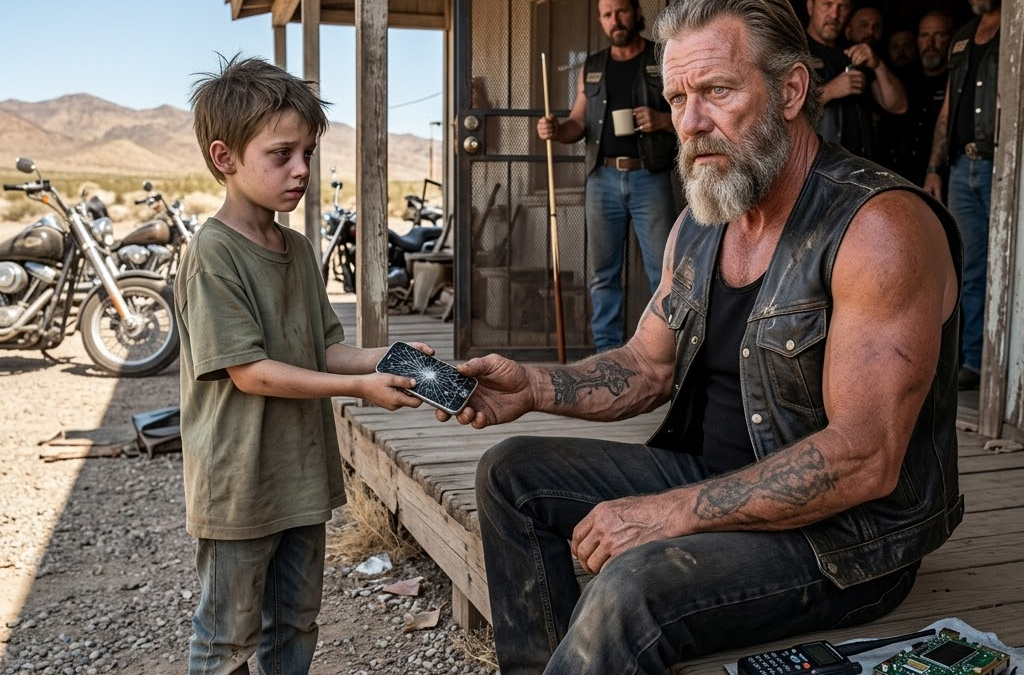
Then lost track because a man on the porch looked up.
He was enormous.
At least six-three.
Maybe taller.
Black vest.
Gray-streaked beard.
Thick forearms.
Faded roses and thorn tattoos wrapping his left arm.
His leather looked old enough to remember presidents Levi had never heard of.
Levi stopped at the gravel.
His heart pounded.
The man was holding a police radio with its casing removed.
Tiny screws rested in a perfect row on a folded rag.
Circuit board balanced in one hand.
A precision pick in the other.
That confused Levi.
Dangerous men were not supposed to repair tiny electronics carefully.
The man looked up.
Pale gray-green eyes.
“You lost?”
“No, sir.”
“Wrong street?”
“No, sir.”
Levi walked closer.
Each crunch of gravel sounded huge.
At the bottom step, he lifted the phone.
“My grandpa said to find somebody who isn’t scared of anything.”
The man’s eyes moved to the phone.
“And?”
“Charge it.”
Behind the screen door, conversation stopped.
Not instantly.
One voice.
Then another.
Then silence.
The biker set down the radio.
“Charge it?”
“Yes, sir.”
He held out one massive hand.
Levi placed the phone into it.
The man tilted it.
Saw the swollen back.
His face changed.
“Where’d you get this?”
“My grandpa.”
“He know you’re here?”
“He’s missing.”
The man looked at Levi again.
Properly this time.
Dust on his legs.
Split sneaker.
Dry lips.
Dark circles beneath his eyes.
“How old are you?”
“Nine.”
“Does your mother know you’re here?”
“She knows where I went.”
That was technically not true.
The biker recognized child-lawyer language instantly.
“She know before you left?”
Levi’s chin trembled.
“No, sir.”
The man closed his eyes.
“Fantastic.”
He looked through the screen door.
“Wendell.”
A thin older man with a silver ponytail appeared.
Patch on his vest:
PRESIDENT.
“What?”
“We have a situation.”
Wendell looked at Levi.
“That appears to be a child.”
“Very observant.”
“Whose?”
“Unknown pending investigation.”
Levi said:
“My mom’s.”
Wendell stared at Cyrus.
“Wonderful.”
The big man’s name was Cyrus Lockheart.
Fifty-eight.
Former Army signal specialist.
Former Arizona Department of Public Safety communications technician.
Tower climber.
Electronics repairman.
Occasional search-and-rescue volunteer.
Current unofficial miracle worker for every broken radio within three counties.
The town knew only one other thing.
Hell’s Angel.
Technically, the Gates Avenue chapter used an affiliated charter name rather than the exact mythology people whispered.
Nobody in Kingman cared about distinctions.
Leather was leather.
Motorcycles were motorcycles.
Fear simplified everything.
Cyrus stood.
“Boy’s name?”
“Levi.”
“Levi, I’m Cyrus.”
Levi nodded.
Cyrus lifted the phone.
“This battery can burn your house down.”
Levi’s eyes widened.
“Really?”
“Really.”
“But can you fix it?”
“Maybe.”
“You scared?”
Something moved at the corner of Cyrus’s mouth.
“Of the battery?”
“Yes.”
“Healthy amount.”
Levi frowned.
“Grandpa said somebody who wasn’t scared of anything.”
“Your grandpa gave you bad instructions.”
Levi looked devastated.
Cyrus added:
“Brave people are scared of plenty.”
He opened the screen door.
“Come inside.”
Levi hesitated.
Cyrus looked at him.
“You walked all this way.”
“Yes.”
“So now you’re scared?”
Levi looked at eleven men staring from inside.
One held a pool cue.
One held a doughnut halfway to his mouth.
One had hands black with grease.
Another wore reading glasses and was doing a crossword.
“Yes, sir.”
“Good.”
Cyrus nodded.
“Means your brain works.”
He held the door.
“Come on.”
Inside smelled of coffee, leather, dust, and machine oil.
No beer bottles at ten in the morning.
No drugs.
No guns lying everywhere like television.
Just men.
Old furniture.
Pool table.
Photographs.
A memorial wall.
American flag.
Arizona flag.
Coffee station.
One younger rider with a shaved head said:
“We’re a motorcycle club, Cy, not Best Buy.”
Cyrus looked at him.
“Jed.”
“What?”
“When your bike died outside Seligman at midnight last June, who did you call?”
Jed stared at the floor.
“You.”
“Did I tell you we’re a motorcycle club, not a tow truck?”
“No.”
“Get the kid a root beer.”
Jed set down the cue.
“Yes, Dad.”
“Say that again and I’ll adopt you legally just so I can disinherit you.”
Several men laughed.
Levi smiled despite himself.
Cyrus took out his phone.
“Your mother’s number.”
Levi gave it.
Six rings.
Voicemail.
Cyrus left a message.
“Ma’am, my name is Cyrus Lockheart. Your son Levi is at the clubhouse at the end of Gates Avenue. He arrived on foot. He is safe. He is sitting with me. I’m repairing his grandfather’s phone at his request. He will not leave here without you. Please call.”
Then text.
Same message.
Wendell watched.
“You realize if she calls the sheriff—”
“She should.”
“This building and the sheriff’s department aren’t exactly pen pals.”
“Then maybe they’ll visit.”
Levi looked between them.
“Do police not like you?”
Wendell sighed.
“Son, police do not exist as one giant personality.”
Cyrus said:
“Some like us.”
Jed entered with root beer.
“Some really don’t.”
Wendell glared.
“Educational moment ruined.”
The repair room surprised Levi most.
It looked like a laboratory hidden behind a biker bar.
Microscope.
Soldering station.
Oscilloscope.
Bench power supply.
Drawers labeled in Cyrus’s handwriting.
CONNECTORS.
FUSES.
MOSFETS.
RADIO PARTS.
DO NOT TOUCH OR DIE POORLY.
Levi read the last label.
“Is that serious?”
Cyrus looked.
“Mostly.”
He pulled on safety glasses.
“Sit.”
Levi sat.
“Tell me everything about your grandpa.”
So Levi did.
Alvin Pel.
Seventy-nine.
Mail carrier.
Missing Tuesday.
Deputy Brisco.
The phone call in August.
The warning Monday night.
The broken phone.
The stores.
Cyrus worked while listening.
Heat along the phone’s edge.
Plastic pry tool.
Slow pressure.
The rear panel lifted.
Everyone in the doorway leaned away.
Battery swollen like a silver pillow.
Jed whispered:
“Damn.”
Cyrus did not look up.
“That word costs a dollar when children are present.”
Jed stared.
“You swear constantly.”
“My clubhouse.”
Wendell said:
“Pay the dollar, Jed.”
Jed reached into his pocket.
Levi almost laughed.
Cyrus removed the battery carefully with a nonconductive tool and placed it in a steel container filled with sand.
“Stan.”
A heavyset gray-haired rider stepped forward.
His vest did not explain that he had spent twenty-six years as a hospice nurse.
Cyrus handed him the container.
“Outside rail. Open air.”
Stan carried it like something alive.
Levi asked:
“Can batteries explode?”
“Yes.”
“Have you seen one?”
“Yes.”
“Was it cool?”
“No.”
Cyrus stared at him.
“It was expensive.”
The charging port was corroded.
The screen cable damaged.
Board had likely been bent during a fall.
Cyrus connected wires directly to test points.
Power supply.
Four volts.
Levi barely breathed.
“Now?”
“Now we ask politely.”
Cyrus pressed the power button.
Nothing.
Levi’s face fell.
Then—
white flash.
One corner of the screen.
Gone.
Another.
Gone.
Cyrus leaned closer.
“There’s a heartbeat.”
Levi sat forward.
“You can fix it?”
“Maybe.”
“Grandpa said it would work.”
“Your grandfather sounds extremely confident for a man who didn’t repair phones.”
“He was confident about mail.”
“That I believe.”
Cyrus examined the board under magnification.
Broken trace.
Microscopic.
Repairable.
“Give me an hour.”
Levi nodded.
Then tires exploded across gravel outside.
Two vehicles.
One civilian.
One sheriff’s cruiser.
Cyrus looked at the clock.
10:52.
A woman’s voice came through the front room.
“LEVI!”
He closed his eyes.
“That’s Mom.”
Gwen Hartwell entered like fire wearing blue medical scrubs.
Thirty-four.
Hair half fallen from a knot.
Eyes red.
Face pale.
She saw Levi.
Crossed the room.
Dropped to her knees.
Grabbed him.
“Do you have any idea what you did?”
“I’m sorry.”
“Two and a half miles.”
“I left a note.”
“A note?”
She pulled him into her chest.
For ten seconds anger disappeared.
Only terror remained.
Then she stood.
Saw the leather.
The men.
The room.
Cyrus in safety glasses.
“What did you do to him?”
“Root beer,” Jed said.
Wendell elbowed him.
Cyrus kept his hands flat on the bench.
“Ma’am, nothing.”
“You brought my son into a Hell’s Angels clubhouse.”
“He brought himself.”
“You let him stay.”
“I wasn’t sending a nine-year-old back onto the street.”
Behind Gwen, Deputy Neil Brisco entered.
Mirrored sunglasses.
Tan uniform.
Right hand near his belt.
The front room changed.
Bodies straightened.
Conversations died.
Twenty years of mistrust condensed into one doorway.
Brisco looked at Cyrus.
“Mr. Lockheart.”
“Deputy.”
“That phone belongs to a missing person.”
Cyrus nodded.
“Correct.”
“It may contain evidence.”
“Also correct.”
“You had no authority to open it.”
Cyrus looked at him.
“Wednesday you told this family Alvin left voluntarily.”
Brisco’s jaw moved.
“That doesn’t mean—”
“If he voluntarily left, you told them there was no active criminal case.”
“We opened a missing-person report.”
“Then why isn’t anyone looking?”
Brisco removed his sunglasses.
“This isn’t your jurisdiction.”
Cyrus’s voice stayed quiet.
“Neither is a broken radio until yours quits.”
The room tightened.
Wendell stepped closer.
“Sigh.”
Cyrus did not look away.
Levi said:
“Grandpa told me the phone has the answer.”
Everybody looked at him.
“He said don’t let anybody tell me it’s not worth saving.”
Gwen sat slowly.
Something inside her had run out.
“I took it to three stores.”
Her voice trembled.
“Three.”
She looked at Cyrus.
“They all said no.”
Then at Brisco.
“And you said wait.”
Brisco began:
“Mrs. Hartwell—”
“No.”
Her voice sharpened.
“My father called you in August.”
Brisco’s eyes shifted.
“You dismissed him.”
“I evaluated the information—”
“You called him lonely.”
Brisco said nothing.
Levi whispered:
“Five minutes.”
Gwen looked at him.
“Mom, give him five.”
She closed her eyes.
Opened them.
“Neil.”
Brisco looked at her.
“Five minutes.”
He hesitated.
Then:
“I stand here.”
Cyrus nodded.
“Wouldn’t want it any other way.”
Back at the microscope, Cyrus’s hands trembled.
Barely.
Nobody else saw.
He did.
That frightened him more than the deputy.
What if nothing was there?
Grocery list.
Catfish photographs.
Old-man rambling.
What if he resurrected the phone only to destroy the last hope a boy had?
For one second, memory returned.
Storm.
Army radio site.
Twenty-six-year-old Cyrus keeping a generator alive while soldiers on another ridge depended on communication.
He remembered what Sergeant Morales had told him.
Hands don’t need confidence.
They need a job.
Cyrus breathed.
Found the torn trace.
Hair-width copper.
He stripped a microscopic strand from fine wire.
Placed it across the break.
Jed stood behind him.
Without being asked, he adjusted the lamp.
Cyrus said:
“Left.”
Jed moved left.
“Hold.”
Jed froze.
Solder.
One end.
Other end.
Cyrus exhaled.
Pressed power.
Black screen.
Then gray.
Then white.
Then—
the lock screen.
A photograph of Levi missing a front tooth, holding a catfish nearly as long as his arm.
Levi gasped.
“That’s me.”
Gwen covered her mouth.
Cyrus said:
“Code?”
Levi typed six numbers.
His birthday.
The phone opened.
One percent battery.
Cyrus immediately connected external power.
“Don’t touch anything.”
Levi frowned.
“Why?”
“Rule one. Never watch the only copy.”
He copied storage to a laptop.
Checked it twice.
Only then opened files.
Not much.
Contacts.
Calendar.
Photos.
One video.
Recorded Tuesday.
5:52 a.m.
Length:
3 minutes, 41 seconds.
Cyrus stared.
“This is the last file.”
Levi whispered:
“Grandpa made it.”
Wendell stood in the doorway.
“Bring it out.”
Cyrus looked at him.
“Everybody needs to see.”
The front room had filled.
The chapter’s noon meeting was approaching.
Twenty-three men now.
Some in vests.
Some work clothes.
Retired school-bus mechanic.
Long-haul truckers.
Hospice nurse.
Roofer.
Electrician.
Volunteer firefighter.
A former Marine missing two fingers.
An accountant nobody in town would have imagined spending Saturdays here.
They gathered around the television.
Cyrus connected the laptop.
11:46 a.m.
Gray image appeared.
Porch.
Predawn sky.
Old man.
Alvin Pel.
Gwen made a sound.
Levi grabbed her hand.
On-screen, Alvin adjusted the phone.
“Levi.”
The room became absolutely still.
“If you’re watching this, buddy, then I didn’t make it home for supper.”
Levi started crying without sound.
“I’m sorry about that.”
Alvin looked tired.
Canvas jacket.
Postal cap.
Behind him, far away, a red beacon blinked on a ridge.
Cyrus went rigid.
“Wendell.”
“What?”
“That tower.”
Alvin continued.
“There’s a boy named Dylan Rusk.”
Brisco’s face changed.
“Sixteen.”
Gwen looked at him.
“He walked out of a group home in Bullhead City back in June.”
Alvin rubbed his mouth.
“I found him in August.”
Brisco went pale.
“I told Deputy Brisco.”
Every head turned toward him.
Nobody said anything.
That was worse.
Alvin continued.
“Boy’s been living around the Bonanza Number Three workings below Dry Saddle.”
Cyrus whispered:
“Jesus.”
Alvin:
“I’ve taken him groceries every Tuesday.”
On-screen, his expression hardened.
“I told the deputy there was a kid out there.”
Brisco stared at the floor.
“He said nobody had lived there since 1982.”
Levi watched the deputy.
The old man continued.
“Dylan wouldn’t come with me at first.”
“He doesn’t trust adults much.”
“Can’t say I blame him.”
Several men shifted.
“Last week he told me his leg was hurt.”
“Fall near the mine.”
“Wouldn’t show me.”
“Yesterday he finally did.”
Alvin shook his head.
“It’s bad.”
“I’m going out this morning.”
“I’m bringing him down whether he likes it or not.”
“Now listen.”
He pointed toward the ridge behind him.
“See that red light?”
Cyrus already knew.
“Site Fourteen,” he whispered.
Alvin said:
“Look left of that tower to the low saddle.”
“Mine’s below it.”
“North on 93.”
“Chloride Junction.”
“East at the windmill missing its tail.”
“Nine cattle guards.”
“Third crossing Boulder Wash.”
He leaned toward the camera.
“If the wash is running, you do not cross.”
Cyrus closed his eyes.
He had crossed that area Thursday.
Boulder Wash road was gone.
Alvin:
“I’ve seen that wash move a Peterbilt.”
Then the old man looked directly into the phone.
“Levi.”
The boy pressed himself against Gwen.
“Don’t give this to just anybody.”
“Give it to somebody who isn’t scared of anything.”
Cyrus’s jaw tightened.
“Somebody who’ll go.”
The room changed.
Not dramatically.
No speeches.
No order.
But Mac Rollins, sixty-three-year-old volunteer firefighter, stood.
Walked out.
Stan followed.
“Trauma kit.”
Jed set down his root beer.
“Water.”
Two others moved toward the door.
On-screen, Alvin continued.
“Bring blankets.”
“Bring rope.”
“Dylan may not be able to walk.”
Outside, an engine started.
Then another.
Alvin smiled faintly.
“And buddy…”
Levi sobbed.
“I love you.”
“I’ll see you at sup—”
The screen died.
11:49.
Black.
Nobody moved for one heartbeat.
Two.
Cyrus turned.
“The road at Boulder Wash is gone.”
Brisco looked up.
“What?”
“I saw it Thursday.”
“How do we reach Dry Saddle?”
“Not Alvin’s way.”
Cyrus pointed toward the frozen frame where the red tower had been.
“Site Fourteen is the state repeater on Black Ridge.”
“I serviced it for years.”
“Service road comes off Mineral Park.”
“Gate.”
“You have a key?”
“Combination.”
“Authorized?”
Cyrus looked at him.
“Probably expired in 2019.”
Wendell smiled.
“Good enough.”
Brisco said:
“I need to call search and rescue.”
He lifted his radio.
Static.
Tried again.
Nothing.
Cyrus stared at it.
“When did your coverage start getting bad?”
Brisco frowned.
“Wednesday.”
Cyrus swore.
“Site Fourteen.”
“What?”
“If commercial power went down in Monday’s storm and the backup batteries lasted forty hours…”
Brisco understood.
“Repeater.”
“Dead.”
Wendell looked around.
The pool table was already abandoned.
Door open.
Men moving.
Cases of water.
Rope.
Medical kits.
Rain gear.
Blankets.
Tools.
He smiled once.
“Well.”
He looked at Cyrus.
“Meeting adjourned.”
11:50.
Four minutes after the video began playing, the clubhouse was nearly empty.
Fourteen motorcycles.
Five pickups.
One shop truck.
Deputy Brisco stood in the doorway.
Jed returned for water.
Looked at him.
“Deputy.”
Brisco stared.
Jed lifted the case.
“You riding or standing?”
That sentence hit harder than any accusation.
Brisco ran for his cruiser.
Gwen climbed into Stan’s truck with Levi.
Cyrus appeared.
“No.”
Gwen looked at him.
“What?”
“Kid stays.”
Levi erupted.
“No!”
Cyrus ignored him.
“Terrain’s bad.”
“My grandpa’s there.”
“Exactly.”
“You said somebody has to go.”
“Adults.”
Levi’s eyes filled.
“He made the video for me.”
Cyrus hesitated.
Wendell said quietly:
“Sigh.”
“What?”
“You’re not winning.”
Cyrus looked at Gwen.
“This is your decision.”
Gwen looked at Levi.
Then at the mountains.
“If he stays, I stay.”
Cyrus swore under his breath.
“Fine.”
He crouched in front of Levi.
“You do exactly what I say.”
“Yes.”
“If I say stop?”
“Stop.”
“If I say sit?”
“Sit.”
“If I say go back?”
Levi hesitated.
Cyrus’s eyes hardened.
“If I say go back?”
“Go back.”
“Good.”
At 11:53, Cyrus started his Harley.
The convoy rolled down Gates Avenue.
People came onto porches.
A little girl on a tricycle waved.
Her mother pulled her back instinctively.
Then saw the sheriff’s cruiser following the bikers.
Confusion replaced fear.
Levi watched from Stan’s truck.
Fourteen motorcycles ahead.
Chrome.
Leather.
Dust.
The people his mother had warned him about.
Going to find his grandfather because a dead phone asked them to.
They reached Mineral Park Road at 12:29.
Service road at 12:34.
Cyrus dismounted.
Old gate.
Combination lock.
He tried four numbers.
Nothing.
Again.
Nothing.
Wendell raised an eyebrow.
“Memory?”
“Shut up.”
Third try.
Click.
Shackle opened.
Cyrus smiled.
“Never changed it.”
Brisco shook his head.
“I’m going to pretend I didn’t see that.”
Cyrus opened the gate.
“You’re learning.”
The road climbed.
Rough.
Motorcycles struggled.
Several riders transferred gear into pickups.
At the top stood Site 14.
One hundred fifty-foot lattice tower.
Red beacon dark in daylight.
Concrete equipment shelter.
Cyrus opened it.
Inside:
dead silence.
All rack lights dark.
“Damn.”
Jed reached for his wallet.
Cyrus glared.
“Not now.”
He opened the battery cabinet.
Dead string.
Commercial feed off.
Brisco stood behind him.
“My handheld’s been dropping calls.”
“Of course.”
“Dispatch said terrain.”
“Terrain didn’t change Wednesday.”
Stan backed the shop truck toward the building.
Generator.
Extension.
Cyrus worked.
Eleven minutes.
Cable.
Jump pack.
Fuse check.
Temporary feed.
Levi stood in the doorway watching enormous hands move through wires.
The same hands that had fixed the phone.
Same hands that had opened a gate.
Same hands doing another impossible thing because something needed working.
At 12:58, amber light.
Then green.
Rack fans spun.
Repeater hummed.
Brisco’s handheld erupted:
“Unit Fourteen, copy?”
Everyone froze.
Brisco grabbed it.
“Dispatch, Fourteen.”
Static.
Then:
“Fourteen, where the hell have you been?”
Brisco closed his eyes.
“Dispatch, I need SAR and state air support to Bonanza Number Three workings below Dry Saddle.”
“Two subjects.”
“One elderly male.”
“One juvenile male, sixteen, probable leg injury and infection.”
“Ground team moving.”
Pause.
Then Brisco added:
“And get everything I say on record.”
Cyrus looked at him.
That mattered.
Not because it fixed August.
Nothing fixed August.
But because Brisco had finally decided not to hide behind uncertainty.
They moved on foot.
One-point-eight miles.
Broken rock.
Wind.
Sky bruising southwest.
Storm coming.
Cyrus led.
Levi beside him.
At first Levi insisted he could keep up.
After half a mile, his split sneaker worsened.
Cyrus stopped.
Took tape from his tool pouch.
Wrapped the shoe.
Levi looked at him.
“You carry tape?”
“Civilization is held together by tape.”
At one mile, Gwen began struggling.
Stan took her pack.
She protested.
He ignored her.
At one-point-five, Mac Rollins looked at the sky.
“Thirty minutes before rain.”
Cyrus nodded.
They climbed faster.
At 1:34, Dry Saddle appeared.
Two ancient timbers marked the mine entrance.
Dark hole in the earth.
In front, white stones spelled:
HELP
One letter looked newer.
Different hand.
Signal mirror on a rock.
Cyrus shouted:
“ALVIN PEL!”
Wind.
Nothing.
Levi took a step.
“Grandpa?”
Silence.
Gwen grabbed his shoulder.
Then from inside the mine:
“You’re late.”
Levi screamed:
“GRANDPA!”
He ran.
Cyrus caught his shirt.
“Wait!”
“Let me go!”
“Mine could be unstable.”
“That’s my grandpa!”
Then Alvin appeared.
Twenty feet inside.
Sitting against feed sacks.
Gray with dust.
Lips cracked.
Face gaunt.
But smiling.
Cyrus released Levi.
The boy ran.
Alvin opened both arms.
Levi collided with him.
The old man folded around his grandson.
Neither spoke.
They shook.
Gwen entered next.
Saw her father.
Stopped.
The last four days came out of her in one sound.
“Dad.”
Alvin looked up.
“Hi, Gwen.”
She hit him.
Not hard.
Flat palm to shoulder.
“You idiot.”
“I know.”
Then hugged him.
Beside Alvin lay Dylan Rusk.
Sixteen.
Thin enough to look twelve.
Skin pale.
Hair filthy.
Left shin splinted with bent tent poles and duct tape.
Sweat on his face despite the cold cave.
Mac knelt.
“Dylan?”
The boy’s eyes snapped open.
Saw leather.
Tattoos.
Beards.
Then saw Brisco’s uniform farther back.
Panic.
“No.”
He tried to move.
Pain stopped him.
“No police.”
Mac raised both hands.
“Easy.”
Dylan’s eyes moved toward Cyrus.
“Who are they?”
Mac smiled.
“Bunch of bikers.”
Dylan stared.
“Oh.”
His body relaxed.
Cyrus would remember that forever.
The boy was more afraid of the deputy than twenty Hell’s Angels.
Mac examined the leg.
Pulse.
Temperature.
Redness.
Swelling.
“Fracture.”
“Probably tibia.”
“Infection around an open wound.”
Stan checked vitals.
“Fever.”
Mac looked at Cyrus.
“Another day gets ugly.”
Dylan whispered:
“I told him to leave.”
Alvin rubbed the boy’s shoulder.
“He’s dramatic.”
“You almost died.”
“So did you.”
Levi sat beside his grandfather.
“What happened?”
Alvin drank water slowly.
“Wash took the Jeep.”
“Tuesday?”
“Afternoon.”
“I tried walking Wednesday.”
“How far?”
“Three miles.”
“Why’d you come back?”
Alvin looked at Dylan.
“Couldn’t leave him.”
Levi frowned as though the answer were obvious.
“Of course.”
Alvin looked at his grandson.
Then at Cyrus.
“Phone?”
Cyrus smiled.
“Stubborn.”
Alvin nodded.
“Like its owner.”
Extraction began.
Dylan into litter.
Jed at front.
Stan rear.
Mac walking beside.
“Look at me, kid.”
Dylan gripped Jed’s sleeve.
“I hate heights.”
“Then don’t look at the rocks.”
“What do I look at?”
“My ugly face.”
Dylan managed a weak laugh.
Alvin refused the second litter.
“I can walk.”
He stood.
Nearly fell.
Cyrus caught him.
“You can absolutely not walk.”
“I walked mail routes thirty-six years.”
“That was before you became dehydrated and stupid.”
Alvin stared at Cyrus.
“You Lockheart?”
Cyrus paused.
“How do you know?”
“State tower man.”
Cyrus smiled.
“Long time ago.”
Alvin looked at his hands.
“Phone?”
“Yeah.”
The old man nodded.
“I chose right.”
Cyrus looked away.
Brisco heard.
At the tower, helicopter arrived at 3:03.
Rain beginning.
Dylan loaded first.
His hand would not release Jed’s vest.
“You coming?”
Jed looked at the medic.
Then Dylan.
“I’ll meet you there.”
“You promise?”
Jed froze.
Cyrus saw something pass through him.
“Yeah.”
Jed put his hand on Dylan’s shoulder.
“I promise.”
The boy released him.
Alvin waited wrapped in a blanket.
Before boarding, he motioned Cyrus over.
Line of bikes and trucks stood in the desert.
Men soaked in first rain.
Machines covered in dust.
Alvin looked.
“Thirty-six years carrying mail.”
Cyrus listened.
“Four hundred six boxes.”
The old man smiled faintly.
“You know what mail teaches you?”
“What?”
“Never judge what’s inside by the envelope.”
Cyrus said nothing.
“I’ve carried ugly envelopes with birthday checks.”
“Pretty envelopes with divorce papers.”
“Registered letters that ruined people.”
“Postcards that saved marriages.”
Alvin looked toward the bikers.
“This town saw leather.”
“Made up its mind.”
He looked at Brisco.
“Same way people saw an old man talking about a runaway kid.”
Brisco lowered his eyes.
Alvin’s voice remained gentle.
“Son.”
Brisco stepped closer.
“Yes, sir.”
“I told you in August.”
“I know.”
“You didn’t listen.”
“No, sir.”
“Why?”
Brisco swallowed.
“Because I thought you were lonely.”
Alvin nodded.
“I am lonely.”
Brisco looked confused.
“Still saw the boy.”
No excuse remained.
Brisco removed his campaign hat.
Held it against his chest.
“I’m sorry.”
Alvin studied him.
“Good.”
Brisco looked surprised.
Alvin continued.
“Be sorrier next time someone tells you something strange.”
“Yes, sir.”
“Write it down.”
Brisco took out his notebook.
Alvin almost smiled.
“Now you’re learning.”
The helicopter lifted.
Storm broke fifteen minutes later.
Brown water filled washes.
Had they waited another hour, ground access would have become much harder.
That night, Kingman Regional Medical Center admitted both Alvin and Dylan.
Dylan went to surgery.
Steel rod.
Debridement.
Antibiotics.
Surgeon told the county caseworker:
“Another twenty-four to forty-eight hours untreated and we might be discussing limb loss.”
Alvin had dehydration.
Bruised hip.
Mild kidney injury.
Nothing permanent.
He complained about dinner.
Levi sat beside his bed.
“You said you’d see me at supper.”
Alvin looked at the hospital tray.
“This hardly counts.”
Gwen laughed for the first time in days.
Across the hall, Dylan woke at 2:17 a.m.
He did not know where he was.
Panicked.
Then saw Jed asleep in a chair.
Leather vest over his face.
The biker had promised.
So he came.
Dylan relaxed.
The investigation afterward embarrassed several institutions.
The group home in Bullhead City had reported Dylan Rusk missing in June.
But records showed the search had been downgraded quickly after staff described him as a “chronic runaway.”
He had left twice before.
Always returned.
This time he didn’t.
A caseworker had attempted follow-up.
Staff turnover swallowed it.
County jurisdiction confusion did the rest.
One agency assumed another had active responsibility.
A database entry existed.
A missing-person bulletin had been issued.
But nobody connected Dylan to Alvin’s August report because Deputy Brisco had never entered the old man’s tip into the formal system.
Brisco admitted it.
Publicly.
That surprised everyone.
The sheriff called him into a closed-door meeting.
Rumors spread.
Suspension.
Termination.
Discipline.
What happened was more complicated.
Brisco received a formal reprimand.
Required retraining.
Internal review.
He nearly resigned.
Alvin stopped him.
The deputy visited the hospital.
No sunglasses.
He stood beside Alvin’s bed.
“I should quit.”
Alvin bit into terrible hospital toast.
“Why?”
“I failed that kid.”
“Yes.”
Brisco flinched.
Alvin continued.
“You quitting help him?”
“No.”
“Help the next one?”
“No.”
“Then staying might be harder.”
Brisco stared.
“That’s your advice?”
“My advice is do your job better.”
Brisco almost smiled.
“You don’t make things easy.”
“Never promised to.”
Dylan’s story became harder.
His mother had died three years earlier.
Father incarcerated.
Rotating placements.
He had spent years learning that adults often meant:
temporary.
He ran from the group home after another older boy assaulted him.
He told staff.
Nothing changed fast enough.
So he left.
The desert felt safer.
At first, he slept in drainage culverts.
Then found the Bonanza mine.
Alvin discovered him while driving old Route 3 roads for nostalgia.
The first time, Dylan threw a rock at his Jeep.
Alvin returned the next Tuesday with canned soup.
Dylan did not come out.
Alvin left it.
Next week:
water.
Peanut butter.
Bandages.
Third week, Dylan spoke.
“You cops?”
Alvin said:
“Do I look like a cop?”
Dylan stared at the postal cap.
“You look like somebody’s grandpa.”
“Accurate.”
Trust took months.
When Alvin called Brisco in August, Dylan disappeared deeper into the hills for four days.
Alvin learned the wrong lesson and the right one simultaneously.
The wrong lesson:
don’t involve police.
The right lesson:
don’t stop showing up.
After rescue, Dylan refused to return to the group home.
The county had a problem.
Then Alvin said:
“He can stay with me.”
Gwen nearly choked.
“You are seventy-nine.”
“Still have a spare room.”
“You just got rescued from a mine.”
“So?”
“You cannot foster a sixteen-year-old.”
The caseworker said:
“Actually—”
Gwen turned.
“Don’t encourage him.”
Temporary kin-like placement required background checks, home inspection, legal approvals.
Alvin completed everything.
Gwen became emergency contact.
Cyrus testified as a character reference.
The caseworker raised an eyebrow.
“A Hell’s Angel?”
Cyrus looked at his vest.
“Apparently.”
Dylan moved into Alvin’s spare room six weeks later.
The first night, he slept on the floor.
Bed felt too soft.
Alvin did not argue.
Second week, mattress.
Third week, he asked for a desk.
Levi visited every Tuesday.
At first Dylan barely tolerated him.
Then they built a model motorcycle together.
By Christmas, Dylan called him “kid.”
Levi called him “old man.”
Dylan was seventeen.
It became their joke.
The Gates Avenue clubhouse changed too.
Not in the sentimental movie way.
They did not become a charity headquarters overnight.
They still argued.
Still swore.
Still scared people.
Some members had criminal histories.
Some didn’t.
They were not secretly saints.
That mattered.
Good actions did not erase bad ones.
Bad reputations did not erase good actions.
People were more complicated than envelopes.
But the rescue became a fault line in town.
People who had spent years crossing the street when motorcycles approached now brought food to the annual toy drive.
The sheriff’s office began using Cyrus for radio maintenance under a formal volunteer agreement.
Wendell framed the paperwork.
Title:
AUTHORIZED TECHNICAL CONSULTANT.
Cyrus hated it.
Jed taped another label beneath:
BEST BUY.
Cyrus fined him five dollars.
Three weeks after the rescue, Deputy Brisco drove to Gates Avenue alone.
No official call.
No backup.
He parked.
Walked across gravel.
Cyrus sat on the porch repairing a handheld radio.
Brisco stopped at the bottom step.
For a moment, he looked exactly like Levi had.
Uncertain.
Out of place.
Cyrus looked up.
“You lost?”
Brisco almost smiled.
“My squelch knob sticks.”
Cyrus stared at him.
Brisco held out the radio.
“Left side.”
“I know where the squelch is.”
“Just explaining the problem.”
“Badly.”
Brisco waited.
Cyrus extended his hand.
The deputy placed the radio in it.
Then did something no one expected.
He sat on the porch step.
Two feet from Cyrus.
Watched him work.
After several minutes, Brisco said:
“Why’d you help the kid?”
“Levi?”
“Yeah.”
Cyrus kept working.
“Needed help.”
“That’s it?”
“Should there be more?”
Brisco looked toward the gravel lot.
“My dad hated bikers.”
Cyrus snorted.
“Mine hated cops.”
Brisco laughed.
“So we’re even.”
“No. Your uniform’s uglier.”
They sat in silence.
Then Brisco said:
“I keep hearing Alvin’s voice.”
Cyrus knew which part.
You’ll listen next time.
“Good.”
Brisco looked at him.
“Good?”
“Means it stuck.”
Months passed.
Dylan healed.
Limp at first.
Physical therapy.
Pain.
Anger.
One afternoon he threw a crutch across Alvin’s living room.
“I hate this.”
Alvin looked up from the newspaper.
“Understandable.”
“I hate everybody asking if I’m okay.”
“Also understandable.”
“I hate that people know.”
“Yep.”
Dylan stared.
“You gonna say anything helpful?”
Alvin folded the paper.
“No.”
Dylan almost smiled.
That was why they worked.
Alvin did not try to turn Dylan into a gratitude project.
He gave him rules.
School.
No drugs.
No disappearing overnight.
Tell somebody where you’re going.
Dylan broke rules.
Alvin enforced consequences.
They fought.
Then ate dinner.
Again.
Again.
Again.
Trust built not through speeches but repetition.
Levi spent more time at Gates Avenue too.
Only with permission now.
Gwen’s rule changed.
No longer:
Never past Eighth Street.
Now:
Never past Eighth Street without telling me exactly where you are.
Cyrus taught Levi basic electronics.
First lesson:
batteries.
“Respect stored energy.”
Levi nodded solemnly.
Second:
soldering.
Third:
radios.
By ten, Levi could identify resistors.
By eleven, he fixed his first flashlight.
By twelve, he told Cyrus his bench organization was inefficient.
Cyrus threatened exile.
Wendell laughed for ten minutes.
One year after the rescue, Alvin returned to the clubhouse carrying a package.
Inside:
an old rural mailbox.
Dented.
Sun-faded.
Route 3.
Box 406.
The last mailbox on his old route.
“What am I supposed to do with this?” Wendell asked.
“Mount it.”
“Why?”
“For people who need help.”
Cyrus stared.
Alvin explained.
“Anonymous note.”
“Name if they want.”
“Problem.”
“Somebody checks it.”
Wendell frowned.
“You’re proposing a help mailbox at a biker clubhouse.”
“Correct.”
“That is ridiculous.”
“Yes.”
They mounted it.
At first, jokes.
Then a note appeared.
Single mother needed help fixing brakes.
Jed did it.
Another:
elderly man needed wheelchair ramp.
Six riders built it.
Another:
teen needed work after juvenile detention.
Cyrus found him sweeping shop floors.
Not every request could be solved.
Some they referred to professionals.
Some were scams.
Some were impossible.
But the mailbox remained.
The town called it Box 406.
Alvin loved that.
Two years after the mine rescue, Dylan graduated high school.
Barely.
He hated algebra.
Loved automotive technology.
His cap had a tiny postal eagle pin Alvin gave him.
Gwen cried.
Levi screamed louder than anyone.
Cyrus and twenty riders sat in the back row.
The principal looked nervous until Wendell handed him a donation check for the trade program.
Dylan walked across the stage with no limp.
When his name was called:
“Dylan Rusk.”
Then a pause.
The counselor added quietly:
“Pel-Hartwell family.”
Not legal.
Just chosen.
Dylan looked at Alvin.
The old man cried openly.
Afterward, Dylan found Brisco near the parking lot.
The deputy had come in uniform.
Dylan stopped.
Their relationship had never become warm.
Too much history.
Brisco said:
“Congratulations.”
“Thanks.”
Silence.
Then Dylan asked:
“You really ignored him?”
Brisco did not pretend not to understand.
“Yes.”
“Why?”
“Because I thought I knew what kind of story I was hearing.”
Dylan stared.
Brisco continued.
“Old man.”
“Remote mine.”
“Runaway kid.”
“Sounded unlikely.”
Dylan’s jaw tightened.
“So I almost lost my leg because it sounded unlikely.”
“Yes.”
There was no safe answer.
Brisco gave the true one.
Dylan looked away.
Brisco said:
“I can’t ask you to forgive that.”
“Good.”
“I can tell you I haven’t forgotten it.”
Dylan looked back.
Brisco pulled a small notebook from his pocket.
Worn.
Pages filled.
“I write everything down now.”
Dylan stared.
Then almost smiled.
“Alvin did that to you?”
“Unfortunately.”
They shook hands.
Not forgiveness.
Beginning.
Years later, people told the story wrong.
Stories simplify.
They said:
A boy walked into a Hell’s Angels clubhouse and ordered them to charge a phone.
Not exactly.
They said:
Twenty-three bikers instantly rescued a grandfather.
More complicated.
They said:
The sheriff refused to search.
Partly true.
They said:
The bikers knew exactly where to go.
No.
They figured it out because Cyrus recognized a tower.
They said:
The phone contained GPS coordinates.
It didn’t.
They said:
Alvin had planned the entire rescue.
He hadn’t.
He had planned for somebody to listen.
That was different.
The famous part became the four minutes.
People loved that.
3:41 video.
Four minutes later:
empty clubhouse.
Photographs circulated of motorcycles leaving Gates Avenue.
People captioned them:
WHEN HELL’S ANGELS BECAME ANGELS.
Cyrus hated that most.
“We’re not angels.”
He told a reporter.
“Then what are you?”
“People.”
“Dangerous people?”
Cyrus looked at him.
“Sometimes.”
“Good people?”
“Sometimes.”
“So what’s the lesson?”
Cyrus hated reporters who demanded lessons.
He pointed toward Box 406.
“The lesson is probably stop deciding what somebody is before they do something.”
The reporter wrote that down.
Cyrus groaned.
At seventy-nine, Alvin had become accidentally famous.
He refused television interviews.
Accepted one newspaper conversation because the reporter had delivered mail in college.
They asked why he trusted Levi with the phone.
“I didn’t.”
The reporter blinked.
“You didn’t?”
“I trusted that boy not to quit.”
“Different thing.”
“Very.”
“Why tell him to find somebody who wasn’t scared?”
Alvin smiled.
“Bad phrasing.”
“Why?”
“Cyrus corrected me.”
The reporter laughed.
Alvin continued.
“Fear’s useful.”
“You really meant somebody who wouldn’t look away.”
The reporter paused.
“That’s better.”
“Most things are after somebody edits them.”
Alvin lived six more years.
Long enough to see Dylan complete a diesel-mechanics certification.
Long enough to see Levi start high school.
Long enough to watch Deputy Brisco become sergeant.
Long enough to see Cyrus finally replace the sign in his repair room after Levi corrected a spelling error.
Alvin died at eighty-five.
Sleep.
Home.
Nothing dramatic.
On Tuesday.
Of course.
His funeral procession included postal trucks.
Sheriff’s cruisers.
Family cars.
And thirty-seven motorcycles.
Gwen stood beside the grave holding Levi’s hand.
Levi was fifteen now.
Tall.
No missing tooth.
Cyrus stood on the other side.
Dylan carried the old postal cap.
Brisco removed his campaign hat.
When the service ended, Levi placed one object on the casket.
Not the repaired phone.
That was too important.
A printed copy of the final video transcript.
At the bottom he had written:
SOMEBODY WENT.
After the funeral, they gathered at Gates Avenue.
Levi sat on the porch.
Cyrus beside him.
For a while, nobody talked.
Then Levi asked:
“Was Grandpa scared?”
Cyrus looked at him.
“In the mine?”
“Yeah.”
“Probably.”
“He always seemed like he wasn’t.”
“Most adults are performing.”
Levi smiled.
“Were you scared fixing the phone?”
Cyrus thought.
“Yes.”
“Of the battery?”
“That too.”
“What else?”
“That there’d be nothing on it.”
Levi turned.
“You never said that.”
“Didn’t need to.”
“What if there was nothing?”
Cyrus looked across the gravel.
“I would’ve fixed the phone anyway.”
Levi nodded slowly.
Then said:
“You know what Grandpa got wrong?”
“What?”
“He said find somebody who isn’t scared.”
“Yeah.”
Levi looked at Cyrus.
“You were scared.”
“Correct.”
“You just did it anyway.”
Cyrus smiled.
“That’s usually the trick.”
At eighteen, Levi joined the Army.
Signal Corps.
Gwen blamed Cyrus.
Cyrus blamed Alvin.
Dylan blamed nobody and bought Levi a decent soldering iron as a graduation gift.
Before Levi left for training, he visited Gates Avenue.
Same porch.
Cyrus older.
More gray.
Hands beginning to ache with arthritis.
Levi brought a broken radio.
Cyrus looked at it.
“You did this on purpose.”
“Maybe.”
“What broke?”
“Squelch knob.”
Cyrus stared.
Levi grinned.
“Left side.”
Cyrus understood.
The same problem Brisco had brought years earlier.
He held out his hand.
Levi set the radio in it.
They repaired it together.
No speech.
Didn’t need one.
By then Box 406 had collected hundreds of notes.
Some trivial.
Some serious.
One changed county policy.
A teenager wrote anonymously that his little sister was being hurt at home.
Because of the mailbox, someone listened.
Proper authorities intervened.
That child was removed safely.
Brisco later stood on the porch staring at Box 406.
“Funny.”
Cyrus looked up.
“What?”
“One old mailbox gets more honest reports than half the forms downtown.”
“Maybe because mailboxes don’t interrupt.”
Brisco nodded.
He had learned to listen.
Years after Alvin’s death, Dylan returned to Bonanza Number Three.
Not alone.
Cyrus came.
So did Levi, home on leave.
Gwen refused at first.
Then went too.
The mine entrance had been sealed by the county after the rescue.
Concrete barrier.
Warning signs.
Dylan stood where the white HELP stones had once been.
Wind moved through Dry Saddle.
He looked toward Black Ridge.
Tower still visible.
Red light blinking at dusk.
“Thought I’d die here.”
Nobody answered.
Dylan continued.
“First month I lived out here, I wanted to disappear.”
Gwen touched his arm.
He looked at her.
“Then that old man kept bringing soup.”
She laughed.
“Dad’s love language was canned food.”
“He never asked me to tell him my story.”
“That was Dad.”
“He just came back.”
Dylan looked at Levi.
“Every Tuesday.”
Levi smiled.
“Mailman.”
Dylan nodded.
“That mattered.”
Cyrus understood.
People liked dramatic rescue.
Helicopter.
Motorcycles.
Storm.
But Alvin had really saved Dylan long before the helicopter.
One grocery bag at a time.
One Tuesday at a time.
Showing up until a boy who trusted nobody finally let one old man close enough to see his broken leg.
That was the part headlines missed.
The rescue began in August.
Not October.
Not with a phone.
With consistency.
At sunset they left Dry Saddle.
Levi turned once.
The mine disappeared behind rocks.
Black Ridge beacon blinked.
Same light visible in Alvin’s video.
One red pulse.
Dark.
One red pulse.
Dark.
Signal.
That was what Cyrus had spent his life repairing.
Signals.
Radios.
Phones.
Repeaters.
Tiny electronic systems whose only purpose was to make sure one human voice could reach another across distance.
He had once believed machines did that.
After Levi, he knew better.
Machines only carried the signal.
Someone still had to listen.
Cyrus retired from climbing towers at sixty-two.
From electronics repair at seventy.
From motorcycles never.
His hands became slower.
Levi took over some repair work whenever he was home.
Eventually another young rider learned.
The bench remained.
So did the sign.
TOOLS DO NOT LEAVE THIS ROOM.
AND NEITHER DO YOU WITHOUT CLEANING UP.
One Saturday morning, almost twenty years after Levi first walked down Gates Avenue, a child appeared at the edge of the gravel.
Not Levi.
A girl.
Eleven.
Backpack.
Bicycle beside her with the chain hanging loose.
Cyrus, now nearly eighty, sat on the porch.
His beard had gone almost white.
The girl’s eyes widened when she saw him.
“You Hell’s Angels?”
Cyrus looked at his vest.
“Depends who’s asking.”
She swallowed.
“My bike broke.”
Cyrus looked at the chain.
Then at her.
“Parents know you’re here?”
“Yes.”
“You sure?”
She held up her phone.
“My mom told me to come.”
Cyrus stared.
“Your mother told you to come to Gates Avenue?”
“She said there are people here who fix things.”
Behind Cyrus, Levi laughed.
Home on leave again.
Dylan, now a foreman at a diesel shop, sat at the coffee table.
Sergeant Brisco—retired—was losing badly at pool.
The town had changed.
Not completely.
No town does.
But enough.
Cyrus stood carefully.
Knees complaining.
“Bring it around back.”
The girl smiled.
“You can fix it?”
Cyrus looked at the bicycle.
“Probably.”
“What if you can’t?”
Levi answered from the porch:
“He’ll find somebody who can.”
The girl rolled the bike toward them.
On her way, she passed Box 406.
She stopped.
“What is that?”
Dylan looked up.
“A mailbox.”
“I know.”
“What’s it for?”
Cyrus glanced at Levi.
Levi smiled.
“For when something needs somebody.”
The girl considered that.
Then wheeled her bicycle on.
Years earlier, nine-year-old Levi Hartwell had stood in that exact gravel holding a dead phone.
Everybody in town had told him what kind of people lived there.
Dangerous.
Criminal.
Trouble.
His mother had warned him never to cross Eighth Street.
Three stores told him the phone was garbage.
A deputy had told the family to wait.
The battery was swollen.
The screen shattered.
The board damaged.
His grandfather missing.
Everything about the situation said:
Too late.
Too dangerous.
Not worth it.
Levi walked anyway.
Cyrus opened the phone.
The phone opened a trail.
The trail led to a tower.
The tower restored a radio.
The radio summoned a helicopter.
The helicopter carried out a boy almost forgotten by everyone whose job had been to remember him.
And somewhere in those four minutes between an old man’s face appearing on a clubhouse television and the last motorcycle firing in the gravel, twenty-three men made the same decision without discussing it.
They could not save everybody.
They could not undo what Brisco missed.
They could not repair Dylan’s childhood.
They could not put the washed-out road back.
They could not guarantee Alvin was alive.
They could not promise the storm would wait.
But they had seen.
They knew.
And once they knew, they had a choice.
Stay.
Or go.
Four minutes later, the clubhouse was empty.
Years afterward, when Levi tried to explain that morning to people who knew only the viral version, they always asked the same question.
“What was on the phone that made twenty-three Hell’s Angels run out of the building?”
Levi would smile.
Because the answer was not coordinates.
Not treasure.
Not evidence of some conspiracy.
Not money.
Not blackmail.
Not even really the missing grandfather.
What was on the phone was an old man saying:
There is a hurt kid out there.
I tried to reach him.
I couldn’t get back.
Somebody needs to go.
That was all.
And for the right people, it was enough.
The town had spent years staring at leather vests and deciding what was inside them.
Alvin had spent thirty-six years staring at envelopes and knowing better.
Levi had been nine years old and desperate enough to ignore every warning.
Cyrus had been fifty-eight and wise enough to open the door.
Deputy Brisco had been wrong and eventually brave enough to admit it.
Dylan had been sixteen and abandoned long enough to believe nobody came back.
Alvin came back every Tuesday.
Then when he couldn’t—
Levi came.
Cyrus came.
Twenty-three bikers came.
A deputy came.
A helicopter came.
And for the first time in Dylan Rusk’s life, more people arrived than left.
That was what emptied the clubhouse.
Not fear.
Not anger.
Not some biker code about revenge.
A sentence from a dying battery.
A voice from a cracked screen.
A person in trouble.
And twenty-three men deciding, almost at the same moment, that knowing meant they could no longer sit still.








