A 9-Year-Old Boy Threw Rocks at a 69-Year-Old Hells Angel—Then He Pointed Uphill and the Biker Saw a Driverless Truck Racing Toward 200 People at the Market
PART3:
Lauren had called it a good event involving people Beckett did not need to bother.
“Stay clear of those men,” she had said that morning while buttering toast.
“They’re collecting toys.”
“I know.”
“For sick kids.”
“I know.”
“So they’re good.”
Lauren looked at him.
“That is not how the world works.”
Beckett frowned.
“If somebody does something good, doesn’t that make them good?”
“It means they did something good.”
“What’s the difference?”
“A bigger conversation than we have time for.”
She put his toast on the plate.
“Just don’t wander around talking to strangers in leather vests.”
“So regular strangers are okay?”
“Beckett.”
He smiled.
She tried not to.
That was the conversation still floating through his head when they reached the stone wall near Grand and Fifteenth.
And that was where Beckett saw Harvey Norwood for the first time.
Harvey had his back to him.
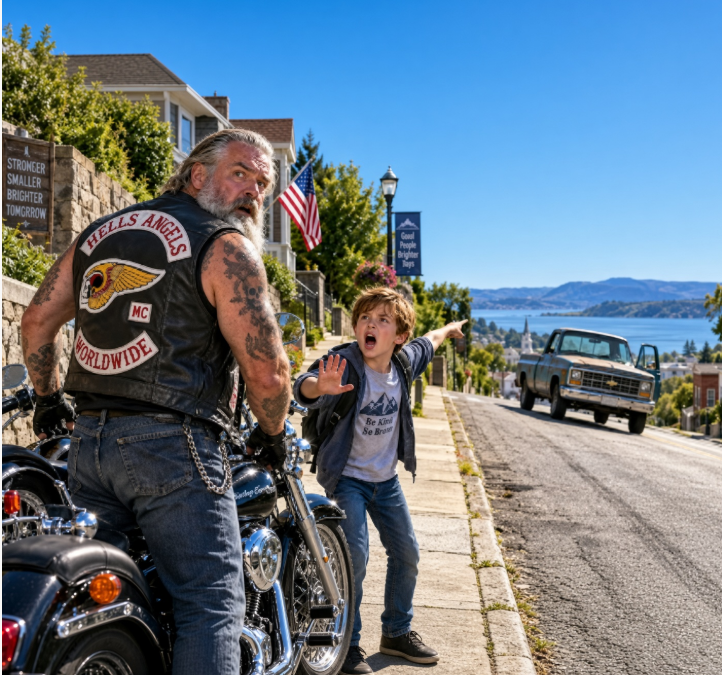
The man was crouched beside a black Harley-Davidson Road King parked nose-out against the stone retaining wall.
He was enormous.
Not overweight.
Just built with the kind of broad shoulders that made a leather vest look less like clothing and more like armor.
His beard was silver-white.
Long enough to hide most of his collar.
His hair matched, pulled behind his ears.
Both forearms were covered in old tattoos softened by time.
A skull and roses on one arm.
Military insignia buried among faded lines on the other.
The large red-and-white patch across his back was the first thing Beckett recognized.
Hells Angels.
He had seen it on television.
Seen adults glance toward it and then glance away.
Harvey was holding a wrench in one hand and working near the lower frame of the motorcycle.
He looked neither dangerous nor friendly.
He looked irritated at a bolt.
That disappointed Beckett slightly.
Dangerous-looking people were supposed to do something interesting.
Harvey did not even notice him.
Beckett shifted his chairs and squeezed along the sidewalk.
One sneaker brushed the stone wall.
A loose capstone wobbled beneath his foot.
He steadied himself.
Then glanced back.
The giant biker remained crouched.
Wrench.
Bolt.
Motorcycle.
Patient as the wall beside him.
Beckett kept walking.
He did not know Harvey was sixty-nine.
Did not know the man had spent thirty-one years hauling timber through the Oregon Coast Range.
Did not know Harvey had once driven loaded logging trucks over rain-slick grades that made Grand Avenue look gentle.
Did not know that before the beard turned gray, before the motorcycle club, before the truck-driving years, Harvey had served three years in the United States Army with a heavy-equipment recovery unit stationed in West Germany.
Nobody in Astoria knew any of that.
They knew the patch.
And people were often satisfied when a patch gave them permission not to ask questions.
Harvey preferred it that way.
He had discovered a long time ago that explaining yourself to strangers was exhausting.
People who feared the vest would fear it regardless of whether he told them about the toy drives.
People who hated bikers would find reasons.
People who admired them often admired the wrong things.
Harvey had stopped trying to control first impressions somewhere around his fiftieth birthday.
He knew who he was.
That had to be enough.
At least, most days.
He tightened the stubborn bolt another quarter turn.
His right knee complained.
“Yeah, yeah.”
He spoke to his own body often now.
Not because he was lonely.
Because knees apparently responded better when insulted.
He shifted.
His back answered with a deeper ache.
The Road King had developed a kickstand problem the previous afternoon.
Harvey could have asked one of the younger members for help.
He refused.
There were two things Harvey Norwood disliked admitting.
That he could not fix a motorcycle problem himself.
And that he had gotten old enough for something to become difficult simply because the ground was too low.
His club brother Merl Quaid had offered.
Harvey told him to get coffee.
Merl had said:
“You know, one day you’re gonna die under that motorcycle just because you were too proud to ask a man to hold the flashlight.”
Harvey replied:
“Then make sure you bury me with the correct wrench.”
Merl left.
Now Harvey worked alone.
At the bottom of the hill, the market was waking.
Lauren set her chairs beside Jinny Talmage’s flower stall.
Jinny was sixty-one, widowed, cheerful, opinionated, and professionally incapable of seeing something without eventually having information about it.
Her stall overflowed with dahlias.
Sunflowers.
Late-season lavender.
Baskets of peaches from an orchard outside Hood River.
“Morning, Lauren.”
“Morning.”
“Beckett.”
“Morning, Ms. Talmage.”
“Those bikers have got half the tourists in town standing around staring at them instead of buying flowers.”
Beckett looked toward the fairgrounds.
Rows of motorcycles gleamed.
Lauren unfolded a table.
“They’ll buy eventually.”
“Not if they spend all their money on leather.”
Beckett asked:
“Do Hells Angels buy flowers?”
Jinny considered.
“Somebody’s probably disappointed if they don’t.”
Lauren gave Beckett a look.
“Don’t start interviewing bikers.”
“I wasn’t.”
“You were thinking about it.”
“That’s different.”
Lauren pointed at the table.
“Help.”
They worked several minutes.
Then Beckett remembered the red rubber ball he had left on the porch.
“Can I go get my ball?”
Lauren looked up.
“By yourself?”
“I know the way.”
“That was not my concern.”
“I’ll go straight there.”
“And?”
“Straight back.”
“And?”
Beckett sighed.
“Don’t talk to strangers.”
“Especially?”
“Large tattooed strangers wearing motorcycle club patches.”
Jinny laughed.
Lauren did not.
“Ten minutes.”
Beckett ran.
He passed the bakery stall.
Smelled cinnamon.
Nearly forgot why he was going home.
Then kept moving.
Up the hill.
The market noise faded behind him.
Halfway up, his legs began burning.
He slowed.
A wind chime clicked somewhere.
A gull cried over downtown.
A dog barked behind a fence.
Then Beckett heard something else.
Low.
Mechanical.
Wrong.
At first he thought somebody had started a car.
Then he realized there was no engine.
Just tires.
Rolling.
And a metallic tick.
Tick.
Tick.
Beckett looked uphill.
Mr. Pelletier’s Chevrolet was moving.
For one second, his brain rejected what his eyes saw.
The truck belonged in the driveway.
It had always been in the driveway.
Objects did not simply abandon where they belonged.
Then the rear tire rolled over the wooden chock.
The chock kicked sideways.
The truck moved another foot.
Then two.
Then the weight took over.
The Chevrolet rolled from the driveway onto Grand Avenue.
No driver.
Engine off.
Nose pointed downhill.
Beckett’s stomach turned cold.
He knew exactly what lay below it.
His house.
Harvey.
The intersection.
The market.
His mother.
The bakery stall.
Jinny’s flowers.
The bounce house he had watched volunteers inflate.
Families.
Strollers.
Children.
Two hundred people.
The truck picked up speed.
“Truck!”
Beckett screamed.
His voice cracked.
“THE TRUCK!”
A woman watering baskets looked up.
“What?”
“STOP THE TRUCK!”
She turned toward him, not uphill.
A man walking a golden retriever paused.
Nobody understood.
The Chevrolet moved faster.
Beckett ran downhill.
“TRUCK!”
Harvey remained crouched beside the motorcycle.
Too far.
His back turned.
Generator noise and market music rising from below.
Beckett screamed again.
Nothing.
He realized with terrifying clarity that he could not reach Harvey before the truck did.
There was no time to explain.
No time to run around and touch him.
He looked at the wall.
Loose capstones.
His hands moved before he had a plan.
He grabbed one.
Fist-sized.
Heavy.
Threw.
The rock missed Harvey completely.
It struck pavement near his boot.
Harvey barely reacted.
Beckett grabbed another.
“HEY!”
He threw harder.
The stone hit Harvey square between the shoulder blades.
Flat.
Hard.
Harvey surged upright.
The wrench dropped.
He spun.
His face changed so quickly Beckett stopped breathing.
Fury.
Pure instinctive anger.
The expression of a man struck unexpectedly from behind.
“What the hell—”
Jinny had wandered partway uphill looking for a late flower delivery van.
She saw the exact wrong moment.
Nine-year-old Beckett.
Rock in hand.
Harvey Norwood turning around.
“Beckett Sorenson!”
Her voice cracked like a whip.
“STOP THAT!”
Officer Trent Ridley was working market foot patrol a block below.
He heard Jinny.
Looked up.
Saw a child throwing rocks at a giant biker.
His entire brain filled in the story before his eyes had gathered the facts.
He began running.
“HEY!”
Harvey took one step toward Beckett.
Not to hurt him.
Beckett did not know that.
Neither did anyone else.
The boy’s face was white.
Tears already in his eyes.
He grabbed a third rock.
Harvey’s anger sharpened.
“Kid, put that—”
Beckett pointed uphill.
Could not get enough breath.
“TRUCK!”
Harvey looked.
Everything inside him changed.
The blue-and-white Chevrolet was coming.
Fast.
No driver.
No engine noise.
Nose shifting slightly as the tires bounced over uneven pavement.
Harvey forgot the rock.
Forgot Beckett.
Forgot his knee.
His back.
His age.
His motorcycle.
He moved.
Boots pounded pavement.
He ran uphill toward the truck.
Jinny froze.
Officer Ridley stopped mid-stride.
Beckett dropped the stone.
Harvey cut across a narrow front yard.
Destroyed a row of dahlias.
Caught himself against a mailbox.
Kept moving.
The truck had momentum.
Harvey had angle.
He had seen runaway equipment before.
Not this truck.
Not this hill.
But gravity did not care where you learned its rules.
He remembered logging roads.
Rain coming sideways through headlights.
Fully loaded Kenworths descending grades with brakes hot enough to smell.
Young drivers panicking when air pressure changed.
He remembered Germany.
M88 recovery vehicles.
Steel tracks.
Mud.
Instructors shouting that heavy equipment never forgave hesitation.
You control weight before weight controls you.
The truck swept past.
Harvey lunged.
Grabbed the passenger-door handle.
It opened.
He stepped onto the running board.
For one terrible instant, his left boot slipped.
His body swung outward.
The pavement blurred beneath him.
Harvey slammed his forearm against the window frame.
Held on.
Then threw himself across the bench seat.
His hip hit hard.
Pain shot through his back.
He ignored it.
The engine was off.
No power steering.
No power brakes.
The wheel felt like concrete.
He reached for the emergency brake.
Old hand-operated lever.
Exactly where memory told him it should be.
Harvey pulled.
Nothing.
Rust.
Stiff cable.
“Come on.”
The truck accelerated.
Downhill, Officer Ridley finally understood.
He grabbed his radio.
“Runaway vehicle! Grand Avenue descending toward Twelfth! Clear the market entrance! Clear the street now!”
Jinny turned.
Ran downhill.
“MOVE!”
People stared.
“MOVE! GET OUT OF THE STREET!”
A vendor laughed nervously.
“What?”
“TRUCK!”
Then they heard it.
Tires.
Metal.
Someone screamed.
Panic spread.
Lauren looked uphill.
Saw Beckett.
Running.
Saw the truck.
And for half a second could not connect them.
Then she understood her son had been up there.
Near it.
“BECKETT!”
He barely heard her.
Harvey hauled the emergency brake again.
The lever moved one inch.
Not enough.
The truck passed a parked gray hatchback.
Harvey pulled the steering wheel right.
Without power assist, the wheel resisted.
His arthritic knuckles screamed.
His shoulder burned.
The truck barely changed direction.
For the first time, doubt hit him.
Not fear of dying.
Fear of being too old.
There had been a time when Harvey Norwood could throw chains across timber in freezing rain and climb a trailer like a ladder.
A time when his grip did not fail.
A time when knees and reflexes obeyed without negotiation.
That man had been gone longer than Harvey liked admitting.
The thought appeared cold and clean:
You are not what you were.
Then another thought followed.
One his Army instructor had shouted forty-eight years earlier.
Do the job you have, not the job you wish you had.
Harvey planted one boot against the transmission hump.
Grabbed the brake lever with both hands.
Pulled.
The cable groaned.
The truck hit the steepest grade.
Market tents filled the street below.
People were running.
Some carrying children.
Some frozen because panic had stolen whatever instructions they had heard.
Lauren saw the truck and then saw Beckett farther uphill.
Alive.
Running.
She nearly collapsed.
Instead she screamed:
“GET CLEAR!”
Harvey yanked the brake.
The cable caught.
Rear drums grabbed.
The truck shuddered sideways.
Rubber shrieked.
Harvey forced the wheel right.
The Chevrolet slammed against the stone retaining wall.
Sparks exploded.
The passenger mirror tore away.
Chrome folded.
Metal screamed against granite.
The truck slowed.
Not enough.
But some.
Harvey held the wheel.
The cab shook violently.
His teeth slammed together.
He smelled brake lining.
Metal.
Dust.
He saw a dog scramble away from the curb.
A stroller abandoned near a tree.
A woman dragging a toddler by the hand.
The market entrance ahead.
Hay bales.
Pumpkins.
Wooden autumn display.
Behind it, people.
Too many.
Harvey had one option.
He aimed for the display.
Officer Ridley reached the lower intersection.
He waved both arms.
“CLEAR!”
Jinny grabbed a child.
A Rotary volunteer hauled two toddlers from the bounce house by their overalls.
Lauren pushed three people behind a vendor truck.
The Chevrolet came sideways down the final block.
Stone scraping.
Sparks.
A trail of broken trim behind it.
Harvey’s hands locked around the wheel.
He saw the hay bales.
Adjusted.
Five degrees.
Maybe less.
Enough.
The pickup hit.
Hay exploded.
Pumpkins shattered.
The truck plowed through the display.
Struck an empty cart.
Sent it spinning.
Then stopped.
Eleven feet from the market arch.
Eleven feet from children.
Eleven feet from Lauren Sorenson.
Silence.
Absolute.
One rear wheel kept spinning.
Tick.
Tick.
Tick.
Hay floated in the air.
Then sound returned all at once.
Children crying.
People shouting.
Generator humming.
Somebody praying.
Officer Ridley reached the cab first.
He yanked open the driver’s door.
Harvey was slumped sideways.
Both hands still gripping the wheel.
“Sir!”
Harvey blinked.
“Can you hear me?”
“Unfortunately.”
Ridley nearly laughed from relief.
“Ambulance is coming.”
“I’m fine.”
Harvey tried to stand.
His legs disagreed.
Ridley grabbed his shoulder.
“Sit.”
“Anybody hurt?”
“No.”
Harvey looked around.
“Anybody?”
“No.”
Ridley’s voice changed.
“Because of you.”
Harvey looked away.
“Because of the kid.”
Ridley followed his gaze.
Beckett stood at the edge of the wreckage.
White-faced.
Trembling.
Hay stuck in his hair.
Lauren reached him first.
She dropped to her knees.
Pulled him into both arms.
“Beckett.”
She said his name again.
And again.
Not sentences.
Just proof.
“Beckett.”
He finally cried.
Not politely.
Not quietly.
The kind of crying that came after fear had nowhere left to go.
“I’m sorry.”
Lauren held him tighter.
“For what?”
“I threw rocks.”
“What?”
“At him.”
She looked toward Harvey.
“He couldn’t hear me.”
Beckett tried to breathe.
“I hit him.”
Lauren looked confused.
Harvey stepped from the truck.
His knees shook.
He ignored them.
Walked toward Beckett.
Lauren stiffened.
Harvey stopped several feet away.
Then lowered himself onto one knee.
Slowly.
Painfully.
So he would not tower over the boy.
“Hey.”
Beckett looked at him.
“I hit you.”
“Yep.”
“Twice.”
“One missed.”
Beckett blinked.
Harvey reached behind himself.
Touched the bruise.
“Second one was pretty good.”
Beckett’s face crumpled.
“I’m sorry.”
Harvey shook his head.
“No.”
He pointed toward the truck.
“You saw something nobody else saw.”
“I yelled.”
“I didn’t hear you.”
“So I…”
“You made me turn around.”
Beckett nodded.
Harvey looked directly at him.
“You did exactly right.”
Lauren stared.
Beckett whispered:
“But I threw a rock at you.”
“You had maybe ten seconds.”
Harvey’s voice softened.
“You used what you had.”
Officer Ridley approached.
His face showed embarrassment.
“I thought…”
Harvey looked at him.
“I know what you thought.”
Ridley swallowed.
“I was about two seconds from grabbing the boy.”
“Good thing you looked uphill.”
Ridley winced.
Harvey looked back at Beckett.
“That took nerve.”
Beckett shook his head.
“I was scared.”
“Same thing.”
Beckett frowned.
Harvey explained:
“Courage isn’t when you’re not scared.”
“It’s when you know exactly how scared you are and still do the job.”
The crowd had gathered.
Jinny stood nearby.
Her face pale.
“I yelled at him.”
Nobody answered.
She looked toward Beckett.
“I saw you throwing rocks.”
Her voice shook.
“I didn’t look up the hill.”
Harvey nodded.
“Most people see the part they expect.”
Jinny’s eyes moved to his vest.
Then back to him.
The implication hurt.
Harvey noticed.
He did not rescue her from it.
Some lessons needed to sting enough to remain.
Lauren stood.
She looked at Harvey.
“Thank you.”
Harvey shook his head.
“Kid did the first important thing.”
“You got into the truck.”
“Because he turned me around.”
Harvey’s club brothers arrived from the fairgrounds.
Merl Quaid was first.
Thin.
Gray mustache.
Helmet still under one arm.
He stopped beside the wreck.
Looked at Harvey.
Then the truck.
Then Harvey again.
“What the hell did you do?”
Harvey sat heavily on the running board.
“Fixed a parking problem.”
Merl stared.
“You drove that?”
“Temporarily.”
Officer Ridley said:
“He jumped into it while it was moving.”
Merl looked at Harvey with new irritation.
“You’re sixty-nine.”
“So I’ve been told.”
“You have a bad knee.”
“Also been told.”
“And you decided to jump into a runaway truck?”
Harvey nodded toward Beckett.
“The kid threw rocks at me.”
Merl looked at the boy.
“That explains absolutely nothing.”
Later it would.
Paramedics checked Harvey.
Bruised shoulder.
Strained back.
Elevated blood pressure.
Small cut on one forearm.
Nothing broken.
Harvey considered that an acceptable report.
Mr. Pelletier arrived fifteen minutes later.
No coat.
House slippers.
Face drained of color.
“My truck.”
Then he saw the market.
Saw the hay.
The destroyed display.
The distance between the bumper and the crowd.
He sat on the curb.
“Oh, God.”
Harvey watched.
Mr. Pelletier looked toward him.
“I don’t know…”
His voice disappeared.
Harvey waited.
“The parking brake.”
Harvey nodded.
“I’ve been meaning to fix it.”
The confession came out like pain.
“For three years.”
Lauren closed her eyes.
Mr. Pelletier looked sick.
“I had the cable checked.”
“Garage said it was fraying.”
“I kept the wheel chock.”
“Never moved.”
Harvey said:
“It moved today.”
Mr. Pelletier began apologizing.
Harvey stopped him.
“Apologize once.”
Mr. Pelletier stared.
“Then fix what you can.”
The old man looked toward the children.
Tears filled his eyes.
Harvey softened.
“Nobody died.”
“But they could have.”
“Yes.”
Harvey did not lie.
“Now you know what putting something off can cost.”
Mr. Pelletier nodded.
The police impounded the truck for inspection.
The market reopened two hours later.
Not normally.
Nothing felt normal.
People walked around the damaged entrance taking photographs.
Parents kept children closer.
Every time a vehicle moved uphill, someone looked.
Beckett stayed beside Lauren.
He did not ask for his cinnamon twist.
The baker brought him one anyway.
He held it without eating.
Harvey returned to his motorcycle.
His wrench still lay where it had fallen.
Beckett followed.
Lauren noticed.
Nearly stopped him.
Then didn’t.
Harvey bent carefully.
Picked up the wrench.
Beckett asked:
“Does your back hurt?”
“Yes.”
“Because of the rock?”
“No.”
Harvey looked at him.
“Your rock’s got competition.”
Beckett smiled weakly.
Harvey resumed tightening the bolt.
After a minute, Beckett said:
“My mom said I shouldn’t talk to you.”
Harvey stopped.
Lauren, ten feet away, closed her eyes.
Harvey looked toward her.
Then back at Beckett.
“Your mom told you not to talk to strangers.”
“She said especially bikers.”
Lauren called:
“Beckett.”
Harvey smiled.
“She wasn’t entirely wrong.”
Beckett looked confused.
Harvey explained:
“You shouldn’t automatically trust somebody because they look safe.”
“Okay.”
“And you shouldn’t automatically trust somebody because they do one good thing.”
Beckett thought.
“Then how do you know?”
“You pay attention.”
“To what?”
“What people do repeatedly.”
Beckett looked at the vest.
“What about that?”
Harvey followed his eyes.
“The patch?”
“Yeah.”
“It tells you who I ride with.”
“Does it tell me if you’re good?”
“No.”
“Bad?”
“No.”
“What tells me?”
Harvey considered.
“Time.”
That answer annoyed Beckett because nine-year-olds preferred things that could be known immediately.
Harvey saw it.
“You don’t like that.”
“No.”
“Neither do adults.”
On Tuesday morning, the Daily Astorian ran the story.
The first headline made Lauren furious.
BIKER, BOY AVERT MARKET DISASTER
She stared at it over breakfast.
“Biker.”
Beckett looked up from cereal.
“He is a biker.”
“That’s not the point.”
“What’s the point?”
“They could have used his name.”
“You said you didn’t know it before.”
“We know it now.”
The article called Harvey a “Hells Angels member” three times before mentioning he was a retired timber hauler and Army veteran.
Lauren read it aloud with increasing irritation.
Beckett finally said:
“You told me not to talk to him because he was a Hells Angel.”
Lauren stopped.
Children had a cruel talent for locating hypocrisy without intentionally being cruel.
“I know.”
“Then why are you mad at the newspaper?”
Lauren folded it.
“Because apparently I learned something Sunday.”
“What?”
“That being careful and deciding you already know someone are different things.”
Beckett ate another spoonful.
“So can I talk to him now?”
Lauren sighed.
“Yes.”
“Any biker?”
“No.”
“Why?”
“Because learning one lesson does not mean we throw out all the other ones.”
Beckett nodded.
That seemed reasonable.
At school, the experience was worse.
Teachers congratulated him.
Children asked whether he had really attacked a Hells Angel.
One boy wanted to know whether Harvey threatened him afterward.
Another claimed his uncle said Hells Angels buried people in the desert.
Oregon did not have much desert near Astoria, but facts rarely improved playground legends.
Beckett hated all of it.
He had not felt brave.
He had felt terrified.
He had not thrown rocks because he was fearless.
He had thrown rocks because he was out of choices.
The praise began making him uneasy.
He told Lauren that night.
“I don’t think I’m a hero.”
She sat beside him.
“You don’t have to.”
“Everybody keeps saying it.”
“They’re trying to understand what happened.”
“I almost hit him in the head.”
“You didn’t.”
“But I could have.”
Lauren nodded.
“Yes.”
Beckett looked surprised.
He expected reassurance.
“What if I hurt him?”
“Then we would still have to talk about whether what you did was reasonable based on what you knew.”
He frowned.
“Was it?”
Lauren swallowed.
“I think so.”
“You told me never throw rocks at people.”
“I did.”
“So the rule changed?”
“No.”
She thought carefully.
“Sometimes emergencies are when rules meet reality.”
Beckett looked blank.
“That sounded like school.”
Lauren laughed.
“Fair.”
She tried again.
“The rule is still don’t throw rocks at people.”
“Okay.”
“But if throwing one rock is the only way you can warn somebody before a truck kills people…”
“Then throw?”
“Yes.”
Beckett nodded.
Then:
“What if I’m wrong?”
That question stayed with Lauren.
Because that was the difficult part.
Adults wanted courage to be obvious afterward.
At the moment it was required, courage often looked indistinguishable from a terrible decision.
“You do the best you can with what you know.”
She touched his hair.
“And then you live with the result.”
Across town, Harvey had his own problems.
Merl refused to stop telling everyone Harvey had “commandeered a ghost truck.”
Harvey threatened to remove him from the toy run.
“You can’t.”
“I’m bigger than you.”
“You’re older than dirt.”
Harvey raised one eyebrow.
Merl sat.
The club stayed in Astoria three extra days.
Mostly because Harvey’s knee swelled badly enough that riding was a poor idea.
Partly because everyone wanted to make sure he was all right.
Harvey disliked both reasons.
Wednesday afternoon, Officer Ridley found him sitting outside the fairgrounds drinking coffee.
Ridley approached cautiously.
Harvey noticed.
“You planning to arrest me?”
“No.”
“Then sit.”
Ridley sat.
For a while neither spoke.
Then:
“I owe you an apology.”
Harvey drank coffee.
“For what?”
“I saw Beckett throw the rock.”
Harvey waited.
“I saw your vest.”
Another pause.
“I thought I knew what was about to happen.”
Harvey looked at him.
“You thought I was going to hurt the boy.”
“Yes.”
“Would’ve looked bad if I did.”
Ridley almost smiled.
Harvey continued.
“You’re a cop.”
“You make decisions fast.”
“That’s not an excuse.”
“No.”
Ridley seemed surprised.
Harvey leaned back.
“Fast decisions keep people alive.”
“Lazy decisions get people hurt.”
Ridley nodded slowly.
“How do you know the difference?”
Harvey smiled.
“You don’t always.”
“Helpful.”
“That’s why when you realize you were wrong, you fix it.”
Ridley looked down.
“I apologized to Beckett.”
“Good.”
“I wanted to apologize to you.”
Harvey studied him.
“Accepted.”
Ridley exhaled.
“That easy?”
“No point making you work for something I already decided.”
They talked another hour.
Motorcycles.
Old trucks.
Brake systems.
Army recovery vehicles.
Ridley learned more about Harvey in sixty minutes than half the town had learned in a decade of seeing people like him ride through.
That night Lauren invited Harvey to dinner.
She spent thirty minutes regretting it before he arrived.
Not because she feared him exactly.
Because her house was small.
Because Harvey was huge.
Because she worried the vest would make neighbors stare.
Then she became angry at herself for worrying.
Harvey appeared at six carrying a bakery pie and no club vest.
He wore a clean flannel shirt.
Beckett looked disappointed.
“Where’s the vest?”
Harvey stared.
“Your mother finally invites a dangerous biker to dinner and you complain I dressed respectable.”
Lauren nearly choked.
Beckett laughed.
Dinner became easier after that.
Beckett asked questions through the entire meal.
“How did you know how to get into the truck?”
“I didn’t know.”
“You just did it?”
“I knew enough.”
“What if the door was locked?”
“Would’ve found another option.”
“What?”
“No idea.”
“How did you know where the emergency brake was?”
“Old trucks used similar layouts.”
“Why did you drive logging trucks?”
“Because somebody paid me.”
“Was it dangerous?”
“Sometimes.”
“Did trucks run away?”
“Sometimes.”
“Did you ever crash?”
Harvey looked at Lauren.
“Your son aware breathing is optional between questions?”
“Apparently not.”
Beckett repeated:
“Did you?”
Harvey nodded.
“Once.”
“Bad?”
“Bad enough.”
The room quieted.
Harvey looked at his plate.
“It was 1988.”
“Wet November.”
“We were hauling out of the Coast Range.”
“Driver ahead of me lost braking on a curve.”
“I had nowhere to go.”
Beckett listened.
“He rolled?”
“Yes.”
“Did he die?”
Lauren almost stopped the question.
Harvey answered.
“Yes.”
Beckett lowered his eyes.
“I’m sorry.”
Harvey nodded.
“That’s why you don’t treat grades casually.”
“Weight wants downhill.”
“It never gets tired.”
After dinner, Harvey showed Beckett diagrams.
Brake systems.
Wheel chocks.
Parking-brake cables.
Transmission positions.
He sketched on the back of grocery advertisements.
Lauren watched them.
Harvey’s hands moved differently when teaching.
Slow.
Patient.
He never made Beckett feel foolish.
When the boy misunderstood, Harvey changed the explanation instead of blaming the listener.
At nine, Beckett said:
“You could teach kids this.”
Harvey shrugged.
“I just did.”
“No, like everybody.”
Harvey looked at him.
“Why?”
“Because Mr. Pelletier didn’t know.”
“He knew.”
Beckett frowned.
Harvey said:
“That’s different.”
“He knew his cable needed work.”
“He trusted forty years of luck.”
Beckett thought about that.
“So adults know stuff and still don’t do it?”
Harvey laughed.
“That might be the best description of adulthood I’ve ever heard.”
The next afternoon, Beckett met Mr. Pelletier.
The old man had avoided the Sorenson house.
Shame kept him away.
Eventually he arrived carrying Beckett’s red rubber ball.
It had been found beneath a hedge.
“I think this is yours.”
Beckett took it.
“Thanks.”
Mr. Pelletier stood awkwardly.
“I’m sorry.”
Beckett looked confused.
“You didn’t hit me.”
“No.”
The man swallowed.
“I almost…”
He could not finish.
Beckett looked at him.
Nine-year-olds did not always know when adults wanted forgiveness.
Sometimes they simply answered the question they heard.
“Are you fixing your truck?”
Mr. Pelletier laughed once.
Then tears appeared.
“Truck’s totaled.”
“Oh.”
“I bought another one.”
“Does the parking brake work?”
Mr. Pelletier nodded.
“I had them check it twice.”
“Good.”
Beckett bounced the ball.
“Then okay.”
Mr. Pelletier stood there.
The simplicity nearly destroyed him.
The following spring, Harvey returned.
The Toy Run was months away.
Nobody expected bikers in March.
Beckett was walking home from school when he heard the Road King before seeing it.
Black Harley.
Silver beard.
Same wall.
Beckett ran.
Harvey removed his helmet.
“You get taller?”
“Half an inch.”
“That all?”
“It’s been six months.”
“Lazy.”
Beckett grinned.
Harvey had promised to teach him.
He kept promises.
Saturday afternoon, twelve neighborhood children gathered near Mr. Pelletier’s new truck.
Parents came too.
Some stood far back at first.
Harvey demonstrated wheel chocks.
Inclines.
Brake testing.
How to know when a parking brake was not holding.
How transmission position mattered.
Why you did not crawl beneath an unsecured vehicle.
Why children never tried to jump into moving trucks.
He repeated that part three times.
Beckett raised his hand.
“What if a truck is going toward two hundred people?”
Harvey stared.
“Especially you.”
Everybody laughed.
Harvey did not.
“I mean it.”
Beckett nodded.
Harvey pointed at him.
“What you did that morning was warn somebody.”
“You did not get into the truck.”
“There’s a difference.”
“What if nobody is around?”
“You run clear and call 911.”
“But people could get hurt.”
“Yes.”
Beckett frowned.
Harvey crouched.
“There’s courage.”
“And there’s deciding you’re indestructible.”
“They’re not the same.”
Beckett remembered that.
Over the next two years, Harvey returned often.
Not constantly.
Enough.
Beckett filled notebooks.
Brakes.
Gear ratios.
Mechanical advantage.
Hydraulics.
Grades.
Torque.
He learned how to change oil.
How to inspect tires.
How to recognize worn belts.
Harvey taught him that a machine usually warned you before it failed.
People were often too distracted or cheap or hopeful to listen.
“You listen early,” Harvey said.
“Machines don’t care whether the repair is convenient.”
Lauren began inviting Harvey for dinner without ceremony.
The vest eventually hung over a kitchen chair like any coat.
Jinny stopped referring to “the bikers” and started using names.
Merl.
Harvey.
Pete.
Ramon.
She also started setting aside peaches.
Harvey liked them.
He would never admit how much.
Officer Ridley volunteered every year for market patrol during the Toy Run.
One September, Beckett watched him wave riders through an intersection.
“You used to not like them.”
Ridley looked at him.
“I used to not know them.”
“Same thing?”
“No.”
“Then why’d you act like it was?”
Ridley sighed.
“You’re getting too much like Harvey.”
“Is that bad?”
“Depends who you ask.”
At eleven, Beckett learned something Harvey had never told him.
Harvey had a daughter.
Her name was Claire.
Lauren discovered accidentally when Harvey left his wallet on the kitchen counter and a photograph slipped out.
Young woman.
Maybe forty.
Two teenage girls beside her.
Lauren returned it without asking.
Harvey noticed anyway.
“You saw.”
“I did.”
He waited.
“She’s my daughter.”
Lauren nodded.
“Beautiful family.”
Harvey looked down.
“Haven’t talked in six years.”
Lauren did not ask why.
Harvey appreciated that.
Later, he told her.
Not all at once.
Pieces.
Claire had hated the club.
Not because Harvey had harmed her.
Because childhood with Harvey had often meant waiting.
Toy runs.
Club meetings.
Emergency calls from brothers.
Long rides.
His priorities had not always been where they should have been.
Claire’s husband disliked Harvey too.
Arguments accumulated.
Then one became final.
“You can’t spend your whole life choosing those men and expect me to pretend you chose us too.”
Harvey had responded badly.
Pride.
Anger.
Six years.
No calls.
He still carried photographs.
Beckett eventually learned.
Children always did.
“Why don’t you call her?”
Harvey looked at him.
“Complicated.”
“Is she alive?”
“Yes.”
“Do you know her number?”
“Yes.”
“Then call.”
Harvey stared.
“That’s not how grown-up relationships work.”
Beckett shrugged.
“That’s stupid.”
Harvey almost laughed.
Then realized Beckett was right enough to be irritating.
He did not call that day.
But he thought about it.
The story of the runaway truck became local history.
Children who had not been there told it inaccurately.
Some said Harvey jumped from his motorcycle onto the moving truck.
He did not.
Some said Beckett hit him in the head with a brick.
He did not.
Some said the truck was doing sixty miles per hour.
Impossible.
Harvey corrected nobody unless the lie made him sound more heroic.
Then he corrected it immediately.
“Fifteen at impact.”
He told a reporter.
“Maybe twenty-five at the worst point.”
“Not sixty.”
The reporter said:
“Twenty-five doesn’t sound as dramatic.”
Harvey answered:
“Stand in front of a two-ton truck doing twenty-five and tell me that again.”
The article used twenty-five.
By Beckett’s thirteenth birthday, his interest in mechanics had become serious.
He rebuilt a lawn mower carburetor.
Fixed Jinny’s market generator.
Diagnosed a bad alternator in Lauren’s car before the garage did.
Harvey pretended not to be proud.
“You got lucky.”
“The multimeter said fourteen volts before and eleven after load.”
“Still luck.”
“You taught me that test.”
“Poorly.”
Beckett rolled his eyes.
Harvey smiled when the boy turned away.
Then came the phone call.
Beckett was fourteen.
Harvey had ridden home toward Tillamook after dinner.
Two days later, Lauren’s phone rang.
Harvey had been hospitalized.
Heart rhythm problem.
Not a heart attack.
Close enough to frighten everyone.
Beckett went silent.
He rode with Lauren to visit.
Harvey looked smaller in a hospital bed.
That upset Beckett more than the machines.
Harvey saw his face.
“I’m not dying.”
“You don’t know.”
“Doctors say I’m not.”
“They’re wrong sometimes.”
Harvey raised an eyebrow.
“Very comforting.”
Beckett stood near the bed.
Then suddenly angry:
“You should’ve told us.”
“Told you what?”
“You weren’t feeling good.”
“I was fine.”
“You weren’t.”
Harvey looked at Lauren.
“Your kid’s yelling at me.”
“You earned it.”
Beckett’s hands shook.
“You always tell everybody to listen when something is wrong.”
Harvey became quiet.
“You told Mr. Pelletier.”
“I know.”
“You tell me.”
“I know.”
“But you didn’t.”
Harvey closed his eyes.
That landed.
Beckett continued:
“You said machines warn you.”
“Bodies do too.”
Harvey looked at him.
The boy was not nine anymore.
Not entirely.
“You’re right.”
Beckett’s anger disappeared so quickly it became tears.
“I don’t want you to die.”
Harvey reached out.
Beckett stepped close.
Harvey put one hand behind the boy’s neck.
“Everybody dies.”
“That’s not helpful.”
“No.”
Harvey smiled.
“But not today.”
He recovered.
Slower afterward.
Fewer long rides.
More medication.
More complaints about medical appointments.
The heart scare changed something else.
Harvey called Claire.
Not immediately.
Three weeks later.
He sat alone outside the hospital follow-up clinic.
Phone in hand.
Stared at the number.
Then remembered Beckett at nine.
Rock in hand.
Doing something that looked wrong because every easier option had failed.
Harvey pressed call.
Claire answered.
“Hello?”
Harvey almost hung up.
“Claire.”
Silence.
Long.
“Dad?”
“Yeah.”
Another silence.
“I’m not calling to ask you to forgive anything.”
Her breath changed.
“I’m not calling to explain the club.”
“I’m not calling because I think I was right.”
He swallowed.
“I’m calling because I got old enough to understand waiting for the perfect way to say something is just another way to say nothing.”
Claire did not respond.
Harvey continued.
“I should’ve shown up more.”
“I should’ve listened.”
“I chose people who needed me and used that as an excuse not to notice when you needed me too.”
His voice broke slightly.
“I’m sorry.”
Claire cried first.
Harvey followed.
Not loudly.
The conversation lasted nineteen minutes.
They did not repair six years.
They opened a door.
That was enough for one day.
Months later, Claire visited Astoria during the Toy Run.
Beckett met her.
“You’re the rock kid.”
He looked offended.
“I have a name.”
“So does my dad.”
“Fair.”
She hugged Harvey.
Awkward.
Then again.
Better.
Harvey introduced his granddaughters.
Lauren watched from Jinny’s stall.
Jinny handed her a peach.
“You gonna cry?”
“No.”
“You are.”
Lauren cried.
Jinny pretended not to notice.
Years continued.
Beckett entered high school.
Then college applications.
Mechanical engineering became the obvious choice.
Harvey argued for diesel technology.
“Engineers design bolts where hands can’t reach.”
Beckett replied:
“Then I’ll become the engineer who doesn’t.”
Harvey approved reluctantly.
Beckett wrote his college essay about the truck.
Lauren worried it sounded too dramatic.
Harvey said:
“It happened.”
Beckett did not make himself the hero.
His essay was about uncertainty.
About how he knew only three things that morning.
The truck was moving.
People were downhill.
Harvey could not hear him.
Everything else was guesswork.
He wrote:
Sometimes the best decision available still looks wrong from the outside.
Harvey read that sentence twice.
Then:
“Not bad.”
“That means you like it.”
“No.”
“You read it twice.”
“I forgot the first time.”
Beckett was accepted to Oregon State.
The night before he left, Harvey gave him a small box.
Inside was the wrench he had dropped when Beckett’s rock struck him.
Same one.
Scratched handle.
Old.
Beckett stared.
“You kept this?”
“Apparently.”
“Why?”
Harvey shrugged.
“Tool works.”
Beckett knew better.
On the handle Harvey had engraved two words.
LOOK UP.
Beckett swallowed.
Harvey said:
“Don’t get sentimental.”
“You engraved a wrench.”
“Practical.”
“It says look up.”
“Good safety advice.”
Beckett hugged him.
Harvey stood stiffly for one second.
Then hugged back.
College took Beckett away from Astoria.
But not entirely.
He returned holidays.
Summer.
Toy Run weekend whenever he could.
Harvey aged.
Beard whiter.
Motorcycle heavier.
Eventually he sold the Road King.
That day was worse than the heart scare in some ways.
Merl helped.
Harvey stood watching the buyer ride away.
Beckett said:
“You okay?”
“No.”
“Want me to say something?”
“No.”
They stood there together.
Later Harvey bought a smaller touring bike.
Complained constantly.
Rode it anyway.
At twenty-two, Beckett graduated.
Harvey sat beside Lauren.
Claire beside Harvey.
Two granddaughters.
Jinny sent flowers because travel had become hard for her.
Officer Ridley, now sergeant, mailed a card with twenty dollars and the note:
For the kid I almost arrested.
Beckett laughed for ten minutes.
After graduation he accepted a position with a transportation-safety engineering firm in Portland.
Harvey disliked Portland.
“Too many Subarus.”
“That doesn’t make sense.”
“Doesn’t need to.”
Beckett’s first major assignment involved municipal runaway-vehicle risk on steep urban corridors.
His supervisor asked why he volunteered.
Beckett told him.
The supervisor thought he was joking.
He was not.
Over the next several years, Beckett worked on grade analysis.
Parking-brake failure studies.
Roadside barriers.
Emergency stopping zones.
Public safety systems.
He became obsessed with one principle Harvey had taught him:
Failure rarely begins when the machine finally moves. It begins when the first warning is ignored.
Beckett quoted Harvey in presentations.
Never by title.
Just:
“A retired logger taught me…”
Harvey discovered this at seventy-eight.
“You’re using me in engineering meetings?”
“Yes.”
“You paying royalties?”
“No.”
“Thief.”
At seventy-nine, Harvey stopped riding motorcycles entirely.
His knee finally won.
He hated it.
The club still came.
Merl died first.
Cancer.
Harvey attended the funeral in his vest.
Stood beside the casket.
Said almost nothing.
Afterward Beckett drove him home.
Harvey stared out the window.
“Thirty-eight years.”
“With Merl?”
“Yeah.”
“That’s longer than I’ve been alive.”
Harvey gave him a look.
“Thank you for making the day worse.”
Beckett smiled.
Harvey did not.
Then:
“He knew every bad thing I ever did.”
“And stayed?”
“Yeah.”
“That sounds like family.”
Harvey looked at him.
“Sometimes.”
By then Harvey and Claire had rebuilt their relationship.
Not perfectly.
No fairy tale.
There were still topics that hurt.
Old habits.
Missed years.
But his granddaughters called him Grandpa Harvey.
That mattered.
One summer, one of them asked about the famous rock story.
Harvey told it badly.
“Kid assaulted me.”
Beckett protested.
“I saved your life.”
Harvey shook his head.
“I saved yours.”
“You would’ve stayed crouched and gotten hit.”
Harvey thought.
“Possible.”
“So I saved you.”
“You started it.”
“Gravity started it.”
Claire laughed.
“You two have been having this argument how long?”
“Twenty years,” Lauren said.
Nobody had realized.
Twenty years.
The truck had stopped eleven feet from the market.
Beckett had grown from nine to twenty-nine.
Harvey from sixty-nine to eighty-nine.
Grand Avenue remained steep.
The market remained crowded.
Jinny retired at seventy-eight.
Her flower stall went to her niece.
But every market Sunday, one peach still appeared on the stone wall at Grand and Fifteenth.
Most people no longer knew why.
Beckett did.
Harvey did.
Lauren did.
That was enough.
On the twentieth anniversary, Astoria installed a small safety marker near the hill.
Not a heroic monument.
Harvey refused that.
A plaque no larger than a notebook:
NOTICE EARLY. ACT CAREFULLY. LOOK UP.
Below it:
In recognition of community action during the Grand Avenue runaway vehicle incident.
No names.
Harvey insisted.
Beckett argued.
Harvey won.
The newspaper interviewed them anyway.
The reporter asked Beckett:
“What do you remember most clearly?”
Beckett looked uphill.
Not the truck.
Not the sparks.
Not the crowd.
“The moment everybody thought I was doing something wrong.”
The reporter frowned.
“Why?”
“Because they weren’t stupid.”
“They saw a kid throwing rocks at a man.”
“That looked wrong.”
He glanced at Harvey.
“The problem was they didn’t have the whole picture.”
The reporter turned toward Harvey.
“And you?”
Harvey thought.
“The boy pointing.”
“Not the truck?”
“No.”
“The pointing.”
He smiled.
“I was mad.”
“Real mad.”
“He’d nailed me good.”
Beckett laughed.
Harvey continued.
“Then I saw his face.”
“Kid wasn’t angry.”
“He was terrified.”
“And his finger…”
Harvey pointed uphill.
“…was telling me the part of the story I hadn’t seen yet.”
The reporter asked:
“Did that change how you viewed people?”
Harvey laughed.
“I was nearly seventy.”
“I already had opinions.”
Beckett said:
“It changed mine.”
Harvey looked at him.
“How?”
Beckett watched market visitors pass.
“Before that day, I thought adults knew what was happening.”
Harvey laughed hard.
“Worst myth of childhood.”
Beckett smiled.
“I learned everybody sees pieces.”
“Sometimes the kid sees the truck.”
“Sometimes the cop sees the rock.”
“Sometimes the flower lady sees the vest.”
“Sometimes the biker sees the hill.”
Harvey nodded.
“Put enough pieces together fast enough…”
“You get the truth.”
Harvey corrected:
“You get closer.”
Beckett looked at him.
Harvey shrugged.
“Don’t get arrogant.”
At eighty-nine, Harvey’s health declined.
Not suddenly.
Slowly.
Heart.
Kidneys.
The accumulated bill for a life lived hard.
He moved into Claire’s house outside Salem.
Beckett visited.
Lauren too.
The club came in smaller numbers.
Fewer original members remained.
One rainy afternoon, Beckett found Harvey sleeping in a recliner.
The old vest hung on a chair.
The patches faded.
The leather cracked.
Beckett sat.
Harvey opened one eye.
“You watching me sleep?”
“Making sure you’re breathing.”
“Creepy.”
Beckett smiled.
Harvey closed his eye.
“You still have the wrench?”
“Yes.”
“Use it?”
“Sometimes.”
“That wasn’t supposed to become a shrine.”
“It’s in my toolbox.”
“Good.”
Silence.
Rain tapped the windows.
Harvey said:
“Beck.”
“Yeah?”
“Remember that morning?”
“Obviously.”
“You know why I forgave you so fast?”
Beckett looked over.
“You told me.”
“No.”
“You said I did the right thing.”
“Different.”
Harvey opened his eyes.
“I knew what it felt like.”
“What?”
“To have everybody decide what you were doing before they knew why.”
Beckett stayed quiet.
Harvey looked toward the vest.
“Most of my life, people saw that thing first.”
“Sometimes they were right to be cautious.”
“Sometimes they weren’t.”
“But after enough years…”
He breathed carefully.
“…you start thinking maybe nobody’s gonna bother looking past it.”
Beckett listened.
“Then there you were.”
“Nine years old.”
“Throwing rocks at me.”
Harvey smiled.
“Everybody thought you were the problem.”
“You knew you weren’t.”
“You just needed one person to turn around long enough to see the truck.”
His eyes softened.
“I understood that.”
Beckett’s throat tightened.
“You taught me a lot.”
Harvey grimaced.
“Don’t start.”
“I mean it.”
“No deathbed speeches.”
“You’re not dying today.”
“Then definitely no speeches.”
Beckett laughed.
Harvey did too.
Harvey Norwood died five months later.
Quietly.
Claire beside him.
His granddaughters nearby.
The vest folded across the foot of the bed.
No motorcycle roar.
No dramatic final words.
Just age completing what time had been doing slowly for years.
At the funeral, dozens of motorcycles came.
Not hundreds.
Enough.
Officer Ridley attended, retired now.
Jinny came with a cane.
Lauren sat beside Beckett.
Mr. Pelletier had died years earlier, but his daughter sent a letter.
Claire asked Beckett to speak.
He refused at first.
Then remembered Harvey saying waiting for perfect words was another way to say nothing.
So Beckett stood.
He carried the old wrench.
He looked at the crowd.
Leather.
Uniforms.
Family.
People who had once feared Harvey.
People who had loved him.
People who had done both.
“When I was nine, I hit Harvey Norwood in the back with a rock.”
Several people laughed.
Beckett smiled.
“He was furious.”
“Which was reasonable.”
More laughter.
“But what I remember isn’t how angry he looked.”
“It’s how fast he stopped being angry when he realized why.”
The room quieted.
“Harvey spent the next twenty years teaching me about brakes, trucks, motorcycles, engineering, mechanical failure, gravity, responsibility, and why engineers who put bolts where mechanics can’t reach should be punished severely.”
Laughter.
Claire covered her mouth.
Beckett continued.
“But the most important thing he taught me happened before he ever knew my name.”
“He turned around.”
“That’s it.”
“He turned around.”
“He saw something he wasn’t expecting.”
“He changed his mind faster than pride.”
“And then he acted.”
Beckett looked at the wrench.
“For years, I thought that day was a story about bravery.”
“I don’t anymore.”
“I think it was a story about attention.”
“Mr. Pelletier ignored a warning from a brake cable.”
“Adults ignored a boy shouting because they didn’t understand him.”
“Officer Ridley saw a rock before he saw the truck.”
“Jinny saw a club patch before she saw the man.”
“My mother saw strangers before she saw neighbors.”
“And Harvey…”
Beckett’s voice broke.
He stopped.
Breathed.
“Harvey saw the thing everybody else missed.”
“That being wrong for one second doesn’t require you to stay wrong for the next one.”
Nobody moved.
Beckett looked at Claire.
“He did that with me.”
“He did it with Officer Ridley.”
“He did it with my mom.”
“And eventually…”
His voice softened.
“…he did it with his daughter.”
Claire cried.
Beckett stepped down.
After the funeral, he drove to Astoria.
Alone.
Grand Avenue looked smaller.
Childhood places always did.
He parked near Fifteenth.
Walked to the stone wall.
A peach sat there.
Ripe.
Perfect.
Jinny’s niece must have placed it.
Beckett touched the wall.
Found one loose stone.
Not the original.
Probably not.
He smiled.
Then heard brakes.
A delivery van parked uphill.
Driver stepped out.
Beckett watched the wheels.
Parking brake.
Transmission.
Grade.
Everything looked secure.
Old habits.
Harvey’s habits.
Beckett sat on the wall.
The Sunday market was open below.
Children moved between stalls.
Parents carried coffee.
A musician played guitar.
Motorcycles were parked near the fairgrounds.
Some had Hells Angels patches.
Some did not.
Nobody stared the way they had twenty years earlier.
Not exactly.
Towns changed slowly.
People too.
Beckett opened his phone.
There was an email from his engineering firm.
A city in California wanted consultation on a steep residential corridor after two parked-vehicle rollaways.
He read the preliminary report.
Old vehicles.
Deferred maintenance.
High pedestrian traffic.
Insufficient barriers.
He looked down Grand Avenue.
Then at the words engraved on Harvey’s wrench.
LOOK UP.
Beckett accepted the project.
Years later, his own son would ask why an old scratched wrench sat in the top drawer of his toolbox instead of with the newer tools.
Beckett would tell him.
Not all at once.
First the fog.
Then the hill.
Then the market.
Then the old truck.
Then the biker.
His son would interrupt.
“Wait.”
“You threw rocks at him?”
“Yes.”
“Mom says never throw rocks.”
“She’s right.”
“But you did.”
“Yes.”
“Did you get in trouble?”
“Eventually, for other things.”
“That’s not an answer.”
Beckett would smile.
Then explain.
Rules.
Emergencies.
Uncertainty.
Consequences.
He would not tell the story as if nine-year-old Beckett had known everything.
That would be a lie.
He had known almost nothing.
He did not know Harvey Norwood’s name.
Did not know the Army.
Logging trucks.
Emergency brakes.
Heavy equipment.
Did not know Harvey had a daughter he missed.
Did not know one of the men below would become a lifelong friend.
He knew only that a truck was moving downhill with nobody inside.
He knew people were below.
He knew one man could not hear him.
And he knew time was disappearing.
So he used what he had.
A loose stone.
A shaking arm.
A decision everyone misunderstood.
Harvey used what he had too.
An old body.
Older knowledge.
A driver’s memory.
Army training buried beneath fifty years of ordinary life.
A willingness to run toward something everybody else was trying to escape.
And then an entire town used what it had.
A police officer admitted he had judged too quickly.
A mother allowed fear to become curiosity instead of suspicion.
A flower seller turned embarrassment into humility.
A careless truck owner turned guilt into responsibility.
Parents brought children to learn.
Children asked questions.
People listened.
That was the part the original newspaper headline never captured.
It was never truly about a boy and a biker.
It was about how quickly human beings decide what a scene means before they have seen all of it.
A child throwing rocks.
A man in a Hells Angels vest.
A police officer running.
A woman screaming.
Every piece suggested a different story.
Until somebody looked uphill.
Years after Harvey was gone, Beckett returned to Astoria every September when work allowed.
He stood near the same stone wall.
Sometimes the Toy Run riders came through.
Sometimes children stared.
Sometimes parents pulled them slightly closer.
Beckett never judged the parents for that.
Caution mattered.
Harvey had taught him that too.
But sometimes he would hear a child ask:
“Are they bad guys?”
And a parent would say:
“I don’t know them.”
Beckett liked that answer.
Not yes.
Not no.
Just honest.
I don’t know them.
Maybe that was where understanding began.
Not with trust.
Not even with kindness.
With enough humility to admit that the person in front of you might contain more than the first thing you noticed.
One September morning, almost thirty years after the runaway truck, Beckett stood beside the market entrance with his son.
The boy was nine.
Exactly Beckett’s age that morning.
That unsettled him.
They walked uphill.
Reached the stone wall.
The peach was there.
His son asked:
“Why does somebody always leave fruit here?”
Beckett looked down Grand Avenue.
Then up toward where Mr. Pelletier’s driveway had once been.
The old house had new owners.
New truck.
Modern automatic parking brake.
Probably safer.
Nothing permanent except the hill.
“Because a lady named Jinny saw something wrong once.”
His son frowned.
“She left a peach because she was wrong?”
“Sort of.”
“What was she wrong about?”
Beckett looked toward motorcycles parked near the fairgrounds.
“She thought she knew what was happening.”
“But she didn’t.”
His son nodded slowly.
“Did the peach fix it?”
“No.”
“Then why leave it?”
“Because sometimes people need small ways to remember big lessons.”
The boy accepted that.
Then noticed the plaque.
NOTICE EARLY. ACT CAREFULLY. LOOK UP.
“Was that Harvey’s saying?”
“Partly.”
“What does it mean?”
Beckett thought of the truck.
The stone.
The wrench.
Harvey’s bruised back.
The emergency brake.
The sparks.
His mother screaming his name.
Officer Ridley’s apology.
Claire’s first visit.
Noticing mattered.
But the phrase meant more now.
“It means the thing you’re looking at might not be the whole thing you need to see.”
His son stared.
“That sounds complicated.”
“It is.”
“Can we get cinnamon twists?”
Beckett laughed.
“Yes.”
They started downhill.
Halfway there, a motorcycle rolled slowly past.
Old rider.
White beard.
Leather vest.
His son watched.
Then looked at Beckett.
“Did Harvey look like him?”
“A little.”
“Was Harvey scary?”
Beckett smiled.
“Very.”
“Were you scared when you threw the rock?”
“Terrified.”
The boy frowned.
“Then why’d you do it?”
Beckett looked toward the crowded market.
Because that was always the question.
Why act when you are afraid?
Why risk looking foolish?
Wrong?
Cruel?
Disobedient?
Why choose the uncertain thing?
Beckett answered exactly as Harvey had answered him decades earlier.
“Because courage doesn’t mean you’re not scared.”
His son waited.
“It means something else matters more.”
They reached the market.
The cinnamon stall was still there.
Different owner.
Same smell.
Beckett bought two.
His son took the larger one.
Of course.
They sat near the edge of Twelfth Street.
People moved around them.
Ordinary Sunday.
Ordinary town.
No runaway truck.
No screaming.
No sparks.
No miracle required.
Beckett preferred it that way.
He watched vehicles on the hill.
Watched children.
Watched strangers.
And for a moment he could almost see Harvey sitting on the old truck’s running board again.
Straw in his silver beard.
Hands shaking after they no longer needed to be strong.
A giant man in a leather vest looking at a terrified nine-year-old boy and refusing to let the worst-looking part of the story become the final one.
People later said Harvey saved the market.
He did.
People said Beckett saved Harvey.
Maybe.
But the older Beckett became, the more he understood they had saved something in each other long after the truck stopped.
Beckett gave Harvey a reason to turn around.
Harvey gave Beckett proof that being misunderstood did not automatically mean being wrong.
And both of them gave one small Oregon town a lesson it kept longer than the newspaper clipping.
Look again.
Listen longer.
Pay attention early.
And when the truth changes the story you thought you were watching, have enough courage to change with it.
Because sometimes the child throwing the rock is trying to save your life.
Sometimes the terrifying stranger is the only man on the hill who knows how to stop the truck.
And sometimes the difference between tragedy and everyone getting to go home is nothing more than one frightened person finding a way to make another person turn around.








