A 77-Year-Old Grandfather Asked Seven Tables for a Seat and Was Turned Away—Then One Biker Let Him Sit Down and Noticed the Marks Hidden on His Wrists
PART2:
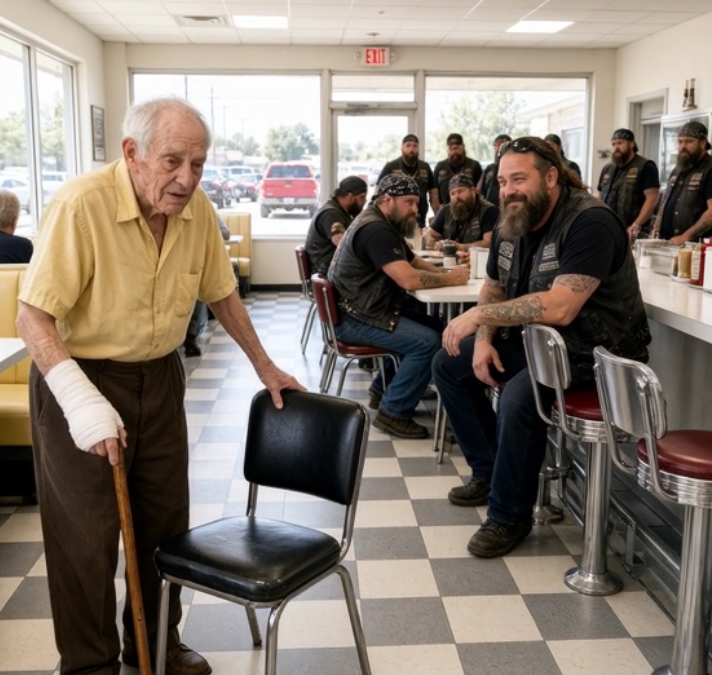
I pulled the chair away from the table, turned it slightly so he would not have to twist his right leg, and held it steady.
“Sit.”
He stared at me.
Then slowly lowered himself.
When he was down, he let out a breath.
Not dramatic.
Just relief.
I sat again.
He leaned the cane against the wall.
“Thank you.”
“No problem.”
The waitress, Angie, came over with a menu.
She had worked at Cedar Grove longer than I had been going there, which meant she knew when not to ask questions.
“What can I get you, honey?”
Walter opened the menu.
His eyes went immediately to the prices.
“Toast.”
Angie waited.
“And?”
“Water.”
She looked at me.
I looked at Walter.
“Add eggs.”
Walter shook his head.
“No, really.”
“Bacon.”
“I can’t—”
“Coffee.”
Walter lowered the menu.
“I don’t have enough money for all that.”
“I didn’t ask what you could afford.”
He stared at me.
“I asked what you need.”
Angie wrote it down before he could argue.
“Eggs, bacon, toast, coffee.”
She took the menu.
Walter watched her walk away.
“I didn’t ask you to buy my breakfast.”
“I know.”
“You don’t know me.”
“True.”
“I could be anybody.”
“So could I.”
That almost made him smile.
Almost.
When the food arrived, Walter ate carefully.
Not like a hungry teenager.
Like someone who had learned to make a plate last.
Half a piece of toast.
Pause.
A little egg.
Coffee.
Then bacon.
He kept one hand in his lap.
The other trembled slightly around the fork.
I did not ask questions.
People talk when silence starts feeling safer than whatever they are carrying.
About ten minutes in, Walter said, “I shouldn’t be here.”
I leaned back.
“Why?”
His fork stopped.
“My grandson tells people I get confused.”
There it was.
I looked at him more closely.
“Do you?”
He raised his eyes.
Clear.
Sharp.
Offended.
“I spent forty-one years designing electrical systems for hospitals, schools, municipal buildings, and factories.”
He set down the fork.
“I can tell you the date.”
“Go ahead.”
“October seventeenth.”
Correct.
“The president.”
He told me.
Correct.
“Where you are.”
“Cedar Grove Diner. Route Eight. About six blocks from the courthouse and two from the old post office.”
He took another sip of coffee.
“I also know exactly how much money should be in my retirement account.”
His voice changed.
“And I know it is not there anymore.”
I said nothing.
Walter looked toward the entrance again.
“My grandson tells people I wander.”
“Do you?”
“No.”
“Ever been diagnosed with dementia?”
“No.”
“Memory problems?”
“I forget where I leave my glasses.”
“So do I.”
“I am not confused.”
He leaned closer.
“He tells people I am.”
I lowered my eyes toward his hands.
That was when his right sleeve shifted.
There were faint discolorations around the wrist.
Not cuts.
Not fresh.
Marks.
Pressure.
I looked at his other wrist.
Same.
Walter noticed.
Pulled the sleeves down.
I kept my voice even.
“What happened?”
“Nothing.”
“Walter.”
He froze.
I had not asked his name yet.
I pointed toward the old embroidery on his shirt.
W. HENSLEY.
He looked down.
“Oh.”
For the first time, he actually smiled.
“Thought I’d impressed you.”
“Still might.”
The smile disappeared.
He stared into his coffee.
“My wife died fourteen months ago.”
“I’m sorry.”
“Her name was Ruth.”
He said the name like it still belonged in the room.
“We were married fifty-two years.”
“That’s a long time.”
“Not when it ends.”
I understood that answer more than he knew.
“My grandson moved in after the funeral.”
“What’s his name?”
“Evan.”
“He close to you?”
“I thought so.”
Walter rubbed one thumb against the other.
“His mother—my daughter—died when he was twenty. Cancer. Ruth and I helped him afterward. Paid for technical school. Helped with an apartment.”
He swallowed.
“He had troubles.”
“What kind?”
“Jobs. Money. Drinking sometimes.”
“But he moved in to help you.”
“That is what he said.”
Walter stared toward the window.
“At first, he did.”
Groceries.
Doctor appointments.
Yard work.
Online banking.
Phone calls.
Things that become harder after seventy-five, especially after a spouse dies and every room in the house reminds you why you stopped wanting to get out of bed.
“Then he started saying I should not drive.”
“Were you unsafe?”
“No.”
“Doctor say that?”
“No.”
“He took the keys anyway?”
Walter nodded.
“Then my credit card.”
His jaw tightened.
“He said I had misplaced it.”
“Did you?”
“No.”
“Phone?”
“Disappeared two months later.”
“ID?”
“He said I lost that too.”
I stopped touching my coffee.
Walter continued.
“He began calling my doctors before appointments.”
“What for?”
“To tell them I was forgetting things.”
“Were you?”
“No.”
“Did they believe him?”
“One doctor ordered a cognitive screen.”
“How’d you do?”
“Perfectly.”
That interested me.
“What happened after?”
“Evan said I have good days and bad days.”
Walter laughed once.
No humor.
“That phrase can explain anything.”
Yes.
It can.
“He told neighbors I was wandering.”
“Did you leave the house?”
“I tried.”
His fingers tightened around the edge of the table.
“One day, I walked to the mailbox.”
“Okay.”
“He came running outside like I had escaped a prison.”
Walter looked embarrassed by his own words.
“He took my arm.”
“Hard?”
Silence.
I looked at the wrists.
Walter looked away.
“That how you got those?”
“He was scared I would fall.”
“Did you?”
“No.”
“Walter.”
“He held me too hard.”
There was a long pause.
Then he said, “Later he apologized.”
That sentence has followed a lot of bad things in this world.
I asked, “How long since you left the house alone?”
He thought.
“Twenty-three days.”
“You counted?”
“Yes.”
“What stopped you?”
His eyes went to mine.
“Lock.”
“What lock?”
“Back door.”
He barely whispered it.
“Outside.”
Everything in me went still.
“You’re saying he locked you inside?”
Walter stared at the table.
“The front door has a deadbolt he changed. It needs a key from both sides.”
“Fire hazard.”
“I told him.”
“What did he say?”
“That I was confused.”
“And the back?”
“Padlock through the gate latch.”
“Windows?”
“Two open. Neither far enough for me.”
I leaned forward.
“How’d you get out today?”
Walter looked almost proud.
“A butter knife.”
I blinked.
“A butter knife.”
“There is a loose strike plate on the pantry door leading to the mudroom. Evan does not know I noticed.”
“You got through?”
“Eventually.”
“And the back lock?”
“He left the key ring hanging on a hook while he showered.”
Walter’s hand moved toward his coat pocket.
He pulled out a tiny brass key.
Placed it on the table.
Not a house key.
Too small.
“What’s that?”
He looked at it.
“My insurance.”
“For what?”
“I wrote everything down.”
“What?”
“Dates. Transactions. Conversations. Things Evan took. Things he said.”
“Where?”
Walter tapped the key.
“Safe-deposit box.”
I stared at him.
He continued.
“The bank manager is an old friend of Ruth’s. I opened the box before Evan took my ID.”
“What’s inside?”
“My journal.”
He counted on his fingers.
“Bank statements. Copies of checks. Property tax documents. A photocopy of the power of attorney Evan tried to get me to sign.”
“Tried?”
“I refused.”
“Anything else?”
Walter hesitated.
“A recording.”
That caught my attention.
“Of what?”
“Evan and a man from a real estate office talking about selling my house.”
“Your house?”
“I own it outright.”
“Can he sell it?”
“Not legally.”
Walter’s expression turned grim.
“But he has been trying to make me legally incompetent.”
Now the shape of it was becoming clear.
Money.
Isolation.
False dementia narrative.
Control over transportation and communication.
A plan to gain legal authority.
This was not a confused old man wandering.
This was somebody preparing to erase him while he was still alive.
“Why come here?”
Walter looked toward the front door again.
“The bank opens at nine.”
It was 8:12.
“You were waiting?”
“Yes.”
“Why not police?”
His eyes changed.
Fear again.
“Evan told me if I make trouble, they’ll put me somewhere.”
“Who?”
“Nursing home. Facility. He says once people believe you’re confused, nobody listens.”
He looked down.
“He said he could have me committed.”
“That isn’t how it works.”
“I know.”
“But you’re afraid it might feel close enough.”
Walter nodded.
Then said something I will never forget.
“When everybody starts speaking about you as if you’re already gone, you begin wondering how much proof you need that you are still here.”
I sat back.
The diner carried on around us.
Forks.
Coffee cups.
Conversation.
The seven tables that had rejected him were still there.
None had any idea what was happening ten feet away.
I asked, “Why me?”
Walter looked at my vest.
Then my hands.
Then my face.
“Because you didn’t look away.”
Simple.
That was all.
I had spent years believing people expected too much from men like me because of the way we looked.
That morning, one old man expected exactly one thing.
Stay.
I pulled out my phone.
Walter tensed.
“Who are you calling?”
“Someone who knows the law better than I do.”
“No police.”
“Not yet.”
His breathing changed.
“Walter, listen to me.”
I put the phone on the table.
“You are deciding.”
He stared.
“I’m not taking that away from you.”
His shoulders eased slightly.
“My friend’s wife runs a senior advocacy program.”
“What kind?”
“Legal and social services. Elder abuse cases.”
Walter flinched at the phrase.
“I don’t like that word.”
“Which one?”
“Abuse.”
“I understand.”
“My grandson isn’t—”
He stopped.
People often protect the person hurting them before they protect themselves.
Family complicates truth.
I said, “We don’t have to call it anything yet.”
Walter looked at me.
“We call it what happened.”
That worked.
He nodded.
I called my friend Marcus.
His wife, Denise, picked up on speaker after I explained I needed her.
“Cole?”
“Yeah.”
“You sound serious.”
“I’m sitting with a seventy-seven-year-old man who says his grandson has taken his phone, ID, keys, controlled his money, locked him inside his house, and has been telling people he has dementia.”
Silence.
Then Denise’s voice changed completely.
“Is he with you now?”
“Yes.”
“Is he safe from the grandson at this moment?”
I looked at Walter.
“Are you?”
“I don’t know.”
I repeated it.
Denise said, “Do not take him back to the house.”
Walter whispered, “My papers…”
“Walter,” Denise said through the phone, “my name is Denise Carter. I’m a licensed social worker and elder-rights advocate. Can you hear me?”
“Yes.”
“I am going to ask you a few questions. You can stop at any time.”
“All right.”
She asked his full name.
Date of birth.
Address.
Basic orientation questions.
Medication.
Diagnosis.
Family.
Finances.
Whether anyone had hit him.
Walter said no.
Restrained him?
He looked at his wrists.
“Once.”
Threatened him?
“Yes.”
Prevented him from leaving?
“Yes.”
Accessed money?
“Yes.”
How much?
Walter breathed deeply.
“Thirty-eight thousand dollars that I can identify.”
I had to stop myself from reacting.
Denise did not.
“Any reason you authorized those withdrawals?”
“No.”
“Does he have power of attorney?”
“No.”
“Joint account?”
“One checking account. I added him for groceries after Ruth died.”
“Primary retirement?”
“My name only.”
“Property?”
“My name.”
“Any firearms in the home?”
Walter stiffened.
“One old revolver. Locked in Ruth’s jewelry cabinet.”
“Does Evan know?”
“I don’t think so.”
Denise said, “We need law enforcement and Adult Protective Services involved.”
Walter started shaking his head.
“No.”
“Walter.”
“They’ll take me.”
“No.”
“I’ve heard stories.”
“So have I.”
Denise’s voice stayed calm.
“You have rights.”
Walter said nothing.
“You also have evidence, if what you’re telling me is accurate.”
The key sat between us.
Denise continued.
“The safest thing is to document your condition now, retrieve the safe-deposit contents with proper witnesses, and make a report while you are clearly able to speak for yourself.”
Walter looked at me.
I said, “Your choice.”
He stared at the key.
Then nodded.
“Do it.”
That was the moment the front door opened.
Walter went pale.
A man in his thirties entered.
Tall.
Dark jacket.
Close beard.
Phone in hand.
He looked around fast.
Then found Walter.
“Grandpa.”
Walter’s fingers locked around the cane.
I knew immediately.
Evan.
His face changed when he saw me.
Then changed again when he noticed the phone on the table.
“Grandpa, what are you doing?”
Walter said nothing.
Evan came closer.
“I’ve been looking everywhere.”
His voice was concerned.
Perfectly concerned.
The kind of concern that works well in front of witnesses.
“You scared me.”
Walter’s shoulders folded inward.
Evan looked at me.
“Sir, thank you for keeping him here. He has dementia. He wanders.”
Walter’s hand started trembling.
I looked at Evan.
“He told me he doesn’t.”
Evan smiled sadly.
“Yeah. That’s part of it.”
There it was.
The sentence that erases anything Walter might say afterward.
“He can sound normal,” Evan continued. “Some days are better.”
Walter whispered, “Stop.”
Evan ignored him.
“He gets paranoid.”
Walter looked at me.
Exactly what he had said.
“He thinks people steal from him.”
Walter’s face drained.
Evan reached toward his arm.
“Come on, Grandpa.”
I stood.
Evan stopped.
I am not the biggest man alive.
But I am six foot three, two hundred thirty pounds, and years of motorcycle repair have not made me delicate.
I did not threaten him.
I simply occupied the space.
“He said stop.”
Evan’s eyes narrowed.
“This is a family matter.”
“Then listen to your family.”
“My grandfather needs to come home.”
Walter’s voice came out stronger.
“No.”
Evan looked at him.
For one second, the concerned grandson disappeared.
Something colder replaced it.
Then the mask returned.
“You’re having an episode.”
Walter lifted his chin.
“No.”
Evan turned toward the other tables.
“Could someone call the police? My grandfather is confused and this man is interfering.”
I reached for my phone.
“Great idea.”
That surprised him.
Denise was still on the line.
She spoke.
“Cole, tell him police are already being contacted.”
Evan heard the voice.
“What the hell is this?”
Walter reached for the brass key.
Evan saw it.
Everything changed.
His eyes locked onto it.
“Where did you get that?”
Walter closed his fist.
Evan took one step forward.
I moved between them.
He stopped.
“What’s the key for?”
Walter said nothing.
Evan’s concern vanished.
“Grandpa.”
There was warning in the word.
Not love.
Walter’s back straightened.
For the first time since entering the diner, he looked tall.
Not physically.
Something else.
“I remember everything.”
Evan’s jaw tightened.
“You don’t know what you’re saying.”
“I remember the forty-two hundred dollars on March third.”
Silence.
“Walter,” I said softly.
But he had started.
He needed this.
“The six thousand eight hundred on April nineteen.”
Evan’s face changed.
“The check to Marshall Realty.”
“Stop.”
“The call with Mr. Barnes about declaring me incompetent.”
“Grandpa.”
“I remember you saying nobody would believe me.”
Now people were watching.
Every table.
Including the seven that had turned him away.
Walter’s voice shook, but he continued.
“You were wrong.”
Police arrived eleven minutes later.
Officer Jenna Alvarez came first.
Middle-aged.
Calm.
No theatrical attitude.
She separated everyone immediately.
Evan tried to speak for Walter.
She stopped him.
“I’m asking Mr. Hensley.”
“He’s confused.”
“I heard you.”
“He has dementia.”
“Has he been diagnosed?”
Evan hesitated.
“He’s being evaluated.”
Walter answered from behind me.
“No, I am not.”
Officer Alvarez looked at Walter.
Then at Evan.
Then at the marks around Walter’s wrist that his sleeve no longer covered completely.
She called for a second unit.
Denise arrived twenty minutes later.
By then, the entire diner had become quiet enough that Angie stopped pretending anyone cared about breakfast.
Denise sat beside Walter.
Not across.
Beside.
She explained every step.
Nobody was taking him anywhere against his will unless there was a medical or legal reason.
He could choose emergency housing.
A hospital exam could document his condition.
Police could accompany him to the bank.
Adult Protective Services could investigate the house.
An attorney could seek emergency orders preventing unauthorized financial activity.
Walter listened.
Then asked, “Can I go to the bank?”
Officer Alvarez looked at Denise.
Denise nodded.
“Yes.”
Evan exploded.
“This is insane.”
Everyone turned.
“My grandfather is sick!”
Walter looked at him.
“I am old.”
His voice became steady.
“That is not the same thing.”
Nobody spoke.
Walter stood slowly.
I helped move the chair.
He reached for his cane.
Evan said, “Grandpa, if you do this, don’t expect me to be there when you need someone.”
Walter froze.
That one hurt.
You could see it.
Whatever Evan had done, he was still his daughter’s boy.
The child Walter had taken fishing.
Helped through school.
Lent money.
Probably forgiven a hundred times before anyone else knew forgiveness was needed.
Walter looked at him for a long time.
Then said, “I needed you.”
Evan’s face shifted.
“And you were there.”
Walter’s voice cracked.
“For my house.”
We went to the bank.
Police followed separately.
Denise rode with Walter.
I took my bike because there was no reason for me to go anymore.
I went anyway.
Some stories become yours simply because someone sat at your table.
The bank manager was a woman named Helen Crawford.
Seventy maybe.
White hair.
Blue suit.
When Walter walked in, she came around the counter immediately.
“Walter?”
He smiled.
“Hello, Helen.”
She looked at the people behind him.
Then at his face.
“Are you all right?”
“No.”
The honesty startled everyone.
“But I intend to be.”
Helen took us into an office.
Walter produced the key.
There were procedures.
Identification problems because Evan had his wallet.
Fortunately, Walter had arranged alternate verification with Helen when he opened the box.
Signatures.
Security questions.
A copy of his passport stored in the bank records.
Within forty minutes, the box was brought into a private room.
Walter opened it.
Inside sat a blue notebook.
A folder.
A flash drive.
Copies of statements.
Cancelled checks.
Property documents.
Letters.
A sealed envelope addressed:
IF ANYTHING HAPPENS TO ME.
Walter stared at that one.
“I forgot I wrote this.”
I almost laughed.
He looked at me.
“That isn’t dementia.”
“Never said it was.”
The notebook was precise.
Dates.
Times.
Amounts.
Every event written in Walter’s careful engineer handwriting.
April 7 — Evan removed car keys. Claimed doctor told him I should not drive. Doctor later denied this.
April 22 — Visa card missing.
May 3 — Evan withdrew $4,200. Said roof repair. No repair performed.
May 17 — Phone removed “for repair.” Never returned.
June 9 — Heard Evan telling neighbor I became lost walking to mailbox.
June 21 — He grabbed both wrists when I attempted front door. Bruising afterward.
July 1 — Lock placed on rear gate.
July 18 — Heard conversation concerning sale of house.
August 2 — Evan brought power of attorney form. Refused to sign.
September 11 — Checking balance $38,441 lower than expected.
October 4 — Evan said if I accuse him again, “they’ll put you somewhere and I’ll finally be able to handle things.”
Officer Alvarez photographed everything.
Denise said little.
She did not need to.
Then came the flash drive.
Audio recording.
Walter explained he had an old digital recorder from his engineering days.
He had left it running inside a drawer when Evan met with a man named Barnes.
Helen allowed police to take custody through proper evidence procedures.
We listened only long enough to identify voices.
Evan.
Another man.
The other man said, “Without authority, you cannot list the property.”
Evan answered, “I’m working on guardianship.”
“How bad is his condition?”
A laugh.
“Bad enough if people keep hearing it.”
Walter closed his eyes.
Officer Alvarez stopped the recording.
“That’s enough for now.”
I watched Walter.
Not confusion.
Grief.
There is a special kind of grief that comes when a person you love confirms the worst thing you tried not to believe.
He whispered, “I raised his mother.”
Nobody knew what to say.
“She was eleven when Ruth and I bought that house.”
His fingers touched the blue notebook.
“She picked the bedroom with the oak tree outside.”
He looked toward the bank office window.
“When she died, I promised her I would look after him.”
Denise said gently, “You did.”
Walter shook his head.
“Did I?”
“You helping him does not make you responsible for what he chose to do.”
Walter looked at her.
“He lost jobs.”
“You helped.”
“He drank.”
“You helped.”
“He owed money.”
“You helped.”
She leaned closer.
“At some point, helping someone and surrendering yourself become different things.”
Walter looked down.
“That line gets blurry with family.”
“Yes.”
“What happens now?”
The answer took months.
Not hours.
That is the part stories sometimes skip.
Police did not drag Evan away in handcuffs from the bank while everyone applauded.
The system moved carefully.
Statements.
Financial records.
Medical assessments.
Adult Protective Services investigation.
A locksmith.
Protective orders.
Attorneys.
Bank fraud investigators.
A court hearing.
The truth was slower than fear.
But it moved.
Walter went to the hospital that afternoon voluntarily.
Not because anyone thought he was confused.
Because Denise wanted his dehydration, bruising, weight loss, and general health documented.
The doctor found he was twenty-three pounds lighter than he had been at his previous annual physical.
His blood pressure medication had not been refilled properly.
He had missed a cardiology appointment.
Nobody had been told he could not drive.
Nobody had diagnosed dementia.
His cognitive screening came back strong.
Not perfect.
He was seventy-seven.
He forgot one word during delayed recall.
Then remembered it later and became furious.
“I knew it was umbrella.”
The doctor laughed.
“I believe you.”
That night, Walter did not go home.
He stayed in a small senior respite apartment run through Denise’s organization.
He hated the idea.
“Sounds like a nursing home.”
“It has a kitchen.”
“So does prison.”
“You can leave whenever you want.”
“That improves it.”
I drove him there.
He stood in the doorway.
Small living room.
Recliner.
Television.
Kitchenette.
Bed.
A window facing trees.
“No locks from the outside,” I said.
He looked at me.
Then smiled.
“No.”
I turned to leave.
“Cole?”
“Yeah?”
“Will you sit a while?”
So I did.
The next morning, we had breakfast.
Not because I was some hero.
Because Walter called me at 6:38 and said the coffee in the apartment tasted like “water that had heard a rumor about beans.”
Cedar Grove had better coffee.
We returned.
When we walked in, something interesting happened.
The first table—the same two men who had said they were leaving—stood.
One of them pulled out a chair.
“Mr. Hensley.”
Walter stopped.
“Would you like to sit here?”
I looked at Walter.
He looked at them.
Then at me.
“Thank you,” he said.
“But I already have a table.”
We went to the corner.
I tried not to smile too much.
Angie brought coffee.
“Eggs?”
Walter looked at me.
“And bacon.”
“Look at you.”
“I’m living dangerously.”
News traveled.
Small towns turn private events into public knowledge faster than radio.
But Walter refused interviews.
A local reporter called.
No.
A television station wanted a story about elder exploitation.
No.
He told Denise, “I spent months being discussed by people as if I weren’t in the room. I’m not volunteering for more of that.”
Fair.
The legal case became complicated.
Evan had taken money.
Some he claimed was reimbursement.
Some was clearly unauthorized.
There were attempts to establish guardianship, but none completed.
The real estate conversation became part of a broader financial exploitation investigation.
Evan eventually faced charges connected to theft and unlawful restraint, among other matters determined by the evidence.
I did not attend every hearing.
Walter did.
He wore a blue suit that had belonged to his life before Ruth died.
Helen helped him recover his ID.
Denise helped him replace his phone.
The police retrieved his car keys.
A locksmith replaced the locks.
And one Friday afternoon, six weeks after the diner, Walter asked me to drive him home.
“You sure?”
“Yes.”
We pulled into the driveway.
Small brick ranch house.
Oak tree near one bedroom window.
The grass needed cutting.
Leaves had gathered against the porch.
Walter sat in my truck staring.
“What?”
“Nothing.”
“You’ve been quiet five minutes.”
“I’m allowed.”
I waited.
Then he said, “I’m afraid to go inside.”
I nodded.
“Want me first?”
“No.”
He opened the door.
“Want me behind you?”
“Yes.”
So that is how we did it.
Walter first.
Me behind.
He unlocked his own front door with his own new key.
The house smelled closed up.
Dust.
Old furniture.
Something faintly floral.
Ruth, maybe.
Walter stopped in the living room.
A framed photograph sat on the mantel.
Young Walter.
Young Ruth.
Two children.
One daughter who would later become Evan’s mother.
Walter touched the frame.
Then walked through each room.
Bedroom.
Kitchen.
Garage.
Back door.
At the back, he stared at the place where the outside padlock had been.
The hardware was gone.
Fresh screw holes remained.
I asked, “Want those patched?”
“No.”
I looked at him.
“Why?”
“I want to remember.”
“That can work both ways.”
“I know.”
He touched the wood.
“Then I’ll decide later.”
Good answer.
Walter stayed in the house.
But not alone at first.
Denise arranged home visits.
A neighbor named Mrs. Greene started checking in.
Helen helped set fraud alerts at the bank.
A lawyer reworked Walter’s estate documents so nobody could claim uncertainty later.
And somehow I became the person he called when the garbage disposal sounded strange.
I repair motorcycles.
Not garbage disposals.
Walter did not care.
“You said you fix things.”
“I fix engines.”
“It has a motor.”
“Engineering is ruining you.”
“I was an engineer before you were born.”
He was right.
We fixed it.
Three months later, Walter came into my shop.
The guys stopped talking.
Not because Walter was intimidating.
Because he had arrived driving a 1974 Ford pickup that sounded like it had personally fought in Vietnam.
He climbed out.
Cane.
Red shirt.
Better-fitting now.
More color in his face.
“What is that noise?” I asked.
“History.”
“It’s knocking.”
“History knocks.”
“Walter.”
“Young people lack poetry.”
He had gained eleven pounds.
His doctor was happy.
He was furious the doctor wanted him walking more.
So he walked to Cedar Grove three mornings a week.
Everybody knew him now.
Funny what happens when a man is no longer invisible.
The same diners who once declined his company greeted him.
Some genuinely.
Some out of guilt.
Walter accepted both without making it easy.
One morning, a woman said, “I’m sorry I didn’t realize you needed help.”
Walter buttered his toast.
“I didn’t need help sitting down.”
She went quiet.
“I needed a chair.”
That was Walter.
He had spent months being treated as fragile.
He had no interest in becoming anyone’s inspirational old man.
He wanted normal things.
Breakfast.
Independence.
A working truck.
His bank balance.
Privacy.
The right to make choices others considered foolish.
Especially the truck.
Then came the hearing where Evan spoke.
Walter asked me to attend.
I sat behind him.
Evan looked thinner.
No polished concern now.
Just tired.
His attorney spoke about stress.
Caretaker burden.
Financial confusion.
Family misunderstandings.
Some of that may even have been true.
Human beings rarely become villains in their own minds.
Then Evan was allowed to make a statement.
He looked at Walter.
“I was trying to help you.”
Walter did not move.
“You were falling apart after Grandma died.”
True.
“You stopped paying bills.”
One was late.
“You forgot appointments.”
One.
“You didn’t eat.”
Also true.
“I moved in because nobody else would.”
Walter’s expression changed.
Pain.
Because that part was true too.
Evan continued.
“I handled everything.”
The prosecutor asked, “Including transferring funds?”
Evan looked away.
“I used money for the house.”
Records disagreed.
“Including restricting Mr. Hensley from leaving?”
“He could fall.”
“Did you lock the rear exit?”
Silence.
“For safety.”
Walter lowered his head.
That phrase again.
Safety.
A word that can hide control if nobody looks closely.
Then Evan said something that changed the room.
“I didn’t know what else to do.”
Walter looked at him.
Evan’s voice broke.
“I was drowning.”
For the first time, I saw not the man from the diner.
The boy Walter had helped raise.
Broken.
In debt.
Drinking.
Shame piling on shame until controlling his grandfather’s money started feeling easier than admitting he needed help.
None of that excused anything.
But it explained why Walter cried.
Not because he doubted what happened.
Because loving someone does not disappear the moment you understand they harmed you.
Sometimes the clarity makes it worse.
After court, Walter sat on a bench outside.
I sat beside him.
He said, “I want to hate him.”
“I know.”
“It would be easier.”
“Probably.”
“But I remember teaching him to ride a bicycle.”
I looked at my hands.
“He broke Ruth’s lamp once and cried for two hours because he thought she’d stop loving him.”
Walter stared across the parking lot.
“How does that boy become this?”
I had no answer.
So I gave him the only honest one.
“Slowly.”
Walter nodded.
“Yes.”
Then after a while:
“Can I love him and still not let him back in my house?”
“Yes.”
“You sound very certain.”
“I am.”
“Can I hope he gets better and still testify?”
“Yes.”
“Can I forgive him someday without giving him my bank password?”
I laughed.
“Yes.”
Walter almost smiled.
“That last one was a test.”
“You passed.”
The case ended without the dramatic satisfaction people expect from stories.
There was accountability.
Restitution orders.
Supervision.
Required treatment.
Restrictions on contact.
Consequences.
Walter did not get every dollar back.
Justice is often mathematically disappointing.
But he kept his house.
Kept control of his accounts.
Kept his legal independence.
More importantly, he kept his voice.
A year after we met, Cedar Grove Diner changed one small thing.
Angie had suggested it.
The owner agreed.
Near the entrance, they placed a long communal table.
Eight seats.
A small wooden sign in the center read:
NO ONE EATS ALONE UNLESS THEY WANT TO.
Walter hated it.
“Too sentimental.”
“You inspired it.”
“Then they misunderstood me.”
“You literally asked seven strangers to sit with them.”
“And I learned my lesson.”
But he sat there every Tuesday.
That was the thing.
He complained.
Then stayed.
One Tuesday morning, a woman in her eighties entered alone.
She held a walker.
Paused near the tables.
Looked uncertain.
Walter saw her.
He stood slowly.
His knee still hurt.
His cane still tapped against the floor.
He pulled out the chair beside him.
“Would you like to sit?”
She looked relieved.
“Are you sure?”
Walter said, “It’s just a chair.”
I was sitting across from him.
He looked at me.
We both knew better.
Nothing is ever just a chair when a person is wondering whether they are still allowed to belong somewhere.
Two years passed.
Walter turned seventy-nine.
Then eighty.
For his eightieth birthday, I asked what he wanted.
“No party.”
“Everybody says that.”
“I mean it.”
“Cake?”
“No.”
“Steak?”
“No.”
“New cane?”
He looked offended.
“This cane has character.”
“It has duct tape.”
“Character.”
Then he said, “I want to go somewhere.”
“Where?”
“The cemetery.”
I understood.
Ruth.
We drove.
Walter carried flowers.
He stood beside her grave longer than I expected.
Then sat on a bench.
“Cole?”
“Yeah?”
“I never told her.”
“Told her what?”
“That I was scared.”
“Of dying?”
“No.”
“Then what?”
He looked toward Ruth’s stone.
“Of becoming irrelevant.”
That surprised me.
“After retirement?”
“Yes.”
“After she died?”
“Especially.”
He rubbed the top of his cane.
“When you’re old, people start speaking louder to you before you’re deaf. Slower before you’re confused. They take things from your hands before you drop them.”
His voice softened.
“Sometimes kindness and erasure wear similar clothes.”
I thought about the diner.
Seven polite refusals.
Evan saying safety.
Doctors being called before Walter could speak.
His phone disappearing “for repair.”
“Ruth never did that,” he said.
“She’d ask if I wanted help.”
He smiled.
“Usually I didn’t.”
“Shocking.”
“She’d help anyway if I was being stupid.”
“Also shocking.”
Walter laughed.
Then became serious.
“When she died, I think part of me stopped defending my own place in the world.”
I said nothing.
“So when Evan began taking pieces, I kept telling myself it was temporary.”
Keys.
Phone.
Money.
Doors.
Voice.
“You know the strangest thing?”
“What?”
“The first thing I truly fought for was a chair in a diner.”
I looked at him.
“I asked seven times.”
“You did.”
“Why?”
“Why what?”
“Why did I keep asking?”
I thought about it.
“Maybe some part of you knew you still belonged somewhere.”
Walter looked at Ruth’s grave.
Then nodded.
“Maybe.”
The last time I saw Walter Hensley walk into Cedar Grove Diner alone, he was eighty-two.
Same cane.
Different red shirt.
This one actually fit.
He entered at 8:05.
Busy morning.
Most tables full.
He paused by the entrance.
For one second, I saw the man from four years earlier.
Thin.
Afraid.
Checking doors.
Then Walter lifted his head.
Angie waved.
“Morning, troublemaker.”
“Coffee.”
“Already pouring.”
A couple moved their bags off the communal bench.
Someone pulled out a chair.
Walter ignored all of them.
He came to my table.
“Can I sit?”
I stared at the empty chair.
“Sorry. I’m just about to leave.”
Walter froze.
Then looked at me.
I lasted two seconds.
He smacked my boot with his cane.
I nearly choked laughing.
“Idiot.”
I pulled out the chair.
“Sit.”
He lowered himself carefully.
His shoulders dropped.
Same as the first day.
Some things change.
Some things become rituals.
Angie brought breakfast without asking.
Eggs.
Bacon.
Toast.
Coffee.
Walter looked at the plate.
“No water?”
“You graduated.”
“About time.”
He ate.
We talked about nothing important.
Truck repairs.
Weather.
My shop.
His blood pressure.
A ridiculous city plan to replace benches in the park.
Normal things.
That is what I eventually understood Walter had been fighting for from the beginning.
Not rescue.
Normalcy.
To be eighty-two and complain about taxes.
To choose bacon even if his cardiologist preferred oatmeal.
To decide who entered his house.
To forget his glasses without having his legal identity questioned.
To make bad financial choices if he wanted, provided they were his choices.
To accept help without surrendering authority.
To sit where he chose.
One afternoon several months later, Denise called me.
Walter had suffered a stroke.
Not severe.
But serious.
I reached the hospital before he fully woke.
He opened one eye.
Looked at me.
“Date?”
I laughed so hard the nurse stared.
“You’re unbelievable.”
“Date?”
I told him.
“President?”
I told him.
“Where am I?”
“St. Joseph’s.”
Walter closed his eyes.
“Good.”
The nurse looked confused.
I explained.
“He likes testing himself.”
Walter muttered, “Umbrella.”
I laughed again.
He recovered enough to return home.
Not completely.
This time, he needed more help.
Real help.
Home health.
Physical therapy.
Meals delivered.
Medication management.
And Walter struggled with it.
One evening he snapped at a nurse who moved his cane.
The nurse quietly placed it back.
Walter later apologized.
“I’m turning into a difficult old man.”
“You started there.”
He smiled.
Then asked the question I knew was coming.
“How do I know when accepting help becomes giving up control?”
I thought about Denise.
About Ruth.
About everything Walter taught me.
“When they ask.”
He waited.
“When they ask what you want instead of telling you what you are.”
Walter nodded slowly.
“That’ll do.”
Walter died at eighty-four.
At home.
His own bedroom.
Window open because he liked cool air even when everyone complained.
No locked door.
No one speaking over him.
Denise was there earlier that day.
I visited that morning.
Angie brought coffee from Cedar Grove, though by then Walter could drink only a few sips.
He looked at the cup.
“Still terrible.”
“It’s your favorite.”
“Both can be true.”
Before I left, he caught my wrist.
His grip was weak.
“Cole.”
“Yeah?”
“Thank you for the chair.”
I shook my head.
“That’s all I did.”
He smiled.
“You still don’t understand.”
He released my wrist.
Walter died that evening.
His funeral was full.
Not enormous.
Enough.
People from the bank.
Denise.
Officer Alvarez.
Angie.
Neighbors.
Men from my shop.
People from Cedar Grove.
Even one of the two men from the first table that morning four years earlier.
He came up to me after the service.
“I think about that day.”
I said nothing.
“I should’ve let him sit.”
“Probably.”
He nodded.
“I was uncomfortable.”
“With what?”
“Old people.”
That surprised me.
“My father had dementia. Walter looked about the same age.”
He stared at the ground.
“I think I was afraid.”
There it was.
Not cruelty.
Fear.
We reject things that remind us where time is taking us.
I said, “Walter would’ve told you to get over yourself.”
The man laughed.
“I believe that.”
After the funeral, I went to Cedar Grove.
Sat in the corner.
Walter’s seat across from me.
Empty.
Angie brought coffee.
“You want food?”
“No.”
She stood there.
Then said, “Communal table’s full.”
I looked.
Eight strangers.
Older man.
Young mother.
Construction worker.
College student.
A woman with a walker.
Two truckers.
One kid doing homework.
Nobody asked who belonged.
They just sat.
On the wall behind them, the diner had added a framed photograph.
Walter at eighty.
Red shirt.
Cane.
Holding a coffee cup.
Underneath, a small plaque.
WALTER’S TABLE.
And one sentence.
BECAUSE YOU DIDN’T LOOK AWAY.
I hated it.
Walter would have hated it too.
Too sentimental.
Exactly why I loved it.
People ask sometimes what happened that morning.
They want a dramatic answer.
A biker rescued an elderly man.
A hidden key exposed a terrible secret.
Police came.
The grandson was stopped.
Justice happened.
That is the version people like.
But it is not the part I remember most.
I remember an old man walking toward seven tables.
Asking seven times.
Being rejected without anyone technically doing anything wrong.
Then standing there wondering whether he was allowed to exist in public without explaining himself.
I remember the way his shoulders dropped when he sat down.
I remember him eating bacon slowly.
I remember the brass key.
But more than anything, I remember what he said when I asked why he chose me.
Because you didn’t look away.
That sentence changed how I see people.
You do not always know when someone is asking for rescue.
Sometimes they ask for a chair.
Sometimes coffee.
Sometimes directions.
Sometimes they keep looking at the door because they are afraid somebody will come through it.
Sometimes they say they are fine because they have already been told nobody will believe anything else.
And sometimes the greatest thing you can do for another human being is not save them.
It is make enough room for them to tell you what is happening.
Walter saved himself.
He kept records.
He hid the key.
He escaped the house.
He walked to the diner.
He asked seven strangers before he reached me.
I did one thing.
I moved a chair.
But Walter taught me that small acts are not always small.
A chair can become a table.
A table can become a conversation.
A conversation can become evidence.
Evidence can become freedom.
And freedom can be as ordinary as an old man unlocking his own front door, pouring his own bad coffee, and deciding for himself where he wants to sit.
So now, when I enter Cedar Grove and see somebody standing near the entrance alone, I look twice.
Not because everyone needs rescuing.
Most do not.
Walter certainly hated being treated that way.
I look because everyone deserves to be seen before somebody else decides their story for them.
And if there is an empty chair at my table, I leave it empty until I know no one needs it.
Because the last thing Walter Hensley ever had to prove to me was something the world should never have made him prove in the first place.
He was still here.
He still knew who he was.
And he still deserved a seat.
::








