A 7-Year-Old Girl Walked Into Our Biker Bar Carrying Her Dead Father’s Scarred Cat and Asked for “the Scary Men”—Then the Cat Crawled From the Carrier and Chose One of Us.
PART2:
Even Big Earl, who laughed during bar fights and once stitched his own arm with fishing line, sat frozen with his mouth half open.
Grizzly was the first to stand.
Grizzly was our club president.
Six-foot-five.
Broad as a doorway.
A jagged scar running from his temple down across his cheek.
A voice like thunder rolling through gravel.
Hands that looked like they could bend horseshoes out of boredom.
Most grown men took a step back when Grizzly stood.
The little girl did not.
He set his pool cue down gently, walked toward her, then lowered himself onto one knee so his eyes were level with hers.
“You’re lost, little bird,” he rumbled. “Where’s your mom?”
The girl swallowed.
Her fingers tightened around the carrier.
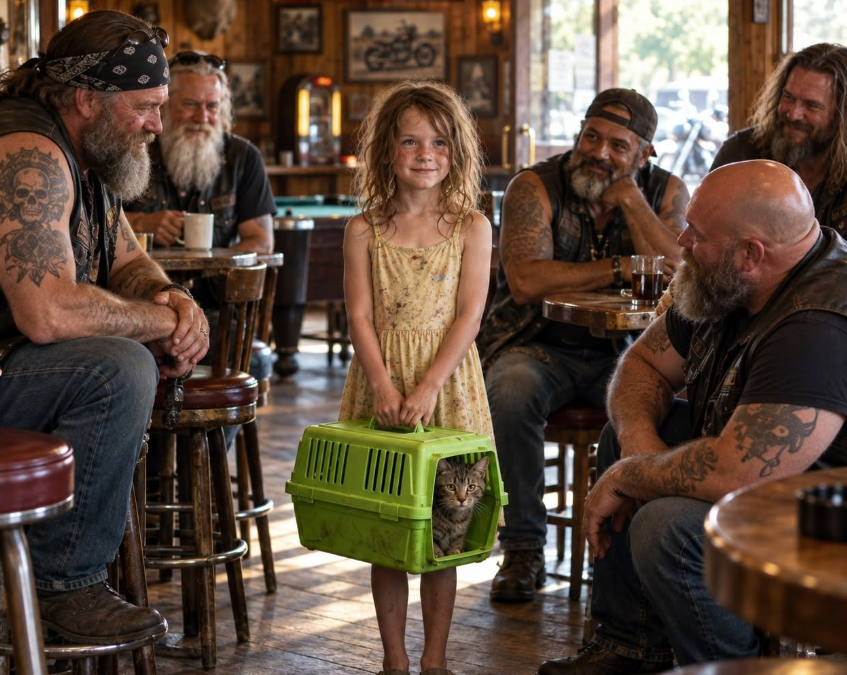
“I’m not lost,” she said. “My name is Chloe. And I’m looking for the scary men.”
That sentence did something to the room.
Nobody laughed.
Nobody made a joke.
Because children do not walk into biker bars asking for scary men unless life has scared them worse than we ever could.
Chloe set the carrier on the floor.
The latch stuck.
She fought it with both hands until Grizzly reached out slowly.
“May I?”
She nodded.
He opened the rusty little door.
For a second, nothing happened.
Then a cat limped out.
Calling him ugly would have been unkind.
But it would not have been wrong.
He was a scrawny tabby with patchy fur, ribs showing under his sides, and one eye scarred shut.
Half of one ear was missing.
His tail had a permanent kink near the end.
His front leg did not bend right, so each step came crooked and painful, like the floor itself had to be negotiated.
A few of the men shifted uncomfortably.
Not because the cat frightened us.
Because pain does, when it is small enough to fit in your hands.
“His name is Frankie,” Chloe said, her voice shaking. “My dad saved him from bad people who hurt animals.”
The cat took three limping steps toward Grizzly’s steel-toed boot.
Stopped.
Sniffed the leather.
Then rubbed his scarred head against it and started purring.
Loud.
Rough.
Broken.
Like an engine full of gravel trying its best to turn over.
Grizzly looked down at that ruined little cat.
Then back at Chloe.
“Where is your dad, sweetheart?”
Tears filled her eyes immediately, but she did not let them fall yet.
“My dad is Officer Miller,” she whispered. “He went to heaven three days ago.”
The name hit the room like a punch.
Officer Daniel Miller.
Every man in that bar knew him.
Strictest cop in town.
Hard-nosed.
Stone-faced.
The kind of officer who could spot an expired tag from fifty yards and write a ticket like it was a sacred duty.
He had pulled most of us over at least once.
Some of us twice.
Grizzly probably had enough Miller citations to wallpaper a bathroom.
We had cursed his name a hundred times.
But none of us knew he spent his nights rescuing broken animals.
Chloe wiped her cheek with the back of her hand.
“My dad told me before he left for work that night,” she said, “if anything happened to him, I had to bring Frankie here.”
Grizzly’s face changed.
Not much.
But I had known him twenty years, and I saw it.
“Why would your dad send a cat to a motorcycle club?”
Chloe looked straight into his eyes.
“Because he said regular people only want perfect things,” she whispered. “They get scared of scars.”
No one breathed.
“He said you guys look really scary on the outside,” she continued. “But that means you’re the only ones brave enough to love something this ugly, and strong enough to protect him.”
I had seen Grizzly break up fights with one hand.
I had seen him stand across from men holding knives and not blink.
I had seen him ride through hail, sleep under bridges, and laugh with blood on his shirt.
But I had never seen him look the way he looked when that little girl said her father believed we were brave enough to love something ugly.
His jaw tightened.
His eyes shone.
He looked down at Frankie, who was still rubbing his battered head against that steel-toed boot like he had found his church.
The whole room had gone quiet enough to hear the neon beer sign buzz above the bar.
Tank stared at the ceiling.
Razor wiped his face with the back of his hand and pretended his allergies had suddenly declared war.
Big Earl whispered, “Damn,” so softly I barely heard it.
Grizzly reached down with one calloused hand.
Slowly.
Carefully.
The way you reach for something that already expects pain.
Frankie leaned into his palm.
The purr grew louder.
Grizzly’s thumb brushed beneath the cat’s chin, and that was when he noticed the tag.
It was not a store-bought tag.
It was a small piece of metal, rough-cut into a circle, hanging from a bit of black cord around Frankie’s neck.
Grizzly lifted it gently and turned it toward the light.
A police badge.
Not a whole badge.
A piece of one.
Officer Miller must have cut it himself, filed the edges smooth, and stamped one word into it.
FRANKIE.
Underneath, smaller:
PROTECTED.
Grizzly closed his fist around the tag for one second.
Then he let it go.
“Your dad,” he said, his voice thick, “was a giant pain in my neck.”
Chloe blinked.
I nearly laughed, but my throat was too tight.
Grizzly looked at her.
“But he was a good man. And he was right.”
He slid both hands under Frankie’s thin body and lifted him with a gentleness that did not seem possible from a man his size.
Frankie did not flinch.
He curled against Grizzly’s leather vest like he had been waiting his whole broken life for that exact place.
Grizzly stood and turned to face the room.
Every man straightened.
Every joke died before it could be born.
“Frankie is one of us now,” Grizzly said.
His voice filled the bar.
Not loud.
Not theatrical.
Final.
“Anybody tries to hurt this cat, they answer to every man in here.”
The bar erupted.
Not the wild drunken kind of noise people imagine from bikers.
This was deeper.
Rougher.
Men slammed fists on tables.
Boots hit the floor.
A rolling, thunderous cheer rose up until Frankie lifted his scarred head and blinked his one good eye like he had accidentally become royalty.
Chloe smiled for the first time.
A small, tired smile.
“Thank you, Mr. Scary Man.”
Grizzly looked down at her, and that scar on his face seemed softer somehow.
“Name’s Grizzly, little bird.”
“I know,” she said.
He raised an eyebrow.
“My dad talked about you.”
The room shifted again.
Grizzly went still.
“What did he say?”
Chloe looked at Frankie tucked against his chest.
“He said you acted mean because you didn’t like people knowing you were good.”
That one got him.
Hard.
Grizzly looked away toward the bar.
“Your dad talked too much.”
“No,” Chloe said. “He mostly didn’t talk enough.”
That tiny correction landed in the room with the weight of a bell.
Because every man there knew what she meant, even if none of us knew Officer Miller the way she had.
Some men spend their lives doing good quietly because they do not know what to do with praise.
Some men enforce rules all day, then rescue a mangled cat at night and never tell a soul.
Some men leave behind daughters with instructions instead of speeches.
Grizzly cleared his throat.
“When is your dad’s funeral?”
“Tomorrow morning.”
“Where?”
“St. Mark’s Church.”
He nodded once.
“Then your dad is getting the safest escort in the world.”
Chloe’s eyes widened.
“My mom didn’t ask for—”
“She won’t have to.”
I stood then.
So did Tank.
So did Razor.
So did everyone else.
Not because Grizzly ordered us.
Because something had been placed in the center of that room, and every man there understood it had to be carried carefully.
A little girl.
A dead cop.
A scarred cat.
A promise.
That night, Frankie stayed at the clubhouse.
Chloe stayed until her mother arrived.
Her mother’s name was Emily Miller, and she came in looking like a woman who had not slept since the world split open.
Her eyes were red.
Her hair was pinned badly.
She wore a black sweater over jeans and had one hand pressed to her stomach like grief had become a physical wound.
When she saw Chloe sitting at the bar between Tank and Razor, drinking orange soda while Frankie slept inside Grizzly’s vest, her face went white.
“Chloe.”
Chloe slid off the stool.
“I did what Dad said.”
Emily looked at us.
At the leather.
The tattoos.
The beer bottles.
The scarred men standing awkwardly as if none of us knew where to put our hands.
Then she looked at Frankie.
The cat lifted his head and gave one broken purr.
Emily covered her mouth.
Grizzly stepped forward.
“Ma’am,” he said, and I had never heard his voice carry so much respect, “your husband sent her to the right place.”
Emily’s tears fell then.
“He worried about that cat,” she whispered. “Daniel said Frankie had been hurt so much that people would only see what was damaged.”
Grizzly looked down at the cat.
“We see him.”
Emily nodded, crying harder.
“I didn’t know what to do. I have funeral arrangements, police paperwork, reporters calling, people bringing casseroles, Chloe asking questions I can’t answer, and then Frankie hiding under Daniel’s side of the bed like he knew.”
She pressed both hands to her face.
“I thought it was just one more thing I was failing.”
“No, ma’am,” Grizzly said. “Not anymore.”
Frankie shifted in his vest.
Emily laughed through tears.
It was a broken sound, but it was still a laugh.
“Daniel would never believe this.”
I spoke before I could stop myself.
“He might.”
Everyone looked at me.
I shrugged.
“He sent her here.”
Grizzly nodded.
“That he did.”
Emily looked around the room, really looking this time.
Not at the roughness.
At the men inside it.
“Thank you,” she whispered.
Nobody knew what to say.
So Big Earl, who had the emotional delicacy of a sledgehammer but a heart like warm bread, said, “We got tuna.”
Emily blinked.
“For the cat,” he clarified.
That was the first time she smiled.
The next morning, fog lay thick over town.
The kind of fog that softens everything, even grief, for a little while.
The police department had planned a formal procession.
Patrol cars lined the street outside St. Mark’s Church.
Officers stood in dress uniforms, white gloves, polished badges, faces carved from duty and loss.
The flag hung heavy in the damp air.
People gathered quietly.
Some held flowers.
Some held folded programs.
Some stood with their hands in their pockets because they did not know what else to do.
We waited three blocks away.
Three hundred bikes.
Not just our club.
Word had gone out after midnight, passed from phone to phone, garage to garage, county to county.
A fallen officer.
A little girl.
A rescue cat.
A promise.
Men came who had argued with Officer Miller on the side of the road.
Men he had ticketed.
Men he had warned.
Men he had once given a ride home instead of an arrest because he knew shame could sometimes do more good than a cell.
We did not come to pretend we had always understood him.
We came because we understood him too late.
Grizzly stood at the front.
Frankie was strapped to his chest in a custom leather pouch Tank had made before dawn from soft scraps and an old riding strap.
The pouch had little holes, a fleece lining, and a tiny black bandana tied around Frankie’s neck.
Frankie looked ridiculous.
And proud.
At nine exactly, Grizzly started his engine.
Then I started mine.
Then Tank.
Then Razor.
Then three hundred motorcycles rolled through the fog in perfect formation.
The ground began to vibrate.
People outside the church turned before they saw us.
Police officers stiffened.
A sergeant stepped forward, hand raised, ready to block the line.
I understood why.
Three hundred bikers arriving unannounced at a police funeral could look like trouble to anyone who did not know the story.
But Chloe knew.
She broke free from her mother’s grip and ran straight past the officers.
“Grizzly!”
The sergeant froze.
Chloe wrapped both arms around Grizzly’s leg, pressing her face against his black denim.
Every bike fell silent.
Not gradually.
All at once.
Like thunder obeying a child.
Emily walked forward, tears already streaming.
Grizzly removed his helmet.
“Ma’am.”
Frankie poked his scarred head from the pouch and blinked at the fog.
Emily touched his head with two fingers.
“He looks safe.”
“He is.”
“Daniel worried so much about what would happen to him.”
Grizzly’s voice softened.
“He doesn’t have to worry anymore. Frankie is family.”
Then he looked at Chloe.
“And so are you.”
Emily’s face crumpled.
Grizzly nodded toward the line of bikes behind him.
“You have three hundred uncles ready to ride, day or night.”
A few officers looked away then.
Not because they were angry.
Because tears are harder to manage in uniform.
The procession that followed was something our town never forgot.
The hearse moved first, slow and black beneath the gray sky.
Behind it came the police cars, lights flashing silently.
And flanking them on both sides, forming a rolling shield of steel and leather, rode three hundred bikers.
No revving.
No showing off.
No noise beyond the deep, steady rumble of engines kept low out of respect.
People came out of shops.
Stood on sidewalks.
Removed hats.
Held hands over hearts.
Some looked confused at first.
Then they saw Chloe in the lead car, holding her mother’s hand.
They saw Frankie tucked against Grizzly’s chest.
They saw the badges.
The bikes.
The tears.
And confusion became reverence.
At the gravesite, the officers performed their honors.
White roses.
Folded flag.
Final call over the radio.
When the dispatcher’s voice broke saying Officer Daniel Miller’s badge number for the last time, something moved through every man in leather like a blade.
I had cursed that badge number once.
Now I would never forget it.
After the officers stepped back, Grizzly walked forward.
He held Frankie in both hands.
“Easy,” he whispered.
The cat’s limp body stretched carefully toward the polished wood of the casket.
Frankie sniffed.
Then gently bumped his scarred head against it.
Chloe made a sound that tore through me.
Emily gathered her close.
Grizzly held Frankie a moment longer.
Then he tucked the cat back against his chest, reached up, and untied the black club bandana from around his own neck.
That bandana was not just cloth.
It was the symbol of his leadership.
Of miles ridden.
Fights survived.
Brothers buried.
A life chosen outside the lines polite people draw.
He folded it once.
Then placed it beside the white roses.
One by one, the rest of us stepped forward.
Tank left a glove.
Razor left a road pin.
Big Earl left a bandana faded almost gray from twenty years of sun.
Men left patches.
Pins.
Gloves.
Small pieces of the road.
The casket disappeared beneath a rough blanket of leather, cloth, metal, and hard-earned respect.
No one had planned it.
That was why it mattered.
When my turn came, I took off the small silver wrench pin I wore for my father, who had taught me engines before he taught me apologies.
I placed it near Grizzly’s bandana.
“Thank you,” I whispered to Officer Miller.
For the tickets.
For the warnings.
For the nights he pulled over men like us and still looked hard enough to see human beings.
For saving Frankie.
For trusting us when half the town only feared us.
After the funeral, we did not leave immediately.
We stayed until Emily and Chloe were ready.
Police officers approached us awkwardly at first.
A few shook hands.
A few apologized for things they did not need to apologize for.
One young deputy looked at Frankie and said, “Officer Miller fed every stray behind the station. We used to tease him.”
Grizzly looked down at the cat.
“Bet he ignored you.”
The deputy smiled sadly.
“Every time.”
That afternoon, the clubhouse changed.
Not visibly.
Not yet.
The beer signs still buzzed.
The pool table still leaned.
The floor still stuck to your boots in the same three places.
But Frankie was there.
That made everything different.
He slept on Grizzly’s shoulder most of the time, claws hooked gently in leather.
He refused the expensive cat bed we bought and chose instead an old folded hoodie under the jukebox.
He hated loud music unless it was old blues, which forced an entire motorcycle club to reconsider its evening atmosphere.
“You telling me we can’t play rock anymore because a five-pound cat doesn’t approve?” Razor complained.
Frankie opened his one good eye.
Razor lowered the volume.
“Fine.”
We learned his medicine.
His food.
How to pick him up without hurting his bad leg.
How to clean his scarred eye when it wept.
How to scratch behind the remaining half of his ear.
Frankie was not grateful in the way people like animals to be grateful.
He bit Tank twice.
He knocked Grizzly’s sunglasses off the bar.
He slept in Big Earl’s helmet and then hissed when Earl tried to retrieve it.
But every night, when the room grew quiet and the last bikes cooled outside, Frankie climbed onto Grizzly’s chest, tucked his ruined little head beneath the man’s beard, and purred like something inside him was finally convinced the bad part was over.
Chloe came every week.
At first, Emily brought her with red eyes and careful smiles.
She stayed near the door, not afraid exactly, but still unsure how a biker clubhouse had become one of the places her daughter felt safest.
Then the weeks became months.
Emily started drinking coffee at the bar while Chloe did homework at a corner table and Frankie sprawled across her spelling list.
Razor helped with math.
Badly.
Tank built her a small wooden stool so she could reach the dartboard, then immediately remembered children should not be encouraged to throw sharp objects in bars.
Big Earl taught her how to check tire pressure.
Grizzly never called her Chloe.
Always little bird.
On the first anniversary of Officer Miller’s death, we rode again.
Not three hundred.
More.
Police rode with us that time.
Not beside us uneasily.
With us.
The route passed the warehouse where Miller had been fatally wounded stopping the men who had been running stolen goods and animal-fighting cages out of the back.
We learned later that Frankie had been one of the animals pulled from that place months before.
Half-dead.
Furious.
Biting every rescuer until Miller wrapped him in his jacket and said, “All right, ugly. You and me both hate everybody. Let’s go.”
That sounded like Miller.
It also sounded like Frankie.
At the cemetery, Chloe placed a drawing on her father’s grave.
It showed Officer Miller with angel wings, standing beside a cat wearing a biker vest.
Grizzly cried openly.
When Tank teased him later, Grizzly stared at him until Tank suddenly remembered an urgent errand outside.
The sign above our clubhouse changed in the second year.
It used to say SAINTS OF IRON in black letters on a steel plate.
After Frankie survived a bad infection that should have taken him, Big Earl painted a cartoon one-eyed cat beside the words.
The cat had a crooked ear, a tiny bandana, and an expression mean enough to scare tax collectors.
Grizzly pretended to hate it.
Then he sealed it with weatherproof varnish himself.
People noticed.
At first, they laughed.
Then they started bringing cats.
A box of kittens left behind a diner.
A senior tomcat found under a porch.
A pregnant stray dumped near the highway.
A half-grown black cat with burns on his paws from sleeping near an engine.
We were not a shelter.
We knew that.
Donna from the county rescue made sure we knew that every week.
“You cannot just become an unofficial animal rescue because a dead cop gave you a cat,” she said.
Grizzly nodded solemnly.
“Understood.”
Behind him, Tank was bottle-feeding three kittens in a crate on the pool table.
Donna closed her eyes.
“I am going to teach you protocols.”
“Good,” Grizzly said. “We like protocols.”
“You do not.”
“We could learn.”
We learned.
Not perfectly.
But seriously.
Vaccinations.
Quarantine.
Foster applications.
Spay and neuter appointments.
Emergency vet contacts.
How to tell ringworm from dirt, which was apparently important and deeply disappointing.
The clubhouse gained a cat tower between the pool table and jukebox.
Then another.
Then wall shelves.
Then a cabinet for food, medicine, and tiny blankets.
Men who once kept knives in their vest pockets now carried kitten formula, eye ointment, and lint rollers.
The town did not know what to do with us.
That was fine.
The town had rarely known what to do with us before.
But Chloe did.
She grew taller.
Her braids became ponytails.
Her yellow dress became jeans and hoodies.
Her grief changed shape, the way grief does when a child grows around it.
It did not disappear.
It became part of her voice when she spoke of her father, part of the way she touched broken animals without pity, part of the way she stood up to kids at school who mocked Frankie’s face.
“He’s not ugly,” she told one boy when she was ten. “He survived something you wouldn’t have.”
The boy never said it again.
By thirteen, Chloe volunteered at the county shelter on Saturdays.
By fourteen, she could give a cat medication better than half our members.
By fifteen, she had decided she wanted to become a veterinarian or a police officer or possibly both, which terrified Emily and delighted Grizzly.
“You can do both,” he told her.
“Can’t be a vet and a cop at the same time,” Razor said.
Chloe looked at him.
“Watch me.”
We all did.
Frankie grew old.
Older than anyone expected.
The vet said that more than once.
“I don’t know what keeps him going,” she admitted.
Grizzly looked offended.
“Spite.”
The vet considered that.
“Possibly.”
Frankie’s limp worsened.
His good eye clouded.
His purr got rougher.
He lost more teeth.
He gained authority.
No meeting started until Frankie settled somewhere important.
No one sat in Grizzly’s chair unless Frankie allowed it.
Visiting bikers were judged first by the cat, then by the club.
One prospect failed because Frankie hissed at him for no clear reason.
The prospect later stole from another club.
After that, Frankie’s judgment became unofficial law.
Six years after Chloe first carried him through our doors, she walked into the clubhouse on a rainy Thursday afternoon wearing a denim jacket with her father’s badge number stitched inside the cuff.
She was taller then.
A teenager.
But when she crossed the room toward Grizzly, I could still see the little girl in the yellow dress.
Frankie was on Grizzly’s shoulder, as always.
Smaller now.
Thinner.
But still there.
Chloe reached up and scratched behind his one good ear.
“Hey, Frankie.”
The cat opened his cloudy eye.
Then pressed his scarred head against her hand.
Chloe smiled softly.
“Dad would be happy.”
Grizzly looked at her.
“You think so?”
“I know so.”
Outside, rain tapped the windows.
Inside, two of our guys were bottle-feeding rescue kittens near the pool table.
Tank was arguing with Donna from the shelter about whether just one more foster counted as a legal number.
Razor was cleaning tiny bowls.
Big Earl was trying to photograph a kitten inside his helmet without admitting he found it adorable.
The clubhouse still looked intimidating from outside.
Black bikes lined up in front.
Heavy doors.
Dark sign.
Cartoon one-eyed cat above it all.
But inside, the place had become something Officer Miller somehow saw before any of us did.
A room full of scary-looking men with space inside for the things the rest of the world stepped around.
Chloe leaned against Grizzly’s chair.
“You remember what Dad said?”
Grizzly’s hand moved over Frankie’s back.
“Regular people only want perfect things.”
She nodded.
“They get scared of scars.”
I looked around the room.
At the tattoos.
The leather.
The patched vests.
The kittens.
The scarred old cat sleeping on the shoulder of the toughest man I knew.
Chloe smiled.
“He said the people who look scariest on the outside usually have the most room on the inside to protect what needs it.”
No one spoke for a while.
We did not need to.
Frankie purred.
Low.
Rough.
Broken.
Still going.
And every man in that room listened like it was the holiest sound in the world.
Because to us, it was.
Officer Miller had been right about many things.
Expired tags.
Speed limits.
Suspicious warehouses.
Men like us.
But he had been most right about Frankie.
The broken things are not always looking for perfect people.
Sometimes they are looking for people who understand scars.
People who know what it means to be judged at the door.
People who have been called ugly, dangerous, too damaged, too hard to love.
People who may look frightening from the outside but still know how to hold something fragile without crushing it.
That night, after Chloe left, Grizzly sat beneath the cartoon cat sign with Frankie asleep against his chest.
The jukebox played low blues because Frankie preferred it.
The kittens slept in a crate lined with towels.
Rain shone on the bikes outside.
I thought about the little girl in the doorway, the cracked green carrier, and the silence that swallowed the bar when she said she was looking for the scary men.
She found us.
But maybe Officer Miller had found us first.
Maybe all those traffic stops, all those hard looks, all those arguments on the roadside had been his way of learning what kind of men we were beneath the noise.
Or maybe he simply knew the truth most people miss.
That sometimes the safest hands are not the cleanest-looking ones.
Sometimes family is not built from blood or badges or matching last names.
Sometimes it is built from a final promise, a child brave enough to keep it, and a scarred cat who limps straight toward the one boot in the room that feels like home.
Frankie was one of us from the moment he rubbed his head against Grizzly’s steel toe.
Chloe was one of us from the moment she called us scary and trusted us anyway.
Officer Miller became one of us in death, though he had spent years trying to keep us in line while he lived.
And maybe that was the strangest mercy of all.
A cop and a biker club, tied forever by the ugliest little cat in town.
If you had told me that before it happened, I would have laughed.
But I have learned not to laugh at the shape love chooses.
Sometimes it comes wearing a badge.
Sometimes it comes wearing leather.
Sometimes it comes in a faded yellow dress, carrying a broken pet carrier with both hands.
And sometimes it has one eye, half an ear, a crooked leg, and the power to make three hundred grown men ride through fog with tears on their faces.
Frankie slept harder that night than he had in weeks.
Grizzly did not move until the cat woke.
Not even when his arm went numb.
Not even when the beer got warm.
Not even when Tank whispered that he looked ridiculous.
Grizzly only looked down at that battered tabby and said, “Sleep easy, brother.”
And Frankie did.
Because at last, he had scary men watching the door.








