A 5-Year-Old Girl Thought No One Was Coming for Her at the Hospital—Until Twenty Bikers Roared Through the Night Before Sunrise and Changed Her Life Forever
PART2:
Both grinning like men who still thought surviving the day meant you had defeated death permanently.
Everett had kept the photograph through three moves.
Two relationships.
One motorcycle crash.
A house fire.
And eleven years of trying not to look at it too often.
“Ryan put me down?”
“Yes.”
“When?”
“I don’t know. The record is old.”
Everett knew.
Ryan had done it before deployment.
Before Daisy was born, probably.
Before any of them understood what that promise might someday mean.
Marissa continued.
“There’s something else.”
Everett walked toward the closet.
“What?”
“The hospital social worker is receiving pressure for Daisy to be discharged to her stepfather.”
Everett stopped with one hand on a pair of jeans.
“From who?”
“I’m not comfortable discussing names over this line.”
“Then tell me what you are comfortable saying.”
Marissa went quiet.
When she spoke again, her voice had lowered.
“The stepfather is well connected locally.”
Everett listened.
“He owns a construction company. He sits on two community boards. He has an attorney already involved. He is presenting this as an overreaction by hospital staff.”
Everett pulled on his jeans.
“And the doctor?”
“Doesn’t believe him.”
“You?”
“I wouldn’t be calling you at three in the morning if I did.”
That was honest enough.
Everett looked again at Ryan’s photograph.
“How long has this been happening?”
“We don’t know yet.”
“Does Daisy talk?”
“Very little.”
“Did she say who hurt her?”
“No.”
“Then what do you have?”
“A pattern.”
The word landed hard.
Everett’s jaw tightened.
“Explain.”
“Different stages of healing.”
His grip on the jeans stiffened.
“She also flinches whenever an adult man moves quickly near the bed.”
Everett said nothing.
“And she keeps asking for her mother.”
He sat down slowly on the edge of the mattress.
“How long has the stepfather been around?”
“Almost three years.”
Everett knew the answer to the next question before he asked.
“What’s his name?”
“Wesley Rowan.”
Everett shut his eyes.
Of course.
He remembered the name.
A Christmas card two years earlier.
Emily Calloway had remarried.
A smiling man in a blue button-down stood behind her.
His hand rested on Daisy’s shoulder.
Everett had looked at the picture for maybe ten seconds.
Then put it in a drawer.
He had not called.
Had not visited.
Had not asked questions.
Because Emily had seemed okay.
Because life had moved.
Because Everett had allowed the promise he made to Ryan to become one of those obligations people honor emotionally instead of practically.
He told himself they were fine.
That was easier.
Now Daisy was in a hospital bed.
“How soon are they trying to discharge her?”
“That’s the problem.”
Marissa hesitated.
“There’s a temporary protective hold, but it expires unless we can get an emergency order extended.”
“When?”
“Tomorrow morning.”
“So you have a hearing.”
“Yes.”
“Good.”
“It isn’t that simple.”
“It never is.”
“Mr. Cole—”
“Everett.”
Another pause.
“Everett, I need you to understand something. Showing up angry will not help.”
He almost laughed.
“You think you know me already?”
“I searched your name before calling.”
That actually made him smile.
“Find anything interesting?”
“Enough to know you’ve been president of the Highway Saints Riders Association for nine years.”
“Association.”
“Yes.”
“Not a gang.”
“I didn’t say gang.”
“You thought it.”
“I work for the state. I think carefully.”
That earned her another small smile.
“Anything else?”
“Two misdemeanor arrests more than twenty years ago.”
“Both dismissed.”
“I know.”
“Military record?”
“I saw enough to know Mr. Calloway served with you.”
Everett looked toward the photograph again.
“He did more than serve with me.”
Marissa waited.
Everett spoke quietly.
“He saved my life.”
The words changed something on the line.
“How?”
Everett’s throat tightened.
“Doesn’t matter tonight.”
But it did.
It mattered every night.
Ryan Calloway had dragged Everett through forty yards of dust and debris after an explosion tore through their vehicle.
Everett remembered waking halfway to cover.
Remembered Ryan shouting at him.
Remembered telling Ryan to leave him.
Ryan had laughed.
Actually laughed.
“Not a chance, Cole.”
Everett had lived.
Ryan had lived through that day too.
Three years later, Ryan died from complications after another deployment injury, surrounded by family in a military hospital in Nashville.
Everett had been there.
Ryan had been thin.
Skin gray.
Voice weak.
But those eyes were still Ryan.
Still stubborn.
Still alive in every way that mattered until they suddenly were not.
He had gripped Everett’s wrist.
“Emily.”
Everett leaned closer.
“What?”
“Take care of my girls.”
Girls.
Emily and Daisy.
Daisy had been barely two then.
Everett answered immediately.
“I will.”
Ryan stared at him.
Not satisfied.
“Promise.”
“I promise.”
Ryan’s hand relaxed.
He died the next morning.
Everett had meant the promise.
For a while.
He visited.
Helped Emily move.
Fixed things around her house.
Showed up for Daisy’s third birthday with a gift so inappropriate—a child-sized leather riding jacket—that Emily laughed for five minutes.
Then Everett’s own life collapsed.
His motorcycle shop struggled.
His marriage ended.
His mother got sick.
The club absorbed more of his time.
Emily moved closer to Memphis.
Calls became texts.
Texts became Christmas cards.
Christmas cards became silence.
Everett told himself people drifted.
He told himself Emily had a new husband.
He told himself Daisy had a family.
But Ryan had not asked Everett to step in only when convenient.
He had said take care of my girls.
And Everett had allowed years to pass without checking whether they needed him.
“How bad is it really?” he asked again.
Marissa answered quietly.
“Bad enough that I called at 3:12 a.m.”
Everett nodded to himself.
“Don’t let her leave.”
“Everett—”
“Do what you legally can. Nothing stupid.”
Marissa almost laughed.
“I’m glad you added that.”
“I’m leaving now.”
“You’re three hours away.”
“Then I’ll be there in three hours.”
“You shouldn’t ride exhausted.”
“Who said I’m riding?”
He walked toward the hall.
“I’m taking the truck.”
“Everett.”
“What?”
“If you bring your club…”
He stopped.
“What?”
She chose her words carefully.
“Please understand how it may look.”
Everett leaned against the wall.
“Marissa, I understand exactly how we look.”
“That isn’t what I—”
“It’s fine.”
He looked toward the garage door downstairs.
“I won’t bring a circus.”
“Good.”
“I’m bringing witnesses.”
“What does that mean?”
Everett smiled without humor.
“People who know how to stand still.”
He hung up.
Then made another call.
It rang four times.
A voice answered.
“If you’re calling me at three twenty in the morning, somebody better be dead.”
“Not yet.”
Silence.
“Everett?”
“Ryan Calloway’s kid is in trouble.”
Everything changed in the voice.
“What kind?”
“Hospital.”
“How bad?”
“Bad.”
Another silence.
The man on the other end was Leonard “Hawk” Daniels, fifty-eight, retired Army medic, Highway Saints vice president, and one of the few men Everett trusted before coffee.
“What do you need?”
Everett looked at Ryan’s picture one more time.
“People.”
“How many?”
Everett thought about Marissa’s warning.
“Not everybody.”
“How many?”
“As many as can come without turning this into a spectacle.”
Hawk snorted.
“You have met our members?”
“Quiet people.”
“That reduces the list.”
“Hawk.”
“I’m joking.”
Everett heard movement.
“How soon?”
“Truck stop off I-75. Forty-five minutes.”
“I’ll call.”
Everett packed.
Jeans.
Boots.
Black riding jacket without club colors.
Phone charger.
Wallet.
Ryan’s photograph.
He hesitated before taking the photograph from the wall.
Then slid it into his inside pocket.
By 4:09 a.m., the truck stop lot looked different.
There were motorcycles.
Not hundreds.
Twenty.
Exactly twenty by the time Everett arrived.
Some members had chosen trucks because of the cold.
Others rode anyway.
No engines revving.
No music.
No shouting.
They stood under yellow parking-lot lights drinking bad coffee and looking serious.
Hawk approached.
Gray beard.
Weathered face.
Old medic’s eyes.
“What do we know?”
Everett told them.
Nobody interrupted.
When he finished, a woman named Gloria Beck handed him a coffee.
She was sixty, a retired emergency nurse, and had been riding since before Everett learned to drive.
“You look terrible.”
“Thanks.”
“Drink.”
He took the cup.
A younger rider named Mason asked:
“Are we confronting the stepdad?”
“No.”
“Are we protecting the hospital?”
“No.”
“What are we doing?”
Everett looked around.
“We are showing up.”
Mason frowned.
“That’s it?”
“That’s it.”
Hawk understood first.
He nodded.
Everett continued.
“Nobody threatens anybody.”
The riders listened.
“Nobody blocks entrances.”
“Nothing illegal.”
“Nothing loud.”
“No club theatrics.”
One man groaned quietly.
Everett ignored him.
“We park where hospital security tells us.”
He looked from face to face.
“If somebody asks why we’re there, we say we are there to support a child and cooperate with staff.”
Mason still looked confused.
Everett stepped closer.
“This isn’t about proving how tough we are.”
He touched Ryan’s photograph beneath his jacket.
“It’s about making sure one little girl sees that somebody came.”
That was enough.
They left before dawn.
Everett drove.
The riders followed.
The sky gradually changed from black to charcoal.
Then gray.
At 5:42, Marissa texted.
Emergency hearing confirmed for 9:00 a.m. tomorrow.
Everett called immediately.
“How is she?”
“She slept a little.”
“Wesley?”
“His attorney has been contacting administration.”
“What about Wesley himself?”
“Security has restricted his access pending review.”
“Good.”
Marissa sighed.
“She keeps asking for her mother.”
“Where’s Emily?”
Silence.
Everett gripped the steering wheel.
“What aren’t you telling me?”
“Emily left residential treatment two weeks ago.”
“And?”
“No confirmed contact.”
“Missing?”
“Not technically.”
“What does that mean?”
“She discharged herself against medical advice and has not responded to our calls.”
Everett cursed quietly.
“Does Daisy know?”
“No.”
“Good.”
“Everett.”
“What?”
“She asked if anybody had called her father’s friend.”
He stopped breathing.
“What?”
“I asked what she meant.”
Marissa’s voice softened.
“She said her father used to have a friend named Ev.”
Everett stared through the windshield.
The highway blurred slightly.
He blinked.
Hard.
“She remembers me?”
“She remembers a jacket you gave her.”
Everett laughed once.
Broken.
“The leather one.”
“I assume.”
“Emily wanted to kill me.”
Marissa almost smiled through her voice.
“Daisy remembers.”
Everett’s hands tightened on the wheel.
“We’re an hour away.”
“How many?”
“Twenty.”
“Twenty?”
“You said no circus.”
“That was your restrained version?”
“Very restrained.”
Silence.
Then Marissa said:
“What exactly are twenty bikers going to do at a children’s hospital?”
Everett looked in the mirror.
Twenty headlights behind him.
“Stand.”
When they reached St. Vincent, people noticed.
They could not help it.
Twenty motorcycles and several large men and women in riding gear did not become invisible simply because they behaved politely.
Hospital security approached before Everett reached the entrance.
He raised both hands slightly.
“Morning.”
The security supervisor eyed the motorcycles.
“You with them?”
“Yes.”
“What’s going on?”
Everett explained.
The man listened.
Then pointed.
“Visitor parking is over there. Bikes need one space each unless parking staff says otherwise. Nobody blocks ambulance lanes.”
“Yes, sir.”
“You planning any demonstration?”
“No.”
“Media?”
“Absolutely not.”
“Good.”
The supervisor studied him.
“You really just standing around?”
Everett nodded.
The man looked toward the group.
Then back.
“My sister rides a Street Glide.”
Everett smiled.
“Good bike.”
“Still watching you.”
“Please do.”
Inside, Marissa met him near the elevators.
She was younger than Everett expected.
Late thirties.
Dark hair tied back.
Hospital badge clipped beside her state identification.
She looked exhausted.
“You really came.”
“So did you.”
“That’s my job.”
“Three a.m. calls aren’t usually in the job description.”
“Neither are twenty motorcycles.”
Everett looked toward the elevator.
“Where is she?”
Marissa’s professional expression softened.
“Before you go in, I need you to listen.”
Everett nodded.
“No sudden movements.”
“Okay.”
“She may not want physical contact.”
“Fine.”
“Don’t ask her directly what happened.”
“I know.”
“She controls the conversation.”
Everett met her eyes.
“I’m not here to interrogate an eight-year-old.”
“Good.”
“Anything else?”
Marissa hesitated.
“Don’t make promises you can’t guarantee.”
That one landed.
Everett nodded.
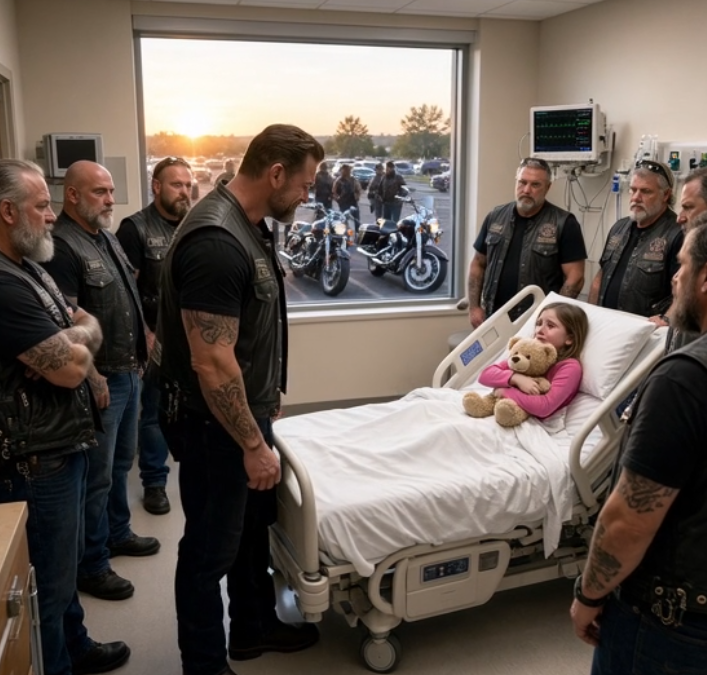
The hospital room was bright.
Too bright.
Children’s hospitals always seemed to Everett like places trying desperately to prove they were not hospitals.
Cartoon animals painted on walls.
Bright blankets.
Toy shelves.
Stars hanging from ceilings.
None of it could hide the IV pole.
The monitors.
The antiseptic smell.
Daisy looked tiny beneath the blanket.
Brown hair tangled around her face.
A stuffed rabbit pressed against her chest.
Everett stopped at the doorway.
She looked at him.
No recognition at first.
Then her eyes shifted toward his jacket.
Something flickered.
Everett stayed near the door.
“Hi.”
Daisy said nothing.
“My name’s Everett.”
Her fingers tightened around the rabbit.
“I knew your dad.”
Her lips moved.
When she spoke, her voice was almost nothing.
“He’s dead.”
Everett swallowed.
“Yeah.”
He pulled a chair closer but left several feet between them.
“He was my best friend.”
Daisy studied his face.
“You’re Ev?”
Everett smiled.
“Been a long time since anybody called me that.”
She looked at him.
“My dad had a picture.”
Everett reached into his jacket.
Slowly.
“Of this?”
He held up the old photograph.
Daisy stared.
Then nodded.
“That’s him.”
“It is.”
“You look younger.”
Everett almost laughed.
“That’s rude.”
For the first time, a tiny change crossed her face.
Almost a smile.
Everett set the picture on the bedside table.
“He saved my life once.”
Daisy looked interested.
“How?”
Everett glanced at Marissa.
She remained near the wall.
“He carried me somewhere safe when I couldn’t get there myself.”
Daisy looked down.
Everett’s voice softened.
“I should’ve been around more after he died.”
She said nothing.
“I’m sorry.”
Still nothing.
Then Daisy whispered:
“He said nobody would come.”
Everett’s stomach tightened.
“Who?”
She did not answer.
She did not need to.
“He said nobody cares,” Daisy whispered.
Everett leaned forward slightly.
Not too far.
“That part isn’t true.”
Her eyes lifted.
“You came because the lady called.”
“Yes.”
“So you didn’t know.”
“No.”
Honesty.
Always honesty.
“I didn’t know.”
Daisy looked away.
Everett continued.
“That was my failure.”
Marissa glanced at him.
“But now I know.”
Daisy stared at the window.
Everett followed her eyes.
“Want to see something?”
She shrugged.
Everett stood slowly.
He did not touch her.
He moved the blinds wider.
Below, twenty motorcycles sat in the morning light.
Beside them stood riders.
Some drinking coffee.
Some talking to security.
Hawk leaned against his bike.
Gloria stood beside him.
Nobody made a scene.
They were just there.
Daisy pushed herself upright.
Her eyes widened.
“Are those yours?”
“One is.”
“Who are the others?”
“Friends.”
She pressed one hand against the glass.
“Why are they here?”
Everett looked at her.
“For you.”
Daisy turned.
“All of them?”
“Every one.”
“Do they know me?”
“No.”
Her face tightened with confusion.
“Then why?”
Everett thought about the answer.
“Because sometimes you don’t need to know somebody for them to matter.”
Daisy stared down again.
Hawk happened to look up.
He saw movement in the window.
He raised one hand.
Daisy froze.
Then slowly lifted hers.
Hawk waved.
Gloria noticed.
Then she waved too.
One by one, the others saw.
Twenty riders raised their hands toward a single hospital window.
Nothing loud.
No engines.
No signs.
Just hands.
Daisy’s shoulders began shaking.
Everett turned toward her.
She was crying.
Not the quiet tears of a child trying not to be noticed.
Real crying.
Deep.
Broken.
Years too old for eight.
Everett did not move toward her.
He waited.
Then Daisy reached out.
Not for his hand.
For his sleeve.
Two fingers.
Barely touching.
Everett sat down beside the bed.
She cried for several minutes.
When she stopped, she whispered:
“They’ll leave.”
“Eventually.”
Her grip tightened.
“But not because you don’t matter.”
“How do you know?”
Everett looked out the window.
“Because I know those people.”
He paused.
“And because I’m staying.”
Marissa shifted slightly.
Everett remembered her warning.
Don’t promise what you can’t guarantee.
So he corrected himself.
“I’m staying as long as they let me be useful.”
Daisy looked at him.
That answer seemed to satisfy her more.
The hearing happened the following morning.
Everett expected a courtroom.
Instead, the emergency custody hearing took place in a smaller family-court room with fluorescent lights, beige walls, and too many folders.
Wesley Rowan arrived in a navy suit.
He looked exactly like the kind of man people trusted in photographs.
Clean haircut.
Calm posture.
Expensive attorney.
Controlled expression.
He saw Everett.
Then saw the riders seated in the back.
Only four had been allowed inside.
Hawk.
Gloria.
A retired teacher named Sam.
And Everett.
The rest waited elsewhere.
Wesley’s attorney argued that Daisy’s injuries were accidental.
That medical staff had misinterpreted normal childhood bruising.
That Wesley was a respected businessman and community volunteer.
That emergency removal was traumatic.
Marissa testified.
Then the emergency physician.
Dr. Anita Patel.
She did not exaggerate.
That made her more convincing.
She described patterns.
Healing stages.
Inconsistencies.
Behavioral indicators.
She did not accuse Wesley emotionally.
She simply placed facts into the room until his polished reputation had nowhere comfortable to sit.
Then the judge asked whether there was a safe relative placement.
There was not.
Emily remained unreachable.
Everett’s attorney had already filed paperwork allowing background review for emergency kin-like placement based on his relationship with Ryan.
The judge looked at him.
“You are not a blood relative.”
“No, ma’am.”
“You have not been actively involved in this child’s life for several years.”
Everett swallowed.
“No, ma’am.”
“Why should the court consider you?”
That question hurt because he agreed with it.
Everett stood.
“I don’t know if you should.”
His attorney looked at him sharply.
The judge raised an eyebrow.
Everett continued.
“I mean, not just because I knew her father.”
He looked toward the table.
“Ryan Calloway trusted me.”
His voice roughened.
“And I did not honor that trust the way I should have.”
Wesley looked almost amused.
Everett noticed.
Ignored it.
“I let years go by.”
He looked at the judge.
“I could tell you I was busy.”
“Everybody’s busy.”
“I could tell you her mother remarried and I didn’t want to interfere.”
“Maybe that’s partly true.”
“But mostly, I assumed somebody else was doing what I promised I would do.”
The room remained quiet.
“So I’m not asking you to believe I’ve been some perfect guardian waiting in the wings.”
Everett’s eyes moved briefly toward Wesley.
“I wasn’t.”
Then back.
“What I’m telling you is that when I got the call, I came.”
His voice steadied.
“I have a home.”
“A stable business.”
“No felony record.”
“References.”
“People who will help me.”
“And I’m willing to submit to every inspection, background check, interview, class, visit, or condition this court requires.”
He paused.
“But more importantly, I’m not going to make Daisy earn my belief.”
The judge watched him.
Everett sat down.
The temporary order did not give him custody.
Not yet.
The court placed Daisy in specialized foster care for immediate recovery.
Everett received approved contact pending evaluation.
It was not the dramatic victory people imagine stories should have.
It was paperwork.
Waiting.
Interviews.
Home inspections.
Therapy.
Background checks.
And that turned out to matter.
Because real protection was rarely one heroic moment.
It was repetition.
Everett showed up.
Tuesday afternoons.
Saturday mornings.
Doctor visits when permitted.
School planning meetings.
He learned Daisy hated peas.
Loved mystery books.
Could not sleep if closet doors were open.
Preferred pancakes shaped like circles but refused to explain why.
She hated loud motorcycles at first.
So the Highway Saints never started engines when she was around unless someone warned her.
Hawk taught the entire club this rule.
Anyone who forgot paid twenty dollars into Daisy’s book fund.
The fund became enormous.
Emily was found six weeks later.
Alive.
Ashamed.
Fragile.
Trying.
Her recovery became another complicated road.
Everett refused to make her the villain.
She had been struggling long before anyone understood how bad things had become.
She admitted Wesley isolated her.
Controlled finances.
Convinced her she was unstable.
Used her treatment against her.
She had believed leaving Daisy temporarily with him would be safer than taking Daisy through another unstable transition.
She had been catastrophically wrong.
But she returned.
And she did the work.
Treatment.
Therapy.
Parenting support.
Every requirement.
Daisy’s relationship with her mother rebuilt slowly.
Everett stayed involved.
Not as replacement family.
As promised family.
That distinction mattered to him.
The case against Wesley expanded.
Messages from former employees surfaced.
Financial coercion.
Threats.
A prior partner gave a statement describing similar behavior.
Hospital evidence supported Daisy’s case.
Eventually Wesley accepted a plea arrangement that included incarceration and restrictions on contact.
Everett did not attend sentencing.
Daisy did not either.
By then, revenge felt smaller than the work happening elsewhere.
One afternoon, nearly a year after the 3:12 a.m. phone call, Everett stood outside his motorcycle shop while Daisy examined a small purple bicycle.
He had not bought it.
That was important.
Emily had.
She stood nearby, healthier now.
Nervous.
Daisy stared at the bicycle.
Everett crouched beside her.
“You don’t have to ride it.”
“I know.”
“We can return it.”
“I know.”
“You can also set it on fire, but your mom probably won’t appreciate that.”
Emily laughed.
Daisy looked at him.
“Can you hold it?”
“The bike?”
She nodded.
Everett held the seat.
Daisy climbed on.
Feet on pedals.
She looked terrified.
Everett did not let go.
“Ready?”
“No.”
“Good.”
She frowned.
“Why good?”
“Because ready is overrated.”
Daisy pushed one pedal.
Then the other.
Everett walked beside her.
Thirty feet.
Forty.
At fifty, Daisy shouted:
“Don’t let go!”
“I’m not!”
Another twenty feet.
“Still there?”
“Still here.”
She rode in a circle.
Eventually Everett’s hand barely touched the seat.
Then it did not.
He still ran beside her.
Daisy looked back.
“You let go!”
“You were riding.”
“You said you wouldn’t!”
“I said I was still here.”
She stopped.
Thought about that.
Then smiled.
“Okay.”
Three years later, Daisy stood at the Highway Saints annual community fundraiser.
She was eleven.
Taller.
Louder.
Still carrying books everywhere.
Twenty riders had become more than twenty people she once saw from a hospital window.
They were birthdays.
Christmas cards.
Tutoring.
School plays.
Pancake breakfasts.
Bad jokes.
One ridiculous pink helmet Hawk had bought despite being specifically told not to.
At the fundraiser, someone asked Daisy if she remembered the hospital.
She nodded.
“What do you remember most?”
Everett was across the room.
He heard the question.
Daisy thought.
“The window.”
“The motorcycles?”
She shook her head.
“The waving.”
Everett stopped.
The woman interviewing her smiled.
“Why?”
Daisy looked toward Everett.
“Because I thought they were scary.”
Several riders laughed.
“They are.”
More laughter.
“But then they waved.”
Her face became serious.
“And nobody asked me to wave back.”
The room quieted.
Daisy continued.
“That mattered.”
Everett felt his throat tighten.
“They just waited.”
Later that night, Everett returned home.
The house was quiet.
He walked into his study.
Ryan’s photograph still hung on the wall.
But now another picture sat beside it.
Daisy at eleven.
Helmet crooked.
Sitting on Everett’s parked Harley.
Emily beside her.
Hawk photobombing in the background.
Everett stood before Ryan’s picture.
For years, he had avoided speaking aloud to dead men.
It felt foolish.
That night, he did it anyway.
“I was late.”
Silence.
Everett nodded.
“I know.”
He looked at Daisy’s photograph.
“But I came.”
His eyes burned.
“And I’m staying.”
Outside, rain began tapping against the windows.
Everett remembered 3:12 a.m.
The phone vibrating.
Marissa’s voice.
Daisy’s name.
How easy it would have been to believe someone else would handle it.
Someone official.
Someone closer.
Someone better qualified.
Maybe they would have.
Maybe the system eventually would have worked without him.
But that was no longer the point.
Ryan had once carried Everett when Everett could not get himself to safety.
Years later, Ryan’s daughter needed the same thing in a different form.
Not to be carried out of a battlefield.
Not to be rescued by force.
She needed adults who would believe what the polished explanations tried to erase.
A social worker willing to make a 3:12 a.m. call.
A doctor willing to question a convenient story.
A judge willing to move carefully.
A mother willing to rebuild.
A biker willing to admit he had failed before deciding to do better.
And twenty people willing to stand beneath a hospital window without asking for attention.
Everett finally understood something Ryan had known long before him.
Showing up was not dramatic.
It was not a single ride.
Not a courtroom speech.
Not twenty motorcycles gleaming beneath hospital lights.
Showing up meant coming back after the moment everyone would remember.
Tuesday.
Saturday.
The next hearing.
The next appointment.
The next nightmare.
The next birthday.
Again.
And again.
And again.
Because the cruelest lie Wesley Rowan had ever told Daisy was not that no one could stop him.
It was that nobody would come.
Everett could never undo every night she had believed that.
But from the morning she pressed her hand against a hospital window and saw twenty strangers raise theirs back, she would never have to believe it alone again.








