A 4-Year-Old Girl Collapsed in a Crowded 1892 Market Holding Her 6-Week-Old Brother—Then Something Fell From His Blanket That Made One Woman Turn Pale
PART2:
Martha Crowley looked down from behind a bolt of blue wool.
She was a narrow woman in her fifties, dressed better than most of the women in town, with sharp cheekbones, pale gloves, and hair pinned so tightly it seemed to pull kindness from her face. Her eyes passed over Lucy’s dirty feet, her torn dress, and the bundle in her arms.
“Excuse me?”
“My mama came here.”
Martha’s hand stilled on the wool.
“What is your mother’s name?”
“Anna Bennett.”
For a moment, something moved across Martha’s face. Not surprise. Not concern.
Calculation.
Then she looked away.
“I don’t know any Anna Bennett.”
Lucy shifted Samuel higher against her chest.
“She said she was coming to get her money.”
Martha’s mouth became a hard line.
“You need to leave.”
“My brother needs water.”
“Then find your mother.”
“I can’t.”
“That is not my problem.”
Lucy stood very still.
The heat shimmered beyond the stall. A fly landed near Samuel’s cheek. Lucy brushed it away with one trembling finger.
“Mama didn’t come back.”
Martha leaned closer, her voice low enough that the richer women browsing nearby would not hear.
“Little girls who wander around making trouble get sent to places much worse than the street. Do you understand?”
Lucy did not understand all the words.
She understood the warning.
She backed away.
The world tilted a little as she turned toward the narrow strip of shade beneath the wooden walkway. She only needed to sit for a moment. Only long enough for her arms to stop shaking. Only long enough to think what to do next.
She took one step.
Then another.
Her knees folded.
When she hit the ground, dust rose around her like smoke.
She curved herself immediately around Samuel.
The baby made a tiny sound.
Barely a whimper.
Lucy’s eyes filled with tears.
“It’s all right, Sammy,” she whispered, pressing her cheek to the blanket. “I got you.”
But for the first time since their mother had left, Lucy was not sure that she did.
People kept walking.
A woman lifted her skirt to avoid brushing against the dirt near Lucy. A man stepped around the children without looking down. Someone muttered that the town needed stronger rules about beggars. Somewhere nearby, Martha Crowley’s voice rose brightly as she complimented a customer’s taste in ribbon.
Then a pair of worn boots stopped in front of Lucy.
She expected them to move on too.
They did not.
Lucy slowly lifted her head.
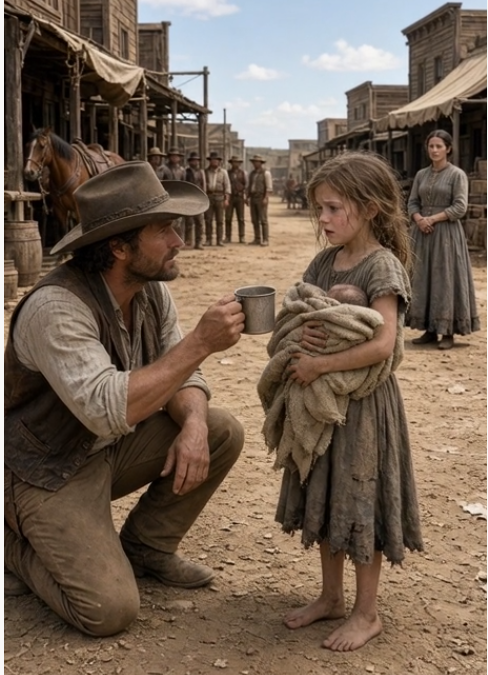
The man standing over her was tall, broad through the shoulders, and covered with dust from the road. His shirt was sun-faded, his hat worn, his jaw rough with several days of beard. His hands were large and scarred, the hands of someone who had spent years with horses, fences, rope, and tools. He looked tired, the kind of tired that lived not only in the body but behind the eyes.
But his eyes were not on her torn dress.
Not on her bare feet.
Not on the dirt.
They were on her face.
Then on the baby.
He crouched slowly, as if he did not want to frighten her.
“Are you hurt, little one?”
Lucy shook her head.
It was not entirely true, but Samuel mattered more.
The man looked at the bundle.
“How old are you?”
“Four.”
“And him?”
Lucy lifted Samuel a little.
“Six weeks.”
The man’s expression changed.
“That your brother?”
She nodded.
“Where’s your mother?”
Lucy looked toward the market.
“She went away.”
“When?”
“Two days ago.”
The man went still.
“And she hasn’t come back?”
Lucy shook her head.
“Sammy hasn’t eaten.”
Her voice broke.
“I asked for water, but nobody will give me any.”
The man lifted his eyes toward the stalls.
Several people who had refused Lucy suddenly became deeply interested in their work. The grain merchant looked down at his coins. The biscuit woman turned her back. Martha Crowley adjusted a ribbon display that did not need adjusting.
The man stood.
“Wait right here.”
Lucy’s heart sank.
She thought he was leaving too.
She looked down at Samuel.
“I’m sorry,” she whispered.
But a few minutes later, the boots returned.
The man knelt again, holding a tin cup filled with water.
“First you,” he said.
Lucy shook her head.
“Samuel.”
“Your brother needs you awake.”
Lucy stared at the cup.
Her lips were cracked too. Her throat felt full of dust. But the idea of drinking before Samuel seemed wrong.
The man seemed to understand.
“Two little sips,” he said. “Then we help him.”
Lucy obeyed.
The water was warm, metallic, and the best thing she had ever tasted.
The man pulled a clean strip of cloth from inside his shirt, dipped it into the water, and gently leaned toward Samuel.
“Not too much at once,” he said. “His stomach’s empty. We start slow.”
He showed Lucy how to touch the wet cloth to Samuel’s dry lips.
Once.
Then again.
Lucy held her breath.
Samuel’s tiny mouth moved.
He tried to suck the moisture from the cloth.
A sob escaped Lucy.
“Sammy.”
The man dipped the cloth again.
“That’s it,” he murmured. “Slow. Good boy.”
Lucy looked at him with wide eyes.
“What’s your name?”
“Daniel Harper.”
“I’m Lucy.”
“I know now.”
He glanced at the baby.
“And he’s Samuel.”
Lucy nodded.
“Sammy.”
Daniel’s mouth softened.
“I have a ranch a few miles east of here. There’s goat milk there. Food. A bed.”
Lucy stared at him, not understanding.
“For who?”
Daniel looked at her as if the answer should have been obvious to every person in the marketplace.
“For you.”
From behind the fabric stall, Martha Crowley made a sharp sound.
“Harper, you can’t just take those children.”
Daniel did not turn.
“Why not?”
“They’re vagrants. You don’t even know where they came from.”
Lucy lowered her eyes.
Martha continued, louder now because attention had shifted and she understood the value of sounding respectable in public.
“Children like that grow up taking whatever people hand them and stealing whatever is left.”
Daniel lifted Samuel carefully, only long enough to adjust the blanket and make sure the baby’s head was supported.
“Curious,” he said.
Now he looked at Martha.
“A few minutes ago, they weren’t worth a cup of water to you.”
Martha’s face hardened.
Daniel returned his attention to Samuel.
As he tucked the blanket more securely around the baby, something small slipped from between the folds.
It fell slowly into the dust.
Lucy looked down in confusion.
She had never seen it before.
Daniel picked it up.
It was a folded paper, softened by handling and hidden deep inside Samuel’s blanket.
Martha Crowley saw it.
All color drained from her face.
Daniel noticed.
He looked at the paper.
Then at Martha.
Then back at the paper.
He unfolded it carefully.
At the top was a name.
Anna Bennett.
Lucy sat up straighter.
“My mama.”
Beneath the name was a line of writing, a figure, and an ink stamp from Crowley Dry Goods.
Fourteen dollars in unpaid wages.
Daniel looked slowly toward Martha’s stall.
“You owed her mother money?”
Martha’s mouth tightened.
“That paper means nothing.”
“Then why do you look like you’ve seen a ghost?”
The market had grown quieter now.
People loved business until business turned into consequence.
Lucy tugged Daniel’s sleeve.
“Mama came here before she went away.”
Martha pointed at her.
“That child doesn’t know what she’s saying.”
Lucy flinched but kept going.
“She said she was going to get her money.”
Daniel folded the receipt and held it tightly.
“Where is Anna Bennett?”
Martha looked around. Too many people were listening now.
“She was arrested.”
Lucy stopped breathing.
“Arrested?”
Martha’s voice gained strength as she found a version of the story she preferred.
“She was caught stealing.”
Lucy’s eyes filled.
“My mama doesn’t steal.”
“She took blue wool from my shop and left without paying.”
Daniel looked at the receipt again.
“How much was the wool worth?”
Martha did not answer.
Daniel’s stare sharpened.
“How much?”
“Fourteen dollars.”
The words landed hard.
The exact amount on the receipt.
Lucy did not understand numbers well enough to grasp the contradiction, but Daniel did. So did a few others nearby. A murmur moved through the crowd.
Daniel crouched beside Lucy.
“Listen to me, little one.”
She looked at him.
“Your mother didn’t abandon you.”
Lucy’s lower lip trembled.
Daniel placed the folded receipt carefully inside his shirt pocket.
“Someone kept her from coming back.”
He took Lucy and Samuel to the ranch first.
He would not drag two exhausted children straight to the sheriff’s office or the county jail without food, warmth, and care. Justice could wait an hour. A starving baby could not.
Harper Ranch sat several miles east of Red Creek, where the land opened wide and rough beneath a merciless sky. It was not an elegant place, not like the wealthy cattle spreads farther south, but it was clean and solid. A sturdy house with a porch. A barn with a patched roof. A windmill that complained in the breeze. A corral, a milk goat, two horses, several chickens, and enough food to keep two children from slipping into silence.
Lucy stood just inside the kitchen door while Daniel warmed goat milk.
She did not sit until he asked twice.
Even then, she perched on the edge of the chair as though expecting someone to tell her she had misunderstood and needed to leave.
“Can Samuel drink that?” she asked.
“A little,” Daniel said. “Slowly.”
“You know babies?”
“I know weak animals. I know people aren’t animals, but small bodies can’t be rushed when they’ve gone too long without food.”
Lucy watched every movement.
“Is he going to die?”
Daniel stilled.
He did not want to answer.
He also would not lie to her.
“He’s weak.”
Lucy hugged her own knees.
“But we’re helping him?”
“Yes,” Daniel said. “We are.”
He fed Samuel a few drops first, then a spoonful, then another. Samuel resisted at first, too exhausted even to understand relief. Then his mouth moved. He swallowed.
Lucy leaned forward, trembling.
“He’s drinking.”
“That’s good.”
“He’s hungry.”
“That’s good too.”
Lucy smiled for the first time.
It was so small and sudden that Daniel had to look away.
He made food for her next. Bread softened with milk. A little broth. A small piece of cheese. Lucy ate like a child trying not to seem desperate and failing because hunger had made all her manners too heavy to hold.
When she thought Daniel was not watching, she slipped half a piece of bread into the pocket of her torn dress.
He saw.
He said nothing for a few seconds.
Then he placed two more pieces beside her plate.
“You can keep those for tomorrow.”
Lucy froze.
“I don’t have to hide it?”
“No.”
“Are you sure?”
“Sure.”
That question hurt Daniel more than anything he had heard in the market.
Before sundown, Samuel began to cry.
A real cry this time. Thin, angry, offended by life.
Lucy looked delighted.
“He’s crying!”
Daniel had never imagined the sound of a crying baby could feel like hope.
That night, Lucy slept in a small bed in the room off the kitchen with Samuel tucked safely in a cradle Daniel had borrowed years earlier and never expected to use again. She refused to let the cradle be more than arm’s length from her bed. Daniel did not argue.
He sat at the kitchen table long after the house went quiet, the receipt spread open before him.
Anna Bennett.
Fourteen dollars.
Crowley Dry Goods.
He had known Martha Crowley for years in the way a town knew its respectable people. He knew she dressed well, spoke sharply, and always made sure the church bazaar knew exactly how much fabric she donated. He knew she treated poorer women as if their gratitude were part of the purchase price. He knew she had power because money, reputation, and fear made a strong fence around certain people.
But he had not known this.
Or maybe, he thought bitterly, he had never looked closely enough.
That bothered him.
The next morning, Lucy came into the kitchen with Samuel in her arms before Daniel had finished hitching the wagon.
“Where are we going?” she asked.
“To talk to the sheriff.”
“I want to come.”
“The road’s long.”
Lucy tightened her hold on the baby.
“I want to find Mama.”
There was no point arguing.
“Then we go together.”
Sheriff Owen Briggs listened to the story from behind his desk with increasing unease. Briggs was not a bad man, which in Daniel’s experience did not always mean enough. He was heavyset, thoughtful, and careful in the way of someone who had learned that quick certainty could ruin lives.
When Daniel showed him the receipt, Briggs frowned.
“Where’d you get this?”
“Inside the baby’s blanket.”
Briggs read the paper.
“Fourteen dollars.”
Lucy stood on tiptoe, trying to see.
Daniel asked, “Why is Anna Bennett locked up?”
Briggs opened a ledger.
“Martha Crowley filed a complaint two days ago. Said Anna Bennett took blue wool from her business and left without paying.”
“How much was the wool worth?”
Briggs ran his finger along the line.
Stopped.
Looked up.
“Fourteen dollars.”
The room changed.
Even Lucy felt it.
“Mama said Mrs. Crowley was going to pay with cloth,” she said.
Briggs lowered his eyes to her.
“When did she say that?”
“Before she left.”
“Do you remember her words?”
Lucy squeezed Samuel’s blanket, thinking hard.
“She said, ‘If she has no coins, she’ll give me the blue wool. She owes me.’”
Daniel looked at Briggs.
Briggs looked again at the receipt.
“That doesn’t prove Mrs. Crowley gave her the wool,” the sheriff said.
“No,” Daniel replied. “But it proves she owed her money.”
“Yes.”
“Where is Anna now?”
“Transferred to Prescott yesterday to wait for a hearing.”
Lucy began to cry.
Not loudly. She had learned not to waste breath on loud crying.
Tears simply ran down her cheeks.
“I want Mama.”
Daniel crouched.
“We’re going to see her.”
Briggs raised a hand.
“Harper, wait.”
Daniel turned.
“There’s something else.”
The sheriff pulled another sheet from the file.
“Martha stated Anna hadn’t worked for her in months.”
Daniel lifted the receipt.
“This is dated last week.”
Briggs nodded.
“Which means Martha lied officially about when Anna last worked for her.”
Lucy did not understand the legal weight of that.
Daniel did.
Martha Crowley had not simply accused Anna in anger. She had built a story around the accusation. She had erased the work before claiming the theft.
That meant she was not confused.
She was protecting herself.
Hours later, Daniel, Lucy, and Samuel reached the county jail in Prescott.
Anna Bennett was thinner than Daniel expected.
Too young to look so tired.
She rose from the bench behind the bars when she saw them, fast enough to strike her knee against the wooden frame.
“Lucy!”
“Mama!”
Lucy ran.
Daniel had to shift Samuel quickly so he would not be crushed between them. Anna fell to her knees on the other side of the bars, reaching through with both hands. Lucy pressed herself against the iron, sobbing now in the full-body way only children sob when safety finally appears and the body realizes how afraid it has been.
“My babies,” Anna whispered. “Oh, God. My babies.”
Lucy shoved one small hand between the bars.
Anna kissed it again and again.
“I came back for you,” Anna said. “I swear I did.”
“I know,” Lucy cried.
Those two words broke Anna completely.
Daniel stood back, Samuel in his arms, giving them the closest thing to privacy the jail allowed.
After several minutes, Anna lifted her face and saw the baby.
“Samuel?”
“He’s weak,” Daniel said, “but better than he was.”
Anna pressed both hands over her mouth.
“I thought they’d take them somewhere. I asked. I begged the sheriff here to send word. Nobody listened.”
Daniel stepped closer.
“I found a receipt in the baby’s blanket.”
Anna’s eyes widened.
“You found it?”
“You hid it there?”
She nodded quickly.
“Martha tried to take it once.”
“What happened?”
Anna swallowed, glancing toward the guard.
Daniel lowered his voice.
“Tell me.”
“She owed me fourteen dollars for work. More, really, but fourteen was what she agreed to put in writing. I went to collect because Samuel needed milk and Lucy hadn’t eaten enough for days. Martha said she didn’t have enough cash in the drawer. She cut a piece of blue wool and said I could sell it or trade it, and that would settle the written debt.”
“Did anyone see her give it to you?”
Anna froze.
Then slowly nodded.
“Yes.”
“Who?”
“Teresa Morales. Another seamstress. She works in the back room.”
Daniel felt the entire case shift beneath his feet.
“Would she say so?”
Anna’s face tightened.
“I don’t know. Martha frightens her.”
“Where does Teresa live?”
Anna told him.
Daniel returned to Red Creek that same afternoon with Lucy and Samuel.
He did not go to Martha’s stall.
Not yet.
He went to find Teresa Morales.
He found her behind Crowley Dry Goods, carrying a basket of fabric scraps toward the alley. She was a small woman in her thirties with dark hair pulled beneath a kerchief and shadows beneath her eyes. When she saw Daniel, she stopped.
“I don’t want trouble.”
“Anna Bennett is in jail.”
“I know.”
“Then you know why I’m here.”
Teresa looked toward the shop door.
“I didn’t see anything.”
Lucy climbed down from the wagon before Daniel could stop her.
She walked straight to Teresa.
“Do you know my mama?”
Teresa’s lips parted, but no answer came.
Lucy pointed to Samuel, sleeping fitfully in the wagon seat.
“He was hungry.”
Teresa closed her eyes.
“Little one…”
“Seven people said no.”
Daniel watched Teresa’s hands tighten around the basket.
“Mrs. Crowley knew where Mama was.”
Teresa looked again toward the shop.
Martha could appear at any moment.
“I have children,” Teresa whispered.
Daniel understood.
“And you need the work.”
She nodded.
“If I speak, she’ll throw me out.”
“Probably.”
Teresa gave a bitter laugh.
“What comfort.”
Lucy looked down at Samuel’s blanket.
“My mama worked too.”
The sentence fell harder than any threat Daniel could have made.
Teresa stared at the child.
Then slowly set the basket down.
“I saw Martha give Anna the blue wool.”
Daniel did not interrupt.
“Anna asked for her fourteen dollars. Martha said she didn’t have enough cash and cut the wool instead. Anna said it wasn’t enough because Martha owed her for other weeks too.”
“More than fourteen?”
“Yes.”
Teresa drew a shaky breath.
“Martha got furious. Anna said she’d go to the sheriff and tell him how Martha paid us late or not at all. When Anna walked out, Martha told me if anyone asked, Anna had stolen the wool.”
“Did you tell the sheriff that?”
“No.”
Lucy asked, “Why?”
Teresa crouched until she was eye level with the girl.
“Because I was afraid.”
Lucy looked at Samuel.
“I was afraid too.”
Teresa covered her mouth.
That afternoon, she walked voluntarily into Sheriff Briggs’s office and gave her statement.
Martha arrived before Teresa finished.
“What are you doing?” she demanded.
Teresa turned.
Her face was pale, but she did not step back.
“Telling the truth.”
“If you finish that statement, do not return to my shop.”
Teresa trembled.
For one terrible second, Daniel thought she would fold.
She did not.
“Then pay me what you owe me too.”
Briggs looked up sharply.
“She owes you wages?”
Martha realized too late what she had provoked.
“This is absurd.”
The sheriff stood.
“Mrs. Crowley, I’ll need to review your payment ledger.”
“My books are private property.”
“And there is an accusation of theft involving merchandise a witness says you handed to the accused as payment.”
Martha pointed at Daniel.
“He is filling their heads with stories.”
Lucy, standing beside Daniel’s chair, spoke quietly.
“He gave me water.”
Martha looked down.
Lucy held her gaze.
“You didn’t.”
No one spoke for several seconds.
The sheriff requested Martha bring her books the next morning.
She left furious.
Daniel expected her to spend the night altering the records.
Instead, Martha made a different mistake.
She went to Teresa’s home.
And she did it in front of two customers who had followed out of curiosity and stayed because they saw Martha’s rage before she noticed them.
“Take back what you said,” Martha ordered.
Teresa stood in her doorway, one child clinging to her skirt.
“No.”
“I can say you stole too.”
One of the customers slowly lowered the bundle of lace she had been carrying.
Teresa went white.
“You would accuse me too?”
Martha understood too late that they were no longer alone.
By the next morning, half of Red Creek knew Martha Crowley had threatened to accuse a second seamstress of theft after the woman demanded unpaid wages.
Reputation, Daniel knew, was a strange kind of currency.
People spent years hoarding it.
Then one truth could set fire to the whole pile.
When Briggs reviewed Martha’s books, he found Anna and Teresa listed. Beside both names were weeks of unpaid wages, delayed wages, partial credits, and confusing notations about “materials compensation.” Then he found five more women in similar positions.
The case stopped being only about Anna Bennett.
But for Lucy, it remained exactly that.
Her mother was locked away.
She wanted to bring her home.
Daniel could have waited for the sheriff to handle it.
He did not.
He petitioned Judge Samuel Reeves to move Anna’s hearing forward and rode personally to Prescott with the original receipt, Teresa’s statement, and copies of the ledger entries Briggs had documented.
Two days later, they returned to the county court.
Anna looked thinner.
But when she saw Lucy walking toward her with Samuel awake and squirming in her arms, she smiled.
“Look at him,” Lucy said proudly.
Anna reached through the bars before the hearing.
“He’s stronger.”
“He cries a lot now.”
Anna laughed through tears.
“I never thought I’d be grateful for that.”
The hearing took place that morning in a room that smelled of dust, paper, and old tobacco. Martha arrived with a lawyer and a stiff black dress that made her look more offended than accused.
She insisted the situation was a misunderstanding.
“Mrs. Bennett took merchandise without payment,” the lawyer said.
Judge Reeves lifted the receipt.
“Your client owed Mrs. Bennett fourteen dollars.”
“That was a separate matter.”
Teresa was called.
She told what she had seen.
Martha denied every word.
Then Sheriff Briggs explained the ledger entries.
Multiple workers.
Unpaid wages.
A false statement about Anna not having worked recently.
Martha protested.
“My business records have no bearing on the alleged theft.”
Anna asked to speak.
The judge allowed it.
She stood slowly.
Her hands shook, but her voice did not.
“They have everything to do with it. We worked from before sunrise some days. She sold dresses we stitched and then said she couldn’t pay us yet. When I asked for my money because Samuel needed milk, she gave me the blue wool.”
“For what purpose?” the judge asked.
“To sell or trade for food.”
“And then?”
“I told her I also wanted what she owed from the weeks before.”
Anna looked directly at Martha.
“She said if I went to the sheriff, no one would believe a poor woman against a respected shopkeeper.”
The room fell silent.
Martha’s mouth twisted.
“She is lying.”
Lucy stood.
“No.”
Daniel touched her shoulder.
“Lucy.”
But she stepped forward.
“Mama doesn’t lie.”
Judge Reeves looked down at her.
“What do you remember about the morning your mother left?”
Lucy twisted her fingers together.
“She wrapped Sammy in his blanket.”
“Did she say where she was going?”
“To get her money.”
“Anything else?”
Lucy thought hard.
Then her eyes brightened with memory.
“She said if Mrs. Martha didn’t have coins, she would bring the blue cloth.”
Martha stiffened.
The judge leaned forward.
“Are you sure?”
Lucy nodded.
“She said she’d make Sammy a blanket when he got bigger.”
Anna began to cry.
Not because Lucy’s words were perfect evidence.
Because they were exactly what she had said.
Martha’s lawyer stood quickly.
“A child of four can repeat anything taught to her.”
Daniel spoke from his seat.
“I didn’t know about that conversation. Neither did Teresa.”
Judge Reeves turned back to Martha.
“And yet it matches the amount, the merchandise, and the receipt signed by your client’s business.”
The lawyer asked to speak privately with Martha.
It did not help.
There were too many contradictions now.
The charge against Anna Bennett was dismissed that day.
Judge Reeves ordered a separate review of unpaid wages and of the false complaint filed against her.
When the side door opened and Anna was released, Lucy ran.
Anna dropped to her knees and gathered both children in her arms for the first time in four days.
“I’m sorry,” she whispered into Lucy’s hair. “I’m so sorry.”
Lucy shook her head fiercely.
“You came back.”
“I tried.”
“I know.”
Daniel stepped away.
That family needed a moment without him inside it.
Later, outside the courthouse, Anna approached him with Samuel in her arms and Lucy pressed against her side.
“I have no way to pay you.”
Daniel frowned.
“For what?”
“You fed my children. You traveled here. You helped me.”
“That is not a debt.”
Anna looked at him as if the words were in a language she had almost forgotten.
Lucy tugged her mother’s skirt.
“Can we go back to the ranch?”
Anna looked embarrassed.
Daniel answered before she had to.
“You can stay until you decide what you want to do.”
Anna hesitated.
“And after that?”
“After that will still be your decision.”
Before climbing into the wagon, Lucy looked back toward the courthouse.
“Will Mrs. Crowley come out too?”
“Yes,” Daniel said.
Lucy frowned.
“Then nothing happened?”
Anna knelt in front of her.
“Yes, something happened.”
“What?”
“People know the truth now.”
Lucy considered that.
It did not feel like enough.
Martha Crowley would soon discover it was not enough for her either.
She returned to Red Creek convinced the scandal would fade.
It did not.
For years, Martha had depended on something more useful than law.
Her reputation.
Women bought from her because they trusted her. Families ordered dresses because she was respectable. Poor seamstresses worked for her because Red Creek offered few alternatives, and Martha knew exactly how far desperation could be stretched before it snapped.
Everything began to change.
Teresa did not return to the shop.
Neither did three other workers.
Two customers canceled dress orders when they learned part of their garments had been sewn by women who had not been fully paid. The sheriff did not close Martha’s store. He did not have to. The town did the slow work of consequence for him.
Martha was forced to pay the wages recorded as outstanding after several women filed claims. She formally withdrew the accusation against Anna. When she tried to explain in the plaza that the whole matter had been a misunderstanding, no one laughed politely. No one rushed to comfort her.
Lucy was there that day.
She had returned to the market with Anna and Daniel.
This time, she wore shoes.
Samuel slept in his mother’s arms, his cheeks fuller, his breathing strong.
Martha saw Lucy and looked away.
Lucy walked toward her.
Anna almost stopped her.
Daniel gently shook his head.
Lucy stopped in front of the fabric stall.
“You knew where my mama was.”
Martha glanced around.
“Lucy…”
“I asked you for water.”
The woman closed her eyes.
“I know.”
“And you said no.”
Martha found no answer.
Lucy pointed to Samuel.
“He could have died.”
Her voice was not loud.
That made everyone listen harder.
“Yes,” Martha said finally.
Lucy asked, “Why didn’t you help us?”
Martha looked at Anna.
Then at the people around them.
She could lie again.
She did not.
“Because I was afraid someone would ask about your mother.”
Anna pressed her lips together.
Martha swallowed.
“And because I thought of myself first.”
Lucy took several seconds to respond.
“That was wrong.”
“Yes.”
There was no grand revenge.
Lucy did not insult her.
She simply turned and walked back to her mother.
For Martha, that small back moving away from her was worse than any shouting.
Anna chose not to return to sewing for anyone who controlled all of her wages.
Daniel offered a small empty house near his ranch.
“It belonged to my old foreman,” he said.
Anna stood in the doorway, looking at the two small rooms, the kitchen, the porch, the cracked but clean windows.
“I can’t accept a house for free.”
“It isn’t free.”
She stiffened.
Daniel pointed to a basket of torn shirts near his saddle.
“I need somebody to make my clothes stop looking like they were attacked by barbed wire.”
Anna gave a startled laugh.
“That doesn’t pay for a house.”
“I also need help with supply accounts.”
“Can you read them?”
“Yes.”
“Then you don’t need me.”
Daniel smiled.
“You’re learning too fast.”
In the end, they agreed on a small rent Anna could pay through sewing and bookkeeping.
Not charity.
Not obligation.
A clear arrangement.
That mattered to her.
Months passed.
Samuel grew rounder and louder.
Lucy grew too.
Daniel never tried to become something no one had asked him to be. But he was there.
When Lucy learned to ride, he walked beside the horse.
When Samuel had his first fever, Daniel drove the wagon to the doctor before Anna finished asking.
When Anna began receiving sewing orders of her own, Daniel built her a large table by the window.
“How much do I owe you?” she asked.
“One shirt without holes.”
“You are trying to cheat me.”
“Probably.”
Red Creek changed too.
Not completely.
No town changed completely because of one shameful morning. There would always be people who looked away when looking came with cost.
But Lucy’s story left a kind of bruise on the town’s conscience.
The grain merchant who had said “not my business” began leaving a jug of water outside his shop on hot days.
The biscuit woman started setting aside yesterday’s bread for families without money.
Even men who had stepped around Lucy in the dust lowered their eyes when they saw her walking with Anna.
A year later, during another brutal summer, Lucy walked through the market holding Anna’s hand. Samuel toddled beside them, unsteady and cheerful, gripping a wooden toy Daniel had carved badly enough that everyone had politely agreed it was a horse.
Lucy saw a little boy sitting beneath the shade of the wooden walkway.
He was alone.
His shirt was torn.
His lips were dry.
Lucy stopped.
Anna stopped too.
The girl looked up.
“Do we have water?”
Anna handed her a canteen.
Lucy walked to the boy and knelt.
“Here.”
The boy stared at her.
Then drank.
Across the street, Daniel watched from beside the hitching rail.
He said nothing.
Lucy had learned something many adults in Red Creek had taken too long to understand.
Helping did not always require money.
Sometimes it only required stopping.
That evening, they returned to the ranch.
Samuel stumbled across the porch while Anna chased him, laughing. Daniel repaired a fence nearby. Lucy ran to him, breathless and proud.
“Mr. Harper.”
He leaned on the fence post.
“Yes?”
“I helped someone today.”
“Is that so?”
“He was thirsty.”
“What did you do?”
Lucy seemed surprised by the question.
“I gave him water.”
As if there could be no other answer.
Daniel smiled.
Lucy looked back toward the house, where her mother lifted Samuel into her arms.
For a long time, she would remember the day she fell in the market and nobody moved.
But she would not remember only the seven refusals.
She would remember worn boots stopping in front of her.
A tired rancher kneeling in the dust.
A tin cup.
A strip of wet cloth touched gently to Samuel’s lips.
And the first person who decided the suffering of two children was his business.
Because in the end, Daniel Harper had not changed their lives with wealth, force, or grand promises.
He had changed them with something much simpler.
When everyone else kept walking, he stopped.








