A 14-Year-Old German Shepherd Sat Alone on a Plastic Chair for 20 Minutes While His Handler Spoke With the Vet Behind a Closed Door—Then the Man Came Back, Lifted the Old K9 to His Chest, and Carried Him Through One Last Door.
PART3:
The receptionist said, “Of course. Take your time.”
Life continued.
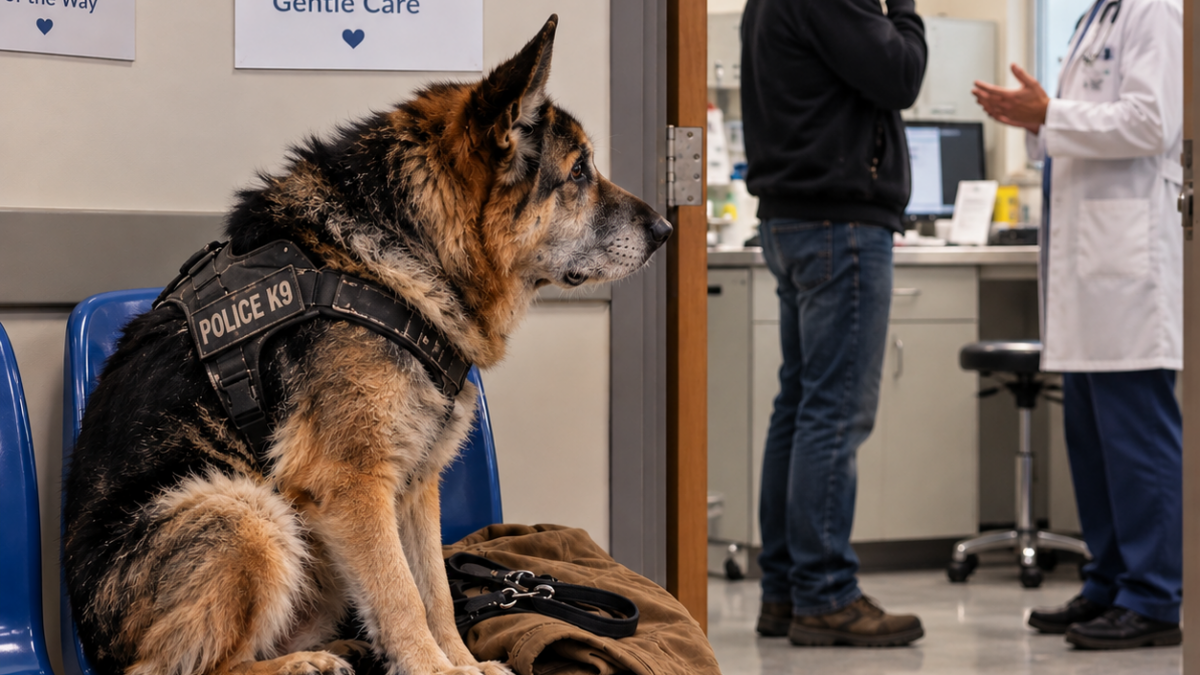
And in the center of it sat that German Shepherd.
Waiting.
He did not whine.
He did not pant.
He did not scratch at the door.
He looked toward it every few seconds.
That was all.
A glance.
Then stillness.
Another glance.
Then stillness again.
His discipline was almost unsettling.
Murphy leaned harder into my leg.
“I know,” I whispered.
He looked up at me.
“You’re being very brave.”
Murphy’s expression made it clear that neither of us should spread that rumor.
I scratched behind his ears.
When I looked back, the Shepherd was watching us.
His gaze rested on Murphy for a moment.
Then on me.
Then returned to the door.
Five minutes passed.
The bulldog puppy was called.
A woman came out of an exam room crying and clutching a prescription bag.
A man entered carrying a terrified orange cat.
Murphy sighed dramatically.
The Shepherd remained.
Nobody came for him.
That was when curiosity became concern.
I looked toward both restroom doors.
One opened.
A young man came out.
The Shepherd’s head moved immediately.
His remaining upright ear lifted.
The man crossed the waiting room and sat beside a husky.
The Shepherd watched him for two seconds.
Then turned back toward the hallway.
Another five minutes.
He shifted.
Slowly.
His hindquarters seemed stiff.
For a second I thought he might jump down.
He did not.
He simply adjusted his front paws.
Then resumed waiting.
There was something about the movement that made my chest tighten.
Not because it was dramatic.
Because it was familiar.
Anyone who has loved an old dog knows the calculations they make before moving.
Can I stand?
Can I lie down?
Is this position worth changing?
Will my legs cooperate?
The body becomes a negotiation.
The Shepherd had chosen the chair.
So he stayed.
I glanced at the receptionist.
She noticed.
Our eyes met.
I gave a tiny motion of my head toward the dog.
She followed my gaze.
Her expression changed.
Not much.
But enough.
She lowered her voice.
“His owner is speaking with Dr. Mercer.”
“Oh.”
I nodded.
Then she added, “He asked if Ranger could wait out here.”
Ranger.
The name immediately suited him.
I looked at the dog again.
“Is he okay?”
The receptionist’s lips parted.
Then closed.
She looked toward the hallway.
“He’s very old.”
Nothing else.
She did not need to say anything else.
Veterinary waiting rooms teach you a language you never wanted to become fluent in.
Quality of life.
Comfort care.
Good days and bad days.
We can try.
We can manage the pain.
There are options.
There aren’t many options.
You’ll know.
Sometimes they tell us when they’re ready.
He’s very old.
The words changed the entire room.
Or maybe they changed me.
Suddenly I saw the harness differently.
The leash.
The jacket.
The keys.
Ranger had not been accidentally left there.
His person had placed him there.
The man had removed the old working harness.
Taken off the leash.
Folded his jacket beside him.
Put down his keys.
Then gone through the door alone.
I looked at the black harness beneath the chair.
POLICE K9.
Faded letters.
Scratched buckle.
One leather strap had been repaired with black thread.
It was not ceremonial.
It had been used.
Used heavily.
I looked at Ranger’s scar.
His damaged ear.
His huge paws.
His old body.
And suddenly I could see a younger version of him.
Standing between patrol cars beneath red and blue lights.
Leaping from the back of an SUV.
Running through wet grass.
Searching dark buildings.
Following scent down alleys.
Waiting beside a uniformed man who trusted him enough to walk into danger together.
I wondered whether the man behind the door was that handler.
I wondered whether he had once given Ranger commands from twenty yards away.
I wondered whether this was the first time he had ever told the dog to stay while he went somewhere Ranger was not allowed to follow.
That thought hurt.
The little girl with the rabbit noticed the Shepherd.
“Mom?”
Her mother looked down.
“Why is that dog sitting by himself?”
Her mother glanced across the room.
“I think his person will be back.”
The little girl considered that.
Then nodded.
Ranger looked toward the door again.
His person will be back.
Simple.
Absolute.
Dogs build their entire world around promises we do not realize we make.
I leave.
I return.
You wait.
I return.
Door closes.
Door opens.
Car leaves.
Car comes back.
Morning becomes evening.
Footsteps come down the hallway.
Keys turn in the lock.
We repeat those things thousands of times until trust becomes automatic.
Ranger was not worried.
That was what destroyed me.
He trusted the pattern.
The man went through the door.
Therefore the man would return.
I put my hand on Murphy.
His fur was warm.
His heart beat beneath my palm.
For no logical reason, my eyes filled.
Murphy looked up.
“What?”
I smiled.
“Nothing.”
Across the room, Ranger waited.
Another five minutes.
By then other people had noticed.
Nobody announced it.
Knowledge simply moved through the waiting room.
The woman with the rabbit followed my gaze.
The man holding the orange cat stopped bouncing his knee.
The receptionist began answering the phone even more softly.
A veterinary technician came through the swinging door carrying towels, saw Ranger, and paused.
She walked over.
Ranger looked up.
She crouched beside him.
“Hey, Sergeant.”
Sergeant.
Ranger’s tail moved once.
The technician touched his chest.
Not his head.
Not his paws.
His chest.
A familiar place.
“You doing okay?”
Ranger looked toward the door.
“I know.”
She swallowed.
Then stood and went back through.
The little girl whispered, “Is he a police dog?”
Her mother said, “I think he used to be.”
Used to be.
There are phrases that become cruel only after enough years.
Used to run.
Used to hear.
Used to jump.
Used to work.
Used to protect.
Used to come home from this place.
Ranger’s harness remained under the chair.
I noticed a second tag now.
Retired.
The word was stamped beneath K9.
I looked away.
It began raining outside.
Lightly at first.
The drops streaked the front windows.
Ranger turned his nose toward the sound.
Maybe he could hear rain.
Maybe smell it.
Old working dogs keep extraordinary pieces of the world long after other things begin leaving them.
His eyes closed for several seconds.
Then opened.
Door.
Still closed.
He waited.
Twenty minutes.
Maybe twenty-two.
I know because I checked the clock more than once.
Then Murphy sat upright suddenly.
His ears lifted.
Ranger’s head turned at the exact same moment.
The consultation-room door opened.
A man walked out.
He was in his late fifties.
Maybe sixty.
Tall.
Broad shoulders that had begun bending forward with age.
Dark jeans.
Work boots.
Gray sweater.
Short hair almost entirely silver.
There was nothing visibly dramatic about him.
No collapse.
No loud crying.
No shaking.
And somehow that made it worse.
His face had the strange emptiness of someone who had just been told something too large for expression.
He stopped when he saw Ranger.
The dog’s entire body changed.
Not much.
Enough.
His head lifted.
His chest came forward.
His tail struck the plastic chair.
Once.
Then again.
The man closed his eyes.
Only for a second.
He walked toward him.
Ranger remained seated.
Did not jump down.
Maybe he could not.
Maybe he had been told to stay.
Maybe years of training still mattered.
The man reached the chair and crouched.
His right knee cracked loudly.
Ranger leaned forward.
The man put one hand against the dog’s face.
The other around his neck.
Then he pressed his forehead against Ranger’s forehead.
Nobody in the room moved.
I heard him whisper.
“Good stay.”
Two words.
Good stay.
The receptionist turned away.
The technician behind the desk covered her mouth.
The man laughed once.
It broke halfway through.
“You always were better at that than me.”
Ranger licked his chin.
The man shut his eyes.
His face changed.
Pain finally got through.
He put both arms around the Shepherd.
“I’m sorry, buddy.”
Ranger leaned into him.
“I tried.”
His voice cracked.
“I swear to God, I tried.”
That was when I knew.
Whatever conversation had happened behind that door had ended with no solution.
The little girl’s mother pulled her closer.
The man remained crouched.
Ranger did not know what sorry meant in that moment.
He only knew his person was back.
That was enough.
The man touched the scar above Ranger’s eye.
Then the damaged ear.
His fingers moved over the dog’s face like he was memorizing it.
“You remember that one?”
He smiled through tears.
“God, you were stupid.”
Ranger’s tail moved.
The man laughed again.
“You scared ten years off me that night.”
The receptionist lowered her eyes.
I wanted to look away.
It felt private.
But there are moments you witness accidentally and carry forever.
The man reached beneath Ranger’s collar.
His fingers found the metal K9 tag.
He held it.
Then whispered something I barely heard.
“End of watch, partner.”
The room changed.
Even the people who had not understood before understood then.
The little girl asked, very quietly, “Mom?”
Her mother whispered, “Shh, baby.”
The man stood.
Then reached beneath Ranger.
One arm under his chest.
One beneath his hips.
Ranger was large.
Even thin and old, he must have weighed sixty-five pounds.
The man grunted as he lifted.
A technician stepped forward.
“Daniel, I can help.”
Daniel.
His name.
He shook his head.
“No.”
The word came out soft.
Not angry.
“I carried him out of the cruiser the first day we met.”
The technician stopped.
Daniel pulled Ranger higher against his chest.
“I’m carrying him now.”
Ranger rested his head against the man’s shoulder.
One huge paw hung over Daniel’s arm.
Daniel’s face disappeared briefly into the gray fur along Ranger’s neck.
Then he turned toward the door.
The leash remained behind.
The harness remained underneath the chair.
The jacket.
The keys.
Everything.
For perhaps ten seconds, Daniel simply stood there.
Holding his dog.
Then he walked.
Ranger looked over Daniel’s shoulder.
Not at us.
At the waiting room.
The walls.
The people.
Maybe nothing in particular.
His eyes were calm.
Then Daniel carried him through the door.
It closed softly.
No one spoke.
The chair was empty.
That was worse than I expected.
The shape Ranger had occupied seemed to remain.
Blue plastic.
Brown jacket.
Keys.
Coiled leash.
Old harness beneath.
The things looked suddenly abandoned.
Evidence of a life interrupted.
A Labrador bumped his cone into the wall.
Nobody laughed this time.
The receptionist called another name.
Her voice cracked.
She cleared her throat and tried again.
Life continued.
It always does.
That is one of grief’s quiet cruelties.
Phones ring.
Printers print.
Appointments begin.
Invoices appear.
Someone somewhere asks whether your pet is eating normally while, ten feet away, another person is saying goodbye to the creature who slept beside them for fourteen years.
Murphy pressed his nose into my palm.
I looked down.
His cloudy eyes met mine.
I put both hands around his face.
“I know.”
He had no idea.
Or maybe he did.
I was beginning to suspect dogs understand rooms better than people do.
Fifteen minutes passed.
Maybe less.
Maybe more.
Time near death behaves differently.
Every minute is both unbearable and insufficient.
The door opened.
Daniel came out.
Alone.
That word still hurts.
Alone.
He walked toward the chair.
His hands were empty.
His sweater had dog hair across the chest.
A damp patch darkened one shoulder where Ranger’s muzzle had rested.
Daniel stopped beside the chair.
For a moment, he stared at it.
Then he picked up the jacket.
Folded it once even though it was already folded.
Picked up the keys.
The metal made a small sound.
Then the leash.
He ran the leather through his hands.
Once.
Slowly.
Finally he bent for the harness.
He lifted it by the handle.
POLICE K9.
RETIRED.
The harness hung empty.
Daniel froze.
His fingers tightened.
The receptionist stepped around the desk.
“You don’t have to do paperwork today.”
He nodded.
“Thank you.”
“We’ll call you.”
Another nod.
She touched his arm.
“He was a good dog.”
Daniel stared at the harness.
Then looked at her.
“No.”
The receptionist seemed confused.
Daniel swallowed.
“He was the best thing I ever did right.”
Nobody knew what to say.
Daniel looked toward the closed door.
“I made a lot of mistakes.”
His eyes filled.
“But not him.”
He lifted the empty harness.
“Never him.”
Then he walked out into the rain.
I watched through the front window.
He reached an old dark-blue pickup truck.
Opened the passenger door.
And stopped.
The seat was covered with a gray dog blanket.
A portable ramp rested behind it.
There was a stainless-steel water bowl on the floorboard.
Daniel stood with one hand on the open door.
He could not put the harness inside.
Not yet.
Eventually he did.
Then he rested both hands against the roof of the truck.
His head lowered.
Rain fell onto his gray hair.
Nobody went outside.
Not because we did not care.
Because some grief needs privacy more than comfort.
He stood there for almost a minute.
Then climbed into the driver’s seat.
The passenger seat remained empty.
He did not leave immediately.
The truck stayed parked.
Five minutes.
Ten.
Then it pulled away.
Our name was called shortly afterward.
“Murphy?”
Routine exam.
Weight.
Temperature.
Heart.
Teeth.
Ears.
Arthritis.
Bloodwork.
The veterinarian listened to Murphy’s chest.
“His murmur sounds stable.”
I almost cried.
Stable.
The word suddenly felt extravagant.
“We’ll check his kidney values. At his age, I like to keep an eye on them.”
At his age.
There it was again.
That little warning hidden inside reassurance.
Murphy growled softly when she touched his back leg.
The vet smiled.
“I agree, sir. Very rude of me.”
I laughed.
But part of my mind remained in the waiting room.
Blue chair.
Empty harness.
Good stay.
End of watch, partner.
On the drive home, Murphy slept in the back seat.
At every red light, I checked the mirror.
Gray muzzle.
Cloudy eyes.
Chest rising.
Falling.
Rising.
Falling.
The ordinary miracle of an old dog still breathing.
I thought about Ranger.
Not his death.
Strangely, what stayed with me most was the waiting.
Those twenty minutes.
Ranger sitting on the chair while Daniel spoke with the veterinarian.
A dog who had chased suspects and searched buildings and protected a police officer simply waiting because his person had told him to.
It would have been easy to keep him in an exam room.
Easy to hold the leash tightly.
Easy to make the entire appointment clinical.
But Daniel had not.
He had brought Ranger into the waiting room.
Removed the harness.
Removed the leash.
Put him on a chair.
Left his jacket there.
His keys.
His scent.
Then gone to hear the words Ranger did not need to hear.
There would be no more treatment.
The mass had spread.
The kidneys were failing.
The pain medication was no longer enough.
Whatever the details were, Ranger did not need them.
Dogs do not need prognosis.
They need us.
Daniel had given him twenty minutes where nothing was being done to him.
No needle.
No examination.
No decision.
Just a chair.
His person’s jacket.
Ordinary sounds.
Rain.
A beagle.
A rabbit.
A receptionist answering phones.
Twenty minutes of being Ranger.
Not a patient.
Not a retired K9.
Not a dying dog.
Ranger.
That stayed with me.
A week later, I returned to pick up Murphy’s medication.
The same receptionist was there.
“How’s your handsome boy?”
“Deeply offended by his joint supplement.”
She smiled.
“That’s a good sign.”
I paid.
Then looked toward the chair.
Second from the corner.
Blue plastic.
Empty.
The receptionist followed my eyes.
“You were here with Ranger.”
I nodded.
I almost apologized for remembering.
Instead I asked, “Was Daniel his handler?”
Her face softened.
“For his whole career.”
I waited.
She leaned against the counter.
“They were partners almost nine years.”
I looked toward the chair.
“Nine?”
“Ranger joined the department when he was eighteen months old.”
“What did he do?”
“Patrol and tracking mostly. Missing persons. Building searches.”
She smiled faintly.
“And apparently stole sandwiches from patrol cars.”
That made me laugh.
“Daniel told you that?”
“Daniel told everybody that.”
She looked down.
“He brought Ranger here for years after retirement.”
“How long had he been retired?”
“Almost five years.”
Fourteen.
The age made sense.
“He got him after retirement?”
She shook her head.
“Daniel fought to keep him.”
Something in her wording caught me.
“Fought?”
“The department originally planned to place Ranger with another handler for a year or two because he was still technically serviceable.”
“Technically?”
“His hips were starting to go. Daniel said no.”
The receptionist smiled sadly.
“He told them Ranger had done enough.”
I looked down.
“What happened?”
“Daniel bought him from the department for one dollar.”
One dollar.
I laughed softly.
“Best purchase he ever made.”
“That’s exactly what he used to say.”
She reached beneath the counter for a box.
Then stopped.
“I probably shouldn’t tell you too much.”
“You don’t have to.”
She nodded gratefully.
Then said, “But you saw them.”
I understood.
Some stories want witnesses.
Not audiences.
Witnesses.
“Was Ranger sick long?”
Her smile disappeared.
“Six months.”
Cancer.
Aggressive.
They tried surgery.
Then chemotherapy.
Daniel drove Ranger almost two hours each way to a specialty hospital.
At first Ranger responded.
Then he did not.
“He stopped climbing into the truck last week,” she said.
My throat tightened.
“Daniel built him a ramp.”
“He stopped using the ramp two days ago.”
I thought of the truck outside.
The gray blanket.
“What happened yesterday?”
“He stopped eating steak.”
I looked at her.
“Steak?”
“Daniel cooked him steak every Sunday after retirement.”
The receptionist’s eyes filled.
“He said Ranger refusing steak was when he knew.”
That tiny detail hurt more than cancer.
Illness becomes real through ordinary things.
A favorite food untouched.
A leash that no longer brings excitement.
Stairs avoided.
A ball ignored.
The absence of wanting.
“Why the chair?” I asked.
She smiled.
“That was Ranger’s chair.”
“What?”
“Not literally that one.”
She pointed.
“Daniel said Ranger always sat in chairs.”
I laughed.
“A German Shepherd?”
“Apparently.”
“Why?”
“He spent years watching Daniel sit in the passenger seat during training briefings and somehow decided chairs were where partners belonged.”
She smiled.
“When he retired, Daniel bought him an old recliner from a thrift store.”
I pictured it immediately.
A huge German Shepherd taking up an entire recliner.
“He asked whether Ranger could wait outside the consult room because he hated exam rooms.”
“Was he scared?”
“No.”
She thought about it.
“Not exactly.”
“What then?”
“Ranger always worked when he went through closed doors.”
I stared at her.
She continued.
“Daniel said every door in Ranger’s life meant a job. Search. Find. Protect.”
My chest tightened.
“So he didn’t want the last twenty minutes to feel like work.”
I looked at the chair.
The receptionist nodded.
“He wanted him to just sit.”
One more chair.
That phrase stayed with me.
One more chair.
I drove home thinking about it.
Murphy was asleep in his bed when I arrived.
He opened one eye.
I held up the medication.
“Bad news.”
His eye closed.
“No enthusiasm?”
Nothing.
“Thought so.”
That night, he climbed onto the couch despite having been told for years that the couch was technically not his.
I started to make him get down.
Then I thought of Ranger.
I moved the blanket instead.
Murphy settled beside me.
His back pressed against my thigh.
I put my hand over his ribs.
Someday.
The thought came uninvited.
Someday I will need to do for you what Daniel did for Ranger.
I hated the thought.
Pushed it away.
But the truth remained.
To love an animal is to accept a contract whose final clause is written in grief.
They give us years.
We give them one unbearable day.
Months passed.
Murphy’s kidney values changed.
Not catastrophically.
“Early disease,” the veterinarian said.
“Manageable.”
Diet.
Medication.
More frequent bloodwork.
I nodded.
Murphy rejected the prescription food with impressive precision.
He would eat around individual pieces.
I mixed it with chicken.
He removed the chicken.
Left the prescription food.
I warmed it.
He stared at me as if heat had only intensified the insult.
I hand-fed him.
He ate three bites.
Then turned his head.
I laughed.
Later I cried in the pantry.
Quietly.
Because Ranger had taught me something else.
Do not make them carry your grief before they have reached the goodbye.
Murphy was still alive.
Still stubborn.
Still furious about healthy food.
He did not need me mourning him while he was busy living.
I wiped my face.
Returned.
“Fine.”
Murphy looked up.
“We negotiate.”
His tail moved.
Victory.
I became softer after Ranger.
Not saintly.
I still yelled in traffic.
Still hated people who stopped shopping carts in the middle of aisles.
Still muttered at telemarketers.
But sometimes, when someone moved too slowly or seemed distracted, I imagined Daniel sitting in that pickup truck with an empty passenger seat.
You do not know what people are carrying.
Sometimes they are carrying an old K9 into a clinic.
Sometimes they are carrying only the harness back out.
A year passed.
Murphy declined gradually.
Old dogs often give you grief in installments.
One shorter walk.
One missed meal.
One night of confusion.
One stumble.
One morning where getting up takes longer.
One favorite toy ignored.
One day you realize you have been counting good days.
Then you realize you have been counting bad ones.
The arithmetic of love near the end is horrible.
Eating.
Drinking.
Sleeping.
Pain.
Interest.
Mobility.
Joy.
You turn a life into columns because you are trying desperately to answer a question that has no painless answer.
Am I keeping you because you want to stay?
Or because I cannot let you leave?
I thought about Daniel often.
How long had he asked himself that?
How many nights had he watched Ranger sleep?
How many times had he changed medication?
How many steaks had he cooked hoping appetite would mean more time?
How many mornings had he helped Ranger stand?
Love near the end becomes practical.
Towels.
Pills.
Ramps.
Non-slip rugs.
Raised food bowls.
Appointments.
Questions.
But beneath every practical act sits terror.
Not yet.
Please.
Not yet.
Murphy’s final winter was cold.
He hated snow by then.
The dog who once dragged me through drifts began standing at the porch door and looking outside like the weather had personally insulted him.
I bought him boots.
He hated those more.
He still barked at delivery trucks.
Still begged for bacon.
Still followed me to the bathroom.
Still found reasons to be Murphy.
So I stopped measuring him only by decline.
That was Ranger’s gift too.
Honor the life.
Not just the ending.
Then one November morning, Murphy did not eat.
At dinner, he did not eat.
The next morning, nothing.
Even chicken.
Even bacon.
He sniffed.
Looked at me.
Turned away.
My stomach dropped.
The veterinarian ran tests.
Kidneys.
Much worse.
She explained numbers.
Options.
Fluids.
Hospitalization.
Possible improvement.
Temporary.
Maybe days.
Maybe weeks.
Murphy sat beside me, leaning against my leg.
The vet spoke gently.
“You don’t have to decide this second.”
I looked down.
Murphy’s head rested against my shin.
I thought of Ranger.
Daniel behind the closed door.
Twenty minutes.
One more chair.
“Is he hurting?”
“Yes.”
That answered more than anything else.
I took Murphy home.
One night.
The veterinarian agreed to come the next morning.
Murphy hated clinics.
His goodbye would not happen there.
That night I slept on the floor beside him.
Or tried.
At 2:00 a.m., he woke.
I carried him outside.
The sky was clear.
Cold stars.
Murphy stood unsteadily in the yard.
Sniffed the air.
Then sat.
I sat beside him.
Neither of us moved.
He leaned against me.
I cried into the top of his head.
“I’m going to miss you.”
His ear moved.
“I don’t know how to do this.”
He breathed.
“But I know somebody who taught me.”
The next morning, before the vet arrived, I carried Murphy onto the porch.
There was an old wooden chair near the steps.
His favorite place was not the chair.
It was beside it.
But I thought of Ranger.
One more ordinary place.
I wrapped Murphy in a blanket.
Sat down.
Placed him across my lap.
For twenty minutes, we watched the yard.
Exactly twenty.
I did not plan the number.
I noticed afterward.
Leaves moved.
A truck passed.
A squirrel appeared on the fence.
Murphy saw it.
His ears lifted weakly.
I laughed.
“There you are.”
His tail tapped against the blanket.
Once.
The veterinarian arrived.
Murphy looked at her.
Then at me.
No fear.
Just tiredness.
There is a difference.
I understood it now.
She gave him the first medication.
His body relaxed.
I held his face.
“Good boy.”
My voice failed.
“You were such a good boy.”
His eyes remained on me.
I thought of Daniel.
Good stay.
I put my forehead against Murphy’s.
“You can go.”
The second medication entered the catheter.
His breathing slowed.
One breath.
Another.
Then stillness.
There are no perfect endings.
Only endings we try to make gentle.
Murphy died with his head against my chest.
The veterinarian left me alone.
I sat on the porch with him long after his heart stopped.
The chair beneath me became unbearable.
And sacred.
When I finally stood, his leash was hanging beside the back door.
His bowls remained in the kitchen.
His medication sat on the counter.
His bed waited beside the couch.
Every object seemed suddenly impossible.
The house was full of things still performing jobs for someone who no longer needed them.
Water bowl.
Leash.
Blanket.
Medication.
Collar.
The body leaves.
Routine does not know.
A week later, I took Murphy’s unused medicine back to the clinic.
The blue chair was still there.
Second from the corner.
A different dog sat near it.
The same receptionist recognized me immediately.
Her expression softened.
“Oh.”
I nodded.
“Murphy?”
“Last week.”
She came around the desk and hugged me.
No questions.
No platitudes.
Just arms.
I let myself cry.
When she stepped back, I looked at the chair.
“I thought about Ranger.”
She looked toward it too.
“When?”
“At the end.”
Her eyes filled.
“I remembered the chair.”
She nodded.
“I took Murphy outside.”
I swallowed.
“We sat on the porch for twenty minutes.”
The receptionist covered her mouth.
“I think Ranger taught me how to say goodbye.”
For several seconds, she could not speak.
Then she whispered, “Daniel would want to know that.”
I looked at her.
“Do you still see him?”
“Sometimes.”
I hesitated.
The story belonged to Daniel.
Ranger belonged to Daniel.
I did not want to intrude.
“Don’t tell him if it would be strange.”
She smiled.
“It wouldn’t.”
Three weeks later, I received an envelope.
The clinic had my address from Murphy’s records.
Inside was a photograph.
Ranger.
Young.
Maybe three years old.
Standing beside a patrol SUV.
Ears upright.
Chest broad.
Eyes bright.
Beside him stood Daniel in uniform.
One hand rested behind Ranger’s neck.
Both looked directly at the camera.
On the back, Daniel had written:
Murphy learned from Ranger. Ranger learned from me. I learned from Ranger. I guess that’s how good dogs keep working after they’re gone.
Below that:
Thank you for sitting with him.
I cried for an hour.
There was another photograph.
Ranger after retirement.
Gray muzzle.
Lying in an ugly brown recliner.
His body took up the entire seat.
Daniel had written:
His real chair. He stole it for five years.
I laughed so hard while crying that my chest hurt.
I framed both pictures.
Not because Ranger was my dog.
He was not.
But some animals pass through your life without ever belonging to you and still leave something behind.
Ranger left me a blueprint for mercy.
Months later, I met Daniel.
Accidentally.
The clinic held a small memorial fundraiser for retired police and military dogs needing veterinary care.
I almost did not go.
Then I saw his name on the event page.
Daniel Hayes.
Retired Sergeant.
K9 Ranger Memorial Fund.
I went.
He recognized me before I recognized him.
“You had the beagle.”
I stopped.
“Yes.”
“Murphy.”
I nodded.
“You remembered his name?”
Daniel looked almost offended.
“Of course.”
We stood awkwardly.
Then he hugged me.
Hard.
When he stepped away, his eyes were red.
“Thank you.”
“For what?”
“Being there.”
“We didn’t do anything.”
“You did.”
I shook my head.
“Nobody should have to say goodbye with strangers staring.”
“You weren’t staring.”
His voice softened.
“You were standing witness.”
I remembered how the room had felt.
Sitting with.
Not watching.
Daniel looked toward a large photograph of Ranger displayed beside the donation table.
Young Ranger.
Police harness.
No gray.
“What happened behind the door that day?”
The question escaped before I could decide whether it was appropriate.
“I’m sorry. You don’t have to answer.”
Daniel stared at the photograph.
“He had hemangiosarcoma.”
I waited.
“Spleen first.”
Surgery.
Then liver.
Then lungs.
Daniel had been told months earlier.
“We got more time than they expected.”
“How much?”
“Five months.”
He smiled sadly.
“Five pretty good months.”
Then the final week.
Ranger stopped following him from room to room.
Stopped climbing onto the recliner.
Stopped barking when the garbage truck came.
Then the steak.
“He always ate steak?”
“Every Sunday.”
“Even working?”
“Especially working.”
Daniel smiled.
“He once tracked a burglary suspect through two miles of woods, found the guy hiding in a drainage pipe, then came home and stole my dinner off the counter.”
I laughed.
Daniel’s smile faded.
“The last Sunday, I put the plate down.”
He stared at his hands.
“Ranger smelled it.”
Pause.
“Then put his head back down.”
His voice cracked.
“I knew.”
We stood quietly.
“What did the vet tell you?”
“That I could hospitalize him.”
“For how long?”
Daniel shrugged.
“A day. Maybe two. Maybe they stabilized him.”
He looked at Ranger’s photograph.
“Then what?”
I knew the answer.
Exactly.
“Then I bring him home to die Wednesday instead of Monday.”
He swallowed.
“I spent nine years asking that dog to be brave for me.”
His eyes filled.
“I figured I could be brave once for him.”
That sentence stayed with me.
Daniel continued.
“I asked if he could wait outside while I talked.”
“Why?”
“Because I couldn’t say the words with him looking at me.”
There it was.
Human.
Not noble.
Not perfect.
“I didn’t want him watching me fall apart.”
His mouth twisted.
“Stupid, right?”
“No.”
“I thought if he saw me scared, he’d think there was danger.”
That made absolute sense.
Ranger had spent years reading Daniel.
Voice.
Breathing.
Posture.
Heart rate.
Fear.
Everything.
“So I put him on the chair.”
“Did you tell him stay?”
Daniel smiled.
“Habit.”
“What did you say?”
He looked down.
“Place.”
One command.
Place.
Ranger obeyed.
“I left my jacket because he’d been cold.”
“The keys?”
Daniel laughed faintly.
“Forgot them.”
I smiled.
“Someone in the waiting room probably turned that into something meaningful.”
Daniel looked at me.
“I did.”
We both laughed.
Then cried a little.
Grief is strange that way.
Daniel explained Ranger’s career.
Eight and a half years.
More than four hundred deployments.
Twenty-three successful tracks.
Eleven missing or endangered people located.
Seven felony apprehensions.
Countless searches.
School demonstrations.
Community events.
One bite injury.
One torn ear.
One emergency surgery after a suspect kicked him from a staircase.
But Daniel did not remember statistics most vividly.
He remembered nonsense.
Ranger stealing gloves.
Ranger refusing to walk on shiny floors.
Ranger barking at a cardboard cutout of a police chief.
Ranger learning to open the refrigerator.
Ranger sleeping upside down.
Ranger stealing Daniel’s pillow every single night after retirement.
“You know what I miss?”
“What?”
“The nails.”
I understood immediately.
“On the floor.”
He nodded.
“Three in the morning.”
Click.
Click.
Click.
“Used to drive me crazy.”
His eyes filled.
“I’d give anything to hear it again.”
That is grief.
The things that irritated you become relics.
Hair on furniture.
Drool.
Scratches.
Noisy drinking.
Barking.
The body misses what the mind once complained about.
Daniel started the Ranger Memorial Fund six months after Ranger died.
Not a huge foundation.
Nothing famous.
A local fund helping retired working dogs whose handlers could not afford cancer treatment, orthopedic surgery, medication, end-of-life care.
“They spend their working life owned by departments.”
Daniel looked at the donation table.
“Then retirement happens, and suddenly every medical bill belongs to the handler.”
“Expensive?”
He laughed.
“My truck cost less than Ranger’s final year.”
“Worth it?”
Daniel looked at me.
“No question.”
A little boy walked over.
Maybe nine.
He stared at Ranger’s photograph.
“Was he brave?”
Daniel looked at the boy.
“Yes.”
“Did he catch bad guys?”
“A few.”
“Did he ever get scared?”
Daniel smiled.
“Of course.”
The boy seemed disappointed.
“I thought police dogs weren’t scared.”
Daniel crouched.
“Kid, being brave doesn’t mean you don’t get scared.”
The boy waited.
“It means you know what you’re scared of and go anyway because somebody needs you.”
The boy looked at Ranger.
“Was he scared at the vet?”
Daniel’s face changed.
“No.”
He glanced toward me.
“I think I was scared enough for both of us.”
Years have passed since that morning.
Murphy is gone.
Ranger is gone.
The clinic renovated.
The blue chairs disappeared.
I asked.
They were donated somewhere.
That bothered me at first.
Then it did not.
A chair is only plastic until love happens around it.
Then memory carries the rest.
I still think about Ranger whenever I see an old German Shepherd.
Gray muzzle.
Sloping hips.
One ear slightly crooked.
Sometimes I have to look away.
I think about him when I see police K9 vehicles.
I think about Daniel whenever someone says they could never stay in the room during euthanasia.
I judge less now.
Grief breaks people differently.
There is fear.
Trauma.
Circumstance.
Not everyone can bear the same thing.
But I also remember Daniel carrying Ranger through the door.
Sixty-five pounds of old dog against his chest.
No leash.
No harness.
No badge.
No command except love.
Ranger had spent his life walking through doors first.
That is what police dogs do.
Danger ahead?
Dog goes.
Dark building?
Dog goes.
Suspect hiding?
Dog goes.
Unknown room?
Dog goes.
Their courage is often measured by how willingly they cross thresholds humans hesitate to cross.
But on the last day, Ranger did not walk through first.
Daniel carried him.
I think about that often.
Maybe that was the final debt being repaid.
For eight years, Ranger had gone through dangerous doors before Daniel.
On the last one, Daniel went with him.
Holding him.
That is the part that still breaks me.
Not the injection.
Not the cancer.
Not even the empty harness.
The reversal.
A handler finally carrying the partner who had carried him through so much.
Daniel once told me Ranger saved his life three times.
I assumed he meant physically.
He shook his head.
“Once physically.”
“What about the other two?”
He stared at the table.
“My wife died.”
I had not known.
“Ovarian cancer. Ranger was six.”
“I’m sorry.”
“Thank you.”
He rubbed his hands together.
“I stopped sleeping.”
He stopped eating.
Stopped returning calls.
Went to work because work was simpler than home.
At night, Ranger lay outside the bedroom.
Would not leave.
One morning Daniel woke on the couch and found Ranger standing over him with a ball in his mouth.
“He dropped it on my chest.”
Daniel smiled.
“I ignored him.”
Ranger dropped it again.
“I threw it because I wanted him to go away.”
Ranger brought it back.
Again.
Again.
Again.
Daniel finally got angry.
“I walked outside to throw the damn ball as far as I could.”
Ranger chased it.
Sunlight.
Cold air.
Morning.
Daniel stood in the yard.
“And I realized it was the first time I’d been outside on purpose in two weeks.”
Ranger brought the ball back.
“That was save number two.”
“And three?”
Daniel looked toward Ranger’s photograph.
“My retirement.”
Police work had been Daniel’s entire adult identity.
Badge gone.
Routine gone.
Purpose uncertain.
Ranger had already retired.
Waiting at home.
“He taught me how.”
“How what?”
“How to become ordinary.”
That sentence surprised me.
Daniel smiled.
“He didn’t care if I had a badge.”
Breakfast.
Walk.
Chair.
Grocery store.
Backyard.
Nap.
Steak Sunday.
“He made ordinary feel like enough.”
There it was again.
Ordinary.
Ranger’s final twenty minutes had not been random.
Daniel was giving him the thing Ranger had given Daniel after retirement.
Ordinary.
Sit here.
No work.
No duty.
No fear.
Just exist.
That changed the memory again.
The blue chair became less tragic.
Still sad.
But tender.
It had been Ranger’s retirement distilled into twenty minutes.
No command beyond place.
No harness.
No leash.
No responsibility.
A chair.
His person nearby.
The world allowed to continue without needing him to save it.
Daniel went through the door to carry the terrible knowledge.
Ranger stayed outside.
For once, his handler protected him from the part he did not need to understand.
That is love too.
Taking information someone else cannot use.
Taking fear into yourself.
Letting them remain peaceful.
We often say animals do not understand death.
Maybe.
Maybe they understand more than we know.
But they do understand us.
Our breathing.
Our voices.
Our hands.
Our presence.
That morning, Ranger did not need a medical explanation.
He needed Daniel to return.
And Daniel did.
That is the promise that matters.
He came back.
There is a photograph from Ranger’s last morning that Daniel eventually showed me.
I had never known it existed.
Taken in his kitchen.
6:14 a.m.
Ranger lying on the floor.
Gray muzzle on Daniel’s boot.
Sunrise coming through the window.
A plate with untouched steak nearby.
Daniel said he almost deleted it.
“Too sad.”
He kept it.
I am glad.
Because Ranger does not look tragic.
He looks tired.
Safe.
Home.
There is dignity in that.
We are uncomfortable with endings because they reveal how little control love gives us.
You can feed perfectly.
Vaccinate.
Exercise.
Train.
Protect.
Spend thousands.
Drive hours.
Pray.
Research.
Try everything.
And eventually the body says enough.
Love cannot always prevent the ending.
Sometimes love can only decide what the ending feels like.
That was what Daniel chose.
Not another hospital night.
Not another procedure.
Not another recovery that would not become recovery.
A chair.
A familiar jacket.
A hand.
A chest.
A final door.
Years later, the Ranger Fund paid for a retired German Shepherd named Axel to receive surgery.
Axel had spent seven years with a state police unit.
His handler was retired and living on a pension.
A tumor was found.
Treatable.
Expensive.
The fund covered enough that the surgery happened.
Axel lived another eighteen months.
Daniel showed me a photograph.
Axel asleep on a couch with a toddler’s foot resting against his side.
“Ranger did that,” Daniel said.
I smiled.
“You did that.”
He shook his head.
“Ranger.”
I stopped arguing.
Maybe both were true.
Good dogs keep working after they are gone.
Murphy did too.
I adopted another dog eventually.
It took two years.
Her name is Lucy.
She is nothing like Murphy.
Young.
Chaotic.
Steals socks.
Barks at leaves.
Believes every stranger is a future best friend.
The first time I took her to the vet, I sat in the renovated waiting room.
No blue chairs.
Gray benches now.
Modern.
Comfortable.
I looked toward the corner where Ranger had sat.
Lucy pulled the leash toward a potted plant.
“Leave it.”
She sneezed.
I smiled.
For a second, I could almost see him.
Old German Shepherd.
One ear folded.
Gray muzzle.
Waiting.
Not sad.
Just waiting.
Daniel told me something at Ranger’s memorial that I did not understand until much later.
“You know the hardest part?”
I expected:
Watching him die.
Carrying the empty harness.
Going home.
Instead he said:
“Giving him the command.”
“What command?”
“Place.”
The waiting-room chair.
“I knew what was going to happen.”
His voice tightened.
“And he didn’t.”
Ranger obeyed immediately.
No hesitation.
Daniel walked away.
“That felt like betrayal.”
I said nothing.
He continued.
“For twenty minutes I thought, He trusts me, and I’m in here deciding to kill him.”
The cruelty of grief often hides inside language.
Kill.
Give up.
Quit.
Betray.
We choose words that punish us.
I asked Daniel what Dr. Mercer said.
He looked at me.
“She said, ‘You’re not deciding whether Ranger dies. The cancer already decided that. You’re deciding whether his last day is today, with you holding him, or later, after more suffering.’”
I remember that sentence.
Daniel did too.
“It didn’t make it easy.”
“No.”
“But it made it true.”
Truth is not always comfort.
Sometimes truth is simply the thing that prevents guilt from becoming another wound.
Daniel went back out.
Ranger looked at him.
Tail moved.
Daniel said:
“Come.”
One final command.
Ranger tried to jump down.
His back legs failed.
That was why Daniel carried him.
I had assumed it was ceremony.
It was necessity.
Somehow that hurt more.
Ranger wanted to obey.
His body could not.
Daniel lifted him.
“I told him, ‘I got you.’”
I had not heard those words from my seat.
“I got you.”
Perhaps that is the whole story.
For years Ranger had told Daniel the same thing without language.
Dark building.
I got you.
Lonely house after your wife dies.
I got you.
Retirement.
I got you.
Nightmare.
I got you.
Ordinary Tuesday.
I got you.
Then the body failed.
The final door waited.
Daniel put his arms beneath him.
I got you.
That exchange is the best explanation of love I know.
Not forever.
We cannot give forever.
Not protection from every ending.
Impossible.
Just this:
When your legs fail, I will lift you.
When you are afraid, I will make the room ordinary.
When the door comes, I will not send you through alone.
When you wait, I will come back.
Ranger waited twenty minutes.
Daniel came back.
He always did.
That is what mattered.
I do not remember what magazine lay on the table that morning.
I do not remember what song played through the clinic speakers.
I do not remember whether it rained all day.
I do not remember the bulldog puppy’s name.
I barely remember the veterinarian who examined Murphy.
But I remember Ranger.
The blue chair.
The scar.
The faded harness.
The keys.
The leash.
The way his tail moved when Daniel returned.
The way Daniel buried his face into Ranger’s neck.
Good stay.
The final command.
End of watch, partner.
The empty harness afterward.
Daniel standing in the rain.
Some moments refuse to leave because they contain more than themselves.
That morning contained every goodbye I had not yet faced.
Murphy’s.
My parents’.
People I love.
My own someday.
It taught me that endings are not made beautiful by pretending they are not endings.
They become merciful through presence.
Ranger was not saved that morning.
That is important.
There was no miracle.
He died.
Daniel went home without him.
The chair became empty.
The truck became quiet.
The recliner remained unused.
The steak bowl was washed.
The nails stopped clicking across the floor.
Nothing changes that.
But tragedy and love are allowed to exist in the same room.
Ranger died.
And Ranger was loved perfectly in the moment when love could no longer cure him.
Both are true.
That is why I no longer remember the blue chair only as sad.
It was a place where an old warrior rested.
For twenty minutes, nobody needed anything from him.
No police department.
No frightened citizen.
No grieving handler.
No stranger.
No veterinarian.
He did not have to search.
Protect.
Track.
Apprehend.
Perform.
He only had to sit.
And wait for the one person he had trusted longer than anyone else.
Daniel returned.
Of course he did.
Ranger had spent fourteen years learning that.
A thousand doors could close.
Daniel came back.
A thousand shifts could end.
Daniel came back.
A thousand nights could pass.
Daniel came back.
Even after the worst conversation of his life—
Daniel came back.
He put his arms around the old dog.
Lifted the body that could no longer carry itself.
And took his partner through one final door.
Not ahead of him.
Not behind him.
Together.
That is how I remember Ranger.
Not dying.
Not sick.
Not abandoned on a chair.
Waiting.
Certain.
Because somewhere behind the closed door was the man who had taught him through thousands of ordinary days that being left for a moment was not the same thing as being left forever.
And Ranger was right.
Daniel came back.
He always came back.
Even when coming back meant breaking his own heart so Ranger would never have to be afraid.








