A 12-Year-Old Dog Stopped Eating After His Owner Died—Then a One-Eared Rescue Cat Carried Kibble to Him One Piece at a Time Until He Chose to Live Again
PART3:
I placed a piece near his nose.
Nothing.
“Come on, old man.”
His eyes moved.
Barely.
That was all.
I put the chicken directly in front of him.
Waited.
He turned his head away.
By the third day, we were concerned.
By the fourth, worried.
By the fifth, scared.
He drank some water, but only when we slid the bowl directly within reach.
If the bowl sat two feet away, he would not get up for it.
His body was capable.
His mind was somewhere else.
We tried canned food.
Chicken.
Turkey.
Rice.
Broth.
Peanut butter.
High-calorie paste.
Every disgusting, irresistible thing shelter workers keep for animals who need to be persuaded.
Nothing.
We sat with him.
We left him alone.
We tried soft music.
We moved his kennel away from the loudest dogs.
We brought in Walter’s old blanket after his niece found one in the house.
That was the first time Barney reacted strongly.
The moment the blanket entered C7, his nose lifted.
He smelled it.
Once.
Twice.
Then stood.
I remember feeling hope so fast it hurt.
He walked toward the blanket.
Pressed his nose into it.
Then lay on top of it.
That was all.
He still did not eat.
On day six, Dr. Priya Shah came in.
Priya had been our consulting veterinarian for years.
She knew Barney’s age made a prolonged hunger strike dangerous.
Blood work.
Physical exam.
Temperature.
Mouth.
Teeth.
Abdominal palpation.
Kidney values.
Liver.
Everything we could reasonably check.
Nothing explained it.
He was old.
Arthritic.
A little dehydrated.
But not medically sick enough to refuse all food.
Priya crouched near him.
Barney did not look at her.
She whispered:
“He’s grieving.”
Nobody disagreed.
We began appetite support.
Then assisted feeding.
I hated that part.
For a dog Barney’s size, it usually took two people.
Not because he fought.
That would have been easier emotionally.
He did not resist.
That was worse.
One of us supported his head.
The other carefully administered small amounts.
Barney swallowed because his body still knew how.
But he never participated.
Never licked.
Never asked for more.
Never showed interest.
It felt less like feeding and more like keeping a machine running after the person inside had gone somewhere else.
On day nine, I sat outside his kennel during lunch.
He faced the wall.
I ate half a sandwich.
Talked to him anyway.
“Walter would be mad at you.”
No response.
“I didn’t know the man.”
I looked at the old blanket.
“But anybody who kept a dog this polite for twelve years probably told you not to waste food.”
Barney’s ear moved slightly.
I smiled.
“See?”
Nothing else.
Day ten.
Day eleven.
His weight dropped.
Priya adjusted the feeding plan.
Then came day twelve.
That morning, Priya sat on an upside-down bucket outside C7.
She looked exhausted.
So did we.
Barney lay with his chin on the blanket.
Priya said:
“His blood work still doesn’t explain this.”
My supervisor, Dana, stood beside me.
“What are you saying?”
Priya rubbed her forehead.
“I’m saying there are animals who lose their person and never fully recover.”
Dana crossed her arms.
“He can’t just starve himself.”
Priya looked at Barney.
“Animals don’t think about death the way humans do.”
“No.”
“But they can stop engaging.”
“Stop eating.”
“Stop seeking social contact.”
“And sometimes…”
She paused.
“…sometimes I’ve seen elderly dogs simply stop trying.”
The hallway became very quiet.
I said:
“You think he decided to die?”
Priya frowned.
“I would be careful with that wording.”
Then she sighed.
“But if you’re asking whether grief can destroy the behaviors keeping him alive?”
“Yes.”
“It can.”
Everyone working in animal welfare has a story like that.
A bonded dog losing another dog.
A cat after an owner dies.
An old animal surrendered after ten years.
Some recover.
Some do not.
People sometimes laugh when shelter workers say animals grieve.
They imagine we are giving human emotions to animals.
Maybe sometimes we do.
But if you have watched a dog lie beside the door for twelve days because the person who always returned has stopped returning, you stop arguing about vocabulary.
Something was breaking Barney.
We just could not reach it.
That same week, the shelter was overflowing.
Kitten season had hit early.
Then county officers seized animals from a property outside town.
Suddenly we were about thirty animals over comfortable capacity.
Every crate mattered.
Every kennel mattered.
Cats occupied temporary housing in offices.
One rabbit lived in the laundry room for two days.
We had an orange female cat named Marigold.
Adult.
Maybe five.
One torn ear.
Small scars across her nose.
No confirmed history, but she had come from a home where several animals had been poorly cared for.
She had been with us four months.
Friendly in her own way.
Not cuddly with strangers.
Independent.
Very observant.
Marigold had originally lived in cat room B.
Then kittens took that space.
Then the seizure filled quarantine.
We moved her twice.
She hated change.
By Thursday afternoon, we genuinely had nowhere sensible to place her overnight.
Dana stood in the hallway holding Marigold’s carrier.
She looked toward Barney’s kennel.
“No.”
I knew what she was thinking before she said it.
“Absolutely not.”
Dana looked at me.
“C7 is huge.”
“He’s a dog.”
“She’s lived around dogs.”
“Not him.”
“He barely notices us.”
“That isn’t the point.”
Dana sighed.
“We have no safe cat space until morning.”
A foster pickup was scheduled at eight.
One night.
That was all.
Priya had previously evaluated Marigold around calm dogs.
No aggression.
No panic.
Barney showed no prey drive.
Frankly, Barney showed no drive of any kind.
Dana said:
“We’ll supervise the introduction.”
I hated it.
But shelter work is often choosing the least imperfect option.
So we tried.
Barney remained in his corner.
Marigold entered slowly.
She froze when she saw him.
Body low.
Eyes wide.
Barney did not move.
Marigold sniffed.
Walked the perimeter.
Inspected his water.
Inspected his food.
Jumped onto the raised platform.
Came down.
Approached within six feet.
Barney’s ear twitched.
That was the entire interaction.
No growling.
No chasing.
No hissing.
After thirty minutes, Marigold curled on a blanket near the kennel door.
Barney stayed at the wall.
“See?”
Dana whispered.
“He doesn’t care.”
I looked at Barney.
“That’s what worries me.”
We left them overnight.
I arrived at six the next morning carrying coffee.
Shelters before opening have a different sound.
Fans.
HVAC.
Occasional bark.
Metal shifting.
Animals waking.
I started my rounds.
Then reached C7.
Stopped.
I do not know how long I stood there before my brain understood what I was seeing.
Barney was in the same corner.
His food bowl sat near the kennel entrance.
Untouched.
Normal.
Marigold stood beside it.
Not normal.
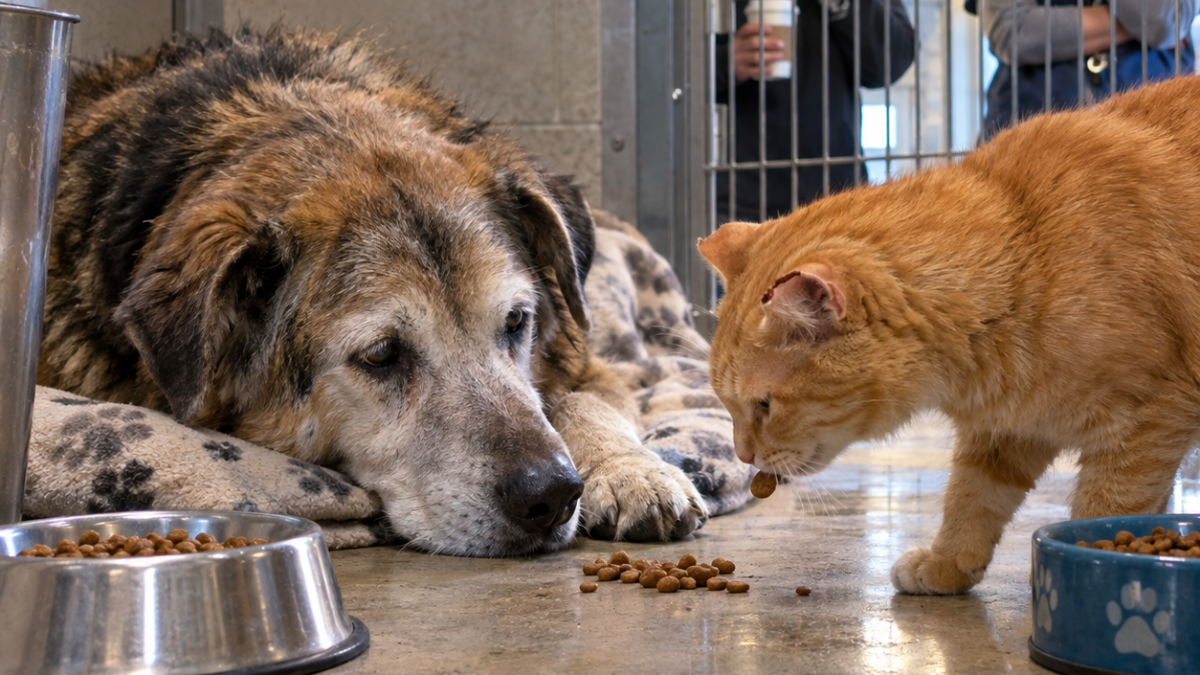
She lowered her head.
Took one piece of kibble into her mouth.
Turned.
Walked across the kennel.
Dropped it directly in front of Barney’s nose.
Then sat.
Barney did nothing.
Marigold waited.
She reached out one orange paw.
Touched the kibble.
Pushed it closer.
Barney kept his eyes closed.
Marigold stood.
Walked back to the bowl.
Took another piece.
Carried it across.
Dropped it beside the first.
I forgot about my coffee.
I watched her do it again.
And again.
Four times.
Five.
A tiny pile formed in front of Barney.
I whispered:
“What are you doing?”
Marigold ignored me.
Kibble.
Walk.
Drop.
Wait.
Paw.
Back again.
At 6:15, I called Dana.
She answered half asleep.
“Something wrong?”
“You need to come in.”
“What happened?”
“Nothing bad.”
“What?”
“Just come.”
She arrived twenty minutes later.
Hair wet.
No makeup.
Shoes barely tied.
I pointed.
Marigold was still doing it.
Dana stared.
“You’ve got to be kidding me.”
“I’ve been watching since six.”
Marigold took another piece.
Dropped it.
Barney had maybe twelve pieces in front of him now.
We stood outside the kennel.
Silent.
At approximately seven, Barney moved.
Not much.
His nose twitched.
Then his eyes opened.
Marigold sat beside the little pile.
She looked at him.
Barney lifted his head.
I grabbed Dana’s arm.
“Don’t move.”
“I’m not.”
Barney smelled the kibble.
Marigold leaned forward.
Pushed one piece with her paw.
It touched his lower lip.
Barney licked.
I stopped breathing.
He took the piece.
Chewed.
Swallowed.
Dana made a sound that was half laugh, half sob.
Barney ate another.
Then stopped.
Marigold returned to the bowl.
Dana whispered:
“Oh my God.”
I was crying before I realized it.
Two grown women standing in a shelter hallway at seven in the morning crying because an old dog had eaten two pieces of dry kibble from a concrete floor.
If you have never worked around an animal that has refused food for twelve days, that might sound ridiculous.
It was not ridiculous.
Those two pieces were the first sign Barney had given us that he might still be reachable.
Marigold carried another.
Barney ate it.
Not immediately.
But he ate it.
By eight, he had eaten maybe fifteen pieces.
Not enough nutritionally.
Everything emotionally.
When Priya arrived later, we showed her the video.
I had started recording after the first few trips.
Priya watched without speaking.
Marigold picked up kibble.
Walked.
Dropped it.
Waited.
Pushed with her paw.
Barney ate.
Priya replayed it.
Then again.
“What does that mean?”
Dana asked.
Priya laughed softly.
“You’re asking the wrong veterinarian.”
“You’ve never seen this?”
“Not exactly.”
“Is she trying to feed him?”
Priya thought.
“I can describe the behavior.”
“I can’t tell you what she thinks she’s doing.”
“What’s the behavior?”
“She’s transporting food.”
“Yes.”
“To him.”
“Yes.”
“Repeatedly.”
Priya looked at us.
“Beyond that, anything I say is interpretation.”
I said:
“Fine.”
“My interpretation is she’s feeding him.”
Priya smiled.
“I’m not going to fight you.”
We let Marigold remain.
The foster placement that should have taken her that morning suddenly felt less urgent.
Dana called.
Explained.
The foster family agreed to wait.
At lunch, Marigold repeated the behavior.
Barney ate more.
Not everything.
Enough.
Next morning, same.
Marigold had her own food bowl.
She ate from it.
She never stole Barney’s meal.
That detail fascinated me.
She would finish part of her food.
Then go to his bowl.
Pick up his kibble.
Carry it to him.
One piece at a time.
Sometimes three or four pieces.
Then she sat.
Waited.
If he ignored it, paw.
Closer.
At first, Barney ate only when she brought food.
By day fourteen, he began eating from a small pile we placed near him.
Day fifteen changed everything.
I poured breakfast into his bowl.
Marigold ate hers.
Then went to work.
Three pieces.
Five.
Barney ate.
Then he stood.
Slowly.
Stiff hips.
Front legs first.
Rear legs trembling.
Marigold backed up.
Barney walked toward the bowl.
We all froze.
He lowered his head.
Ate directly from it.
Half.
Paused.
Finished.
An entire bowl.
Dana sat down on the floor.
“I can’t do this today.”
I laughed.
“Do what?”
“Feel this much before nine.”
On day seventeen, Barney walked to the front of the kennel.
First time since arriving.
He stood there watching the hallway.
A volunteer approached.
Barney sniffed her hand.
Not enthusiastic.
Interested.
That was enough.
Day nineteen, I walked past.
Said:
“Morning, handsome.”
His tail moved.
One slow sweep.
Then another.
I stopped.
“Dana!”
“What?”
“Tail.”
She came running.
Barney looked at us as if we were unstable.
His tail moved again.
Within a month, Barney was still old.
Still arthritic.
Still gray.
Grief did not vanish.
Walter was still dead.
I think that distinction matters.
People love stories where one magical moment fixes everything.
That is not what happened.
Marigold did not erase twelve years with Walter.
She did not make Barney forget.
What she seemed to do was give him something that could exist beside the loss.
Company.
Routine.
A reason to look away from the wall.
They became inseparable.
We tried separating them once.
Not permanently.
Just to clean.
Marigold went to a temporary cat enclosure for twenty minutes.
Barney paced.
Actually paced.
This dog who had barely moved for nearly two weeks walked back and forth in front of C7.
Looked toward the door.
Whined.
We finished cleaning.
Returned Marigold.
Barney immediately settled.
After that, we stopped pretending they were temporary roommates.
At night, Marigold slept against his chest.
Sometimes between his front paws.
She kneaded the blanket.
Barney rested his chin near her back.
During the day, she climbed onto his bed.
If Barney stood, Marigold often followed.
If Marigold climbed a shelf, Barney watched.
He became interested in the cat room.
Then people.
Then the outdoor yard.
His first time outside after recovery, we let Marigold accompany him in a secure harness.
Barney walked into sunlight.
Stopped.
Lifted his face.
Smelled the air.
I cried again.
Shelter workers cry more than we admit.
Marigold rolled in the grass.
Barney watched her.
Then took three more steps.
That became his routine.
Eat.
Walk.
Rest.
Find Marigold.
We changed their adoption profiles.
Originally Barney’s listing had said:
Senior shepherd mix. Calm. House-trained. Best suited for quiet home.
Marigold:
Adult orange cat. Independent but affectionate. Needs patient adopter.
We deleted both.
Created one listing.
BONDED PAIR: BARNEY & MARIGOLD.
That made adoption harder.
Everyone knew it.
Finding a home for a twelve-year-old large dog is difficult.
Finding one for an adult cat with a torn ear can also take time.
Finding one home willing to take both?
We knew what we were doing.
Some people suggested separating them.
“They’ll adjust.”
Maybe.
“More adoption options.”
Definitely.
“Barney’s old.”
Exactly.
He had already lost one family.
We were not going to deliberately remove the relationship that had brought him back.
So the rule became:
Both or neither.
Weeks passed.
Families came.
Some loved Barney.
Did not want a cat.
Some liked Marigold.
Could not manage a large senior dog.
A couple considered both.
Then changed their minds after hearing about arthritis care and veterinary costs.
Six weeks.
Still there.
Barney did not seem bothered anymore.
He had Marigold.
Then one Thursday afternoon, a woman entered.
Her name was Helen Carter.
Sixty-three.
Short silver hair.
Simple blue coat.
No husband beside her.
No children.
She stood in reception longer than most adopters.
Finally said:
“I think I’m looking for something older.”
I asked:
“Cat or dog?”
She smiled sadly.
“I don’t know.”
That was unusual.
“What kind of home do you have?”
“Small house.”
“Fenced yard.”
“No stairs except porch.”
“Other pets?”
“No.”
“Children?”
“Grown.”
“Any preferences?”
She looked down.
“My husband died last year.”
I waited.
Helen continued:
“The house got quiet.”
She laughed once without humor.
“Not peaceful.”
“Quiet.”
I understood immediately.
“I don’t think I want a puppy.”
“Or a kitten.”
“I’m too tired for something that thinks three in the morning is recreational.”
I smiled.
“Fair.”
She looked toward the kennel hallway.
“I want somebody who needs me.”
That sentence made me think of Barney.
Then Marigold.
I said:
“I might have two.”
Helen raised an eyebrow.
“Two?”
I explained.
Old dog.
Orange cat.
Bonded.
She listened.
Then I told her about Walter.
Twelve days.
Food refusal.
Assisted feeding.
Then Marigold.
One kibble.
Then another.
Helen did not interrupt.
By the end, one hand covered her mouth.
She whispered:
“The cat did that?”
“Yes.”
“Nobody trained her?”
“No.”
“She just…”
“Yes.”
Helen looked toward the hallway.
“Can I meet them?”
We brought her into a quiet room.
Barney entered first.
Slow.
Polite.
He sniffed Helen’s shoes.
Marigold came next.
Walked around the room.
Jumped onto the chair beside Helen.
Helen did not reach.
Good.
She waited.
Marigold sniffed her sleeve.
Barney sat.
Helen looked at him.
“You lost somebody too.”
I pretended not to hear.
Barney leaned slightly into her knee.
Helen touched his head.
Her face crumpled.
Marigold moved onto her lap.
That was it.
Sometimes adoption decisions are complicated.
This one took twenty minutes.
Helen asked about cost.
Medical care.
Barney’s arthritis.
Marigold’s history.
Food.
Litter.
Emergency planning.
Good questions.
Then:
“Can they sleep together?”
“We would strongly recommend it.”
She smiled.
“I have a big bed.”
I asked:
“You want time to think?”
Helen shook her head.
“I’ve been thinking for a year.”
Then:
“I’m not separating them.”
Her voice strengthened.
“Both or neither.”
I smiled.
“That’s our rule.”
“Good rule.”
The adoption took two days because we wanted home verification and a veterinary plan for Barney.
Helen passed everything.
She bought ramps before pickup.
Orthopedic bed.
Cat tree.
Two feeding stations.
She sent me a photograph of the living room before she even took them home.
Barney’s bed beside the couch.
Cat tree near the window.
Ramp to the porch.
I wrote:
You’re ready.
She replied:
I haven’t felt ready for anything in a year. This feels different.
On adoption day, Barney climbed into Helen’s vehicle slowly.
Marigold rode in a secured carrier.
Before we closed the door, Helen looked at me.
“You think he’ll miss this place?”
I looked at Barney.
“No.”
She laughed.
“Good.”
Then I added:
“He may miss us a little.”
“I’ll accept that.”
They drove away.
C7 became empty.
That night, walking past it felt strange.
Twelve days earlier—well, now almost two months earlier—that kennel had held a dog we thought might die from grief.
Then it held two animals who made no obvious sense together.
Old shepherd.
Scarred orange cat.
And somehow it became the happiest kennel in the building.
Helen sent the first photograph that evening.
Barney lying on the couch.
Yes.
Already on the couch.
Marigold draped across his back.
Caption:
I think they’ve settled in.
Next morning:
Marigold on Helen’s bed.
Barney sleeping on the floor beside it.
Three days:
Both in the yard.
One week:
Barney’s nose pressed against the refrigerator.
Helen wrote:
Apparently grief has not affected his ability to recognize cheese.
I laughed so loudly Dana came to see.
A month later, Helen visited.
Without them.
Just to donate blankets.
“How are they?”
She pulled out her phone.
Hundreds of photographs.
Barney sleeping in sunlight.
Marigold on top of Barney.
Barney walking slowly through the garden.
Marigold in a flower pot.
One photograph stopped me.
Helen sat on the couch.
Barney beside her.
Marigold between them.
Three creatures who had lost someone or somewhere.
Together.
Helen looked at the picture.
“I thought I was adopting animals that needed me.”
She smiled.
“Turns out everybody in that house was confused about who was rescuing who.”
Barney turned thirteen.
Then fourteen.
Helen managed arthritis with medication.
Slow walks.
Ramps.
Warm bedding.
He never became energetic.
That was not the goal.
He became engaged.
There is a difference.
He sniffed around the garden.
Barked at delivery trucks.
Waited at the kitchen door when Helen cooked.
Followed her from room to room at a slow, dignified pace.
Marigold continued sleeping against him.
And the eating ritual never disappeared.
Helen noticed the first night.
She placed both bowls down.
Marigold began eating.
Barney watched her.
Then started.
Next meal.
Same.
She tested it accidentally one morning when Marigold was still upstairs.
Barney stood beside his food.
Did nothing.
Helen called:
“Marigold!”
The cat appeared.
Walked to her bowl.
Took a bite.
Barney immediately ate.
Helen texted me.
He still waits for her.
Two years.
Every meal.
Barney looked toward Marigold.
Once she ate, he ate.
Priya laughed when I told her.
“Conditioned association.”
I said:
“Don’t ruin it.”
“I’m being scientific.”
“You can be scientific somewhere else.”
She smiled.
“Fine.”
Then:
“It’s still beautiful.”
Barney’s story spread quietly.
Not viral.
Not huge.
Just shelter people telling shelter people.
We started paying closer attention to grief cases.
We already knew bonded animals mattered.
But Barney changed something about how we looked at cross-species companionship.
Not every dog should live with cats.
Not every grieving animal needs another animal.
We did not start throwing random cats into dog kennels.
That would be irresponsible.
But we became more observant.
Who relaxed around whom?
Who ate when another animal was nearby?
Who slept better with social contact?
We stopped assuming recovery had to come from humans.
Sometimes humans were not the missing language.
Marigold had known something we did not.
Or maybe she did not “know” anything in the way we mean that word.
Maybe she simply responded to Barney’s stillness.
Maybe transporting kibble was play.
Resource movement.
Social behavior.
Chance.
I do not care anymore.
Because whatever scientific label belongs to the behavior, the result was the same.
Barney ate.
Then ate again.
Then stood.
Then walked.
Then wagged.
Then lived.
That is enough.
One winter afternoon, almost three years after adoption, Helen called.
Her voice told me before the words did.
“Barney’s declining.”
My chest tightened.
“How bad?”
“Priya came.”
Of course she had.
“Cancer.”
I closed my eyes.
“Pain?”
“Managed.”
“Time?”
Helen cried.
“Not much.”
I drove to her house after work.
Not technically part of my job.
I went anyway.
Barney lay on an orthopedic bed near the fireplace.
Older.
Thinner.
Almost completely gray around the face.
Marigold curled against his chest.
Helen sat nearby.
Barney lifted his head when I entered.
Tail moved once.
I sat on the floor.
“Hey, old man.”
He smelled my hand.
Then rested again.
Helen said:
“He had three years.”
I nodded.
“Three good years.”
“I keep thinking about those twelve days.”
“So do I.”
“If Marigold hadn’t…”
She stopped.
Nobody needed to finish.
Marigold opened one eye.
Helen smiled through tears.
“She still makes sure he eats.”
“Even now?”
“When he will.”
We sat there.
No inspirational speeches.
Death does not need to be inspirational to matter.
Barney had already received something we once thought impossible.
More time.
Not endless.
Enough.
Two weeks later, Helen called again.
Barney had died at home.
On his bed.
Helen beside him.
Marigold between his front paws.
The position she had slept in since the shelter.
Helen said his breathing slowed.
Marigold never moved.
Afterward, she remained beside him until Helen carried her away.
I cried.
At work.
In front of everyone.
Nobody cared.
We had all known Barney.
Dana said:
“I thought losing him would feel different after three years.”
“It doesn’t.”
“No.”
It did not.
But there was gratitude inside it.
Twelve days into his shelter stay, we thought Barney might die facing a concrete wall.
Instead, he died in a warm house after three extra years.
Loved.
Safe.
With Marigold.
That mattered.
Then we worried about the cat.
Of course we did.
Would Marigold stop eating?
Would history repeat?
Helen watched closely.
The first night, Marigold searched the house.
Couch.
Bedroom.
Garden door.
Barney’s bed.
She cried.
Helen slept on the couch beside her.
Next morning, Marigold did not eat breakfast immediately.
Helen panicked.
Called us.
Priya told her:
“Give her time.”
Helen sat beside the bowls.
Marigold stared at Barney’s empty spot.
Then walked to Helen.
Rubbed against her hand.
Eventually she ate.
Not much.
Enough.
Over the next week, she slept on Barney’s bed.
Then began sleeping beside Helen.
Grief again.
Different animal.
Different shape.
This time, Helen became the one carrying someone else through it.
She talked to Marigold.
Kept routines.
Sat nearby while she ate.
One evening Helen sent me a photograph.
Marigold on the couch.
Pressed against Helen’s side.
Caption:
I think it’s my turn now.
That sentence broke me.
Because that was the whole story.
Barney lost Walter.
Marigold found Barney.
Helen found both.
Barney died.
Now Helen stayed for Marigold.
Care moving in circles.
Nobody saved anyone permanently.
We just carried each other through the part we could.
Marigold lived another four years.
She became Helen’s shadow.
Slept on the pillow beside her.
Sat in the kitchen during meals.
And for the rest of her life, Helen kept two food bowls.
Only one needed filling.
The second stayed beside the wall.
Barney’s bowl.
Not as a shrine exactly.
Just because removing it felt unnecessary.
When Marigold died at an estimated age of thirteen or fourteen, Helen asked if we wanted her old adoption records.
We already had copies.
She brought something else instead.
A photograph.
Barney lying on the couch.
Marigold stretched across his back like an orange scarf.
Helen had written on the back:
One piece at a time.
We framed it.
It hangs near kennel C7 now.
New staff ask what it means.
I tell them.
Old shepherd.
Owner died.
Stopped eating.
Twelve days.
Orange cat.
No space.
One night.
Kibble.
One piece at a time.
Then I always add the part that matters most to me.
Barney did not come back all at once.
That is not how grief works.
First one piece of kibble.
Then another.
Then one bowl.
Then standing.
Then walking.
Then one tail wag.
Recovery was tiny before it was visible.
That lesson stayed with me.
We spend so much time waiting for obvious signs that someone—or some animal—is okay.
Eating everything.
Playing.
Smiling.
Moving on.
But sometimes healing is one piece of kibble on concrete.
That is enough for that day.
Sometimes another living thing cannot remove your grief.
They simply sit near it.
Bring something small.
Wait.
Try again.
Marigold never knew Walter.
She did not understand why Barney faced the wall.
She did not know his history.
Did not know what twelve days without food meant.
Did not know we were frightened.
She only encountered an old dog who had stopped reaching for the world.
Then, for whatever reason belonged to her, she began carrying the world back to him.
One piece at a time.
Walk.
Drop.
Wait.
Push.
Again.
Until Barney lifted his head.
Until he ate.
Until he remembered—or his body remembered for him—that he was still here.
For years afterward, people asked me what I thought Marigold was doing.
Did she understand?
Was it instinct?
Did she think Barney could not reach his food?
Was she sharing?
Was it a coincidence?
I still do not know.
I have stopped needing to.
I know what I saw at six o’clock that morning.
An orange cat with a torn ear crossing a concrete kennel.
One piece of kibble in her mouth.
An old dog lying beside the wall.
A tiny pile forming near his nose.
Then Marigold sitting there.
Waiting.
Barney opening his eyes.
A paw pushing the food closer.
And finally, after twelve days of turning away from everything we offered him, Barney choosing to eat.
If you want to call that instinct, fine.
If you want to call it attachment, fine.
If you want to call it chance, I will not argue.
But after nine years in a shelter, I have learned that sometimes the most important things happen before we have language for them.
A dog loses the only person he has known and decides there is nothing left.
A cat nobody asked to help notices.
She carries him one small reason to stay.
Then another.
Then another.
Until staying becomes a habit again.
Barney lived three more years because of what began that morning.
Marigold got a home because Barney made it impossible for us to imagine sending her anywhere without him.
Helen, who thought her house had become too quiet to survive, ended up with two animals who understood silence better than anyone.
And all of it began because our shelter ran out of room.
That part still amazes me.
We thought we were solving a space problem.
One night.
One kennel.
That was all.
Instead, Marigold walked into C7, looked at a grieving old dog, and somehow found the one thing the rest of us had missed.
We had spent twelve days trying to feed Barney.
She gave him a reason to eat.
There is a difference.
And I think about that every time I walk past the photograph outside C7.
Barney asleep.
Marigold across his back.
Both home.
On the back, Helen’s handwriting:
One piece at a time.
Maybe that is how most of us survive the things that should break us.
Not because the grief disappears.
Not because somebody fixes everything.
Because something small reaches us.
A hand.
A voice.
A warm body beside us.
One bite.
One morning.
One reason.
Then another.
Until one day we look up and realize we are still here.








