A 10-Year-Old Boy Spotted a Hells Angel’s Motorcycle, Stolen 30 Years Ago, Hidden in the Background of His Class Photo—Then His Discovery Exposed a Secret That Had Ruined the Biker’s Reputation.
PART2:
Beckett unrolled the photograph.
Hollis closed his eyes for half a second.
Diane whispered, “Beckett.”
But it was too late.
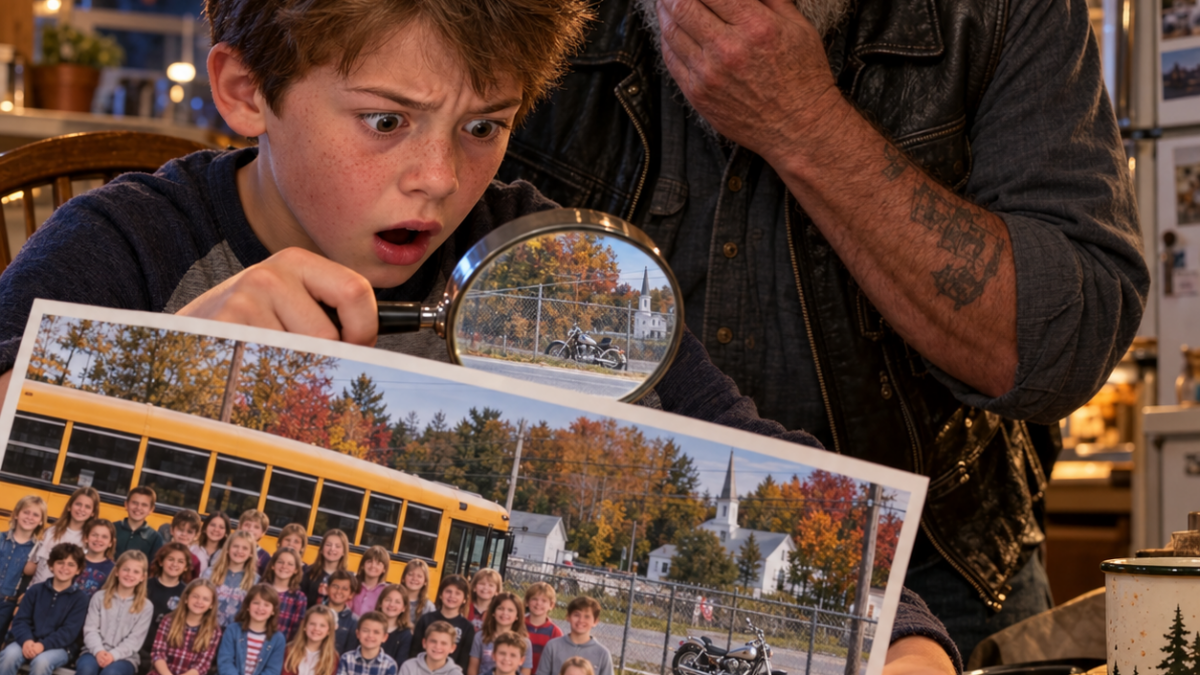
The boy held up a poster-sized fourth-grade class photograph like a warrant.
“You have his motorcycle,” he repeated.
Kurt stared at him.
Then at Hollis.
Then at Chief Ashbrook.
And thirty years of buried suspicion took its first breath.
But the story had actually begun six days earlier, with a yellow envelope on a kitchen table and a mother making meatloaf.
Fairmount Elementary had held picture day on an unusually warm Tuesday in October.
The fourth graders stood in three rows on the grass behind the gym.
Sixty children.
Two teachers.
One yellow school bus parked behind them because Principal Harper believed school buses made photographs “feel cheerful.”
Beckett had spent most of the photo trying not to sneeze.
His mother, Diane, had carefully combed his dark hair before school.
By 10:15 it looked exactly as it always did.
A mess.
His left sneaker was untied.
His shirt collar was folded under itself.
He had forgotten they were even taking pictures until the photographer told everyone to smile.
Four days later, the envelope came home.
Diane set it beside the fruit bowl.
“Please tell me you didn’t make a face.”
“I didn’t.”
“You said that last year.”
“I didn’t make a face then either.”
“You crossed your eyes.”
“That wasn’t a face. That was my eyes.”
Diane stared at him.
Beckett grinned.
She pointed a wooden spoon at him.
“Homework.”
He opened the yellow envelope instead.
The large composite slid out.
Rows of children.
Teachers.
Bus.
Trees turning orange.
Chain-link fence at the edge of school property.
Beckett found himself.
Back row.
Third from the right.
Eyes half closed.
“I look terrible.”
“You look ten.”
“That’s worse.”
Diane laughed and turned back to the stove.
Beckett pulled out the individual photograph.
He was about to toss the composite aside when something near the far-right edge caught him.
Not a person.
Not part of the school.
Beyond the fence, between two maple trees, a narrow section of road was visible.
And on the road was a motorcycle.
Tiny.
Blurry.
Almost nothing.
Beckett stared.
Then reached for his backpack.
The magnifying glass lived in the front pocket.
His grandfather’s.
Old brass handle.
Slightly warped lens.
Diane called it useless.
Beckett considered it one of the best things he owned.
His grandfather had repaired watches.
Beckett had never known him, but his grandmother said he could look at a broken pocket watch for twenty seconds and tell you which gear had failed before opening the case.
Beckett liked that.
The idea that looking carefully could be a skill.
He held the lens over the photograph.
The motorcycle enlarged.
Still blurry.
Silver tank.
Dark front fender.
A shape near the side.
Beckett adjusted the angle.
There.
A crooked smear.
Almost like wings.
His stomach moved.
He looked again.
Silver.
Touring frame.
Wing shape.
He thought of Hollis.
More specifically, he thought of a story Hollis never finished.
Stroud Cycle Repair sat six blocks from Beckett’s house at the corner of Hammond and Cedar.
A low cinder-block building with a hand-painted sign and a garage door that stuck halfway up in winter.
Hollis owned it.
Everybody knew Hollis.
Most people knew him without knowing him.
That was different.
He rode with the North Woods charter of the Hells Angels when he was younger.
Still wore the vest.
Still had the patch.
Still had the reputation.
Adults lowered their voices when his name came up.
Kids called the garage “the clubhouse.”
Some crossed the street rather than walk in front of it.
Beckett had met Hollis because his bicycle chain snapped two years earlier.
He had been eight.
He had tried pushing the bike home.
Hollis came out of the garage.
“Chain’s gone?”
Beckett had nodded.
“Bring it here.”
Beckett followed because saying no to a man with a beard like Hollis’s had not occurred to him.
Four minutes later, the chain was fixed.
“How much?”
Hollis snorted.
“You got money?”
“Seven dollars.”
“You need it more than I do.”
After that, Beckett started stopping by.
First occasionally.
Then every Saturday.
He sat on an upside-down bucket while Hollis worked.
Learned socket sizes.
Learned not to touch exhaust pipes.
Learned motorcycles were mostly metal, fuel, electricity, pressure, and swearing.
Hollis taught him to patch bicycle tubes.
True wheels.
Clean carburetor jets.
Never once asked Beckett to think he was cool.
That was probably why Beckett did.
The only subject Hollis avoided was his old silver touring motorcycle.
He had mentioned it maybe four times.
A 1993 Harley-Davidson Electra Glide.
Silver tank.
Hand-built modifications.
Eagle painted by Hollis himself.
Stolen in September 1994.
Never recovered.
The town remembered.
Especially the rumor.
Hollis had insured the bike six weeks before the theft.
Someone decided that was suspicious.
Someone else remembered seeing him short on money.
Then came a story that he had sold the motorcycle out of state and filed a false theft claim.
The insurance company delayed payment.
Police found nothing.
No arrest.
No bike.
No evidence of fraud.
But small towns do not require evidence to keep a story alive.
They require repetition.
Three decades later, people still said, “That stolen bike.”
With quotation marks you could hear.
Beckett looked through the magnifying glass again.
The painted shape was wrong.
One wing looked higher.
He knew Hollis had once said something about that.
Eleven tries.
Still crooked.
Beckett rolled up the photograph.
“Where are you going?” Diane asked.
“Hollis’s.”
“No.”
“Mom.”
“It’s almost seven.”
“It’s six-forty.”
“That is almost seven in October.”
“I need to ask him something.”
“What?”
Beckett hesitated.
Diane noticed.
“What?”
“I think his motorcycle is in my class picture.”
The spoon stopped.
Diane stared.
For several seconds she said nothing.
Then, “His what?”
“The stolen bike.”
Diane put the spoon down.
“Beckett.”
“I’m serious.”
“Honey, that motorcycle disappeared before I graduated high school.”
“I know.”
“And you think it’s in a picture taken Tuesday?”
“Yes.”
“Why?”
He unrolled the photograph.
Diane looked.
Then at Beckett.
Then back.
“That gray spot?”
“It’s silver.”
“That is six pixels.”
“It has the eagle.”
“You can’t even see an eagle.”
“With the glass.”
Diane tried.
She leaned closer.
Adjusted.
Frowned.
Beckett watched.
She stayed quiet longer than he expected.
Finally she handed it back.
“I see something.”
“That’s the eagle.”
“I said something.”
“It’s his.”
“You cannot know that.”
“Hollis can.”
Diane rubbed her forehead.
The history between Diane Lowry and Hollis Stroud was mostly imaginary.
They had barely spoken.
That didn’t matter.
She had grown up in Bangor.
She knew the stories.
A Hells Angel.
Bar fights.
Noise complaints.
A weapons charge in 1988 that was later dismissed.
The stolen-bike rumor.
People said things.
Parents absorb community warnings before they decide whether the warnings deserve to survive.
Diane had never forbidden Beckett from going to the garage.
But she had never liked it either.
“He’s seventy,” Beckett said.
“That does not erase anything.”
“What did he do?”
Diane opened her mouth.
Stopped.
“That’s not the point.”
“What did he do?”
“I don’t know every detail.”
“Did he hurt somebody?”
“I didn’t say that.”
“Steal something?”
“No.”
“Then what?”
Diane became irritated.
“He was in a motorcycle club with a reputation.”
“Hollis says reputation is what people use when they don’t want to know details.”
Diane stared at her son.
“That sounds exactly like something Hollis would say.”
“It’s still true.”
She folded her arms.
“No going inside if there are people drinking.”
“Nobody drinks when I’m there.”
“Text me when you arrive.”
“I don’t have a phone.”
Diane closed her eyes.
Right.
He was ten.
“I’ll walk you.”
“You don’t have to.”
“I know.”
They reached Stroud Cycle at 7:02.
The garage door was open.
Hollis was beneath the hood of an old Ford pickup.
One work lamp.
Radio low.
Coffee on the bench.
Two other motorcycles parked outside.
Diane stopped at the sidewalk.
“You coming?”
“I can see you from here.”
Beckett rolled his eyes.
He entered.
The bell over the side door jingled.
Hollis looked up.
“School night.”
“I found something.”
“You find homework?”
“No.”
“Then probably trouble.”
Beckett unrolled the picture.
“Is that your bike?”
Hollis smiled at first.
Then looked where Beckett pointed.
The smile disappeared.
Completely.
Beckett had known Hollis two years.
He had seen him angry.
Amused.
Tired.
Once frightened when a customer nearly wrecked during a test ride.
He had never seen Hollis become still like that.
Hollis wiped his hands.
Took the magnifying glass.
Bent over.
Diane stepped inside.
Hollis didn’t notice.
He moved the picture beneath the work lamp.
Adjusted the lens.
Thirty seconds.
A minute.
Two.
Beckett started wondering if he had been stupid.
Finally Hollis whispered, “Where was this taken?”
“School.”
“What day?”
“Tuesday.”
“This Tuesday?”
“Yes.”
Hollis lowered the glass.
His face had lost color.
Diane said, “Can you really tell from that?”
Hollis looked at her for the first time.
“Maybe.”
“Maybe?”
“That eagle’s wrong.”
Beckett almost shouted.
“I knew it!”
Hollis pointed.
“Left wing rides high.”
“You painted it.”
“Yes.”
“How many tries?”
Hollis looked at Beckett.
“Eleven.”
Beckett grinned.
Diane’s expression shifted.
Hollis looked again.
“There should be a nick under the front fork.”
“Can you see it?”
“No.”
“A serial?”
“No chance.”
“So it could be another bike.”
“Yes.”
Beckett’s face fell.
Hollis stared at the photograph.
Then said, “But it could be mine.”
Those six words changed the next month of all their lives.
The first person Diane contacted was the school photographer.
She requested the highest-resolution digital file.
He refused initially because the photograph contained sixty children.
Diane explained.
He laughed.
Then realized she wasn’t joking.
Two days later he provided a cropped high-resolution image of the background.
Hollis paid a photo lab in Brewer to enlarge it.
Poster size.
Then larger.
Under proper magnification, more details appeared.
The silver tank.
The imperfect eagle.
A faint line where the factory serial plate should have been.
The bike had been repainted in places.
But beneath the paint was a shape Hollis knew.
Not because he was sentimental.
Because he had built pieces of it himself.
He showed Beckett where he had welded an auxiliary bracket.
Where the saddlebag mount sat a quarter inch too high.
Where he had reshaped part of the exhaust shield after dropping the bike during a winter restoration.
Diane watched him identify details no casual observer could invent.
“How sure are you?”
Hollis took off his glasses.
“Ninety percent.”
“Why not a hundred?”
“Because I learned a long time ago what happens when you get too certain before the evidence earns it.”
That was the first moment Diane understood why the old accusation still hurt.
Not because Hollis had spent thirty years demanding people believe him.
Because he had spent thirty years learning belief was fragile.
Chief Floyd Ashbrook did not share Beckett’s excitement.
They brought the enlarged print to the Bangor Police Department.
Hollis.
Beckett.
Diane.
Floyd recognized Hollis immediately.
He also recognized the case.
Everyone above fifty in law enforcement did.
“September 1994,” Floyd said.
“Yes.”
“Electra Glide.”
“Yes.”
“Silver.”
“Yes.”
Floyd sighed.
“You filed with Officer Latham.”
“Latham called me a liar before he finished writing.”
“That’s not in the report.”
“Funny thing about insults.”
Hollis’s eyes stayed on him.
“They don’t usually make the report.”
Floyd ignored that.
He examined the photograph.
He did not use Beckett’s magnifying glass.
That annoyed Beckett.
“This is not enough.”
Hollis nodded.
“I know.”
Floyd looked surprised.
“You know?”
“I’m not asking you to seize anybody’s property based on pixels.”
“What are you asking?”
“Find the bike.”
“Where?”
“That’s what police do.”
Floyd leaned back.
“You know how many open cases I have?”
“No.”
“Twenty-seven.”
“How many are thirty years old?”
“That is exactly the problem.”
Floyd rubbed his temple.
“Hollis, I pulled your old file after I made chief.”
That surprised everyone.
“Why?”
“Curiosity.”
“What’d you find?”
“Nothing.”
Hollis laughed once.
“Sounds familiar.”
Floyd’s jaw tightened.
“The original investigation was thin. I’ll give you that.”
“Thin?”
“Two witness statements. Regional teletype. Insurance check. No recovery.”
“They questioned me twelve times.”
“That’s not investigation?”
“Not when I’m the victim.”
Diane watched both men.
Floyd said, “There was a belief the claim might be staged.”
“A belief.”
“Yes.”
“Evidence?”
“Circumstantial.”
“What circumstance?”
“You increased coverage.”
“I restored the bike.”
“You were having financial problems.”
“My wife had cancer.”
Silence.
Beckett looked at Hollis.
He had never known Hollis had been married.
Floyd continued more softly.
“There were reports you talked about selling the bike.”
“I talked about selling everything.”
Hollis’s voice dropped.
“Chemo cost money in 1994 too.”
Diane’s face changed.
Hollis looked away.
“She died eleven months later.”
Nobody spoke.
Then Hollis pointed at the photograph.
“That motorcycle was the one thing I didn’t sell because she bought the frame for me.”
Floyd studied him.
“Why didn’t you ever tell investigators that?”
“I did.”
The room became quiet again.
Floyd looked down at the old file.
Not everything people say survives paperwork.
That realization troubled him.
Still, he refused to assign an officer.
“Bring me a location,” he said. “A real location. Then I’ll look.”
Outside, Hollis stood on the sidewalk.
Traffic moved.
Cold wind lifted the edge of his vest.
Beckett said, “We can find it.”
Hollis looked tired.
“You don’t know that.”
“We found it once.”
“We found a photograph.”
“It was there Tuesday.”
“Four days ago.”
“So?”
“So motorcycles move.”
“Then we figure out where.”
Hollis looked down at him.
“You always this annoying?”
“My mom says yes.”
“I do,” Diane said.
That evening, Diane started digging.
She worked part-time in the Bangor Room at the public library.
Local newspapers.
City directories.
Property maps.
Old photographs.
She told herself she was helping Beckett.
By midnight, she knew that wasn’t true anymore.
She was helping Hollis.
Because the more she looked, the more embarrassed she became about how much she had believed without examining.
The 1994 theft appeared in the Bangor Daily News.
Four sentences.
Local mechanic reports customized motorcycle stolen from Cedar Street garage.
No suspects.
Then another article.
A profile of Hollis from months earlier.
Not biker news.
Veterans section.
Hollis J. Stroud.
Twenty-six.
Air Force intelligence analyst.
Four years overseas.
Specialized in aerial reconnaissance photography.
Received commendation.
The reporter described him as “possessing an eye trained to notice what others pass over.”
Diane stared at the article.
The town had remembered the leather vest.
Forgotten the uniform.
That seemed important.
She kept searching.
Insurance dispute.
Civil complaint.
Hollis eventually received only part of the bike’s insured value because the company claimed insufficient documentation of custom modifications.
No fraud charge.
No criminal case.
Nothing.
Yet by 1996, newspaper letters referred to “that questionable theft.”
By 2001, an online forum called it “the insurance scam.”
By 2010, people treated it as fact.
Rumor had hardened.
That frightened Diane.
Not just because of Hollis.
Because she could see herself inside the process.
She had never repeated the story publicly.
But she had believed it enough to warn her son.
The next morning, she showed Beckett the clippings.
He read slowly.
“Air Force?”
“Yes.”
“Hollis?”
“Yes.”
“He never told me.”
“He probably had reasons.”
Beckett tapped the photograph.
“If he looked at pictures for the Air Force, maybe that’s why he knew the little marks.”
Diane nodded.
Then Beckett stared at the class photo.
“What?”
He picked up the magnifying glass.
“The wall.”
“What wall?”
“Behind the motorcycle.”
The road background showed a low stone wall.
Granite.
Two uneven sections.
One white mailbox.
Beckett knew it.
His cousin lived near Veazie.
They passed that wall whenever Diane drove him there.
“Stillwater Road.”
“You sure?”
“Yes.”
Diane looked.
“I don’t know.”
“The mailbox has the crooked post.”
Half an hour later, they were in the car.
The wall existed exactly where Beckett said.
The house behind it had a FOR SALE sign.
The owner, Raymond Soul, had died in spring.
Diane knew the name.
Everyone did.
Volunteer firefighter.
Little League coach.
Church fundraiser.
Three terms on the zoning board.
A good man.
The kind of good man a town uses as proof of itself.
The estate belonged to his son Kurt.
There was a barn.
Diane felt uneasy.
Not because she thought Raymond stole a motorcycle.
Because she hoped he hadn’t.
Good reputations are comforting.
They make the world feel sortable.
Hollis met them outside the property.
He stared at the wall.
Then went quiet.
“What?” Beckett asked.
Hollis walked to one section.
Touched the granite.
“There was damage in the police photographs.”
“What photographs?”
“My case.”
“From where?”
“Officer found tire marks here three days after the theft.”
Diane stared.
“Why was that not in the report?”
“It was.”
“Then why didn’t anyone search this property?”
Hollis smiled without humor.
“Raymond Soul told them he hit the wall with a borrowed truck.”
Diane looked toward the barn.
“How well did police know him?”
“Everybody knew Ray.”
“What about you?”
“Everybody thought they knew me too.”
They called Chief Ashbrook.
This time Diane did the talking.
“There’s a house.”
“Diane—”
“There’s a barn. The background in the photo matches the stone wall. Old case photographs apparently documented damage in the same location after the theft.”
Floyd went silent.
“Who owns it?”
“Raymond Soul’s estate.”
Longer silence.
“You’re sure?”
“About the property, yes.”
“Kurt clearing it?”
“The realtor said tomorrow.”
That changed everything.
Potential evidence about to move.
Floyd came.
Officially to ask permission.
Unofficially because something inside him was beginning to feel sick.
Kurt answered the door.
And that was where the night began.
Beckett held up the photograph.
“I think you have his motorcycle.”
Kurt stared.
Then laughed once.
Not mockery.
Confusion.
“I don’t own a motorcycle.”
“The barn,” Diane said.
Kurt looked at her.
“We’re clearing it.”
Hollis stepped forward.
“May we look?”
Kurt recognized him then.
Everybody eventually did.
His eyes dropped to the Hells Angels patch.
Something tightened.
“My father had no business with you people.”
Hollis stopped.
Diane noticed.
Beckett noticed too.
“Mr. Soul,” Floyd said, “we’re asking to inspect the barn voluntarily.”
“For what?”
“A motorcycle reported stolen in 1994 may appear in a photograph taken near this property four days ago.”
Kurt stared.
“That’s insane.”
“Probably.”
Floyd said it calmly.
“But if we don’t look tonight and the barn gets cleared tomorrow, everybody involved will wonder forever.”
Kurt’s face reddened.
“My father was a firefighter.”
“I know.”
“He coached your brother, Floyd.”
“I know.”
“He wasn’t a thief.”
Floyd did not answer.
That was the first crack.
Kurt looked at Hollis.
“You think my father stole from you?”
Hollis’s voice stayed low.
“I think I’d like to see the barn.”
For several seconds, Kurt looked as if he might slam the door.
Then Beckett spoke.
“The motorcycle was in my class picture.”
Everyone turned.
He held it out.
Kurt looked at the tiny background bike.
Then the enlargement.
His anger gave way to something else.
Recognition?
Not of the bike.
Of possibility.
He whispered, “There’s an old motorcycle.”
Hollis inhaled.
“In the barn?”
“My dad said it belonged to a buddy.”
Nobody moved.
“How long?” Floyd asked.
“Forever.”
“How long is forever?”
Kurt’s face went pale.
“Since I was a kid.”
The barn doors were already open.
A trailer waited outside.
Scrap metal loaded halfway.
Boxes.
Lawn equipment.
Old tools.
And beneath a gray moving blanket at the far wall was the unmistakable shape of a large touring motorcycle.
Hollis did not run.
That surprised Beckett.
He walked.
Slow.
Measured.
As if every step required permission from thirty years of disappointment.
He reached the bike.
Took the blanket.
Pulled.
Silver.
Dust.
Rust at the chrome.
Cracked seat.
And on the tank, a hand-painted eagle.
Left wing slightly higher than the right.
Hollis put one hand on the tank.
Nobody spoke.
His fingers trembled.
Beckett whispered, “It’s yours.”
Hollis looked at him.
“Not yet.”
He crouched.
Checked the front fork.
Scraped grime.
Found the weld.
Checked the saddlebag mount.
A quarter inch high.
Then beneath the seat.
The chip.
Right where he said.
Floyd stepped closer.
Hollis moved to the frame.
“Factory number’s probably gone.”
It was.
Ground.
Painted.
Floyd’s face tightened.
“That’s criminal alteration.”
Hollis reached lower.
Near the steering neck.
“I put another one here.”
“Why?”
“Paranoid.”
He wiped grease.
Nothing.
Again.
Then numbers appeared.
Hand-stamped.
Crooked.
Floyd pulled out a photocopy of the original registration.
Read.
Looked.
Read again.
The same serial.
Exactly.
Thirty years collapsed into six digits.
Hollis sat down on an overturned bucket.
No one knew what to say.
Beckett walked over.
“Are you okay?”
Hollis laughed once.
Then covered his face.
His shoulders shook.
Beckett had never seen him cry.
Adults crying always disturbed him because children assume adulthood includes some machinery that prevents complete emotional breakdown.
It doesn’t.
Hollis looked at the motorcycle.
“My wife painted the first line.”
Diane stared.
“What?”
“The eagle.”
He touched one wing.
“She did the outline.”
His voice cracked.
“I filled it.”
Kurt stood near the barn entrance.
Color gone from his face.
“That bike’s been here my whole life.”
Floyd turned.
“Tell me everything.”
Kurt sat on the trailer.
He was seven in 1994.
He remembered one night his father coming home late.
Shirt torn.
Blood on his elbow.
Truck damaged.
Raymond said he had clipped the stone wall with a borrowed truck.
A week later, a motorcycle appeared in the barn.
Covered.
Raymond told his wife it belonged to a fire-department friend who was deployed.
“Did you ever ask?”
“I was seven.”
“Later?”
Kurt looked ashamed.
“I stopped seeing it.”
That sentence hung in the barn.
Stopped seeing it.
How many things survive because people stop seeing them?
Raymond later built shelves around it.
Boxes accumulated.
Twenty years passed.
Then thirty.
Nobody questioned.
After Raymond died, Kurt uncovered the bike.
He planned to scrap it.
A neighbor who collected motorcycles offered to look first.
That neighbor had rolled it outside Tuesday afternoon.
Past the stone wall.
At exactly the moment Fairmount Elementary’s photographer pressed the shutter.
He decided the bike was too far gone and put it back.
Pure accident.
If picture day had been Monday, nothing.
If the photographer framed slightly left, nothing.
If Beckett had thrown away the composite, nothing.
If his grandfather’s magnifying glass had stayed in the drawer, nothing.
Truth had survived by inches.
Floyd called for an evidence vehicle.
Kurt began pacing.
“My father wasn’t a thief.”
Nobody answered.
“He couldn’t have been.”
Hollis looked at him.
“I’m sorry.”
Kurt spun.
“For what?”
“For knowing what this feels like.”
Kurt stared.
Hollis continued.
“Everybody in this town told me who I was for thirty years based on one story.”
Kurt’s anger collapsed slightly.
“Now you got one night.”
Kurt looked at the motorcycle.
“What do you think happened?”
Hollis pointed toward the damaged wall.
“Joyride.”
Floyd looked at him.
“You think Raymond took it?”
“I think somebody did.”
“The bike disappeared from your garage.”
“Door was unlocked.”
Kurt asked, “Why?”
Hollis almost smiled.
“Different time.”
He walked toward the bike.
“Ray knew where I kept the keys.”
Kurt’s face changed.
“You knew him?”
Hollis nodded.
“Not well. Volunteer department used my garage sometimes. He came around.”
“Why would he steal it?”
“Maybe he didn’t mean to.”
Hollis looked at the wall through the open barn doors.
“Maybe he wanted to ride it.”
Floyd looked at the old case notes.
“One witness reported a loud crash around one a.m.”
Hollis nodded.
“Bike had fresh damage under the right saddlebag.”
Kurt whispered, “Dad’s elbow.”
Everyone looked at him.
“He had road rash.”
Floyd asked, “Did Raymond ride motorcycles?”
“No.”
“Exactly.”
Hollis looked toward the bike.
“Big touring Harley’s not what you learn on.”
Floyd said, “He lays it down near the wall.”
“Panics.”
“Moves it into the barn.”
“Plans to return it.”
“Then hears you reported it stolen.”
“And insurance investigators are asking questions.”
Kurt finished quietly, “And he keeps hiding it.”
Nobody could prove every step.
Raymond was dead.
No confession.
No witness.
But evidence accumulated over the next weeks.
A diary.
Raymond’s wife had kept journals.
Kurt found them in an attic trunk.
September 14, 1994:
Ray didn’t sleep. Says mistake at firehouse may cost everything.
September 17:
He says H.S. is being questioned. I asked if he should speak. He said absolutely not.
September 22:
Silver bike still in barn. I hate looking at it.
That last line broke Kurt.
He sat at his kitchen table reading his dead mother’s handwriting.
Diane sat across from him.
Hollis refused to come.
“This is a family moment,” he said.
Kurt whispered, “She knew.”
Diane didn’t answer.
“She knew.”
“Yes.”
“And she said nothing.”
“Yes.”
“My father let another man be called a thief.”
Diane said carefully, “Your father may have been afraid.”
Kurt looked up.
“So?”
The question was raw.
Diane had no answer.
Fear explains.
It does not absolve.
Kurt called Hollis himself.
“Come over.”
Hollis said no.
“I found something.”
Silence.
“What?”
“My mother’s journals.”
Longer silence.
“I don’t need to read them.”
“I need you to.”
That changed the answer.
Hollis arrived alone.
No vest.
Just jeans.
Work shirt.
Kurt put the journal on the table.
Hollis read three entries.
Then closed it.
“That’s enough.”
“I’m sorry.”
Hollis looked at him.
“You didn’t do it.”
“I defended him.”
“He was your father.”
“I said things about you.”
“You knew what everybody told you.”
“That doesn’t make it right.”
“No.”
Hollis’s honesty hurt.
Kurt nodded.
“No.”
For thirty years, Hollis had imagined vindication.
He thought it would feel like winning.
Instead, it felt like excavating a grave and discovering everyone inside had been afraid.
Raymond.
His wife.
The police.
The insurance company.
The town.
Himself.
Fear had done most of the damage.
Fear of losing reputation.
Fear of admitting error.
Fear of questioning respected people.
Fear of defending disreputable ones.
The newspaper correction came eleven days later.
The Bangor Daily News headline read:
30-YEAR-OLD MOTORCYCLE THEFT RESOLVED AFTER SCHOOL PHOTO REVEALS MISSING HARLEY
The article contained something Hollis never expected.
A statement from Chief Floyd Ashbrook.
“The original investigation reflected assumptions that were not supported by evidence. Mr. Stroud was treated as a likely suspect in the disappearance of his own property largely because of his affiliations and reputation. That was wrong.”
Hollis read it three times.
Then folded the paper.
Beckett said, “You’re famous.”
“Worst thing you’ve ever said to me.”
“Are you going to frame it?”
“No.”
“You should.”
“No.”
Diane framed it.
She put it in the garage without permission.
Hollis complained for two weeks.
Never removed it.
But public correction did not instantly correct private prejudice.
That was another thing Beckett learned.
At the Paul Bunyan Diner, a man named Ed Marlow laughed when Hollis entered.
“Guess insurance scams got a long statute of limitations.”
Three people chuckled.
Hollis stopped.
Beckett was with him.
Diane too.
Everyone went quiet.
Hollis turned.
Ed smiled awkwardly.
“Come on, Hollis. Joke.”
Hollis stared.
Thirty years earlier, he might have crossed the room.
At seventy, he simply asked, “What’s funny?”
Ed’s smile faded.
“You know.”
“No.”
Hollis stepped closer.
“Explain it.”
Ed looked around.
Nobody helped him.
“I was joking.”
“About what?”
Ed’s face reddened.
“Hollis.”
“For thirty years people said I stole from myself.”
Silence.
“My wife was dying.”
Someone at the counter lowered his coffee.
“I spent nights at Eastern Maine Medical and mornings answering questions about whether I faked a motorcycle theft.”
Ed looked away.
Hollis continued.
“You told people I was a fraud.”
“I didn’t start it.”
“No.”
Hollis nodded.
“You just kept it alive.”
Ed said nothing.
“Tell me the joke.”
No answer.
Hollis turned back toward his table.
The humiliation did not belong to him anymore.
That was the difference.
The police department reopened the file formally.
Not to charge Raymond Soul.
He was dead.
But to correct the record.
Floyd requested old property logs.
Witness notes.
Insurance correspondence.
The deeper he looked, the worse it became.
Officer Latham had interviewed Raymond once.
Seven minutes.
Raymond said he damaged his truck near the stone wall.
No inspection followed.
Why?
A handwritten note in the margin:
Reliable citizen. No reason to suspect involvement.
By contrast, Hollis’s file contained:
Known motorcycle-club member.
Financial pressure.
Aggressive demeanor.
Possible staged loss.
Floyd stared at the two phrases.
Reliable citizen.
Known motorcycle-club member.
Two men.
Two labels.
One questioned.
One believed.
Evidence had followed reputation instead of the other way around.
Floyd invited Hollis to the station.
This time, coffee waited.
“I owe you something.”
“You already corrected the file.”
“No.”
Floyd put an old folder on the table.
The original report.
Then a new one.
Final disposition:
Recovered stolen property.
Victim: Hollis J. Stroud.
Suspected offender: Raymond Soul, deceased.
Investigative failure noted.
Hollis touched the folder.
“Victim.”
“Yes.”
He gave a strange laugh.
“Took thirty years to spell that right.”
Floyd looked ashamed.
“My father was on patrol then.”
Hollis looked up.
“He talk about it?”
“Once.”
“What’d he say?”
“That you were trouble.”
Hollis nodded.
“I probably was.”
“That isn’t the same thing.”
“No.”
Floyd leaned back.
“I believed him.”
“Most sons do.”
“That’s not an excuse.”
Hollis looked at him.
“No.”
Again, honesty.
No easy absolution.
But something shifted.
The motorcycle itself became another problem.
Technically stolen property returned to Hollis.
Insurance interests had expired through settlements and paperwork no one wanted to resurrect.
Kurt offered to pay restoration costs.
Hollis refused.
Kurt insisted.
They argued.
Beckett solved it.
“Donate it.”
Both men looked at him.
“To who?”
“Somebody who needs to learn motorcycles.”
Hollis frowned.
“You mean a school?”
“Yeah.”
Kurt stared at the bike.
Then at Hollis.
The idea grew.
Eastern Maine Community College ran a small-engine and automotive program.
Hollis knew an instructor.
Kurt offered to finance all replacement parts.
Hollis would supervise restoration.
Students would do the work.
Then the motorcycle would stay with the program.
Not as a museum piece.
A teaching machine.
Hollis liked that.
“Engines should run.”
Kurt nodded.
“Not hide.”
That became the plan.
But before donation, Hollis rode it once.
Everybody in Bangor seemed to know.
The garage doors opened on a cold Saturday.
The restored silver Harley rolled out.
Eagle bright again.
Left wing still wrong.
Beckett had begged Hollis not to fix it.
“It’s evidence.”
“It’s ugly.”
“It’s history.”
“History can be ugly.”
“That’s what Mom says about your vest.”
Diane shouted from across the garage, “I did not say that.”
She had.
Hollis climbed on.
Leather vest.
Helmet.
Old hands on familiar grips.
The engine turned.
Coughed.
Then roared.
The sound filled Hammond Street.
People came out of shops.
Children covered ears.
Hollis sat still.
Then put the bike in gear.
Beckett expected excitement.
Instead, Hollis looked terrified.
Diane saw it too.
“You okay?”
Hollis stared ahead.
“She was alive last time I rode this.”
Nobody needed to ask who.
His wife.
Margaret.
The motorcycle had become a container for years he could not return to.
Beckett stepped closer.
“You don’t have to.”
Hollis looked down at him.
“Yeah.”
He smiled faintly.
“I do.”
He rode three blocks.
That was all.
Hammond.
Cedar.
Union.
Back.
People watched.
No parade.
No police escort.
No music.
A seventy-year-old man taking a motorcycle around the neighborhood.
When he returned, his eyes were wet.
“Good?”
Beckett asked.
Hollis shut off the engine.
“Enough.”
At school, Beckett became famous for approximately two weeks.
Fourth-grade fame is unstable.
One day you solve a thirty-year-old theft.
The next someone brings a snake skin to recess.
Still, teachers treated him differently.
Mr. Price, his science teacher, asked Beckett to explain how he spotted the motorcycle.
“I looked.”
The class laughed.
Mr. Price smiled.
“No. Really.”
“That’s really it.”
“What made you notice?”
“I didn’t know.”
“Pattern recognition?”
Beckett shrugged.
Mr. Price held up the class photograph.
“How many of you looked at this?”
Every hand rose.
“How many saw the motorcycle?”
No hands.
Mr. Price nodded.
“Seeing and looking are different.”
That phrase stuck.
So did something else.
One boy named Dallas, who had spent two years calling Hollis “the criminal biker,” approached Beckett at lunch.
“My dad says Hollis still probably did bad stuff.”
Beckett looked at him.
“Maybe.”
Dallas seemed disappointed.
“I thought you’d argue.”
“I don’t know everything he did.”
“But the bike thing?”
“He didn’t do that.”
Dallas nodded.
“Can both be true?”
“Yes.”
That was another adult lesson hiding inside a child’s question.
Vindicating someone from one false accusation does not canonize them.
Hollis had fought.
Broken laws.
Ridden with people who did worse.
He did not pretend otherwise.
One Saturday, Beckett asked him.
“Were you ever bad?”
Hollis looked up from a carburetor.
“Absolutely.”
“How bad?”
“None of your business.”
“Did you hurt people?”
Hollis put down the wrench.
“Yeah.”
Beckett went quiet.
“Why?”
“Anger.”
“That’s not a reason.”
“No.”
“Did you go to jail?”
“Twice.”
“For what?”
“Assault once. Possession of a weapon once.”
Beckett swallowed.
Diane had not told him.
Hollis continued.
“I’m not a secret hero, kid.”
“I know.”
“Do you?”
Hollis wiped his hands.
“The town being wrong about the motorcycle doesn’t mean they imagined every bad thing.”
Beckett looked toward the club patch hanging on a hook.
“Then why were you nice to me?”
Hollis frowned.
“What kind of question is that?”
“You said you hurt people.”
“I did.”
“But not me.”
“No.”
“Why?”
Hollis sat.
“Because people aren’t one thing.”
He looked at Beckett.
“That’s what I need you to learn from this.”
Not that appearances always lie.
Sometimes they don’t.
Not that the scary-looking man is secretly harmless.
Hollis wasn’t harmless.
Not that respected men are secretly guilty.
Most weren’t.
“The lesson is evidence.”
Hollis tapped the boy’s magnifying glass.
“Look at what’s there.”
“Not what people say?”
“What people say matters.”
He nodded.
“But check.”
Diane heard about that conversation later.
It changed something in her.
She had feared Hollis partly because she imagined him defending his past.
Instead, he refused to romanticize it.
That made trust possible.
Weeks after the story broke, Diane stopped by the garage with two coffees.
One for herself.
One for Hollis.
He stared.
“What’s this?”
“Coffee.”
“I can see that.”
“Then our educational goals are progressing.”
He took it.
They sat outside.
Beckett worked on a bicycle.
Diane said, “I owe you an apology.”
Hollis sighed.
“You and everybody else.”
“I’m serious.”
“So am I.”
She looked at him.
“I judged you without knowing you.”
“Some of what you heard was true.”
“I know.”
“That make it easier?”
“No.”
Hollis drank.
“Good.”
She frowned.
“Good?”
“Means you figured out the hard part.”
“What’s the hard part?”
“People want easy categories.”
He pointed at himself.
“Bad biker.”
Then toward Beckett.
“Good kid.”
Toward the police station down the road.
“Good cops.”
Toward the Soul property.
“Good firefighter.”
He shook his head.
“Everybody gets lazy with labels.”
Diane thought about Raymond.
A man who coached children.
Saved houses from fires.
Helped neighbors.
And made one terrible choice, then another, then another for thirty years.
Was Raymond a bad man?
Kurt wrestled with that hardest.
He began avoiding people.
Some neighbors treated him as if his father’s guilt transferred genetically.
A woman at church stopped mid-conversation when he approached.
An old teammate made a joke about stolen property.
Kurt left a grocery store because two men whispered.
The same mechanism that had hurt Hollis began turning toward him.
Reputation.
Association.
Inheritance.
Hollis heard.
One Saturday he drove to Kurt’s house.
Kurt opened the door.
“What?”
“You hiding?”
“No.”
“Liar.”
Kurt laughed bitterly.
“Rich coming from you.”
“Exactly.”
Hollis stepped inside without invitation.
Kurt let him.
The farmhouse felt emptier.
Estate boxes stacked everywhere.
Kurt said, “I spent thirty years bragging about my father.”
“You had reason.”
“Did I?”
“Yes.”
Kurt looked angry.
“He stole your bike.”
“He also pulled two kids out of a burning apartment in ’88.”
“That doesn’t cancel it.”
“No.”
“Then what am I supposed to do with that?”
“Live with both.”
Kurt stared.
Hollis continued.
“Your father did something cowardly.”
Kurt’s jaw tightened.
“He also did good.”
“You forgiving him?”
“Not mine to forgive.”
“Then why are you defending him?”
“I’m not.”
Hollis leaned closer.
“I’m defending you from making the mistake this town made with me.”
Kurt said nothing.
“You don’t have to turn your father into a monster to admit what he did.”
That broke him.
Kurt sat.
Covered his face.
“I wish he’d told me.”
“Yeah.”
“I would’ve made him return it.”
“You were seven.”
“Later.”
“Maybe.”
Kurt looked up.
“I would.”
Hollis nodded.
“I believe you.”
That mattered more than Kurt expected.
The restoration took three weeks.
Students from the community college came to the garage.
Kurt paid.
Hollis supervised.
Beckett hovered.
Floyd stopped by once.
Then twice.
The first time in uniform.
The second in flannel.
No badge.
He and Hollis sat outside with coffee.
Twenty minutes.
Barely spoke.
Sometimes apology works better without repetition.
When the motorcycle went to the college, the school installed a plaque.
Not about theft.
Not about scandal.
Hollis objected to anything sentimental.
So the plaque read:
1993 HARLEY-DAVIDSON ELECTRA GLIDE
RESTORED BY COMMUNITY STUDENTS
WITH HOLLIS STROUD AND KURT SOUL
2026
That was enough.
But Beckett did receive something.
His birthday arrived in November.
Hollis handed him a small box.
Inside was a jeweler’s loupe.
Professional quality.
Folding lens.
Metal housing.
Beckett looked up.
“My magnifying glass still works.”
“Barely.”
“It was Grandpa’s.”
“Keep it.”
Hollis pointed at the loupe.
“This is for when old tools need help.”
A folded note sat beneath it.
Beckett opened.
Hollis’s handwriting was ugly.
MOST PEOPLE NEVER LEARN TO LOOK TWICE.
YOU ALREADY DID IT ONCE.
DO IT AGAIN.
Beckett read it twice.
Then hugged Hollis.
Hollis stiffened.
“Don’t make this a habit.”
“Okay.”
“You’re still doing it.”
“I know.”
At Fairmount, the enlarged class photograph went into the front hallway.
Diane framed it.
Principal Harper approved.
Beneath it, a small card:
FOURTH GRADE — OCTOBER 2026.
A motorcycle visible in the background of this photograph led to the recovery of property stolen thirty years earlier.
No names.
Beckett liked that.
The picture itself was enough.
Kids stopped and searched.
Every new class tried to find the motorcycle.
Teachers used it for observation exercises.
Within months, students called it “the detective photo.”
Beckett hated that.
But he loved watching people lean closer.
The newspaper eventually ran a longer Sunday feature.
Not about the bike.
About assumption.
Reporter Julia Mendes interviewed everyone.
Hollis.
Floyd.
Diane.
Kurt.
Beckett.
She asked Beckett the most difficult question.
“Why do you think adults missed it?”
“The motorcycle?”
“No. Hollis.”
Beckett looked at her.
He did not understand.
She explained.
“Why do you think people believed the rumor?”
He thought.
“Because it matched what they already thought.”
Julia paused.
Then wrote that down.
“Who taught you that?”
“Nobody.”
Later, Hollis read the article.
He circled that sentence.
Because it matched what they already thought.
That had been the whole case.
Police thought biker.
Therefore suspicious.
Town thought club member.
Therefore liar.
Insurance investigator thought debt.
Therefore fraud.
Raymond thought respected firefighter.
Therefore believed.
Evidence entered afterward.
Only where convenient.
Three months later, Chief Ashbrook ordered a department review of old unresolved cases involving “credibility-based assumptions.”
The phrase sounded bureaucratic.
The effects were not.
One case involved a homeless man whose report of assault had been dismissed.
Another involved a sex worker whose stolen car complaint had been labeled questionable.
A third involved a teenager with prior drug arrests who had reported workplace theft.
Not every complaint proved true.
But several had never been seriously investigated.
Floyd invited Hollis to speak at a police training.
Hollis laughed for almost a minute.
“Absolutely not.”
“Why?”
“I’ve spent fifty years avoiding police stations.”
“It’s one hour.”
“No.”
Beckett said, “You should.”
Hollis glared.
“Whose side are you on?”
“The evidence.”
Hollis groaned.
He went.
Stood in front of twenty-three officers.
Leather vest.
Gray beard.
No PowerPoint.
He held up Beckett’s class photo.
“This little thing ruined my month.”
They laughed.
He didn’t.
“For thirty years I thought I wanted police to say they believed me.”
He looked around.
“I was wrong.”
Room quiet.
“I didn’t need belief.”
He pointed at the photograph.
“I needed work.”
That was his message.
Not trust everyone.
Not distrust everyone.
Work.
Check.
Photograph.
Verify.
Ask another question.
He told them reputation was not evidence in either direction.
“A clean name isn’t proof of innocence.”
Some officers shifted.
“A dirty one isn’t proof of guilt.”
Floyd watched from the back.
Hollis said, “That’s it.”
Then left.
Shortest police training anyone remembered.
The town’s relationship with Stroud Cycle changed gradually.
Not dramatically.
No parade.
No mayoral proclamation.
The same people who had avoided the sidewalk began stopping.
One father brought his daughter’s bicycle.
An elderly woman asked Hollis to inspect her late husband’s Honda before she sold it.
Dallas arrived with a flat tire.
Then came back the next Saturday.
Soon eight kids were hanging around.
Hollis complained.
“They multiply.”
Diane said, “Stop fixing their bikes for free.”
“That’s not related.”
“It is directly related.”
He began an informal Saturday repair class.
Bicycle maintenance.
Tools.
Basic engines.
No fee.
“Why?” Diane asked.
Hollis looked at Beckett.
“That one won’t stop talking.”
Beckett grinned.
Hollis kept one rule on the wall.
LOOK TWICE.
Underneath:
THEN TOUCH THE WRENCH.
He claimed it was about safety.
Nobody believed him.
A year later, Kurt joined the class once.
He brought a box of his father’s tools.
Hollis recognized some.
“Ray’s?”
“Yeah.”
“What do you want?”
“Donate them.”
Hollis opened the box.
Old Craftsman sockets.
Firefighter’s wrench.
Torque wrench.
Screwdrivers.
“You sure?”
“No.”
Hollis looked at him.
Kurt swallowed.
“But I think they should get used.”
Hollis nodded.
“Tools shouldn’t hide either.”
Kurt laughed.
The phrase echoed the motorcycle.
They put Raymond’s torque wrench into rotation.
No plaque.
No absolution.
Just use.
That was how Hollis preferred memory.
Not purified.
Integrated.
The anniversary of the discovery passed quietly.
Beckett was eleven.
Then twelve.
The story became local legend.
Details distorted.
Some people said Beckett recognized the serial number directly.
Impossible.
Others said Hollis and twenty Hells Angels surrounded the farmhouse.
There had been four club members.
Someone claimed Raymond stole the bike during a bar fight.
False.
Rumor began shaping the correction the same way rumor had shaped the original injustice.
Beckett noticed.
“That’s not what happened.”
Hollis shrugged.
“Welcome to people.”
“We should correct them.”
“Every time?”
“Yes.”
“You’ll die tired.”
Beckett frowned.
“So we just let lies happen?”
“No.”
Hollis leaned back.
“You correct the ones that matter.”
“How do you know?”
“You don’t.”
“That’s terrible advice.”
“Most true advice is.”
By thirteen, Beckett could rebuild a bicycle hub alone.
At fourteen, a carburetor.
At sixteen, Hollis let him ride a motorcycle in an empty parking lot.
Diane nearly murdered both of them.
At seventeen, Beckett wrote his college essay about the photograph.
Not about solving a mystery.
About how adults use certainty to protect themselves.
He wrote:
“I used to think being right meant seeing something nobody else saw. Hollis taught me that sometimes being right means being willing to look again at something you were certain you already understood.”
He got into the University of Maine.
Mechanical engineering.
Hollis pretended this was disappointing.
“Engineers ruin everything.”
“You use engineering every day.”
“Exactly.”
Before Beckett left for college, Hollis gave him the old hand-stamped number plate from a replaced frame bracket on the motorcycle.
The original bike remained at the college.
The small piece was legal to remove during restoration.
Beckett held it.
“Why?”
“Because you found it.”
“I found a picture.”
“Same difference.”
“No.”
Hollis smiled.
“Good.”
“What?”
“You still know the difference.”
Years later, Beckett would return to Bangor.
Not immediately.
He worked in Portland.
Then Boston.
Designed imaging systems for industrial inspection.
Tiny cracks.
Structural flaws.
Things people could miss unless they looked closely.
He never planned his career around Hollis.
At least that was what he told himself.
Hollis grew older.
The garage slowed.
The Hells Angels patch hung more often on a wall than on his back.
By eighty-two, he no longer rode long distances.
By eighty-five, he sold Stroud Cycle to Beckett’s childhood friend Dallas.
The “Scary Garage” had become a neighborhood repair shop.
Kids still came Saturday mornings.
The LOOK TWICE sign remained.
Hollis refused retirement.
He sat in a chair and criticized everyone.
“That bolt’s wrong.”
“It’s not.”
“It will be.”
“How?”
“Experience.”
At eighty-eight, Hollis died in his sleep.
No dramatic final words.
No motorcycle beside the bed.
No movie ending.
A cup sat half finished on his kitchen table.
The funeral filled the community college auditorium because the church was too small.
Police officers came.
Bikers came.
Teachers.
Mechanics.
People whose bicycles he fixed as children.
Kurt Soul sat in the third row.
Chief Ashbrook, long retired, sat beside him.
Diane held Beckett’s arm.
Onstage stood the silver Harley.
The eagle still crooked.
Beckett had been asked to speak.
He did not want to.
He went anyway.
He stood at the podium.
Looked at the motorcycle.
Then the crowd.
“Most of you know the story.”
A few people smiled.
“I was ten.”
He paused.
“I thought I found a motorcycle.”
He looked at Hollis’s empty chair.
“I didn’t.”
Silence.
“I found what happens when people stop checking whether the story they’ve inherited is true.”
Diane wiped her eyes.
Beckett continued.
“Hollis wasn’t perfect.”
A few bikers laughed quietly.
“He would be furious if I said he was.”
More laughter.
“He hurt people when he was young. He made mistakes. He scared people. He spent time in jail. None of that made the false thing true.”
The room became still.
“That mattered to him.”
Beckett touched the podium.
“And it should matter to us.”
He told them what Hollis had taught him.
A man can have done bad things and still be wronged.
A respected man can have done good things and still have failed terribly.
A police department can contain decent people and still produce injustice.
A town can mean no harm and still spend thirty years harming someone through repetition.
“Truth doesn’t need us to make people simple.”
He looked at Kurt.
“It asks us to let them stay complicated.”
Afterward, Kurt approached.
Gray-haired now.
Older than Raymond had been when he hid the motorcycle.
“My dad would’ve liked that.”
Beckett nodded.
“Hollis would’ve complained.”
Kurt laughed.
“He’d say you talked too long.”
“He always did.”
They stood beside the Harley.
Kurt touched the silver tank.
“I spent half my life wanting my father to be good.”
Beckett listened.
“Then half trying to figure out whether he was bad.”
He shook his head.
“Waste of time.”
“What do you think now?”
Kurt smiled sadly.
“He was my father.”
That was enough.
The old class photograph still hung at Fairmount.
Decades later.
Different frame.
Digitally restored.
Children stopped in the hall.
Teachers told the story.
Some details changed.
Beckett visited once as an adult.
A fourth-grade class gathered around him.
One boy asked, “How did you know it was stolen?”
“I didn’t.”
“But you found it.”
“I noticed something.”
“So you were lucky?”
“Yes.”
The teacher looked surprised.
Beckett smiled.
“Luck matters.”
A girl raised her hand.
“Then what did you do?”
“I asked somebody who knew more than I did.”
That was the part most versions left out.
Beckett did not solve the case alone.
He noticed.
Hollis identified.
Diane researched.
Floyd reopened.
Kurt allowed the search.
Evidence confirmed.
Truth was cooperative.
Hero stories are cleaner.
Reality is usually a relay.
Before leaving Fairmount, Beckett stood alone in front of the photograph.
Sixty children.
Yellow bus.
Fence.
Trees.
Tiny motorcycle.
He could still remember opening the envelope.
His mother cooking.
The light across the table.
The old magnifying glass.
He carried it now in his coat pocket.
The brass was scratched.
Lens yellowed further.
Hollis’s jeweler’s loupe lived beside it.
Both tools.
Both memories.
The little printed card beneath the photograph had been changed years earlier.
It now read:
OCTOBER 2026.
A detail in the background of this photograph led to the recovery of a stolen motorcycle thirty years after its disappearance.
LOOK TWICE.
Beckett smiled.
That evening, he stopped at the Paul Bunyan Diner.
Still there.
Different owner.
Same counter.
He ordered coffee.
An elderly waitress named Peg remained on staff two mornings a week because retirement bored her.
She looked at him.
“You’re Diane’s boy.”
“Depends who’s asking.”
She laughed.
“Hollis used to sit right there.”
She pointed.
Beckett sat in the booth.
Peg poured coffee.
“You know, I believed it.”
“What?”
“The bike rumor.”
Beckett looked up.
“So did almost everybody.”
“I never said it to him.”
“No?”
She shook her head.
“Never defended him either.”
Peg stared into the coffee pot.
“That bothers me more now.”
Beckett said nothing.
She continued.
“One morning after the newspaper corrected it, Hollis came in.”
“I remember.”
“He sat here.”
Peg smiled.
“I poured him coffee.”
Beckett waited.
“That was all.”
“Did you apologize?”
“No.”
“Why?”
“Cowardice.”
Honest.
“I kept thinking I’d do it next time.”
She looked toward the empty booth.
“Then there wasn’t one.”
Beckett felt the old lesson settle again.
Truth arriving late does not automatically repair silence.
Sometimes apologies expire with people.
Peg said, “You think he knew?”
“Knew what?”
“That I was sorry.”
Beckett looked at the booth.
“I don’t know.”
She nodded.
“Fair.”
He took out the old magnifying glass.
Set it on the table.
Peg laughed.
“You still carry that thing?”
“Sometimes.”
“What do you look at?”
“Depends.”
She poured more coffee.
“Find anything lately?”
Beckett looked through the warped lens.
The diner distorted.
Light bent.
Edges enlarged.
Nothing dramatic.
Nothing hidden.
Just an old counter.
A coffee ring.
Scratches in wood.
Evidence of people being there.
He lowered it.
“Mostly ordinary things.”
Peg nodded.
“Those are usually the important ones.”
Outside, morning fog drifted off the Penobscot.
Motorcycles passed on Main Street.
Beckett heard the engines before he saw them.
Once, years ago, the sound might have made people glance nervously toward the windows.
Now nobody stopped eating.
The bikes rolled past.
Noise.
Leather.
Chrome.
Nothing more.
Or maybe more.
You could not know from the sound.
That was the point.
Thirty years earlier, a young mechanic had walked into a police station and said somebody stole his motorcycle.
People looked at his vest.
His beard.
His record.
His club.
His debt.
They decided they knew the rest.
A firefighter with a clean reputation said he had damaged a wall with a truck.
People looked at his uniform.
His service.
His family.
They decided they knew the rest.
Both conclusions felt reasonable.
Only one matched the evidence.
And because nobody bothered to keep looking, one man carried suspicion for three decades while another carried a secret into his grave.
Then a ten-year-old opened a class photograph.
There, barely visible past a fence and sixty smiling children, truth happened to pass through the corner of the frame.
Not centered.
Not posed.
Not waiting to be discovered.
Just there.
Silver tank.
Crooked eagle.
A man beside it.
A stone wall behind.
Beckett could easily have missed it.
Everybody else did.
But he looked twice.
Then he asked.
Then someone else looked.
Then another.
That was all.
No miracle.
No genius detective.
No prophecy.
Attention.
Patience.
Humility.
The willingness to consider that what everyone knows may not be what happened.
Years after Hollis died, Beckett had the note framed above his desk.
Not the newspaper article.
Not the police correction.
Not a photograph of the motorcycle.
The note.
Hollis’s handwriting.
MOST PEOPLE NEVER LEARN TO LOOK TWICE.
YOU ALREADY DID IT ONCE.
DO IT AGAIN.
Visitors sometimes asked what it meant.
Beckett never told the whole story unless they had time.
Usually he just said:
“It means the first thing you see might be true.”
Then he would smile.
“But it hasn’t earned your certainty yet.”
Because that was what Hollis Stroud gave him.
Not suspicion.
Not cynicism.
Something harder.
Fairness.
Look at the evidence.
Look at the person.
Look at what contradicts the story you already like.
Then look again.
A motorcycle can disappear for thirty years.
A reputation can disappear even longer.
Sometimes the truth returns because a police department finally corrects itself.
Sometimes because a family opens an old journal.
Sometimes because a man finds the courage to admit his father was wrong.
And sometimes because a ten-year-old boy with untied shoes notices a silver blur in the corner of a class picture everybody else had already finished looking at.
The motorcycle gave Hollis his name back.
But the photograph gave Beckett something more important.
A rule he carried for the rest of his life.
Never decide who a person is from the patch on his back.
Never decide what a respected man could never have done.
Never confuse a rumor repeated for thirty years with thirty years of evidence.
And never assume the important part of a picture is standing in the center smiling for the camera.
Sometimes the truth is almost outside the frame.
Waiting for somebody patient enough to notice it.
Waiting for somebody stubborn enough to ask one more question.
Waiting for somebody small enough, maybe, to walk up the driveway first.
And look twice.








