A 10-Year-Old Boy Asked a Hells Angel to Guard a Mysterious Tin Box “Just Until Friday”—But Friday Came, and the Boy Never Showed Up. What the Biker Discovered Sparked a Desperate Search.
PART2:
Behind the shop window, Gordon Pettibone watched with considerably less subtlety.
Gordon had been made store manager seven months earlier after transferring from a regional office.
He was forty-three, wore crisp polo shirts even in a shop where everything smelled like rubber and oil, and seemed personally offended by the row of motorcycles that had occupied the same section of parking lot every Tuesday and Friday for more than two decades.
The bikers bought parts.
Paid on time.
Never started fights.
Never bothered customers.
But Gordon disliked the image.
Corporate stores lived on image.
Dwight had once heard him refer to the motorcycle row as “a branding problem.”
Dwight considered Gordon a man who had confused branding with character.
He never said so.
At 3:53, the boy tried a third time.
This time he kept coming.
Dwight put his coffee on the pavement.
He rested both hands open on his knees.
The boy stopped six feet away.
Close enough now for Dwight to see how tightly he held the tin.
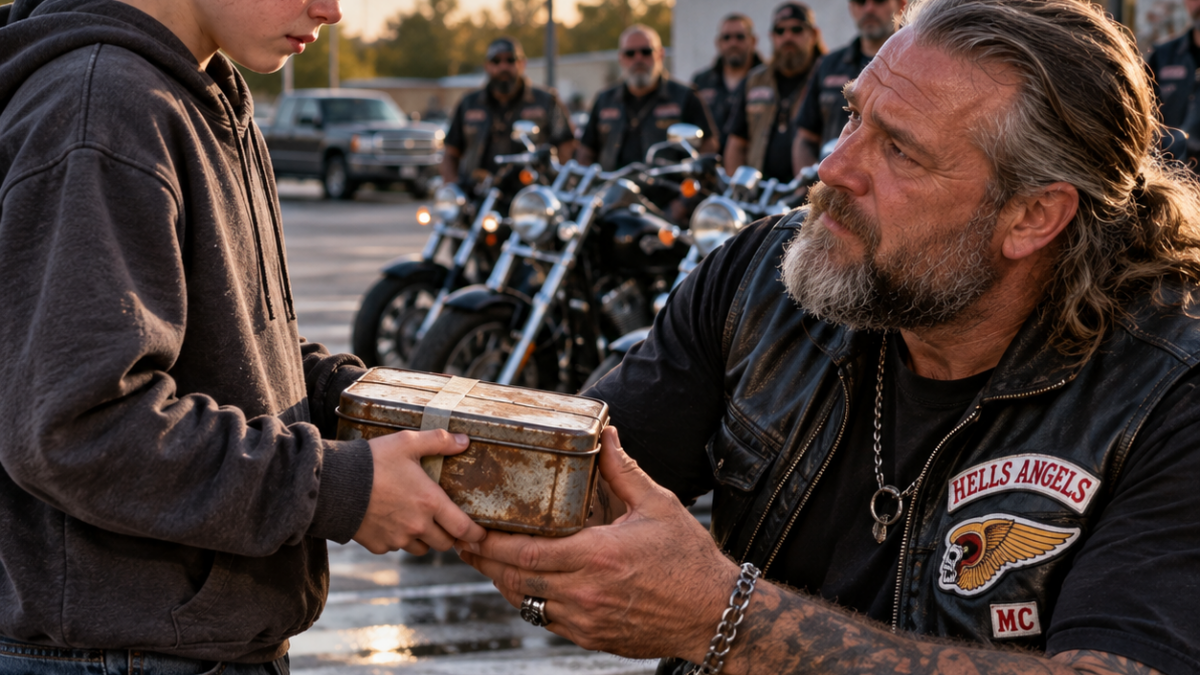
It was the size of a small loaf of bread.
Old metal.
Silver once, now brown with rust along the corners.
Masking tape crossed the lid.
Two pencil letters were pressed hard into the tape.
C.R.
“Sir?”
The boy’s voice cracked.
Dwight waited.
“Are you a Hells Angel?”
“I am.”
The boy looked at the patch.
Then at Dwight’s hands.
“Is it true nobody can make you do anything you don’t want to?”
One of the men ten feet away laughed under his breath.
Dwight didn’t.
“That isn’t true of anybody.”
The boy seemed disappointed.
Dwight tilted his head.
“Why do you ask?”
The boy held the tin tighter.
“Would you hold something for me?”
Dwight glanced at the box.
“How long?”
“Just until Friday.”
“What’s Friday?”
The boy looked toward the road.
“Nothing.”
“That usually means something.”
The boy said nothing.
Dwight lowered himself from the motorcycle.
Then sat on the curb.
Now the boy was taller than he was.
Dwight had learned years earlier that adults often made frightened children feel interrogated simply by remaining upright.
“What’s your name?”
“Caleb.”
“Last name?”
The boy hesitated.
“My mama says not to tell strangers my whole name.”
“Your mama is smart.”
That loosened something around Caleb’s mouth.
Almost a smile.
Dwight nodded toward the tin.
“Does your mama know you’re giving that to me?”
“No.”
“Anybody at home know?”
“No.”
“Why me?”
Caleb’s eyes moved toward the group of bikers.
“Because nobody takes stuff from you.”
Several men heard.
Nobody laughed this time.
“What do people take from you?”
Caleb looked down.
“My bike.”
“Who?”
“Big kids at Sycamore Court.”
“When?”
“August.”
“You tell your mom?”
“She works nights.”
“That wasn’t what I asked.”
Caleb’s shoulders lifted.
“She’d worry.”
“What else?”
“Lunch money.”
“When?”
“September.”
“Same kids?”
He nodded.
Dwight felt his jaw tighten.
“Anybody hitting you?”
“No.”
“Threatening you?”
“They just take stuff.”
“Anybody at home hurting you?”
Caleb’s eyes snapped up.
“No, sir.”
“Your mother?”
“No.”
“Boyfriend?”
“She doesn’t have one.”
“Father?”
The boy’s face changed.
Tiny.
But Dwight saw.
“He died.”
Dwight waited.
“I’m sorry.”
Caleb shrugged in the way children do when the alternative is crying in front of a stranger.
“Two winters ago.”
“How?”
“Roof.”
Construction accident.
Dwight understood without asking.
He pointed toward the tin.
“His?”
Caleb looked surprised.
“How’d you know?”
“Guess.”
The boy’s arms tightened again.
“It was his tackle box.”
Dwight nodded.
“And you need it safe until Friday.”
“Yes.”
“Why can’t it stay home?”
Caleb looked toward the road again.
“Because Mama cleans when she’s nervous.”
“And?”
“She’ll find it.”
That was the first clue.
Dwight filed it away.
“You stealing something?”
“No!”
The answer came fast.
Good.
“Anything dangerous in there?”
“No.”
“Anything illegal?”
Caleb looked offended.
“No.”
“Food?”
“No.”
“Animal?”
“No.”
“Then here’s what I’ll do.”
Dwight put out one large hand.
“I’ll hold it.”
Caleb’s eyes widened.
“I won’t open it.”
“Really?”
“Yes.”
“And I won’t let anybody else open it unless somebody with legal authority gives me no choice.”
The last part confused Caleb.
Dwight simplified.
“I’ll keep it safe.”
“Until Friday?”
“Friday at four.”
The boy looked suspicious.
“What if you’re not here?”
“I’ll be here.”
“What if it rains?”
“I’ve been wet before.”
“What if you forget?”
Dwight went still.
“Won’t happen.”
Caleb studied him.
“How do I know?”
Dwight held out his hand.
“Handshake.”
The boy looked at it.
“That makes it real?”
“For me.”
Caleb placed his hand inside Dwight’s.
Cold.
Damp.
Small enough to disappear.
Dwight closed his fingers gently.
“Friday at four.”
“Promise?”
“Promise.”
Caleb held on a second longer than necessary.
Then he gave Dwight the tin.
The weight surprised him.
Maybe a pound.
Something soft shifted inside.
Then something small and hard clicked against metal.
“Careful,” Caleb whispered.
“I will be.”
The boy backed away.
Turned.
Ran toward Rangeline Road.
At the crosswalk he looked once over his shoulder.
Dwight lifted one hand.
Caleb disappeared behind a brick mini mart.
Ward Eastman, president of the local chapter, approached slowly.
“What you got?”
“Not mine.”
“What’s in it?”
“Don’t know.”
Ward raised an eyebrow.
“You took a sealed box from a kid you don’t know.”
“Yep.”
“And you’re not opening it.”
“Nope.”
Ward rubbed his beard.
“That’s how documentaries start.”
Dwight stood.
He wrapped the tin inside a clean shop towel.
Placed it gently in his locked saddlebag.
Then the motorcycle shop door slammed open.
Gordon Pettibone crossed the lot with his phone already in hand.
“What the hell was that?”
Dwight looked over.
“What?”
“A child.”
“Yes.”
“Walked up to you.”
“Yes.”
“Gave you a sealed container.”
“Yes.”
“And left.”
“You have excellent eyesight.”
Gordon’s face reddened.
“Do you know him?”
“No.”
“Do you know what’s in that box?”
“No.”
Gordon stared.
“I’m calling the police.”
Dwight nodded.
“You should do what you think is right.”
That answer stopped Gordon.
He had expected aggression.
Or defensiveness.
“What?”
“If I were you and saw a ten-year-old hand a sealed box to a stranger, I’d probably have questions too.”
Gordon lowered the phone slightly.
“You’re not concerned?”
“I asked him whether he was safe.”
“And?”
“Said yes.”
“A child said yes.”
“Correct.”
“You believe every kid who says they’re fine?”
“No.”
That answer came too quickly.
Something in Dwight’s eyes ended the argument.
Gordon went inside.
Ward looked toward the window.
“He really going to call?”
“Maybe.”
“You care?”
“If a cop asks, I’ll tell the truth.”
“What if they want the box?”
“They can get a warrant.”
Ward laughed.
“You enjoy making ordinary situations difficult.”
“No.”
Dwight looked toward the corner where Caleb had disappeared.
“I’m keeping a promise.”
Friday came bright and windy.
Dwight arrived at Tri-State at 2:58.
An hour early.
He parked in his usual spot.
Opened the saddlebag.
Checked the shop towel.
The tape on the tin remained intact.
C.R.
He had not opened it.
Not once.
He had thought about it.
More than once.
That bothered him.
Curiosity wasn’t the problem.
Responsibility was.
What if there was information inside that mattered?
A phone number.
Address.
Evidence Caleb was in danger.
What if keeping his promise actually made him irresponsible?
Thursday night, Dwight had placed the tin on his kitchen table.
His wife Lorraine stood in the doorway wearing a robe and watched him stare at it.
“You’re going to burn a hole through the lid.”
“Thinking.”
“That usually gets you in trouble.”
Lorraine had been married to Dwight for twenty-eight years.
She drove a school bus for twenty-six of them.
She had transported hundreds of children through divorces, foster placements, custody disputes, poverty, neglect, and ordinary bad mornings.
She trusted children more than most adults.
She also understood promises.
“Kid ask you not to open it?”
“Didn’t have to.”
“You said you wouldn’t.”
“Yeah.”
“Then don’t.”
“What if there’s something in there I need to know?”
“Friday’s tomorrow.”
“That isn’t what I asked.”
Lorraine had looked at the tin.
Then at the small date tattooed inside Dwight’s right forearm.
09-19-94.
Most people assumed it meant prison.
The club had asked once.
Dwight hadn’t explained.
Lorraine knew.
She knew almost everything.
“Wait until Friday.”
So he did.
At 3:15, Ward arrived.
At 3:21, Rufus Lambert.
By 3:45, twelve motorcycles sat in the row.
Nobody had been invited.
They had simply heard.
At 3:58, Dwight stood.
At 4:00, the corner across Rangeline was empty.
4:05.
Nothing.
4:17.
Ward drank coffee.
Nobody said much.
4:30.
Rufus looked toward the street.
“Maybe kid forgot.”
“No.”
Dwight didn’t even look at him.
“Kids forget everything.”
“Not this.”
“How do you know?”
“A kid who says ‘just until Friday’ has been counting days.”
Rufus accepted that.
At 5:00, shadows stretched across the lot.
Gordon came outside.
“He didn’t show?”
“No.”
“Maybe his mother found out.”
“Maybe.”
“Maybe you should give the box to police.”
Dwight looked at him.
“No.”
“You don’t even know the kid’s last name.”
“I’ll find it.”
“You’re going to go looking for a ten-year-old?”
That sounded worse aloud.
Gordon’s face said so.
Dwight sighed.
“I know.”
“You see why I don’t like this?”
“Yes.”
“Then—”
“But I made a promise.”
Gordon looked genuinely frustrated.
“That is not a magic phrase that makes everything okay.”
“No.”
Dwight surprised him again.
“It isn’t.”
By 6:30, most riders left.
At 7:00, Ward stood.
“You staying?”
“Yep.”
“How long?”
“Until I know.”
Ward looked at the darkening road.
Then squeezed Dwight’s shoulder.
“Call.”
At 8:00, the cycle shop closed.
Gordon locked the front doors.
Dwight remained on the curb.
At 9:30, traffic thinned.
At 10:08, he finally stood.
Not because he’d decided Caleb wasn’t coming.
Because a ten-year-old should not be walking a commercial road at ten at night.
Dwight put one hand on the saddlebag.
“I’ll be here next Friday.”
He said it aloud.
No one heard.
Except him.
Saturday morning, Dwight left his vest in the motorcycle saddlebag.
Not because he was ashamed.
Because he understood arithmetic.
A large tattooed man in a Hells Angels vest asking where to find a missing ten-year-old created more problems than it solved.
So he wore jeans and a plain dark button-down shirt.
His tattoos still showed.
There wasn’t much he could do about his face.
He crossed Rangeline and entered the mini mart.
An elderly woman sat behind the counter on a high stool.
Her name tag said OPAL.
She looked at him.
Then toward the parking lot outside.
“You’re the motorcycle man.”
“One of them.”
“Don’t sell alcohol to your crowd after nine.”
“I don’t drink.”
“Then you’re cheaper than you look.”
Dwight almost smiled.
“I’m looking for a boy.”
Opal’s expression changed.
“That’s not a sentence men like you should lead with.”
“I know.”
“Good.”
“Ten years old.”
“Gray hoodie.”
“Freckles.”
“Name’s Caleb.”
Opal stopped rearranging lottery tickets.
“Why?”
Dwight told her.
Everything.
Tin.
Friday.
No-show.
Promise.
By the time he finished, Opal had removed her reading glasses.
“Caleb Rainey.”
Dwight felt relief at having a full name.
Then immediately lost it when he saw Opal’s face.
“What happened?”
“His mama.”
“What?”
“Tamara.”
Opal folded her hands.
“Thursday night, pickup ran a red light at Thirty-Second and Main.”
Dwight went still.
“Hit her driver’s side.”
“How bad?”
“ICU.”
The mini mart seemed to shrink.
“Caleb?”
“Wasn’t in the car.”
Dwight exhaled.
Then Opal continued.
“He was home asleep.”
“Alone?”
“Tammy works nights at Cedar Hills.”
“Neighbor checks him.”
“That night, neighbor thought Tammy was home.”
“Nobody knew until Friday morning.”
Dwight felt something cold move through him.
“Where is he?”
“Children’s division took him.”
“Emergency placement.”
“Do you know where?”
“No.”
“I called.”
“They won’t tell me.”
“Good.”
Opal looked irritated.
“Good?”
“They shouldn’t tell strangers.”
Then:
“But I need someone who can give them a message.”
Opal watched him.
“Friday was Tammy’s birthday.”
Dwight’s eyes moved toward the tin in his mental picture.
There it was.
“What’s inside?”
“I don’t know.”
Opal almost laughed.
“You still haven’t opened it?”
“No.”
“Lord.”
She sat back.
“Caleb’s been working here since March.”
Dwight frowned.
“He’s ten.”
“Sweeps my sidewalk.”
“Takes trash out.”
“Five dollars a week.”
“Calls it a job because that boy would rather chew glass than take charity.”
“Saving for what?”
“Wouldn’t say.”
Opal looked toward the door.
“Just said something for his mama’s work.”
Dwight closed his eyes briefly.
The tin got heavier without physically being in the room.
“He has a hiding place too.”
“Where?”
“No idea.”
“Somewhere at Sycamore Court.”
“He told me big boys can’t fit there.”
“Calls it his place.”
“Only spot that’s his.”
Dwight stored that too.
“Thank you.”
He reached the door.
Opal called after him.
“Mister.”
He turned.
She had lost the sarcasm.
“If you find him…”
She stopped.
Then tried again.
“Just find him.”
Sunday, Dwight went to Freeman West Hospital.
The volunteer desk refused to confirm Tamara Rainey was admitted.
Correctly.
Dwight respected that.
He wrote his number on the back of a gasoline receipt.
“Could you give this to social work?”
The volunteer looked uncertain.
“Tell them Dwight Maddox is holding something for Caleb.”
She looked at his tattoos.
“And that I’ll be at Tri-State Cycle at four every Friday.”
“Every Friday?”
“Until he comes.”
The woman stared.
“Just tell them.”
Monday at 8:15 a.m., Dwight’s phone rang.
“Mr. Maddox?”
“Yes.”
“Detective Frances Oaks, Joplin Police Department.”
Dwight sat straighter at the kitchen table.
“I understand you’ve been making inquiries about a minor child.”
“Yep.”
“I’d like to speak with you.”
“When?”
“Today.”
“Where?”
She gave an address.
Lorraine watched him end the call.
“Police?”
“Yep.”
“You surprised?”
“No.”
“Take a lawyer?”
“No.”
“Why?”
“Because they’re supposed to investigate grown men who keep secrets for ten-year-old boys.”
Lorraine studied him.
“You’re an infuriatingly reasonable person when you’d rather not be.”
“Practice.”
The interview room was gray.
Metal table.
Camera.
Detective Oaks was forty-eight, dark hair threaded with silver, expression controlled enough to make strangers confess things simply to fill the silence.
She opened a file.
“Dwight Maddox.”
“Yes.”
“Fifty-six.”
“Last time I checked.”
“Arrest in 1997.”
“Disturbing peace.”
“Bar fight?”
“Mostly chairs.”
“No convictions after.”
“No.”
“Hells Angels member.”
“Yes.”
She looked up.
“You understand why we’re having this conversation.”
“Completely.”
“That doesn’t offend you?”
“Should it?”
“Most people don’t enjoy being investigated.”
“Most people shouldn’t enjoy police ignoring a ten-year-old who handed a secret box to a stranger.”
That answer made Oaks pause.
She opened another page.
“Caseworker Joyce Ambrose contacted us Friday.”
Dwight’s attention sharpened.
“Caleb?”
“Safe.”
That one word loosened something in his chest.
“Where?”
“I can’t tell you.”
“Good.”
She blinked.
Dwight continued.
“Is he okay?”
“Physically.”
Not emotionally.
He heard the distinction.
“He told Ms. Ambrose he gave a sealed tin to a man wearing a Hells Angels vest.”
Dwight nodded.
“He asks every night whether that man came Friday.”
Dwight looked down.
His hand closed once on the edge of the table.
“I did.”
“I know.”
Oaks studied him.
“What’s in it?”
“I don’t know.”
“You expect me to believe that?”
“Yes.”
“You’ve had it almost a week.”
“Yes.”
“And never opened it.”
“No.”
“Why?”
“I promised.”
Oaks leaned back.
“Mr. Maddox, I need the tin.”
“No.”
Her expression cooled.
“That wasn’t a request.”
“Then show me an order.”
“You’re withholding property belonging to a child in state care.”
“I am safeguarding something that belongs to a child who asked me to safeguard it.”
“Semantics.”
“No.”
Dwight leaned forward.
“In less than seventy-two hours that boy lost his mother to an ICU bed, his apartment, his school routine, every familiar adult, and the right to decide where he sleeps.”
Oaks remained still.
“Every person involved probably had a valid reason.”
“Police.”
“Social workers.”
“Hospital.”
“Foster parents.”
“All doing jobs.”
“And every one of them is still taking something.”
Oaks’s fingers stopped moving over the folder.
Dwight continued.
“I told him one thing.”
“That I’d hold his tin.”
“If you have legal grounds to open it, get an order.”
“I’ll bring it to court myself.”
“But Caleb cuts the tape.”
Oaks stared at him a long time.
“What if it contains information relevant to his safety?”
“Then the judge decides.”
“You willing to risk that?”
“No.”
Dwight’s voice lowered.
“I’m willing to protect one thing that’s still his until the law gives me a reason not to.”
Oaks closed the file.
“I’ll request an order.”
“Fine.”
“Could be Friday.”
“Friday at four I’ll be at Tri-State.”
“You really mean to sit there every Friday?”
“Yes.”
“Why?”
Dwight did not answer.
Not yet.
Tuesday night, he almost opened it.
The tin sat beneath the yellow kitchen light.
Utility knife beside it.
Lorraine stood in the doorway.
Dwight touched the edge of the masking tape.
“Maybe there’s a name.”
“Maybe.”
“Maybe a number.”
“Maybe.”
“Maybe Caleb needs what’s in here more than he needs my promise.”
Lorraine came closer.
“You’re not thinking about Caleb.”
Dwight looked up.
“Who am I thinking about?”
She pointed to the date tattooed inside his forearm.
Dwight said nothing.
Lorraine sat.
“Tell it.”
“I’ve told you.”
“Tell the tin.”
He laughed once.
“That’s ridiculous.”
“Good.”
She waited.
Dwight stared at the numbers.
September 19, 1994.
“I was twenty-six.”
Lorraine already knew.
Still, she listened.
“Army.”
“Port-au-Prince.”
“I wasn’t anybody important.”
“Chaplain’s assistant.”
“Set up a plywood chapel.”
“Made coffee.”
“Sat with soldiers who couldn’t sleep.”
“A mile from the perimeter was an orphanage.”
“There was a kid.”
“Maybe nine.”
“Never told me his name.”
“Liked learning English.”
“First word he learned from me was peaches.”
Lorraine smiled faintly.
“Because of canned peaches?”
“Army cans had pictures.”
“He asked me for one.”
“I told him I’d bring a whole can Friday.”
Dwight’s thumb moved across the tin.
“Thursday morning orders changed.”
“Two hours.”
“We were on trucks.”
“Couldn’t get back.”
“Could’ve asked somebody.”
“Didn’t.”
“Thought someone would tell him.”
Lorraine waited.
“Never knew.”
“If he sat on that wall Friday…”
Dwight’s voice stopped.
Thirty years compressed into a kitchen.
One can of peaches.
One boy waiting somewhere in Haiti.
Lorraine reached across and removed the utility knife.
“Then you don’t open Caleb’s tin.”
Dwight nodded.
Wednesday, a hospital social worker called.
Janelle Carver.
“You don’t remember me.”
“Should I?”
“Emergency department, 2009.”
Dwight searched memory.
“I was new.”
“Twelve-year-old girl after domestic violence call.”
“You told me to sit on the floor.”
Memory returned.
“Blue sweater.”
Janelle laughed softly.
“You remember the sweater?”
“I remember children.”
She became serious.
“I can’t tell you where Caleb is.”
“I know.”
“I can’t discuss his mother’s condition.”
“I know.”
“But I can tell you something you taught me.”
Dwight waited.
“A child in placement learns whether adults keep promises very fast.”
His throat tightened.
“Don’t let him be right about you.”
“I won’t.”
Thursday evening, Caleb sat at a kitchen table three miles away pushing macaroni around a plate.
His foster mother, Bonnie Sturgill, was sixty-two and had cared for emergency placements for nearly fifteen years.
She did not force conversation.
That helped.
Caleb distrusted adults who filled silence because silence frightened them.
Bonnie let quiet sit.
Caseworker Joyce Ambrose sat across from him.
“Your mom is leaving intensive care tomorrow.”
Caleb’s fork stopped.
“What?”
“They’re moving her to a regular room.”
“Can I see her?”
“Saturday if her doctors agree.”
“Saturday?”
“Yes.”
Caleb swallowed.
Then:
“Did he come?”
Joyce knew immediately.
“Dwight?”
Caleb nodded.
“I don’t know.”
“You said police talked to him.”
“They did.”
“Did he come Friday?”
“I don’t know.”
Caleb pushed back his chair.
“Can you call?”
“It’s complicated.”
“No, it’s not.”
“Caleb—”
“He promised.”
Joyce took a breath.
“The detective may need to open the tin.”
Everything left Caleb’s face.
“No.”
“Only if necessary.”
“No.”
“Honey—”
“They can’t.”
He stood.
“It’s mine.”
“I know.”
“It’s for Mom.”
Joyce’s voice softened.
“What’s inside?”
Caleb covered his mouth.
Tears appeared instantly.
“If they open it, it’s ruined.”
“Why?”
“Because she has to open it.”
There it was.
Joyce leaned closer.
“What is it?”
He shook his head.
“Surprise.”
Then something worse entered his expression.
“Is Dwight in trouble?”
“No.”
“Because I gave it to him?”
“No.”
“You’re lying.”
Children in unstable situations became experts at watching adults separate reassurance from truth.
Joyce felt ashamed.
“He isn’t charged with anything.”
“Then why police?”
“To make sure you’re safe.”
Caleb sat down.
“I was safe with him.”
“You’d met him once.”
Caleb whispered:
“I watched him before.”
Joyce heard it but didn’t understand yet.
That night Caleb lay beneath a quilt that smelled like somebody else’s laundry detergent.
Red digital clock.
11:14.
11:37.
12:02.
His father used to say valuables should go inside ugly containers.
“Nobody steals junk.”
The rusted tackle box had been his.
Caleb remembered his father’s hands tying fishing line.
Remembered the smell of sunscreen.
Remembered being seven and believing adults knew what happened next.
Friday was his mother’s birthday.
He had worked seven months sweeping Opal’s sidewalk.
Five dollars each week.
Saved nearly everything.
He had gone into a discount store alone.
Asked a clerk which watches nurses used.
Picked one with a second hand.
His mother worked as a nursing assistant.
Her old watch broke.
He had heard her crying in the kitchen after her supervisor wrote her up for using her phone to time a resident’s pulse.
She thought Caleb was asleep.
He wasn’t.
He bought a new watch.
Hid it in his father’s tackle tin.
Friday morning, the accident stole the plan.
Now adults might open it.
His mother might see it because a detective handed it to her.
The surprise would become evidence.
Property.
Inventory.
Caleb couldn’t tolerate one more thing changing names.
At 3:55 Friday afternoon, he left Bonnie’s house.
He did not mean to run away permanently.
He intended to go to Tri-State.
Get the tin.
Return.
Three miles.
He had mapped it in his head.
He reached Rangeline at 4:41.
The sky had turned purple-gray.
Rain coming.
Then he saw the motorcycles.
Fourteen.
More than Tuesday.
Then Detective Oaks’s sedan.
He knew it from the foster home conversation.
Then the marked police cruiser.
Caleb stopped.
His stomach dropped.
Dwight was in trouble.
Because of him.
The police had come for the tin.
Maybe for Dwight.
Maybe the bikers were there because police had accused him.
Caleb backed away.
Across the lot, Gordon Pettibone later saw the small shape on security footage.
Gray hoodie.
Backpack.
Frozen.
Then gone.
At 4:55, Detective Oaks’s phone rang.
She listened.
Her face changed.
Dwight saw it.
“What?”
“Caleb left his foster placement.”
“When?”
“3:55.”
“Walking?”
“Yes.”
“Here?”
“Likely.”
“He should’ve arrived.”
“Exactly.”
Gordon came running from the store with a phone.
“I found something.”
He had pulled exterior camera footage.
4:41.
Caleb at the edge of the lot.
Looking at riders.
Looking at Oaks’s sedan.
Looking at patrol car.
Then turning and running.
Oaks went pale.
“He saw me.”
Dwight looked at the footage.
“He thinks he got me arrested.”
“We need units.”
“Yes.”
Oaks grabbed her radio.
“All units—”
Dwight touched her wrist lightly.
“Wait.”
She looked at him sharply.
“No lights.”
“What?”
“No uniforms walking at him.”
“He’s ten and missing.”
“Which is exactly why.”
Dwight pointed toward the screen.
“He ran from your car.”
“You fill the neighborhood with police, he goes deeper.”
Oaks hesitated.
Her training screamed search.
Visibility.
Command presence.
Dwight’s experience whispered smaller.
He continued.
“Send cars to perimeter.”
“Keep distance.”
“Let us search places a scared kid would choose.”
Oaks looked at him.
“You giving me police tactics?”
“I’m giving you child tactics.”
That phrase landed strangely.
She agreed.
The rain started at 5:02.
Cold drops.
Wind.
Temperature fell quickly.
Riders spread in pairs.
Railroad tracks.
Drainage culverts.
Car wash.
Behind grocery stores.
Bus shelters.
Opal joined from her mini mart doorway by phone.
“He has a spot at Sycamore Court.”
“Where?”
“Never told me.”
“Something small?”
“He said bigger boys couldn’t fit.”
That was enough.
By 6:00, rain came steadily.
7:00.
Nothing.
8:00.
Temperature forty-eight degrees.
Gordon emerged from the shop carrying sealed rain suits from store inventory.
Rufus looked at the boxes.
“These aren’t cheap.”
Gordon shoved one at him.
“Take it.”
“Store manager okay?”
“I am the store manager.”
“You’re giving away a thousand dollars.”
“Take the damn suit.”
Gordon looked toward Dwight.
“I was wrong about Tuesday.”
Dwight pulled on the rain jacket.
“Which part?”
“Most of it.”
“Good.”
No lecture.
No victory.
People corrected themselves in their own time.
At 8:40, Oaks said highway patrol could send a helicopter.
“No.”
Dwight stared through the rain.
“Floodlight drives him farther.”
“Temperature is dropping.”
“I know.”
“Then we need speed.”
“We need the right place.”
Opal’s sentence came back.
The one place that’s his.
Big boys can’t fit.
Sycamore Court had three aging brick apartment buildings around a cracked central courtyard.
Concrete stairs rose along the back.
Dwight and Oaks arrived at 9:31.
Neighbors stood beneath doorways.
Phones out.
They saw a huge wet man in leather and a detective.
Their assumptions assembled instantly.
Dwight ignored them.
He walked behind building C.
Trash bins.
Utility boxes.
Small shrubs.
Then behind the last staircase.
A juniper.
Mud.
One small shoeprint.
Pointing toward a dark opening beneath the concrete stairs.
Maybe twenty-two inches high.
Dwight’s heartbeat changed.
He removed his flashlight.
Turned it on.
Then turned it off.
Oaks raised hers.
“No.”
“He could be hurt.”
“Light’s why he ran.”
She hesitated.
Then switched it off.
Dwight removed his vest.
Not because the patch mattered.
Because wet leather was heavy.
Then reconsidered.
He put it back on.
Caleb knew him in the vest.
Recognition mattered.
Dwight lowered himself onto the wet concrete.
His knees protested.
He sat beside the opening.
Not blocking it.
Not reaching.
At 9:47 p.m., he spoke.
“Caleb.”
Silence.
Rain striking concrete.
“It’s Dwight.”
Nothing.
“From Tri-State.”
For several seconds, Dwight thought they’d been wrong.
Then a sound.
Breathing.
Small.
Rapid.
Oaks stepped forward instinctively.
Dwight held one hand behind him.
Stay.
He spoke toward the darkness.
“I’m gonna sit right here.”
No answer.
“I won’t reach in.”
Rain.
“Nobody’s gonna grab you.”
Then, from inside:
“I saw her car.”
Dwight closed his eyes.
Found.
Oaks covered her mouth.
Dwight kept his voice steady.
“I know.”
“I didn’t mean to bring police.”
“You didn’t.”
“They came because of the box.”
“No.”
“You got in trouble.”
“Nope.”
“You’re lying.”
“Fair.”
Dwight almost smiled.
“Grown-ups got scared for you.”
“Sometimes scared grown-ups get clumsy.”
Silence.
“Did you open it?”
There it was.
The only question that mattered to Caleb.
Dwight reached slowly inside his jacket.
Pulled out the rusted tin.
It had been against his chest all evening beneath rain gear.
Dry.
He placed it on the concrete near the opening.
Tape facing upward.
“Look.”
A pale hand emerged.
Tiny fingers.
They touched the masking tape.
C.R.
Still intact.
“You didn’t.”
“No.”
“Not even police?”
“No.”
“They wanted to.”
“Yep.”
“And you said no?”
“Yep.”
A sound came from the darkness.
Not quite crying.
Not quite laughter.
Something between.
Dwight swallowed.
“I told you Friday.”
A long pause.
“Is it still Friday?”
The question broke him more than anything else had.
“Yeah, buddy.”
His voice nearly failed.
“Still Friday.”
The hand pulled the tin inside.
Dwight listened.
Metal touching concrete.
Then he heard teeth clicking.
Not crying.
Chattering.
Cold.
“Caleb.”
No response.
“How long you been under there?”
“Don’t know.”
“You wet?”
“Yeah.”
“Hands hurt?”
“Yes.”
“Feet?”
“Can’t feel them.”
Dwight’s entire manner changed.
Calm remained.
But now clinical.
“Okay.”
Oaks heard it.
Professional.
Experienced.
“Caleb, I need you to come out.”
“No.”
“We need to get you warm.”
“I’ll be in trouble.”
“No.”
“I ran.”
“Tonight we care about warm.”
“Tomorrow can handle running.”
No answer.
“I’m not taking the tin.”
Silence.
“You hold it.”
Another pause.
“I’ll carry you.”
“I can walk.”
“Maybe.”
Dwight shifted.
“But I’m offering.”
Nothing.
Then the tin appeared first.
Dragged toward the opening.
Caleb followed on his stomach.
His hoodie was soaked through.
Lips bluish.
Skin pale.
Shaking so violently his elbows collapsed beneath him.
Dwight did not curse.
But something inside him did.
He pulled off Caleb’s wet hoodie.
Wrapped him in his motorcycle jacket.
Then removed his vest and placed it over the jacket.
The winged skull covered almost the entire child’s back.
Dwight lifted him.
Caleb weighed almost nothing.
“Detective.”
Oaks was already on radio.
“Ambulance.”
“Hospitals use warm packs on chest and groin.”
“Not hands and feet yet.”
“Still shivering, so that’s good.”
Oaks looked at him.
“How do you know—”
“Later.”
Caleb pressed the tin against his chest.
Dwight held both.
The boy looked up.
“You stayed.”
“Yes.”
“Why?”
Dwight thought of Haiti.
A nameless child on a wall.
A Friday he missed.
“Because I said I would.”
The ambulance arrived without sirens.
Neighbors watched.
One woman slowly lowered her phone after realizing the enormous biker she’d been recording as a threat was holding a freezing child beneath his vest.
Detective Oaks knelt beside the stretcher.
“Caleb?”
His eyes shifted toward her.
“I’m Frances.”
“You’re the police car.”
She nodded.
“I am.”
“I’m sorry about that.”
Caleb looked confused.
Adults didn’t apologize to him often.
“I thought you came for Dwight.”
“I know.”
“I didn’t.”
“Okay.”
“I’m not asking you questions tonight.”
“Okay.”
“You’re not in trouble.”
He looked toward Dwight.
“Is she lying?”
Oaks almost laughed despite herself.
Dwight shook his head.
“Not this time.”
“Rude,” Oaks said.
But relief softened her entire face.
The medics loaded Caleb.
His hand shot out.
Dwight caught it.
“My tin.”
“You have it.”
Caleb looked.
Still against his chest.
“Can I give it to Mom?”
“The second they let you.”
“Promise?”
Dwight hesitated.
Then held out his hand.
Caleb placed his cold fingers inside.
“Promise.”
At nine the next morning, Dwight sat outside room 312 at Freeman West Hospital.
The coffee in his hands had gone cold.
Again.
He seemed to drink more cold coffee than hot.
Detective Oaks sat beside him.
Neither had slept much.
Caleb had been treated for mild-to-moderate hypothermia.
No frostbite.
No serious injury.
Just exhaustion.
Tamara Rainey had been transferred from intensive care.
Fractured pelvis.
Broken left arm.
Severe bruising.
A concussion.
Lucky.
Another word people used strangely.
Oaks broke the silence.
“I ran you.”
Dwight looked over.
“You already ran me.”
“Not criminal.”
He waited.
“State licensing.”
Dwight’s face changed slightly.
Oaks saw.
“Dwight Ray Maddox.”
“Licensed clinical social worker.”
“Twenty-one years.”
“Retired 2022.”
He took a sip of cold coffee.
“Congratulations.”
“You never mentioned it.”
“You didn’t ask.”
“You let me interview you like—”
“Like a grown man holding a child’s secret.”
“Yes.”
“You should have.”
Oaks frowned.
Dwight continued.
“If I’d been sitting where you sat, I would’ve checked me too.”
“You’re not angry?”
“I was a little irritated.”
“That I noticed.”
“But your job is to ask.”
He looked down the hallway.
“Bad things happen when nobody asks.”
Oaks looked at the floor.
“I called Janelle Carver.”
Dwight groaned.
“At one in the morning?”
“She answered.”
“She always does.”
“She told me about the tornado.”
He stared.
“What tornado?”
“Don’t.”
“She said you ran reunification out of a school gym for nine days.”
“There were fifty people there.”
“She said you sat in one corner matching hospital wristbands, names, foster records, shelter lists, and police reports until every displaced child was accounted for.”
“Team effort.”
“She said you refused to go home.”
“She’s dramatic.”
“She said you taught her never to stand over frightened kids.”
Dwight looked annoyed.
Oaks smiled faintly.
“I watched you last night.”
His face softened.
She continued.
“I was going to shine a flashlight under those stairs.”
“I know.”
“I thought light meant safety.”
“Usually.”
“It didn’t for him.”
“Not then.”
Oaks turned her coffee cup.
“I saw a vest.”
“Yes.”
“A sealed box.”
“Yes.”
“A child.”
“Yes.”
“And I built a story.”
Dwight nodded.
“Everyone does.”
“Doesn’t make it okay.”
“No.”
“No lecture?”
“You already learned it.”
That irritated her.
“Do you ever let people apologize properly?”
“Rarely.”
The elevator opened.
Opal Krenshaw stepped out wearing a quilted church coat and carrying a black purse large enough to transport farm equipment.
Dwight stood.
“Opal.”
She pointed.
“Sit.”
He sat.
She placed a paper bag in his lap.
“Day-old bread.”
“You charged me?”
“Half price.”
“Generous.”
She turned toward Oaks.
“You’re police?”
“Detective Frances Oaks.”
Opal sat across from her.
“You look like somebody who listens after she’s wrong.”
Oaks glanced at Dwight.
“He invited you?”
“No.”
Opal continued.
“I’ve worked behind a counter thirty-one years.”
“I sold cigarettes to preachers.”
“Milk to a man who later went to prison for beating his wife.”
“Lottery tickets to women who donated more to church than I ever will.”
She pointed toward Dwight.
“A vest tells you who a man rides with.”
“It doesn’t tell you what he’ll carry for somebody else’s child.”
Dwight became fascinated by the bread bag.
Oaks smiled.
“I’ve been figuring that out.”
Opal narrowed her eyes.
“Took a week.”
“Less.”
“Still slow.”
Dwight finally laughed.
At ten, Joyce Ambrose entered the hallway.
“Mr. Maddox?”
Dwight stood.
“Caleb would like you to come in.”
She paused.
“He asked for you before he asked for breakfast.”
Room 312 smelled like sanitizer and coffee.
Tamara Rainey lay propped against pillows.
Thirty-four.
Bruise along her jaw.
Cast on one arm.
Eyes exhausted.
Caleb sat beside her wearing an oversized hospital sweatshirt.
The rusted tin rested on his knees.
When Dwight entered, Tamara looked at the vest.
She flinched.
Barely.
Dwight saw.
So did she.
“I guess I’m supposed to be afraid of you.”
Dwight stopped.
“Who told you that?”
“Enough people.”
“People should be careful.”
She looked surprised.
“Especially about men who take secrets from children.”
“I checked,” Tamara said.
“Good.”
“Joyce told me.”
Her voice broke.
“Everything you did.”
“Mostly I sat in rain.”
“You found my boy.”
“Your boy found a hiding place.”
“You brought him out.”
“He came out because he wanted to.”
“You kept his box.”
“Yes.”
Tamara extended her good hand.
“Thank you for holding it.”
Dwight took it.
Warm.
Alive.
“Caleb did the hard part.”
The boy stood.
He suddenly became serious.
Formal.
Like he’d rehearsed.
“Mama.”
Tamara looked over.
“Happy birthday.”
His voice trembled.
“It’s late.”
She stared at the tin.
“Is that your dad’s tackle box?”
Caleb nodded.
“It’s not fishing stuff.”
He placed it carefully on her blanket.
“Open it.”
Tamara touched the lid.
Then stopped.
“You taped this?”
“Yes.”
“C.R.?”
“Caleb Rainey.”
She smiled.
“Good security.”
“Dad said ugly boxes don’t get stolen.”
Her smile collapsed slightly at the mention of him.
Then returned.
Caleb sat beside her.
Tamara peeled the tape.
One strip.
Then another.
Dwight watched Caleb watch her.
That was the gift.
Not the object.
The moment.
The control.
After a week when adults decided everything about him, he finally got to choose what happened next.
Tamara lifted the lid.
Inside was a folded index card.
A rubber-banded wad of dollar bills and coins.
Six dollars.
And a square of paper towel.
She unwrapped it.
A wristwatch.
Nothing expensive.
Silver case.
White face.
Black silicone strap.
Red second hand.
Practical.
Tamara stopped breathing for one second.
“Caleb.”
The boy looked terrified now.
“Do you like it?”
Her hand began trembling.
“How did you—”
“You said yours broke.”
She covered her mouth.
“In August.”
“I heard.”
Tamara began crying.
“You weren’t supposed to hear that.”
“You cried at the table.”
Dwight looked away.
Caleb continued.
“You got in trouble for using your phone.”
Tamara nodded.
“My supervisor thought I was texting.”
“I was timing Mr. Dwyer’s pulse.”
“I know.”
“You never told me.”
“I heard Opal say you needed a watch.”
Tamara picked it up.
“Where did you get money?”
“Sweeping.”
“Caleb.”
“Five dollars a week.”
“You were saving that?”
“Yes.”
“For me?”
He nodded.
“I checked the second hand four times against the microwave.”
Tamara laughed and sobbed together.
She opened the card.
The pencil writing wandered.
MAMA,
NOW YOU DON’T HAVE TO USE YOUR PHONE TO COUNT.
HAPPY BIRTHDAY.
LOVE, CALEB.
P.S. THE SECOND HAND IS REAL. I CHECKED IT FOUR TIMES.
P.P.S. THERE IS SIX DOLLARS LEFT. I DIDN’T KNOW HOW TO BUY A CAKE.
Tamara pressed the card against her mouth.
Then pulled Caleb against her uninjured side.
The boy began crying too.
Not terrified crying.
Not foster-home crying.
Release.
Joy.
Grief for his father.
Relief for his mother.
Everything children often carry without vocabulary.
Joyce removed her glasses.
Detective Oaks looked through the doorway and turned away.
Opal openly cried.
Dwight stepped backward.
The moment belonged to them.
A small hand caught his vest.
“Mr. Dwight.”
He looked down.
Caleb’s face was blotchy.
“What?”
“You want to know why I picked you?”
Dwight nodded.
Caleb looked toward the adults.
“Everybody thinks it’s because you look scary.”
Dwight almost smiled.
“Reasonable theory.”
“No.”
The boy shook his head.
“I watched you.”
“When?”
“Before Tuesday.”
Dwight frowned.
Caleb continued.
“Mrs. Krenshaw came over to buy something at the motorcycle place.”
“Couldn’t get the door because she had bags.”
“You held it.”
“I hold doors.”
“But then you waited.”
Dwight stopped.
“She walked to her car.”
“You stood there until she got in.”
“You didn’t know anybody was looking.”
The room became quiet.
Caleb’s fingers still held the bottom of Dwight’s vest.
“That’s why.”
Dwight could not speak.
The boy continued.
“Dad said you find out what people are really like when they think nobody’s watching.”
Dwight’s eyes filled.
He nodded once.
That was all he could manage.
Tamara looked at him differently now.
Not past the vest.
Not through it.
At him.
“Apparently my son does background checks.”
Dwight cleared his throat.
“Good policy.”
The legal aftermath was less dramatic.
Social services arranged for Caleb to stay with Bonnie another ten days while Tamara recovered.
Opal visited.
Lorraine brought food.
Dwight did not become Caleb’s replacement father.
He did not need one.
That mattered.
Kind adults did not need ownership of children to matter to them.
Dwight simply remained available.
Friday afternoons became something.
At first, Caleb came because he wanted to see the motorcycles.
Then because Ward taught him how to check tire pressure.
Rufus showed him basic tools.
Gordon—after considerable internal transformation—started setting a folding chair near the parking-lot light pole around 3:45 each Friday.
Nobody asked him to.
Nobody discussed it.
The chair was simply there.
The first Friday in November, Caleb arrived at 3:56.
Dwight sat on the curb.
Same place.
“You came.”
Caleb grinned.
“You said every Friday.”
“I did.”
“I don’t have anything for you to hold.”
“Good.”
They sat.
After a minute Caleb asked:
“You ever break a promise?”
Dwight stared across Rangeline.
“Yes.”
“What happened?”
Dwight rubbed the numbers on his forearm.
“Kid once asked me for canned peaches.”
Caleb looked confused.
“That’s it?”
“That’s enough.”
He told him.
Not every detail.
Just enough.
A boy.
Haiti.
Friday.
Orders changed.
Dwight never returned.
Caleb listened seriously.
“You couldn’t help it.”
“I could’ve told somebody.”
“You were twenty-six.”
“Still old enough.”
Caleb thought.
“Maybe he knew.”
“Maybe.”
“Maybe somebody else brought him peaches.”
“Maybe.”
“Maybe he forgot.”
Dwight shook his head.
“Kids don’t forget things adults promise.”
Caleb looked toward the motorcycles.
“No.”
They understood each other.
“Is that why you stayed?”
“Partly.”
“What was the other part?”
Dwight looked at him.
“You asked.”
Caleb accepted that.
Tamara eventually returned to work.
She wore the silver watch every shift.
Her supervisor never wrote her up for using a phone again.
After hearing how she got the replacement, half the residents at Cedar Hills knew Caleb’s story.
An eighty-nine-year-old woman named Mrs. Durham gave him five dollars for “being a good son.”
Caleb refused.
She made him take cookies instead.
Two months after the accident, Tamara walked into Tri-State Cycle and Supply carrying a sheet cake.
Gordon looked at the cake.
“We sell motorcycle parts.”
“Then eat around it.”
Written in blue frosting:
THANK YOU FOR KEEPING YOUR WORD.
Ward took a photograph.
Dwight protested.
Nobody listened.
The image showed Caleb beside the cake.
Tamara wearing her watch.
Dwight looking as though cameras were an infringement on constitutional rights.
Fourteen bikers behind them.
Gordon in the corner holding plastic forks.
Opal seated in the folding chair as though she owned the building.
Detective Oaks arrived late and ate two pieces.
Years passed.
The rusted tin stayed with Caleb.
He never repainted it.
Never fixed the bent corner.
The masking tape with C.R. went inside.
So did his father’s old fishing license.
A photograph of Tamara wearing the watch.
A hospital bracelet.
Then later, other things.
His first driver’s license after it expired.
College acceptance letter.
One of Opal’s handwritten grocery lists after she died at eighty-seven because he couldn’t explain why throwing away her handwriting felt wrong.
Ward’s memorial card.
His mother’s CNA pin when she retired.
The box became what his father had intended.
A place for things that looked small until they were gone.
Caleb grew.
At fourteen, he got tall enough to look Dwight in the eye.
At sixteen, Gordon hired him part-time at Tri-State.
At seventeen, he bought his first motorcycle.
A terrible motorcycle.
1989 Honda with electrical problems and rust on the tank.
Dwight looked at it.
“No.”
Caleb grinned.
“I already bought it.”
“How much?”
“Eight hundred.”
“You paid seven hundred too much.”
“You’ll help fix it.”
“That confidence bothers me.”
“You promised you’d be here Fridays.”
Dwight glared.
Caleb laughed.
They rebuilt it together.
On Caleb’s eighteenth birthday, Dwight gave him something wrapped in newspaper.
A can of peaches.
Caleb stared.
“You’re weird.”
“I know.”
“Why?”
Dwight tapped the can.
“One Friday finally accounted for.”
Caleb understood.
He did not joke.
He opened the can.
They ate peaches sitting on the curb at Tri-State.
He left one slice in the bottom.
“For the other kid.”
Dwight stared.
“What?”
“In case promises can travel.”
Dwight looked away for a while.
At twenty-two, Caleb graduated with a degree in social work.
That surprised nobody except him.
His first internship was in child welfare.
The first week nearly broke him.
Too many forms.
Too many children with trash bags instead of suitcases.
Too many adults saying temporary when children knew temporary could last months.
One evening he called Dwight.
“I hate this.”
“Good.”
Caleb frowned.
“What?”
“You should hate parts of it.”
“I don’t think I can do it.”
“Why?”
“I can’t fix anything.”
“You think Janelle fixed you?”
“No.”
“Joyce?”
“No.”
“Bonnie?”
Caleb thought.
“No.”
“What’d they do?”
“They stayed.”
“Sounds familiar.”
Caleb closed his eyes.
“There was a kid today.”
“Wouldn’t speak.”
“I sat down.”
Dwight smiled into the phone.
“Good.”
“How’d you know?”
“Because somebody taught somebody who taught somebody.”
That was how kindness worked.
Not like lightning.
More like hand tools.
Passed down.
Used.
Dulled.
Sharpened.
Given forward.
Detective Oaks retired two years after Caleb graduated.
At her retirement dinner, she gave him a folder.
Inside was a photocopy of her original report.
He read the first paragraph.
SUBJECT: DWIGHT MADDOX, POSSIBLE UNAUTHORIZED POSSESSION OF MINOR CHILD’S PROPERTY.
Caleb laughed so hard he nearly spilled his drink.
Oaks smiled.
“I stand by investigating.”
“You should.”
“I was wrong about him.”
“You were careful.”
“Sometimes those are different.”
Caleb looked at her.
“What did you learn?”
She considered.
“That suspicion is useful.”
“But it’s a tool.”
“Not a verdict.”
Caleb nodded.
He would repeat that later.
Dwight grew older.
Sixty.
Sixty-five.
His beard whitened.
His knees stopped enjoying motorcycles as much as the rest of him did.
Lorraine retired from the school district.
They bought a smaller house.
Dwight never left the club.
He also never allowed it to be the only thing people knew about him.
Or the only thing they feared.
At seventy-one, he developed congestive heart failure.
He treated it like a mechanical inconvenience.
Medicine.
Less salt.
More appointments.
Caleb knew better.
One Friday, Dwight didn’t come to Tri-State.
Caleb was thirty-two.
Married.
One daughter.
He had not needed Dwight every Friday for years.
Still, 4:00 came.
No black Road King.
No Dwight.
Something old and ten years old moved in his chest.
He called.
Lorraine answered.
“He’s in the hospital.”
Caleb didn’t ask permission.
He drove.
Room 418.
Dwight lay in bed with oxygen beneath his nose.
He looked furious to be horizontal.
Caleb entered carrying the rusted tin.
Dwight stared.
“You brought that thing?”
“Yes.”
“Why?”
“Thought you could hold it.”
Dwight laughed, then coughed.
“For how long?”
Caleb sat.
“Just until Friday.”
Both went quiet.
It was Friday.
Dwight knew.
Caleb knew.
Some jokes become prayers without warning.
Dwight touched the lid.
Still rusted.
“What’s in it now?”
“None of your business.”
“Fair.”
He closed one hand around it.
Caleb leaned back.
“You scared?”
Dwight looked at the ceiling.
“Some.”
“Good.”
“You sound like me.”
“Terrifying.”
Dwight smiled.
Then he said:
“You know what I finally decided?”
“What?”
“That boy in Haiti probably got peaches.”
Caleb looked at him.
“What changed?”
“Nothing.”
“So why?”
Dwight’s breathing was shallow.
“Because I’ve spent thirty years punishing myself with the version where he waited forever.”
“And?”
“Maybe that’s arrogance too.”
Caleb waited.
“Maybe my failure wasn’t the biggest event in his life.”
“Maybe somebody else fed him.”
“Maybe he grew up.”
“Had kids.”
“Forgot my face.”
Dwight smiled faintly.
“People survive us.”
Caleb looked at the tin.
“You taught me that.”
“No.”
“You learned it yourself.”
Dwight survived that hospitalization.
Then another.
Two more years.
When he died, it happened at home.
Lorraine beside him.
Caleb arrived twenty minutes later.
The rusted tin sat on Dwight’s bedside table.
Lorraine pointed.
“He wouldn’t let me move it.”
Caleb picked it up.
Heavy now.
He opened it later.
Inside, beneath his own collection of memories, he found one item that had not been there before.
A faded army can label.
Peaches.
And a folded note.
CALEB,
I KEPT ONE PROMISE FOR YOU.
YOU KEPT A LOT MORE FOR ME.
IF YOU EVER HAVE TO CHOOSE BETWEEN LOOKING LIKE A GOOD MAN AND ACTUALLY BEING ONE, PICK THE SECOND. SOMETIMES NOBODY WILL SEE IT.
THAT’S WHEN IT COUNTS.
—DWIGHT
Caleb sat on his kitchen floor and cried until his wife found him.
At Dwight’s funeral, motorcycles stretched farther down the road than Caleb could count.
But the people who mattered most were not bikers.
Janelle Carver.
Joyce Ambrose.
Detective Oaks.
Gordon Pettibone.
Nurses.
Former clients from Dwight’s social-work years.
Adults who had been frightened children when he first met them.
A man who said Dwight stayed with him in an emergency room after an overdose when his own family wouldn’t come.
A woman who said Dwight found her a shelter bed in 2003.
Two former foster children.
Three veterans.
Opal was already gone.
Her chair at Tri-State remained.
Nobody sat in it during the memorial ride.
Caleb brought the rusted tin.
He kept it closed.
Some promises stay private.
Years later, Caleb became a supervisor in child protective services.
He trained new workers.
On their first day, he always did something unusual.
He put a chair in the center of the room.
Then he asked:
“What is this?”
People answered:
Chair.
Seat.
Furniture.
Caleb shook his head.
“Tool.”
They laughed.
He didn’t.
“When you talk to a frightened child, sit.”
“Don’t make them look up at authority if you don’t need to.”
“Don’t crowd doorways.”
“Don’t stand between them and exits.”
“Don’t promise things you can’t control.”
That last one mattered most.
A trainee once asked:
“What if they ask whether everything will be okay?”
Caleb thought about a parking lot.
A Hells Angels vest.
A rusted tin.
“Don’t say yes unless you know.”
“What do you say?”
“Say what you can actually do.”
“I can stay until your mom arrives.”
“I can come back tomorrow.”
“I can keep this safe.”
“I can make the call.”
“I will be here Friday.”
He paused.
“Then show up.”
The room usually became quiet.
Caleb never told the full story during training.
Not because he was ashamed.
Because some stories became too important to turn into motivational material.
But occasionally, after a hard case, he would open the bottom drawer of his desk.
Inside sat the rusted tin.
Still ugly.
Still brown around the corners.
C.R. tape folded beneath the lid.
His father’s tackle box.
His mother’s birthday watch was still on her wrist into her sixties.
She eventually replaced the band.
Never the watch.
It ran six minutes slow by the time she retired.
She refused to repair it.
“Caleb checked the second hand four times.”
That was apparently more accurate than Swiss engineering.
On her seventieth birthday, Tamara gave the watch back to him.
“No.”
“You bought it.”
“For you.”
“I wore it forty years.”
“You’re supposed to keep it.”
“I did.”
She closed his fingers over it.
“Now you do.”
Caleb put it inside the tin.
Beside Dwight’s note.
His father’s fishing license.
The peach label.
A thousand small things that looked worthless to anybody who didn’t know.
His daughter eventually found the box when she was eleven.
“What is this?”
“My dad’s.”
“Grandpa?”
“The one you never met.”
She touched the rust.
“Why don’t you get a nicer box?”
Caleb smiled.
“Because nobody steals junk.”
She frowned.
Then lifted the peach label.
“Why is garbage in here?”
“Long story.”
“What about this watch?”
“Long story.”
“This note?”
“Long story.”
She looked at him.
“Are they all long stories?”
“Most important things are.”
She sat cross-legged.
“Tell me one.”
Caleb looked through the window.
Friday afternoon.
Almost four.
He began.
“When I was ten, I needed somebody to hold something for me.”
“Why?”
“Because I was scared it’d get taken.”
“Who’d you give it to?”
Caleb laughed softly.
“The scariest-looking man I could find.”
Her eyes widened.
“Was he dangerous?”
Caleb thought about that.
A man can be dangerous and safe.
Strong and gentle.
Capable of violence and disciplined enough not to use it.
Human beings resisted easy categories.
“I think Dwight could’ve been dangerous.”
“Was he?”
“Never to me.”
“Why did you trust him?”
That question took Caleb back farther than any other.
The motorcycle shop.
The door.
Opal carrying bags.
Dwight holding the door.
Waiting until an old woman got safely to her car.
Thinking nobody noticed.
“I watched what he did when he thought nobody was looking.”
His daughter accepted that.
Children often understand character better than adults because they haven’t learned to be impressed by branding yet.
“What did you ask him?”
Caleb touched the tin.
“Keep this until Friday.”
“Did he?”
“Yes.”
“Was he there Friday?”
Caleb smiled sadly.
“Yes.”
“I wasn’t.”
“Why?”
And so he told her.
His mother’s accident.
The foster home.
Police car.
Running.
Rain.
Concrete stairs.
Cold.
A huge shadow sitting outside the darkness without reaching in.
The tin set carefully at the opening.
Tape unbroken.
Still Friday.
When Caleb finished, his daughter was crying.
“So he saved you.”
Caleb shook his head.
“No.”
“He found you.”
“What’s the difference?”
Caleb thought of something Dwight had once said.
“Saving makes it sound like one person did everything.”
“He didn’t.”
“Opal knew my name.”
“Bonnie cared for me.”
“Joyce looked for me.”
Detective Oaks changed how police searched.”
“Riders covered miles.”
“Gordon checked the camera.”
“Medics warmed me.”
“Doctors saved my mom.”
“Dwight sat down.”
His daughter wiped her eyes.
“What was the most important part?”
Caleb looked at the rusted tin.
“He did what he said.”
Years later, after Tamara died peacefully at eighty-one, Caleb found the old silver watch on her dresser.
Still running.
Six minutes slow.
He did not reset it.
He put it inside the tin.
By then the box barely closed.
His wife suggested a larger one.
Caleb refused.
Some containers become sacred by surviving what they were never designed to hold.
The tin had started life carrying hooks and sinkers.
Then grief.
Then money.
Then a watch.
Then trust.
It had spent ten days in the locked cabinet of a Hells Angel who could have opened it with one knife stroke and didn’t.
It sat beneath concrete stairs while a child froze.
It rested on a hospital bed while a mother learned her son had heard her cry.
It waited beside a dying man’s hospital bed decades later.
It became evidence of something difficult to measure.
That keeping a promise is sometimes less about the promise itself than about giving another person one fixed point while everything else moves.
Caleb had lost every fixed point that week.
Mother.
Home.
Routine.
School.
Privacy.
Control.
Adults changed his location.
Asked questions.
Signed forms.
Moved him from room to room.
Every one of them could justify every decision.
And most had been correct.
But Dwight gave him one thing nobody else had.
Continuity.
I said Friday.
So I’m here.
No grand speech.
No rescue fantasy.
Just presence.
At some point, Caleb stopped telling people Dwight had been a Hells Angel first.
Not because the patch didn’t matter.
It did.
It shaped how everyone reacted.
Gordon saw danger.
Oaks saw suspicion.
Hospital volunteers saw risk.
Neighbors saw a threat kneeling in mud.
The irony mattered.
But the older Caleb got, the less interested he became in the surprise.
“Scary biker turns out kind” was still another stereotype.
Just reversed.
Dwight was not kind despite looking dangerous.
He was kind because he practiced kindness.
Quietly.
Repeatedly.
He also had a temper.
Could be stubborn.
Had made mistakes.
Belonged to a world with its own complicated history.
None of that disappeared because he protected one child.
People are not court exhibits.
One act does not acquit an entire life.
One label does not convict it either.
Caleb learned to look longer.
That became perhaps Dwight’s biggest gift.
Look longer.
Ask.
Sit down.
Watch what someone carries.
Watch what they do when nobody is applauding.
And never confuse fear with knowledge.
The folding chair Gordon first placed under the parking-lot light pole remained there for years.
Rain ruined one.
He replaced it.
Then another.
After Dwight died, Tri-State employees bolted a simple metal bench in the same spot.
No plaque initially.
Gordon resisted.
“He’d hate it.”
Caleb agreed.
Then the store was sold.
New ownership planned to remove the bench.
Gordon, retired by then, called Caleb.
“You want it?”
Caleb drove over.
The parking lot looked smaller.
Places from childhood often did.
The air pump was newer.
Store sign changed.
Motorcycle row remained on Fridays, though fewer old faces occupied it.
Caleb stood where he had stood at ten.
Six feet from Dwight.
He could almost see him.
Coffee.
Open hands.
No hurry.
The new manager approached.
“You taking the bench?”
Caleb looked at it.
“No.”
“Thought Gordon said—”
“Leave it.”
“Why?”
Caleb smiled.
“Somebody might need to wait.”
The manager looked confused.
But left it.
On the first Friday after ownership changed, a rider sat there.
Then another.
Over time nobody remembered exactly why the bench existed.
That seemed perfect.
Not every good thing needs its origin story advertised.
Sometimes it is enough for a place to remain where somebody can sit.
Years later, Caleb drove past with his granddaughter.
She was eight.
She pointed.
“Grandpa, why are all those motorcycles there?”
“Friday.”
“That doesn’t answer anything.”
He laughed.
“Family problem.”
“Are they dangerous?”
Caleb looked at the riders.
Some young.
Some old.
Leather.
Tattoos.
Laughter.
Coffee.
One held the door for a woman pushing a stroller.
The rider remained there until she cleared the threshold.
Caleb smiled.
“Maybe.”
His granddaughter frowned.
“That’s not an answer.”
“It becomes one when you’re older.”
She rolled her eyes.
He recognized the expression from his daughter.
From Tamara.
Maybe from himself.
The light turned green.
Caleb drove on.
Behind him, the motorcycles became small in the mirror.
He thought again about Dwight sitting in rain outside a concrete stairwell.
The moment everyone remembered.
But Caleb’s favorite memory wasn’t the rescue.
It was Tuesday.
Before anything went wrong.
Before police.
Before the accident.
Before foster care.
A frightened boy crossing asphalt toward a man everyone else kept distance from.
Dwight lowering himself to the curb.
Hands open.
Not touching.
Not rushing.
Taking the tin only after checking whether the child was safe.
Saying:
“If something happens and you can’t make Friday, I’ll be here the Friday after that.”
At ten, Caleb had asked:
“Why would something happen?”
Dwight answered:
“Because things do sometimes.”
That was the truth adults rarely gave children.
Things happen.
Cars run lights.
Parents die.
Mothers get injured.
Systems separate families.
Police misunderstand.
Fear makes children run.
Rain comes.
People miss Fridays.
But Dwight had followed it with another truth.
“If you can’t make Friday, I’ll be there the Friday after.”
That’s what love looked like to Caleb when he grew older.
Not guaranteeing nothing bad would happen.
Nobody could.
Love was deciding where you would stand when it did.
At a hospital bed.
In a foster home.
Beside an ambulance.
At the edge of a dark staircase.
In a motorcycle parking lot every Friday at four.
The rusted tin stayed with Caleb until he died in his eighties.
His daughter opened it afterward.
Inside were decades.
His father’s fishing license.
The silver watch.
His mother’s hospital bracelet.
Opal’s grocery note.
An expired driver’s license.
Photographs.
Dwight’s note.
Peach label.
The original masking tape.
C.R.
And beneath everything, one folded piece of paper Caleb had added in old age.
His daughter opened it.
Four sentences.
WHEN I WAS TEN, I THOUGHT I CHOSE DWIGHT BECAUSE NOBODY WOULD TAKE ANYTHING FROM HIM.
I WAS WRONG.
I CHOSE HIM BECAUSE I HAD SEEN HIM BE GENTLE WHEN HE DIDN’T KNOW ANYONE WAS WATCHING.
THAT IS STILL THE BEST TEST OF A PERSON I HAVE EVER KNOWN.
She sat with the note for a long time.
Then folded it.
Put it back.
Closed the lid.
The rusty latch clicked.
Somewhere far away from the old Tri-State parking lot, it was Friday afternoon.
Almost four.
And after all those years, the promise was still being kept.








