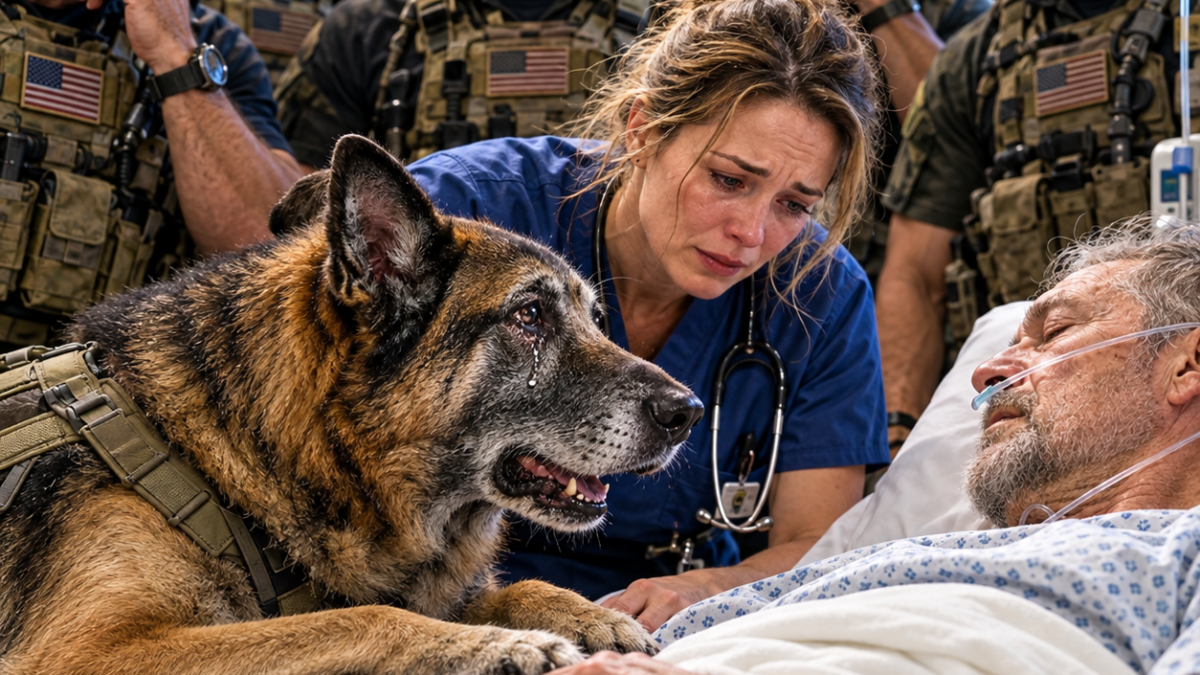
Five Navy SEALs Tried to Lead Their Retired K9 to His Dying Handler—Then a Nurse Realized Why He Refused to Cross the Doorway.
PART2:
The dog’s ears moved toward him.
“Go see him.”
Nothing.
On the hospital bed six feet away lay Chief Petty Officer Ethan Cole.
Retired.
Forty-six years old.
Terminal pancreatic cancer.
Barely conscious.
His face had become frighteningly thin over the last three months.
A nasal cannula delivered oxygen.
The white blanket rose only slightly with each breath.
His right hand rested beneath the covers.
His left hand lay near the edge of the mattress.
Palm down.
Fingers loose.
Still.
The five men had not expected Ethan to decline this quickly.
Two days earlier he had spoken in short sentences.
That morning he had managed only a few words.
By afternoon, the hospice physician told them there might not be another morning.
So Mason drove forty minutes to the house where Ranger had been living since Ethan entered inpatient hospice.
He had lifted the old dog into the back of his SUV.
Talked to him the entire drive.
“Going to see him.”
Ranger knew Ethan’s name.
Of course he did.
He had lifted his head every time Mason said it.
That made what happened in the hospice room worse.
The moment Ranger entered and saw Ethan, he had stopped.
Not at the bedside.
At the doorway.
Mason pulled gently.
Nothing.
Tried a familiar hand motion.
Ranger shifted but stayed near the door.
Luke called him.
Nothing.
Another SEAL, Aaron Pike, knelt and opened his arms.
“Come on, old man.”
Ranger barely looked at him.
The men had come prepared for tears.
For a dog climbing onto the bed.
For Ethan somehow waking enough to touch him.
For one of those rare moments people remembered for the rest of their lives.
Instead, Ranger refused to go near him.
That was almost crueler.
Claire Bennett had been watching from the far side of the room.
Thirty-nine years old.
Hospice nurse for nine years.
Before that, emergency medicine.
Before that, two years on a medical-surgical floor that had taught her exactly how dangerous assumptions could become when everyone in a room shared the same one.
Claire knew very little about military working dogs.
She knew even less about Navy SEAL operations.
But she knew bodies.
Human.
Animal, sometimes.
And Ranger’s body was telling her something none of the men seemed to hear.
Mason tightened the leash again.
Ranger leaned backward.
Not wildly.
Deliberately.
Claire spoke.
“Don’t pull him.”
Mason looked at her.
“We came here so he could be with Ethan.”
“I know.”
“He might not get another chance.”
“I know.”
Mason’s jaw tightened.
“Then why would I leave him at the door?”
Claire did not answer immediately.
She was watching Ranger.
The dog’s tail was not tucked.
His body was not shrinking.
His ears were not flattened in fear.
He was not panting heavily.
He was not searching for an exit.
He had already found the exit.
He was sitting beside it.
And guarding it.
Claire walked to Ethan’s bed.
Checked his oxygen.
Pulse.
Skin temperature.
She adjusted nothing unnecessary.
Ranger watched.
His eyes moved from Claire to Ethan.
Then to the hallway.
Then back to Ethan’s left hand.
A cart rolled past outside.
Ranger’s ears snapped toward the sound.
Head turned.
He tracked the cart until it disappeared.
Then his eyes returned immediately to Ethan’s hand.
Claire stopped.
There it was again.
Hallway.
Room.
Hand.
Hallway.
Hand.
Mason pulled.
Ranger resisted.
Claire said:
“Loosen the leash.”
“Why?”
“Because right now we don’t know whether he’s refusing something or doing something.”
Mason frowned.
“He’s refusing to go to Ethan.”
“Maybe.”
“What else would you call it?”
Claire nodded toward Ranger.
“A choice.”
Mason stared at her.
“You think he doesn’t want to see him?”
“I don’t know.”
“Then what?”
“I know forcing him will stop us from finding out.”
Another shallow breath came from the bed.
Every man looked toward Ethan.
Ranger did too.
But still he did not approach.
Mason slowly opened his hand.
The leash slackened.
Ranger now had complete freedom to walk to Ethan.
He stepped backward.
Mason’s face fell.
Ranger moved until his shoulder was beside the doorframe.
Then sat.
Straight.
Alert.
Facing the room.
No one spoke.
Claire crouched several feet from him.
She did not reach.
Ranger glanced toward her.
Dismissed her.
Then resumed his pattern.
Hall.
Ethan.
Left hand.
Door.
Left hand.
Luke whispered:
“He always went to Ethan.”
Mason nodded.
“When Ethan walked into a room, that dog forgot the rest of us existed.”
Claire stood.
“Then don’t bring him closer.”
Mason’s head snapped toward her.
“What?”
“Leave him there.”
“Why?”
Claire looked at Ranger.
“Because I don’t think he’s refusing to say goodbye.”
The oxygen hiss suddenly seemed louder.
Luke stared.
“Then what is he doing?”
Claire looked at Ethan’s motionless hand.
“I think he’s waiting.”
Mason’s expression changed.
Not understanding.
Not yet.
But something had reached him.
“What would he be waiting for?”
Claire shook her head.
“You tell me.”
Mason looked toward Ranger.
Then Ethan.
Then the four men who had served beside them both.
None answered.
Claire lifted the leash gently and placed its handle back into Mason’s hand.
“Keep it slack.”
Mason did.
“Nobody calls him.”
Aaron frowned.
“What are we supposed to do?”
“Give him the choice you thought he already had.”
Claire pushed the rolling tray away from the door.
Moved a chair.
Created a clear path.
Then she asked Mason to step back.
Ranger stood.
Walked three measured paces into the room.
Circled once near the foot of Ethan’s bed.
Then returned to the doorway.
Same place.
Sat.
Mason looked devastated.
Claire shook her head.
“No.”
“No what?”
“That wasn’t failure.”
She pointed.
“That was an answer.”
Ethan’s breathing changed.
Short inhale.
Long pause.
Mason instinctively moved toward him.
Ranger rose immediately.
No bark.
No growl.
He stepped sideways into Mason’s path.
Held position.
Mason froze.
Ranger looked at him.
Then at Ethan’s left hand.
Then back.
Claire’s eyes narrowed.
“Step back.”
Mason did.
Ranger returned to the door.
Luke whispered:
“What the hell?”
Claire looked at him.
“You approach Ethan from the right.”
Luke hesitated.
Then moved.
Ranger watched him.
Did nothing.
Luke reached the right side of the bed.
Still nothing.
Claire walked behind the head of the bed.
Adjusted the blanket.
Ranger watched but stayed seated.
Then Claire deliberately reached toward Ethan’s left forearm.
Ranger stood.
Two silent steps forward.
Claire stopped.
Ranger stopped.
She withdrew her hand.
Ranger backed away.
Mason stared.
“He’s guarding his left side.”
“Seems that way.”
“Why?”
Claire looked at him.
“That is the question.”
She rearranged Ethan’s care supplies.
Oxygen tubing.
Water.
Oral care.
Everything moved to the right.
No one questioned her.
Not anymore.
The next vital check happened with Ranger watching from the doorway.
He never interfered.
As long as Ethan’s left side remained clear.
Mason looked down at the leash.
Then bent.
Unclipped it.
The metal clasp clicked.
Ranger glanced back.
Felt the absence of tension.
Stayed exactly where he was.
Mason draped the leash across the chair.
Claire watched.
The men had arrived believing Ranger needed help saying goodbye.
Now they had removed the easiest tool they possessed for forcing him to do it.
That changed the room.
Claire said:
“He’s not waiting for us to move him.”
Mason stared at Ethan’s left hand.
“Then we need to figure out what he thinks Ethan still has to do.”
To understand Ranger, Mason had to remember who the dog had once been.
Eight years earlier, Ranger had not been gray around the muzzle.
He had been a two-year-old military working dog with more energy than patience and enough intensity to make new handlers nervous.
Mason remembered the first day Ethan met him.
Training compound.
Virginia.
Hot enough that sweat darkened every shirt.
Ranger had already rejected two prospective handlers.
Not dramatically.
He simply refused to fully engage.
Would work.
Would comply.
But something essential remained missing.
Then Ethan entered the yard.
He was thirty-eight.
Quiet.
Compact.
Not the largest man on the team.
Not the loudest.
Ethan stood outside the kennel and watched Ranger pace.
One of the trainers said:
“He’s a lot of dog.”
Ethan answered:
“Good.”
“You sure?”
“No.”
That made the trainer laugh.
Ethan entered.
He did not call Ranger.
No baby voice.
No exaggerated confidence.
He stood in the center.
Waited.
Ranger circled once.
Twice.
Came close.
Ethan did nothing.
Ranger sniffed his boot.
Still nothing.
Then the dog looked up.
Ethan raised two fingers.
Barely.
A small movement.
Ranger sat.
The trainer’s eyebrows rose.
“That was luck.”
Ethan smiled.
“Then let’s get lucky twice.”
That became the beginning.
Ranger learned voice commands.
Hand signals.
Directional movements.
Silent holds.
Release.
Ethan learned Ranger.
How one ear moved when uncertain.
The difference between alert and overstimulation.
The tiny shoulder shift before a turn.
How Ranger’s breathing changed before he committed to movement.
How long he could work before intensity became exhaustion.
A working dog and handler do not become a team because one commands and one obeys.
They become a team because each starts predicting the other.
Months later, Ranger could move with Ethan through darkness with barely a sound.
Mason first saw them work together during a training evolution.
He had joked afterward:
“Dog listens to you better than I do.”
Ethan said:
“That’s because he’s smarter.”
Ranger sneezed.
Mason pointed.
“See? Disrespect.”
Over time, Ranger became less like equipment assigned to Ethan and more like an extension of him.
The team’s routines changed around them.
Where Ethan went, Ranger was considered.
Transport.
Food.
Rest.
Noise.
Space.
Mission planning.
The dog was never humanized.
Ethan hated when people did that.
“He’s a dog,” he would say.
“That’s not less.”
That sentence stayed with Mason.
Ranger’s job was not to be a furry soldier.
His job was to be Ranger.
His nose.
Body.
Instinct.
Training.
Trust.
During one deployment, the team spent hours in a position where sound discipline mattered.
Ranger held beside an entry point.
Ethan gave no spoken commands.
Just gestures.
Palm.
Point.
Two fingers.
Hold.
Move.
Release.
The two-finger release was almost invisible.
Index and middle finger parting slightly.
Ranger knew it instantly.
Mason had forgotten that gesture existed.
Years later, inside hospice room 214, he had not yet remembered.
He only knew something about Ranger’s behavior felt familiar.
Claire asked:
“Show me how Ethan used him when he needed someone protected.”
Mason looked up.
“What?”
“You said they worked together.”
“Yes.”
“Then show me the dog’s job.”
“This isn’t an operation.”
“Ranger doesn’t know what hospice is.”
That stopped him.
Claire continued.
“He knows Ethan is here.”
“Yes.”
“He knows Ethan is weak.”
Mason looked toward the bed.
“Yes.”
“He knows people keep entering this room.”
Mason understood part of it.
“Guard.”
“Maybe.”
“But Ethan never gave him that command today.”
“Did Ethan need to?”
Mason looked at Ranger.
The old dog held the doorway.
Claire said:
“If he knows his handler is vulnerable, what would his training tell him?”
Mason swallowed.
“To hold.”
“Until?”
The answer almost came.
Then slipped away.
Mason shook his head.
“Depends.”
“On what?”
“Ethan.”
Claire said nothing.
Luke pulled a chair out of Ranger’s way.
Aaron closed the bathroom door so the main hallway remained the only open entry point.
The five SEALs stopped acting like visitors.
They began unconsciously arranging the room around Ranger’s boundary.
A hospice aide appeared with linens.
Ranger stood.
The aide froze.
Before Claire could say anything, Mason redirected her.
“Come around this side.”
Right side.
Ranger watched.
Sat again.
Mason stared at him.
Claire didn’t need to explain anymore.
The men were learning.
That afternoon, the responsibility in room 214 changed hands.
Claire remained responsible for Ethan’s care.
The SEALs began protecting Ranger’s ability to hold whatever post he believed he’d been given.
And Ranger was no longer treated like an old confused dog standing between a dying man and his goodbye.
He became what he had always been.
A working dog doing something the humans had not yet understood.
Mason moved the chair beside the doorway completely out of Ranger’s space.
“Nobody moves him.”
Claire nodded.
Then Ethan’s oxygen monitor gave a soft warning tone.
Claire crossed to the bed from the right.
Cannula had shifted.
Mason moved the tray for her.
Luke steadied the tubing.
Ranger watched.
Stayed seated.
Claire corrected the oxygen.
Saturation recovered.
Ranger’s eyes returned to Ethan’s left hand.
Mason released the breath he’d been holding.
He started toward Ethan.
Then caught himself.
Changed direction.
Approached from the right.
That choice hurt him.
Claire could see it.
Mason wanted to stand near Ethan’s left shoulder.
Always had.
That had been his place during hospital visits.
Close enough to touch.
Close enough to whisper.
Instead he stopped where the dog had decided the room remained safe.
Ethan’s eyelids fluttered.
Mason bent slightly.
“We’re here, brother.”
Ethan did not answer.
Then his left fingers shifted.
Barely.
Ranger stood.
Every man froze.
The dog did not rush forward.
One step.
Eyes on the hand.
The fingers settled.
Ranger remained standing.
Then backed slowly into his post.
Something clicked inside Mason’s memory.
Not fully.
A shape.
A movement.
Ethan’s hand.
Ranger.
Claire noticed his face.
“What?”
“I don’t know.”
“Think.”
Mason rubbed both hands across his beard.
“There’s something.”
“About the hand?”
He nodded.
“I need a second.”
Claire did not rush him.
Hospice teaches a person the value of not filling every silence.
Minutes passed.
Ethan coughed weakly.
His left arm slid several inches toward the mattress edge.
Ranger crossed half the room.
No command.
No hesitation.
He stopped near the foot of the bed.
Eyes locked on Ethan’s hand.
“Ranger,” Mason whispered.
The dog did not look.
Ethan’s fingers twitched.
Ranger leaned forward.
Then the hand stilled.
He backed away again.
Luke slowly sat.
“He keeps moving when the hand moves.”
Claire nodded.
Then did something deliberate.
She adjusted Ethan’s blanket so his left hand remained uncovered.
Visible.
Mason reached to cover it.
Stopped.
Looked at Ranger.
Instead he pulled a second blanket higher over Ethan’s chest.
Left hand stayed exposed.
Ranger lowered himself at the doorway.
Head slightly down.
Eyes never leaving the fingers for long.
Five men had brought a retired K9 to understand that his handler was leaving.
Now they were arranging a dying man’s last hours around one hand because the dog believed it still had something to say.
Claire reached toward Ethan’s wrist.
Ranger lifted his head.
Mason saw.
Then his expression changed completely.
“Wait.”
Nobody moved.
He slowly raised his own left hand.
Index and middle fingers.
Separated by perhaps an inch.
Ranger stood instantly.
Luke looked between them.
“What was that?”
Mason did not answer.
His face had gone pale.
He lowered his hand.
Ranger remained standing.
Claire watched both of them.
“Mason?”
“The release.”
Her voice remained quiet.
“From what?”
“A post.”
He swallowed.
“A hold.”
Then looked toward Ethan.
“Anything Ethan needed Ranger to maintain until it was safe to stop.”
The room changed.
Claire understood before the others.
Ranger had not rejected Ethan.
He had not failed to recognize him.
He had not been too afraid to approach.
He was waiting for release.
From Ethan.
Luke whispered:
“Give it again.”
Mason raised his hand halfway.
Stopped.
“No.”
“Why?”
“He already saw mine.”
“He responded.”
“Yes.”
Mason’s voice broke.
“But then he looked back at Ethan.”
Claire nodded.
That mattered.
Mason tried the gesture once more.
Two fingers.
Ranger saw.
Then turned his eyes directly to Ethan’s left hand.
Not Mason’s.
Mason closed his fingers.
“It’s not mine.”
No one spoke.
Claire moved Ethan’s pillow beneath his elbow.
Raised the forearm enough that the hand rested clearly on white blanket.
Ranger stepped forward.
Stopped.
Mason sat hard in the chair.
Hand over mouth.
Luke turned toward the hall.
One of the other SEALs cursed softly.
Claire looked from Ranger to Ethan.
Every hour the dog had spent at the doorway suddenly carried new meaning.
Ranger had not been keeping distance.
He had been keeping the post.
And if the release belonged to Ethan, then reproducing it themselves would solve the men’s pain.
Not Ranger’s duty.
Mason raised his own hand.
Two fingers almost separated.
“I could give it.”
Claire watched him.
“He’d probably obey me.”
“Maybe.”
“He knows me.”
“Yes.”
Mason stared at the dog.
“He trusts me.”
“Yes.”
“Then why shouldn’t I?”
Claire answered quietly.
“Because he isn’t waiting for a signal.”
Mason looked at her.
“He’s waiting for Ethan.”
Mason’s hand fell.
That was the moment Claire knew these men truly loved the dog.
Not when they drove him there.
Not when their eyes filled.
When Mason possessed the power to make Ranger stop waiting and chose not to use it.
Claire rearranged everything around Ethan’s right side.
Then lowered the left bed rail slightly while keeping Ethan safe.
Ranger left the doorway.
For the first time.
He crossed half the room.
Stopped several feet from the bed.
Close enough to see Ethan’s fingers without turning.
Still unwilling to close the final distance.
Mason whispered:
“All this time, we thought he couldn’t let go.”
Claire did not answer.
Ethan’s fingers shifted faintly.
Ranger’s ears moved forward.
Weight shifted.
Hand stopped.
Ranger stopped.
Claire checked Ethan’s wrist carefully.
No shaping.
No lifting his fingers.
“Ethan.”
His eyelids fluttered.
“Ranger is here.”
Mason stood.
Stayed back.
Ethan’s eyes opened slightly.
Unfocused.
Then closed.
His left index finger moved.
Ranger leaned.
Middle finger moved next.
Not enough.
The hand relaxed again.
Ranger held.
Mason took one involuntary step.
Stopped himself.
The goodbye they had come to force had become something none of them had the right to finish.
Claire pulled a chair near Ethan’s left side.
Then deliberately moved it back.
Leaving open floor.
Ranger lowered himself onto his front paws.
Eyes on Ethan’s fingers.
For the first time, he was no longer guarding the doorway.
He was waiting beside his handler.
That evening, as daylight faded beyond the small hospice window, the five men sat in a rough half-circle.
They had known Ethan in different years.
Mason longest.
Luke nearly as long.
The other three through deployments, training cycles, marriages, injuries, funerals, divorces, births, and the thousand ordinary things that turn teammates into family.
Hospice had reduced all of that history to one room.
One bed.
One dog.
One hand.
People believe elite soldiers become comfortable with death.
Mason hated that idea.
Death never became comfortable.
You simply learned what needed doing when it came close.
Sometimes you acted.
Sometimes you fought.
Sometimes you carried.
Sometimes you stood beside a bed and discovered there was nothing left to fix.
That was harder.
Luke broke the silence.
“Remember Kandahar?”
Mason almost smiled.
“Which disaster?”
“The goat.”
One of the other men laughed despite himself.
Claire looked over.
Luke said:
“Ranger got into a goat pen.”
Mason shook his head.
“He didn’t get into anything.”
“He absolutely did.”
“Gate wasn’t secure.”
“And then?”
Aaron asked.
Luke smiled.
“Twenty goats started following him.”
Claire looked at Ranger.
The dog remained focused on Ethan.
“He liked them?”
“No.”
Mason laughed softly.
“He was furious.”
“Why were they following?”
“Probably thought he was food.”
Another man said:
“Or leadership.”
Their laughter was quiet.
Brief.
But it changed the room.
Hospice rooms deserve laughter too.
Ethan’s mouth moved faintly.
Mason leaned closer.
No words came.
Ranger watched.
Claire said:
“Talk to him.”
“We have been.”
“No.”
She looked at Mason.
“Talk normally.”
Mason’s eyes filled.
“He can’t answer.”
“He may still hear.”
Ranger’s ears lifted at Mason’s voice.
The dog could definitely hear.
Mason sat closer on Ethan’s right.
“Remember when Ranger stole my steak?”
Ranger glanced at him.
Luke snorted.
“He remembers.”
“I did not steal—”
Mason looked at the dog.
“You stole my steak.”
Tail moved once.
Everyone saw it.
For the first time since entering the room, Ranger had wagged.
Mason laughed.
Then cried immediately afterward.
The emotions arrived too close together.
He covered his face.
“Son of a bitch.”
Luke put a hand on his shoulder.
Mason left it there.
Ethan’s left fingers moved again.
Ranger stood.
Instant.
The room quieted.
The hand shifted.
Two fingers tried.
Failed.
Ranger took one step closer.
Then stopped.
Mason whispered:
“You stubborn bastard.”
Claire looked at him.
“Ethan or Ranger?”
“Yes.”
Night settled.
Hospice staff changed shifts.
Claire stayed later than scheduled.
She told herself it was because Ethan required continuity.
Partly true.
Mostly she could not leave.
A younger nurse offered:
“I can take over.”
Claire shook her head.
“I’m all right.”
“You’ve been here twelve hours.”
“I know.”
The nurse glanced toward Ranger.
“He still waiting?”
“Yes.”
“For what?”
Claire looked toward Ethan’s hand.
“Permission.”
The nurse frowned.
Claire did not explain.
Some things sounded absurd outside the room where they became obvious.
Around eight, Ethan became briefly more alert.
His eyes opened.
Claire noticed first.
“Ethan?”
Mason stood.
All five men did.
Ranger rose.
Ethan’s gaze moved slowly.
Ceiling.
Claire.
Mason.
Then Ranger.
The old dog’s body leaned forward.
Ethan’s lips moved.
No sound.
Mason leaned closer.
“I’m here.”
Ethan tried again.
This time a whisper.
“Dog.”
Mason laughed through tears.
“Yeah.”
He looked toward Ranger.
“Your dog’s here.”
Ranger took one step.
Stopped.
Ethan’s eyes found his hand.
Maybe he knew.
Maybe some procedural memory survived where language failed.
His fingers moved.
Index.
Middle.
Collapsed.
Ranger did not break.
Mason’s fist closed at his side.
He could have given the signal.
Claire knew.
Everyone knew.
He did not.
Ethan’s eyes closed again.
The moment passed.
Aaron whispered:
“What if he can’t do it?”
No one answered.
Finally Luke said:
“Then Ranger stays.”
“For how long?”
Luke looked toward the dog.
“As long as he needs.”
Mason nodded.
Even if Ethan died before releasing him?
No one said the question.
Everyone heard it anyway.
Claire had seen death come hundreds of times.
Sometimes slowly.
Sometimes between one breath and the next.
She knew Ethan might lose consciousness completely before morning.
Ranger could wait for a hand that would never move again.
The thought hurt.
But forging Ethan’s final command felt worse.
Claire said:
“No one helps his fingers.”
Mason looked at her.
“I know.”
“I need everyone to understand.”
The five men nodded.
“Even if it doesn’t happen.”
Another nod.
“Especially if it doesn’t happen.”
That was harder.
Mason crossed to the chair.
Picked up Ranger’s leash.
For a second Claire thought he’d changed his mind.
Instead, he folded it.
Placed it inside Ethan’s old duffel.
Zipped it shut.
“Nobody uses that to move him.”
Luke nodded first.
Then the others.
The decision became physical.
There would be no leash.
No pulling.
No forced ending.
Ranger would remain until he chose differently or Ethan released him.
Claire turned back.
Ethan’s eyes were partially open.
She placed a folded towel beneath his left forearm so the weight of his wrist would not pin his hand.
Then she raised her own fingers where Ethan could see.
Not toward Ranger.
Just demonstrating the beginning.
Two fingers.
Ethan watched.
Claire lowered her hand immediately.
Once.
No more.
Mason came to Ethan’s right.
“We’re here.”
That was all.
Ethan looked at Mason.
Then Ranger.
The dog’s body leaned forward.
Ethan tried.
Two fingers lifted.
Trembled.
Collapsed.
Ranger’s paws edged closer.
Then stopped.
Luke turned away.
Aaron reached toward Ranger’s shoulder.
Stopped before touching him.
There was nothing else to adjust.
No better position.
No missing equipment.
No procedural solution.
They had done everything possible except steal the decision.
So they waited.
Mason sat.
The others sat.
Claire stepped back.
Ranger took one slow step closer to Ethan.
Stopped where Ethan could see him easily.
Ethan looked at the dog.
Then his hand.
Another breath.
Fingers moved.
Index first.
Middle.
Collapsed.
Mason’s knuckles whitened against the chair arm.
His own hand stayed closed.
Ethan took another shallow breath.
Eyes opened.
Found Ranger.
Ranger stepped once.
Then stopped.
And in that moment, Claire understood what loyalty actually looked like.
Not the dramatic version.
Not a dog leaping onto a hospital bed.
Not men saluting.
Not speeches about brotherhood.
Loyalty was six feet of open floor.
An old dog who could easily cross it but would not until released.
Five men who could end his waiting but refused to counterfeit the one command that mattered.
And a dying man gathering the last strength in his body because somewhere inside him, he understood his partner was still working.
Ethan’s wrist shifted.
Index finger rose.
Then middle.
Both trembled.
For one second they almost fell.
Then separated.
Barely.
The old release signal.
Ranger froze.
Everyone did.
Nothing moved.
Then the change passed through the dog.
His ears softened first.
Shoulders dropped.
The rigid line through his back disappeared.
His tail lowered naturally.
His entire body released a tension the men had mistaken for fear.
Ranger stepped forward.
Not toward the door.
Not away.
Toward Ethan.
The last six feet.
No one called him.
No one touched him.
He crossed them alone.
At the bedside, Ranger lowered his head.
Ethan’s raised hand fell gently into the silver fur between his ears.
Ranger closed his eyes.
Then folded his front legs.
Slowly.
Carefully.
His old joints complained beneath him.
He lay beside the bed.
Mason turned his face toward the wall.
Luke covered his mouth.
Aaron closed his eyes.
No one touched the duffel.
No leash was necessary.
Ethan’s hand rested too weakly to stroke Ranger.
The dog pressed upward anyway.
Keeping contact.
Mason whispered:
“He wasn’t waiting to say goodbye.”
Claire said nothing.
Ranger had already answered.
A cart rattled through the hallway.
Earlier, Ranger would have checked it.
He barely moved an ear.
Footsteps passed.
Nothing.
Door opened somewhere nearby.
Nothing.
His post was over.
Ethan’s fingers moved faintly against his fur.
Ranger lowered his chin beside Ethan’s arm.
A long breath left him.
Not a sigh exactly.
Something deeper.
Release.
Mason took one step toward the bed.
Stopped himself.
He had spent hours learning not to crowd this moment.
He sat again.
The others followed.
Claire dimmed the light.
Ranger did not react.
For the first time since he entered the hospice, he was no longer watching the room.
He was simply beside Ethan.
That lasted forty-three minutes.
Claire knew because she checked the monitor.
Later she wished she had not.
Numbers make moments feel measurable when they are not.
During those forty-three minutes, Ethan’s breathing weakened.
Ranger stayed.
His head beneath Ethan’s hand.
Mason told stories.
Not heroic ones.
The good stories were rarely heroic.
The time Ethan burned bacon badly enough to set off a smoke detector.
The argument over whether Ranger preferred Mason.
The day Ranger refused to get out of a kiddie pool during a training break.
The hotel in Virginia Beach where Ethan insisted military dogs did not belong on beds and woke to find Ranger sleeping across his feet anyway.
Luke talked about Ethan teaching a new guy to tie fishing knots.
Aaron mentioned Ethan’s absolute inability to dance.
One of the men said:
“Remember his wedding?”
Mason smiled.
“Ranger wore a bow tie.”
Claire looked at them.
“Ethan was married?”
“Was.”
Mason’s voice softened.
“Laura died three years ago.”
Cancer.
Claire looked at Ethan.
Suddenly another piece fit.
Ranger had already watched Ethan lose someone.
Maybe that was why the dog had become even more attached afterward.
Laura had helped Ethan transition Ranger into retirement.
When Ranger’s military service ended at nine, adoption paperwork made Ethan his permanent owner.
No kennel.
No reassignment.
No unknown retirement home.
Ethan took him.
“They both retired badly,” Mason said.
Claire smiled.
“How so?”
“Ethan kept waking at four-thirty.”
“Ranger?”
“Also.”
“What did they do?”
“Walked five miles because neither knew what civilians did before breakfast.”
Luke laughed.
“They learned eventually.”
Mason nodded.
“Laura taught both of them.”
Then Laura became ill.
Ranger started sleeping beside her side of the bed.
After she died, he moved to Ethan’s.
Mason had worried about both.
Ethan stopped returning calls for a while.
Lost weight.
Stopped fishing.
Then Ranger developed arthritis and needed daily medication.
Mason remembered Ethan telling him:
“Stupid dog keeps giving me things to do.”
The sentence sounded like complaint.
It was gratitude.
When Ethan’s cancer came, Ranger stayed beside him.
Through chemotherapy.
Nausea.
Bad mornings.
Better mornings.
Walks shrinking from miles to blocks.
Then to the mailbox.
Then the backyard.
Eventually hospice would not allow Ranger to live there full-time because of care requirements and Ethan’s increasing medical needs.
That separation nearly broke both.
Mason took Ranger home.
Every day he visited Ethan, he brought Ethan’s shirt back for the dog.
Every morning Ranger slept with his muzzle resting on it.
The five SEALs had believed the final visit would be for Ranger.
Now Claire wondered whether it was equally for Ethan.
Ethan’s fingers shifted.
Ranger lifted his nose.
Touched the back of the hand.
Then settled again.
Mason looked at Claire.
“How long?”
She knew what he meant.
“I don’t know.”
“Hours?”
“Maybe.”
“Minutes?”
“Maybe.”
He nodded.
No more questions.
Hospice teaches people to stop asking clocks for promises.
A few minutes later, Ethan opened his eyes.
Ranger felt the movement before anyone called his name.
He lifted his head.
Ethan looked down.
For the first time that day, something like recognition fully entered his face.
His lips moved.
Claire leaned closer.
“Ranger.”
The dog’s tail moved once.
Ethan’s fingers tightened weakly in the fur.
“Good.”
One syllable.
Barely there.
Ranger pressed closer.
Ethan breathed.
Then:
“Boy.”
Mason broke.
He stood and turned away.
Luke caught his shoulder.
Ethan’s eyes closed.
Ranger kept his head beneath the hand.
That was the last thing Ethan Cole ever said.
Good boy.
Thirty-one minutes later, his breathing stopped.
Claire knew before the monitor did.
There is a difference in a room when a person leaves it.
She reached toward Ethan’s neck.
Ranger opened his eyes.
Mason looked at her.
Claire paused.
Then approached from the right.
Exactly as they had all afternoon.
Ranger watched.
Did not stand.
She checked.
Waited.
Then turned off the oxygen.
No one spoke.
Mason lowered his head.
Luke stepped beside him.
The other three men stood.
Five Navy SEALs in a hospice room trying to learn what to do with their hands.
Ranger stayed beneath Ethan’s.
The fingers were no longer moving.
No signal remained unfinished.
But the dog did not immediately leave.
No one expected him to.
Claire gave them time.
Ten minutes.
Twenty.
She completed only what was necessary.
Moved quietly.
Never disturbed Ethan’s left arm.
At one point she considered placing the hand beneath the blanket.
Couldn’t.
Not yet.
Ranger eventually lifted his head.
Sniffed Ethan’s wrist.
Then palm.
Then fingers.
Long.
Slow.
The men watched.
There is debate about what animals understand about death.
Claire had no interest in debating it.
Ranger understood change.
That was enough.
He smelled.
Waited.
Then rested his chin once more.
Mason sat beside him.
Not touching.
“You can stay as long as you need.”
Ranger’s ears moved.
Mason smiled through tears.
“That one isn’t a command.”
Eventually the hallway lights dimmed.
Claire had delayed the next steps as long as she reasonably could.
She opened the door.
Left the path clear.
The five men stood.
Nobody called Ranger.
Nobody clipped on a leash.
Ranger remained beside Ethan.
Looked once at the open doorway.
Then at Ethan’s hand.
Slowly, the old dog stood.
His hips were stiff.
He pressed his nose into Ethan’s palm one final time.
Then stepped backward.
At the threshold, he stopped.
Looked back.
Not at the bed.
At the hand.
Open now.
Resting on white blanket.
The same hand that had sent him forward.
Held him.
Redirected him.
Released him.
Thousands of times.
Ranger stared for one quiet second.
Then turned.
Mason stepped aside.
Luke did too.
The other three men naturally opened their formation.
There was space in the center.
Ranger walked into it.
No leash tightened.
No command led him away.
Five men and one retired K9 moved slowly down the hospice corridor.
Claire stayed in room 214.
She watched until they disappeared around the corner.
Then returned to Ethan.
His left hand remained open.
She covered it gently.
Only then.
Three days later, Mason came back.
Claire was surprised.
He stood at the nurses’ station holding a paper bag and looking uncomfortable.
“You forgot something?”
“No.”
He handed her the bag.
Inside:
Coffee.
A blueberry muffin.
A thank-you card signed by five men.
Claire opened it later.
One sentence:
You saw him before we did.
She folded the card and put it inside her locker.
Mason remained.
“How’s Ranger?”
Claire asked.
He exhaled.
“Quiet.”
“Eating?”
“Yes.”
“Sleeping?”
“Some.”
“Looking for Ethan?”
Mason thought.
“Not exactly.”
“What does that mean?”
“He sleeps beside Ethan’s duffel.”
Claire remembered the leash.
“Still inside?”
Mason nodded.
“I haven’t taken it out.”
They stood in silence.
Then he said:
“I keep thinking about what you said.”
“What?”
“That he was choosing.”
Claire leaned against the counter.
“We almost dragged him over.”
“Yes.”
“He would’ve gone eventually.”
“Probably.”
“He trusts us.”
“Yes.”
“And we’d have told ourselves we helped.”
Claire did not answer.
Mason looked down.
“We would have stolen it from him.”
“The release?”
“The whole thing.”
He swallowed.
“His last job.”
Claire nodded.
Mason looked toward the hallway.
“I’ve spent half my life thinking leadership meant knowing when to make somebody move.”
Then a faint smile.
“Turns out sometimes it’s knowing when not to.”
He left.
Ranger lived with Mason after Ethan died.
That decision was not simple.
All five men offered.
Mason had been keeping him already.
His house was familiar.
His wife, Rebecca, knew Ranger.
Their twelve-year-old daughter Sophie adored him.
So the paperwork was straightforward.
The emotional part was not.
For two weeks Ranger slept near the front door.
Not guarding.
Waiting.
Whenever Mason returned from work, Ranger looked behind him.
As if Ethan might be one step farther down the walkway.
Mason stopped saying:
“He’s gone.”
The words seemed cruel even if true.
Instead:
“It’s me, buddy.”
Ranger would sniff him.
Then move away.
On the fifteenth night, Mason opened Ethan’s duffel.
He had avoided it.
Inside:
Two shirts.
A baseball cap.
A folded fleece.
The leash.
And an old fabric K9 patch.
Mason sat on the floor.
Ranger watched.
He removed the leash.
The metal clasp touched the floor.
Ranger’s ears lifted.
Mason held it.
“Walk?”
Ranger stood.
That was all.
Outside, it was almost midnight.
Cold.
Empty street.
Mason clipped the leash on.
Ranger walked beside him.
Not ahead.
Not behind.
For the first time since Ethan died, he seemed to want somewhere to go.
They walked one mile.
Then another.
At one intersection, Mason stopped.
Ranger stopped.
Mason raised two fingers without thinking.
The old release signal.
Ranger looked at his hand.
Mason immediately lowered it.
“No.”
Ranger stared.
“Not mine.”
He crouched.
“You don’t need that from me.”
Ranger stepped closer.
Pressed his head briefly against Mason’s chest.
Then resumed walking.
Mason cried halfway home.
He did not tell anyone.
Rebecca knew anyway.
Over the following months Ranger learned a different retirement.
No more Ethan.
That never changed.
But there was Sophie.
She read beside him after school.
Ranger slept with his nose against her sock.
Rebecca gave him joint supplements hidden in cheese.
Mason took him to quiet trails.
Luke visited every Sunday and pretended it was because Mason owned better coffee.
Aaron brought tennis balls even though Ranger no longer fetched more than twice.
The five men who once entered hospice thinking they needed to lead Ranger through grief instead became a rotating pack around him.
Nobody tried replacing Ethan.
That mattered.
Ranger did not need another handler.
He needed people willing to love him without pretending history could be reassigned.
Once a month, Mason brought Ranger to visit Claire.
The first time surprised her.
She walked outside during a break.
Ranger saw her.
Stopped.
Claire wondered whether the dog associated her with Ethan’s death.
Then his tail moved.
One slow sweep.
She crouched.
“Hey, old man.”
Ranger approached.
Sniffed.
Then leaned his shoulder against her leg.
Claire put one hand on his back.
“Still keeping everybody organized?”
Mason laughed.
“Constantly.”
The visits continued.
Ranger aged.
At twelve, stairs became difficult.
Mason built a ramp.
At thirteen, hearing began declining.
Sophie joked:
“He’s earned the right not to listen.”
Mason answered:
“He’s been ignoring me selectively for years.”
Ranger spent more time sleeping.
But there was one habit he never lost.
Whenever Mason lay sick or injured, Ranger stationed himself near the doorway.
Not aggressively.
Just there.
Watching the room.
The first time happened when Mason had shoulder surgery.
He came home groggy.
Rebecca helped him into bed.
Ranger positioned himself beside the doorway.
Mason stared.
“No.”
Ranger remained.
“Mason,” Rebecca said.
“Don’t.”
“He’s going to stay there all night.”
“Then let him.”
Mason looked at the old dog.
For a second, room 214 returned.
Ethan.
Hand.
Release.
Mason’s throat tightened.
He did not give the two-finger signal.
Instead:
“You don’t work for me.”
Ranger lowered his head.
Stayed.
Mason smiled.
“All right.”
Rebecca turned off the light.
“Let him wait.”
The words hit Mason hard enough that he had to close his eyes.
Claire had said essentially the same thing years earlier.
Let him wait.
Let him choose.
Do not mistake loyalty for confusion simply because its language is unfamiliar.
Ranger stayed until morning.
Then when Mason got out of bed, the dog followed him to the kitchen.
Duty over on his own terms.
Ranger died at fourteen.
Not in a hospital.
Not dramatically.
Age.
Kidneys.
Arthritis.
Body tired.
Dr. Patterson, the veterinarian, came to Mason’s home.
Sophie was fifteen by then.
She sat on the floor with Ranger’s head in her lap.
Rebecca beside her.
Luke arrived.
Then Aaron.
Then the rest.
Five men again.
Mason noticed.
Same five.
Different room.
This time nobody had a leash.
Ranger lay on Ethan’s old fleece.
The K9 patch rested nearby.
Claire came too.
Mason had called her.
He had not planned to.
Then realized there was no one else he wanted there more.
When Claire entered, Ranger lifted his head weakly.
Tail moved.
Once.
She sat on the floor.
“You remember me.”
Mason whispered:
“He remembers everybody worth remembering.”
Sophie cried silently.
The veterinarian explained the process.
Mason listened.
Then looked at Ranger.
For years, the two-finger signal had belonged to Ethan.
Mason had never used it.
Not once after hospice.
He wondered now whether that needed to remain true.
Ranger’s breathing was tired.
His eyes stayed on Mason.
Mason looked at Claire.
She understood the question without words.
This time, she nodded.
Not because Mason had become Ethan.
He hadn’t.
Because this was not a working post.
Not a command Ethan had begun.
This was a new life Ranger had shared with new people.
And Ranger had chosen Mason after Ethan released him.
Mason bent close.
“You’ve done enough.”
Ranger’s eyes softened.
Mason raised his hand.
Two fingers.
Separated slowly.
“Free.”
It was not Ethan’s signal anymore.
Or maybe it was.
Passed forward.
Permission, not authority.
Love, not command.
Ranger exhaled.
His head settled deeper into Sophie’s lap.
The veterinarian administered the sedative.
Everyone touched him.
Not crowding.
Just enough.
Five men who had once stood helplessly around Ethan.
A nurse who taught them to wait.
A woman and girl who gave Ranger a second home.
And Ranger.
The last one left from the partnership that had started so many years before.
Before the final injection, Mason whispered:
“Go find him.”
Claire looked away.
Sophie kissed Ranger’s forehead.
The old dog died with no post left unfinished.
Weeks later, Mason brought Ethan’s duffel back out of storage.
He placed Ranger’s collar inside.
Then the K9 patch.
Then the leash.
For a long time he considered adding the hospital card Claire had signed after Ethan died.
Instead he kept that.
Inside the duffel, beneath the leash, he placed a photograph.
Ethan sitting outside years earlier.
Ranger beside him.
Ethan’s left hand resting on the dog’s head.
Not commanding.
Not signaling.
Just touching.
Mason zipped the bag.
He did not lock it away.
It stayed on a shelf in his study.
Sometimes people asked him about Ranger.
Military events.
Friends.
Young operators who had heard stories.
They wanted dramatic ones.
Missions.
Explosives.
Danger.
Courage.
Mason had plenty.
But the story he told most happened in a quiet hospice room.
No gunfire.
No classified operation.
No enemy.
Just five men making the mistake of believing an old dog needed them to explain what was happening.
Mason would say:
“We thought Ranger was afraid to go to Ethan.”
Then pause.
“He wasn’t.”
People would lean closer.
“He was waiting for Ethan to release him.”
Sometimes they understood immediately.
Sometimes Mason had to explain the signal.
Two fingers.
Tiny motion.
Years of meaning.
Then he always told them about Claire.
How she stopped the leash.
How she asked them to let the dog choose.
How Ranger guarded the doorway.
Protected Ethan’s left side.
Watched the hand.
And how every man in the room eventually realized the most respectful thing they could do was surrender control.
Mason always ended the same way.
“People think working dogs obey because they’re trained.”
He would shake his head.
“Training is only the beginning.”
Then:
“The good ones trust.”
That was what Ranger had given Ethan.
Not blind obedience.
Trust.
Ethan said hold.
Ranger held.
Ethan said move.
Ranger moved.
Ethan said wait.
Ranger waited.
And when Ethan’s body could barely lift two fingers, Ranger still believed the signal would come.
Hours passed.
Breathing weakened.
Men coaxed.
A nurse moved around him.
Nothing changed.
Because Ranger’s trust was more patient than everybody else’s grief.
He waited.
And Ethan, somehow, did the final thing his partner needed.
Two trembling fingers.
Release.
Only then did Ranger cross the room.
Only then did he put his head beneath Ethan’s hand.
Only then did he stop watching the door.
Years later Claire kept the thank-you card in a box at home.
Not because she believed she had done anything extraordinary.
She had simply watched.
That was the part she taught younger nurses.
“When families are distressed, everybody wants to do something.”
Fix.
Move.
Call.
Touch.
Explain.
Resolve.
“Sometimes,” Claire told them, “the hardest clinical skill is noticing when your need to act is greater than the patient’s need for you to act.”
She never told the full Ranger story in training.
Too personal.
But she carried it.
Especially when a family wanted to rush a goodbye.
When somebody said:
“We need him to understand.”
Or:
“We need her to let go.”
Claire would remember a gray-muzzled dog at a doorway.
And sometimes she would say:
“Maybe.”
Then:
“Or maybe we should give them a minute.”
The lesson was not about dogs.
Not really.
It was about dignity.
About allowing a relationship to have its own language.
Ethan and Ranger had built theirs over years.
Hand signals.
Body position.
Breath.
Eye contact.
Trust.
The five SEALs loved Ethan.
They loved Ranger.
But love did not automatically make them fluent.
For several hours, grief convinced them that because they were hurting, they had the right to decide how the goodbye should happen.
Then a nurse watched one old K9 carefully enough to notice he was not resisting love.
He was honoring it.
He had been told to hold positions all his life.
To stay until released.
And at the end, with the handler who had given him every command that mattered lying beneath a white hospice blanket, Ranger did exactly what Ethan had spent years teaching him to do.
He held.
He waited.
He trusted.
And when Ethan finally lifted those two fingers, Ranger did not celebrate.
He did not bark.
He simply crossed the room, put his head beneath the hand he had been waiting for, and rested.
That was his goodbye.
Not something five men gave him.
Not something a nurse created.
Something Ethan and Ranger finished together.
And maybe that was why everyone who witnessed it remembered the moment for the rest of their lives.
Because Ranger had spent years being praised for knowing when to move.
That final day, he taught five men something harder.
Sometimes loyalty means refusing to move at all.
Sometimes love means not pulling someone toward the ending you think they need.
Sometimes the kindest thing anyone in the room can say is exactly what Claire Bennett said when five Navy SEALs tried to drag an old K9 toward his dying handler.
“Let him wait.”
So they did.
And Ranger was right.
The signal came.








