15 Minutes Before Euthanasia, This Black Cat Was Saved—Now He Finds the Quietest Child in the Hospital Every Week
PART3:
She looked toward another cage where a young cat was practically climbing the bars.
“I think we want one with more personality.”
Shadow watched them leave.
That phrase stayed with me.
More personality.
As if quietness were absence.
I had heard the same thing said about children.
Adults.
Patients.
People who did not perform themselves loudly enough to be easily understood.
At the time, I did not make that connection.
I simply wrote:
Met with family. Not selected.
Five months is a long time in a crowded municipal shelter.
Especially for a healthy adult cat with no applications.
Then came the Tuesday.
I was not scheduled to volunteer that day.
I stopped in after work because I had left a jacket there.
That is the truth.
My entire relationship with Shadow almost never happened because I nearly decided the jacket could wait until Thursday.
I was tired.
I had worked nine hours.
It was raining.
My car needed gas.
I drove to the shelter anyway.
Inside, the atmosphere felt different.
Shelter people recognize certain days.
Staff move faster.
Nobody lingers.
Clipboards appear.
Doors close.
You learn not to ask questions casually.
I went to the laundry room.
Found my jacket.
Then saw Maria, one of the senior technicians, carrying paperwork.
She looked at me.
Then away.
“Bad day?”
She gave a small nod.
“Capacity.”
That word explained everything.
“How many?”
“Six.”
I hated that I asked.
I hated more that I wanted to know.
Maria named them.
Two dogs with severe behavior concerns.
One elderly cat with advanced kidney failure.
A feral cat who had deteriorated in confinement despite multiple placement attempts.
Then:
“Shadow.”
I stopped.
“Shadow?”
“Denise.”
“He’s healthy.”
“I know.”
“He’s not aggressive.”
“I know.”
“He’s three.”
“I know.”
Every answer made me angrier.
Maria’s face tightened.
“Don’t do that.”
“What?”
“Make me defend it.”
I looked at her.
She was crying.
Barely.
“I’m sorry.”
“We’re full.”
She wiped under one eye.
“He has no holds.”
“No applications.”
“Two rescues declined this week because they’re full too.”
“When?”
“What?”
“What time?”
She looked at the clock.
“Four-thirty.”
It was 4:15.
Fifteen minutes.
I walked to Shadow’s kennel.
He was on the upper shelf.
Black body curled.
Yellow eyes open.
Watching.
“Hey.”
He stood.
Not excited.
Just stood.
I opened the door.
Shadow came forward.
Sniffed my wrist.
Then stepped into my arms when I lifted him.
No struggle.
No cling.
Just accepted the change.
I held him against my chest.
His body was warm.
Smaller than he looked inside the kennel.
About ten pounds.
His head rested near my shoulder.
I whispered:
“You have terrible timing.”
He blinked.
That was when Maria found me.
“Denise.”
“Take him off.”
She froze.
“What?”
“Take him off the list.”
“You adopting?”
“No.”
“Then—”
“I’ll foster.”
“You already have two cats.”
“I know.”
“And your landlord said two was the limit.”
“I know.”
“Denise.”
“I’ll figure it out.”
That sentence has caused many bad decisions in human history.
That afternoon, it saved one cat.
Maria stared at me.
“You understand if you sign foster responsibility, he needs to leave tonight.”
“Yes.”
“You have supplies?”
“Yes.”
“Separate room?”
“Bathroom.”
“You have a foster plan?”
“No.”
That answer finally made her laugh through tears.
“Of course you don’t.”
“I have fifteen minutes.”
She took the paperwork.
“You now have twelve.”
“Then write faster.”
Shadow left the shelter at 5:07.
No fanfare.
No cheering staff lined up at the door.
The shelter still had five other animals on the schedule.
That fact kept me from feeling heroic.
I placed Shadow’s carrier in my passenger seat.
Rain hit the windshield.
He made no sound.
At a red light, I looked over.
Two yellow eyes stared through the carrier door.
“What now?”
He blinked.
“Exactly.”
My apartment had two resident cats.
Mabel, who believed she owned the lease.
And Chester, who believed everything was food until proven otherwise.
Shadow went into the bathroom for decompression.
Litter box.
Water.
Food.
Blanket.
Box to hide in.
I opened the carrier.
He came out.
Explored the bathroom once.
Ate.
Used the litter.
Then jumped onto the closed toilet lid and sat.
“Good talk.”
I closed the door.
For the first three days, Shadow seemed almost invisible.
He did not cry.
Did not scratch the door.
Did not hide under the sink.
When I entered, he greeted me by looking up.
Sometimes he rubbed once along my shin.
That was all.
I took photographs.
Posted them.
Three-year-old black male looking for a quiet home. Gentle, calm, easygoing.
A few likes.
No applications.
One comment:
He looks spooky lol.
I deleted it.
By the end of the week, I began introducing him carefully to the apartment.
Mabel hissed.
Shadow sat.
Chester approached too fast.
Shadow walked away.
No fighting.
No drama.
Within days, he moved through the apartment as though he had always lived there.
I kept telling myself it was temporary.
Then Friday happened.
Work had been awful.
Nothing catastrophic.
Sometimes bad days are more exhausting because they contain twenty small disappointments instead of one clear emergency.
A client yelled at me.
My supervisor changed a deadline.
I spilled coffee inside my bag.
Traffic took nearly an hour.
When I got home, I fed the cats and sat on the couch.
No television.
No phone.
Just sat.
I did not realize I was crying until something jumped beside me.
Shadow.
He walked onto my lap.
That itself was unusual.
He had not voluntarily climbed onto me before.
He turned once.
Then lowered himself across my thighs.
Pressed his entire side against my stomach.
No kneading.
No loud purring.
No dramatic headbutts.
Just weight.
Warm.
Still.
I placed one hand on his back.
“Hi.”
Nothing.
I cried for maybe ten minutes.
Shadow never moved.
When I finally reached for my phone, he got down.
I laughed.
“So that’s the arrangement?”
Two days later, it happened again.
Different mood.
I was exhausted.
Shadow appeared.
Lap.
Pressure.
Stillness.
Then again after I received bad news about my aunt’s cancer treatment.
He came from another room.
Climbed onto me.
Stayed.
Mabel loved affection but on her schedule.
Chester loved everybody constantly.
Shadow was different.
He seemed to appear specifically when I stopped pretending I was fine.
I know how that sounds.
People anthropomorphize animals constantly.
We turn normal behavior into moral insight.
I tried not to.
Maybe he noticed posture.
Breathing.
Stillness.
Cortisol changes.
Routine.
Maybe I sat differently when sad.
Animals are excellent pattern readers.
Whatever the mechanism, Shadow noticed.
One Saturday my friend Julia came over.
She worked as a child-life specialist at St. Matthew’s Children’s Hospital.
She sat at the kitchen table while I made coffee.
Shadow ignored her.
We talked about work.
Then Julia told me about a patient who had died.
She did not give identifying details.
She just said:
“Bad week.”
Her voice changed.
Shadow walked in.
Paused.
Then jumped onto the chair beside her.
From there, her lap.
Julia stopped talking.
“He doesn’t do that with everybody.”
“I know.”
Shadow pressed against her.
She looked down.
“Is this his thing?”
“What thing?”
“Emotional support without consent.”
I smiled.
“Apparently.”
She stroked him.
Shadow stayed perfectly still.
Julia looked at me.
Then asked:
“Have you ever thought about therapy animal certification?”
I laughed.
“For Shadow?”
“Yes.”
“He was fifteen minutes from euthanasia.”
“That’s not a disqualification.”
“He barely interacts.”
“That might be an advantage.”
I had only thought of therapy dogs.
Golden retrievers wearing vests.
Friendly Labradors in hospital lobbies.
Julia explained there were programs certifying suitable cats.
Requirements varied.
Temperament.
Handling tolerance.
Health screening.
Response to strangers.
Unexpected sounds.
Mobility equipment.
Being touched awkwardly.
Ability to remain calm in unfamiliar environments.
I looked at Shadow.
He was still on her lap.
“You want to work?”
His eyes closed.
“That seems like a no.”
But the idea stayed.
I researched.
Found a reputable therapy animal organization.
Read the evaluation criteria.
Then laughed again.
One item involved accepting multiple strangers touching the animal.
Another involved reaction to loud or sudden sounds.
Wheelchairs.
Walkers.
Unusual movements.
Being held.
Shadow tolerated nearly everything.
Not because he was shut down.
That distinction mattered.
I had seen shut-down shelter animals.
Bodies rigid.
Eyes wide.
No outward reaction because fear had pushed them past response.
Shadow was not that.
His body stayed loose.
Tail neutral.
Ears relaxed.
He simply did not consider most human chaos worth responding to.
The veterinary exam came first.
Healthy.
Good weight.
Vaccines updated.
Nails trimmed.
No infectious concerns.
Then the evaluation.
I expected him to fail because I was nervous.
Shadow was not.
The evaluator, Karen, spent forty-five minutes testing situations.
Stranger touches paws.
Shadow watches.
Touches ears.
Nothing.
Examines tail.
One ear flick.
Drops a clipboard.
Shadow looks.
Wheelchair rolls past.
Shadow sniffs wheel.
Child volunteer approaches too quickly.
Shadow steps half a pace back.
Then allows gentle petting.
At one point Karen laughed.
“I’ve evaluated hundreds of animals.”
“Good sign or bad?”
“I’m trying to figure out if this cat has a pulse.”
Shadow sat on the table.
She ran a hand down his back.
“He’s remarkable.”
That word bothered me.
Not because I disagreed.
Because five months earlier, the shelter had seen the same behavior and visitors interpreted it as lack of personality.
Now someone was calling it a gift.
Context.
That lesson stayed with me.
Shadow passed in one session.
Training for me took longer.
Infection control.
Patient boundaries.
Consent.
Stress signals.
When to end visits.
Never placing the animal where medical staff had not approved.
Never assuming a child wanted contact.
Protecting Shadow from grabbing, pulling, overstimulation.
The story people later told said Shadow tolerated children pulling his tail without reacting.
What mattered more was that we did not allow children to pull his tail.
A therapy animal’s calm temperament is not permission to ignore its boundaries.
Shadow had a job.
He also had rights.
Our first hospital visit happened four months after I pulled him from the euthanasia list.
Wednesday afternoon.
St. Matthew’s pediatric wing.
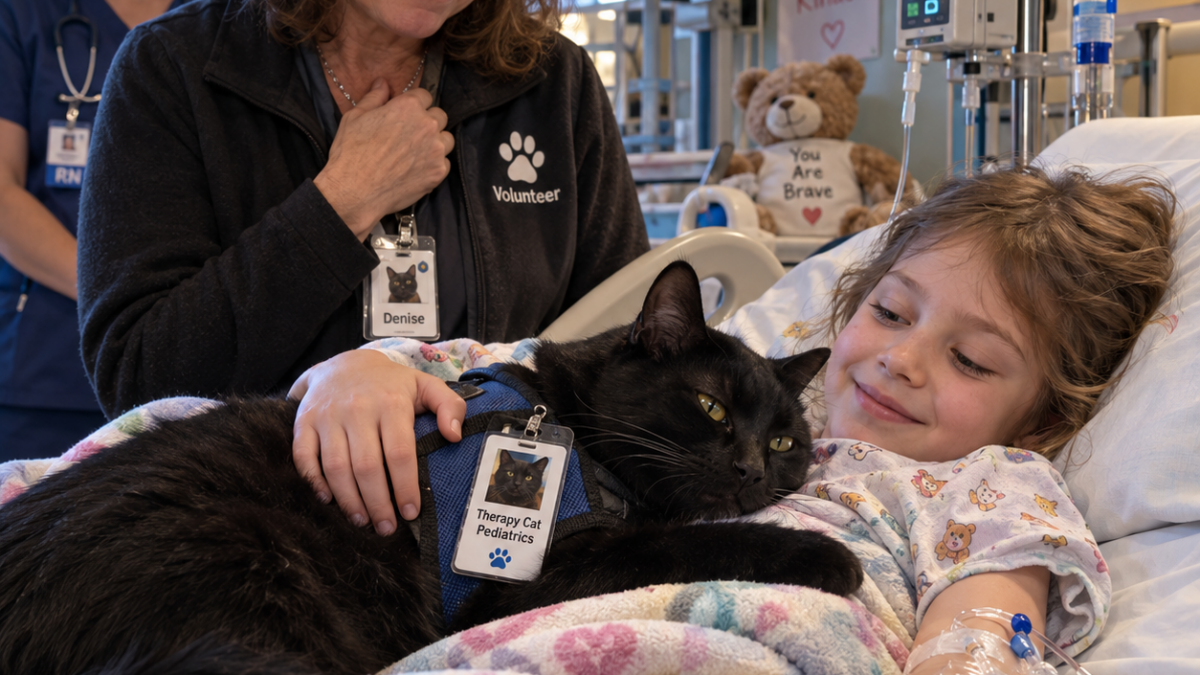
Shadow wore a small vest.
Dark blue.
Hospital-approved.
His identification badge clipped near the shoulder.
The badge made me laugh the first time I saw it.
Photo.
Name:
SHADOW
Below:
THERAPY CAT — PEDIATRICS
His yellow eyes in the photograph looked deeply suspicious of bureaucracy.
Julia met us in the lobby.
“You nervous?”
“Yes.”
“Shadow?”
We looked at the carrier.
He was asleep.
“Apparently not.”
First room:
Ten-year-old boy recovering from surgery.
He smiled when he saw Shadow.
“Cat!”
Good start.
Shadow sat beside him.
Boy stroked him.
Five minutes.
Easy.
Second patient declined.
Important.
“No thanks.”
So we left.
Therapy means choice.
Third room:
Teenage girl.
She barely looked up.
Shadow settled near her feet.
She touched him twice.
That was all.
Afterward Julia said:
“Good first day.”
I agreed.
No miracles.
Exactly what I wanted.
Week two, Shadow climbed onto a boy’s lap while he waited for bloodwork.
The boy stopped crying.
Week three, he lay beside a teenager undergoing chemotherapy.
She told me about her cat at home.
Week four, a six-year-old spent the entire visit arranging Shadow’s badge because he “wasn’t wearing it professionally.”
Every Wednesday became routine.
Carrier.
Hospital entrance.
Sanitize.
Check in.
Vest.
Badge.
Rounds.
Shadow learned the elevator.
Did not like the first ding.
Eventually ignored it.
He learned IV poles.
Wheelchairs.
Monitors.
Squeaking shoes.
He learned nurses carried treats sometimes even though food rewards had to follow rules.
He learned the pediatric floor had sunny windows.
Then something else emerged.
Shadow did not go toward the loudest child.
This took months for me to understand.
Most children reacted immediately when they saw him.
“Kitty!”
Hands up.
Smiles.
Shadow accepted affection.
But when he had freedom to choose between appropriate patients in a shared activity space, he often walked past those calling him.
Toward somebody quiet.
A child sitting apart.
One lying turned toward the wall.
One staring at a tablet without really watching it.
One whose parent was talking more than the child.
At first I thought coincidence.
Julia noticed too.
Then nurses.
“Shadow’s doing it again.”
Doing what?
“Finding the quiet one.”
That phrase became shorthand.
I started tracking informally.
Not scientifically.
Just noticing.
He did not always choose the saddest child.
We could not know who “needed him most.”
That is human storytelling.
But he consistently approached children who were less active in seeking interaction.
Why?
Maybe quiet posture felt safer to a quiet cat.
Maybe their bodies were still.
Maybe eye contact was less direct.
Maybe he liked children who did not reach.
I did not care which explanation sounded more magical.
The effect was real.
The child who did not ask for Shadow often received Shadow.
Sometimes that mattered.
One boy with severe burns would not let staff touch anything near his face without panic.
Shadow lay near his hip.
Not face.
Not wound.
The boy placed two fingers in Shadow’s fur during dressing changes.
Another child recovering after an organ transplant spent days barely speaking.
Shadow slept at the foot of her bed.
She did not talk to him either.
But her mother later told us it was the first afternoon she slept without asking someone to check the door.
Then came Mia.
I will call her Mia.
Seven years old.
She had been hospitalized nearly three weeks.
I will not describe her diagnosis because that belongs to her family, not to the story.
She was medically stable enough for animal-assisted visits.
Emotionally, she had shut down.
That was how her mother described it.
Mia answered necessary questions with nods.
Sometimes.
She turned toward the wall.
Refused child-life activities.
Would not talk to physicians beyond a whispered yes or no.
Then stopped speaking almost entirely.
Six days.
Her mother sat beside the bed looking like somebody had forgotten how to sleep.
When Julia asked whether they wanted a visit from a therapy cat, Mia did not answer.
Her mother said:
“We can try.”
That is not the same as consent from the child.
So we entered but kept distance.
“Hi, Mia.”
No response.
“This is Shadow.”
She remained turned toward the wall.
Shadow sat beside my shoes.
I expected to leave after a minute.
Then he moved.
Not onto the bed immediately.
Toward the side.
He looked up.
Waited.
Mia’s mother glanced at me.
I whispered:
“Only if she’s okay with it.”
“Mia?”
No response.
“Would it be okay if Shadow sits on your bed?”
Long pause.
Then Mia’s fingers moved.
Tiny nod.
We placed a clean barrier on the approved section of the bed.
I lifted Shadow.
Usually he chose where to settle.
That day, he walked toward Mia’s arm.
Stopped.
Turned.
Lowered himself along her side.
Not on the IV tubing.
Not near the lines.
Against the blanket beside her forearm.
Mia looked at him.
First movement toward us.
Shadow closed his eyes.
Her hand lifted.
Touched his back.
Then:
“Hi, kitty.”
Two words.
Almost nothing.
Her mother made a sound behind me.
I looked over.
Both hands covered her mouth.
Tears came instantly.
Julia turned away for a second.
Mia stroked Shadow.
“Your name is Shadow?”
Her voice weak.
But voice.
I answered:
“Yes.”
“He’s black.”
“Very observant.”
Mia looked at me.
Almost smiled.
Then back at him.
“He’s warm.”
Shadow stayed.
We did not turn the moment into an event.
No one ran to get doctors.
No applause.
That would have been too much.
We let the room stay quiet.
Mia spoke maybe ten sentences in twenty minutes.
Mostly to Shadow.
Did he sleep at my house?
Did he eat tuna?
Was he scared of dogs?
Did he know tricks?
I answered honestly.
“Yes.”
“Yes.”
“Depends on the dog.”
“No useful ones.”
That got a tiny smile.
When we left, Shadow stood.
Mia’s hand stayed on him as long as possible.
“Will he come back?”
“Next Wednesday if you’re here and want him.”
She nodded.
Her mother followed me into the hallway.
Then cried.
Full body.
The kind that had been waiting six days.
She kept apologizing.
“Don’t.”
“She talked.”
“I know.”
“She hasn’t…”
“I know.”
She grabbed my hands.
“You don’t understand.”
I probably did not.
No outsider ever fully understands a parent’s fear beside a hospital bed.
So I did not pretend.
I said:
“I’m glad he came.”
That was all.
Mia’s story traveled through the floor.
Carefully.
Confidentiality maintained.
Staff talked about Shadow.
Not because we claimed he cured anything.
He did not.
He created a moment where speaking felt safe enough to happen.
That was enough.
A hospital communications employee eventually asked whether we would allow a photograph for the therapy program.
Only with appropriate family permission.
No diagnosis.
No identifying details.
The photograph showed Shadow lying on a hospital bed.
Blue vest.
Badge visible.
One child’s hand on his back.
IV equipment nearby.
Shadow’s eyes closed.
The child smiling.
The caption explained his history:
Four years earlier, Shadow had been minutes from euthanasia at a shelter.
Now he visited pediatric patients every Wednesday.
Then one line:
He always seems to find the quietest child in the room.
That line spread.
More than the photograph.
More than the fifteen-minute rescue.
People shared it thousands of times.
Someone commented:
He was the quietest cat in the shelter. Now he finds the quietest child in the hospital. Maybe he knows what it feels like to be the one nobody sees.
I read that sentence at my kitchen table.
Shadow was asleep nearby.
I cried.
Then felt guilty for liking the sentence so much.
Because we do not know what Shadow “knew.”
Animals are not little humans writing autobiographies internally.
He may have preferred stillness.
Nonthreatening posture.
Low sensory input.
Maybe children who did not reach for him simply felt safer.
But maybe understanding does not need to look exactly like ours to matter.
Shadow had spent five months watching people walk past.
He had lived in a metal kennel while louder cats were selected.
Then, in hospital rooms, he repeatedly chose children who did not reach.
Whatever mechanism existed inside him, the pattern was beautiful.
Four years passed.
Every Wednesday.
Not literally every single Wednesday.
There were veterinary checks.
Vacations.
Illness.
Weather.
Hospital restrictions.
But enough Wednesdays that staff began saying:
“Shadow day.”
Nurses recognized his carrier.
Security recognized his badge.
One receptionist kept a printed photograph behind the desk.
Some children learned his schedule.
“Is Shadow coming?”
“Wednesday.”
“What day is it?”
“Monday.”
“Too long.”
His badge became famous on the floor.
Children sometimes spotted it before they processed the animal.
“Shadow has a job!”
Yes.
He had better workplace identification than I did.
We eventually ordered a second vest because the first wore out.
I kept the original.
People asked whether I ever found Shadow an adoptive home.
No.
Not after the first month.
I failed fostering spectacularly.
He became mine quietly.
No adoption event.
I signed the paperwork.
Paid the fee.
Took a photograph.
Mabel tolerated him.
Chester adored him.
Shadow slept on my bed but never near my face.
He preferred my legs.
Unless I was sad.
Then he climbed higher.
Same pattern.
Weight.
Stillness.
Presence.
He never became a loud cat.
Rarely meowed.
When he did, it sounded rusty.
He did not greet visitors at the door.
Did not perform.
If somebody sat quietly long enough, he sometimes appeared.
That was Shadow.
The hospital never changed him into an extrovert.
His usefulness came partly from remaining exactly who he had been.
That realization changed how I thought about adoption too.
I returned to shelter volunteering.
Whenever families said:
“This one isn’t doing much.”
I told them:
“Sometimes what you see in a kennel is only what an animal looks like while waiting.”
I started taking extra videos of quiet cats.
Not staged play.
Real behavior.
Sitting beside someone.
Sleeping near a hand.
Slow blinking.
Calm.
We changed descriptions.
Instead of:
Shy black cat.
We wrote:
Quiet companion who prefers being near you without demanding attention.
Instead of treating stillness like marketing failure, we described it as temperament.
Adoptions improved.
Not dramatically.
But enough.
Shadow’s story brought attention to the shelter.
Donations.
Foster applications.
People asking specifically about adult black cats.
I liked that.
I also worried about what happens when viral stories create unrealistic expectations.
Not every quiet black cat will become a therapy animal.
Not every shelter dog has a hidden heroic destiny.
Animals should not need extraordinary future usefulness to justify being kept alive.
Shadow mattered before the hospital badge.
He mattered when his greatest achievement was sitting quietly on a kennel shelf.
That became something I said often.
People told me:
“You knew he was special.”
No.
I didn’t.
That is the point.
I pulled him because I could not stand the idea of his life ending simply because nobody had chosen him yet.
What came afterward was extra.
Beautiful.
Unexpected.
Extra.
One afternoon a reporter asked:
“If Shadow hadn’t become a therapy cat, would saving him still have been worth it?”
I stared at her.
“Yes.”
Immediate.
“He could’ve spent fifteen years sleeping on my couch and stealing chicken.”
“That would’ve been enough.”
She smiled.
“Not as good a story.”
“Maybe not.”
“But a life doesn’t owe us a good story.”
That quote did not go viral.
I still think it was the most important thing I said.
Shadow aged.
Seven.
Eight.
Then older.
The hospital began reviewing his visits more carefully.
Therapy animals should not work past what they enjoy or tolerate.
I watched stress signals obsessively.
Tail.
Ears.
Grooming.
Avoidance.
Appetite after visits.
He continued choosing the carrier on Wednesday mornings.
That became my test.
I would place it open on the floor.
If Shadow entered voluntarily, we went.
If not, we stayed home.
The first time he refused, I panicked.
He looked at the carrier.
Walked away.
“That’s new.”
He slept all morning.
Veterinarian found mild arthritis beginning.
We started treatment.
Reduced visit length.
Added a softer carrier pad.
The next Wednesday he walked in.
I cried like an idiot.
“You don’t have to keep working.”
Shadow looked at me.
“Seriously.”
No response.
“If you retire, you still get food.”
He entered the carrier fully.
“Fine.”
Children aged too.
Some left the hospital healthy.
Some returned periodically.
Some did not survive.
Therapy work contains joy and grief together.
People prefer the joyful stories.
The first words.
The smiles.
The photographs.
There were rooms Shadow entered once and never again because the child died before the following Wednesday.
I remember them.
Shadow probably did not understand.
Maybe that protected him.
I did.
One boy named Lucas loved Shadow so much he drew him every week.
Black oval.
Four legs.
Giant yellow circles for eyes.
When Lucas died, his mother mailed me the last drawing.
On the back:
SHADOW HELPS ME BE BRAVE.
I keep it with the original hospital vest.
Some Wednesdays I sat in my car afterward and cried before driving home.
Shadow sat in the carrier.
Quiet.
At home, he climbed into my lap.
Weighted blanket that chose me.
Same as the beginning.
People assumed therapy was one-directional.
Cat helps children.
It was not.
Shadow kept helping me survive the work of watching them suffer.
Julia eventually became a program director.
She still took credit for discovering Shadow’s career.
I reminded her she did nothing except ask one question.
“That’s leadership,” she said.
“Annoying.”
“Still true.”
Mia, the seven-year-old who spoke after six days, eventually went home.
Her mother sent us a card.
No medical details.
Just:
Thank you for bringing him when she had stopped letting any of us in.
Inside was a drawing.
A black cat.
Yellow eyes.
Blue vest.
Speech bubble:
HI, KITTY.
I framed it.
Years later, Mia visited the hospital for a follow-up on a Wednesday.
Older.
Taller.
Hair longer.
Shadow was on the floor in the activity room.
She stopped.
“Is that him?”
I recognized her mother first.
Then Mia.
Shadow looked up.
No dramatic recognition.
He did not run to her.
I was glad.
Real stories do not need false magic.
Mia approached slowly.
Sat.
Shadow walked over.
Climbed beside her.
She laughed.
“He’s heavier.”
“That happens.”
She scratched beneath his chin.
“Do you remember me?”
Shadow closed his eyes.
Mia looked at me.
“Probably not.”
“Probably not.”
She smiled.
“I remember him.”
That was enough.
Her mother told me later:
“That day was the beginning.”
Not the cure.
Not the solution.
Beginning.
Mia began speaking more after Shadow’s visit.
First to her parents.
Then staff.
Then child-life specialists.
The underlying fear took time.
Support.
Therapy.
Medical stability.
Shadow did not do all of that.
He opened one small door.
Professionals and family helped her walk through.
That is how I prefer to tell it.
Because animals deserve credit without turning them into magic.
Shadow’s gift was presence.
Sometimes presence is enormous.
The hospital added more therapy animals over the years.
Dogs.
Another cat eventually.
A rabbit through a special program.
Shadow remained unusual.
Not superior.
Different.
Some children wanted energetic dogs.
Some liked tricks.
Some needed an animal they could throw a ball for.
Shadow offered stillness.
He made no demands.
For a child living in a hospital where every adult seemed to need something—
Blood pressure.
Blood sample.
Answer this question.
Take this medication.
Move your arm.
Rate your pain.
Shadow wanted nothing.
You did not have to talk.
Did not have to smile.
Did not have to pet him.
He could lie beside you.
That was enough.
A teenage patient once told me:
“He’s the only visitor who doesn’t ask how I’m doing.”
I laughed.
Then understood.
The teenager placed one hand on Shadow’s back.
“Everybody wants me to say better.”
Shadow closed his eyes.
“I don’t have to lie to him.”
That sentence stayed with me almost as much as Mia’s first words.
Shadow did not ask children to be brave.
People called them brave constantly.
“You’re so brave.”
“You’re such a fighter.”
“You’re strong.”
Those phrases are meant kindly.
Sometimes sick children get tired of being courageous for adults.
Shadow did not care.
Cry?
Fine.
Silent?
Fine.
Angry?
Fine.
No performance required.
Maybe that was why quiet children liked him too.
He understood, or at least embodied, the relief of not having to audition for affection.
As Shadow approached ten, I started thinking about retirement.
His arthritis remained manageable.
He still enjoyed visits.
But hospital floors are hard.
Travel takes energy.
He slept longer afterward.
Julia and I discussed it.
“Maybe monthly.”
“Maybe.”
I hated the idea.
Then hated myself for hating it.
Therapy work existed for Shadow’s welfare too.
He did not owe the hospital endless service because humans loved the narrative.
So we reduced.
Every other Wednesday.
Then shorter rounds.
Children complained.
I understood.
One afternoon, a little boy asked:
“Why is Shadow retiring?”
“He’s getting older.”
“Can’t he just keep coming?”
“Would you want to work every week when you’re a grandpa?”
The boy thought.
“No.”
“Shadow agrees.”
Shadow was asleep.
The boy whispered:
“Does he get a pension?”
I laughed so hard a nurse came to check on us.
The staff threw him a retirement celebration when visits became monthly.
Not full retirement yet.
Semi-retirement.
They made a paper badge:
EMPLOYEE OF THE CENTURY.
He tried eating the ribbon.
Very dignified.
I stood in the hallway that day remembering the shelter.
Metal kennel.
No applications.
Fifteen minutes.
If I had arrived later.
If traffic had been worse.
If I decided the jacket could wait.
I used to think about those things with horror.
Eventually, another thought replaced them.
How many Shadows do we never learn about?
Not because they die.
Because they live ordinary lives.
Quiet dogs adopted by old men.
Cats sleeping beside lonely people.
Senior animals giving someone a reason to get up each morning.
No badges.
No viral posts.
Still important.
Shadow’s story became famous because the contrast was dramatic.
Fifteen minutes from euthanasia.
Hospital therapy badge.
Children.
First words.
But the part I cherish most never happened at the hospital.
It was the first week.
Me on the couch.
Feeling invisible in my own miserable little day.
Shadow climbing into my lap.
Pressing his weight against me.
Doing nothing.
Maybe that was the first therapy visit.
No certification.
No vest.
No badge.
Just a cat who had spent months being overlooked deciding to sit with someone who had stopped asking to be noticed.
I think about the comment people shared.
He knows what it feels like to be the one nobody sees.
Do I know that Shadow understood his shelter experience that way?
No.
But I understand the sentence.
I know what it means for a living thing to become background.
To stop asking.
To stop performing.
To sit quietly while louder needs fill the room.
Shadow’s gift was that he noticed stillness.
Maybe because stillness felt familiar.
Maybe because quiet children did not overwhelm him.
Maybe because coincidence became a pattern humans needed.
The reason matters less to me now.
I watched what happened.
Again and again.
He entered.
Children called.
He sometimes passed them.
Went to a bed in the corner.
Sat.
Waited.
And eventually a hand touched black fur.
Sometimes no words.
Sometimes many.
Sometimes two:
“Hi, kitty.”
Four years after he almost died, Shadow had his own hospital identification.
Five years.
Six.
His yellow eyes stayed enormous.
His black coat developed a few white hairs near the chest.
I called them unauthorized.
He ignored me.
At home he remained exactly the same cat.
Visitors often expected a magical emotional detector.
They would sit dramatically on my couch.
“Is Shadow going to sense my sadness?”
“No.”
“What?”
“He’s a cat.”
“But at the hospital—”
“He might sit on you.”
“Might not.”
Shadow usually chose the person who did not care.
That made me laugh.
One Thanksgiving, twelve people filled my apartment.
Shadow disappeared.
My cousin said:
“Therapy cat doesn’t like people?”
“Therapy professionals get holidays.”
He returned after everyone left.
Climbed onto me.
Correct priorities.
When Shadow finally stopped choosing the carrier, he was twelve.
I placed it on the floor Wednesday morning.
He looked.
Walked toward me instead.
Sat on my foot.
I waited.
Ten minutes.
Nothing.
The next scheduled visit, same.
That was the answer.
I called Julia.
“I think he’s done.”
She was quiet.
“Okay.”
“That’s all?”
“What do you want me to say?”
“I don’t know.”
“You kept your promise.”
“What promise?”
“That he gets to choose too.”
I cried.
Shadow retired.
Fully.
The hospital made his badge inactive.
I kept it.
His last official visit was planned gently.
No big tour.
No parade.
Just familiar staff.
A few long-term patients.
Shadow lay on a blanket in the activity room.
Children came one at a time.
Some had known him for years.
One teenager whispered:
“You got me through chemo.”
Another said:
“You sat with my brother.”
A nurse kissed two fingers and touched them to his head.
Shadow tolerated exactly one minute of sentimentality before getting up and walking toward his carrier.
Everybody laughed.
Perfect ending.
I carried him out.
At the elevator, I looked back.
Blue vest.
Badge.
Black cat.
Then imagined the kennel.
Five months invisible.
Fifteen minutes.
“Ready to go home?”
Shadow blinked.
We went.
Retirement suited him.
Sunlight.
Long naps.
Arthritis medication.
Warm beds.
Occasional supervised time on the balcony.
He still climbed into my lap when I was sad.
That job apparently remained unpaid and mandatory.
The hospital replaced him with other wonderful animals.
Nobody replaced Shadow.
That is how relationships work.
Replacement is the wrong frame.
New bonds form beside old ones.
Sometimes parents sent updates.
Children grew up.
Graduated.
Went to college.
One became a nurse.
One family adopted a black cat specifically because of Shadow.
They named him Wednesday.
I approved.
The original shelter still has Shadow’s first intake photo in its office.
Black cat.
Metal cage.
Yellow eyes.
No badge.
No vest.
Nothing about the image suggests what came next.
That is what I love about it.
You cannot see destiny.
You can only see a cat.
And maybe that should be enough.
People still ask:
“How did you know?”
I answer:
“I didn’t.”
“How did you know he’d become a therapy cat?”
“I didn’t.”
“How did you know he was special?”
“I didn’t.”
I knew he was alive.
Healthy.
Quiet.
And fifteen minutes from losing the chance to become anything at all.
That was enough reason.
Maybe the greatest mistake we make with overlooked animals is asking them to prove potential before we offer time.
Shadow could not show us the pediatric wing from inside his kennel.
He could not show us Mia speaking.
Could not display the badge he had not earned yet.
Could not explain that one day a frightened child would lay a hand on his back and feel safe enough to use her voice.
He only had the present.
Black fur.
Yellow eyes.
Silence.
And in that present, almost nobody chose him.
I nearly didn’t either.
I happened to walk in.
That scares me less than it once did.
Now it reminds me that intervention does not always begin with certainty.
Sometimes it begins with:
“Take his name off the list.”
Then figuring out everything else afterward.
Shadow gave me years I never expected.
He gave children quiet.
He gave parents moments of relief.
He gave nurses something soft to look at during hard shifts.
He gave a seven-year-old girl enough comfort to say two words after six days of silence.
He gave me a completely different understanding of what usefulness looks like.
But none of those things were the price of saving him.
He did not earn those fifteen minutes retroactively.
They belonged to him because his life had value before anybody knew what it might become.
That matters to me more every year.
One winter afternoon near the end of his life, Shadow sat on my lap by the window.
He was fourteen.
Kidneys beginning to weaken.
Arthritis worse.
Yellow eyes still bright.
I had his old therapy badge in my hand because I was cleaning a drawer.
I held it near him.
“Remember this?”
Shadow sniffed it.
Turned away.
I laughed.
“Of course.”
To me, the badge represented hundreds of hospital visits.
Children.
Mia.
Lucas.
Nurses.
Photos.
To Shadow, it was probably plastic that smelled faintly like an old vest.
Memory belongs differently to animals.
I put it away.
Then placed my hand on his back.
He pressed closer.
Weighted blanket.
Still choosing me.
“You know what everybody says about you?”
Nothing.
“They say you find the quietest person.”
His eyes closed.
“I think you just hate loud people.”
Tail moved once.
“Fair.”
Shadow died at fifteen.
At home.
Not suddenly.
Kidney disease.
Age.
We had time.
Enough to make decisions.
Not enough to feel ready.
He stopped eating.
Then drinking well.
His veterinarian came to the apartment.
Mabel and Chester were gone by then too.
Shadow was the last one from that chapter of my life.
He lay on his favorite blanket.
Black fur thinner.
Yellow eyes tired.
I held his hospital badge.
Then decided not to put it beside him.
That badge was ours.
Human meaning.
Shadow needed only familiar things.
Blanket.
My lap.
My hand.
The vet gave the first medication.
Shadow relaxed.
His body became heavy against me.
Exactly like all those years before.
I cried into his fur.
“You did enough.”
That sentence surprised me.
Enough.
As if he ever owed anything.
I corrected myself.
“You never had to do any of it.”
His breathing slowed.
“You were enough before.”
Then he was gone.
For several months, Wednesdays hurt.
At two in the afternoon I would look at the clock.
Shadow day.
Then remember.
The hospital held a small memorial.
No dramatic ceremony.
His original therapy vest in a frame.
Photo.
Badge.
A few drawings.
Mia’s HI, KITTY picture.
Lucas’s SHADOW HELPS ME BE BRAVE.
One nurse said:
“He taught us quiet counts.”
That became the line I remembered.
Quiet counts.
Shelters forget sometimes.
Hospitals forget.
Families.
Schools.
Workplaces.
The world rewards the living things that demand attention.
Shadow rarely demanded anything.
Yet hundreds of people remember him.
A black cat nobody noticed became famous for noticing those nobody else could reach.
That symmetry is almost too perfect.
Which is why I remain careful with it.
Shadow did not understand symbolism.
We did.
But symbols matter because they help humans understand themselves.
When people hear Shadow’s story, I hope they do not only think:
What an extraordinary cat.
I hope they think:
Who am I walking past because they are quiet?
Which animal have I decided has “no personality” because fear or temperament does not perform well behind bars?
Which child looks fine because they are not causing trouble?
Which patient has stopped asking?
Which friend sits silently while everyone else talks?
Shadow spent five months being overlooked.
Then four years—and more—walking toward the overlooked.
Maybe that was instinct.
Temperament.
Pattern recognition.
Maybe it was something we do not have a clean word for.
I am comfortable not knowing.
I know what I saw.
A black cat entering a pediatric room.
Three children reaching.
Shadow walking past.
One little girl facing the wall.
Shadow choosing her bed.
Her fingers touching his fur.
Then:
“Hi, kitty.”
Two words.
Her mother crying.
Shadow closing his eyes.
No applause.
No miracle cure.
Just connection.
Sometimes connection is enough to restart something.
A conversation.
Trust.
Hope.
The willingness to participate in the next hour.
Shadow did that quietly.
Of course he did.
Quiet was always his language.
There is one photograph from the shelter I keep beside his hospital picture.
In the first, Shadow is three.
Metal kennel.
No collar.
Black body sitting still.
Yellow eyes looking through bars.
In the second, he is older.
Blue therapy vest.
Hospital badge.
Curled beside a child.
If you look only at those two images, the story appears to be transformation.
Shelter cat becomes hospital hero.
But that is not what happened.
Shadow did not transform.
The world finally found a place where the traits people ignored became exactly what somebody needed.
He was calm in the shelter.
He was calm in the hospital.
He did not demand attention in the shelter.
He did not demand attention from sick children.
He sat beside people without asking anything.
The same cat.
Different context.
That may be the lesson I love most.
Not everything overlooked needs to become different before it becomes valuable.
Sometimes we need to become better at seeing what was already there.
Shadow had fifteen minutes.
I had no plan.
I signed a foster form because I could not watch one more healthy animal disappear without somebody trying.
Years later, strangers called me the woman who saved Shadow.
I always corrected them.
“I postponed something.”
“That’s all.”
Shadow did the rest.
He made a home.
Passed an evaluation.
Walked hospital halls.
Found quiet beds.
Sat beside frightened children.
Stayed still when staying still was exactly what somebody needed.
And in return, the world finally did for him what nobody had done during those five months in the shelter.
It noticed him.
Sometimes I wonder what would have happened if I arrived sixteen minutes later.
I do not let myself stay in that thought.
Instead, I think about Wednesday afternoons.
A little blue vest.
A hospital badge swinging gently against black fur.
Yellow eyes scanning a room.
Children calling:
“Shadow!”
Hands reaching.
And Shadow, as usual, deciding for himself.
Walking quietly toward the child who was not calling at all.
Because whether he understood the reason or not, that was always where he seemed to belong.
Beside the one nobody noticed.
Doing almost nothing.
And somehow making that almost nothing feel like everything.








