“YOU DON’T PAY, YOU FREEZE!” HOA Karen Cut Off My Heat During a Historic Blizzard—She Had No Idea I Designed the System Heating All 80 Homes
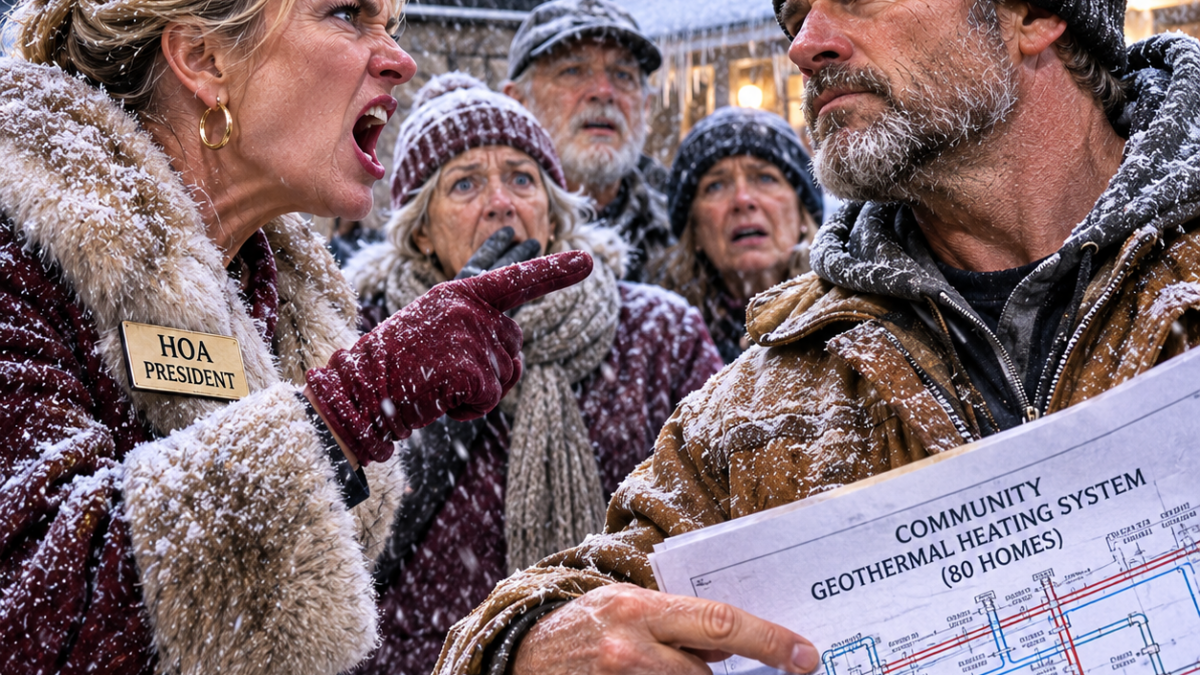
“YOU DON’T PAY, YOU FREEZE!” HOA Karen Cut Off My Heat During a Historic Blizzard—She Had No Idea I Designed the System Heating All 80 Homes
“TURN OFF HIS HEAT, THERON—IF THAT BROKE OLD ENGINEER WANTS TO DEFY MY HOA, LET HIM AND HIS LITTLE GRANDSON FREEZE!” Mallory Vandecamp shouted from the foot of my driveway as her husband shut down the geothermal connection to my house, with twenty-eight inches of snow approaching, wind chills forecast to reach forty below zero, and my eleven-year-old grandson waiting inside for the warm home I had promised him.
For twenty-three years, I had protected the heating system serving all eighty houses in Bretton Estates, but Mallory had no idea that I was the engineer who designed it, that her husband had secretly disabled its emergency safeguards and falsified inspection records for years, or that my father’s forgotten 1999 lease gave me a legally documented role in protecting the district plant when its operators endangered residents.
And when the blizzard finally swallowed the White Mountains, Mallory discovered that the man she had tried to intimidate possessed the original engineering records, an emergency court order, three independent engineers’ reports, and evidence capable of destroying her husband’s maintenance empire—while seventy-nine other homeowners were about to learn how close their families had come to disaster because their HOA president had decided that obedience mattered more than keeping children warm.
The first thing I heard after the heating stopped was my grandson laughing.
That may sound strange.
But when your world is about to change, the last ordinary sound has a way of staying with you forever.
Toby was in the kitchen, sitting on a barstool with his feet hooked around the legs, eating macaroni and cheese straight from a blue ceramic bowl.
He was eleven.
Thin.
Dark-haired.
With the same careful gray eyes my mother had possessed.
His Boston Bruins sweatshirt was a size too large, and he had a smear of cheese on his chin.
He was laughing at something on his Nintendo Switch.
For one second, the sound made everything feel normal.
Then the circulation pump inside the utility room fell silent.
I knew that sound.
More precisely, I knew the absence of it.
For twenty-three years, the low hum of the geothermal heating loop had been part of the background noise of my house.
Like a refrigerator.
Or the wind through the spruce trees.
Something you stopped noticing until it disappeared.
At 4:47 p.m. on a Thursday in February, it disappeared.
Outside, a maintenance van stood at the end of my driveway.
Its headlights cut through the gathering snow.
Two people waited beside it.
Mallory Vandecamp and her husband, Theron.
Mallory wore a white parka with a fur-trimmed hood, expensive winter boots, and pearl earrings that seemed absurdly delicate for a New Hampshire afternoon when the temperature was dropping fast.
Theron wore a navy work jacket.
His company’s name was embroidered above the pocket.
BRETTON MECHANICAL SERVICES.
He held a maintenance ticket.
The connection serving my house had been isolated.
Mallory smiled when I stepped onto the porch.
That smile was the first thing I hated.
Not the cold.
Not the paperwork.
Not even the fact that she had chosen a blizzard warning to enforce a disputed charge.
The smile.
Because it told me she was enjoying herself.
“Mr. Easton,” she called brightly, “I’m afraid we’ve reached the end of your grace period.”
I stared at her.
“Mallory.”
She raised a clipboard.
“Forty-seven days delinquent.”
“Eight thousand four hundred dollars.”
“Supplemental geothermal service assessments.”
I looked toward the van.
Then at Theron.
“You actually disconnected my house.”
Theron avoided my eyes.
Mallory smiled wider.
“Actions have consequences, Cole.”
I stepped off the porch.
Snow crunched beneath my boots.
“The 1999 easement agreement expressly exempts my property from those assessments.”
She waved one gloved hand.
“Our legal department disagrees.”
“Your legal department doesn’t get to rewrite a recorded lease.”
“Neither do you.”
I stared at her.
She continued.
“Pay by Monday and we’ll schedule reconnection.”
“There’s a blizzard warning.”
“Weather doesn’t suspend financial obligations.”
“My grandson is inside.”
Her expression barely changed.
“Then I suggest you make alternate arrangements.”
I felt something cold move through my chest.
Not fear.
Not yet.
Something harder.
“You’re cutting heat to a house with a child during a severe winter storm.”
Mallory tilted her head.
“I’m enforcing HOA policy.”
I looked at Theron again.
He finally met my eyes.
For a brief moment, something crossed his face.
Uncertainty.
Maybe embarrassment.
Maybe the knowledge that he was doing something his own professional training should have told him not to do.
But he said nothing.
Mallory stepped toward her Range Rover.
“Have a pleasant weekend, Mr. Easton.”
I watched her climb inside.
Then I looked toward the darkening mountains.
The weather service was forecasting twenty-eight inches of snow.
Potentially life-threatening cold.
Road closures.
Dangerous winds.
The kind of storm that could isolate entire communities.
Behind me, Toby called from the kitchen.
“Pop?”
I turned.
He stood in the doorway holding his empty bowl.
“Why’d the heater stop?”
I looked at his small face.
Then back toward the Range Rover disappearing down the road.
I had designed the heating system serving all eighty houses in that subdivision.
I knew every major engineering decision that had gone into it.
I knew what the original safety requirements demanded.
I knew which maintenance records no longer matched the equipment.
And I knew Mallory had just started something she didn’t understand.
But none of that mattered as much as the child looking at me from the doorway.
I went inside.
Closed the door.
Then knelt in front of him.
“Pop’s going to take care of it.”
Toby studied me.
“Are we going to be cold?”
I swallowed.
“Not if I can help it.”
He hesitated.
Then whispered:
“Mom’s coming Sunday.”
“I know, buddy.”
“I want the house warm when she gets here.”
The words hit harder than any threat Mallory had made.
I put my hands on his shoulders.
“So do I.”
Then I hugged him.
And made the only promise I knew I had to keep.
“We’re going to get through this together.”
PART2
My name is Cole Easton.
I’m fifty-three years old.
I live in the White Mountains of northern New Hampshire, where winter is not something you admire through a window and forget about when the sun goes down.
Winter here is a responsibility.
You prepare for it.
Respect it.
Plan around it.
Because when the temperature drops far enough, small mistakes become expensive.
And serious mistakes can kill people.
I’ve spent most of my adult life working as a mechanical engineer.
Heating systems.
District energy networks.
Hydronic circulation.
Controls.
Equipment that most people never think about until it stops working.
In 2002, I designed the geothermal district heating system for Bretton Estates.
Eighty homes.
A central energy plant.
Buried circulation infrastructure.
Individual heat exchangers.
Redundant safety systems intended to help protect the community during extreme winter conditions.
I was twenty-nine when the project began.
My daughter Sasha was ten.
My father was still alive.
And I had a tiny engineering office above a hardware store in Lincoln.
I remember spreading the original drawings across three folding tables.
My father standing beside me.
His sleeves rolled up.
A carpenter’s pencil tucked behind his ear.
He studied the plans for a long time.
Then pointed at the emergency provisions.
“Cole.”
“Yeah, Dad?”
“What’s this part for?”
“Freeze protection.”
“Explain.”
I laughed.
He wasn’t an engineer.
But he had spent most of his life building things that had to survive New Hampshire winters.
He understood failure better than most people with expensive degrees.
I explained the backup systems.
The monitoring.
The design margins.
The need for qualified operators.
He listened.
Then asked one question.
“What happens if the people running it stop caring?”
I stared.
“What?”
“Not if a pump breaks.”
“Not if a valve fails.”
“What happens if the people responsible stop doing their jobs?”
I looked down at the plans.
That question stayed with me.
It influenced the redundancy and protective controls I specified.
And it shaped the legal agreements my father insisted upon when the development needed access to our land.
The geothermal wells and associated infrastructure occupied areas governed by a recorded easement and lease on our twelve-acre property.
My father granted those rights in exchange for continuing heating service to our family residence without the supplemental assessments imposed on the newly developed lots.
The original agreement also included emergency provisions addressing failures by the maintenance operator.
At the time, I thought they were excessive.
My father didn’t.
He told me:
“People change, Cole.”
“Paper lasts longer.”
He was right.
About that.
And about more things than I understood while he was alive.
My father built our house in 1971.
A simple frame structure on Macintosh Road.
Three bedrooms.
A large kitchen.
A porch facing the woods.
A creek running along the back acreage.
It wasn’t impressive.
Not compared with the newer homes in Bretton Estates.
Their stone fireplaces.
Three-car garages.
Panoramic windows.
Decorative gates.
But our house had something those properties could never purchase.
History.
My father built the front steps himself.
My mother planted the maple tree beside the kitchen.
The marks on the dining-room doorframe recorded Sasha’s height every birthday.
And the basement still smelled faintly of sawdust whenever the air turned damp.
My mother, Merritt Easton, lived there for most of her adult life.
She worked as an addiction recovery nurse for thirty-eight years.
She was the steadiest person I’ve ever known.
If somebody asked what made my mother remarkable, I wouldn’t point to an award.
I’d tell them about a night when I was eighteen years old.
A night when I became a father.
And lost the young woman I had loved since high school.
Sasha’s mother died during childbirth.
I remember the hospital corridor.
The harsh fluorescent lights.
The smell of disinfectant.
The doctor talking.
The way words seemed to arrive from very far away.
I remember holding my newborn daughter and being completely unable to understand how a person could begin life at the exact moment another person’s life ended.
I was eighteen.
Terrified.
And certain I would fail.
Then my mother walked into the room.
She looked at me.
At the baby.
At the tears on my face.
Then she took Sasha gently into her arms.
“We’re going to figure this out,” she said.
I started crying.
“Mom, I don’t know how.”
She looked at me.
“Neither do I.”
Then she smiled.
“But we’ll learn.”
And we did.
My mother helped raise Sasha.
She attended school events.
Sat up through fevers.
Taught her to cook.
Helped her with homework.
Loved her with a patience I didn’t know how to imitate.
When Sasha struggled as a teenager, Mom listened.
When she made mistakes, Mom stayed.
When addiction eventually entered our family, Mom understood better than anyone that recovery wasn’t achieved by yelling at somebody to become stronger.
She taught me that.
Not in lectures.
By showing up.
Again.
And again.
Until she died of a heart attack in 2018.
After that, I tried to become the person she had been.
Some days, I succeeded.
Other days, I stared at her photograph and wondered how she’d made it look so easy.
Sasha was thirty-three when the storm came.
She had been in recovery for fourteen months.
She was receiving structured support in Concord and working hard to build a stable life.
I was proud of her.
More proud than I knew how to say.
Her son Toby had lived with me during the most difficult stretch of her treatment.
He was eleven now.
A bright boy.
Quietly observant.
The kind of child who noticed when adults were pretending not to worry.
He missed his mother.
Desperately.
But he was beginning to trust that their relationship had a future.
They spoke regularly.
She wrote him letters.
Sent photographs.
Asked about school.
She had bought him a small stuffed otter for Christmas.
He slept with it most nights.
And that Sunday, she was supposed to visit for Toby’s birthday.
He had been counting down the days.
The one thing he’d asked was that we celebrate at home.
Our home.
The house where my mother had raised Sasha.
Where Sasha had grown up.
Where Toby could be with both his mother and grandfather without feeling like he was visiting somebody else’s life.
That was what Mallory threatened when she cut the heating connection.
She didn’t see a family trying to rebuild.
She saw an unpaid assessment.
A house outside her preferred boundaries.
An older engineer who refused to sign whatever document she placed in front of him.
And a chance to demonstrate control.
Mallory Vandecamp had been president of Bretton Estates HOA for seven years.
She dressed like somebody who expected to appear in a lifestyle magazine.
Expensive winter coats.
Pearl earrings.
Perfect hair.
A Range Rover that seemed to spend more time idling outside other people’s driveways than traveling anywhere useful.
She loved calling the development a premium mountain community.
She talked constantly about appearance standards.
Property values.
Administrative efficiency.
The importance of respecting the board.
Her husband, Theron, owned Bretton Mechanical Services.
His company held the contract to maintain the district heating plant.
That arrangement had always concerned me.
Not because a contractor’s spouse was automatically forbidden from serving on an HOA board.
But because the relationship created an obvious conflict requiring transparency and independent oversight.
Under Mallory, the board became less transparent.
Maintenance reports grew shorter.
Independent inspections were postponed.
Questions from homeowners were redirected toward the contractor.
And when I asked for the original equipment logs, Theron began treating me like an outsider.
Which was ridiculous.
My professional seal appeared on the original plans.
I had been involved in commissioning the plant.
I knew its design intent.
But Theron preferred engineers who agreed with his decisions.
Over time, I began finding discrepancies.
Reports listing safety tests that didn’t appear to have occurred.
Equipment statuses inconsistent with what I could verify.
Redundant protective features unavailable or bypassed.
Records carrying the same copied language month after month.
I documented the concerns.
Dates.
Photographs where lawfully accessible.
Technical discrepancies.
Correspondence.
The original specifications.
My attorney, Margaret Doyle, helped preserve the evidence.
She had handled my father’s estate and my mother’s affairs.
She knew our family.
She knew the lease.
And she knew I wasn’t imagining the contractual protection.
What I hadn’t expected was that Mallory would turn the disputed fees into a threat to Toby’s safety.
The first notice came Wednesday afternoon.
Eight thousand four hundred dollars.
Forty-seven days overdue.
Disconnect threatened.
I was standing in the kitchen when Mallory rang the doorbell.
She wore the same white parka.
Held a leather portfolio.
Smiled.
“Mr. Easton.”
I opened the door.
“Mallory.”
She handed me the notice.
I read it.
Then looked up.
“This charge doesn’t apply to my property.”
She nodded politely.
“The board’s legal interpretation has changed.”
“The recorded agreement hasn’t.”
“Current leadership isn’t bound by every informal understanding from decades ago.”
I stared.
“It’s not informal.”
I pointed toward the paper.
“It’s a recorded instrument.”
She looked irritated.
“Our attorney has reviewed the matter.”
“Then have your attorney call Margaret Doyle.”
Mallory’s smile tightened.
“Cole, perhaps you’re not understanding the urgency.”
I glanced at the date.
“I’m understanding it perfectly.”
“Then pay.”
“No.”
Her expression changed.
A pause.
Then:
“You’re being difficult.”
I looked at her.
“No.”
“I’m refusing a charge that the agreement says I don’t owe.”
She leaned closer.
“The HOA has the right to enforce its rules.”
“Not beyond the rights it actually has.”
Mallory stared.
Then smiled coldly.
“Thursday.”
I frowned.
“What?”
“Your connection will be terminated Thursday afternoon unless payment is received.”
I looked toward the weather report on my kitchen television.
A winter storm warning was already developing.
“You’re serious?”
“Completely.”
“There’s dangerous weather coming.”
“That isn’t relevant to your financial obligations.”
I felt my jaw tighten.
“There’s a child living here.”
She shrugged.
“Then I suggest you plan accordingly.”
She turned.
Walked back to her Range Rover.
And drove away.
I stood on the porch holding the notice.
For the first time in years, I heard my father’s voice in my memory.
What happens if the people running it stop caring?
The answer stood in front of me.
And drove a white Range Rover.
Toby came downstairs wearing his Bruins hoodie.
“Pop?”
“Yeah, buddy?”
“Was that the lady from the HOA?”
I nodded.
He looked toward the driveway.
“Is she still trying to take our heat?”
I swallowed.
“She’s still trying.”
He hesitated.
Then said:
“Mom’s coming Sunday.”
“I know.”
“I want the house warm.”
I crouched.
Put both hands on his shoulders.
“Toby, listen.”
He looked at me.
“Your mom is coming.”
“We’ll make sure you’re somewhere safe and warm.”
“And I’m going to work on getting this fixed properly.”
His eyes searched mine.
“Promise?”
I nodded.
“Promise.”
That afternoon, I called Margaret.
She listened while I described the notice.
Then asked for a copy.
When she’d read it, she sighed.
“Cole.”
“Yeah?”
“I’ve been expecting something like this.”
I stared.
“Why?”
“Because Mallory has been pushing the boundaries of that lease for months.”
She paused.
“And I’ve been rereading Section Fourteen.”
The section my father had insisted upon.
The emergency control provisions.
The requirement that qualified professionals be able to protect the district network if the contracted operator failed to meet serious safety obligations.
Margaret continued.
“There’s a contractual emergency mechanism.”
“But we need to have the scope confirmed and coordinate with the proper authorities.”
I sat down.
“Can we stop the disconnect?”
“I’ll seek emergency relief.”
“How quickly?”
“As quickly as the court can consider it.”
I looked toward the window.
Snow had begun collecting against the trees.
“Margaret.”
“Yes?”
“If Theron disables my heat, what happens to the rest of the neighborhood when that storm arrives?”
She was silent.
Then asked:
“What have your maintenance findings shown?”
I looked at the engineering files stacked beside my laptop.
The discrepancies.
The false test records.
The equipment statuses.
The protections that weren’t available.
Then answered:
“The system may not be as safe as anyone thinks.”
Margaret took a breath.
“Then we need more than a billing dispute.”
“Yes.”
“We need independent technical review.”
“Yes.”
“And we need it before the blizzard.”
I looked at the sky.
“Then let’s begin.”
By Thursday evening, the house was cooling.
The kitchen thermostat dropped.
Slowly at first.
Then more noticeably.
I moved Toby into the living room.
Added blankets.
Checked the weather.
The wood stove had not been used regularly for years, and its chimney needed professional attention.
I decided not to rely on an unsafe heating source.
Instead, I used approved temporary measures for the short term while arranging a safe place for Toby to stay.
I called Foster Whitlock.
He owned a small motel in Lincoln.
We’d known each other for years.
He’d attended Sasha’s school graduation.
My mother had helped his brother during recovery.
Foster answered on the second ring.
“Cole.”
“Foster.”
“You sound worried.”
I looked toward Toby sitting beneath a blanket.
“I need a warm room for my grandson.”
His voice changed immediately.
“What happened?”
“The HOA disconnected our heating connection.”
Silence.
Then:
“During this storm?”
“Yes.”
Foster swore quietly.
Then said:
“Bring him.”
“I’ll get Room Four ready.”
I swallowed.
“Thank you.”
“Don’t thank me.”
He paused.
“Just get the boy here safely.”
I hung up.
Looked toward Toby.
He was watching me.
“Are we going to a hotel?”
“For a little while.”
His face fell.
“But Mom’s coming Sunday.”
“I know.”
“Will we still have my birthday?”
I sat beside him.
“Absolutely.”
He looked down.
Then whispered:
“Are you sure?”
I put one arm around him.
“Toby.”
He leaned against me.
“We’re not canceling your birthday because somebody sent a bad bill.”
He smiled a little.
“Okay.”
Then he asked something that nearly broke me.
“Would Grandma Merritt be mad at that lady?”
I looked toward my mother’s photograph on the mantel.
For a moment, I could almost hear her answer.
Mad? Honey, I’d be furious.
I smiled sadly.
“She’d have some very strong words.”
Toby nodded thoughtfully.
Then:
“Use her voice, Pop.”
I looked at him.
“What?”
“When you talk to the lady.”
“Use Grandma’s voice.”
I stared.
My mother had a particular way of speaking when someone was being cruel.
She didn’t shout.
Didn’t insult.
Didn’t let anger make her careless.
She lowered her voice.
Spoke slowly.
Clearly.
And left no room for confusion.
I looked at Toby.
Then smiled.
“Okay, buddy.”
“I’ll use Grandma’s voice.”
At 5:30 Friday morning, I called Lars Holm.
Lars was an old friend from MIT.
Norwegian-born.
A specialist in hydronic systems and district heating.
He’d spent years working on energy projects in harsh climates.
I trusted him.
Not because he always agreed with me.
Because he never did when the evidence suggested otherwise.
He answered.
“Cole.”
“Lars.”
He heard something in my voice.
“What happened?”
I explained.
The disconnect.
The storm.
The falsified records.
The old lease.
The concern about disabled safeguards.
Lars listened.
Then asked:
“What do you need?”
“Independent review.”
“Original schematics.”
“Your experience.”
“And a second set of eyes before this storm gets worse.”
A pause.
“I’m coming.”
“Lars, the roads—”
“I’ll check conditions.”
“Travel only while safe.”
“I’m not asking you to risk your life.”
He sighed.
“Cole.”
“Yes?”
“You built a system to keep eighty families warm.”
“I know.”
“And somebody has been lying about its condition.”
“Yes.”
Then he said:
“I’m not letting you sort that out alone.”
I closed my eyes.
“Thank you.”
He grunted.
“Save the gratitude until we know what is wrong.”
Then the call ended.
I smiled despite myself.
Classic Lars.
By eight, Toby’s bag was packed.
Warm clothing.
His inhaler and relevant medical information.
His Switch.
The stuffed otter Sasha had mailed him.
His favorite blanket.
I drove him into Lincoln before the roads deteriorated further.
The snow was already blowing sideways.
Foster met us outside the motel.
He wore a thick flannel jacket and a knitted cap.
He opened the door before we reached it.
“Come in.”
Warm air washed over us.
Toby smiled.
Foster pointed toward the lobby.
“Hot chocolate’s ready.”
My grandson looked at me.
“Really?”
I laughed.
“Apparently.”
Foster leaned closer.
“Room Four’s warm.”
“I’ve got backup power arrangements and emergency supplies.”
“And he’s not staying alone.”
I looked at him.
For a moment, I couldn’t speak.
Foster smiled.
“Cole.”
“Your mother helped my brother when nobody else knew what to do.”
I swallowed.
“That was years ago.”
He shrugged.
“Good neighbors remember.”
Toby sat on the couch in the lobby.
Foster’s daughter brought him hot chocolate.
A cartoon played on the television.
For the first time since the heat had gone out, my grandson looked relaxed.
I crouched beside him.
“Buddy.”
He turned.
“Yeah?”
“I’m going to work on the house.”
He nodded.
“Okay.”
“Foster’s here.”
“You’ve got everything you need.”
“I’ll call.”
Toby studied me.
Then asked:
“Pop, are you going to fix it?”
My throat tightened.
“I’m going to do everything I can.”
He looked at his stuffed otter.
Then back at me.
“Use Grandma’s voice.”
I smiled.
“I will.”
He leaned forward.
Wrapped both arms around my neck.
And held on.
Longer than usual.
I hugged him.
Then whispered:
“I love you.”
“Love you too, Pop.”
When I stood, Foster was watching.
He placed one hand on my shoulder.
“Go do what you need to do.”
“I’ve got him.”
I nodded.
Then walked outside into the snow.
And for the first time in twenty-four hours, I could focus on the technical emergency without wondering whether Toby was going to be cold.
Lars arrived that morning with his daughter Annika.
I hadn’t expected her.
She was twenty-eight.
A mechanical engineer.
Bright.
Focused.
Newly established in her professional career.
She climbed out of the passenger seat wearing a heavy winter coat and carrying a laptop bag.
Lars smiled.
“Cole.”
He pulled me into a hug.
Then gestured toward her.
“My daughter.”
Annika extended her hand.
“Mr. Easton.”
“Please.”
“Cole.”
She smiled.
“Dad’s told me about your work.”
I looked at Lars.
“Has he?”
He shrugged.
“Only the embarrassing parts.”
Annika laughed.
Then became serious.
“I reviewed the documents you sent.”
I nodded.
“And?”
She looked toward the darkening sky.
“We should get inside.”
We spread the records across my kitchen table.
Original design drawings.
Commissioning documents.
Maintenance reports.
Recent photographs.
Equipment schedules.
The recorded lease.
The disputed HOA notice.
My notes from eighteen months of monitoring.
Lars studied the records carefully.
Annika cross-checked dates and equipment descriptions.
I watched them work.
It reminded me of the early days of my career.
When problems were solved by people sitting around a table asking uncomfortable questions.
Not by titles.
Not by threats.
By evidence.
After nearly two hours, Lars leaned back.
“Cole.”
I looked up.
“Yes?”
“These maintenance records are not reliable.”
Annika nodded.
“The reported tests don’t match the documented equipment condition.”
Lars pointed toward a series of entries.
“Someone has represented safety functions as operational without evidence of the required checks.”
I swallowed.
“And the redundancy?”
Annika looked grim.
“Not available as designed.”
Silence.
I stared at the plans.
Twenty-three years earlier, I’d spent weeks reviewing the emergency provisions.
Now the system I had built to protect families was being maintained by people who appeared to have cut corners for years.
I rubbed my face.
Lars watched me.
“Cole.”
I looked up.
“This isn’t your fault.”
I shook my head.
“It’s my design.”
“Yes.”
“And the design included protections.”
“Yes.”
He leaned forward.
“The problem is not that you failed to provide safeguards.”
“The problem is that somebody failed to maintain them.”
Annika added:
“And we need to make sure the response doesn’t endanger the residents.”
I nodded immediately.
“Absolutely.”
Whatever Mallory had done to me, I had no intention of making eighty families pay for it.
Those houses were full of people.
Children.
Retirees.
Parents.
People who trusted the HOA to keep essential services operating.
I would not turn them into weapons in a personal dispute.
I looked at both engineers.
“Then our priority is straightforward.”
Lars nodded.
“Human safety.”
Annika added:
“Independent verification.”
I said:
“And a controlled recovery plan.”
Lars smiled faintly.
“Now you sound like the engineer I remember.”
Margaret called shortly after noon.
She’d obtained emergency consideration of the matter.
The court had granted temporary relief concerning the disputed disconnection and required appropriate action to prevent further harm while the legal issues were examined.
The order did not give me permission to damage the district system.
Nor would a contract or professional license automatically authorize endangering residents.
The emergency provisions required careful coordination with qualified professionals and the appropriate authorities.
Margaret was clear.
“Cole, listen.”
“I’m listening.”
“Your contractual rights are important.”
“But the essential thing is restoring safe service and preserving evidence.”
“I agree.”
“Do not do anything that creates unnecessary harm to the eighty households.”
“I won’t.”
She exhaled.
“Good.”
Then she softened.
“How’s Toby?”
“Warm.”
“Where?”
“Lincoln Motor Lodge.”
“Foster’s got him.”
Margaret was quiet.
Then:
“Merritt would have liked that.”
I smiled sadly.
“Yeah.”
“She would.”
By early afternoon, the storm had intensified.
Snow blew horizontally past the kitchen windows.
The trees bent beneath the wind.
The world beyond the driveway disappeared into white.
My phone rang.
Mallory.
I answered with Lars and Annika present.
“Cole.”
Her voice was different.
Polite.
Careful.
The voice of a woman who had just discovered that a judge was not as impressed by HOA stationery as she was.
“Mallory.”
“I think there’s been a misunderstanding.”
I looked at the emergency order.
Then at the engineering files.
“Has there?”
“The board is willing to reconnect your heat.”
I paused.
“Under the existing agreement?”
Silence.
Then:
“We can discuss the accounting later.”
“No.”
Her voice sharpened.
“Cole, don’t be unreasonable.”
I looked toward the window.
Snow struck the glass.
Then I remembered Toby.
His blue bowl.
The Bruins sweatshirt.
The little stuffed otter.
And my mother’s voice.
Calm.
Steady.
One truth spoken clearly.
I lowered my voice.
“Mallory.”
She stopped.
“You disconnected essential heating service to a house with a child during a severe weather warning.”
“I have preserved the notice, the service records, and the communications.”
“Independent engineers have identified serious concerns about the condition of the entire district system.”
“From this moment forward, the response will be coordinated through the court, qualified engineers, and the relevant safety authorities.”
She was silent.
Then:
“You’re trying to take over my HOA.”
“No.”
“I’m trying to keep people safe.”
Her breathing grew louder.
“You have no right—”
I interrupted.
“Mallory, your authority stops where the law and other people’s safety begin.”
Then I ended the call.
Lars looked at me.
Annika smiled slightly.
“What?” I asked.
Lars shook his head.
“Nothing.”
Then:
“That was very calm.”
I looked toward my mother’s photograph.
“Learned from the best.”
The technical review identified another problem.
The district system had been operating for years without the full redundant protection I had specified.
Under normal winter conditions, the system had continued functioning.
That apparent success helped conceal the failure.
But extreme cold changed everything.
When outside temperatures dropped far enough, a malfunction could become dangerous very quickly.
Loss of circulation.
Loss of adequate heat transfer.
Equipment faults.
Potential freezing in vulnerable sections.
The consequences could spread across the district.
The original design had addressed those risks.
The maintenance contractor’s records claimed the protections remained functional.
The evidence suggested otherwise.
We documented the findings.
Contacted the relevant authorities.
Requested independent oversight.
And began developing a controlled plan to stabilize service rather than allow the entire district to fail during the storm.
The state response moved quickly once officials understood the scale.
Eighty houses.
A blizzard.
A compromised district plant.
A maintenance contractor accused of falsifying inspections.
A dispute involving the engineer of record.
And an HOA president who had deliberately disconnected a home despite severe weather warnings.
There was no appetite for treating it as a neighborhood personality conflict.
It was a public-safety concern.
By late afternoon, the authorities had begun formal action concerning the maintenance contractor.
Records were requested and preserved.
Operational control was placed under qualified emergency oversight while the legal and technical issues were evaluated.
Theron’s company faced immediate scrutiny over its licensing, maintenance practices, and representations.
The district plant was no longer something Mallory could use to punish an individual homeowner.
It was essential infrastructure.
And essential infrastructure requires accountability.
Annika organized the technical documentation.
Lars worked with the response team on safety assessments.
I provided original design records and historical knowledge.
We coordinated with local emergency management to identify households that might need assistance if service became unreliable.
Warming centers were prepared.
Transportation support arranged.
Residents received updates through authorized emergency channels.
No one was told to abandon a safe home unnecessarily.
No one was promised conditions that hadn’t been verified.
And no one was intentionally deprived of heat to make a political point.
That was the most important decision we made.
Because Mallory had treated my home as an enforcement target.
I refused to treat the rest of the community the same way.
At five o’clock, Sasha called.
I was sitting at the kitchen island.
The house was cold enough that I had added a second sweater.
A portable light illuminated the engineering drawings.
The wind battered the windows.
And the basement was full of people preparing for a controlled emergency response.
I answered.
“Hey, sweetheart.”
“Daddy?”
Her voice was quiet.
Careful.
The voice she’d been learning to use during recovery when she needed to ask a difficult question without letting fear take over.
“Hey, Sasha.”
“Is Toby okay?”
I closed my eyes.
“Yes.”
“He’s safe.”
“Where?”
“Foster’s motel.”
“In Lincoln?”
“Yes.”
She exhaled.
“Okay.”
Then:
“Is he scared?”
I looked toward the empty barstool.
The blue macaroni bowl was still in the dishwasher.
“Some.”
Her voice broke.
“Daddy, I’m sorry.”
I stared.
“For what?”
“For not being there.”
I closed my eyes.
“Sasha.”
She began crying.
“Mom’s supposed to protect her kid.”
“You are protecting him.”
She fell silent.
“You’re doing the work that will help you be there for him.”
Her breathing shook.
“But you’re having to do everything.”
I looked toward the kitchen window.
Snow swirled past the glass.
Then I thought of my mother.
Eighteen years old.
A newborn baby.
A life I wasn’t ready for.
And a woman who said we’d figure it out.
“Sasha.”
“Yes?”
“Your grandmother once helped me raise you because I needed her.”
Silence.
“She didn’t call me a failure.”
“She helped me become a father.”
I swallowed.
“I’m helping you become the mother you want to be.”
Sasha started crying harder.
I let her.
Then she whispered:
“Thank you, Daddy.”
I looked at my mother’s photograph.
“Keep doing the work, sweetheart.”
“I am.”
“I know.”
She paused.
Then:
“Tell Toby I love him.”
“I will.”
“And Daddy?”
“Yes?”
“Please be safe.”
I smiled sadly.
“I will.”
When the call ended, I sat staring at the phone.
Lars entered the kitchen.
He looked at me.
Then silently poured another cup of coffee.
He placed it beside my hand.
No speech.
No advice.
Just coffee.
And for a moment, that was exactly what I needed.
The blizzard reached its worst intensity after dark.
The wind screamed against the house.
Snow piled beside the garage.
The road beyond the driveway became difficult to distinguish from the fields.
Inside the district plant, the emergency technical team continued monitoring conditions.
The properly supervised response prioritized restoring protective functions, maintaining circulation where safe, and preventing uncontrolled failures.
We worked from verified system status.
Not assumptions.
Not outdated maintenance reports.
Not Theron’s claims that everything was fine.
The situation was serious.
There were equipment problems.
Several homes reported inadequate heating.
Some households needed temporary accommodation.
But the district avoided the catastrophic systemwide freeze that could have resulted from an uncontrolled failure during the coldest part of the storm.
At one point, Lars looked at the monitoring data.
Then at me.
“Cole.”
I turned.
“Yes?”
“The protection measures are holding.”
I stared at the display.
Then let out a breath I hadn’t realized I was holding.
“Good.”
Annika smiled.
“Very good.”
I looked toward the original plans spread across the table.
Twenty-three years old.
Lines drawn when Sasha was ten.
When my father was alive.
When my mother still worked long shifts helping people who thought their lives were beyond repair.
I felt my eyes burn.
Lars placed one hand on my shoulder.
“Your father would be proud.”
I looked down.
Then whispered:
“I hope so.”
He squeezed my shoulder.
“Cole.”
I looked up.
“He built this with you.”
I nodded.
“And you both planned for the day somebody might need to protect it.”
I couldn’t speak.
Because all I could see was my father’s hand resting on a rolled drawing.
His carpenter’s pencil.
His tired smile.
And the question he’d asked in 2002.
What happens if the people running it stop caring?
Tonight, I finally had an answer.
You find people who do.
Mallory called repeatedly.
At first, she demanded explanations.
Then apologies.
Then reassurance that her house would remain warm.
I referred operational questions to the authorized emergency response officials.
That made her furious.
She left messages accusing me of destroying the community.
Threatened lawsuits.
Threatened professional complaints.
Threatened to have my engineering license revoked.
I saved every message.
Not because I enjoyed listening to them.
Because evidence matters.
And Mallory was supplying more of it every hour.
One voicemail began:
“Cole, I am willing to be reasonable.”
Then ended:
“I WILL DESTROY YOU, YOU LITTLE MAN.”
Annika heard it.
She stared at the phone.
Then looked at me.
“That’s the HOA president?”
I nodded.
“Yes.”
She considered.
Then said:
“She seems unqualified for emergencies.”
Lars laughed.
I laughed too.
It was the first genuine laugh I’d managed since Thursday.
And it felt good.
Not because the situation was funny.
But because sometimes humor is the only thing keeping exhaustion from becoming despair.
The night dragged on.
Snow.
Wind.
Technical checks.
Emergency coordination.
Calls from residents.
Some polite.
Some frightened.
Some angry.
A woman named Dorothy called from the community center.
She was seventy-eight.
Lived alone.
Her house had reported a heating problem.
Emergency personnel had helped her reach a warm location.
She asked for me.
“Mr. Easton?”
“Yes, ma’am.”
“Are you the engineer?”
“Yes.”
She paused.
“I wanted to say thank you.”
I stared.
“Dorothy, I’m sorry you had to leave home.”
She dismissed that.
“Oh, honey.”
“I’ve lived through New Hampshire winters for seventy-eight years.”
“I’ve spent nights in church basements and school gyms.”
She chuckled.
“I’ve got blankets older than your HOA president.”
I smiled.
Then she became serious.
“They told me the equipment hadn’t been maintained properly.”
I looked toward the engineering records.
“That’s under review.”
She paused.
“Are you fixing it?”
“We’re working to make it safe.”
“Good.”
Then:
“Tell your grandson not to worry.”
My throat tightened.
“How do you know about Toby?”
“Everybody’s been talking.”
I closed my eyes.
She continued.
“That woman had no business cutting off a child’s heat.”
I swallowed.
“Thank you, Dorothy.”
She sighed.
“And Mr. Easton?”
“Yes?”
“Don’t let her make you mean.”
I froze.
Because those words could have come from my mother.
I stared toward the photograph on the kitchen wall.
Then whispered:
“I won’t.”
Around midnight, Foster called.
Toby was asleep.
He had eaten dinner.
Watched cartoons.
Played with Foster’s daughter.
His breathing was comfortable.
His inhaler was available.
The motel was warm.
Foster said:
“Cole, he’s fine.”
I closed my eyes.
“Thank you.”
“He wanted me to tell you something.”
I smiled faintly.
“What?”
“He said you should remember Grandma Merritt’s voice.”
I laughed through tears.
“Yeah.”
“I’m trying.”
Foster paused.
Then:
“Your mother would’ve been proud of the way you’re handling this.”
I looked down.
The words hit harder than I expected.
“Thanks, Foster.”
He continued.
“Now make sure somebody gives you a break.”
I laughed.
“You sound like my mother.”
“Good.”
“Somebody should.”
After the call, I sat alone for a moment.
The kitchen was chilly.
My coffee had gone cold.
Outside, the storm showed no sign of ending.
But Toby was warm.
The district response was under control.
And for the first time since Mallory disconnected my house, I believed we might get through the night without losing something we could never repair.
By early Saturday morning, the wind began easing.
The worst of the snowfall passed.
Plows started clearing major roads.
Emergency responders continued checking vulnerable households.
The district plant remained under supervised technical control pending further evaluation.
Independent inspectors documented the compromised maintenance conditions.
Redundant safeguards were tested and restored where appropriate.
The evidence was preserved.
And the emergency team began the process of returning the system to stable, normal service.
Some houses needed repairs.
Some residents had temporary accommodations.
The costs were significant.
But the neighborhood had avoided the nightmare of widespread uncontrolled freezing and extensive burst-pipe damage across all eighty homes.
The engineers were exhausted.
So were the emergency workers.
I hadn’t slept properly in two days.
At six-thirty, Annika came into the kitchen.
She wore a sweater that belonged to her father.
Her hair was pulled into a loose ponytail.
She held a mug of coffee.
“Cole?”
I looked up.
“Yeah?”
“Come outside.”
I frowned.
“Why?”
She smiled.
“The sky.”
I followed her to the back porch.
Lars stood near the railing.
The snow was finally falling lightly.
Beyond the spruce trees, the eastern sky had turned the color of pewter.
Then silver.
Then pale gold.
The White Mountains emerged through the thinning clouds.
I stood beside my old friend and his daughter.
For a long time, none of us spoke.
Then Lars said quietly:
“Good work.”
I looked at him.
“We’re not done.”
He nodded.
“No.”
“Not yet.”
Then he smiled.
“But the families are safe.”
I looked toward the valley.
Eighty homes.
Eighty separate lives.
People waking in temporary shelters.
People checking on loved ones.
Some frightened.
Some angry.
Some simply relieved.
I thought about what could have happened if we’d treated the crisis as a private fight with Mallory instead of a public-safety emergency.
I didn’t need to imagine long.
The engineering records showed enough.
I turned toward Lars.
“Thank you for coming.”
He shrugged.
“You called.”
I smiled.
“That’s all?”
He looked at me.
“Cole.”
“Yes?”
“You would’ve come for me.”
I nodded.
“Yes.”
“Then that’s all.”
Annika leaned against the railing.
Then said:
“I think your father would’ve liked this.”
I looked toward the house.
Then toward the basement where his old cabinet still stood.
“Yeah.”
I whispered.
“I think he would.”
The investigators arrived later that morning.
State authorities.
Technical specialists.
Financial investigators.
Personnel authorized to examine potential contractor misconduct and the records surrounding the disconnection.
The investigation was not a theatrical raid staged for my amusement.
It was a serious review involving essential infrastructure and allegations of falsified safety records.
The maintenance logs were collected.
Electronic records preserved.
Contract documents examined.
Equipment conditions documented.
Investigators also reviewed the HOA’s financial decisions.
The supplemental fees.
Theron’s company’s invoices.
Payments for inspections that may not have occurred.
The relationship between Mallory’s board and her husband’s business.
Homeowners began asking questions.
Why had independent safety inspections been postponed?
Why did maintenance records claim safeguards had been tested when the underlying evidence suggested otherwise?
Why had the HOA imposed new assessments on certain properties?
Who approved those decisions?
And why had a home with a child been disconnected during a severe weather warning despite a recorded service agreement?
Those questions mattered.
Not because everybody asking them was an engineer.
But because people had a right to know whether those responsible for their heating system had fulfilled their obligations.
By Saturday afternoon, my home’s connection had been restored under the supervised recovery plan.
The thermostat climbed.
Slowly.
From the low fifties.
Into the sixties.
Then toward seventy.
I stood in the kitchen listening to the familiar hum of the circulation system.
For twenty-three years, it had been background noise.
Now it sounded almost beautiful.
Lars checked the relevant readings.
Annika confirmed the documentation.
The technicians completed their work.
Then, finally, I looked at the thermostat.
Seventy-two degrees.
I stared.
A little plastic device on a kitchen wall.
Ordinary.
Unremarkable.
Something most people glanced at without thinking.
But that afternoon, it meant my grandson could come home.
It meant my daughter could visit.
It meant our family could celebrate a birthday in the house my father built.
It meant Mallory had failed to take away the one thing I had promised Toby.
A warm place to belong.
I drove to Lincoln after the roads were cleared and safe.
Foster met me in the motel lobby.
He smiled.
“Cole.”
“Hey.”
“You look terrible.”
I laughed.
“Good to see you too.”
He pointed toward the couch.
Toby sat beside Foster’s daughter watching cartoons.
The stuffed otter rested in his lap.
My grandson looked up.
Saw me.
Then jumped off the couch.
“POP!”
He ran across the lobby.
I crouched.
He threw both arms around my neck.
Not the embarrassed half-hug of a boy who wanted to seem grown up.
A full hug.
Tight.
Desperate.
He buried his face against my shoulder.
“Pop.”
I held him.
“Hey, buddy.”
He pulled back.
Looked at me.
“You’re cold.”
I laughed softly.
“Yeah.”
“A little.”
He studied my face.
“Did you fix it?”
I smiled.
“We got the heat back.”
His eyes widened.
“Really?”
“Really.”
He looked toward Foster.
Then back.
“Can we go home?”
I swallowed.
“Yes.”
Then he asked the question that nearly brought me to my knees.
“Will Mom be there tomorrow?”
I nodded.
“Yes, buddy.”
“She’ll be there.”
He smiled.
Then hugged me again.
I closed my eyes.
And for a moment, I could almost feel my mother standing beside us.
Watching.
Smiling.
Proud that we were still learning how to take care of one another.
On the drive home, Toby asked what happened.
I explained it simply.
The HOA had made an improper demand.
They’d cut our heating service.
The system’s maintenance records raised serious concerns.
Engineers and emergency workers had stepped in.
The court had helped protect our rights.
The neighborhood’s heating system was being made safe.
Toby listened without interrupting.
Then said:
“Pop?”
“Yeah?”
“Did you make the other houses cold?”
I looked at him.
“No.”
He frowned.
“Then why are people mad at the HOA?”
“Because the people responsible for the system hadn’t maintained all the safeguards they were supposed to.”
He considered.
“So it could’ve broken?”
“Yes.”
“And everybody could’ve been cold?”
“Yes.”
He looked out the window.
Then asked:
“Like us?”
I nodded.
“Like us.”
He was quiet.
Then said:
“Good thing you fixed it.”
I smiled.
“Lots of people helped.”
“Lars?”
“Yes.”
“Annika?”
“Yes.”
“The firefighters?”
“Some of them.”
“Foster?”
I laughed.
“Foster helped most of all.”
Toby looked at the stuffed otter in his lap.
Then whispered:
“Grandma Merritt would’ve helped too.”
My throat tightened.
I glanced toward him.
“Yeah, buddy.”
“She would.”
When we reached the house, Toby ran inside.
He stopped in the kitchen.
Looked toward the thermostat.
Seventy-two degrees.
Then he smiled.
“Pop!”
I walked in.
“Yeah?”
“It’s warm!”
I laughed.
“Sure is.”
He placed the stuffed otter on the counter.
Then hurried toward the living room.
He touched the couch.
The blanket.
The familiar furniture.
As if checking that everything was still there.
Then he came back.
Wrapped his arms around my waist.
“Thank you.”
I rested one hand on his head.
“You don’t have to thank me.”
He looked up.
“Yes, I do.”
I swallowed.
Then crouched.
“Toby.”
He stared.
“This is your home.”
His eyes filled.
“You never have to earn being safe here.”
He hugged me again.
And I held him.
Long enough for the world to become quiet.
Sunday arrived with clear skies.
The snow outside stood in enormous white banks.
The roads had been cleared enough for safe travel.
The community was still dealing with inspections, repairs, and the aftermath of the storm.
But at my house, the oven was warming.
A cake sat on the counter.
Twelve candles.
Vanilla frosting.
Blue lettering.
HAPPY BIRTHDAY, TOBY.
He had turned twelve.
I kept looking at the cake.
Not because it was impressive.
It wasn’t.
The frosting was uneven.
The lettering tilted.
My mother would’ve laughed at my technique.
But I had made it.
And Toby loved it.
At noon, a car turned into the driveway.
My grandson ran to the window.
“POP!”
I knew.
Before he said another word.
I looked outside.
Sasha was climbing out of the car.
She wore a green winter coat.
Her hair was pulled back.
She carried a small bag and a framed photograph wrapped in brown paper.
She stood beside the vehicle for a moment.
Looking toward the house.
I could see the nervousness in her face.
She had been working hard.
Staying sober.
Showing up for treatment.
Building routines.
Making plans.
But none of that erased the fear of being a mother who worried her child might no longer trust her.
I opened the front door.
Toby ran past me.
“Mom!”
Sasha turned.
Her face changed.
She dropped the bag.
Then crouched as her son ran into her arms.
They held each other in the snow.
Sasha began crying.
Toby held on.
I stood on the porch.
Unable to move.
For years, my mother had told me that recovery was not a straight line.
That love needed boundaries.
That trust returned through consistent actions.
Not speeches.
Not promises alone.
Now I watched my daughter hold her son.
And I understood.
This was what the work had been for.
Not a perfect family.
Not an erased past.
A future.
A real one.
Sasha looked toward me over Toby’s shoulder.
Her eyes filled.
I smiled.
She whispered:
“Daddy.”
I walked down the steps.
Joined them.
And for a long time, the three of us stood together in the snow.
That afternoon, Sasha gave Toby the photograph.
It showed her as a young girl sitting on my mother’s lap on the back porch.
Sasha was twelve.
Almost the same age Toby had just turned.
My mother looked younger.
Her hair darker.
Her smile familiar.
Toby stared at the picture.
“Is that Mom?”
Sasha nodded.
“Yes.”
“And Grandma Merritt?”
“Yes.”
He looked toward me.
“Pop?”
“Yeah?”
“You took this?”
I smiled.
“I did.”
Toby looked again.
Then whispered:
“Mom looks like me.”
Sasha started crying.
She laughed through tears.
“Yeah.”
“I guess I did.”
Toby hugged her.
She held him.
Then looked toward me.
Her lips moved silently.
Thank you.
I felt my throat close.
I answered without speaking.
You’re home.
And for the first time since the heating went out, I stopped thinking about Mallory Vandecamp.
The legal investigation continued over the following months.
Authorities examined the falsified maintenance records.
The disabled safety provisions.
The invoices.
The disputed assessments.
The communications surrounding the heating disconnection.
The relationship between the HOA board and Bretton Mechanical Services.
The evidence showed a sustained pattern of maintenance failures and misrepresentations.
The contractor had represented safety work as completed when the supporting records and equipment conditions did not substantiate those claims.
The HOA’s enforcement decisions had also been used to pressure homeowners over disputed financial obligations.
Investigators reviewed the conduct of both Mallory and Theron.
Charges followed where the evidence met the required standards.
The criminal process took time.
Hearings.
Document review.
Legal arguments.
Resolution of contested facts.
Nothing happened with the speed of a television courtroom.
But the records were clear enough to make accountability unavoidable.
Theron’s license and contracting status faced serious consequences.
Mallory was removed from the HOA presidency under the proper governance process.
The board’s financial and maintenance decisions underwent independent review.
Homeowners who had once believed everything was under control learned how little they had actually been shown.
And the district heating system finally received the attention it should have received years earlier.
The association’s new leadership made a decision that mattered more than any public apology.
It changed the way the geothermal system was governed.
Instead of leaving essential infrastructure under a contractor controlled through the same small circle of HOA leadership, the homeowners established an independently overseen utility cooperative.
Proper legal arrangements were completed.
The engineering responsibilities were clarified.
Maintenance became subject to transparent reporting and qualified review.
Independent inspections were scheduled.
Emergency communication procedures improved.
The financial records became accessible through appropriate governance channels.
And the original service rights attached to my family’s property were formally acknowledged.
I agreed to serve on the cooperative’s volunteer board.
Not as president.
Not as somebody who wanted to control the neighborhood.
Just as a technical adviser and landowner with a legitimate interest in keeping the system safe.
Lars helped.
Annika accepted an ongoing engineering role.
The emergency response teams reviewed lessons from the storm.
Residents contributed ideas.
For the first time in years, the community’s heating system was discussed openly by people interested in safety rather than authority.
I liked that.
A lot.
Six months after the storm, I sat on the back porch with my mother’s photograph in my lap.
August sunlight moved through the maple leaves.
The creek behind the house glittered between stones.
Sasha stood near the bank beside Toby.
She was teaching him how to skip stones.
Or trying.
She threw one.
It sank immediately.
Toby laughed.
“Mom!”
She groaned.
“I used to be good at this.”
He picked up a flat stone.
“Watch.”
He threw.
One skip.
Two.
Three.
Sasha cheered.
I smiled.
She’d been sober twenty months.
Had moved into an apartment in Lincoln.
Started part-time work at the library.
Built a routine that gave her stability.
Toby had begun spending some weekends with her.
Carefully.
Gradually.
With everyone working together to make sure he felt secure.
There were still hard days.
Difficult conversations.
Appointments.
Moments when Sasha worried she’d never fully repair the damage of the past.
But she kept showing up.
And Toby kept learning that he could trust the people around him.
I looked down at my mother’s photograph.
She was smiling.
Sitting in the same chair I occupied.
I touched the edge of the frame.
“Mom,” I whispered.
“She’s doing it.”
A breeze moved through the leaves.
I smiled through tears.
“She’s really doing it.”
Later that summer, we established the Merritt Easton Recovery Scholarship.
A modest annual award supporting a local student whose family had been affected by addiction and whose life had been shaped by a grandparent or caregiver stepping in during a difficult period.
The scholarship didn’t promise to solve every problem.
It couldn’t.
But it honored the kind of quiet work my mother had done for decades.
The first recipient was a young girl interested in nursing.
She wrote a letter.
Not long.
Only a few paragraphs.
She thanked the program.
Explained that her grandmother had raised her during her mother’s recovery.
And said she wanted to become the kind of nurse who helped families feel less alone.
I read that letter three times.
Then placed it in the drawer beside my mother’s old nursing badge.
For a long time, I sat there.
Thinking about the night Sasha was born.
My mother’s hands.
Her voice.
We’re going to figure this out.
Decades later, another young person was moving toward a future because people had believed she deserved one.
That felt like a better tribute than any statue.
The community also created an emergency warming network.
Retired plow operator Eldon Pickering volunteered to coordinate transportation.
He was seventy-six.
Had a truck that looked capable of pushing a mountain out of the road.
And a personality that could convince almost anybody to accept help without feeling embarrassed.
He recruited neighbors.
Created contact lists.
Helped develop safe transportation arrangements.
Worked with emergency officials to identify warming locations and vulnerable households.
Whenever severe weather approached, volunteers checked on residents who might need assistance.
Eldon took the job seriously.
Far more seriously than his official title required.
One afternoon, he arrived at my house wearing a high-visibility vest.
Across the back:
VOLUNTEER COORDINATOR — STORM SHELTER NETWORK.
He turned around proudly.
“What do you think?”
I laughed.
“Looks official.”
He grinned.
“Damn right.”
Then he pointed toward the geothermal plant.
“Next time the weather turns ugly, nobody gets forgotten.”
I nodded.
“That’s the idea.”
He looked at me.
“Your mother would’ve liked this.”
My throat tightened.
I smiled.
“Yeah.”
“She would’ve.”
Mallory’s house eventually sold.
A new family moved in.
Two children.
A golden retriever.
A husband who worked remotely.
A wife who volunteered at the school.
They knew some of the story.
Not everything.
One morning, the new owner stopped near my mailbox.
“Mr. Easton?”
I turned.
“Cole.”
He smiled.
“I’m David.”
“Just bought the Vandecamp place.”
I nodded.
“Welcome.”
He looked uncomfortable.
“Can I ask something?”
“Sure.”
“Is the heating system reliable now?”
I smiled.
“It’s being maintained under independent oversight.”
He nodded.
“That sounds reassuring.”
“It’s better than relying on somebody’s word.”
He laughed.
Then asked:
“Anything we should know as new homeowners?”
I considered.
“Read the governing documents.”
“Attend meetings.”
“Ask questions.”
“Keep copies of important records.”
He smiled.
“That’s it?”
I looked toward the houses below us.
Then toward my father’s old home.
“Mostly.”
He nodded.
Then said:
“Thanks.”
As he walked away, I noticed something.
I wasn’t angry.
Not at him.
Not at his family.
Not even at the house where Mallory had lived.
The place had changed.
New people.
New lives.
The past no longer stood on every doorstep.
And for the first time, I was glad.
One cold evening the following winter, Toby came into the basement while I was checking stored engineering records.
He stopped beside my father’s old wooden cabinet.
“Pop?”
“Yeah?”
“Is that the thing you used during the storm?”
I looked at the cabinet.
Then at him.
“The emergency controls and original records are associated with the system, yes.”
He studied the old wood.
“Did Great-Grandpa build it?”
I smiled.
“He built the cabinet.”
Toby ran his fingers along the worn edge.
“Why?”
I considered.
“Because he believed important things should be protected.”
Toby looked toward me.
“Like the heater?”
“Like the records.”
“And the people depending on it.”
He nodded thoughtfully.
Then noticed the framed note on the wall.
“What does that say?”
I took it down.
The paper was old.
The handwriting familiar.
My father’s block letters.
Cole, if you’re reading this, the contractor has failed. Do what needs to be done. This system was designed to keep people warm. Use it. Love, Dad.
Toby read slowly.
Then looked up.
“Great-Grandpa knew?”
I smiled sadly.
“He knew people might make mistakes someday.”
Toby frowned.
“Was he mad?”
I thought about my father.
His quiet patience.
The way he’d explained difficult things without humiliating anybody.
His habit of checking work twice even when he trusted the person who did it.
“No.”
I said.
“I think he was prepared.”
Toby looked at the note again.
Then asked:
“Pop?”
“Yeah?”
“Are you going to keep it?”
I nodded.
“Always.”
He smiled.
Then said something I would never forget.
“Good.”
“Because someday somebody might need you to remember.”
I stared.
Eleven years old when the storm arrived.
Twelve now.
Still a child.
But already beginning to understand that responsibility is something we inherit from the people who loved us before we knew what responsibility meant.
I put one hand on his shoulder.
“Yeah, buddy.”
“Somebody might.”
That night, Sasha came over for dinner.
She brought homemade soup.
Toby complained that it contained too many carrots.
She told him he could cook next time.
He said he would.
They argued cheerfully about whether grilled cheese counted as cooking.
I sat at the kitchen island watching them.
The thermostat read seventy-one degrees.
Outside, snow drifted quietly past the windows.
Not a blizzard.
Just an ordinary New Hampshire winter evening.
Sasha glanced toward me.
“Daddy.”
“Yeah?”
“You’re smiling.”
I blinked.
“Am I?”
She laughed.
“Yes.”
Toby looked up.
“Pop always smiles when Mom burns the grilled cheese.”
Sasha gasped.
“I do not burn it.”
“You did last week.”
“That was toasted.”
“That was black.”
I started laughing.
Sasha threw a dish towel toward Toby.
He ducked.
The towel landed in my lap.
For a moment, the kitchen filled with laughter.
Real laughter.
The kind you don’t plan.
The kind that rises from ordinary life when nobody is trying to impress anyone.
I looked toward my mother’s photograph on the mantel.
And realized something.
For years, I’d believed that being an engineer meant fixing things.
Finding the broken component.
Understanding the failure.
Restoring the system.
But some of the most important things in my life couldn’t be fixed with tools.
Sasha’s recovery wasn’t a machine.
Toby’s trust wasn’t a valve.
Grief wasn’t a faulty circuit.
And family wasn’t something I could repair once and then forget about.
Those things required patience.
Consistency.
Honesty.
Love.
The same qualities my mother had spent her life teaching people who were learning how to begin again.
I looked at my daughter.
My grandson.
The warm kitchen.
And understood that perhaps the greatest work I’d ever done had very little to do with geothermal engineering.
People sometimes ask whether I enjoyed watching Mallory Vandecamp lose control of the HOA.
I usually disappoint them.
They want a dramatic answer.
A story about revenge.
A moment when I threw a switch and proved that every home in Bretton Estates depended on my engineering.
A scene where Mallory’s mansion went cold while she screamed into the phone.
But I never wanted to make innocent families suffer simply to prove a point.
The system I designed wasn’t a weapon.
It was a promise.
A promise that people could live safely through dangerous winters.
A promise that proper engineering, maintenance, and accountability could protect a community.
And a promise my father had insisted we put into writing because he understood that good intentions weren’t always enough.
Mallory tried to punish me by taking away heat.
Theron had undermined safeguards designed to protect other families.
Their mistakes were serious.
Their conduct deserved scrutiny and consequences.
But the answer wasn’t to become like them.
It was to restore the system to what it was supposed to be.
Reliable.
Transparent.
Safe.
And operated for the people who depended on it.
That was the victory.
Not freezing eighty houses.
Keeping them warm.
Sometimes, when the winter wind rises after dark, I still go down to the basement.
I open my father’s cabinet.
Look at the old engineering drawings.
The preserved note.
The records that helped us understand what happened.
I think about the young engineer I was in 2002.
Twenty-nine.
Overworked.
Raising a little girl.
Trying to make my father proud.
Trying to build something that would last.
I didn’t know then how much life could change.
That Sasha would struggle.
That my mother would die.
That I would become a grandfather helping raise another child.
That the system I designed would become the center of a bitter conflict with people who believed authority meant they could do anything they pleased.
I certainly didn’t know that one February storm would force me to decide what kind of man I wanted to be.
But my father knew something I didn’t.
He knew that the real measure of a system wasn’t how beautifully it operated on an ordinary day.
It was whether its safeguards still mattered when everything went wrong.
And my mother knew something equally important.
The real measure of a person wasn’t how powerful they looked when life was easy.
It was whether they continued caring when caring became difficult.
That winter, I needed both lessons.
The engineer’s.
And the nurse’s.
The man who taught me to build responsibly.
And the woman who taught me to love patiently.
On the anniversary of the storm, Toby and I stood on the back porch.
Snow covered the creek.
The trees were white.
The distant mountains glowed beneath the late afternoon sun.
He wore his Bruins hoodie.
The same one he’d worn the night our heat went out.
It was tighter now.
He’d grown.
I looked at him.
“Need a new sweatshirt?”
He glanced down.
“Maybe.”
I smiled.
“Maybe?”
He shrugged.
“This one’s lucky.”
I laughed.
“Lucky?”
He looked toward the house.
Then said:
“Mom came home after the storm.”
My throat tightened.
He continued.
“And everybody helped.”
I nodded.
“Yeah.”
He looked up.
“So I like it.”
I rested one hand against his shoulder.
“Then keep it.”
We stood quietly.
A light wind moved across the snow.
Then Toby asked:
“Pop?”
“Yeah?”
“Do you think Great-Grandpa would’ve been proud?”
I looked toward the house.
The wooden porch.
The maple tree.
The basement cabinet.
My father’s note.
My mother’s photograph.
The warm kitchen where Sasha was preparing dinner.
Then I looked at Toby.
And smiled.
“I think he would’ve been proud that we kept everybody safe.”
Toby nodded.
Then said:
“And Grandma Merritt?”
I laughed softly.
“Oh, she’d have a few things to say.”
He grinned.
“About Mallory?”
“Definitely.”
Then I added:
“But I think she’d be happiest about your mom.”
Toby looked toward the kitchen window.
Sasha stood inside.
She waved.
He waved back.
Then smiled.
“Me too, Pop.”
He took my hand.
And we walked into the house together.
The heat was on.
The lights were warm.
The table was set.
Sasha had made soup.
Toby complained about the carrots again.
She told him to eat them.
He asked whether he could have birthday cake instead.
I laughed.
And for one beautiful moment, the world was ordinary.
No HOA notices.
No disconnected heating.
No blizzard warnings.
No emergency engineering plans.
No threats.
Just a family sitting around a kitchen island in a house built by people who had always believed that love meant showing up.
I looked at the thermostat.
Seventy-two degrees.
Then at my daughter.
My grandson.
And the photograph of my mother smiling from the mantel.
That was when I finally understood what my father’s old note had meant.
Do what needs to be done.
It had never meant punish everyone who failed us.
It meant protect what mattered.
Tell the truth.
Ask for help when the problem is too big to solve alone.
Don’t look away when somebody else’s safety depends on your courage.
And never let people who abuse authority convince you that becoming cruel is the only way to fight back.
Mallory Vandecamp thought she could freeze me into submission.
She believed a forged sense of authority would make me surrender an agreement my father had protected for decades.
She believed my grandson’s safety was simply another pressure point.
But what she never understood was that I wasn’t standing alone.
I had my father’s records.
My mother’s lessons.
My attorney.
Two engineers who drove through dangerous weather to help.
A motel owner who opened his doors to a frightened child.
Neighbors who transported vulnerable residents.
A daughter fighting to rebuild her life.
And an eleven-year-old boy who believed his grandfather would keep a promise.
The system survived because people worked together.
The neighborhood changed because homeowners demanded accountability.
And my family came through the storm because we remembered something Mallory had forgotten.
A warm house isn’t a privilege an HOA president grants to people who obey her—it’s a place where a child should feel safe, where a family can begin again, and where the people responsible for keeping others alive must never forget why their work matters.








