FULL STORY:“PAY THE $5,500 OR GET OUT OF OUR NEIGHBORHOOD!” HOA Karen Dumped Three Weeks of Snow on My Dying Wife’s Yard—Then My Bulldozer Exposed the Road She Never Owned
“PAY THE $5,500 OR GET OUT OF OUR NEIGHBORHOOD!” HOA Karen Dumped Three Weeks of Snow on My Dying Wife’s Yard—Then My Bulldozer Exposed the Road She Never Owned
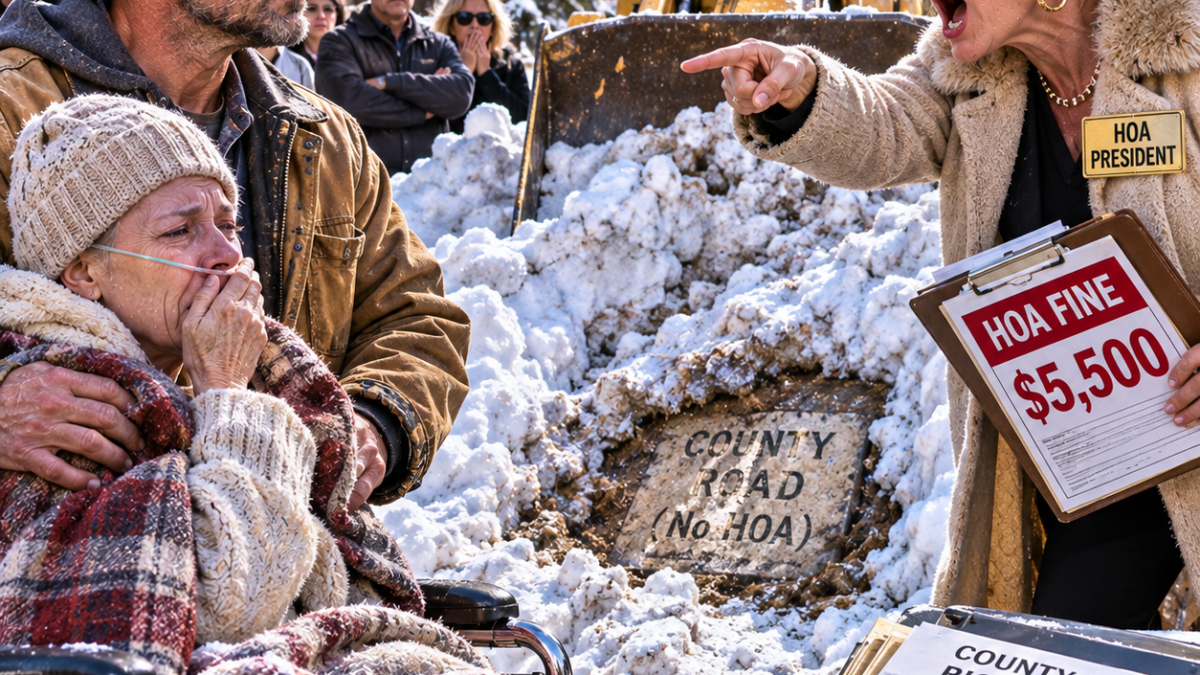
“PAY THE $5,500 FINE, REX—AND IF YOUR SICK WIFE CAN’T HANDLE A LITTLE SNOW, MAYBE YOUR FAMILY DOESN’T BELONG IN STONEFIELD MANOR!” HOA president Cordelia Ashford screamed on my front porch while my sixteen-year-old daughters stood behind me, watching the woman who had ordered truckloads of dirty road snow dumped across our property now threaten to put a lien on the house we’d inherited after selling nearly everything to pay for their mother’s chemotherapy.
What Cordelia didn’t know was that the forty-two-foot section of roadway her entire subdivision depended on crossed land my late Uncle Pete had never sold, and hidden among his old papers was a handwritten permission letter proving the HOA’s supposed ownership had begun as a temporary favor—not the permanent legal right she had been boasting about for thirty-six years.
And when Cordelia brought her lawyer and a crowd of furious homeowners to stop my bulldozer from building a massive wall out of the very snow she’d dumped on us, she had no idea that sixty witnesses, a television camera, a licensed surveyor, and the HOA’s own financial records were about to expose who really owned the land—and where the neighborhood’s missing road-maintenance money had been going.
At 6:47 on the morning of December fifteenth, I woke to the sound of diesel engines.
Not one.
Four.
They rumbled outside our bedroom window with the low, grinding sound of heavy equipment working under load.
For twenty-five years, I’d operated construction machinery. Backhoes, excavators, loaders, dozers, compactors. I could identify most engines from the sound before seeing the machine.
These were snowplows.
Working hard.
Much too close to our house.
I slid out of bed carefully.
Sarah was finally sleeping.
She’d been awake most of the night after chemotherapy, nauseated and shivering despite the blankets I’d piled around her.
I didn’t want to wake her.
I crossed the bedroom and pulled back the curtain.
Then I stood perfectly still.
Four HOA snow-removal trucks were pushing snow off Stonefield Manor’s private street and directly onto our front property.
Not toward the development’s designated storage area.
Not onto public land.
Onto ours.
A truck lifted its blade and rolled another enormous wave of compacted snow across the narrow strip beside our driveway.
Gray slush spilled over the lawn.
Ice chunks tumbled toward the front steps.
Road salt and sand mixed into the piles.
One plow reversed, scraped another load from the street, and came back for more.
I stared at the growing mountain.
Then looked toward the garage.
Our driveway was almost completely blocked.
My truck couldn’t get out.
Sarah’s car couldn’t get out.
And if she needed to return to the hospital that morning, we were going nowhere until somebody cleared the entrance.
I threw on jeans, boots, and a winter coat.
By the time I reached the front yard, a third load had fallen.
“HEY!”
The closest driver glanced toward me.
I waved both arms.
“STOP!”
He shut down the blade but kept the engine running.
I walked through snow above my ankles.
“What the hell are you doing?”
He lowered his window.
“Snow removal.”
“On whose property?”
He looked at the pile.
Then at me.
“HOA told us to put it here.”
“This isn’t an HOA snow-storage area.”
He shrugged.
“Where else are we supposed to put it?”
That was the first sentence that made me understand how little anybody involved cared.
Not:
Sorry.
Not:
I thought this was common land.
Not even:
Let me call my supervisor.
Where else are we supposed to put it?
As if my yard existed because their snow needed somewhere to go.
I pointed at the development.
“There’s a designated storage lot near your maintenance shed.”
“That’s full.”
“Then arrange proper removal.”
He laughed.
“Buddy, I’m just doing my job.”
“Then call whoever gave you the order.”
He glanced toward the other trucks.
“I don’t have time for this.”
“Make time.”
He sighed, reached for his radio, and spoke to somebody I couldn’t hear.
I waited in the cold.
The wind cut through my coat.
Behind me, our front door opened.
Sarah stood there.
Gray sweatshirt.
Soft knitted cap.
One hand braced against the doorframe.
My heart dropped.
“Sarah!”
She looked at the driveway.
Then the snow mountain.
“What happened?”
I turned back toward the driver.
“Don’t move another blade onto my property.”
He lifted both hands.
“Take it up with Cordelia.”
Cordelia Ashford.
Of course.
The name alone made something in my chest tighten.
I hurried back toward Sarah.
“Get inside, sweetheart.”
Her eyes moved toward the driveway.
“Can we get out?”
“I’m handling it.”
She looked at me.
“Rex.”
“What?”
“My appointment is at nine.”
I stopped.
The hospital was forty minutes away in good weather.
Our oncologist had already adjusted her schedule twice because treatment-related complications made travel difficult.
We couldn’t simply miss another appointment.
I looked over my shoulder.
The plow driver was speaking into his radio again.
Then he said something that would stay with me for months.
“Lady, maybe your husband ought to shovel faster.”
Sarah heard him.
I saw it.
Her face changed.
Not anger.
Humiliation.
My wife had spent three decades caring for other people.
Before she became sick, she was the woman who brought meals to neighbors, baked Christmas cookies for teachers, and remembered which elderly people on our old street needed help during storms.
Now she stood in our doorway, weak from chemotherapy, while a stranger mocked her husband for failing to clear somebody else’s snow quickly enough.
I turned back toward the driver.
“Get off my property.”
He rolled up his window.
The four trucks left.
The snow stayed.
And that was how Cordelia Ashford officially began her war with my family.
My name is Rex Cavanaugh.
I was fifty-three that winter.
Twenty-five years in heavy equipment.
Former Army combat engineer.
Husband to Sarah.
Father to sixteen-year-old twins, Emma and Grace.
And until December 2023, a man who believed the worst things life had to offer were behind him.
I was wrong.
Three years earlier, Sarah had been diagnosed with breast cancer.
Treatment became the organizing principle of our lives.
Not birthdays.
Not holidays.
Not work schedules.
Treatment.
Appointments.
Scans.
Blood tests.
Medication.
Insurance calls.
Hospital parking garages.
Weeks when she felt almost normal.
Then weeks when walking from the bedroom to the kitchen exhausted her.
Medical bills piled up even with insurance.
We sold our larger house.
Used savings.
Cut expenses.
Told the girls we were downsizing because we wanted a simpler life.
They knew better.
Sixteen-year-olds understand more than adults want to admit.
Then Uncle Pete died.
Peter Cavanaugh.
My father’s older brother.
A retired carpenter who had lived alone on the corner property at Stonefield Manor for nearly forty years.
He left me his house.
Three bedrooms.
Old furnace.
A garage big enough to hold tools.
A small yard.
And a piece of land at the entrance to the subdivision that would eventually become the most important forty-two feet in Colorado.
Uncle Pete wasn’t wealthy.
He didn’t leave us a fortune.
He left us somewhere to live without a mortgage.
That was worth more than gold.
For the first time in months, Sarah had cried from relief instead of fear.
“We can breathe,” she’d whispered when we first walked inside.
The twins chose bedrooms.
Emma picked the one facing the mountains.
Grace chose the room with the larger closet.
Sarah claimed the little breakfast nook by the kitchen window.
And I claimed the garage.
I brought over my tools, workbench, and an old bulldozer I had restored over the years.
A weathered yellow machine I called General Patton.
The girls hated the name.
Sarah loved it.
“Only you would name a bulldozer after a general,” she’d said.
“It’s a very distinguished bulldozer.”
“It’s forty years old.”
“Experienced.”
“It’s loud.”
“Commanding.”
She laughed until she had to sit down.
That was the life I wanted.
Small.
Ordinary.
Safe.
Then Cordelia decided we owed the HOA $5,500 for the snow her own contractors had dumped onto our land.
And the funniest part?
At the time, she had no idea that the road she used to justify the fines was sitting on property she didn’t own.
PART2
The first fine arrived three days after the snow dumping.
I found it tucked beneath the windshield wiper of my truck.
Official Stonefield Manor letterhead.
Gold embossed logo.
A signature printed in dark blue at the bottom.
Cordelia Ashford, HOA President.
The notice stated:
VIOLATION: EXCESSIVE SNOW ACCUMULATION AND FAILURE TO MAINTAIN SAFE ACCESS.
FINE: $500.
I stared at it.
Read it again.
Then laughed.
Not because it was funny.
Because the alternative was throwing the paper through a window.
They dumped the snow.
Blocked our driveway.
Made us nearly miss Sarah’s treatment.
And now wanted five hundred dollars because the snow was there.
I went inside.
Sarah sat at the kitchen table sorting medication receipts.
Emma was making toast.
Grace was finishing an assignment on her laptop.
Sarah looked up.
“What’s wrong?”
I placed the notice in front of her.
She read.
Her expression changed.
“Is this a joke?”
“No.”
“They fined us for the snow they put here?”
“Yes.”
Grace leaned over.
“Five hundred dollars?”
Emma picked up the notice.
“Dad, that’s more than Mom’s prescription copay last month.”
Sarah lowered her eyes.
That was the part that hurt.
The girls were tracking medical expenses.
They shouldn’t have needed to.
They should have been thinking about school dances, driving tests, colleges, and who liked whom.
Instead, Emma knew the amount of our prescription copays.
Grace knew which insurance claims were still pending.
Both knew that five hundred dollars could mean groceries, transportation, or another month of uncertainty.
I picked up the notice.
“Nobody’s paying this.”
Grace looked worried.
“Can they make us?”
“Not without establishing a legal basis.”
Emma asked:
“What if they put something against the house?”
I turned toward her.
“Why would you think that?”
She hesitated.
“Cordelia talked about liens at the last neighborhood meeting.”
I stared.
“When did you go to an HOA meeting?”
“School civics assignment.”
Grace looked up.
“She said people who break rules deserve consequences.”
Sarah took Emma’s hand.
“Sweetheart, this isn’t your problem.”
Emma’s expression changed.
“But it is.”
She looked at me.
“If they can take money from us for something they did, what else can they do?”
I didn’t answer immediately.
Because that was exactly what I intended to find out.
Cordelia’s house stood on the far side of Stonefield Manor.
Two stories.
Oversized columns.
A circular driveway.
Christmas decorations that probably required a professional installation crew.
Her white Mercedes sat outside.
License plate:
QUEEN BEE.
I stood on her porch holding the violation notice.
She opened the door in a cream sweater and pearl earrings.
Even at ten in the morning, she looked prepared for a fundraiser.
“Mr. Cavanaugh.”
“Mrs. Ashford.”
She looked down at my boots.
“Can I help you?”
“Yes.”
I held up the notice.
“Explain this.”
She glanced at it.
Then smiled.
“Oh, your snow violation.”
“My what?”
“Your snow violation.”
She said it like the words had existed since the Constitution.
“Your property is creating a safety hazard near the neighborhood entrance.”
“Your contractors put the snow there.”
“Our contractors maintain community roads.”
“By dumping onto my land?”
“That area has been used for neighborhood operations for decades.”
I stared.
“Who told you that?”
“Your uncle understood the arrangement.”
“Uncle Pete permitted cars to use a section of the road.”
“Snow storage was never part of that.”
Cordelia’s smile narrowed.
“Mr. Cavanaugh, we have prescriptive rights.”
I knew enough to recognize a legal claim when I heard one.
I also knew she’d just used a complicated term as if it ended the discussion.
“Show me the easement.”
She blinked.
“Excuse me?”
“The recorded easement.”
“Deed restriction.”
“Whatever document gives the HOA the right to use my property for snow disposal.”
She crossed her arms.
“That is board information.”
“County easement records aren’t secret board information.”
Her face reddened.
“You’ve lived here barely a month.”
“My uncle owned this land for decades.”
“And he cooperated.”
“He was kind.”
“Don’t confuse the two.”
Cordelia stepped forward.
“I don’t appreciate your tone.”
“And I don’t appreciate four trucks leaving chemically treated snow against my house.”
She laughed.
“Chemically treated?”
“Road salt.”
“Sand.”
“Dirty plow runoff.”
“Whatever was on the street.”
“That is normal winter maintenance.”
“Then keep it where you’re authorized to maintain.”
She smiled again.
This time colder.
“Mr. Cavanaugh, perhaps you’re unfamiliar with how civilized neighborhoods operate.”
I looked at her pearls.
Her perfect porch.
The wreath that probably cost more than my winter tires.
“I know how roads operate.”
“I’ve spent twenty-five years running heavy machinery.”
“Then you should understand snow has to go somewhere.”
“I do.”
I leaned closer.
“But not onto somebody else’s property just because it’s cheaper.”
She stared.
Then said:
“Your uncle never caused problems.”
The words hit harder than they should have.
Uncle Pete was dead.
He’d left us the house because he loved us.
And this woman was using his memory as a weapon.
I lowered my voice.
“My uncle isn’t here for you to speak for anymore.”
“I’m asking for documentation.”
“You can send it to me or my attorney.”
“You have ten days.”
Her eyes narrowed.
“Are you threatening the association?”
“No.”
“I’m giving you the same amount of time you gave me to pay a fine for your snow.”
I walked away.
Behind me, she called:
“You will regret making yourself difficult, Mr. Cavanaugh.”
I kept walking.
I didn’t know yet how much she meant it.
The next morning, the neighborhood received an email.
Subject:
DANGEROUS PROPERTY OWNER THREATENS COMMUNITY ACCESS.
Cordelia described me as hostile.
Aggressive.
Uncooperative.
A threat to safe winter operations.
She claimed I’d attempted to intimidate her on her own doorstep and demanded that the HOA abandon decades of necessary road maintenance.
By noon, three residents had come to our house.
Jim Martinez.
Janet Pierce.
And a retired firefighter named Harold Wilson.
They weren’t angry.
They looked confused.
Jim held a copy of the email.
“Rex, is this true?”
I invited them inside.
Sarah put coffee on.
Jim looked at the snow outside.
“Holy hell.”
“That’s all from the street?”
“Every bit.”
Janet stared.
“Cordelia said you refused to clear your own driveway.”
I laughed.
“That’s one way to describe it.”
I showed them the camera footage from my driveway security system.
Four trucks.
One after another.
Blades pushing snow across the property line.
Janet covered her mouth.
“They did that deliberately?”
“Yes.”
Harold leaned closer.
“That’s not normal snow disposal.”
“No.”
Jim looked toward the street.
“You know the HOA charges all of us two hundred dollars a year for road maintenance.”
I stopped.
“What?”
“Separate from regular dues.”
“Two hundred per home?”
“Yes.”
“How many homes?”
“Two hundred.”
I did the math.
Forty thousand dollars.
Annually.
For a road Cordelia claimed the HOA owned.
Jim continued.
“And Cordelia says snow removal is expensive because the entrance is complicated.”
I looked at Sarah.
She looked at me.
Something about that sentence bothered me.
Not simply because it was unfair.
Because the trucks were saving money by dumping on our land.
Where was the money residents were paying for proper removal?
I looked back at Jim.
“Do you have the HOA budget?”
“Some.”
“Can I see it?”
He nodded.
“Sure.”
That was the first crack in Cordelia’s story.
It started with a neighbor who wanted to understand his own maintenance bill.
The next few days were miserable.
Snow continued falling.
The original piles partially melted during daylight, then froze into hard, dirty ridges.
Salt runoff stained the lawn.
Our driveway remained difficult to enter until I hired equipment to clear a safe path.
I documented the work.
Photographs.
Contractor invoice.
The amount of snow removed.
The locations where it had been deposited.
Every call to the HOA.
Every response.
Every refusal.
Sarah watched from the kitchen.
One afternoon she whispered:
“I’m sorry.”
I turned.
“For what?”
“All this.”
I stared at her.
“Sarah, what are you talking about?”
“We only moved here because I got sick.”
“If we hadn’t needed the house—”
I crossed the kitchen.
Sat beside her.
“Stop.”
She looked down.
I took both her hands.
“We moved because Uncle Pete loved us.”
“We moved because we needed somewhere we could afford.”
“We moved because this is home now.”
“None of that gives Cordelia a right to treat us this way.”
Sarah cried quietly.
“I just don’t want the girls to lose another house.”
That sentence hollowed me out.
We’d already sold the first one.
The house where Emma and Grace learned to ride bicycles.
Where Sarah hosted Thanksgiving.
Where we’d celebrated our twentieth anniversary.
The house with pencil marks along the pantry doorway recording the girls’ height every birthday.
We’d walked away because the medical bills were bigger than our savings.
Now Sarah was afraid this woman could take the replacement too.
I pressed her hands against my chest.
“Listen to me.”
“This house isn’t going anywhere.”
She looked at me.
“Promise?”
I wanted to give her absolute certainty.
But we had already learned how easily life destroyed promises.
So I said:
“I promise I’ll do everything lawfully possible to protect it.”
She nodded.
That was enough.
For then.
The second fine arrived the following Monday.
I had spent part of the weekend moving snow away from our driveway and onto a section of our own land where it could safely be managed.
One small amount ended up redistributed near the roadside area used by the HOA, which gave Cordelia another excuse.
The notice was waiting at our door when we returned from Sarah’s appointment.
UNAUTHORIZED SNOW RELOCATION.
DAMAGE TO COMMUNITY COMMON AREA.
FINE: $5,000.
I stared.
Five thousand.
Added to the original five hundred.
$5,500.
The exact amount of several months of the medical costs we’d been struggling to manage.
Sarah saw it.
Her face went pale.
“Rex.”
I shook my head.
“Don’t worry.”
“Five thousand dollars?”
“They can’t just write down numbers and make them valid.”
“But what if they try?”
I looked at the notice.
Cordelia’s signature.
A deadline.
Threatened collection action.
And a sentence stating that failure to comply could affect property ownership rights.
It was written to frighten.
It worked.
Not because I believed her legal claims.
Because Sarah was frightened.
That was what made me furious.
Cordelia wasn’t simply demanding money.
She was taking our weakest moment and making it more painful.
I called our family attorney.
Tony Braden.
He had handled Uncle Pete’s estate.
“Tony.”
“Rex.”
“You busy?”
“Depends.”
“Do you enjoy HOA disputes?”
He sighed.
“Absolutely not.”
“Good.”
“Because I’ve got one.”
Tony looked at the fines, the recorded deed, the snow footage, and Cordelia’s emails.
He remained quiet for a long time.
Then said:
“First thing, we separate what the HOA can lawfully regulate from what Cordelia wishes it could regulate.”
“Okay.”
“Second, we investigate the road.”
“Third, we do not assume absence of a recorded easement automatically means the road can be closed.”
I nodded.
“Prescriptive rights?”
“Potentially.”
“Other implied rights?”
“Possibly.”
“But Uncle Pete allowed them to use it.”
“That matters.”
He looked at me.
“Can you prove it?”
“Not yet.”
“Then that’s our priority.”
He leaned back.
“Colorado property law is more complicated than Cordelia’s threats or the internet’s explanations.”
“I understand.”
“A long-used access road can raise legitimate claims.”
“Permissions can defeat some theories of adverse use, but the facts matter.”
“I understand.”
“And Rex?”
“What?”
“Don’t build anything that blocks emergency access while title and access issues are unresolved.”
I sighed.
“You heard about the bulldozer?”
He smiled faintly.
“Everybody in town knows you named it General Patton.”
“It’s a good machine.”
“I’m sure it is.”
“Doesn’t mean you get to use it as a judicial remedy.”
I laughed despite myself.
“Fine.”
He stood.
“Let’s find Uncle Pete’s documents.”
Chuck Morrison arrived with a survey crew three days later.
He had spent thirty years surveying mountain properties.
He wore a battered canvas jacket and spoke only when he had something useful to say.
I liked him immediately.
The work took most of the day.
Boundary monuments.
County survey references.
Old plat maps.
Field measurements.
By dusk, Chuck had a preliminary picture.
He spread the drawing over my kitchen table.
“Here.”
He pointed toward the entrance road.
“This is the parcel boundary.”
“Okay.”
“Here’s the street.”
I leaned in.
The road entered our land before curving into Stonefield Manor.
“How far?”
“Approximately forty-two feet at the relevant crossing section.”
I stared.
“Forty-two feet of the subdivision road is on Uncle Pete’s property?”
“Now your property.”
“Yes.”
“Ownership is one issue.”
“Access rights are another.”
I nodded.
Chuck continued.
“The survey establishes where the road sits.”
“It does not, by itself, determine whether an easement or other access right exists.”
“Tony said the same.”
“Smart lawyer.”
He pointed again.
“The recorded plat doesn’t show the dedication Cordelia says exists.”
“Could there be something else?”
“Sure.”
“Find it in the title history.”
I looked at the drawing.
For the first time, the road made sense.
Uncle Pete had always called it “the shortcut.”
He said the neighborhood developers had run out of money during construction.
He let people use a small part of his land because otherwise some homes would have been inconvenient to reach while the street plan was sorted out.
I remembered him telling me that once when I was eighteen.
“Never thought they’d be using it forever.”
At the time, I hadn’t cared.
Now I wished I’d asked him a hundred questions.
We searched the county records.
Plats.
Deeds.
Old development filings.
Utility records.
Correspondence.
The subdivision had been planned in the late 1980s.
Stonefield Construction intended to connect its private street to the public road through a section that required additional land rights.
The developer ran into problems.
Permits.
Wetland restrictions.
Financing.
Then bankruptcy.
The HOA formed.
Road maintenance continued.
But the recorded paperwork was incomplete.
A transportation plan was not a deed.
A proposed dedication was not the same as an accepted public road.
And a paved surface didn’t tell us who owned the land underneath it.
Tony looked through the documents.
“Cordelia has been treating uncertainty as proof of ownership.”
“Can she claim they’ve always used it?”
“Yes.”
“Does that establish the full right she claims?”
“Not automatically.”
“What about snow storage?”
“Even a lawful access easement doesn’t automatically authorize every use somebody can imagine.”
That sentence stayed with me.
A right to pass was not necessarily a right to dump.
A road was not automatically a landfill.
And an HOA president wasn’t automatically a property owner just because she carried a gavel.
But we still needed the document proving Uncle Pete’s permission.
Without it, Cordelia might argue long-standing use had created rights independent of his generosity.
And I was not going to gamble our family’s house on an assumption.
Cordelia called an emergency HOA meeting.
I attended with Tony.
The community center was packed.
Residents stood along the walls.
People whispered when I entered.
Cordelia sat at the front behind a polished table.
White blouse.
Pearl necklace.
Silver gavel.
She waited until everyone quieted.
Then smiled.
“Before we begin, I’d like to address recent misinformation concerning our neighborhood entrance.”
She looked directly at me.
“Some residents have been distributing unverified maps and making baseless accusations against this board.”
I remained seated.
She continued.
“Stonefield Manor has used its access road continuously since 1987.”
“We have therefore established rights that no disgruntled individual can simply revoke.”
A resident raised his hand.
“What rights?”
Cordelia ignored him.
“Our legal counsel is examining the matter.”
Jim Martinez stood.
“Then why are we paying to maintain a road the HOA doesn’t own?”
The room stirred.
Cordelia glared.
“Jim, please follow procedure.”
He sat.
Then Janet Pierce stood.
“Did you dump neighborhood snow on Rex’s property?”
Cordelia’s face tightened.
“Routine snow placement is an operational necessity.”
“Is that a yes?”
“This meeting is not about personal grievances.”
Tony leaned toward me.
“Let her talk.”
Cordelia continued for ten minutes.
Safety.
Property values.
Community harmony.
Established patterns.
Legal traditions.
Every phrase sounded polished.
None answered the basic question.
Where was the actual document?
Eventually she opened the floor for comment.
I stood.
“My name is Rex Cavanaugh.”
“I own the corner property at the entrance.”
A few people nodded.
“I have three questions.”
Cordelia sighed.
“Proceed.”
“One.”
I held up the snow photographs.
“Who authorized four trucks to deposit neighborhood snow onto my property on December fifteenth?”
Cordelia smiled.
“Operational decisions are made by management.”
“Was it you?”
“Management.”
“Two.”
I held up the violation notices.
“Under what authority did the HOA fine me $5,500 for snow its contractors deposited?”
“Your property created a hazard.”
“Because your contractors put the snow there.”
“That is your interpretation.”
I looked at the residents.
“Would anyone like to see the video?”
The room erupted.
Cordelia banged the gavel.
“ORDER!”
I waited.
Then raised my third document.
“Three.”
“Where is the recorded easement or other legal instrument that supports the board’s claim of permanent road rights over my property?”
Cordelia leaned back.
“Mr. Cavanaugh, the HOA is not required to justify decades of established community operations to someone who has lived here a few weeks.”
A woman near the back said:
“He owns the land.”
Cordelia snapped:
“He owns a house near the road.”
Tony stood.
“Actually, the recorded deed and survey place the disputed crossing within his parcel.”
Silence.
Cordelia looked at Tony.
“And you are?”
“Anthony Braden.”
“Counsel for Mr. Cavanaugh.”
She smiled coldly.
“Then I’m sure you understand the doctrine of prescriptive rights.”
“I understand it well enough not to assume it applies without evidence.”
The room went quiet again.
Tony continued.
“We’ve asked for your supporting documentation.”
“We remain willing to review it.”
“If you have it, produce it.”
Cordelia’s face reddened.
“This board will not be bullied.”
A man stood.
“Then show us the papers!”
Another voice:
“Why are our road fees so high?”
Someone else:
“Did we really fine him for your snow?”
Cordelia slammed the gavel.
“MEETING ADJOURNED!”
People shouted.
Chairs scraped.
The room dissolved into arguments.
As I gathered my folder, Cordelia approached.
She leaned close enough that only Tony and I could hear.
“You think this is funny?”
“No.”
“You have no idea how much money this association can spend making your life miserable.”
I held her gaze.
“Then maybe the homeowners should know that’s what you intend to spend it on.”
Her face changed.
For the first time, Cordelia looked less angry than afraid.
The attorney letter arrived two days later.
Thick envelope.
Expensive stationery.
Long paragraphs of threats.
The HOA’s law firm asserted potential prescriptive access rights and demanded that I stop interfering with road operations.
They also ordered me to remove survey markers and pay the disputed fines.
Tony reviewed it.
“What do you think?”
I asked.
“I think they are preserving every argument they might have.”
“Can they win?”
“They could establish some rights depending on facts we haven’t resolved.”
“And the fines?”
“We challenge them separately.”
I stared at the snow outside.
“I’m tired of reacting.”
Tony looked up.
“Then gather what we need.”
“Uncle Pete’s letter.”
“I’ll find it.”
Christmas Eve arrived without the normal feeling of Christmas.
Emma and Grace decorated the tree.
Sarah sat on the couch helping untangle lights.
She tired quickly.
But she refused to let the girls do everything alone.
At one point, Grace stepped onto a chair to hang an ornament.
Sarah laughed.
“Your father used to put the angel on crooked every year.”
I looked up.
“I did not.”
Emma grinned.
“You absolutely did.”
“Your mother has been poisoning your memories.”
Sarah smiled.
“Yes.”
“And I’m very good at it.”
For a moment, everything felt normal.
Then the doorbell rang.
Another HOA notice.
This one warned that unpaid fines could lead to collection action and that the board intended to pursue formal recognition of its claimed access rights.
Sarah read it.
The color drained from her face.
“On Christmas Eve?”
I took it from her.
“Don’t give her the holiday.”
She looked at me.
“What?”
“Cordelia has already taken enough.”
I placed the notice in a folder.
“We’ll deal with this after Christmas.”
The girls watched.
Emma said:
“Dad?”
“Yeah?”
“What if we can’t keep the house?”
Sarah closed her eyes.
I sat beside my daughters.
“Listen.”
“This isn’t about whether we have the money to pay a ridiculous demand.”
“It’s about whether that demand is valid.”
“And we’re getting help.”
Grace asked:
“Can they take it?”
I swallowed.
“Not simply because Cordelia wrote a threatening letter.”
Emma’s eyes filled.
“Promise?”
I looked at both girls.
Then at Sarah.
“I promise we won’t surrender the house because somebody is trying to scare us.”
That was the truth I could give.
And I could keep it.
On Christmas morning, after presents and breakfast, I went through Uncle Pete’s remaining boxes.
Not the courthouse.
It was closed.
The boxes in our basement.
Old bank statements.
Car manuals.
Receipts.
Photographs.
Hardware-store invoices.
Handwritten notebooks.
Uncle Pete kept everything.
Sarah joked he had never thrown away a screw because he worried somebody would need it in 2050.
I sorted for hours.
Then Grace came downstairs.
“Dad?”
“Yeah?”
“What are you looking for?”
“A letter.”
“From who?”
“Uncle Pete.”
“What does it say?”
“Hopefully that he let the neighborhood use the road.”
She crouched beside a box.
“Would he have kept a copy?”
“Probably.”
“Where?”
I looked around.
“Your guess is as good as mine.”
Grace picked up an old metal file box.
“What’s this?”
I stared.
I’d seen it a dozen times.
It sat beneath a stack of woodworking magazines.
Small.
Brown.
Rust around the clasp.
Inside were folders labeled by year.
My heart accelerated.
I pulled out the 1988 folder.
Property taxes.
Road correspondence.
One handwritten letter.
January fifteenth, 1988.
Addressed to the original Stonefield Manor board.
Signed:
Peter Cavanaugh.
I read.
Then read again.
Uncle Pete wrote that he understood the neighborhood needed temporary access across his property while the developer’s road arrangement remained unresolved.
He granted permission for ordinary travel as a neighborly accommodation.
He requested that the board keep him informed about a permanent solution.
He made clear that the permission did not transfer ownership.
I sat on the basement floor.
Grace stared.
“Dad?”
I looked up.
“We found it.”
“What?”
“Uncle Pete’s letter.”
She smiled.
“Is that good?”
I started laughing.
Then crying.
Both.
“Sweetheart, I think it’s very good.”
She threw her arms around me.
We carried the file upstairs.
Sarah read the letter.
Then pressed her hand over her mouth.
“Oh, Pete.”
Emma leaned closer.
“He wrote all that?”
“Yes.”
Sarah looked at me.
“He knew somebody might need it one day.”
I shook my head.
“He was just careful.”
“Same thing sometimes.”
I called Tony the next business day.
He reviewed the original with the rest of the title evidence.
His expression changed.
“This is significant.”
“Does it settle everything?”
“Not by itself.”
“Of course.”
“But it directly addresses how use began.”
“Permission.”
“Yes.”
“And it’s contemporaneous.”
“That’s important.”
I leaned back.
“For the first time, I feel like Uncle Pete is still protecting us.”
Tony smiled.
“Then let’s make sure we use what he left correctly.”
The next discovery came from Jim Martinez.
He knocked after dinner carrying a manila folder.
He looked nervous.
“Rex.”
“Come in.”
Sarah had already gone upstairs.
The girls were doing homework.
Jim sat at the kitchen table.
“I think the road stuff is worse than anybody knows.”
He opened the folder.
HOA budgets.
Management invoices.
Road-maintenance categories.
Snow-removal contracts.
Special assessments.
I read slowly.
Ashford Property Services.
The name appeared repeatedly.
“Who’s that?”
Jim stared.
“Cordelia’s company.”
I looked up.
“What?”
“She owns it.”
I read again.
Ashford Property Services billed the HOA for road maintenance coordination and snow-management administration.
Some of those bills were substantial.
Jim pointed.
“Look at 2023.”
Forty-seven thousand dollars.
“What did they actually spend on snow removal?”
“That’s what I’m trying to understand.”
He slid over vendor invoices.
The actual plow contractor’s invoices appeared much lower.
Not necessarily the entire cost of maintenance.
But different enough to raise questions.
“Where’s the rest?”
Jim shook his head.
“Management charges.”
“Consulting.”
“Administrative support.”
“I’m not saying all of it is stolen.”
“I’m saying nobody can explain it.”
I looked at him.
“How did you get these?”
“Architectural committee access.”
“Some budgets are shared with committee members.”
“I requested other documents as a homeowner.”
“Did Cordelia approve her own company’s contract?”
Jim nodded.
“The board did.”
“Was the conflict disclosed?”
“Not clearly.”
He leaned forward.
“There’s more.”
The HOA had recently approved a special assessment.
Five hundred dollars per homeowner.
Two hundred homes.
Another one hundred thousand dollars.
Purpose:
Legal defense and infrastructure protection.
I stared.
“They’re charging the residents to sue me?”
Jim nodded.
“That’s what it looks like.”
I rubbed my face.
Sarah’s hospital bills sat in one folder.
Cordelia’s legal-threat letters in another.
Now two hundred families were being asked to pay an unexpected assessment because their president refused to answer a simple question about land ownership.
Jim whispered:
“My wife is furious.”
“Why?”
“Because we’ve been saving for our daughter’s tuition.”
“And Cordelia says every family has to pay immediately.”
I looked at him.
“What do you want to do?”
“Get the records independently audited.”
“Will people support you?”
Jim smiled bitterly.
“After this?”
“Yes.”
The neighborhood began splitting.
Not neatly.
Some people supported Cordelia.
They feared losing the road.
Others questioned the fees.
A third group hated conflict and wanted everybody to stop talking.
I understood all three.
When your home depends on a neighborhood entrance, uncertainty is frightening.
But uncertainty isn’t a license to lie.
We held an informational meeting at the public library.
Tony came.
Chuck Morrison brought the survey.
Jim brought the budgets.
Janet Pierce helped notify homeowners.
The room filled.
I stood before them.
“I want everyone to understand something first.”
A man near the back crossed his arms.
“You want to block our road.”
“No.”
“I want a lawful resolution.”
“Your street crosses property I inherited.”
“My uncle allowed it temporarily.”
“We have evidence.”
“I am not asking two hundred families to lose access to their homes.”
The room quieted.
I continued.
“I am asking the HOA to stop dumping snow on us, stop threatening unauthorized fines, and deal honestly with the land rights it has never properly documented.”
A woman raised her hand.
“What if your uncle gave permission?”
“Then that is part of the legal history.”
“What happens now?”
“Negotiation.”
“Court review if needed.”
“Safe access planning.”
“Not a surprise road closure.”
That calmed some people.
Then Jim stood.
“And we also need an audit.”
Cordelia’s supporters protested.
Jim held up the invoices.
“These aren’t accusations.”
“They’re questions.”
“Forty-seven thousand billed through a company connected to our president.”
“Separate vendor costs.”
“An additional hundred-thousand-dollar assessment.”
“Where is the accounting?”
Nobody answered.
Then Mrs. Wilson, an elderly homeowner, stood.
“My husband died last year.”
Her voice shook.
“I paid that five-hundred-dollar assessment out of money I was saving for dental work.”
She looked around.
“If it was necessary, fine.”
“But somebody should be able to explain it.”
That was the moment the room changed.
Because the dispute stopped being about me.
It became about everyone who was being told to pay without understanding why.
Cordelia responded with another legal letter.
Then another.
Threats of harassment claims.
Interference with HOA operations.
Defamation.
Collection action.
She demanded I remove survey stakes.
I refused.
Tony answered each letter professionally.
No threats.
No theatrical insults.
Just documentation.
Then the harassment moved from paper to darkness.
At eleven one night, my cameras picked up headlights near the property boundary.
Three vehicles.
Six people.
Cordelia.
Two board members.
Three men I didn’t recognize.
One carried a tool bag.
Another began pulling up survey markers.
I watched on my phone.
My stomach tightened.
I called the sheriff’s department.
Then put on my coat.
Sarah woke as I reached the door.
“Rex?”
“Stay inside.”
“What is it?”
“Someone’s outside.”
She sat up.
“Please be careful.”
I stopped.
Looked at her.
“I will.”
Then went outside.
The cold bit through my coat.
I stopped a safe distance away.
“Evening.”
Six flashlights turned toward me.
Cordelia recovered first.
“Mr. Cavanaugh.”
“Those stakes were placed by a licensed surveyor.”
She folded her arms.
“They create confusion about community boundaries.”
“They mark documented boundary points.”
“They’re unauthorized.”
“On whose land?”
Cordelia’s face tightened.
One of the men stepped forward.
“Sir, I’m Vincent Morrison.”
“Counsel for the HOA.”
I looked at him.
“Then you know this isn’t how boundary disputes are resolved.”
He smiled thinly.
“Property lines are in dispute.”
“That’s why licensed surveyors and courts exist.”
Cordelia snapped:
“We don’t need your permission to maintain our access.”
I looked at the stake in the man’s hand.
“Then put it back.”
He hesitated.
The deputy arrived minutes later.
Asked everyone to remain calm.
Reviewed the available footage.
Looked at the survey.
Then told the group to leave the disputed markers alone pending legal resolution.
Cordelia screamed about rights.
Vincent argued.
The deputy repeated himself.
They left.
Not arrested.
Not humiliated on a livestream.
Just ordered away.
But the footage mattered.
So did the report.
And the fact that Cordelia’s attorney had physically appeared at night while people interfered with survey markers.
Tony was furious when I sent him the recording.
Not at me.
“At eleven at night?”
“Yes.”
“Six people?”
“Yes.”
“One claims to be counsel?”
“Yes.”
He exhaled.
“Preserve everything.”
“I already did.”
“Good.”
Then:
“This has stopped being a normal disagreement.”
I stared out at the snow.
“It stopped being normal when they dumped half the neighborhood onto my yard.”
The next morning, I found something else.
General Patton sat at Jim Martinez’s equipment lot because I planned to use it for lawful snow cleanup and site work once the boundary and access arrangements were clarified.
Two men had entered the lot overnight.
Security footage showed them approaching the bulldozer.
Working near hydraulic components.
Then leaving quickly.
When Jim found the machine in the morning, hydraulic fluid was leaking.
A line had been damaged.
I felt cold.
Not angry.
Cold.
Damaged hydraulic equipment can seriously injure an operator.
If I had started the machine without checking it, somebody could have been hurt.
I called the sheriff.
Then the repair contractor.
The machine stayed shut down.
Evidence was preserved.
No grabbing a shotgun.
No charging across the road.
No deciding I could investigate a potentially dangerous crime myself.
I waited.
Deputy Williams examined the scene.
Photographs.
Tool marks.
Vehicle footage.
Statements.
Jim looked sick.
“Rex, I’m sorry.”
“Why?”
“It happened here.”
“Jim.”
He stared.
“You didn’t do this.”
“What if they come back?”
“Then we increase security.”
He looked at the bulldozer.
“You still going ahead?”
I considered.
Not blindly.
Not because somebody had challenged my pride.
Because now the machine needed repairs, and the planned work had to be reviewed against the risk of escalating a neighborhood access dispute.
I called Tony.
He said:
“Not until we confirm access obligations and emergency arrangements.”
I hated that answer.
It was the correct one.
So I waited.
And while I waited, something happened Cordelia never anticipated.
The investigation into her HOA finances accelerated.
Jim’s documents led to independent review.
The board’s own records raised concerns about self-dealing and inadequate documentation.
The special assessment became a flashpoint.
Residents demanded a meeting under the bylaws.
Cordelia tried postponing it.
Enough homeowners signed the request to force the issue.
For the first time, she couldn’t end a conversation simply by banging her gavel.
The day before the meeting, Sarah asked me to sit with her.
The twins were upstairs.
Snow fell outside.
The house was quiet.
She held one of Uncle Pete’s old photographs.
He stood in front of the house in 1991 wearing a ridiculous red scarf.
Sarah smiled.
“I miss him.”
“Me too.”
“He’d hate all this.”
“He’d probably offer everybody coffee.”
She laughed.
“Then tell Cordelia she was full of it.”
“Absolutely.”
Sarah looked at me.
“Rex.”
“Yeah?”
“I need you to hear something.”
I turned.
Her expression was serious.
“The girls are frightened.”
“I know.”
“They think every time the phone rings somebody is going to take the house.”
My throat tightened.
“I know.”
“They’ve stopped inviting friends over.”
I closed my eyes.
Emma.
Grace.
Both already carrying more fear than children should.
“I’m trying to fix it.”
“I know.”
Sarah took my hand.
“But don’t make winning the only thing they remember about this winter.”
That sentence hit hard.
Because I’d begun planning every day around Cordelia.
Evidence.
Phone calls.
Lawyer.
Records.
Anger.
I woke thinking about her.
Went to sleep thinking about her.
The fight had become its own disease.
Sarah continued.
“I want them to remember Christmas.”
“And the snow.”
“And us.”
“Not just court documents.”
I looked at her.
“What do you want me to do?”
“Finish it.”
“But don’t lose yourself.”
Then she smiled.
“And when it’s over, take me somewhere warm.”
I laughed softly.
“Florida?”
“No.”
“Too many HOAs.”
We both laughed.
For a moment, everything felt lighter.
Then she whispered:
“I want my husband back.”
That hurt more than Cordelia’s fines.
Because I understood.
She wasn’t asking me to surrender.
She was asking me to remember who I was fighting for.
The emergency HOA meeting began at six.
I attended with Tony.
Sarah stayed home.
Emma and Grace wanted to come.
I said no.
Then Grace crossed her arms.
“We’re sixteen.”
“I know.”
“This is our house too.”
I looked at Sarah.
She raised her eyebrows.
I sighed.
“Fine.”
“But you sit with me.”
Emma smiled.
“Deal.”
The community center was packed.
More than a hundred residents.
Cordelia sat at the front.
Vincent Morrison beside her.
The treasurer looked miserable.
Jim Martinez stood near the back with the petition.
Janet Pierce had copies of the financial questions.
The meeting opened with a motion to commission an independent audit and suspend approval of additional legal expenditures until the board explained the road dispute.
Cordelia’s face hardened.
“This is a coordinated attempt to undermine community leadership.”
A resident shouted:
“Then answer the questions!”
She banged the gavel.
“ORDER!”
Jim stood.
“We’re asking where the money went.”
Cordelia glared.
“The financials have been reviewed.”
“By whom?”
“Our management company.”
Jim held up the records.
“Your management company?”
Silence.
He continued.
“Ashford Property Services?”
Cordelia’s jaw tightened.
“That arrangement was properly approved.”
“Then show us the conflict disclosures.”
She looked toward Vincent.
He leaned closer.
Whispered something.
Cordelia stared forward.
Then Janet stood.
“Why did you charge us a hundred thousand dollars in special assessments to fight over land the HOA never bought?”
Cordelia snapped:
“The road is essential!”
Tony raised his hand.
The chair recognized him reluctantly.
“Essential access does not eliminate the need to establish legal rights.”
He placed Uncle Pete’s letter on the projector.
The old paper appeared enormous on the wall.
January 15, 1988.
Peter Cavanaugh.
Temporary permission.
Future resolution expected.
A murmur moved through the room.
Cordelia stood.
“That letter is meaningless.”
Tony remained calm.
“It’s relevant evidence of the original owner’s permission.”
“You’re twisting it.”
“Then present the legal instrument supporting the board’s position.”
Silence.
Cordelia looked at Vincent.
He stood.
“The association continues to assert longstanding access rights and reserves all available legal remedies.”
Tony nodded.
“That’s a position.”
“It’s not proof of ownership.”
A resident shouted:
“SO WHY DID YOU TELL US WE OWNED IT?”
Cordelia slammed the gavel.
“YOU PEOPLE DO NOT UNDERSTAND PROPERTY LAW!”
The room erupted.
Then Emma stood.
My daughter.
Sixteen.
Hands shaking.
I reached toward her.
She looked at me.
“Dad.”
“Please.”
I hesitated.
Then nodded.
Emma faced the board.
“Mrs. Ashford?”
Cordelia looked irritated.
“Yes?”
“Do you know my mom has cancer?”
The room quieted.
Cordelia shifted.
“This is not relevant to tonight’s agenda.”
Emma swallowed.
“It’s relevant to us.”
I felt Sarah’s absence beside me.
Emma continued.
“My parents sold our old house because treatment was expensive.”
“Uncle Pete left us this one.”
“We thought we’d finally be okay.”
Her voice shook.
“Then your trucks dumped snow across our driveway.”
“My mom almost missed an appointment.”
“You fined us five hundred dollars.”
“Then five thousand.”
Cordelia sighed theatrically.
“Sweetheart, adults are discussing complicated—”
Emma interrupted.
“I’m not your sweetheart.”
The room went silent.
She continued.
“My sister checks our mailbox every day because she’s scared there’ll be another letter saying we owe money.”
“Mom cries when she thinks we can’t hear.”
“Dad barely sleeps.”
“And you keep saying it’s about neighborhood safety.”
Tears rolled down her face.
“Whose safety?”
Nobody moved.
Cordelia’s expression hardened.
“Your father has encouraged this kind of hostility.”
Grace stood beside Emma.
“No.”
Her voice was small.
Then stronger.
“He told us not to hate you.”
Cordelia blinked.
Grace continued.
“He told us facts matter.”
“Then show us your facts.”
Silence.
My daughters stood together.
Two sixteen-year-old girls who should never have had to ask powerful adults to stop making their sick mother’s life harder.
For a moment, I hated myself for bringing them.
Then I realized something.
They weren’t weak because they were frightened.
They were brave because they spoke while frightened.
Jim stood.
Then Janet.
Then Mrs. Wilson.
Then more residents.
Not in applause.
In support.
Cordelia looked around and realized the room had stopped waiting for her permission.
The motion passed.
Independent audit.
Financial review.
No further discretionary legal spending without proper authorization.
And a formal requirement that the HOA negotiate lawful access rather than assume ownership.
Cordelia left before the room emptied.
Her Mercedes roared out of the parking lot.
I watched through the window.
For the first time, I didn’t feel the need to chase her.
The following week, Tony called.
“Rex.”
“Yeah?”
“We have a proposed interim access arrangement.”
“What does it say?”
“Emergency and resident passage remain open while ownership and permanent rights are negotiated.”
“Snow dumping stops.”
“Unauthorized fines are suspended pending review.”
“The association will pay for proper removal from your property.”
I sat down.
“Really?”
“Yes.”
“And the road?”
“Still being addressed.”
“Cordelia?”
“The board has restricted her authority pending its internal review.”
I looked toward the kitchen.
Sarah stood making tea.
I smiled.
“Good.”
Then Tony added:
“Now, about your bulldozer.”
I laughed.
“What about it?”
“We can proceed with cleanup and a visible snow-storage berm on your land, but we’re not creating a dangerous twelve-foot wall that traps two hundred households or obstructs emergency vehicles.”
I sighed.
“You take all the fun out of construction.”
“It’s one of my professional talents.”
“What can we do?”
“Something better.”
The plan was simple.
We would take the enormous piles of dirty snow deposited on our property and consolidate them into a controlled berm along the privately owned strip beside the roadway, outside the agreed emergency passage corridor.
Not across the road.
Not into a blind intersection.
Not reinforced with steel rods or designed to injure anyone.
Just a large, visually striking, properly assessed pile of the HOA’s own snow.
A boundary.
A demonstration.
A physical record of what they’d done.
The surveyor marked the permissible area.
The contractor reviewed drainage and visibility.
The interim access agreement preserved a clear route.
We notified the relevant parties.
And then I called Danny Torres.
Old friend.
Union equipment operator.
The sort of man who described construction machinery as if it were a beloved family.
“Danny.”
“Rex.”
“Want to move some snow?”
“How much?”
“Enough that I might need Patton.”
He laughed.
“What did your HOA do now?”
“Pull up a chair.”
By the time I finished the story, he was furious.
“Count me in.”
He brought two experienced operators and suitable equipment.
Not an angry mob.
A legitimate crew.
The hydraulic damage to General Patton had been repaired and inspected.
We would use it for the part of the work it could safely perform.
Danny insisted on checking everything twice.
“Somebody tampered with your equipment,” he said.
“I know.”
“Then nobody starts until we know it’s right.”
“Agreed.”
He slapped the side of Patton.
“Old girl still has life.”
“She’s a general.”
“Of course she is.”
Jessica Chang from Channel 7 came because she was investigating the HOA’s financial issues.
Not because I promised arrests.
I had sent her the documents weeks earlier.
The survey.
Uncle Pete’s letter.
The fines.
The snow footage.
The audit request.
She wanted images for the story.
The snow berm would provide them.
On January eighth, at 7:30 in the morning, our crew began.
General Patton rumbled to life.
Diesel smoke rose into the cold air.
The blade pushed a heavy load of snow across our property.
Danny directed the crew.
Another machine lifted and stacked the compacted material in the marked area.
We kept the road corridor clear.
No blockage of emergency passage.
No vehicles trapped.
No opportunity for someone to claim I had held a neighborhood hostage.
Just a growing white wall beside the road.
Eight feet in places.
Wide enough to be visible from the development entrance.
Striking against the winter landscape.
Jessica filmed from the roadside.
She approached during a pause.
“Rex, what exactly are we looking at?”
I gestured toward the pile.
“Three weeks of snow the HOA dumped on my family.”
“And now?”
“Now it’s on my property in a place I control, while the association arranges lawful removal.”
She looked at the berm.
“It’s enormous.”
“Yes.”
“Is it a protest?”
I considered.
“It’s evidence you can see from the road.”
She smiled.
“That’s a good line.”
“It wasn’t intended as one.”
She laughed.
Then asked:
“Why go to all this trouble?”
I looked toward the house.
Sarah watched through the kitchen window.
Emma and Grace stood beside her.
“Because my wife is sick.”
Jessica’s expression softened.
I continued.
“And some people decided our need for peace meant we were too tired to defend ourselves.”
“They were wrong.”
At 9:45, the white Mercedes arrived.
I heard it before I saw it.
Cordelia drove toward the construction area and stopped hard.
Vincent Morrison climbed out of the passenger side.
Cordelia stared at the snow berm.
Then at the cameras.
Then at me.
Her face turned red.
“STOP THIS IMMEDIATELY!”
Danny shut down the active machine.
The engine’s sudden silence made her voice sound even louder.
Cordelia marched toward the survey markers.
“WHAT HAVE YOU DONE?”
I stood beside Tony.
“Consolidated the snow your contractors dumped on my property.”
“This is retaliation!”
“This is managed snow removal within the surveyed area, with access preserved under the interim agreement.”
She stared at the road.
It remained open.
I could almost see her disappointment.
She had come expecting a blockade.
A chance to shout about children trapped in their homes.
Ambulances unable to pass.
A villainous ranch owner.
Instead, she found a visible snow berm, a clear road, licensed survey stakes, and a lawyer holding the access agreement.
Jessica moved closer.
“Mrs. Ashford, would you like to comment?”
Cordelia turned on her.
“Turn that camera off.”
Jessica remained calm.
“We’re reporting on the dispute.”
Cordelia pointed at me.
“He is harassing this association!”
I said nothing.
She continued.
“He has no right to interfere with community property!”
Tony spoke.
“The work is on Mr. Cavanaugh’s surveyed parcel.”
“YOU PEOPLE KEEP SAYING THAT!”
Cordelia stormed toward a marker.
Grabbed it.
Pulled.
It didn’t immediately move.
She yanked again.
Then wrenched it free.
I stared.
Tony said:
“Mrs. Ashford.”
She threw the stake down.
“There!”
“Your stupid line is gone!”
The crowd went silent.
Jessica’s camera remained recording.
Danny looked at me.
I held up one hand.
Nobody moved toward her.
No shouting.
No confrontation.
Then Deputy Williams arrived.
He had been dispatched after reports of a dispute at the entrance.
He approached calmly.
“What’s happening?”
Cordelia rushed toward him.
“Officer, this man is obstructing community infrastructure!”
Williams looked at the open road.
Then the marked work area.
Then the stake on the ground.
“Ma’am.”
“Did you remove that marker?”
She blinked.
“What?”
“The survey marker.”
She stared at him.
“That thing was unauthorized.”
“Did you remove it?”
Vincent stepped forward.
“My client is asserting the HOA’s rights—”
Williams held up one hand.
“I understand there’s a civil property dispute.”
“But I’m asking about what just happened.”
Cordelia’s jaw tightened.
“Yes.”
“I moved it.”
“Because these people need to know their place.”
Silence.
The words hung in the cold air.
A woman in the crowd gasped.
Jim Martinez looked away.
My daughters, watching from beside our porch, went still.
Williams looked toward the camera.
Then back at Cordelia.
“Ma’am, step away from the work area.”
Cordelia folded her arms.
“No.”
“I’m asking you to step away.”
“This neighborhood belongs to its residents.”
Tony said:
“The road-access issue is being handled through counsel.”
“And you’re interfering with documented work on private land.”
Cordelia pointed at me.
“HE THINKS HE CAN DO WHATEVER HE WANTS BECAUSE HE HAS A BULLDOZER!”
I answered quietly.
“No.”
“I think you should have to follow the same rules you threaten everybody else with.”
She stared.
Then screamed:
“I WILL MAKE SURE YOU LOSE THAT HOUSE!”
From the porch, I heard Grace cry out.
I turned.
Sarah held both girls close.
That was the moment my anger disappeared.
Not because I forgave Cordelia.
Because I saw exactly what my family was watching.
A grown woman in expensive clothes promising to take away their home.
Again.
Enough.
I looked at Williams.
“We’d like the incident documented.”
He nodded.
Cordelia continued shouting.
The deputy instructed her to leave the active work area.
When she refused to comply with further lawful directions and continued interfering, the officers handled the incident under the applicable procedures.
She was detained.
Later, charges relating to property interference were pursued based on the facts and evidence.
There was no instant magical conviction.
No federal agents materializing from nowhere.
But the camera captured her pulling the marker, refusing to back away, and threatening me.
And sixty witnesses had seen it.
That was more than enough to change the public conversation.
By noon, the Channel 7 video was everywhere locally.
Not because the snow berm was a masterpiece.
Because it exposed the contradiction.
The HOA had dumped snow on a sick woman’s property.
Fined the homeowner for it.
Threatened to collect the fines.
Then its president publicly interfered with the cleanup and threatened the family’s house while the road remained open.
Residents shared the footage.
Some were horrified.
Some embarrassed.
Some furious they’d believed Cordelia.
I didn’t watch the comments.
I went home.
Sarah stood by the kitchen table.
Her face was pale.
I approached.
“Are you okay?”
She nodded.
Then shook her head.
I opened my arms.
She stepped into them.
For a long time, we just stood there.
Then she whispered:
“She said she’d take our house.”
“I heard.”
“Could she?”
I kissed her forehead.
“No.”
“She can threaten.”
“She can file claims.”
“She can create expense and delay.”
“But she cannot simply take our home because I asked for proof.”
Sarah started crying.
“I don’t want to be brave anymore.”
That nearly broke me.
I held her tighter.
“You don’t have to be.”
She whispered:
“I’m tired, Rex.”
“I know.”
“I’m so tired.”
“I know.”
Behind us, Emma and Grace stood silently.
I looked at them.
Then held out my hand.
They came.
All four of us stood in the kitchen.
The furnace hummed.
Snow tapped against the window.
For the first time since the dispute began, I stopped thinking about the next legal move.
I simply held my family.
That was the part the cameras didn’t capture.
The part that mattered most.
The HOA held its next emergency meeting without Cordelia chairing it.
The remaining board members faced angry residents.
Jim Martinez presented the audit findings that had become available.
Not every dollar was missing.
Not every fee was fraudulent.
But the financial records showed serious conflicts of interest and unsupported payments involving Ashford Property Services.
Road-maintenance and snow-management expenses had been billed in ways the independent auditor could not adequately reconcile.
The special assessment had been imposed without the transparency residents expected.
The new board voted to terminate the management company’s contract, rescind the disputed special assessment, and pursue recovery where legally supported.
Cordelia’s position became untenable.
Under the association’s procedures, she was removed from leadership.
Residents called for new elections.
Jim and Janet eventually became part of the replacement board.
Their first public message was simple.
We will disclose what we spend, document what we own, and stop treating unanswered questions as disloyalty.
I liked that.
So did Sarah.
The access negotiations took another month.
The new board couldn’t pretend the road wasn’t important.
It served real families.
Emergency vehicles.
Delivery trucks.
School transportation.
People going to work.
The association needed a stable legal solution.
We needed certainty that our land wouldn’t become a permanent dumping ground.
Tony and the HOA’s new counsel developed terms.
A documented access agreement, with legal review of its appropriate property form.
Maintenance responsibilities.
Drainage.
Snow removal.
A defined passage corridor.
Compensation.
No unauthorized storage on our land.
Proper procedures for emergencies.
And clear limits preventing the road agreement from becoming permission for unrelated activities.
There was no need to trap cars behind a twelve-foot barricade.
The legal problem had an actual legal solution.
And because the homeowners finally knew what was happening, the agreement didn’t need to be hidden behind Cordelia’s slogans.
The HOA also agreed to cover the cost of removing the remaining snow piles and restoring the damaged lawn.
The disputed $5,500 in fines was withdrawn.
That alone made Sarah cry.
When Tony called with the news, she sat at the kitchen table for a full minute holding the phone.
“Gone?”
I nodded.
“Gone.”
“All of it?”
“Yes.”
She closed her eyes.
Then whispered:
“Thank God.”
Emma cheered.
Grace hugged her.
And I realized how deeply those two pieces of paper had haunted our house.
Not because they were legally sound.
Because they were designed to make frightened people feel powerless.
The moment they were gone, the house seemed to breathe again.
The financial case continued.
Records were reviewed.
Witnesses interviewed.
The management-company payments examined.
Some matters led to civil recovery efforts.
Others were referred to appropriate authorities for investigation.
Cordelia’s legal team disputed allegations.
She was entitled to that.
Due process mattered even when I disliked the person involved.
Eventually, the combination of findings and proceedings resulted in meaningful financial and professional consequences for Cordelia and her company.
The important thing wasn’t a theatrical prison sentence.
It was that residents obtained an accounting, the management arrangement ended, and the money questions could no longer be buried under threats.
I testified about what I’d personally seen.
The snow dumping.
The fines.
The survey-marker incident.
The camera footage.
I didn’t claim to know things I hadn’t seen.
Tony insisted.
“Rex, credibility is more useful than anger.”
He was right.
Even when it annoyed me.
The most surprising thing came from Vincent Morrison.
Cordelia’s attorney.
He sent Tony a letter after the civil dispute was resolved.
Not an apology for representing his client.
Attorneys represent clients.
That alone wasn’t wrongdoing.
He acknowledged that the claims and threats made during the conflict had outpaced the evidence available to support them.
He expressed regret for how the dispute had escalated.
Then he asked whether the firm could contribute to a veterans’ legal assistance program I had mentioned during negotiations.
Tony handed me the letter.
I stared.
“Is this a joke?”
“No.”
“What do you think?”
I looked toward the garage.
General Patton sat quietly inside.
“I think people can reconsider things.”
Tony smiled.
“That’s a mature answer.”
“Don’t get used to it.”
The snow berm stood only until conditions made removal appropriate.
Not until spring as a dangerous frozen monument towering over the roadway.
Once the agreement was signed and the HOA arranged proper disposal, we moved the snow.
Professionally.
Safely.
The road remained open.
The boundary documented.
The lawn repaired.
The snow disappeared.
The paperwork remained.
That was exactly how I wanted it.
But Channel 7 had captured enough for the images to live much longer.
General Patton pushing snow.
Cordelia shouting.
The survey stake.
The crowd.
The legal documents.
And my daughter Emma standing beside the porch holding her mother’s hand.
One photograph became widely shared.
Not the most dramatic one.
It showed Sarah wrapped in a blanket, watching from our kitchen window while a bulldozer moved the snow away from our home.
The caption read:
A FAMILY ASKED FOR PEACE. THE HOA SENT FINES.
That was the part people understood.
Six months later, we established a modest property-rights assistance fund with help from Tony, local veterans, and community donations.
Not a giant organization.
Not a money-making business.
A small program helping people access qualified legal guidance, surveys, records, and practical support when facing documented land-use disputes.
The first family was an older couple threatened with unjustified landscaping fines.
The second was a veteran whose neighborhood association kept entering his land to trim trees without permission.
The third was a widow who didn’t understand a recorded easement affecting her driveway.
Tony helped them find proper counsel.
Chuck helped explain surveys.
I helped people organize evidence.
The rule was always the same.
No threats.
No dangerous tricks.
No blocking emergency access.
No assuming a survey answers every legal question.
Document.
Verify.
Get competent help.
Then act.
It wasn’t as satisfying as watching a bulldozer move a mountain of snow.
But it helped people.
And it didn’t require making anyone else unsafe.
By late spring, Sarah had completed another major phase of treatment.
She was still tired.
Still needed monitoring.
But some days, she could walk farther than she had in months.
One Saturday afternoon, she came into the garage.
I was cleaning General Patton.
She leaned against the doorway.
“Rex.”
“Yeah?”
“I’m bored.”
I turned.
That was a beautiful sentence.
For months, she’d been too exhausted to be bored.
“What do you want to do?”
“Something normal.”
“Like?”
“Go to the nursery.”
I stared.
“The plant nursery?”
“Yes.”
“What for?”
“Flowers.”
“We have flowers.”
“Not enough.”
I laughed.
She smiled.
Then:
“And afterward, maybe lunch.”
“In a restaurant.”
“With no discussion of HOAs, easements, fines, survey stakes, or bulldozers.”
I held up both hands.
“Yes, ma’am.”
She stepped closer.
“I’m serious.”
“So am I.”
We drove into town.
Bought pansies and lavender.
Had soup and sandwiches.
Sat beside a window.
Talked about nothing important.
The girls joined us later.
Emma complained about calculus.
Grace talked about a boy from school.
Sarah teased them.
I complained about parking.
Ordinary.
Beautifully ordinary.
I realized halfway through lunch that I hadn’t checked my phone in two hours.
For a man who had spent months watching cameras and answering attorneys, it felt like freedom.
Then came the girls’ seventeenth birthday.
We held a small party in the backyard.
Friends.
Music.
Pizza.
A cake Sarah insisted on decorating herself.
It looked terrible.
She had piped the names crooked.
Emma laughed.
Grace took photographs.
Sarah pretended to be offended.
“Professional decorators are overrated.”
I leaned toward her.
“Absolutely.”
The girls blew out candles.
Friends cheered.
And for one second, Sarah closed her eyes.
I knew what she was thinking.
There had been months when she wasn’t certain she’d see this birthday.
Later, after everyone left, I found her standing in the yard.
She was looking toward the house.
“Sweetheart?”
She smiled.
“Just thinking.”
“About what?”
“The girls.”
I stood beside her.
“They’re getting old.”
“Don’t say that.”
“Why?”
“Because it makes us older.”
She laughed.
Then whispered:
“I almost let Cordelia steal this from me.”
I turned.
“What?”
“I spent so much of winter frightened.”
“Every letter.”
“Every truck.”
“Every phone call.”
“I was scared somebody would take away the only safe place we had left.”
I took her hand.
Sarah looked toward the garage.
“Then you built that ridiculous snow wall.”
“Berm.”
She laughed.
“Whatever you call it.”
“Very respectable engineering.”
“Of course.”
She leaned against me.
“Thank you.”
“For what?”
“For making sure we could have normal days again.”
I kissed her forehead.
“Always.”
The following winter, Stonefield Manor hired a new snow-removal contractor.
The contract specified where snow could be stored, when removal was required, and how private property would be protected.
The HOA published its maintenance budget.
Residents could inspect the relevant records.
The corner entrance was managed under the new access agreement.
And for the first time in years, there was a visible distinction between land owned by the HOA and land belonging to someone else.
It shouldn’t have required a scandal.
But it did.
Jim called before the first big storm.
“Rex.”
“Yeah?”
“Wanted to let you know crews are coming tomorrow.”
I laughed.
“Planning to bury my house?”
“Actually, we’re hauling the excess snow out.”
“Imagine that.”
He sighed.
“You know, normal road maintenance is boring.”
“Good.”
“I’m starting to like boring.”
“Me too.”
The next morning, I watched the snowplows from the kitchen window.
They cleared the street.
Pushed snow into authorized areas.
Removed excess material.
And left our driveway alone.
No confrontation.
No threats.
No fine.
No need to start General Patton.
Sarah stood beside me holding coffee.
She watched for a moment.
Then smiled.
“That’s nice.”
“What?”
“Nothing happening.”
I laughed.
“Best winter entertainment in Colorado.”
People still recognized me sometimes.
A man at the hardware store pointed.
“Hey, you’re the snow-wall guy.”
“Apparently.”
“Loved that video.”
“Glad somebody did.”
He laughed.
“Did the HOA really fine you for snow they dumped?”
“Yes.”
“Five grand?”
“Five thousand after an earlier five hundred.”
He shook his head.
“Unbelievable.”
Then asked:
“Would you do it again?”
I thought.
Would I fight again?
Yes.
Would I document every incident?
Yes.
Would I hire Tony?
Without question.
Would I trust the survey, but also have a lawyer examine legal access rights?
Absolutely.
Would I let my anger push me toward a dangerous wall that could prevent families or emergency responders from traveling?
No.
I had learned something.
Winning isn’t simply doing the thing that scares your opponent most.
Winning is finding the solution that protects what matters without destroying the thing you’re trying to protect.
I told him:
“I’d stand up for my family again.”
“But I’d still do it carefully.”
He looked disappointed.
Not as entertaining.
I understood.
Reality is less flashy than revenge videos.
But much better to live inside.
Two years after the dispute, Emma and Grace graduated high school.
We sat in the gymnasium.
Rows of folding chairs.
Parents holding flowers.
Teachers giving speeches nobody would remember.
Sarah wore a blue dress.
A matching scarf covered her hair.
She looked beautiful.
She’d regained strength slowly, though continued medical follow-up remained part of our lives.
When the girls’ names were called, Sarah gripped my hand.
Emma crossed the stage first.
Then Grace.
Sarah stood.
Cheered.
Cried.
Laughed.
At the same time.
I looked at her rather than the stage for a moment.
The woman who once feared she wouldn’t see the girls turn seventeen was watching them graduate.
That mattered more than every court document we’d ever filed.
Afterward, the twins ran toward us.
Four people hugging in the middle of a crowded gym.
Emma whispered:
“Mom, you made it.”
Sarah held her tighter.
“So did you.”
Grace wiped her eyes.
Then turned toward me.
“Dad?”
“Yeah?”
“Thanks for not letting us lose the house.”
My throat tightened.
I looked at her.
Then at Emma.
Then at Sarah.
“The house mattered.”
I said.
“But you three mattered more.”
Grace nodded.
“I know.”
“That’s why we wanted to keep it.”
That summer, Sarah and I finally took our trip somewhere warm.
Not Florida.
We went to New Mexico.
Small rental cabin.
Mountain views.
Quiet mornings.
No HOA president.
No neighborhood politics.
No camera footage.
No court dates.
We sat on a porch overlooking a valley.
Sarah leaned back in her chair.
“Rex.”
“Yeah?”
“Do you remember the morning the trucks came?”
“Unfortunately.”
“I thought everything was falling apart again.”
I looked toward her.
She continued.
“The house we’d inherited.”
“My treatment.”
“The girls.”
“I really believed one woman could ruin all of it.”
I took her hand.
“She tried.”
Sarah nodded.
“Yes.”
“Then something strange happened.”
“What?”
“We discovered people.”
I frowned.
“People?”
“Jim.”
“Janet.”
“Tony.”
“Chuck.”
“Danny.”
“Even some neighbors who first believed Cordelia.”
I thought.
She was right.
Our family had moved to Stonefield Manor hoping for peace.
Then spent months feeling surrounded by enemies.
But when the truth emerged, so did people willing to help.
Not perfect people.
Not always brave at first.
But people.
Sarah smiled.
“I guess that’s what a neighborhood is supposed to be.”
“Not matching mailboxes?”
She laughed.
“Apparently not.”
Uncle Pete’s handwritten letter now sits framed in my office.
Not because I’m obsessed with land disputes.
Because it reminds me of something important.
The whole problem began when a favor was treated like an entitlement.
In 1988, Pete allowed neighbors to cross his property temporarily.
He wasn’t trying to create a legal trap.
He wasn’t waiting thirty-six years to defeat an HOA president.
He was simply helping people reach their homes.
Somewhere along the way, that kindness became an expectation.
Then a claim.
Then, in Cordelia’s hands, a threat.
A favor was rewritten as permanent authority.
And the person who inherited the land was told he was selfish for asking what had actually been agreed.
That’s why I keep the letter.
Not as a weapon.
As a reminder to put important agreements in writing, respect other people’s property, and never mistake a neighbor’s generosity for something you own.
I also keep the original $500 fine.
And the $5,000 one.
Both framed together.
Sarah thinks it’s ridiculous.
“Why would you frame the worst mail we ever received?”
“Historical documents.”
“Trash.”
“Evidence.”
“Ugly decorations.”
“Very expensive decorations.”
She rolls her eyes.
Then smiles.
The fines were withdrawn.
We never paid them.
The snow was removed.
The damaged areas restored.
The road’s lawful access arrangement documented.
The HOA’s finances reviewed.
Cordelia’s leadership ended.
The legal disputes resolved through actual process instead of shouted threats.
And our house remained ours.
That last part matters.
The house wasn’t fancy.
The furnace still made a noise every January.
One bathroom faucet dripped unless you tightened it exactly right.
General Patton still leaked a little oil occasionally.
The garage door squeaked.
The driveway needed resurfacing.
But the kitchen window looked out toward the mountains.
Emma’s height marks were on the pantry frame.
Grace’s graduation photograph stood beside Sarah’s favorite mug.
And every winter, when snow began falling, I could stand in my own yard without wondering whether an HOA convoy would arrive to bury it.
Home.
That was enough.
Sometimes people ask what finally destroyed Cordelia Ashford.
The bulldozer?
No.
The snow berm?
No.
The television camera?
It helped.
The survey?
Important.
Uncle Pete’s letter?
Very important.
But the real answer was that enough people stopped accepting her authority as a substitute for evidence.
Jim asked where the money went.
Janet asked why the fines were issued.
Tony asked for recorded legal rights.
Chuck documented the boundary.
Residents demanded an audit.
Emma asked why a sick mother should be punished for something the HOA itself had done.
Grace asked for proof.
And eventually, the people Cordelia had spent years intimidating began asking their own questions.
A bully can control a room when everybody believes speaking up means standing alone.
That power changes when people compare notes.
Then one angry homeowner becomes three.
Then ten.
Then sixty.
And suddenly the question isn’t:
Why is Rex causing trouble?
It’s:
Why won’t Cordelia answer?
That was the moment she lost.
Long before any camera recorded her near the snow berm.
Long before her management contract ended.
Long before her threats were reduced to paper in an attorney’s file.
She lost when people stopped being afraid to ask.
I still operate heavy equipment.
Not as much as I did.
The years have caught up with my knees.
Patton still starts on cold mornings if I treat her respectfully.
Danny says I spoil that machine.
He’s right.
Sometimes I take her out after a snowstorm and clear our own drive.
Carefully.
Normally.
No audience.
No television reporter.
No angry HOA president.
Sarah watches through the window.
Occasionally she comes outside and shouts:
“REX!”
I shut down the engine.
“What?”
“YOU MISSED A SPOT!”
I look at the perfectly cleared driveway.
Then at her.
She grins.
I shake my head.
“Bossy woman.”
She shouts:
“YOUR FAVORITE!”
Always.
The last time I saw Cordelia, she wasn’t wearing pearls.
We crossed paths outside the courthouse near the end of the civil proceedings.
She looked older.
Tired.
No entourage.
No board members rushing to agree with her.
For a moment, she looked like an ordinary person.
She saw me.
Stopped.
I expected another threat.
Instead, she said:
“You ruined my life.”
I stared.
Then answered:
“No.”
She looked angry again.
“You know what people say about me?”
“I know what you did to my family.”
She swallowed.
“I was protecting the neighborhood.”
I shook my head.
“You could have protected the neighborhood by doing the paperwork properly.”
“By telling homeowners what the road actually cost.”
“By keeping snow off private property.”
“By answering questions.”
“You chose threats instead.”
She looked away.
I continued.
“You had every opportunity to stop.”
“Every single one.”
Silence.
Then she whispered:
“I didn’t think you’d fight.”
That was the closest thing to a confession of motive I ever needed.
Not that she hated me personally.
Not that she’d planned this entire ordeal for years.
She simply looked at our family and thought we were too tired, too broke, and too frightened to resist.
A wife receiving chemotherapy.
Two teenage daughters.
A man working long hours.
A house inherited because we couldn’t afford another.
To Cordelia, that looked like weakness.
I looked at her.
“You were wrong.”
Then walked away.
I didn’t need the last insult.
I had the last answer.
One December morning, years after that first snow dump, I woke at 6:47.
The clock beside our bed glowed blue.
For half a second, my body reacted.
That same hour.
That same memory.
Engines.
Plow blades.
Sarah crying.
I lay still.
Listened.
Nothing.
Just the furnace.
Wind.
A little snow tapping against the glass.
Then Sarah turned beside me.
“Rex?”
“Yeah?”
“Are you awake?”
“Apparently.”
She smiled sleepily.
“Coffee?”
“It’s not even seven.”
“So?”
I laughed.
“Fine.”
I went downstairs.
Started the coffee.
Looked through the kitchen window.
Snow covered our yard in a smooth, clean blanket.
No dirty mountains.
No salt.
No blocked driveway.
No trucks crossing our boundary.
The private street was clear.
Our driveway was open.
Beyond the fence, the mountains looked blue in the early light.
Sarah came downstairs wrapped in her robe.
She stood beside me.
For a moment, neither of us spoke.
Then she said:
“It’s beautiful.”
I nodded.
“Yes.”
She leaned against my shoulder.
“Remember when snow used to scare me?”
My throat tightened.
“I remember.”
She took my hand.
“Not anymore.”
That was when I understood what we had really won.
Not $5,500.
Not forty-two feet of land.
Not a legal argument.
Not a viral video.
The right to look out of our own window without fear.
The right for our daughters to know home was still home.
The right for my wife to spend whatever days lay ahead thinking about living instead of wondering what Cordelia would do next.
Sarah squeezed my hand.
“Rex?”
“Yeah, sweetheart?”
“Promise me something.”
I smiled.
“You and your promises.”
“Just one.”
“Anything.”
“Next time somebody dumps a mountain of snow in our yard…”
I laughed.
“There better not be a next time.”
She grinned.
“Let me finish.”
“Okay.”
“Before you start a war…”
She kissed my cheek.
“…ask me if I want a snowman.”
I laughed so hard I nearly spilled the coffee.
Then I wrapped both arms around her.
Outside, snow kept falling.
Quiet.
Peaceful.
Exactly where it belonged.
And the old man who had once let an entire neighborhood cross his property out of kindness had left us something better than a house.
He had left us the opportunity to learn that kindness is not weakness, boundaries are not cruelty, and no amount of money or authority gives somebody the right to make a family feel unwelcome in the only home they have left.
Cordelia Ashford could keep her Mercedes.
Her pearls.
Her memories of being president.
And every excuse she ever invented.
We kept the house.
We kept the family.
We kept the truth.
And when winter came again, we kept something we had almost forgotten existed.
Peace.








