PART2:“SHE SHOULDN’T HAVE COME HOME EARLY!” My Husband Filmed His Mistress Hurting Our 7-Year-Old—Then His Own Cloud Backup Exposed What They Planned to Tell Police.v
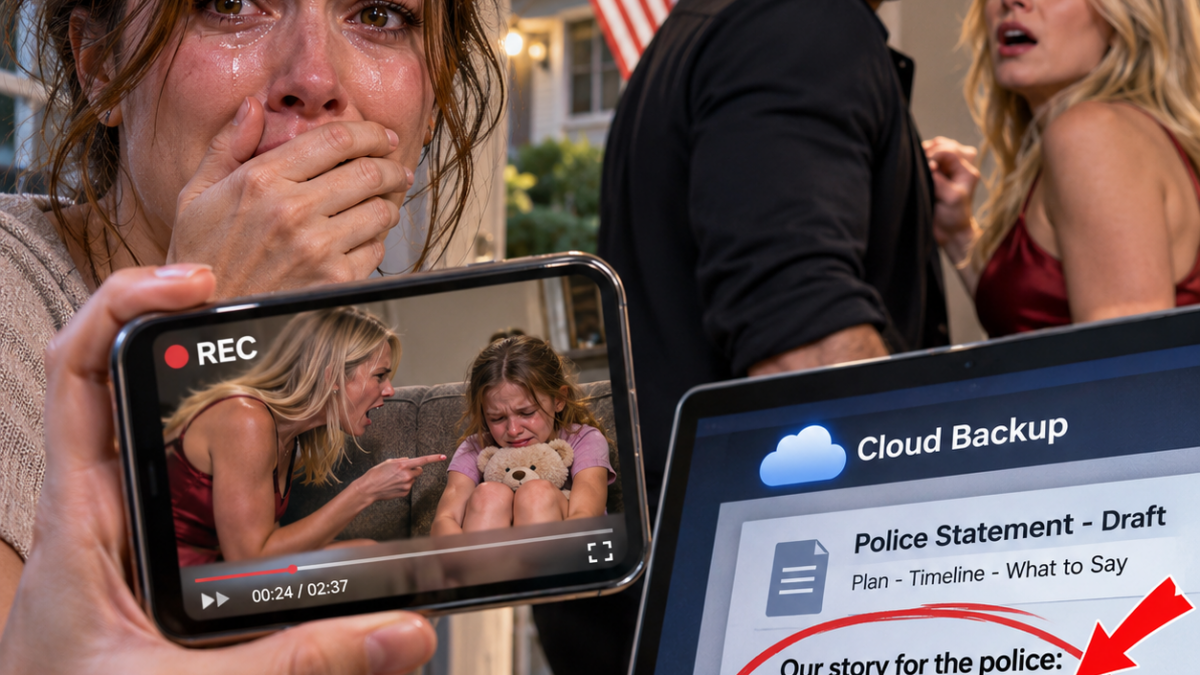
PART2
The paramedics moved past me so quickly I barely registered their faces.
One knelt beside Willa.
Another opened a trauma bag.
A third asked me questions while attaching leads and checking her pupils.
“What happened?”
“I don’t know.”
“Did she fall?”
“I don’t know.”
“Any known medical conditions?”
“No.”
“Allergies?”
“Penicillin.”
“Did you move her?”
“No.”
“Good.”
Good.
Such a strange word.
Nothing in that garage was good.
A uniformed officer touched my elbow.
“Ma’am, step back with me.”
“I need to stay with her.”
“You can see her from here.”
“I’m her mother.”
“I understand.”
“No, you don’t.”
My voice broke.
He did not argue.
He simply moved me three feet away.
That was all.
Three feet felt like a continent.
He introduced himself as Lieutenant Colson.
Late forties.
Calm eyes.
Voice deliberately neutral.
“What happened when you arrived?”
I told him.
Clinic.
Grocery store.
Derek’s texts.
His truck gone.
Willa alone.
The bat.
Then I handed over my phone.
Colson read:
Call me NOW before you speak to anyone.
He looked at me.
“When did he send this?”
“Two minutes before you arrived.”
“How would he know you were home?”
“I don’t know.”
“Any cameras?”
“Yes.”
“Inside?”
“Exterior.”
“Can we access them?”
“Yes.”
“Does your husband know?”
“Yes.”
I suddenly remembered something.
The side camera above the garage door.
Wide angle.
Supposed to show the driveway and side entrance.
When the large garage door was open, it caught part of the interior threshold.
Maybe enough.
Colson asked:
“Anyone else with access to the house?”
“No.”
“Friends? Family?”
“No.”
“Domestic conflict between you and your husband recently?”
I almost said no automatically.
Then stopped.
“Normal arguments.”
“Affair concerns?”
“No.”
At least, that was what I believed at 2:36 that afternoon.
The ambulance left seven minutes later.
I rode in the back.
Willa regained partial consciousness halfway to Mercy Children’s.
Her eyes opened.
Confused.
“Mom?”
“I’m here.”
“Where’s Daddy?”
“I don’t know.”
She flinched.
Then whispered:
“Don’t let her come.”
Every muscle in my body tightened.
“Who?”
“Chelsea.”
The name fell into me like a stone.
Chelsea Monroe.
Derek’s marketing director.
Thirty-four.
Blonde.
Divorced.
Polished.
Funny.
She had been inside my home.
She had eaten my food.
Held my wine glass.
Complimented my kitchen.
Brought Willa a bracelet from a business trip.
At Derek’s fortieth birthday, she had hugged me and said:
“You’re so lucky. He talks about you guys constantly.”
I had believed that meant he loved us.
At the hospital, they took Willa from me.
That was the first moment I truly lost control.
Until then, I had tasks.
Answer questions.
Sign consent.
Call.
Wait.
Once the trauma team took her behind double doors, I had nothing to do but imagine.
I paced until a nurse made me sit.
Lieutenant Colson arrived thirty minutes later.
A social worker came with him.
“Mrs. Calder.”
“Yes.”
“Your daughter is stable.”
I collapsed against the chair.
Not gracefully.
Not quietly.
Stable.
The most beautiful word I had ever heard.
The doctor explained Willa had several serious injuries requiring treatment and observation, but there was no immediate indication that she would not recover.
I heard maybe half of it.
All I wanted was:
Will she live?
Yes.
Will she wake fully?
We expect so.
Will she know me?
Likely.
Will she be okay?
Too early to promise.
That last answer stayed with me.
Too early to promise.
Colson waited until the doctor left.
Then said:
“We obtained your exterior footage.”
I looked up.
“Tell me.”
“We confirmed Derek picked Willa up from school.”
“You called?”
“School did.”
“Then?”
“His truck enters your driveway at 1:19.”
“Okay.”
“A white BMW arrives at 1:26.”
Chelsea’s car.
I knew.
“Who gets out?”
“Chelsea Monroe.”
The room seemed to narrow.
“She enters through the front door.”
“Where’s Willa?”
“Inside.”
“And Derek?”
“Inside.”
My hands began shaking again.
“At 1:52, the garage door opens.”
I stared.
Colson continued.
“Your husband and Ms. Monroe are visible near the garage entrance.”
“Doing what?”
“Talking.”
“Willa?”
“She appears several seconds later.”
“Then?”
He looked at the social worker.
That hesitation scared me.
“Tell me.”
“There’s a confrontation.”
“Between Chelsea and my daughter?”
“Yes.”
“What is Derek doing?”
Colson said nothing.
I understood before he answered.
“No.”
My voice came out as a whisper.
“He doesn’t intervene immediately.”
“Immediately?”
I stood.
“What does that mean?”
“Mrs. Calder—”
“Does he stop her?”
“No.”
“Does he help Willa?”
“Not on the footage we have.”
I turned away.
The wall had a framed photograph of a sailboat.
Blue water.
White sky.
I stared at it because looking at Colson made reality too sharp.
My phone buzzed.
Derek.
I froze.
Another message:
Marin PLEASE call me. There’s an explanation.
Then:
Willa freaked out. Chelsea tried to calm her. It was an accident.
I handed the phone to Colson.
His jaw tightened.
Another message appeared while he held it.
Do not let Evan turn this into something it isn’t.
My stomach dropped.
“How does he know I called Evan?”
I said it out loud.
Colson looked at the screen.
“Shared phone account?”
“Yes.”
“Can he see call logs?”
“Yes.”
Not content.
Numbers.
Times.
Duration.
I had called Evan immediately after 911.
Derek was monitoring the account.
Colson asked:
“Can you change the password?”
“Yes.”
“Don’t yet.”
“Why?”
“Because right now he’s telling us what worries him.”
That was exactly what Evan had said.
Let him believe I knew nothing.
My cousin arrived shortly after five.
He had driven nearly two hours in just under ninety minutes and looked like a man who had not noticed speed limits.
Suit pants.
White shirt.
No tie.
Hair windblown.
He saw me.
Stopped.
Then crossed the waiting room and wrapped both arms around me.
For years, Derek had teased Evan for being emotionally cold.
That hug was the safest thing I had felt all day.
“How is she?”
“Stable.”
Evan closed his eyes.
“Thank God.”
Then:
“Where’s Derek?”
“Police don’t know yet.”
“Chelsea?”
“No.”
“Footage?”
“Shows enough.”
He looked at Colson.
“You the lead?”
“For now.”
They recognized each other.
Professional world.
That made me understand something I had ignored for years.
Derek did not dislike Evan because Evan was arrogant.
Derek disliked people who asked a second question after the first answer sounded too convenient.
Evan sat beside me.
“Show me the messages.”
I did.
He read each twice.
Then handed the phone back.
“Don’t answer.”
“What do you think happened?”
“I’m not guessing.”
“You already guessed on the phone.”
“I said Derek sounded like a man trying to control the sequence.”
“What does that mean?”
“It means innocent people usually lead with concern.”
Evan looked toward the pediatric wing.
“He led with silence.”
“What’s coming, Evan?”
He studied me.
“You asked me that earlier.”
“Yes.”
He lowered his voice.
“If Derek helped cover up what happened to Willa, this stops being about adultery or divorce.”
“What does it become?”
“Evidence.”
One word.
Evidence.
That became the word around which the rest of my life reorganized itself.
Detective Rachel Kim arrived at 5:37.
She worked major crimes and child-abuse investigations with the county.
Early forties.
Black hair in a tight knot.
No wasted words.
She asked me for permission to review our shared cloud storage.
“Our what?”
“Your home-media account.”
I blinked.
Then remembered.
Three years earlier, Derek lost a phone in Lake Okoboji.
Every vacation picture disappeared.
He had complained for weeks.
So we upgraded to a family cloud plan.
Automatic backup.
Photos.
Videos.
Voice recordings.
Anything saved through the camera app.
I paid for the storage because it was attached to my credit card.
That made me account administrator.
Derek had mocked me.
“Family archivist.”
I had rolled my eyes.
Now Detective Kim asked:
“Do you know whether his phone backs up automatically?”
“Yes.”
“When connected to Wi-Fi?”
“Yes.”
“Was he home?”
“Yes.”
She looked at me.
“Then we may have more than the exterior camera.”
I stopped breathing.
We opened the account.
Four devices.
Mine.
Derek’s.
Willa’s tablet.
Home computer.
His folder showed three new video uploads that afternoon.
1:54 p.m.
1:56 p.m.
2:03 p.m.
Three.
I stared at the timestamps.
Detective Kim said:
“You do not have to watch these.”
“Yes.”
Evan touched my arm.
“No.”
I looked at him.
“That’s my daughter.”
“Exactly.”
“I need to know.”
“You need to know enough.”
His eyes held mine.
“You do not have to injure yourself to prove you love her.”
I hated him for being right.
So Kim watched first.
Headphones.
Screen turned slightly away.
Her face stayed controlled.
Only once did her eyes close longer than a blink.
When she finished, she took off the headphones.
“Mrs. Calder.”
“Marin.”
“Marin.”
Her voice softened.
“The first recording shows Willa confronting your husband and Ms. Monroe.”
“What does she say?”
“She asks why Chelsea is kissing Daddy.”
My throat closed.
“She saw them.”
“Yes.”
“What happens?”
“Chelsea tells her to go upstairs.”
“Willa?”
“Refuses.”
“Then?”
Kim paused.
“Chelsea becomes aggressive.”
“Derek?”
“He records.”
“Why?”
“We don’t know.”
“Does he call for help?”
“No.”
“Does he stop it?”
“No.”
“Does he say anything?”
“Yes.”
“What?”
Kim looked at Evan.
Then back at me.
“He tells Chelsea to move because he can’t see.”
My body went numb.
“What?”
“Marin—”
“He moves her?”
“No. He tells Chelsea to move.”
“Why?”
“To improve his camera angle.”
I stood.
The chair tipped behind me.
Evan caught it.
I walked to the corner.
Hands over my mouth.
My daughter had been frightened.
My husband’s instinct was not:
Stop.
His instinct was framing.
Recording.
Witnessing through a screen as if his child were content.
I turned back.
“Was he laughing?”
Kim hesitated.
“At one point there is laughter.”
I shook my head.
“No.”
“I’m sorry.”
“No.”
Derek had laughed when Willa learned to ride a bicycle.
When she pronounced “hippopotamus” wrong at three.
When she dumped flour over the kitchen trying to make pancakes.
That laugh had belonged to love.
What kind of man laughed now?
Kim said:
“People sometimes laugh under stress.”
I looked at her.
“I don’t care.”
She nodded.
Fair.
“The second video is shorter.”
“What’s on it?”
“Willa is mostly out of frame.”
“Alive?”
“Yes.”
I hated that I needed to ask.
“Chelsea is crying.”
“Why?”
“Because she believes Willa will tell you.”
“Derek?”
“Talking about what to say.”
My skin went cold.
“Play that one.”
Evan said my name.
“I need to hear it.”
Kim played audio only.
Chelsea’s voice first.
“What are we going to say?”
Derek:
“She fell.”
Chelsea:
“With the bat?”
Derek:
“She gets dramatic.”
Chelsea:
“Derek.”
Derek:
“She grabbed it because she was upset.”
Chelsea:
“Marin won’t believe that.”
Pause.
Then Derek laughed quietly.
My husband.
My daughter somewhere nearby.
And he said:
“Marin believes whatever keeps the family together.”
I closed my eyes.
There are betrayals larger than sex.
Larger than kissing another woman.
Larger than hotel receipts.
That sentence was one.
Derek knew me.
Eleven years.
He knew I forgave.
He knew I hated public conflict.
He knew my own parents divorced badly when I was twelve and I had spent adulthood telling myself Willa would never grow up between two houses.
He knew every fear.
Every scar.
Every promise I had made silently to myself.
And somewhere along the way, my husband had stopped seeing those things as parts of me to protect.
He saw them as handles.
The third recording was two minutes and forty-seven seconds.
Derek had apparently forgotten to stop recording before sliding the phone into his pocket.
Mostly darkness.
Audio.
Chelsea:
“We can’t leave her.”
Derek:
“I need to think.”
Chelsea:
“Call an ambulance.”
Derek:
“And say what?”
Silence.
Then:
“That my girlfriend lost it because my kid caught us?”
Chelsea:
“Don’t call me your girlfriend.”
Derek:
“Fine.”
Footsteps.
A door.
Chelsea crying.
“What if she doesn’t wake up?”
Derek:
“She will.”
“How do you know?”
No answer.
Then:
“Marin gets home around four.”
My appointment had been scheduled until 2:30.
He believed I would stop for pharmacy pickup afterward.
I had finished early.
Chelsea said:
“That’s almost two hours.”
Derek:
“Stop.”
Chelsea:
“We can’t just leave.”
Derek:
“We need the story straight.”
My knees weakened.
Evan grabbed my elbow.
Then came Derek’s voice again.
Calm.
Too calm.
“We say Willa was upset after school.”
Chelsea:
“Why?”
“Kids get upset.”
“We say she took the bat into the garage.”
Chelsea:
“She saw us.”
“She’s seven.”
“Seven-year-olds talk.”
“Then we say she misunderstood what she saw.”
Chelsea:
“And Marin?”
Long pause.
Then the sentence that ended whatever tiny part of me had still been hoping the man I married existed somewhere underneath the horror.
“Marin will choose me over Willa.”
No one moved.
No one breathed.
I stared at the dark laptop screen.
Then I said:
“Again.”
Evan shook his head.
“Marin.”
“Play it.”
Kim did.
Marin will choose me over Willa.
I heard it.
Again.
Clear.
Certain.
Not a question.
Not hope.
A plan.
I did not cry.
Something inside me simply closed.
For eleven years, I had thought Derek understood my devotion to our family.
He did.
He just misunderstood who I meant when I said family.
He believed family meant him first.
The marriage.
The house.
The shared name.
The Christmas cards.
The appearance.
Willa somewhere inside all of that.
Important.
Loved.
But expendable if protecting her threatened the structure Derek valued more.
He had chosen wrong.
And I knew with a clarity so sharp it almost felt peaceful that I would never choose him again.
Detective Kim asked:
“Can we preserve these?”
“Yes.”
She created forensic copies.
Documented hashes.
Times.
Account ownership.
Access logs.
The technical process was boring.
Beautifully boring.
Because every time she clicked something, the truth moved farther away from Derek’s ability to erase it.
At 6:14, officers located his black F-150 in the parking lot of a motel twelve miles away.
Chelsea’s white BMW was two rows over.
They were not fleeing.
They were hiding.
Waiting.
Planning.
Probably arguing over which version of the lie sounded least impossible.
Derek called me from the motel before police confiscated his phone.
I did not answer.
Voicemail:
“Marin, this got out of control.”
Pause.
“Chelsea panicked.”
Pause.
“I didn’t touch Willa.”
That sentence told me everything about the man he had become.
Not:
Is my daughter alive?
Not:
How badly is she hurt?
Not:
I’m sorry.
I didn’t touch Willa.
He had already reduced fatherhood to technical liability.
Chelsea did it.
Not me.
I just watched.
I just recorded.
I just left.
I just lied.
How little responsibility could he carve out for himself?
That was Derek now.
A man standing inside the wreckage measuring which pieces legally belonged to somebody else.
Willa woke more fully around eight.
I was beside her.
Her face looked so small against the hospital pillow.
I touched her fingers.
She opened her eyes.
“Mom?”
“I’m here.”
“Are you mad?”
The question nearly killed me.
“At you?”
She nodded.
“Never.”
Her lower lip trembled.
“Daddy said you’d be mad.”
I stopped breathing.
“Why?”
“Because I came downstairs.”
I wanted to ask everything.
What happened?
What did he say?
What did Chelsea do?
Why did Daddy say that?
But the social worker had warned me.
Do not lead.
Do not investigate your child.
Let trained interviewers do that.
So I swallowed every question.
Instead:
“You will never be in trouble for telling me when something scares you.”
She started crying.
“I saw Daddy kissing Chelsea.”
“I know.”
“He said I wasn’t supposed to.”
“You did nothing wrong.”
“She said I ruin everything.”
“No.”
I leaned close.
“You hear me?”
Willa nodded.
“You did not ruin anything.”
“But Daddy said—”
“Daddy was wrong.”
The words hurt.
Not because I regretted them.
Because seven-year-old children should not have to learn their father can be wrong about something that big.
She whispered:
“Is Chelsea coming?”
“No.”
“You promise?”
“Yes.”
“Daddy?”
I could not make the same promise.
“He won’t come here tonight.”
Willa closed her eyes.
Then opened them again.
“Can you sleep here?”
“Yes.”
“All night?”
“All night.”
I did.
The chair beside her bed did not recline fully.
My neck hurt.
My back hurt.
I slept maybe forty minutes total.
Best night of my life.
Because every time I opened my eyes, my daughter was breathing.
At 3:12 a.m., Derek’s mother Ruth called.
I ignored it.
Text at 3:19:
What did you tell police?
3:24:
Derek says this was an accident.
3:31:
Please don’t destroy his life before you know everything.
His life.
Nobody asked about Willa.
I turned my phone face down.
Morning brought doctors.
Police.
Child advocacy staff.
And Sandra Levin.
Evan had called her.
Family-law attorney.
Former child-welfare counsel.
Fifty-eight.
Silver hair.
Voice so calm it felt dangerous.
She sat across from me in the hospital cafeteria.
“Before we discuss divorce, we secure Willa.”
“I’m divorcing him.”
“I assumed.”
“There’s no possibility.”
“I didn’t ask.”
Good.
I liked her.
“Emergency protective order.”
“Yes.”
“Exclusive possession of the residence.”
“Yes.”
“Temporary custody.”
“Yes.”
“Preservation orders for devices, accounts, cloud services, cameras.”
“Yes.”
“Derek does not enter the home.”
“Yes.”
“Any contact with Willa through court-approved process only.”
“Yes.”
Sandra watched me.
“You’re answering fast.”
“I don’t need time.”
“Good.”
Then:
“You may later.”
“For what?”
“Grief.”
“I’m not grieving him.”
She looked at me.
“You will.”
I hated that she was right.
Evan sat beside me.
Quiet.
I asked:
“What did you mean yesterday?”
“When?”
“When you said Derek had no idea what was coming.”
He looked toward the window.
“I meant procedure.”
I almost laughed.
“Procedure?”
“People like Derek count on emotion.”
He turned back.
“They expect screaming.”
“Threats.”
“Maybe retaliation.”
“What they’re usually least prepared for is documentation followed by people who know what to do with it.”
Sandra smiled faintly.
“An excellent love letter to due process.”
Evan shrugged.
“It works.”
That became the justice arc of our life.
Not revenge.
Procedure.
Protective orders.
Search warrants.
Forensic copies.
Interview protocols.
Hospital records.
School pickup logs.
Cloud timestamps.
Messages.
Phone location history.
People imagine truth wins because somebody gives a dramatic courtroom speech.
Sometimes truth wins because three different systems record 1:52 p.m. the same way.
The forensic interview happened three days later.
I was not in the room.
That hurt.
I wanted to hold Willa.
Instead, I watched from behind glass only where permitted.
A trained child interviewer sat with her.
No leading.
No pressure.
No:
Did Chelsea hit you?
No:
Did Daddy laugh?
Questions like:
“Tell me what happened after you got home.”
Willa explained.
Derek picked her up.
Bought her a strawberry smoothie.
Told her Mommy was at the doctor.
At home, he said she could watch cartoons upstairs.
She heard a woman laughing downstairs.
Came down.
Saw Chelsea near the kitchen.
Daddy was kissing her.
Willa asked:
“Why are you kissing Daddy?”
Chelsea told her:
“Go upstairs.”
Willa said:
“I’m telling Mommy.”
Derek told her to stop.
Willa walked toward the side door because she wanted to go to Mrs. Nolan’s house next door.
Chelsea followed.
Argument moved into the garage.
Willa cried.
Called Chelsea a liar.
Chelsea became furious.
Then the interview became harder.
Willa described enough.
Not graphically.
Enough.
The interviewer asked:
“What was Daddy doing?”
“Making a video.”
“How do you know?”
“He had his phone.”
“Did he say anything?”
Willa looked at the floor.
“He told Chelsea to move.”
“Why?”
“So he could see.”
The interviewer remained calm.
“Did Daddy help you?”
“No.”
“Did you ask him to?”
“Yes.”
“What did he say?”
Willa began crying.
“He said stop making everything worse.”
That sentence destroyed me more than the affair.
Seven years old.
Scared.
And her father told her she was making everything worse.
Not Chelsea.
Not him.
Willa.
The child who accidentally walked into the truth.
Later, Willa said Derek told her:
“Mommy will be angry if you break this family.”
There it was.
The lie had begun before he ever left the garage.
He had already started making his child responsible for the consequences of his betrayal.
The police found more evidence in our home.
Not another act of violence.
Something quieter.
An older phone in Derek’s desk.
Messages with Chelsea going back fourteen months.
Fourteen.
Birthdays.
Christmas.
Our anniversary.
A family vacation.
All during the affair.
I read only what Sandra said I needed.
Still too much.
At first, romantic.
Then complaints about me.
Chelsea:
Does Marin suspect?
Derek:
No. She trusts me.
Chelsea:
Must be nice.
Derek:
She’d rather believe me than admit her family is broken.
My hands shook.
Another:
CHELSEA: When are you leaving her?
DEREK: Not yet.
CHELSEA: You said after New Year’s.
DEREK: Financials are complicated.
CHELSEA: Because of her father’s money?
DEREK: Partly.
My father died four years earlier.
He left my sister and me equal shares of a small but successful healthcare consulting company.
I had spent years growing mine.
Much of our house equity and investments were tied to assets Derek did not simply get because we were married.
He knew.
Chelsea knew.
Divorce would not ruin Derek.
But it would end the lifestyle he had grown accustomed to.
Then I saw the part that frightened me.
Months before Willa came home early, Derek and Chelsea began building a story about me.
Not formal.
Not illegal.
Social.
Psychological.
CHELSEA: If she catches us, say she’s been accusing you forever.
DEREK: She hasn’t.
CHELSEA: Doesn’t matter if everyone thinks she has.
Another:
DEREK: Marin’s headaches are getting worse.
CHELSEA: There you go.
DEREK: What?
CHELSEA: Stress. Anxiety. Confusion.
DEREK: She’s not confused.
CHELSEA: You need to stop correcting me when I’m helping you.
I sat staring at the screen.
For months Derek had said things to family:
“Marin’s stressed.”
“She’s overwhelmed.”
“She’s not sleeping.”
“Her headaches are making everything harder.”
All technically true.
I had headaches.
My father had died.
Work was stressful.
But context had been turned into narrative.
I remembered dinners where Ruth asked:
“You doing okay, sweetheart? Derek says you’ve been struggling.”
I thought my husband was concerned.
He was laying groundwork.
Not to have me institutionalized.
Not some melodramatic master plan.
Something simpler.
If the affair surfaced, Derek wanted people already primed to think:
Marin is emotional.
Marin overreacts.
Marin imagines things.
The realization made me sick.
Sandra stopped me when I started jumping ahead.
“Do not invent more than the evidence gives you.”
“I’m not.”
“You’re close.”
She tapped the messages.
“We have manipulation.”
“We have affair concealment.”
“We have an attempt to shape how others perceived your emotional state.”
“That is enough.”
She looked at me.
“Reality is already ugly.”
“Don’t make it uglier to feel more justified.”
That lesson mattered.
Pain tempts you toward exaggeration.
Especially when truth feels insufficient to match how destroyed you feel.
But evidence deserves discipline.
So we stayed with what existed.
Derek lied.
Derek manipulated.
Derek helped construct a false narrative after Willa was hurt.
Derek failed to protect his daughter.
That was enough.
His criminal attorney tried separating him from Chelsea immediately.
She acted.
He did not.
He did not touch Willa.
He froze.
He was confused.
He was afraid.
Then the videos came.
Freezing does not involve adjusting camera position.
Confusion does not produce a rehearsed cover story.
Fear may explain silence.
It does not explain leaving an injured child behind while going to a motel to coordinate stories.
The defense shifted.
Derek claimed he intended to return.
Then phone location showed he drove past an urgent-care center.
Then a hospital.
Then stopped at the motel.
His attorney stopped using that line.
Chelsea’s case moved differently.
She eventually accepted a plea.
There were serious consequences.
Custody was not relevant to her.
Employment was.
Freedom was.
Reputation was.
I did not attend sentencing.
People assumed I wanted to see her punished.
I did not need to watch.
My life was at Willa’s therapy appointment that morning.
She was learning to enter the garage again.
That mattered more.
The garage became its own character in our lives.
For months, neither of us could use it.
Police released the scene.
I hired professional cleaners.
Then painters.
Willa chose the color.
Pale yellow.
Derek had always insisted garages should be gray because “they’re utilitarian.”
Willa said yellow.
Yellow it became.
The first time she approached the doorway again, she stopped.
Held my hand.
“Do I have to?”
“No.”
“What if I can’t?”
“Then we leave.”
“Can I just look?”
“Yes.”
She looked.
One minute.
Then two.
“Mom.”
“Yes?”
“Can my bike go where that shelf was?”
I almost cried.
“Sure.”
“Why are you crying?”
“Because that’s a great spot for your bike.”
She rolled her eyes.
Even at seven.
We moved the bike.
Pink.
White basket.
Purple streamers.
The garage became hers again.
That was justice too.
Not court.
Not punishment.
A bicycle occupying the place fear once owned.
Willa’s recovery was not a straight line.
Nothing real is.
Some weeks she slept normally.
Then a smell would trigger something.
Chelsea’s perfume.
Vanilla and jasmine.
One day a teacher wore something similar.
Willa vomited in the school bathroom.
No one understood why until she told me.
We changed classrooms temporarily.
Teacher felt horrible.
Not her fault.
At birthday parties, Willa hated phones pointed at her.
At first, people thought she was shy.
Then my sister pulled out her camera during cake.
Willa screamed:
“No!”
Everyone froze.
My sister immediately lowered it.
“I’m sorry.”
No arguing.
No:
I was just taking a picture.
No:
Don’t be dramatic.
She put the phone away.
That became my measure of safe adults.
Safe adults respect no even when they meant no harm.
Derek had heard no his entire marriage.
No, I’m tired.
No, don’t joke about that.
No, don’t tell your mother private things.
No, don’t undermine me in front of Willa.
He always negotiated.
Minimized.
Explained.
By the time the garage happened, he had spent years teaching himself that another person’s boundary was merely the beginning of a conversation.
I saw it everywhere afterward.
Not proof I should have predicted violence.
But part of who he was.
Ruth did not accept the court’s restrictions.
At first.
Letters.
Calls.
Voicemails.
“A child needs her father.”
“Derek made a mistake.”
“Chelsea is the dangerous one.”
“He loves Willa.”
I finally answered once.
“Love is not the issue.”
Ruth cried.
“How can you say that?”
“Because he loved her and still didn’t protect her.”
Silence.
That was the sentence she could not fight.
People often use love as evidence that harm cannot be real.
He loves her.
She loves him.
They’re family.
But love is not a safety certificate.
Ruth said:
“He froze.”
“No.”
“You weren’t there.”
“No.”
“His phone was.”
That ended it.
For a while.
Then she turned on me.
“You always wanted him away from us.”
“I wanted him accountable.”
“You’re destroying his relationship with his child.”
“No.”
“He did that.”
“You sound like Evan.”
“Good.”
She hung up.
I blocked her for three months.
My own mother, Diane, surprised me.
She moved into my guest room for six weeks.
Not because I asked.
Because she knew if she asked, I would say I was fine.
She cooked.
Drove Willa to therapy.
Sat with me in silence.
One night, after Willa fell asleep, I said:
“I missed all of it.”
Mom looked at me.
“The affair?”
“Everything.”
“The messages.”
“The way he talked to me.”
“Mom, I slept beside him.”
She took my hand.
“You trusted your husband.”
“I was stupid.”
“No.”
“I should have seen something.”
“Maybe.”
I looked at her.
She continued.
“You should have seen that he dismissed you.”
“You should have seen some boundaries were unhealthy.”
“You should have seen your marriage needed work.”
“But that is not the same as knowing he would do what he did.”
My eyes filled.
“A red flag is not a time machine, Marin.”
I cried.
I needed permission to stop prosecuting my past self.
After betrayal, your mind becomes cruel.
It finds every moment.
Every late meeting.
Every text he turned over.
Every joke that felt wrong.
Every evening he showered immediately after coming home.
And says:
There.
You should have known.
But if we could predict every betrayal from ordinary imperfections, nobody would ever trust anyone.
I was not responsible for failing to imagine something unimaginable.
I was responsible for what I did after I knew.
That part, I could live with.
I called 911.
I preserved evidence.
I protected Willa.
I did not cover for Derek.
That became enough.
The divorce took fourteen months.
Longer than I wanted.
Shorter than some.
Derek contested assets.
Then stopped.
Contested custody.
Then the evidence narrowed options.
He requested supervised contact.
Willa’s therapist said not yet.
Court agreed.
He wrote letters.
The first one was awful.
I’m sorry things got out of control.
Passive.
I wish I had reacted better.
Better?
Sometimes adults freeze when events happen fast.
I gave it to the therapist.
She asked if I wanted Willa to see it.
“No.”
“Why?”
“Because it makes what happened sound like weather.”
She nodded.
Exactly.
Things got out of control.
Events happened.
Mistakes were made.
No subject.
No verb attached to Derek.
I told Sandra:
“He wants forgiveness without nouns.”
She corrected me.
“Without verbs.”
Right.
Accountability needs verbs.
I failed.
I watched.
I left.
I lied.
I did not protect you.
Derek took almost a year to write those words.
The second letter came after therapy and court-ordered parenting intervention.
It began:
Willa, what happened in the garage was not your fault. I was your father, and I should have protected you immediately. I did not. I chose to protect myself instead.
I stopped reading.
Cried.
Not because I forgave him.
Because at last he named it.
I gave the letter to Willa’s therapist.
Weeks later, Willa read it.
She said:
“He finally said it right.”
Then:
“Do I have to write back?”
“No.”
She didn’t.
The following year, she did.
Three sentences.
I’m okay. I play softball again. I don’t want to see you yet. Please don’t ask Mom when.
Derek replied through the therapist:
Okay. I won’t.
That single okay probably did more for his chances of someday having a relationship with her than every apology before it.
Respecting a boundary after years of violating them.
Small.
Necessary.
The criminal proceedings ended separately.
Chelsea received incarceration and supervision afterward.
Derek’s consequences reflected his different role.
Failure to protect.
Post-incident conduct.
Evidence-related issues.
I will not turn exact sentencing into entertainment.
This was my daughter’s trauma.
Not a scoreboard.
He lost his job before the case fully resolved.
His employer saw the public filings.
The videos were not publicly broadcast, thank God, but enough allegations became known.
Derek left me a voicemail.
“You destroyed my career.”
I saved it.
Did not respond.
Months later, another voicemail.
“I destroyed my career.”
I listened twice.
Then deleted it.
Growth belonged to him.
I did not need to archive every sign of it forever.
The darkest thing investigators found was not another violent act.
It was another video from six months before the garage.
Derek and Chelsea sitting in his truck.
Talking.
Chelsea:
“What if Marin takes Willa?”
Derek laughed.
“She won’t.”
“How do you know?”
“Because Marin’s whole personality is keeping families together.”
Chelsea:
“So?”
Derek:
“She’ll blame herself first.”
I stopped the recording.
Could not continue.
My husband had studied my kindness like a burglar studies a lock.
That became the betrayal I struggled with longest.
He knew I hated conflict.
He knew my parents’ divorce had scarred me.
He knew I promised myself Willa would never hear adults using her as leverage.
He knew I would spend hours asking:
What did I do wrong?
And instead of protecting those tender places, he planned around them.
When people asked why I did not just hate him, I could not explain.
Hatred would have been easier.
I had loved him.
That history did not disappear because the ending became ugly.
I remembered Derek at twenty-nine holding our newborn daughter against his bare chest.
He cried.
Whispered:
“She’s perfect.”
I remembered him building Willa a dollhouse at two.
Teaching her to throw a baseball at five.
Dancing with her in the kitchen.
Then I remembered the garage.
How can both people be real?
That question haunted me.
Years later, Aaron—the man I eventually married—gave me the best answer.
“People aren’t one moment.”
I said:
“No.”
“But some moments show what they’re capable of when it matters most.”
That was it.
Derek had loved Willa.
And when protecting her cost him his affair, his image, his marriage, and possibly his freedom, he chose himself.
Love without courage failed.
That was the lesson.
Willa turned eight five months after the garage.
She asked for a baseball cake.
I almost broke.
Softball had been hers before Chelsea.
The bat used that day had belonged to Willa’s little rec-league team.
For months she wanted nothing to do with the sport.
Then one afternoon, she found her glove in the closet.
Put it on.
Asked:
“Can we go outside?”
I tried to keep my voice normal.
“Sure.”
We tossed from ten feet apart.
Then fifteen.
No bat.
Just glove.
Ball.
Sun.
At her birthday she said:
“I want to play again.”
I asked three times whether she was sure.
Finally she sighed.
“Mom.”
“What?”
“You always tell me I can change my mind.”
“Yes.”
“So let me have one first.”
Fair.
She returned to softball the next spring.
Her first at-bat, she froze.
Coach called time.
Walked over.
Willa looked toward me.
I stood.
Did not wave.
Did not shout.
Just stood.
She stepped back in.
Swung.
Missed.
Second pitch.
Foul.
Third.
Single through the left side.
She reached first base and burst into tears.
So did I.
Coach did too.
Apparently youth softball is emotionally unstable.
After the game, Willa said:
“I thought I’d be scared forever.”
I knelt.
“Fear doesn’t always leave before you do the thing.”
She nodded.
“Sometimes it comes with you.”
“Yes.”
She thought.
“That’s rude.”
I laughed.
“Very.”
Evan remained part of our life.
For a long time Willa believed he had some secret law-enforcement team waiting to arrest Derek because she heard me tell someone:
“Evan said Derek had no idea what was coming.”
At fourteen, she finally asked.
“What was Uncle Evan actually planning?”
I said:
“Paperwork.”
She stared.
“Paperwork?”
“Evidence preservation.”
“Protective orders.”
“Attorneys.”
“Police.”
“That’s so disappointing.”
I laughed.
“You expected helicopters?”
“At least one.”
Evan overheard.
He said:
“I had a printer.”
Willa groaned.
“Terrifying.”
Then he became serious.
“Your dad’s advantage was time.”
“What do you mean?”
“He thought he had time to call your mom first.”
“Time to explain.”
“Time to delete.”
“Time to coordinate.”
“Time to make everyone uncertain.”
He looked at me.
“Once your mother called 911 before calling him, he lost the first thing he needed.”
Control.
That word.
Derek’s whole strategy required control.
Control the affair.
Control what Willa understood.
Control what I heard.
Control who spoke first.
Control whether police became involved.
Control the family story.
The cloud removed control.
The cameras removed control.
The hospital removed control.
I removed control when I stopped asking permission to believe what I saw.
That was what came.
Not Evan.
Not revenge.
Reality moving faster than Derek’s lies.
The family cloud became almost symbolic after that.
I canceled the account eventually.
Could not stand the idea of family memories living beside evidence.
I downloaded Willa’s baby videos.
Birthdays.
Vacations.
Christmas.
Then closed it.
For months I could not watch any videos with Derek.
Eventually I tried.
Willa at four.
Derek pushing her on a swing.
She screamed:
“Higher!”
He laughed.
Real laugh.
Happy.
I turned it off.
Later I watched again.
Not because I wanted him back.
Because I refused to let one terrible day steal every memory before it.
Some therapists call that integration.
I called it refusing to let Chelsea own Disneyland.
Willa asked once:
“Were we happy before?”
“Yes.”
“Really?”
“Yes.”
“Then how did this happen?”
I thought.
“Being happy sometimes doesn’t mean people can’t make terrible choices later.”
She frowned.
“So was Daddy pretending?”
“Not always.”
That answer hurt.
But lying would have been easier and worse.
Children do not need villains made simpler for them.
They need adults honest enough to say:
Someone can love you and still fail you.
That failure is still their responsibility.
Derek’s parents eventually changed too.
Ruth took almost two years.
At first, denial.
Then bargaining.
Then anger.
Finally, therapy.
One day she asked to meet me.
Public café.
I almost refused.
Sandra said:
“You don’t owe her.”
“I know.”
“Then if you go, go because you want information or closure.”
I went.
Ruth looked older.
Smaller.
She said:
“I blamed Chelsea.”
“Of course.”
“I needed it to be her.”
I said nothing.
“Because if it was Chelsea, then Derek was still my son.”
“He is still your son.”
“You know what I mean.”
I did.
“If Derek failed Willa that badly, then I had to ask what I missed.”
I almost laughed.
The same question I had tortured myself with.
Ruth continued.
“I told myself he froze.”
“I repeated it.”
“I told everybody.”
“Then I finally listened to the recording.”
My body stiffened.
She cried.
“He didn’t freeze.”
“No.”
“He planned.”
“Yes.”
“I’m sorry I asked you to protect him.”
That was the apology.
Not:
I’m sorry you were hurt.
Not:
I’m sorry things happened.
I asked you to protect him.
Active voice.
I nodded.
“Thank you.”
“Will Willa see me?”
“That’s her decision.”
Ruth cried harder.
I did not fix it.
Pain is not always a problem someone else must solve.
Eventually Willa chose to see her grandmother.
Supervised at first by me.
Ruth brought no gifts.
That impressed me.
Families often try to buy around grief.
She simply said:
“I’m sorry I asked your mom to make things easier for your dad instead of making things safe for you.”
Willa looked at her.
Then:
“Okay.”
Not forgiveness.
Acknowledgment.
Enough.
My own relationship with trust changed.
For years after Derek, every delay looked suspicious.
Every face-down phone.
Every work trip.
Aaron suffered through that with more patience than I deserved.
We met three years after the divorce.
Widower.
Two daughters.
Quiet man.
When I told him my history, he did not say:
I would never do that.
People love promises built on hypothetical virtue.
He said:
“I understand why trust is expensive for you.”
That sentence felt safer.
The first time Aaron met Willa, he offered his hand instead of a hug.
She shook it.
After he left, she said:
“I like him.”
“Why?”
“He didn’t touch me.”
That sentence almost broke me.
Not because Aaron did something extraordinary.
Because respect had become extraordinary to her.
We dated two years before marrying.
Small backyard ceremony.
Willa stood beside me.
Evan held the rings because Willa refused to trust him with anything more important after he lost his car keys that morning.
Aaron never tried to replace Derek.
That helped.
He became something else.
Safe adult.
Then family.
Sometimes Willa calls him Aaron.
Sometimes Dad slips out accidentally.
He never celebrates either version.
He simply answers.
That is love without demand.
Years passed.
Willa became taller than me.
Her hair darkened.
She developed Derek’s crooked smile.
For a while that bothered her.
At thirteen she stood in the bathroom mirror.
“I look like him.”
“Some.”
“I hate it.”
I said:
“You also look like yourself.”
“That’s a mom answer.”
“It’s still true.”
She touched her chin.
“Do you hate that I look like Dad?”
“No.”
“Really?”
“Never.”
I held her face.
“Your face belongs to you.”
That mattered.
Children of parents who cause harm sometimes feel their own bodies betray them through resemblance.
I refused to let Derek take that too.
The year Willa turned fourteen, Derek’s therapist reached out through approved channels.
He had completed years of treatment.
No violations.
No attempts to contact Willa outside rules.
He asked whether she would consider a supervised meeting.
I did not decide.
I gave the request to Willa.
She read it.
Sat quietly.
Then:
“Do you think I should?”
“No.”
She looked annoyed.
“You’re my mom.”
“I know.”
“Have an opinion.”
“I do.”
“What?”
“I think you should do whatever makes you feel safest.”
“That’s not helpful.”
“It’s the only honest answer.”
She considered for a week.
Then said yes.
One meeting.
Therapist’s office.
I waited outside.
Forty-three minutes.
Longest forty-three minutes of my life.
Willa came out.
Face pale.
Not crying.
I stood.
She walked directly into my arms.
I held her.
“Want to go?”
“Yes.”
We drove ten minutes before she spoke.
“He looks old.”
I almost laughed.
“What did he say?”
“He apologized.”
“Did it help?”
“I don’t know.”
“Okay.”
“He didn’t ask me to forgive him.”
“That’s good.”
“He said he thinks about the garage every day.”
I gripped the steering wheel.
Willa looked out the window.
Then:
“I told him I don’t.”
That sentence stunned me.
“You don’t?”
“Not every day.”
She shrugged.
“I have school.”
“Softball.”
“Friends.”
“Other stuff.”
I started crying.
She groaned.
“Mom.”
“What?”
“You cry at everything.”
“Yes.”
She handed me a napkin from the glove compartment.
That was when I understood healing had outrun me.
I had spent years imagining the garage remained the central room in her mind.
It did not.
It was a room she had survived.
Not her whole house.
Months later, Willa agreed to another meeting.
Then another.
Slow.
No forced reconciliation.
No movie ending.
I never told her she needed a father.
She had one.
Whether she wanted relationship was different.
Derek accepted whatever she offered.
That was the only way anything became possible.
He never returned to our home.
Never asked.
The yellow garage remained ours.
His old workbench disappeared.
Aaron built shelves.
Willa painted one crooked.
We left it.
At sixteen, she got her driver’s license.
First car:
Used Subaru.
White.
Safe.
Boring.
She wanted something faster.
Absolutely not.
One afternoon she pulled into the garage with grocery bags.
I heard something roll.
An orange.
It crossed the concrete.
Stopped near my shoe.
For a second, I was back there.
2:27 p.m.
Pink sneaker.
Still child.
Bloodless fear.
My body remembered before my mind.
Willa saw my face.
“Mom?”
I looked at the orange.
Then at her.
Sixteen.
Alive.
Healthy.
Annoyed because I had made her text when she left the grocery store.
“You okay?”
I picked up the orange.
“Yes.”
“You look weird.”
“I’m great.”
“You sure?”
I smiled.
“Absolutely.”
She took the orange from me.
Then tossed it lightly.
“Catch.”
I caught it.
That was the moment the garage finally became ordinary.
Not therapy.
Not court.
Not paint.
An orange.
Rolling across concrete and meaning nothing more than groceries.
Years later, people still ask me why I called Evan before Derek.
Sometimes the question carries judgment.
Shouldn’t a wife call her husband?
Shouldn’t you hear both sides?
Shouldn’t you know what happened?
I knew one thing.
My daughter was injured.
My husband was missing.
And his first message was not asking whether she was safe.
It was telling me to speak to him before I spoke to anyone else.
There are moments when your body understands danger before your heart gives permission.
Mine did.
I called someone whose loyalty was to truth.
That decision changed the sequence.
By the time Derek reached me, police already had the scene.
Paramedics had Willa.
Camera footage was preserved.
The cloud had begun backing up.
Evan was driving.
Derek could no longer make reality private.
That is what saved us.
Not because machines are perfect.
Not because police never make mistakes.
Not because courts heal families.
But because truth needs witnesses when the person you trusted becomes invested in changing it.
I often think about the sentence Derek said in the third recording.
Marin will choose me over Willa.
He knew I loved him.
He just never understood how.
I loved him as my husband.
I loved the life we built.
I loved our home.
Our routines.
Our jokes.
Sunday coffee.
Christmas decorations.
The way he always warmed my side of the bed with his feet because mine were cold.
I loved all of it.
But love has hierarchy when danger enters.
A seven-year-old does not compete with a grown man.
A child does not prove loyalty.
A child does not absorb consequences so adults can stay comfortable.
The moment Derek made protecting him incompatible with protecting Willa, there was no choice.
He believed there was.
That was his fatal miscalculation.
I did choose family.
Just not the family structure he meant.
I chose the little girl on the concrete floor.
I chose the truth she was too young to defend by herself.
I chose the future in which she would never have to wonder whether her mother saw what happened and still picked her father.
That choice cost me a marriage.
A house did not disappear.
Money did not disappear.
My life did not end.
The thing Derek had used to control me for years—the fear of breaking the family—turned out to be a lie.
Families do not always break when one person leaves.
Sometimes they stop breaking.
Our home became quieter.
Willa slept.
I slept eventually.
No more explaining why Daddy was late.
No more pretending his sarcasm was humor.
No more measuring my words because I knew he would call me emotional.
No more asking:
Is this worth a fight?
That question had governed my marriage.
Afterward, I replaced it.
Is this safe?
Is this true?
Is this respectful?
Those questions built a different life.
When Willa graduated high school, Derek attended.
Her choice.
He sat six rows behind us.
Ruth beside him.
He did not approach until Willa walked over after the ceremony.
I watched from a distance.
He hugged her only after she opened her arms.
They spoke.
She laughed once.
That surprised me.
Later I asked:
“What was funny?”
“He said he still has my first softball glove.”
I stiffened.
She noticed.
“Mom.”
“What?”
“It’s okay.”
“Is it?”
“Yes.”
She smiled.
“I told him the glove was terrible.”
I laughed.
Maybe someday their relationship will become something fuller.
Maybe not.
It no longer scares me either way.
Because Willa knows choice now.
Not the kind Derek believed he could remove from me.
Real choice.
The right to say yes.
No.
Not yet.
Never.
Maybe.
People who survive betrayal sometimes become obsessed with certainty.
I did.
For a while.
I wanted guarantees.
Aaron would never cheat.
Willa would never be hurt again.
Derek would never manipulate anybody.
Life does not give guarantees.
What I learned instead was more useful.
I can respond.
I can leave.
I can document.
I can believe myself.
I can believe my daughter.
I can ask for help.
I can stop confusing forgiveness with safety.
I can love people without handing them control.
Those are stronger than guarantees.
Evan jokes now that he regrets saying:
“He has no idea what’s coming.”
“Why?”
“Sounds dramatic.”
“It was dramatic.”
“I was trying to calm you.”
“Terrible job.”
He laughs.
Then reminds me:
“I didn’t save you.”
“I know.”
“You saved Willa before I arrived.”
“I called.”
“You acted.”
Maybe.
I still think of him as the first person who gave me permission not to call Derek.
Sometimes the smallest permission changes everything.
Do not warn him.
Do not let him explain first.
Do not protect him from evidence.
That was all Evan gave me.
The rest came from decisions one after another.
Call 911.
Open cloud.
Tell truth.
Sign affidavit.
Protect child.
Leave husband.
Get therapy.
Paint garage.
Buy bicycle.
Return to softball.
Date again.
Drive again.
Laugh again.
Life rebuilt itself through small verbs.
That is the part viral stories leave out.
They end at arrest.
Or court.
Or revenge.
Real stories continue through Tuesday.
School lunches.
Insurance forms.
Nightmares.
Laundry.
Therapist appointments.
The first time your child sleeps through the night.
The first birthday where nobody checks the door.
The first holiday where the empty chair stops feeling like an injury.
The first time you hear his name and your stomach does not drop.
That is where justice becomes life.
Willa once asked me:
“If the cloud didn’t save the videos, would you have believed me?”
I did not answer quickly.
That question deserved respect.
“Yes.”
“How do you know?”
“Because you were my daughter.”
She stared.
“But Dad was your husband.”
“Yes.”
“What if he said I was lying?”
I swallowed.
“I would have listened to you.”
“Would you have believed me immediately?”
I wanted to say yes.
Perfect answer.
Then I remembered everything I had learned about honesty.
“I hope so.”
She looked at me.
“That’s not yes.”
“No.”
I took her hand.
“I cannot promise the woman I was then would have understood everything immediately.”
Her face changed.
“But I can promise this.”
“What?”
“I would never have stopped looking until I knew you were safe.”
She thought.
Then nodded.
“That’s better.”
She was right.
Children do not need parents pretending to be infallible.
They need parents committed to truth even when truth humiliates them.
I could admit I had loved Derek enough to be vulnerable to his lies.
I could also show her I stopped when it mattered.
That became our family’s version of courage.
Not never being fooled.
Not never being scared.
Acting once you know.
Derek once told me, years after the divorce through a therapist-approved message:
“I believed you would save the marriage because you always had.”
I stared at that sentence for a long time.
Then replied:
“You confused saving the marriage with saving you.”
Nothing else.
He never argued.
Maybe he finally understood.
The marriage had been dying long before I knew.
Not because of Chelsea alone.
Because Derek believed family existed to absorb whatever he did.
The affair exposed that.
The garage ended it.
The cloud proved it.
Willa survived it.
And I rebuilt after it.
The last time I stood in that garage before Willa left for college, she was loading boxes into the Subaru.
Aaron carried a lamp.
I carried bedding.
Willa walked back inside one final time.
Looked around.
Yellow walls.
Shelves.
Old hook where her pink bicycle once hung.
She said:
“Mom.”
“Yes?”
“Do you ever think about that day when you come in here?”
“Sometimes.”
“Still?”
“Sometimes.”
She looked surprised.
“Does it hurt?”
“Not like before.”
She nodded.
Then:
“I barely remember the floor.”
I felt something loosen in my chest.
“That’s good.”
“I remember you at the hospital more.”
“What?”
“You sleeping in the chair.”
I laughed.
“I wasn’t sleeping.”
“You snored.”
“I did not.”
“You did.”
She smiled.
Then hugged me.
“That’s what I remember.”
Not Chelsea.
Not Derek’s phone.
Not the bat.
Me.
In a terrible hospital chair.
Keeping my promise.
All night.
That is the memory I want.
Not because it erases what happened.
Because it tells the truth about what happened afterward.
Someone hurt my daughter.
Her father failed her.
Then other people showed up.
Paramedics.
Police.
Doctors.
Evan.
My mother.
Therapists.
Coaches.
Teachers.
Aaron.
And me.
Trauma teaches children the world is unsafe.
Healing teaches them unsafe is not the whole world.
That is what we spent years proving.
After we loaded the last box, Willa stood in the driveway.
College sweatshirt.
Hair pulled back.
The same crooked smile she inherited from Derek.
I no longer hated that smile.
It belonged to her now.
She said:
“You gonna cry?”
“Yes.”
“Can you wait until I leave?”
“No.”
She rolled her eyes.
Then hugged me again.
Before getting into the car, she looked toward the garage.
“Close it.”
I pressed the button.
The yellow interior disappeared behind the descending door.
For years, I imagined closing that garage would feel like an ending.
It did not.
It felt like a door.
That is all.
Doors open.
Doors close.
What matters is who controls them.
The day I found Willa, Derek believed he still controlled ours.
He believed he controlled what I would hear.
What I would forgive.
What Willa would say.
What Chelsea would admit.
What police would believe.
What our families would protect.
He believed my fear of divorce was stronger than my instinct to protect our daughter.
He was wrong about every one of those things.
But he was especially wrong about me.
I spent years thinking strength meant holding a family together.
Now I know strength can also mean being the first person willing to admit that the thing you are holding together has become dangerous.
Strength can mean letting it fall.
Calling 911.
Calling Evan.
Handing over your phone.
Opening the cloud.
Telling your child:
None of this was your fault.
And meaning it enough to build an entire new life around those words.
People still occasionally ask what happened to Derek.
They want a punishment summary.
Lost job?
Yes.
Criminal consequences?
Yes.
Marriage?
Gone.
House?
No longer his.
Relationship with Willa?
Damaged, slowly rebuilding only where she allows.
But none of those is the real ending.
The real ending is not what Derek lost.
It is what Willa kept.
Her childhood did not end in that garage.
Her love of softball came back.
Her laughter came back.
Her trust came back carefully.
Her ability to say no became fierce.
She went to college.
She made friends.
She fell in love once and broke up because the boy kept checking her phone.
When she told me, I asked:
“You okay?”
She said:
“Yeah.”
“Why’d you end it?”
“He didn’t trust my boundaries.”
I nearly cried.
She saw my face.
“Oh my God, Mom.”
“What?”
“Do not turn this into a healing moment.”
“Too late.”
She laughed.
That laugh.
Free.
That is the justice.
Chelsea could not take it.
Derek could not take it.
The garage could not take it.
And neither could the years afterward.
If I could go back to the woman standing over four rolling oranges at 2:27 that afternoon, I would not tell her everything will be okay.
That would be a lie.
A lot of things were not okay.
Her marriage was over.
Her daughter would hurt for years.
Her trust would change.
Her home would feel unsafe.
She would discover conversations she wished she never heard.
She would sit in courtrooms.
Therapy offices.
Hospital rooms.
She would cry in grocery-store parking lots because a man wearing Derek’s cologne walked past.
She would sleep with the hall light on at thirty-eight years old.
No.
I would tell her something better.
Pick up the phone.
Do not call him.
Call for help.
Believe the part of yourself that knows something is wrong.
And when the man you love tells you saving him is the same thing as saving your family—
look at your little girl.
Then decide what family means.
I did.
And Derek was right about one thing.
I did choose.
I chose Willa.
Every time.
After that day.
Every single time.
And I have never regretted it.








