“CALL THE COPS, YOU BROKE LOSER!” HOA Karen Sent a Fake Officer to Block My Driveway—Then I Revealed My Police Chief Badge and Exposed Her $47,000 Scam
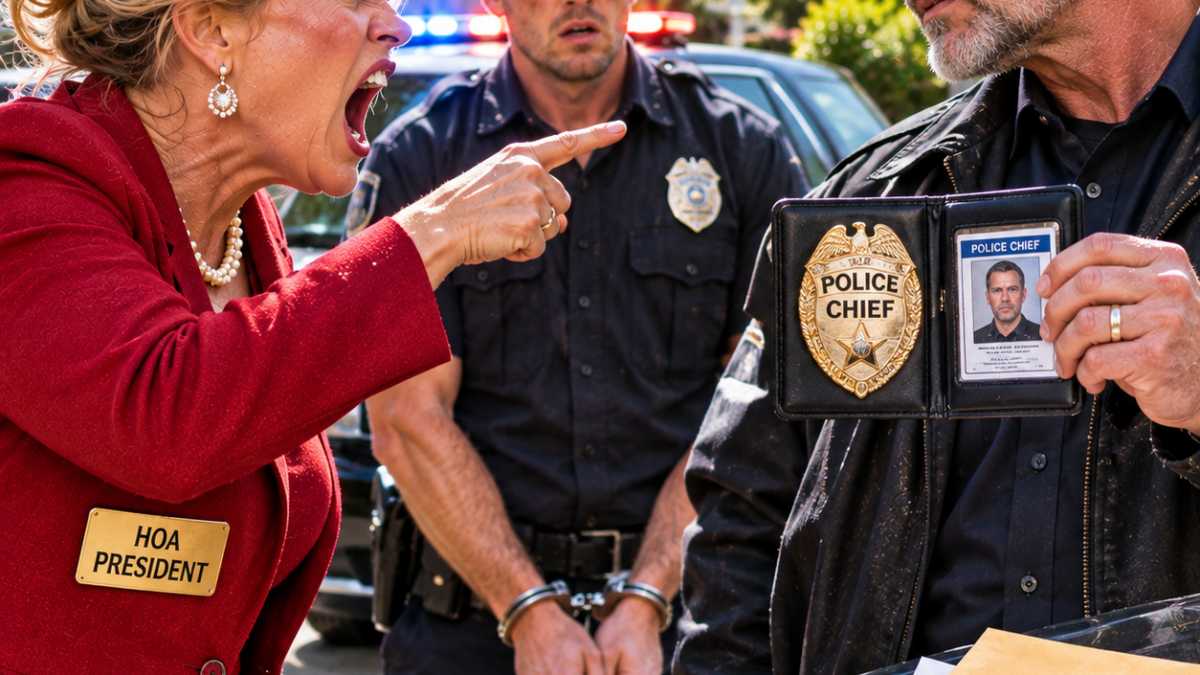
“CALL THE COPS, YOU BROKE LOSER!” HOA Karen Sent a Fake Officer to Block My Driveway—Then I Revealed My Police Chief Badge and Exposed Her $47,000 Scam
“CALL THE COPS, YOU BROKE LOSER—LET’S SEE WHO THEY BELIEVE!” HOA president Vivian Whitmore screamed as her fake security officer, Braden Hutchkins, planted an orange traffic cone behind my car, blocked my driveway, and threatened to have my home seized over a $79 violation, completely unaware that I was Marcus Rivera, the police chief who had spent twenty years investigating people who thought a badge gave them the right to terrorize others.
I could have revealed my identity right there, but when Vivian started photographing my sixteen-year-old daughter Sophia at school, demanded $3,000 from every homeowner, and offered to make my troubles disappear for $2,000 cash, I realized the problem wasn’t one power-hungry HOA Karen—it was an organized campaign that had already driven six families from their homes.
And when I discovered that Pine Grove Estates’ HOA corporation had been dissolved three years earlier, the missing financial records, forty-seven thousand dollars in disputed collections, and a trail of suspicious property sales exposed a scheme so disturbing that Vivian’s final attempt to publicly humiliate me would end with sixty neighbors watching real investigators walk through the community center doors.
The first time Vivian Whitmore fined me, I paid her seventy-nine dollars.
That was my mistake.
Not because paying a disputed fine automatically makes someone weak.
Not because I was legally admitting she was right.
But because Vivian interpreted my desire for peace as permission to keep pushing.
And I was too tired to notice.
My name is Marcus Rivera.
I’ve worn a police badge for twenty years.
I started as a patrol officer at twenty-four, working night shifts in neighborhoods where people called the police because they had nowhere else to turn.
Then I became a detective.
I investigated burglaries, violent crimes, narcotics trafficking, and financial schemes that destroyed families who trusted the wrong people.
Six months before Vivian began making my life miserable, I was appointed chief of the Millbrook Heights Police Department.
It was an honor.
It was also exhausting.
People imagine police chiefs spend their days attending ceremonies, holding press conferences, and shaking hands with city officials.
Some days, that’s true.
Other days, you’re in the office at three in the morning trying to find enough officers to cover a shift while someone across town has just lost everything in a house fire.
I worked sixty-hour weeks.
Sometimes seventy.
I drove an unmarked department vehicle when official duties required it and an ordinary pickup when I wasn’t working.
I wore civilian clothes outside the station.
Most of my neighbors didn’t know what I did.
Some assumed I worked construction.
Others thought I was a contractor.
I never corrected them.
The last thing I wanted was for people to treat my family differently because of my job.
My wife, Sarah, had died of cancer two years before I became chief.
She was forty.
We’d been married seventeen years.
The day she died, our daughter Sophia sat beside her hospital bed holding a bracelet she’d made from blue plastic beads.
Sarah wore it until the end.
I still have it.
Sometimes I find it in the drawer beside our wedding photograph and spend an hour sitting there without realizing how much time has passed.
After Sarah died, Sophia and I needed somewhere quieter.
Our old neighborhood reminded us of every moment we’d lost.
The kitchen where Sarah used to dance while making pancakes.
The porch where she sat during chemotherapy, wrapped in a blanket, insisting she could still smell spring coming.
The bedroom where Sophia sometimes stood in the doorway because she couldn’t bear to enter.
So I bought a modest house in Pine Grove Estates.
Three bedrooms.
A small backyard.
An attached garage.
A driveway with a crack running diagonally across the concrete.
Nothing luxurious.
But Sophia liked the nearby high school.
There were trees along the sidewalks.
Children rode bicycles in the evenings.
And the people living around us seemed pleasant.
For almost two years, things were peaceful.
Then I repaired the driveway.
A pothole had formed near the garage entrance.
I hired a licensed contractor to patch it.
The repair was safe, professionally completed, and documented.
The fresh material was slightly darker than the surrounding surface.
You had to look carefully to notice.
Vivian Whitmore noticed immediately.
She appeared on my porch wearing a white blazer and carrying a clipboard.
“Mr. Rivera, your driveway violates our community’s visual harmony standards.”
I looked past her toward the repair.
“My driveway?”
“The unauthorized surface material.”
“It’s a pothole repair.”
“An unapproved pothole repair.”
I almost laughed.
Then saw she wasn’t joking.
She handed me a notice.
$79 — UNAUTHORIZED DRIVEWAY MATERIAL.
I asked for the governing provision.
She gave me a page containing vague aesthetic guidelines.
I asked whether emergency safety repairs required approval.
She said all modifications did.
I considered challenging it.
Then remembered I had a homicide briefing at seven the next morning, a school conference with Sophia on Thursday, and an unfinished pile of reports on my desk.
Seventy-nine dollars.
I paid.
Not because I accepted Vivian’s interpretation.
Because I wanted her to go away.
She smiled when she received the payment.
And I made a mental note that I’d never forget.
She didn’t look relieved that a violation had been corrected.
She looked pleased that I’d obeyed.
PART2
Three weeks later, Sophia forgot to bring in the trash cans.
She was sixteen.
An excellent student.
Smart.
Funny.
The kind of daughter who could explain advanced chemistry and still somehow leave every kitchen cabinet open after making a sandwich.
The collection truck had passed around ten.
The bins remained at the curb until eleven-thirty.
That afternoon, an HOA notice appeared on our front door.
$150 — REPEAT NONCOMPLIANCE.
I stared at the paper.
Then at the bins.
Then back at the paper.
One hundred fifty dollars.
For trash cans.
The notice referenced enhanced enforcement procedures and warned that continued noncompliance could trigger additional penalties.
Sophia came downstairs while I was reading.
“Dad?”
“Yeah?”
“What’s wrong?”
I folded the notice.
“Nothing important.”
She looked at my face.
“That’s your lying voice.”
I sighed.
“Apparently, we’re in trouble for the trash cans.”
Her expression collapsed.
“Oh.”
I turned.
“Soph?”
“I forgot.”
“That’s okay.”
She looked at the notice.
“How much?”
I hesitated.
“One hundred fifty.”
Her eyes widened.
“For trash cans?”
“Apparently.”
She stared at the floor.
“I’m sorry.”
That broke my heart more than the fine.
My daughter had spent two years apologizing for things she couldn’t control.
For crying unexpectedly.
For needing me during work hours.
For forgetting school assignments when grief made concentration impossible.
For not knowing what to do on Mother’s Day.
Now she was apologizing because somebody had decided ordinary teenage forgetfulness should cost us a week’s grocery money.
I set the notice down.
“Look at me.”
She did.
“Your responsibility is to bring in the bins.”
She nodded.
“My responsibility is to handle disputes with adults.”
“But—”
“No.”
I smiled.
“You can improve without feeling guilty for existing.”
Her eyes filled.
Sarah used to say something similar.
I wondered whether Sophia remembered.
She hugged me.
I held her.
Then looked toward the window.
Across the street, Vivian’s white BMW was parked beside the clubhouse driveway.
And for the first time, I wondered how many other families had been paying to make that woman disappear.
The mailbox inspection arrived on a Saturday.
Seven in the morning.
I was drinking coffee on the front porch.
The air smelled of freshly cut grass, damp soil, and somebody cooking bacon two houses down.
A rare peaceful morning.
Then Vivian’s BMW appeared.
Behind it came a rusty Honda Civic.
The Honda’s driver looked twenty-five.
Thin.
Pale.
Wearing sunglasses despite the cloudy sky.
He climbed out in a black uniform with a cheap metal badge pinned crookedly over his chest.
Vivian marched toward my mailbox carrying a measuring tape.
The young man followed with a clipboard.
I watched them.
Didn’t move.
Vivian measured from the street edge to the post.
Then looked toward my porch.
“Mr. Rivera!”
I took a sip of coffee.
“Morning.”
She approached.
“Your mailbox is improperly positioned.”
I looked at it.
“It’s been there for years.”
“Two inches inside the approved setback.”
“Two inches?”
“Yes.”
I stared.
She opened her folder.
“You have forty-eight hours to relocate it.”
“What happens after forty-eight hours?”
“Three-hundred-dollar fine.”
I lowered my coffee.
“Can you show me the provision authorizing retroactive relocation of existing mailboxes?”
Her smile tightened.
“Recent amendments supersede previous standards.”
“Which amendment?”
She looked annoyed.
“Mr. Rivera, I’ve managed this community for eight years.”
“Then the amendment should be easy to identify.”
The young man stepped forward.
“Sir, refusing a lawful compliance inspection is a serious matter.”
I looked at him.
Then his badge.
Then the name patch.
BRADEN HUTCHKINS — ENFORCEMENT OFFICER.
“What’s your title?”
“Neighborhood Enforcement Officer.”
“Employed by whom?”
“Pine Grove Estates.”
“What authority allows you to issue orders on private property?”
He straightened.
“Community safety regulations.”
I waited.
He looked toward Vivian.
She stepped between us.
“Braden has completed the necessary security certification.”
I nodded.
“Licensed security officer?”
Braden’s face reddened.
“I completed an online course.”
“Which course?”
He hesitated.
“Comprehensive security training.”
“Who issued the credential?”
He stared.
Then said:
“That’s confidential.”
I nearly laughed.
Instead, I looked at Vivian.
“I’d like the minutes authorizing this position, the relevant contract, and the mailbox regulation.”
She snapped the folder shut.
“You’ll receive everything through formal enforcement.”
“Great.”
I took out my phone.
“I’m going to document today’s conversation.”
Her expression changed.
“You don’t need to do that.”
“Then it shouldn’t be a problem.”
She stared.
Braden looked toward my phone.
His posture shifted.
Vivian turned sharply.
“Forty-eight hours, Mr. Rivera.”
Then they walked away.
Braden stopped beside my truck.
Raised his phone.
Photographed the license plate.
Then the garage.
Then the front windows.
I watched carefully.
He wasn’t measuring mailboxes anymore.
He was collecting pictures of my home.
And suddenly, the seventy-nine-dollar driveway fine didn’t seem quite so ridiculous.
It seemed like the first step in something I’d been too busy to notice.
Two days later, the city’s water department called.
A complaint had been filed about my supposedly illegal sprinkler system.
I stood in the kitchen holding the phone.
“Sprinkler system?”
“Yes, sir.”
“I don’t have one.”
The employee paused.
“Our report says you’re operating automated irrigation during restricted hours.”
I looked out the window.
Sophia’s little herb garden sat beside the patio.
Three basil plants.
Two struggling rosemary bushes.
A mint plant that seemed determined to conquer the entire yard.
I watered it with a hose.
Maybe twice a week.
“I can show you there isn’t an irrigation system.”
The employee apologized.
The complaint was reviewed and closed.
But the next day, Sophia came home looking frightened.
She dropped her backpack near the stairs.
Then stood there.
“Dad?”
I looked up from my laptop.
“Hey.”
She didn’t smile.
“Why are people saying we’re criminals?”
I stopped typing.
“What?”
She swallowed.
“Emma’s mom said men come to our house at night.”
I stared.
“Okay.”
“And that we have secret meetings.”
My stomach tightened.
“Who told her that?”
Sophia looked away.
“Mrs. Whitmore.”
Of course.
I closed the laptop.
“What exactly did she say?”
Sophia sat beside me.
“That people should be careful around our house because unmarked cars keep visiting.”
I took a breath.
“And?”
“She said nobody knows how you make your money.”
I stared at the wall.
Detectives occasionally came to my house to discuss department issues when an urgent matter couldn’t wait.
A budget officer once dropped off documents.
A deputy chief came by after Sarah’s anniversary because he knew I’d had a difficult day.
Nothing criminal.
Nothing remotely suspicious when understood in context.
But Vivian had been photographing vehicles and turning them into a story.
Sophia looked at me.
“Dad, people at school think you’re running something illegal.”
I reached for her hand.
“Sophia, listen.”
She looked up.
“I’m not involved in anything illegal.”
“I know.”
“But now other kids are asking me questions.”
Her voice broke.
“Somebody asked if that’s why Mom died.”
For a moment, I couldn’t breathe.
“What?”
She started crying.
“They said maybe there was something bad going on.”
I put my arms around her.
Held her tightly.
And felt a cold anger settle into my chest.
Vivian’s campaign had crossed a line.
Not because she insulted me.
I could handle insults.
But because she had dragged my dead wife into my daughter’s school day.
That was no longer a funny neighborhood dispute.
It was a family being targeted.
And I needed to know how far it went.
I attended the HOA meeting the following Wednesday.
The clubhouse smelled like stale coffee and carpet cleaner.
About twenty homeowners sat in folding chairs.
Vivian occupied the center of a long table beneath the association’s framed mission statement.
OUR COMMUNITY, OUR VALUES, OUR FUTURE.
I sat near the back.
Mrs. Patterson, an older resident with silver hair and an enormous handbag, smiled at me.
“First meeting?”
I nodded.
“First in a while.”
She leaned closer.
“Bring patience.”
I smiled.
“I’ll try.”
The meeting began with an argument about pool hours.
Then landscaping.
Then whether children should be permitted to draw chalk pictures on common sidewalks.
Vivian spoke about property values.
Visual harmony.
Maintaining standards.
Respect for established community traditions.
Then the treasurer’s report began.
A middle-aged man named Harold Green read from a spreadsheet.
The association’s accounts showed overdue assessments.
Delinquent balances.
Collection expenses.
I listened quietly.
Then heard a familiar surname.
Whitmore.
Twelve thousand dollars.
I looked up.
Harold hesitated before continuing.
It appeared that Rick Whitmore, Vivian’s husband, had a substantial unpaid balance associated with property and related assessments.
A resident raised her hand.
“Is that being collected?”
Vivian leaned toward the microphone.
“Those matters are subject to administrative reconciliation.”
The resident frowned.
“Does that mean he owes it?”
“It’s more complicated.”
Another homeowner asked why his own eighty-dollar balance had produced three warning letters.
Vivian stiffened.
“Each account has unique circumstances.”
I wrote the exchange in my notebook.
Not because I had proof of criminal misconduct.
Because inconsistent collections were worth examining.
Especially when the association president’s household appeared to be receiving treatment unavailable to everyone else.
After the meeting, I approached Harold.
“Mr. Green.”
He looked nervous.
“Yes?”
“Could you explain how homeowners request financial records?”
He hesitated.
“Through the board.”
“Is there a written process?”
“Yes.”
“Could I have it?”
He glanced toward Vivian.
She was speaking to Rick near the entrance.
Harold lowered his voice.
“I’ll email it.”
“Thank you.”
He leaned closer.
“Mr. Rivera?”
“Yes?”
“Be careful.”
I stared.
“About what?”
He looked toward Vivian again.
Then whispered:
“She doesn’t like people asking questions.”
The following morning, another notice arrived.
This time, five hundred dollars.
SPECIAL SECURITY ASSESSMENT.
The document claimed additional protective measures were necessary because of suspicious activities associated with my residence.
Enhanced lighting.
Monitoring equipment.
Threat assessment personnel.
Then came a second page.
It referred to undisclosed commercial activities and suggested that failure to pay could eventually result in a lien.
I read it.
Twice.
Then called the association office.
Vivian answered.
“Marcus.”
I disliked how familiar she sounded.
“Mrs. Whitmore.”
“I assume you received the assessment.”
“I did.”
“Then I expect prompt payment.”
“What’s the basis for classifying my residence as a special security threat?”
She laughed softly.
“Mr. Rivera, we’re not naive.”
“I didn’t suggest you were.”
“Unmarked vehicles.”
“Men visiting at unusual hours.”
“Private meetings.”
I looked toward the driveway.
My truck sat there.
Nothing else.
“Are you alleging criminal conduct?”
“We’re protecting neighborhood safety.”
“That’s not an answer.”
Her tone sharpened.
“Perhaps you’d prefer the association to escalate.”
I stared at the document.
“Send me the vote authorizing the assessment.”
“Everything is properly documented.”
“Then send it.”
She hung up.
I placed the notice in a folder.
Then looked toward Sophia’s room upstairs.
My daughter was still at school.
I wondered what she’d heard today.
And I realized something.
Vivian wasn’t trying to persuade me to follow a rule.
She was trying to make life unpleasant enough that I’d eventually stop resisting.
Maybe pay.
Maybe move.
Maybe both.
Three days later, Mrs. Patterson came to my house.
She brought banana bread.
And a folder.
The bread was for politeness.
The folder was why she was really there.
“Marcus.”
“Mrs. Patterson.”
“Call me Ruth.”
I smiled.
“Come in, Ruth.”
She sat at my kitchen table.
Looked around.
Then said:
“Your daughter seems lovely.”
“She is.”
“I saw Vivian bothering her at the bus stop last week.”
My smile disappeared.
“What?”
Ruth nodded.
“Asked who visited your house.”
“Whether she knew what you did.”
“Whether you had visitors at night.”
I stared.
“Vivian questioned Sophia directly?”
“Yes.”
I felt my stomach tighten.
Ruth opened her folder.
“That’s why I’m here.”
Inside were records.
Violation notices.
Photographs.
Meeting summaries.
Copies of letters sent to other homeowners.
A spreadsheet tracking fines.
Dates.
Properties.
Outcomes.
Ruth had apparently been documenting Vivian’s behavior for more than a year.
“Why?”
I asked.
She looked surprised.
“Why what?”
“Why keep all of this?”
Her expression changed.
“Because I watched the Henderson family lose their home.”
I sat down.
“Tell me.”
She folded her hands.
“James Henderson worked construction.”
“His wife was a nurse.”
“Two children.”
“Good neighbors.”
“They had a little wooden playhouse in their backyard.”
I waited.
“Vivian started fining them.”
“The playhouse.”
“Their truck.”
“Children’s toys.”
“Grass height.”
“Driveway stains.”
Ruth’s mouth tightened.
“They appealed.”
“Then the fines doubled.”
“Eventually they sold.”
“How much?”
“Thirty thousand below what they’d hoped to receive.”
I stared.
Ruth continued.
“The Garcias had similar problems.”
“Then the Millers.”
“Then a single mother named Denise Hall.”
“Six families in all.”
I opened the spreadsheet.
Property after property.
Dates.
Violations.
Letters.
Escalation.
Sales.
Not proof of a conspiracy on its own.
Families sell homes for many reasons.
Property values fluctuate.
HOA rules can legitimately differ across properties.
But the pattern was troubling.
Ruth leaned closer.
“Marcus.”
“Yes?”
“I think she’s choosing people she wants gone.”
I looked up.
“Why?”
Ruth’s expression hardened.
“Some are minorities.”
“Some are working families.”
“Some are people who ask too many questions.”
I stared at the papers.
Then asked:
“Does she enforce the same rules against her friends?”
Ruth laughed bitterly.
“Not even close.”
She showed me photographs.
Rick Whitmore’s broken boat trailer sitting beside his garage for months.
No visible violation notice.
A board member’s overgrown hedges.
No fine.
A favored neighbor’s work van.
No enforcement.
Meanwhile, other residents had been punished for less.
I looked at Ruth.
“Have you spoken with a lawyer?”
She nodded.
“Couldn’t afford to keep going.”
I sat quietly.
Then said:
“We should preserve all of this.”
She leaned forward.
“Are you going to help?”
I looked toward the stairs.
Sophia’s school photograph hung on the wall.
Then I looked back.
“Yes.”
“But we’re going to do it carefully.”
Ruth nodded.
“Good.”
Then she smiled faintly.
“Because I think Vivian’s about to learn something.”
I raised an eyebrow.
“What?”
“That some of us still know how to read.”
For the first time in days, I laughed.
The school situation escalated before the HOA dispute could be resolved.
Sophia texted me on a Tuesday afternoon.
Dad, Braden’s outside school again.
I stared at the screen.
Again?
I called her.
She answered immediately.
“Dad?”
“Where are you?”
“Inside.”
“Stay there.”
“He’s parked across the street.”
“Have you told school security?”
“Yes.”
“Good.”
I contacted the school’s administrator and the appropriate local authorities.
Then drove over.
Braden’s Honda sat legally parked near the public street.
But the camera equipment visible through the windshield was troubling.
A long lens.
A notebook.
Photographs apparently being taken of students entering and leaving.
I didn’t approach as an officer.
This involved my daughter.
That created a personal conflict I couldn’t ignore.
Instead, I met the school security officer.
Provided Sophia’s messages.
Identified Braden.
Explained the HOA dispute.
And requested that the matter be documented and assessed independently.
The school reviewed its security concerns.
Local law enforcement obtained information through proper procedures.
Braden was instructed to stop conduct that could create safety problems or violate applicable restrictions.
The investigation into any harassment or stalking offense required more than simply assuming that photography from a public street was automatically criminal.
But the circumstances mattered.
Repeated appearances.
Targeting.
Following.
Communications.
Any threats.
And why an HOA contractor was monitoring students who had nothing to do with association rules.
That evening, Sophia sat on her bed holding Sarah’s old blue-bead bracelet.
I stood in the doorway.
“Soph?”
She looked up.
“Yeah?”
“Can I come in?”
She nodded.
I sat beside her.
For a long time, neither spoke.
Then she whispered:
“Dad, why does she hate us?”
My chest tightened.
“I don’t know that she hates us.”
Sophia looked at me.
“She acts like it.”
I nodded.
“Yeah.”
She stared at the bracelet.
“Maybe we should move.”
The words hurt more than I expected.
We had moved here to escape the weight of loss.
Now my daughter wanted to leave the place we’d chosen because someone was making her feel unsafe.
I took her hand.
“Do you want to move?”
She shrugged.
“I want people to stop watching me.”
I swallowed.
“I know.”
She looked at me.
“Mom would’ve done something.”
I closed my eyes.
Sarah.
Always.
Even now.
“Your mom would’ve gone straight to Vivian’s door.”
Sophia smiled faintly.
“She would’ve yelled.”
I laughed softly.
“She would’ve been very organized about it.”
My daughter laughed.
Then started crying.
“I miss her.”
I pulled her close.
“Me too.”
We sat together.
And I made a private decision.
Whatever happened with Vivian, my daughter’s safety would come before my pride.
Before the HOA.
Before the pleasure of winning an argument.
That had to be the line.
The next major development came in the grocery-store parking lot.
Rick Whitmore approached me as I loaded bags into my truck.
He smelled of cigarette smoke.
His hands moved nervously.
“Marcus.”
I looked up.
“Rick.”
“Can we talk?”
I glanced around.
“About what?”
He nodded toward my truck.
“Your HOA situation.”
I stopped moving.
“Okay.”
He stepped closer.
“Vivian’s under a lot of pressure.”
I said nothing.
“She can be intense.”
“That’s one word.”
Rick gave a weak laugh.
Then lowered his voice.
“I might be able to help.”
“How?”
“Make the fines disappear.”
I stared.
“What would that require?”
He looked around.
Then said:
“Two thousand dollars.”
I kept my expression neutral.
“Two thousand for what?”
“Administrative settlement.”
“Through the HOA?”
He hesitated.
“Informally.”
I looked at him.
“Cash?”
He nodded.
“Cash is easier.”
Something cold settled in my stomach.
I asked:
“Does this cover the mailbox notice?”
“Yes.”
“The driveway?”
“Yes.”
“The security assessment?”
“Everything.”
“And Braden will stop monitoring my house?”
Rick looked toward the store entrance.
“Sure.”
“What about my daughter?”
He hesitated.
Then:
“That can stop too.”
I stared at him.
There it was.
The suggestion that pressure on my family could be switched off in exchange for money.
Rick leaned closer.
“Look, other people have resolved things this way.”
I kept my voice calm.
“Which people?”
He shook his head.
“Names aren’t important.”
I nodded.
“But you’re saying this has worked before?”
He looked uncomfortable.
“People pay to avoid trouble.”
I let the silence sit.
Then said:
“I’ll need something in writing.”
Rick’s expression changed.
“That’s not how this works.”
“Then I can’t agree.”
He sighed.
“Marcus, you’re making this harder than necessary.”
I looked at him.
“Maybe.”
He stepped closer.
“You know, Vivian doesn’t like certain kinds of families moving into Pine Grove.”
I felt my pulse quicken.
“What kinds?”
He shrugged.
“People who don’t fit the community profile.”
I waited.
He glanced around.
“Working families.”
“People who don’t understand our standards.”
Then a phrase I would remember.
“Keeping the right demographics.”
I stared.
Rick seemed to realize he’d said too much.
He stepped backward.
“Anyway, think about it.”
Then walked away.
I stood beside my truck.
Groceries forgotten.
My hands cold.
I documented the conversation immediately while the details were fresh and preserved any lawful recording available.
Then contacted the appropriate investigative authorities.
Because the question was no longer whether Vivian was an unpleasant HOA president.
It was whether people were using threats and selective enforcement to obtain money and push homeowners out.
And because I was one of the targeted residents, I couldn’t appropriately direct my own department to conduct a case for my personal benefit.
I needed independent investigators.
That distinction would become critical.
I contacted District Attorney Patricia Wong.
I’d known Patricia for years.
She was smart.
Careful.
Not easily impressed.
I explained the situation.
The fines.
The security contractor.
The school incidents.
The cash proposal.
The apparent selective enforcement.
Then I said:
“I’m personally involved.”
Patricia nodded.
“Which means you don’t supervise the investigation.”
“Agreed.”
“We’ll determine what potential offenses are supported.”
“Agreed.”
“And Marcus?”
“Yes?”
“No dramatic police-chief showdown.”
I almost smiled.
“What makes you think I wanted one?”
She gave me a look.
I laughed.
Then stopped.
Because she was right.
Part of me wanted to walk into the clubhouse, lay my badge on the table, and watch Vivian’s face change.
Part of me wanted to humiliate Braden in front of every person he’d intimidated.
But a police chief doesn’t get to use official power to settle personal scores.
Not even when the other person deserves investigation.
Especially then.
So Patricia worked with an outside agency to ensure the matter received independent review.
Financial records were requested or obtained through appropriate process.
Witnesses interviewed.
The potential harassment involving Sophia assessed separately.
Residents provided documentation voluntarily.
And I became what I should have been from the beginning.
A complainant.
A witness.
A father.
Not the person deciding who got arrested.
Then I visited the county records office.
I had been studying the HOA’s governing documents and wanted to verify its corporate information.
The clerk, a woman named Elaine Porter, directed me toward the state business records terminal.
I searched.
PINE GROVE ESTATES HOMEOWNERS ASSOCIATION.
A record appeared.
Formation date.
Registered agent.
Filing history.
Then one line made me stop.
ADMINISTRATIVELY DISSOLVED — THREE YEARS EARLIER.
I leaned forward.
Read it again.
The corporation had been administratively dissolved after failing to maintain required filings and fees.
I stared.
Three years.
The same period during which Vivian’s enforcement campaign had intensified.
I printed the record.
Then called Patricia.
“Have you seen the association’s corporate status?”
She paused.
“What about it?”
“Administratively dissolved.”
Silence.
Then:
“Send it.”
I did.
She called back after reviewing.
“This is important.”
I nodded.
“But we need to be precise.”
“I know.”
“Dissolution doesn’t automatically erase recorded covenants, eliminate legitimate property obligations, or make every assessment criminal.”
“Understood.”
“We need to examine the association’s governing documents, state law, any reinstatement rights, the bank records, and what the board represented to residents.”
I stared at the paper.
“Right.”
She continued.
“But collecting money while falsely representing corporate authority can create serious issues, depending on the facts.”
I looked toward the clerk.
She was helping another homeowner locate a deed.
“Patricia.”
“Yes?”
“I think a lot of people have been paying money they didn’t owe.”
She was quiet.
Then:
“That’s what the records will have to establish.”
The independent financial review identified tens of thousands of dollars in collections during the disputed period.
Fines.
Special assessments.
Administrative charges.
Security fees.
Some expenses appeared to have supported legitimate common-area services.
Others were poorly documented.
Several payments raised questions about who benefited.
The public record and victim statements ultimately supported a disputed collection figure of approximately thirty-seven thousand dollars initially identified through the dissolved entity’s accounts.
Further investigation located additional transfers and related payments, bringing the amount subject to restitution and recovery efforts to roughly forty-seven thousand dollars.
The difference mattered.
Not all money flowing through an association account is automatically stolen.
And an administrative dissolution alone doesn’t prove every payment fraudulent.
The investigators had to determine what residents were told, what authority actually existed, and how the money was used.
That work was less dramatic than a shouting match.
But much more important.
It created a case that could withstand challenge.
And the more investigators learned, the more troubling the pattern became.
Ruth Patterson helped identify homeowners who had suffered repeated enforcement.
The Hendersons.
The Garcias.
The Millers.
Denise Hall.
Others.
Some had already moved.
Some were reluctant to speak.
One family told investigators they had paid thousands of dollars because Vivian threatened a lien and foreclosure.
Another said Braden repeatedly came to their door photographing minor exterior conditions.
A single mother described receiving a fine the morning after she questioned the board’s spending.
An elderly homeowner said Vivian warned him that refusing a special assessment could jeopardize his ability to keep his house.
Each story required verification.
Letters.
Payments.
Witnesses.
Recorded restrictions.
Comparable properties.
The independent investigators didn’t simply declare discrimination because Ruth believed a pattern existed.
They examined which homeowners were targeted, how similar violations were handled, and whether the evidence supported deliberate unequal treatment.
Some incidents involved ordinary disputes.
Others did not.
And a disturbing picture began to emerge.
Certain homeowners faced aggressive enforcement while favored residents received exceptions.
The people most likely to be pressured included lower-income families, working households with limited time to appeal, and some minority homeowners.
That pattern raised civil-rights concerns requiring separate legal assessment.
Meanwhile, Rick’s offer to exchange cash for reduced enforcement created a different problem.
An association was not supposed to operate like a private protection racket.
Pay the right person.
Make the trouble disappear.
That was what investigators were beginning to examine.
And Vivian continued behaving as though none of it mattered.
The next letter arrived on a Monday.
An emergency assessment.
Three thousand dollars per household.
Payable within seventy-two hours.
The stated purpose was extraordinary legal and security costs associated with an allegedly dangerous resident.
Me.
The notice warned that failure to pay could lead to aggressive collection action.
I read it at the kitchen counter.
Sophia came downstairs.
She was wearing Sarah’s old blue sweatshirt.
The sleeves were too long.
She always pulled them over her hands when she was nervous.
“Dad?”
I looked up.
“Yeah?”
“Another letter?”
I nodded.
She glanced at the amount.
“Three thousand dollars?”
“That’s what it says.”
She stared.
“Because of us?”
I set it down.
“No.”
She looked at me.
“But it says—”
“Vivian is choosing to blame us.”
“That’s different.”
Sophia swallowed.
“People are going to hate me.”
My heart dropped.
“Soph.”
“Three thousand dollars is a lot.”
“I know.”
“What if everybody has to pay because you won’t leave?”
I moved toward her.
Took her hands.
“Listen carefully.”
She looked at me.
“You are not responsible for what Vivian demands.”
“Neither am I.”
“She has to establish legal authority for any assessment.”
Sophia’s eyes filled.
“But everyone thinks we’re causing this.”
I looked toward the window.
Then back at her.
“Then people need the facts.”
She swallowed.
“Are you going to tell them you’re the chief?”
I hesitated.
She continued.
“Dad, they think you’re a criminal.”
I sat beside her.
For two years, I’d kept my professional life quiet because I wanted Sophia to feel normal.
Now that privacy had become another thing Vivian used against us.
I looked at my daughter.
“I might need to explain my job publicly.”
She nodded.
“Okay.”
“Would that make school harder for you?”
She thought.
Then shook her head.
“I’d rather they know the truth.”
I put my arm around her.
“Me too.”
The seventy-two-hour assessment enraged the neighborhood.
Homeowners began questioning the board.
Online discussions grew.
Residents demanded financial statements.
Some called for a special meeting.
Others wanted an outside audit.
Vivian responded with increasingly aggressive messages accusing unnamed residents of undermining community safety.
She portrayed criticism as disloyalty.
Questioning fees became an attack on property values.
Requests for records became harassment.
A demand for transparent governance became a conspiracy.
Even some of her supporters began backing away.
Ruth called me one afternoon.
“Marcus.”
“Hey.”
“People are finally asking questions.”
“Good.”
“She thinks you’ve organized a rebellion.”
I smiled.
“Have I?”
Ruth laughed.
“No.”
“She managed that herself.”
Then her voice grew serious.
“Vivian’s calling an emergency meeting.”
“When?”
“Thursday.”
“What for?”
“To vote on forcing you out.”
I stared.
“That’s not how property ownership works.”
“I know.”
“She claims she has enough authority to make you sell.”
I looked toward the assessment notice.
Then asked:
“Who told you?”
“Vivian.”
Ruth paused.
“She wants everybody there.”
I thought about Sophia.
The school.
The Honda.
The cameras.
Then said:
“I’ll attend.”
Ruth sounded relieved.
“Good.”
Then she asked:
“Marcus?”
“Yes?”
“Are you ready to tell them who you are?”
I stared at the wall.
For a long moment, I didn’t answer.
Then:
“Yes.”
The evening before the meeting, Braden parked across from my house.
His Honda sat beneath a streetlight.
Engine running.
Headlights pointed toward our front windows.
It remained there long enough for Sophia to notice.
She came downstairs.
“Dad.”
I looked up.
“He’s back.”
I went to the window.
Saw the car.
The camera equipment.
The same face.
Sophia stood beside me.
Her expression was tight.
“This is getting scary.”
I placed an arm around her shoulders.
“I know.”
She looked up.
“Can you arrest him?”
There it was.
The question I’d known would come.
I looked at her.
“I’m not the right person to decide that.”
She frowned.
“But you’re the police chief.”
“Yes.”
“Then—”
“That’s exactly why I need to be careful.”
She stared.
I crouched slightly so our eyes were level.
“If somebody is harassing you, I want it investigated fairly.”
“By people who can look at the evidence without taking orders from your father.”
Sophia thought about that.
Then asked:
“Even if he’s really doing it?”
“Especially then.”
She nodded slowly.
I took photographs from a lawful position.
Documented the time.
Contacted the appropriate independent officers handling the complaints.
Then we closed the blinds.
Sophia stayed beside me.
For a while, neither of us spoke.
Then she whispered:
“Dad?”
“Yeah?”
“I wish Mom was here.”
My chest tightened.
“Me too.”
She leaned against me.
Sarah had been the person who made our house feel certain.
She could take a difficult day and somehow make it manageable with a pot of soup and a joke.
She could look at me when I was furious and say one sentence that made me realize I was being foolish.
I missed her every day.
But especially then.
I kissed Sophia’s hair.
“We’re going to get through this.”
She nodded.
“Promise?”
I took a breath.
“I promise I won’t stop working to keep you safe.”
She wrapped her arms around me.
And I held her until the headlights across the street finally went dark.
Thursday arrived.
The community meeting was scheduled for seven.
Sophia stayed with my sister, Elena.
Not because I expected violence.
Because she’d already endured enough.
She didn’t need to sit in a crowded room listening to adults argue about whether her father was a criminal.
Before leaving, she hugged me.
“Dad?”
“Yes?”
“Don’t get mad.”
I smiled faintly.
“I’ll try.”
She looked serious.
“Mom always said you look scary when you’re quiet.”
I laughed.
“She did?”
Sophia nodded.
“She said that’s when you’re thinking too hard.”
I hugged her.
“Your mom knew me pretty well.”
Sophia smiled.
Then whispered:
“I love you.”
“I love you too.”
She left.
I stood in the driveway for a moment.
Looked at the house.
The cracked concrete.
The repaired patch.
The mailbox.
The bins.
All the ordinary objects Vivian had used to make our lives miserable.
Then I drove to the clubhouse.
The community center was packed.
Sixty residents.
Maybe more.
Folding chairs filled every row.
People stood along the walls.
A projector sat near the front.
The air smelled of stale coffee and nervous sweat.
Vivian stood behind a podium.
White blazer.
Perfect hair.
Her favorite clipboard.
Braden stood near the entrance wearing his fake-looking enforcement uniform.
He glanced at me.
Smirked.
I nodded politely.
That seemed to annoy him.
Ruth sat in the front row.
Her thick folder rested on her lap.
She caught my eye.
Gave a slight nod.
I returned it.
Detective Sarah Coleman, an investigator assisting the independent inquiry, attended in plain clothes with proper authorization.
The outside investigative team had determined its own operational plan.
I wasn’t commanding it.
I wasn’t deciding when or whether arrests would happen.
I was there because Vivian had summoned the community to make accusations against me.
And because it was time my neighbors heard the truth about who lived at 247 Maple Street.
Vivian struck the podium with a small wooden gavel.
“Order!”
The room quieted.
She smiled.
“Thank you all for coming.”
Her voice carried practiced concern.
“Tonight, we must address a serious threat to our neighborhood.”
I sat still.
She continued.
“Pine Grove Estates has long been a place of safety, stability, and established community standards.”
Ruth shifted in her chair.
Vivian looked toward the back of the room.
“Unfortunately, one resident has repeatedly refused to comply.”
There it was.
I watched her.
She clicked to the first presentation slide.
A photograph of my house.
Then another.
An unmarked department vehicle.
Two detectives standing beside my garage.
A man carrying documents toward my front door.
The next slide read:
SUSPICIOUS COMMERCIAL ACTIVITY.
I almost laughed.
Vivian continued.
“Mr. Marcus Rivera has repeatedly hosted unknown individuals at unusual hours.”
She pointed at the photographs.
“Unmarked vehicles.”
“Private meetings.”
“Unexplained visitors.”
Then she turned toward the room.
“Does this look like an ordinary family residence?”
Several people murmured.
A man near the back said:
“Maybe he works from home.”
Vivian ignored him.
“His behavior has created significant safety concerns.”
The next slide appeared.
ACCUMULATED VIOLATIONS — $8,000.
I looked at the figure.
Eight thousand.
An amount assembled from fines, administrative charges, and disputed assessments.
Vivian spoke with growing confidence.
“We have given Mr. Rivera numerous opportunities to comply.”
“He has refused.”
“He has intimidated our enforcement personnel.”
“And tonight, we must decide whether his continued presence is compatible with our community.”
A woman raised her hand.
“Can an HOA really force someone to sell?”
Vivian smiled.
“Under appropriate enforcement procedures.”
I wrote that down.
The woman frowned.
“Which procedures?”
Vivian ignored her.
Then turned toward me.
“Mr. Rivera.”
I looked up.
“Would you like to respond before we vote?”
Every face turned.
I stood.
Slowly.
No theatrical flourish.
No pretending to be defeated.
I walked toward the front.
Vivian stepped aside, smiling.
She thought she had cornered me.
I looked at the residents.
Then at the screen.
Then back at Vivian.
“Before I answer, may I ask a few questions?”
She crossed her arms.
“Of course.”
“First, what legal authority is the association relying on to impose these specific fines and threaten foreclosure?”
She frowned.
“The governing covenants.”
“Which provisions?”
“Our enforcement framework.”
I nodded.
“Second, what authority permits an HOA enforcement contractor to monitor a minor at school?”
The room went quiet.
Braden shifted near the doorway.
Vivian’s expression hardened.
“We conduct reasonable security assessments.”
“Of children?”
“Of community risks.”
I looked at the audience.
Then asked:
“Third, when was Pine Grove Estates Homeowners Association last in good standing as a corporation?”
Vivian froze.
A murmur moved through the room.
She recovered quickly.
“Mr. Rivera, that’s irrelevant.”
“Is it?”
“Yes.”
I held up the publicly obtained corporate record.
“The association was administratively dissolved three years ago.”
Silence.
Then someone near the back said:
“What?”
Vivian shook her head.
“That is a paperwork issue.”
“It may be correctable,” I said.
“But homeowners deserve to know about it.”
Another voice:
“We’ve been paying assessments all this time!”
A woman stood.
“Does that mean the fines weren’t valid?”
I raised one hand.
“It means those charges need review against the actual governing documents and applicable law.”
I looked toward Vivian.
“Corporate dissolution alone doesn’t answer every question.”
“But repeatedly claiming unquestionable authority while withholding records is serious.”
Ruth stood.
She lifted her folder.
“I have copies of the collection letters.”
The room turned toward her.
She continued.
“Three years of them.”
Vivian snapped:
“Ruth, sit down.”
Ruth didn’t.
“I have the Hendersons’ notices.”
“The Garcias’.”
“Denise Hall’s.”
“I have photographs showing that similar conditions were treated differently depending on whose house it was.”
Vivian slammed the gavel.
“YOU’RE OUT OF ORDER!”
Ruth looked at her.
“Then put the records on the table.”
The room erupted.
People began speaking at once.
Questions.
Accusations.
Fear.
Vivian tried to restore order.
Then she pointed at me.
“This man is manipulating all of you!”
I waited.
She continued.
“He won’t even disclose what business he’s running from his residence!”
That was the moment.
I reached into my jacket.
Not for a weapon.
Not for a threat.
For my credentials.
I opened the case.
Held it where the room could see.
And spoke clearly.
“My name is Marcus Rivera.”
“I’ve served in law enforcement for twenty years.”
“And for the last six months, I’ve been chief of the Millbrook Heights Police Department.”
The room went silent.
Vivian stared.
For a moment, I thought she hadn’t heard.
Then her mouth opened.
Closed.
And opened again.
“That’s impossible.”
I looked at her.
“No.”
She shook her head.
“You never told us.”
“I wasn’t required to.”
Her face reddened.
“The unmarked vehicles—”
“Department-related visits.”
“The men—”
“Colleagues.”
“The meetings—”
“Ordinary professional matters.”
I paused.
“Nothing that gave you permission to accuse my family of criminal activity.”
Braden slowly lowered his clipboard.
I turned toward the residents.
“I’m not here to use my badge to enforce HOA rules.”
“I’m here as a homeowner whose daughter has been frightened by repeated surveillance.”
Then I looked back at Vivian.
“And because residents deserve to know that financial concerns about this association have been referred for independent investigation.”
Her face drained.
“You’re threatening me.”
“No.”
I said.
“I’m explaining the situation.”
She began looking toward the doors.
And for the first time that evening, she stopped smiling.
Patricia Wong had instructed me not to orchestrate a confrontation.
I had followed that instruction.
The investigation was independent.
The relevant authorities had their own evidence.
Their own warrants where appropriate.
Their own decisions.
I had disclosed my profession because Vivian had publicly accused me of criminal activity.
Nothing more.
But the meeting itself produced additional information.
Several residents stood and described payments.
Some produced receipts.
Others demanded explanations about alleged liens.
A man in the second row asked why Rick Whitmore’s large unpaid balance had disappeared from enforcement reports.
Vivian snapped:
“Those matters are private!”
Harold Green, the treasurer, finally stood.
He looked ill.
“Mrs. Whitmore.”
She turned.
“Harold, sit down.”
He shook his head.
“No.”
The room quieted.
He swallowed.
“I’ve asked you for supporting invoices.”
“You haven’t provided them.”
Vivian stared.
“Harold—”
“I have concerns about the security vendor.”
Braden moved toward the side of the room.
Sarah Coleman, attending in her investigative capacity, observed him.
Harold continued.
“Some payments were approved without complete documentation.”
Ruth looked toward him.
“Will you provide the records?”
He nodded slowly.
“Yes.”
Vivian’s voice rose.
“YOU CAN’T DISCLOSE CONFIDENTIAL BOARD INFORMATION!”
I watched Harold.
His hands shook.
Then he said:
“Residents’ money isn’t your personal property.”
Silence.
A woman near the front began crying.
Another homeowner stood.
Then another.
The entire mood shifted.
Vivian was no longer addressing a room full of people waiting for instructions.
She was facing homeowners demanding answers.
And she had no adequate explanation.
Before the meeting ended, investigators from the outside agency entered the community center to take actions authorized through the independent inquiry.
They identified themselves.
Asked the relevant people to cooperate.
Provided necessary legal notices.
And separated the individuals involved.
The proceedings weren’t a performance I had scheduled for my neighbors.
They were the result of evidence gathered outside my personal control.
Vivian began shouting.
“This is a setup!”
No one answered immediately.
One investigator addressed her calmly.
“Mrs. Whitmore, we need to speak with you concerning the matter under investigation.”
She pointed at me.
“HE DID THIS!”
I stood still.
The investigator continued explaining the applicable process.
Braden moved toward the door.
Another officer asked him to stop.
He hesitated.
Then complied.
There was no dramatic tackle.
No collision.
No theatrical reading of rights for the benefit of television cameras.
When arrests were made pursuant to the available legal authority, the officers handled them.
Not me.
I watched from beside the podium.
And I felt something unexpected.
Not excitement.
Not revenge.
Relief.
Because for months, Vivian had behaved as though her authority was absolute.
Now she was being treated like anyone else.
A person subject to the law.
Entitled to due process.
But not above accountability.
Ruth came to stand beside me.
Her eyes were wet.
“Marcus.”
I looked at her.
“Yeah?”
“It’s really happening.”
I nodded.
“The records are finally being examined.”
She looked toward Vivian.
Then back at me.
“For three years, I thought nobody would listen.”
I swallowed.
“They are now.”
The community meeting didn’t magically solve everything.
It began a difficult period of review.
The corporate status had to be addressed.
The recorded covenants examined.
The assessments reconciled.
The bank accounts reviewed.
The security contracts investigated.
The property sales analyzed.
And the allegations against Vivian, Rick, Braden, and any other involved parties tested through lawful proceedings.
Some residents wanted every fee returned immediately.
Others demanded the entire association be abolished.
A few still defended Vivian.
That was inevitable.
People can spend years believing somebody is protecting them.
Discovering that the person may have exploited them doesn’t make those years disappear.
It creates shame.
Anger.
Confusion.
The investigators had to separate ordinary HOA expenses from questionable payments.
They had to determine who authorized what.
Who knew what.
Who benefited.
Which representations were false.
Which legal obligations remained enforceable despite the corporate dissolution.
And whether the selective targeting of homeowners supported separate civil-rights claims.
That work took months.
But the evidence did not disappear.
The letters existed.
The bank records existed.
The payment trail existed.
The residents existed.
And some of them were finally ready to speak.
Sophia learned what happened the next morning.
I picked her up from Elena’s house.
She climbed into the passenger seat.
Looked at me.
Then grinned.
“So.”
I raised an eyebrow.
“So?”
“You told them.”
“Yes.”
“About being chief?”
“Yes.”
She looked out the window.
Then back.
“Did Mrs. Whitmore freak out?”
I smiled faintly.
“She was surprised.”
Sophia laughed.
Then grew serious.
“Is Braden going to stop coming to school?”
I looked at her.
“The appropriate authorities are handling that.”
She nodded.
“Good.”
We drove in silence for a few minutes.
Then she whispered:
“Dad?”
“Yeah?”
“Mom would’ve been proud of you.”
My throat tightened.
I gripped the steering wheel.
For a moment, I couldn’t answer.
Then:
“I hope so.”
Sophia looked at me.
“She would’ve.”
I swallowed.
“Your mom would be proud of you too.”
She smiled.
“Why?”
“Because you told me when you were scared.”
She looked surprised.
I continued.
“Because you didn’t pretend everything was okay just to protect me.”
Her eyes filled.
I reached over and squeezed her hand.
“That’s courage too.”
She nodded.
And we drove home.
For the first time in months, neither of us checked the rearview mirror every few seconds.
The financial investigation eventually established substantial misconduct involving the disputed collections and transfers.
The initial thirty-seven thousand dollars identified through the association’s accounts expanded to approximately forty-seven thousand dollars in funds pursued for recovery and restitution.
That did not mean every dollar was sitting in a bank account waiting to be returned.
Some had been spent.
Some transferred.
Some remained subject to contested claims.
The affected families received relief through a combination of restitution orders, recovered assets, and civil remedies as determined by the proceedings.
Vivian faced criminal consequences for the conduct prosecutors proved.
Rick’s role was evaluated separately.
Braden’s conduct toward residents and near the school was also addressed according to the evidence and applicable law.
The outcomes were not identical because their conduct wasn’t identical.
That mattered.
Real justice shouldn’t be about assigning everyone in a room the same punishment because they appear on the same side of a dispute.
It should be about evidence.
Responsibility.
And proportionate consequences.
Ruth Patterson helped organize the homeowners during the recovery.
She was elected to a new leadership role after the association addressed the required legal and governance steps.
The community did not simply create a replacement HOA by announcing that Ruth was president.
They consulted counsel.
Reviewed the governing instruments.
Addressed the entity’s status.
Established transparent elections.
And rebuilt financial procedures.
Ruth insisted on independent bookkeeping.
Clear budgets.
Access to relevant records.
Proper voting processes.
Conflict-of-interest disclosures.
And documented enforcement decisions.
She wasn’t interested in replacing Vivian as neighborhood ruler.
She wanted the association to do the ordinary work it was supposed to do.
Maintain common areas.
Manage legitimate expenses.
Address real safety issues.
Help people live together.
At the first meeting under the new leadership, Ruth opened with an announcement.
“I’ve got a very ambitious plan.”
Everyone looked up.
She smiled.
“We’re going to be boring.”
The room erupted in laughter.
Ruth continued.
“No surprise security assessments.”
“No secret enforcement officers.”
“No threats to seize somebody’s house because the mailbox is two inches out of alignment without a valid legal basis.”
More laughter.
Then she became serious.
“And every homeowner gets to ask where the money goes.”
Applause followed.
I sat in the back.
Sophia beside me.
For once, the clubhouse felt like a room full of neighbors.
Not subjects waiting for permission to live.
Mrs. Morgan planted vegetables in her front garden after obtaining any approvals actually required by the revised rules.
Bok choy.
Snow peas.
Herbs.
A row of tomatoes.
She gave away extra produce to people walking past.
The Johnson children drew chalk pictures on the sidewalk again where allowed.
The Henderson family returned to visit old friends.
They didn’t move back.
Their lives had already changed too much.
But James Henderson told me something that stayed with me.
“Marcus.”
“Yes?”
“People keep asking if we got justice.”
I looked at him.
“What do you tell them?”
He thought.
“Some.”
Then:
“We got money back.”
“Some of the damage was recognized.”
“The woman who harassed us lost her authority.”
He looked toward his children playing nearby.
“But we don’t get those years back.”
I nodded.
“No.”
He looked at me.
“People think a bad neighbor getting arrested fixes everything.”
I said nothing.
He continued.
“It doesn’t give my kids back the friends they lost.”
“Doesn’t undo the way my wife cried when we had to sell.”
I swallowed.
“I know.”
He smiled sadly.
“But I’m glad somebody finally listened.”
I shook his hand.
“So am I.”
And I understood that the real measure of justice wasn’t how embarrassed Vivian became at the community center.
It was whether families like the Hendersons could finally speak about what happened without being told they were imagining it.
Sophia started a neighborhood gathering that summer.
Nothing elaborate.
A Saturday cookout.
Music.
Food.
A volleyball net.
Teenagers.
Parents.
Children riding bicycles.
She made a flyer.
PINE GROVE COMMUNITY DAY — EVERYONE WELCOME.
I stared at it.
“Everyone?”
She nodded.
“Everyone.”
I smiled.
“Even people who disagreed with us?”
Sophia rolled her eyes.
“Dad.”
“What?”
“That’s the point.”
I laughed.
She was right.
The day arrived warm and bright.
Neighbors brought burgers.
Salads.
Cookies.
Mrs. Morgan arrived with vegetables from her garden.
Ruth brought lemonade.
The Johnson children decorated a table with colorful chalk drawings.
And for the first time since moving to Pine Grove, I watched my daughter laugh with friends without worrying about Braden’s Honda appearing at the curb.
That afternoon, Sophia came over carrying two plates.
“Dad.”
“Yeah?”
“You look weird.”
I frowned.
“What?”
“Happy.”
I laughed.
“Am I not usually happy?”
She gave me a look.
I smiled.
Then she sat beside me.
For a moment, we watched the children playing.
Then she whispered:
“I think Mom would’ve liked this.”
I looked toward the backyard.
The people.
The laughter.
The summer light.
“Yes.”
I said.
“She would’ve.”
We eventually turned the orange traffic cones that Braden had used to block my driveway into something ridiculous.
Planters.
Ruth came up with the idea.
I told her it was absurd.
She said that was precisely why we should do it.
The cones were cleaned and repurposed safely in a community garden display.
Sunflowers grew from them.
Bright yellow flowers rising from objects once used to intimidate residents.
Sophia laughed every time she saw them.
One afternoon, she took a photograph.
Sent it to me.
Dad, the cones finally found a legitimate purpose.
I laughed so hard I had to sit down.
It was a small thing.
Silly.
Almost childish.
But sometimes reclaiming an ordinary object matters.
The cones had once represented a man pretending to exercise authority over our driveway.
Now they were just planters.
Nothing threatening.
Nothing powerful.
Only flowers.
A state-level consumer-protection and community education effort later used lessons from the Pine Grove case to help homeowners understand how to verify association records, request financial information, and report suspected misconduct.
It wasn’t a magical nationwide reform.
It didn’t eliminate HOA abuse everywhere.
But the case showed why checking recorded governing documents and corporate filings can matter.
It also showed why homeowners shouldn’t assume administrative dissolution automatically erases all property restrictions or dues.
The real questions are more specific.
What documents govern the land?
What powers survive under applicable law?
What was represented to residents?
Were charges properly authorized?
Were funds used for legitimate purposes?
Was enforcement applied consistently?
Those questions are less dramatic than a police-chief badge hitting a podium.
But they’re the questions that protect people.
I spoke at a few training and community meetings when invited.
Not about using official power against neighbors.
About preserving evidence.
Avoiding conflicts of interest.
Documenting complaints.
And making sure the people investigating aren’t personally involved.
That was a lesson Vivian never understood.
Authority is not permission to do whatever you want.
It is responsibility to act within limits.
Even when you’re angry.
Especially then.
One evening, a year after Vivian’s removal, I sat on the back porch with Sophia.
She was seventeen now.
Applying to colleges.
Talking about studying environmental science.
Sarah would’ve loved that.
My wife had always cared about parks, trees, and the river running through Millbrook Heights.
Sophia sat beside me holding a college brochure.
“Dad?”
“Yeah?”
“Do you think we’ll ever move again?”
I looked toward the backyard.
The herb garden.
The repaired fence.
The trees.
The house we’d bought because we needed somewhere to begin again after Sarah died.
“Do you want to?”
She shook her head.
“No.”
I smiled.
“Then probably not anytime soon.”
She leaned back.
“Good.”
We sat in silence.
Then she looked at me.
“Can I ask something?”
“Anything.”
“Why didn’t you just tell Vivian you were the police chief in the beginning?”
I considered.
“Because it shouldn’t have mattered.”
She frowned.
“What do you mean?”
I turned toward her.
“If I were a construction worker, the rules would still need to apply fairly.”
“If I drove a delivery truck, I would still deserve privacy.”
“If I worked at the grocery store, you would still deserve to feel safe at school.”
Sophia nodded.
“And if I were just a tired dad trying to raise his daughter…”
I smiled.
“I’d still have the same rights.”
She thought about that.
Then said:
“So the badge wasn’t the important part.”
“No.”
“What was?”
“The documents.”
“The people who told the truth.”
“The investigators who did their work.”
“And the neighbors who finally asked questions.”
Sophia smiled.
Then:
“Mom would say you gave a really long answer to a simple question.”
I laughed.
“She absolutely would.”
Sometimes people tell the story as though Vivian’s biggest mistake was picking a fight with a police chief.
I understand why.
It’s satisfying.
A woman invents authority.
Hires a fake-looking enforcement officer.
Threatens a quiet homeowner.
Then discovers he’s the chief of police.
That makes a great headline.
But it’s the wrong lesson.
Because Vivian would’ve been just as wrong if I’d been a mechanic.
A nurse.
A school bus driver.
A retiree.
A single mother.
A recent immigrant.
A person with no money to hire an attorney.
My badge didn’t make her misconduct wrong.
It was wrong already.
And it was especially dangerous when she targeted people who had fewer resources to challenge it.
The Hendersons.
The Garcias.
Denise Hall.
The elderly homeowners who paid because they were afraid of losing their houses.
Those were the people I remembered when the case ended.
Not Vivian’s face at the meeting.
Not Braden’s cheap badge.
Not the headlines.
The families.
The people who had spent nights wondering whether the next certified envelope would be the one they couldn’t afford to pay.
The children who stopped bringing friends home because their parents were afraid of another complaint.
The people who moved because fighting was more exhausting than leaving.
That was the real harm.
And that was why the money, the records, and the accountability mattered more than public humiliation.
I kept the original seventy-nine-dollar fine in my desk.
For a while, I hated looking at it.
It reminded me of how I’d ignored the first warning.
Then, gradually, I began seeing it differently.
Not as proof I’d been foolish.
As a reminder that small abuses can become larger when nobody questions the authority behind them.
The paper was ordinary.
HOA letterhead.
My address.
A description of a driveway patch.
Seventy-nine dollars.
Nothing about it looked dramatic.
But it was the beginning of a series of demands that eventually brought my daughter to tears.
That was why I kept it.
Not to remember Vivian.
To remember Sophia.
The moment I finally understood the fight wasn’t about property values.
It was about whether a neighborhood could be made safe for ordinary families or turned into a place where people lived afraid of one person’s anger.
At our next community festival, Ruth gave a short speech.
She stood beneath a string of lights beside the clubhouse.
Her silver hair glowed in the evening sun.
She looked around at the children.
The families.
The garden.
The tables of food.
Then said:
“A year ago, many of us were afraid to disagree with our HOA president.”
Some people nodded.
“Now we’re here arguing over who makes the best potato salad.”
The crowd laughed.
Ruth smiled.
“I consider that progress.”
More laughter.
Then she became serious.
“We learned that a neighborhood belongs to the people who live in it.”
“Not to one board member.”
“Not to the loudest person.”
“Not to whoever sends the most threatening letters.”
She looked toward me.
Then toward Sophia.
“We also learned that sometimes the strongest thing a person can do is ask a simple question.”
She paused.
“Where does that authority come from?”
Applause followed.
I sat quietly.
Sophia squeezed my hand.
“Dad.”
“Yeah?”
“She’s talking about you.”
I smiled.
“She’s talking about everybody who asked.”
Sophia grinned.
“Still giving long answers.”
I laughed.
“Occupational hazard.”
Later that evening, after the festival ended, I walked home.
The street was quiet.
Porch lights glowed.
Children’s chalk drawings colored the sidewalk.
Mrs. Morgan’s vegetables grew beside her front walkway.
The orange-cone planters stood near the community garden.
The air smelled of barbecue smoke and fresh-cut grass.
I reached my driveway.
Stopped.
Looked at the patch of darker material near the garage.
The one Vivian had fined me seventy-nine dollars for repairing.
It was still there.
Perfectly ordinary.
A little darker than the surrounding concrete.
Nothing more.
I thought about the day she’d stood beside it waving her clipboard.
Then Braden placing the traffic cone behind my car.
The threats.
The photographs.
Rick’s cash offer.
The dissolved corporate record.
The emergency assessment.
Sophia crying on the stairs.
The community meeting.
The independent investigation.
All the families who finally spoke.
And I realized the most important change wasn’t that Vivian had lost her power.
It was that the neighborhood had stopped being afraid of asking questions.
I opened the front door.
Sophia was in the kitchen.
She’d left a plate of food for me.
A note sat beside it.
Dad, eat something before you start working again. Love, Soph.
I smiled.
Sarah used to leave notes like that.
Different handwriting.
Same concern.
I picked up the plate.
Sat at the table.
And for a moment, let myself feel the life we’d managed to protect.
Not perfect.
Not without grief.
Not without difficult days.
But ours.
The house.
The daughter.
The peace.
I looked toward Sarah’s photograph on the counter.
Then whispered:
“We did okay.”
The house remained quiet.
No answer came.
I didn’t expect one.
But I smiled anyway.
Because my wife had always believed that standing up for people mattered more than winning arguments.
And I thought she’d be glad that after everything Vivian tried to do, Pine Grove Estates had become a place where people could disagree without being punished, ask for records without being threatened, and raise children without worrying that an angry HOA president would send a man with a fake-looking badge to watch them at school.
Outside, a neighbor drove past.
He waved.
I waved back.
Nothing else happened.
No complaint.
No citation.
No security patrol.
No shouting.
Just an ordinary evening in a quiet neighborhood.
And after the year we’d survived, ordinary felt extraordinary.
Vivian Whitmore thought she could control Pine Grove Estates by making everyone afraid of her authority—but when she finally learned I was the police chief, the real lesson wasn’t that she’d chosen the wrong man to intimidate; it was that no family should need a police chief living next door to have its rights respected.








