𝗙𝗨𝗟𝗟 𝗦𝗧𝗢𝗥𝗬 When the Police Put Me in Handcuffs, My Dog Refused to Let Them Take Me Away Alone
𝗙𝗨𝗟𝗟 𝗦𝗧𝗢𝗥𝗬
That word again.
Warrant.
Something official.
Heavy.
Something that didn’t care whether I understood.
The bakery bag slipped from my hand.
It landed beside the curb.
Barnabé looked down at it.
Then at me.
I turned around.
The officer placed my hands behind my back.
The click of the handcuffs was louder than I expected.
Metal around bone.
A sound I had only ever heard on television.
I remember looking toward my own house.
Curtains moved across the street.
Someone was watching.
Then another.
My neighbors.
Of course.
My face burned.
“What am I accused of?”
The younger officer said, “There’s a property fraud investigation connected to an old civil dispute.”
I frowned.
“What property?”
“We don’t have the full details.”
“Then why are you arresting me?”
“Mr. Bennett—”
“My dog.”
That was the first practical thought I had.
“What about Barnabé?”
“We can call animal control.”
“No.”
The word came so quickly that both officers looked at me.
“No.”
“Sir, we can’t leave him loose.”
“He’s not going to animal control.”
Barnabé had moved in front of me.
He stood between my knees and the police car.
“Barnabé.”
I tried stepping around him.
He moved with me.
“Come on, boy.”
The older officer crouched slightly.
“Hey, buddy.”
Barnabé stared.
The officer reached toward his collar.
Barnabé stepped closer to me.
Not growling.
Not aggressive.
Simply refusing.
“He won’t leave me.”
“We need to get you into the car.”
“I can see that.”
“Does he respond to anybody else?”
“Not when he’s decided something.”
The younger officer tried holding the leash.
Barnabé planted all four paws.
“Come on.”
Nothing.
“Buddy.”
Nothing.
He looked at his partner.
“What do we do?”
I would have laughed under other circumstances.
Instead, I felt panic growing.
“Please.”
My voice changed.
“He was a stray before I took him in.”
The officers looked at me.
“He doesn’t do well when people take him away from me.”
The older officer exhaled.
“Can he ride in the vehicle?”
“Yes.”
“You sure?”
“He rides in my truck.”
The officers exchanged a look.
This was clearly not standard procedure.
Finally, the older one said, “Fine.”
So the police arrested both of us.
Technically, Barnabé was not under arrest.
Try explaining that to a dog sitting beside a handcuffed seventy-two-year-old in the back of a police car.
I kept one hand low where he could reach me.
The cuffs made it awkward.
Barnabé licked my fingers.
“It’s all right.”
I had no idea whether that was true.
“It’s going to be all right.”
He rested his chin against my thigh.
For him, perhaps it was just another car ride.
For me, every familiar street disappearing through the window felt like I was being pulled out of my own life.
The police station was in a part of the city I had rarely visited.
Large.
Gray.
Functional.
The kind of building designed not to care how nervous you were.
When the cruiser stopped, I stroked Barnabé’s head.
“Stay close.”
As if he needed instructions.
Inside, our arrival created immediate confusion.
A desk sergeant looked up.
Then looked again.
His nameplate said MORRISON.
He was broad-shouldered, gray-haired, probably in his late fifties.
He stared at Barnabé.
Then me.
Then the officers.
“What is this?”
The younger officer cleared his throat.
“Prisoner transport.”
Morrison pointed.
“That is a dog.”
“Yes, Sergeant.”
“Why is there a dog in my booking area?”
“Wouldn’t separate from him.”
Morrison looked at me.
“Sir, is that your dog?”
“Yes.”
“Animal control will have to take him.”
My heart dropped.
“No.”
Morrison’s expression hardened.
“Mr. Bennett—”
“Please.”
I stepped closer despite the officer holding my arm.
“Please don’t send him away.”
“It’s procedure.”
“He’s not evidence.”
“No.”
“He’s not dangerous.”
“We don’t know that.”
“I do.”
Barnabé sat at my feet.
Perfectly calm.
His head against my leg.
Morrison stared at him.
“Eight years,” I said.
“What?”
“I’ve had him eight years.”
My throat tightened.
“He is my family.”
Something about the words changed the room.
Maybe because I wasn’t saying them dramatically.
They were simply true.
Barnabé lifted his head and looked directly at Sergeant Morrison.
Morrison held the stare.
Later, he told me that was when he changed his mind.
He had dealt with plenty of dogs in twenty-five years.
Barking dogs.
Frightened dogs.
Police dogs.
Dogs involved in domestic calls.
Dogs protecting homes.
Barnabé apparently looked different.
Not frightened.
Not aggressive.
Just determined.
Morrison pointed at the floor.
“Does he stay when told?”
“Mostly.”
“Mostly isn’t reassuring.”
“He’s seventy in dog years.”
Morrison almost smiled.
Almost.
“If he causes one problem, animal control.”
“Understood.”
“If he bites anyone—”
“He won’t.”
“Mr. Bennett.”
“He won’t.”
Morrison looked at the officers.
“Let the dog stay.”
I think I loved that man a little in that moment.
Not enough to admit it later.
But a little.
Booking was humiliating.
Name.
Address.
Date of birth.
Photograph.
Fingerprinting.
Questions.
Forms.
Everything reduced me to information.
Barnabé followed whenever they allowed it.
When they finally moved me into a holding cell, he came too.
The cell had concrete floors.
Metal benches.
Pale fluorescent lights that made everyone look sick.
Barnabé walked the perimeter once.
Sniffed.
Then crawled beneath the bench.
I sat.
He positioned himself so part of his back remained within reach.
My hand rested against him.
That first night, I barely slept.
Every time I closed my eyes, the same thought returned.
What did they think I had done?
Property fraud.
Old dispute.
Warrant.
None of it made sense.
Ten years earlier, I had owned a small piece of land jointly with a business associate named Raymond Cole.
Raymond and I had bought it with the intention of developing storage units.
The project never happened.
We disagreed.
He wanted to borrow against the property.
I refused.
Eventually, I sold my interest.
Or thought I had.
I hadn’t spoken to Raymond in years.
Could this be related?
At two in the morning, I woke from a shallow sleep.
My fingers touched warm fur.
Barnabé was still there.
His breathing was slow.
“Good boy.”
His tail tapped once against the concrete.
I closed my eyes again.
By morning, my fear had changed into anger.
An attorney named Susan Meyers arrived.
Court-appointed initially, though I later retained her because she was the first person in the building who seemed to believe that being confused did not mean being guilty.
She sat across from me.
Barnabé lay beneath the table.
“Mr. Bennett, your name appears on several documents connected to a property transaction from approximately ten years ago.”
“What documents?”
“Transfer papers.”
“I didn’t sign any transfer papers.”
“Someone did.”
“Raymond.”
“Possibly.”
“Not possibly.”
I leaned forward.
“He forged my name.”
“Can you prove that?”
My confidence disappeared.
“I…”
Could I?
Ten years.
Old files.
Old correspondence.
Memories.
Susan continued.
“Your former associate was investigated in another financial matter recently. During that investigation, these documents resurfaced.”
“And because my name was on them—”
“Someone reopened the file.”
“So they arrest a seventy-two-year-old man walking his dog?”
“The warrant should have been reviewed more carefully.”
“Should have?”
She held my gaze.
“I’m not defending it.”
Barnabé lifted his head.
Susan looked down.
“He’s surprisingly calm.”
“He’s smarter than most people.”
“That includes attorneys?”
“Especially attorneys.”
She smiled.
Good.
I needed someone who could smile.
The next two days moved slowly.
Questions.
Paperwork.
Waiting.
Mostly waiting.
The legal system has a particular kind of time.
Minutes become hours.
Hours become entire days.
You are told something will happen “soon.”
Soon means nothing.
Meanwhile, Barnabé became part of the station.
At first, officers avoided him.
Then someone gave him water.
Then someone else found food.
A secretary named Margot appeared every morning carrying fresh water in a bright yellow mug.
“Couldn’t find a proper bowl.”
Barnabé drank from it anyway.
“See?”
She smiled.
“He has standards.”
A young officer named Kevin pretended not to like him.
“I’m a cat person.”
Barnabé walked over and placed his head against Kevin’s knee.
Kevin froze.
“Don’t.”
Barnabé stayed.
“I said don’t.”
Tail wag.
Kevin scratched behind his ear.
“One time.”
The next afternoon, I caught him taking a photograph.
“For evidence?”
“Shut up, Walter.”
An hour later, he told me his wife had replied:
We’re getting a dog.
I laughed for the first time since the arrest.
Barnabé was winning the station.
But more importantly, he was keeping me together.
The first two days, my hands shook constantly.
Not from age.
Fear.
There is something deeply destabilizing about being accused of something you didn’t do.
At first, you are certain the truth will protect you.
Then people begin asking questions.
Are you sure?
Do you remember?
Could you have signed this?
Is it possible?
And eventually, a dangerous thought appears.
What if I forgot something?
At seventy-two, memory becomes a subject people treat cautiously.
Maybe I had signed something.
No.
I knew I hadn’t.
But confidence erodes when a system keeps asking you to doubt yourself.
Whenever that happened, Barnabé pressed his head against my knee.
His presence brought me back.
My kitchen.
My porch.
Our walks.
My real life.
The version of me that existed before a stranger closed handcuffs around my wrists.
On the third day, they took me into an interrogation room.
An officer stopped Barnabé at the door.
“The dog stays outside.”
I looked down.
Barnabé looked up.
“It’s okay.”
He didn’t move.
“I’ll be back.”
The officer led me inside.
The door closed.
Barnabé sat outside.
At first, I heard nothing.
Then a low sound began.
Whining.
Not loud.
Not frantic.
Steady.
Almost musical.
A long, aching note.
I tried ignoring it.
The detective across from me opened a file.
“Mr. Bennett, I want to go over the timeline again.”
Barnabé whined.
I looked toward the door.
“Can somebody check on him?”
“He’s fine.”
“He doesn’t think so.”
“Mr. Bennett.”
I tried focusing.
The detective placed a copy of the document in front of me.
“Is this your signature?”
“No.”
“Looks similar.”
“It’s supposed to.”
Barnabé whined again.
My chest tightened.
The detective asked about Raymond.
When we’d met.
When we’d gone into business.
When we disagreed.
Dates.
Amounts.
Meetings.
Ten years compressed into questions.
I knew answers.
Then doubted them.
Outside, Barnabé continued that low sound.
A shadow stopped behind the small window in the door.
Sergeant Morrison.
He looked at Barnabé.
Then at me.
The door opened.
“Everything okay?”
The detective looked irritated.
“Fine.”
Morrison pointed at the dog.
“He isn’t.”
“Sergeant—”
“Let him in.”
The detective blinked.
“What?”
“Dog comes in.”
“Is that standard?”
“Nothing about this week is standard.”
Barnabé entered.
Immediately silent.
He walked to me.
Lay across my feet.
I exhaled.
Morrison closed the door.
The detective looked at Barnabé.
Then at me.
“Better?”
“Yes.”
“Good. Now tell me again about your relationship with Raymond Cole.”
I placed my hand on Barnabé’s head.
Something inside me steadied.
“Raymond wanted control of the property.”
“When?”
“About eleven years ago.”
“What happened?”
“I refused.”
“Then?”
“We argued.”
“Any written communication?”
“Probably.”
“Letters?”
I opened my mouth.
Nothing.
Then Barnabé shifted under my hand.
A memory surfaced.
Not because dogs have magical powers.
Because calm gives memory somewhere to land.
A letter.
Cream-colored envelope.
Raymond’s handwriting.
I saw it suddenly.
Not as an idea.
As an object.
My bedroom.
Top drawer.
Socks.
“What?”
The detective leaned forward.
I sat straight.
“There was a letter.”
“What letter?”
“Raymond wrote to me.”
“When?”
“After the deal collapsed.”
“What did it say?”
My heart began racing.
“He admitted it.”
“Admitted what?”
“The signature.”
The detective stopped.
“What exactly did he write?”
“I don’t remember the exact words.”
“Where is this letter?”
“At my house.”
“Where?”
I closed my eyes.
I had kept it because something about the tone made me uneasy.
I didn’t trust Raymond.
But years passed.
The property was gone.
The letter became old paper.
I had shoved it somewhere.
Then I remembered.
“My bedroom.”
“Where in the bedroom?”
“Top dresser drawer.”
The detective waited.
“Under the socks.”
He stared.
“Under your socks?”
“Yes.”
“You’re certain?”
“No.”
Then I felt Barnabé’s body against my feet.
I corrected myself.
“Yes.”
“Yes, I’m certain.”
The detective stood.
Within an hour, officers went to my house with proper authorization and Susan present.
I sat in the station.
Barnabé beside me.
Longest hour of my life.
Morrison walked past twice.
Said nothing.
On the third pass, his phone rang.
He answered.
His face changed.
Then he looked directly at me.
“They found it.”
My entire body weakened.
“The letter?”
He nodded.
Susan returned later carrying a clear evidence sleeve.
Inside was the old cream-colored paper.
Raymond’s handwriting.
The words were even stronger than I remembered.
He apologized for “using my signature” because he believed the transaction had to happen quickly and said he would “make it right later.”
There it was.
A confession that had spent almost a decade beneath my socks.
Susan looked at me.
“This is extremely helpful.”
“Helpful?”
I nearly laughed.
“It says he signed my name.”
“Yes.”
“So I go home.”
“We still need to complete the process.”
Of course.
Process.
The old mill wheel turning.
But everything had changed.
The accusation no longer felt like a wall.
It had a crack.
Then a hole.
By the fifth day, investigators confirmed more.
Dates didn’t match my known whereabouts.
Other documents connected to Raymond showed similar irregularities.
The prosecution began backing away.
Nobody said “we made a mistake” immediately.
Systems rarely apologize as quickly as they accuse.
But the tone changed.
Officers who had avoided discussing my case now smiled.
Kevin brought Barnabé a proper bowl.
Margot found him biscuits.
Morrison stood beside my cell one evening.
“Looks like you’re going home.”
“I was always going home.”
He nodded.
“Fair.”
Barnabé lifted his head.
Morrison looked at him.
“That dog may have done more for this case than half the people in the building.”
I scratched Barnabé’s ear.
“He reminds me who I am.”
Morrison looked at me.
“What does that mean?”
I thought about it.
“In here, everybody sees a suspect.”
Barnabé looked up.
“He sees Walter.”
Morrison was silent.
Then he nodded.
“That’s probably useful.”
On the sixth day, Susan came in smiling.
Not her professional smile.
A real one.
“It’s done.”
I stood.
“What?”
“Charges dismissed.”
I stared.
“Completely?”
“Completely.”
“Nothing pending?”
“No.”
“Nothing I have to come back for?”
“Not unless you want to sue somebody.”
That almost sounded tempting.
Instead, I sat back down.
My knees had gone weak.
Barnabé stood immediately.
I put both hands on his face.
“We’re going home.”
His tail began moving.
“Home.”
He didn’t know what charges were.
Didn’t understand fraud.
Couldn’t appreciate exculpatory evidence.
But he knew that word.
Home.
The station staff gathered near the front when we left.
I didn’t expect that.
Margot hugged me.
Kevin shook my hand, then crouched to say goodbye to Barnabé.
“Tell your wife no dog yet.”
“Too late.”
“What did you get?”
“Nothing.”
“Good.”
“We’re visiting the shelter Saturday.”
I laughed.
Sergeant Morrison stood near the door.
Hands in his pockets.
Trying to look indifferent.
I stopped.
“Thank you.”
“For what?”
“You know.”
He looked at Barnabé.
“I bent enough rules to retire early if anyone asks.”
“Then I saw nothing.”
“Good answer.”
He held out his hand.
I shook it.
Outside, sunlight felt almost offensive.
Too bright.
Too normal.
Six days earlier, that same world had watched me disappear into a police car.
Now pedestrians walked past without knowing anything extraordinary had happened.
Barnabé lifted his nose into the air.
Then pulled gently toward the sidewalk.
“Yes.”
I laughed.
“Walk first.”
We didn’t go directly home.
I stopped at a grocery store.
Bought two things.
A package of biscuits for me.
And a large piece of meat for Barnabé.
The cashier looked at the meat.
“Special occasion?”
“You could say that.”
At home, I sat on the front steps.
Barnabé ate.
Slowly at first.
Then with enthusiasm.
I ate my biscuits.
Neighbors began appearing.
Martha from next door.
Mr. Levin across the street.
The Johnsons.
People brought food I didn’t need.
A pie.
Soup.
Bread.
Questions.
“Are you okay?”
“What happened?”
“We heard it was a mistake.”
“Can you believe this?”
I answered what I could.
But my eyes kept returning to Barnabé.
Each time I found him, I relaxed.
He was there.
That evening, after everyone left, I stood in my kitchen.
Silence.
My silence.
Home silence.
Different from the station.
No fluorescent buzzing.
No metal door.
No footsteps in hallways.
I made tea.
Barnabé followed me into the bedroom.
For six nights, I had slept on a hard bench.
My mattress felt impossibly soft.
I lay down.
Barnabé jumped beside me.
Technically, he wasn’t allowed on the bed.
That rule died immediately.
He turned three times.
Then curled against my left hand.
I rested it on his back.
“You know something?”
His eyes opened.
“You saved me.”
Barnabé licked my cheek.
Then put his head down.
“I mean it.”
Tail tap.
“I would’ve fallen apart in there.”
He breathed slowly.
“You didn’t let me.”
I closed my eyes.
For the first time in six days, I slept through the night.
The next morning, I woke before sunrise.
Habit.
Barnabé was still asleep.
I made coffee.
Then sat by the front window.
The street looked exactly as it had before.
Yellow leaves falling.
Children heading to school.
Mail carrier moving house to house.
A woman pushing a stroller.
Ordinary morning.
Except I wasn’t ordinary anymore.
Or perhaps I had finally understood how valuable ordinary was.
A week earlier, police had handcuffed me on that sidewalk.
For six days, my name had belonged to paperwork.
Walter Bennett.
Suspect.
Defendant.
Person of interest.
Now I sat inside my house with coffee in my hand.
Walter.
Neighbor.
Widower.
Dog owner.
Me.
Barnabé woke.
Stretched.
Yawned like a creature who had personally resolved an international crisis.
He walked over.
Placed his head against my knee.
“Good morning.”
Tail.
“You ready?”
His ears lifted.
“Longest walk we’ve ever taken.”
He was immediately awake.
I laughed.
“Thought so.”
We walked for almost an hour.
Slowly.
My knees complained.
Barnabé sniffed everything.
Every tree.
Every fence.
Every corner.
I didn’t rush him.
For six days, other people had decided where I stood.
When I sat.
When I ate.
When doors opened.
That morning, we went nowhere important.
It was perfect.
A few weeks later, we passed the police station.
Not intentionally.
I had an appointment nearby.
Barnabé recognized it before I did.
His pace slowed.
Mine did too.
Sergeant Morrison happened to be outside.
Cigarette in one hand.
He saw us.
Raised his other hand.
“Well, look who stayed out of trouble.”
“Speak for yourself.”
Morrison smiled.
He reached into his pocket.
“Got something.”
He walked toward us holding a small plastic bag.
“Chocolate cookies.”
I stared.
“You’re trying to kill my dog.”
Morrison stopped.
“What?”
“Chocolate.”
His eyes widened.
“Damn.”
I laughed.
“They’re for me now.”
“Good.”
He handed them over.
“I knew that.”
“No, you didn’t.”
“Prove it.”
Barnabé sat between us.
Morrison looked down.
“I’ve got proper dog biscuits inside.”
“You’re getting soft.”
“Don’t spread rumors.”
He disappeared into the station.
Returned with a biscuit.
Barnabé accepted it.
Morrison scratched behind his ears.
“Good dog.”
I smiled.
“You know, Sergeant, you were wrong about something.”
“What?”
“You said Barnabé helped free me.”
“He did.”
“Not exactly.”
Morrison waited.
“He just kept me from forgetting myself long enough to remember the truth.”
Morrison considered that.
“Same difference.”
Maybe it was.
Life returned to normal after that.
Mostly.
There were legal follow-ups.
Apologies written in careful language.
Forms.
Records corrected.
My lawyer insisted I keep copies of everything.
I did.
None of it mattered to Barnabé.
He cared about breakfast.
Walks.
Weather.
Whether I had dropped anything edible.
The simplicity was comforting.
But I changed.
For a while after the arrest, sirens made me tense.
Police cars made my stomach turn.
The first time I saw officers outside the grocery store, I nearly walked the other way.
Then Barnabé pulled toward them because one officer had a sandwich.
I laughed at myself.
“You’re impossible.”
He wagged.
Eventually, the fear softened.
Not disappeared.
Softened.
One afternoon, Kevin from the station knocked on my door.
He had a puppy with him.
Black.
Long ears.
Large paws.
I stared.
“You actually did it.”
“My wife did.”
“Sure.”
“This is Milo.”
Milo tried eating my shoelace.
Barnabé approached.
The puppy froze.
Barnabé sniffed him.
Then walked away with the exhausted dignity of an elderly professor confronted by an unruly freshman.
Kevin laughed.
“I think he hates him.”
“He tolerates you. Milo will earn it.”
We sat on the porch.
Kevin became serious.
“I’m sorry.”
“For what?”
“What happened.”
“You didn’t issue the warrant.”
“No.”
“But I was there.”
I looked at him.
“So was Barnabé.”
Kevin smiled faintly.
“Still.”
I thought about it.
“You know what bothered me most?”
“What?”
“Nobody listened at first.”
Kevin nodded.
“Everybody knew procedure.”
“Exactly.”
He looked down.
“That doesn’t make it right.”
“No.”
“But Morrison eventually listened.”
“Because of the dog.”
“Maybe.”
I looked at Barnabé.
“Sometimes people need something to interrupt the routine.”
Kevin stroked Milo.
“Apparently dogs.”
“Apparently.”
Months passed.
The story became neighborhood history.
Walter and the dog who got arrested together.
Technically inaccurate.
Nobody cared.
People joked that Barnabé had a criminal record.
Martha bought him a bandanna that said OUTLAW.
I hated it.
Barnabé looked excellent in it.
But beneath the humor, I never forgot those six days.
Especially the interrogation.
The sound of Barnabé whining behind the door.
Morrison opening it.
The moment Barnabé settled on my feet.
The letter returning to my memory.
Could I have remembered without him?
Probably.
Maybe.
Eventually.
But fear does strange things to memory.
It scatters it.
Barnabé gathered me.
That is the best way I can explain it.
He didn’t solve the case.
Didn’t understand the evidence.
Didn’t know what the letter meant.
He simply made me feel enough like myself to think clearly.
That was his gift.
Years earlier, when I found him beneath the grocery store awning, I thought I was giving a stray dog a home.
Food.
Warmth.
Safety.
Eight years later, sitting in a jail cell, I realized he had been building a home inside my life too.
And when everything familiar was stripped away, Barnabé brought that home with him.
A metal bench became survivable because his back rested beneath my hand.
An interrogation room became manageable because his body lay across my feet.
A police station became less frightening because one creature inside it did not care what accusation had been typed beside my name.
He knew me.
Sometimes that is more powerful than being defended.
Months after the arrest, I found the old cream-colored letter again.
My attorney had returned it after the case closed.
I held it for a long time.
Raymond’s handwriting.
One piece of paper.
Nearly forgotten.
It had almost cost me.
Then saved me.
I placed it in a folder with all the legal records.
This time, not beneath socks.
Barnabé watched from the bed.
“Important documents go here now.”
Tail tap.
“I learned.”
No response.
“You’re very judgmental.”
He yawned.
The following autumn, almost exactly one year later, Barnabé and I took our usual morning walk.
Same street.
Same maple trees.
Same bakery.
I stopped at the place where the police car had pulled over.
Barnabé kept walking until he felt the leash tighten.
Then looked back.
“You remember?”
He sniffed a leaf.
Probably not.
Or maybe not in the way I did.
I looked at the curb.
For a long time after the arrest, that spot represented humiliation.
Fear.
Wrongful accusation.
Neighbors watching.
Handcuffs.
But standing there a year later, I noticed something else.
Barnabé had stood beside me.
He hadn’t run.
Hadn’t allowed them to lead him away.
Didn’t understand what was happening.
Didn’t need to.
He knew only that I was being taken somewhere.
So he went too.
There is something almost embarrassingly pure about that.
Humans ask questions before deciding whether to stay.
What happened?
Were you wrong?
Will this be inconvenient?
How long will it take?
Animals like Barnabé sometimes reduce loyalty to its simplest form.
You’re going?
I’m going.
You’re scared?
I’m here.
You don’t know what happens next?
Neither do I.
Let’s go together.
I scratched behind his ear.
“You old fool.”
Tail.
“I’m the one who rescued you, remember?”
Barnabé looked unimpressed.
“Fine.”
I smiled.
“Maybe we’re even.”
We continued walking.
As Barnabé grew older, our walks shortened.
Mine probably would have anyway.
We met in the middle.
He developed stiffness in his hips.
I had arthritis in both knees.
Some mornings, we were two old men negotiating with gravity.
At the park, we sat more than we walked.
I liked that.
He watched squirrels.
I watched people.
Children.
Couples.
Joggers.
Other dogs.
Life.
One afternoon, Sergeant Morrison sat beside us.
He had retired.
Without the uniform, I almost didn’t recognize him.
“Look at you.”
He frowned.
“What?”
“Normal clothes.”
“Disturbing, isn’t it?”
Barnabé approached him.
Morrison scratched his head.
“He remembers me.”
“You’re the biscuit man.”
“I had a twenty-five-year career.”
“To Barnabé, you’re biscuit man.”
Morrison accepted the demotion.
We sat quietly.
After a while, he said, “That case bothered me.”
I looked at him.
“Mine?”
“Yeah.”
“Why?”
“Because we followed the paper.”
“That is generally your job.”
“Yeah.”
He rubbed his hands.
“But sometimes paper is wrong.”
I laughed softly.
“You’re telling me.”
Morrison looked toward Barnabé.
“That dog changed the mood in the station.”
“How?”
“Made you a person.”
The wording surprised me.
“I was already a person.”
“You know what I mean.”
I did.
“Cases become files.”
“Names.”
“Charges.”
“Booking numbers.”
He nodded toward Barnabé.
“But every time we looked at you, there was this dog acting like you were the most important human being alive.”
I smiled.
“He has poor judgment.”
Morrison ignored that.
“Makes it harder to reduce somebody to paperwork.”
That stayed with me.
Barnabé had humanized me without saying a word.
Not because loyal dogs prove innocence.
They don’t.
Good people can have loyal dogs.
Bad people can too.
But he reminded everyone that accusation and identity are not the same thing.
That distinction matters.
The legal system eventually recognized the mistake.
Barnabé recognized Walter from the beginning.
Years later, I still make coffee early.
Still sit by the front window.
Barnabé’s face is whiter now.
His hearing isn’t good.
I sometimes have to touch his shoulder before he notices I’m speaking.
But every morning, he eventually comes over.
Head on my knee.
Same gesture.
Same weight.
Same certainty.
I think often about the phrase family.
For most of my life, I would have defined it traditionally.
Wife.
Children.
Parents.
Blood.
Marriage.
Then my wife died.
We never had children.
My parents were long gone.
Eventually, family became a dog I found beneath an awning.
People may think that’s sad.
I don’t.
Family is not diminished because it walks on four legs.
Barnabé knows my moods.
My medicine schedule.
My walking speed.
Which chair I use when my knee hurts.
He knows when I wake from bad dreams.
He knows that if I stand in the kitchen after eight in the evening, there is a strong possibility cheese is involved.
And when my entire identity was temporarily reduced to a criminal accusation, he knew something no warrant contained.
Who I was.
That’s enough for me.
Sometimes, when people hear the story, they say:
“What a loyal dog.”
Yes.
But loyalty is too small a word sometimes.
Loyalty sounds like obedience.
Barnabé wasn’t obedient that morning.
The police wanted him to leave.
He refused.
I told him to go with the young officer.
He refused.
At the interrogation room, they shut him outside.
He objected until someone opened the door.
That wasn’t obedience.
It was commitment.
There is a difference.
He didn’t follow orders.
He followed me.
And somehow, that stubborn old dog kept me steady long enough for the truth to catch up.
These days, whenever we pass the station, we still slow down.
Sometimes the officers outside recognize us.
Most of the people who knew the story have moved on.
Kevin was promoted.
Margot retired.
Morrison definitely retired, despite pretending he would die at that desk.
New officers come and go.
To them, I’m just an elderly man walking an elderly dog.
That’s fine.
I prefer it.
Once in a while, someone who remembers steps outside with biscuits.
Always proper dog biscuits now.
Barnabé accepts them like official tribute.
Then we continue.
The old man.
The old dog.
Two former suspects.
At least according to neighborhood legend.
One morning, I stopped outside the building and Barnabé sat beside me.
I looked at the gray walls.
They seemed smaller than I remembered.
Fear does that.
Makes places enormous.
Time reduces them again.
I bent down and rubbed Barnabé’s chest.
“Ready?”
His tail moved.
We walked home.
Our blue house came into view.
Porch.
Window.
Maple tree.
Everything exactly where it belonged.
Barnabé pulled slightly ahead.
Not much.
Just enough to reach the gate first.
I opened it.
He walked inside.
That simple act still affects me sometimes.
A gate opening.
A dog walking through.
Nobody stopping us.
Nobody asking questions.
Nobody deciding where we had to go next.
Freedom can become visible after you’ve briefly lost it.
That afternoon, we sat on the porch.
I had coffee.
Barnabé slept beside my chair.
A school bus passed.
Leaves moved across the sidewalk.
Somewhere, somebody started a lawn mower.
An ordinary day.
The kind of day I once took completely for granted.
I leaned down.
“Barnabé.”
His ear moved.
“You know what?”
One eye opened.
“If they arrest me again, I’m leaving you home.”
His tail moved once.
“That’s right.”
I smiled.
“You don’t believe me.”
He closed his eye.
Neither did I.
Because if there is one thing I learned during those six days, it is that Barnabé has never cared where I am going.
Only whether I am going without him.
Eight years earlier, I had found him alone in the rain and decided he shouldn’t have to be alone anymore.
Then the police put me in handcuffs, took me from my street, locked me behind a metal door, and for six days turned my ordinary life upside down.
Barnabé returned the promise.
He did not leave.
Not on the sidewalk.
Not in the police car.
Not in the station.
Not beneath the metal bench.
Not outside the interrogation room.
Not once.
The letter cleared my name.
My lawyer did her job.
Sergeant Morrison made one humane decision after another.
The system eventually corrected its mistake.
All of that matters.
But when I remember those six days, what I remember most is warm fur beneath my hand in a cold cell.
A dog breathing beside me while I tried not to be afraid.
A head resting on my knee when the world had suddenly begun treating me like a stranger to myself.
Barnabé never did.
He knew exactly who I was.
And until everyone else caught up, he stayed beside me to make sure I remembered too.
𝗧𝗛𝗘 𝗘𝗡𝗗
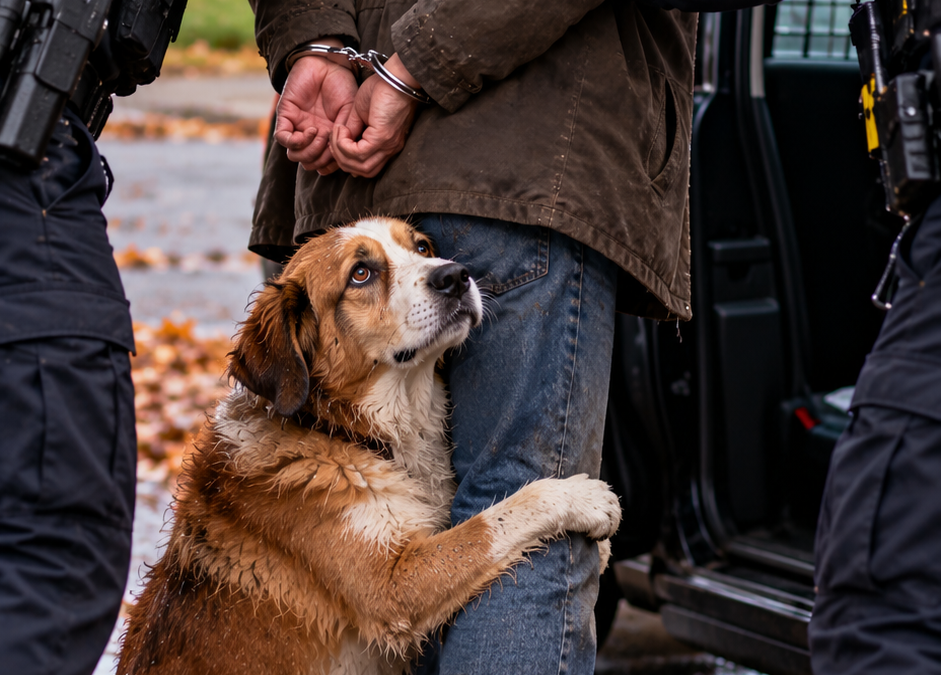
When the Police Put Me in Handcuffs, My Dog Refused to Let Them Take Me Away Alone
When the police put me in handcuffs in the middle of my own street, I thought the worst part would be the humiliation.
Then Barnabé planted himself against my leg and refused to let the officers take me anywhere without him.
By the time we reached the station, I still didn’t understand why I had been arrested, but my dog had already decided one thing with absolute certainty: whatever was happening to me was happening to both of us.
My name is Walter Bennett.
I was seventy-two years old when I became, for six very long days, a criminal in the eyes of a system that had confused my name with a lie written ten years earlier.
Before that morning, my life was small and predictable.
I liked it that way.
I lived in a little blue house on the edge of a quiet neighborhood where maple trees lined the street and everybody knew who belonged where.
My wife had been gone for nine years.
Cancer.
Fast at the end.
After she died, people told me I should travel.
Join clubs.
Meet someone.
As though loneliness were a scheduling problem.
I tried a few things.
Church dinners.
A gardening group.
Once, my neighbor Martha convinced me to attend some kind of community dance for seniors.
I lasted nineteen minutes.
Then I went home.
The truth was simpler.
I missed my wife.
And I had become comfortable with silence.
Then Barnabé entered my life.
He wasn’t Barnabé then.
He was just a muddy stray standing beneath a grocery store awning during a thunderstorm.
That was eight years before the arrest.
I had gone out for milk.
I came home with a dog.
He was maybe two years old at the time, though no one knew exactly.
Medium-sized.
Brown and white.
One ear that stood straight and another that never fully committed.
He had no chip.
No collar.
No owner anyone could find.
I told the shelter I could keep him for three days.
That was eight years ago.
Barnabé became the rhythm of my house.
Morning coffee.
Walk.
Breakfast.
Nap near the radiator.
Second walk.
Dinner.
Evening on the porch.
At night, he slept near my bed.
Not because I trained him to.
Because he decided that was where a dog belonged.
By the time I was seventy-two, my knees were bad.
My hearing wasn’t perfect.
My blood pressure required medication.
Barnabé adjusted to all of it.
He walked slower when I walked slower.
Waited when I stopped.
Some days, I suspected he knew my limitations better than I did.
That morning, we had just come back from our first walk.
The air was cold.
Autumn leaves scraped along the pavement.
I had a paper bag from the bakery tucked under one arm.
Barnabé was sniffing the base of a tree as if investigating a serious crime.
Then a police cruiser stopped beside us.
I didn’t think anything of it.
The neighborhood was safe, but police cars passed through often enough.
The passenger door opened.
An officer stepped out.
“Mr. Walter Bennett?”
I turned.
“Yes?”
The officer’s expression changed slightly.
Not hostile.
Professional.
“Can we speak with you?”
“You’re already speaking with me.”
The younger officer behind him almost smiled.
The first did not.
“Sir, can you put the bag down?”
That was when I felt something tighten inside me.
“Why?”
“Please place the bag on the ground.”
I stared at him.
Barnabé stopped sniffing.
His head lifted.
“What’s this about?”
“Mr. Bennett, we need you to cooperate.”
“With what?”
The second officer stepped closer.
“Sir, there’s an active warrant associated with your name.”
I laughed.
Actually laughed.
Not because it was funny.
Because it was absurd.
“A warrant?”
“Yes.”
“For what?”
“We can explain at the station.”
“No.”
I looked between them.
“I’m seventy-two years old. I’ve never been arrested in my life.”
“Sir—”
“I pay my taxes.”
A ridiculous sentence.
As if taxes prevented arrest.
“I haven’t even had a speeding ticket in fifteen years.”
The older officer remained calm.
“I understand this is confusing.”
“Confusing?”
My hands began shaking.
“This is insane.”
Barnabé moved against my leg.
His body touched mine.
The officer looked at him.
“Is the dog friendly?”
“Friendly?”
I stared.
“Yes, he’s friendly.”
Barnabé watched him carefully.
“Mr. Bennett, I’m going to need you to turn around.”
Everything inside me went cold.
“You cannot be serious.”
“Sir.”
“I’m standing fifty yards from my house.”
“I understand.”
“Then walk over there with me and explain whatever mistake you’ve made.”
“We can’t do that.”
“Why?”
“Because we have an active warrant.”
That word again.
Warrant.
Something official.
Heavy.
Something that didn’t care whether I understood.
The bakery bag slipped from my hand.
It landed beside the curb.
Barnabé looked down at it.
Then at me.
I turned around.
The officer placed my hands behind my back.
The click of the handcuffs was louder than I expected.
Metal around bone.
A sound I had only ever heard on television.
I remember looking toward my own house.
Curtains moved across the street.
Someone was watching.
Then another.
My neighbors.
Of course.
My face burned.
“What am I accused of?”
The younger officer said, “There’s a property fraud investigation connected to an old civil dispute.”
I frowned.
“What property?”
“We don’t have the full details.”
“Then why are you arresting me?”
“Mr. Bennett—”
“My dog.”
That was the first practical thought I had.
“What about Barnabé?”
“We can call animal control.”
“No.”
The word came so quickly that both officers looked at me.
“No.”
“Sir, we can’t leave him loose.”
“He’s not going to animal control.”
Barnabé had moved in front of me.
He stood between my knees and the police car.
“Barnabé.”
I tried stepping around him.
He moved with me.
“Come on, boy.”
The older officer crouched slightly.
“Hey, buddy.”
Barnabé stared.
The officer reached toward his collar.
Barnabé stepped closer to me.
Not growling.
Not aggressive.
Simply refusing.
“He won’t leave me.”
“We need to get you into the car.”
“I can see that.”
“Does he respond to anybody else?”
“Not when he’s decided something.”
The younger officer tried holding the leash.
Barnabé planted all four paws.
“Come on.”
Nothing.
“Buddy.”
Nothing.
He looked at his partner.
“What do we do?”
I would have laughed under other circumstances.
Instead, I felt panic growing.
“Please.”
My voice changed.
“He was a stray before I took him in.”
The officers looked at me.
“He doesn’t do well when people take him away from me.”
The older officer exhaled.
“Can he ride in the vehicle?”
“Yes.”
“You sure?”
“He rides in my truck.”
The officers exchanged a look.
This was clearly not standard procedure.
Finally, the older one said, “Fine.”
So the police arrested both of us.
Technically, Barnabé was not under arrest.
Try explaining that to a dog sitting beside a handcuffed seventy-two-year-old in the back of a police car.
I kept one hand low where he could reach me.
The cuffs made it awkward.
Barnabé licked my fingers.
“It’s all right.”
I had no idea whether that was true.
“It’s going to be all right.”
He rested his chin against my thigh.
For him, perhaps it was just another car ride.
For me, every familiar street disappearing through the window felt like I was being pulled out of my own life.
The police station was in a part of the city I had rarely visited.
Large.
Gray.
Functional.
The kind of building designed not to care how nervous you were.
When the cruiser stopped, I stroked Barnabé’s head.
“Stay close.”
As if he needed instructions.
Inside, our arrival created immediate confusion.
A desk sergeant looked up.
Then looked again.
His nameplate said MORRISON.
He was broad-shouldered, gray-haired, probably in his late fifties.
He stared at Barnabé.
Then me.
Then the officers.
“What is this?”
The younger officer cleared his throat.
“Prisoner transport.”
Morrison pointed.
“That is a dog.”
“Yes, Sergeant.”
“Why is there a dog in my booking area?”
“Wouldn’t separate from him.”
Morrison looked at me.
“Sir, is that your dog?”
“Yes.”
“Animal control will have to take him.”
My heart dropped.
“No.”
Morrison’s expression hardened.
“Mr. Bennett—”
“Please.”
I stepped closer despite the officer holding my arm.
“Please don’t send him away.”
“It’s procedure.”
“He’s not evidence.”
“No.”
“He’s not dangerous.”
“We don’t know that.”
“I do.”
Barnabé sat at my feet.
Perfectly calm.
His head against my leg.
Morrison stared at him.
“Eight years,” I said.
“What?”
“I’ve had him eight years.”
My throat tightened.
“He is my family.”
Something about the words changed the room.
Maybe because I wasn’t saying them dramatically.
They were simply true.
Barnabé lifted his head and looked directly at Sergeant Morrison.
Morrison held the stare.
Later, he told me that was when he changed his mind.
He had dealt with plenty of dogs in twenty-five years.
Barking dogs.
Frightened dogs.
Police dogs.
Dogs involved in domestic calls.
Dogs protecting homes.
Barnabé apparently looked different.
Not frightened.
Not aggressive.
Just determined.
Morrison pointed at the floor.
“Does he stay when told?”
“Mostly.”
“Mostly isn’t reassuring.”
“He’s seventy in dog years.”
Morrison almost smiled.
Almost.
“If he causes one problem, animal control.”
“Understood.”
“If he bites anyone—”
“He won’t.”
“Mr. Bennett.”
“He won’t.”
Morrison looked at the officers.
“Let the dog stay.”
I think I loved that man a little in that moment.
Not enough to admit it later.
But a little.
Booking was humiliating.
Name.
Address.
Date of birth.
Photograph.
Fingerprinting.
Questions.
Forms.
Everything reduced me to information.
Barnabé followed whenever they allowed it.
When they finally moved me into a holding cell, he came too.
The cell had concrete floors.
Metal benches.
Pale fluorescent lights that made everyone look sick.
Barnabé walked the perimeter once.
Sniffed.
Then crawled beneath the bench.
I sat.
He positioned himself so part of his back remained within reach.
My hand rested against him.
That first night, I barely slept.
Every time I closed my eyes, the same thought returned.
What did they think I had done?
Property fraud.
Old dispute.
Warrant.
None of it made sense.
Ten years earlier, I had owned a small piece of land jointly with a business associate named Raymond Cole.
Raymond and I had bought it with the intention of developing storage units.
The project never happened.
We disagreed.
He wanted to borrow against the property.
I refused.
Eventually, I sold my interest.
Or thought I had.
I hadn’t spoken to Raymond in years.
Could this be related?
At two in the morning, I woke from a shallow sleep.
My fingers touched warm fur.
Barnabé was still there.
His breathing was slow.
“Good boy.”
His tail tapped once against the concrete.
I closed my eyes again.
By morning, my fear had changed into anger.
An attorney named Susan Meyers arrived.
Court-appointed initially, though I later retained her because she was the first person in the building who seemed to believe that being confused did not mean being guilty.
She sat across from me.
Barnabé lay beneath the table.
“Mr. Bennett, your name appears on several documents connected to a property transaction from approximately ten years ago.”
“What documents?”
“Transfer papers.”
“I didn’t sign any transfer papers.”
“Someone did.”
“Raymond.”
“Possibly.”
“Not possibly.”
I leaned forward.
“He forged my name.”
“Can you prove that?”
My confidence disappeared.
“I…”
Could I?
Ten years.
Old files.
Old correspondence.
Memories.
Susan continued.
“Your former associate was investigated in another financial matter recently. During that investigation, these documents resurfaced.”
“And because my name was on them—”
“Someone reopened the file.”
“So they arrest a seventy-two-year-old man walking his dog?”
“The warrant should have been reviewed more carefully.”
“Should have?”
She held my gaze.
“I’m not defending it.”
Barnabé lifted his head.
Susan looked down.
“He’s surprisingly calm.”
“He’s smarter than most people.”
“That includes attorneys?”
“Especially attorneys.”
She smiled.
Good.
I needed someone who could smile.
The next two days moved slowly.
Questions.
Paperwork.
Waiting.
Mostly waiting.
The legal system has a particular kind of time.
Minutes become hours.
Hours become entire days.
You are told something will happen “soon.”
Soon means nothing.
Meanwhile, Barnabé became part of the station.
At first, officers avoided him.
Then someone gave him water.
Then someone else found food.
A secretary named Margot appeared every morning carrying fresh water in a bright yellow mug.
“Couldn’t find a proper bowl.”
Barnabé drank from it anyway.
“See?”
She smiled.
“He has standards.”
A young officer named Kevin pretended not to like him.
“I’m a cat person.”
Barnabé walked over and placed his head against Kevin’s knee.
Kevin froze.
“Don’t.”
Barnabé stayed.
“I said don’t.”
Tail wag.
Kevin scratched behind his ear.
“One time.”
The next afternoon, I caught him taking a photograph.
“For evidence?”
“Shut up, Walter.”
An hour later, he told me his wife had replied:
We’re getting a dog.
I laughed for the first time since the arrest.
Barnabé was winning the station.
But more importantly, he was keeping me together.
The first two days, my hands shook constantly.
Not from age.
Fear.
There is something deeply destabilizing about being accused of something you didn’t do.
At first, you are certain the truth will protect you.
Then people begin asking questions.
Are you sure?
Do you remember?
Could you have signed this?
Is it possible?
And eventually, a dangerous thought appears.
What if I forgot something?
At seventy-two, memory becomes a subject people treat cautiously.
Maybe I had signed something.
No.
I knew I hadn’t.
But confidence erodes when a system keeps asking you to doubt yourself.
Whenever that happened, Barnabé pressed his head against my knee.
His presence brought me back.
My kitchen.
My porch.
Our walks.
My real life.
The version of me that existed before a stranger closed handcuffs around my wrists.
On the third day, they took me into an interrogation room.
An officer stopped Barnabé at the door.
“The dog stays outside.”
I looked down.
Barnabé looked up.
“It’s okay.”
He didn’t move.
“I’ll be back.”
The officer led me inside.
The door closed.
Barnabé sat outside.
At first, I heard nothing.
Then a low sound began.
Whining.
Not loud.
Not frantic.
Steady.
Almost musical.
A long, aching note.
I tried ignoring it.
The detective across from me opened a file.
“Mr. Bennett, I want to go over the timeline again.”
Barnabé whined.
I looked toward the door.
“Can somebody check on him?”
“He’s fine.”
“He doesn’t think so.”
“Mr. Bennett.”
I tried focusing.
The detective placed a copy of the document in front of me.
“Is this your signature?”
“No.”
“Looks similar.”
“It’s supposed to.”
Barnabé whined again.
My chest tightened.
The detective asked about Raymond.
When we’d met.
When we’d gone into business.
When we disagreed.
Dates.
Amounts.
Meetings.
Ten years compressed into questions.
I knew answers.
Then doubted them.
Outside, Barnabé continued that low sound.
A shadow stopped behind the small window in the door.
Sergeant Morrison.
He looked at Barnabé.
Then at me.
The door opened.
“Everything okay?”
The detective looked irritated.
“Fine.”
Morrison pointed at the dog.
“He isn’t.”
“Sergeant—”
“Let him in.”
The detective blinked.
“What?”
“Dog comes in.”
“Is that standard?”
“Nothing about this week is standard.”
Barnabé entered.
Immediately silent.
He walked to me.
Lay across my feet.
I exhaled.
Morrison closed the door.
The detective looked at Barnabé.
Then at me.
“Better?”
“Yes.”
“Good. Now tell me again about your relationship with Raymond Cole.”
I placed my hand on Barnabé’s head.
Something inside me steadied.
“Raymond wanted control of the property.”
“When?”
“About eleven years ago.”
“What happened?”
“I refused.”
“Then?”
“We argued.”
“Any written communication?”
“Probably.”
“Letters?”
I opened my mouth.
Nothing.
Then Barnabé shifted under my hand.
A memory surfaced.
Not because dogs have magical powers.
Because calm gives memory somewhere to land.
A letter.
Cream-colored envelope.
Raymond’s handwriting.
I saw it suddenly.
Not as an idea.
As an object.
My bedroom.
Top drawer.
Socks.
“What?”
The detective leaned forward.
I sat straight.
“There was a letter.”
“What letter?”
“Raymond wrote to me.”
“When?”
“After the deal collapsed.”
“What did it say?”
My heart began racing.
“He admitted it.”
“Admitted what?”
“The signature.”
The detective stopped.
“What exactly did he write?”
“I don’t remember the exact words.”
“Where is this letter?”
“At my house.”
“Where?”
I closed my eyes.
I had kept it because something about the tone made me uneasy.
I didn’t trust Raymond.
But years passed.
The property was gone.
The letter became old paper.
I had shoved it somewhere.
Then I remembered.
“My bedroom.”
“Where in the bedroom?”
“Top dresser drawer.”
The detective waited.
“Under the socks.”
He stared.
“Under your socks?”
“Yes.”
“You’re certain?”
“No.”
Then I felt Barnabé’s body against my feet.
I corrected myself.
“Yes.”
“Yes, I’m certain.”
The detective stood.
Within an hour, officers went to my house with proper authorization and Susan present.
I sat in the station.
Barnabé beside me.
Longest hour of my life.
Morrison walked past twice.
Said nothing.
On the third pass, his phone rang.
He answered.
His face changed.
Then he looked directly at me.
“They found it.”
My entire body weakened.
“The letter?”
He nodded.
Susan returned later carrying a clear evidence sleeve.
Inside was the old cream-colored paper.
Raymond’s handwriting.
The words were even stronger than I remembered.
He apologized for “using my signature” because he believed the transaction had to happen quickly and said he would “make it right later.”
There it was.
A confession that had spent almost a decade beneath my socks.
Susan looked at me.
“This is extremely helpful.”
“Helpful?”
I nearly laughed.
“It says he signed my name.”
“Yes.”
“So I go home.”
“We still need to complete the process.”
Of course.
Process.
The old mill wheel turning.
But everything had changed.
The accusation no longer felt like a wall.
It had a crack.
Then a hole.
By the fifth day, investigators confirmed more.
Dates didn’t match my known whereabouts.
Other documents connected to Raymond showed similar irregularities.
The prosecution began backing away.
Nobody said “we made a mistake” immediately.
Systems rarely apologize as quickly as they accuse.
But the tone changed.
Officers who had avoided discussing my case now smiled.
Kevin brought Barnabé a proper bowl.
Margot found him biscuits.
Morrison stood beside my cell one evening.
“Looks like you’re going home.”
“I was always going home.”
He nodded.
“Fair.”
Barnabé lifted his head.
Morrison looked at him.
“That dog may have done more for this case than half the people in the building.”
I scratched Barnabé’s ear.
“He reminds me who I am.”
Morrison looked at me.
“What does that mean?”
I thought about it.
“In here, everybody sees a suspect.”
Barnabé looked up.
“He sees Walter.”
Morrison was silent.
Then he nodded.
“That’s probably useful.”
On the sixth day, Susan came in smiling.
Not her professional smile.
A real one.
“It’s done.”
I stood.
“What?”
“Charges dismissed.”
I stared.
“Completely?”
“Completely.”
“Nothing pending?”
“No.”
“Nothing I have to come back for?”
“Not unless you want to sue somebody.”
That almost sounded tempting.
Instead, I sat back down.
My knees had gone weak.
Barnabé stood immediately.
I put both hands on his face.
“We’re going home.”
His tail began moving.
“Home.”
He didn’t know what charges were.
Didn’t understand fraud.
Couldn’t appreciate exculpatory evidence.
But he knew that word.
Home.
The station staff gathered near the front when we left.
I didn’t expect that.
Margot hugged me.
Kevin shook my hand, then crouched to say goodbye to Barnabé.
“Tell your wife no dog yet.”
“Too late.”
“What did you get?”
“Nothing.”
“Good.”
“We’re visiting the shelter Saturday.”
I laughed.
Sergeant Morrison stood near the door.
Hands in his pockets.
Trying to look indifferent.
I stopped.
“Thank you.”
“For what?”
“You know.”
He looked at Barnabé.
“I bent enough rules to retire early if anyone asks.”
“Then I saw nothing.”
“Good answer.”
He held out his hand.
I shook it.
Outside, sunlight felt almost offensive.
Too bright.
Too normal.
Six days earlier, that same world had watched me disappear into a police car.
Now pedestrians walked past without knowing anything extraordinary had happened.
Barnabé lifted his nose into the air.
Then pulled gently toward the sidewalk.
“Yes.”
I laughed.
“Walk first.”
We didn’t go directly home.
I stopped at a grocery store.
Bought two things.
A package of biscuits for me.
And a large piece of meat for Barnabé.
The cashier looked at the meat.
“Special occasion?”
“You could say that.”
At home, I sat on the front steps.
Barnabé ate.
Slowly at first.
Then with enthusiasm.
I ate my biscuits.
Neighbors began appearing.
Martha from next door.
Mr. Levin across the street.
The Johnsons.
People brought food I didn’t need.
A pie.
Soup.
Bread.
Questions.
“Are you okay?”
“What happened?”
“We heard it was a mistake.”
“Can you believe this?”
I answered what I could.
But my eyes kept returning to Barnabé.
Each time I found him, I relaxed.
He was there.
That evening, after everyone left, I stood in my kitchen.
Silence.
My silence.
Home silence.
Different from the station.
No fluorescent buzzing.
No metal door.
No footsteps in hallways.
I made tea.
Barnabé followed me into the bedroom.
For six nights, I had slept on a hard bench.
My mattress felt impossibly soft.
I lay down.
Barnabé jumped beside me.
Technically, he wasn’t allowed on the bed.
That rule died immediately.
He turned three times.
Then curled against my left hand.
I rested it on his back.
“You know something?”
His eyes opened.
“You saved me.”
Barnabé licked my cheek.
Then put his head down.
“I mean it.”
Tail tap.
“I would’ve fallen apart in there.”
He breathed slowly.
“You didn’t let me.”
I closed my eyes.
For the first time in six days, I slept through the night.
The next morning, I woke before sunrise.
Habit.
Barnabé was still asleep.
I made coffee.
Then sat by the front window.
The street looked exactly as it had before.
Yellow leaves falling.
Children heading to school.
Mail carrier moving house to house.
A woman pushing a stroller.
Ordinary morning.
Except I wasn’t ordinary anymore.
Or perhaps I had finally understood how valuable ordinary was.
A week earlier, police had handcuffed me on that sidewalk.
For six days, my name had belonged to paperwork.
Walter Bennett.
Suspect.
Defendant.
Person of interest.
Now I sat inside my house with coffee in my hand.
Walter.
Neighbor.
Widower.
Dog owner.
Me.
Barnabé woke.
Stretched.
Yawned like a creature who had personally resolved an international crisis.
He walked over.
Placed his head against my knee.
“Good morning.”
Tail.
“You ready?”
His ears lifted.
“Longest walk we’ve ever taken.”
He was immediately awake.
I laughed.
“Thought so.”
We walked for almost an hour.
Slowly.
My knees complained.
Barnabé sniffed everything.
Every tree.
Every fence.
Every corner.
I didn’t rush him.
For six days, other people had decided where I stood.
When I sat.
When I ate.
When doors opened.
That morning, we went nowhere important.
It was perfect.
A few weeks later, we passed the police station.
Not intentionally.
I had an appointment nearby.
Barnabé recognized it before I did.
His pace slowed.
Mine did too.
Sergeant Morrison happened to be outside.
Cigarette in one hand.
He saw us.
Raised his other hand.
“Well, look who stayed out of trouble.”
“Speak for yourself.”
Morrison smiled.
He reached into his pocket.
“Got something.”
He walked toward us holding a small plastic bag.
“Chocolate cookies.”
I stared.
“You’re trying to kill my dog.”
Morrison stopped.
“What?”
“Chocolate.”
His eyes widened.
“Damn.”
I laughed.
“They’re for me now.”
“Good.”
He handed them over.
“I knew that.”
“No, you didn’t.”
“Prove it.”
Barnabé sat between us.
Morrison looked down.
“I’ve got proper dog biscuits inside.”
“You’re getting soft.”
“Don’t spread rumors.”
He disappeared into the station.
Returned with a biscuit.
Barnabé accepted it.
Morrison scratched behind his ears.
“Good dog.”
I smiled.
“You know, Sergeant, you were wrong about something.”
“What?”
“You said Barnabé helped free me.”
“He did.”
“Not exactly.”
Morrison waited.
“He just kept me from forgetting myself long enough to remember the truth.”
Morrison considered that.
“Same difference.”
Maybe it was.
Life returned to normal after that.
Mostly.
There were legal follow-ups.
Apologies written in careful language.
Forms.
Records corrected.
My lawyer insisted I keep copies of everything.
I did.
None of it mattered to Barnabé.
He cared about breakfast.
Walks.
Weather.
Whether I had dropped anything edible.
The simplicity was comforting.
But I changed.
For a while after the arrest, sirens made me tense.
Police cars made my stomach turn.
The first time I saw officers outside the grocery store, I nearly walked the other way.
Then Barnabé pulled toward them because one officer had a sandwich.
I laughed at myself.
“You’re impossible.”
He wagged.
Eventually, the fear softened.
Not disappeared.
Softened.
One afternoon, Kevin from the station knocked on my door.
He had a puppy with him.
Black.
Long ears.
Large paws.
I stared.
“You actually did it.”
“My wife did.”
“Sure.”
“This is Milo.”
Milo tried eating my shoelace.
Barnabé approached.
The puppy froze.
Barnabé sniffed him.
Then walked away with the exhausted dignity of an elderly professor confronted by an unruly freshman.
Kevin laughed.
“I think he hates him.”
“He tolerates you. Milo will earn it.”
We sat on the porch.
Kevin became serious.
“I’m sorry.”
“For what?”
“What happened.”
“You didn’t issue the warrant.”
“No.”
“But I was there.”
I looked at him.
“So was Barnabé.”
Kevin smiled faintly.
“Still.”
I thought about it.
“You know what bothered me most?”
“What?”
“Nobody listened at first.”
Kevin nodded.
“Everybody knew procedure.”
“Exactly.”
He looked down.
“That doesn’t make it right.”
“No.”
“But Morrison eventually listened.”
“Because of the dog.”
“Maybe.”
I looked at Barnabé.
“Sometimes people need something to interrupt the routine.”
Kevin stroked Milo.
“Apparently dogs.”
“Apparently.”
Months passed.
The story became neighborhood history.
Walter and the dog who got arrested together.
Technically inaccurate.
Nobody cared.
People joked that Barnabé had a criminal record.
Martha bought him a bandanna that said OUTLAW.
I hated it.
Barnabé looked excellent in it.
But beneath the humor, I never forgot those six days.
Especially the interrogation.
The sound of Barnabé whining behind the door.
Morrison opening it.
The moment Barnabé settled on my feet.
The letter returning to my memory.
Could I have remembered without him?
Probably.
Maybe.
Eventually.
But fear does strange things to memory.
It scatters it.
Barnabé gathered me.
That is the best way I can explain it.
He didn’t solve the case.
Didn’t understand the evidence.
Didn’t know what the letter meant.
He simply made me feel enough like myself to think clearly.
That was his gift.
Years earlier, when I found him beneath the grocery store awning, I thought I was giving a stray dog a home.
Food.
Warmth.
Safety.
Eight years later, sitting in a jail cell, I realized he had been building a home inside my life too.
And when everything familiar was stripped away, Barnabé brought that home with him.
A metal bench became survivable because his back rested beneath my hand.
An interrogation room became manageable because his body lay across my feet.
A police station became less frightening because one creature inside it did not care what accusation had been typed beside my name.
He knew me.
Sometimes that is more powerful than being defended.
Months after the arrest, I found the old cream-colored letter again.
My attorney had returned it after the case closed.
I held it for a long time.
Raymond’s handwriting.
One piece of paper.
Nearly forgotten.
It had almost cost me.
Then saved me.
I placed it in a folder with all the legal records.
This time, not beneath socks.
Barnabé watched from the bed.
“Important documents go here now.”
Tail tap.
“I learned.”
No response.
“You’re very judgmental.”
He yawned.
The following autumn, almost exactly one year later, Barnabé and I took our usual morning walk.
Same street.
Same maple trees.
Same bakery.
I stopped at the place where the police car had pulled over.
Barnabé kept walking until he felt the leash tighten.
Then looked back.
“You remember?”
He sniffed a leaf.
Probably not.
Or maybe not in the way I did.
I looked at the curb.
For a long time after the arrest, that spot represented humiliation.
Fear.
Wrongful accusation.
Neighbors watching.
Handcuffs.
But standing there a year later, I noticed something else.
Barnabé had stood beside me.
He hadn’t run.
Hadn’t allowed them to lead him away.
Didn’t understand what was happening.
Didn’t need to.
He knew only that I was being taken somewhere.
So he went too.
There is something almost embarrassingly pure about that.
Humans ask questions before deciding whether to stay.
What happened?
Were you wrong?
Will this be inconvenient?
How long will it take?
Animals like Barnabé sometimes reduce loyalty to its simplest form.
You’re going?
I’m going.
You’re scared?
I’m here.
You don’t know what happens next?
Neither do I.
Let’s go together.
I scratched behind his ear.
“You old fool.”
Tail.
“I’m the one who rescued you, remember?”
Barnabé looked unimpressed.
“Fine.”
I smiled.
“Maybe we’re even.”
We continued walking.
As Barnabé grew older, our walks shortened.
Mine probably would have anyway.
We met in the middle.
He developed stiffness in his hips.
I had arthritis in both knees.
Some mornings, we were two old men negotiating with gravity.
At the park, we sat more than we walked.
I liked that.
He watched squirrels.
I watched people.
Children.
Couples.
Joggers.
Other dogs.
Life.
One afternoon, Sergeant Morrison sat beside us.
He had retired.
Without the uniform, I almost didn’t recognize him.
“Look at you.”
He frowned.
“What?”
“Normal clothes.”
“Disturbing, isn’t it?”
Barnabé approached him.
Morrison scratched his head.
“He remembers me.”
“You’re the biscuit man.”
“I had a twenty-five-year career.”
“To Barnabé, you’re biscuit man.”
Morrison accepted the demotion.
We sat quietly.
After a while, he said, “That case bothered me.”
I looked at him.
“Mine?”
“Yeah.”
“Why?”
“Because we followed the paper.”
“That is generally your job.”
“Yeah.”
He rubbed his hands.
“But sometimes paper is wrong.”
I laughed softly.
“You’re telling me.”
Morrison looked toward Barnabé.
“That dog changed the mood in the station.”
“How?”
“Made you a person.”
The wording surprised me.
“I was already a person.”
“You know what I mean.”
I did.
“Cases become files.”
“Names.”
“Charges.”
“Booking numbers.”
He nodded toward Barnabé.
“But every time we looked at you, there was this dog acting like you were the most important human being alive.”
I smiled.
“He has poor judgment.”
Morrison ignored that.
“Makes it harder to reduce somebody to paperwork.”
That stayed with me.
Barnabé had humanized me without saying a word.
Not because loyal dogs prove innocence.
They don’t.
Good people can have loyal dogs.
Bad people can too.
But he reminded everyone that accusation and identity are not the same thing.
That distinction matters.
The legal system eventually recognized the mistake.
Barnabé recognized Walter from the beginning.
Years later, I still make coffee early.
Still sit by the front window.
Barnabé’s face is whiter now.
His hearing isn’t good.
I sometimes have to touch his shoulder before he notices I’m speaking.
But every morning, he eventually comes over.
Head on my knee.
Same gesture.
Same weight.
Same certainty.
I think often about the phrase family.
For most of my life, I would have defined it traditionally.
Wife.
Children.
Parents.
Blood.
Marriage.
Then my wife died.
We never had children.
My parents were long gone.
Eventually, family became a dog I found beneath an awning.
People may think that’s sad.
I don’t.
Family is not diminished because it walks on four legs.
Barnabé knows my moods.
My medicine schedule.
My walking speed.
Which chair I use when my knee hurts.
He knows when I wake from bad dreams.
He knows that if I stand in the kitchen after eight in the evening, there is a strong possibility cheese is involved.
And when my entire identity was temporarily reduced to a criminal accusation, he knew something no warrant contained.
Who I was.
That’s enough for me.
Sometimes, when people hear the story, they say:
“What a loyal dog.”
Yes.
But loyalty is too small a word sometimes.
Loyalty sounds like obedience.
Barnabé wasn’t obedient that morning.
The police wanted him to leave.
He refused.
I told him to go with the young officer.
He refused.
At the interrogation room, they shut him outside.
He objected until someone opened the door.
That wasn’t obedience.
It was commitment.
There is a difference.
He didn’t follow orders.
He followed me.
And somehow, that stubborn old dog kept me steady long enough for the truth to catch up.
These days, whenever we pass the station, we still slow down.
Sometimes the officers outside recognize us.
Most of the people who knew the story have moved on.
Kevin was promoted.
Margot retired.
Morrison definitely retired, despite pretending he would die at that desk.
New officers come and go.
To them, I’m just an elderly man walking an elderly dog.
That’s fine.
I prefer it.
Once in a while, someone who remembers steps outside with biscuits.
Always proper dog biscuits now.
Barnabé accepts them like official tribute.
Then we continue.
The old man.
The old dog.
Two former suspects.
At least according to neighborhood legend.
One morning, I stopped outside the building and Barnabé sat beside me.
I looked at the gray walls.
They seemed smaller than I remembered.
Fear does that.
Makes places enormous.
Time reduces them again.
I bent down and rubbed Barnabé’s chest.
“Ready?”
His tail moved.
We walked home.
Our blue house came into view.
Porch.
Window.
Maple tree.
Everything exactly where it belonged.
Barnabé pulled slightly ahead.
Not much.
Just enough to reach the gate first.
I opened it.
He walked inside.
That simple act still affects me sometimes.
A gate opening.
A dog walking through.
Nobody stopping us.
Nobody asking questions.
Nobody deciding where we had to go next.
Freedom can become visible after you’ve briefly lost it.
That afternoon, we sat on the porch.
I had coffee.
Barnabé slept beside my chair.
A school bus passed.
Leaves moved across the sidewalk.
Somewhere, somebody started a lawn mower.
An ordinary day.
The kind of day I once took completely for granted.
I leaned down.
“Barnabé.”
His ear moved.
“You know what?”
One eye opened.
“If they arrest me again, I’m leaving you home.”
His tail moved once.
“That’s right.”
I smiled.
“You don’t believe me.”
He closed his eye.
Neither did I.
Because if there is one thing I learned during those six days, it is that Barnabé has never cared where I am going.
Only whether I am going without him.
Eight years earlier, I had found him alone in the rain and decided he shouldn’t have to be alone anymore.
Then the police put me in handcuffs, took me from my street, locked me behind a metal door, and for six days turned my ordinary life upside down.
Barnabé returned the promise.
He did not leave.
Not on the sidewalk.
Not in the police car.
Not in the station.
Not beneath the metal bench.
Not outside the interrogation room.
Not once.
The letter cleared my name.
My lawyer did her job.
Sergeant Morrison made one humane decision after another.
The system eventually corrected its mistake.
All of that matters.
But when I remember those six days, what I remember most is warm fur beneath my hand in a cold cell.
A dog breathing beside me while I tried not to be afraid.
A head resting on my knee when the world had suddenly begun treating me like a stranger to myself.
Barnabé never did.
He knew exactly who I was.
And until everyone else caught up, he stayed beside me to make sure I remembered too.





