PART 2: HOA Karen Called 911 to Arrest Me for Swimming in My Own Pool—Then the County Proved I Was Never in Her HOA
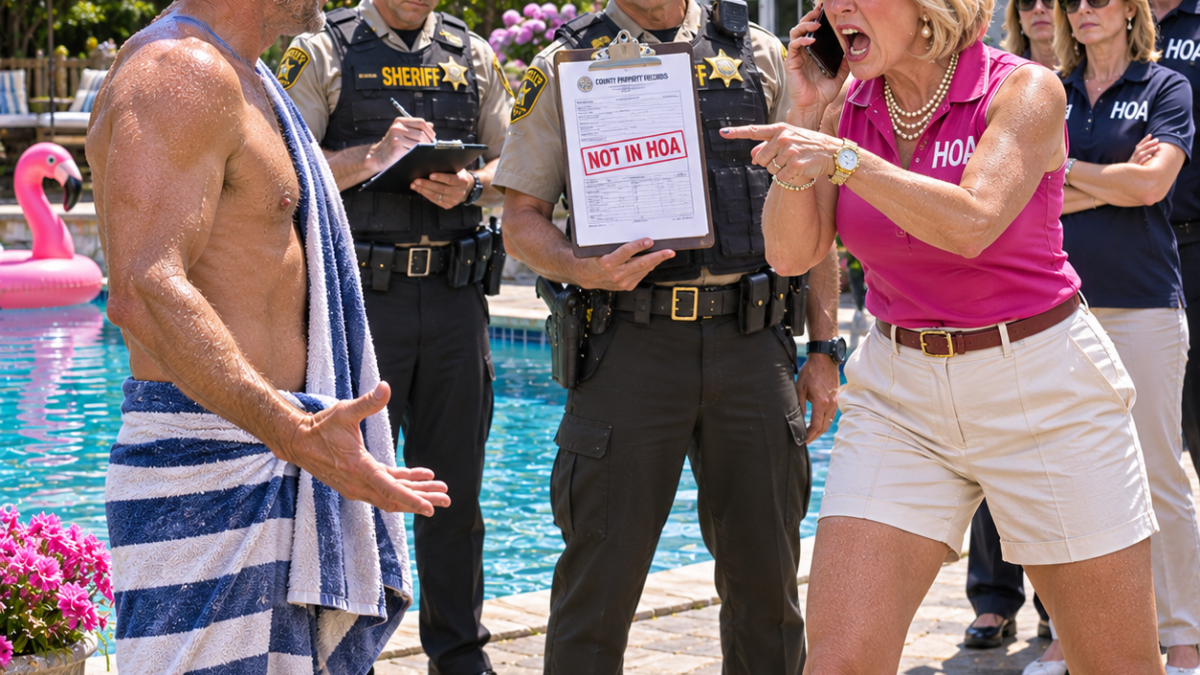
I was halfway through a cannonball into my own backyard pool when a woman in a pink visor burst through my gate and told 911 I was trespassing.
Ten minutes later, I was standing barefoot in a towel while two deputies checked whether my home somehow belonged to an HOA I had never knowingly joined.
By the end of that afternoon, one unfinished line in an old stack of property records had turned a ridiculous accusation into the beginning of the strangest fight of my life.
That Saturday had started exactly the way I wanted.
Quiet.
Hot.
Uneventful.
The kind of summer afternoon where the air hangs heavily over the neighborhood and even the birds seem too tired to argue.
I had spent most of the morning mowing the front yard, trimming hedges, edging the driveway, cleaning the patio, and finally repairing the pool ladder I’d been promising myself I would fix for almost a month.
By noon, my shirt was soaked through.
Grass clippings stuck to my legs.
My back hurt.
And I had earned a few hours of doing absolutely nothing.
That pool was one of the main reasons I’d bought the house.
The property sat on a slightly wider lot than most of the homes around it.
There were two old oak trees along one side, a concrete patio behind the kitchen, and a rectangular blue pool surrounded by enough privacy fencing that I could sit outside without feeling like I was living inside a display window.
I wasn’t looking for excitement when I moved there.
I was middle-aged, worked hard, kept mostly to myself, and considered a peaceful Saturday more valuable than any neighborhood social event.
The area seemed perfect.
Retired couples.
Young families.
A few people like me who waved from driveways but didn’t feel the need to know everybody’s business.
Six days after moving in, my neighbor Doug gave me the only warning.
Doug was in his sixties and seemed permanently attached to a coffee mug.
Morning?
Coffee.
Afternoon?
Coffee.
Probably midnight too.
“You’ll like it here,” he’d said.
“Only thing you have to watch out for is HOA Karen.”
I laughed.
“Every neighborhood has one.”
Doug didn’t laugh back.
“That one has paperwork.”
I should have listened more carefully.
When I bought the house, my closing package had been enormous.
Deed.
Survey.
Disclosures.
Title documents.
Developer paperwork.
Page after page of legal language.
There were references to something called the Maple Ridge Estates Association, but nobody billed me HOA dues.
Nobody asked me to sign membership paperwork.
Nobody issued me gate credentials.
Nobody contacted me about meetings.
The pool had been part of the house long before I bought it.
So I assumed Maple Ridge was simply the neighboring development.
Karen apparently had a different interpretation.
I’d met her once before the pool incident.
She had marched onto my porch with a clipboard and introduced herself as the “head of community standards.”
Not hello.
Not welcome.
Not nice to meet you.
Her first sentence was:
“Your pool does not comply with our community aesthetic.”
I told her politely:
“I’m not in your HOA.”
She stared at me like I had denied the existence of gravity.
Then scribbled something on her clipboard and left.
I figured that was the end of it.
It wasn’t.
Nineteen peaceful minutes after I got into the pool that Saturday, I heard flip-flops slapping against concrete.
Fast.
Angry.
Then my side gate flew open.
Karen stormed in wearing a floral blouse, giant sunglasses, a pink visor, and the expression of someone responding to a national emergency.
Her phone was already recording.
“You!”
I stared at her from the water.
“Me?”
“You’re trespassing on HOA property.”
I actually looked behind myself.
My house.
My patio.
My grill.
My pool.
Then back at her.
“Karen, this is my backyard.”
“That pool is under HOA jurisdiction.”
“No, it isn’t.”
“We voted.”
“You voted on my pool?”
“Don’t be difficult.”
I climbed out.
Water ran down my arms.
“Leave my property.”
She smiled.
Not pleasantly.
“You don’t get to order an HOA representative off communal property.”
“Communal?”
“Yes.”
She raised her phone.
“I’m documenting your refusal.”
“Good.”
I reached for my towel.
“Document this too. Get out.”
Her face tightened.
Then she tapped her screen.
“What are you doing?”
“Calling the police.”
I thought she was bluffing.
She wasn’t.
“911, what’s your emergency?”
Karen straightened.
“There is a man refusing to leave HOA property.”
I stared at her.
“He’s using a community swimming facility without authorization.”
That was the moment I realized I was no longer dealing with an annoying neighbor.
I was dealing with someone willing to turn her private fantasy into an official accusation.
And when the deputies actually pulled onto my street ten minutes later, the whole thing stopped being funny.
PART 2
The first deputy came through the side gate chewing gum.
The second looked like the August heat had personally offended him.
Karen practically intercepted them before they reached the patio.
“Officers!”
She hurried toward them.
“Thank God.”
I stood beside the pool wearing swim trunks and a towel around my shoulders.
One deputy looked at me.
Then at Karen.
Then at the inflatable flamingo floating behind me.
You could almost see him reevaluating whatever dispatch had told him.
Karen pointed.
“He’s refusing to leave.”
The taller deputy asked:
“Sir, do you live here?”
“Yes.”
Karen interrupted.
“He lives here, but this is HOA-controlled recreational space.”
I stared at her.
The deputy held up one hand.
“Ma’am, let him answer.”
Karen looked personally offended.
“Yes,” I repeated. “I own the home.”
“Pool included?”
“Yes.”
“Can you show us some documentation?”
“Absolutely.”
Karen crossed her arms.
“His personal deed doesn’t supersede HOA jurisdiction.”
The gum-chewing deputy stopped.
“Ma’am.”
“Yes?”
“Please stop talking for about thirty seconds.”
Doug was watching from his driveway.
Coffee mug in hand.
He caught my eye.
His expression said:
Told you.
I went to the outdoor storage cabinet where I kept copies of my property records.
My deed.
Survey.
Closing documents.
Mortgage paperwork.
The taller deputy flipped through them.
Karen hovered behind him.
Then began narrating for her phone.
“This is the section where he violated communal water-use standards.”
The deputy looked up.
“Ma’am.”
She stopped.
He went back to the documents.
“There is a reference here to Maple Ridge.”
My stomach tightened.
Karen smiled.
“Exactly.”
He continued.
“Planned development.”
She nodded vigorously.
“See?”
“But I’m not seeing executed annexation paperwork.”
Her smile slipped.
“It’s part of Phase Two.”
The other deputy pulled out his phone.
“Let me call county records.”
I wrapped the towel tighter.
Until that moment, I had been certain.
My property.
My pool.
End of story.
Then I remembered the closing.
The mountain of paperwork.
The agent sliding documents across the table.
“Standard language.”
“Initial here.”
“Nothing unusual.”
Had I missed something?
A covenant?
An annexation clause?
An automatic membership provision?
The possibility was small.
But uncertainty doesn’t have to be large to ruin your afternoon.
The deputy returned several minutes later.
“Here’s what county mapping shows.”
Karen stepped forward.
“My property.”
“No.”
He gave her a look.
“The lot appears on some preliminary planned-development maps.”
Karen smiled again.
“But.”
Her face fell.
“There’s no record we can locate right now showing this block was formally annexed into the association.”
Karen blinked.
“That’s impossible.”
“Could be incomplete records.”
“No.”
She shook her head.
“We had votes.”
“Do you have recorded annexation documents?”
“We have maps.”
“Recorded?”
She hesitated.
The deputy looked at me.
“Sir, everything we’re seeing indicates you own the property outright.”
I exhaled.
“Thank you.”
“However, because there are old development references, you’ll probably want to clear the HOA-status question with the county.”
Karen immediately said:
“Exactly. Until then, he should follow HOA regulations.”
The deputy turned.
“No.”
She blinked.
“No?”
“That’s not how this works.”
“But if status is unclear—”
“Unclear does not mean your authority automatically applies.”
Her mouth tightened.
“This man is trespassing.”
“On property he owns.”
“Within HOA jurisdiction.”
“Which you haven’t established.”
Karen threw up both hands.
“So you’re doing nothing?”
“This is not a criminal trespass situation.”
“But—”
“It’s a civil property dispute.”
The gum-chewing deputy looked toward the pool.
Then at me.
Then back at Karen.
“Ma’am, it’s a swimming pool.”
He paused.
“Not a federal monument.”
Doug coughed into his coffee.
I looked away because I was about to laugh.
Karen did not.
She stomped one foot.
Actually stomped.
“This isn’t over.”
The taller deputy nodded.
“You can address ownership and association jurisdiction through appropriate civil channels.”
“I am the appropriate channel.”
“No, ma’am.”
That was the first time I watched somebody tell Karen no.
I would later learn why she hated that word so much.
The deputies left.
Karen stayed.
She stood at the edge of my patio, trembling.
“You embarrassed me.”
I stared.
“You called 911 because I was swimming.”
“You refused lawful instruction.”
“You broke into my backyard.”
“I entered community property.”
“Leave.”
She stepped closer.
“I will take this to the board.”
“Great.”
“I will make sure every violation is documented.”
“Wonderful.”
“You will regret treating me this way.”
I smiled.
“I think the embarrassment handled itself.”
Her mouth fell open.
Then she turned.
Stormed through the gate.
Left it swinging behind her.
I walked over.
Closed it.
Locked it.
Then sat in a pool chair.
The adrenaline wore off.
What remained wasn’t amusement.
It was nausea.
Because the deputies hadn’t said:
You are definitely outside the HOA.
They had said:
The records are unclear.
That mattered.
I went inside.
Pulled every closing document I owned.
And started reading.
—
At seven that evening, papers covered my dining table.
Some referenced Maple Ridge Estates.
Others mentioned “future annexation.”
One described my row of homes as an **optional expansion phase**.
Another referred to:
**HOA coverage areas subject to future finalization by developer.**
I stared at that phrase.
Future finalization.
What did that mean?
My pool was listed on the survey as a private residential improvement.
Good.
No obvious HOA ownership.
But another document mentioned:
**Future amenities designation pending county confirmation.**
Amenities.
That word bothered me.
Karen had called my pool communal.
Could somebody have planned to buy or absorb it?
I kept digging.
Nothing contained my signature agreeing to HOA membership.
Nothing showed dues.
Nothing showed formal annexation.
But nothing gave me the one sentence I desperately wanted:
**THIS PROPERTY IS NOT PART OF MAPLE RIDGE ESTATES ASSOCIATION.**
At midnight, I finally stopped.
My eyes hurt.
I called Doug the next morning.
He came over with coffee.
Obviously.
“You look terrible.”
“Everybody keeps telling me that lately.”
“Karen?”
“Paperwork.”
“Worse.”
I handed him the preliminary development map.
“My block was supposed to become part of Maple Ridge.”
Doug frowned.
“Supposed to?”
“Looks like it.”
“But?”
“I can’t find final paperwork.”
He sipped.
“So you’re HOA-adjacent.”
“Don’t make that a term.”
“I like it.”
“I need answers.”
Doug nodded.
“Go see Janet.”
“Who?”
“HOA office.”
“You’re recommending I walk voluntarily into their headquarters?”
“Janet isn’t Karen.”
“That sounds like a low standard.”
“It is.”
—
The Maple Ridge office smelled like printer toner, lemon cleaner, and bureaucracy.
A woman behind the desk looked up.
Mid-forties.
Tired eyes.
Kind face.
“Can I help?”
“I hope so.”
I gave her my address.
Her eyebrows rose.
“Oh.”
Never good.
“What does ‘oh’ mean?”
She pulled out a huge binder.
“You’re one of the Phase Two edge lots.”
“Am I in the HOA?”
She flipped pages.
“That’s complicated.”
“I was hoping for yes or no.”
“So was everyone in 2009.”
She pointed at a map.
My street appeared in dashed lines.
“The developer intended to annex these lots.”
“Okay.”
“They drafted the paperwork.”
“Okay.”
“Circulated preliminary documents.”
I leaned closer.
“And?”
“Never finalized it.”
I stared.
“No signatures?”
“Not the required ones.”
“County recording?”
“No.”
“Homeowner consent?”
“Not completed.”
“Final board acceptance?”
“No.”
“So I’m not in the HOA.”
She tilted one hand.
“Legally, based on what I’m seeing? Probably not.”
“Probably?”
“I need to verify county files.”
“Karen called 911 because I was swimming in my pool.”
Janet closed her eyes.
“Oh, Karen.”
“You know about this?”
“No.”
She looked tired.
“But I know Karen.”
“She’s your president?”
Janet looked at me strangely.
“What?”
“Karen.”
“No.”
I frowned.
“She said she was head of community standards.”
“That isn’t an official position.”
“Board member?”
Janet hesitated.
“Not anymore.”
I leaned forward.
“What does that mean?”
“She used to serve.”
“How long ago?”
“Over a year.”
I stared.
“She’s been acting like she’s running the HOA.”
Janet sighed.
“I can’t discuss personnel history in detail.”
“Was she removed?”
She said nothing.
That answered enough.
I sat back.
“So a former HOA board member entered my property, called 911, and claimed jurisdiction over a house the HOA never legally annexed.”
Janet rubbed her forehead.
“When you say it all together, it sounds bad.”
“It felt bad separately too.”
She almost smiled.
“I need a formal verification.”
“I’ll research the developer records.”
“How long?”
“Few days.”
I hated that answer.
“A few days gives Karen time.”
Janet looked at me.
“Document everything.”
Those two words would define the next several weeks.
—
When I got home, a pink note was in my mailbox.
All caps.
**YOU ARE IN VIOLATION OF HOA RULES.**
**FINES WILL ACCUMULATE UNTIL YOU COMPLY.**
No official letterhead.
No board signature.
No citation.
Just marker.
I looked toward Karen’s house.
A blind moved.
I held up the note.
“Really?”
Blind stopped.
I carried it inside.
Set it on the table.
Then went into the backyard.
Another paper waited under a decorative stone.
Printed this time.
Fake-looking Maple Ridge logo.
**NOTICE OF NON-COMPLIANCE**
**VIOLATION #MR-4471**
**UNAUTHORIZED PRIVATE USE OF COMMUNITY SWIMMING FACILITY**
I laughed.
Then stopped.
Folded it carefully.
Put it in a plastic sleeve.
The shift inside me was immediate.
I had been treating Karen as a nuisance.
That was over.
From now on, she was evidence.
I made a folder.
**KAREN — DOCUMENTATION**
Pink note.
Fake violation.
911 incident details.
Deputy names.
Dates.
Times.
Photographs.
Doug stopped by later.
He looked at the folder.
“You’re getting serious.”
“She already did.”
He nodded.
“You have cameras?”
“No.”
“Get cameras.”
“Why?”
Doug looked toward the side fence.
“I saw her taking pictures over here yesterday.”
I turned.
“What?”
“She does that.”
“What do you mean she does that?”
“Last owner on your street got notes on his windshield.”
“For?”
“Trash bins.”
“He moved?”
“Two months later.”
I stared.
Doug took a slow drink.
“Karen doesn’t like losing.”
“Neither do I.”
He smiled.
“Different kind, hopefully.”
That evening, I bought cameras.
Side gate.
Driveway.
Front door.
Mailbox area.
Back patio.
Everything aimed only at my property and lawful public-facing areas.
By nine, my house had better surveillance than some banks.
I slept.
At 6:30 the next morning, I reviewed the footage.
Squirrel.
Cat.
Branches.
Nothing.
Then:
2:13 a.m.
Karen appeared.
Bathrobe covered in lavender clouds.
Flashlight.
Stack of pink papers.
She crouched beside my mailbox.
Looked left.
Right.
Stuffed a notice inside.
Then walked to my front door.
Placed another under the mat.
Then she moved toward my side gate.
I leaned toward the screen.
She tested the latch.
Locked.
She peered over.
Flashlight between her teeth.
For one absurd moment, she looked like a suburban burglar who had gotten lost on the way to a pajama convention.
Then she whispered something toward the yard.
The camera microphone barely caught it.
“We’ll see.”
She ran home.
Robe flapping.
I sat back.
“Wow.”
I wasn’t sure whether to be angry or impressed by the commitment.
The new notice read:
**UNAUTHORIZED POOL SOUND LEVELS DETECTED AFTER SUNSET.**
I had not used the pool that night.
I opened a spreadsheet.
Date.
Time.
Violation claim.
Evidence.
Security video filename.
Welcome to the Karen archive.
—
At noon, someone knocked.
Official uniform.
Animal control.
I opened the door.
“Can I help?”
“We received a complaint.”
“Of course you did.”
He checked a form.
“Potentially aggressive animals.”
I stared.
“What animals?”
He read.
“Pit bull.”
“I don’t own a dog.”
“Parrot.”
“No.”
“And…”
He squinted.
“Goat.”
I looked behind me.
Then back.
“Do you hear a goat?”
The officer almost smiled.
“Sir, I have to verify.”
“Come on.”
We walked through the house.
Backyard.
Pool.
No pit bull.
No parrot.
No goat.
Two squirrels were fighting near a bird feeder.
The inflatable flamingo rotated slowly in the pool.
The officer sighed.
“False reports happen.”
“Can I get an incident number?”
He looked at me more carefully.
“Pattern?”
“Yes.”
He wrote it down.
“Keep records.”
Everybody was giving me the same advice.
Document.
Document.
Document.
The officer left.
I stood beside the pool.
Karen had now involved:
911.
Deputies.
Animal control.
Neighborhood gossip.
Fake notices.
Late-night visits.
That was enough.
Not because I wanted revenge.
Because if I didn’t establish the boundary now, she would keep moving it.
I grabbed my keys.
County records.
—
The county clerk had seen property disasters before.
I could tell by her expression.
I gave her the address.
“Maple Ridge annexation history.”
She typed.
Then frowned.
“Oh.”
Again.
“What is it with everybody saying ‘oh’ when they see my address?”
She turned the monitor.
Different development phases appeared in different colors.
My street was pale.
Dashed lines.
No official annexation stamp.
She clicked.
“Developer proposed Phase Two expansion.”
“Yes.”
“Administrative fee?”
She looked.
“Never paid.”
“Annexation certificate?”
“No.”
“County approval?”
“No.”
“Recorded homeowner consent?”
“No.”
“Community vote?”
She searched.
“None logged.”
My shoulders loosened.
“So legally?”
“Your parcel was never annexed.”
I sat still.
“Never?”
“Never.”
“The HOA has no authority?”
“Not through this proposal.”
“What about old maps?”
“Drafts.”
“Binding?”
“No.”
“My pool?”
She looked at me strangely.
“What about your pool?”
“Long story.”
“HOA claiming it?”
“Yes.”
She laughed.
Not polite laughter.
Real laughter.
“I’m sorry.”
“No, please.”
I almost joined her.
“Can you give me something certified?”
“Yes.”
“How strong?”
She started typing.
“Something even Karen will understand.”
“You know Karen?”
The clerk stopped.
“We don’t name difficult residents.”
I waited.
She added:
“But yes.”
Twenty minutes later, she handed me a stamped certificate.
I read:
**Parcel 17B remains outside the jurisdiction of Maple Ridge Estates Association. No annexation has been approved, recorded, or legally recognized.**
I stared.
There it was.
One sentence.
Weeks of confusion.
One sentence.
I thought about laminating it.
Instead, I ordered three certified copies.
—
When I returned, two neighbors stood by my driveway.
They looked embarrassed.
One handed me a flyer.
**COMMUNITY ALERT**
**POOL ABUSER REFUSES TO FOLLOW HOA RULES**
Below:
– Unauthorized monopolization of HOA pool.
– Failure to pay community fees.
– Aggressive behavior toward community representative.
– Disrespect for neighborhood standards.
I stared.
“Pool abuser?”
The first neighbor shrugged.
“We know.”
The second said:
“Karen has been going door-to-door.”
“What is she telling people?”
“That your pool used to belong to the association.”
I looked toward my house.
“How?”
“She says the previous owner privatized a community amenity.”
“That isn’t remotely true.”
“We figured.”
“Why?”
“Because it’s behind your fence.”
Good neighborhood detective work.
The first neighbor said:
“Most people aren’t buying it.”
“Most?”
He hesitated.
“Some people remember old plans.”
There it was again.
Ambiguity.
Karen’s fuel.
I thanked them.
Placed the flyer into the evidence binder.
Checked my cameras.
4:31 a.m.
Karen stood across the street.
Clipboard.
Watching my house.
Writing.
Every few minutes she pointed toward something.
My mailbox.
Sidewalk.
Trees.
She paced.
Wrote.
Paced again.
This wasn’t governance.
It wasn’t even neighborhood annoyance.
It was obsession.
I took the certified county document.
Went to Janet.
She read it.
Her shoulders dropped.
“Oh, thank God.”
“You really need a different phrase.”
She laughed.
“This settles it.”
“Completely?”
“Yes.”
“My house has never been part of Maple Ridge?”
“Correct.”
“My pool?”
“Private.”
“Dues?”
“None owed.”
“Karen’s notices?”
“Worthless.”
“Good.”
Janet held up one finger.
“But.”
I groaned.
“What?”
“Karen won’t accept this gracefully.”
“She’s calling animal control about imaginary goats.”
Janet stared.
“She did what?”
“Long story.”
“She can get worse.”
“I’m starting to doubt that.”
I should not have said that.
—
Waiting on my front door when I got home:
Bright yellow envelope.
Three pages.
Official-looking.
**RETROACTIVE COMMUNITY SWIMMING FEES**
Amount due:
**$1,200**
Karen had included a payment deadline.
Late penalties.
Threat of collection.
And a signature:
**KAREN L. — AUTHORIZED HOA REPRESENTATIVE**
I sat on my porch and laughed.
A long time.
Not because it was harmless.
Because now I held certified proof she had no authority.
And she was creating documents pretending she did.
I copied everything.
Called Janet.
Sent photographs.
She responded immediately:
**Do not pay. The HOA did not authorize this.**
That sentence mattered.
I printed it.
Added it.
Karen’s evidence binder was becoming thick enough to stop a bullet.
The next morning brought three more papers.
**UNACCEPTABLE YARD FENG SHUI**
I stared.
Then:
**PATIO FURNITURE COMMUNITY RELAXATION STANDARD REVIEW**
Then:
**FINAL WARNING — YOU CANNOT IGNORE THE HOA.**
I was holding them when a sound echoed down the street.
Electronic feedback.
A squeal.
Then Karen’s voice.
Amplified.
“ATTENTION, NEIGHBORS.”
I looked up.
She was standing near the sidewalk.
Megaphone.
I closed my eyes.
“Of course.”
“WE HAVE A COMMUNITY VIOLATOR WHO REFUSES TO COMPLY WITH HOA STANDARDS.”
Curtains moved.
Dogs barked.
A child stopped his bicycle.
Doug emerged.
Coffee.
Naturally.
I walked toward Karen.
“Turn it off.”
She aimed it at me.
“YOU CANNOT SILENCE COMMUNITY AUTHORITY.”
“You are not community authority.”
She lowered the megaphone.
“Leadership is about spirit.”
I stared.
“What does that even mean?”
“It means somebody has to protect standards.”
“From swimming?”
“You are mocking this association.”
“I’m not in the association.”
“You keep saying that.”
“Because it’s true.”
I held up the certificate.
Before she could respond, a car pulled up.
Janet.
She got out.
Slamming the door.
“Karen!”
Karen turned.
“Janet.”
“Turn off the megaphone.”
“I’m addressing a violation.”
“No.”
Janet walked closer.
“You are disturbing residents.”
“I am protecting them.”
“No one asked you.”
Karen’s face reddened.
“The board will support me.”
Janet stopped.
Then said:
“Karen, you aren’t on the board.”
Silence.
Doug lowered his mug.
Karen blinked.
“I am head of community standards.”
“No.”
“That position—”
“Does not exist.”
Karen looked around.
Neighbors had begun appearing.
She whispered:
“I was elected.”
“You were removed over a year ago.”
Karen’s expression broke.
“That vote was illegitimate.”
“It was unanimous.”
“You can’t—”
“Karen.”
Janet’s voice softened.
“You are not an officer of Maple Ridge Estates Association.”
I watched Karen process it.
Or refuse to.
Then Janet looked at me.
“Do you have the county certificate?”
I handed it over.
She turned it toward Karen.
“Parcel 17B has never been legally annexed.”
Karen stared.
“No.”
“This property is outside Maple Ridge jurisdiction.”
“No.”
“The pool is private.”
“No.”
“All notices you issued are unauthorized.”
“You’re lying.”
“And the HOA did not authorize any of those fines.”
Karen’s hands started shaking.
She clutched the megaphone.
“This document isn’t real.”
“County-certified.”
“No.”
“Karen.”
Janet stepped closer.
“Go home.”
Karen stared at me.
“You did this.”
I almost laughed.
“I completed paperwork from fifteen years ago?”
“You turned everyone against me.”
“No.”
“You humiliated me.”
“No.”
“The deputies.”
“You called them.”
“Animal control?”
My eyebrows rose.
Her eyes widened.
Interesting.
She had just told on herself.
Doug stopped drinking.
Janet looked at Karen.
“You filed that report?”
Karen backed up.
“I don’t know what he’s talking about.”
I said nothing.
Didn’t need to.
Karen retreated.
One step.
Then another.
Reached her driveway.
Turned.
Walked inside.
Door slammed.
Blinds closed.
For several seconds, nobody spoke.
Doug finally raised his mug.
“Well.”
“What?”
“HOA storm warning downgraded.”
I smiled.
“For now.”
And I meant it.
Because I knew something Karen didn’t.
Being publicly proven wrong does not make controlling people stop.
Sometimes it makes them desperate.
—
Two peaceful days.
Then an envelope.
Manila.
Thick.
Court seal.
Karen had sued me.
Personally.
Harassment.
Emotional distress.
Defamation.
Interference with community operations.
And my favorite:
**Willful obstruction of HOA authority through belligerent pool usage.**
I sat at my kitchen table.
Read that phrase twice.
Then called Doug.
He came over.
I handed him the complaint.
He read.
“Belligerent pool usage?”
“Yes.”
“What did you do?”
“Cannonball.”
He nodded solemnly.
“Violent.”
“Apparently.”
We both laughed.
Then I became serious.
Court paperwork was ridiculous.
Still court paperwork.
I called an attorney.
Her name was Melissa Grant.
Civil litigation.
Property disputes.
No sense of humor until after billing hours.
She read Karen’s complaint.
Then:
“Is she actually authorized to represent the HOA?”
“No.”
“Former board member?”
“Yes.”
“Removed?”
“Yes.”
“And your property isn’t in the HOA?”
I handed her the certificate.
She read.
“Okay.”
“Good?”
“Very.”
I handed her the surveillance files.
“What are these?”
“2:13 a.m.”
She watched Karen in the cloud robe.
For five seconds, Melissa remained professional.
Then:
“What is she doing?”
“Community spirit.”
Melissa paused the video.
“Is that a flashlight in her mouth?”
“Yes.”
She watched more.
The animal-control report.
Flyers.
Fake fines.
Megaphone footage.
911 incident.
Janet’s written confirmation.
Melissa put both hands on the table.
“Let me understand.”
“Okay.”
“She filed a lawsuit claiming you’re harassing her?”
“Yes.”
“After repeatedly entering your property?”
“Yes.”
“Pretending to act for an organization she no longer represents?”
“Yes.”
“Against a homeowner who isn’t even in that organization?”
“Yes.”
“And she called your swimming ‘belligerent’?”
“Yes.”
Melissa stared.
“Court is going to be interesting.”
—
Karen increased her propaganda before the hearing.
Apparently suing me wasn’t enough.
Flyers appeared.
**PROTECT MAPLE RIDGE**
**STOP NEIGHBORHOOD INTIMIDATION**
No name.
But everybody knew.
Someone photographed Karen distributing them.
I didn’t respond.
Melissa insisted.
“No Facebook.”
“I don’t use Facebook.”
“No neighborhood posts.”
“Fine.”
“No sarcastic sign.”
“I didn’t say anything about a sign.”
“You thought it.”
Maybe.
“No confronting her.”
“Restraining myself.”
“Good.”
“What about swimming?”
Melissa looked at me.
“What?”
“Can I use my pool belligerently?”
She closed her eyes.
“Please leave my office.”
Court was three weeks away.
I spent those weeks living normally.
That turned out to be the best retaliation.
Karen wanted reaction.
I gave her nothing.
Camera footage showed her stopping at the sidewalk.
Looking toward my house.
Unable to enter because even she understood she was now being documented.
She stood there for minutes.
Then walked away.
Doug said:
“You’re driving her crazy.”
“How?”
“By not doing anything.”
“That sounds efficient.”
—
The courthouse was beige.
Of course.
Every government building involved in neighborhood drama seems legally required to be beige.
I arrived early.
Karen was outside.
Navy blazer.
A price tag hung from one sleeve.
Huge binder in her arms.
She paced.
Rehearsing.
When she saw me:
“There he is!”
A couple nearby turned.
Karen announced:
“The pool tyrant.”
I rubbed my forehead.
“Good morning.”
“You won’t be smiling later.”
“I’m not smiling now.”
“The judge will finally see what you’ve done to Maple Ridge.”
“Your Maple Ridge.”
“Our community.”
“Not mine.”
She hugged the binder.
“That’s what you think.”
I walked inside.
Melissa whispered:
“Don’t engage.”
“I know.”
“Good.”
Karen sat directly across from us in the waiting room.
Staring.
At 9:42, the bailiff called the case.
Karen practically launched out of her chair.
Inside, the judge looked like a man who had spent thirty years resolving arguments about fences.
“Let’s make this efficient.”
Karen stood before he finished.
“Your Honor, I have suffered repeated harassment, disrespect, emotional vandalism—”
The judge stopped.
“Emotional what?”
“Vandalism.”
I bit my cheek.
A man in the gallery coughed suspiciously.
Karen continued.
“He has eroded community morale.”
“How?”
“Splashing.”
The judge stared.
Melissa looked down.
I could see her shoulders move once.
Karen slammed her binder onto the table.
Papers escaped.
Several slid onto the floor.
The judge sighed.
“Please sit.”
Karen sat.
Barely.
“State the basis of your claim.”
She stood again.
“This man uses our community pool without authorization.”
I said quietly:
“My pool.”
Karen spun.
“See?”
The judge tapped his pen.
“Ms. Karen, is the pool located on the defendant’s residential lot?”
“Yes, but—”
“Is it physically inside his fenced backyard?”
“Yes.”
“Who built it?”
“The prior homeowner.”
“HOA?”
“No.”
“Then why are you calling it the community pool?”
“Because the parcel belongs under Maple Ridge authority.”
“Belongs?”
“Yes.”
“Does?”
Karen hesitated.
“Functionally.”
The judge’s expression changed.
That’s never a good word in court.
“Are you currently an officer of Maple Ridge Estates Association?”
Karen froze.
“I have served the community for years.”
“Current officer?”
“My removal was contested.”
“Current?”
“No.”
“Do you have authorization from Maple Ridge Estates Association to represent it in this lawsuit?”
Karen searched her papers.
“I am protecting its interests.”
“That was not my question.”
Silence.
The judge looked toward Melissa.
“Counsel?”
Melissa stood.
“Your Honor, the association has provided written confirmation that Ms. Karen is not authorized to represent it.”
She handed over Janet’s letter.
The judge read.
Then looked at Karen.
“You filed as representative of an organization that says you don’t represent it?”
“I am a community advocate.”
“That’s different.”
Karen’s face reddened.
The judge continued.
“Now establish HOA jurisdiction over the defendant.”
Karen pulled out the preliminary annexation map.
“There.”
The judge examined it.
“Preliminary.”
“The intent is obvious.”
“Was it recorded?”
“It was planned.”
“Recorded?”
“No.”
“County-approved?”
“The developer intended—”
“Approved?”
“No.”
“Homeowner consent?”
“It should have happened.”
“Did it?”
Karen said nothing.
The judge turned to us.
“Defendant?”
I stood.
Melissa handed him the certified document.
“This is the county’s formal non-annexation record.”
He read.
Then read again.
His eyebrows rose.
“Parcel 17B remains outside Maple Ridge Estates Association.”
“Yes, Your Honor.”
“No annexation ever legally recognized?”
“Correct.”
He looked at Karen.
“Ms. Karen.”
She stood.
“It appears you have filed a claim based on authority you did not verify and do not possess.”
“But he disrespected me.”
The judge paused.
“Not actionable.”
“He publicly undermined my leadership.”
“You have just testified you are not currently in leadership.”
“That isn’t—”
“And his property isn’t in the HOA.”
Karen opened her mouth.
The judge continued.
“He used his own swimming pool.”
“He did it aggressively.”
I couldn’t help it.
I looked down.
The judge stared at her.
“How does one swim aggressively enough to create a legal claim?”
Karen pointed at me.
“He laughed.”
The judge closed his eyes briefly.
“Ms. Karen.”
“Yes?”
“No.”
That single word seemed to hit her harder than any speech.
He looked down at the complaint.
“All claims are dismissed.”
Relief moved through me so suddenly my shoulders physically dropped.
But Melissa remained still.
The judge wasn’t finished.
He flipped through our exhibits.
“Now.”
Karen’s face changed.
He held up one fake violation notice.
“Did you issue this?”
“It was a community notice.”
“Were you authorized by the HOA?”
Karen hesitated.
“I was performing an informal enforcement function.”
“No.”
He held another.
“Retroactive pool fees?”
“Fees were appropriate.”
“Authorized?”
“They should have been.”
“That’s not the same thing.”
He reviewed the security stills.
“Did you enter the defendant’s property at approximately two in the morning?”
Karen’s face went red.
“I delivered notices.”
“Did you have permission?”
“No.”
“Did you call law enforcement claiming he was trespassing?”
“Yes, because—”
“On property county records show he owns?”
“I believed—”
“Did you file or cause an animal-control complaint?”
Karen froze.
The room got quiet.
“I don’t recall.”
Melissa stood.
“Your Honor, the incident record and timeline are in Exhibit Twelve.”
The judge read.
Then looked at Karen again.
“You appear to have repeatedly contacted or monitored this individual while misrepresenting authority you did not possess.”
Karen shook her head.
“I was protecting the neighborhood.”
“From what?”
She looked toward me.
“Him.”
The judge leaned back.
I saw the exhaustion leave his face.
What replaced it was seriousness.
“Ms. Karen, disagreement is not a license for harassment.”
Her eyes widened.
“This court is ordering no direct contact with the defendant.”
Karen gasped.
“No.”
The judge continued.
“No entry onto his property.”
“No notices.”
“No communications purporting to enforce HOA authority against Parcel 17B.”
“No indirect contact through neighbors.”
“And any future conduct involving false official reports or violation of this order may result in further civil or criminal consequences depending on the conduct.”
Karen looked physically stunned.
“I am the HOA.”
The judge shook his head.
“No, ma’am.”
Silence.
“You are not.”
That was the end.
Not my comeback.
Not a speech.
Four words from a tired judge.
You are not.
Karen’s entire identity collapsed around them.
—
Outside the courtroom, she stood holding the restraining-order papers.
I walked past.
“This isn’t over.”
I stopped.
Melissa touched my elbow.
Keep moving.
I looked at Karen.
“It is for me.”
Then left.
No celebration.
No dramatic courthouse stairs speech.
Just sunlight.
Air.
The feeling of something heavy finally coming off my chest.
My phone began buzzing before I reached the parking lot.
Doug:
**YOU ALIVE?**
I replied:
**Pool remains sovereign territory.**
His answer:
**Coffee later.**
Then neighbors.
Apparently people had attended.
Others had heard.
The story spread.
I hated that part.
Then someone uploaded a short clip of Karen outside the courtroom complaining that the judge “failed to respect community authority.”
It circulated.
Then came memes.
I did not create them.
I want that recorded.
Somebody edited a pink visor onto a cartoon dictator.
Someone else made:
**BELLIGERENT POOL USAGE**
into a T-shirt design.
A teenager created something called the HOA Shuffle.
I refused to watch it.
Doug watched it seventeen times.
Karen stopped appearing outside.
Curtains closed.
No clipboard.
No notes.
No megaphone.
For the first time since the cannonball, I used my pool without checking the side gate every few minutes.
That mattered.
—
The neighborhood changed slowly.
First a wave from a couple down the street.
Then someone stopped to talk.
Then a teenager mowing his yard gave me a thumbs-up.
One afternoon, I found a box on my porch.
No name.
Sticky note:
**FOR SURVIVING HOA KAREN — THE NEIGHBORHOOD**
Inside:
A coffee mug.
**NOT YOUR HOA**
**NOT YOUR RULES**
**NOT YOUR PROBLEM**
Doug was deeply offended.
“Why don’t I have one?”
“You weren’t arrested for swimming.”
“You weren’t arrested.”
“Attempted symbolic arrest.”
“Still.”
I gave him coffee in the mug.
He forgave me.
Then the stories started.
Karen counting Christmas lights.
Karen following delivery drivers.
Karen complaining about balloons at a baby shower.
Karen trying to ban pink flamingos.
Karen timing trash-can retrieval.
Karen measuring lawns.
Karen threatening to report a basketball hoop because its angle looked “aggressive.”
I kept hearing the same thing.
“We should have said something.”
“We thought we were the only ones.”
“She made it easier to just comply.”
That sounded familiar.
Fear does not always look like terror.
Sometimes fear looks like deciding a fifty-dollar fine isn’t worth an argument.
Then another.
Then another.
Eventually one unreasonable person trains an entire street to keep its head down.
The problem wasn’t that Karen had actual power.
It was that everyone had slowly agreed to behave as though she did.
—
I wanted to mark the end of it.
Not with revenge.
Something better.
So I organized a pool party.
On my pool.
My legally private, completely non-HOA pool.
I called it:
**FREEDOM FROM HOA TYRANNY**
Doug said the name was too subtle.
I decorated with red, white, and blue plastic flamingos.
A table sign said:
**NON-COMPLIANT SNACKS**
The cake:
**COMMUNITY PEACE RESTORED**
And beside the pool gate, I installed a wooden sign.
**PRIVATE PROPERTY**
**NOT PART OF YOUR HOA**
**NEVER WAS**
**NEVER WILL BE**
I considered that sign petty.
Then installed it anyway.
Saturday afternoon, neighbors arrived.
At first cautiously.
Then in groups.
Kids jumped into the pool.
Adults talked.
Someone brought ribs.
Someone brought soda.
Someone brought a Bluetooth speaker.
Doug brought coffee.
Of course.
For years, many of these people had lived within a hundred yards of one another without actually knowing each other.
Karen had somehow created more “community standards” and less community.
Now people were laughing.
A teenager brought a cardboard cutout of a woman in a pink visor holding a clipboard.
Speech bubble:
**COMMUNITY STANDARDS ARE UNDER ATTACK**
I should have removed it.
I didn’t.
Even the mail carrier took a photograph.
As evening came, the energy softened.
Kids wrapped themselves in towels.
Parents sat near the pool.
Doug asked:
“You joining the HOA now?”
Everyone turned.
I pointed toward the sign.
Cheering.
Someone yelled:
“Make shirts!”
Another:
“Yard signs!”
I held up my hands.
“Don’t start another organization.”
Laughter.
And standing there, I realized something.
I didn’t feel like I had defeated Karen.
I felt like I had gotten my backyard back.
That’s better.
—
The morning after the party, a real-estate sign appeared outside Karen’s house.
**FOR SALE**
No announcement.
No final pink letter.
No megaphone farewell.
Just a sign.
Rumors began immediately.
The HOA was forcing her out.
Her family had intervened.
She was moving across the state.
She planned to live with a sister.
She was suing the county.
She was starting another HOA.
I believed none of it without evidence.
Look at me learning.
A week later, movers came.
Karen stayed inside.
Boxes went out.
Furniture.
That infamous clipboard might have been among them.
I never saw.
The final truck pulled away on a Thursday afternoon.
I happened to be outside.
No confrontation.
She did not look at me.
I didn’t wave.
The house stood empty.
Doug walked over.
“That’s it?”
“Looks like it.”
“No final battle?”
“Court was enough.”
He sipped coffee.
“Bit anticlimactic.”
“No.”
I looked around.
Children riding bikes.
Someone washing a car.
Dog barking.
Normal life.
“This is perfect.”
—
Without Karen patrolling the neighborhood, Maple Ridge became almost startlingly ordinary.
Decorations returned.
Pink flamingos appeared on three lawns.
I suspected coordination.
Nobody admitted it.
Wind chimes.
Basketball hoops.
Holiday lights.
Kids on roller skates.
Trash cans occasionally stayed out late.
Civilization survived.
The actual HOA board also changed.
Janet pushed for clearer communication around boundary maps.
The association sent residents a formal clarification explaining which parcels were legally within Maple Ridge and which were not.
My street?
Outside.
Completely.
I framed that letter.
Doug laughed.
“You framed paperwork?”
“After what I went through?”
“Fair.”
The board also adopted a policy stating that former officers had no authority to issue notices or represent the association.
Apparently that had not previously needed to be written down.
Karen had made it necessary.
The real board apologized to the residents she’d harassed while pretending to represent it.
Some neighbors demanded stronger reforms.
Open meetings.
Clear appeals.
Published enforcement procedures.
Limits on individual board members.
The changes passed.
The irony wasn’t lost on me.
Karen claimed to protect the HOA.
Her behavior forced it to become more accountable.
—
Months later, I was sitting beside the pool at sunset.
Feet in the water.
Mystery novel finally open.
Yes, the same one.
I still hadn’t finished it.
Doug appeared at the fence.
“Busy?”
“Very.”
He looked at the book.
“Page?”
“Forty-seven.”
“You’ve had that six months.”
“It’s complicated.”
He sat.
For a while, neither of us spoke.
Then he said:
“You know, the old owner almost joined.”
“What?”
“Your property.”
I looked at him.
“Really?”
“Developer tried to get the annexation done.”
“What happened?”
“Money dried up.”
“That matches the records.”
“Previous owner didn’t care.”
“Why not?”
“He was selling.”
I looked toward the pool.
“So Karen saw those old plans.”
“Probably.”
“And decided they were reality.”
Doug nodded.
“That’s Karen.”
I thought.
“No.”
He looked at me.
“What?”
“That’s part of it.”
I closed the book.
“She didn’t just misunderstand.”
“She kept going after people corrected her.”
Doug considered.
“Fair.”
“Deputies told her.”
“County told her.”
“Janet told her.”
“Court told her.”
“And she kept saying the same thing.”
Doug nodded.
“Some people don’t want facts.”
“What do they want?”
“To be right.”
I looked at the pool.
That was it.
Karen’s greatest problem was not ignorance.
Ignorance can be corrected.
Her problem was identity.
She needed to be the authority.
When facts threatened that role, facts became enemies.
That’s much harder to fix.
—
A year passed.
The house Karen sold went to a young couple.
They introduced themselves before moving in.
Imagine that.
The husband knocked.
“Hi.”
“Hi.”
“I’m Aaron.”
“Welcome.”
“This might sound strange.”
“Try me.”
“The realtor mentioned there had been some kind of neighborhood dispute.”
I laughed.
“What did they tell you?”
“Something involving a swimming pool.”
“That’s one way to describe it.”
He looked toward my side gate.
“We just wanted to make sure there aren’t any weird shared-property issues.”
I almost hugged him.
Instead, I grabbed my framed county letter.
He read.
“So you’re not in the HOA.”
“No.”
“And we’re in it?”
“Yes.”
He nodded.
“Great.”
“Great?”
“My wife likes the pool there.”
“The community pool?”
“Yes.”
I laughed.
“Excellent distinction.”
He had no idea why.
A month later, Aaron invited me to a cookout.
His wife planted flowers.
No clipboard.
No surveillance.
No emergency calls.
Karen’s old house became just another house.
That was healing too.
—
One evening, Janet came to my door.
No crisis.
She brought wine.
“I thought you deserved this.”
“For what?”
“Surviving.”
I laughed.
“Apparently that’s my reputation.”
We sat on the patio.
She looked at the pool.
“So this is the infamous community amenity.”
“Careful.”
She smiled.
“I should tell you something.”
“What?”
“Karen wasn’t always like that.”
I raised an eyebrow.
“When she first joined the board, she was useful.”
“How?”
“She organized repairs.”
“Helped older residents.”
“Pushed a developer to fix drainage.”
“She actually cared.”
“What happened?”
Janet looked toward Karen’s old house.
“I don’t know.”
“Power?”
“Maybe.”
“She got addicted to being the person everyone asked.”
I understood.
“Then people stopped asking.”
“So she started telling.”
Janet nodded.
“Then correcting.”
“Then punishing.”
“Eventually she couldn’t separate disagreement from disrespect.”
That sounded painfully plausible.
I thought about the courtroom.
**You disrespected me.**
That had been her core claim.
Not:
You damaged me.
Not:
You stole from me.
You didn’t respect my authority.
I asked:
“Why was she removed?”
Janet hesitated.
Then:
“Repeated unauthorized enforcement.”
“Shocking.”
“She issued notices the board never approved.”
“Also shocking.”
“Entered common-area contracts.”
“Let me guess.”
“Without votes.”
I smiled.
“Why did nobody stop her sooner?”
Janet looked at me.
“They tried.”
“What happened?”
“She exhausted people.”
That sentence landed.
Not terrified.
Exhausted.
Karen’s superpower.
She made every disagreement cost more energy than surrender.
I understood now why people complied.
Not because she had more rights.
Because everyone had jobs.
Families.
Bills.
Children.
Lives.
Karen apparently had unlimited time and office supplies.
“That may be the most honest explanation I’ve heard.”
Janet nodded.
“People assume bullies win because they’re strong.”
“Sometimes they win because everyone else is tired.”
“Exactly.”
—
That conversation changed how I remembered the fight.
At first, I had thought I won because I had better documents.
Partly true.
Then because I had cameras.
Also true.
Then because Karen sued me and exposed herself.
Definitely true.
But there was another reason.
I finally had enough energy to say:
No.
Again.
And again.
And again.
People underestimate the labor of boundaries.
You don’t just say no once.
Some people hear no.
Others hear:
Convince me.
Karen heard:
Escalate.
The deputies said no.
She escalated.
Janet said no.
Escalated.
County said no.
Escalated.
Judge said no.
Finally, the consequence behind the word became stronger than her ability to ignore it.
The restraining order mattered because it turned a social boundary into an enforceable one.
No contact.
No notices.
No entry.
No fake authority.
Simple.
Clear.
Backed by consequence.
Sometimes peace needs paperwork too.
—
The famous sign by my pool eventually weathered.
**NOT PART OF YOUR HOA**
The paint faded.
One screw rusted.
I considered replacing it.
Then decided not to.
The sign had done its job.
I took it down.
Doug objected.
“Historic artifact.”
“It’s a piece of wood.”
“Neighborhood heritage.”
“You’re getting sentimental.”
“I’m old.”
“Fair.”
I put the sign in the garage.
Not as a trophy.
Mostly.
The cameras stayed.
Not because of Karen.
Because they were useful.
The Karen evidence binder eventually moved into a filing cabinet.
I almost threw away the fake feng shui violation.
Couldn’t.
Some history is too ridiculous to destroy.
I kept the mug too.
**NOT YOUR HOA. NOT YOUR RULES. NOT YOUR PROBLEM.**
Still used it.
Doug remained jealous.
—
Several years later, I told the story at a neighborhood dinner.
Not dramatically.
Someone new had heard rumors.
“Is it true a woman called 911 because you were swimming?”
“Yes.”
“In your own pool?”
“Yes.”
“And she thought it belonged to the HOA?”
“Yes.”
“Were you in the HOA?”
“No.”
He stared.
“Then how did that last more than ten minutes?”
That was a good question.
I thought.
“Old paperwork.”
“Ego.”
“Fear.”
“People not comparing notes.”
He waited.
“And one woman with too much free time.”
Everyone laughed.
Then I added:
“But that’s not really why.”
“What is?”
“Because ridiculous claims still have consequences when people act on them.”
The table quieted.
“911 came.”
“Animal control came.”
“Neighbors wondered.”
“I spent money.”
“Lost sleep.”
“Went to court.”
“The claim was absurd.”
I shrugged.
“Still had to answer it.”
That’s something people forget when they laugh at stories like mine.
False accusations do not need to be convincing forever.
They only need to consume your time today.
That is why documenting them mattered.
That is why the county certificate mattered.
Not because I enjoyed winning an argument.
Because reality needs records when somebody keeps trying to rewrite it.
—
I did eventually finish the mystery novel.
The killer was the brother.
Disappointing.
Karen had been more unpredictable.
I started another book.
Sat by the pool.
Cannonball-free these days.
My knees had opinions.
One Saturday afternoon, Aaron’s little daughter knocked on the gate.
“Mr. Neighbor?”
“Yes?”
“Can we swim?”
I looked toward her parents.
They stood outside.
Aaron called:
“Only if you’re okay with it!”
I smiled.
“Come in.”
The kids jumped into the pool.
Their mother brought lemonade.
Aaron grilled burgers.
Doug appeared without invitation.
Coffee mug.
“You know.”
“What?”
“You finally turned it into a community pool.”
I stared.
He grinned.
“Get out.”
He laughed.
“Your property.”
“Exactly.”
That was the entire difference.
Consent.
My pool could hold twenty neighbors.
Still private.
Private doesn’t mean nobody else can enjoy something.
It means the owner gets to choose.
Karen never understood that.
Authority without consent feels like ownership to the person exercising it.
To everyone else?
It feels like trespass.
—
Later that evening, after everyone left, I sat on the edge.
Feet in the water.
The surface reflected the patio lights.
Same pool.
Different memory.
I thought about my first Saturday.
Karen exploding through the gate.
Phone raised.
911.
“YOU’RE TRESPASSING.”
At the time, I felt absurd.
Humiliated.
Then afraid.
For a few hours, I genuinely wondered whether some piece of paperwork had quietly given strangers power over my home.
That’s what scared me most.
Not Karen.
Uncertainty.
Once the truth became clear, everything changed.
**Parcel 17B remains outside the jurisdiction of Maple Ridge Estates Association.**
One sentence.
But that sentence worked because a system existed to record it.
Because some clerk stamped it.
Because somebody had preserved the development history.
Because unfinished annexation did not magically become completed annexation just because Karen wanted it to.
Paperwork nearly created my problem.
Paperwork also solved it.
That’s almost poetic.
—
I occasionally wondered what happened to Karen.
Not often.
Once, Doug claimed someone had seen her in a neighborhood across town.
“HOA?”
I asked.
“Rumor says no.”
“Smart.”
“Maybe she learned.”
I laughed.
“Let’s not get reckless.”
I never searched.
Didn’t care.
Her life wasn’t my responsibility.
That was part of getting peace back.
Not needing updates.
Not wondering whether she was suffering.
Not waiting for an apology.
People often confuse closure with the other person finally admitting you were right.
That’s dangerous.
If your peace requires your antagonist to become self-aware, you’re going to be waiting a long time.
My closure came from the county certificate.
Then court.
Then the empty sidewalk.
Then my pool returning to being a pool.
That was enough.
—
One summer, Janet retired from the HOA office.
The neighborhood gave her a party.
I attended.
Yes.
An actual HOA event.
Doug nearly fainted.
“You’re crossing enemy lines.”
“It’s barbecue.”
“That’s how they recruit you.”
I pointed.
“Parcel 17B.”
He raised both hands.
“Protected.”
At the party, Janet gave a small speech.
Nothing dramatic.
She thanked residents for becoming more involved.
Talked about transparency.
Clear records.
Responsible governance.
Then she saw me.
“And always verify your annexation.”
Everybody laughed.
I raised my drink.
She continued.
“Seriously.”
The laughter faded.
“Organizations like ours only work when authority is clearly defined.”
I listened.
“When people don’t know where authority begins and ends, someone will eventually fill the uncertainty with their own interpretation.”
She looked at me.
“Sometimes very enthusiastically.”
Laughter again.
But the lesson was real.
My house had existed in a bureaucratic gray zone on old development drafts.
Karen had treated gray as hers.
Good governance treats gray as a reason to verify.
Not a license to dominate.
That was the difference between Janet and Karen.
Same organization.
Different relationship with power.
—
After Janet retired, Maple Ridge adopted clearer maps.
They published them online.
Property boundaries.
Membership areas.
Common amenities.
Actual community pool.
Not mine.
The board held annual orientation for new members.
One slide reportedly said:
**PRELIMINARY DEVELOPMENT MAPS DO NOT CREATE HOA JURISDICTION.**
Doug sent me a picture.
“You made policy.”
“I’m sorry.”
“You should be proud.”
“I’m going back to my pool.”
They also created a rule that any violation notice had to include:
Specific covenant citation.
Date.
Authorized board or management signature.
Appeal instructions.
No more anonymous pink marker.
Progress.
Maybe that’s the funniest ending.
Karen wanted absolute enforcement authority.
Instead, her behavior produced stronger due-process protections.
She accidentally made the HOA less Karen-friendly.
Beautiful.
—
I grew older.
The oaks grew larger.
Doug eventually switched to decaf.
Mostly.
The pink visor became a neighborhood legend.
Kids who weren’t alive during the incident heard exaggerated versions.
One teenager asked:
“Did she really try to arrest you?”
“She called 911.”
“Did cops handcuff you?”
“No.”
“Dad said you got thrown against a police car.”
“Your dad is lying.”
“Did she jump into the pool?”
“No.”
“Did you spray her with the hose?”
“No.”
He looked disappointed.
“Real story’s boring.”
“Real story went to court.”
“That part’s good.”
I laughed.
Legends always improve themselves.
I didn’t need embellishment.
The actual image remained ridiculous enough.
Me.
Barefoot.
Wet.
Holding a towel.
Two deputies.
Karen pointing at my pool like it was stolen military equipment.
That will stay with me forever.
—
There was one part I remembered differently with age.
The deputies.
At the time, I was annoyed they didn’t immediately tell Karen to leave.
Later, I understood their caution.
They didn’t know.
They saw incomplete development records.
Competing claims.
They refused to arrest me.
They refused to endorse Karen.
They identified it correctly:
Civil dispute.
Verify documents.
That was appropriate.
Real authority says:
I don’t know yet.
Karen could never say that.
She needed certainty even when she had none.
The clerk could.
Janet could.
The deputies could.
The judge could review.
That made them trustworthy.
Strange lesson:
People who admit uncertainty often deserve more authority than people who never do.
—
One evening, Doug and I sat by the pool.
He was older now.
Walking slower.
Still holding coffee.
“You know what your problem was?”
“What?”
“You didn’t listen to me.”
“When?”
“Six days after you moved.”
“You said watch out for HOA Karen.”
“Exactly.”
“That is not actionable intelligence.”
“It was accurate.”
“You could have said she was a former board member impersonating neighborhood government.”
“I assumed you’d figure it out.”
“Terrible neighbor.”
He laughed.
Then grew quiet.
“You did help people, though.”
“I helped myself.”
“Same thing sometimes.”
I looked at him.
He nodded toward the street.
“Before you, everyone complained privately.”
“And?”
“You made her go public.”
“I didn’t.”
“She did.”
“Exactly.”
He smiled.
“Then everybody saw what they’d been dealing with.”
I thought about that.
The 911 call.
Megaphone.
Lawsuit.
Karen destroyed her own credibility because I stopped absorbing her behavior privately.
Documentation dragged it into daylight.
Maybe Doug was right.
Sometimes defending yourself gives other people permission to defend themselves too.
Not because you’re special.
Because somebody has to be first.
—
The final time I pulled out the Karen evidence binder was when I refinanced the house.
The lender wanted clarification regarding the old association references in the title history.
I laughed.
The loan officer looked confused.
“Is something funny?”
“No.”
I handed over the county non-annexation certificate.
She read.
“This is unusually specific.”
“You have no idea.”
“Any active HOA obligations?”
“No.”
“Fees?”
“No.”
“Association lien rights?”
“No.”
“Shared pool?”
I paused.
Then laughed again.
“No.”
She marked the file.
“Outside HOA.”
Two words.
That was it.
Years of madness.
Two words.
When I came home, I returned the binder to the cabinet.
Then I looked at the pool.
And decided I didn’t need the fake violation notices anymore.
Most of them, anyway.
I shredded the repetitive ones.
Kept:
The first pink note.
The feng shui violation.
The retroactive $1,200 pool fee.
The court dismissal.
The restraining order.
And the county certificate.
A small museum of nonsense and reality.
—
The next Saturday was hot.
Almost exactly like the day everything began.
I mowed.
Trimmed hedges.
Cleaned the patio.
Fixed something I had been procrastinating.
Some traditions survive.
Then I changed into swim trunks.
Walked outside.
No cameras needed anymore, though they still existed.
No Karen.
No clipboard.
No 911 call.
I stood on the pool edge.
For old times’ sake, I considered a cannonball.
My knees objected preemptively.
I stepped down the ladder instead.
Age brings wisdom.
And joint preservation.
I floated.
Quiet.
Birds.
Oak shade.
Water.
Exactly what I’d wanted when I bought the place.
The story had begun because someone tried to turn that ordinary peace into a jurisdictional battle.
Years later, the ordinary peace was what mattered most.
Not winning court.
Not memes.
Not the party.
Not Karen moving.
This.
Being able to exist on my own property without explaining myself.
—
People love revenge because it gives stories a clean emotional ending.
Bad person loses.
Good person wins.
Everybody cheers.
Real life is more complicated.
Karen lost.
Yes.
Her lawsuit was dismissed.
She received a restraining order.
She lost whatever imagined authority she thought she still possessed.
She moved away.
But the most satisfying consequence wasn’t humiliation.
It was irrelevance.
Her opinion stopped mattering.
That’s a much deeper loss for someone obsessed with control.
She couldn’t fine me.
Couldn’t inspect me.
Couldn’t enter my yard.
Couldn’t define my property.
Couldn’t make the neighborhood treat her certainty as law.
She became what she should have been all along.
A neighbor.
Then not even that.
And I got my Saturday afternoons back.
That was enough revenge for me.
—
If I learned anything from Maple Ridge, it was that boundaries are not merely lines on maps.
They’re also expectations.
Who gets to enter your space.
Who gets to demand your time.
Who gets to interpret your silence.
Who gets to claim authority.
Karen crossed my physical gate once.
But long before that, she had crossed social boundaries because nobody had made the cost clear enough.
Every fake rule people accepted became evidence, in her mind, that she deserved the next one.
That is how petty tyranny grows.
Not in one dramatic leap.
Incrementally.
A note.
A warning.
A fine.
A photograph.
A demand.
A person decides paying fifty dollars is easier than fighting.
Perfectly understandable.
Then the person issuing the fifty-dollar fine learns resistance has a price.
That lesson compounds.
Until eventually someone calls 911 because a homeowner is swimming in his own backyard.
Ridiculous?
Yes.
Predictable?
Also yes.
Once you understand the pattern.
—
But there was another lesson.
The answer isn’t becoming Karen in reverse.
I could have harassed her.
Followed her.
Put signs outside her house.
Filed endless complaints.
Tried to humiliate her after court.
I didn’t need to.
The court order was enough.
The truth was enough.
The neighborhood knowing the truth was enough.
When you spend too long fighting a controlling person, revenge can tempt you to copy their methods.
That’s the dangerous part.
I wanted her to feel embarrassed.
Of course I did.
I enjoyed the flamingos at the party.
I laughed at the cardboard cutout.
I’m human.
But I didn’t want to spend the rest of my life policing Karen the way she had policed everyone else.
That wouldn’t be freedom.
That would just change who held the clipboard.
So when she moved, I let her disappear.
Best decision I made.
—
Years later, a new neighbor once asked me:
“What would you do differently?”
I thought.
“Read every page at closing.”
He laughed.
“Seriously.”
“I am serious.”
Anything else?”
“Verify the HOA status before assuming.”
“Anything else?”
“Install the cameras earlier.”
“Anything else?”
I thought about Doug.
“Listen when the old guy with coffee warns you.”
Doug overheard from his driveway.
“Finally!”
I shouted:
“Don’t enjoy it.”
Too late.
—
And that is how a Saturday cannonball became a county-record search, a harassment file, an animal-control report, a megaphone showdown, and one of the strangest small-claims hearings I will probably ever witness.
Karen thought the entire conflict was about obedience.
She was wrong.
It was about proof.
She had old preliminary maps.
I had the actual county record.
She had fake fines.
I had timestamps.
She had volume.
I had documentation.
She had confidence.
I had ownership.
And eventually, she gave me the greatest gift an unreasonable person can give someone who’s been carefully recording everything:
A courtroom.
She walked into it expecting a judge to certify the world she had invented.
Instead, he did something far simpler.
He read the documents.
That was all it took.
No dramatic trick.
No secret influence.
No technical loophole.
Just:
Was the property annexed?
No.
Did Karen have HOA authority over it?
No.
Was the pool hers?
No.
Did she have the right to issue fines?
No.
Had she repeatedly harassed the owner anyway?
The evidence answered that one for her.
Sometimes justice doesn’t require a clever speech.
Sometimes it just requires everyone to stop listening to the loudest person and look at the paper.
—
The sun was almost down when I climbed out of the pool that final summer evening.
I dried off.
Locked the gate.
Then paused.
Years earlier, Karen had thrown that gate open without permission.
It felt like such a small thing at the time.
A gate.
A pool.
An argument.
But standing there now, I understood why it mattered.
My gate was not important because it kept everybody out.
It was important because I decided when it opened.
Neighbors came through it all the time now.
Kids.
Doug.
Aaron and his wife.
Janet once.
Friends.
Family.
They came because I invited them.
That is what Karen never understood about boundaries.
A boundary does not destroy community.
A boundary makes healthy community possible.
There is a difference between sharing and taking.
Between leadership and control.
Between a rule and a demand.
Between authority and somebody standing on your patio insisting they have it.
I closed the latch.
Walked inside.
The mug sat beside my coffee maker.
**NOT YOUR HOA.**
**NOT YOUR RULES.**
**NOT YOUR PROBLEM.**
I smiled.
The first part was legally true.
The second part had taken a county certificate and a judge to establish.
The third?
That one had taken me longer to learn.
Karen wasn’t my problem anymore.
Her anger wasn’t my responsibility.
Her embarrassment wasn’t mine to repair.
Her need for control wasn’t mine to satisfy.
And her imaginary authority had never been mine to obey.
The house was quiet.
The pool water shimmered outside.
No pink notes.
No megaphone.
No headlights from deputies.
Just ordinary suburban peace.
Exactly what I had bought the place for.
Karen had called 911 because she believed I was trespassing in my own pool.
In the end, the county proved I had never belonged to her HOA at all.
But the best part wasn’t proving Karen wrong.
It was finally understanding that I never needed her permission to be home.
