A Truck Driver Saw a Tiny Movement Beside the Highway—Then He Found a Cat Duct-Taped Upright to a Fence Post With Her Mouth Sealed Shut
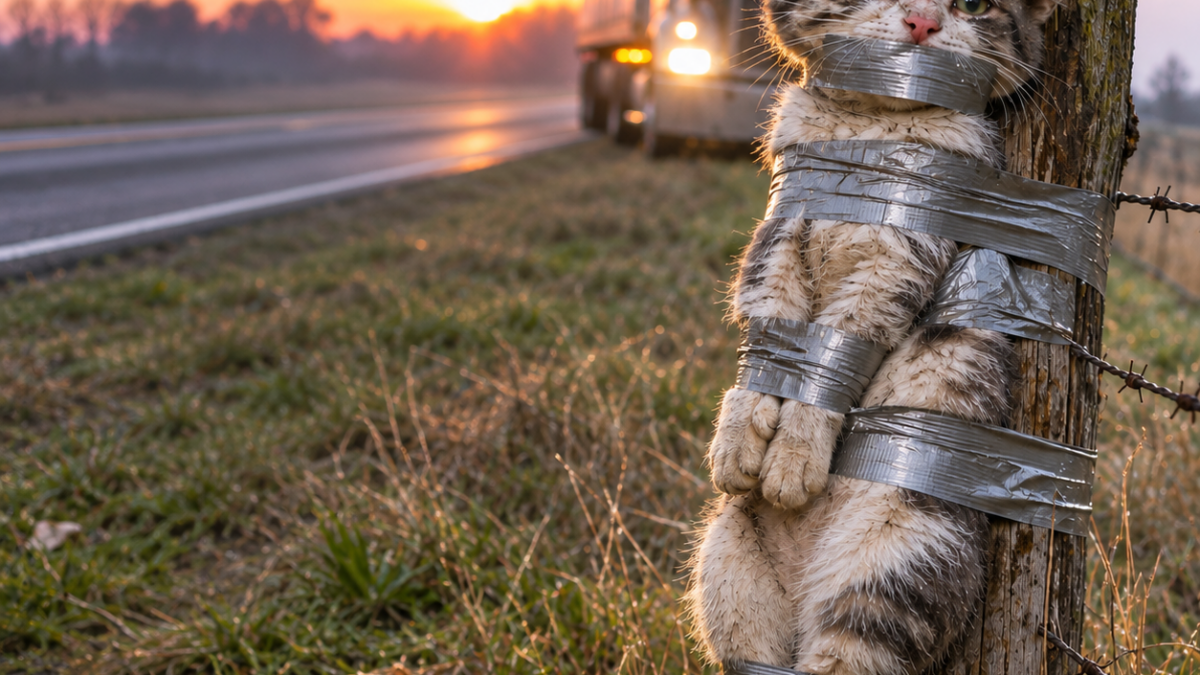
A Truck Driver Saw a Tiny Movement Beside the Highway—Then He Found a Cat Duct-Taped Upright to a Fence Post With Her Mouth Sealed Shut
At sixty miles an hour, the gray-and-white shape strapped to a fence post looked like nothing more than roadside debris, and if truck driver Daniel Mercer had blinked at the wrong second, the terrified cat would have remained bound there until the rising sun finished what her attacker had started.
Someone had wrapped duct tape around every leg, sealed her mouth shut, fastened her body upright against the wood, and left her on an empty rural highway where she could neither run nor make a sound.
But the person who tried to make sure nobody heard her had overlooked one thing—the smallest movement of her head was enough to catch one stranger’s eye, and Daniel was about to turn his forty-ton rig around for an animal the rest of the world had driven past.
Daniel Mercer had been driving trucks for twenty-seven years, which meant he had learned not to trust what he saw before sunrise.
Darkness lied.
Fog lied.
Headlights lied worst of all.
A garbage bag caught in a ditch could look like a person.
A deer standing perfectly still could vanish against a field until you were almost on top of it.
Reflective road signs sometimes appeared to float in blackness like disembodied rectangles.
Daniel had trained himself to notice movement without reacting to every shadow.
That habit was the only reason he saw her.
It was 5:14 on a Tuesday morning in early April.
Daniel was forty-nine years old, hauling refrigerated produce north along a two-lane highway outside a small farming town in eastern Ohio.
He had left the distribution yard before three.
His trailer held pallets of lettuce, onions, tomatoes, and dairy headed toward three grocery warehouses.
The schedule was tight.
The route was familiar.
The sky was still black except for the faintest gray beginning to gather along the horizon.
Daniel had coffee in the cup holder.
Old country music low on the radio.
Left elbow resting near the window.
He was thinking about his daughter.
Not anything dramatic.
She had texted him the night before asking whether he would be home Saturday because his grandson had a Little League game.
Daniel had replied:
Wouldn’t miss it.
Then his dispatcher added another run.
Daniel hadn’t answered yet.
PART2:
That was what occupied his mind when the fence post appeared in his headlights.
Wooden post.
Barbed-wire fence.
Open field behind it.
Something pale attached to the post.
Daniel’s brain registered it as plastic.
Then it moved.
Barely.
A twitch.
Maybe wind.
He drove past.
His headlights swept away.
The fence vanished into darkness behind the trailer.
Daniel glanced into the driver’s-side mirror.
Nothing.
Then something inside him said:
No.
He eased off the accelerator.
The truck rolled down from sixty to fifty.
Forty.
There was nowhere to stop immediately.
The shoulder narrowed beside a culvert.
He drove another quarter mile until he found a wider strip of gravel.
Hazards on.
Air brakes.
The rig hissed to a stop.
Daniel sat for two seconds with both hands on the wheel.
He could have continued.
He had already passed whatever it was.
Probably trash.
Maybe an old feed sack.
Maybe insulation caught on the fence.
His first delivery had a strict window.
His dispatcher had already warned him that the warehouse had been complaining about late arrivals.
He looked at the clock.
5:15.
Then he thought about that movement.
One tiny turn.
Not flapping.
Not blowing.
Turning.
Daniel grabbed his flashlight.
Climbed down.
Cold April air hit him immediately.
The highway was quiet.
No houses close enough to see.
Fields on both sides.
A line of bare trees in the distance.
He stood beside the truck listening.
Diesel engine idling.
Hazard lights clicking.
Somewhere far away, a dog barked once.
Daniel looked south toward the fence post he had passed.
Quarter mile.
Too far to walk safely along the dark shoulder.
He climbed back into the cab.
There was no legal place for a forty-ton refrigerated rig to make a simple U-turn.
He drove north another mile and a half until he found a wide farm entrance.
Checked both directions.
Backed carefully.
Turned the tractor and trailer around in three slow movements.
His phone rang.
Dispatch.
“Mercer, you good?”
“Yeah.”
“You’re showing southbound.”
“I turned around.”
“Why?”
“I saw something.”
“What kind of something?”
“Don’t know yet.”
Pause.
“You’ve got a six-fifteen dock.”
“I know.”
Daniel ended the call before the argument could begin.
A minute later the fence post appeared ahead.
He slowed almost to walking speed.
His high beams washed across the ditch.
Post.
Wire.
Gray-and-white shape.
Then Daniel saw two eyes.
Reflecting yellow.
His foot hit the brake.
The truck stopped halfway onto the shoulder.
Hazards flashing.
Daniel stared through the windshield.
For one second, his brain refused to understand what he was looking at.
A cat.
Upright.
Not standing.
Attached.
Her body was pressed vertically against the post, belly facing the road.
Silver-gray duct tape wrapped around the lower part of her body.
More tape crossed her chest.
Her front legs were bound against the wood.
Her rear legs were wrapped separately and then taped together.
Another strip encircled her muzzle.
The cat’s eyes were wide.
She moved her head less than an inch.
That was the movement Daniel had seen.
“Jesus.”
He jumped from the cab.
This time he took his phone, flashlight, work gloves, and utility knife.
Then stopped.
Knife.
Tape.
Terrified animal.
One wrong cut and she could jerk.
He shoved the knife back into his pocket.
The cat watched him approach.
She could not meow.
Could not run.
Could not flatten herself.
Could not do anything except stare.
Daniel had grown up with barn cats.
He knew that look.
Not aggression.
Panic.
He stopped six feet away.
“Hey, sweetheart.”
The cat’s eyes widened further.
Daniel crouched.
“I’m not touching you yet.”
Her whiskers were trapped beneath the tape around her mouth.
The strip had been pulled tight enough that her lips bulged slightly around the edges.
There was blood near one front paw where tape had twisted against skin.
Her breathing was fast.
Shallow.
Daniel called 911.
The dispatcher answered.
“What’s your emergency?”
“I’m on County Route 17 about four miles south of Millersburg Junction. Somebody taped a cat to a fence post.”
Silence.
Then:
“I’m sorry, sir, did you say taped?”
“Duct-taped. Legs, body, mouth. She’s alive.”
The dispatcher’s tone changed.
“Are you in immediate danger?”
“No.”
“Is the animal aggressive?”
“She can’t move.”
“I’m sending a deputy and animal control.”
“How long?”
“I can’t give an exact time.”
Daniel looked toward the horizon.
Gray becoming pink.
“She’s cold. I’m going to get the tape off her mouth.”
“Sir, use caution.”
“I will.”
He put the phone on speaker and set it on the grass.
Then moved slowly.
The cat flinched when his hand came near.
Daniel stopped.
“Okay.”
He talked because silence felt wrong.
“My name’s Daniel. I drive a truck. I’m late now because of you, so you better not bite me.”
The cat stared.
Daniel pulled off one work glove.
He placed his bare hand near her face without touching.
Let her smell him.
Her nose moved beneath the tape.
That tiny movement almost broke him.
He had two daughters.
Both grown.
One grandson.
Daniel had spent much of his life telling himself he was not sentimental.
He worked.
Paid bills.
Showed up.
Fixed things.
He was not the person who cried at commercials involving dogs.
But something about an animal trying to smell a stranger while her mouth was taped shut made his throat tighten.
“Easy.”
He examined the tape.
It was ordinary silver duct tape, but several layers had been wound tightly.
Pulling it directly could tear fur and skin.
He found a narrow exposed edge near the back of her jaw.
Using two fingers, he lifted it slightly.
The cat jerked.
The post rattled.
Daniel froze.
“Sorry.”
Her breathing accelerated.
He waited.
Thirty seconds.
Then a minute.
The road remained empty.
He tried again.
Millimeter by millimeter.
The tape released some fur.
The cat trembled.
When enough loosened, Daniel slipped one finger under the band.
Then another.
He pulled outward rather than backward.
Finally the strip came free.
The cat’s mouth opened.
No sound at first.
She took one deep breath.
Then another.
Then a tiny broken cry came out.
Not a full meow.
More like air passing over something exhausted.
Daniel sat back on his heels.
“Yeah. I hear you.”
The cat opened her mouth again.
Another weak sound.
He looked at the rest of the tape.
He wanted to remove everything immediately.
But the way she hung against the post worried him.
Maybe she had been injured.
Maybe the tape was the only thing holding a broken leg still.
Maybe ripping her free would cause more damage.
He called the dispatcher again.
“They coming?”
“Deputy is three minutes out. Animal control approximately ten.”
“I got the tape off her mouth.”
“Good. Keep yourself safe.”
Daniel took off his jacket.
It was a heavy canvas work coat.
He draped it loosely over the cat’s shoulders and sides without covering her face.
The shaking did not stop.
But the wind did.
A car approached.
Daniel stepped into the shoulder and waved.
A sedan slowed.
The driver stared at the cat.
Then drove on.
Daniel felt anger rise so quickly that he almost shouted after them.
Then he stopped himself.
Maybe they had children.
Maybe they were afraid.
Maybe they had no idea what they were seeing.
He had passed the cat too.
The only difference was that he turned around.
A sheriff’s cruiser appeared.
Deputy Rachel Foster stepped out.
Early thirties.
Hair pulled back.
Gloves already on.
She looked once at the fence.
“Oh my God.”
“That was pretty much my reaction.”
“Did you remove the mouth tape?”
“Yeah.”
“You did good.”
Rachel walked closer.
The cat’s head moved toward her.
Rachel crouched.
“Animal control’s coming.”
Daniel looked at the tape around the chest.
“Do we wait?”
Rachel studied the cat.
“I’d rather have them cut her free. If she’s been hanging like this long enough, circulation could be bad.”
She radioed dispatch.
Then photographed the scene.
Post.
Tape.
Ditch.
Tire marks.
The empty road.
Daniel realized for the first time that this was not simply an animal rescue.
Someone had done this deliberately.
Not tossed a cat from a car.
Not abandoned a carrier.
Someone had taken time.
Caught the animal.
Wrapped each leg.
Sealed her mouth.
Fastened her upright against a post.
That required intention.
The thought made Daniel’s stomach turn.
Rachel noticed tracks in the gravel shoulder.
Vehicle tires.
Boot prints near the post.
She told Daniel not to walk around more than necessary.
Animal control arrived in a white county van.
Officer Luis Mendoza and a veterinary technician named Emma Price stepped out carrying blankets, bandage scissors, a soft carrier, and a small oxygen kit.
Emma approached first.
She spoke softly to the cat.
Daniel watched her check the gums.
Pale.
Very pale.
She pressed a finger against one paw.
The paw barely reacted.
“Circulation’s compromised.”
Luis cut the first band around the torso.
Not through the fur.
He slid bandage scissors underneath carefully.
One layer.
Then another.
The tape made a tearing sound that seemed far too loud.
As the pressure released, the cat sagged.
Emma caught her chest.
“Easy.”
They supported her entire body before cutting the leg bindings.
When the last strip came off, the cat did not stand.
She collapsed into Emma’s arms.
Daniel swore under his breath.
Emma wrapped her immediately in a fleece blanket.
“She’s hypothermic.”
“How bad?”
“Cold enough that we need to move.”
The cat’s body looked smaller without the tape.
Tiny.
Maybe six pounds.
Gray-and-white coat.
Young adult, perhaps.
One front leg swollen.
Several areas where the adhesive had pulled fur.
Raw skin at the mouth.
The cat lifted her head once.
Her eyes found Daniel.
Then closed.
Emma carried her toward the van.
Daniel followed.
“Where are you taking her?”
“Millersburg Veterinary Emergency.”
“Can I come?”
Luis looked at his truck.
“You’ve got a semi.”
Daniel remembered the produce.
The schedule.
The dispatcher.
The real world.
His phone showed six missed calls.
5:42.
He was now very late.
Rachel took his information.
“You can call the hospital later.”
Daniel nodded.
Then asked:
“She going to make it?”
Emma paused before closing the van door.
“I don’t know.”
Daniel hated that answer.
But it was honest.
The van pulled away.
Deputy Foster remained.
She took more photos.
Bagged several cut pieces of duct tape.
Photographed tread marks.
Then looked at Daniel.
“You’re a commercial driver?”
“Yeah.”
“You need documentation for your employer?”
He almost laughed.
“You offering me a note?”
“I can give you an incident number.”
“Please.”
She wrote it down.
Then:
“You really saw her at sixty?”
“Something moved.”
Rachel looked at the fence post.
“That’s a hell of a thing to notice.”
Daniel shrugged.
“I almost didn’t.”
That was the part that stayed with him.
Almost.
He climbed back into the truck.
His dispatcher called before he even shut the door.
“Where are you?”
“Route 17.”
“You’re fifty minutes behind.”
“I know.”
“What happened?”
Daniel stared through the windshield at the empty fence post.
“Somebody taped a cat to it.”
Silence.
“What?”
“I stopped. Sheriff came. Animal control.”
Another pause.
Then:
“Send me the case number.”
“You believe me?”
“No. But send it anyway.”
Daniel laughed for the first time that morning.
He delivered the produce late.
Warehouse supervisor complained.
Dispatcher complained less after Deputy Foster confirmed the call.
By ten, Daniel should have been thinking about his second delivery.
Instead, he called Millersburg Veterinary Emergency.
Reception transferred him to Emma.
“She’s alive.”
Daniel exhaled.
“Okay.”
“Her body temperature is coming up. She was dehydrated. The front right paw has significant swelling from the tape. There’s skin damage around the muzzle and legs.”
“Anything broken?”
“We’re still checking.”
“Can I see her?”
Emma hesitated.
“She’s technically a county cruelty hold right now.”
“I understand.”
“But you can come after your route. We’ll put your name down.”
Daniel finished his deliveries.
Turned down the extra run his dispatcher tried assigning.
At 3:17 that afternoon, he parked his truck at the yard, climbed into his Ford pickup, and drove straight to the veterinary hospital.
The cat was in a heated kennel.
No tape.
No post.
No highway.
She had an IV catheter in one front leg.
Her swollen paw rested on a towel.
Ointment coated the raw skin around her muzzle.
A small heating pad sat beneath layers of blankets.
Daniel stood outside the kennel.
She looked at him.
He could not tell whether she recognized him.
Emma joined him.
“She’s lucky.”
Daniel almost laughed.
“Doesn’t look lucky.”
“You stopped.”
That silenced him.
Emma explained the injuries.
No fractures.
That was the first good news.
The pressure from the tape had reduced circulation in the legs, especially the front right limb.
But blood flow had returned.
They would need to watch for tissue damage.
Her mouth was sore.
Several whiskers had been pulled out or bent under the adhesive.
Skin beneath the tape was inflamed.
She was severely dehydrated.
Her temperature had been dangerously low.
But her bloodwork did not show organ failure.
“How long was she out there?”
“We can’t know.”
“Overnight?”
“Probably.”
Daniel looked away.
Early April nights still dropped into the thirties.
“She couldn’t even curl up.”
“No.”
The fact hit differently hearing someone else say it.
Cats survive cold partly by finding shelter.
Curling.
Tucking legs beneath themselves.
Hiding from wind.
Whoever taped this cat upright had taken away every natural way she could protect herself.
Daniel asked:
“Has she eaten?”
“Not yet.”
“Meowed?”
“A little.”
“Does she have a chip?”
“No.”
“Pregnant?”
“No.”
“Age?”
“Maybe a year and a half. Two at most.”
Young.
Barely past kittenhood.
Daniel stood there for twenty minutes.
The cat mostly watched.
At one point he put two fingers through the bars.
Not enough to touch her unless she chose.
She sniffed.
Then turned her head away.
Daniel withdrew his hand.
“Fair.”
Emma smiled.
“You talk to all animals like coworkers?”
“Most coworkers are harder.”
The county shelter took legal custody while the sheriff investigated.
Because the story involved deliberate cruelty, they kept the cat’s exact location quiet.
Deputy Foster called Daniel the next day.
They had found partial shoe impressions.
Tire marks.
The tape brand was common.
No nearby traffic camera had a direct view of the post.
A farmhouse almost a mile away had a driveway camera facing the road, but it only captured headlights passing at night.
“Any idea who did it?” Daniel asked.
“Not yet.”
“Could’ve been kids?”
“Could’ve been anybody.”
He hated that.
Daniel’s daughter, Megan, heard the story that evening.
His grandson Luke listened with enormous eyes.
“You saved her?”
“I stopped.”
“That’s saving.”
Daniel shook his head.
“The vet saved her.”
Luke disagreed.
“You turned around.”
Seven-year-olds are difficult to argue with when they have decided something.
Saturday, Daniel made the Little League game.
He kept his promise.
Luke struck out twice and hit a single.
Afterward, Megan asked:
“You going back to see the cat?”
“Tomorrow.”
“You thinking about adopting her?”
“No.”
Megan smiled.
“That was too fast.”
“What?”
“The no.”
“I’m gone four nights a week.”
“You know I’m not asking.”
“You’re thinking it.”
“I know you.”
Daniel changed the subject.
Sunday, he visited the cat.
The hospital staff had started calling her Fencepost because nobody knew her name.
Daniel hated that.
“She needs an actual name.”
“Suggestions?” Emma asked.
Daniel looked at the gray patch over the cat’s left eye.
She was sitting now.
Still weak.
One front paw bandaged.
Her gaze followed every movement in the room.
“June.”
Emma blinked.
“Why June?”
“My mother’s name.”
“You naming her after your mother?”
“No. Just saying June is a good name.”
Emma wrote it on the kennel card.
JUNE.
Daniel stared.
“You didn’t have to do that.”
“She needed something better than Fencepost.”
June ate for the first time that afternoon.
Only a little.
Wet food warmed slightly.
Emma placed it near her.
The cat sniffed.
Waited until everyone stepped back.
Then licked once.
Again.
By the end, she had eaten maybe two tablespoons.
Daniel received a photo.
He saved it.
Then pretended he had not been checking his phone every ten minutes.
Over the next several days, June improved.
Her temperature stayed normal.
The front paw swelling decreased.
No tissue died.
That possibility had worried the doctors most.
She started grooming herself carefully.
First chest.
Then one shoulder.
When she tried licking the areas where tape had torn fur, she stopped, apparently because the skin hurt.
Daniel visited whenever his route allowed.
Sometimes at seven at night.
Sometimes noon.
One morning at five-thirty before starting a local run.
June became less frightened of him faster than she became comfortable with most people.
Maybe his voice.
Maybe his smell.
Maybe coincidence.
He was the first human she saw after the tape came off her mouth.
Nobody knew.
On the sixth day, Daniel sat beside her kennel while she ate.
He was scrolling through weather on his phone when something touched his finger.
June’s nose.
He stayed still.
She sniffed.
Then rubbed one cheek against his knuckle.
Daniel froze.
Emma was across the room.
She saw.
Said nothing.
June did it again.
Daniel whispered:
“Okay.”
His voice broke slightly.
He cleared his throat.
“Okay, kid.”
The sheriff’s investigation moved slowly.
Then the story hit local news.
Not because law enforcement released graphic photographs.
Someone who had driven past while Daniel and Deputy Foster were on the shoulder had taken a distant photo.
The post appeared.
The truck.
Sheriff’s cruiser.
The county confirmed an animal cruelty investigation.
News stations picked it up.
TRUCKER STOPS AFTER SEEING CAT TAPED TO FENCE POST.
Daniel hated the headline.
He did one interview because Deputy Foster said publicity might help identify whoever did it.
The reporter asked:
“What made you turn around?”
Daniel answered:
“She moved.”
“Most people might have assumed it was trash.”
“I did.”
“But you came back.”
“I wasn’t sure.”
“Do you consider yourself a hero?”
“No.”
“Why not?”
“Because stopping when something looks wrong should be normal.”
That quote spread farther than he expected.
Drivers at truck stops recognized him.
A waitress gave him free pie.
Daniel hated that too.
His coworkers did not.
Someone taped a paper sign to his locker.
CAT RESCUE SPECIALIST.
Daniel removed it.
Another appeared.
Then a third.
He gave up.
June transferred from the emergency hospital to a foster program after ten days.
She was physically stable.
But staff noticed something new once the medical crisis passed.
She hated being restrained.
Not normal cat resistance.
Panic.
If someone wrapped a towel too tightly around her, her entire body stiffened.
If a hand reached suddenly toward her legs, she fought.
The carrier door closing could make her crouch and shake.
No one needed a psychologist to guess why.
Her foster caregiver, Karen Walsh, had worked with fearful cats for years.
She gave June one quiet room.
Open carrier.
Boxes.
Low bed.
Window perch.
Food.
Water.
Litter.
No forced affection.
Daniel visited three days later.
He sat on the floor.
June stayed under a chair.
Twenty minutes.
Thirty.
Daniel talked about traffic.
Diesel prices.
Luke’s baseball game.
Things a cat could not possibly understand.
Finally June emerged.
One step.
Then another.
She smelled his boot.
Daniel did not move.
She rubbed her side along the leather.
Karen smiled.
“She remembers you.”
Daniel tried to make a joke.
“Probably remembers I almost cut her loose with a utility knife.”
“You didn’t.”
“No.”
“You waited.”
That seemed to be the thing everyone kept returning to.
Noticing.
Stopping.
Waiting.
June began trusting Karen too.
Within two weeks she would sit beside her on the couch.
Not lap.
Beside.
She still startled at ripping sounds.
Packing tape.
Velcro.
A roll of duct tape accidentally used during a home repair sent her under the bed for almost an hour.
Karen removed every roll from the room afterward.
Her physical wounds improved faster than the fear.
The raw muzzle healed.
Fur began returning where the tape had pulled it.
One wrist remained thin where the adhesive had compressed the leg, but circulation was normal.
The veterinarian expected full function.
June started playing with a feather wand.
At first, only with her eyes.
Then one paw.
Then both.
Soon she launched herself sideways after it with enough enthusiasm that Karen sent Daniel a video.
Daniel watched it at a truck stop in Indiana.
Three times.
Then again.
June missed the feather and crashed into a cardboard box.
Daniel laughed loud enough that another driver looked over.
“Cat video?”
Daniel locked his phone.
“No.”
The investigation finally got a break nearly three weeks after the rescue.
Deputy Foster called him.
“Do you remember exactly where the post was?”
“Yes.”
“Fence belongs to an abandoned parcel. Owner died last year. Property’s been vacant.”
“Okay.”
“We found another incident.”
Daniel’s stomach tightened.
“What kind?”
“A neighbor reported finding duct tape and cat fur in a trash barrel behind a rental house three miles away.”
“Same cat?”
“Possibly.”
The rental belonged to a twenty-three-year-old man named Tyler Crane.
A tip came after the news story.
His former girlfriend told deputies Tyler had complained about a stray cat getting into outdoor garbage.
She said he had joked about “making sure it never came back.”
The girlfriend had dismissed it as ugly talk.
Then she saw the story.
Investigators obtained a warrant.
Inside Tyler’s garage:
Rolls of duct tape.
Animal trap.
Food dishes.
Gray-and-white fur on a blanket.
A photograph on his phone taken the night before June was found.
The cat was visible inside a live trap.
Another photograph showed the fence post.
Deputy Foster did not give Daniel every detail.
She did not need to.
“They arrested him.”
Daniel stood beside his truck at a rest area.
“What did he say?”
“Claims he was trying to scare the cat away and things got out of hand.”
Daniel stared across the parking lot.
“How do you accidentally tape four legs and a mouth?”
Rachel was quiet.
“That’s for the court.”
Daniel appreciated that answer.
He had learned something during the whole experience.
Anger always wanted the fastest conclusion.
Evidence took longer.
Tyler faced felony animal cruelty charges under applicable state law.
His attorney disputed some allegations and argued he had not intended to kill the cat.
The case took months.
Daniel attended one hearing.
Only one.
He expected to feel something satisfying when he saw Tyler.
He did not.
Tyler looked young.
Ordinary.
That disturbed Daniel more.
No monster face.
No movie villain.
Just a man in a button-down shirt sitting beside a lawyer.
Daniel thought of June upright against the post.
Unable to call out.
He left before the hearing ended.
When Megan asked why, Daniel said:
“I don’t need to watch him become more important than the cat.”
That became his answer whenever people asked about punishment.
June was what mattered.
By the fifth week, she looked almost ordinary.
That was perhaps the strangest part.
If somebody met her without knowing the story, they saw a small gray-and-white cat with a slightly uneven patch of fur near one front leg.
Bright green eyes.
Pink nose.
White paws.
Nothing about her appearance explained the fence post.
Nothing told you her mouth had once been taped shut.
Nothing revealed the cold morning or the trucker who turned around.
Trauma often becomes invisible before its effects disappear.
June still did not like sudden restraint.
She hated closed carriers.
If a stranger reached directly over her head, she ducked.
But she also played.
Ate well.
Used the window perch.
Chattered at birds.
Slept on Karen’s couch.
And increasingly, whenever Daniel visited, she climbed beside him.
Not immediately.
June always made him wait.
Daniel came to respect that.
Then came the question everyone except Daniel had apparently already answered.
Karen called.
“June is ready for adoption.”
“Good.”
Silence.
Daniel knew what was coming.
“You want an application?”
“No.”
“You sure?”
“I drive long haul.”
“I know.”
“I’m gone too much.”
“Yes.”
“Wouldn’t be fair.”
“I agree.”
That answer annoyed him.
“What?”
“I said I agree.”
“Oh.”
Karen continued.
“But I thought you’d want to know.”
Daniel spent the next four days convincing himself he was relieved.
June needed somebody home.
Stable schedule.
Probably no young kids.
Quiet house.
He was not the right home.
That was true.
Then Megan called.
“Dad.”
“What?”
“I heard June’s up for adoption.”
“How?”
“Facebook.”
“Don’t start.”
“I’m not.”
“You’re using the voice.”
“What voice?”
“The voice where you pretend you’re not about to interfere in my life.”
Megan laughed.
“Luke wants to apply.”
“He’s seven.”
“He has me.”
Daniel went quiet.
Megan lived thirty-five minutes from his house.
She worked from home three days a week.
Her husband Aaron was a high-school science teacher.
They had one older dog named Molly who had lived with cats before and mostly considered sleeping a profession.
Their son Luke already called June “Grandpa’s highway cat.”
Daniel said:
“You don’t adopt animals because you feel sorry for me.”
“I don’t.”
“Or because Luke wants one.”
“I know.”
“June gets scared.”
“I read the foster notes.”
“She doesn’t like being grabbed.”
“I understand.”
“You have a kid.”
“A kid who can follow rules.”
“Sometimes.”
“Dad.”
He knew he was losing.
Megan applied.
The rescue performed the normal process.
References.
Veterinary history for Molly.
Home visit.
Meeting.
Nobody gave them preference because Daniel found June.
That mattered to him.
If they were not the right home, he wanted the rescue to say no.
The first meeting happened at Karen’s house.
Luke sat on the floor.
He had been instructed not to chase June.
Not to reach under furniture.
Not to pick her up.
Not to touch unless she approached.
For twenty minutes, June watched him from behind a chair.
Luke whispered to Daniel:
“She doesn’t like me.”
“She doesn’t know you.”
“What do I do?”
“Nothing.”
“That’s boring.”
“Welcome to earning trust.”
Luke sighed dramatically.
Then sat.
Five minutes later, June emerged.
She walked past Daniel first.
Smelled Megan.
Then Aaron.
Then Luke’s shoe.
Luke’s entire body went rigid with effort.
June sniffed his fingers.
Then walked away.
Luke whispered:
“She touched me.”
“Don’t make it weird.”
“I’m not.”
He absolutely was.
The second meeting went better.
June chased a toy Luke dragged slowly across the floor.
Third meeting:
She sat beside Megan.
The rescue approved the adoption.
Daniel cried in his truck afterward.
Not much.
Maybe thirty seconds.
Then he denied it ever happened.
June moved into Megan’s house on a Sunday.
At first she stayed in one bedroom.
Molly smelled her under the door and showed no interest beyond a single sneeze.
Luke visited only with an adult.
No grabbing.
No chasing.
No tape noises.
No forced introductions.
June took three days to leave the room voluntarily.
A week to explore the upstairs.
Two weeks before she and Molly could share a room calmly.
A month before June slept on the back of the couch while the whole family watched television.
Daniel visited often.
Every time his truck route brought him home, he stopped by.
June developed a habit.
She would ignore him for several minutes.
Then jump onto the chair beside him.
Daniel accused her of trying to maintain negotiating leverage.
Megan said:
“She’s a cat.”
“Exactly.”
By summer, most of the missing fur had returned.
No lasting circulation problems.
No limp.
The veterinary team was pleased.
The emotional scars took longer.
A ripping sound from a package could still send her running.
One afternoon Luke opened a cardboard shipping box and pulled a strip of heavy tape too fast.
RIP.
June disappeared.
Luke looked devastated.
“I scared her.”
Megan said:
“You didn’t mean to.”
He waited.
Did not crawl under the bed.
Did not call her.
He sat on the floor several feet away.
Ten minutes later, June looked out.
Luke stayed still.
She emerged.
Walked to him.
Rubbed against his knee.
Daniel happened to be there.
He watched without speaking.
Luke looked up.
“I waited.”
Daniel nodded.
“Yeah.”
That moment meant more to him than the arrest.
More than the headlines.
More than the free pie.
The cat who once had every choice taken from her now lived in a house where people let her choose.
When to approach.
When to hide.
When to play.
When to be touched.
That seemed like justice in a form Daniel understood.
Not revenge.
Restored choice.
The court case eventually ended.
Tyler Crane entered a plea that resulted in a conviction for animal cruelty, along with court-imposed penalties, restrictions involving animal ownership, and restitution connected to June’s veterinary treatment.
Daniel did not attend sentencing.
Deputy Foster called afterward.
“You want the details?”
“Anything I need to know?”
“He can’t legally own animals under the terms.”
“Good.”
“Restitution ordered.”
“Good.”
“Anything else?”
Daniel thought.
“No.”
Rachel understood.
“June doing okay?”
“She runs the house.”
“Sounds right.”
The county later installed a small roadside camera near the stretch where June had been found.
Not because of one cat alone.
The area had also been used for illegal dumping.
The landowner’s family repaired the fence.
The post itself disappeared.
Daniel noticed the first time he drove Route 17 after the repair.
He slowed.
There was a new post.
Plain wood.
Nothing attached.
He expected relief.
Instead he felt strange.
For weeks, that location had existed in his mind as the place June almost died.
Now it looked like nothing.
Fields.
Fence.
Road.
Ordinary.
That was probably good.
Trauma should not own a landscape forever.
Months passed.
Then a year.
Daniel kept driving.
Still complained about schedules.
Still drank too much truck-stop coffee.
Still promised Luke he would make baseball games and sometimes had to argue with dispatch to keep those promises.
But something changed in him.
He stopped more often.
Not dramatically.
A dog wandering near traffic.
A turtle in a lane.
Once, an old man whose pickup had a flat.
Daniel’s coworkers started joking that he ran the Mercer Roadside Rescue Service.
He told them to shut up.
One driver named Pete asked:
“You always stop now?”
“No.”
“How do you decide?”
Daniel thought about June.
“I guess I stop when something tells me I’ll think about it later if I don’t.”
Pete nodded.
“That’s annoyingly philosophical.”
“Blame the cat.”
The rescue organization invited Daniel to a fundraiser that fall.
He refused twice.
Megan accepted for him the third time.
There was a slideshow.
Photos of dogs.
Cats.
Medical recoveries.
Adoptions.
Then June appeared on the screen.
First photograph:
Blanketed at the emergency hospital.
They did not show the worst roadside image.
Daniel was grateful.
Next:
Eating.
Then playing with a feather toy.
Then sitting beside Luke.
Final photo:
June asleep across Daniel’s chest while he reclined on Megan’s couch.
Daniel had not known anyone took it.
The room applauded.
He wanted to disappear.
The rescue director handed him a small plaque.
Daniel read it.
FOR TURNING AROUND.
He almost refused it.
Then thought better.
The plaque hangs in his garage now.
Not in the house.
He says that makes it less sentimental.
Nobody believes him.
On the anniversary of June’s rescue, Megan drove her to Daniel’s house.
Not because cats care about anniversaries.
Humans do.
Daniel had built a screened porch attachment off his den.
He claimed it was for himself.
Megan pointed out that it contained:
Three cat shelves.
A scratching post.
A window hammock.
A heated pad.
Daniel said:
“Could be for anything.”
Luke replied:
“Like a cat?”
Daniel ignored him.
June stepped onto the porch.
Sunlight fell across her coat.
Birds moved near the yard.
She watched them.
Tail twitching.
Daniel sat in an old chair.
Luke sat on the floor doing homework.
Megan brought coffee.
For almost an hour, nothing extraordinary happened.
That became Daniel’s favorite part of the story.
Not the highway.
Not the rescue van.
Not the arrest.
This.
Ordinary afternoon.
A cat in sunlight.
A kid complaining about fractions.
Coffee.
No one afraid.
There was still one thing Daniel had never told anyone.
Not Megan.
Not Deputy Foster.
Not the reporter.
Sometimes he dreamed about the moment he first saw June.
Except in the dream, he did not turn around.
He kept driving.
The pale shape disappeared behind him.
The sun rose.
He woke before the rest.
Every time.
Daniel knew dreams were not reality.
He had turned around.
June survived.
She had a family.
Still, the dream reminded him how small the difference had been.
A movement.
A glance.
One thought:
No.
That was all.
People later told the story as though Daniel had instantly understood what he saw.
He had not.
He thought June was trash.
Then maybe plastic.
Then maybe nothing.
The heroic version bothered him because it made the rescue sound inevitable.
It was not.
He almost kept going.
That was why he told Luke something different whenever the boy bragged that his grandfather saved a cat.
“I didn’t know she was a cat.”
“But you stopped.”
“I stopped because I wasn’t sure.”
Luke eventually understood.
Sometimes certainty comes too late.
Sometimes helping begins before you know exactly what you are looking at.
June grew into a confident cat.
Not fearless.
That word never fit.
She remained cautious around strangers.
Delivery workers could send her upstairs.
She disliked loud ripping noises.
She never tolerated being held tightly.
Veterinary visits required patience.
But confidence is not the absence of fear.
It is knowing you have somewhere safe to return after fear appears.
June had that.
When startled, she ran.
But now she ran under Luke’s bed.
Or behind Megan’s couch.
Or into the quiet room kept open for her.
Then she came back.
That ability to leave and return might have been the most important difference between the life she had and the life someone once tried to take from her.
On the fence post, June had no choice.
Her legs were bound.
Mouth sealed.
Body fixed upright.
She could not retreat from a vehicle.
Could not hide from the wind.
Could not call.
Could not scratch.
Could not choose anything.
In her new home, almost everything was choice.
Which room.
Which bed.
Whether to sit beside someone.
Whether to accept a hand.
Whether to play.
Whether to sleep in the sun.
The family respected that.
Luke especially.
He became oddly proud of being the person June occasionally chose to sleep beside.
One evening he asked Daniel:
“Do you think she knows you saved her?”
Daniel answered:
“No idea.”
“Do you think she remembers the fence?”
“I hope not.”
“But she gets scared of tape.”
“Maybe she remembers the sound. Maybe not.”
Luke considered that.
“Do cats forgive?”
Daniel smiled.
“That’s above my pay grade.”
“What do you think?”
Daniel looked at June curled against the couch cushion.
“I don’t think she owes anybody forgiveness.”
Luke nodded slowly.
Then:
“She likes us, though.”
“Yeah.”
“That’s better.”
Daniel thought so too.
Years later, the story people remembered would probably be the dramatic part.
Truck driver sees movement.
Turns forty-ton rig around.
Finds cat duct-taped to fence post.
Police.
Rescue.
Arrest.
Those details were unforgettable.
But Daniel eventually understood that they were not the whole story.
The important part came after someone cut the tape.
Because freedom alone does not instantly make fear disappear.
June still had to learn that hands could approach without grabbing.
That closed doors could reopen.
That a ripping sound did not always mean restraint.
That a person sitting quietly nearby might wait instead of forcing contact.
That home could mean having a place to hide without being abandoned.
That people could notice discomfort and stop.
That a child could learn patience for her.
That a truck driver could visit week after week without expecting anything in return.
That life could become boring.
Safe.
Predictable.
Hers.
One summer evening, Daniel sat on his daughter’s back porch while Luke played catch in the yard.
June lay on the window ledge behind the screen.
Daniel’s phone buzzed.
Dispatch.
Extra run.
He looked at the message.
Then at Luke.
Saturday tournament the next morning.
Daniel typed:
Unavailable.
A minute later Pete from work called.
“You turning down money now?”
“Got plans.”
“Baseball?”
“Yeah.”
“Cat gonna be there?”
“No.”
“You sure? That thing runs your family.”
Daniel looked through the screen.
June was washing one paw.
“Pretty much.”
He hung up.
Luke threw the ball too high.
Daniel caught it one-handed.
“Again.”
Luke grinned.
Through the screen, June watched.
Nothing dramatic.
That was exactly how Daniel liked it.
The cat once left upright beside a highway where no one was supposed to hear her now lived in a house full of ordinary sounds.
A baseball hitting a glove.
A refrigerator opening.
A child laughing.
A dog snoring.
Someone tearing open a food pouch carefully because they remembered certain sounds still frightened her.
And sometimes, late in the afternoon, the low rumble of Daniel’s pickup turning into the driveway.
Whenever June heard that sound, she usually appeared near the front window.
Not every time.
She was still a cat.
But often enough.
Daniel would walk inside.
Megan would say:
“She heard you.”
Daniel would pretend not to care.
Then sit.
Wait.
And eventually June would climb onto the chair beside him.
The first time he saw her, she had been attached to wood by another person’s cruelty.
Now, whenever she came near him, nothing held her there.
No tape.
No restraint.
No fear forcing her to stay.
She could leave whenever she wanted.
And somehow, after everything, she chose not to.
That was the ending Daniel cared about.
Not that the man responsible was caught.
Not that strangers called him a hero.
Not even that June survived a cold night beside the highway.
It was that the cat whose every movement had once been taken away eventually had an entire life built around the freedom to choose.
And all of it existed because at 5:14 on one dark Tuesday morning, a tired truck driver saw something beside the road move less than an inch—
and decided that “probably nothing” was still worth turning around for.




