PART 2: HOA Karen’s Unemployed Son Demanded My Ferrari for FREE—Then His Mom Used the HOA to Punish Me for Saying No
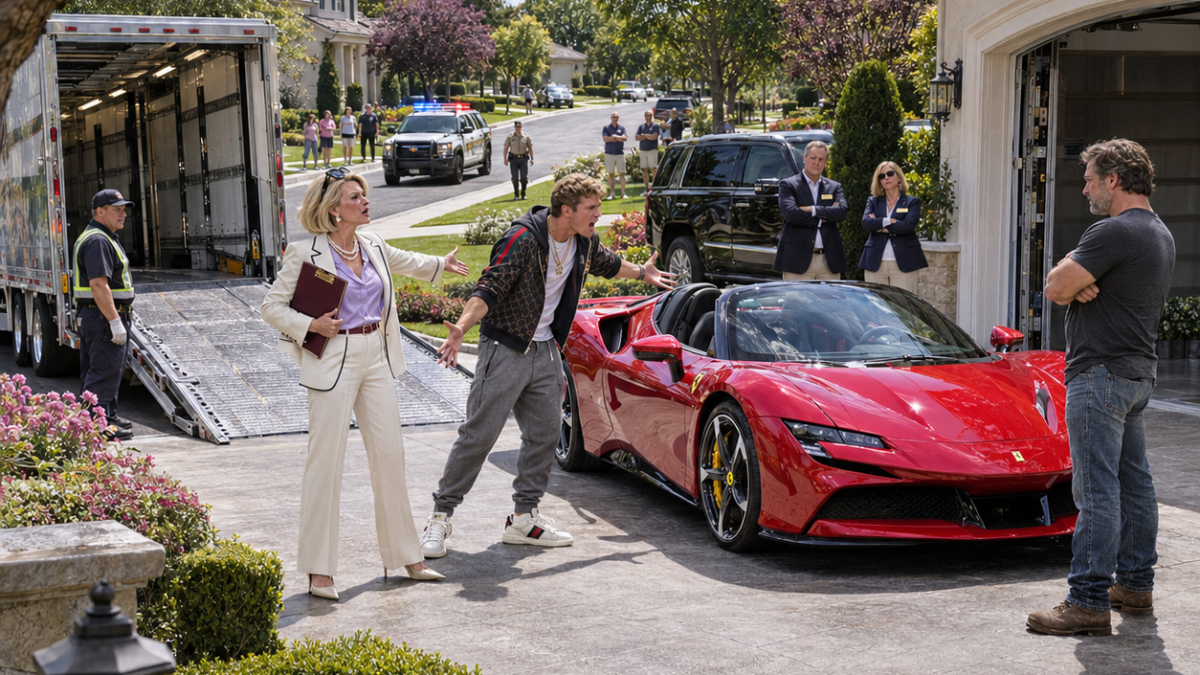
The morning my brand-new Ferrari SF90 Spider rolled off the delivery truck, my unemployed twenty-six-year-old neighbor stared at the metallic red bodywork for maybe five seconds before turning to his HOA-president mother and shouting, loud enough for half the cul-de-sac to hear, “Mom, I want that one—why does he get it, and why can’t you make him give it to me for free?”
I laughed because I genuinely thought Hunter Jones was having another spoiled outburst, but his mother Isabella didn’t laugh at all; she stood across from me in her perfectly pressed blazer, studying the car with the same calculating expression she normally reserved for grass-height violations, and that was the moment I should have realized the Ferrari wasn’t simply making her jealous—it had given her something new to control.
Two days later, when a police cruiser rolled into Pinecrest Estates because someone had reported my “sudden unexplained wealth” as suspicious, I looked across the street at Isabella hiding behind her blinds and understood that saying no to her son had started something much uglier than a neighborhood argument, but I still had no idea how far the two of them were willing to go.
My name is Kevin Adams.
I was thirty-nine years old when this happened, and for most of my adult life I followed one rule: work quietly and let the results make the noise.
I started my first software company in a leaking apartment with a folding table, an old laptop, and enough credit-card debt to keep me awake at night.
For years, there was nothing glamorous about it.
I wrote code until sunrise.
I slept on office couches.
I pitched investors who forgot my name before I reached the elevator.
I watched projects fail after months of work and once spent Thanksgiving eating vending-machine pretzels because a server migration went wrong.
Eventually, one of those companies worked.
Then it really worked.
When the acquisition finally closed, the software I had built turned into more money than the kid in that apartment could have imagined.
I didn’t buy a mansion.
I didn’t start throwing parties.
I moved to Pinecrest Estates with my dog Max because I wanted something boring.
A clean house.
A garage.
A garden.
Quiet streets.
For the first few weeks, that was exactly what I got.
Then Isabella Jones introduced herself.
She crossed my lawn wearing oversized sunglasses and a beige blazer.
“Kevin Adams?”
“That’s me.”
“Isabella Jones. HOA president.”
She extended her hand like we were closing a treaty.
“Welcome to Pinecrest. We value simple cars, quiet evenings, modest living, and visual balance.”
I remember thinking that was an odd welcome.
Still, I smiled.
“Sounds peaceful.”
“It is,” she said. “As long as everybody respects the standards.”
Then her son Hunter appeared behind her.
Twenty-six years old.
Faded hoodie.
Phone in hand.
Permanent look of irritation.
Isabella introduced him.
Hunter glanced at me.
“Another tech guy.”
“Something like that.”
“You people ruin everything.”
I laughed because surely he was joking.
He wasn’t.
Over the next few months, I learned Hunter didn’t work, wasn’t studying, and spent most of his time gaming or sitting on his mother’s porch complaining that everyone else had gotten lucky.
Isabella defended him constantly.
“He’s finding himself.”
“He’s waiting for the right opportunity.”
“He’s too intelligent for meaningless jobs.”
I stayed out of it.
Then the Ferrari arrived.
The SF90 Spider had been a dream purchase, not because I wanted strangers impressed, but because it reminded me of every year when buying groceries felt risky and success looked impossible.
When the delivery driver lowered it onto my driveway, sunlight turned the deep metallic red paint almost gold.
Kids stopped their bicycles.
Neighbors came outside.
Someone applauded.
Hunter just stared.
Then he yelled:
“Mom, I want that.”
Isabella’s face tightened.
Hunter pointed directly at me.
“He doesn’t need it. Tell him to give it to me.”
I looked at him.
Then Isabella.
Surely she was going to apologize.
Instead, she studied the Ferrari and said quietly:
“Kevin, that is certainly… extravagant.”
I smiled.
“I’ve wanted one for years.”
She tilted her head.
“In Pinecrest, we try not to create unnecessary social imbalance.”
I thought she was joking.
Then Hunter stepped closer.
“So let me drive it.”
“No.”
His face changed instantly.
“Why?”
“Because it’s my car.”
And the silence that followed told me I had just said the one word neither of them was used to hearing.
No.
PART 2
Hunter stared at me as though I had slapped him.
Not physically.
Worse.
Emotionally.
Apparently, telling a twenty-six-year-old man that he couldn’t drive a nearly thousand-horsepower Ferrari without my permission was an act of oppression.
He shoved both hands into the pocket of his hoodie.
“Seriously?”
“Seriously.”
“Just around the block.”
“No.”
“You think I’m going to wreck it?”
“I think I don’t lend cars like this to people I barely know.”
Hunter scoffed.
“You barely know me because you think you’re better than everybody.”
I looked at Isabella.
This was the moment when a normal mother might have told her adult son he was embarrassing himself.
Instead she gave me a tight smile.
“You’ll have to forgive Hunter. He’s passionate about fairness.”
“Fairness?”
“Yes.”
Hunter nodded.
“Exactly.”
I looked at the Ferrari.
Then at Hunter.
Then back at Isabella.
“I’m not sure what fairness has to do with my car.”
Isabella folded her arms.
“Well, you’ve obviously been very fortunate.”
There it was.
Fortunate.
Not exhausted.
Not stubborn.
Not fifteen years of missed weekends and bad meals and near-bankrupt companies.
Fortunate.
I didn’t bother explaining.
People who want to believe success happened by magic usually aren’t interested in the years before the magic trick.
I smiled.
“Have a good morning.”
Then I turned back toward the delivery driver.
Hunter muttered something under his breath.
I ignored it.
Isabella didn’t.
She called after me.
“Kevin.”
I turned.
“We do try to maintain a modest atmosphere here.”
I glanced toward the Ferrari.
“It has a quiet mode.”
Her mouth tightened.
“That’s not exactly what I meant.”
“I know.”
Then I went back to signing paperwork.
That should have been the end of it.
It wasn’t even the beginning.
***
That evening, I got a notification from the Pinecrest neighborhood group.
**COMMUNITY REMINDER**
Isabella had posted it from the HOA administrator account.
I opened the message.
**Residents are encouraged to consider how unusual displays of wealth may affect neighborhood harmony, safety, and social balance. Sudden high-value acquisitions can attract unwanted attention and create unnecessary tension among community members. Pinecrest Estates has always valued modest living, transparency, and mutual respect.**
I read it twice.
Then I laughed.
Max lifted his head from the rug.
“What?”
He stared at me.
“I bought a car and apparently destabilized capitalism.”
Max put his head back down.
Smart dog.
I took a screenshot.
Then I ignored the post.
That was my first mistake.
Not because I should have fought back immediately.
Because I assumed Isabella would get bored if I refused to react.
People like Isabella don’t always get bored when ignored.
Sometimes they get offended.
***
The next morning, a police cruiser turned into the cul-de-sac.
I was outside watering a row of young shrubs near the garage.
The cruiser stopped.
Two officers stepped out.
One older, one probably around thirty.
The older officer approached.
“Mr. Adams?”
“Yes.”
“We received a report about possible suspicious financial activity connected to a recent vehicle purchase.”
I stared.
“Financial activity?”
He glanced toward the garage.
“The Ferrari.”
I actually laughed.
The younger officer looked embarrassed.
“It’s mostly a welfare and verification thing, sir.”
“Someone called the police because I bought a Ferrari?”
“Someone reported concern about rapid unexplained wealth.”
I looked across the street.
Isabella’s blinds moved.
Very slightly.
Hunter’s face appeared behind them.
Then disappeared.
I nodded.
“Come inside.”
Ten minutes later, the officers were in my home office.
I handed them identification.
Corporate records.
Tax documentation.
The public announcement from when my company had been acquired.
The purchase paperwork for the Ferrari.
The older officer read the acquisition article.
Then looked at me.
“Syntrace?”
“That was me.”
“You built this?”
“With a team.”
He whistled.
“My brother uses your software at his company.”
“Tell him I’m sorry.”
The younger officer laughed.
The older one handed back the documents.
“Everything is fine.”
“Surprising.”
“I’m sorry we bothered you.”
“You’re doing your job.”
He hesitated.
“Do you have trouble with anybody in the neighborhood?”
I glanced through the window.
Isabella was now pretending to water a plant near her porch.
The plant was artificial.
“Nothing I can’t handle.”
The younger officer smiled.
“For what it’s worth, nice car.”
“Thanks.”
“Mind if I take a picture for my son?”
“Absolutely.”
We walked outside.
He took one quick photo.
Then both officers returned to the cruiser.
As they passed Isabella’s house, the older officer rolled down his window.
“Everything checks out, ma’am.”
I nearly dropped my coffee.
Isabella froze.
Hunter, standing behind her, threw his hands into the air.
“Mom!”
His voice carried across the entire street.
“You embarrassed us again!”
He stormed inside.
I turned away because I didn’t want Isabella to see me smile.
I should have known humiliation would make things worse.
***
The following afternoon, I was backing the Ferrari out when Isabella stepped directly onto the edge of my driveway.
I stopped.
She approached the driver’s side.
I lowered the window.
“Morning.”
“Kevin.”
Her voice had that polished sweetness she used when she was furious but wanted plausible deniability.
“Some residents are concerned.”
“About?”
“The attention.”
“What attention?”
She looked at the Ferrari as though the answer were obvious.
“This.”
“The car?”
“The spectacle.”
“It’s parked in my garage.”
“You drive it.”
“That’s usually how cars work.”
Her mouth tightened.
“We don’t want Pinecrest becoming a racetrack.”
“I’ve never raced here.”
“I know.”
“Then what’s the issue?”
She glanced toward her house.
Hunter was watching.
Then she lowered her voice.
“He’s been having a difficult time.”
I waited.
“Hunter?”
“Yes.”
“What does that have to do with me?”
“He feels stuck.”
“I’m sorry.”
“He sees someone like you arrive with everything.”
I almost responded.
Stopped myself.
Isabella continued.
“Perhaps it would help if you let him drive the car once.”
I genuinely thought I misheard her.
“What?”
“Just around Pinecrest.”
“No.”
“Kevin.”
“No.”
Her face stiffened.
“It would mean a lot.”
“I’m sure it would.”
“He’s responsible.”
“Is he insured on the Ferrari?”
“No, but—”
“Then no.”
“It’s a short drive.”
“No.”
She sighed dramatically.
“This is exactly what I mean.”
“What do you mean?”
“You’re creating division.”
I stared.
“Because I won’t hand your son the keys to my car?”
“You could show generosity.”
“I can show generosity without letting Hunter drive a Ferrari.”
Her voice dropped.
“You have resources other people don’t.”
“I’m aware.”
“Community means sharing.”
“Community does not mean communal ownership of my garage.”
Isabella stepped backward.
“That attitude is unfortunate.”
“So was the police report.”
Her face went completely still.
“I don’t know what you’re talking about.”
“I think you do.”
“I’m trying to help my son.”
“Then help him find a job.”
That hit harder than I intended.
Her eyes flashed.
“You know nothing about him.”
“You’re right.”
I shifted into reverse.
“That’s another reason he isn’t driving my car.”
She stepped aside.
I backed out.
Her stare followed me to the end of the street.
***
That night, another HOA notice arrived.
Not a fine.
Not yet.
A “community harmony reminder.”
It claimed residents had a responsibility to prevent “socioeconomic imbalances caused by ostentatious property displays.”
I opened the bylaws.
Searched the phrase.
Nothing.
Searched “luxury vehicles.”
Nothing.
Searched “socioeconomic imbalance.”
Nothing.
I saved the notice anyway.
That became a habit.
Every letter.
Every email.
Every screenshot.
I had built software around data integrity.
When something smelled wrong, my instinct wasn’t to argue.
It was to preserve.
Date.
Time.
Source.
Context.
The same habits that had protected multimillion-dollar systems were about to become extremely useful in a neighborhood full of clipboards.
***
The complaints multiplied.
Noise violation at 9:40 p.m.
I was in another city that night.
Exterior lighting violation.
My garage light had been on for twelve minutes.
Improper runoff from washing the Ferrari.
The water entered the same legal drain every other homeowner used.
Reflective hazard.
Apparently sunlight had bounced off the hood and “temporarily impaired a cyclist’s vision.”
I read that one aloud.
Max sneezed.
“Exactly.”
Then I started noticing Hunter near my driveway.
Selfies.
Videos.
Long pauses near the garage.
One afternoon I heard him yelling from across the street.
“He thinks he’s better than us!”
Isabella answered too quietly for me to hear.
Hunter shouted again.
“Then do something!”
I went inside.
Locked the garage.
Checked the cameras.
Not because I expected a crime.
Because my instincts had finally caught up with the situation.
***
Saturday morning, Isabella and Hunter came to my door together.
I opened it.
Isabella smiled.
Hunter didn’t.
“We wanted to clear the air.”
“That would be new.”
Her smile twitched.
“We believe in being neighborly.”
“Okay.”
She looked toward the garage.
“Hunter has been struggling to find direction.”
Hunter stared at the ground.
I waited.
Isabella continued.
“Sometimes exposure to success can inspire someone.”
I already knew where this was going.
“No.”
She blinked.
“I haven’t asked yet.”
“I’m saving us time.”
Hunter stepped forward.
“Just let me drive it.”
“No.”
“Why not?”
“Because it’s my car.”
“Again with that.”
“With what?”
“Mine, mine, mine.”
I stared at him.
Hunter laughed bitterly.
“Dude, you have millions.”
“So?”
“You won’t even share one thing.”
“I share plenty of things.”
“Not with me.”
“We barely know each other.”
Isabella raised one hand.
“Let’s stay calm.”
I looked at her.
“I’m calm.”
She smiled.
“Perhaps driving it isn’t the best solution.”
That surprised me.
Then she continued.
“Maybe you could sell it to Hunter.”
I waited.
“At a reduced price.”
Hunter perked up.
“I can pay.”
“How much?”
He shrugged.
“Like twenty-five percent.”
I actually laughed.
Hunter’s face reddened.
“What?”
“Nothing.”
“You think that’s funny?”
“Yes.”
Isabella’s voice sharpened.
“Kevin.”
“I paid full price.”
“You can afford the loss.”
“That doesn’t mean I’m taking it.”
“You could consider the difference a community contribution.”
I stared at both of them.
Then laughed harder.
“This is real.”
Isabella crossed her arms.
“Community means compromise.”
“No. Community means you don’t show up at someone’s door and demand a seventy-five-percent discount on his Ferrari because your unemployed son wants it.”
Hunter took a step forward.
“You think you’re better than me.”
“No.”
“Yes, you do.”
“I think I earned my car.”
He clenched his fists.
“That’s the difference.”
His face went red.
Isabella grabbed his arm.
“Hunter.”
He jerked away.
“You always let people like him win.”
“Go home.”
“Mom—”
“Now.”
He glared at me.
“You’ll regret this.”
He walked away.
Isabella remained.
Her fake smile was gone.
“You embarrassed him.”
“He embarrassed himself.”
“He’s going through things.”
“That does not make me financially responsible for his feelings.”
She looked at me coldly.
“You’ve been blessed.”
“I worked.”
“You were fortunate.”
“I worked.”
“Not everyone gets your opportunities.”
“I know.”
“Then perhaps you should give back.”
“I do.”
“To him.”
“No.”
One word.
Again.
No.
Her jaw tightened.
“Pinecrest families hold one another accountable.”
“I’m not your family.”
“You live here.”
“That’s not the same thing.”
She stepped closer.
“You should be very careful about isolating yourself from the community.”
I smiled.
“Isabella, are you threatening me because I won’t donate a Ferrari to your son?”
“Of course not.”
“Good.”
I started closing the door.
She said:
“You’ll understand eventually.”
I stopped.
“That sounded like a threat.”
“It was a reminder.”
I looked at her.
“So was no.”
Then I closed the door.
***
Within forty-eight hours, flyers appeared.
**LUXURY DOESN’T EQUAL CHARACTER**
Under the headline was cartoon clip art of a red sports car.
The flyer warned residents that “newcomers flaunting unexplained wealth” could erode Pinecrest’s values.
No signature.
But the font was identical to HOA newsletters.
The paper stock was identical.
And the jasmine perfume was unmistakable.
I collected three.
Photographed each location.
Saved them.
Then came four new complaints.
Noise.
Runoff.
Lighting.
“Antisocial conduct.”
That was a new one.
I opened a spreadsheet.
Date.
Time.
Type of complaint.
Evidence.
Where I was.
Witnesses.
I pulled my security-camera logs.
Doorbell footage.
Garage sensors.
Vehicle telemetry.
My old company had made me obsessive about timestamps.
Now the obsession felt useful.
***
Late Thursday night, I received a motion alert.
1:17 a.m.
I was upstairs.
Max barked once.
My phone showed the front driveway.
A figure in a dark hoodie crouched near my mailbox.
Hunter.
I zoomed in.
He held a container.
He poured thick black liquid onto the grass and edge of my driveway.
Then he grabbed the mailbox.
Hit it.
Twice.
Metal dented.
He looked toward my house.
Smirked.
Then ran.
I sat completely still.
My first reaction was anger.
Pure, immediate anger.
The kind that makes you want to cross the street before your judgment catches up.
I stood.
Made it halfway down the stairs.
Stopped.
Turned around.
Picked up my phone.
Called the police.
Not Isabella.
Not Hunter.
Police.
An officer arrived twenty-five minutes later.
I showed him the footage.
“Recognize him?”
“Yes.”
“Neighbor?”
“Across the street.”
“Want to press charges?”
I looked at the frozen frame.
Hunter’s face clear beneath the hood.
“File the report.”
“You don’t want charges tonight?”
“Document it first.”
The officer looked at me.
“You sure?”
“Yes.”
He nodded.
“Smart.”
We walked outside.
The substance smelled like motor oil.
My mailbox was dented.
The edge of the lawn was black.
The officer photographed everything.
Before leaving, he said:
“Don’t confront him.”
“I won’t.”
“You have good cameras.”
“Occupational habit.”
“What do you do?”
“Used to build systems that caught people lying.”
He smiled.
“Well.”
He glanced toward Isabella’s dark house.
“Still employed, apparently.”
***
At nine the next morning, Isabella marched onto my driveway.
Clipboard in hand.
She held a violation notice.
I almost admired the audacity.
“Mr. Adams.”
“Isabella.”
“We’ve received reports of hazardous material on your lawn.”
“Have you?”
“Yes. The HOA requires immediate cleanup.”
“I agree.”
Her confidence grew.
“Good.”
“Luckily, I know who put it there.”
She stopped.
“What?”
I held up my phone.
Played the video.
Hunter.
Hoodie.
Oil.
Mailbox.
Smirk.
Isabella’s face drained of color.
“That’s not—”
“Hunter?”
“He must have been—”
“Is it Hunter?”
“He’s under stress.”
I stared at her.
“Isabella.”
“He didn’t mean—”
“Is it your son?”
“Yes.”
The word came out barely audible.
I lowered the phone.
“Police have the footage.”
Her head snapped up.
“You called the police?”
“He vandalized my property.”
“He’s a boy.”
“He’s twenty-six.”
“He made a mistake.”
“A mistake is backing into a mailbox.”
“He didn’t understand.”
“He poured oil onto my lawn after midnight.”
“You’re trying to destroy his life.”
“No.”
“You know how hard things are for him.”
“That isn’t my responsibility.”
Her eyes filled with fury.
“You humiliated him.”
“I told him no.”
“You flaunted everything he doesn’t have.”
I stared at her.
For the first time, I understood something.
Isabella didn’t merely excuse Hunter.
She fed him.
Every grievance.
Every resentment.
Every belief that somebody else’s success was an attack on him.
Then she protected him from the consequences.
“You’ve been telling him I’m the problem.”
She looked away.
“You think you’re very clever.”
“No.”
“You think cameras make you untouchable.”
“No.”
“You think money protects you.”
“No.”
“What do you think?”
I pointed toward the video.
“I think facts matter.”
Her expression hardened.
“That can be edited.”
There it was.
The next lie forming while the previous one was still warm.
I smiled.
“Go ahead.”
“What?”
“Claim it’s fake.”
She stared.
“Tell the board.”
Silence.
“Tell the police.”
Still nothing.
“Put it in writing.”
Her fingers tightened around the clipboard.
“You’ll regret humiliating my family.”
She turned.
Walked away.
I watched her cross the street.
Then I looked at my phone.
The system had already uploaded the footage to encrypted cloud storage.
Original file.
Timestamp.
Hash verification.
Offsite backup.
Insurance-linked archive.
If Isabella wanted to fight over authenticity, she had chosen the worst possible person.
***
Two days later, I learned she had done exactly that.
The HOA board received an email from Isabella.
She claimed I had manipulated security footage to frame Hunter.
She attached screenshots with missing timestamp information.
Low-resolution.
Cropped.
Altered.
One board member forwarded the email to me.
I read it.
Then called my attorney.
Her name was Rachel Mason.
She listened quietly.
“So she’s accusing you of falsifying criminal evidence?”
“Yes.”
“Can you prove authenticity?”
“More ways than she can spell authenticity.”
“Kevin.”
“Yes.”
“Please don’t say that in court.”
“Fair.”
I explained the system.
Cloud verification.
Automated upload.
Immutable log.
Insurance backup.
Device signatures.
Rachel became very quiet.
Then:
“You built this?”
“I built parts of the technology years ago.”
She laughed.
“Isabella has absolutely no idea who she picked.”
“I’d rather she stop.”
“Maybe she will.”
“She won’t.”
“No.”
Rachel sighed.
“She probably won’t.”
***
The HOA called an emergency meeting.
I didn’t attend the first one.
I gave the board a written packet.
Complaint history.
Police report.
Video.
File verification.
Screenshots of the neighborhood posts.
HOA notices.
The false claim about video manipulation.
I also gave Rachel copies.
Then I waited.
That was harder than fighting.
Waiting always is.
Two days later, my doorbell rang.
Isabella.
Hunter.
Together again.
But neither looked confident.
I opened the door but stayed inside.
“Kevin.”
“Isabella.”
“We need to clear up a misunderstanding.”
“Which one?”
Hunter stepped forward.
“You set me up.”
I stared.
“How?”
“You knew I’d come over.”
“At one seventeen in the morning?”
“You have cameras everywhere.”
“That’s not setting you up.”
“You edited the video.”
“No.”
“You’re a tech guy.”
“Yes.”
“So you could.”
“I could also build a calculator. That doesn’t mean I forged your tax return.”
Hunter looked at his mother.
Isabella spoke.
“He was helping with a property issue.”
“What property issue?”
“The mailbox.”
“My mailbox?”
“He thought it needed repair.”
“So he repaired it by hitting it and pouring oil on my lawn?”
Her face tightened.
“It was an accident.”
I pulled out my phone.
“There’s audio.”
Both froze.
Hunter’s expression changed first.
Fear.
Isabella tried to recover.
“Audio proves nothing.”
I pressed play.
The directional microphone had captured more than I realized that night.
Hunter’s voice:
“Here?”
Then Isabella’s voice from farther back.
“Just hurry. He’s asleep.”
Hunter:
“How much?”
Isabella:
“Pour it near the driveway. Make it look like his car leaked.”
Hunter laughed.
The recording ended.
Nobody spoke.
Isabella’s mouth had opened slightly.
Hunter stared at her.
I stared at both.
She whispered:
“That’s out of context.”
I almost admired it.
“Please tell me the good context.”
She said nothing.
“Actually, don’t.”
I stepped onto the porch.
“You need to leave.”
Hunter’s fists clenched.
“You ruined everything.”
“I was asleep.”
“You made us look bad.”
“You did this at one in the morning.”
Isabella’s mask returned.
“You think this makes you powerful?”
“No.”
“I am still HOA president.”
“For now.”
“I can make your life unbearable.”
“You already tried.”
Her eyes narrowed.
“You have no idea what I can do.”
I looked past her.
A patrol car turned into the cul-de-sac.
Isabella followed my gaze.
Her face changed.
“You called police?”
“I emailed the follow-up evidence.”
“You knew we were coming?”
“My doorbell camera told me.”
The cruiser stopped.
Two officers stepped out.
Same pair from the Ferrari complaint.
The younger one recognized me.
“Mr. Adams.”
“Morning.”
He looked at Isabella.
Then Hunter.
“Ms. Jones. Hunter.”
Isabella stepped forward.
“This man lured us here.”
The older officer held up one hand.
“We’ve reviewed the vandalism report.”
Hunter immediately said:
“I didn’t vandalize anything.”
The officer looked at him.
“We have video.”
“It’s fake.”
“We have the original verification.”
Hunter’s shoulders sank.
Isabella started.
“Officer, this situation has been blown completely—”
“We also reviewed the audio.”
Silence.
The officer continued.
“And the statements made afterward.”
Isabella’s face whitened.
The officers separated them.
Asked questions.
Took statements.
The interaction lasted nearly an hour.
No dramatic tackle.
No guns.
No screaming at first.
Just the slow process of facts closing doors.
Hunter received a summons related to vandalism and trespassing.
The investigation also expanded into the coordinated complaints and pressure campaign, including whether attempts to force compensation or access to my property crossed into criminal conduct.
Isabella kept insisting it was HOA business.
The older officer finally said:
“Ma’am, the HOA does not authorize vandalism.”
Her face crumpled.
Not with guilt.
With disbelief that the title no longer protected her.
***
By noon, Pinecrest knew.
Neighborhood group chat.
Texts.
Whispers.
Someone posted a photograph of the cruiser outside Isabella’s house.
Caption:
**HOA KARMA — LIVE EDITION**
I didn’t react.
Not publicly.
The satisfaction I expected wasn’t there.
Mostly I was tired.
I had bought the Ferrari because it represented freedom.
Somehow it had become Exhibit A in a suburban psychological war.
I closed the garage door.
Made coffee.
Sat on the floor beside Max.
He leaned against my leg.
“You’re the only sane neighbor I have.”
He licked my hand.
Close enough.
***
Friday afternoon, the HOA vice chair called.
Thomas Lowell.
Quiet man.
Mid-fifties.
Always looked uncomfortable whenever Isabella spoke at meetings.
“Mr. Adams?”
“Kevin is fine.”
“Kevin. We’ve reviewed some troubling material.”
“I’m sure.”
“Isabella claims your cameras violate HOA privacy policy.”
“They don’t.”
“We’re checking.”
“2022 handbook. Page forty-seven. Section eight.”
Pause.
“What?”
“Private residential security systems are permitted within property boundaries if not aimed into restricted interior spaces.”
Longer pause.
“You memorized the handbook?”
“Only the parts your president keeps misunderstanding.”
I heard a sound that might have been a laugh.
Then Lowell said:
“Did you distribute the footage?”
“No.”
“Post it online?”
“No.”
“Send it to neighbors?”
“No.”
“Who received it?”
“Police. Insurance archive. My attorney. Your board after Isabella accused me of fabrication.”
Another pause.
Lowell exhaled.
“She forwarded screenshots to board members.”
“I know.”
“And some residents.”
“I didn’t know that.”
“That may create another issue.”
I leaned back.
“What do you need?”
“Monday evening. Special session.”
“About Isabella?”
“Yes.”
“I’ll come.”
“Bring the original evidence.”
“I’ll bring copies.”
“Smart.”
“I’ve learned.”
***
Monday’s meeting was full.
Not because Pinecrest residents cared deeply about HOA governance.
Because drama travels faster than meeting notices.
Isabella sat at the end of the board table.
Hunter waited in the hallway.
I took a seat opposite her.
Lowell opened.
“We are reviewing allegations involving misuse of HOA authority, targeted enforcement, false complaints, and conduct related to the Adams property.”
Isabella interrupted immediately.
“This is a setup.”
Lowell looked exhausted.
“You’ll have time.”
“He manipulated you.”
“Isabella.”
“He manipulates everything. That’s what tech people do.”
I said nothing.
Lowell turned toward me.
“Mr. Adams?”
I slid a flash drive across the table.
“Play it.”
A board member inserted it.
The projector came on.
First video:
Hunter entering my property.
Oil.
Mailbox damage.
Second:
Audio.
“Just hurry. He’s asleep.”
Gasps.
Isabella sat rigid.
Then came the metadata verification.
Police evidence receipt.
Cloud timestamp.
System hash.
Insurance archive confirmation.
I had deliberately kept the technical explanation simple.
The point wasn’t that I was clever.
The point was that the files were real.
Lowell paused the display.
“Isabella.”
She stared at me.
He repeated:
“Isabella.”
“What?”
“Is that your voice?”
“No.”
One board member spoke.
“Police verification says it is.”
“The system could be wrong.”
“Is that your voice?”
She looked around.
Former supporters.
Neighbors.
Board members.
Nobody rescuing her.
Finally:
“I was trying to protect the community.”
I almost laughed.
Lowell didn’t.
“How did pouring motor oil on Kevin’s lawn protect Pinecrest?”
“It was supposed to expose the hypocrisy.”
“What hypocrisy?”
“He washes that car constantly.”
“I wash it twice a month,” I said.
She pointed at me.
“See? He’s obsessed.”
Lowell closed his eyes.
Then another board member, Susan Patel, spoke.
“You used HOA complaint procedures against him repeatedly.”
“He violated standards.”
“Which standards?”
“Community harmony.”
“Where is that enforceable?”
Isabella stared.
Susan continued.
“You accused him of suspicious wealth.”
“Residents were concerned.”
“Which residents?”
No answer.
“You demanded he hide his vehicle.”
“For peace.”
“You asked him to let Hunter drive it.”
Her face tightened.
“That was personal.”
“You asked him to sell it to Hunter at a fraction of the value.”
“That was not HOA business.”
“Then why did enforcement increase immediately after he refused?”
Silence.
The room had changed.
This was no longer Kevin versus Isabella.
It was Isabella versus her own timeline.
Lowell spoke softly.
“You used this board.”
Her eyes flashed.
“I built this board.”
“No.”
He shook his head.
“You chaired it.”
“That’s the same thing.”
“No.”
That single word landed.
No.
Again.
The word this whole story kept circling.
No.
Lowell called for a closed discussion among eligible board members.
I stepped into the hallway.
Hunter stood against the wall.
He wouldn’t look at me.
For several minutes, neither of us spoke.
Then he muttered:
“Happy?”
“No.”
He looked up.
“Bull.”
“I wanted you to stay off my property.”
“You wanted this.”
“I wanted the harassment to stop.”
“You have everything.”
There it was.
Still.
I leaned against the opposite wall.
“What do you think I had at twenty-six?”
He shrugged.
“Probably money.”
“No.”
He looked at me.
“I had eighty-three dollars in checking after rent one month.”
He laughed bitterly.
“Sure.”
“I ate noodles for six days.”
“Whatever.”
“My first company failed.”
He said nothing.
“My second nearly did.”
Still nothing.
“I had investors tell me I wasn’t smart enough. Employers tell me my ideas were worthless. I spent years watching people younger than me succeed faster.”
Hunter looked away.
I continued.
“You think I’m angry because you wanted the Ferrari.”
He looked back.
“I’m angry because you decided wanting it meant I owed you something.”
His jaw tightened.
“You don’t know what it’s like.”
“You’re right.”
“What?”
“I don’t know your life.”
That surprised him.
“But neither do you know mine.”
The boardroom door opened.
Lowell appeared.
“Mr. Adams. Hunter.”
We went back inside.
Isabella remained seated.
Her face was white.
Lowell sat.
“The vote is unanimous.”
Nobody moved.
“Effective immediately, Isabella Jones is removed as president of Pinecrest Estates Homeowners Association.”
Isabella shot to her feet.
“You can’t.”
“The bylaws allow removal for misconduct by unanimous board vote.”
“I am the HOA.”
“No.”
Lowell’s voice stayed calm.
“You are a member.”
She looked at the people around the table.
“You’re choosing him?”
Susan answered.
“We’re choosing the association.”
Isabella turned toward me.
“You think you’ve won.”
I stood.
“No.”
Her expression hardened.
“I just stopped losing.”
Then I left.
***
For the first time since the Ferrari arrived, nobody filed a complaint when I started the engine that night.
I backed out.
Drove slowly through Pinecrest.
No curtain twitching.
No Hunter shouting.
No Isabella photographing.
Just the quiet mechanical hum of the hybrid system and the soft glow of streetlights across the hood.
I expected triumph.
Instead I felt peace.
That bothered me less.
***
Rachel still wanted to pursue the legal side.
“Board removal doesn’t erase vandalism.”
“I know.”
“Or false reports.”
“I know.”
“Or harassment.”
“I know.”
“Or the pressure campaign.”
“I know.”
She leaned across the desk.
“Kevin, accountability is not revenge.”
“I’m aware.”
“Are you?”
I thought about it.
“Some days.”
She smiled.
“Good enough.”
We filed the necessary reports and civil claims.
Not because I wanted Isabella homeless.
Not because I wanted Hunter in jail.
Because consequences had to exist somewhere.
Otherwise the lesson became:
If harassment fails, simply try again later.
***
The court hearing came several weeks later.
Small courtroom.
Wood benches.
Too much fluorescent light.
Local reporter in the back.
Isabella wore another beige suit.
Hunter wore a dark hoodie and kept his eyes on the floor.
The judge was a silver-haired woman named Judge Evelyn Hart.
She reviewed the file.
Then looked at Isabella.
“Ms. Jones.”
“Yes, Your Honor.”
“You filed multiple complaints involving Mr. Adams.”
“I was acting as HOA president.”
“You accused him of suspicious financial conduct.”
“I was concerned.”
“You attempted to regulate a legally parked vehicle.”
“For community harmony.”
“You coordinated complaint filings after he refused access to the vehicle.”
“That is not how I would characterize it.”
The judge looked at Hunter.
“And your son entered Mr. Adams’s property at night?”
Hunter swallowed.
“Yes.”
“Damaged the mailbox?”
“I didn’t mean—”
“Did you damage it?”
“Yes.”
“Poured motor oil onto the lawn?”
“Yes.”
The judge looked at Isabella again.
“Your voice appears in the recording.”
Isabella clasped her hands.
“It was a bad moment.”
“You told him to hurry because Mr. Adams was asleep.”
She said nothing.
The judge continued.
“And then you accused Mr. Adams of fabricating the video.”
“I believed he had technical abilities that made manipulation possible.”
“Ability is not evidence.”
“No.”
“Did you possess evidence the footage was fake?”
“No.”
The judge leaned back.
For the first time, Isabella looked small.
Then Hunter spoke.
“I’m sorry.”
The judge looked at him.
“For what?”
He hesitated.
“The mailbox.”
“Only the mailbox?”
Hunter looked toward me.
Then down.
“For all of it.”
Isabella grabbed his arm.
He pulled away.
Not violently.
Just enough to surprise her.
“Mom.”
She looked at him.
“We did it.”
The courtroom became silent.
He continued.
“You keep saying he made us do stuff.”
His voice shook.
“He didn’t.”
Isabella whispered:
“Hunter.”
“You told me he deserved it.”
Her face collapsed.
“I was trying to help you.”
“You made it worse.”
That was the first time I saw the relationship clearly.
Hunter was entitled.
Lazy.
Angry.
But Isabella had turned every frustration into proof that the world owed him compensation.
And he had believed her because it was easier than believing he needed to change.
Judge Hart waited.
Then said:
“Envy is not a legal defense.”
No one laughed.
She continued.
“Neither is embarrassment.”
The ruling included restitution for the property damage.
Community service.
Counseling conditions.
No-contact restrictions.
Consequences tied to false reports and harassment.
The exact penalties were less dramatic than internet rumors later claimed.
They were enough.
Hunter would spend hundreds of hours doing public-service work and enter counseling focused on anger and responsibility.
Isabella faced her own substantial community-service requirement, financial penalties, and restrictions related to HOA activity and contact with me.
They were both ordered to stay off my property.
I didn’t smile when the ruling came.
I breathed.
That was better.
***
A month later, I drove past the municipal park.
Orange safety vests moved near a concrete wall.
I slowed.
Hunter was scrubbing graffiti.
Isabella was farther down the path collecting litter with a grabber.
For one second, the symmetry was almost too perfect.
The woman who lectured everyone about community values was cleaning a public park.
The son who wanted a Ferrari for free was doing labor nobody could outsource to his mother.
I could have driven past laughing.
Instead, I stopped at the traffic light.
Hunter looked up.
Saw the Ferrari.
His face tightened.
Then relaxed.
He gave me a small nod.
I returned it.
The light changed.
I drove on.
***
Pinecrest changed quickly after Isabella’s removal.
Lowell became president.
His first rule change was simple:
No anonymous complaints.
If you wanted the HOA to investigate a neighbor, your name went on the complaint.
Evidence required.
Half the drama disappeared in one week.
His second reform required board review before repeated citations were sent to one property.
Third:
No president could initiate enforcement based on personal disputes.
That one should have been obvious.
Then again, most useful rules exist because someone once proved they weren’t obvious enough.
***
The apology casseroles started shortly afterward.
I’m not kidding.
One neighbor brought lasagna.
Another banana bread.
A retired couple delivered cookies.
A note:
**Sorry we believed some of the rumors.**
Another:
**We should have asked questions.**
One said:
**Still think the Ferrari is obnoxious. But it’s your obnoxious Ferrari.**
That was my favorite.
I framed it in the garage.
***
Then the restitution check arrived from Hunter.
The amount wasn’t enormous.
Enough to cover the mailbox, lawn cleanup, detailing, legal expenses assigned to him, and related damage.
Inside was a handwritten note.
The handwriting looked rushed.
**Mr. Adams,**
**I’m sorry for what I did.**
**Mom and I lost the house. I got a job at a detailing shop. I’m trying to figure things out.**
**You didn’t have to destroy my life, and you didn’t.**
**Maybe someday I’ll earn my own car.**
**Hunter**
I read it twice.
That sentence stopped me.
**Maybe someday I’ll earn my own car.**
Not get.
Not deserve.
Not take.
Earn.
I put the note in my desk.
The restitution money went toward repairing the landscaping.
The note mattered more.
***
Isabella’s house went on the market soon afterward.
The lawn grew longer than HOA rules allowed.
Irony has a strange sense of humor.
One morning, I saw her standing near the FOR SALE sign.
No clipboard.
No blazer.
Just jeans and a gray sweater.
A realtor photographed the property.
Isabella noticed me.
Neither of us moved.
Then she looked away.
I went inside.
I didn’t need another confrontation.
We had already said enough.
***
A week before she moved, a letter arrived.
No HOA logo.
No attorney.
No demand.
Just:
**Kevin,**
**You probably do not want to hear from me, but I need to say this before I leave.**
**I spent years believing control was the same thing as stability. If I could control the appearance of the neighborhood, the people around me, Hunter’s future, every problem, then nothing would fall apart.**
**When your car arrived, I saw someone who had everything I felt my son should have had. Instead of helping him build something for himself, I taught him to resent you.**
**You did not destroy my position, my reputation, or my home.**
**I did that.**
**I am sorry.**
**Take care of Pinecrest.**
**Isabella Jones**
I sat with that letter for a long time.
Forgiveness is complicated.
People like simple endings.
Villain apologizes.
Victim forgives.
Music plays.
Life rarely works that neatly.
I didn’t forget what she did.
The police report.
The false accusations.
The vandalism.
The months of feeling watched in my own house.
But accountability means something.
So does admitting responsibility without attaching the word “but.”
Isabella’s letter contained no “but.”
That mattered.
I folded it.
Placed it beside Hunter’s.
***
The moving truck came Friday.
Boxes.
Furniture.
A giant television.
Hunter wasn’t there.
Isabella stood near the front door while workers cleared the house.
At the end, she walked through the empty rooms once.
Then stepped outside.
Locked the door.
Paused.
For years, Pinecrest had been her kingdom.
Every lawn.
Every mailbox.
Every light.
Every complaint.
Now she was leaving it.
She looked toward my house.
This time I raised one hand.
Not friendly exactly.
Not hostile.
Acknowledgment.
She hesitated.
Then nodded.
Got into her car.
Drove away.
No final threat.
No speech.
No revenge.
Just tires turning the corner.
Gone.
***
The house sold quickly.
A young couple moved in.
Two kids.
One dog.
They painted the shutters navy blue.
The old Isabella would have written three letters.
Lowell’s HOA sent one.
**Welcome to Pinecrest.**
That was it.
The first evening, the new family’s children played in the front yard.
Their dog escaped.
Ran straight toward my driveway.
Max barked from behind the fence.
The father chased after it.
“I’m sorry!”
I caught the dog by the collar.
“No problem.”
He looked toward the Ferrari through the open garage.
“Is that the car?”
I sighed.
“People already told you?”
“Bits.”
“Forget most of them.”
He smiled.
“My son wants to see it.”
His son stood behind him, maybe nine.
Eyes huge.
I looked at the kid.
“Want to sit in it?”
His father looked surprised.
“So that’s allowed?”
I laughed.
“If you ask.”
The boy climbed carefully into the passenger seat.
Didn’t touch anything until I told him he could.
He looked at the steering wheel as though it belonged to a spaceship.
His father took one photo.
Then the boy climbed out.
“Thank you, Mr. Adams.”
“You’re welcome.”
They walked home.
I stood in the garage thinking about the difference.
Hunter demanded.
The child asked.
One word separated entitlement from gratitude.
Please.
***
Months passed.
One Saturday, I needed the Ferrari professionally detailed before a charity event.
I searched local shops.
One name appeared.
A small place downtown.
Good reviews.
I drove over.
The garage door opened.
Hunter stepped out.
He froze.
I almost reversed.
Then he wiped his hands on a microfiber cloth.
“Mr. Adams.”
“Hunter.”
He looked at the car.
Then me.
“You came here?”
“You have good reviews.”
He almost smiled.
“Trying to.”
I got out.
He walked around the Ferrari but kept his hands behind his back.
“Same paint.”
“Hopefully.”
He laughed awkwardly.
Then:
“I still love this thing.”
“I know.”
“Don’t worry.”
He raised both hands.
“I’m not asking.”
“Good.”
He became serious.
“I was an idiot.”
I didn’t answer.
He continued.
“I thought people like you just got lucky.”
“Some do.”
“Yeah.”
He looked around the shop.
“But I didn’t even try.”
There was no self-pity in his voice.
That was new.
“My boss started me cleaning floor mats.”
“How’d that go?”
“Bad.”
I smiled.
“I hated it.”
“Understandable.”
“But he didn’t care.”
“Also understandable.”
“He said if I wanted to touch expensive cars, first I had to prove I could clean a Corolla without missing the cupholders.”
I laughed.
“Smart man.”
“He is.”
Hunter nodded toward the Ferrari.
“I’m still not touching this unless you say so.”
I handed him the keys.
“Detail it.”
His eyes widened.
“Seriously?”
“You’re insured?”
“Yes.”
“Your shop’s insured?”
“Yes.”
“You have references?”
He laughed.
“Yes.”
“Then do your job.”
He took the keys carefully.
Not like a prize.
Like responsibility.
That was different too.
***
When I picked the car up, it looked better than the day it arrived.
No streaks.
No dust.
Even the inside of the wheels was spotless.
Hunter stood beside it.
“What do you think?”
“You missed a spot.”
His face fell.
I pointed toward the hood.
“Just kidding.”
He stared at me.
Then laughed.
“That was cruel.”
“You survived.”
He handed back the keys.
I paid the full invoice.
Then added a tip.
Hunter looked at the amount.
“You don’t have to.”
“I know.”
He nodded.
“Thanks.”
I started to leave.
Then he called:
“Mr. Adams.”
I turned.
“Kevin.”
“Kevin.”
He hesitated.
“Someday I’m going to have my own.”
“A Ferrari?”
“Maybe.”
“Start smaller.”
He laughed.
“I mean something I earned.”
That was the first honest thing I ever heard from him.
I nodded.
“That part feels better.”
***
That conversation stayed with me.
Not because Hunter suddenly became inspiring.
He still had years of growing up to do.
So did I, probably.
But his bitterness made me think about something uncomfortable.
When I was building my first company, I had mentors.
People who answered emails.
People who introduced me to investors.
People who told me when my code was terrible.
People who opened doors.
I had earned my success.
But I hadn’t earned it alone.
That distinction mattered.
Hunter had been taught to expect things.
He had never been taught how to build toward them.
Those aren’t the same problem.
So I started a small program.
Nothing huge.
No foundation gala.
No giant building with my name on it.
I called it Drive Forward.
It funded small grants and mentorship for young adults entering skilled trades, software, automotive work, and technical careers.
Tools.
Certification fees.
Training.
A few months of transportation.
The kind of practical help that can turn “I wish I had that” into “here’s how I start.”
The first recipient was a twenty-one-year-old mechanic’s apprentice named Marcus.
His father had died in an accident.
Marcus worked evenings at a grocery store and days at the shop.
He came to my garage to thank me.
Then saw the Ferrari.
His eyes widened.
“Man.”
I smiled.
“Go ahead.”
“Can I look?”
“Yes.”
He walked around it slowly.
“Someday.”
“Maybe.”
“I want one.”
“Good.”
He looked at me.
“What?”
“Wanting is useful.”
I pointed toward the garage.
“Just don’t confuse wanting with being owed.”
He nodded.
“I get it.”
I hoped so.
***
Pinecrest became almost pleasant.
HOA meetings focused on budgets.
Drainage.
Streetlights.
Actual problems.
Lowell started a newsletter.
The title made me laugh.
**COMMUNITY OVER CONTROL**
I called him.
“Really?”
“What?”
“The title.”
“You inspired it.”
“Please remove my involvement from the historical record.”
“No.”
“Thomas.”
He laughed.
It was the first HOA newsletter I read voluntarily.
***
One year after Isabella’s removal, the board invited me to a meeting.
I almost declined.
Lowell insisted.
“It’s not a complaint.”
“That’s exactly what someone with a complaint would say.”
“Come.”
I did.
The room was full.
Neighbors.
Board members.
A few people from Drive Forward.
Lowell stood.
“We want to recognize someone who helped Pinecrest learn a difficult lesson.”
I groaned quietly.
He heard me.
“Too late.”
He presented a framed certificate.
**OUTSTANDING COMMUNITY CONTRIBUTION AND INTEGRITY**
I stared.
“This is dangerously close to becoming an HOA award.”
“It is an HOA award.”
“I spent a year fighting the HOA.”
“Exactly.”
The room laughed.
I took the certificate.
“Thank you.”
Someone shouted:
“Speech!”
“No.”
More laughter.
Lowell handed me the microphone anyway.
I looked around.
These were the same neighbors who once watched police walk into my house because somebody thought my Ferrari required investigation.
Now they were smiling.
I said:
“I have one request.”
Lowell looked concerned.
“No more fines because grass is too green.”
The room erupted.
I handed back the microphone.
Perfect speech.
***
That night, I drove the Ferrari through Pinecrest with the top down.
Not fast.
Not loud.
Just enough engine to hear the V8 behind me.
Streetlights slid across the hood.
The old Jones house glowed warmly.
The new family had pumpkins on the porch.
One was crooked.
Nobody issued a violation.
I laughed.
When I reached home, I parked in the driveway instead of immediately putting the car away.
For a while, I sat on the porch with Max.
The Ferrari reflected the moon.
When I first bought it, I thought the car meant success.
Proof.
I had survived the startup years.
Built something.
Sold something.
Made it.
Then Isabella and Hunter turned it into a symbol of everything ugly about envy.
For months, I nearly stopped enjoying it.
That bothered me.
They had almost succeeded in making something I loved feel guilty.
Now, looking at it, I understood the car differently.
Freedom.
Not freedom because I was rich enough to own something expensive.
Freedom because I no longer needed anyone else to approve of my happiness.
That was harder to buy.
***
I thought about Isabella’s letter.
**You didn’t destroy me. I did that.**
She was right.
That was the real reason the ending felt satisfying.
I hadn’t needed to sabotage her.
I didn’t fake evidence.
I didn’t vandalize her house.
I didn’t spread rumors.
I didn’t call her employer.
I didn’t try to get Hunter hurt.
I documented what they did.
Then I stopped shielding them from the consequences.
That was enough.
More than enough.
***
A few weeks later, Hunter sent me a photograph.
No message at first.
Just a used blue Honda Civic.
Clean.
Nothing fancy.
Then:
**Bought it myself.**
I smiled.
I wrote back:
**Congratulations.**
Three dots appeared.
Then:
**Not a Ferrari.**
I replied:
**Better.**
He sent:
**How?**
I thought.
Then typed:
**It’s the first one you earned.**
No response for several minutes.
Then:
**Yeah. It is.**
I put the phone down.
That might have been my favorite moment in the entire story.
***
People like endings where the bad guy loses everything.
Sometimes that happens.
Isabella lost her position.
Her house.
Her reputation in Pinecrest.
Hunter faced criminal consequences.
Both did community service.
Both paid restitution.
But if the story ended there, it would only be about punishment.
And punishment is easy.
Growth is harder.
Hunter got a job.
Learned a skill.
Bought a used car.
Started earning the confidence he once tried to steal from other people.
Isabella admitted she had turned fear into control.
I don’t know where her life went after Pinecrest.
I didn’t need to.
Maybe she changed.
Maybe she didn’t.
Her future was hers.
Mine was mine.
That boundary finally felt peaceful.
***
On the second anniversary of the Ferrari arriving, the neighborhood held its summer barbecue.
Kids ran through sprinklers.
Lowell burned hamburgers.
Max stole half a hot dog and pretended innocence.
Someone asked whether I would bring the Ferrari to the park.
I said no.
Then Marcus from Drive Forward arrived.
He had just completed a certification program.
Hunter came too.
That surprised me.
He was there with coworkers from the detailing shop.
For a few minutes, we all stood awkwardly.
Then Marcus spotted him.
“You work on cars?”
Hunter nodded.
“Detailing.”
Marcus pointed toward me.
“This guy keeps telling me to earn things.”
Hunter laughed.
“Yeah.”
“You too?”
“You have no idea.”
I stood between them.
Two young men.
Different stories.
Both trying.
For once, I didn’t feel like explaining anything.
I just handed them sodas.
***
Later, Hunter approached me alone.
“Can I ask something?”
“Sure.”
“Do you hate my mom?”
The question surprised me.
“No.”
He looked skeptical.
“I did for a while.”
“That sounds more believable.”
“I hated what she did.”
“Same.”
“You can love someone and still know they’re wrong.”
He stared toward the park.
“I spent my whole life thinking she was protecting me.”
“She probably thought she was.”
“That’s worse.”
“Sometimes.”
He rubbed the back of his neck.
“She called last week.”
“How is she?”
“Better.”
I nodded.
“She asked about you.”
“What’d you say?”
“That you’re still annoying.”
“Fair.”
He smiled.
Then became serious.
“She said she was sorry she taught me to hate people who had more.”
I didn’t know what to say.
Hunter continued.
“She said she thought if somebody else had something I didn’t, it meant life had cheated me.”
He looked down.
“That messes with your head.”
“Yes.”
“But I still made my choices.”
That mattered.
I held out my hand.
He shook it.
Not friendship exactly.
Something more important.
Respect.
***
The Ferrari was still in my garage years later.
Still red.
Still ridiculous.
Still one of the most unnecessary things I had ever bought.
I loved it.
But the object that meant the most to me sat in my desk.
Hunter’s first apology.
Next to Isabella’s letter.
Not because I enjoyed remembering how low they fell.
Because both pieces of paper represented something people rarely give willingly.
Accountability.
***
One Sunday morning, I pulled the Ferrari into the driveway.
Sunrise turned the hood gold.
Max—older now—lay near the garage watching me clean the windshield.
Across the street, the new family’s little boy stood beside his father.
He waved.
I waved back.
The boy pointed toward the car.
His father called:
“He wants to know if you’ll start it.”
I laughed.
“Cover his ears.”
The kid did.
I pressed the button.
The engine came alive.
Deep.
Sharp.
Beautiful.
The boy jumped with excitement.
His father laughed.
No curtains snapped shut.
No HOA complaint arrived.
No police cruiser appeared.
No neighbor posted about socioeconomic imbalance.
Just a kid enjoying the sound of a Ferrari on a quiet morning.
That was what the moment should have been the first time.
Joy.
Nothing more.
***
I shut the engine off.
Silence returned.
Good silence.
The kind I had moved to Pinecrest to find.
I looked at the car.
Then down the street.
The whole mess had started because one young man looked at something I had earned and said:
**I want it for free.**
That sentence contained the entire problem.
Wanting wasn’t wrong.
Admiring wasn’t wrong.
Even envy, in small doses, is human.
The danger came when want turned into entitlement.
When entitlement found authority.
When authority tried to punish the person who said no.
That was Isabella’s mistake.
Hunter’s too.
For a while, I thought my revenge would be watching them lose.
Their power.
Their reputation.
Their comfort.
I was wrong.
The most satisfying ending came later.
Watching Hunter hold the keys to a used Civic he had paid for himself.
Watching Pinecrest become quiet again.
Watching Isabella finally write the words:
**I did that.**
Watching myself enjoy the Ferrari without feeling the need to prove anything to anybody.
That was better than revenge.
That was freedom.
***
I wiped the last spot from the windshield.
Closed the garage cabinet.
Max struggled to his feet and followed me toward the house.
Halfway inside, I looked back.
The Ferrari sat exactly where it belonged.
On my property.
Bought with my money.
Earned through my work.
Not because that made me better than anybody.
Because it made it mine.
And after everything Isabella and Hunter had done trying to turn my success into something they were entitled to control, I finally understood something I wish I had understood the day that delivery truck arrived.
You do not have to shrink what you’ve earned to make somebody else comfortable.
You do not owe people your happiness simply because they resent it.
And you do not need to destroy the people who cross your boundaries.
Sometimes the strongest thing you can do is say no, document what happens next, and let people meet the consequences of refusing to hear you.
I stepped inside.
The garage door began to close.
For a few seconds, the red Ferrari glowed beneath the morning light.
Then the door lowered.
Quiet.
Private.
Mine.
Exactly the way it should have been from the beginning.
[END OF STORY]
