A Paralyzed Cat Dragged Himself Nearly Six Miles Down a Lonely Highway—Then a Sheriff’s Deputy Discovered He Was Following the Car That Took His Kittens
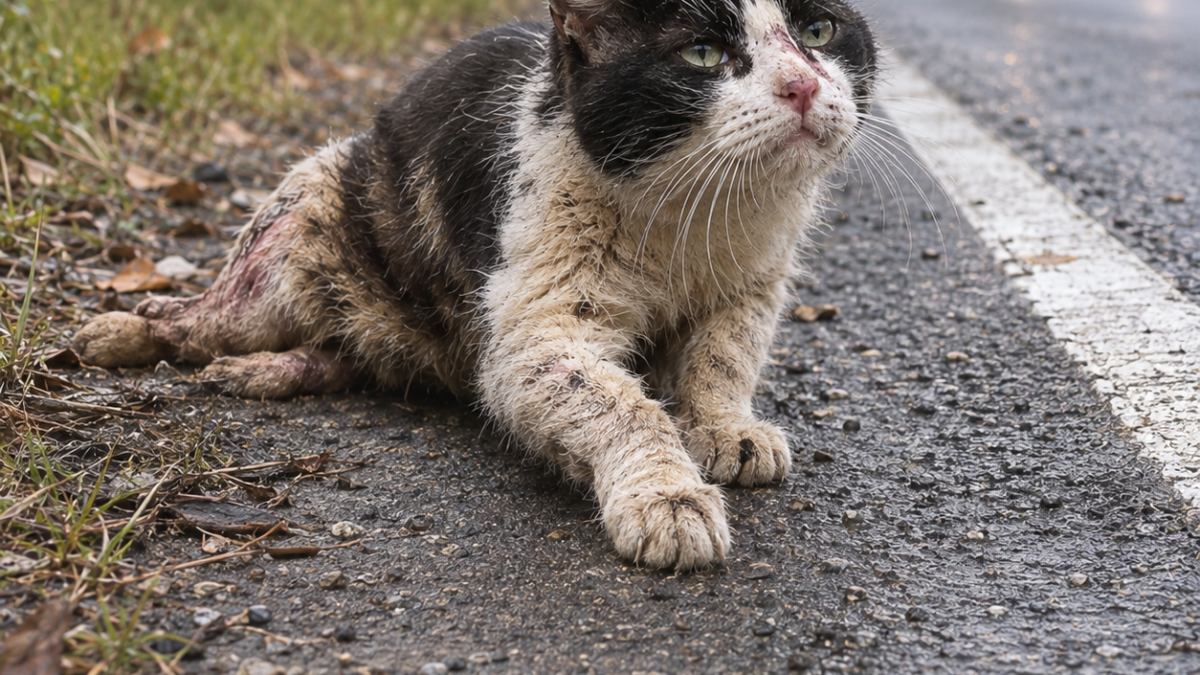
A Paralyzed Cat Dragged Himself Nearly Six Miles Down a Lonely Highway—Then a Sheriff’s Deputy Discovered He Was Following the Car That Took His Kittens
They left the paralyzed black-and-white cat beside a highway rest area with a plastic bowl, believing an animal that couldn’t use his back legs could never follow them.
But instead of crawling toward food, water, or safety, he pulled himself nearly six miles down Route 17—always south, always in the exact direction the car had gone.
By the time a sheriff’s deputy discovered why he refused to stop, the question was no longer how that broken cat had survived the journey—it was what he believed was waiting for him at the end of it.
The first person who saw him thought he was torn fabric moving in the wind.
Heather Nolan was driving home on a gray March afternoon when something in the highway median moved strangely.
She slowed.
The truck behind her honked.
Heather ignored it.
Whatever was ahead reached forward.
Stopped.
Then dragged itself several inches.
She pulled onto the shoulder.
Hazard lights blinking.
Only when she stepped from the SUV did she understand.
It was a cat.
Black face.
White chest.
One frightened eye fixed on the road ahead.
His front legs still worked.
His back legs did not.
Yet he kept moving.
Reach.
Pull.
Rest.
Reach again.
And always south.
“Oh my God.”
Heather approached slowly.
The cat barely looked at her.
Cars passed.
He ignored them too.
There was water in Heather’s SUV.
Food.
A warm blanket.
None of it mattered.
PART2:
The moment she placed herself between him and the road, the cat tried to pull around her.
“Sweetheart, where are you going?”
He obviously couldn’t answer.
But his body did.
South.
Only south.
Heather called 911.
A sheriff’s deputy arrived first.
Deputy Aaron Cole had handled injured animals before.
He expected fear.
Maybe aggression.
Instead, the cat allowed Aaron to slide a blanket beneath him.
Then immediately began clawing forward again.
Trying to leave the blanket.
Trying to continue.
Aaron looked down the highway.
“What’s down there?”
Heather shook her head.
“I don’t know.”
They took him to an emergency veterinary clinic.
X-rays gave them the first piece.
An older spinal injury had left his rear legs without useful movement.
This hadn’t happened on the highway.
He had been living that way.
The veterinarian estimated the cat had traveled miles using only his front legs.
Someone checked reports from nearby rest areas.
That was when Aaron found the security footage.
A sedan had stopped earlier that morning.
Two people got out.
They placed the cat in the grass.
Beside him went a plastic bowl.
Then something else happened.
Before the sedan left, one passenger carried a cardboard pet carrier from the vehicle.
Aaron enlarged the footage.
Inside were tiny shapes moving behind the openings.
Kittens.
The cat lifted his head the moment the carrier passed.
He struggled toward it.
The people put the carrier back into the sedan.
Then drove away.
South.
Aaron watched the footage three times.
The veterinarian stood beside him.
Heather was there too.
Nobody said anything for several seconds.
Then Heather whispered,
“He wasn’t trying to get home.”
Aaron looked at the frozen image.
The cat’s front legs were stretched toward the disappearing sedan.
“No.”
“He was following them.”
Aaron nodded.
The cat, now sedated lightly for pain, lay in a padded kennel a few feet away.
Someone had given him a temporary name during intake.
Miles.
Because they had found him after a journey nobody could quite understand.
Heather hated the name at first.
“It sounds like a joke.”
The technician shook her head.
“It isn’t.”
Then she looked toward the kennel.
“He earned it.”
Miles had wounds along his rear legs from dragging them across rough pavement.
His paw pads were torn.
His chest was scraped.
His front shoulders were inflamed from carrying nearly all his weight.
He was dehydrated.
Hungry.
Exhausted.
Yet every time the clinic door opened and a car passed outside, his head came up.
Listening.
Waiting.
Aaron noticed.
That bothered him more than anything.
The cat was no longer on the road.
No longer in immediate danger.
But whatever mattered to him was still somewhere south.
Aaron returned to the sheriff’s office.
The sedan’s license plate was partially visible on the rest-area camera.
Not enough for an immediate match.
He checked highway cameras.
Gas stations.
A convenience store two miles south.
Then another.
The same sedan appeared in one frame.
Eleven minutes after leaving the rest area.
Still heading south.
Aaron paused the image.
There was something visible through the rear window.
A cardboard carrier.
He called dispatch.
“Run the partial.”
While they worked, Heather stayed at the clinic.
She did not know why.
Miles technically belonged to nobody now.
The people who abandoned him had made that clear.
But leaving felt wrong.
So she sat beside the kennel.
He did not look at her much.
Mostly, he stared toward the door.
At one point, Heather placed a shallow dish of food inside.
Miles sniffed it.
Then looked away.
“You have to eat.”
Nothing.
She moved the food closer.
He took one bite.
Then another.
Then stopped and raised his head toward a sound outside.
A car door.
Heather’s throat tightened.
“They’re not coming back.”
Miles kept listening.
She did not know whether cats understood sentences.
But she regretted saying it.
Because she wasn’t sure.
Maybe someone would come back.
Maybe Aaron would find them.
Maybe the kittens were still alive.
That question became worse the longer she sat there.
How old were they?
Were they nursing?
Were they sick?
Why would anyone abandon the adult and keep the kittens?
The veterinarian, Dr. Elena Morris, had an idea.
“Could be money.”
Heather looked at her.
“What?”
“Kittens are easier to place.”
“Sell?”
“Maybe. Give away. Dump somewhere else. We don’t know.”
She pointed toward Miles.
“But if he was injured and needed lifelong care…”
Heather understood.
“He was the inconvenient one.”
Elena said nothing.
That silence answered enough.
An hour later Aaron called.
They had a plate.
The sedan belonged to a woman named Denise Harper.
Address twenty-three miles south of the rest area.
Aaron did not rush there with sirens.
Abandonment was serious.
But he still needed facts.
He brought another deputy.
Animal control met them nearby.
They arrived at a small rental house on the edge of town.
The sedan was in the driveway.
Aaron immediately noticed cardboard scraps beside the trash bin.
One piece had round ventilation holes.
Animal control officer Kelly Monroe noticed too.
Aaron knocked.
A man opened the door.
Late forties.
Work shirt.
Suspicious expression.
“Can I help you?”
Aaron introduced himself.
Asked for Denise Harper.
“She’s my sister.”
“Is she home?”
“No.”
“Were you with her at the Route 17 rest area this morning?”
The man’s face changed.
Not much.
Enough.
“No.”
Aaron held up a still image from the surveillance camera.
The man stared.
“That’s not clear.”
“Is that your sister’s car?”
Silence.
Animal control heard something behind the house.
Tiny.
High-pitched.
A kitten crying.
The man looked over his shoulder.
Aaron heard it too.
Then another cry.
Kelly stepped forward.
“Sir, are there animals inside?”
The man folded his arms.
“Cats.”
“How many?”
“I don’t know.”
“You don’t know how many cats are in the house?”
“They’re not mine.”
Aaron asked,
“Did they come from the carrier in this photograph?”
The man’s jaw tightened.
“I need a lawyer?”
“That’s your decision.”
Aaron stayed calm.
“We are investigating an injured cat left beside Route 17. We have video showing your sister’s vehicle, two adults, and a carrier containing kittens.”
Another kitten cried.
Then louder.
The man looked toward the hallway.
Finally:
“They were supposed to go to somebody.”
“Who?”
“A woman Denise found online.”
“Where?”
“She backed out.”
“So where are the kittens now?”
The man did not answer.
Kelly said,
“If the kittens require medical care, every minute matters.”
That did it.
The man stepped aside.
“Back room.”
There were four kittens.
Not newborns.
About seven weeks old.
Black-and-white.
All four.
One had a white chin.
Another had a black patch over the left eye.
A third was mostly white with a black tail.
The fourth looked so much like Miles that Aaron stopped in the doorway.
Same mask.
Same white chest.
Same uneven black mark near the nose.
The kittens were inside a laundry basket lined with towels.
No mother cat.
No food except a dish of cow’s milk.
One kitten had diarrhea.
Another had crusting around the eyes.
Kelly immediately called for veterinary transport.
Aaron looked at the man.
“Where’s their mother?”
“She died.”
“How?”
“I don’t know.”
“Who owned the paralyzed adult cat?”
The man exhaled.
“Nobody owned him.”
“That’s not what the video suggests.”
“He lived behind Denise’s apartment.”
“For how long?”
“Maybe a year.”
“Was he injured when he showed up?”
“No.”
That changed everything.
Aaron looked at him.
“What happened?”
The man rubbed his face.
“Car.”
“When?”
“Last summer.”
“Did you take him to a veterinarian?”
“No.”
“Did anybody?”
“No.”
The room became very quiet.
“He got hit in the parking lot,” the man continued. “After that his back legs didn’t work right.”
Aaron stared at him.
“And he survived like that for months?”
“People fed him.”
“Outside?”
“Yes.”
“What about the kittens?”
“There was a female cat.”
“His mate?”
The man shrugged.
“They stayed together.”
Aaron did not like assigning human relationships to animals without evidence.
But he understood the picture now.
Two outdoor cats.
One male left paralyzed after being struck.
A female.
Then kittens.
Someone fed them just enough that they survived.
Then something happened to the mother.
The kittens became valuable or inconvenient depending on who looked at them.
And Miles became the part nobody wanted.
“What happened to the female?”
The man’s eyes dropped.
“She disappeared.”
“Disappeared?”
“We found her near the dumpsters.”
“Dead?”
“Yes.”
“When?”
“Three days ago.”
Aaron looked toward the kittens.
Then back at him.
“And after she died, your sister decided to move the kittens?”
“She said someone wanted them.”
“And Miles?”
The man said nothing.
Aaron already knew.
The man eventually whispered:
“He wouldn’t leave the carrier alone.”
“What does that mean?”
“He kept crawling after it.”
Every word from there made the highway footage worse.
When Denise and her brother put the kittens into the cardboard carrier, Miles had dragged himself across the apartment courtyard after them.
He cried.
Scratched at the carrier.
Tried to climb toward it.
Denise worried he would scare away whoever wanted the kittens.
So they put him in the sedan too.
Not because they planned to help him.
Because he would not stop following.
They drove south.
The potential adopter canceled during the trip.
Denise did not want to drive back with the paralyzed cat.
So they stopped at the rest area.
Left Miles beside the grass.
Put down a bowl.
Then continued south with the kittens.
The brother insisted they believed somebody would find him.
Aaron thought of Miles crawling away from the bowl.
They had been right about one thing.
Somebody did find him.
Just six miles farther down the road than anyone thought possible.
The kittens were taken to the same clinic.
Heather was there when the carrier arrived.
Miles heard them before anyone opened the door.
The change in him was instant.
He had been lying flat.
Head down.
Almost asleep.
Then one kitten cried from the hallway.
Miles lifted his head.
His ears stood.
He answered.
A strange low sound.
Not quite a meow.
Not quite a chirp.
The kittens cried again.
Miles began pulling himself forward inside the kennel.
Heather stood.
“Oh my God.”
Elena ran over.
“Wait.”
They needed to control the introduction.
Miles was injured.
Exhausted.
The kittens needed examination.
But the sounds had already changed everything.
Miles clawed at the bedding.
Front legs working.
Rear legs useless behind him.
The same movement Heather had seen on Route 17.
Reach.
Pull.
Reach.
Only now there was nowhere to go.
Elena knelt.
“Miles.”
He ignored her.
Another cry.
He answered immediately.
Heather covered her mouth.
“He knew.”
Aaron arrived a few minutes later.
He stood at the door and watched.
The kittens had been examined.
Dehydrated.
Fleas.
Parasites likely.
One respiratory infection.
Nothing immediately life-threatening.
Elena brought the healthiest kitten first.
The one with the matching black mark near the nose.
She held the kitten against a towel.
Miles smelled him.
His entire body seemed to soften.
He began licking the kitten’s head.
Fast.
Over and over.
The kitten pressed into his chest.
Then started kneading.
Heather cried.
Aaron looked away.
Not because he did not want to see.
Because he did.
Too much.
They introduced the other three one at a time.
Miles groomed each.
One climbed onto his front leg.
Another tucked against his shoulder.
The smallest crawled beneath his chin.
He stopped trying to move.
For the first time since Heather found him beside the highway, Miles rested.
Completely.
He closed his eyes.
That was when Aaron understood the six miles.
Miles had not been following a car.
Not really.
He had been following sounds.
Smells.
Memory.
The last place he saw the kittens go.
The only direction available.
South.
Aaron later checked the odometer distance from the rest area to where Heather found him.
5.8 miles.
The veterinarian said the journey should have been impossible.
Not literally impossible.
But close enough.
Miles had dragged his body over pavement shoulder, gravel, dead grass, drainage edges, and roadside debris.
Using only his front legs.
He had crossed at least two entrance ramps.
One shallow ditch.
A service road.
His rear legs had developed fresh abrasions from the journey.
At any point he could have been hit.
He could have collapsed from dehydration.
He could have crawled the wrong direction.
He did not.
Always south.
Heather sat beside him that evening.
The four kittens slept in a heated enclosure nearby.
Miles had finally eaten an entire small meal.
He looked exhausted.
“You found them.”
His ears moved.
Heather touched his head.
“You actually found them.”
Technically Aaron had.
Technically cameras had.
Technically animal control had.
But Heather could not shake the feeling that Miles had done the first and most important thing.
He had refused to let the trail disappear.
The legal case moved separately.
Aaron documented the abandonment.
Animal control documented the prolonged lack of treatment for Miles’s spinal injury and the kittens’ condition.
Denise eventually gave a statement through an attorney.
She said she had been overwhelmed.
The outdoor cats were never formally hers.
The apartment complex had complained about feeding strays.
She had tried to find homes for the kittens.
When the adopter canceled, she panicked.
She admitted leaving Miles at the rest area.
She claimed she believed the food and water made it humane.
Aaron did not argue with her.
The evidence would speak for itself.
Miles did not care about any of it.
His world had shrunk to four kittens and a clinic room.
For several days, they kept him close to them.
Not together constantly.
He needed rest.
The kittens needed isolation for treatment at first.
But whenever they were separated, Miles became restless.
Whenever they returned, he settled.
Elena became curious about one thing.
Was Miles actually their biological father?
Cats do not form father-child relationships the way humans imagine.
Male cats can ignore kittens.
Some can even be dangerous around them.
But Miles’s behavior was unusually protective.
The rescue eventually ran genetic testing through a veterinary lab because Aaron’s case required clarification about the animals’ history.
The result surprised nobody by then.
Miles was the father of all four kittens.
That fact became less important than everyone expected.
Because biology did not explain six miles.
Plenty of biological fathers would not do what Miles did.
What mattered was that these kittens were part of his social world.
He knew them.
They knew him.
And after their mother disappeared, Miles had remained with them.
The apartment residents later told Aaron that the kittens often slept around Miles’s body.
He could not chase them.
Could not climb.
Could barely move his rear half.
But he groomed them.
Allowed them to climb over him.
Sometimes dragged himself toward the feeding area when they cried.
One resident had taken a photograph two weeks before the abandonment.
Miles lay beneath a patio chair.
Four kittens slept against his stomach.
Their mother sat nearby.
Aaron printed the picture.
He brought it to Heather.
She stared for a long time.
“This is why.”
“Yes.”
The mother was gone.
Then the kittens were taken.
Miles had lost everything in three days.
So he followed the only thing left.
The clinic began discussing his long-term future.
That was harder.
Miles was not merely injured.
His paralysis was old.
The spinal damage had healed in the wrong way months earlier.
Surgery could not simply restore normal function.
He still had sensation in parts of his rear limbs, but useful voluntary control was minimal.
Elena was careful.
“He may never walk normally.”
Heather looked at Miles.
“Can he have a good life?”
“Yes.”
That answer came quickly.
“But it will require work.”
Bladder monitoring.
Skin protection.
Weight management.
Physical therapy.
Possibly a mobility cart.
Safe flooring.
Regular checks for sores.
Someone willing to understand that paralyzed did not mean miserable.
Heather asked:
“What about the kittens?”
“They’ll be adoptable once healthy.”
“Together?”
Elena smiled sadly.
“Probably not all five.”
Heather knew.
Finding one home for a special-needs adult cat and four kittens together would be nearly impossible.
Still, she hated the thought.
Miles had nearly died trying not to lose them.
Now rescuers would deliberately separate them.
Aaron asked the same question.
Elena explained carefully.
“The goal isn’t to preserve a human version of family at any cost. The goal is good homes.”
The kittens would become independent.
They were already weaning.
Miles could stay connected during recovery.
Then each animal needed the home best suited for them.
Aaron understood.
Heather understood too.
Miles had more difficulty.
The first kitten left three weeks later.
A couple adopted the mostly white female.
They named her June.
Heather expected Miles to become frantic.
Instead, he sniffed the blanket where June had slept.
Called once.
Then settled near the remaining three.
The second adoption happened five days later.
Then the third.
The final kitten was the little male who looked exactly like Miles.
Black mask.
White chest.
Mark beside the nose.
The rescue called him Scout.
Scout had become especially attached to Miles.
He slept across Miles’s shoulders.
Groomed his ears.
Attacked his tail even though Miles rarely moved it.
When potential adopters came, Scout hid behind Miles’s body.
Heather began hoping nobody would choose him.
She knew that was selfish.
Then a family came specifically asking about Scout.
Good home.
Indoor-only.
Two adults.
Older child.
Experience with cats.
Everything rescue workers wanted.
Heather watched Scout meet them.
He warmed up quickly.
Then returned to Miles.
Heather went into the hallway and cried.
Aaron happened to be visiting.
“You okay?”
“No.”
“Good answer.”
She wiped her face.
“He dragged himself six miles for them.”
Aaron nodded.
“And now we’re taking the last one.”
“We’re giving him a home.”
“I know.”
“Doesn’t mean it doesn’t hurt.”
Scout left that Saturday.
Before he went, the family sat beside Miles.
The daughter, twelve years old, stroked his forehead.
“We’ll take care of him.”
Heather nearly lost it again.
Miles sniffed Scout through the carrier door.
Scout reached one paw through.
Touched Miles’s nose.
Then the carrier left.
Miles called twice.
After that, silence.
That night he did not eat much.
The next morning, he did.
Two days later, he began showing interest in the window.
Life moved forward.
Heather had become part of that life by then.
Almost accidentally.
She visited every day.
Then twice a day.
She learned how to change Miles’s bedding.
How to check his rear paws.
How to support his hips during therapy.
How to express his bladder if needed.
How to lift him without twisting his spine.
Elena noticed.
“You know where this is going.”
Heather pretended not to.
“Where?”
“You.”
“No.”
“You.”
“I have two dogs.”
“They’re cat-friendly.”
“One is seventy pounds.”
“And terrified of kittens.”
Heather crossed her arms.
“I travel for work.”
“Your sister lives ten minutes away.”
“You’ve been gathering evidence against me.”
Elena smiled.
“I learned from Aaron.”
Heather looked through the glass.
Miles was watching a technician prepare food.
“Do you think he could live with dogs?”
“With proper introductions.”
“Stairs?”
“Block them.”
“Hardwood?”
“Rugs.”
“Workdays?”
“He sleeps eighteen hours.”
“He needs special care.”
“Yes.”
Heather sighed.
Elena stopped smiling.
“You don’t have to adopt him because you found him.”
“I know.”
“Do not turn guilt into a fifteen-year commitment.”
Heather looked at her.
“I’m not guilty.”
“Then what are you?”
She did not answer.
That evening, Heather brought Miles home for a foster trial.
The first thing he did was drag himself off the blanket and toward the hallway.
Heather panicked.
“Wait.”
Miles ignored her.
One dog appeared at the far end.
Daisy.
A thirteen-year-old Labrador mix.
Daisy froze.
Miles froze.
Heather held her breath.
Daisy walked forward slowly.
Sniffed Miles.
Miles hissed.
Daisy jumped backward so fast she nearly fell.
Heather laughed.
“Good. Establish boundaries.”
The second dog, Cooper, refused to enter the room for twenty minutes.
Miles apparently seemed terrifying.
Within a week, Daisy slept beside him.
Cooper gave him unnecessary distance.
Miles learned the house.
Rugs became highways.
Heather placed runners over slippery floors so his front legs could grip.
His food stayed in one place.
Water another.
Low-sided litter setup nearby.
He could not use a normal box easily, so Heather experimented until she found what worked.
The first mobility cart arrived a month later.
Miles hated it.
Violently.
He twisted.
Grabbed the harness.
Refused to move.
Heather looked at the physical therapist.
“Well.”
“Give him time.”
Second attempt:
He stood in the cart for seven seconds.
Then bit the strap.
Third:
Twenty seconds.
Fourth:
One step.
Then another.
Three weeks later, Miles discovered speed.
Heather stood in the driveway holding a treat.
Miles moved toward her in the cart.
Front paws running.
Rear wheels turning.
Then Daisy passed.
Miles changed direction.
Chased her.
Daisy looked over her shoulder with absolute betrayal.
Heather laughed until she had to sit down.
The cat who once dragged himself inch by inch along Route 17 now raced across a driveway on two paws and two wheels.
Aaron came to watch one afternoon.
Miles rolled toward the patrol car.
Aaron crouched.
“You trying the highway again?”
Miles sniffed his hand.
“No chance.”
Heather smiled.
She had officially adopted him three days earlier.
Aaron knew.
He brought something.
A small envelope.
Inside were photographs of all four kittens in their new homes.
June asleep on a child’s pillow.
Otis sitting in a window.
Mabel stretched across a couch.
Scout wearing a ridiculous blue bow tie.
Heather placed the pictures near Miles.
He sniffed them.
Obviously photographs meant nothing to him.
But they meant something to her.
“They’re okay.”
Miles started grooming his front paw.
Heather laughed.
“Fine. Be emotionally unavailable.”
Aaron sat on the porch.
The case against Denise and her brother had resolved through animal-cruelty and abandonment proceedings.
There were fines.
Probation conditions.
Restrictions on possessing animals.
The exact penalties mattered less to Heather than the outcome that came before them.
Miles and the kittens were safe.
Still, Aaron carried one question.
“Do you think he actually followed the sedan?”
Heather looked at Miles.
“What else would he have been doing?”
“I mean how?”
“Smell?”
“Six miles?”
“Sound?”
“Not after the car got that far.”
Aaron nodded.
“Maybe he just kept going in the direction he last saw them.”
Heather looked toward Route 17, invisible beyond the trees.
“Isn’t that what following is?”
Aaron thought about it.
Maybe.
Months passed.
Miles’s shoulders grew stronger.
His dragging sores healed.
His coat became glossy.
The mobility cart was used outdoors.
Inside, he preferred pulling himself.
Heather worried until Elena explained that as long as his skin was protected and surfaces were safe, Miles should choose how he moved.
Choice mattered.
Miles had lived too long without enough of it.
The rescue group posted his story online.
People called him heroic.
Supercat.
Miracle dad.
Heather disliked some of the language.
Miles had not chosen paralysis.
He had not chosen suffering.
He had simply responded to the world available to him.
Still, one thing about the story stayed with everyone.
The bowl.
Security footage showed it clearly.
Denise had placed food and water beside Miles.
If his goal had been immediate survival, he should have stayed.
He was exhausted.
Hungry.
Dehydrated.
Instead, the moment the kittens disappeared south, he pulled himself away from food.
That choice was impossible to explain without emotion.
Maybe instinct.
Maybe social attachment.
Maybe distress.
Maybe something humans would call love because they did not have a better word.
Heather did not need to name it.
Miles knew something important was leaving.
So he followed.
A year after the highway, Aaron drove to Heather’s house.
Not official.
No uniform.
He brought Scout’s family.
They had kept in touch with the rescue.
Scout was now a large, healthy young cat.
Still black-and-white.
Still carrying Miles’s face.
Heather opened the carrier inside the living room.
Scout stepped out cautiously.
Miles was sleeping near the window.
Scout sniffed.
Stopped.
His body became alert.
Miles lifted his head.
For a second, Heather expected nothing.
Too much time had passed.
Cats rely heavily on scent.
Scout smelled different.
Older.
Different home.
Different food.
Different people.
Miles smelled different too.
Clean.
Healthy.
Indoor life.
Then Scout approached.
Slowly.
Miles sniffed him.
Once.
Twice.
Scout touched his nose to Miles’s forehead.
Miles began grooming the top of Scout’s head.
Heather sat down immediately because her knees stopped feeling useful.
Scout’s family smiled.
Aaron looked at the ceiling.
“Don’t start,” Heather warned.
“I’m not doing anything.”
“You’re doing the thing with your face.”
“What thing?”
“The sheriff face where you pretend emotions are illegal.”
Scout curled beside Miles for nearly an hour.
Not exactly like the kitten photographs.
But close enough.
Then they separated.
Scout explored.
Miles ate.
Daisy stole Scout’s toy.
Normal things.
That was what Heather liked most.
The reunion did not need to prove some magical memory.
It was simply two cats sharing a safe room after once sharing a life nobody had protected properly.
That was enough.
Route 17 changed for Heather too.
For months she avoided the section where she found Miles.
Then one afternoon she deliberately drove it.
The median looked ordinary.
Cars.
Weeds.
Guardrail.
No marker where Miles had crawled.
No sign that anything extraordinary had happened there.
She pulled into the rest area.
The same security camera still hung above the building.
The grassy area where Miles had been abandoned looked smaller than she remembered.
A family was eating sandwiches at a picnic table.
Truckers came and went.
Heather stood near the spot.
She imagined Miles there.
Plastic bowl.
Rear legs useless.
Watching the sedan disappear.
He could have stayed.
Nobody would have blamed him.
He could have eaten.
Drunk.
Hidden.
Waited.
Instead:
Reach.
Pull.
Rest.
Reach.
Five point eight miles.
Heather returned home.
Miles was asleep beside Daisy.
His cart leaned against the wall.
She sat on the floor near him.
He opened one eye.
“You know everybody thinks you’re incredible.”
Miles yawned.
“I’m serious.”
He stretched one front paw.
“You nearly killed yourself.”
He closed his eye again.
Heather scratched beneath his chin.
“You stubborn little idiot.”
Miles began purring.
Another year passed.
Then another.
Miles became older.
Not old yet.
But mature.
His life developed routines so ordinary that sometimes Heather forgot how they met.
Breakfast at six.
Window after breakfast.
Nap.
Patio in the mobility cart if weather was warm.
Daisy eventually died at fifteen.
Miles searched for her for three days.
He checked her bed.
The hallway.
The patio door.
Heather understood that kind of searching now.
She did not try to distract him constantly.
Loss needed room.
Cooper became braver around Miles after Daisy was gone.
Eventually they slept close enough for their paws to touch.
Heather fostered special-needs cats.
Not many.
One at a time.
Miles tolerated them.
Mostly.
A young paralyzed tabby named Felix arrived one winter.
Felix had no idea how to move efficiently with his front legs.
He panicked when his rear half failed to follow.
Heather placed him on a rug near Miles.
Miles ignored him.
Felix watched.
Miles pulled himself toward the water bowl.
Front paws.
Shoulders.
Body sliding safely across the rug.
Felix tried.
Failed.
Tried again.
Within days, he copied the motion.
Heather knew she was anthropomorphizing when she called Miles his teacher.
She did it anyway.
Aaron stayed part of their lives.
Every March, he texted:
MILES DAY.
Heather always answered:
YOU MEAN THE DAY I FOUND HIM.
Aaron:
I FOUND THE KITTENS.
Heather:
BECAUSE HE GAVE YOU DIRECTIONS.
Aaron:
HE IS A CAT.
Heather:
AND YET.
The kittens remained connected through photos.
June became enormous.
Mabel developed an obsession with sinks.
Otis learned to open cabinet doors.
Scout remained the one who most resembled Miles.
Once a year, when schedules allowed, Scout visited.
The first reunion had been emotional.
Later ones became casual.
Scout arrived.
Sniffed.
Sometimes groomed Miles.
Sometimes ignored him completely and stole his bed.
Family.
In the most catlike way possible.
One evening, years after the highway, Heather found Miles sitting in his cart near the front window.
A car had stopped outside.
Scout’s family.
Miles could not see them clearly through the reflection.
But he heard the engine.
His head turned.
Heather opened the door.
Scout’s carrier came inside.
Miles rolled forward.
No dragging.
No bleeding paws.
No highway.
No bowl abandoned in grass.
Just wheels clicking gently over the hardwood.
Heather thought about the first question she asked him.
“Sweetheart, where are you going?”
Back then, she did not know.
Now she did.
He had been going toward the only family he believed he had left.
He did not know they were twenty-three miles away.
Did not know what a highway was.
Did not know six miles was impossible for a paralyzed cat.
He only knew the car went south.
So he went south too.
Years later, when people asked Heather what she remembered most, they expected her to say the injuries.
The blood.
The raw back legs.
The distance.
Sometimes the kittens.
Instead, she always remembered Miles’s face when she tried to block him from the road.
He had not looked grateful.
He had looked frustrated.
There was somewhere he needed to be.
Heather had thought she was rescuing him by stopping the journey.
In a way, she had.
But Aaron later finished what Miles started.
He followed the road.
Then the camera footage.
Then the sedan.
Then the cries behind a stranger’s door.
And because one broken cat refused to stop moving south, four kittens were found before sickness and neglect became something worse.
The people who abandoned Miles believed paralysis had solved their problem.
A cat who could not walk could not follow.
They were wrong.
Miles did not need four working legs.
He needed two.
He did not need to know the destination.
Only the direction.
He did not need anyone to understand what he was doing.
Only someone to notice.
Heather noticed.
Aaron listened.
The clinic believed the movement in his front legs was worth protecting.
And eventually Miles reached the kittens he had been trying to follow.
Not by crawling all twenty-three miles himself.
He did something more important.
He made people ask why he refused to stop.
That question led the rest of the way.
Today, the old highway footage still exists in Aaron’s case archive.
A grainy sedan.
A rest-area camera.
Two people.
A cardboard carrier.
A paralyzed cat in the grass.
The bowl placed beside him.
Then the car leaving.
And Miles lifting his head.
Beginning to crawl.
If you watch only those first few seconds, the footage looks like an abandonment.
It was.
But keep watching.
The people disappear.
The car gets smaller.
Miles pulls himself forward.
Once.
Again.
Again.
And suddenly the video becomes something else.
Not a story about where someone left him.
A story about where he decided to go.
South.
Toward the kittens.
Toward the last thing he still recognized as his.
Toward a family he had no reason to believe he would ever reach.
Five point eight miles later, Heather Nolan finally stopped him.
At the time, she thought she was ending his journey.
She was not.
She was simply the first person who agreed to help him finish it.




