𝗙𝗨𝗟𝗟 𝗦𝗧𝗢𝗥𝗬 When I Opened the Dead Man’s Coat, Something Underneath His Arms Was Still Breathing
𝗙𝗨𝗟𝗟 𝗦𝗧𝗢𝗥𝗬
The officer said, “Maintenance guy found him about twenty minutes ago.”
I looked around.
“Anyone know who he is?”
“No ID yet.”
I examined his clothing.
Old jeans.
Thin shoes.
Layers, but not nearly enough.
His coat was large, though.
Heavy-looking.
I thought for one irrational second that perhaps he had had a better chance than most.
Then I noticed how strangely the front of it sat.
Bulky.
Uneven.
As though something had been tucked inside.
“Laura?”
Nate had seen me looking.
“There’s something under his coat.”
The officer took one step closer.
“A bag?”
“I don’t know.”
I reached for the zipper.
It would not move.
Frozen.
I pulled the fabric aside instead.
The man’s shirt underneath was open.
That immediately seemed wrong.
In that cold, every instinct should have told him to close everything.
Zip the coat.
Button the shirt.
Trap whatever heat remained.
Instead, his chest had been exposed.
His arms were curved inward around something small.
At first, my brain did not understand the shape.
Then it moved.
Barely.
I froze.
“Nate.”
“What?”
“Wait.”
I leaned closer.
There.
A tiny shiver.
Then another.
“Oh my God.”
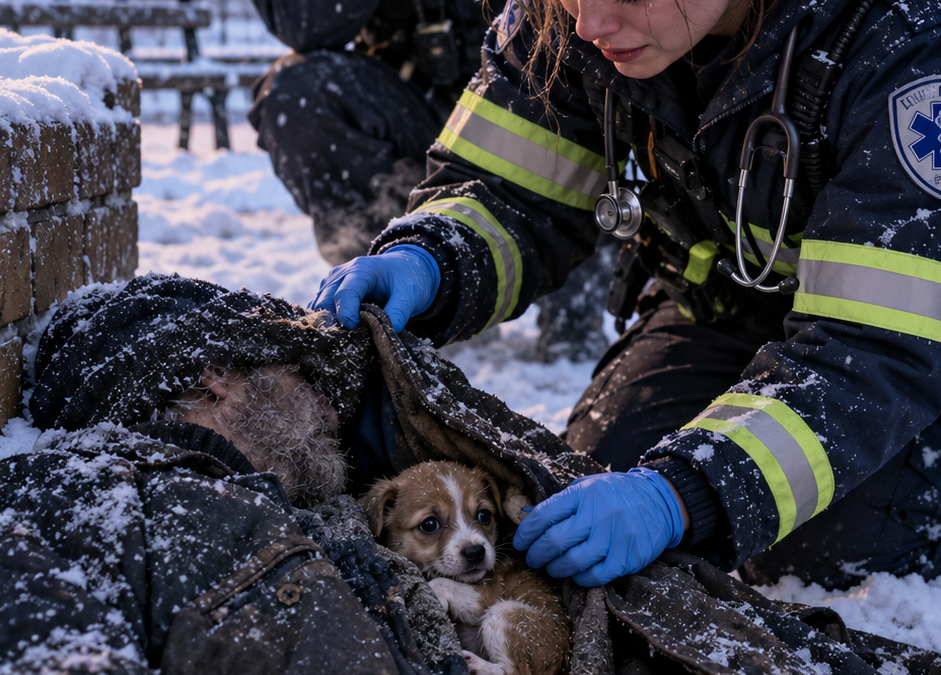
I pushed the coat open.
A small dog was pressed directly against the man’s chest.
The animal was so tightly tucked beneath his arms that I almost could not separate them.
Brown fur.
Maybe tan.
I couldn’t tell because frost and moisture had darkened it.
The dog’s nose was hidden against the man’s skin.
One ear was folded.
Its whole body trembled in tiny, rapid movements.
Alive.
“Get the thermal blanket.”
Nate was already moving.
I slid my hands beneath the dog.
For one second, it resisted.
Not by biting.
By pressing itself harder against the dead man’s chest.
That nearly stopped me.
“Hey.”
My voice changed automatically.
Soft.
“It’s okay.”
The dog opened its eyes.
They were dark brown.
Alert despite everything.
Terrified.
I touched its side.
Its body felt dangerously cold.
But not frozen.
Not yet.
“You need to come with me.”
The little animal tried to burrow deeper beneath the man’s arm.
I had to gently uncurl his stiff fingers from the dog’s back.
That was when I understood the position.
His hands had not fallen there after death.
He had put them there.
Deliberately.
One arm beneath.
One across.
His shirt open so the dog could lie directly against the warmest part of his body.
His own chest.
I swallowed.
“Laura.”
Nate was beside me with the blanket.
“I’ve got her.”
The dog weighed almost nothing.
Five pounds.
Maybe six.
I lifted her free.
The moment she left the man’s body, she made a tiny sound.
Not a bark.
A broken little whimper.
Then she twisted in my hands, trying to look back at him.
“I know.”
I wrapped her immediately.
“We’ve got you.”
Her teeth began chattering.
That was good.
Shivering meant her body was still fighting.
Nate opened the ambulance.
I carried her inside.
The officer called after us.
“What about him?”
I looked back.
The man lay exactly as we had found him.
Coat open now.
Chest exposed.
Arms empty.
For some reason, without the dog beneath them, his position looked unbearable.
“I’ll be back.”
Inside the ambulance, I turned the heat up.
We had no animal-specific monitoring equipment, but basic physiology is basic physiology.
Cold kills small bodies quickly.
I checked her gums.
Pale.
Breathing shallow.
Heart fast.
Extremities cold.
No obvious major injuries.
I wrapped her in another blanket and held her against me.
“Come on.”
The dog looked up.
One eye seemed slightly swollen.
“You survived this long.”
Her whole body trembled.
I rubbed gently.
“Stay with me.”
Nate called a nearby emergency veterinary hospital.
While he spoke, the dog shifted.
Her nose pressed against my jacket.
Then she crawled upward until her face rested near my collarbone.
Instinct.
Heat.
Heart.
It took me a second to understand why the position felt so familiar.
That was how she had been lying against him.
Directly over his chest.
I looked down at her.
“Oh.”
Something tightened in my throat.
The dog sighed.
Not relaxed.
Exhausted.
I held her closer.
Nate finished the call.
“They’ll take her.”
“Good.”
“You okay?”
“Yes.”
I answered too quickly.
He looked toward the park.
“Hell of a thing.”
I did not respond.
Because at that moment, I was not thinking about the dog.
I was thinking about the open shirt.
Human beings do remarkable things when cold becomes extreme.
The body sacrifices what it can.
Blood pulls inward.
Hands lose warmth.
Feet lose warmth.
Skin loses warmth.
Everything tries to protect the core.
Heart.
Lungs.
Brain.
It is not courage.
It is biology.
Survival becomes selfish because it has to.
Yet this man had done something opposite.
He had opened himself.
Literally.
Placed the dog against his skin.
Wrapped his arms around her.
Given away the very heat his body was trying to keep.
I looked down at the small creature pressed against my chest.
“What did he do for you?”
She trembled.
Of course she couldn’t answer.
I returned to the body after the veterinary team took the dog.
They placed her in a warmed oxygen enclosure and began controlled rewarming.
The doctor said she was severely hypothermic but responsive.
“Do you think she’ll survive?”
He looked through the glass.
“If nothing else is wrong, yes.”
That should have been enough.
It wasn’t.
I went back to the park because I needed to understand.
The medical examiner’s investigator had arrived.
Police had opened the backpack.
There was almost nothing inside.
A thin sleeping bag.
So thin I would not have trusted it on a fifty-degree night, let alone what we had experienced.
One cracked bottle of water, frozen solid.
Two unopened cans of tuna.
A pair of socks.
A small plastic bag.
I crouched beside it.
“Dog food?”
The officer nodded.
“Almost empty.”
The strange thing was the tuna.
Unopened.
The man had food.
Not much.
But food.
He had not eaten it.
The dog food was almost gone.
I stared.
The officer noticed.
“Yeah.”
“How long had he been out here?”
“No idea.”
“Did anyone recognize him?”
“Not yet.”
“Shelter?”
“We’re checking.”
The investigator handed me a small folded piece of paper.
“This was in the backpack.”
“Why me?”
“Thought you might want to see it.”
The paper looked as though it had been folded and unfolded many times.
The handwriting was shaky.
Pencil.
Three short lines.
Her name is Bailey.
Feed her twice a day.
She is afraid of loud noises.
Nothing else.
No emergency contact.
No address.
No explanation.
No plea for himself.
I read it again.
Her name is Bailey.
Not my name is.
Not if something happens to me.
Not please contact.
Only instructions for the dog.
I looked toward the covered body.
“Did he know?”
The investigator frowned.
“Know what?”
“That he was dying.”
“Maybe.”
I handed the note back.
“No.”
I changed my mind.
“Can I photograph it?”
He nodded.
I did.
I don’t know why.
I think some part of me was afraid the note would disappear with everything else.
That he would be catalogued.
Unknown male.
Approximate age.
Cause of death.
Personal effects.
Case number.
And this one small proof of who he had been at the end would vanish into a file.
Her name is Bailey.
Feed her twice a day.
She is afraid of loud noises.
I went home after my shift but didn’t sleep.
Every time I closed my eyes, I saw his arms.
I had removed them from around Bailey.
That small detail haunted me.
Dead hands protecting a living animal.
I made coffee.
Didn’t drink it.
Sat at the kitchen table until sunrise.
Then I called the veterinary hospital.
“This is Laura Hayes. I brought in the hypothermic dog yesterday.”
“One moment.”
Hold music.
Then the doctor.
“She’s stable.”
I closed my eyes.
“Eating?”
“A little.”
“Temperature?”
“Normal now.”
“Any frostbite?”
“Minor concern on the ears, but I think we caught it early.”
“Can I see her?”
The doctor paused.
“Are you the owner?”
“No.”
Another pause.
“I’m the paramedic who found her.”
His voice softened.
“Come by.”
Bailey was awake when I arrived.
The difference twelve hours of warmth had made was extraordinary.
She still looked fragile.
Thin.
Ribs visible.
But her eyes were clearer.
Her coat, now dry, was caramel brown with white fur along her chest.
She was smaller than I remembered.
Perhaps because the dead man’s coat had made her seem like something hidden and mysterious.
Now she was simply a dog.
A tiny mixed-breed dog with oversized ears.
One ear stood.
The other folded.
When I approached the kennel, Bailey stood.
Her legs shook.
“Hi.”
Her tail moved.
Once.
I stopped breathing.
Then it moved again.
Weakly.
But unmistakably.
The doctor stood beside me.
“She recognizes you.”
“I met her for five minutes.”
“You were warm.”
I looked at him.
He smiled.
“That matters.”
I opened my hand.
Bailey sniffed through the bars.
Then licked one finger.
My eyes burned.
“Her name is Bailey.”
“We heard.”
“There was a note.”
“Yes.”
The doctor’s expression changed.
“He cared about her.”
“That’s one way to say it.”
I told him what I had seen.
The open shirt.
The arms.
The position.
The doctor became quiet.
Finally he said, “That may be why she’s alive.”
“I know.”
“It would have accelerated his own heat loss.”
“I know.”
We stood together.
Bailey sat.
She tilted her head.
“What happens to her?”
“Animal control will handle placement once she’s medically cleared.”
“A shelter?”
“Probably.”
I thought about the man.
Then the note.
She is afraid of loud noises.
Shelters are loud.
“How long until she’s cleared?”
“A few days.”
I nodded.
Then left before I could say something impulsive.
For the next week, I became obsessed with identifying the man.
That was not my job.
I knew that.
The police had procedures.
The medical examiner had procedures.
Missing-person databases existed.
Fingerprints.
Records.
All the machinery built to turn unknown bodies back into people.
Still, I kept asking.
“Anything?”
No.
“Fingerprints?”
Nothing useful.
“Dental?”
Pending.
“Missing-person match?”
None.
“How can no one be looking for him?”
The detective I spoke with gave me a tired look.
“Laura.”
“What?”
“You know the answer.”
I did.
Some people disappear long before they die.
They become invisible gradually.
Address lost.
Phone lost.
Job lost.
Relationships fray.
Documents expire.
Friends stop knowing where to call.
Family stops knowing which city.
Eventually the person still exists physically, but almost nowhere on paper.
That possibility disturbed me more than I expected.
I started asking local shelters.
Not the dog shelters.
Homeless services.
Meal programs.
Churches.
Warming centers.
Most people did not recognize the photograph.
Then I called a shelter downtown.
A woman named Margaret answered.
Not the same Margaret from any other story. Just Margaret.
She had worked nights there for eight years.
I described the man.
Age perhaps late fifties to early sixties.
Gray-brown beard.
Thin.
Dark coat.
Backpack.
Small brown dog.
The dog changed everything.
“Wait.”
Silence.
“A little dog?”
“Yes.”
“Brown?”
“Yes.”
“White chest?”
“Yes.”
The woman inhaled.
“Oh.”
“You know him?”
“I saw him.”
“When?”
“Beginning of winter.”
My pulse accelerated.
“Do you know his name?”
“No.”
The hope collapsed immediately.
“But I remember him.”
“Tell me.”
Margaret was quiet.
“He came in during the first cold snap.”
“For shelter?”
“Yes.”
“Why didn’t he stay?”
Another silence.
“Animals weren’t allowed.”
I closed my eyes.
“He had Bailey.”
“I didn’t know the dog’s name.”
“What happened?”
“We were almost full anyway.”
She sounded defensive.
I understood.
“No one is blaming you.”
“I know.”
Her voice softened.
“I told him we couldn’t take the dog.”
“And?”
“He nodded.”
“That’s all?”
“Yes.”
“He didn’t argue?”
“No.”
“Did you offer another place?”
“I gave him a list.”
“Any that accepted dogs?”
“Not overnight.”
There it was.
A policy.
Simple.
Ordinary.
Probably created for understandable reasons.
Allergies.
Safety.
Space.
Sanitation.
One rule.
A man standing outside in winter with a small dog.
“What did he say?”
Margaret took a breath.
“Nothing.”
“Nothing?”
“He looked down at the dog.”
She paused.
“Then he thanked me and left.”
I stared at my kitchen wall.
“Did you see him again?”
“Yes.”
“A few times.”
“Where?”
“Outside the building.”
“Why?”
“I don’t know.”
Margaret hesitated.
“One morning, one of my staff went out before dawn.”
I waited.
“He was sitting against the wall.”
“With Bailey?”
“We didn’t know her name.”
“Yes.”
“What happened?”
“My employee asked if he was okay.”
“And?”
Margaret’s voice changed.
That was when I knew she remembered the exact moment.
“She said he smiled.”
“What did he say?”
“Just someone who needs me.”
I closed my eyes.
The phrase entered me like cold.
Just someone who needs me.
“That was the dog?”
“Yes.”
“Did he ever come inside after that?”
“No.”
“Never?”
“No.”
“He chose to stay outside?”
“With her.”
I thanked Margaret.
Then sat at my kitchen table for a long time.
People would later call him heroic.
Selfless.
A saint.
I never liked those words.
They make sacrifice sound clean.
Beautiful.
As if noble people exist in a separate category from the rest of us.
I wanted to know the ordinary man.
The one who had been tired.
Hungry.
Afraid.
The one who had probably wanted a warm bed as badly as anyone.
The one who could have surrendered Bailey and entered a shelter.
He didn’t.
Maybe that was love.
Maybe it was dependence.
Maybe Bailey was the only reason he still woke each morning.
Maybe giving her up would have meant giving up the last piece of himself.
I would never know.
What I did know was that he chose the cold over abandoning her.
And on the coldest night, when his body could no longer save them both, he made another choice.
Bailey.
The autopsy report came later.
I should never have become so emotionally involved with a case.
But by then the wall I had built over twelve years was gone.
The report described severe hypothermia.
Malnutrition.
No significant intoxicants.
No major trauma.
The medical examiner noted something unusual about the position of the body and exposure pattern.
The man’s core had been deliberately uncovered.
His arms had remained around the dog.
The conclusion was clinical.
Careful.
It did not say he “gave his life” for her.
Medicine avoids poetry.
But the meaning was clear.
His actions had directed the greatest available body heat toward the animal at the expense of his own thermal protection.
I read the sentence several times.
Then stopped.
Because I already knew.
I had seen his hands.
What I had not known was how weakened he already was.
Poor nutrition.
Weight loss.
Cold stress over time.
His body had little left to give.
He gave it anyway.
Bailey was transferred to an animal shelter after ten days.
I lasted four hours.
At noon, I called.
“Has the little brown dog arrived?”
“Yes.”
“Can I visit?”
“We close at five.”
“I’m coming.”
Nate found out.
“You’re adopting that dog.”
“No.”
“You are.”
“I’m visiting.”
“Sure.”
“I work twelve-hour shifts.”
“You’ll figure it out.”
“I don’t need a dog.”
“No one ever does until they do.”
I ignored him.
The shelter placed Bailey in a quiet kennel away from the loudest dogs because of the note.
She is afraid of loud noises.
The first time I saw her there, she was pressed against the back wall.
The barking overwhelmed her.
Every time a metal bowl hit the floor, her body flinched.
I crouched.
“Bailey.”
Her head lifted.
The moment she saw me, she stood.
Tail.
One wag.
Then another.
She approached the gate.
I put my hand through.
Bailey pushed her face into my palm.
That was the end of my argument with myself.
“I can foster her.”
The shelter coordinator smiled.
“Of course.”
“Temporarily.”
“Of course.”
“I work long shifts.”
“We can help arrange support.”
“Just until a permanent home.”
“Absolutely.”
Her smile told me she had heard this speech before.
I brought Bailey home the next afternoon.
The first thing she did was inspect every room.
Not confidently.
Cautiously.
She entered the kitchen.
Stopped.
Looked behind her.
Entered the living room.
Stopped.
Looked behind her.
Bedroom.
Bathroom.
Hallway.
Every doorway became a decision.
I let her take as much time as she needed.
Her supplies looked ridiculous beside such a small dog.
Bed.
Blanket.
Bowls.
Harness.
Toys.
I had bought too much.
I knew it.
Nate had driven me to the pet store and watched me place item after item in the cart.
“You said temporary.”
“It is.”
“Then why are you buying a memory-foam bed?”
“She was hypothermic.”
“That has nothing to do with memory foam.”
“She needs comfort.”
“Right.”
I gave him a look.
He stopped talking.
That first evening, Bailey would not eat unless I sat on the floor.
So I sat.
She took one bite.
Looked at me.
Another.
Looked again.
“Still here.”
She kept eating.
When I stood to wash the bowl, she followed.
Kitchen to sink.
Sink to couch.
Couch to bathroom.
Bathroom to bedroom.
Always one step behind.
At ten, I put her bed beside mine.
“Here.”
Bailey sniffed it.
Turned.
Then climbed directly onto my chest.
I was lying against the pillows reading.
Suddenly five pounds of dog settled over my heart.
I froze.
Bailey circled once.
Then curled into a ball.
Exactly where she had been beneath his coat.
Her ear rested beneath my chin.
I felt her heartbeat.
Fast.
Regular.
Alive.
My book remained open beside me.
I did not read another word.
I placed one hand carefully over her back.
Bailey sighed.
I stared at the ceiling.
That was the first night she slept in my house.
And every night after, for months, she slept the same way.
Not beside me.
On me.
Chest to chest.
Sometimes I wondered whether she needed to hear the heartbeat.
Maybe after that January night, silence beneath a body terrified her.
Maybe the pulse meant safety.
Maybe it had always meant safety.
I would never know.
During the day, separation was difficult.
If I closed a bathroom door, Bailey scratched softly.
Not frantically.
Just three or four tiny scrapes.
Pause.
Then again.
The first time, I opened the door.
She sat outside.
“Seriously?”
Tail wag.
“I was gone forty seconds.”
She followed me back to the kitchen.
If I left for groceries, she waited against the front door.
My neighbor, Mrs. Peterson, checked on her during long shifts.
Bailey gradually learned I came back.
But the first few weeks were hard.
One night after work, I found her sleeping on one of my sweatshirts.
I crouched.
“You stole that.”
Bailey looked at me.
“It smells like me, doesn’t it?”
Her tail moved.
“Keep it.”
The sweatshirt became hers.
I found myself wondering what had belonged to the man.
His coat had been evidence.
Then property.
The sleeping bag.
Backpack.
Tuna.
A note.
Nothing Bailey could keep.
She had lost everything that smelled like him.
That thought hurt me more than expected.
So I began taking her back to the park.
Not immediately.
Winter remained dangerous.
I waited for warmer days.
The first time, Bailey froze the moment we reached the entrance.
I almost turned around.
“You don’t have to.”
Her nose lifted.
She sniffed.
Then pulled forward.
Not quickly.
Purposefully.
We reached the bench.
The same one near the wall where he had been found.
Bailey stopped.
The leash went slack.
She stared toward it.
Dogs see the world through scent far more than sight, but weeks had passed.
Snow.
Rain.
Foot traffic.
Cleaning crews.
Whatever remained of him there had to be faint.
Still, Bailey knew.
She walked to the bench.
Sniffed the ground.
Then the brick wall.
Then circled twice.
I sat.
She jumped onto my lap.
For several minutes, Bailey did not settle.
Her ears remained forward.
Listening.
Waiting.
Then she looked toward the empty place beside the bench.
I watched her.
My throat tightened.
“You remember him.”
She kept looking.
I wished I knew what memory was like for dogs.
Was it images?
Smells?
Body sensations?
A hand?
A heartbeat?
Did Bailey expect him to return?
Did she understand death?
Or only absence?
Eventually she turned.
Curled into my lap.
Released a small sigh.
I stroked her back.
“I’m sorry.”
She closed her eyes.
“I wish I knew his name.”
That part bothered me constantly.
No name.
The authorities never identified him.
No family came.
No missing-person report matched.
No one claimed the body.
He became a case number.
Unknown adult male.
I hated that.
I called the detective more times than was appropriate.
“Anything?”
“No.”
“Dental records?”
“No match.”
“Fingerprints?”
“Nothing useful.”
“What happens?”
“You know what happens.”
I did.
Eventually, arrangements would be made for burial.
Public funds.
Minimal ceremony.
No family.
I asked for the date.
The detective was silent.
“Laura.”
“I want the date.”
“Why?”
“Someone should be there.”
In the end, I wasn’t.
That is one of the few things I still regret.
I was working an emergency call when he was buried.
By the time I reached the cemetery, the workers had gone.
There was no stone.
No flowers.
Just disturbed earth.
Bailey was with me.
I carried her because the ground was muddy.
We stood there.
No priest.
No family.
No music.
No name to say.
I felt ridiculous speaking to a grave when I did not know who lay beneath it.
Then I remembered his note.
Her name is Bailey.
So I said the only thing I could.
“Bailey’s okay.”
The dog shifted in my arms.
“She’s warm.”
My voice broke.
“She eats twice a day.”
I laughed through tears.
“And more if she can manipulate me.”
Bailey licked my chin.
“She still hates loud noises.”
Wind moved through bare branches.
I swallowed.
“I’m sorry we didn’t know you.”
That was the sentence that hurt most.
“We should have.”
Bailey pressed against me.
“I know her now.”
I looked down at the grave.
“I’ll take care of her.”
That was the moment temporary fostering ended.
Not legally.
The paperwork came later.
Emotionally, Bailey was already mine.
Or perhaps more accurately, I had accepted responsibility for carrying forward something he had started.
I did not rename her immediately.
The note said Bailey.
That mattered.
For weeks, she was Bailey.
But one morning in early February, I stood at the kitchen window and noticed water dripping from the icicles beneath the roof.
Sunlight had appeared.
The days were getting longer.
Winter had not ended.
But something in it had changed.
Bailey sat near my feet.
I looked down.
“You know what February means?”
Tail wag.
“No, you don’t.”
I crouched.
“It’s the month winter starts losing.”
She licked my hand.
I smiled.
“Maybe that’s you.”
The nickname began accidentally.
February girl.
Little February.
Feb.
Eventually, February became what I called her most.
But I never erased Bailey.
Bailey was the name he had given—or at least the name he had written down.
February was the life that came afterward.
She carried both.
Like many survivors do.
The first spring changed her.
Her ribs disappeared beneath healthy weight.
Her coat became glossy.
The small frostbitten patch on one ear healed, leaving the tip slightly uneven.
She learned toys.
At first, she had no idea what to do with them.
I rolled a ball.
Bailey stared.
I squeaked a stuffed duck.
She ran out of the room.
“Great.”
I put the duck away.
Two weeks later, I found her dragging one of my socks through the hallway.
“That is not technically a toy.”
Tail wag.
“It appears we have discovered crime.”
Soon she learned to chase small soft balls.
Then tug gently on rope.
Then race in circles through the living room after baths.
The first time she did that, I laughed so hard I sat on the floor.
Bailey skidded around the coffee table.
Ran toward me.
Then away.
Her entire body seemed filled with joy.
For one moment, I could not connect that dog to the trembling animal beneath the dead man’s coat.
That was when I understood something important.
Trauma had happened to Bailey.
It was not Bailey.
There was more dog inside her than fear.
Safety simply gave the rest room to appear.
She remained afraid of loud noises.
Thunder.
Fireworks.
Dropped pans.
Sirens.
That last one was difficult because of my job.
The first time Bailey heard the ambulance siren while I was bringing her to visit the station, she collapsed beneath a chair.
I crouched several feet away.
“Okay.”
Her body shook.
I did not reach.
Nate switched the siren off.
“Poor thing.”
“She’ll be okay.”
Bailey eventually crawled toward me.
I opened my jacket.
Without thinking.
She climbed inside.
Her head appeared beneath my chin.
Nate stared.
“That’s how you found her?”
“Yeah.”
“Wow.”
I looked down.
Bailey pressed against my chest.
“She remembers.”
“Probably.”
I stroked one ear.
Nate was quiet for a moment.
Then said, “Do you ever think about him?”
“Every day.”
That was true for a long time.
Not obsessively.
But in small moments.
When Bailey left food in her bowl, I thought about the unopened tuna.
When temperatures dropped, I thought about his coat.
When someone at work complained about a homeless person sleeping in a hospital entrance, I heard Margaret’s voice.
Animals aren’t allowed.
He thanked me and left.
When I passed a person holding a sign near an intersection, I found myself wondering what life had looked like before strangers started looking past them.
I became less comfortable with easy stories.
Lazy.
Addicted.
Dangerous.
Irresponsible.
Unlucky.
Mentally ill.
Bad choices.
Good choices.
People love categories because categories let us stop asking questions.
The man in the park had no category I could accept.
He was homeless.
He was malnourished.
He died of exposure.
He also used the last heat in his body to keep a five-pound dog alive.
Those truths existed together.
He did not need to become a saint to deserve warmth.
That lesson changed how I worked.
Not dramatically.
I was still a paramedic.
I still followed protocols.
Still became impatient.
Still drank bad coffee.
Still complained.
But I began noticing more.
Names.
Details.
The human pieces behind the medical complaint.
One winter night, we picked up a man from outside a grocery store.
The dispatcher reported intoxication.
He was drunk.
Also hypothermic.
Also embarrassed.
While I placed warm packs under his arms, he said, “I’m sorry.”
“For what?”
“Wasting your time.”
I stopped.
Years earlier, I might have said nothing.
That night I looked at him.
“You’re not.”
His eyes filled.
I thought of Bailey’s man.
Unknown.
Unnamed.
I never wanted another person to believe being alive was an inconvenience to us.
February became something of a station dog.
Not officially.
Management would have hated that designation.
But everyone knew her.
Nate kept treats in his locker.
Our dispatcher bought her a tiny red vest.
One of the firefighters insisted she liked him best.
She did not.
She tolerated him because he carried chicken.
February remained most attached to me.
When I returned from a twelve-hour shift, she met me at the door.
Every time.
No matter how late.
Her entire body vibrated.
I would kneel.
“Hi.”
She climbed onto me.
Chest first.
Always.
Even years later.
When I slept, she crawled toward my upper body.
Sometimes she rested beside me.
But if a storm came, she returned to my chest.
Heartbeat.
Warmth.
Memory.
I began to wonder whether the man had held her that way every night.
Margaret from the homeless shelter remembered another detail when I visited months later.
“He used to carry her under his coat.”
“All the time?”
“When it was cold.”
“How long had they been together?”
“I don’t know.”
“One employee thought she saw him before winter without a dog.”
“So he found her?”
“Maybe.”
That fit the story I had invented.
But I refused to turn guesses into facts.
Perhaps Bailey had been abandoned.
Perhaps born outside.
Perhaps belonged to someone else.
The only clear truth was that, by the time winter came, they had become a pair.
I once asked Margaret, “Why didn’t he surrender her?”
She gave me a tired look.
“Why do you think?”
“I don’t know.”
“Maybe she was all he had.”
That answer stayed with me.
We often ask poor people to give up the things they love in exchange for basic survival.
Give up the dog.
Give up the belongings.
Separate from a partner.
Throw away the shopping cart.
Leave your things outside.
Then you can come in.
Maybe each rule has a reason.
But from inside the rule, we sometimes forget what we are asking.
The man had been offered warmth without Bailey.
He chose Bailey.
I could not decide whether that choice was beautiful or terrible.
Probably both.
By summer, February had become confident enough to spend short periods alone.
That mattered.
At first, every closed door felt like abandonment.
Then she learned.
I left.
I returned.
Left.
Returned.
Again.
Again.
One afternoon I came home and found her sleeping rather than waiting at the door.
For a second I felt insulted.
Then I smiled.
“That’s good.”
She opened one eye.
“You trust me enough to be lazy.”
Tail wag.
I sat beside her.
“That’s progress.”
My sister, Karen, visited that summer.
She had heard the story but never met February.
The dog barked when Karen entered.
Then hid behind me.
“She’s tiny.”
“I know.”
“This is the dog he died saving?”
I stiffened.
Karen heard it.
“Sorry.”
“No. It’s true.”
February sniffed her shoes.
Karen crouched.
“Can I touch her?”
“Wait.”
February moved closer.
Eventually she sniffed Karen’s hand.
Then allowed one stroke.
My sister looked at me.
“You’re really attached.”
“Apparently.”
“Apparently?”
I looked down at February.
“I was supposed to keep her for a few days.”
Karen laughed.
“You were doomed.”
Probably.
Later that evening, after February fell asleep against me, Karen asked quietly, “Do you ever feel guilty?”
The question surprised me.
“For what?”
“Having her.”
I frowned.
“Why would I?”
“Because he doesn’t.”
The words hit harder than she intended.
Karen immediately said, “I’m sorry.”
“No.”
I looked at February.
“I’ve thought about it.”
The dog’s chest rose and fell against mine.
“At first, yes.”
“Why?”
“Because every good thing she experienced felt like something he should have seen.”
Her first real meal.
First toy.
First time running in spring grass.
First night without trembling.
First time sleeping belly-up in the sun.
I wished he had seen all of it.
“You know what changed?”
Karen waited.
“I realized he probably knew exactly what he was doing.”
“What do you mean?”
“He didn’t save her so that her life would belong to him.”
I stroked February’s back.
“He saved her so she would have one.”
Karen nodded.
That thought freed me.
I stopped treating February’s happiness as something borrowed from a dead man.
It was the point.
The entire point.
He had protected a future he would not be part of.
That was what made his choice so difficult to understand.
Most love contains some hope of return.
Gratitude.
Companionship.
Memory.
He must have known, near the end, that he would receive none of those things.
He still kept his arms around her.
The second winter after I found February, temperatures dropped again.
Not as low.
But enough.
Weather reports warned people to remain indoors.
Our ambulance calls increased.
Exposure.
Falls.
Vehicle accidents.
One night, around three, we drove past the same park.
I asked Nate to slow down.
He did.
The bench was empty.
Snow gathered along the brick wall.
For one second, I saw the scene exactly as before.
Then it disappeared.
Nate looked at me.
“You good?”
“Yes.”
I realized I meant it.
When I got home, February was sleeping beneath my blanket.
I changed clothes.
Climbed into bed.
She woke.
Crawled toward me.
Settled against my chest.
I placed one hand over her.
The house was warm.
The furnace hummed.
Snow struck the window.
February sighed.
I whispered, “He’d like this.”
Her ear moved.
“I think he would.”
Years passed.
February grew from a frightened little creature into a dog with opinions.
She hated peas.
Loved scrambled eggs.
Refused to walk through puddles.
Barked at cardboard boxes.
Had an unreasonable grudge against one particular garden statue two blocks from my house.
Every time we passed it, she growled.
“It’s concrete.”
Growl.
“It has never done anything to you.”
Growl.
“Fine.”
We crossed the street.
She developed a habit of stealing my pillow.
She disliked baths but adored being dried afterward.
She discovered squirrels and considered their existence a personal challenge.
The first time she chased one through the park where I had found her, I stopped.
Not because anything was wrong.
Because suddenly I saw the contrast.
The first time I carried her through that park, she had been half-frozen.
Now she ran.
Full speed.
Ears flying.
Tail high.
Alive in the most uncomplicated way.
I laughed.
February stopped.
Looked back.
Then raced toward me.
I crouched.
She hit my knees.
“You’re okay.”
I held her.
“You’re really okay.”
That may have been the moment I finally believed it.
The park remained part of our life.
We visited several times a year.
February always noticed the bench.
No matter which path we took.
She slowed.
Sometimes stopped.
Always turned her head toward it.
I never knew whether she remembered the exact place.
I believed she did.
Memory lives in the body.
Humans know this.
A smell takes us back twenty years.
A song opens a room we thought had disappeared.
A particular kind of cold can put you inside a night you survived.
Why would dogs be different?
One spring afternoon, flowers had begun appearing around the park.
February was older then.
Seven, maybe eight.
Her muzzle had lightened.
We sat on the bench.
She climbed onto my lap as usual.
For a long time, she watched the grass.
Then leaned against me.
I thought about the man.
I tried imagining his face before life had reduced him to an unknown body under a coat.
Was he once someone’s husband?
Brother?
Father?
Coworker?
Did he have a favorite song?
Did he drink coffee?
Was he funny?
Annoying?
Did he have a house once?
A dog before Bailey?
What happened?
I would never know.
That used to frustrate me.
Then one day I realized maybe identity is not only what can be printed on a card.
I did not know his name.
But I knew something true about him.
When the cold became unbearable and every biological instinct told him to close his coat, protect his chest, preserve himself—
he opened it.
When his body was starving, he still had dog food in the bag nearly gone while his own tuna remained.
When shelter required separation, he stayed with her.
When he believed someone might eventually find Bailey without him, he left instructions.
Her name is Bailey.
Feed her twice a day.
She is afraid of loud noises.
Those sentences told me more about him than an address might have.
He was someone who noticed her fear.
Someone who knew her meal schedule.
Someone who expected the world might continue after he didn’t.
Someone who tried to make that continuation easier.
I did not know his name.
But I knew what he did when nothing was left to gain.
That is a kind of identity too.
February is old now.
Not ancient.
But older.
Her caramel coat has silver around the muzzle.
She tires earlier on walks.
Squirrels are still offensive, though she no longer catches up enough to make the chase convincing.
At night, she still climbs into bed.
She has alternatives.
Three dog beds.
A couch she has illegally claimed.
A heated blanket I bought because I have become the kind of person who buys heated blankets for dogs.
But eventually she comes to me.
Circles.
Settles.
Head near my heart.
The position has changed slightly because both of us are older and my back refuses certain arrangements.
Still, she needs contact.
Sometimes she trembles in her sleep.
Tiny movements.
A paw twitch.
One sharp breath.
I never wake her.
I place my hand over her.
“You’re safe.”
Usually her body relaxes.
I don’t know whether she dreams about January.
Maybe dogs don’t dream in stories.
Maybe only sensation.
Cold.
Heartbeat.
Darkness.
Hands around her.
Then another pair of hands.
Mine.
Warm ambulance.
Light.
Home.
Sometimes I think my life divided into before and after the morning I opened that coat.
Before, I believed compassion was mostly an emotion.
A feeling.
Pity.
Concern.
Sadness.
Afterward, I understood compassion can be physical.
It can cost.
Time.
Sleep.
Money.
Convenience.
Warmth.
Sometimes everything.
I am not romantic about what happened.
I wish that man had entered a shelter.
I wish there had been a place for both of them.
I wish he had eaten the tuna.
I wish someone had known his name.
I wish someone had found him hours earlier.
I wish he had never faced a decision between himself and Bailey.
His death was not beautiful.
Hypothermia is not beautiful.
Homelessness is not beautiful.
A human being dying outside because there was nowhere he could safely go with the one creature he refused to abandon is not beautiful.
What he did inside that terrible situation was beautiful.
There is a difference.
I never want his kindness to make the circumstances acceptable.
They weren’t.
Years into my career, our county changed some emergency cold-weather policies.
More warming facilities began coordinating with animal groups.
Temporary kennel options.
Pet-friendly placements when available.
It did not fix everything.
Nothing fixes everything.
But when I heard about the changes, I thought of him.
Maybe February’s story had traveled farther than I knew.
Maybe not.
Either way, more doors stayed open.
That mattered.
One evening, Nate and I were finishing a shift when he said, “Do you realize we’d probably never be friends if you hadn’t found that dog?”
“We were already partners.”
“That’s not the same.”
“Fair.”
He took a sip of coffee.
“February still sleeping on you?”
“Yes.”
“Still temporary?”
I looked at him.
He laughed.
“You said temporary.”
“That was years ago.”
“I remember.”
“You’re insufferable.”
“So I’ve been told.”
He became quiet.
Then asked, “Would you have taken her if he’d lived?”
I had never considered that.
“No.”
“Obviously.”
“She was his.”
“Right.”
He stared at the ambulance dashboard.
“You think he knew she’d survive?”
I looked out the window.
“I hope so.”
“Do you think he knew he wouldn’t?”
That answer took longer.
“Probably.”
The night must have given him warnings.
Confusion.
Numbness.
Exhaustion.
The need to sleep.
He may not have understood the physiology.
But human beings know when something is going terribly wrong.
“And he still kept her there,” Nate said.
“Yes.”
We sat quietly.
Finally Nate whispered, “Damn.”
There was nothing else to say.
On the anniversary of the morning I found them, I sometimes take February to the park.
Not every year.
I don’t believe in forcing grief into calendars.
But often enough.
One January, snow covered the bench.
I brushed part of it away and sat.
February wore a small blue coat.
She hated the hood.
I had put protective boots on her feet.
She hated those even more.
“You’re spoiled.”
She looked at me.
“You have no idea.”
She climbed into my lap.
I opened my coat.
February immediately tucked herself inside.
Old habit.
I laughed softly.
“Of course.”
Her nose appeared near my collar.
I wrapped the coat around us.
For several minutes, I simply sat.
Cold air.
Gray sky.
Small heartbeat against mine.
The difference was that I could stand whenever I wanted.
Walk home.
Turn on the heat.
Make food.
Climb into a warm bed.
He had none of those options.
I looked toward the place beside the wall.
“I still have her.”
My voice sounded strange in the empty park.
February moved.
“She’s doing well.”
I smiled.
“She eats more than twice a day if she can get away with it.”
Tail movement beneath the coat.
“Still hates loud noises.”
I paused.
“Still sleeps over my heart.”
My eyes filled.
“You were right to save her.”
Snow drifted from a branch.
“She was worth it.”
Then immediately I shook my head.
“No.”
That wasn’t right.
Worth implied a scale.
His life against hers.
One worth more.
I did not believe that.
“You were worth saving too.”
That was what I wished someone had told him.
You too.
Your hunger matters too.
Your cold matters too.
Your life matters too.
Love for Bailey did not mean he deserved to die.
I wish the world had made room for both truths.
I sat there crying quietly.
February crawled higher.
Licked my chin.
I laughed.
“Okay.”
I wiped my face.
“No more speeches.”
We walked home.
Slowly.
February stopped to inspect every snowbank.
The world went on.
That is perhaps the hardest and most beautiful fact about loss.
The world goes on.
Not because what happened was insignificant.
Because life keeps receiving what the dead gave it.
February is part of that continuation.
So am I.
So are the people I treat differently because I met him without ever speaking to him.
I learned his greatest lesson after he could no longer teach anything.
A person can reach the end of his resources and still possess something to give.
Attention.
Protection.
Warmth.
A decision.
But I also learned that love should not always have to be heroic.
Most love deserves ordinary conditions.
A roof.
Food.
A door that opens.
A place where both members of a pair can come inside.
I wish that had been his story.
It wasn’t.
His story ended in the cold.
February’s did not.
Some nights, after difficult shifts, I lie awake with her beside me.
I think about all the people I have failed to save.
Every paramedic has a list.
Faces.
Rooms.
Calls that return at three in the morning.
You learn eventually that the job cannot guarantee outcomes.
You arrive.
You try.
Sometimes life stays.
Sometimes it doesn’t.
For years I wondered whether the man in the park belonged on my list.
I had not reached him in time.
Maybe if someone had called earlier.
Maybe if the temperature had been two degrees warmer.
Maybe if the shelter had space.
Maybe.
Maybe.
Maybe.
Then February would shift against me.
Alive.
And I would remember.
One life made it through that night.
Not because of me.
Because before I arrived, someone had already been doing everything he could.
My job that morning was simply to continue what he began.
Take her from his arms.
Wrap her in warmth.
Carry her forward.
That is how I think about it now.
I did not rescue February from him.
He handed her to the future.
He just never got to see who caught her.
I did.
And I have spent years making sure she never hits the ground.
Last month, we visited the park again.
February walked more slowly than before.
At the bench, she stopped.
Not because I guided her.
She simply stopped.
Her head turned toward the old brick wall.
The city had renovated parts of the park.
New lamps.
Fresh path.
Different trash cans.
But the bench remained.
I sat.
February stood for several seconds.
Listening.
Her ears pointed forward.
Then she climbed into my lap.
Turned once.
Lay down.
A long sigh left her.
I placed my hand across her side.
Her heart beat beneath my palm.
Steady.
Slower than when she was young.
But strong.
I thought of another heartbeat.
The one she had pressed herself against in the cold.
It had stopped years ago.
Yet somehow, the consequences of it were still moving.
In her.
In me.
Maybe that is what people mean when they say love survives.
Not magic.
Not ghosts.
Not some promise that death is not real.
Death is very real.
I know that better than most.
But an act can continue after the person who made it is gone.
A hand shields an animal.
The animal survives.
A paramedic carries her home.
A story changes how someone treats the next stranger.
A shelter alters a policy.
A tiny dog sleeps warmly through another winter.
Cause and effect.
Heart to heart.
Life continuing through choices.
February lifted her head.
I looked down.
“What?”
She licked my hand.
“You ready?”
She stood.
I placed her carefully on the ground.
We walked away from the bench.
After several yards, February stopped.
She looked back.
She always does.
Not for long.
Only a second or two.
Then she turns and follows me.
I no longer feel sad when she does it.
I think memory deserves its moment.
We do not honor the past by refusing to leave it.
We honor it by carrying forward what was worth keeping.
February carries him in ways I will never fully understand.
The sleeping position.
The fear of loud sounds.
The instinct to crawl beneath a coat.
Perhaps more.
I carry him differently.
In the questions I ask.
In the people I notice.
In the certainty that someone can possess almost nothing and still have something precious to lose.
At home that night, February ate dinner.
Twice, technically, because she convinced me the first portion had been inadequate.
Then she walked into the bedroom before I did.
When I finally turned off the lights, she was waiting.
I climbed into bed.
February moved toward me.
Her body curled against my chest.
I placed my hand around her.
Exactly where another pair of arms had once been.
For a long time, I listened to her breathing.
Then I whispered into the darkness.
“You’re safe.”
February sighed.
Outside, winter wind moved against the windows.
Inside, the room was warm.
I thought about the man whose name I never learned.
No marker bears it.
No relative ever called.
No one came forward with photographs of him young.
I will probably die without knowing who he was before that night.
But I know who he was during the final hours that mattered.
He was cold.
He was hungry.
He was alone.
He was afraid, whether he admitted it or not.
And still, when the small creature inside his coat needed warmth, he did not close himself against the world.
He opened his shirt.
Pulled her against his chest.
Wrapped his arms around her.
And stayed that way until he had nothing left.
People sometimes say love is what remains after everything else has been taken away.
I used to think that sounded sentimental.
Now I understand it differently.
Sometimes love is not what remains.
Sometimes love is the last thing you choose to give.
A meal you do not eat.
A shelter you walk away from because someone else is not allowed inside.
A coat opened in impossible cold.
A note written in pencil.
Her name is Bailey.
Feed her twice a day.
She is afraid of loud noises.
A final pocket of warmth.
A pair of arms.
One more heartbeat beneath a frightened animal’s ear.
Enough to carry that small life to morning.
And then into my hands.
February shifted in her sleep.
Her paw touched my wrist.
I smiled in the dark.
The man in the park never knew me.
He never knew where Bailey would go.
Never knew she would grow strong.
Never knew she would run through spring grass, chase squirrels, steal socks, sleep on clean blankets, or terrorize a concrete garden statue.
He never knew she would be loved for years.
But on the coldest night of his life, he acted as if her future mattered anyway.
Maybe that is the purest kind of love I have ever witnessed.
Not because it demanded death.
Because it believed in a tomorrow the giver would never see.
I tightened my arm slightly around February.
Her breathing remained calm.
Warm.
Alive.
And in the silence of my house, with her small heart beating against mine, I understood once again that the stranger in the park had not vanished completely.
Part of what he chose that night was still here.
Breathing.
Sleeping.
Safe.
And every morning when February wakes, stretches, and looks at me as though the day has been created specifically for her, I think the same thing.
He did not save the whole world.
Neither did I.
But he saved one small life.
And sometimes one small life is an entire world to someone.
It became one to me.





