𝗙𝗨𝗟𝗟 𝗦𝗧𝗢𝗥𝗬 Three Years After My Husband Never Came Home, I Saw His Military Dog Lying Silent in the Last Kennel at a Shelter
𝗙𝗨𝗟𝗟 𝗦𝗧𝗢𝗥𝗬
Bruno stared at me with amber eyes.
“He looks like he’s judging my furniture.”
“He is.”
“Does he bite?”
David gave me a look.
“Only people who ask stupid questions.”
I stepped backward.
“I’m kidding.”
“David.”
He laughed.
“Come here.”
He crouched beside Bruno.
“Bruno, this is my wife.”
The dog’s ears moved.
“He has heard about you.”
“Good things?”
“No.”
I glared at David.
He grinned.
Then Bruno stood.
He approached slowly.
Sniffed my hand.
My jeans.
My shoes.
Then returned to David and sat beside his leg.
“Wow.”
“What?”
“Rejected.”
“Give him time.”
Bruno did.
By the third day, he followed me into the kitchen.
By the fifth, he rested his chin on my knee during breakfast.
By the seventh, I woke up to find him sleeping outside our bedroom door.
“He’s guarding us,” David said.
“He’s blocking the hallway.”
“Same thing.”
But Bruno was always David’s.
There was no jealousy in that truth.
If David stood, Bruno stood.
If David crossed a room, Bruno tracked him with his eyes.
If David left the house, Bruno waited near the entrance until he returned.
Their bond wasn’t dramatic.
It was constant.
That made it more powerful.
I sometimes envied it.
Not because David loved Bruno more.
He didn’t.
Love does not fit neatly into rankings.
I envied what Bruno knew.
He had seen David frightened.
Exhausted.
Focused.
Angry.
Silent.
He had been beside him during nights when I was thousands of miles away staring at my phone.
He knew the parts David protected me from.
Once, I told David that.
We were lying in bed.
Bruno slept in the hallway.
“I think he knows you better than I do.”
David turned toward me.
“No.”
“He does.”
“Different.”
“How?”
David thought.
“You know who I am when I have a choice.”
“And Bruno?”
“He knows who I am when I don’t.”
I never forgot that.
Then came the day David didn’t return.
People use careful language around death in military families.
Lost.
Gone.
Did not return.
Killed.
Fell.
Passed.
Words become attempts to put walls around something too large.
For a long time, I couldn’t say any of them.
I simply said David wasn’t coming home.
That was the truth my mind could handle.
A uniformed officer came to my door.
There were two people with him.
I knew before anyone spoke.
I remember looking at the officer’s mouth as he said my husband’s name.
I remember thinking his lips were moving too slowly.
I remember a glass breaking.
Later, I discovered I had dropped it.
For months afterward, I found tiny pieces beneath the refrigerator no matter how many times I cleaned.
That felt appropriate.
Grief is like broken glass.
You think you’ve collected everything.
Then months later, something small cuts you again.
Everyone asked about me.
How are you?
Do you need anything?
Are you sleeping?
Have you eaten?
No one knew what to ask about Bruno.
At first, neither did I.
He returned separately through arrangements connected to David’s service.
By then, I was barely functioning.
Someone called me.
Then someone else.
There were discussions about where Bruno would go.
Whether I wanted him.
Whether a former colleague could take him.
A relative offered.
Then another person.
I don’t remember the details clearly because those weeks exist in my mind like scenes viewed through fog.
I remember only one thing distinctly.
I saw Bruno once.
He was standing outside with a handler.
He looked thinner.
His ears were upright.
His eyes searched every car that entered the lot.
When he saw me, he froze.
I froze too.
For one second, I thought he would run to me.
Instead, he looked behind me.
Past me.
Toward the empty space where David should have been.
That destroyed me.
I couldn’t do it.
I couldn’t walk toward the dog who expected my husband to appear beside me.
I turned away.
Someone said my name.
I kept walking.
For years afterward, that memory became one of the things I hated most about myself.
Bruno had lost David too.
And I left him there.
At the time, I told myself I had no choice.
I could barely take care of myself.
I forgot meals.
Forgot appointments.
I would walk into rooms and stand there because I couldn’t remember why I’d entered.
Some mornings I stayed in bed until afternoon.
Other mornings I woke at four and cleaned the kitchen repeatedly because silence felt dangerous.
How could I care for a large working dog with needs I didn’t understand?
That was the reasonable explanation.
The less reasonable truth was simpler.
Looking at Bruno hurt.
He carried David in every movement.
The way he waited.
The way he watched doors.
The way he tilted his head at certain sounds.
I had already lost my husband.
I couldn’t live with his absence reflected back at me through amber eyes every day.
So I didn’t take Bruno.
Someone told me later he’d gone to another home.
Then that arrangement changed.
I stopped asking.
That is the part I am most ashamed to admit.
I stopped asking.
Not because I didn’t care.
Because caring had become painful, and I had confused avoiding pain with surviving it.
Three years passed.
Grief did what grief does when it doesn’t leave.
It changed shape.
At first it filled every room.
Then it moved into corners.
It stopped shouting every morning.
Started whispering unexpectedly.
A smell.
A song.
A man in the grocery store who walked like David from behind.
A military uniform in an airport.
Some days I almost felt normal.
Then guilt would arrive because I had felt normal.
I became very skilled at existing.
Work.
Groceries.
Bills.
Sleep.
Repeat.
Friends tried to help.
Jennifer tried hardest.
She had known me before David.
She knew that saying “you need to move on” would guarantee I never spoke to her again.
So she didn’t.
Instead, she invited me places.
Coffee.
Dinner.
Farmer’s markets.
Walks.
I declined more often than I accepted.
Then, one rainy summer evening, she called.
“I’m going to the shelter.”
“Congratulations.”
“Come with me.”
“No.”
“I didn’t ask whether you wanted a dog.”
“Good, because I don’t.”
“I’m dropping off blankets and food.”
“Then drop them off.”
“I need help carrying things.”
“You own a car.”
“The car doesn’t have arms.”
“Jennifer.”
“One hour.”
“No.”
“Forty-five minutes.”
“No.”
“Thirty.”
I sighed.
She knew she’d won.
“I hate you.”
“No, you don’t.”
“I might.”
“Put shoes on.”
I had no intention of adopting anything.
That matters.
I wasn’t looking for purpose.
Wasn’t looking for healing.
Wasn’t searching for some sign from David.
I was helping Jennifer carry boxes because she was incapable of accepting the word no when she believed she was helping me.
The shelter was noisier than I expected.
Dogs barking.
Metal latches clicking.
People talking.
A puppy crying somewhere near reception.
I carried two bags of donated food inside.
Jennifer carried blankets.
A woman named Sarah thanked us.
“We’re short on everything this week.”
“Can we help put them away?” Jennifer asked.
I shot her a look.
She ignored me.
“Sure.”
That was how I ended up walking past the kennel rows.
I kept my eyes forward.
I told myself not to look.
I didn’t want to see abandoned dogs.
Didn’t want stories.
Didn’t want need.
Need was dangerous.
Then we reached the final row.
And everything stopped.
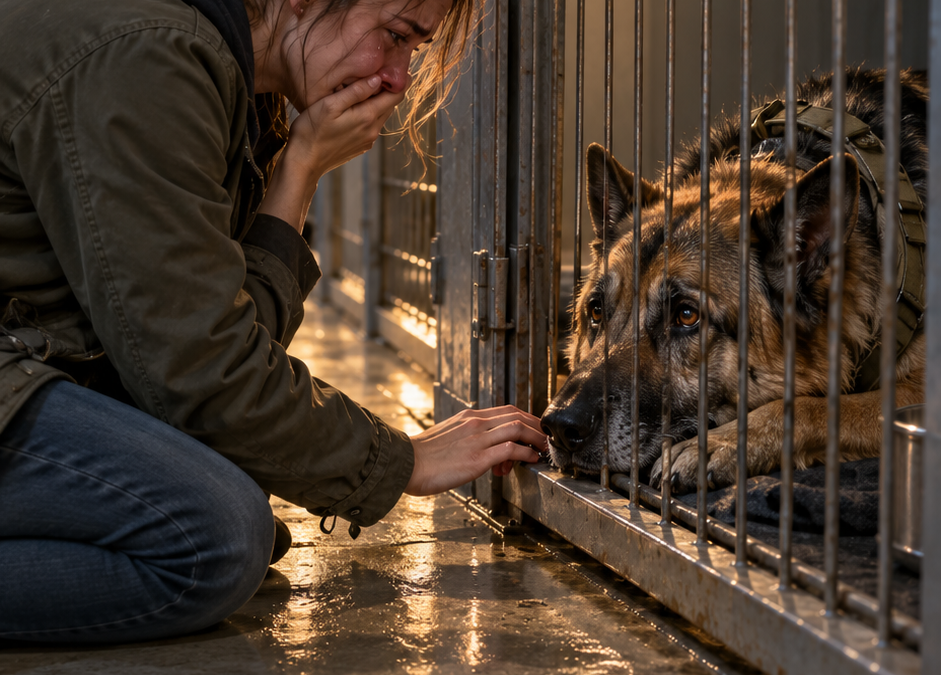
At first, I saw only the eyes.
Amber.
Deep.
Familiar.
The dog was lying at the back of the kennel on an old blanket.
His body looked heavier than I remembered and yet somehow more fragile.
German shepherd.
Black and tan.
Gray beginning around the muzzle.
One front leg lying at an odd angle.
One eye slightly cloudy.
His coat had lost its shine.
He looked old.
Too old.
Three years should not have changed him that much.
I stopped walking.
Jennifer almost bumped into me.
“What?”
I couldn’t answer.
The dog lifted his head.
My heart slammed against my ribs.
No.
Impossible.
I stepped closer.
The shape of the ears.
The dark mask.
The scar near the right shoulder.
I remembered David showing it to me once.
“Bruno got this before I met him,” he’d said.
The dog stared.
I gripped the kennel bars.
“Bruno?”
Jennifer turned toward me.
“What did you say?”
The dog’s ears lifted.
Not much.
But enough.
I could no longer breathe normally.
“Bruno.”
He didn’t stand.
He simply watched me.
Sarah approached from behind.
“Do you know him?”
I looked at her.
“This dog.”
My voice sounded wrong.
“What’s his name?”
She glanced at the paperwork.
“Bruno.”
Everything inside me dropped.
Jennifer whispered, “Oh my God.”
Sarah looked between us.
“You know him?”
I nodded.
Tears had already started.
“He belonged to my husband.”
The words were barely audible.
Sarah’s face changed.
“Your husband?”
“He was military.”
Sarah became very still.
“You should sit down.”
“I don’t want to sit down.”
Bruno’s eyes remained on me.
“What happened to him?”
Sarah hesitated.
“He’s been here a long time.”
“How long?”
Her silence answered before her words did.
“Almost three years.”
Three years.
My hand left the bars.
“No.”
“I’m sorry.”
“No.”
I shook my head.
“Someone told me he went to a home.”
“He did.”
Sarah’s voice was careful.
“More than one placement was attempted.”
I stared at Bruno.
“What happened?”
“He didn’t adjust.”
“What does that mean?”
“He wouldn’t bond.”
“Bruno bonds.”
The response came too quickly.
Too defensively.
Sarah didn’t argue.
“He may have once.”
I looked at her.
“He does.”
“Okay.”
“He loved David.”
“I believe you.”
“No, you don’t understand.”
My voice cracked.
“He followed him everywhere.”
Bruno’s head moved slightly at the sound of David’s name.
I saw it.
Sarah saw it too.
“Oh.”
I turned back toward the kennel.
“David.”
Bruno lifted his head higher.
A tiny sound escaped his throat.
Not a bark.
Not a whine.
Something between them.
I covered my mouth.
Jennifer put a hand on my back.
Sarah spoke softly.
“He’s been difficult to place.”
“Has he bitten anyone?”
“No.”
“Growled?”
“Rarely.”
“Then why difficult?”
“He shuts down.”
I didn’t understand.
She explained.
“He doesn’t engage. Doesn’t play. Doesn’t approach people. Sometimes he barely eats.”
I looked at his body.
“He looks terrible.”
“We’ve treated what we can.”
Sarah did not become defensive.
I respected her for that.
“He came in underweight after the last placement failed. His leg has arthritis and an old injury. The eye has early opacity. We’ve improved his weight some.”
“Why has no one adopted him?”
“People have tried.”
She looked toward Bruno.
“He waits.”
The word hit me.
“What?”
“We don’t know what else to call it.”
Sarah folded her arms.
“He spends a lot of time facing the entrance. Whenever a man with a certain build comes through, he watches.”
My knees weakened.
“He’s waiting for David.”
No one answered.
They didn’t need to.
I crouched beside the kennel.
Bruno stayed in the back.
“Hey.”
My voice broke.
“It’s me.”
His eyes never left my face.
“Do you remember?”
Nothing.
“Bruno.”
I pushed my fingers carefully through the bars.
I didn’t reach for him.
Just left them there.
“I’m sorry.”
Jennifer began crying behind me.
I ignored her.
“I’m so sorry.”
Bruno’s nose moved.
He lifted his head.
Then, with visible effort, he stood.
His left front leg shook.
I saw the pain immediately.
He took one step.
Stopped.
Another.
Sarah whispered, “He never does this.”
I didn’t move.
Bruno crossed the kennel slowly.
When he reached the bars, he did not touch me.
He smelled my hand.
Long.
Carefully.
Then my sleeve.
Then the air around my face.
I realized what he was doing.
Searching.
Not for me.
For David.
Maybe David’s scent had once lived on my clothes.
Maybe something familiar still remained.
Or maybe Bruno remembered me separately.
I don’t know.
His head lifted.
Our eyes met.
“Hi.”
His tail hit the floor once.
Thump.
I sobbed.
Another.
Thump.
“Bruno.”
He pressed his nose between the bars.
I put my forehead against the metal.
“I’m sorry.”
His tongue touched two of my fingers.
Gentle.
Tentative.
Jennifer whispered, “He knows you.”
I wasn’t sure whether that made the moment easier or harder.
Sarah wiped her eyes.
“I’ve worked here six years.”
Her voice trembled.
“I’ve never seen him do that.”
I remained there for almost an hour.
I did not adopt Bruno that day.
I wish I could say I saw him and immediately understood what to do.
Real life isn’t that clean.
Instead, I went home terrified.
Jennifer drove because my hands would not stop shaking.
For most of the trip, neither of us spoke.
Then she said, “What are you going to do?”
“I don’t know.”
“You do.”
“No.”
“You do.”
I turned toward her.
“I can’t.”
“Why?”
The answer came out harder than I intended.
“Because he’s David.”
Jennifer kept her eyes on the road.
“No.”
“Don’t.”
“He’s not.”
“You weren’t there.”
“I know.”
“You didn’t see them together.”
“I know.”
“Every time I look at Bruno, I see—”
“David.”
“Yes.”
Jennifer nodded.
“That’s why you’re scared.”
“I’m not scared.”
She looked at me briefly.
“You haven’t been anything except scared for three years.”
I stared out the window.
Rain moved in silver lines across the glass.
“What if I take him home and he spends every day looking for David?”
“Maybe he will.”
“What if he hates me?”
“He licked your hand.”
“That doesn’t mean anything.”
“What if you love him?”
That was the question I couldn’t answer.
Jennifer knew.
She softened.
“You don’t have to decide tonight.”
“I left him once.”
“Then don’t make this about punishment.”
I looked at her.
“You were drowning too.”
“That doesn’t excuse it.”
“No.”
She didn’t give me easy forgiveness.
That’s why I trusted her.
“But guilt isn’t a plan.”
I went back the next morning alone.
Sarah looked surprised.
“You’re early.”
“I didn’t sleep.”
“That makes two of us.”
She led me to Bruno.
He was lying where I’d first seen him.
This time, when he heard my footsteps, his head lifted before I reached the kennel.
I stopped.
“Did he hear me?”
Sarah smiled faintly.
“I think so.”
I sat on the concrete.
No chair.
No blanket.
Just floor.
Bruno remained several feet away.
“Hi.”
His tail moved once.
That was enough.
I started talking.
I don’t know why.
Maybe because for three years I’d avoided saying David’s name unless absolutely necessary.
Maybe because Bruno was the one listener who could never ask me to make the story easier.
“He loved you.”
Bruno watched me.
“You know that, don’t you?”
His ears moved.
“When he talked about you, his voice changed.”
I smiled through tears.
“He would say, ‘Bruno did this. Bruno found that. Bruno saved me from looking like an idiot.'”
A faint tail movement.
“He said you understood more than people did.”
I swallowed.
“I used to be jealous of you.”
Sarah was somewhere down the hall.
I could hear bowls clattering.
“I thought you knew parts of him I didn’t.”
Bruno shifted.
Slowly stood.
His leg trembled.
I almost told him not to move.
Instead, I stayed still.
He crossed the kennel.
Stopped at the gate.
I put my hand near the bars.
Not through.
“I couldn’t look at you after he died.”
The word died felt brutal.
But I said it.
For the first time to Bruno.
“David died.”
Bruno stared.
I knew he didn’t understand language the way I wanted him to.
But saying it mattered.
“He didn’t leave you.”
My voice broke.
“He didn’t choose not to come back.”
Bruno’s nose touched the metal.
“I need you to know that.”
Tears fell onto my hands.
“He loved you.”
Bruno leaned forward.
His tongue touched my fingers.
Slowly.
Then again.
I closed my eyes.
“I loved him too.”
Sarah appeared quietly at the end of the row.
She didn’t interrupt.
Bruno pressed his muzzle closer.
This time, I touched him.
Just fingertips against the side of his face.
His eyes closed.
I felt something inside me crack open.
Not heal.
Crack.
There is a difference.
Healing would come later.
For two weeks, I visited every day.
Morning before work.
Evening after.
At first, I told myself I was only helping Bruno adjust.
That was a lie.
I needed those visits as much as he did.
Maybe more.
I brought food.
Sarah taught me what his stomach tolerated.
I cooked chicken and rice.
Added the supplements the veterinarian recommended.
Bought a new blanket.
The first time I put it inside, Bruno sniffed it for almost five minutes before lying down.
I bought him a soft ball.
He looked at it.
Then at me.
Then placed his head on it and went to sleep.
I laughed.
The sound surprised me.
Sarah heard it.
“That’s progress.”
“For him?”
“For both of you.”
I rolled my eyes.
But she was right.
Bruno rarely barked.
At night, sometimes he barked in his sleep.
I heard it once because I stayed late.
Short, sharp sounds.
His paws moved against the blanket.
He seemed to run without going anywhere.
I stood outside the kennel.
“Bruno.”
He didn’t wake.
Another bark.
Harder.
Sarah came beside me.
“He does that sometimes.”
“Every night?”
“Not every night.”
“What does it mean?”
“We can’t know.”
I thought about what David had told me.
Bruno alerting him.
Bruno waking him.
Bruno beside him in places where sleep was never completely safe.
I put one hand against the bars.
“He’s remembering.”
Sarah looked at me.
“Maybe.”
I hated maybe.
I wanted certainty.
Grief makes you hungry for certainty because death gives you none.
I wanted to know whether Bruno dreamed about David.
Whether he understood he was gone.
Whether he blamed me for leaving him.
Whether he had truly waited three years.
None of those questions came with answers.
So I learned to live beside them.
By the end of the first week, Bruno began recognizing my footsteps.
I tested it accidentally.
Another woman walked down the hallway.
Nothing.
Then I came around the corner.
His ears lifted.
Tail.
One small bark.
I stopped.
“Was that for me?”
Another bark.
Sarah laughed.
“He hasn’t greeted anyone like that since I’ve known him.”
“Maybe he wants food.”
“Let yourself have one nice thing.”
I opened the kennel.
Bruno didn’t rush me.
He never did.
He approached.
Sniffed.
Then stood near my leg.
That was enough.
The first walk happened on day nine.
Sarah warned me.
“He hasn’t wanted to stay outside long.”
“Why?”
“Could be pain. Could be anxiety.”
I attached the leash.
Bruno stared at the open yard door.
For a moment, he refused to move.
“Come on.”
Nothing.
I stepped outside.
He remained in the doorway.
“Bruno.”
His body lowered slightly.
I understood.
Open space.
After years of cages, placements, unfamiliar homes, abandonment from his perspective—freedom might not feel like freedom.
It might feel like being left again.
I crouched.
“I’m not going anywhere.”
His ears moved.
“I promise.”
A dangerous word.
Promise.
I’d learned how little control humans have over forever.
So I corrected myself.
“I’m here now.”
That was honest.
Bruno took one step.
Then another.
We walked into the yard.
Slowly.
His front leg hurt.
Every three or four steps, he paused.
I wanted to stop the entire walk.
But Bruno kept looking forward.
So we continued.
When he reached the center of the yard, he lifted his head.
Sky.
Clouds.
Wind.
He stood there.
Completely still.
I watched his nose move.
He smelled grass.
Rain somewhere far off.
Other dogs.
Trees.
Life outside concrete walls.
Then he sat.
He looked upward for so long that I followed his gaze.
Nothing there.
Just sky.
And suddenly I thought:
He’s waiting for David to come out of it.
The idea was irrational.
Maybe cruel.
But grief doesn’t ask permission before creating meanings.
I sat beside him in the dirt.
“You still look for him.”
Bruno continued staring upward.
“So do I.”
That was the first moment I felt we truly understood each other.
Not because we had the same grief.
Human and animal grief aren’t identical.
Because we were both searching for someone who was no longer in the places we expected to find him.
I rested my hand on Bruno’s back.
This time, he didn’t flinch.
We stayed there until Sarah came outside.
“You two planning to move in?”
“Maybe.”
Bruno looked at her.
She smiled.
“Good walk?”
I looked at him.
“Yeah.”
Then I said something I had not planned.
“I’m going to take him home.”
Sarah became very still.
“You sure?”
“No.”
She nodded.
“Good answer.”
“What?”
“The people who say they’re completely sure are usually imagining the dog they want.”
She looked at Bruno.
“You’re seeing the dog he actually is.”
I swallowed.
“Do you think he’ll accept me?”
Sarah crouched.
“I think he already has.”
“That’s not what I mean.”
“I know.”
I looked away.
“I’m not David.”
“No.”
“He may always want David.”
“Probably.”
The truth hurt.
Sarah continued.
“That doesn’t mean there isn’t room for you too.”
I went home that night and panicked.
I lay awake staring at the ceiling.
What if Bruno hated the house because David was gone?
What if he spent every night waiting by the door?
What if he became worse?
What if I failed him?
What if he died?
That last one was the real question.
Bruno was older now.
His body had suffered.
If I loved him, I would eventually lose him.
I already knew what loss could do.
Why volunteer for another?
At two in the morning, I got out of bed.
Walked to the living room.
David’s chair still stood near the window.
I had not moved it in three years.
I touched the back.
“You’d tell me to stop being ridiculous.”
Silence.
“Then you’d say something annoying.”
Still silence.
For years, I had imagined David’s answers.
That night, I stopped.
I didn’t need a sign.
Didn’t need a dream.
Didn’t need permission from the dead.
Bruno was alive.
I was alive.
That had to matter.
At seven the next morning, I was at the shelter carrying a folder.
Sarah saw me.
“Paperwork?”
“Paperwork.”
She smiled.
“I’ll start the adoption file.”
“Don’t make this emotional.”
“Wouldn’t dream of it.”
Twenty minutes later, she was crying.
“So much for that.”
“Shut up.”
I signed forms.
Medical history.
Behavior disclosures.
Veterinary requirements.
Emergency contact.
When I reached the line asking why I wanted to adopt Bruno, I stopped.
What was I supposed to write?
Because he belonged to my dead husband?
Because I abandoned him once?
Because we were both lonely?
Because when he looked at me, three years of silence suddenly had a face?
I wrote:
We already know each other.
That was enough.
The shelter veterinarian examined Bruno before release.
His leg had an old injury complicated by arthritis.
Treatable.
Manageable.
Not reversible.
His cloudy eye required monitoring but did not cause significant pain.
Dental work would be needed.
Nutrition had to improve.
He was not an easy adoption.
That was fine.
I wasn’t an easy person anymore either.
Sarah handed me the leash.
Bruno wore a new dark leather collar.
I had chosen one similar to the kind David used.
Then changed my mind.
I bought a different one.
Blue.
Not military.
Not memory.
Bruno’s.
That mattered.
“Ready?”
I asked.
Bruno looked toward the shelter door.
His body trembled.
Sarah noticed.
“He doesn’t know what this means.”
“He thinks he’s being moved again.”
“Probably.”
I hated that.
I opened the car.
Bruno hesitated.
Then climbed onto the back seat with difficulty.
For the first ten minutes, he remained standing.
Wouldn’t lie down.
Wouldn’t look out the window.
His breathing was quick.
At a stoplight, I reached backward.
“It’s okay.”
My fingers touched his head.
Bruno moved forward.
Slowly.
He pushed his muzzle between the front seats.
Then lowered his head beside my arm.
“You’re not going back.”
The words came out before I thought.
I looked at him in the mirror.
“You hear me?”
Amber eyes.
“No more kennels.”
His breathing slowed.
When we reached the house, I sat in the driveway for several minutes.
The same house.
The one David had known.
The one Bruno had visited years before.
I wondered whether dogs remembered buildings after so much time.
I got my answer at the front door.
Bruno stopped.
His nose lifted.
He inhaled.
Once.
Again.
His entire body changed.
The ears rose.
He stepped forward.
Sniffed the threshold.
Then the wall.
He entered.
Slowly.
Hallway.
Kitchen.
Dining room.
He walked as though reading a book written in scent.
I followed without speaking.
He reached the living room.
Stopped.
David’s chair.
Bruno froze.
My chest tightened.
“No.”
He approached it.
Sniffed the armrest.
The seat.
The floor.
Then stood completely still.
I had washed that room countless times.
Three years had passed.
There couldn’t possibly be much of David’s scent left.
But memory doesn’t always require scent.
Maybe the shape was enough.
Maybe the room itself.
Bruno sat beside the chair.
He looked at the empty cushion.
Waited.
One minute.
Two.
Then slowly, painfully, he lowered himself beside it.
His head went onto his paws.
A sigh left him.
Deep.
Heavy.
I sat on the floor across from him.
“He’s not coming.”
The sentence almost killed me.
Bruno’s ears moved.
“I wish he was.”
Tears blurred the chair.
“I wish I could give that to both of us.”
Bruno closed his eyes.
I cried quietly.
For three years, I’d avoided that chair.
That day, Bruno and I sat beside it together.
Not trying to fix anything.
Just admitting what was gone.
That night, Bruno slept in the living room.
I had bought an orthopedic bed.
He ignored it.
Of course.
He chose the rug beside David’s chair.
Around two-thirty, barking woke me.
Sharp.
Repeated.
I ran downstairs.
Bruno was asleep.
His paws moved rapidly.
His body twitched.
Bark.
Bark.
Pause.
Bark.
I stood several feet away.
“Bruno?”
Nothing.
I remembered David saying never startle a working dog from a deep sleep if you don’t know where his mind is.
So I approached carefully.
“Bruno.”
His paws kicked.
I crouched.
Fear went through me.
Not fear he’d hurt me.
Fear of whatever he was seeing.
“You’re home.”
I touched his back gently.
He froze.
Eyes opened.
For half a second, there was no recognition.
His body tensed.
Then he saw me.
Really saw me.
His expression changed.
Confusion.
Recognition.
Exhaustion.
I kept my hand still.
“It’s me.”
Bruno breathed.
Then, slowly, he moved his head onto my lap.
I sat there.
Bare feet on cold floor.
Back against the chair.
Hand on Bruno’s shoulders.
He fell asleep.
I didn’t.
My legs went numb.
My lower back hurt.
I stayed.
Because for the first time in three years, something living needed me in the middle of the night.
Not as David’s widow.
Not as the woman people spoke to in careful voices.
Me.
Just me.
At dawn, light entered through the window.
Bruno woke.
Lifted his head.
Looked at me.
Tail.
One slow sweep.
“Morning.”
That became our first morning.
The weeks afterward were not magical.
Bruno didn’t suddenly become a happy dog because love entered the house.
Healing is not a switch.
He refused food some days.
Panicked when I left for work.
Waited by the front window.
Searched the hallway when cars stopped outside.
Every time a man with a deep voice spoke near the house, his ears shot up.
At first, those moments destroyed me.
Then I learned not to interpret every search as rejection.
Bruno wasn’t choosing David over me.
He was carrying memory.
So was I.
We could both carry it.
I found a veterinarian who had experience with older working dogs.
Dr. Collins.
She examined Bruno’s leg.
“This probably should have been managed more aggressively.”
My guilt returned instantly.
“I didn’t have him.”
She looked up.
“I’m not blaming you.”
“I should’ve.”
“That won’t help his joint.”
Direct.
I liked her.
She prescribed anti-inflammatory medication, physical therapy exercises, supplements, and gentle massage.
“Ten minutes twice a day.”
I followed the instructions obsessively.
Bruno hated the exercises.
“David would’ve made you do this.”
His ears moved.
“Yes, I’m using his name against you.”
He glared.
“Don’t judge me.”
We developed routines.
Breakfast at seven.
Medication hidden in chicken.
Short walk.
I went to work.
At first, Jennifer came by midday.
Then Bruno learned I returned.
That was important.
Dogs abandoned repeatedly do not trust departures.
Each morning I left.
Each evening I returned.
Again.
Again.
Again.
The repetition itself became medicine.
When I came home, Bruno initially stayed near David’s chair.
Then, after several weeks, he began meeting me halfway down the hallway.
A month later, he reached the door.
Two months later, he barked when my key turned.
Three months later, he spun once in a circle.
The first time he did that, I dropped my purse.
“Did you just…”
Bruno spun again.
His tail hit the wall.
I laughed.
“You’re ridiculous.”
He jumped slightly.
Not high.
His leg wouldn’t allow it.
But enough.
I crouched.
He pressed into me.
That evening, I called Jennifer.
“He was excited.”
“About what?”
“Me.”
She was silent.
Then:
“Of course he was.”
“No. You don’t understand.”
“I do.”
“He ran to the door.”
“I’m happy for you.”
I started crying.
Jennifer sighed.
“Now I can’t tell whether you’re happy or devastated.”
“Both.”
“That sounds right.”
We had good days.
Then difficult ones.
One afternoon, I found Bruno standing in David’s closet.
I had left the door open.
He had pushed past several boxes.
His nose was buried in an old jacket.
David’s jacket.
One I hadn’t touched in years.
Bruno inhaled.
His body trembled.
I stood in the doorway.
Every instinct told me to remove the jacket.
Close the door.
Protect us both.
Instead, I sat.
Bruno eventually lay down with the jacket beneath his head.
I cried.
He stayed there for an hour.
Afterward, I washed nothing.
I stopped trying to erase pain from the house.
There was no need.
We could survive it now.
Summer became fall.
Bruno’s coat improved.
His weight stabilized.
His leg became stronger.
Then winter arrived.
December was always difficult.
The anniversary of David’s death sat near the end of the year like a wall I could see from months away.
Every November, I became restless.
Every December, I stopped sleeping well.
That year, I believed Bruno would make it easier.
He didn’t.
Not exactly.
Grief does not leave because you acquire companionship.
Sometimes love creates enough safety for grief to finally come out.
One cold evening, I sat at the kitchen table.
Rain touched the windows.
I had found an old voicemail from David while cleaning my phone backups.
I should have deleted it.
Instead, I listened.
His voice filled the kitchen.
“Hey, babe. Call me when you get this. Bruno stole my glove again, so apparently I live with a criminal.”
Then laughter.
Normal.
Alive.
I listened twice.
Three times.
On the fourth, I couldn’t breathe.
I put the phone down.
Covered my face.
And cried.
Not the restrained tears I’d perfected.
Real crying.
Ugly.
Loud.
Three years of anger and loneliness.
Why did you leave?
Why did you have to go?
Why did everyone tell me I was strong when I didn’t want to be strong?
Why did the world continue?
Why had I been given a future when the person I planned it with had not?
I didn’t hear Bruno enter.
I felt him.
His head came down heavily across my knees.
I froze.
Bruno had learned affection, but he still rarely initiated contact unless there was a purpose.
This had a purpose.
I lowered my hands.
He stood beside me.
Head across my lap.
Eyes forward.
Not licking.
Not pawing.
Not trying to stop the tears.
Just there.
Exactly as David had described him.
He doesn’t fix things.
He stays.
I put one hand on his neck.
“You miss him too.”
Bruno remained still.
“I know.”
I leaned over him.
For several minutes, I cried into his fur.
He let me.
That was when I realized I loved him.
Not because he had belonged to David.
Not because saving him made me feel closer to my husband.
I loved Bruno.
Him.
The stubborn dog who hated physical therapy.
Who refused dry kibble unless I added something ridiculous.
Who slept with one paw beneath his chin.
Who distrusted the vacuum cleaner.
Who stood beside the kitchen counter whenever I cut chicken.
Who had started waiting at the door for me.
Bruno was no longer only evidence that David had lived.
He had become part of my life now.
That realization frightened me.
Then relieved me.
Love had entered again without asking whether I was ready.
And I had survived.
The first anniversary after Bruno came home was different.
I took the day off.
Normally I spent it alone.
This time, I took Bruno to the cemetery.
I hadn’t planned to.
Halfway through the morning, I looked at him.
“Want to go see him?”
His ears lifted at him.
Maybe because of my tone.
Maybe because he somehow knew.
The cemetery was quiet.
Gray sky.
Cold grass.
I walked to David’s grave.
Bruno slowed.
He sniffed.
Then stopped beside the marker.
I don’t know what he understood.
I refuse to turn every animal behavior into something mystical because reality itself was enough.
But Bruno stood there for a long time.
Then lay down.
His body pressed against the cold ground.
I sat beside him.
“David.”
Saying his name outside felt different.
“I brought him.”
Bruno’s ears moved.
“I should have done it years ago.”
I touched the stone.
“I’m sorry.”
Wind moved through the trees.
Bruno placed one paw across my boot.
“I think he’d forgive me.”
I looked down at him.
“You probably already did.”
We stayed almost an hour.
When we left, Bruno looked back once.
So did I.
Then we went home together.
Spring came.
Bruno started running.
At first, barely.
A trot across the backyard.
Then a faster one.
Dr. Collins warned me not to overdo it.
“His enthusiasm will exceed his joints.”
“Story of my life.”
One morning, I opened the back door.
Bruno saw a squirrel.
All medical advice disappeared from his mind.
He took off.
“Bruno!”
The squirrel reached the fence.
Bruno stopped short.
Barked.
Then looked at me proudly.
“You were never going to catch it.”
Tail.
“That wasn’t strategy.”
Tail.
I laughed.
He ran toward me.
For the first time, I didn’t see the damaged shelter dog.
Didn’t see David’s partner.
Didn’t see grief.
I saw Bruno.
Alive.
Happy.
That mattered more than I can explain.
A full year after adoption, I took him to a lake.
David and I had once planned to go there.
We never did.
For years, that had made the place feel forbidden.
Then I thought:
Why?
Why should grief own geography?
So Bruno and I drove there on a clear spring morning.
The lake was enormous.
Blue.
Wind pushed small waves toward shore.
Bruno stopped the moment he saw it.
His ears stood straight up.
“You’ve never seen this much water, have you?”
He looked at me.
“Don’t expect me to rescue you.”
He approached carefully.
One paw touched water.
He pulled it back.
Sniffed.
Tried again.
Two paws.
Then four.
A wave touched his chest.
Bruno jumped sideways.
I laughed.
“Military courage.”
He turned toward me.
Then suddenly ran into the water.
“Bruno!”
He splashed.
Pushed deeper.
Then started swimming.
Not elegantly.
But confidently.
He went out several yards.
Turned.
Came back.
Shook water all over me.
“Seriously?”
He ran in again.
For twenty minutes, he became young.
No limp.
No shelter.
No waiting.
Just a dog in a lake.
I sat on the shore laughing.
Real laughter.
The kind that arrives before you remember whether you’re allowed to be happy.
At some point, I realized I wasn’t thinking about David.
The realization stopped me.
Guilt tried to come.
Then something else replaced it.
Gratitude.
For years, I had believed remembering David required carrying pain constantly.
If I felt happy without thinking of him, I felt disloyal.
But sitting there watching Bruno swim, I understood something.
David’s existence did not need my suffering as proof.
Love didn’t disappear when pain loosened.
It simply stopped requiring pain to speak for it.
Bruno came out of the water.
Shook himself beside me.
“Thank you.”
He licked my cheek.
“I don’t know what for.”
I scratched his chest.
“Everything, maybe.”
On the drive home, Bruno sat in the passenger seat.
Normally I made him stay in back.
That day I broke the rule.
He pushed his nose toward the open window.
His ears moved wildly in the wind.
Tongue out.
Eyes bright.
At a traffic light, he turned toward me.
I looked back.
Something was different.
Those eyes no longer searched past me.
They saw me.
That distinction nearly made me cry.
“You know me now.”
Tail.
“I’m not him.”
Bruno watched.
“And that’s okay.”
The light turned green.
I drove.
“You’re home.”
He settled back into the seat.
“Finally.”
Over the next few years, Bruno became inseparable from me.
Not in the same way he had been with David.
That mattered too.
Our relationship developed its own shape.
David gave commands with quiet precision.
I negotiated.
David could apparently make Bruno stop moving with one word.
I required several.
“Bruno, stay.”
Bruno moved.
“Stay.”
Another step.
“I know you understand English.”
Tail.
“David said you were well trained.”
Bruno sat.
“Thank you.”
He sneezed.
Jennifer said David would be horrified.
I said David should have left me an instruction manual.
Bruno became my reason to walk every morning.
My excuse to leave work on time.
The presence in the house that changed silence from emptiness into peace.
He slept closer to my room each month.
Eventually, he abandoned David’s chair as his primary sleeping place.
One evening, I noticed.
His bed was beside my bedroom door.
I stood there staring.
Bruno opened one eye.
“When did you move?”
No answer.
I looked toward the living room.
David’s chair remained.
Empty.
But it no longer felt like an altar.
Just a chair.
That was a milestone I never expected.
One weekend, I moved it.
Only six feet.
To another side of the room.
My hands shook while doing it.
Then nothing terrible happened.
Bruno watched.
Afterward, he lay in the patch of sunlight where the chair used to be.
I laughed.
“So much for sacred memory.”
He rolled onto his side.
Life continued.
Bruno aged.
Gray spread across his face.
The cloudy eye worsened.
His leg occasionally bothered him despite medication.
We adjusted.
Shorter walks.
More rugs.
A ramp into the car.
Orthopedic beds in three rooms because apparently one dog required more furniture than I did.
He continued greeting me at the door.
Just slower.
One evening, years after I found him, Jennifer sat with me on the porch.
Bruno slept beside us.
“Do you ever think about that first day?”
“At the shelter?”
“Yeah.”
“All the time.”
“What would’ve happened if you hadn’t gone?”
I looked at her.
“You forced me.”
“I encouraged.”
“You harassed.”
“Same family.”
I looked at Bruno.
“I don’t know.”
That question terrified me.
Maybe someone else would have adopted him.
Maybe not.
Maybe he would have spent the rest of his life waiting.
I didn’t want to imagine it.
Jennifer seemed to understand.
“You went.”
“Eventually.”
“You went.”
The phrase reminded me of something David used to say.
You don’t have to arrive first. You just have to arrive when it matters.
Maybe I’d remembered incorrectly.
Maybe grief had rewritten the line.
It didn’t matter.
I was there.
Bruno was there.
We found each other late.
Late was still better than never.
As Bruno grew older, people sometimes asked whether I would get another dog someday.
The question felt almost insulting while he was still beside me.
“He’s not dead.”
“I know, I mean eventually.”
“No.”
I always answered quickly.
No.
I couldn’t do this again.
Couldn’t love another animal knowing the ending.
Then I realized I had once said the same thing about Bruno.
Life enjoys embarrassing our certainties.
The day came when Bruno’s veterinarian wanted to talk seriously.
Not yet about the end.
About decline.
Kidneys.
Arthritis.
Vision.
Hearing.
He was getting old.
Very old.
I sat in the exam room with Bruno’s head on my shoe.
“How long?”
Dr. Collins shook her head.
“Don’t ask for a calendar.”
“I need to know.”
“No, you want control.”
That irritated me.
“Same thing.”
“It isn’t.”
She sat across from me.
“We watch quality of life.”
She explained.
Eating.
Movement.
Interest.
Comfort.
Sleep.
Pain.
Good days.
Bad.
I hated every word.
On the drive home, I cried.
Bruno sat in the back now because getting into the front seat had become difficult.
“I’m not ready.”
His ears moved.
“That isn’t fair, is it?”
I looked in the mirror.
“You waited three years for David.”
My voice broke.
“I got you for only…”
I stopped.
Only.
What an ungrateful word.
Years.
Mornings.
Walks.
The lake.
The kitchen.
The cemetery.
The nights when he slept near my door.
None of that was only.
I corrected myself.
“I got you.”
That was enough.
Bruno’s final years taught me another kind of love.
Not rescue.
Care.
Slow, repetitive, sometimes exhausting care.
Helping him stand on bad mornings.
Wiping muddy paws.
Medication.
Appointments.
Sitting outside at two in the morning because he seemed restless and wanted cold air.
Waiting while he spent five full minutes smelling one patch of grass.
Once, I became impatient.
“Come on, Bruno.”
He looked at me.
I immediately felt ashamed.
“Sorry.”
We stood there another five minutes.
Time matters differently when you know you’re running out.
One December evening, near the anniversary of David’s death, I sat at the kitchen table again.
Years had passed since the first time Bruno rested his head on my knees there.
I wasn’t crying.
Not initially.
Then I heard one of David’s old songs playing from a neighbor’s radio.
My throat tightened.
Bruno was asleep across the room.
I looked at him.
Gray.
Slow.
Safe.
I thought about the strange route grief had taken.
David.
Then Bruno.
Then me.
Three beings connected by loss and loyalty.
I whispered, “We made it.”
Bruno opened his eyes.
Tail.
One movement.
“We actually made it.”
He stood with effort.
Walked toward me.
Placed his head on my lap.
Same gesture.
Older body.
Same answer.
Presence.
That had always been his gift.
Not saving me.
I dislike saying Bruno saved me.
It makes grief sound too simple.
No dog can erase a husband.
No friendship replaces a marriage.
No new love cancels an old one.
Bruno did something quieter.
He gave me somewhere to place love that had become trapped inside grief.
And I gave him somewhere to place loyalty after the person who had once received it was gone.
We did not replace David for each other.
We carried him differently.
That was enough.
Years after the shelter, Sarah visited us.
She had moved to another job but remembered Bruno.
When he walked slowly toward her, she covered her mouth.
“He looks amazing.”
“He looks old.”
“He was old in spirit when you found him.”
She crouched.
Bruno sniffed her.
Tail.
Sarah cried.
“Do you remember me?”
“He probably remembers who fed him.”
“That’s insulting.”
“Accurate.”
We sat outside.
Sarah told me something I hadn’t known.
“The night before you first came in, we were discussing Bruno.”
My stomach tightened.
“What about him?”
She hesitated.
“He wasn’t doing well.”
“How bad?”
“Bad.”
I looked at Bruno sleeping in the grass.
“What were you discussing?”
“Options.”
She didn’t need to explain.
I went cold.
“Would you have…”
“We weren’t there yet.”
“But close?”
Sarah’s eyes filled.
“His quality of life was deteriorating.”
I looked away.
Jennifer had asked me to go to the shelter on a random rainy evening.
One evening.
Days mattered.
Maybe hours.
I had spent years thinking I found Bruno.
Now I understood how close I had come to not finding him at all.
Sarah touched my arm.
“Don’t turn this into guilt.”
“How can I not?”
“Because you came.”
Again that phrase.
You came.
I breathed.
Bruno opened one eye.
I went to him.
Knelt.
“Hey.”
He licked my wrist.
I pressed my forehead against his.
“I’m here.”
Not forever.
Not always.
Just honest.
I’m here.
When Bruno’s final day eventually came, it was peaceful.
That matters to me.
It was spring.
Warm enough to open the windows.
Birds outside.
Sunlight across the living room floor.
He had stopped eating the night before.
Wouldn’t stand that morning.
Dr. Collins came to the house.
Jennifer came too.
I almost told her not to.
Then I realized I needed her.
Bruno lay beside David’s old chair.
Not because he had returned to waiting.
Because that patch of sunlight was warm.
I sat beside him.
His head rested on my lap.
Dr. Collins explained everything.
I barely heard her.
I had lived this goodbye in my imagination for years.
Reality was quieter.
“Bruno.”
His amber eye moved toward me.
The other had clouded almost completely.
“You’ve done enough.”
My voice broke.
“I need you to know that.”
His breathing was shallow.
“You waited for him.”
Tears fell onto his fur.
“Then you waited for me.”
Jennifer cried quietly behind me.
“And I am so sorry it took me so long.”
Bruno’s ear moved.
“But I’m here.”
I stroked his face.
“David isn’t coming through the door.”
I could finally say it without feeling the world collapse.
“And you don’t have to keep looking.”
His eyes remained on me.
“You found home again.”
I pressed my forehead against his.
“So did I.”
Dr. Collins administered the first medication.
Bruno relaxed.
His body softened.
For years, he had seemed like a dog perpetually listening for something.
That day, for the first time, he stopped listening.
He simply rested.
I whispered:
“Go find him if you can.”
I don’t know what I believe about what comes after death.
I didn’t need to know.
The words were for me as much as Bruno.
“Tell him I love him.”
Jennifer put a hand over her mouth.
“And tell him…”
I laughed through tears.
“Tell him you were still more stubborn than both of us.”
Bruno exhaled.
His breathing slowed.
My hand remained on him.
Then stopped.
The room became still.
I expected the old emptiness to return.
The kind that followed David.
It didn’t.
Pain came.
Enormous.
But different.
Because this time, I had stayed.
No turning away.
No letting someone else take responsibility because love hurt too much.
Bruno died knowing my hand.
Knowing my voice.
Knowing home.
That became a kind of peace.
Afterward, I sat beside him for a long time.
Jennifer eventually asked, “Are you okay?”
“No.”
She nodded.
“Okay.”
Best answer she could have given.
Weeks later, I went back to the shelter.
Not to adopt.
Not then.
I brought Bruno’s orthopedic bed.
Blankets.
Unused medication that could legally be donated.
Bowls.
A bag of food.
Sarah no longer worked there, but one of the newer employees helped me.
“Was this your dog?”
“Yes.”
“What was his name?”
“Bruno.”
“How long did you have him?”
I thought.
Years.
Too few.
Enough.
“Long enough.”
The employee smiled uncertainly.
I left before crying.
Outside, rain had begun.
Exactly the kind of summer rain that had fallen the night Jennifer dragged me there years earlier.
I stood beneath the awning.
For a second, I almost expected to hear Bruno bark behind me.
Nothing.
Then I smiled.
I could remember him without needing him to appear.
That was new.
Months later, Jennifer asked again.
“Would you ever adopt another dog?”
This time, I didn’t say no.
“I don’t know.”
She smiled.
“What?”
“That’s progress.”
“Don’t start.”
We walked.
David had been gone many years by then.
Bruno too.
Yet neither felt erased.
That surprised me most.
For so long, I thought healing meant forgetting enough to stop hurting.
It doesn’t.
Healing means memory no longer prevents life from entering.
David remained part of me.
Bruno remained part of me.
Their absence did not require my own absence from the world.
The following spring, I returned to the lake alone.
Same shore.
Same water.
I sat where I had watched Bruno discover swimming.
A golden retriever splashed nearby.
Not Bruno.
I knew that immediately.
Years earlier, the sight would have crushed me.
That day, it made me smile.
I could almost see him.
One cautious paw.
Pulling it back.
Trying again.
Then throwing himself into the water as though fear had never existed.
I laughed quietly.
A woman nearby looked at me.
“Sorry.”
“No problem.”
She threw a ball for her dog.
The dog jumped into the water.
I watched.
For years, I believed David’s death had divided my life into before and after.
Maybe it did.
Then Bruno created another division.
Before I found him.
After.
Before Bruno, I thought survival meant closing parts of myself permanently.
Don’t love too much.
Don’t remember too clearly.
Don’t depend.
Don’t need.
After Bruno, I understood something different.
You can lose someone and still love again.
You can love again and still remain loyal to who was lost.
The heart is not a room with one chair.
It expands.
Sometimes painfully.
But it expands.
David had loved Bruno.
I had loved David.
Then Bruno and I learned to love one another without asking either relationship to disappear.
That was our story.
Not a miracle.
Not David sending Bruno back to me from somewhere beyond the world.
Maybe some people would prefer that interpretation.
I don’t need it.
The truth is beautiful enough.
A widow who was afraid to feel anything walked into a shelter.
An old German shepherd who had stopped trusting people looked up.
We recognized something in each other.
Then we tried.
The first day, a tail moved once.
The second, he touched my hand.
Then walks.
Food.
A car ride.
A doorway.
A chair.
A nightmare.
A hand on his back.
Morning.
Another morning.
Another.
Healing arrived through repetition.
So did trust.
So did love.
Not suddenly.
Quietly.
By the time I noticed, it was already home.
I still have Bruno’s blue collar.
It hangs beside one photograph of David.
Not beneath it.
Beside it.
That distinction matters.
The photograph shows David younger than I ever became able to imagine him.
He is smiling.
Bruno is beside him.
Young.
Alert.
Amber eyes focused on the camera.
For years, I couldn’t look at that picture.
Now it makes me smile.
There is another photograph beside it.
Bruno at the lake.
Wet.
Tongue hanging out.
Older.
Happy.
That one belongs to me.
Two lives.
Two chapters.
The same dog.
Sometimes I stand there and say, “You had a good run, buddy.”
And sometimes, when the house is especially quiet, I imagine David answering:
Told you he was stubborn.
I don’t know whether he would.
But I know what I would answer.
“Yeah.”
I would smile.
“He learned it from you.”
Three years after losing my husband, I walked into an animal shelter and found the dog who had once been his most faithful companion.
At first, I believed Bruno had been waiting for David.
He had.
Then I believed I was taking Bruno home because I owed something to the man we both loved.
Maybe I did.
But in the end, that wasn’t why we stayed together.
We stayed because two grieving creatures recognized loneliness in each other.
We stayed because I came back to the shelter the next morning.
Because Bruno came to the bars.
Because I opened the kennel.
Because he got into my car.
Because each day after that, neither of us left.
We had lost the same man.
For three years, we had each carried that loss alone.
Then somehow, in the last row of a noisy shelter on a rainy evening, our lives crossed again.
And this time, when Bruno looked at me and waited, I did not turn away.
I reached through the bars.
He reached back.
And that small act became the beginning of everything that came after.
Not forgetting.
Not replacing.
Living.
Together.
Until the end.





