𝗙𝗨𝗟𝗟 𝗦𝗧𝗢𝗥𝗬 The Woman Who Sued Me Over a Snowbank Had No Idea What the Next Blizzard Was About to Expose
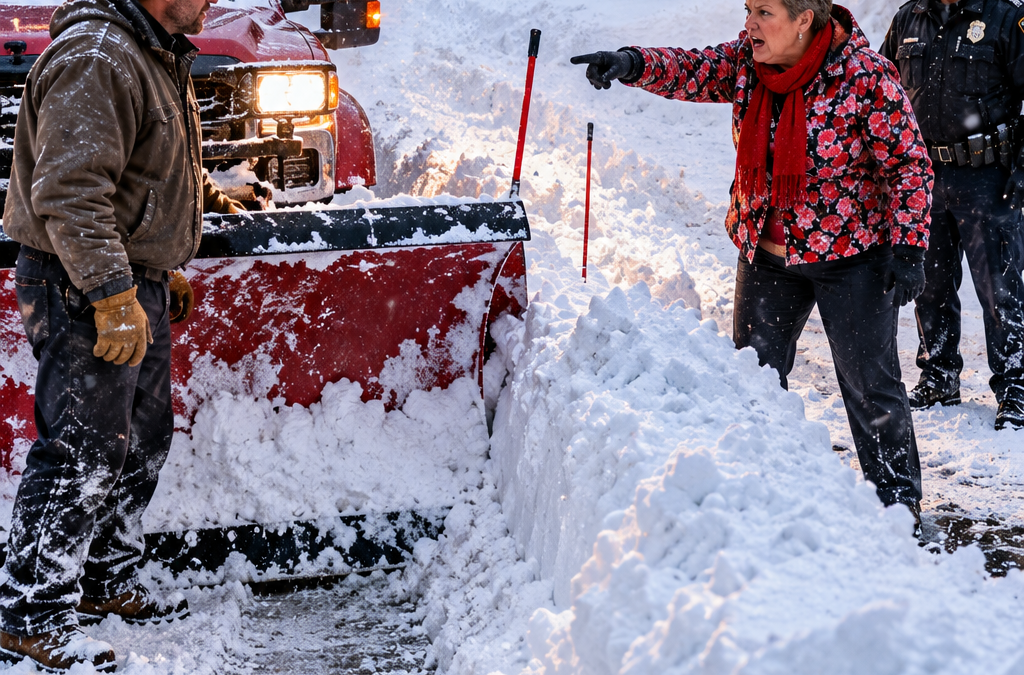
𝗙𝗨𝗟𝗟 𝗦𝗧𝗢𝗥𝗬
Then I checked it all again.
At five o’clock, the sky had turned the color of old steel.
Snow had started falling sideways.
Before I climbed into the truck, I stood there for a second watching the first white streaks cross the parking lot.
Nora had texted me earlier.
Be careful.
Nora is my wife.
She works as a nurse at the county hospital and has spent most of our marriage watching me leave home when weather is bad enough that sensible people are trying to get inside.
She never asks me not to go.
She knows why I do it.
That almost makes leaving harder.
I answered.
Always.
Then I pulled onto the county road.
Two weeks earlier, we had held a winter preparedness meeting at the fire hall.
I had spoken for maybe ten minutes.
Nothing complicated.
In serious storms, emergency access came first.
The volunteer team would try to keep one lane open wherever possible.
Private driveways were secondary.
Nobody should expect every entrance to remain perfectly clear because plows push snow somewhere and wind pushes it everywhere.
I said the last part twice.
Most people understood.
One woman in the third row did not seem impressed.
Her name was Marlene Whitaker.
She was fifty-two and worked as a high-end real estate agent.
Marlene lived in Birwood Ridge, a small collection of expensive homes built on elevated lots along the northern section of Larch Creek Road.
Her house was impossible to miss.
Stone facade.
Large windows.
Heated three-car garage.
Perfect landscaping.
Low stone wall.
Decorative black fencing.
Sculpted evergreens.
Even in winter, the property looked like a real estate brochure.
I learned later from her husband, Samuel, that she had spent two years and a small fortune redesigning the frontage.
To Marlene, that yard was not just grass and stone.
It was presentation.
Her business was presentation.
She sold homes for a living, and she believed the first impression of her own property said something about her competence.
I didn’t know all that when I met her.
I only knew she did not like snowbanks.
When I reached Birwood Ridge that first evening, my dashboard thermometer read negative twenty.
The wind chill was worse.
Marlene was already standing at the end of her driveway.
White parka.
Dark pants.
Phone in one hand.
Her SUV idling beside her.
She walked toward my truck before I had fully stopped.
I lowered the window.
Cold air filled the cab instantly.
“You’re Ethan Cole?”
“Yes.”
“You’re doing this road tonight?”
“Yes.”
She pointed toward her landscaping.
“I need you to understand something before you start.”
That sentence should have warned me.
She began listing requirements.
No snow against the stone wall.
No berm higher than twelve inches at the driveway entrance.
Nothing pushed toward the decorative fence.
Her driveway had to remain completely open.
No snow piled anywhere near the sculpted spruce trees.
I let her finish.
Then I said, “I can’t promise any of that tonight.”
Her face changed.
“I pay taxes in this county.”
“So do I.”
“That road is maintained with my money.”
“I’m not county staff.”
She blinked.
“What?”
“I’m a volunteer.”
“You’re operating road equipment.”
“My own truck. My fuel. Volunteer route.”
Her breath hung between us.
“That doesn’t give you permission to damage my property.”
“I don’t intend to damage anything.”
“Then keep the snow away from my landscaping.”
I looked down the road.
Snow was already streaking across it.
“Marlene, in this wind, the priority is keeping a lane open.”
“My driveway is part of that road.”
“Your driveway is private.”
“If I’m trapped, how is that safe?”
“I’ll clear entrances when I can.”
“That isn’t acceptable.”
I leaned slightly out the window.
“If an ambulance comes through here tonight, it needs a lane more than your fence needs a clean view.”
Her eyes narrowed.
Then she pulled out her phone.
“Say that again.”
I looked at it.
She raised the camera.
“I want that on the record when I take you to court.”
I could have argued.
Instead, I repeated myself.
“The road comes first.”
She stared at me.
I put the truck in gear.
As I began moving forward, something beyond her property caught my attention.
About a quarter mile past Birwood Ridge, Larch Creek Road dipped into a shallow basin.
Locals called it the bowl.
Open fields bordered both sides.
When northwest winds came hard across those fields, snow funneled into that low section.
I had seen four-foot drifts appear there overnight.
Once, I had seen the road disappear completely in less than two hours.
I stopped again.
Rolled down the window.
“Marlene.”
She was still filming.
“You should put that SUV in your garage tonight.”
Her expression became incredulous.
“What?”
“And don’t drive out once this gets heavy.”
“I don’t need a snowplow driver telling me how to live.”
“That bend ahead fills faster than anywhere on this road.”
“I’ve lived here nine years.”
“Then you know.”
“I know how to drive in snow.”
I looked at the sky.
“Tonight isn’t about driving skill.”
She folded her arms.
I nodded once and moved on.
For the next five hours, I barely thought about her.
There were people who actually needed help.
By seven, the storm had intensified.
Wind came sideways over the fields.
Snow hissed across the windshield.
Visibility dropped to a few car lengths.
Daniel divided everyone into short rotations.
Forty minutes out.
Twenty minutes at a warming station.
At negative twenty, fatigue arrives quietly.
Your hands become slow.
Judgment becomes lazy.
You stop noticing how cold you are.
Every driver knows the rule.
Every driver bends it when somebody needs help.
Helen Park handled dispatch from the emergency center.
Helen has one of those voices that never changes no matter how bad things become.
At eight fifteen, she called about a propane delivery that couldn’t reach a farmhouse.
At eight forty, an elderly man on supplemental oxygen needed the road cleared before a nurse arrived in the morning.
Then came the family with the newborn.
Power out.
Generator failing.
No immediate evacuation needed, but they wanted a passable route if things got worse.
I marked every address on the laminated map clipped beside the dash.
The work becomes very simple in weather like that.
Blade down.
Move snow.
Watch the ditch line.
Keep the truck straight.
Listen to the radio.
Don’t think too far ahead.
Around nine, Helen called with a name that made me pay attention.
Walter Briggs.
Walter was sixty-nine, a retired rancher living near the end of Larch Creek Road.
He never asked anyone for help.
If Walter called, something mattered.
A drift had buried his farm gate.
His daughter needed him to get medication to a relative before morning.
I radioed Daniel.
“Leaving the main line for Briggs.”
“How long?”
“Twenty minutes.”
“Make it fifteen.”
“I’ll try.”
Walter stood outside when I arrived.
Hunting jacket.
Flashlight.
Snow almost to his knees.
The drift at his gate reached above my wheel wells.
I spent fifteen minutes carving a narrow lane.
Another five making enough space to turn.
Walter handed me a thermos through the window.
“Coffee.”
“Thanks.”
His hand was shaking.
He looked toward the road.
“That wind will close this again by midnight.”
“I know.”
“You’ll have to come back.”
“Then I’ll come back.”
He studied me for a second.
“You boys are crazy.”
“Probably.”
I drove away strangely happy.
There is a satisfaction in useful work that is difficult to explain.
Nobody is applauding.
Nothing is glamorous.
You simply know that a road exists behind you where there wasn’t one before.
At ten thirty, I approached Birwood Ridge again.
Marlene was outside.
White parka.
Flashlight.
Phone.
A ridge of snow had formed along the roadway near her driveway.
Four feet deep in places.
She waved the flashlight until I stopped.
I stepped out.
Wind hit hard enough that I had to brace myself.
“Look at this!”
She pointed.
“Look what you’ve done.”
Most of the snow she was indicating had drifted naturally from the open field.
I could see the difference.
Plow spill is rougher.
It forms ridges.
Wind drift is smoother, layered, sculpted.
I explained that.
She did not care.
“You put it there.”
“Some came off the blade. Most didn’t.”
“My entrance was clear before you came through.”
“And the wind has been blowing for six hours.”
“You did this deliberately.”
I stared at her.
“Marlene, why would I deliberately bury your driveway?”
“Because I challenged you.”
I almost laughed.
Then I realized she was serious.
I looked at her phone.
Recording again.
“Please step away from the blade.”
“This is a volunteer who is deliberately damaging private property,” she said toward the phone. “I am documenting this.”
I felt anger rise.
Real anger.
The kind that makes your ears hot even when the air is twenty below.
Part of me wanted to stand there and explain exactly how ridiculous she sounded.
Then Helen’s voice crackled through my shoulder radio.
Another address.
Another problem.
I looked at the radio.
Then at Marlene.
“Ma’am, stay off the road.”
I climbed into my truck.
Drove away.
In my mirror, the white glow of her phone became smaller until the storm swallowed it.
I thought that was the end.
It wasn’t.
I got home at four in the morning.
Nora was already at the hospital.
I fell asleep in my thermal clothes and woke two hours later with my boots still beside the bed.
My phone had three messages from Curtis Hail, a friend who worked the hardware counter at the lumber yard.
First:
Heard Whitaker complained about you.
Second:
She’s telling people you drove onto her lawn.
Third:
Call me.
I sat on the edge of the bed reading them.
Then Daniel called.
“Marlene Whitaker contacted the town office.”
“Of course.”
“Also called three members of the volunteer committee.”
“What does she want?”
“You removed from Birwood Ridge.”
I laughed without humor.
“For keeping the road open?”
“She says you intentionally damaged her property.”
“What did you tell her?”
“That you were assigned there.”
Silence.
Then Daniel said, “Ethan, if she keeps pushing, committee may take you off that route until it’s sorted.”
“You believe her?”
“No.”
His answer came immediately.
“That doesn’t matter.”
I knew what he meant.
Small communities are complicated.
A volunteer group can survive bad weather.
Legal complaints are different.
Three days later, court papers arrived at my shop.
A courier walked in while I was pricing hydraulic couplings.
He asked for Ethan Cole.
I signed.
Opened the packet behind the counter.
Marlene had filed a civil claim.
Trespass.
Property damage.
Damage to landscaping.
Fence damage.
Negligent snow placement.
She alleged I had driven onto her property and deliberately dumped large amounts of snow along her frontage.
She wanted compensation.
I felt my stomach hollow out.
Then I saw something.
The filing stated the main incident had occurred “at approximately 4:00 p.m.”
I read it again.
Four.
Daniel had not assigned me the route until four.
My first logged arrival on Larch Creek was after five.
I did not circle the mistake.
I didn’t call Marlene.
I didn’t tell anyone.
When someone hands you an error, sometimes the smartest thing is to understand it before announcing that you found it.
That night, I sat at the kitchen table with a legal pad.
I built a timeline.
4:00 – Daniel assigns route.
4:35 – equipment check complete.
5:17 – first Larch Creek check-in.
6:02 – Miller crossing.
7:15 – warming station.
8:40 – oxygen call.
9:10 – Walter Briggs dispatch.
10:27 – second pass at Birwood Ridge.
Then I opened the volunteer dispatch application.
Everything was logged automatically.
Times.
Routes.
Calls.
Addresses.
The records confirmed my memory.
I should have felt relieved.
I didn’t.
Because the timeline only proved where I was.
It did not prove I hadn’t damaged her property.
If a fence post was actually broken, the court would still care.
Being a volunteer does not give anyone permission to cause harm.
I stared at the legal pad until Nora came home near midnight.
She walked into the kitchen in hospital scrubs, set down her bag, and looked at me.
“What’s wrong?”
I pushed the papers toward her.
She read them.
Slowly.
Then sat across from me.
“Are you going to quit?”
That wasn’t the question I expected.
“I don’t know.”
“Why?”
“Because this is insane.”
“That isn’t what I asked.”
I rubbed my eyes.
“I don’t need this, Nora.”
“No.”
“I work all day. I go out all night for free, and now I’m paying to defend myself because someone doesn’t like where snow landed.”
“I know.”
“I could just stop.”
“You could.”
Her voice was calm.
Nora almost never tells me what to do.
She asks questions that make avoiding the answer uncomfortable.
Then she asked one.
“If you know you did the work honestly, are you going to defend the truth or just avoid the trouble?”
I looked at her.
“That sounds unfair.”
“Probably.”
She stood.
“Kettle?”
“Please.”
While she made tea, I stared at the lawsuit.
Avoiding trouble was exactly what I wanted.
Step off the volunteer roster.
Stay away from Birwood Ridge.
Let somebody else deal with it.
Reasonable.
Safe.
Comfortable.
But comfortable and honest are not always the same thing.
The next morning, I built a file.
That is what I do when machinery fails.
Break the system into components.
Identify evidence.
Remove assumptions.
I printed route logs.
Weather reports.
Dispatch records.
Equipment check times.
Volunteer instructions.
I wrote down my memory of both conversations with Marlene.
No adjectives.
No emotional language.
Only what I remembered her saying and what I had answered.
The file grew.
Then I called Helen.
“I need records.”
“For what?”
“Whitaker lawsuit.”
Silence.
“I can’t take sides.”
“I don’t want you to.”
“What do you need?”
“Whatever the dispatch center recorded.”
Helen read times.
Addresses.
Radio calls.
She did not say I was a good man.
Did not say Marlene was wrong.
She gave me timestamps.
That mattered more.
I learned something during that process.
Sympathy feels useful because it makes you less alone.
Evidence is useful because it survives people changing their minds.
So I stopped collecting people who agreed with me.
I collected facts.
Walter Briggs was next.
I drove to his farm that Saturday.
We sat in his kitchen drinking coffee strong enough to dissolve a spoon.
He had already heard about the lawsuit.
Of course he had.
Pine Hollow has fewer than two thousand people.
Bad news travels before the person involved finishes understanding it.
Walter listened.
Then said, “I’ll tell anyone what I remember.”
“What do you remember?”
“You got to my gate sometime after nine.”
“Right.”
“Snow was already above your wheel wells.”
“Right.”
“You told me the bend near Whitaker’s was filling fast.”
I looked up.
“You remember that?”
“I’ve known that bend fifty years.”
Then he told me something I hadn’t known.
Decades earlier, before Birwood Ridge existed, a county grader had been stranded in that same low basin during a February storm.
The geography mattered.
Shallow depression.
Open field.
Northwest wind.
Snow did not merely fall there.
It traveled there.
I pulled official weather data.
After seven that first night, wind speed increased.
Direction shifted.
Exactly toward the basin.
Marlene claimed I had created her snowbank in the afternoon.
Meteorological data showed the most aggressive drifting occurred later.
Still, I forced myself not to jump from evidence to accusation.
Maybe she believed what she was saying.
Maybe she had looked outside, seen snow, remembered my truck, and connected the two.
Being wrong isn’t the same as lying.
I needed the physical site.
Where had my blade passed?
Where had her tires been?
Was the fence actually damaged?
Then Marlene began talking around town.
That hurt more than I expected.
I heard versions indirectly.
I loved the power of the plow blade.
I had targeted her because she questioned me.
I had driven onto her lawn.
I had buried her driveway intentionally.
She posted part of her phone recording.
Thirty seconds.
My voice saying the road mattered more than her yard.
Without context, it sounded harsher.
At the grocery store, a woman I had once pulled from a ditch looked at me too long.
At the feed store, a man asked carefully, “Everything okay with that lawsuit?”
Years of showing up during storms suddenly seemed easier to forget than thirty seconds of video.
One evening, I sat alone at my shop after closing.
I opened my phone.
Started writing a message to Daniel.
I’m stepping away from the volunteer team until the lawsuit is resolved.
My thumb hovered over send.
Then Nora called.
“Want me to bring dinner?”
I told her what I was doing.
Silence.
Then:
“If you leave because one person tells a false story, she gets to decide who you are.”
I closed my eyes.
“Nora.”
“You asked.”
“I didn’t.”
“You married me. Same thing.”
I deleted the message.
Two weeks before the hearing, Marlene’s evidence package arrived.
I read everything.
One photograph showed her white SUV stuck at an angle in snow.
Caption:
Vehicle stranded due to negligent snow placement by defendant.
I stared at the picture.
It proved an SUV was stuck.
It did not prove why.
That distinction went into my notes.
Then the weather forecast changed.
Another storm was coming.
Not a normal storm.
A major system moving across the Dakotas.
Heavy snowfall.
Severe wind.
Temperatures again approaching twenty below.
By Wednesday, meteorologists stopped using cautious language.
Whiteout conditions possible.
Road closures likely.
Drifts exceeding several feet in exposed low areas.
When I read that last part, I thought immediately about the bowl beyond Birwood Ridge.
I thought about Marlene’s white SUV.
I didn’t want to.
Daniel called a team meeting at the fire hall Thursday.
He unfolded a road map across a table.
Four sections.
Spotter trucks paired with plows.
Shorter rotations.
Stricter check-ins.
Then he looked at me.
“North route.”
I knew what that meant.
“Not Larch?”
“No.”
“Because of the lawsuit.”
“Yes.”
It stung.
He wasn’t punishing me.
I knew that.
He was protecting the team.
If I returned to Marlene’s property during an active lawsuit and anything happened, even naturally, it would become part of the fight.
Curtis Hail got Larch Creek.
He had only plowed two winters.
Good driver.
Less experience.
I stood beside his truck afterward.
“The basin past Birwood.”
He nodded.
“Whitaker’s area.”
“Forget Whitaker. Watch the geography.”
I drew the road in snow on his hood with one finger.
“Wind comes northwest, this fills first.”
He wrote notes on the back of a receipt.
“Anything else?”
“Don’t chase the drift.”
“What?”
“If you clear it and it closes behind you, don’t keep widening. Keep one lane and keep yourself out of the ditch.”
“Got it.”
Marlene heard I had been reassigned.
According to Samuel, she considered it vindication.
The volunteer team had removed me.
Therefore she had been right.
Samuel tried explaining that Daniel was probably avoiding a legal complication.
She dismissed him.
The story in her mind was finished.
Friday morning, the storm arrived.
At eleven, Marlene had an appointment with clients near the lake.
A large sale.
Samuel asked her to cancel.
He showed her the radar.
She refused.
“The road was plowed.”
He told her conditions were deteriorating.
She said she had driven Minnesota winters for twenty-five years.
Samuel tried one final time.
Then stopped.
I did not know any of that.
I was on the north route.
By noon, snow was moving horizontally.
Within an hour, roadside reflector posts disappeared.
Visibility dropped until my hood barely existed.
My spotter, Tyler Grant, followed behind in another truck.
We communicated constantly.
“Twenty feet left.”
“Ditch right.”
“Mailbox ahead.”
“Slow.”
Plowing that day felt less like moving snow than arguing with an ocean.
I would clear a quarter mile.
Turn.
The road behind me was already disappearing.
At one, Helen radioed.
Emergency.
Frank Doyle.
Eighty-one.
Furnace failure.
House temperature dropping.
Unable to walk to road.
Tyler and I diverted.
Drifts on Frank’s gravel spur reached my door handles.
It took nearly forty minutes to reach the house.
We found him at the kitchen table wrapped in three blankets.
He insisted he was fine.
His lips were purple.
We moved him into my truck.
Drove him slowly to the church warming center.
Nora was there working volunteer medical duty after her hospital shift.
She took Frank’s hands.
Wrapped him in heated blankets.
Looked at me.
“You okay?”
“Fine.”
I wasn’t.
By then, events on Larch Creek Road were developing without me.
I pieced them together later from Samuel, dispatch records, Curtis, and eventually Marlene herself.
At 11:15, she backed her SUV out of the garage.
The first mile looked manageable.
The road had been cleared earlier.
Visibility wasn’t terrible yet.
That reinforced her decision.
She continued.
As she approached the low basin, wind intensified.
In less than ten seconds, according to her later account, the world beyond the windshield became white.
No road edge.
No ditch.
No horizon.
Nothing.
She slowed.
Then stopped.
When she tried turning around, she discovered drifting snow had already crossed part of her tracks.
She reversed.
Wheels spun.
The SUV slid sideways off the packed road onto an old field approach.
A section no plow used.
She tried forward.
Reverse.
Forward.
Nothing.
By early afternoon, the snow around the tires had risen past the axles.
By midafternoon, it was above the lower doors.
I didn’t know any of that until dusk.
Curtis radioed Daniel.
“Got tracks near the bowl.”
“What kind?”
“Fresh SUV.”
“Coming out?”
“No.”
Silence over the radio.
I felt something drop into my stomach.
I knew whose vehicle it probably was.
A small, mean part of me spoke immediately.
She was warned.
She sued you.
She said she knew better.
That voice lasted maybe three seconds.
Then I put it away.
You don’t use resentment during emergencies.
It’s the wrong tool.
I keyed the radio.
“Approach from high side if you search.”
Daniel answered.
“Copy.”
“Do not drive into the basin.”
“Copy.”
Then conditions became worse.
At six, gusts became violent enough that Daniel recalled every volunteer truck.
Cell service began failing.
Radio communication degraded.
Some towers went down.
Static swallowed half the transmissions.
Samuel reported that Marlene had never arrived home.
Her phone went to voicemail.
By ten, the tire tracks Curtis had seen were buried.
The storm erased them.
I spent the night at the church warming center.
People slept on cots.
Frank Doyle lay beneath blankets.
Nora moved quietly between tables checking people.
Walter Briggs had somehow made it into town and sat drinking coffee near the entrance.
Around midnight, Daniel sat beside me with two cups of tea.
“Samuel confirms she’s missing.”
I stared at the map.
Daniel pointed to the low basin.
“If she’s where we think she is, we wait until visibility improves.”
“We should search from the ridge.”
“Yes.”
“Upwind.”
“Yes.”
Neither of us said her name.
I didn’t sleep.
I kept thinking about the first storm.
Marlene at the end of her driveway.
I don’t need a snowplow driver telling me how to live.
It would have been easy to hold onto those words.
To let them become proof of something moral.
She deserved this.
Except nobody deserves to freeze inside a car because they were arrogant.
Weather isn’t justice.
It’s weather.
Everyone in that church basement understood that.
Nobody was keeping score.
Before dawn, wind eased slightly.
Still dangerous.
But possible.
Daniel organized the search.
Two plows.
Two spotters.
Rescue ropes.
Sled.
Medical kit.
Strict radio intervals.
Nobody alone.
Approach from high ground.
At eight, we moved toward Larch Creek.
The landscape no longer looked like a landscape.
Fences had vanished.
Mailboxes protruded from white slopes like small black posts.
Road lines were gone.
Only reflector tops suggested where pavement had once been.
We crawled along the ridge above the basin.
Daniel stopped every hundred feet.
Binoculars.
Scan.
Move.
At 9:20, he pointed.
“There.”
I saw nothing.
Then sunlight caught metal.
A narrow strip.
Roof rack.
Forty yards off the road.
Buried.
The SUV sat in a hollow along the old field approach.
No plow had ever cleared that area.
Snow around it reached six feet in places.
Only part of the roof remained visible.
Daniel looked at me.
We both understood the first danger.
Exhaust.
If Marlene had run the engine while the tailpipe was buried, carbon monoxide could have accumulated.
We tied ropes.
Probed the slope.
Moved carefully.
Fast rescue is often bad rescue.
You don’t charge downhill through unstable snow because someone is trapped.
You create another victim.
We cleared the tailpipe first.
Then worked toward the driver’s side.
Forty minutes.
Shovels.
Probe poles.
Hands numb despite gloves.
Finally, we exposed part of the window.
Daniel wiped frost from the glass.
Knocked three times.
Nothing.
My stomach tightened.
He knocked again.
Then a face appeared.
Pale.
Eyes wide.
Marlene.
Her lips moved.
“Please.”
I crouched near the glass.
“Are you hurt?”
She stared at me.
Recognition moved across her face.
Not shame.
Not yet.
Disbelief.
“No.”
“Any chest pain?”
“No.”
“Headache?”
“A little.”
“Stay in the vehicle.”
She nodded immediately.
That alone told me how frightened she was.
No argument.
No challenge.
No phone held in my face.
“We’re going to clear the door.”
She nodded again.
The engine had been used only intermittently overnight.
She had rationed fuel.
Blocked drafts with clothing.
She had survived partly by making several smart decisions after making one very bad one.
It took another hour to dig a safe trench along the driver’s side.
When the door finally opened enough, Marlene crawled out.
Her white parka was gray with dirt.
Hair flattened.
Makeup smeared.
She looked twenty years older than she had at the roadside.
Nora wasn’t there, so Daniel performed the first basic assessment.
Hands.
Feet.
Orientation.
Breathing.
Marlene was cold and exhausted but conscious.
We wrapped her in blankets.
Placed her on the rescue sled.
Gave her warm fluid.
She stared at the landscape.
That’s when I saw her begin to understand.
Across the road, the snowbank along Birwood Ridge had become part of a massive natural drift system.
The new storm had rounded everything.
Buried old ridges.
Created new ones.
There was no neat boundary between wind and plow anymore.
Just geography.
Then I did what I had been planning since I saw the roof rack.
I walked the site.
Not for revenge.
For evidence.
I followed the shallow depressions where her tires had left the roadway.
She had lost the lane before reaching the deepest section and slid onto the old field approach.
Then I located old blade marks from the first storm.
A faint cut remained beneath harder crust along the road shoulder.
My plow path stopped more than one hundred yards before the field approach where Marlene’s SUV had become buried.
No plow had pushed snow into that hollow.
Not mine.
Not Curtis’s.
The basin filled itself.
Exactly as Walter had described.
Exactly as the weather data predicted.
I pointed it out to Daniel.
He took photographs.
Wide shots.
Close shots.
Landmarks.
Distances.
Then he called Deputy Aaron Mills once communication improved and requested formal documentation.
I did not show Marlene.
I didn’t need to.
She was watching us from the sled.
She saw where the tire path went.
She saw where the blade marks stopped.
She saw six feet of untouched drift surrounding her SUV.
When our eyes met, she looked down.
For once, Marlene Whitaker had nothing to say.
We brought her to the warming center.
Samuel was waiting.
He crossed the room and wrapped his arms around her.
I turned away.
I thought that would end everything.
I thought surviving the night would make the lawsuit look ridiculous even to Marlene.
Nora touched my arm.
“Not yet.”
She was right.
The next morning, another court envelope waited on my kitchen counter.
Hearing still scheduled.
Case open.
Life is rarely polite enough to resolve itself because someone learned a lesson.
It took nearly two weeks for Pine Hollow to dig out.
When roads reopened, I returned to Larch Creek with a camera.
I photographed everything.
Mile markers.
Shoulders.
Old blade scars.
Drift patterns.
Field approach.
Marlene’s frontage.
No assumptions.
Only evidence.
By then, I had hired an attorney.
Jill Harmon.
Practical.
Calm.
Not interested in courtroom theatrics.
She reviewed my file.
“You did most of my work.”
“I repair machines.”
“What does that have to do with this?”
“Bad diagnosis gets expensive.”
She smiled.
“Correct.”
The settlement hearing took place at the county courthouse.
Small conference room.
Long table.
Bad coffee.
Mediator named Judge Carol Bennett.
Retired judge.
Hard face.
No patience for speeches.
Marlene sat across from me.
Her attorney was Richard Voss.
Samuel sat behind her.
Voss began by arguing that the second storm and rescue were irrelevant.
His client’s lawsuit concerned the first storm.
The alleged trespass.
Landscaping damage.
Fence damage.
Snow placement.
Technically, he was right.
The rescue did not automatically disprove the earlier claim.
When my turn came, I opened the folder.
I did not talk about Marlene being rude.
I did not mention her filming me.
I did not say she deserved embarrassment.
I presented facts.
First:
Daniel’s dispatch log.
Assignment at 4:00 p.m.
First Larch Creek check-in at 5:17.
Marlene’s filing claimed I damaged her property around 4:00.
Impossible.
Second:
Route records.
Addresses.
Radio calls.
My movements that night.
Third:
Weather data.
Wind intensifying after seven.
Direction consistent with drifting into the low basin and along her frontage.
Fourth:
Photographs showing physical plow marks.
Where my blade cut.
Where it did not.
Fifth:
The second storm site.
Not because it proved the first automatically.
Because it demonstrated how the terrain behaved during strong wind.
Marlene’s own SUV had been buried on unplowed ground forty yards from the road.
Sixth:
Witnesses.
Daniel spoke first.
About forty words.
He had assigned me the route.
I was a volunteer.
I followed instructions.
No more.
Helen read dispatch records.
Times.
Calls.
Addresses.
Neutral voice.
Walter Briggs stood wearing his best flannel shirt.
He looked uncomfortable in the courthouse.
He confirmed I had reached his property that first night and warned him that the bend near Whitaker’s was filling quickly.
Then he sat down.
Deputy Aaron Mills spoke last.
He had documented the rescue site.
He explained that Marlene’s SUV was approximately forty yards off the roadway.
He had located no plow marks leading into the hollow.
Existing blade marks stopped roughly one hundred yards before the field approach.
He said something I respected.
“I cannot tell this room exactly what happened during the first storm because I wasn’t there. I can only tell you what I documented during the second.”
Then he closed his notebook.
That was the moment Marlene’s case started collapsing.
Not dramatically.
Quietly.
Evidence removed possibilities one by one.
I watched her eyes moving between photographs.
Maps.
Timestamps.
Weather reports.
Her claim depended heavily on intent.
That I had targeted her.
That I had deliberately used the plow as a weapon against her property.
But the records showed a volunteer following an assigned route, responding to emergency calls, dealing with documented wind patterns, and warning residents about the exact geography that later trapped her.
During a recess, Samuel leaned toward her.
The room was small enough that I heard part of it.
“Marlene, this file is mostly assumptions.”
She turned toward him.
“So you’re against me now?”
He shook his head.
“No.”
Then he said something I will never forget.
“I think the facts are.”
Marlene looked as though he had slapped her.
He hadn’t.
He had simply stopped protecting her version of events.
When we returned, Voss spoke privately with Judge Bennett.
Then his approach changed.
He acknowledged that portions of the claimed damages would be difficult to sustain without direct evidence linking them to my actions.
Translation:
They were losing.
Jill leaned toward me.
“We can counterclaim.”
“For what?”
“Legal costs. Lost work. Potential reputation damages.”
I looked at Marlene.
Then at Samuel.
Then at my folder.
For weeks, I had imagined being cleared.
I hadn’t imagined what I would do once I had leverage.
It would have been satisfying to push.
Ask for every dollar.
Make her pay for every rumor.
Every hour.
Every look in the grocery store.
But I asked myself what I actually wanted.
My name cleared.
Claims withdrawn.
Return to the volunteer team.
Truth sent to the same people who heard the false story.
I didn’t need another lawsuit to get those things.
“Hold off,” I told Jill.
Judge Bennett called everyone back.
She looked at Marlene over her glasses.
“Ms. Whitaker, the evidence presented today significantly changes the posture of this dispute.”
Marlene said nothing.
“The question is no longer whether you are frustrated with the snow conditions. The question is whether you possess evidence that Mr. Cole caused the damages you alleged.”
Silence.
“And at present, much of the documentation points elsewhere.”
Marlene looked down.
The agreement took another week.
She withdrew nearly every claim.
A signed document stated there was insufficient basis to hold me liable for trespass, property damage, landscaping damage, or the circumstances surrounding her SUV.
My reasonable legal costs associated with defending the unsupported claims were addressed through settlement.
More importantly to me, she had to send a written correction.
To the same residents she had contacted.
Same community circles.
Same people who had heard I was reckless.
The message acknowledged that I had been operating an assigned emergency route.
That weather and wind were responsible for most of the snow accumulation.
That evidence did not support her original description of deliberate damage.
Samuel later told me she rewrote the message eleven times.
Every version sounded like a confession to her.
Maybe it was.
Not a confession of crime.
A confession that certainty had outrun facts.
Daniel called that afternoon.
“You’re back.”
“On the team?”
“Yes.”
“Vote?”
“Unanimous.”
“What route?”
“Whichever I give you.”
I laughed.
“Fair.”
I stood inside the shop after hanging up.
One hand resting on a coil of tow strap.
For the first time in a month, my shoulders relaxed.
Marlene did not go to jail.
She did not lose her home.
I never wanted either.
Consequences were quieter.
Some neighbors stopped returning her calls.
Two real estate clients moved their business elsewhere after hearing the dispute.
Trust mattered in her profession.
She had spent years building a reputation for judgment.
One winter had damaged it.
Samuel came to my shop a week after settlement.
He stood near the counter turning his hat in his hands.
“Ethan.”
“Samuel.”
“I owe you an apology.”
“You didn’t sue me.”
“No.”
He looked down.
“But I believed the story because it was easier than checking.”
I said nothing.
“I check everything for a living.”
He was a structural engineer.
“Loads. Materials. Drawings. Calculations. But at home, I listened to my wife and assumed I knew.”
He looked at me.
“I should’ve checked.”
“I appreciate you saying that.”
“I mean it.”
“I know.”
I didn’t tell him it was nothing.
It had not been nothing.
A week later, Marlene came in.
Near closing time.
No phone in her hand.
Plain brown coat instead of the white parka.
She wandered along the drive belts for a while.
Then spoke without looking at me.
“I spent a long time protecting what I’d built.”
I waited.
“My house. My work. My reputation.”
She rubbed one thumb against the edge of her glove.
“I started hearing anything that didn’t fit what I wanted as an attack.”
That was more honest than anything I expected.
She finally looked at me.
“You warned me about that bend.”
“Yes.”
“I thought you were talking down to me.”
“I wasn’t.”
“I know.”
Silence.
Then:
“When I saw you through the window of that SUV, I thought you might leave.”
That surprised me.
“Why?”
She gave a small, embarrassed laugh.
“Because I might have.”
I thought about that.
Then answered honestly.
“No, you wouldn’t.”
“How do you know?”
“Because being angry and leaving someone to freeze are different things.”
Her eyes dropped.
I continued.
“I don’t need you to like me, Marlene.”
She looked up.
“I don’t need thanks either.”
“What do you want?”
“Next storm, listen.”
She nodded.
“A clear road matters more than a perfect yard.”
Another nod.
Then she left.
She did not become a different person.
That would have been too easy.
She remained proud.
Direct.
Difficult.
But something shifted.
The next winter arrived early.
Second week of November.
First real storm rolled into Pine Hollow at dusk.
I was back on Larch Creek Road.
Blade down.
Amber lights turning across fields.
When I passed Birwood Ridge, Marlene’s SUV was inside her garage.
Door closed.
Hours before the worst wind.
Later, Nora showed me the neighborhood group message.
Marlene had written:
Please follow volunteer team guidance tonight and move vehicles off exposed roadways before conditions worsen.
No mention of me.
No apology.
No speech.
Just the advice she once rejected.
I read it twice.
Smiled.
That was enough.
I understood then that I had never actually wanted to humiliate her.
Humiliation doesn’t keep roads open.
It doesn’t make people safer.
It doesn’t repair a reputation.
The only thing I wanted was for the true story to reach the places where the false one had gone.
It did.
I lowered the blade and continued down Larch Creek Road.
Another dark driveway waited ahead.
Somebody I might never know needed a lane.
That night, I got home after midnight.
Nora had left the kitchen light on.
She set coffee in front of me.
My gloves were stiff with frozen snow.
I sat there looking at them.
Then I thought about everything that had happened.
The hardest part had never been the cold.
Not even the lawsuit.
It was having someone take work I was proud of and turn it into evidence that I was dangerous.
Being described as the villain in a story where I had been trying to help.
For a while, that almost changed me.
Almost made me stop showing up.
Almost made me decide no volunteer job was worth being misunderstood.
But the accusations didn’t get the final say.
Records did.
Timestamps did.
Weather did.
Physical evidence did.
And eventually, even Marlene did.
I still volunteer.
I also document everything now.
Every route.
Every call.
Every unusual interaction.
Not because I expect another lawsuit.
Because memory is soft.
Facts should not be.
There are still people in Pine Hollow who think I should have counter-sued Marlene for everything I could get.
Maybe they are right.
I don’t regret my decision.
I got what I needed.
My name.
My route.
The truth.
And a woman who once told me she didn’t need a plow driver telling her how to survive winter now puts her SUV in the garage when the forecast turns bad.
Sometimes consequences are not dramatic.
Sometimes nobody gets arrested.
Nobody loses a house.
Nobody is carried away in handcuffs.
Sometimes a person simply has to live with the moment when their certainty meets a fact it cannot move.
Marlene thought snow could be ordered where to fall.
She thought a volunteer could be ordered where to push it.
She thought a lawsuit could make her interpretation true.
Then the next storm came.
It buried fences.
Roads.
Mailboxes.
Her SUV.
And for one long night, it stripped away everything except what actually mattered.
Wind.
Cold.
Geography.
A buried car.
And the people willing to go find her.
The first time I met Marlene at twenty below, she pointed at my plow blade and told me I would regret pushing snow toward her property.
A year later, I drove past her house during another storm and saw her garage closed, her yard already disappearing under fresh snow, and not a single vehicle left exposed.
I didn’t stop.
I didn’t need to.
I kept driving.
Because by then, Marlene finally understood the one thing I had been trying to tell her from the beginning.
You can argue with a person.
You can sue a volunteer.
You can tell a whole town your version of the story.
But winter doesn’t care who wins the argument.
𝗧𝗛𝗘 𝗘𝗡𝗗
The Woman Who Sued Me Over a Snowbank Had No Idea What the Next Blizzard Was About to Expose
Marlene Whitaker stood beside my plow truck at twenty below zero, pointed toward the snow piling along her driveway, and told me she would destroy me in court if I pushed one more inch toward her property.
Three days later she actually filed the lawsuit, but before I ever reached the hearing, another storm buried the same stretch of road so completely that the truth was waiting under six feet of snow.
My name is Ethan Cole.
I run a small farm equipment store on Main Street in Pine Hollow, Minnesota.
Most days, my life is not dramatic.
I sell hydraulic hoses, belts, bearings, tractor parts, heater cords, and the thousand little pieces of machinery that fail at exactly the wrong time.
Farmers come in holding broken parts in gloved hands and say things like, “You got another one of these?”
Usually, I do.
After enough years behind that counter, I can recognize half my customers by the sound of their truck before they step through the door.
I like work where problems have causes.
A belt slips.
A seal leaks.
A bearing goes bad.
You identify the failure, replace what needs replacing, and move on.
People are harder.
Weather is harder still.
The storm that started everything had been in the forecast for five days.
By Monday afternoon, Pine Hollow had gone quiet in that particular way northern towns do when everybody understands that nature is about to take over.
People stopped pretending the forecast might change.
Snow shovels disappeared from store racks.
Gas cans sold out.
Hardware stores stacked furnace filters and heater cords near the front registers.
At my shop, customers came in mostly for fuel treatment, battery cables, hydraulic fluid, and things they hoped would keep old machines alive when temperatures dropped below zero.
Every one of them asked me some version of the same question.
“You running the plow this time?”
I gave everyone the same answer.
“As soon as Daniel gives me a route.”
I do not work for the county.
That matters.
I have never received a paycheck for plowing snow.
I joined Pine Hollow’s volunteer winter support team seven years earlier after a storm I still think about more than I want to.
An elderly couple lived near the end of Larch Creek Road.
A January blizzard trapped them for four days.
County crews were overwhelmed.
Drifts closed sections of the road faster than equipment could reopen them.
By the time an ambulance finally reached the house, both of them were severely dehydrated and one had developed complications from an untreated infection.
They survived, but barely.
I had owned a pickup with a heavy plow that winter.
I had also been out of town.
That fact stayed with me.
I knew logically that their situation wasn’t my responsibility.
Knowing something and feeling it are different things.
When a volunteer group formed the following fall, I signed up before the first organizational meeting ended.
Daniel Reyes runs the team.
He is fifty-eight, speaks as if every extra word costs money, and has probably forgotten more about winter roads than I will ever know.
At four o’clock on the afternoon the storm arrived, my phone rang.
“Ethan.”
“Daniel.”
“Larch Creek Road. All the way past Walter Briggs and up through Birwood Ridge.”
I picked up a pen.
“How many priority houses?”
“Nine possible calls tonight.”
“Medical?”
“Two elderly. One oxygen. Family with a newborn near Miller Crossing.”
I wrote quickly.
Daniel continued.
“Main road first. Driveways only when we have time. No hero nonsense.”
“I know.”
“Check your gear twice.”
Then he hung up.
That is Daniel’s version of affection.
I closed the shop early and walked around back to my truck.
The temperature had dropped so quickly that the metal door handle bit through my glove.
I clipped on my headlamp and checked everything.
Plow bolts.
Cutting edge.
Hydraulics.
Amber warning lights.
Recovery strap.
Shovel.
Traction boards.
Flares.
Emergency blankets.
Portable jump pack.
First-aid kit.
Fuel.
Then I checked it all again.
At five o’clock, the sky had turned the color of old steel.
Snow had started falling sideways.
Before I climbed into the truck, I stood there for a second watching the first white streaks cross the parking lot.
Nora had texted me earlier.
Be careful.
Nora is my wife.
She works as a nurse at the county hospital and has spent most of our marriage watching me leave home when weather is bad enough that sensible people are trying to get inside.
She never asks me not to go.
She knows why I do it.
That almost makes leaving harder.
I answered.
Always.
Then I pulled onto the county road.
Two weeks earlier, we had held a winter preparedness meeting at the fire hall.
I had spoken for maybe ten minutes.
Nothing complicated.
In serious storms, emergency access came first.
The volunteer team would try to keep one lane open wherever possible.
Private driveways were secondary.
Nobody should expect every entrance to remain perfectly clear because plows push snow somewhere and wind pushes it everywhere.
I said the last part twice.
Most people understood.
One woman in the third row did not seem impressed.
Her name was Marlene Whitaker.
She was fifty-two and worked as a high-end real estate agent.
Marlene lived in Birwood Ridge, a small collection of expensive homes built on elevated lots along the northern section of Larch Creek Road.
Her house was impossible to miss.
Stone facade.
Large windows.
Heated three-car garage.
Perfect landscaping.
Low stone wall.
Decorative black fencing.
Sculpted evergreens.
Even in winter, the property looked like a real estate brochure.
I learned later from her husband, Samuel, that she had spent two years and a small fortune redesigning the frontage.
To Marlene, that yard was not just grass and stone.
It was presentation.
Her business was presentation.
She sold homes for a living, and she believed the first impression of her own property said something about her competence.
I didn’t know all that when I met her.
I only knew she did not like snowbanks.
When I reached Birwood Ridge that first evening, my dashboard thermometer read negative twenty.
The wind chill was worse.
Marlene was already standing at the end of her driveway.
White parka.
Dark pants.
Phone in one hand.
Her SUV idling beside her.
She walked toward my truck before I had fully stopped.
I lowered the window.
Cold air filled the cab instantly.
“You’re Ethan Cole?”
“Yes.”
“You’re doing this road tonight?”
“Yes.”
She pointed toward her landscaping.
“I need you to understand something before you start.”
That sentence should have warned me.
She began listing requirements.
No snow against the stone wall.
No berm higher than twelve inches at the driveway entrance.
Nothing pushed toward the decorative fence.
Her driveway had to remain completely open.
No snow piled anywhere near the sculpted spruce trees.
I let her finish.
Then I said, “I can’t promise any of that tonight.”
Her face changed.
“I pay taxes in this county.”
“So do I.”
“That road is maintained with my money.”
“I’m not county staff.”
She blinked.
“What?”
“I’m a volunteer.”
“You’re operating road equipment.”
“My own truck. My fuel. Volunteer route.”
Her breath hung between us.
“That doesn’t give you permission to damage my property.”
“I don’t intend to damage anything.”
“Then keep the snow away from my landscaping.”
I looked down the road.
Snow was already streaking across it.
“Marlene, in this wind, the priority is keeping a lane open.”
“My driveway is part of that road.”
“Your driveway is private.”
“If I’m trapped, how is that safe?”
“I’ll clear entrances when I can.”
“That isn’t acceptable.”
I leaned slightly out the window.
“If an ambulance comes through here tonight, it needs a lane more than your fence needs a clean view.”
Her eyes narrowed.
Then she pulled out her phone.
“Say that again.”
I looked at it.
She raised the camera.
“I want that on the record when I take you to court.”
I could have argued.
Instead, I repeated myself.
“The road comes first.”
She stared at me.
I put the truck in gear.
As I began moving forward, something beyond her property caught my attention.
About a quarter mile past Birwood Ridge, Larch Creek Road dipped into a shallow basin.
Locals called it the bowl.
Open fields bordered both sides.
When northwest winds came hard across those fields, snow funneled into that low section.
I had seen four-foot drifts appear there overnight.
Once, I had seen the road disappear completely in less than two hours.
I stopped again.
Rolled down the window.
“Marlene.”
She was still filming.
“You should put that SUV in your garage tonight.”
Her expression became incredulous.
“What?”
“And don’t drive out once this gets heavy.”
“I don’t need a snowplow driver telling me how to live.”
“That bend ahead fills faster than anywhere on this road.”
“I’ve lived here nine years.”
“Then you know.”
“I know how to drive in snow.”
I looked at the sky.
“Tonight isn’t about driving skill.”
She folded her arms.
I nodded once and moved on.
For the next five hours, I barely thought about her.
There were people who actually needed help.
By seven, the storm had intensified.
Wind came sideways over the fields.
Snow hissed across the windshield.
Visibility dropped to a few car lengths.
Daniel divided everyone into short rotations.
Forty minutes out.
Twenty minutes at a warming station.
At negative twenty, fatigue arrives quietly.
Your hands become slow.
Judgment becomes lazy.
You stop noticing how cold you are.
Every driver knows the rule.
Every driver bends it when somebody needs help.
Helen Park handled dispatch from the emergency center.
Helen has one of those voices that never changes no matter how bad things become.
At eight fifteen, she called about a propane delivery that couldn’t reach a farmhouse.
At eight forty, an elderly man on supplemental oxygen needed the road cleared before a nurse arrived in the morning.
Then came the family with the newborn.
Power out.
Generator failing.
No immediate evacuation needed, but they wanted a passable route if things got worse.
I marked every address on the laminated map clipped beside the dash.
The work becomes very simple in weather like that.
Blade down.
Move snow.
Watch the ditch line.
Keep the truck straight.
Listen to the radio.
Don’t think too far ahead.
Around nine, Helen called with a name that made me pay attention.
Walter Briggs.
Walter was sixty-nine, a retired rancher living near the end of Larch Creek Road.
He never asked anyone for help.
If Walter called, something mattered.
A drift had buried his farm gate.
His daughter needed him to get medication to a relative before morning.
I radioed Daniel.
“Leaving the main line for Briggs.”
“How long?”
“Twenty minutes.”
“Make it fifteen.”
“I’ll try.”
Walter stood outside when I arrived.
Hunting jacket.
Flashlight.
Snow almost to his knees.
The drift at his gate reached above my wheel wells.
I spent fifteen minutes carving a narrow lane.
Another five making enough space to turn.
Walter handed me a thermos through the window.
“Coffee.”
“Thanks.”
His hand was shaking.
He looked toward the road.
“That wind will close this again by midnight.”
“I know.”
“You’ll have to come back.”
“Then I’ll come back.”
He studied me for a second.
“You boys are crazy.”
“Probably.”
I drove away strangely happy.
There is a satisfaction in useful work that is difficult to explain.
Nobody is applauding.
Nothing is glamorous.
You simply know that a road exists behind you where there wasn’t one before.
At ten thirty, I approached Birwood Ridge again.
Marlene was outside.
White parka.
Flashlight.
Phone.
A ridge of snow had formed along the roadway near her driveway.
Four feet deep in places.
She waved the flashlight until I stopped.
I stepped out.
Wind hit hard enough that I had to brace myself.
“Look at this!”
She pointed.
“Look what you’ve done.”
Most of the snow she was indicating had drifted naturally from the open field.
I could see the difference.
Plow spill is rougher.
It forms ridges.
Wind drift is smoother, layered, sculpted.
I explained that.
She did not care.
“You put it there.”
“Some came off the blade. Most didn’t.”
“My entrance was clear before you came through.”
“And the wind has been blowing for six hours.”
“You did this deliberately.”
I stared at her.
“Marlene, why would I deliberately bury your driveway?”
“Because I challenged you.”
I almost laughed.
Then I realized she was serious.
I looked at her phone.
Recording again.
“Please step away from the blade.”
“This is a volunteer who is deliberately damaging private property,” she said toward the phone. “I am documenting this.”
I felt anger rise.
Real anger.
The kind that makes your ears hot even when the air is twenty below.
Part of me wanted to stand there and explain exactly how ridiculous she sounded.
Then Helen’s voice crackled through my shoulder radio.
Another address.
Another problem.
I looked at the radio.
Then at Marlene.
“Ma’am, stay off the road.”
I climbed into my truck.
Drove away.
In my mirror, the white glow of her phone became smaller until the storm swallowed it.
I thought that was the end.
It wasn’t.
I got home at four in the morning.
Nora was already at the hospital.
I fell asleep in my thermal clothes and woke two hours later with my boots still beside the bed.
My phone had three messages from Curtis Hail, a friend who worked the hardware counter at the lumber yard.
First:
Heard Whitaker complained about you.
Second:
She’s telling people you drove onto her lawn.
Third:
Call me.
I sat on the edge of the bed reading them.
Then Daniel called.
“Marlene Whitaker contacted the town office.”
“Of course.”
“Also called three members of the volunteer committee.”
“What does she want?”
“You removed from Birwood Ridge.”
I laughed without humor.
“For keeping the road open?”
“She says you intentionally damaged her property.”
“What did you tell her?”
“That you were assigned there.”
Silence.
Then Daniel said, “Ethan, if she keeps pushing, committee may take you off that route until it’s sorted.”
“You believe her?”
“No.”
His answer came immediately.
“That doesn’t matter.”
I knew what he meant.
Small communities are complicated.
A volunteer group can survive bad weather.
Legal complaints are different.
Three days later, court papers arrived at my shop.
A courier walked in while I was pricing hydraulic couplings.
He asked for Ethan Cole.
I signed.
Opened the packet behind the counter.
Marlene had filed a civil claim.
Trespass.
Property damage.
Damage to landscaping.
Fence damage.
Negligent snow placement.
She alleged I had driven onto her property and deliberately dumped large amounts of snow along her frontage.
She wanted compensation.
I felt my stomach hollow out.
Then I saw something.
The filing stated the main incident had occurred “at approximately 4:00 p.m.”
I read it again.
Four.
Daniel had not assigned me the route until four.
My first logged arrival on Larch Creek was after five.
I did not circle the mistake.
I didn’t call Marlene.
I didn’t tell anyone.
When someone hands you an error, sometimes the smartest thing is to understand it before announcing that you found it.
That night, I sat at the kitchen table with a legal pad.
I built a timeline.
4:00 – Daniel assigns route.
4:35 – equipment check complete.
5:17 – first Larch Creek check-in.
6:02 – Miller crossing.
7:15 – warming station.
8:40 – oxygen call.
9:10 – Walter Briggs dispatch.
10:27 – second pass at Birwood Ridge.
Then I opened the volunteer dispatch application.
Everything was logged automatically.
Times.
Routes.
Calls.
Addresses.
The records confirmed my memory.
I should have felt relieved.
I didn’t.
Because the timeline only proved where I was.
It did not prove I hadn’t damaged her property.
If a fence post was actually broken, the court would still care.
Being a volunteer does not give anyone permission to cause harm.
I stared at the legal pad until Nora came home near midnight.
She walked into the kitchen in hospital scrubs, set down her bag, and looked at me.
“What’s wrong?”
I pushed the papers toward her.
She read them.
Slowly.
Then sat across from me.
“Are you going to quit?”
That wasn’t the question I expected.
“I don’t know.”
“Why?”
“Because this is insane.”
“That isn’t what I asked.”
I rubbed my eyes.
“I don’t need this, Nora.”
“No.”
“I work all day. I go out all night for free, and now I’m paying to defend myself because someone doesn’t like where snow landed.”
“I know.”
“I could just stop.”
“You could.”
Her voice was calm.
Nora almost never tells me what to do.
She asks questions that make avoiding the answer uncomfortable.
Then she asked one.
“If you know you did the work honestly, are you going to defend the truth or just avoid the trouble?”
I looked at her.
“That sounds unfair.”
“Probably.”
She stood.
“Kettle?”
“Please.”
While she made tea, I stared at the lawsuit.
Avoiding trouble was exactly what I wanted.
Step off the volunteer roster.
Stay away from Birwood Ridge.
Let somebody else deal with it.
Reasonable.
Safe.
Comfortable.
But comfortable and honest are not always the same thing.
The next morning, I built a file.
That is what I do when machinery fails.
Break the system into components.
Identify evidence.
Remove assumptions.
I printed route logs.
Weather reports.
Dispatch records.
Equipment check times.
Volunteer instructions.
I wrote down my memory of both conversations with Marlene.
No adjectives.
No emotional language.
Only what I remembered her saying and what I had answered.
The file grew.
Then I called Helen.
“I need records.”
“For what?”
“Whitaker lawsuit.”
Silence.
“I can’t take sides.”
“I don’t want you to.”
“What do you need?”
“Whatever the dispatch center recorded.”
Helen read times.
Addresses.
Radio calls.
She did not say I was a good man.
Did not say Marlene was wrong.
She gave me timestamps.
That mattered more.
I learned something during that process.
Sympathy feels useful because it makes you less alone.
Evidence is useful because it survives people changing their minds.
So I stopped collecting people who agreed with me.
I collected facts.
Walter Briggs was next.
I drove to his farm that Saturday.
We sat in his kitchen drinking coffee strong enough to dissolve a spoon.
He had already heard about the lawsuit.
Of course he had.
Pine Hollow has fewer than two thousand people.
Bad news travels before the person involved finishes understanding it.
Walter listened.
Then said, “I’ll tell anyone what I remember.”
“What do you remember?”
“You got to my gate sometime after nine.”
“Right.”
“Snow was already above your wheel wells.”
“Right.”
“You told me the bend near Whitaker’s was filling fast.”
I looked up.
“You remember that?”
“I’ve known that bend fifty years.”
Then he told me something I hadn’t known.
Decades earlier, before Birwood Ridge existed, a county grader had been stranded in that same low basin during a February storm.
The geography mattered.
Shallow depression.
Open field.
Northwest wind.
Snow did not merely fall there.
It traveled there.
I pulled official weather data.
After seven that first night, wind speed increased.
Direction shifted.
Exactly toward the basin.
Marlene claimed I had created her snowbank in the afternoon.
Meteorological data showed the most aggressive drifting occurred later.
Still, I forced myself not to jump from evidence to accusation.
Maybe she believed what she was saying.
Maybe she had looked outside, seen snow, remembered my truck, and connected the two.
Being wrong isn’t the same as lying.
I needed the physical site.
Where had my blade passed?
Where had her tires been?
Was the fence actually damaged?
Then Marlene began talking around town.
That hurt more than I expected.
I heard versions indirectly.
I loved the power of the plow blade.
I had targeted her because she questioned me.
I had driven onto her lawn.
I had buried her driveway intentionally.
She posted part of her phone recording.
Thirty seconds.
My voice saying the road mattered more than her yard.
Without context, it sounded harsher.
At the grocery store, a woman I had once pulled from a ditch looked at me too long.
At the feed store, a man asked carefully, “Everything okay with that lawsuit?”
Years of showing up during storms suddenly seemed easier to forget than thirty seconds of video.
One evening, I sat alone at my shop after closing.
I opened my phone.
Started writing a message to Daniel.
I’m stepping away from the volunteer team until the lawsuit is resolved.
My thumb hovered over send.
Then Nora called.
“Want me to bring dinner?”
I told her what I was doing.
Silence.
Then:
“If you leave because one person tells a false story, she gets to decide who you are.”
I closed my eyes.
“Nora.”
“You asked.”
“I didn’t.”
“You married me. Same thing.”
I deleted the message.
Two weeks before the hearing, Marlene’s evidence package arrived.
I read everything.
One photograph showed her white SUV stuck at an angle in snow.
Caption:
Vehicle stranded due to negligent snow placement by defendant.
I stared at the picture.
It proved an SUV was stuck.
It did not prove why.
That distinction went into my notes.
Then the weather forecast changed.
Another storm was coming.
Not a normal storm.
A major system moving across the Dakotas.
Heavy snowfall.
Severe wind.
Temperatures again approaching twenty below.
By Wednesday, meteorologists stopped using cautious language.
Whiteout conditions possible.
Road closures likely.
Drifts exceeding several feet in exposed low areas.
When I read that last part, I thought immediately about the bowl beyond Birwood Ridge.
I thought about Marlene’s white SUV.
I didn’t want to.
Daniel called a team meeting at the fire hall Thursday.
He unfolded a road map across a table.
Four sections.
Spotter trucks paired with plows.
Shorter rotations.
Stricter check-ins.
Then he looked at me.
“North route.”
I knew what that meant.
“Not Larch?”
“No.”
“Because of the lawsuit.”
“Yes.”
It stung.
He wasn’t punishing me.
I knew that.
He was protecting the team.
If I returned to Marlene’s property during an active lawsuit and anything happened, even naturally, it would become part of the fight.
Curtis Hail got Larch Creek.
He had only plowed two winters.
Good driver.
Less experience.
I stood beside his truck afterward.
“The basin past Birwood.”
He nodded.
“Whitaker’s area.”
“Forget Whitaker. Watch the geography.”
I drew the road in snow on his hood with one finger.
“Wind comes northwest, this fills first.”
He wrote notes on the back of a receipt.
“Anything else?”
“Don’t chase the drift.”
“What?”
“If you clear it and it closes behind you, don’t keep widening. Keep one lane and keep yourself out of the ditch.”
“Got it.”
Marlene heard I had been reassigned.
According to Samuel, she considered it vindication.
The volunteer team had removed me.
Therefore she had been right.
Samuel tried explaining that Daniel was probably avoiding a legal complication.
She dismissed him.
The story in her mind was finished.
Friday morning, the storm arrived.
At eleven, Marlene had an appointment with clients near the lake.
A large sale.
Samuel asked her to cancel.
He showed her the radar.
She refused.
“The road was plowed.”
He told her conditions were deteriorating.
She said she had driven Minnesota winters for twenty-five years.
Samuel tried one final time.
Then stopped.
I did not know any of that.
I was on the north route.
By noon, snow was moving horizontally.
Within an hour, roadside reflector posts disappeared.
Visibility dropped until my hood barely existed.
My spotter, Tyler Grant, followed behind in another truck.
We communicated constantly.
“Twenty feet left.”
“Ditch right.”
“Mailbox ahead.”
“Slow.”
Plowing that day felt less like moving snow than arguing with an ocean.
I would clear a quarter mile.
Turn.
The road behind me was already disappearing.
At one, Helen radioed.
Emergency.
Frank Doyle.
Eighty-one.
Furnace failure.
House temperature dropping.
Unable to walk to road.
Tyler and I diverted.
Drifts on Frank’s gravel spur reached my door handles.
It took nearly forty minutes to reach the house.
We found him at the kitchen table wrapped in three blankets.
He insisted he was fine.
His lips were purple.
We moved him into my truck.
Drove him slowly to the church warming center.
Nora was there working volunteer medical duty after her hospital shift.
She took Frank’s hands.
Wrapped him in heated blankets.
Looked at me.
“You okay?”
“Fine.”
I wasn’t.
By then, events on Larch Creek Road were developing without me.
I pieced them together later from Samuel, dispatch records, Curtis, and eventually Marlene herself.
At 11:15, she backed her SUV out of the garage.
The first mile looked manageable.
The road had been cleared earlier.
Visibility wasn’t terrible yet.
That reinforced her decision.
She continued.
As she approached the low basin, wind intensified.
In less than ten seconds, according to her later account, the world beyond the windshield became white.
No road edge.
No ditch.
No horizon.
Nothing.
She slowed.
Then stopped.
When she tried turning around, she discovered drifting snow had already crossed part of her tracks.
She reversed.
Wheels spun.
The SUV slid sideways off the packed road onto an old field approach.
A section no plow used.
She tried forward.
Reverse.
Forward.
Nothing.
By early afternoon, the snow around the tires had risen past the axles.
By midafternoon, it was above the lower doors.
I didn’t know any of that until dusk.
Curtis radioed Daniel.
“Got tracks near the bowl.”
“What kind?”
“Fresh SUV.”
“Coming out?”
“No.”
Silence over the radio.
I felt something drop into my stomach.
I knew whose vehicle it probably was.
A small, mean part of me spoke immediately.
She was warned.
She sued you.
She said she knew better.
That voice lasted maybe three seconds.
Then I put it away.
You don’t use resentment during emergencies.
It’s the wrong tool.
I keyed the radio.
“Approach from high side if you search.”
Daniel answered.
“Copy.”
“Do not drive into the basin.”
“Copy.”
Then conditions became worse.
At six, gusts became violent enough that Daniel recalled every volunteer truck.
Cell service began failing.
Radio communication degraded.
Some towers went down.
Static swallowed half the transmissions.
Samuel reported that Marlene had never arrived home.
Her phone went to voicemail.
By ten, the tire tracks Curtis had seen were buried.
The storm erased them.
I spent the night at the church warming center.
People slept on cots.
Frank Doyle lay beneath blankets.
Nora moved quietly between tables checking people.
Walter Briggs had somehow made it into town and sat drinking coffee near the entrance.
Around midnight, Daniel sat beside me with two cups of tea.
“Samuel confirms she’s missing.”
I stared at the map.
Daniel pointed to the low basin.
“If she’s where we think she is, we wait until visibility improves.”
“We should search from the ridge.”
“Yes.”
“Upwind.”
“Yes.”
Neither of us said her name.
I didn’t sleep.
I kept thinking about the first storm.
Marlene at the end of her driveway.
I don’t need a snowplow driver telling me how to live.
It would have been easy to hold onto those words.
To let them become proof of something moral.
She deserved this.
Except nobody deserves to freeze inside a car because they were arrogant.
Weather isn’t justice.
It’s weather.
Everyone in that church basement understood that.
Nobody was keeping score.
Before dawn, wind eased slightly.
Still dangerous.
But possible.
Daniel organized the search.
Two plows.
Two spotters.
Rescue ropes.
Sled.
Medical kit.
Strict radio intervals.
Nobody alone.
Approach from high ground.
At eight, we moved toward Larch Creek.
The landscape no longer looked like a landscape.
Fences had vanished.
Mailboxes protruded from white slopes like small black posts.
Road lines were gone.
Only reflector tops suggested where pavement had once been.
We crawled along the ridge above the basin.
Daniel stopped every hundred feet.
Binoculars.
Scan.
Move.
At 9:20, he pointed.
“There.”
I saw nothing.
Then sunlight caught metal.
A narrow strip.
Roof rack.
Forty yards off the road.
Buried.
The SUV sat in a hollow along the old field approach.
No plow had ever cleared that area.
Snow around it reached six feet in places.
Only part of the roof remained visible.
Daniel looked at me.
We both understood the first danger.
Exhaust.
If Marlene had run the engine while the tailpipe was buried, carbon monoxide could have accumulated.
We tied ropes.
Probed the slope.
Moved carefully.
Fast rescue is often bad rescue.
You don’t charge downhill through unstable snow because someone is trapped.
You create another victim.
We cleared the tailpipe first.
Then worked toward the driver’s side.
Forty minutes.
Shovels.
Probe poles.
Hands numb despite gloves.
Finally, we exposed part of the window.
Daniel wiped frost from the glass.
Knocked three times.
Nothing.
My stomach tightened.
He knocked again.
Then a face appeared.
Pale.
Eyes wide.
Marlene.
Her lips moved.
“Please.”
I crouched near the glass.
“Are you hurt?”
She stared at me.
Recognition moved across her face.
Not shame.
Not yet.
Disbelief.
“No.”
“Any chest pain?”
“No.”
“Headache?”
“A little.”
“Stay in the vehicle.”
She nodded immediately.
That alone told me how frightened she was.
No argument.
No challenge.
No phone held in my face.
“We’re going to clear the door.”
She nodded again.
The engine had been used only intermittently overnight.
She had rationed fuel.
Blocked drafts with clothing.
She had survived partly by making several smart decisions after making one very bad one.
It took another hour to dig a safe trench along the driver’s side.
When the door finally opened enough, Marlene crawled out.
Her white parka was gray with dirt.
Hair flattened.
Makeup smeared.
She looked twenty years older than she had at the roadside.
Nora wasn’t there, so Daniel performed the first basic assessment.
Hands.
Feet.
Orientation.
Breathing.
Marlene was cold and exhausted but conscious.
We wrapped her in blankets.
Placed her on the rescue sled.
Gave her warm fluid.
She stared at the landscape.
That’s when I saw her begin to understand.
Across the road, the snowbank along Birwood Ridge had become part of a massive natural drift system.
The new storm had rounded everything.
Buried old ridges.
Created new ones.
There was no neat boundary between wind and plow anymore.
Just geography.
Then I did what I had been planning since I saw the roof rack.
I walked the site.
Not for revenge.
For evidence.
I followed the shallow depressions where her tires had left the roadway.
She had lost the lane before reaching the deepest section and slid onto the old field approach.
Then I located old blade marks from the first storm.
A faint cut remained beneath harder crust along the road shoulder.
My plow path stopped more than one hundred yards before the field approach where Marlene’s SUV had become buried.
No plow had pushed snow into that hollow.
Not mine.
Not Curtis’s.
The basin filled itself.
Exactly as Walter had described.
Exactly as the weather data predicted.
I pointed it out to Daniel.
He took photographs.
Wide shots.
Close shots.
Landmarks.
Distances.
Then he called Deputy Aaron Mills once communication improved and requested formal documentation.
I did not show Marlene.
I didn’t need to.
She was watching us from the sled.
She saw where the tire path went.
She saw where the blade marks stopped.
She saw six feet of untouched drift surrounding her SUV.
When our eyes met, she looked down.
For once, Marlene Whitaker had nothing to say.
We brought her to the warming center.
Samuel was waiting.
He crossed the room and wrapped his arms around her.
I turned away.
I thought that would end everything.
I thought surviving the night would make the lawsuit look ridiculous even to Marlene.
Nora touched my arm.
“Not yet.”
She was right.
The next morning, another court envelope waited on my kitchen counter.
Hearing still scheduled.
Case open.
Life is rarely polite enough to resolve itself because someone learned a lesson.
It took nearly two weeks for Pine Hollow to dig out.
When roads reopened, I returned to Larch Creek with a camera.
I photographed everything.
Mile markers.
Shoulders.
Old blade scars.
Drift patterns.
Field approach.
Marlene’s frontage.
No assumptions.
Only evidence.
By then, I had hired an attorney.
Jill Harmon.
Practical.
Calm.
Not interested in courtroom theatrics.
She reviewed my file.
“You did most of my work.”
“I repair machines.”
“What does that have to do with this?”
“Bad diagnosis gets expensive.”
She smiled.
“Correct.”
The settlement hearing took place at the county courthouse.
Small conference room.
Long table.
Bad coffee.
Mediator named Judge Carol Bennett.
Retired judge.
Hard face.
No patience for speeches.
Marlene sat across from me.
Her attorney was Richard Voss.
Samuel sat behind her.
Voss began by arguing that the second storm and rescue were irrelevant.
His client’s lawsuit concerned the first storm.
The alleged trespass.
Landscaping damage.
Fence damage.
Snow placement.
Technically, he was right.
The rescue did not automatically disprove the earlier claim.
When my turn came, I opened the folder.
I did not talk about Marlene being rude.
I did not mention her filming me.
I did not say she deserved embarrassment.
I presented facts.
First:
Daniel’s dispatch log.
Assignment at 4:00 p.m.
First Larch Creek check-in at 5:17.
Marlene’s filing claimed I damaged her property around 4:00.
Impossible.
Second:
Route records.
Addresses.
Radio calls.
My movements that night.
Third:
Weather data.
Wind intensifying after seven.
Direction consistent with drifting into the low basin and along her frontage.
Fourth:
Photographs showing physical plow marks.
Where my blade cut.
Where it did not.
Fifth:
The second storm site.
Not because it proved the first automatically.
Because it demonstrated how the terrain behaved during strong wind.
Marlene’s own SUV had been buried on unplowed ground forty yards from the road.
Sixth:
Witnesses.
Daniel spoke first.
About forty words.
He had assigned me the route.
I was a volunteer.
I followed instructions.
No more.
Helen read dispatch records.
Times.
Calls.
Addresses.
Neutral voice.
Walter Briggs stood wearing his best flannel shirt.
He looked uncomfortable in the courthouse.
He confirmed I had reached his property that first night and warned him that the bend near Whitaker’s was filling quickly.
Then he sat down.
Deputy Aaron Mills spoke last.
He had documented the rescue site.
He explained that Marlene’s SUV was approximately forty yards off the roadway.
He had located no plow marks leading into the hollow.
Existing blade marks stopped roughly one hundred yards before the field approach.
He said something I respected.
“I cannot tell this room exactly what happened during the first storm because I wasn’t there. I can only tell you what I documented during the second.”
Then he closed his notebook.
That was the moment Marlene’s case started collapsing.
Not dramatically.
Quietly.
Evidence removed possibilities one by one.
I watched her eyes moving between photographs.
Maps.
Timestamps.
Weather reports.
Her claim depended heavily on intent.
That I had targeted her.
That I had deliberately used the plow as a weapon against her property.
But the records showed a volunteer following an assigned route, responding to emergency calls, dealing with documented wind patterns, and warning residents about the exact geography that later trapped her.
During a recess, Samuel leaned toward her.
The room was small enough that I heard part of it.
“Marlene, this file is mostly assumptions.”
She turned toward him.
“So you’re against me now?”
He shook his head.
“No.”
Then he said something I will never forget.
“I think the facts are.”
Marlene looked as though he had slapped her.
He hadn’t.
He had simply stopped protecting her version of events.
When we returned, Voss spoke privately with Judge Bennett.
Then his approach changed.
He acknowledged that portions of the claimed damages would be difficult to sustain without direct evidence linking them to my actions.
Translation:
They were losing.
Jill leaned toward me.
“We can counterclaim.”
“For what?”
“Legal costs. Lost work. Potential reputation damages.”
I looked at Marlene.
Then at Samuel.
Then at my folder.
For weeks, I had imagined being cleared.
I hadn’t imagined what I would do once I had leverage.
It would have been satisfying to push.
Ask for every dollar.
Make her pay for every rumor.
Every hour.
Every look in the grocery store.
But I asked myself what I actually wanted.
My name cleared.
Claims withdrawn.
Return to the volunteer team.
Truth sent to the same people who heard the false story.
I didn’t need another lawsuit to get those things.
“Hold off,” I told Jill.
Judge Bennett called everyone back.
She looked at Marlene over her glasses.
“Ms. Whitaker, the evidence presented today significantly changes the posture of this dispute.”
Marlene said nothing.
“The question is no longer whether you are frustrated with the snow conditions. The question is whether you possess evidence that Mr. Cole caused the damages you alleged.”
Silence.
“And at present, much of the documentation points elsewhere.”
Marlene looked down.
The agreement took another week.
She withdrew nearly every claim.
A signed document stated there was insufficient basis to hold me liable for trespass, property damage, landscaping damage, or the circumstances surrounding her SUV.
My reasonable legal costs associated with defending the unsupported claims were addressed through settlement.
More importantly to me, she had to send a written correction.
To the same residents she had contacted.
Same community circles.
Same people who had heard I was reckless.
The message acknowledged that I had been operating an assigned emergency route.
That weather and wind were responsible for most of the snow accumulation.
That evidence did not support her original description of deliberate damage.
Samuel later told me she rewrote the message eleven times.
Every version sounded like a confession to her.
Maybe it was.
Not a confession of crime.
A confession that certainty had outrun facts.
Daniel called that afternoon.
“You’re back.”
“On the team?”
“Yes.”
“Vote?”
“Unanimous.”
“What route?”
“Whichever I give you.”
I laughed.
“Fair.”
I stood inside the shop after hanging up.
One hand resting on a coil of tow strap.
For the first time in a month, my shoulders relaxed.
Marlene did not go to jail.
She did not lose her home.
I never wanted either.
Consequences were quieter.
Some neighbors stopped returning her calls.
Two real estate clients moved their business elsewhere after hearing the dispute.
Trust mattered in her profession.
She had spent years building a reputation for judgment.
One winter had damaged it.
Samuel came to my shop a week after settlement.
He stood near the counter turning his hat in his hands.
“Ethan.”
“Samuel.”
“I owe you an apology.”
“You didn’t sue me.”
“No.”
He looked down.
“But I believed the story because it was easier than checking.”
I said nothing.
“I check everything for a living.”
He was a structural engineer.
“Loads. Materials. Drawings. Calculations. But at home, I listened to my wife and assumed I knew.”
He looked at me.
“I should’ve checked.”
“I appreciate you saying that.”
“I mean it.”
“I know.”
I didn’t tell him it was nothing.
It had not been nothing.
A week later, Marlene came in.
Near closing time.
No phone in her hand.
Plain brown coat instead of the white parka.
She wandered along the drive belts for a while.
Then spoke without looking at me.
“I spent a long time protecting what I’d built.”
I waited.
“My house. My work. My reputation.”
She rubbed one thumb against the edge of her glove.
“I started hearing anything that didn’t fit what I wanted as an attack.”
That was more honest than anything I expected.
She finally looked at me.
“You warned me about that bend.”
“Yes.”
“I thought you were talking down to me.”
“I wasn’t.”
“I know.”
Silence.
Then:
“When I saw you through the window of that SUV, I thought you might leave.”
That surprised me.
“Why?”
She gave a small, embarrassed laugh.
“Because I might have.”
I thought about that.
Then answered honestly.
“No, you wouldn’t.”
“How do you know?”
“Because being angry and leaving someone to freeze are different things.”
Her eyes dropped.
I continued.
“I don’t need you to like me, Marlene.”
She looked up.
“I don’t need thanks either.”
“What do you want?”
“Next storm, listen.”
She nodded.
“A clear road matters more than a perfect yard.”
Another nod.
Then she left.
She did not become a different person.
That would have been too easy.
She remained proud.
Direct.
Difficult.
But something shifted.
The next winter arrived early.
Second week of November.
First real storm rolled into Pine Hollow at dusk.
I was back on Larch Creek Road.
Blade down.
Amber lights turning across fields.
When I passed Birwood Ridge, Marlene’s SUV was inside her garage.
Door closed.
Hours before the worst wind.
Later, Nora showed me the neighborhood group message.
Marlene had written:
Please follow volunteer team guidance tonight and move vehicles off exposed roadways before conditions worsen.
No mention of me.
No apology.
No speech.
Just the advice she once rejected.
I read it twice.
Smiled.
That was enough.
I understood then that I had never actually wanted to humiliate her.
Humiliation doesn’t keep roads open.
It doesn’t make people safer.
It doesn’t repair a reputation.
The only thing I wanted was for the true story to reach the places where the false one had gone.
It did.
I lowered the blade and continued down Larch Creek Road.
Another dark driveway waited ahead.
Somebody I might never know needed a lane.
That night, I got home after midnight.
Nora had left the kitchen light on.
She set coffee in front of me.
My gloves were stiff with frozen snow.
I sat there looking at them.
Then I thought about everything that had happened.
The hardest part had never been the cold.
Not even the lawsuit.
It was having someone take work I was proud of and turn it into evidence that I was dangerous.
Being described as the villain in a story where I had been trying to help.
For a while, that almost changed me.
Almost made me stop showing up.
Almost made me decide no volunteer job was worth being misunderstood.
But the accusations didn’t get the final say.
Records did.
Timestamps did.
Weather did.
Physical evidence did.
And eventually, even Marlene did.
I still volunteer.
I also document everything now.
Every route.
Every call.
Every unusual interaction.
Not because I expect another lawsuit.
Because memory is soft.
Facts should not be.
There are still people in Pine Hollow who think I should have counter-sued Marlene for everything I could get.
Maybe they are right.
I don’t regret my decision.
I got what I needed.
My name.
My route.
The truth.
And a woman who once told me she didn’t need a plow driver telling her how to survive winter now puts her SUV in the garage when the forecast turns bad.
Sometimes consequences are not dramatic.
Sometimes nobody gets arrested.
Nobody loses a house.
Nobody is carried away in handcuffs.
Sometimes a person simply has to live with the moment when their certainty meets a fact it cannot move.
Marlene thought snow could be ordered where to fall.
She thought a volunteer could be ordered where to push it.
She thought a lawsuit could make her interpretation true.
Then the next storm came.
It buried fences.
Roads.
Mailboxes.
Her SUV.
And for one long night, it stripped away everything except what actually mattered.
Wind.
Cold.
Geography.
A buried car.
And the people willing to go find her.
The first time I met Marlene at twenty below, she pointed at my plow blade and told me I would regret pushing snow toward her property.
A year later, I drove past her house during another storm and saw her garage closed, her yard already disappearing under fresh snow, and not a single vehicle left exposed.
I didn’t stop.
I didn’t need to.
I kept driving.
Because by then, Marlene finally understood the one thing I had been trying to tell her from the beginning.
You can argue with a person.
You can sue a volunteer.
You can tell a whole town your version of the story.
But winter doesn’t care who wins the argument.








