𝗙𝗨𝗟𝗟 𝗦𝗧𝗢𝗥𝗬 The Woman Who Followed Me Through a Blizzard Came Into My Garage for the One Machine Keeping My Family Alive
𝗙𝗨𝗟𝗟 𝗦𝗧𝗢𝗥𝗬
Silence.
Then she said, “I know.”
That was Rachel.
She never told me what to do twice.
Which somehow made me take the first warning more seriously.
I spent the next hour working on the old generator.
Fuel.
Plug.
Carburetor.
Compression.
It had failed the previous winter, and I’d promised myself I would rebuild it in spring.
Spring became summer.
Summer became autumn.
Now I was kneeling on a frozen garage floor trying to make months of procrastination disappear with a wrench.
Within twenty minutes, I knew the truth.
I could probably make the engine run.
Maybe.
What I could not do was trust it.
Not for a furnace.
Not through a night predicted to reach twenty-five below.
Industrial repair has taught me the difference between making a machine move and making a machine reliable.
I needed reliable.
I called every large retailer within fifty miles.
Sold out.
Sold out.
Waiting list.
No generators until Thursday.
Maybe Friday.
One employee actually laughed when I asked.
Not cruelly.
More like he had answered the same question two hundred times.
Then I remembered Pike Equipment and Supply.
Family-owned shop in the next town.
The kind of place that still stocked obscure parts because Gerald Pike believed anything worth selling was worth repairing.
I called.
Busy signal.
Called again.
Nothing.
I went anyway.
I told Noah to stay inside and keep his boots, coat, and gloves near the door.
“Can I come?”
“No.”
“I can help carry it.”
“If I find one, it’ll weigh more than you.”
“I lift weights.”
“You own two ten-pound dumbbells.”
“That’s technically weights.”
“Stay home.”
The drive should have taken twenty-five minutes.
It took almost two hours.
Snow moved across the county road in long white sheets.
Wind filled the tire tracks almost as quickly as cars made them.
Twice I slowed to fifteen miles an hour because I could not tell where pavement ended and ditch began.
A pickup ahead of me disappeared into blowing snow for several seconds at a time.
I kept both hands on the wheel and wondered how many other people were driving exactly the same route with exactly the same idea.
When I reached Pike Equipment, the parking lot was packed.
Inside, the place smelled like wet coats, gasoline, and two-stroke oil.
The generator section had been stripped almost completely bare.
People stood shoulder to shoulder near the counter.
Some were angry.
Most were simply scared.
Cold makes people honest.
When you know your pipes might freeze and your children may spend the night under blankets, you stop pretending the situation is merely inconvenient.
Gerald Pike stood behind the counter.
Sixty-seven.
Gray mustache.
Reading glasses hanging from a cord.
I had known him for twenty years.
He sold me my first pressure washer.
He had repaired a snowblower for me after I did something stupid with the fuel system and had been polite enough not to say the word stupid.
When I finally reached him, he recognized me.
“Ethan.”
“Tell me you have one.”
He looked tired.
“Had twelve this morning.”
My stomach dropped.
“Had?”
“Gone.”
I closed my eyes briefly.
Then Gerald stopped.
Looked toward the loading door.
“There might be one.”
I looked back up.
“What do you mean might?”
“Seven-thousand-five-hundred-watt dual-fuel. Floor unit.”
“I’ll take it.”
“I haven’t told you the price.”
“I’ll still take it.”
He almost smiled.
“Customer looked at it earlier and walked because of the price.”
“Does it run?”
“It’s new.”
“I have a transfer switch.”
That mattered.
He nodded.
“Then you’re not doing something stupid with extension cords through a window.”
“Correct.”
Gerald pointed toward the register.
“It’s yours if you decide right now. There’s a man behind you who’s been asking if anybody backs out.”
I pulled out my card.
The total was $1,989.
I didn’t even react.
Normally I would have.
Under ordinary circumstances, two thousand dollars is a discussion.
That afternoon it was the cost of keeping my family warm.
Gerald printed the invoice.
Then did something I would be grateful for later.
He personally copied the generator’s serial number from the data plate onto the receipt.
Slowly.
One character at a time.
“Why are you writing that?”
“Warranty.”
He looked over his glasses.
“And because when half the county is buying the same equipment, nobody remembers which machine belongs to who.”
The invoice showed:
My name.
Ethan Cole.
4:41 p.m.
Model.
Purchase price.
Payment method.
Serial number ending in 4417.
I folded the paper and put it inside my coat.
Melissa Grant met me at the loading door.
Melissa ran receiving and deliveries for Gerald.
Mid-forties.
Practical.
The kind of person who could move a refrigerator through a narrow doorway without touching either wall.
We wheeled the generator outside.
Wind hit us hard enough to push snow sideways.
Together we loaded the unit into my truck.
Melissa checked my straps.
Then checked them again.
“Get home before this gets worse.”
“Planning to.”
“Don’t run it in the garage.”
“I repair machinery for a living.”
“Smart people kill themselves with generators every winter.”
“Fair.”
She slapped the side of the machine.
“Get going.”
I climbed into the cab.
My phone vibrated.
Rachel.
Power flickered again.
I typed:
Found one. Coming home.
What I did not notice then was the dark SUV idling at the far edge of the Pike lot.
Lights off.
The drive home was worse.
Snow had thickened.
Darkness came early under the cloud cover.
Somewhere near the edge of town, I noticed a black SUV behind me.
Three car lengths.
Maybe four.
It stayed there through two turns.
Then onto the county road.
I didn’t think much about it.
There weren’t many roads between Pike Equipment and my side of the county.
Maybe the driver lived near me.
Maybe she didn’t want to be alone in a storm.
My entire attention was on the generator strapped behind me and the house waiting at the end of the road.
By the time I turned into my driveway, it was after five-thirty and fully dark.
Rachel’s car was there.
She had left the clinic early.
She and Noah stood on the porch.
Noah held a flashlight in both hands like an airport marshal.
Rachel came down the steps.
“Power’s out.”
“For good?”
“Ten minutes.”
“Temperature?”
“Fifty-eight and falling.”
We moved fast.
Rachel and Noah cleared enough snow for me to back toward the garage.
I lowered the tailgate.
The generator was heavy.
Almost two hundred pounds.
With the wheeled frame and the three of us working carefully, we got it down and into the garage.
I parked it along the side wall.
I was not going to start it there.
Not even briefly.
Carbon monoxide kills people every year because they tell themselves the garage door is open enough.
It isn’t.
My plan was to check the unit inside, connect the cable, then roll the generator to the sheltered pad beside the house where the exhaust could vent safely.
I had already installed a transfer switch years earlier.
One of those decisions you make and then forget until the day it matters.
Rachel took Noah inside.
I started checking the machine.
Oil.
Connections.
Cable.
Outdoor inlet.
Transfer panel.
I was holding a meter when headlights swept across the garage opening.
A vehicle pulled up near the curb.
Black SUV.
The same one I had seen behind me.
I still didn’t make the connection.
Not immediately.
A woman stepped out.
Tall.
Long camel-colored coat.
Expensive boots that were completely wrong for deep snow.
Hair pulled back.
Scarf wrapped around her neck.
She didn’t walk toward the front door.
She walked directly toward my open garage.
I straightened.
“Can I help you?”
She stopped just outside.
Looked past me.
At the generator.
Not at me.
“You bought that one?”
“Yes.”
Her eyes stayed on the machine.
She had an expression I didn’t understand.
Not curiosity.
Not jealousy.
Recognition.
“You bought the last one?”
I lowered the meter.
“At Pike?”
“Yes.”
“Why?”
I almost laughed.
“Because my power is out.”
She stepped closer.
“That heater is mine.”
For a second, I genuinely thought I had misheard her.
“What?”
She looked at me for the first time.
Calm.
Completely calm.
“The generator.”
“It’s mine.”
“No.”
She said it softly.
Like she was correcting a child.
“That unit was supposed to be mine.”
I stood still.
A woman with the wrong address usually checks the house number.
A customer dealing with a store mistake wants to see paperwork.
This woman had followed me directly to my garage and identified a machine I had bought less than two hours earlier.
“Who are you?”
“Patricia Whitmore.”
She adjusted her gloves.
“Everyone calls me Trish.”
“Okay, Trish. I think you have the wrong idea.”
“No.”
“I bought this generator.”
“I know where you bought it.”
Something cold moved through me that had nothing to do with the weather.
“How?”
“I was at Pike today.”
That explained part of it.
Not enough.
She said she had been looking for a generator since seven that morning.
Three hardware stores.
Two farm supply stores.
Rental yard.
Nothing.
Her own house had lost power around noon.
Then she mentioned her mother.
“Eighty-one years old.”
Her voice softened.
“She lives with me.”
I felt sympathy immediately.
I wish I could say I didn’t.
I did.
I have a mother.
I understood exactly why she was scared.
“I’m sorry.”
“Then you understand.”
“I understand your problem.”
I pointed toward the generator.
“This is still mine.”
She looked at the house.
Smoke came from the chimney.
“You have a wood stove.”
“Yes.”
“You have other heat.”
“One room.”
“My mother needs the furnace.”
“So does my family.”
“Your son looks healthy.”
I stared at her.
She had seen Noah.
I hadn’t noticed her near enough to see him before.
“How long were you behind me?”
She ignored the question.
“You have options.”
“No.”
“You could all stay in one room.”
“So could you.”
Her face hardened slightly.
I reached into my coat and pulled out the receipt.
“Here.”
I held it where she could see.
“My name. My card. The serial number. Purchased today.”
Trish glanced at the paper.
Only glanced.
That mattered.
A person who honestly believes a store gave away something reserved for her grabs the receipt.
Reads it.
Looks for the mistake.
Trish didn’t.
She changed arguments.
“This isn’t about paperwork.”
“It absolutely is.”
“It’s about need.”
“No. It’s about ownership.”
“In a situation like this, people with options should know when to step aside.”
She said it warmly.
Reasonably.
Almost kindly.
That was what made her dangerous.
She wasn’t demanding the generator like a thief.
She was explaining why keeping my own property made me selfish.
For a moment, I actually felt myself questioning my position.
She had an elderly mother.
I had a wood stove.
Maybe I could take Rachel and Noah somewhere else.
Maybe—
Then I looked toward the house.
Snow.
Dark roads.
Fifty-something degrees inside.
A twelve-year-old boy.
No.
“Did you buy this unit?”
“Gerald knew I wanted it.”
“Did you pay?”
“Not yet.”
“Deposit?”
“No.”
“Reservation?”
“He knows me.”
“Order confirmation?”
“Small towns don’t always work through formal paperwork.”
I held up the receipt.
“This small town did today.”
She crossed her arms.
I said, “Let’s call Gerald.”
A tiny pause.
“Fine.”
I dialed.
Gerald answered on the fourth ring.
Sounded exhausted.
I put him on speaker.
“Gerald, I’ve got someone here who says the generator I bought was reserved for her.”
“Who?”
“Patricia Whitmore.”
Silence.
Then:
“No.”
Trish stepped closer.
“Gerald, I think you’re mistaken.”
Gerald’s voice changed.
“I might be old, ma’am. I am not mistaken about the last generator I sold three hours ago.”
“You knew I needed that unit.”
“You looked at it.”
“You said—”
“I told you the price.”
“And I said I might return.”
“And then you left.”
“You should have held it.”
“You didn’t ask me to.”
Trish looked at me.
Gerald continued.
“Ethan paid for that generator. His name is on the invoice. I wrote the serial number myself.”
That should have ended everything.
Instead, Trish looked toward my house.
Then said, “This is bigger than a receipt.”
Gerald went silent.
I thanked him.
Hung up.
The kitchen door opened.
Rachel came into the garage.
Blanket around her shoulders.
Noah behind her.
Rachel looked at Trish.
“I’m Rachel.”
Trish barely acknowledged her.
Rachel continued.
“I heard enough.”
“My mother is eighty-one.”
“I’m sorry.”
“Our house has no power.”
“So does ours.”
“You have a stove.”
Rachel looked toward the interior door.
“It heats one room.”
Trish’s voice sharpened.
“We have a real emergency.”
That was the moment my sympathy began evaporating.
Rachel didn’t raise her voice.
“We do too.”
“No. You have inconvenience.”
I felt heat rise into my neck.
Rachel saw it.
She put one hand lightly against my arm.
That probably saved me from saying something stupid.
I looked directly at Trish.
“This conversation is over.”
She opened her mouth.
“No.”
I pointed toward the driveway.
“You are on my property. I am asking you to leave.”
She stared at me.
“You would let an elderly woman freeze?”
“I’m asking you to leave.”
There was a long pause.
Then Trish turned.
Walked down the driveway.
I expected her to get into the SUV.
She didn’t.
She stopped near the mailbox.
Folded her arms.
And watched.
Just stood there in the blowing snow watching my garage.
I lowered the overhead door.
The chain rattled.
Noah stood behind me.
“Dad?”
“Yeah?”
“Is she going to take it?”
I looked at him.
His face was pale.
He wasn’t asking an abstract question.
He had understood enough.
I crouched.
“No.”
“Are you sure?”
I almost gave him the easy answer.
Then didn’t.
“Not if I can stop it.”
He swallowed.
Rachel took him inside.
I engaged the garage lock.
Checked the side door.
Checked the overhead latch.
Then I made a list in my head.
Fuel.
Cable.
Oil.
Outdoor pad.
Transfer switch.
Get the generator running.
Get heat back into the house.
I carried one fuel can from the storage shed.
Then another.
I realized I’d forgotten a heavy outdoor-rated cable.
The coil was in the smaller shed across the yard.
I stepped outside.
The man door beside the garage was unlatched.
I planned to be gone less than two minutes.
I was gone maybe ninety seconds.
On the way back, I heard the garage door moving.
That sound is part of my life.
Metal rollers rattling through a track.
Spring tension.
Chain vibration.
I had heard it ten thousand times.
That evening, it made my stomach drop.
I rounded the corner.
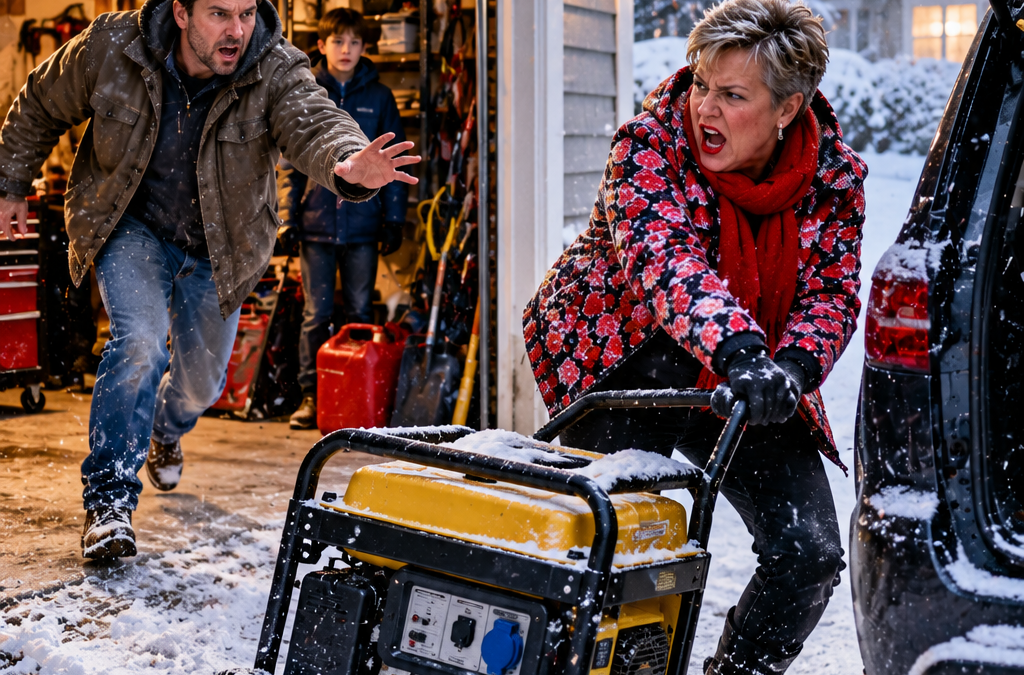
The overhead garage door was open.
Trish was inside.
Both hands wrapped around the generator frame.
Dragging.
For half a second, my mind refused to accept it.
Then everything sharpened.
The generator was already outside the garage.
She had tilted it onto its wheels.
The snow packed around them had stopped them from rolling smoothly.
One metal foot was grinding along the ice.
Trish leaned backward with her full weight.
Her SUV’s rear hatch was open.
She had made it ten feet.
Maybe more.
Then she saw me.
Her face changed.
She shouted:
“That heater is mine!”
The sentence echoed down the driveway.
My body moved before my mind did.
One step.
Two.
Then I stopped myself.
Because I understood something.
If I ran at her and grabbed her, the story could change.
If she fell?
If she claimed I hit her?
If somebody recorded only the final fifteen seconds?
Suddenly the man protecting his property could become the aggressive one.
So I did the hardest thing available.
I slowed down.
Pulled out my phone.
Took a picture.
Flash.
The serial plate.
Ending 4417.
Another photograph.
Trish pulling.
Another.
The groove cut into the snow behind the machine.
“Go ahead,” I said.
She stared at me.
“Keep going.”
She laughed.
Short.
Dry.
She thought I had surrendered.
She dragged the generator another few feet.
I took another photograph.
Then I walked in front of the machine.
I didn’t touch her.
Didn’t touch the frame.
Just planted my boots between the generator and her SUV.
“Put it down.”
“I’m taking back what belongs to me.”
“Show me the receipt.”
She glared.
I waited.
“Show me.”
No answer.
Then she pulled out her phone.
Started recording.
Her entire voice changed.
Louder.
Trembling.
Performing.
“I want everyone to know this man is blocking me from retrieving my property.”
I almost admired how quickly she switched.
“I feel threatened.”
There it was.
Exactly what I had feared.
She wanted footage.
A large man.
A woman.
Night.
Snow.
Conflict.
All she needed was five seconds of me losing control.
So I looked directly at her phone.
“My name is Ethan Cole.”
She stopped talking.
“This is my residence.”
I spoke slowly.
“I purchased this generator today from Pike Equipment and Supply using my own credit card.”
Pause.
“The serial number on my invoice matches the machine.”
Pause.
“I have not given this woman permission to remove it.”
Pause.
“She entered my garage after being asked to leave.”
Pause.
“I am asking her to put the generator down and leave my property.”
It felt strange.
Like dictating a maintenance report.
That was intentional.
Rachel once told me that when frightened, people often speed up.
Speech.
Breathing.
Movement.
I did the opposite.
I photographed the receipt.
The serial plate.
Trish’s hands.
The open garage.
The drag mark.
The distance to her SUV.
She lowered her phone.
“You think pictures are going to save you?”
“I’m not trying to save myself.”
“What does that mean?”
“I’m documenting what’s happening.”
Something flickered in her expression.
Then she dialed three numbers.
I heard the dispatcher answer.
Trish instantly became fragile.
“I need help.”
Her voice trembled.
“There is a man here who has an emergency generator that I purchased and he refuses to give it to me.”
I stood completely still.
“My elderly mother is at home without heat.”
She turned partly away.
“He won’t let me leave.”
That was a lie.
“I don’t feel safe.”
Another lie.
Listening to someone lie about you to emergency dispatch is a strange experience.
Every instinct says interrupt.
Correct.
Defend yourself.
But the call was being recorded.
That mattered.
Behind me, the kitchen door opened.
“Dad?”
Noah.
I did not turn.
“Rachel.”
She understood.
“Take him inside.”
I heard the door close.
Lock turn.
The dispatcher eventually asked to speak with me.
Trish held the phone toward me without giving it up.
I stayed several feet away.
I said my name.
Address.
No injuries.
No weapons.
Property dispute.
I told the dispatcher I would maintain distance until deputies arrived.
She instructed both of us not to touch each other.
Fine with me.
Trish ended the call.
Looked at the generator.
Then started pulling again.
The machine scraped another six feet.
“Stop.”
I kept my voice low.
She did.
The groove now ran almost forty feet.
From inside my garage.
Across packed snow.
Toward her open SUV.
No person could look at that trail and believe the generator had accidentally arrived there.
I crouched near the frame.
A plastic guard around one support foot had cracked where she dragged it over ice.
White plastic fragments remained inside the split.
I photographed that too.
From the house, Rachel cracked the kitchen window.
“Ethan!”
I looked.
“It’s fifty-one.”
I closed my eyes briefly.
The machine meant nothing if it sat in the driveway while my family froze.
But I also knew touching it before deputies arrived could complicate the scene.
So we waited.
Wind.
Darkness.
Trish standing near her SUV.
Me near the generator.
Rachel and Noah inside.
Every few minutes I looked toward the road.
Nothing.
The temperature kept dropping.
Then red and blue light appeared through the snow.
Two patrol vehicles crawled toward the house shortly after seven.
Relief hit me so hard my legs almost weakened.
The cars stopped at angles along the road.
Deputy Marcus Hale stepped out first.
Late thirties.
Broad shoulders.
Slow, controlled movements.
Deputy Laura Bennett came from the second vehicle.
Flashlight already in hand.
“Everybody stay where you are.”
I stepped back.
Hands visible.
Trish immediately rushed toward them.
Of course she did.
“Officer, thank God.”
Marcus held up one hand.
“Stay there, ma’am.”
She stopped.
Then started talking.
The generator was hers.
She had obtained it.
I had taken possession improperly.
Her elderly mother was freezing.
She tried to retrieve the machine.
I physically prevented her from leaving.
She felt threatened.
Marcus listened.
Did not interrupt.
When she finished, he asked:
“Do you have proof of ownership?”
“The store knows me.”
“Receipt?”
“No.”
“Bill of sale?”
“No.”
“Order confirmation?”
“It wasn’t that formal.”
“Deposit?”
“No.”
“Reservation?”
“They understood.”
Laura stepped in.
“What model?”
Trish hesitated.
“Seven-thousand-something.”
“Serial number?”
“How would I know that?”
“Payment method?”
“I was supposed to pay when I picked it up.”
“Any email?”
“No.”
“Text?”
“No.”
“Phone record with the store?”
“I spoke in person.”
Laura wrote.
No expression.
Then Marcus turned to me.
I handed him the folded invoice.
Didn’t give a speech.
He read it.
Passed it to Laura.
She crouched beside the generator.
Flashlight over the plate.
She read the serial number aloud.
One character at a time.
Marcus followed on the invoice.
When she reached the final digits:
“Four-four-one-seven.”
Marcus nodded.
Match.
He looked at me.
“Tell me what happened.”
So I did.
In order.
Power outage.
Old generator unreliable.
Pike Equipment.
Purchase.
Drive home.
Trish’s arrival.
Her claim.
Call with Gerald.
Request that she leave.
Second entry through the garage.
Generator dragged outside.
911 call.
I never called her a thief.
I never said she was crazy.
I never said she was lying.
I described actions.
That is something technical work had taught me.
A good failure report says:
The bearing overheated.
Lubrication was absent.
Shaft misaligned.
It does not say:
The idiot on second shift destroyed it.
Facts first.
Conclusions later.
Laura walked the drag trail.
From garage threshold.
Down driveway.
Past my truck.
To the generator.
Then beyond it toward Trish’s SUV.
She swept her light into the open cargo area.
Stopped.
Looked back.
Trish said quickly, “I was only moving it so I could verify it.”
Laura turned.
“If it was yours, why did you need to verify it after removing it?”
Silence.
Trish looked at Marcus.
Then me.
Then the generator.
“It was in the way.”
Laura looked at the empty driveway around us.
Nothing was in its way.
Marcus walked toward the SUV.
Inside the cargo area was a heavy moving blanket.
A long ratchet strap sat ready near the rear opening.
Hook positioned outside.
Prepared.
Not random.
He turned back.
“Ma’am, why is your cargo area set up to secure this generator?”
“I carry equipment.”
“In an SUV?”
“For my work.”
“What work?”
“Private service management.”
Whatever that meant.
I pointed toward the cracked footguard.
“The machine was undamaged when I bought it.”
Laura photographed it.
Marcus told everyone not to touch the generator again until he finished documenting.
Then Laura called Pike Equipment using the number printed on my invoice.
Gerald answered.
She identified herself.
Asked whether he had sold a generator to Ethan Cole that afternoon.
“Yes.”
Model?
Correct.
Time?
4:41.
Serial number?
Gerald read it.
Match.
Trish stepped closer.
“The store made a mistake.”
Gerald heard her.
“No, ma’am.”
“You knew I wanted it.”
“I knew you looked at it.”
“You told me—”
“I told you the price.”
“I said I was coming back.”
“You said you’d think about it.”
“I had an emergency.”
“So did everybody who walked through my door today.”
That silenced her for a second.
Then she changed the story.
She no longer said she had bought the generator.
She said it had been promised.
Marcus asked:
“Who promised it?”
“Someone there.”
“Who?”
“I don’t remember his name.”
“When?”
“Earlier.”
“Approximate time?”
“I don’t know.”
“Did you leave money?”
“No.”
“Any written confirmation?”
“No.”
Each answer reduced the claim.
Gerald remained on the phone.
Marcus asked one more question.
“Did you see this woman before Mr. Cole’s purchase?”
Gerald paused.
He said he wanted to be precise.
Then:
“Yes.”
A woman matching Trish’s description came in early that afternoon.
Camel coat.
Asked about the 7500-watt dual-fuel generator.
Gerald showed her the last unit.
She objected to the price.
Said it was outrageous.
Said she would think about it.
Gerald offered to put her name on the incoming shipment list.
She declined because that shipment wasn’t due until the end of the week.
She left.
Ninety minutes later, I arrived.
Bought the machine.
Melissa loaded it.
Then Gerald said, “Melissa’s here.”
There was muffled movement.
Melissa came on the phone.
“Deputy?”
“Yes.”
“I loaded Ethan’s generator.”
“Anything unusual?”
She paused.
“Actually, yes.”
I felt my stomach tighten.
“There was a black SUV parked at the far edge of the lot.”
Laura looked toward Trish’s vehicle.
Melissa continued.
“Engine running. Woman in the driver’s seat.”
“What happened when Mr. Cole left?”
“The SUV pulled out behind him.”
For a second, I could hear only the generator-less silence of the winter night.
Then memory rearranged itself.
The dark vehicle behind me through town.
Three car lengths.
County road.
Turns.
My driveway.
Trish had followed me.
Not because she was confused.
Not because Gerald told her where I lived.
She watched me buy the generator she had refused to pay for.
Then followed me home through a blizzard.
Marcus turned toward her.
“Mrs. Whitmore.”
She looked at him.
“Did you see Mr. Cole purchase the generator?”
No answer.
“Ma’am?”
Wind moved snow across the road.
Finally:
“I knew he got it.”
Laura stopped writing for half a second.
Marcus asked, “Then why did you tell 911 it belonged to you?”
Trish looked at me.
Then at him.
And finally said the most important words of the entire night.
“Because I thought he should give it to me.”
Nobody spoke.
She continued.
“My mother is eighty-one. He had options. I didn’t.”
Marcus said, “But you knew the generator belonged to him.”
“I knew he paid for it.”
“That’s usually what belonging means.”
She flushed.
“I thought given the circumstances he should step aside.”
Laura’s pen resumed.
I said nothing.
I understood instinctively that anything I added could only dilute what Trish had just admitted.
She knew.
She followed me.
She entered my property.
She moved the generator.
She called 911 saying it was hers.
All because she believed her need gave her a superior claim.
Laura examined the damage.
Asked if the crack was preexisting.
“No.”
Gerald offered to inspect the generator later.
Trish suddenly changed again.
“I’ll pay for it.”
No one answered.
“I’ll pay cash.”
She reached toward her coat pocket.
“I’ll cover the plastic piece. Let’s just settle this.”
I shook my head.
“No.”
Her eyes narrowed.
“Why?”
“Because I want a report.”
“This doesn’t need to become some legal crusade.”
“It’s already a police response.”
“You are trying to punish me.”
“No.”
I looked toward the house.
“I’m trying to document what happened.”
Rachel opened the kitchen window again.
“Ethan.”
I looked.
“Forty-nine.”
That did it.
I turned to Marcus.
“You’ve photographed the machine?”
“Yes.”
“Serial?”
“Yes.”
“Damage?”
“Laura has it.”
“Trail?”
“Yes.”
“I need to get heat back into my house.”
He looked at Rachel through the window.
Then at Noah behind her.
“Understood.”
I explained the exterior pad.
Transfer inlet.
Safe location.
Marcus nodded.
“Move it. Mrs. Whitmore, remain near your vehicle.”
Trish said nothing.
I rolled the generator around the side of the house.
The damaged foot dragged slightly.
I hated hearing it.
Once on the sheltered pad, I connected the cable.
Checked oil.
Fuel valve.
Choke.
Everything twice.
Then I pulled the starter.
Cough.
Again.
The engine caught.
Deep.
Steady.
Beautiful.
I flipped the transfer switch.
For a moment, nothing.
Then the furnace blower started.
Inside, lights came on.
Family room.
Kitchen.
Hall.
Yellow rectangles appeared in the windows.
I could see Rachel pull Noah close.
He looked outside.
I raised one hand.
He raised his.
That moment nearly broke me.
For hours, I had been thinking about ownership.
Evidence.
Police.
Receipts.
Suddenly the generator became what it really was again.
Heat.
My family.
A twelve-year-old boy who had been watching adults fight over the machine keeping his home safe.
When I turned, Trish had moved closer than Marcus allowed.
She was standing near the corner of the house.
Looking through the window.
At Rachel.
At Noah.
At the lights.
At the family she had reduced to “people with options.”
Her face looked different.
Not apologetic.
But less certain.
Marcus walked back toward the driveway and told her to follow.
Then he explained something in the same calm voice he’d used all evening.
“Need doesn’t create ownership.”
Trish stared at the snow.
“Your mother’s situation is serious,” he said. “Nobody is disputing that.”
No response.
“But one emergency does not give you legal permission to take property needed by another family.”
“I only wanted it for a few hours.”
I finally spoke.
“Then why didn’t you ask?”
She looked at me.
“Would you have said yes?”
“No.”
Her expression became almost triumphant.
“Exactly.”
“No.”
I stepped closer but stayed well outside her space.
“My son was in that house. We had no reliable backup. Roads were dangerous. I would have said no.”
She folded her arms.
“Then what difference would asking make?”
“The difference between asking and taking.”
She looked away.
“If you had asked, I would have given you an honest answer. You could have called another store, emergency services, a shelter, family, anybody.”
“I already tried everything.”
“So you followed me home?”
Her face tightened.
“You had a wood stove.”
“You keep saying that like it belonged to you too.”
She flushed.
“You’re enjoying this.”
“I’m standing outside at twenty-something below while police document you dragging my generator forty feet down my driveway.”
I shook my head.
“I am not enjoying anything.”
Marcus stepped between us.
Not because either of us moved.
Because the conversation had reached its useful limit.
He formally warned Trish not to return to my house, garage, or property.
She had been asked to leave once.
She returned.
She would be treated as trespassing if she came back.
Laura took our written statements.
She photographed everything one more time.
Then, sometime before nine, the deputies left.
Trish drove away shortly afterward.
I stood alone in the driveway listening to the generator.
The sound was almost comforting.
A steady mechanical roar.
Predictable.
Honest.
Inside, the house had climbed several degrees.
Rachel sat at the kitchen table.
Hands around a mug.
Noah had gone upstairs but was sleeping in the family room that night anyway.
I came in.
Rachel didn’t speak.
She reached out.
Wrapped her hand around my wrist.
Held it.
That was enough.
The utility power returned at 10:06 the next morning.
When the furnace switched over and the refrigerator came alive normally, I shut the generator down.
Let it cool.
Checked every connection.
Then I found Noah sitting cross-legged near the wood stove.
Quilt around his shoulders.
Cereal bowl in his lap.
He wasn’t eating.
“What’s up?”
He watched the orange glow behind the stove glass.
“Dad?”
“Yeah?”
“Were we really going to lose the heat?”
I sat beside him.
The easy answer would have been:
No.
I had it handled.
Everything was always going to be okay.
But children remember when adults lie to make them feel safe.
I didn’t want that.
“If she had taken the generator, or if it got broken, we probably would’ve had to leave.”
“Where?”
“Somewhere warm.”
“Like a hotel?”
“Maybe. If we could get there.”
“Grandma’s?”
“Roads were bad.”
He looked down.
“So we could’ve been stuck.”
“Maybe for a while.”
His eyes filled slightly.
“I was scared.”
“I know.”
“I saw her pulling it.”
I didn’t say anything.
“Mom wouldn’t let me come outside.”
“Good.”
“I wanted to help you.”
“Noah.”
He looked at me.
“You helped by staying inside.”
He shook his head.
“I didn’t do anything.”
“You did exactly what I needed.”
He thought about that.
Then said, “I was glad you didn’t hit her.”
That surprised me.
“What?”
“I thought you were going to.”
I sat very still.
He continued.
“I’ve seen movies where somebody takes something and then people fight and the police come and arrest everybody.”
I looked toward the kitchen.
Rachel was standing there.
Listening.
Noah said, “Would you have gotten arrested?”
“I don’t know.”
“But you wanted to hit her?”
Children ask questions adults spend years learning to avoid.
I answered honestly.
“For a few seconds, yes.”
His eyes widened.
“Really?”
“She was taking something we needed. I was angry.”
“But you didn’t.”
“No.”
“Why?”
I thought about it.
“Because being angry doesn’t make every action useful.”
He looked back at the stove.
I continued.
“If I had pushed her and she fell, the whole situation changes. The police have to decide whether I used too much force. She gets to talk about being hurt instead of explaining why she was in our garage.”
“So you took pictures.”
“Yeah.”
“That’s boring.”
I laughed.
“Very.”
“It worked.”
“Yeah.”
Rachel sat on the couch arm behind us.
She put her hand on my shoulder.
“I watched you.”
I looked at her.
She knew what I had felt.
“I almost lost it.”
“I know.”
“I was close.”
“I know.”
“I don’t know if I would’ve stopped if she’d gotten another ten feet.”
Rachel squeezed my shoulder.
“But you did.”
That conversation stayed with me more deeply than the police report.
From my height, that night had been a property dispute.
A machine.
Receipt.
Trespass.
Evidence.
For Noah, it had been something else.
A stranger taking the thing keeping his house warm.
His father standing in the driveway.
Police lights on snow.
His mother holding him inside.
Fear looks different from four feet lower.
Two days later, once the roads were cleared, I brought the generator back to Pike Equipment.
Gerald met me at the loading door.
He looked at the damaged foot.
“She did this dragging it?”
“Forty feet.”
“Impressive.”
“Wrong word.”
“Fair.”
He wheeled it into the service bay.
Removed the cracked guard.
Then found one mounting bracket slightly bent from the repeated impacts against ice.
Not catastrophic.
But enough that vibration could eventually loosen it.
He replaced both pieces.
Checked the frame.
Ran the unit under load.
Then wrote an inspection report.
He documented:
Condition at sale.
Reported incident.
Damage.
Repair.
Cost.
Labor.
Signature.
Date.
While he worked, Gerald told me something else.
Trish had not simply walked away after seeing the price.
She had asked him to find another generator.
He offered to call a supplier in the city.
She refused.
Too far.
Roads too bad.
Then Gerald offered to place her name on the incoming shipment.
She refused again.
She said somebody would sell her one before then.
“She actually said that?”
Gerald nodded.
“Pretty close.”
He tightened a bolt.
“She believed the last generator should stay available until she decided whether she wanted it.”
“Even after leaving.”
“Some people confuse wanting first with owning first.”
He called Trish himself.
I didn’t ask him to.
He explained the repair bill.
Told her the sheriff’s report documented the damage.
She paid by card before closing time.
No argument.
There wasn’t much left to argue.
The police report was boring.
That’s what made it powerful.
It didn’t describe Trish as evil.
Didn’t describe me as heroic.
It said:
Ethan Cole provided an invoice identifying the generator by serial number.
Pike Equipment confirmed the sale.
Patricia Whitmore provided no ownership documentation.
Whitmore moved the generator from Cole’s garage without permission.
Whitmore’s initial account to emergency dispatch did not align with information later verified by deputies.
Damage occurred during the unauthorized movement.
Simple.
Facts rarely need adjectives when they’re strong enough.
The next afternoon, I was loading the repaired generator into my truck when Trish appeared.
No camel coat.
No scarf.
No performance.
Just a woman standing several feet away in a parking lot.
“Ethan.”
I paused.
“What?”
“Can I talk to you?”
I waited.
She looked toward the generator.
“You could’ve just given it to me.”
I almost laughed.
Not because it was funny.
Because after everything, that was still where her mind was.
I thought about Noah.
The thermometer.
The garage door opening.
The groove in the snow.
Then I said:
“And you could have just asked.”
She looked at me.
“You said yourself you would’ve refused.”
“Yes.”
“Then asking wouldn’t have changed anything.”
“It would’ve changed everything.”
“How?”
“You would’ve still been a woman asking for help.”
I paused.
“Instead, you became a woman dragging my generator out of my garage.”
Her face hardened.
“You had options.”
“So did you.”
“My mother could have died.”
“My son was in a freezing house.”
“He’s young.”
“So?”
“Young people tolerate cold better.”
That sentence erased the last of my sympathy.
“Trish.”
I stepped closer to the truck.
“You don’t get to decide which member of my family can afford danger so yours doesn’t have to.”
She stared.
I continued.
“That’s the part you still don’t understand.”
She looked away.
“I’m not a bad person.”
I had not called her one.
“I didn’t say you were.”
“You think I’m a thief.”
“I think you followed me home, entered my garage, moved my generator, and called 911 claiming it was yours.”
Her jaw tightened.
“Those are facts.”
I closed the tailgate.
“What you call yourself afterward is your problem.”
I got into the truck.
She didn’t stop me.
For several days, I thought the story ended there.
It didn’t.
Not really.
The legal side ended.
The emotional part stayed.
I kept thinking about the second before I stopped myself from running at Trish.
I could still feel it.
The surge.
Hands tightening.
Vision narrowing.
That primitive certainty that if somebody threatens your home, you put them on the ground.
People like to tell stories about self-control as though calm people don’t feel anger.
That’s nonsense.
Sometimes the calmest person in the room is the one spending the most energy not becoming the loudest.
I had wanted to grab the generator.
I wanted to grab Trish.
I wanted to physically remove her from my property.
What stopped me wasn’t kindness.
It was calculation.
For years, I repaired machines by asking what the next failure would be if I made the wrong move.
That night I did the same thing with myself.
If I shove her, what happens next?
If she falls?
If she records it?
If Noah sees it?
If the police arrive and the first visible injury belongs to her?
Every answer made the same point.
Force would feel satisfying for about three seconds.
Evidence would last longer.
So I took pictures.
That decision became more important to me than the generator.
A week later, I saw Trish at the hardware store.
Weather-stripping aisle.
She was holding a box.
Looked up.
Saw me.
We both stopped.
For one moment, I could see her decide whether to speak.
Then she put the box back on the shelf.
Turned.
Walked the other direction.
I didn’t follow.
Didn’t smile.
Didn’t want her humiliated.
By then, she looked ordinary.
That surprised me.
When she stood in my driveway, she had seemed enormous.
Not physically.
In presence.
A person absolutely certain that her emergency should reorganize everyone else’s obligations.
Under fluorescent hardware-store lights, she was just a tired middle-aged woman buying supplies.
That was when I understood something.
She wasn’t a monster.
Monsters are easier.
She was an ordinary person who had become frightened, entitled, and convinced that fear gave her permission.
That is more unsettling.
Because ordinary people become dangerous faster than we like to admit when they start treating their own need as proof of someone else’s duty.
I don’t know what eventually happened with her mother that night.
I later heard through Gerald that Trish found another way to heat part of the house.
Maybe relatives.
Maybe a hotel.
Maybe emergency assistance.
I was glad.
I never wanted an eighty-one-year-old woman hurt.
That had never been the choice.
Trish made it the choice.
Her mother versus my son.
Her furnace versus our furnace.
Her fear versus our ownership.
That false choice justified everything in her head.
But the world does not work that way.
Sometimes two people need the same scarce thing.
One of them owns it.
The other doesn’t.
That can be tragic without making theft righteous.
I’ve thought about scarcity a lot since then.
Storms change people.
Empty shelves.
No fuel.
No heat.
People become less civilized very quickly when they believe there isn’t enough.
Most remain decent.
They ask.
Share.
Trade.
Wait.
Help.
A smaller number start redefining fairness until fairness happens to mean they should get what you have.
Trish didn’t say:
I want your generator.
She said:
You have options.
That was more dangerous.
Because once she made the dispute moral, my refusal could be treated as wrongdoing.
She wasn’t stealing.
She was correcting selfishness.
She wasn’t lying to 911.
She was protecting an elderly woman.
She wasn’t trespassing.
She was retrieving what circumstances supposedly entitled her to.
People can do terrible things once they rename them.
That is why documents matter.
A receipt doesn’t care about the story in your head.
Serial number 4417 belonged to the unit purchased by Ethan Cole at 4:41 p.m.
That was the anchor.
Everything else could move.
Need.
Sympathy.
Fear.
Rhetoric.
The number stayed the same.
Gerald’s statement stayed the same.
Melissa’s memory stayed the same.
The drag mark stayed in the snow until the next storm.
The broken guard stayed broken.
Trish’s 911 call stayed recorded.
She could reinterpret her intentions forever.
She could not reinterpret those things.
Rachel understood this before I did.
One night, after Noah went to bed, she asked:
“Do you know what scared me most?”
“Her taking the generator?”
“No.”
“What?”
“Watching you decide.”
I looked at her.
She sat at the kitchen table.
Same chair she’d been sitting in when I came inside after the deputies left.
“Decide what?”
“Whether to go after her.”
I didn’t answer.
“You had this look.”
“What look?”
“The one you get when something breaks at work and you know exactly what you’re going to do.”
“That’s not reassuring.”
“It wasn’t.”
She smiled slightly.
“Then you stopped.”
“I remembered the phone.”
“No.”
“What?”
“You stopped before she took out the phone.”
I thought back.
She was right.
I had started photographing before Trish recorded.
Rachel continued.
“You knew something bad could happen if you touched her.”
“I knew the story could change.”
“Exactly.”
She looked toward the hallway where Noah slept.
“He saw that.”
“I wish he hadn’t seen any of it.”
“Me too.”
“But he saw you angry and not out of control.”
That sentence stayed with me.
Parents spend years trying to hide their worst emotions from children.
Maybe that’s impossible.
Maybe the useful lesson isn’t that adults don’t get furious.
Maybe it’s that fury doesn’t get to make every decision.
Months passed.
The generator went back into storage after winter.
I maintained it obsessively.
Oil.
Fuel stabilizer.
Battery.
Periodic test runs.
Once a month, I rolled it onto the pad and started it under load.
No more procrastinating.
Every time the engine settled into that deep rhythm, I remembered the storm.
Noah did too.
One Saturday the following autumn, he was helping me check the unit.
He was holding the flashlight while I changed oil.
“Serial ends in 4417.”
I looked up.
“What?”
He pointed at the plate.
“4417.”
“You remember?”
“Of course.”
I smiled.
“That’s slightly concerning.”
He shrugged.
“Important number.”
Maybe it was.
I let him help with the service.
Showed him how to check the plug.
How to inspect the frame.
Why a generator never runs inside any enclosed space.
Why the transfer switch matters.
Then he asked:
“What would you do if someone tried to take it now?”
I looked at him.
“Call you.”
“Me?”
“You’re taller.”
He laughed.
“No, seriously.”
I thought.
“Probably the same thing.”
“Pictures?”
“Pictures.”
“Police?”
“If needed.”
“No hitting?”
“Hopefully not.”
He grinned.
“You sound disappointed.”
“Very.”
He laughed again.
I was grateful he could laugh about it.
That night had become a story for him rather than a wound.
That was enough.
The generator itself still has a faint scrape on one section of the frame.
Gerald offered to replace that too.
I told him not to.
Not because I wanted a trophy.
Because it didn’t affect function.
And because I don’t mind scars on machines.
Machines are built to be used.
The repaired footguard works.
The bracket is straight.
Everything important remains solid.
In that sense, maybe the generator is like the rest of us after that night.
Functional.
Marked.
Still useful.
I never heard another word from Trish.
No apology.
No letter.
No phone call.
For a while, that bothered me.
I thought closure meant the other person eventually understands.
Says:
I was wrong.
I’m sorry.
I shouldn’t have done it.
Life rarely cooperates that neatly.
Some people never give you the sentence you deserve.
If your peace depends on hearing it, they still control something.
So I stopped waiting.
I had the report.
The receipt.
The repaired machine.
My family was safe.
That was closure.
The next winter was milder.
We lost power once.
Only twenty minutes.
No emergency.
Still, I rolled the generator out before dark.
Noah helped.
Rachel watched from the kitchen window.
When the engine started, Noah looked toward the road.
I noticed.
“You expecting someone?”
“No.”
“Black SUV?”
He smiled.
“Maybe.”
I put my arm around his shoulders.
“No one’s taking this one.”
“I know.”
This time, he believed me.
I think that’s where the story really ends.
Not with police.
Not with Trish paying the repair.
Not with the hardware-store aisle.
It ends with trust returning to normal.
A boy hearing a generator start and thinking about power, not danger.
A wife seeing her husband walk into the driveway and not wondering whether someone is waiting in the dark.
A machine becoming a machine again.
People asked me afterward why I didn’t just give Trish the generator.
Some said they would have.
Maybe they would.
Maybe if I had lived alone, I might have thought differently.
Maybe if I had owned two.
Maybe if the roads were safe.
Maybe if I knew her mother had nowhere else.
Life is full of hypotheticals that cost nothing after the emergency is over.
That night, I had one machine.
One family.
One responsibility.
I don’t regret choosing them.
I also don’t regret understanding why Trish was scared.
Both things can be true.
Compassion does not require surrender.
Understanding someone else’s desperation does not obligate you to let them harm you.
Boundaries are not cruelty simply because someone dislikes the answer.
That may be the most important thing I learned.
Trish kept trying to turn “no” into evidence against me.
No meant selfish.
No meant uncaring.
No meant I was letting her mother suffer.
But no was simply the answer.
The generator was mine.
My family needed it.
I was not giving it away.
She could hate that.
She could cry.
She could call it unfair.
She could call 911.
None of that changed ownership.
Years of mechanical work taught me there are some facts you cannot negotiate.
You can argue with a seized bearing.
It remains seized.
You can yell at a broken belt.
It remains broken.
You can tell a scale that the weight is unfair.
The number remains.
That night, Trish argued with a receipt.
The receipt won.
She argued with the serial number.
The serial number won.
She argued with the trail in the snow.
The trail won.
Eventually, even her own words worked against her.
I knew he got it.
I thought he should give it to me.
That was the whole case in two sentences.
She knew it was mine.
She thought she deserved it more.
Everything else was performance.
I sometimes wonder what would have happened if I had left the garage five minutes longer.
Could she have loaded the generator herself?
Probably not easily.
But she had straps.
Blanket.
SUV.
Maybe she would have managed.
Maybe I would have returned to an empty driveway.
By the time deputies arrived, she might have been gone.
Then the night becomes more dangerous.
We pack blankets.
Try driving icy roads.
Find a shelter.
Maybe the pipes freeze.
Maybe we end up fine.
Maybe not.
That possibility is why I refuse to romanticize her motive.
Her mother being cold did not make my family less vulnerable.
She wasn’t transferring inconvenience.
She was transferring risk.
Away from herself.
Onto us.
Without our permission.
That distinction matters.
People often call selfishness the refusal to absorb consequences someone else wants to hand you.
It isn’t.
Sometimes protecting your family requires saying:
Your emergency is real.
I am still not giving you what keeps my child safe.
That can feel harsh.
It can also be responsible.
The night taught me another thing.
Never underestimate boring preparation.
Transfer switch.
Receipt.
Serial number.
Camera on the phone.
Generator pad.
Fuel cans.
Written report.
Nothing glamorous.
Nothing heroic.
But when trouble arrived, those small pieces gave me options.
Gerald’s handwritten serial number might have been the most valuable ink in the county that night.
Melissa checking my straps twice.
The service report.
The 911 recording.
Tiny things.
Individually forgettable.
Together undeniable.
People like Trish depend on confusion.
Documentation removes confusion.
That’s why the moment I remember most clearly isn’t when the deputies arrived.
It’s when I looked at my own phone screen and saw the flash reflected from the generator’s data plate.
In that instant, I knew I didn’t need to overpower her.
I needed to outlast the lie.
So I let her talk.
Let her record.
Let her call.
Let the deputies ask.
Let Gerald remember.
Let Melissa describe the SUV.
Every word narrowed her options until only the truth remained.
In a strange way, Trish built the case against herself.
Every step dragging the generator lengthened the mark in the snow.
Every sentence on the 911 call created something that could be compared against evidence.
Every change in her explanation showed exactly where the earlier version failed.
She thought escalation would create leverage.
Instead, escalation created records.
That’s the danger of lying to systems designed to document.
You have to maintain the first story through every new fact.
The truth doesn’t have that problem.
It just sits there.
Years later, I can still hear the overhead garage door rising.
That rattling metallic sound.
I sometimes hear it now when I open the door on a winter evening, and for one second I am back in that yard.
Then the feeling passes.
Memory is strange that way.
A sound can hold an entire night.
The smell of cold exhaust.
Flashlight beams.
Rachel’s voice:
It’s fifty-one in the kitchen.
Noah asking:
Is that lady going to take it?
Trish shouting:
That heater is mine.
Deputy Marcus asking:
Then why did you tell 911 it was yours?
And her answer:
Because I thought he should give it to me.
I don’t hate her.
That surprises some people.
I hated what she did.
There is a difference.
Hate requires maintenance.
I already maintain enough equipment.
What I feel now is mostly distance.
A recognition that ordinary people can cross extraordinary lines once they believe their justification is strong enough.
That’s useful knowledge.
It makes me slower to judge someone’s fear.
And quicker to defend a boundary when fear becomes entitlement.
My old generator—the broken one I failed to repair before the storm—still sits in the corner of the garage.
I eventually rebuilt it too.
Because after that winter, leaving any machine unfinished started bothering me.
It runs now.
Not as well as the new one.
But well enough for tools.
I have two generators.
If Trish had knocked on my door today during a similar storm?
If I knew her mother needed heat?
I might lend her the old one.
Maybe even drive it over myself.
That doesn’t make my original decision wrong.
Circumstances change.
Resources change.
Trust changes.
The important thing is that giving must remain giving.
Help stops being generosity when someone takes it.
I think about that whenever people talk about kindness as though it has no boundaries.
Kindness given freely creates connection.
Kindness demanded under threat becomes submission.
Trish wanted the moral credit of receiving help without allowing me the moral agency of choosing whether to help.
That’s why her argument was always hollow.
She never trusted me enough to ask.
She only trusted pressure.
Then force.
Then a false report.
I wish she’d asked.
Not because I would have given her the generator.
I wouldn’t.
But because there were other possibilities.
Rachel worked in health care.
We knew people.
Gerald was calling suppliers.
County emergency services had warming shelters.
Maybe we could have helped her find another way.
Instead, by the time the deputies arrived, every ounce of energy was being spent sorting out a conflict she created.
That is what entitlement wastes.
Not just property.
Time.
Goodwill.
Options.
By forcing a single answer, she destroyed alternatives.
I think that is the tragedy underneath the ridiculousness.
Two frightened families in dangerous cold could have been neighbors helping each other.
Instead, one woman decided the machine belonged to whoever needed it most according to her own calculation.
The next morning, Noah told me he was scared.
I remember that more clearly than Trish’s face.
Because my responsibility that night was larger than keeping a generator.
I was teaching my son something whether I intended to or not.
What does a man do when someone violates his home?
Does he explode?
Does he surrender?
Does he become cruel because the other person is wrong?
Or does he hold the line without losing himself?
I wish I could say I handled it perfectly because I am exceptionally disciplined.
I didn’t.
I handled it because I was afraid of what would happen if I didn’t.
Sometimes fear can sharpen you instead of ruining you.
I feared losing the generator.
I feared Rachel and Noah freezing.
I feared being arrested if I touched Trish.
I feared my son seeing me become someone he didn’t recognize.
All of those fears competed.
The one I listened to was the one saying:
Stay still.
Document.
Tell the truth.
That saved the night.
Not courage.
Not strength.
Restraint.
The coldest night I can remember taught me that restraint isn’t passive.
Standing still while every muscle tells you to move can be an act.
Keeping your hands open can be an act.
Saying only what you can prove can be an act.
Waiting for facts to catch up with a lie can be an act.
People often imagine defending themselves as something loud.
Sometimes the best defense sounds like a camera shutter.
A serial number being read aloud.
A deputy asking a simple question.
A witness saying:
I watched her follow his truck.
That was enough.
The generator still starts on the second pull most days.
Sometimes the first.
I test it before every winter.
Noah is older now.
Strong enough to help me roll it.
Rachel still checks the flashlights herself because she has never accepted my definition of knowing where they are.
The porch thermometer has been replaced twice.
The wood stove remains.
The transfer switch remains.
And inside a fireproof folder in my office, the old Pike Equipment invoice is still there.
Ethan Cole.
4:41 p.m.
$1,989.
Serial 4417.
The paper is beginning to soften along the folds.
I could throw it away.
Warranty expired long ago.
I haven’t.
Not because I expect Trish to return.
She won’t.
I keep it because that little sheet of paper reminds me of something I needed to learn.
A loud claim does not become true because it is emotional.
A desperate person does not become an owner because their need is real.
A lie does not become stronger because police are called.
And a calm person is not weak because he refuses to fight the way someone else expects.
That night, Trish believed I had only two options.
Give her the generator.
Or become the villain for refusing.
She was wrong.
There was a third option.
I kept what belonged to me.
I protected my family.
I never touched her.
And I let the truth stand in the driveway until everyone else finally saw it too.
That was enough.








