𝗙𝗨𝗟𝗟 𝗦𝗧𝗢𝗥𝗬 The Woman Who Called 911 Over Our Christmas Dinner Had Already Been Told the Table Wasn’t Hers
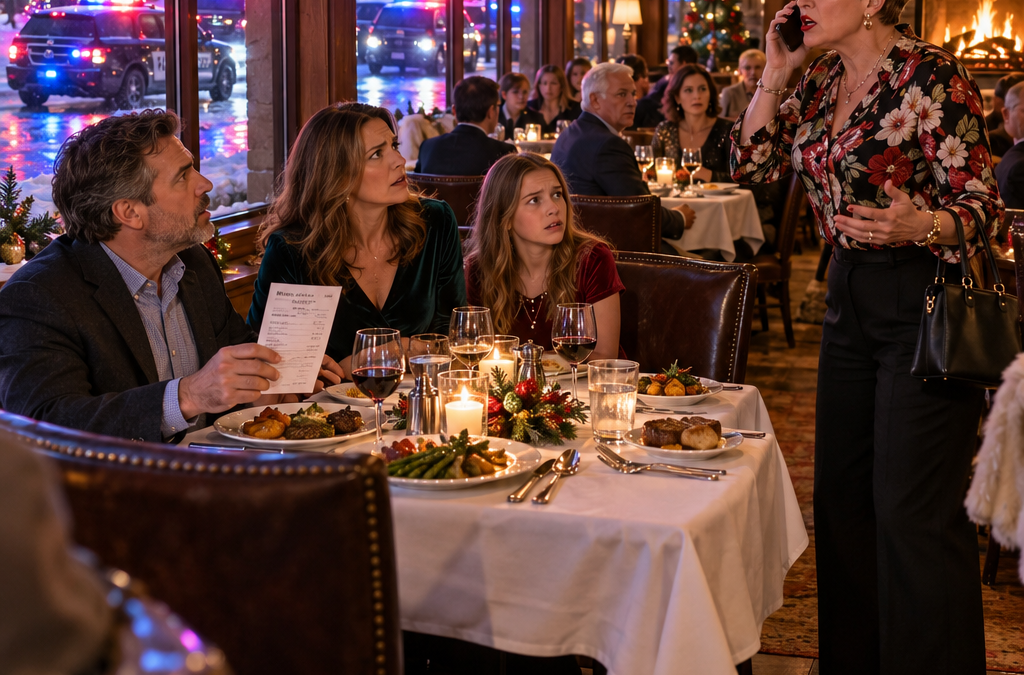
𝗙𝗨𝗟𝗟 𝗦𝗧𝗢𝗥𝗬
She kissed my cheek.
“You’re treating Christmas dinner like a service ticket.”
“Service tickets get results.”
Neither of us knew how useful that stupid piece of paper would become.
I left work two hours early Christmas Eve.
My supervisor had approved it weeks before.
By the time I pulled into our driveway, Rachel was already dressed.
There was a small wrapped box on the kitchen counter that she had been hiding from Sophie.
Sophie herself stood beside the front door in the nicest coat she owned.
“You’re late.”
I looked at my watch.
“I’m twelve minutes early.”
“You said we’d leave at five forty-five.”
“It is five thirty-three.”
“Exactly. We could leave now.”
Rachel laughed.
“Someone’s excited.”
“No.”
Sophie was almost bouncing.
Rachel and I exchanged a look.
That alone made the reservation worth the effort.
We arrived downtown a little before seven.
Christmas lights covered the square.
The storefronts glowed.
People moved along the sidewalks carrying shopping bags and cups of coffee.
A light wind had picked up, cold enough that Sophie grabbed my arm while we crossed the parking lot.
Evergreen Hearth looked exactly as I remembered.
Warm golden windows.
Garlands around the entrance.
Small lights wrapped around the lamp posts outside.
For a few seconds, standing there with Rachel on one side and Sophie on the other, I felt ridiculously proud.
Not because booking a table was some great achievement.
Because I had managed to protect one evening.
Parents understand those small victories.
You plan around jobs, school schedules, bills, exhaustion, and all the things that compete for attention.
Sometimes success is simply getting everybody to the same place while they’re still happy to be together.
Inside, the restaurant was busy but comfortable.
Conversation.
Silverware.
Glasses.
Christmas music low enough not to become irritating.
A young host named Ethan Brooks welcomed us.
“Mercer?”
“Yes.”
“Party of three?”
“That’s us.”
He checked his tablet.
“Window table.”
Sophie smiled before he finished the sentence.
Ethan led us through the dining room.
The table was exactly where I had hoped.
Beside the tall windows overlooking the square.
Sophie sat closest to the glass.
Rachel sat beside her.
I took the opposite side.
Our server, Claire Dawson, brought menus.
Sophie flattened her napkin across her lap with ridiculous seriousness.
Rachel asked what she wanted for Christmas.
Sophie rolled her eyes.
“You already asked me.”
“I’m checking for updates.”
“I want one dinner where neither of you checks your phone.”
I pulled mine from my pocket.
Turned it to silent.
Placed it inside my coat.
Rachel did the same.
“Done.”
Sophie looked satisfied.
For the first fifteen minutes, the evening was exactly what I had planned.
Rachel relaxed.
Sophie talked about school.
We ordered drinks.
Outside, families moved through the square beneath strings of lights.
I remember looking at my wife and daughter and thinking how strange it was that something so ordinary could feel so rare.
Then the front door opened.
Vanessa Cole walked in.
I did not know her name yet.
What I noticed first was the way she entered.
Some people walk into a crowded room looking for where they belong.
Vanessa walked in as though the room already knew.
She was probably in her late forties.
Expensive coat.
Perfect hair.
Phone in hand.
Two people followed her, a woman around her age and a man who seemed determined not to attract attention.
I would later learn they were Vanessa’s sister and brother-in-law.
Vanessa barely paused at the host stand before looking toward our side of the dining room.
Toward our table.
She spoke to Ethan.
At first, I couldn’t hear them.
Then his expression changed.
He checked the tablet.
Vanessa looked toward us.
Back at him.
She said something.
He checked again.
Rachel noticed.
“What?”
“Nothing.”
“You’re looking over there.”
“Somebody seems confused about a reservation.”
Sophie was busy watching the lights outside.
I hoped it would stay that boring.
Then Vanessa’s voice became loud enough to hear.
“Are you sure that man actually reserved it?”
That man.
Me.
Rachel looked at me.
I felt something settle in my stomach.
Not anger yet.
Recognition.
This wasn’t going to be solved by Ethan pointing at a screen.
Vanessa spoke to him another few seconds.
Then instead of waiting for a manager, she walked directly toward us.
Her sister stayed near the entrance.
Her brother-in-law looked at the floor.
Vanessa stopped beside our table.
“This table is usually reserved for my events.”
There was no hello.
No apology.
I looked up.
“Okay.”
“I believe there has been a mistake.”
“We have a reservation.”
“This specific table is normally held for my clients.”
I reached for my phone.
Rachel touched my arm lightly, not to stop me, just aware the atmosphere had changed.
I opened the confirmation email.
“I booked it three weeks ago.”
I turned the screen.
Reservation number.
Date.
Time.
Table request.
Vanessa glanced at it for maybe half a second.
“That doesn’t change the arrangement I have with this restaurant.”
That was my first real clue.
She wasn’t checking whether she was mistaken.
She had already decided mistake and inconvenience were the same thing.
Ethan had followed her.
He said carefully, “Ms. Cole, Mr. Mercer’s reservation is valid.”
Vanessa turned.
“I’ve hosted seven client dinners in this section.”
“I understand.”
“You know Monica normally accommodates me.”
“I understand, but there isn’t another booking under your name tonight.”
Vanessa looked back at me.
Then she changed strategies.
“You seem like a reasonable person.”
I almost laughed.
“That depends.”
“My family is hosting a special dinner.”
“So are we.”
She gave a small smile.
“I mean an actual event.”
I looked at Rachel.
Then Sophie.
Sophie had stopped looking outside.
Vanessa continued.
“It would be very easy for your family to move to another table.”
I kept my voice calm.
“Then I assume it would be equally easy for yours.”
The smile disappeared.
“I specifically requested this section.”
“So did I.”
“I have a longstanding relationship with Evergreen Hearth.”
“And I have a confirmed reservation.”
She glanced at Sophie.
“A child isn’t going to care where she’s sitting.”
Sophie lowered her eyes.
That was the first moment I became angry.
Not about the table.
About how casually Vanessa had made my daughter part of the negotiation.
Rachel’s hand closed around my wrist.
A quiet reminder.
Stay calm.
I said, “We’re not moving.”
Vanessa stared at me.
“This is incredibly inconsiderate.”
“We booked the table.”
“You’re choosing to make something difficult that doesn’t need to be difficult.”
“No.”
I looked directly at her.
“You were told the table is reserved. You’re choosing not to accept it.”
For a moment, neither of us spoke.
Then Vanessa turned toward Ethan.
“Get your manager.”
Ethan left.
Vanessa remained beside our table.
That bothered me.
She didn’t return to her family.
She stood there as though the space itself was still under negotiation.
I noticed her eyes moving around the dining room.
People were beginning to watch.
Vanessa noticed too.
Something about that seemed to strengthen her.
I had seen that behavior before.
Not from her specifically.
From people who understood that public discomfort gave them leverage.
If they made a scene large enough, someone eventually surrendered simply to make the scene stop.
Her sister looked embarrassed.
Her brother-in-law shifted near the entrance.
Rachel leaned toward Sophie.
“It’s okay.”
Sophie whispered, “Why does she want our table?”
“Because she expected it.”
“Did we do something wrong?”
That question hurt.
“No.”
I answered immediately.
“We didn’t.”
A woman approached from the rear of the restaurant.
Early fifties.
Dark suit.
Controlled expression.
Monica Reyes, the manager.
She introduced herself.
Then pulled up the reservation system.
“Mr. Mercer, your reservation was made December third.”
“Yes.”
“Deposit received.”
“Yes.”
“Window table requested.”
“Yes.”
She looked at Vanessa.
“There is no reservation for your party attached to this table tonight.”
Vanessa’s posture stiffened.
“You know I use this section for events.”
“Yes, and we’ve appreciated your business.”
“Then you know there is an understanding.”
“There is no standing reservation for Christmas Eve.”
Vanessa’s voice sharpened.
“I emailed about this.”
Monica’s expression changed almost imperceptibly.
“We can discuss that separately.”
“Why separately?”
“Because this family has a valid reservation.”
Vanessa looked at me again.
Then said, “Fine. If this gentleman needs the manager to defend him, maybe we’ll handle it officially.”
I didn’t understand what she meant.
Not yet.
I asked Monica directly, “Can you confirm that we’ve done nothing wrong by being seated here?”
Monica answered immediately.
“Your reservation is valid. You checked in correctly. You were seated by our staff. You have done nothing wrong.”
I wanted Sophie to hear that.
She did.
Her shoulders lowered slightly.
I thought that would end it.
It should have.
Instead, something changed in Vanessa’s face.
The frustration became colder.
Less spontaneous.
She reached into her coat.
Pulled out her phone.
“If you want to handle this officially, we will.”
Then she stepped away.
Dialed.
At first, I assumed she was calling somebody from her event company.
Then I heard:
“I feel threatened.”
I turned toward her.
Rachel did too.
Vanessa continued speaking.
There was a man in the restaurant.
Aggressive.
Refusing to leave her alone.
She felt unsafe.
I realized she had called 911.
My stomach dropped.
For one irrational second, I wanted to walk over and tell her exactly what she was doing.
Then every instinct from years of hospital work took over.
Do not react to the noise.
Protect the record.
I stayed where I was.
“Rachel.”
She looked at me.
“Take Sophie over there.”
“What?”
“Just away from the table for a minute.”
Sophie looked frightened now.
Rachel gathered her coat.
“Come on, sweetheart.”
Sophie stood reluctantly.
“Dad?”
“I’m fine.”
“Are we leaving?”
“No.”
I forced myself to smile.
“We’re having dinner.”
They moved toward the quieter side of the room.
Then I took out my phone.
Opened my reservation.
And sent Monica a short message using the contact thread attached to our booking.
Please preserve all records related to tonight’s reservation, including our booking, deposit, table assignment, and any communications regarding this table.
Maybe that was excessive.
Maybe not.
When people begin making accusations, I prefer documentation before interpretation.
Claire came over quietly.
“Mr. Mercer?”
“Yeah?”
“I checked your reservation when I brought the menus.”
“Okay.”
“You were supposed to be at this table.”
“Thank you.”
Ethan stood nearby.
“No one asked you to leave.”
“I know.”
He looked toward Vanessa.
“She approached you.”
“I know.”
Their nervousness told me how serious the situation had become.
These were young employees working Christmas Eve.
They hadn’t signed up to become witnesses in a police call.
A man at the next table caught my eye.
He was probably in his late sixties.
Gray hair.
Reading glasses.
He gave me one slow nod.
I didn’t know his name then.
Harold Bennett.
Retired high-school teacher.
He had watched almost everything.
Vanessa ended the call.
Then she began telling Ethan that I had approached her aggressively.
That I had blocked her path.
That she had been afraid.
I felt something strange when I heard it.
Not rage.
Disorientation.
There is something deeply unsettling about standing in a room where you know exactly what happened while another person describes a version that doesn’t resemble reality at all.
Rachel heard her.
She returned closer with Sophie.
“That is not true.”
Vanessa looked at her.
“Of course you’d defend your husband.”
Rachel’s face hardened.
“I was sitting beside him.”
“You’re emotionally involved.”
“And you aren’t?”
Vanessa ignored her.
I said, “Rachel.”
She looked at me.
I shook my head.
Not because Vanessa deserved silence.
Because I could see Sophie.
She stood beside her mother with one hand gripping Rachel’s sleeve.
She wanted to disappear.
Then she asked quietly:
“Are we going to have to go home?”
The question carried farther than she intended.
Several people heard.
I crouched slightly.
“No.”
“Are the police coming?”
“Yes.”
“Why?”
“Because that woman called them.”
Sophie looked terrified.
“Are you in trouble?”
“No.”
I said it as clearly as I could.
“I haven’t done anything wrong.”
Outside the windows, red and blue light reflected against the glass.
The dining room went quiet.
Vanessa straightened.
I will never forget the expression on her face when she saw the lights.
Relief.
Satisfaction.
She believed the balance had shifted.
Two officers walked through the entrance.
Officer Marcus Hill.
Officer Elena Ruiz.
Vanessa moved toward them immediately.
I stayed beside the table.
That decision felt unnatural.
When somebody is telling police a false story about you, every instinct says get there first.
Correct it.
Defend yourself.
But I knew competing to speak first would accomplish nothing.
So I waited.
Officer Hill listened to Vanessa.
Officer Ruiz surveyed the room.
Staff.
Customers.
Rachel.
Sophie.
Me.
Then Hill raised a hand.
“We’re going to speak to people separately.”
Good.
That was the first thing all evening that made me feel better.
Vanessa gave her statement.
She said I had taken over a table intended for her party.
That she tried to discuss it reasonably.
That I became aggressive.
That I approached her.
Blocked her movement.
Made her fear for her safety.
She left out some details.
The reservation confirmation.
Ethan telling her we had the table.
Monica confirming it.
The fact that Vanessa had repeatedly approached us.
When Officer Hill turned toward me, I already had my phone open.
“My name is Daniel Mercer.”
He nodded.
“Tell me what happened.”
I handed him the phone.
“This is our reservation.”
He read it.
“Three weeks ago?”
“Yes.”
“Deposit?”
I pulled the printed receipt from my coat.
Rachel had laughed at it that morning.
Officer Hill studied it.
I almost smiled at the absurdity.
“What happened after you were seated?”
I told him.
No embellishment.
Vanessa arrived.
Asked for the table.
I refused.
Staff confirmed the reservation.
Manager confirmed it.
Vanessa called police.
“Did you threaten her?”
“No.”
“Did you approach her?”
“No.”
“Did you block her?”
“No.”
“Any physical contact?”
“No.”
“You raise your voice?”
“No.”
He studied me.
“Why do you think she says she felt threatened?”
“I can’t answer for her.”
That seemed to matter.
Because it was true.
I wasn’t going to guess at Vanessa’s motives.
Officer Ruiz began interviewing Ethan.
I could hear parts.
“Who seated Mr. Mercer?”
“I did.”
“Based on what?”
“Reservation system.”
“Was the reservation valid?”
“Yes.”
“Did anyone ask him to leave?”
“No.”
“Did he touch Ms. Cole?”
“No.”
“Who approached whose table?”
Ethan hesitated.
Then looked toward Vanessa.
“She approached his.”
Officer Ruiz wrote something down.
Then she spoke with Claire.
Same questions.
Same basic answers.
I had arrived on time.
Reservation valid.
I had not behaved aggressively.
Vanessa had come to our table.
Then Officer Ruiz approached the older man.
Harold Bennett.
He seemed almost amused that his quiet Christmas dinner had turned into witness testimony.
“I don’t know either of them,” he said.
“That’s useful,” Ruiz replied.
Harold explained what he had seen.
Vanessa entered.
Looked toward our table.
Walked over.
I remained seated.
She stood beside us.
Asked repeatedly that we move.
I did not approach her.
I did not block her.
At one point, Officer Ruiz asked whether Harold had any relationship with my family.
“None.”
“Any reason to favor them?”
“I would favor finishing my dinner.”
Ruiz almost smiled.
Harold added, “But since that appears unlikely, I can at least tell you what happened.”
His account matched Ethan’s.
Matched Claire’s.
Matched mine.
Separate interviews.
Same sequence.
Then Officer Hill returned to Vanessa.
“What specifically did Mr. Mercer do that made you afraid?”
“He came toward me.”
I watched Ruiz look at her notes.
“When?”
Vanessa hesitated.
“Near the table.”
Ruiz said, “Multiple witnesses say he remained seated.”
Vanessa frowned.
“He positioned himself in a way that blocked me.”
Hill asked, “How?”
“He was… between me and where I needed to go.”
“Were you trying to pass his chair?”
Vanessa paused.
“I was trying to resolve the situation.”
“That wasn’t my question.”
She looked irritated.
“I felt threatened.”
Officer Hill remained calm.
“I’m not asking whether you felt something. I’m asking what action he took.”
Vanessa’s confidence faltered.
“He was confrontational.”
“What did he say?”
“He refused to cooperate.”
“That isn’t a threat.”
Silence.
That silence was the first sign I saw that Vanessa was beginning to understand what she had done.
She had expected a 911 call to strengthen her position.
Instead, she had triggered a process where everyone had to describe events independently.
And independent descriptions were destroying hers.
Then Monica returned from her office carrying a folder and tablet.
Her expression had changed.
Officer Ruiz asked to see reservation records for both parties.
Monica placed the tablet on the host stand.
“Mr. Mercer reserved this table on December third.”
She showed the entry.
“Party of three.”
Deposit.
Window request.
Confirmed.
Then she searched Vanessa.
Nothing.
“No reservation under Vanessa Cole for tonight.”
Vanessa interrupted.
“I have an arrangement.”
Monica looked at her.
“You have hosted private events here previously.”
“Exactly.”
“But there is no event reservation tonight.”
“You know I requested this table.”
Monica became very still.
“Yes.”
Something in the way she said it caught everyone’s attention.
Officer Ruiz asked, “What do you mean?”
Monica opened the folder.
“A few days ago, Ms. Cole emailed asking us to hold this window table informally for a private family dinner.”
My pulse slowed.
Vanessa’s face tightened.
Monica continued.
“The request was declined because the table was already reserved.”
Officer Hill looked at Vanessa.
“You knew it was booked?”
Vanessa answered quickly.
“I was told they would try to accommodate me.”
Monica shook her head.
“No.”
She pulled out the printed email.
“We wrote that the table was unavailable and that we could not override an existing reservation.”
She read the relevant portion.
Not dramatically.
She didn’t need to.
Vanessa had known.
Before she entered the restaurant.
Before she approached our table.
Before she called me unreasonable.
Before she called 911.
She knew the table wasn’t hers.
For the first time all evening, I felt the full shape of what had happened.
This had not been a misunderstanding.
Vanessa had asked.
The restaurant said no.
She arrived anyway.
She expected history, money, familiarity, or force of personality to convert no into yes.
When that failed, she turned the disagreement into an accusation.
Officer Hill looked at her.
“Why did you tell dispatch this man was threatening you when you already knew he had a valid reservation?”
Vanessa’s face flushed.
“That has nothing to do with how he behaved.”
“Then let’s stay with behavior.”
He returned to the same question.
“What did he do?”
“I already told you.”
“You gave several different descriptions.”
“I was upset.”
“That may be true.”
Officer Ruiz stepped in.
“If you believed Mr. Mercer was dangerous, why did you repeatedly approach his table?”
Vanessa looked at her.
“I was trying to resolve the reservation issue.”
“But you went toward him.”
“Yes.”
“More than once?”
“I don’t know.”
Ethan quietly said, “Yes.”
Vanessa turned.
He looked frightened but did not retreat.
“She came over several times.”
Claire nodded.
Harold added, “She did.”
Ruiz looked back at Vanessa.
“You’re telling us you were frightened enough to call 911, but continued approaching the person you were supposedly afraid of.”
“I did not say supposedly.”
Ruiz’s tone remained professional.
“I’m trying to understand the sequence.”
Vanessa’s sister finally spoke.
“Vanessa.”
Vanessa turned sharply.
Her sister looked tired.
“Let’s just go.”
“Stay out of this.”
“I’ve been trying to stay out of it for an hour.”
Her brother-in-law had already picked up his coat.
No one missed that.
Officer Hill explained that nothing they had heard supported treating me as a criminal threat.
No arrest.
No removal.
No basis to force my family from our table.
He advised Vanessa to stop approaching us.
“If you have a dispute over restaurant service, take it up with management.”
“I already did.”
“Then management made a decision.”
Vanessa looked toward Monica.
Monica said, “Your party will not be served tonight.”
Vanessa’s eyes widened.
“You cannot be serious.”
“I am.”
“I’ve spent thousands of dollars here.”
“I know.”
“My company has brought you business for years.”
“I know.”
“And you’re throwing me out because of him?”
Monica shook her head.
“No.”
That single word landed harder than if she’d raised her voice.
“We’re asking you to leave because you disrupted another guest’s confirmed reservation, ignored staff direction, and escalated a seating dispute by giving emergency dispatch an account that is not supported by our staff or independent witnesses.”
Vanessa stared at her.
“I want to speak to you privately.”
“No.”
“Monica.”
“No.”
The manager’s voice stayed even.
“The officers are documenting what happened. There is no reason for us to move this conversation somewhere private.”
Vanessa looked around.
The dining room that had once seemed useful as an audience now seemed unbearable.
She had wanted public pressure.
Now she had public accountability.
Her sister picked up her purse.
“I’m leaving.”
The brother-in-law nodded.
Vanessa looked at them.
Then at the officers.
Then at me.
For one second, I expected another accusation.
Instead, she said nothing.
Officer Hill gave her one final warning.
“911 is for emergencies. A reservation disagreement does not become an emergency because you describe another customer as threatening without specific conduct supporting that claim.”
Vanessa’s jaw tightened.
He continued.
“This call and the witness statements will be documented.”
She nodded stiffly.
Then she left.
No handcuffs.
No dramatic arrest.
No one cheered.
I was grateful for that.
The door closed behind Vanessa and her family.
For several seconds, the restaurant remained unusually quiet.
Then conversation slowly returned.
Forks moved.
Glasses clinked.
Christmas music became audible again.
Life restarted.
I stood there beside the table and realized my hands were shaking.
Not much.
Enough.
Rachel came over.
She took my hand.
“You okay?”
“Yeah.”
Sophie stood beside her.
Her face was pale.
“Can we go home?”
That hurt.
Not because I blamed her.
Because this was exactly what I had tried to prevent.
I had planned the night so carefully because I wanted one peaceful memory.
Vanessa had managed to make my daughter want to escape from it.
I crouched.
“We can.”
Sophie looked at the window table.
Then at the pie Claire had brought before everything happened.
She hadn’t touched it.
Rachel asked, “What do you want?”
Sophie hesitated.
I did not answer for her.
Finally she said, “I don’t want her to ruin it.”
I felt something tighten in my throat.
“Neither do I.”
We sat down.
Not immediately comfortably.
That would have been unrealistic.
The plates had gone cold.
The room still felt too aware of us.
Sophie kept glancing toward the entrance.
Rachel kept touching my hand beneath the table.
Then Monica approached carrying an envelope.
“Mr. Mercer.”
I stood.
“I am so sorry.”
“You don’t need to apologize for her.”
“I do need to apologize that your family had to spend Christmas Eve dealing with this in my restaurant.”
She handed me the envelope.
Inside was a printed copy of our original reservation.
Our deposit receipt.
Refund confirmation.
Then a handwritten note.
Daniel Mercer and family were properly seated pursuant to a valid reservation and were not responsible for the disruption that occurred on Christmas Eve.
No misconduct by Mr. Mercer or his party was reported or observed by restaurant staff.
I read it twice.
That note meant more than the refunded deposit.
People who work around records understand why.
Accusations have a strange way of surviving after the details disappear.
A note in a customer file.
An incident description.
A staff comment months later.
I didn’t want our family remembered as the people who caused police to come to the restaurant.
We hadn’t.
The paper made that clear.
Monica said, “I’ve also removed any internal incident notation from your customer profile except for this clarification.”
“Thank you.”
“And I’d like to offer your family dinner here another evening.”
“You don’t have to.”
“I know.”
She smiled.
“I want to.”
Then she became more serious.
“One other thing.”
“What?”
“Vanessa’s private-event privileges have been revoked.”
I looked at her.
“Because of tonight?”
“Because tonight showed us we’ve allowed familiarity to turn into expectation.”
She glanced toward the door.
“That’s on us too.”
I respected that answer.
“Will she still be allowed here?”
“She can make reservations through the same system as anyone else.”
No special table.
No unofficial arrangement.
No assumption that previous business guaranteed future priority.
It was a surprisingly appropriate consequence.
Vanessa’s problem had never really been that she wanted a good table.
People want things.
That’s normal.
Her problem was that she believed wanting something, combined with being accustomed to receiving it, transformed preference into entitlement.
Now that entitlement was gone.
Officer Ruiz approached before the police left.
“If you’d like a copy of the incident report, it will be available through the department.”
“I probably will.”
She nodded.
“Good idea.”
Then she glanced at Sophie.
“You doing okay?”
Sophie nodded.
“Yeah.”
Ruiz smiled gently.
“Christmas Eve should be less exciting than this.”
Sophie almost smiled.
“Yeah.”
The officers left.
Red and blue reflections disappeared from the windows.
A few minutes later, Claire brought fresh entrées.
“Kitchen reheated everything.”
“Thank you.”
“And Monica sent another pie.”
Sophie finally smiled.
“Another one?”
“Emergency pie.”
That got a laugh.
The first real laugh since Vanessa entered.
I watched my daughter take a bite.
Something in me finally unclenched.
Harold Bennett stopped beside our table on his way out.
“Mr. Mercer.”
I stood.
“Thank you for speaking to the officers.”
“I told them what I saw.”
“Still.”
He looked at Sophie.
“You handled a difficult evening with more grace than many adults I’ve taught.”
Sophie sat a little straighter.
“Thank you.”
Harold nodded.
“Merry Christmas.”
Then he left.
Ethan came by next.
He looked exhausted.
“I’m really sorry.”
“Stop apologizing.”
“I should’ve gotten Monica sooner.”
“You did fine.”
“I didn’t know she was going to call the police.”
“Neither did I.”
He looked toward Sophie.
“I’m sorry your dinner got messed up.”
She shrugged.
“It’s okay.”
Then, after a second:
“Thanks for not making us move.”
Ethan seemed surprised.
“Of course.”
That sentence stayed with me.
Of course.
It should have been obvious.
We had the reservation.
Moving us should never have been the easiest solution.
But I understood why businesses sometimes do that.
A demanding customer raises the emotional cost of saying no.
Someone else is quieter.
So management asks the quieter person to compromise.
Move tables.
Accept the inconvenience.
Take the refund.
Be reasonable.
All because the unreasonable person has made resistance exhausting.
Evergreen Hearth didn’t do that.
Ethan checked the record.
Monica honored it.
That mattered.
Eventually, Sophie opened the small wrapped box she had brought.
It wasn’t the gift Rachel had hidden at home.
Sophie had made something for us.
Inside was a small frame.
A photograph from the previous Christmas.
The three of us standing in our kitchen.
Underneath, she had written:
My favorite place is wherever both of you are.
Rachel cried immediately.
I blamed Vanessa for making my eyes look watery.
Sophie laughed.
For the first time that evening, the dining room disappeared again.
It was just us.
Exactly what I had wanted.
Outside, snow had started falling.
Softly.
The square lights blurred through the window.
Sophie pressed her hand against the cold glass just as she had when we first arrived.
Rachel leaned against my shoulder.
I thought about how close we had come to letting the worst fifteen minutes define the whole night.
That might be the lesson I remember most.
Holding your ground does not always mean escalating.
Sometimes it means refusing to surrender something simply because another person’s behavior has made keeping it uncomfortable.
We finished dinner.
We had dessert.
Sophie ate most of the second pie.
On the drive home, she was quiet.
Not upset.
Thinking.
About halfway there, she asked:
“Why would someone call the police over a table?”
Rachel looked at me.
I thought carefully before answering.
I didn’t want to tell my twelve-year-old that Vanessa was evil.
People are usually more complicated than that.
So I said, “Some people get very used to hearing yes.”
Sophie looked out the window.
“And then?”
“When they finally hear no, they think the no is the problem.”
“But it wasn’t her table.”
“No.”
“She knew?”
“Yes.”
“So why did she come?”
“Probably because she thought someone would change the answer.”
“And when you didn’t?”
“She got angry.”
Sophie frowned.
“That’s stupid.”
Rachel laughed softly.
“Concise but accurate.”
Sophie thought another moment.
“Were you scared when the police came?”
That question surprised me.
“Yes.”
She turned.
“You didn’t look scared.”
“I was.”
“Then why were you acting normal?”
“Because being scared doesn’t mean you have to act scared.”
She considered that.
“Is that something from your hospital job?”
“Probably.”
I smiled.
“Machines don’t care how upset you are. You still have to look at the evidence.”
She nodded slowly.
Then said, “I’m glad you printed the receipt.”
From the driver’s seat, Rachel burst out laughing.
I looked at her.
“You mocked the receipt.”
“I retract my criticism.”
“Put it in writing.”
“Don’t push it.”
By the time we reached home, Sophie was laughing again.
That mattered more than anything Vanessa lost that night.
In the weeks afterward, the incident became smaller.
That’s what time does.
The police report confirmed what the officers had told us.
No evidence of threatening conduct by me.
Witness statements consistent.
Reservation dispute.
No criminal action.
I saved a copy.
Of course I did.
Evergreen Hearth emailed us again after New Year’s.
Monica reiterated the invitation for a complimentary dinner.
We waited several months before going back.
I wondered whether Sophie would want to.
She did.
“Can we get the window table?”
I laughed.
“If it’s available.”
“It better be.”
“Don’t make me call 911.”
Rachel hit my arm.
“Too soon.”
When we returned, Ethan still worked there.
He recognized us immediately.
“No police tonight,” he said.
“I was hoping for a quieter experience.”
“I’ll do my best.”
The window table was available.
We sat there.
Nothing happened.
No confrontation.
No special treatment.
Just dinner.
That evening was almost more meaningful than the first one because it gave the place back to us.
Bad experiences contaminate locations if you let them.
A restaurant becomes the place where police arrived.
A street becomes the place where you crashed.
A room becomes the place where somebody gave you terrible news.
Sometimes returning is how you remind yourself that one event doesn’t own the place forever.
Evergreen Hearth became our restaurant again.
Vanessa never approached us.
I saw her once months later.
Not at the restaurant.
At a charity event connected to the hospital.
She was standing near a registration table talking to several people.
Our eyes met.
I recognized her immediately.
She recognized me too.
For a second, I wondered whether she would walk over.
She didn’t.
Neither did I.
No confrontation was necessary.
I didn’t need an apology from her.
That surprised me.
In the days after Christmas, part of me had imagined one.
Vanessa admitting she lied.
Explaining herself.
Acknowledging what she had done to Sophie.
But apologies only matter when they contain understanding.
I had no idea whether Vanessa understood.
What I knew was that the system around her had changed.
The restaurant no longer gave her informal privileges.
The staff knew exactly what had happened.
The police had documented the call.
Her attempt to force the outcome had failed.
Those were consequences grounded in reality.
They were enough.
Rachel and I talked about the incident more than Sophie knew.
One night after she had gone to bed, Rachel asked me:
“What would’ve happened if nobody else had been watching?”
I didn’t answer immediately.
It was the question I had been avoiding.
If Ethan had been somewhere else.
If Claire hadn’t seen it.
If Harold hadn’t been there.
If Monica’s records were sloppy.
If I had left the confirmation on an old phone.
If Vanessa had reached the officers first and sounded frightened enough.
Would they have arrested me?
Probably not.
But the situation could have become much worse.
That disturbed me.
Rachel said, “She was so comfortable saying it.”
“I know.”
“She didn’t hesitate.”
“I know.”
“She looked right at you and described things you hadn’t done.”
I stared at the kitchen table.
“That bothered me too.”
Rachel said something then that I still think about.
“She wasn’t trying to remember what happened. She was trying to create the version that got her what she wanted.”
Exactly.
Facts were obstacles to Vanessa.
When one argument failed, she switched to another.
The table was always hers.
No?
Then her family needed it more.
No?
Then I was unreasonable.
No?
Then I was aggressive.
No?
Then she felt unsafe.
Each version had one purpose.
Produce the result.
That is very different from misunderstanding.
A misunderstanding changes when facts arrive.
Vanessa’s position changed so it could survive the facts.
Until eventually there was nowhere left to move.
That’s what documentation did.
Not punish her.
Corner the story.
My confirmation email mattered.
The receipt mattered.
The restaurant database mattered.
Her email requesting the table mattered most of all.
She had asked before Christmas Eve.
The answer had been no.
She knew.
Everything after that became harder to explain innocently.
The police call accidentally created the exact investigation she didn’t want.
Separate witnesses.
Separate accounts.
Records.
Specific questions.
What did he say?
Where was he standing?
Who approached whom?
How many times?
What did the restaurant tell you beforehand?
Vague accusations work best in vague environments.
Specificity destroys them.
I learned that in hospitals.
A doctor may say, “This machine keeps failing.”
Okay.
Which machine?
Which serial number?
What time?
What alarm?
During what procedure?
What error code?
How often?
Once you ask specific questions, frustration becomes data.
That Christmas Eve, Officer Ruiz did the same thing.
What did Daniel do?
Vanessa said she felt unsafe.
What did he do?
He came toward me.
Witnesses say he remained seated.
Then he blocked my path.
Where?
When?
Which direction were you going?
Silence.
Specificity.
It was remarkable how quickly the accusation weakened when required to become concrete.
A year after that Christmas Eve, Sophie was thirteen.
She brought up the restaurant incident while we were decorating the tree.
Out of nowhere.
“Do you think that woman remembers us?”
I looked up from the lights.
“Probably.”
“Do you think she’s embarrassed?”
“Maybe.”
“Good.”
Rachel gave her a look.
Sophie shrugged.
“She lied about Dad.”
“True,” Rachel said.
“But what did we learn?”
Sophie groaned.
“No.”
“What?”
“Don’t turn this into a lesson.”
“Everything is a lesson.”
“That’s exactly what teachers say when nobody asked.”
Rachel looked personally wounded.
I laughed.
Then Sophie became serious.
“I think I learned something anyway.”
“What?”
She adjusted an ornament.
“That adults can lie even when they know other adults are watching.”
The sentence caught me off guard.
“Yes.”
“And being confident doesn’t mean you’re right.”
“No.”
“And keep receipts.”
I smiled.
“Always.”
She rolled her eyes.
But I knew she meant it.
The part I worried about most was whether Vanessa had made Sophie less trusting.
I didn’t want my daughter to grow up believing every stranger was dangerous.
That every disagreement required evidence.
That people were waiting to lie about her.
So I tried to explain the other half too.
Ethan told the truth even though Vanessa was a valuable customer.
Claire paid attention instead of disappearing into the kitchen.
Harold spoke up for people he didn’t know.
Monica chose fairness over money.
Two police officers listened instead of assuming the caller must be correct.
The night contained Vanessa.
But it also contained all of them.
That’s the balance I wanted Sophie to remember.
One person created the problem.
Several ordinary people prevented it from becoming something worse.
That matters.
It would be easy to tell this story as though I defeated Vanessa.
I don’t think I did.
There was nothing strategic about my role.
I booked dinner.
Showed up.
Sat down.
Refused to surrender a table that belonged to my reservation.
Then I stayed calm because getting angry would have made everything more dangerous.
The truth did most of the work.
That sounds simplistic.
It isn’t.
Truth does not always win automatically.
It needs records.
Witnesses.
People willing to say what they saw.
Institutions willing to check.
That night, we had all of those.
That’s why the story ended the way it did.
The restaurant’s system had the booking.
My email had the confirmation.
My receipt had the deposit.
Monica had Vanessa’s earlier request and the restaurant’s written refusal.
Ethan knew who seated us.
Claire knew I never caused trouble.
Harold saw who approached whom.
Rachel was beside me.
Even Sophie’s memory, though I never wanted her dragged into anything formal, matched the same sequence.
No one piece was dramatic.
Together they were impossible to ignore.
Vanessa had volume.
We had consistency.
Consistency won.
Christmas has come and gone several times since then.
Sophie is older.
Evergreen Hearth is still there.
We still occasionally go.
Every December, when reservations open, Rachel sends me a message.
Don’t forget the paperwork.
I usually answer:
Printing two copies.
She sends an eye-roll emoji.
The original receipt from that Christmas Eve is still in a folder in my desk.
So is Monica’s note.
So is the incident report.
I know I don’t need them anymore.
I keep them anyway.
Not because I expect Vanessa to come back.
Because they remind me how quickly an ordinary moment can become unstable when someone realizes facts aren’t giving them what they want.
And how much calmer you can remain when you know exactly what the facts are.
I remember the flashing lights most clearly.
Red.
Blue.
Moving across the windows.
Sophie sitting beside untouched pie.
Rachel with one arm around her.
Vanessa standing near the entrance looking almost pleased.
At that moment, Vanessa thought calling police had ended the argument.
In one sense, she was right.
It did end it.
Just not because the officers had more authority than the restaurant manager.
Because the moment police arrived, the problem stopped being about who could pressure whom.
It became about what actually happened.
That was the one contest Vanessa had not prepared to win.
Her previous relationship with Evergreen Hearth couldn’t change the reservation database.
Her event-planning business couldn’t change the timestamps.
Her confidence couldn’t change four separate witness accounts.
Her claim of fear couldn’t explain why she repeatedly approached me.
And her assumption that she deserved the table couldn’t survive the email proving she had already been told it was unavailable.
Eventually all that was left was the simplest version of the evening.
A family booked a table.
A woman wanted it.
She had been told no.
She refused to accept the answer.
Everything else grew from that.
I think about Sophie’s question sometimes.
Why would someone do all that over a table?
Because it wasn’t really about the table.
The table was only the first thing Vanessa couldn’t control.
People who become accustomed to exceptions can begin to experience ordinary boundaries as personal attacks.
A reservation is a boundary.
No is a boundary.
Another family’s evening is a boundary.
She crossed each one because she believed persistence would make someone move it.
Nobody did.
Not Ethan.
Not Monica.
Not the officers.
Not us.
And eventually Vanessa had to leave the restaurant without the table she had already known was unavailable.
We stayed.
Not triumphantly.
Not to prove something.
We stayed because Sophie wanted her pie.
Rachel wanted one night with her family.
I wanted the same.
So we finished dinner.
Years later, that remains my favorite part.
Not Vanessa being asked to leave.
Not the police report.
Not losing her event privileges.
My daughter reaching for dessert after asking if we had to go home.
Because that was the moment the evening stopped belonging to Vanessa.
She had taken our attention.
She had frightened Sophie.
She had made strangers stare at us.
She had brought police into a room where families were trying to celebrate Christmas.
But she didn’t get the ending.
We did.
I sat across from Rachel while snow fell outside the window.
Sophie ate pie.
The restaurant returned to its low holiday hum.
And the table we had reserved three weeks earlier remained exactly what it had been before Vanessa walked through the door.
Ours for the evening.
Nothing more.
Nothing less.
Sometimes fairness is not dramatic.
Sometimes it is simply everyone checking the record and refusing to let the loudest person rewrite it.
That Christmas Eve, that was enough.
𝗧𝗛𝗘 𝗘𝗡𝗗
The Woman Who Called 911 Over Our Christmas Dinner Had Already Been Told the Table Wasn’t Hers
Vanessa Cole stood in the middle of a packed Christmas Eve restaurant, pointed at me in front of my wife and twelve-year-old daughter, and told the dispatcher that I had threatened her badly enough that she needed police protection.
I had barely left my chair, but as red and blue lights began flashing against the dining-room windows, I realized a stranger had just turned the quiet family dinner I had planned for weeks into a question of whose version of the truth the room was going to believe.
My name is Daniel Mercer.
I was forty-two that Christmas, and if you had asked me earlier that day what I wanted most from the evening, my answer would have sounded almost embarrassingly ordinary.
Dinner with my family.
That was it.
No emergency calls from the hospital.
No homework spread across the kitchen table.
No eating reheated food while one of us answered emails.
No phones buzzing every five minutes.
Just dinner.
I repair and calibrate medical equipment for a hospital outside town.
It is not glamorous work, but it matters.
Ventilators.
Infusion pumps.
Patient monitors.
Defibrillators.
Equipment most people never think about until someone they love depends on it working exactly as designed.
The job had trained me in ways I hadn’t noticed until that Christmas Eve.
When a machine fails in a hospital, panic is useless.
People may be shouting.
A doctor may be demanding an answer.
A nurse may be waiting for equipment needed immediately.
You learn to slow your breathing.
Check the record.
Find the failure.
Document what happened.
Then fix the problem in front of you instead of reacting to the fear around it.
I would need all of those habits before the night was over.
My wife, Rachel, taught third grade.
She had a different kind of exhausting job.
Mine involved machines that behaved according to predictable physical rules.
Rachel spent her days with twenty-eight eight-year-olds who believed pencils disappeared through supernatural forces and that every playground argument represented a constitutional crisis.
Between my rotating hospital schedule and her grading, parent conferences, lesson plans, and school events, our family had become too good at postponing things.
We’ll go next weekend.
We’ll have dinner after this project.
We’ll take Sophie somewhere when things slow down.
Things almost never slow down.
Our daughter Sophie had started noticing.
She was twelve.
Old enough to understand when her parents were tired.
Old enough to stop asking for things when she suspected the answer would be, “Maybe later.”
That bothered me more than I admitted.
So at the beginning of December, I decided Christmas Eve would be different.
There was a restaurant downtown called Evergreen Hearth.
It sat across from the town square in an old brick building with tall windows, dark wood, warm lighting, and the kind of fireplace that made winter look beautiful instead of inconvenient.
Rachel and I had taken Sophie there when she was little.
Back then, she sometimes fell asleep before dessert.
I could still remember carrying her through the dining room one December when she was four, her footed pajamas hidden beneath her winter coat.
As she grew older, Evergreen Hearth became our unofficial special-place restaurant.
Birthdays.
Anniversaries.
The occasional dinner when work hadn’t exhausted us first.
But the restaurant became popular.
Reservations became harder to get.
Two years passed without us going back.
Then one afternoon in early December, during my lunch break at the hospital, I checked their reservation system.
Christmas Eve.
Three people.
7:00 p.m.
There was one table available near the window facing the square.
Sophie’s favorite.
I booked it immediately.
The confirmation arrived within minutes.
Daniel Mercer.
Party of three.
Christmas Eve.
7:00 p.m.
Window seating requested and confirmed.
Deposit paid.
Reservation number.
I saved the email.
Then I printed the receipt.
Rachel laughed when she saw me folding it into my wallet that morning.
“You know restaurants have computers now.”
“I know.”
“You don’t have to carry evidence.”
“It’s not evidence.”
“You printed a reservation receipt.”
“Backup.”
“For dinner?”
I shrugged.
“I work in a hospital. You’d be amazed what a missing document can ruin.”
She kissed my cheek.
“You’re treating Christmas dinner like a service ticket.”
“Service tickets get results.”
Neither of us knew how useful that stupid piece of paper would become.
I left work two hours early Christmas Eve.
My supervisor had approved it weeks before.
By the time I pulled into our driveway, Rachel was already dressed.
There was a small wrapped box on the kitchen counter that she had been hiding from Sophie.
Sophie herself stood beside the front door in the nicest coat she owned.
“You’re late.”
I looked at my watch.
“I’m twelve minutes early.”
“You said we’d leave at five forty-five.”
“It is five thirty-three.”
“Exactly. We could leave now.”
Rachel laughed.
“Someone’s excited.”
“No.”
Sophie was almost bouncing.
Rachel and I exchanged a look.
That alone made the reservation worth the effort.
We arrived downtown a little before seven.
Christmas lights covered the square.
The storefronts glowed.
People moved along the sidewalks carrying shopping bags and cups of coffee.
A light wind had picked up, cold enough that Sophie grabbed my arm while we crossed the parking lot.
Evergreen Hearth looked exactly as I remembered.
Warm golden windows.
Garlands around the entrance.
Small lights wrapped around the lamp posts outside.
For a few seconds, standing there with Rachel on one side and Sophie on the other, I felt ridiculously proud.
Not because booking a table was some great achievement.
Because I had managed to protect one evening.
Parents understand those small victories.
You plan around jobs, school schedules, bills, exhaustion, and all the things that compete for attention.
Sometimes success is simply getting everybody to the same place while they’re still happy to be together.
Inside, the restaurant was busy but comfortable.
Conversation.
Silverware.
Glasses.
Christmas music low enough not to become irritating.
A young host named Ethan Brooks welcomed us.
“Mercer?”
“Yes.”
“Party of three?”
“That’s us.”
He checked his tablet.
“Window table.”
Sophie smiled before he finished the sentence.
Ethan led us through the dining room.
The table was exactly where I had hoped.
Beside the tall windows overlooking the square.
Sophie sat closest to the glass.
Rachel sat beside her.
I took the opposite side.
Our server, Claire Dawson, brought menus.
Sophie flattened her napkin across her lap with ridiculous seriousness.
Rachel asked what she wanted for Christmas.
Sophie rolled her eyes.
“You already asked me.”
“I’m checking for updates.”
“I want one dinner where neither of you checks your phone.”
I pulled mine from my pocket.
Turned it to silent.
Placed it inside my coat.
Rachel did the same.
“Done.”
Sophie looked satisfied.
For the first fifteen minutes, the evening was exactly what I had planned.
Rachel relaxed.
Sophie talked about school.
We ordered drinks.
Outside, families moved through the square beneath strings of lights.
I remember looking at my wife and daughter and thinking how strange it was that something so ordinary could feel so rare.
Then the front door opened.
Vanessa Cole walked in.
I did not know her name yet.
What I noticed first was the way she entered.
Some people walk into a crowded room looking for where they belong.
Vanessa walked in as though the room already knew.
She was probably in her late forties.
Expensive coat.
Perfect hair.
Phone in hand.
Two people followed her, a woman around her age and a man who seemed determined not to attract attention.
I would later learn they were Vanessa’s sister and brother-in-law.
Vanessa barely paused at the host stand before looking toward our side of the dining room.
Toward our table.
She spoke to Ethan.
At first, I couldn’t hear them.
Then his expression changed.
He checked the tablet.
Vanessa looked toward us.
Back at him.
She said something.
He checked again.
Rachel noticed.
“What?”
“Nothing.”
“You’re looking over there.”
“Somebody seems confused about a reservation.”
Sophie was busy watching the lights outside.
I hoped it would stay that boring.
Then Vanessa’s voice became loud enough to hear.
“Are you sure that man actually reserved it?”
That man.
Me.
Rachel looked at me.
I felt something settle in my stomach.
Not anger yet.
Recognition.
This wasn’t going to be solved by Ethan pointing at a screen.
Vanessa spoke to him another few seconds.
Then instead of waiting for a manager, she walked directly toward us.
Her sister stayed near the entrance.
Her brother-in-law looked at the floor.
Vanessa stopped beside our table.
“This table is usually reserved for my events.”
There was no hello.
No apology.
I looked up.
“Okay.”
“I believe there has been a mistake.”
“We have a reservation.”
“This specific table is normally held for my clients.”
I reached for my phone.
Rachel touched my arm lightly, not to stop me, just aware the atmosphere had changed.
I opened the confirmation email.
“I booked it three weeks ago.”
I turned the screen.
Reservation number.
Date.
Time.
Table request.
Vanessa glanced at it for maybe half a second.
“That doesn’t change the arrangement I have with this restaurant.”
That was my first real clue.
She wasn’t checking whether she was mistaken.
She had already decided mistake and inconvenience were the same thing.
Ethan had followed her.
He said carefully, “Ms. Cole, Mr. Mercer’s reservation is valid.”
Vanessa turned.
“I’ve hosted seven client dinners in this section.”
“I understand.”
“You know Monica normally accommodates me.”
“I understand, but there isn’t another booking under your name tonight.”
Vanessa looked back at me.
Then she changed strategies.
“You seem like a reasonable person.”
I almost laughed.
“That depends.”
“My family is hosting a special dinner.”
“So are we.”
She gave a small smile.
“I mean an actual event.”
I looked at Rachel.
Then Sophie.
Sophie had stopped looking outside.
Vanessa continued.
“It would be very easy for your family to move to another table.”
I kept my voice calm.
“Then I assume it would be equally easy for yours.”
The smile disappeared.
“I specifically requested this section.”
“So did I.”
“I have a longstanding relationship with Evergreen Hearth.”
“And I have a confirmed reservation.”
She glanced at Sophie.
“A child isn’t going to care where she’s sitting.”
Sophie lowered her eyes.
That was the first moment I became angry.
Not about the table.
About how casually Vanessa had made my daughter part of the negotiation.
Rachel’s hand closed around my wrist.
A quiet reminder.
Stay calm.
I said, “We’re not moving.”
Vanessa stared at me.
“This is incredibly inconsiderate.”
“We booked the table.”
“You’re choosing to make something difficult that doesn’t need to be difficult.”
“No.”
I looked directly at her.
“You were told the table is reserved. You’re choosing not to accept it.”
For a moment, neither of us spoke.
Then Vanessa turned toward Ethan.
“Get your manager.”
Ethan left.
Vanessa remained beside our table.
That bothered me.
She didn’t return to her family.
She stood there as though the space itself was still under negotiation.
I noticed her eyes moving around the dining room.
People were beginning to watch.
Vanessa noticed too.
Something about that seemed to strengthen her.
I had seen that behavior before.
Not from her specifically.
From people who understood that public discomfort gave them leverage.
If they made a scene large enough, someone eventually surrendered simply to make the scene stop.
Her sister looked embarrassed.
Her brother-in-law shifted near the entrance.
Rachel leaned toward Sophie.
“It’s okay.”
Sophie whispered, “Why does she want our table?”
“Because she expected it.”
“Did we do something wrong?”
That question hurt.
“No.”
I answered immediately.
“We didn’t.”
A woman approached from the rear of the restaurant.
Early fifties.
Dark suit.
Controlled expression.
Monica Reyes, the manager.
She introduced herself.
Then pulled up the reservation system.
“Mr. Mercer, your reservation was made December third.”
“Yes.”
“Deposit received.”
“Yes.”
“Window table requested.”
“Yes.”
She looked at Vanessa.
“There is no reservation for your party attached to this table tonight.”
Vanessa’s posture stiffened.
“You know I use this section for events.”
“Yes, and we’ve appreciated your business.”
“Then you know there is an understanding.”
“There is no standing reservation for Christmas Eve.”
Vanessa’s voice sharpened.
“I emailed about this.”
Monica’s expression changed almost imperceptibly.
“We can discuss that separately.”
“Why separately?”
“Because this family has a valid reservation.”
Vanessa looked at me again.
Then said, “Fine. If this gentleman needs the manager to defend him, maybe we’ll handle it officially.”
I didn’t understand what she meant.
Not yet.
I asked Monica directly, “Can you confirm that we’ve done nothing wrong by being seated here?”
Monica answered immediately.
“Your reservation is valid. You checked in correctly. You were seated by our staff. You have done nothing wrong.”
I wanted Sophie to hear that.
She did.
Her shoulders lowered slightly.
I thought that would end it.
It should have.
Instead, something changed in Vanessa’s face.
The frustration became colder.
Less spontaneous.
She reached into her coat.
Pulled out her phone.
“If you want to handle this officially, we will.”
Then she stepped away.
Dialed.
At first, I assumed she was calling somebody from her event company.
Then I heard:
“I feel threatened.”
I turned toward her.
Rachel did too.
Vanessa continued speaking.
There was a man in the restaurant.
Aggressive.
Refusing to leave her alone.
She felt unsafe.
I realized she had called 911.
My stomach dropped.
For one irrational second, I wanted to walk over and tell her exactly what she was doing.
Then every instinct from years of hospital work took over.
Do not react to the noise.
Protect the record.
I stayed where I was.
“Rachel.”
She looked at me.
“Take Sophie over there.”
“What?”
“Just away from the table for a minute.”
Sophie looked frightened now.
Rachel gathered her coat.
“Come on, sweetheart.”
Sophie stood reluctantly.
“Dad?”
“I’m fine.”
“Are we leaving?”
“No.”
I forced myself to smile.
“We’re having dinner.”
They moved toward the quieter side of the room.
Then I took out my phone.
Opened my reservation.
And sent Monica a short message using the contact thread attached to our booking.
Please preserve all records related to tonight’s reservation, including our booking, deposit, table assignment, and any communications regarding this table.
Maybe that was excessive.
Maybe not.
When people begin making accusations, I prefer documentation before interpretation.
Claire came over quietly.
“Mr. Mercer?”
“Yeah?”
“I checked your reservation when I brought the menus.”
“Okay.”
“You were supposed to be at this table.”
“Thank you.”
Ethan stood nearby.
“No one asked you to leave.”
“I know.”
He looked toward Vanessa.
“She approached you.”
“I know.”
Their nervousness told me how serious the situation had become.
These were young employees working Christmas Eve.
They hadn’t signed up to become witnesses in a police call.
A man at the next table caught my eye.
He was probably in his late sixties.
Gray hair.
Reading glasses.
He gave me one slow nod.
I didn’t know his name then.
Harold Bennett.
Retired high-school teacher.
He had watched almost everything.
Vanessa ended the call.
Then she began telling Ethan that I had approached her aggressively.
That I had blocked her path.
That she had been afraid.
I felt something strange when I heard it.
Not rage.
Disorientation.
There is something deeply unsettling about standing in a room where you know exactly what happened while another person describes a version that doesn’t resemble reality at all.
Rachel heard her.
She returned closer with Sophie.
“That is not true.”
Vanessa looked at her.
“Of course you’d defend your husband.”
Rachel’s face hardened.
“I was sitting beside him.”
“You’re emotionally involved.”
“And you aren’t?”
Vanessa ignored her.
I said, “Rachel.”
She looked at me.
I shook my head.
Not because Vanessa deserved silence.
Because I could see Sophie.
She stood beside her mother with one hand gripping Rachel’s sleeve.
She wanted to disappear.
Then she asked quietly:
“Are we going to have to go home?”
The question carried farther than she intended.
Several people heard.
I crouched slightly.
“No.”
“Are the police coming?”
“Yes.”
“Why?”
“Because that woman called them.”
Sophie looked terrified.
“Are you in trouble?”
“No.”
I said it as clearly as I could.
“I haven’t done anything wrong.”
Outside the windows, red and blue light reflected against the glass.
The dining room went quiet.
Vanessa straightened.
I will never forget the expression on her face when she saw the lights.
Relief.
Satisfaction.
She believed the balance had shifted.
Two officers walked through the entrance.
Officer Marcus Hill.
Officer Elena Ruiz.
Vanessa moved toward them immediately.
I stayed beside the table.
That decision felt unnatural.
When somebody is telling police a false story about you, every instinct says get there first.
Correct it.
Defend yourself.
But I knew competing to speak first would accomplish nothing.
So I waited.
Officer Hill listened to Vanessa.
Officer Ruiz surveyed the room.
Staff.
Customers.
Rachel.
Sophie.
Me.
Then Hill raised a hand.
“We’re going to speak to people separately.”
Good.
That was the first thing all evening that made me feel better.
Vanessa gave her statement.
She said I had taken over a table intended for her party.
That she tried to discuss it reasonably.
That I became aggressive.
That I approached her.
Blocked her movement.
Made her fear for her safety.
She left out some details.
The reservation confirmation.
Ethan telling her we had the table.
Monica confirming it.
The fact that Vanessa had repeatedly approached us.
When Officer Hill turned toward me, I already had my phone open.
“My name is Daniel Mercer.”
He nodded.
“Tell me what happened.”
I handed him the phone.
“This is our reservation.”
He read it.
“Three weeks ago?”
“Yes.”
“Deposit?”
I pulled the printed receipt from my coat.
Rachel had laughed at it that morning.
Officer Hill studied it.
I almost smiled at the absurdity.
“What happened after you were seated?”
I told him.
No embellishment.
Vanessa arrived.
Asked for the table.
I refused.
Staff confirmed the reservation.
Manager confirmed it.
Vanessa called police.
“Did you threaten her?”
“No.”
“Did you approach her?”
“No.”
“Did you block her?”
“No.”
“Any physical contact?”
“No.”
“You raise your voice?”
“No.”
He studied me.
“Why do you think she says she felt threatened?”
“I can’t answer for her.”
That seemed to matter.
Because it was true.
I wasn’t going to guess at Vanessa’s motives.
Officer Ruiz began interviewing Ethan.
I could hear parts.
“Who seated Mr. Mercer?”
“I did.”
“Based on what?”
“Reservation system.”
“Was the reservation valid?”
“Yes.”
“Did anyone ask him to leave?”
“No.”
“Did he touch Ms. Cole?”
“No.”
“Who approached whose table?”
Ethan hesitated.
Then looked toward Vanessa.
“She approached his.”
Officer Ruiz wrote something down.
Then she spoke with Claire.
Same questions.
Same basic answers.
I had arrived on time.
Reservation valid.
I had not behaved aggressively.
Vanessa had come to our table.
Then Officer Ruiz approached the older man.
Harold Bennett.
He seemed almost amused that his quiet Christmas dinner had turned into witness testimony.
“I don’t know either of them,” he said.
“That’s useful,” Ruiz replied.
Harold explained what he had seen.
Vanessa entered.
Looked toward our table.
Walked over.
I remained seated.
She stood beside us.
Asked repeatedly that we move.
I did not approach her.
I did not block her.
At one point, Officer Ruiz asked whether Harold had any relationship with my family.
“None.”
“Any reason to favor them?”
“I would favor finishing my dinner.”
Ruiz almost smiled.
Harold added, “But since that appears unlikely, I can at least tell you what happened.”
His account matched Ethan’s.
Matched Claire’s.
Matched mine.
Separate interviews.
Same sequence.
Then Officer Hill returned to Vanessa.
“What specifically did Mr. Mercer do that made you afraid?”
“He came toward me.”
I watched Ruiz look at her notes.
“When?”
Vanessa hesitated.
“Near the table.”
Ruiz said, “Multiple witnesses say he remained seated.”
Vanessa frowned.
“He positioned himself in a way that blocked me.”
Hill asked, “How?”
“He was… between me and where I needed to go.”
“Were you trying to pass his chair?”
Vanessa paused.
“I was trying to resolve the situation.”
“That wasn’t my question.”
She looked irritated.
“I felt threatened.”
Officer Hill remained calm.
“I’m not asking whether you felt something. I’m asking what action he took.”
Vanessa’s confidence faltered.
“He was confrontational.”
“What did he say?”
“He refused to cooperate.”
“That isn’t a threat.”
Silence.
That silence was the first sign I saw that Vanessa was beginning to understand what she had done.
She had expected a 911 call to strengthen her position.
Instead, she had triggered a process where everyone had to describe events independently.
And independent descriptions were destroying hers.
Then Monica returned from her office carrying a folder and tablet.
Her expression had changed.
Officer Ruiz asked to see reservation records for both parties.
Monica placed the tablet on the host stand.
“Mr. Mercer reserved this table on December third.”
She showed the entry.
“Party of three.”
Deposit.
Window request.
Confirmed.
Then she searched Vanessa.
Nothing.
“No reservation under Vanessa Cole for tonight.”
Vanessa interrupted.
“I have an arrangement.”
Monica looked at her.
“You have hosted private events here previously.”
“Exactly.”
“But there is no event reservation tonight.”
“You know I requested this table.”
Monica became very still.
“Yes.”
Something in the way she said it caught everyone’s attention.
Officer Ruiz asked, “What do you mean?”
Monica opened the folder.
“A few days ago, Ms. Cole emailed asking us to hold this window table informally for a private family dinner.”
My pulse slowed.
Vanessa’s face tightened.
Monica continued.
“The request was declined because the table was already reserved.”
Officer Hill looked at Vanessa.
“You knew it was booked?”
Vanessa answered quickly.
“I was told they would try to accommodate me.”
Monica shook her head.
“No.”
She pulled out the printed email.
“We wrote that the table was unavailable and that we could not override an existing reservation.”
She read the relevant portion.
Not dramatically.
She didn’t need to.
Vanessa had known.
Before she entered the restaurant.
Before she approached our table.
Before she called me unreasonable.
Before she called 911.
She knew the table wasn’t hers.
For the first time all evening, I felt the full shape of what had happened.
This had not been a misunderstanding.
Vanessa had asked.
The restaurant said no.
She arrived anyway.
She expected history, money, familiarity, or force of personality to convert no into yes.
When that failed, she turned the disagreement into an accusation.
Officer Hill looked at her.
“Why did you tell dispatch this man was threatening you when you already knew he had a valid reservation?”
Vanessa’s face flushed.
“That has nothing to do with how he behaved.”
“Then let’s stay with behavior.”
He returned to the same question.
“What did he do?”
“I already told you.”
“You gave several different descriptions.”
“I was upset.”
“That may be true.”
Officer Ruiz stepped in.
“If you believed Mr. Mercer was dangerous, why did you repeatedly approach his table?”
Vanessa looked at her.
“I was trying to resolve the reservation issue.”
“But you went toward him.”
“Yes.”
“More than once?”
“I don’t know.”
Ethan quietly said, “Yes.”
Vanessa turned.
He looked frightened but did not retreat.
“She came over several times.”
Claire nodded.
Harold added, “She did.”
Ruiz looked back at Vanessa.
“You’re telling us you were frightened enough to call 911, but continued approaching the person you were supposedly afraid of.”
“I did not say supposedly.”
Ruiz’s tone remained professional.
“I’m trying to understand the sequence.”
Vanessa’s sister finally spoke.
“Vanessa.”
Vanessa turned sharply.
Her sister looked tired.
“Let’s just go.”
“Stay out of this.”
“I’ve been trying to stay out of it for an hour.”
Her brother-in-law had already picked up his coat.
No one missed that.
Officer Hill explained that nothing they had heard supported treating me as a criminal threat.
No arrest.
No removal.
No basis to force my family from our table.
He advised Vanessa to stop approaching us.
“If you have a dispute over restaurant service, take it up with management.”
“I already did.”
“Then management made a decision.”
Vanessa looked toward Monica.
Monica said, “Your party will not be served tonight.”
Vanessa’s eyes widened.
“You cannot be serious.”
“I am.”
“I’ve spent thousands of dollars here.”
“I know.”
“My company has brought you business for years.”
“I know.”
“And you’re throwing me out because of him?”
Monica shook her head.
“No.”
That single word landed harder than if she’d raised her voice.
“We’re asking you to leave because you disrupted another guest’s confirmed reservation, ignored staff direction, and escalated a seating dispute by giving emergency dispatch an account that is not supported by our staff or independent witnesses.”
Vanessa stared at her.
“I want to speak to you privately.”
“No.”
“Monica.”
“No.”
The manager’s voice stayed even.
“The officers are documenting what happened. There is no reason for us to move this conversation somewhere private.”
Vanessa looked around.
The dining room that had once seemed useful as an audience now seemed unbearable.
She had wanted public pressure.
Now she had public accountability.
Her sister picked up her purse.
“I’m leaving.”
The brother-in-law nodded.
Vanessa looked at them.
Then at the officers.
Then at me.
For one second, I expected another accusation.
Instead, she said nothing.
Officer Hill gave her one final warning.
“911 is for emergencies. A reservation disagreement does not become an emergency because you describe another customer as threatening without specific conduct supporting that claim.”
Vanessa’s jaw tightened.
He continued.
“This call and the witness statements will be documented.”
She nodded stiffly.
Then she left.
No handcuffs.
No dramatic arrest.
No one cheered.
I was grateful for that.
The door closed behind Vanessa and her family.
For several seconds, the restaurant remained unusually quiet.
Then conversation slowly returned.
Forks moved.
Glasses clinked.
Christmas music became audible again.
Life restarted.
I stood there beside the table and realized my hands were shaking.
Not much.
Enough.
Rachel came over.
She took my hand.
“You okay?”
“Yeah.”
Sophie stood beside her.
Her face was pale.
“Can we go home?”
That hurt.
Not because I blamed her.
Because this was exactly what I had tried to prevent.
I had planned the night so carefully because I wanted one peaceful memory.
Vanessa had managed to make my daughter want to escape from it.
I crouched.
“We can.”
Sophie looked at the window table.
Then at the pie Claire had brought before everything happened.
She hadn’t touched it.
Rachel asked, “What do you want?”
Sophie hesitated.
I did not answer for her.
Finally she said, “I don’t want her to ruin it.”
I felt something tighten in my throat.
“Neither do I.”
We sat down.
Not immediately comfortably.
That would have been unrealistic.
The plates had gone cold.
The room still felt too aware of us.
Sophie kept glancing toward the entrance.
Rachel kept touching my hand beneath the table.
Then Monica approached carrying an envelope.
“Mr. Mercer.”
I stood.
“I am so sorry.”
“You don’t need to apologize for her.”
“I do need to apologize that your family had to spend Christmas Eve dealing with this in my restaurant.”
She handed me the envelope.
Inside was a printed copy of our original reservation.
Our deposit receipt.
Refund confirmation.
Then a handwritten note.
Daniel Mercer and family were properly seated pursuant to a valid reservation and were not responsible for the disruption that occurred on Christmas Eve.
No misconduct by Mr. Mercer or his party was reported or observed by restaurant staff.
I read it twice.
That note meant more than the refunded deposit.
People who work around records understand why.
Accusations have a strange way of surviving after the details disappear.
A note in a customer file.
An incident description.
A staff comment months later.
I didn’t want our family remembered as the people who caused police to come to the restaurant.
We hadn’t.
The paper made that clear.
Monica said, “I’ve also removed any internal incident notation from your customer profile except for this clarification.”
“Thank you.”
“And I’d like to offer your family dinner here another evening.”
“You don’t have to.”
“I know.”
She smiled.
“I want to.”
Then she became more serious.
“One other thing.”
“What?”
“Vanessa’s private-event privileges have been revoked.”
I looked at her.
“Because of tonight?”
“Because tonight showed us we’ve allowed familiarity to turn into expectation.”
She glanced toward the door.
“That’s on us too.”
I respected that answer.
“Will she still be allowed here?”
“She can make reservations through the same system as anyone else.”
No special table.
No unofficial arrangement.
No assumption that previous business guaranteed future priority.
It was a surprisingly appropriate consequence.
Vanessa’s problem had never really been that she wanted a good table.
People want things.
That’s normal.
Her problem was that she believed wanting something, combined with being accustomed to receiving it, transformed preference into entitlement.
Now that entitlement was gone.
Officer Ruiz approached before the police left.
“If you’d like a copy of the incident report, it will be available through the department.”
“I probably will.”
She nodded.
“Good idea.”
Then she glanced at Sophie.
“You doing okay?”
Sophie nodded.
“Yeah.”
Ruiz smiled gently.
“Christmas Eve should be less exciting than this.”
Sophie almost smiled.
“Yeah.”
The officers left.
Red and blue reflections disappeared from the windows.
A few minutes later, Claire brought fresh entrées.
“Kitchen reheated everything.”
“Thank you.”
“And Monica sent another pie.”
Sophie finally smiled.
“Another one?”
“Emergency pie.”
That got a laugh.
The first real laugh since Vanessa entered.
I watched my daughter take a bite.
Something in me finally unclenched.
Harold Bennett stopped beside our table on his way out.
“Mr. Mercer.”
I stood.
“Thank you for speaking to the officers.”
“I told them what I saw.”
“Still.”
He looked at Sophie.
“You handled a difficult evening with more grace than many adults I’ve taught.”
Sophie sat a little straighter.
“Thank you.”
Harold nodded.
“Merry Christmas.”
Then he left.
Ethan came by next.
He looked exhausted.
“I’m really sorry.”
“Stop apologizing.”
“I should’ve gotten Monica sooner.”
“You did fine.”
“I didn’t know she was going to call the police.”
“Neither did I.”
He looked toward Sophie.
“I’m sorry your dinner got messed up.”
She shrugged.
“It’s okay.”
Then, after a second:
“Thanks for not making us move.”
Ethan seemed surprised.
“Of course.”
That sentence stayed with me.
Of course.
It should have been obvious.
We had the reservation.
Moving us should never have been the easiest solution.
But I understood why businesses sometimes do that.
A demanding customer raises the emotional cost of saying no.
Someone else is quieter.
So management asks the quieter person to compromise.
Move tables.
Accept the inconvenience.
Take the refund.
Be reasonable.
All because the unreasonable person has made resistance exhausting.
Evergreen Hearth didn’t do that.
Ethan checked the record.
Monica honored it.
That mattered.
Eventually, Sophie opened the small wrapped box she had brought.
It wasn’t the gift Rachel had hidden at home.
Sophie had made something for us.
Inside was a small frame.
A photograph from the previous Christmas.
The three of us standing in our kitchen.
Underneath, she had written:
My favorite place is wherever both of you are.
Rachel cried immediately.
I blamed Vanessa for making my eyes look watery.
Sophie laughed.
For the first time that evening, the dining room disappeared again.
It was just us.
Exactly what I had wanted.
Outside, snow had started falling.
Softly.
The square lights blurred through the window.
Sophie pressed her hand against the cold glass just as she had when we first arrived.
Rachel leaned against my shoulder.
I thought about how close we had come to letting the worst fifteen minutes define the whole night.
That might be the lesson I remember most.
Holding your ground does not always mean escalating.
Sometimes it means refusing to surrender something simply because another person’s behavior has made keeping it uncomfortable.
We finished dinner.
We had dessert.
Sophie ate most of the second pie.
On the drive home, she was quiet.
Not upset.
Thinking.
About halfway there, she asked:
“Why would someone call the police over a table?”
Rachel looked at me.
I thought carefully before answering.
I didn’t want to tell my twelve-year-old that Vanessa was evil.
People are usually more complicated than that.
So I said, “Some people get very used to hearing yes.”
Sophie looked out the window.
“And then?”
“When they finally hear no, they think the no is the problem.”
“But it wasn’t her table.”
“No.”
“She knew?”
“Yes.”
“So why did she come?”
“Probably because she thought someone would change the answer.”
“And when you didn’t?”
“She got angry.”
Sophie frowned.
“That’s stupid.”
Rachel laughed softly.
“Concise but accurate.”
Sophie thought another moment.
“Were you scared when the police came?”
That question surprised me.
“Yes.”
She turned.
“You didn’t look scared.”
“I was.”
“Then why were you acting normal?”
“Because being scared doesn’t mean you have to act scared.”
She considered that.
“Is that something from your hospital job?”
“Probably.”
I smiled.
“Machines don’t care how upset you are. You still have to look at the evidence.”
She nodded slowly.
Then said, “I’m glad you printed the receipt.”
From the driver’s seat, Rachel burst out laughing.
I looked at her.
“You mocked the receipt.”
“I retract my criticism.”
“Put it in writing.”
“Don’t push it.”
By the time we reached home, Sophie was laughing again.
That mattered more than anything Vanessa lost that night.
In the weeks afterward, the incident became smaller.
That’s what time does.
The police report confirmed what the officers had told us.
No evidence of threatening conduct by me.
Witness statements consistent.
Reservation dispute.
No criminal action.
I saved a copy.
Of course I did.
Evergreen Hearth emailed us again after New Year’s.
Monica reiterated the invitation for a complimentary dinner.
We waited several months before going back.
I wondered whether Sophie would want to.
She did.
“Can we get the window table?”
I laughed.
“If it’s available.”
“It better be.”
“Don’t make me call 911.”
Rachel hit my arm.
“Too soon.”
When we returned, Ethan still worked there.
He recognized us immediately.
“No police tonight,” he said.
“I was hoping for a quieter experience.”
“I’ll do my best.”
The window table was available.
We sat there.
Nothing happened.
No confrontation.
No special treatment.
Just dinner.
That evening was almost more meaningful than the first one because it gave the place back to us.
Bad experiences contaminate locations if you let them.
A restaurant becomes the place where police arrived.
A street becomes the place where you crashed.
A room becomes the place where somebody gave you terrible news.
Sometimes returning is how you remind yourself that one event doesn’t own the place forever.
Evergreen Hearth became our restaurant again.
Vanessa never approached us.
I saw her once months later.
Not at the restaurant.
At a charity event connected to the hospital.
She was standing near a registration table talking to several people.
Our eyes met.
I recognized her immediately.
She recognized me too.
For a second, I wondered whether she would walk over.
She didn’t.
Neither did I.
No confrontation was necessary.
I didn’t need an apology from her.
That surprised me.
In the days after Christmas, part of me had imagined one.
Vanessa admitting she lied.
Explaining herself.
Acknowledging what she had done to Sophie.
But apologies only matter when they contain understanding.
I had no idea whether Vanessa understood.
What I knew was that the system around her had changed.
The restaurant no longer gave her informal privileges.
The staff knew exactly what had happened.
The police had documented the call.
Her attempt to force the outcome had failed.
Those were consequences grounded in reality.
They were enough.
Rachel and I talked about the incident more than Sophie knew.
One night after she had gone to bed, Rachel asked me:
“What would’ve happened if nobody else had been watching?”
I didn’t answer immediately.
It was the question I had been avoiding.
If Ethan had been somewhere else.
If Claire hadn’t seen it.
If Harold hadn’t been there.
If Monica’s records were sloppy.
If I had left the confirmation on an old phone.
If Vanessa had reached the officers first and sounded frightened enough.
Would they have arrested me?
Probably not.
But the situation could have become much worse.
That disturbed me.
Rachel said, “She was so comfortable saying it.”
“I know.”
“She didn’t hesitate.”
“I know.”
“She looked right at you and described things you hadn’t done.”
I stared at the kitchen table.
“That bothered me too.”
Rachel said something then that I still think about.
“She wasn’t trying to remember what happened. She was trying to create the version that got her what she wanted.”
Exactly.
Facts were obstacles to Vanessa.
When one argument failed, she switched to another.
The table was always hers.
No?
Then her family needed it more.
No?
Then I was unreasonable.
No?
Then I was aggressive.
No?
Then she felt unsafe.
Each version had one purpose.
Produce the result.
That is very different from misunderstanding.
A misunderstanding changes when facts arrive.
Vanessa’s position changed so it could survive the facts.
Until eventually there was nowhere left to move.
That’s what documentation did.
Not punish her.
Corner the story.
My confirmation email mattered.
The receipt mattered.
The restaurant database mattered.
Her email requesting the table mattered most of all.
She had asked before Christmas Eve.
The answer had been no.
She knew.
Everything after that became harder to explain innocently.
The police call accidentally created the exact investigation she didn’t want.
Separate witnesses.
Separate accounts.
Records.
Specific questions.
What did he say?
Where was he standing?
Who approached whom?
How many times?
What did the restaurant tell you beforehand?
Vague accusations work best in vague environments.
Specificity destroys them.
I learned that in hospitals.
A doctor may say, “This machine keeps failing.”
Okay.
Which machine?
Which serial number?
What time?
What alarm?
During what procedure?
What error code?
How often?
Once you ask specific questions, frustration becomes data.
That Christmas Eve, Officer Ruiz did the same thing.
What did Daniel do?
Vanessa said she felt unsafe.
What did he do?
He came toward me.
Witnesses say he remained seated.
Then he blocked my path.
Where?
When?
Which direction were you going?
Silence.
Specificity.
It was remarkable how quickly the accusation weakened when required to become concrete.
A year after that Christmas Eve, Sophie was thirteen.
She brought up the restaurant incident while we were decorating the tree.
Out of nowhere.
“Do you think that woman remembers us?”
I looked up from the lights.
“Probably.”
“Do you think she’s embarrassed?”
“Maybe.”
“Good.”
Rachel gave her a look.
Sophie shrugged.
“She lied about Dad.”
“True,” Rachel said.
“But what did we learn?”
Sophie groaned.
“No.”
“What?”
“Don’t turn this into a lesson.”
“Everything is a lesson.”
“That’s exactly what teachers say when nobody asked.”
Rachel looked personally wounded.
I laughed.
Then Sophie became serious.
“I think I learned something anyway.”
“What?”
She adjusted an ornament.
“That adults can lie even when they know other adults are watching.”
The sentence caught me off guard.
“Yes.”
“And being confident doesn’t mean you’re right.”
“No.”
“And keep receipts.”
I smiled.
“Always.”
She rolled her eyes.
But I knew she meant it.
The part I worried about most was whether Vanessa had made Sophie less trusting.
I didn’t want my daughter to grow up believing every stranger was dangerous.
That every disagreement required evidence.
That people were waiting to lie about her.
So I tried to explain the other half too.
Ethan told the truth even though Vanessa was a valuable customer.
Claire paid attention instead of disappearing into the kitchen.
Harold spoke up for people he didn’t know.
Monica chose fairness over money.
Two police officers listened instead of assuming the caller must be correct.
The night contained Vanessa.
But it also contained all of them.
That’s the balance I wanted Sophie to remember.
One person created the problem.
Several ordinary people prevented it from becoming something worse.
That matters.
It would be easy to tell this story as though I defeated Vanessa.
I don’t think I did.
There was nothing strategic about my role.
I booked dinner.
Showed up.
Sat down.
Refused to surrender a table that belonged to my reservation.
Then I stayed calm because getting angry would have made everything more dangerous.
The truth did most of the work.
That sounds simplistic.
It isn’t.
Truth does not always win automatically.
It needs records.
Witnesses.
People willing to say what they saw.
Institutions willing to check.
That night, we had all of those.
That’s why the story ended the way it did.
The restaurant’s system had the booking.
My email had the confirmation.
My receipt had the deposit.
Monica had Vanessa’s earlier request and the restaurant’s written refusal.
Ethan knew who seated us.
Claire knew I never caused trouble.
Harold saw who approached whom.
Rachel was beside me.
Even Sophie’s memory, though I never wanted her dragged into anything formal, matched the same sequence.
No one piece was dramatic.
Together they were impossible to ignore.
Vanessa had volume.
We had consistency.
Consistency won.
Christmas has come and gone several times since then.
Sophie is older.
Evergreen Hearth is still there.
We still occasionally go.
Every December, when reservations open, Rachel sends me a message.
Don’t forget the paperwork.
I usually answer:
Printing two copies.
She sends an eye-roll emoji.
The original receipt from that Christmas Eve is still in a folder in my desk.
So is Monica’s note.
So is the incident report.
I know I don’t need them anymore.
I keep them anyway.
Not because I expect Vanessa to come back.
Because they remind me how quickly an ordinary moment can become unstable when someone realizes facts aren’t giving them what they want.
And how much calmer you can remain when you know exactly what the facts are.
I remember the flashing lights most clearly.
Red.
Blue.
Moving across the windows.
Sophie sitting beside untouched pie.
Rachel with one arm around her.
Vanessa standing near the entrance looking almost pleased.
At that moment, Vanessa thought calling police had ended the argument.
In one sense, she was right.
It did end it.
Just not because the officers had more authority than the restaurant manager.
Because the moment police arrived, the problem stopped being about who could pressure whom.
It became about what actually happened.
That was the one contest Vanessa had not prepared to win.
Her previous relationship with Evergreen Hearth couldn’t change the reservation database.
Her event-planning business couldn’t change the timestamps.
Her confidence couldn’t change four separate witness accounts.
Her claim of fear couldn’t explain why she repeatedly approached me.
And her assumption that she deserved the table couldn’t survive the email proving she had already been told it was unavailable.
Eventually all that was left was the simplest version of the evening.
A family booked a table.
A woman wanted it.
She had been told no.
She refused to accept the answer.
Everything else grew from that.
I think about Sophie’s question sometimes.
Why would someone do all that over a table?
Because it wasn’t really about the table.
The table was only the first thing Vanessa couldn’t control.
People who become accustomed to exceptions can begin to experience ordinary boundaries as personal attacks.
A reservation is a boundary.
No is a boundary.
Another family’s evening is a boundary.
She crossed each one because she believed persistence would make someone move it.
Nobody did.
Not Ethan.
Not Monica.
Not the officers.
Not us.
And eventually Vanessa had to leave the restaurant without the table she had already known was unavailable.
We stayed.
Not triumphantly.
Not to prove something.
We stayed because Sophie wanted her pie.
Rachel wanted one night with her family.
I wanted the same.
So we finished dinner.
Years later, that remains my favorite part.
Not Vanessa being asked to leave.
Not the police report.
Not losing her event privileges.
My daughter reaching for dessert after asking if we had to go home.
Because that was the moment the evening stopped belonging to Vanessa.
She had taken our attention.
She had frightened Sophie.
She had made strangers stare at us.
She had brought police into a room where families were trying to celebrate Christmas.
But she didn’t get the ending.
We did.
I sat across from Rachel while snow fell outside the window.
Sophie ate pie.
The restaurant returned to its low holiday hum.
And the table we had reserved three weeks earlier remained exactly what it had been before Vanessa walked through the door.
Ours for the evening.
Nothing more.
Nothing less.
Sometimes fairness is not dramatic.
Sometimes it is simply everyone checking the record and refusing to let the loudest person rewrite it.
That Christmas Eve, that was enough.








