𝗙𝗨𝗟𝗟 𝗦𝗧𝗢𝗥𝗬 The Woman Demanding My Car Keys Had a Badge, a Crowd Behind Her, and One Detail She Never Expected Me to Check
𝗙𝗨𝗟𝗟 𝗦𝗧𝗢𝗥𝗬
I laughed, shoved the sandwich into my work bag, and pointed at her.
“Motor’s in the Explorer.”
“Good.”
She returned to her list.
For a few minutes, the whole day felt easy.
Then my phone buzzed.
A longtime customer named Janet had messaged me.
Her washing machine had started making a violent grinding noise during the spin cycle.
Janet had used me for nearly two years.
She’d referred three other customers.
The kind of relationship that keeps a small business alive.
I stared at the message.
Avery noticed.
“Work?”
“Yeah.”
Her expression changed just enough for me to see it.
I immediately shook my head.
“Not now.”
“You don’t have to—”
“I already told her I’m unavailable this morning.”
“Okay.”
“I can go late this afternoon.”
“You don’t have to miss work because of me.”
“I am not missing today.”
She looked at me.
There was a difference between hearing a promise and trusting one.
“I’ll take you downtown, stay for the competition, then go see Janet afterward.”
“You’re staying for the presentation?”
“Yes.”
“Not just registration.”
“The presentation.”
She nodded.
“Okay.”
That one word mattered.
We left a little before one.
The Riverside Convention Center was busy when we arrived.
A technology conference occupied one hall.
A charity gala was setting up in another.
A youth robotics competition filled the section Avery needed.
Eastbrook Parking Garage sat beside the convention center and was almost always my choice whenever I had work downtown.
At 1:15, the electronic display outside still showed open spaces.
I took a ticket and drove to level two.
There were temporary reserved signs near the elevators.
Not everywhere.
A few.
Laminated placards placed in front of certain spaces.
Staff in reflective vests directed luxury cars toward that area.
I assumed an event had rented a block.
Nothing unusual.
I kept driving until I found B226.
No sign.
No cone.
No tape.
No RESERVED marking.
Nothing on the wall.
The painted space number was clearly visible.
I parked.
The kiosk accepted my payment.
Eighteen dollars.
My phone received the receipt immediately.
Transaction confirmed.
I remember that detail because later so many people tried to make the situation sound complicated.
At the moment I parked, it wasn’t.
I had entered a public garage.
Found an unmarked public space.
Paid the posted fee.
Parked.
That was it.
I opened the rear hatch.
Avery stood beside me with the larger equipment case.
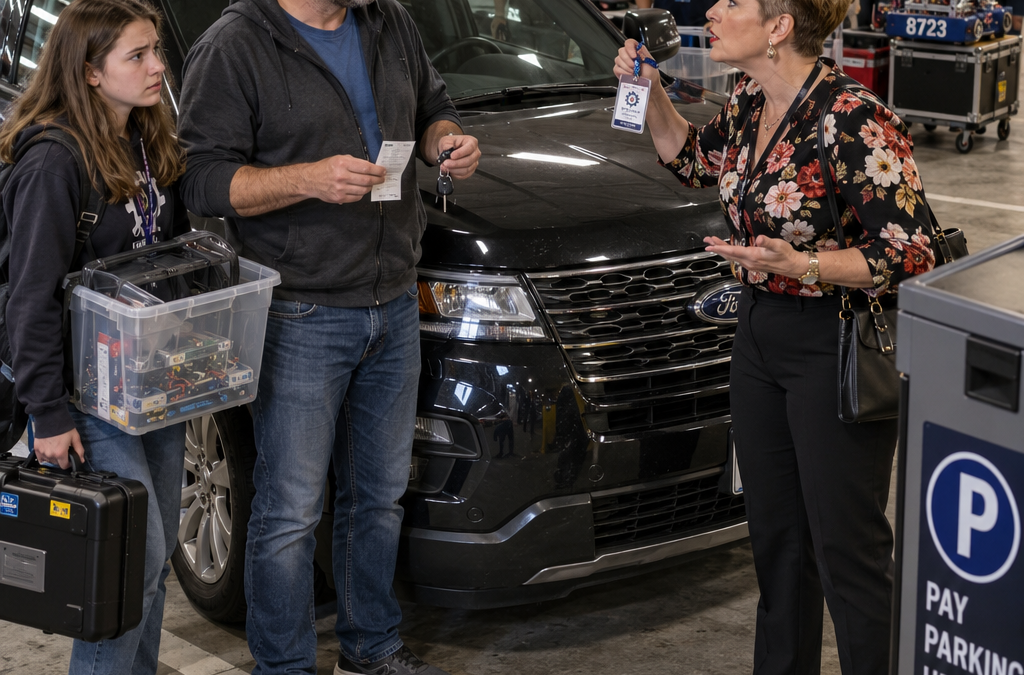
I reached for a second bag when a woman’s voice came from behind us.
“Excuse me.”
I turned.
She was approaching quickly.
Late forties, maybe early fifties.
Red blazer.
Black pants.
Radio clipped at her waist.
A laminated credential hanging from a lanyard.
Her name, I would learn seconds later, was Veronica Sloan.
At that moment, she was simply an irritated stranger walking directly toward my car.
“You can’t park there.”
I looked at B226.
Then at her.
“Why?”
“This section is reserved.”
She pointed toward a sign.
The sign was several spaces away.
“That section looks reserved.”
“This entire area is reserved for VIP guests.”
I looked around.
“There’s no sign here.”
“The system hasn’t been updated.”
“What system?”
“The garage system.”
Her tone suggested the question itself annoyed her.
“I just paid.”
“You’ll need to move.”
I held up my phone.
“The kiosk took eighteen dollars for this space.”
“That doesn’t change the reservation.”
“Okay.”
I wasn’t looking for a fight.
“If the garage changed the section after the system was set up, fine. Just have someone from the garage confirm it and I’ll move.”
Her expression tightened.
“I am confirming it.”
“You work for the garage?”
“I run this garage today.”
That was the first version of the sentence.
Not yet the one that would stick in my memory.
I glanced at her credential.
The words PARKING OPERATIONS appeared beneath her name.
A small SUPERVISOR label was visible on the sleeve.
It looked official enough.
But I’ve spent my adult life going into people’s homes wearing a company shirt and carrying tools.
I know how quickly a uniform or badge can create trust.
That doesn’t mean you stop asking basic questions.
“All right,” I said. “Where should I move?”
“You don’t need to.”
She held out her hand.
“Keys.”
I thought I’d misheard.
“My keys?”
“I’ll have someone relocate the vehicle.”
“No.”
She blinked.
“No?”
“I’ll move it myself.”
“Our staff will handle it.”
“I’m not giving my keys to anyone.”
She took one step closer.
“Sir, we’re trying to keep this area moving efficiently.”
“So am I. Tell me where I’m allowed to park.”
“Give me your keys.”
I looked at the Explorer.
It wasn’t a new car.
It had scratches along the rear bumper.
The driver’s seat had a tear I’d been ignoring for six months.
But that vehicle carried my livelihood.
Electrical meters.
Hand tools.
Specialty drivers.
Diagnostic equipment.
Parts.
Invoices.
Work orders.
There were easily thousands of dollars’ worth of tools inside.
More important, if that car disappeared into a tow yard or got damaged, I couldn’t work.
“No.”
Her hand remained open.
“I don’t surrender my vehicle to people I don’t know.”
She lifted the badge.
“I run this garage.”
Then, louder:
“Give me your keys. Now.”
People started slowing down.
A couple walking toward the elevator stopped.
A man unloading luggage glanced over.
Someone farther away turned to watch.
Avery stood beside me holding the robotics case against her chest.
I saw her eyes move from Veronica to me.
Children, even teenagers, read their parents before they read the danger.
If I looked frightened, Avery would become frightened.
So I kept my voice even.
“Can you show me the rule requiring a self-park customer to hand over his keys?”
“I don’t have to explain internal procedures to you.”
“I’m a customer.”
“You’re refusing a direct order.”
That sentence changed the temperature.
A direct order.
Not request.
Not policy.
Order.
Veronica turned toward the small audience.
“This customer is refusing to comply with event parking instructions.”
I held up my phone again.
“I paid for this space.”
“Your payment doesn’t authorize you to interfere with reserved operations.”
“I asked for confirmation.”
She looked past me.
A young man in a reflective vest stood near the elevator.
“Eli!”
He came over.
He looked maybe twenty-three.
Thin.
Nervous.
The kind of employee who had been told to wear a vest and make traffic flow and was suddenly discovering he’d been drafted into something much larger.
“Yeah?”
Veronica pointed toward my Explorer.
“Mark this vehicle for removal.”
Eli looked at me.
Then at her.
“Reason?”
“Unauthorized parking.”
I looked at my phone.
The eighteen-dollar receipt glowed on the screen.
“Unauthorized?”
Veronica ignored me.
Eli pulled out a small notepad.
I asked him:
“Do you work for Eastbrook Garage?”
He looked at Veronica before answering.
“I’m with a traffic-support contractor.”
“Contracted by the garage?”
“Busy weekends. Multiple events.”
“Can you authorize a tow?”
He hesitated.
“I don’t personally—”
“Don’t explain internal procedures,” Veronica snapped.
Eli stopped.
That told me more than his answer would’ve.
People with legitimate authority rarely panic when their employees explain how that authority works.
I turned back to Veronica.
“If this is actually a restricted space, I’ll move.”
“We’ve been through that.”
“No, you’ve demanded my keys.”
“Because that is how we’re handling relocation.”
“Who is we?”
She tapped her badge.
I looked closer.
Parking Operations.
Supervisor.
Her name.
No Eastbrook logo that I could see.
“What company are you with?”
Her expression hardened.
“That isn’t relevant.”
“It feels relevant.”
“You’re delaying a major event.”
“My car is parked.”
“You’re occupying a VIP space.”
“Then refund me and give me another one.”
“Refunds aren’t my responsibility.”
“You’re the manager of the entire garage but can’t refund parking?”
“Finance handles that.”
I nodded slowly.
Every answer widened the gap.
A black SUV rolled up behind us.
The driver lowered the window.
“Is this gala parking?”
Veronica’s entire demeanor changed.
Smile.
Professional tone.
“Yes, sir. Just one moment.”
Then she turned back toward me, and the smile vanished.
“This man is holding up the entrance.”
I looked behind her.
My Explorer was entirely inside B226.
I wasn’t in the traffic lane.
Veronica was.
Several people could see that.
Still, when someone speaks confidently in public, confidence has a way of becoming temporary evidence.
A woman near the elevator frowned at me.
A man shook his head.
Avery lowered her eyes.
That hurt more than anything Veronica said.
She was embarrassed.
Not because she’d done anything.
Because strangers were watching her father be treated like a problem.
She leaned toward me.
“Dad.”
“Yeah?”
“Can we just move somewhere else?”
I heard what she really meant.
Please don’t let this make me late.
I looked at the time.
Registration deadline: 1:45.
We had already lost almost fifteen minutes.
I wanted to leave.
But if I got in the Explorer and drove off after Veronica had already ordered it marked for towing, what happened next?
Would she claim I fled a violation?
Would another employee stop me?
Would I get charged some invented fee?
Would the garage record show something against my plate?
I didn’t know.
That uncertainty was the problem.
I told Avery:
“I’m going to fix it.”
She nodded, but she looked at the convention-center doors like they were getting farther away.
Veronica heard me.
“There is nothing to fix. Give me your keys.”
“No.”
“Then the car will be towed.”
“For what?”
“Unauthorized parking.”
I held up my receipt.
“I’m authorized.”
She leaned closer.
“You can hand me the keys or pay to get the vehicle back later.”
That was the first moment I felt genuine fear.
Not fear of her.
Fear of consequences.
Wrongful towing isn’t dramatic when you describe it later.
In the moment, it can dismantle your day.
Tow fee.
Storage.
Transportation to the yard.
Hours lost.
Maybe damage.
Maybe tools missing.
Maybe the customer I’d promised to see that afternoon lost permanently.
And above all of that, Avery’s competition.
I looked at Veronica’s badge.
Then at the space.
I made a decision.
Document first.
I photographed B226.
Wide shot.
No sign.
The painted markings.
Neighboring spaces.
The nearest reserved placard several spots away.
The payment kiosk.
The receipt.
Time.
Veronica noticed.
“Stop taking photographs.”
“I’m photographing my vehicle and the space.”
“This area is under event control.”
“Then the photos should help establish that.”
“You do not have permission.”
“I’m not photographing private documents or people.”
I saved everything.
Avery’s phone buzzed.
She checked it.
“Registration closes in fifteen minutes.”
“Who’s texting?”
“Dana.”
Her robotics coach.
I called Dana immediately.
She answered over crowd noise.
“Nolan?”
“We’ve got a parking problem.”
“You coming in?”
“Avery is. Can you meet her at the walkway?”
“Absolutely.”
I looked at my daughter.
“Take your case. Go with Dana.”
Veronica stepped forward.
“Neither of you can leave until this is resolved.”
I turned slowly.
“Excuse me?”
“The vehicle has been flagged.”
“My daughter is not the vehicle.”
“You’re both involved in—”
“No.”
I didn’t shout.
But something in my voice changed.
“You can argue with me. You are not holding a fifteen-year-old here because of a parking dispute.”
“I didn’t say hold.”
“You said she couldn’t leave.”
Veronica glanced at the growing crowd.
“I said the matter needs to be resolved before you leave the area.”
“Avery is leaving.”
Dana appeared near the pedestrian walkway moments later.
I handed her Avery’s main equipment case.
Avery looked back at me.
“You’ll make it?”
“Yes.”
“The presentation?”
“I’ll be there.”
She studied me.
I knew what memory existed between us.
The school theater.
The empty hallway.
Twenty minutes late.
“I promise.”
She nodded.
Then left with Dana.
I watched until she disappeared through the doors.
The garage suddenly felt much colder.
I was angry now.
Not because Veronica had challenged my parking.
Because she’d tried to use my daughter as leverage.
I opened the Explorer’s rear hatch.
The spare motor assembly Avery had checked that morning sat beside my tool cases.
I lifted it out.
Veronica approached immediately.
“What are you doing?”
“Taking my daughter’s equipment.”
“This vehicle has already been flagged.”
“And?”
“You cannot remove items until the parking violation is resolved.”
For a second, I honestly thought she had misspoken.
“It’s my property.”
“The vehicle is subject to relocation.”
“That does not give you ownership of what’s inside it.”
“I’m telling you to put that back.”
I held the motor case.
“No.”
“You are deliberately escalating this.”
“No.”
I closed the hatch.
“I’m retrieving property from my own car.”
“Sir—”
“Don’t.”
That was the first time I’d interrupted her sharply.
She stopped.
I took a breath.
Then said:
“I am done discussing this directly with you. I am finding the garage management.”
“I am management.”
“Then the garage should have no difficulty confirming that.”
I walked toward the elevator bank.
A customer-information board hung beside it.
I had passed it earlier without reading.
Now I did.
EASTBROOK SELF-PARK FACILITY
CUSTOMERS RETAIN THEIR KEYS.
I stared at the words.
Then took a photograph.
Below them was a service number.
I called.
A woman named Ava Flores answered.
“Eastbrook customer support.”
I gave her the garage.
Level.
Space B226.
Entry time.
Receipt transaction number.
Then explained that a woman claiming to manage the facility was demanding my keys and threatening to tow my Explorer.
Ava paused.
“Someone asked for your keys?”
“Repeatedly.”
“This is a self-park garage.”
“I know.”
“Do you know her name?”
“Veronica Sloan.”
“One moment.”
I heard typing.
Ava verified my payment.
Eighteen dollars.
Valid.
No cancellation.
No existing violation on the account.
“Can you tell whether B226 is reserved?”
“I’m checking.”
I waited.
“I’m seeing an event allocation on level two, but I can’t confirm the exact space range from this screen.”
“Who can?”
“The on-site operations manager.”
“Can you send him?”
“Yes.”
“I also want this complaint logged.”
“Absolutely.”
She gave me a reference number.
That simple professionalism calmed me.
Information.
Names.
Records.
Things that could be checked.
Veronica approached while I was still on the call.
“Who are you talking to?”
“Eastbrook.”
“I told you I’m handling this.”
I held up one finger and finished with Ava.
She told me the operations manager on duty was Marcus Ellison and that she was contacting him immediately.
When I hung up, Veronica said:
“You’re making this much harder than it needs to be.”
“If your rule is real, Marcus can confirm it.”
Her expression went cold.
She called Eli over.
“Put a reserved sign here.”
She pointed directly in front of B226.
Eli hesitated.
“There wasn’t one there earlier,” I said.
Veronica looked at him.
“Do it.”
He placed the sign.
I photographed it.
Timestamp visible.
Then I pulled up the photograph I’d taken twenty minutes earlier.
Same space.
No sign.
I wasn’t claiming conspiracy.
I didn’t know enough yet.
But I knew one thing had changed.
The evidence in front of my car.
And it changed after I challenged her.
While Veronica walked away to direct another vehicle, I asked Eli:
“When did these extra signs arrive?”
He lowered his voice.
“Around noon.”
“Did Eastbrook tell you which spaces to add?”
“Veronica pointed them out.”
“Did you get an updated allocation sheet?”
“No.”
“You assumed she had approval?”
“Yeah.”
I nodded.
“I’m not asking you to take my side.”
“I know.”
“Just remember what you were told.”
He looked at B226.
Then nodded.
Another luxury sedan arrived.
Veronica waved it into the space beside mine.
The driver asked:
“This part of the gala section?”
“Yes.”
No hesitation.
That bothered me.
A woman holding a printed event pass came walking toward us.
Her name was Tessa Bell.
She was irritated.
“Where am I supposed to park?”
Veronica smiled.
“We’re working on that.”
“I was told level two VIP parking was guaranteed.”
“It is.”
“Everything is full.”
“Some public customers are occupying reserved spaces.”
She pointed directly at my Explorer.
Tessa looked at me.
I could see exactly what she’d been told without hearing another word.
I was the selfish man stealing a VIP spot.
I said:
“I paid for B226. There was no reserved sign when I arrived.”
Tessa looked at the sign now sitting in front of my car.
“There is one.”
“It was placed there twenty minutes after I parked.”
She looked at Veronica.
Veronica said:
“He’s refusing relocation.”
I showed Tessa the earlier photograph.
Same angle.
No sign.
Her expression changed.
Not completely.
Just enough.
I noticed her printed pass.
It said:
LEVEL TWO — ZONE B
No specific number.
“Did they assign you a spot?”
“No. They said there’d be a dedicated section.”
“How many guests?”
“I don’t know.”
Veronica stepped between us.
“You don’t need to interrogate event attendees.”
“I’m not.”
I looked at Tessa.
“Sorry.”
She nodded.
Something was wrong.
I didn’t yet know what.
But it was becoming obvious the problem wasn’t B226 alone.
I asked Veronica one final time:
“If I move voluntarily, will Eastbrook transfer my payment?”
“That isn’t my department.”
“Can I park on level three?”
“Possibly.”
“Will you confirm I won’t be cited there?”
“You need to follow staff direction.”
“Whose direction?”
“Mine.”
We had come full circle.
Then Ava called back.
“Mr. Price?”
“Yes.”
“Marcus Ellison is on his way.”
“Thank you.”
“I’ve also forwarded the photos and receipt you sent.”
“Good.”
She confirmed again that event parking existed on level two.
But she still wouldn’t guess whether B226 was part of it.
That mattered to me.
A person who actually represented Eastbrook was comfortable saying she didn’t yet know.
Veronica had never said “I don’t know” once.
When I hung up, she asked:
“Who’s coming?”
“Marcus Ellison.”
The smallest pause.
Less than a second.
But there.
“Marcus is busy.”
“Ava says he’s coming.”
“This does not need an operations manager.”
“Apparently it does.”
She held out her hand again.
“Give me the keys and this ends now.”
“No.”
Eli’s phone rang.
He listened.
Then looked at Veronica.
“Tow dispatcher wants confirmation.”
Veronica lifted her hand.
“Yes.”
I stepped closer—not to her, to Eli.
“Ask who authorized the tow.”
Eli looked uncomfortable.
Veronica answered for him.
“Tell them management authorized it.”
I looked directly at her badge.
Management.
Again.
I told Eli:
“The Eastbrook operations manager is on his way. I have a valid receipt. No tow has been verified through Eastbrook. Please tell dispatch that.”
Veronica snapped:
“Do you think you can walk into my garage and tell my staff how to do their jobs?”
“I’m not telling anybody how to do a job.”
“You are obstructing event operations.”
“I’m asking someone to verify authority before removing my vehicle.”
“You’ve refused repeated instructions.”
“Because you keep refusing to show me the rule.”
She took another step.
“If this tow is delayed because of you, you may be financially responsible.”
“For what?”
“Event disruption.”
“What contract makes me responsible?”
“Our legal department can address that.”
“What contract?”
She had nothing.
My phone buzzed.
Janet.
The washing-machine customer.
Nolan, can you confirm an arrival time? Water is coming out now. If not I need to call someone else.
I stared at the message.
There went money.
Not theoretical.
Real.
I called her.
“Janet, I’m sorry.”
“You stuck downtown?”
“Yeah.”
“I need somebody today.”
“I understand.”
“You sure?”
“Call whoever can get there quickest.”
“I hate doing that.”
“Don’t. You need the machine handled.”
She thanked me and hung up.
I put the phone away.
One appointment gone.
And suddenly I wondered whether any of this was worth it.
Eighteen dollars.
One parking space.
I could have left.
Maybe I should have left at the first request.
But that wasn’t where we were anymore.
My car had been marked.
A tow nearly dispatched.
Veronica was claiming I could owe fees.
Walking away without resolution meant leaving the Explorer vulnerable while I went inside.
I couldn’t do that.
Then Avery called.
“Dad?”
“Hey.”
“Where are you?”
“Still in the garage.”
A pause.
“You promised you’d watch me present.”
Five words.
She didn’t say them angrily.
That made them worse.
“I know.”
“Our robot’s already in check.”
“I’ll be there.”
“Are you sure?”
“Yes.”
Another promise.
This time I felt the weight of it before it left my mouth.
Dana texted a minute later.
Drive motor acting unstable. Need spare assembly ASAP.
I looked at the case in my hand.
“I’m taking this inside,” I told Veronica.
“No.”
I stared at her.
“It’s my daughter’s spare motor.”
“The vehicle dispute isn’t resolved.”
“The motor isn’t the vehicle.”
“You need to stay here.”
“No.”
I started toward the pedestrian walkway.
She moved in front of me.
Not touching.
Blocking.
“Turn around.”
My anger sharpened.
I kept several feet between us.
“Move.”
“Not until this is resolved.”
“You’re preventing me from delivering equipment to a minor’s competition because you want leverage in a parking argument.”
“Don’t exaggerate.”
“I’m not.”
A convention-center employee came around the corner.
He slowed immediately.
“Everything okay?”
I turned to him.
“My daughter’s robotics coach is on the other side of this walkway. I need to hand her this equipment. This woman is blocking me.”
Veronica said:
“There is an unresolved parking issue.”
The employee looked at the motor case.
Then at Veronica.
“Can he hand it off?”
Silence.
The presence of someone outside her chain of control changed her behavior.
She stepped aside.
“Fine.”
I walked through.
Dana met me halfway.
“Thank God.”
She took the case.
“Avery okay?”
“Nervous.”
“I’ll get there.”
Dana looked at my face.
“You all right?”
“Not really.”
“Do you need help?”
“Just get this to the team.”
She nodded.
“Nolan.”
“Yeah?”
“She keeps checking the doors for you.”
That sentence stayed with me on the walk back.
When I returned, Eli approached while Veronica was speaking to a driver.
“I checked the assignment sheet.”
“What does it say?”
“We’re Halden traffic support.”
“Halden?”
“The event company.”
“Okay.”
“It says we’re supposed to direct gala guests to assigned spaces. It doesn’t say we can reassign public customers.”
“Do you have that sheet?”
“Yeah.”
“Keep it for Marcus.”
“I will.”
“Thank you.”
Veronica saw us.
“What are you discussing?”
“Authority,” I said.
Her face tightened.
“I have authority.”
“From who?”
“I don’t need permission from anyone in this garage.”
I looked at her.
“Not even Marcus Ellison?”
“Especially not him.”
Eli heard it.
So did a couple standing nearby.
Then the elevator doors opened.
A man in a charcoal jacket stepped out.
He looked around slowly.
Reserved sign in front of my Explorer.
Eli with a notepad.
Veronica.
Me.
Several curious customers.
He walked over.
“Marcus Ellison. Operations manager.”
Before I could speak, Veronica stepped forward.
“Marcus, I have an unauthorized vehicle refusing relocation.”
Marcus didn’t react.
He looked past her at B226.
Then back.
“Who authorized relocation?”
“I did.”
“Okay.”
He paused.
“May I see your badge?”
For the first time all afternoon, Veronica didn’t immediately present it.
Her hand went instinctively toward the lanyard.
“What for?”
“Your badge, please.”
She unclipped it.
Slowly.
Marcus took it.
Then he turned toward Eli.
“Pause everything involving this vehicle.”
“Yes, sir.”
“No tow.”
“Understood.”
“Keep the traffic lane open.”
Then Marcus looked at me.
“Mr. Price?”
“Yes.”
“I have your customer-support complaint.”
“Thank you.”
“Walk me through it from the beginning.”
Not who was right.
Not who was louder.
Beginning.
I showed him the receipt.
1:18 p.m.
$18.
B226.
I showed him the first photograph.
No reserved sign.
Then the later photograph.
Sign added.
I explained Veronica’s demand for my keys.
The threatened tow.
Her refusal to identify any rule.
My daughter’s equipment.
Everything.
Marcus didn’t interrupt.
When I finished, Veronica started immediately.
“He deliberately entered an event-restricted zone.”
Marcus raised one hand.
“You’ll have your turn.”
She stared at him.
It was the first time someone with recognized authority had told her to wait.
She hated it.
Marcus asked me:
“Did anyone take possession of your keys?”
“No.”
“Did you give anyone permission to move the vehicle?”
“No.”
“Did you receive any notice at entry that B226 was reserved?”
“No.”
“Any sign when you parked?”
“No.”
He looked at the photograph.
Then turned to Veronica.
“Why were you asking for his keys?”
“We had to relocate vehicles to free VIP capacity.”
“This is self-park.”
“This was a special event.”
“Did Eastbrook authorize valet or staff relocation?”
“It was necessary operationally.”
“That wasn’t my question.”
She crossed her arms.
“No written valet authorization.”
“Then why were you asking for keys?”
“To solve the parking shortage.”
There it was.
Parking shortage.
Not safety.
Not unauthorized access.
Shortage.
Marcus held up her badge.
“Who do you work for?”
“Halden Event Services.”
“Your role?”
“I oversee event parking.”
“What is your job title?”
“Parking supervisor.”
Marcus looked at the badge.
Then removed the identification card from its clear plastic sleeve.
The small word SUPERVISOR was actually a separate label attached to the plastic.
Not printed on the credential itself.
The actual card beneath read:
VERONICA SLOAN
HALDEN EVENT SERVICES
EVENT ACCESS
Marcus flipped it over.
Small text.
EVENT ACCESS ONLY.
He looked at her.
“Supervisor of what?”
“Event parking.”
“Not this garage.”
“I am responsible for the VIP parking operation today.”
“That is not the same thing.”
Marcus pulled out a handheld device.
Entered the credential number.
Waited.
Then read.
“Halden Event Services. Event parking liaison.”
Veronica’s face changed.
Barely.
But it changed.
Marcus continued.
“Authorized access: contracted event zones.”
He looked up.
“No authority over general Eastbrook operations.”
“I never said I had general administrative authority.”
Several people nearby actually murmured.
I almost laughed.
She had said it repeatedly.
Marcus didn’t argue about memory.
He simply said:
“You represented yourself as garage management to a paying customer.”
“I was trying to solve a problem.”
“You demanded his keys.”
“For relocation.”
“In a self-park facility.”
“Because we were short on VIP spaces.”
Marcus looked toward B226.
“Let’s verify whether this space is even yours.”
He pulled up the allocation map.
Veronica stood very still.
I watched his finger scroll.
Then stop.
“Halden allocation is B201 through B224.”
He looked at the painted number beneath my Explorer.
B226.
He checked again.
“B226 is public.”
Nobody said anything.
Marcus turned to Veronica.
“This space was never part of your allocation.”
She stared at the device.
“Zone B was assigned to us.”
“Not all of Zone B.”
“The intent was to provide a dedicated area.”
“The contract is specific.”
He turned the screen toward her.
“B201 through B224.”
Then pointed.
“Your allocation ends two spaces before this vehicle.”
For the first time since she’d approached me, Veronica had no immediate response.
Marcus looked at the temporary reserved sign in front of my car.
“Who placed that?”
Eli raised his hand slightly.
“I did.”
“At whose direction?”
Eli glanced at Veronica.
“Hers.”
“When?”
“After Mr. Price was already parked.”
Marcus looked at me.
I showed him the timestamped first photo.
Then the second.
He nodded.
“Eli, remove this sign and the one at B225.”
“Yes, sir.”
Veronica found her voice.
“The VIP zone had to be expanded.”
“Who approved expansion?”
“I made an operational judgment.”
“On Eastbrook inventory?”
“We needed spaces.”
“That isn’t approval.”
Eli removed the signs.
The exact sign that had been used as proof I was violating a restriction disappeared because it had never belonged there.
Marcus turned toward the people nearby.
He didn’t make a speech.
He said clearly:
“Mr. Price has a valid payment. B226 is a public space. His vehicle is not in violation.”
Simple.
Verifiable.
The woman who had frowned at me earlier looked away.
Tessa stepped closer.
“What about my pass?”
Marcus looked at it.
“You’re with the gala?”
“Yes.”
“I was told parking was guaranteed.”
Veronica interrupted.
“It is.”
Marcus looked at her.
“How many spaces did Halden contract?”
No answer.
“Twenty-four,” he said.
Tessa frowned.
“How many passes are there?”
Veronica said:
“Guests don’t all arrive simultaneously.”
“How many?”
She hesitated.
That hesitation finally exposed the problem.
Marcus asked Eli to retrieve the pass list.
Veronica objected.
“This is internal Halden information.”
“You’re attempting to use Eastbrook public spaces because of it. It’s relevant.”
Tessa looked increasingly angry.
“I paid extra for the package that included parking.”
Other gala guests were arriving now.
Several listened.
Marcus asked:
“Was each pass represented as guaranteed?”
Tessa answered:
“Mine was.”
A man behind her raised his.
“Same.”
Another woman nodded.
Veronica rubbed her forehead.
“There may have been a minor overbooking.”
Marcus’s expression didn’t change.
“How minor?”
She didn’t answer.
A few minutes later, the actual list reached Marcus’s device.
He looked at it.
Then at Veronica.
“Thirty-six.”
Tessa said:
“What?”
Marcus repeated:
“Thirty-six passes issued.”
“How many spaces?”
“Twenty-four contracted.”
The garage suddenly felt silent again.
Tessa stared at Veronica.
“You sold thirty-six parking passes for twenty-four spaces?”
“It wasn’t expected that all guests would drive individually.”
“Did you tell us that?”
“No.”
“We were told guaranteed.”
Veronica straightened.
“Additional names were added late. We expected carpooling and turnover.”
Marcus asked:
“Did Eastbrook approve overflow into public spaces?”
“No.”
“Did you request additional spaces?”
“No.”
“Why not?”
The answer took several seconds.
“Budget.”
One word.
Marcus waited.
Veronica exhaled.
“The additional VIP guests were added too late. Requesting more guaranteed spaces would’ve required approval from Halden management and an increase in the event cost.”
And there it was.
The whole day.
Not my parking mistake.
Not a safety issue.
Not garage policy.
A budget problem.
She had promised more spaces than her company had actually purchased.
B226 sat near the elevator.
Convenient.
Public.
Available.
My ordinary Ford Explorer occupied a spot she needed to convert quietly into VIP capacity.
If I handed her my keys, my car could be moved one level down.
A sign could appear.
The gala guest would park.
No one at Halden would necessarily know she had overbooked.
No budget increase.
No uncomfortable conversation with her boss.
I had become the problem because I refused to participate in hiding hers.
Marcus asked:
“Why didn’t you just tell Halden you needed twelve more spaces?”
“They were last-minute additions.”
“That isn’t an answer.”
“I thought I could manage it.”
“By moving public customers.”
“Only as needed.”
“Without their consent.”
“I was trying to make the event work.”
Marcus looked toward my Explorer.
“You tried to solve an internal event problem by inventing authority over someone else’s vehicle.”
Veronica said nothing.
The elevator opened again.
A woman in a dark green suit stepped out quickly.
Camille Hartwell.
She was the Halden executive responsible for the convention-center contract.
Marcus had called her.
She did not ask Veronica for an explanation first.
She asked for the records.
Good managers do that.
Marcus showed her the allocation.
Twenty-four spaces.
The pass list.
Thirty-six.
My receipt.
B226.
The photos showing the reserved sign appearing after I parked.
Then Veronica’s credential.
Camille’s face changed as she read.
She turned to Veronica.
“Why were thirty-six passes issued?”
Veronica explained the late guest additions.
Carpooling assumptions.
Staggered arrivals.
Camille listened.
“Did anyone approve an overage?”
“No.”
“Did you request one?”
“No.”
“Did anyone authorize you to use Eastbrook public inventory?”
“No.”
“Did Eastbrook authorize you to move customer vehicles?”
“No.”
Camille closed her eyes briefly.
Then asked:
“Did you tell this customer you ran the garage?”
Veronica glanced at me.
“It was shorthand.”
I almost admired the nerve.
Camille did not.
“Did you demand his keys?”
“I needed to relocate the vehicle.”
“Did you tell staff management had authorized a tow?”
“It was an attempt to resolve—”
“Yes or no.”
Veronica looked down.
“Yes.”
Camille nodded once.
Not angrily.
Final.
“Give me the radio.”
Veronica looked up.
“What?”
“Your radio.”
“Camille—”
“You are done coordinating this event.”
Her face went pale.
“You’re removing me because one customer refused—”
“No.”
Camille’s voice remained controlled.
“I’m removing you because you issued more guaranteed parking access than the contract supported, failed to disclose the overage, attempted to appropriate public spaces without authorization, instructed contractors to misrepresent management approval, demanded access to a customer’s vehicle, and represented your authority inaccurately.”
Every item.
Specific.
Documented.
Impossible to hide behind the word misunderstanding.
Veronica unclipped the radio.
Handed it over.
Camille held out her hand for the remaining allocation documents.
Then Marcus returned the credential to her only long enough for access cancellation to be processed.
The crooked SUPERVISOR label looked suddenly ridiculous.
Veronica had held that badge near my chest an hour earlier as if it ended arguments.
Now the actual manager was disabling it.
She handed it over.
No dramatic speech.
No insult.
No crowd cheering.
Just plastic passing from one hand to another.
Camille told her replacement coordinator to take over.
Then she and Marcus started solving the problem Veronica should have reported from the beginning.
How many gala vehicles were already inside?
How many legitimate event spaces were occupied?
How many additional public spaces could Eastbrook voluntarily sell to Halden?
How many guests needed to be redirected?
There was another lot less than five minutes away on foot.
Halden agreed to pay for additional spaces Eastbrook could properly allocate.
Guests who could not be accommodated were redirected.
No cars had to be moved without consent.
No fake reserved signs.
No threats.
No towing.
The whole supposedly impossible crisis became manageable once people stopped pretending.
Tessa stood beside me while Marcus worked.
“I owe you an apology.”
“You don’t.”
“I thought you were stealing one of our spaces.”
“I know.”
“She pointed at you.”
“I know.”
Tessa looked at B226.
“I didn’t even check the number.”
“Why would you?”
“Still.”
I shrugged.
“Someone with a badge told you a story confidently.”
She nodded.
“That’s unsettling.”
“Yeah.”
That was the part that stayed with me.
How quickly someone else’s certainty had made me guilty in the eyes of strangers.
I hadn’t shouted.
Hadn’t parked illegally.
Hadn’t cut a line.
Yet within minutes, Veronica had turned me into the difficult customer obstructing a charity gala.
Authority doesn’t always need to be real to work.
Sometimes it only needs enough people to assume it is.
Marcus came back to me.
“Mr. Price.”
“Yes.”
“Your vehicle is clear.”
“No violation?”
“None.”
“Can you document that?”
“Absolutely.”
I appreciated that he didn’t take offense.
He understood why I was asking.
“I want the incident report to state the tow was never validly authorized.”
“It will.”
“And the time.”
“What time?”
“How long this took.”
He looked at me.
“I lost a customer appointment because I couldn’t leave the car while it was being threatened with removal.”
“Understood.”
“I’m not asking you to pay me on the spot.”
“I know.”
“I just want the record accurate.”
“It will be.”
He also refunded the eighteen-dollar parking fee as a customer-service gesture.
Then Camille approached.
“Mr. Price, I owe you an apology on behalf of Halden.”
“Thank you.”
“What happened should not have happened.”
“No.”
“If you document the work loss, send it through this address.”
She handed me a card.
“I can’t promise an outcome until it’s reviewed.”
“That’s fair.”
Fair.
That was all I had wanted for more than an hour.
I checked my phone.
2:37.
My stomach dropped.
“Avery.”
Marcus frowned.
“My daughter.”
I grabbed the motor case instinctively before remembering I’d already handed it to Dana.
“When does she present?”
My phone buzzed.
Avery.
Dad, presentation starts in 3 minutes.
I looked at Marcus.
“Can the car stay?”
“Yes.”
“No one is touching it?”
“No one.”
I started moving.
“Thank you.”
“Mr. Price.”
I turned.
“You were right not to give up the keys.”
I nodded once.
Then ran.
Not literally sprinting at first.
I’m forty-one and repair appliances for a living. My knees prefer negotiation.
But by the time I hit the pedestrian walkway, I was moving faster than dignity recommends.
Convention-center doors.
Security.
Hallway.
Signs for the robotics competition.
Crowd.
Rows of chairs.
Dana stood near the entrance waving both arms.
“Here!”
I checked the stage.
An announcer was introducing Avery’s team.
I slid into the empty chair beside Dana.
One second later, Avery walked out.
She carried part of the equipment.
Three teammates followed.
She scanned the audience.
I saw the exact moment she found me.
Her shoulders loosened.
Just slightly.
Then she smiled.
Not a huge smile.
One second.
That was enough.
I raised my thumb.
She turned toward the judges.
I sat there breathing hard, still angry, still embarrassed, still thinking about the customer I’d lost.
Then Avery began speaking.
And none of it mattered for the next ten minutes.
Her team had built a small robot designed to navigate a constrained course, identify markers, and manipulate lightweight objects.
I understood maybe sixty percent of the technical explanation and pretended to understand ninety.
Avery handled the drive-system section.
She spoke clearly.
Looked at the judges instead of the floor.
Answered a question about torque.
One judge asked why they had chosen a particular motor configuration.
Avery explained.
I remembered the kid from a year earlier standing outside an empty auditorium.
This wasn’t that kid anymore.
Halfway through the demonstration, the robot jerked.
Stopped.
Tried to move again.
One wheel stuttered.
The judges noticed.
So did every parent.
I leaned forward.
Avery crouched beside it.
One teammate looked panicked.
She didn’t.
She checked the connection.
Spoke to Dana.
Then reached for the spare motor assembly.
The one from my Explorer.
The one Veronica had tried to prevent me from removing.
Avery looked at the judges.
“We’re seeing inconsistent drive response on the left side. We have a spare motor assembly, so we’re going to diagnose whether the issue is control-side or mechanical.”
Calm.
No apology.
No meltdown.
She and another student opened the housing.
Swapped the assembly.
Reconnected.
Tested.
The robot moved.
The room applauded.
A judge smiled.
“Was that planned?”
Avery laughed.
“No, sir.”
The whole room laughed with her.
“Good recovery.”
“Thank you.”
They finished.
When Avery stepped off the presentation area, I stood with everyone else.
Proud doesn’t cover it.
Relieved doesn’t either.
Maybe because the day had spent hours teaching me how easily control can disappear.
And then there was my daughter calmly repairing a failed mechanism in front of strangers, exactly because she couldn’t control whether it failed.
She could control what she did next.
Afterward, she ran toward me.
Not cool teenager walking.
Ran.
She hugged me.
“You made it.”
“I said I would.”
“You almost didn’t.”
“That part wasn’t in the plan.”
She pulled back.
“Did you see the motor?”
“Every second.”
“We thought the gearbox was done.”
“You looked calm.”
“I was not calm.”
“You fooled me.”
She smiled.
Then remembered.
“What happened with the parking lady?”
I looked around.
“Short version?”
“Yes.”
“She did not run the garage.”
Avery stared.
“What?”
“She worked for the event company.”
“But the badge.”
“Real badge.”
“So she worked there.”
“For the gala.”
“Not the garage?”
“No.”
Avery’s mouth fell open.
“She lied?”
“About her authority.”
“Did she really try to tow us?”
“Yes.”
“Could she?”
“No.”
“Did they fire her?”
“I don’t know.”
“You’re not curious?”
“No.”
She gave me a look that suggested this was biologically impossible.
“What happened to her?”
“They removed her from the event.”
“Good.”
I laughed.
“Don’t enjoy it too much.”
“She tried to keep the motor.”
“Fair point.”
Avery’s expression changed.
“Was the car okay?”
“Fine.”
“Your tools?”
“Fine.”
“And the space?”
“Ours the whole time.”
She let out a long breath.
That was when I realized how much of the fear she’d carried into the competition.
She hadn’t been standing in the garage anymore.
But part of her had stayed there.
“I was worried they’d tow it while you were watching us.”
“They didn’t.”
“Good.”
Then she looked at me.
“Were you scared?”
Kids know when adults pretend.
So I told her the truth.
“Yeah.”
She seemed surprised.
“Of her?”
“Not exactly.”
“Then what?”
“Losing the car for the day. Tools getting damaged. Missing work. Missing you.”
Her face softened.
“I thought you were going to miss it.”
“I know.”
She looked down.
“I didn’t mean to make you feel bad when I said you promised.”
“You didn’t.”
“I kind of did.”
“No.”
I touched her shoulder.
“You reminded me what mattered.”
She thought about that.
Then said:
“You still came.”
Three words.
Exactly what I needed.
Avery’s team didn’t win the overall competition.
Honestly, that made the day more real.
They received a design and problem-solving recognition for the way they handled the motor failure during live evaluation.
The judges specifically praised their diagnosis and recovery.
Avery’s coach told me afterward:
“She took control without taking over.”
I liked that sentence.
There is a difference.
We stayed for photographs.
Avery held the small award with her teammates.
I stood behind my phone taking more pictures than anyone needed.
One photograph caught her laughing with her hair falling across her face.
I sent it to my sister.
Then saved it twice.
A year earlier, I’d had no photograph from the school performance because I arrived after it ended.
That afternoon, I had proof I’d been in the room.
Maybe nobody else would understand why that mattered.
I did.
When we returned to the garage, B226 looked completely ordinary.
No reserved sign.
No crowd.
No confrontation.
My Explorer sat where I had left it.
Eighteen dollars refunded.
No tow sticker.
No damage.
Veronica was gone.
Eli was still working near the ramp.
He saw us.
“Everything okay?”
“Yeah.”
I introduced Avery.
“This is the daughter whose robot nearly died because you people trapped the spare motor.”
Eli’s face fell.
I smiled.
“I’m kidding.”
Avery said:
“The spare saved us.”
Eli looked relieved.
“Good.”
Then he grew serious.
“Sorry about earlier.”
“You don’t need to apologize for all of it.”
“I should’ve asked who authorized the signs.”
“Yes.”
He looked surprised by the direct answer.
“But you did start asking.”
“Eventually.”
“That’s how people learn.”
We loaded everything.
On the drive home, Avery talked almost continuously.
The judges.
Another team’s robot.
A coding mistake somebody fixed five minutes before a round.
A boy who dropped an entire tray of screws.
I listened.
That’s what I’d promised to do that day.
Not fix.
Not teach.
Be there.
The Eastbrook email arrived that evening.
I opened it after dinner.
It confirmed:
My payment had been valid.
B226 had been public parking.
The Halden event allocation ended at B224.
No self-park customer was required to surrender keys.
No valid tow authorization had ever existed for my Explorer.
The temporary removal note was cancelled.
My parking fee had been refunded.
I saved the report next to the original receipt and photographs.
Not because I planned to post it.
I didn’t.
I had no interest in turning Veronica into internet entertainment.
I wanted a clean record.
That’s all.
Several days later, Halden responded.
They confirmed Veronica had been removed from event coordination duties that afternoon and her Eastbrook access credentials had been revoked.
An internal review had opened regarding the overissued passes and unauthorized instructions.
They did not tell me whether she was fired.
I didn’t ask.
People sometimes assume the satisfying ending to a conflict is seeing the other person lose everything.
I don’t.
What I wanted was for the behavior to stop.
It had.
Halden also asked for documentation of my lost repair appointment.
I sent Janet’s messages and a copy of the canceled service slot.
After review, they offered me an eighty-five-dollar goodwill payment for lost time and inconvenience.
It wasn’t enough to replace an entire repair job.
It wasn’t supposed to be.
They also weren’t legally admitting some enormous financial liability.
It was a practical resolution.
I accepted.
Then I called Janet.
“I’m sorry about Saturday.”
“You don’t owe me another apology.”
“I still do.”
“I got someone.”
“Did they fix it?”
“Eventually.”
I laughed.
“I’d like to make the next service right.”
She booked me the following week for a different appliance.
That relationship survived.
Not because I demanded loyalty.
Because I called.
Explained.
Showed up the next time.
Trust is ordinary that way.
Two weeks later, I had a repair job downtown.
I passed Eastbrook Garage.
A new sign was mounted beside the payment kiosk.
SELF-PARK FACILITY — KEEP YOUR KEYS.
EVENT PARKING RESTRICTIONS APPLY ONLY TO DESIGNATED SPACES.
I stood there reading it longer than necessary.
I knew the sign hadn’t been created for me alone.
The incident had exposed a system problem.
Still, seeing the words gave me relief.
Clear language prevents a lot of abuse.
Not all.
But a lot.
Eli was directing traffic near the entrance.
He recognized me.
“Mr. Price.”
“Nolan.”
He walked over.
“New signs.”
“I noticed.”
“We had retraining.”
“Good.”
He laughed.
“Very good.”
Then his expression turned serious.
“They went through authority limits. Who can move what. Who can place signs. Who can request towing.”
“Should’ve existed already.”
“Probably.”
He looked embarrassed.
“I should’ve questioned Veronica sooner.”
“Maybe.”
“I knew something felt off.”
I leaned against the Explorer.
“Eli, I’ve been self-employed long enough to know how easy it is to follow the person who sounds certain.”
“Still.”
“Next time, ask.”
He nodded.
“Definitely.”
That was enough.
Systems fail when people don’t know where their authority ends.
They also fail when everyone underneath a confident person assumes somebody else must have verified the order.
Veronica couldn’t move my car alone.
She needed Eli to place the sign.
A tow dispatcher to act.
Customers to believe her.
Me to surrender the keys.
Her power depended on cooperation.
That was what struck me most afterward.
She had a real badge.
A real job.
Real responsibility.
Her mistake wasn’t that she had no authority.
It was that she treated limited authority as unlimited authority because she thought nobody would check the boundary.
By itself, “event parking liaison” didn’t sound powerful enough to solve her problem.
So she became, in her own words, the person who ran the garage.
The badge didn’t change.
Only the story did.
Avery found me at the kitchen table a few nights later doing invoices.
Her robot sat beside her.
Competition trophy on the shelf near the window.
“You busy?”
“Always.”
“Next event is in three weeks.”
I looked at my calendar.
Several Saturday appointments already penciled in.
“Where?”
“Dayton.”
I groaned.
“That’s driving.”
“Cars do that.”
“I’ve heard rumors.”
She leaned over.
“Can you come?”
A year earlier, I might have said:
I’ll try.
That phrase protects adults from breaking promises.
It also tells children not to fully believe them.
I looked at the calendar.
Moved one appointment.
Blocked the morning.
Then another.
“I’ll be there.”
“Promise?”
“Yes.”
She smiled.
Then returned to adjusting wiring.
I sat there looking at her.
The whole confrontation at Eastbrook had started because someone wanted a parking space.
That’s the easy version.
But when I think about it now, I don’t remember B226 first.
I remember Avery standing beside me in that garage.
Equipment against her chest.
Watching my face.
I remember the embarrassment in her posture when Veronica publicly called me a violator.
I remember sending her inside without me.
I remember her voice on the phone.
You promised you’d watch me present.
And I remember walking into that convention hall with three minutes left.
The room full.
The lights too bright.
Avery walking onto the stage.
Then searching.
Finding me.
That small smile.
That’s what survived.
Not Veronica.
Not the badge.
Not the eighteen dollars.
Not the tow threat.
A smile that lasted maybe one second.
I had spent most of the afternoon thinking I was defending my keys.
I wasn’t.
Not really.
Yes, the Explorer mattered.
My tools mattered.
My livelihood mattered.
A wrongful tow would’ve created real consequences.
But beneath all of it was something I had already failed at once.
My word to my daughter.
If I handed Veronica the keys, maybe things went fine.
Maybe her employee moved the Explorer safely.
Maybe I reached Avery earlier.
I don’t know.
That’s what people sometimes ask when they hear the story.
Why not just cooperate?
Why fight?
That’s the wrong question.
Because cooperation requires knowing what you’re cooperating with.
A legitimate request?
A real policy?
A person authorized to touch your property?
Or someone improvising because your compliance is convenient?
If Veronica had said:
“Sir, we’ve overbooked event parking. B226 is public, but would you be willing to move one level down? We’ll refund your payment and cover the new space.”
I probably would’ve moved in sixty seconds.
Maybe thirty.
I wasn’t emotionally attached to B226.
I didn’t care about parking near the elevator.
I cared that a stranger demanded possession of my vehicle, refused to explain her authority, publicly branded me as violating rules, then tried to manufacture the appearance of a restriction after the fact.
There is a difference between solving a problem and transferring it to somebody weaker.
Veronica tried the second.
She had made a professional mistake.
Thirty-six passes.
Twenty-four guaranteed spaces.
That could have been fixed.
Embarrassing conversation with her supervisor.
Higher event expense.
Some guests redirected.
Normal operational failure.
Instead, she tried to hide it.
And once hiding it required moving my car, my refusal became dangerous to her.
That’s when the threats began.
Tow fees.
Legal department.
Event disruption.
Direct orders.
Every new claim existed to protect the previous one.
I’ve seen versions of that in my own business.
A technician guesses at a diagnosis.
Then instead of admitting uncertainty, he keeps replacing parts until the customer’s bill becomes a monument to the first guess.
The professional thing is simpler.
Stop.
Check.
Measure.
Admit when the first conclusion is wrong.
I repair appliances.
Customers often have no idea whether I’m telling the truth.
If I tell someone a control board costs five hundred dollars, how would they know?
If I say a motor needs replacement, most can’t verify it without paying someone else.
That creates an imbalance.
Knowledge becomes authority.
So does a uniform.
So does a badge.
The ethical obligation isn’t to exploit the imbalance.
It’s to narrow it.
Show the bad part.
Explain the failure.
Give options.
Let the customer decide with enough information to understand.
Veronica did the opposite.
She widened the gap deliberately.
The more I asked, the less she explained.
Because explanation would’ve exposed the limit.
I sometimes wonder what would’ve happened if I’d simply handed her my keys when she first demanded them.
Maybe nothing dramatic.
That’s important to admit.
Perhaps a worker would’ve driven the Explorer one level down.
Maybe no damage.
Maybe no missing tools.
Maybe I would’ve reached Avery’s presentation earlier.
Maybe Veronica would’ve finished the event and gone home convinced she’d solved a difficult situation.
Then the next public customer might’ve been moved.
Then another.
Maybe Eli would’ve learned that a person with an event badge could verbally expand a contract.
Maybe Eastbrook would’ve never known Halden had appropriated public spaces.
Maybe thirty-six guests would’ve been accommodated inside twenty-four paid spots because ordinary customers were quietly displaced.
Nothing spectacular.
No headlines.
Just one person’s mistake transferred onto people who didn’t know enough to object.
That’s how small abuses become procedures.
Someone does it once.
It works.
Nobody challenges it.
Next time, it feels less wrong.
Eventually somebody says:
That’s just how we do it.
I’ve heard that sentence in houses for years.
A homeowner shows me an appliance repair done by someone else.
Wire twisted improperly.
Safety interlock bypassed.
Wrong part installed.
“Why’d they do this?”
“The last guy said that’s how they always do it.”
Always is not evidence.
Neither is confidence.
The real manager, Marcus, did something Veronica never did.
He checked.
He asked me questions.
Then asked her.
Then checked the contract.
Then checked the credential.
Then checked the pass count.
He didn’t have to humiliate anyone.
Facts did the work.
That taught Avery something too.
A few weeks later, she was telling my sister the story.
I was in the next room and heard her say:
“The lady had a real badge, just not the authority she said it gave her.”
I stopped.
That was the whole story in one sentence.
A real badge.
Wrong claim.
Life is full of things like that.
Real titles used outside their scope.
Real expertise stretched beyond its limits.
Real rules interpreted more broadly than they were written.
Real authority used where consent is still required.
The hardest part isn’t spotting obvious fraud.
Obvious fraud is easy.
The difficult moments are when someone genuinely has some power and starts acting as though it means all power.
That’s when people hesitate.
Maybe she can do this.
Maybe this is the policy.
Maybe I’m the difficult one.
Maybe everyone else knows something I don’t.
I had those thoughts.
I don’t want to rewrite myself into somebody fearless.
I wasn’t.
When Veronica threatened the tow, I wondered whether I should surrender the keys.
When Janet canceled, I wondered whether I was sacrificing income over pride.
When Avery called, I wondered whether I had confused principle with stubbornness and was about to hurt my daughter with it.
Those doubts were real.
The thing that kept me from giving in wasn’t bravery.
It was one simple question.
Can this be verified?
I had a receipt.
A space number.
A customer-service number.
A manager’s name.
Photos.
A contract somewhere.
If Veronica was right, verification would prove it.
If she was wrong, she had no reason to fear verification unless the truth was the actual problem.
That lesson became useful later.
Not because I started challenging every instruction anyone gave me.
That would be exhausting.
Most rules are ordinary.
Most employees are trying to do their jobs.
Most misunderstandings are actually misunderstandings.
But when a person refuses reasonable verification while increasing threats, pay attention.
Especially when the consequences belong to you.
A year after Eastbrook, Avery and I drove past the garage together.
She pointed.
“Your favorite place.”
“Keep talking and I’m making you park there alone.”
“I don’t drive yet.”
“Exactly.”
She laughed.
Then said:
“Do you think that woman still works in parking?”
“I don’t know.”
“You really never found out?”
“No.”
“How?”
“What?”
“How do you not look her up?”
“Because I don’t care.”
She stared at me like I’d claimed not to understand gravity.
“I’d care.”
“You would’ve been fifteen-year-old internet detective.”
“I still could.”
“No.”
“You’re no fun.”
“One of my better qualities.”
The truth was, I did wonder sometimes.
Human curiosity doesn’t disappear because you’ve decided something isn’t your business.
Maybe Halden fired her.
Maybe they retrained her.
Maybe she left.
Maybe she had been having the worst month of her life and made a series of terrible decisions.
Maybe she learned from it.
I hope she did.
That isn’t forgiveness exactly.
It’s perspective.
People become easier to turn into villains once you only remember their worst hour.
I don’t know enough about Veronica’s life to do that fairly.
I know what she did that afternoon.
That is enough.
She overbooked parking.
Tried to hide it.
Misrepresented authority.
Demanded my keys.
Threatened towing.
Placed signs after the fact.
That behavior deserved to be stopped.
It was stopped.
I didn’t need the rest of her life destroyed for the story to feel complete.
My own life continued.
That matters more.
Janet stayed a customer.
The Explorer lasted another two years before the transmission finally convinced me it wanted retirement.
When I sold it, Avery came outside.
“That’s the famous car.”
“Unfortunately.”
“Did you tell the buyer?”
“What?”
“That it survived attempted VIP kidnapping.”
“No.”
“You should charge extra.”
“I did not.”
She patted the hood.
“Bye, B226.”
I laughed.
The replacement vehicle has fewer scratches and better mileage.
I still don’t hand the keys to strangers.
Avery’s robotics team continued.
Competitions got harder.
She eventually became team captain.
At the next event, I was early.
Painfully early.
She complained.
“Doors aren’t even open.”
“I am present.”
“You’re sitting in a parking lot forty minutes early.”
“Correct.”
“This is overcompensation.”
“Also correct.”
She smiled.
I kept going to events.
Not every one.
Life isn’t a movie where one lesson eliminates every scheduling conflict forever.
Sometimes work truly couldn’t move.
Sometimes Avery told me not to come because she wanted to travel with the team.
But I stopped making casual promises.
If I said I’d be there, I treated it like an appointment with my most important customer.
Because in a way, it was.
Years later, that Saturday at Eastbrook has become a family story.
Avery exaggerates parts.
According to her current version, Veronica tried to personally steal the Explorer while thirty angry billionaires watched.
Not accurate.
She claims I gave a heroic speech.
Also false.
Mostly I asked repetitive questions and took photographs.
That’s reality.
The useful moments rarely feel heroic while you’re living them.
You’re just tired.
Worried.
Trying not to make things worse.
Trying to think.
What I remember clearest is still the opening.
Veronica’s hand.
Palm up.
Keys.
Now.
So simple.
Compliance would’ve ended the confrontation.
At least temporarily.
That’s what pressure relies on.
The easiest way to make the discomfort stop is to hand over something.
Your keys.
Your money.
Your place in line.
Your right to question.
Your confidence that you understood the situation correctly.
Sometimes handing it over is the smart choice.
Sometimes it isn’t worth the argument.
But you should at least know what you’re giving away and to whom.
I didn’t know Veronica.
I didn’t know Halden.
I didn’t know the scope of her badge.
So I checked.
That was all.
One phone call led to Ava.
Ava led to Marcus.
Marcus checked the credential.
The credential led to the contract.
The contract led to B224.
B226 sat outside it.
Then the pass count exposed the real shortage.
One question after another.
Not dramatic.
Just verification.
By the time the truth was visible, Veronica’s badge hadn’t changed.
Same plastic.
Same name.
Same photograph.
What changed was everyone’s understanding of what it actually meant.
I think about that sometimes when I watch people react to authority.
We respond to symbols.
Uniforms.
Badges.
Titles.
Letterhead.
Confidence.
They exist for a reason.
A functioning society can’t require every person to independently investigate every instruction before complying.
But symbols only work because trust sits underneath them.
The moment someone abuses that trust, the damage extends past one parking space.
Eli became more cautious.
Eastbrook changed its signs.
Halden reviewed its procedures.
Tessa learned not every confident explanation was accurate.
I learned something about myself too.
And Avery watched the whole thing.
Not every minute.
But enough.
Months afterward, she asked me:
“What would’ve happened if Marcus said she was right?”
“I would’ve moved.”
“Really?”
“Of course.”
“You would’ve just accepted it?”
“If B226 was actually reserved and the garage said so, yes.”
She frowned.
“But after all that?”
“The point wasn’t to win.”
“Then what was it?”
“To know.”
She thought about that.
“If she was right, would you have apologized?”
“Yes.”
“Even to her?”
“Especially to her.”
Avery smiled.
“That would’ve hurt.”
“Probably.”
That’s the lesson I hope she kept.
Standing your ground doesn’t mean deciding in advance you’re right.
It means refusing to be pushed past the point where the truth can still be checked.
If the evidence goes against you, move.
Apologize.
Learn.
If it supports you, don’t let somebody’s volume substitute for facts.
There is strength in both.
The garage incident cost me most of an afternoon.
One service call.
A lot of stress.
Some embarrassment.
Eighty-five dollars didn’t magically make those things disappear.
Neither did the refund.
But the resolution was enough because it was accurate.
My car had been legally parked.
The accusation was withdrawn.
No violation remained.
My tools were untouched.
Avery got her motor.
I got to her presentation.
That was the ledger I cared about.
Sometimes I still see the photograph from that day.
Not the pictures of the parking space.
Those live in an old folder somewhere.
I mean Avery with her robotics team.
Small trophy in front.
Three teammates beside her.
Hair slightly messy from crouching over the robot.
Huge smile.
I wasn’t supposed to care whether a picture proved anything.
But I do.
That photograph proves I made it.
After being twenty minutes late the year before, I made it.
After Veronica.
After the tow threat.
After the lost job.
After the phone calls.
After the spare motor.
I was in the room.
Avery saw me.
Years later, that matters more than whether anyone remembers who was right about B226.
The parking dispute ended.
The badge was surrendered.
The passes were fixed.
The garage retrained people.
Cars came and went.
Someone else parked in B226 the next day and probably never knew any of it happened.
That’s how most conflict disappears.
The place returns to being ordinary.
What stays is what the conflict showed you.
For me, it showed two things.
Authority deserves respect when it’s real.
And real authority should never be afraid to prove where it begins and where it ends.
But even more than that, it reminded me that winning the argument in front of you isn’t always the thing you’re actually fighting for.
I thought I was protecting an old Ford Explorer.
What I was protecting was my ability to work.
My tools.
My time.
My right not to have someone else take control of my property without authorization.
All true.
But underneath those things was a promise.
A year earlier, my daughter had stood outside an auditorium after I’d arrived too late.
On that Saturday, she walked onto another stage and searched the room.
This time, I was already there.
That was the part Veronica never understood because she never knew me well enough to see it.
To her, B226 was simply one more space she needed.
To me, my car was the thing standing between the responsibilities I carried and the person I was trying very hard not to disappoint again.
That’s why I remember Avery’s smile more clearly than I remember Veronica’s face when Marcus asked for her badge.
The badge was only plastic.
The smile was the reason I had refused to let the entire afternoon be decided by someone else’s confidence.
And when I think about that day now, I don’t hear Veronica saying, “I run this garage.”
I hear Avery saying three quieter words after the presentation.
“You still came.”
She was right.
I did.
And in the end, that was the only outcome I truly needed.








