𝗙𝗨𝗟𝗟 𝗦𝗧𝗢𝗥𝗬 The Woman Blocking My Driveway Kept Saying “It’s a Public Road” While My Daughter Watched Us Miss the Appointment We’d Waited Seven Weeks For
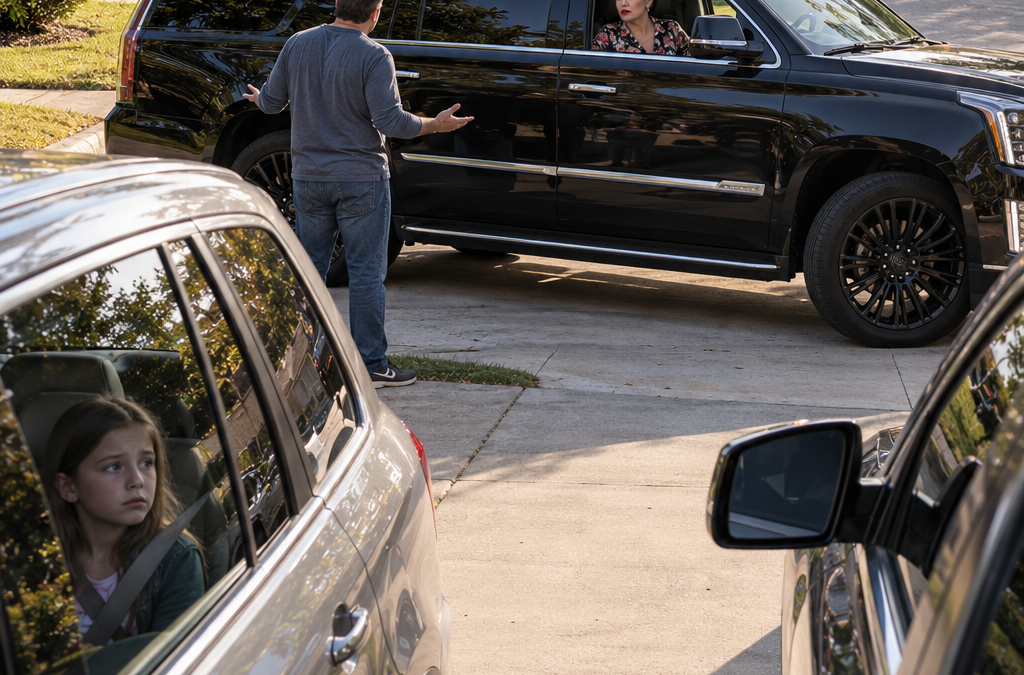
𝗙𝗨𝗟𝗟 𝗦𝗧𝗢𝗥𝗬
Afterward, I was supposed to drive across the county to a packaging plant where I had a one-day contract shift beginning at 1:00.
A conveyor drive had been failing intermittently for days.
The plant manager, Dale Wittmann, had hired me because I already knew that model and because shutting the line down for another day would cost considerably more than my rate.
My shift was worth $650.
So when I walked down to the cluster mailbox that morning around ten after nine, I had the day divided into pieces in my head.
Mail.
Coffee.
Home.
Leave by 9:40.
Specialist at 10:30.
Get Lily settled afterward.
Grab something quick to eat.
Drive to the plant.
Clock in at one.
Simple.
I was halfway back toward the house when I saw the SUV.
Large.
Black.
Expensive.
Parked sideways across the entrance to my driveway.
I stopped walking.
At first, I honestly thought I was misunderstanding what I was looking at.
The SUV wasn’t parked parallel to the curb.
It wasn’t pulled halfway onto a shoulder.
It wasn’t waiting behind somebody.
It sat angled across the entire mouth of my driveway, nose pointing toward my mailbox post and rear end tucked close to the neighbor’s hedge.
Both vehicles in my garage were trapped.
No car could get in.
No car could get out.
I stood there holding a fistful of mail in one hand and a coffee in the other.
My first emotion was irritation.
Nothing more.
People do thoughtless things.
I’ve done thoughtless things.
Someone is looking at a phone.
They misjudge a driveway.
They think they’ll only be there for two minutes.
You point it out.
They move.
I walked toward the driver’s side.
The window was lowered a few inches.
Behind the wheel sat a woman in a tailored cream jacket.
Sunglasses.
Phone in one hand.
A leather folder on the passenger seat.
I would later learn that her name was Madison Vance.
Forty-six years old.
Luxury real estate broker.
She represented the kind of properties that came with professional photographs, gates, outdoor kitchens, wine rooms, and descriptions containing the word estate.
At that moment, I knew none of that.
I only knew she looked like someone who was not expecting a stranger with a paper coffee cup to interrupt her morning.
I tapped lightly on the glass.
She looked up slowly.
“Good morning,” I said. “Sorry to bother you. This is my driveway. Could you move forward a little so I can get my truck out?”
She looked through the windshield.
Then toward the roadway.
Then back at me.
“This is a public road.”
Her tone wasn’t hostile.
That would have made more sense.
She sounded patient.
As if I had misunderstood something elementary.
“I know the road is public.”
She gave me a slight smile.
“Then you understand you don’t own it.”
“I didn’t say I owned the street.”
I pointed toward the garage.
“I said you’re blocking my driveway.”
She sighed.
“The street is public. You don’t get to reserve it because your house is here.”
For a second, I didn’t know what to say.
We were having two entirely different conversations.
I was talking about access.
She was talking about pavement.
“I don’t need you to leave the street,” I said. “If you pull ahead about thirty feet, there’s plenty of room. I just need this opening.”
“I’m only going to be a little while.”
“How long?”
She gestured with her phone toward a large stone-and-glass house several doors up.
There was a real estate sign at the curb.
“I’m preparing for an open house.”
I looked at the house.
Then at her SUV.
There was plenty of legal parking farther down.
Not as convenient.
But plenty.
“Okay. I just need to leave before 9:40.”
She turned her attention back to her phone.
“Shouldn’t be a problem.”
I wish I had made her define “shouldn’t.”
Instead, I thanked her.
I was raised that way.
Sometimes politeness remains in your mouth even when the person in front of you hasn’t earned it.
I walked home.
Emily was in the kitchen packing the last things into Lily’s backpack.
Our daughter sat at the counter already wearing her shoes.
That told me she was nervous.
Lily always put her shoes on early when she was worried about something.
School presentations.
Dentist appointments.
Tests.
Anything where time mattered.
Emily looked through the front window.
“Is that car going to be a problem?”
“No. Real estate agent. She’s doing an open house.”
“She’s moving?”
“She said she wouldn’t be long.”
Emily glanced at the clock.
“We need to leave at 9:40.”
“I know.”
“The clinic won’t hold that slot.”
“I know.”
She looked at me for another second.
She did not say what both of us were thinking.
Then she zipped the backpack.
At 9:28, the SUV had not moved.
At 9:32, it had not moved.
At 9:35, I went outside again.
Madison was still sitting in the driver’s seat.
This time I walked directly to the window.
“Ma’am.”
She looked up.
“I really need the driveway clear now. My daughter has a medical appointment.”
She glanced toward my house.
“Okay.”
“I need to leave in about five minutes.”
“I heard you.”
“If you pull forward thirty feet, you’ll still be right beside the property you’re showing.”
Her expression changed.
Just slightly.
“No.”
I thought I had misheard.
“I’m sorry?”
“No.”
That was all.
No explanation.
No public-road speech.
No attempt to compromise.
She looked back at her phone and began typing.
I stood there long enough to understand something I should have noticed sooner.
Her parking wasn’t accidental.
The front wheels were turned sharply toward the curb.
The rear of the SUV was tucked close to my mailbox.
The body of the vehicle stretched across the entire driveway opening.
She had placed it that way deliberately.
Maybe not to trap me specifically.
But she had deliberately chosen the exact position that maximized her convenience.
Moving now would mean admitting that her convenience didn’t matter more than my access.
And apparently that had become unacceptable.
Something in me cooled.
I don’t know a better way to describe it.
Anger is hot.
This wasn’t.
It was the feeling I get at work when a machine makes a noise everybody else insists is normal and I realize the easiest explanation is wrong.
I stepped back.
“I’m asking you again. Please move your vehicle.”
She did not look up.
I walked away.
At 9:40, the minute hand on the kitchen clock crossed the point where our morning plan became impossible.
Emily looked at me.
Neither of us spoke.
Then she picked up her phone and called someone at the clinic.
I listened from the other side of the kitchen.
“Hi, it’s Emily Reed. I know this is a terrible request, but Lily has the ten-thirty with Dr. Soren and we’re having an access problem at the house.”
Pause.
“No, we’re not going to make it.”
Another pause.
“Anything later?”
She listened.
I watched Lily.
Her hands were folded tightly in her lap.
Her backpack sat beside her.
Shoes on.
Ready.
Waiting.
Emily covered the phone and looked at me.
“There’s a cancellation at 2:15.”
“Take it.”
She nodded.
Into the phone she said, “Yes. Please. We’ll confirm.”
When she hung up, Lily asked, “Are we still going?”
Emily crouched beside her.
“Yes, sweetheart. Just later.”
Lily nodded.
She didn’t complain.
That somehow made it worse.
She looked toward the front door as if the door itself had betrayed her.
I went outside.
By ten o’clock, guests were arriving at the open house.
Expensive cars pulled up.
Well-dressed couples stepped out.
Madison had left her SUV where it was and moved to the front steps of the listing.
She smiled at clients.
Opened doors.
Gestured toward the house.
She was working.
Meanwhile my driveway remained sealed.
I stood on my porch.
At one point, I heard a visitor ask her about the large black SUV.
I couldn’t catch every word.
I heard enough.
Madison laughed.
“Oh, that’s just a neighbor making a scene over nothing.”
Then something about me being “very territorial about the pavement.”
She said it warmly.
Almost playfully.
The way you might describe a difficult dog who barked behind a fence.
People glanced down the street.
At me.
Some looked away.
A few looked sympathetic.
One older man gave a tiny shake of his head in my direction.
As though he had already heard enough to know who the unreasonable person was.
That stung more than I expected.
I’ve never built my life around whether strangers like me.
Working maintenance teaches you that somebody is always angry when a machine stops.
But standing outside my own home while someone else narrated me into the villain of a story she’d created felt different.
I wanted to walk up there.
I wanted to explain.
Loudly.
Instead, I thought about Lily watching through the window.
And I thought about every argument I had ever seen escalate because the man who was right decided being right gave him permission to lose control.
The audience rarely remembers who started the problem.
They remember who shouted.
So I did the boring thing.
I documented.
I took photographs.
Front angle.
Side angle.
Rear.
License plate.
The position relative to the mailbox.
The neighbor’s hedge.
The full width of the blocked driveway.
I photographed the empty concrete behind the SUV.
I checked the timestamps.
Then I wrote the times on the back of an envelope from the morning’s mail.
9:12 first request.
9:35 second request.
9:40 missed departure.
10:02 photos.
Emily came outside.
“Call someone.”
“I will.”
“Police?”
“Maybe. I want to know the exact rule first.”
She stared at me.
“Jackson, we already missed the appointment.”
“I know.”
“What else do you need to know?”
“I need to know she’s actually wrong.”
Emily exhaled.
Not impatiently.
Tiredly.
“You know she’s wrong.”
“I think she’s wrong.”
“Same thing.”
“No.”
That was the maintenance technician in me.
Thinking something is broken and proving what is broken are different jobs.
I went into the hall closet.
We kept property documents in a metal filing cabinet.
Deed.
Survey.
Title insurance.
Closing documents.
Utility records.
Near the bottom was an old recorded access document for Lark Spur Court.
I didn’t remember reading it closely before.
I sat on the floor and read it twice.
The language was dry.
Shared right of passage over the roadway for owners, visitors, service providers, utility access, and emergency vehicles.
Then a separate description for the driveway approaches serving each individual lot.
Private points of access.
That phrase mattered.
The road could be shared.
My driveway access could not be closed off simply because someone had a right to use the street beside it.
That seemed obvious.
But I wasn’t a lawyer.
I didn’t want to turn a common-sense interpretation into a legal crusade without verification.
I called the township public works office.
A receptionist took my name.
Address.
Description.
She told me a supervisor would call.
While I waited, Madison walked down the street toward my house.
Fast.
Leather folder under one arm.
Heels striking the pavement.
She stopped several feet away.
“I understand you’re trying to intimidate a woman who’s doing her job.”
Her voice was louder than necessary.
Loud enough for neighbors to hear.
“I’m not trying to intimidate you.”
“You’ve been photographing my car.”
“Because it’s blocking my driveway.”
She held up her phone.
Then she spoke into it.
“Yes, he’s claiming I can’t park on a public street.”
She paused theatrically.
“On a public street. Can you believe it?”
I looked at the screen.
It was dark.
No call.
No one on the other end.
She was performing.
Not for me.
For whoever might be watching.
That was the moment I understood the trick completely.
Madison wasn’t defending her actual behavior.
She was changing the accusation.
I said:
You are blocking my driveway.
She repeated:
He says I can’t park on a public road.
Those statements were not opposites.
They were different questions.
If she kept repeating hers loudly enough, anyone listening casually would assume I was trying to claim ownership of the street.
It was clever.
And effective.
Behind her, I saw movement in my window.
Lily.
Watching.
Her face was close to the glass.
That’s when I stopped treating the situation as a misunderstanding.
At 10:45, my phone rang.
Township number.
“Mr. Reed?”
“Speaking.”
“Carl Bennett. Road maintenance supervisor.”
His voice was slow.
Flat.
Professional.
“Before I tell you anything, I need you to describe exactly where the vehicle is.”
I did.
He interrupted twice for measurements.
Mailbox location.
Driveway width.
Vehicle angle.
How long it had been stationary.
I sent photographs while we talked.
He went quiet as he opened them.
Then he said, “Okay. Here’s the distinction.”
I listened.
“Lark Spur Court is a roadway with shared public use. People can travel on it. Where parking is otherwise legal, they can park. But that doesn’t give somebody the right to position a vehicle so another property loses its legal access.”
“That’s what I’ve been saying.”
“I understand.”
There was a dry humor in his voice.
“But you saying it and the township documenting it are two different things.”
Exactly.
“What do I do?”
“First, don’t touch her vehicle.”
“I haven’t.”
“Don’t push it.”
“I won’t.”
“Don’t block her in. Don’t try to tow it with your own equipment. Don’t damage it. Don’t put yourself in the enforcement position.”
That sentence stayed with me.
Do not become the enforcement.
“There’s a non-emergency obstruction process,” he continued. “Log the complaint. Send the photographs. If the vehicle is confirmed to be blocking legal access and the driver refuses to move, there is a licensed recovery company that handles it.”
“So I call them?”
“After the complaint is logged. Give them the case number.”
I wrote everything down.
When I ended the call, I felt calmer.
Until then, every possible solution involved persuading Madison.
Carl had given me an alternative.
Stop persuading.
Document.
Use the process.
Let people whose job it was to decide do the deciding.
I called the non-emergency line.
The operator took the address.
Vehicle description.
Time.
Circumstances.
She issued a case number.
I wrote it on the same envelope containing my timestamps.
While I was still writing, Madison came back.
“What exactly are you doing?”
“I’m documenting the blocked access.”
Something changed in her expression.
Tiny.
Gone almost immediately.
Then she hardened again.
“If anyone touches my SUV, I will hold you personally responsible.”
“I haven’t touched it.”
“I will report that you’ve been harassing me.”
“I’ve asked you to move it.”
“I have witnesses.”
“So do I.”
That stopped her for half a second.
Then she opened the leather folder and pulled out a glossy business card.
She held it toward me.
“Sterling Crest Realty.”
I took it.
“I work with some of the wealthiest homeowners in this county.”
I waited.
She continued.
“People know me. You should think very carefully about the kind of trouble you’re inviting.”
I looked at the card.
Her photograph.
Name.
Luxury Residential Specialist.
I slipped it into my shirt pocket.
“I’m asking you to move thirty feet.”
She stared at me.
Then turned around.
Later, I learned why she was so determined not to move.
The house she was showing had a narrow frontage.
The seller wanted the street around it to look open for a group of out-of-state buyers.
Sterling Crest had promised them a private, uncluttered viewing.
Madison’s own SUV needed to disappear somewhere.
Parking farther down would occupy the space she wanted guests to use.
My driveway opening was wide.
Empty.
At the end of the road.
From her perspective, perfect.
She had chosen it because it made the open house look better.
And once I objected, moving would mean losing face in front of her clients.
That was the real conflict.
Not law.
Image.
I didn’t know all of that yet.
But I understood enough.
At 11:15, the clock was becoming painful.
Emily had to confirm Lily’s 2:15 appointment before noon.
My 1:00 shift was slipping away.
Madison remained unmoved.
Carl called again shortly before 11:30.
“I pulled the recorded access sketch.”
“And?”
“Matches your document.”
He paused.
“I’m coming out.”
“You don’t need to.”
“I do.”
“Why?”
“Because if I’m going to say a vehicle is blocking an access point, I’m going to stand there and look at it myself.”
I liked Carl immediately.
He arrived at 11:40 in a white township pickup.
Late fifties.
Gray mustache.
Reflective vest.
Boots that looked like they had spent decades stepping through gravel and mud.
He didn’t begin by shaking his head at Madison.
He didn’t tell me I was right.
He got a measuring wheel from his truck.
Walked the frontage.
Measured the driveway.
Looked at the curb.
Checked the vehicle angle.
Crouched near the front bumper.
Photographed the position.
Looked at the drainage edge.
Only after he had gathered his own information did he stand.
“Mr. Reed.”
“Yeah?”
“You’re not wrong.”
Relief moved through me harder than I expected.
He pointed toward the road.
“She’s allowed to be on the roadway.”
“I know.”
“But this vehicle isn’t simply parked on the roadway. She’s positioned it so the entire access opening is closed.”
“Exactly.”
“That’s a different issue.”
His tone was almost boring.
That made it powerful.
He wasn’t taking my side.
He was reading the road like I would read a pressure gauge.
Then Madison appeared.
She came down the street quickly.
Sunglasses pushed into her hair.
“Who are you?”
Carl introduced himself.
Showed identification.
I watched her expression recalculate.
“I’ve shown properties here for years,” she said. “Nobody has ever complained about where I park.”
Carl nodded.
“Nobody complained because nobody was blocked.”
“This is a public road.”
There it was.
Same key.
Same lock.
Carl didn’t react.
“The road is public.”
Madison lifted her chin slightly.
Then he continued.
“That doesn’t mean you can block a private driveway access.”
Her expression changed.
Barely.
He pointed.
“Ma’am, I need you to move the vehicle.”
“I’ll move it after my clients leave.”
Carl shook his head.
“That’s not an arrangement.”
She frowned.
“Excuse me?”
“That’s a delay.”
For the first time all morning, somebody had answered Madison in a language she couldn’t bend.
She turned and walked back toward the open house.
Carl looked at me.
“You’ve given her enough opportunities.”
“What now?”
“Use the recovery number I gave you.”
I nodded.
Before I called, Emily came outside holding Lily’s backpack.
Lily stood beside her.
“We’re going through Marcus and Denise’s yard,” Emily said.
Our neighbors behind us had a back gate onto the parallel street.
“Why?”
“Watching this isn’t helping her.”
I looked at Lily.
She looked tired.
Not physically.
The kind of tired children get when adults create problems they cannot understand.
“We’re still making the appointment, right?” she asked.
“Yes.”
“You promise?”
“Yes.”
I hoped I wasn’t lying.
Emily kissed me.
“I confirmed 2:15.”
“Good.”
“And your shift?”
I looked toward the SUV.
“I have to call Dale.”
The packaging plant manager answered after two rings.
“Jackson?”
“Dale, I’ve got a problem.”
When I explained, he was understanding.
But understanding did not change the conveyor.
“You can’t make one?”
“Not and get my daughter to this appointment.”
There was a pause.
“Family first.”
“I hate doing this to you.”
“We’ll manage.”
“I know what the line is doing.”
“I know.”
“I’m sorry.”
“So am I.”
The contract shift was gone.
$650.
Not theoretical money.
Real money.
I stood in my driveway after the call and felt every dollar of it.
That was the moment I stopped hoping Madison would suddenly discover consideration.
I called the recovery dispatcher.
Her name was Janine.
She asked for the case number.
Address.
Photographs.
She opened them while we talked.
“What size vehicle?”
“Full-size SUV.”
“Estimated weight?”
“North of six thousand pounds empty.”
“Wheels?”
“Turned hard toward the curb.”
“Clearance?”
“Mailbox on one side. Hedge on the other.”
“Grade?”
“Driveway slopes toward the cul-de-sac.”
She paused.
“Could one unit move this safely?”
I looked at the SUV.
If someone dragged it carelessly, they could damage the driveway apron.
Crack concrete.
Scar wheels.
Hit the mailbox.
“I’m not a recovery operator,” I said, “but I wouldn’t try it with one.”
Janine went quiet.
Then:
“I’m sending two heavy units.”
I almost asked if that was excessive.
Then I remembered Carl.
Let them assess it.
“How long?”
“About thirty minutes.”
“And I should stay away?”
“Completely. Don’t touch the vehicle.”
“Understood.”
At a quarter to noon, Lark Spur Court felt unnaturally still.
Bright sky.
Warm sun.
Open-house guests moving through the property.
Madison smiling.
Talking.
Laughing.
Her SUV still sealing my driveway.
She had no idea what was coming.
The first thing I heard was the engine.
Low.
Heavy.
A grinding diesel note rolling from the far end of the street.
People turned before the truck appeared.
Then it came around the curve.
Large heavy-duty recovery truck.
White and orange.
Boom folded behind the cab.
Amber lights rotating.
It moved slowly because there wasn’t much space.
Madison stopped talking.
I could see her from halfway down the block.
Her head turned.
Then a second engine came around the corner.
Second heavy recovery truck.
Same size.
Same amber lights.
That’s when Madison started walking toward me.
Fast.
One heel caught briefly on a crack.
She recovered.
“Why are there two of them?”
Her voice had lost some of its polish.
“What is this?”
The first driver climbed out.
Lean man in his early fifties.
Gray hair.
Dark work jacket.
Raymond Holt stitched over one pocket.
“Holt Recovery,” he said.
He looked at the SUV.
Then the driveway.
“We were dispatched for an obstructing vehicle.”
Madison stepped between him and the car.
“You are not touching my SUV.”
Raymond didn’t argue.
He took orange cones from the truck.
Placed them around the work area.
Then he looked at her.
“Are you the registered owner?”
“Yes.”
“Do you have the keys?”
“Yes.”
“Good. If you’d like to move the vehicle yourself before we begin, you’re free to do that.”
That was the last simple exit.
I remember holding my breath.
She could have ended everything.
No towing.
No bill.
No cables.
No damage risk.
No further embarrassment.
Get in.
Start engine.
Move thirty feet.
Madison looked at the keys in her hand.
Then she looked at me.
“He weaponized a towing company because he couldn’t win an argument.”
Raymond didn’t react.
I did.
Barely.
“I asked you five times.”
Her eyes stayed on Raymond.
“I asked you to move for almost three hours. The township came here and asked you too.”
“If there’s one scratch on this vehicle, I’ll sue every person standing here.”
Raymond gave a small nod.
“Understood. Please remain outside the cone area.”
Then he said something I respected.
“We’re not here to punish anybody. This is an obstruction removal. Access is blocked. A complaint is logged. Township documentation supports it. We’re following procedure.”
The second driver joined him.
Derek Mason.
Stocky.
Thirty-eight.
Clipboard.
Dry half-smile.
He walked around the SUV twice.
Crouched by the front wheels.
Studied the driveway edge.
Looked down the slope.
“Two units makes sense,” he said.
Madison heard him.
“Why?”
Derek pointed.
“Wheels are turned hard toward the curb. Vehicle wants to swing if we lift wrong. Driveway drops downhill. That edge is thin.”
He indicated the concrete apron.
“One truck can drag it. Two can control it.”
Raymond nodded.
“One stabilizes downhill. One lifts and draws. Keeps the SUV off the mailbox and hedge. Protects the driveway.”
That was the whole reason.
Not intimidation.
Not spectacle.
Safety.
Ironically, the thing Madison saw as proof of my aggression was the very measure being taken to protect her vehicle.
“Cancel this,” she said to me.
I looked at her.
“Call them off.”
“No.”
Her face tightened.
“You’ve made your point.”
“This was never about making a point.”
“Then tell them to leave.”
“You’ve had almost three hours.”
“You’re being vindictive.”
“No.”
My voice surprised even me.
No anger.
Just no.
“You had every opportunity to move it yourself.”
She stared at me.
Then called someone.
A real call this time.
I later learned it was Douglas Ferris, managing broker at Sterling Crest Realty.
He was inside the open-house property with the buyers.
Madison wanted him to intervene.
Tell the tow operators to leave.
Tell Carl the road was public.
Make the scene disappear.
I couldn’t hear Douglas.
I could watch Madison listening.
Her face changed.
She glanced toward the house.
Then the trucks.
Then back at her phone.
Douglas appeared outside a minute later.
Arms folded.
He did not walk down.
Several buyers came out behind him.
They stared toward us.
Cones.
Heavy trucks.
Township pickup.
Madison in the middle.
One couple spoke quietly.
The woman touched the man’s arm.
They walked to their rental car.
Then drove away.
Two more couples followed.
Madison watched the taillights.
The open house she had protected so fiercely was falling apart because of the exact decision she’d made to protect it.
I did not enjoy that as much as I might have earlier in the morning.
By then, I was tired.
I wanted my driveway.
I wanted Lily’s appointment.
I wanted the morning to stop belonging to Madison.
She straightened.
One more attempt.
“You cannot tow this vehicle.”
Raymond looked at her.
“I have a right to use this road.”
“If you have documentation giving you a right to hold the vehicle in this position, show me.”
That offer seemed to revive her.
She unlocked her phone.
Opened a document.
Held it up.
“I do.”
Carl stepped forward.
“May I?”
She handed him the phone.
He read it.
Slowly.
Scrolled down.
Back up.
Madison watched him with the first confident expression she’d had in several minutes.
Then Carl handed it back.
“This confirms shared roadway use.”
“Exactly.”
“It confirms travel. And legal parking where allowed.”
“Yes.”
“It doesn’t authorize blocking a driveway approach.”
Her face stopped moving.
Carl continued.
“It’s the same language Mr. Reed showed me.”
Madison turned toward me.
“Then he has no right to ask me to leave a public road.”
Carl shook his head.
“He never asked you to leave the road.”
Silence.
“He asked you to open the access.”
That was it.
The sentence I had been trying to say since nine in the morning.
The distinction.
Simple.
Unavoidable.
The road was public.
My driveway was not hers to close.
Madison stood with her phone in one hand.
For the first time, she had nothing to say.
I did not smile.
I wanted to.
I didn’t.
“If you’d moved when I first asked,” I said, “this would’ve been over in two minutes.”
She looked away.
Then the delaying started.
Supervisor.
Insurance.
Can you wait for the remaining clients?
Can this be rescheduled?
Raymond answered everything.
Insurance information?
Here.
Supervisor?
Available by phone.
Waiting?
Billable.
Every minute two heavy units remained on scene cost money.
Finally, he said:
“You can move it yourself now, or we begin.”
Madison looked toward Douglas.
He said nothing.
Looked toward the now mostly empty open house.
Then at the trucks.
“Fine.”
That word sounded painful.
She handed Raymond the keys.
The removal took almost twenty minutes.
It was one of the most precise mechanical operations I had watched outside a plant.
Derek attached padded straps to safe lifting points.
Raymond positioned downhill.
Stabilizing cable tightened.
Derek climbed into the SUV to release steering and brake controls.
They communicated in measurements.
Inches.
Angles.
Stop.
Hold.
Two inches.
Again.
Every movement was controlled.
The SUV shifted sideways a little at a time.
No scraping.
No dramatic jerking.
No damage.
Every few seconds, Derek stopped the operation and checked the concrete edge.
Mailbox clearance.
Hedge.
Tire angle.
Eventually, the SUV cleared the driveway.
Six inches to spare near one edge.
Then Raymond and Derek lowered it into a legal space farther along the road.
Parallel.
Open.
No access blocked.
The cables went slack.
The trucks stopped.
My driveway was empty.
I stared at it.
Three hours earlier, it had been ordinary concrete.
Now it looked enormous.
Beautiful, almost.
I laughed at myself for thinking that.
Relief doesn’t always make sense.
I thanked Carl.
Raymond.
Derek.
Then I started my truck.
For the first time that day, I could leave my own garage.
Before pulling away, I needed to pick up Emily and Lily from Marcus and Denise’s place.
I had just put the truck into gear when Raymond tapped twice on my window.
I lowered it.
“Mr. Reed, I know you’ve got somewhere to be.”
“I do.”
“There’s one thing you should know about the invoice.”
I didn’t have time to hear the whole explanation.
He said he’d call that evening.
I thanked him.
Then I left.
I drove around to the parallel street.
Emily and Lily were waiting.
Lily climbed into the back.
“Are we going?”
“We’re going.”
No questions about the tow trucks.
Not then.
The appointment went better than Emily and I had feared.
I won’t go into Lily’s private medical details.
What matters is that the doctor was patient.
Thorough.
Kind.
Lily answered every question carefully.
By the time we walked into the parking lot afterward, the tension Emily had carried for seven weeks had loosened slightly.
That was worth more than any argument about a road.
We drove home late that afternoon.
Lark Spur Court looked completely normal.
No cones.
No tow trucks.
No crowd.
No black SUV.
My driveway sat open in the evening light.
If I hadn’t been so exhausted, I might have wondered whether I had exaggerated the whole thing in my mind.
Then Raymond called.
I sat at the kitchen table.
Coffee in front of me.
Cold before I remembered to drink it.
“The total is $1,740,” he said.
I whistled.
“That much?”
“Two heavy recovery units. On-scene time. Specialized rigging. Labor.”
“I understand.”
“Could’ve been cheaper with one truck.”
“But?”
“But then somebody would’ve been paying for cracked concrete or vehicle damage.”
Fair.
Then he explained something I hadn’t expected.
Because I had called for the service, I was technically listed as the requesting party and temporary guarantor under their procedure until the vehicle owner was billed and the responsibility processed through the obstruction records.
“So the bill’s mine?”
“Not ultimately if the owner is responsible and the documentation holds.”
“But my name is attached.”
“Initially.”
I didn’t love that.
Not at all.
But it reinforced something important.
This hadn’t been punishment.
The towing company hadn’t charged $1,740 because Madison was rude.
It cost that much because she had left a six-thousand-pound vehicle positioned in a location requiring two heavy trucks and almost twenty minutes of controlled recovery.
The bill measured the work.
Not my anger.
Madison appeared at my door the next morning.
No folder.
Navy jacket.
The confidence was gone.
Not completely.
But enough.
I opened the door.
She stood there with her arms at her sides.
“Since you called the towing company, I think you should pay at least half.”
No apology.
Not even a hello.
I had expected something like that.
I handed her a printed procedure sheet.
Case number.
Township complaint reference.
Recovery company contact.
“If you think the tow was improper, dispute it through the process.”
“You caused the tow.”
“I reported a blocked driveway.”
“You called them.”
“After the township documented the blockage.”
“That’s semantics.”
“No.”
She looked at the page.
“I’m not deciding who’s responsible for the invoice.”
“Convenient.”
“It’s not my job.”
I paused.
“There’s a process. Use it.”
She stared at me.
I recognized the moment.
She wanted me to become the thing she’d accused me of being.
The authority.
The judge.
The man declaring punishment.
I refused.
Carl reviewed her complaint.
His written statement later confirmed three facts.
Madison had been repeatedly asked to move.
The obstruction continued for hours.
The towing action resulted from blocked property access, not from her general use of the public roadway.
That ended the central argument.
She could keep saying “public road.”
The documentation didn’t dispute that.
It simply established that public road access did not include the right to turn somebody else’s driveway into a temporary wall.
Her professional consequences unfolded separately.
Douglas Ferris had watched part of the entire scene.
The open house had lost multiple interested buyers.
Several out-of-state guests left early.
Sterling Crest had to explain that the tow operation had nothing to do with the property being sold.
I heard later that Douglas called Madison into a meeting.
He told her a simple parking request had become a public scene involving township staff and two heavy recovery units because she refused to move.
I wasn’t in that meeting.
I didn’t need to be.
Her employer could decide what to do with her behavior.
My problem had ended when my driveway opened.
My own financial loss turned out better than I expected.
Two days later, Dale from the packaging plant emailed me.
He had marked my missed Thursday shift as a documented obstruction rather than a no-show.
More importantly, he offered me a Saturday makeup shift at the same $650 rate.
I sat looking at that email for a long time.
People who work contracts don’t always receive that grace.
If you don’t show, you don’t earn.
Simple.
Dale didn’t owe me another day.
His decision mattered.
I wrote him back immediately.
Thank you.
I’ll be there.
I was.
The conveyor ran smoothly by Saturday afternoon.
At some point while I was tightening a mount, I realized the absurdity.
Machines made more sense than people.
At least when a bearing fails, it doesn’t lecture you about how bearings are public.
Marcus Hill came over that weekend while I was working in the yard.
Baseball cap.
Coffee mug.
He lived behind us.
High school teacher.
Quiet man.
He stopped near the fence.
“I want you to know something.”
“Okay.”
“I watched most of Thursday.”
I waited.
“You asked her nicely.”
I nodded.
“You didn’t yell.”
“No.”
“Didn’t touch the car.”
“No.”
“Didn’t threaten her.”
“No.”
“If anybody ever asks me what happened, that’s what I’ll tell them.”
I felt something shift in my chest.
All Thursday morning, I had been aware of people watching.
I had assumed they were judging.
Some probably were.
But Marcus had simply been paying attention.
“Thanks.”
He nodded.
Then drank his coffee.
That was the entire conversation.
It meant more than the long ones.
A few days later, an envelope arrived from the township.
Not just for me.
Every household on Lark Spur Court received one.
The public works office had written a plain-language clarification regarding roadway parking and driveway access.
No names.
No blame.
No reference to Madison.
It explained that residents and visitors had a shared right to use the roadway.
It also explained that vehicles could not obstruct private driveway approaches or deny residents access to their own properties.
There was a number to report problems.
A summary of the procedure.
What to document.
What not to do.
Do not move another person’s vehicle yourself.
Do not retaliate.
Do not cause damage.
Use the established process.
I read the letter twice.
Carl told me later the township had been considering issuing clearer guidance anyway.
Our incident simply made the confusion impossible to ignore.
That was one of the few parts of the whole situation I genuinely liked.
The morning had produced something useful.
Not revenge.
Clarity.
Madison never apologized.
I didn’t expect her to.
I saw her twice during the next several weeks.
Once showing another house.
Once driving through the intersection at the entrance to our street.
Both times, she looked somewhere else.
Sky.
Phone.
Road.
Anything but me.
I could have smiled.
Waved.
Made some clever remark.
For about three seconds, that might have felt satisfying.
Then it would have made me smaller.
I had spent too much of that Thursday trying not to let her behavior decide mine.
I wasn’t going to give her that power afterward.
One evening, Emily and I were washing dishes.
Lily had gone upstairs.
Emily handed me a plate to dry.
“You know what I’m proud of?”
“What?”
“You didn’t lose it.”
I laughed.
“I came close.”
“I know.”
“Really close.”
“I know that too.”
She smiled.
“You tried to solve it quietly.”
“For too long.”
“Maybe.”
She rinsed another plate.
“But Lily watched you.”
I stopped drying.
Emily continued.
“She watched you get angry without becoming cruel.”
That landed harder than anything Carl or Raymond had said.
Because the truth was, I had been furious.
When we lost the 10:30 appointment, I wanted to grab Madison’s keys.
When I lost the $650 shift, I wanted to drag that SUV myself.
I had equipment.
Experience.
Enough tools in my garage to improvise something.
I probably could have moved it.
And if I’d scratched it?
If I’d damaged the transmission?
Cracked the driveway?
Knocked over the mailbox?
Then the story would have changed.
Not legally in every detail.
But emotionally.
Socially.
Instead of a woman deliberately blocking access for three hours, the neighborhood would remember the angry maintenance guy who dragged a real estate broker’s SUV.
That was exactly what Carl meant when he told me not to become the enforcement.
Two weeks later, Lily had a follow-up appointment.
I was ready absurdly early.
Truck started at 8:15.
Appointment much later.
Driveway empty.
Sun across the concrete.
Lily climbed into the back seat and buckled herself.
We were halfway through backing out when she asked:
“Dad?”
“Yeah?”
“Why didn’t you just move her car yourself?”
I stopped the truck.
Turned around.
“What do you mean?”
“You know how to move heavy things.”
Fair question.
“I do.”
“You have chains.”
“Yes.”
“And that puller thing.”
“Come-along.”
“Whatever.”
I smiled.
“So why didn’t you?”
She was eleven.
Old enough to understand something beyond don’t touch other people’s stuff.
“I probably could’ve moved it.”
“Then why call those giant trucks?”
“Because being able to do something doesn’t mean you’re the person who should do it.”
She frowned.
I continued.
“If I’d pulled Madison’s SUV and damaged it, what would everybody remember?”
“That you damaged it.”
“Exactly.”
“But she blocked us.”
“She did.”
“So she was wrong.”
“Yes.”
“Then you’d still be right.”
“Not if I did something wrong back.”
She thought about that.
I watched her face in the rearview mirror.
“It’s not enough to be right,” I said. “You have to be careful about how you get there.”
She looked out the window.
Then back at me.
“So the trucks weren’t revenge.”
“No.”
“They were how you did it correctly.”
“Exactly.”
She nodded.
Satisfied.
Children accept principles quickly when adults don’t ruin them with too many words.
I put the truck into reverse.
We rolled out of the driveway.
No obstruction.
No permission required.
Just an ordinary morning.
That’s the part of the story that stayed with me.
People who heard about it later always wanted to talk about the two tow trucks.
I understand.
It’s visual.
Dramatic.
Two heavy recovery units rolling into a quiet suburban street while an expensive SUV blocks a driveway.
Madison asking, “Why are there two?”
The clients leaving.
The cables tightening.
The $1,740 bill.
Those are memorable details.
But they are not what the day was really about for me.
The hardest part was the certainty in Madison’s voice.
“It’s a public road.”
Over and over.
She said it so confidently that for a while even I felt compelled to prove something that should have been obvious.
Confidence is persuasive.
Especially when it comes dressed well.
Speaks smoothly.
Carries a professional title.
Threatens connections to wealthy people.
Sounds as if questioning it means exposing your own ignorance.
Madison understood status.
She sold status for a living.
Homes with gates.
Luxury addresses.
Perfect photographs.
Exclusive showings.
The appearance of effortless control.
That Thursday morning, she needed the street to look controlled.
Her SUV couldn’t interrupt the presentation.
Her buyers needed convenient parking.
My driveway looked like unused space.
So she used it.
Then when the owner of that space objected, she changed the language.
Not:
I am blocking your driveway because this parking spot is convenient for me.
Instead:
You think you own a public road.
One version made her selfish.
The other made me unreasonable.
She only needed spectators to accept the second version.
For a while, some did.
What defeated that wasn’t a louder story.
It was documentation.
Deed.
Access record.
Photographs.
Timestamps.
Complaint number.
Carl’s measurements.
Tow company’s assessment.
Every boring little piece.
By noon, the facts no longer depended on whether Madison sounded convincing.
That’s why I kept calm.
Not because I am naturally patient enough to stand through anything.
I’m not.
Ask Emily.
I kept calm because anger would have made the evidence messier.
I fix industrial machines for a living.
When something fails, the worst technician in the room is the one who starts hitting components because he is frustrated.
He may eventually get the machine moving.
He may also destroy three other things and make the diagnosis impossible.
Thursday was the same.
I had one problem.
A blocked driveway.
I did not need to create another.
Months later, the township painted small no-obstruction markings near several particularly confusing access points along the street.
Not ours specifically.
Multiple houses.
That surprised me.
Apparently Carl had found several places where road geometry made it easy for visitors to misread driveway approaches.
Nobody had caused a three-hour confrontation before.
Madison wasn’t the first person to misunderstand.
She was simply the first person to be corrected and decide misunderstanding was easier than moving.
I appreciated the township’s response.
They didn’t create some giant new prohibition.
They clarified.
Roadway use.
Access.
Process.
That was enough.
Sterling Crest continued doing business in the area.
Madison continued working in real estate.
As far as I know, she didn’t lose her career.
I didn’t want her to.
I wanted her SUV out of my driveway.
People sometimes become disappointed when stories don’t end with total destruction.
They expect the rude person to lose everything.
Job.
House.
Reputation.
Marriage.
But consequences should fit actions.
Madison lost clients that day.
Her company questioned her judgment.
She paid for the recovery.
Her argument was rejected by the township.
And she learned that confidence could not create a parking right where one did not exist.
That was enough for me.
One spring afternoon, almost a year later, I saw her car at another listing near the entrance to our neighborhood.
Parked perfectly along the curb.
Clear of every driveway.
I noticed.
Then drove past.
I didn’t need her to know I noticed.
Some lessons work whether anybody applauds them or not.
Lily remembers the day differently.
To her, it was the morning we nearly missed the doctor.
She remembers watching the giant tow trucks more than the argument.
She remembers Derek climbing into the SUV.
She remembers Emily taking her through Marcus’s backyard.
Once, during dinner, she said:
“That lady was really stubborn.”
Emily looked at me.
I said, “Yes.”
Lily asked, “Was she mean?”
I thought about it.
“She did something selfish.”
“That’s not what I asked.”
Children are ruthless cross-examiners.
“No,” I said. “I don’t know if she is mean.”
“But she was mean to us.”
“She treated us badly.”
Lily accepted that distinction.
I wanted her to.
People can do wrong things without becoming permanent monsters.
That’s another reason I refused to let the conflict define everything about Madison.
I didn’t know her life.
Her pressure.
Her fears.
Her ambitions.
I only knew what she did that morning.
And what she did was wrong.
You can hold both ideas.
That’s something adults forget.
The $1,740 invoice eventually resolved through the recovery company’s process.
Documentation attached.
Township statement attached.
Madison’s registered ownership attached.
I did not end up carrying the cost.
That mattered financially.
More importantly, it confirmed the entire process had worked as designed.
Report.
Verification.
Removal.
Review.
Responsibility.
I hadn’t needed to improvise justice.
That may sound boring.
It is.
Boring systems are wonderful when the alternative is two strangers screaming beside a six-thousand-pound SUV.
I still keep that original envelope.
The one where I wrote the timeline.
9:12.
9:35.
9:40.
10:02.
10:45.
Case number.
Carl Bennett.
Holt Recovery.
It sits in our house file beside the access document.
Emily asked once why I kept it.
“Evidence.”
“The case is over.”
“I know.”
“Then why?”
I thought about it.
“Reminder.”
“Of Madison?”
“No.”
“Of what?”
“Sequence.”
She rolled her eyes.
Of course I would turn a life lesson into a maintenance procedure.
But sequence mattered.
Ask politely.
Confirm the facts.
Document.
Call the right office.
Do not touch what isn’t yours.
Let trained people do their jobs.
Keep your family out of the conflict.
Appeal through the process.
That’s the sequence.
I wish I could say I followed it because I am wise.
I followed it because I fix machines.
And machines punish people who skip steps.
People do too.
The house at the end of Lark Spur Court is still ours.
Emily still works at the clinic.
Lily is older.
My truck still backs through the same wide driveway.
The mailbox is still standing.
Marcus still wanders over holding coffee without warning.
Dale still calls me when the packaging plant has equipment that makes noises nobody likes.
Most mornings are exactly as uneventful as I want them to be.
Occasionally, a delivery driver stops awkwardly near the driveway.
I walk outside.
Wave.
They move.
Ten seconds.
No problem.
That’s how ordinary conflicts are supposed to work.
Madison could have had that.
Two minutes.
Probably less.
I ask.
She says, “Sorry about that.”
Starts the SUV.
Pulls forward.
We make Lily’s appointment.
I make my shift.
Her open house continues.
Nobody knows anybody’s name.
No township supervisor.
No case number.
No recovery trucks.
No $1,740.
No clients walking away.
No official letter to the entire street.
No story.
All of it existed because she refused the smallest possible correction.
That taught me something I had seen in factories but never named outside them.
A small problem becomes an expensive problem when pride prevents adjustment.
A bearing makes noise.
Operator ignores it.
Then the shaft heats.
Then the seal fails.
Then the motor overloads.
Suddenly a ten-dollar part becomes a ten-thousand-dollar shutdown.
Madison had a thirty-foot problem.
She turned it into a three-hour one.
Then a two-truck one.
Then a four-figure one.
Not because anybody trapped her.
Because every time there was an easy exit, she decided backing down cost more than continuing.
By the end, the cost became literal.
I don’t tell that story to celebrate her bill.
I tell it because the principle applies to more than parking.
Pride compounds.
So does patience, if you use it correctly.
There is a difference between patience and submission.
For the first hour, I wasn’t sure I understood that.
I worried that staying calm meant allowing her to win.
It didn’t.
Staying calm bought me enough clarity to choose the right action.
Submission would have been giving up the driveway.
Patience was refusing to surrender it badly.
That’s an important difference.
And if I’m proud of anything, it isn’t that two giant trucks showed up.
It’s that my daughter watched me solve a problem without becoming the kind of person I would later have to explain away.
At eleven, Lily didn’t need a father who could intimidate Madison.
She needed one who could get her safely out of the house.
She needed to know that anger did not get to control what happened next.
She needed to see that rules mattered more when somebody powerful was pretending they didn’t.
I didn’t understand that while I was standing beside the mailbox.
Emily did.
That night when she told me she was proud, something in me finally relaxed.
I had been thinking all day about whether I’d handled the road correctly.
She reminded me there had been a second audience.
My daughter.
If I had screamed at Madison, Lily would have remembered that.
If I had hooked a chain to the SUV and dragged it aside, Lily would have remembered that too.
Instead, she remembers me making calls.
Taking photographs.
Waiting.
Explaining.
Then two enormous tow trucks arriving because professionals determined that was the safest way to solve the problem.
That is the memory I can live with.
The public works letter remains taped inside one of our cabinets.
Emily put it there.
I asked why.
“So next time you spend three hours wondering if you’re right, you can read it first.”
“Very funny.”
“I’m serious.”
“There won’t be a next time.”
She gave me a look.
We’ve been married long enough that I know exactly what that look means.
Eventually, something will happen.
A tree.
A fence.
A vehicle.
A contractor.
A neighbor.
Life supplies conflict whether you order it or not.
When it does, I hope I remember Lark Spur Court.
Not the tow trucks.
Not Madison.
The line.
Public road.
Private access.
Two rights existing beside each other.
Neither giving one person permission to erase the other.
Most conflicts aren’t about one person having every right and the other having none.
Madison had a right to use the road.
So did I.
She was allowed to park legally.
I was allowed to access my home.
The problem began when she treated her right as larger than mine.
That’s where fairness usually lives.
At the boundary where one person’s freedom stops requiring another person to disappear.
I never needed to own Lark Spur Court.
I never claimed I did.
I needed to use my driveway.
That’s all.
It took three hours, a township supervisor, two heavy recovery units, a case file, an invoice, and a street-wide clarification to establish something that should have required one sentence.
But sometimes the simplest truths are the ones people resist hardest when accepting them means admitting they were wrong.
Madison thought the strongest person in the argument would be the one who refused to move.
She was mistaken.
Sometimes strength is knowing when to stop arguing altogether.
Document.
Call the right people.
Stand back.
Let the truth arrive in its own vehicle.
In our case, it happened to arrive twice.
Both trucks had amber lights.








