𝗙𝗨𝗟𝗟 𝗦𝗧𝗢𝗥𝗬 The Sound My Old K9 Made in the Dark Should Have Been Impossible
𝗙𝗨𝗟𝗟 𝗦𝗧𝗢𝗥𝗬
Found an elderly man suffering from dementia during a freezing November night.
Once, he located a little girl hiding beneath a collapsed wooden porch after a tornado damaged several homes on the edge of town.
She was only six.
Her name was Sophie.
I remember Bear stopping beside the wreckage, lifting his head, and refusing to move.
At first, I thought he’d located an animal.
Then I heard a small voice beneath the broken boards.
“Help.”
We called the fire department and carefully removed the debris.
Sophie emerged shaking and covered in dirt.
When she saw Bear, she reached toward him.
“Is that your dog?”
I smiled.
“He’s my partner.”
She touched his face.
“He found me.”
“Yes, sweetheart. He did.”
Bear stood quietly while she wrapped her arms around his neck.
That was the kind of dog he was.
Fierce when he needed to be.
Gentle when someone was afraid.
And utterly devoted to the people he considered his responsibility.
But the most important person in his life wasn’t a police officer.
It was my wife, Linda.
Linda had been a third-grade teacher for nearly thirty years.
She was patient, quick-witted, and stubborn enough to win arguments I didn’t even realize we’d started.
When I first brought Bear home, she looked at his size and raised an eyebrow.
“Michael, that is not a dog.”
I laughed.
“What is he?”
“A small horse with police training.”
Bear immediately walked over and rested his head against her hand.
She looked down.
“Oh, you think you’re charming?”
His tail moved.
Linda smiled.
“Well, you’re right.”
From that day forward, Bear had two people.
Me for work.
Linda for everything else.
She fed him little pieces of chicken when she thought I wasn’t looking.
She bought him expensive orthopedic beds long before he needed them.
She talked to him while cooking dinner.
And whenever I worked late, Bear lay beside her chair until he heard my truck in the driveway.
Our daughter, Emily, had already moved out by then.
She lived in Ohio with her husband and two children.
Linda and I had been adjusting to the quiet house.
Bear filled it with life.
His nails clicked across the hardwood.
His water bowl rattled against the kitchen tiles.
His toys appeared in places that made no sense.
Once, Linda found a training tug hidden beneath her pillow.
She held it up when I came home.
“Explain this.”
I looked at Bear.
Bear looked at me.
“I think he’s trying to recruit you.”
Linda laughed.
“Tell him my retirement package is better.”
Those years were good.
Not perfect.
Nobody’s life is.
There were difficult shifts, arguments about money, and evenings when I came home too exhausted to speak.
But there was always something waiting for me.
Linda’s voice from the kitchen.
Bear’s tail thumping against the floor.
The smell of dinner.
The feeling that no matter what happened outside, I could still come home.
Then everything began changing.
Bear’s first serious breathing problems appeared four years before his retirement.
We’d been assigned to assist with a search near an old chemical storage warehouse that had caught fire earlier that afternoon.
The fire department had contained most of the blaze, but a worker was still missing.
The building was unstable, and conditions were dangerous.
Firefighters handled the interior rescue operation while our team searched accessible perimeter areas and adjoining structures.
Bear picked up a scent near a loading bay.
He followed it toward a damaged service building.
Smoke drifted through the broken windows.
His breathing became faster.
I almost pulled him back.
Then he stopped beside a closed maintenance-room door and gave his trained indication.
We alerted the firefighters.
They entered with protective equipment and found the missing worker unconscious on the floor.
The man survived.
Bear coughed several times after we withdrew from the smoky area.
I took him to the veterinarian.
He was treated for irritation from smoke exposure and recovered enough to return to work after clearance.
At the time, I thought the incident was over.
I didn’t know his lungs would become one of the greatest worries of my life.
Over the following years, Bear developed a persistent cough.
At first, it appeared only after strenuous activity.
Then during cold weather.
Then after excitement.
Dr. Bennett investigated several possible causes.
Eventually, additional imaging and specialist evaluations revealed chronic lung disease with areas of scarring.
We couldn’t say that one warehouse incident had caused everything. Age, inflammation, and other factors might have contributed.
What mattered was that Bear’s breathing was becoming less efficient.
I began noticing how often he paused after climbing steps.
How carefully he settled down.
How long he needed to recover after exercise.
And most painfully, how his once-powerful bark began changing.
It had always been a deep, commanding sound.
The sort of bark that made grown men reconsider their decisions.
But gradually, it became shorter.
Rougher.
Interrupted by coughing.
One afternoon, a delivery driver approached the front porch.
Bear rushed toward the door.
He opened his mouth.
A weak, breathy noise escaped.
Then he coughed so hard he had to sit down.
I hurried toward him.
“Easy, buddy.”
He tried again.
I knelt beside him.
“No. Don’t.”
He looked at me.
I scratched his ears.
“You don’t have to bark anymore.”
His tail moved uncertainly.
“I know you’re here.”
That became something I told him almost every day.
When someone knocked.
When a car entered the driveway.
When another dog barked outside.
“You don’t have to prove anything, Bear.”
Eventually, he stopped trying.
And the house grew quieter.
A year and a half before the fire, Bear retired.
I retired shortly afterward.
At first, we enjoyed the change.
No more midnight calls.
No more emergency deployments.
No more long shifts.
I bought a comfortable chair for the porch and imagined spending the next several years watching the seasons change with Linda and Bear.
Then Linda had a stroke.
It happened on a Sunday afternoon.
She’d been watering flowers in the backyard.
I heard the watering can strike the patio.
When I turned, she was lying beside the flower bed.
Bear reached her before I did.
He stood close, trembling, while I called for an ambulance.
Linda survived the initial stroke.
But complications followed.
She spent weeks in the hospital.
Then months in rehabilitation.
Some days, she improved.
Other days, she struggled to recognize ordinary words.
Bear wasn’t allowed inside every treatment area, but whenever a visit was possible, he sat beside her wheelchair with his head resting against her knee.
She always smiled when she saw him.
Even on difficult days.
“My handsome boy,” she’d whisper.
He would gently touch her hand with his nose.
Linda died eight months later from complications related to another stroke.
I was sixty-two.
We’d been married thirty-six years.
After the funeral, the house became unbearably quiet.
I stopped using the dining room.
I couldn’t bring myself to move her slippers.
Her gardening gloves remained beside the back door.
The house still smelled faintly of her lavender hand lotion.
Bear stayed close.
He followed me into the kitchen.
Rested beside my chair.
Slept near the bedroom door.
Whenever I sat alone staring at her photograph, he’d approach and place his head against my knee.
He couldn’t bark anymore.
But he didn’t need to.
He had a thousand other ways of telling me I wasn’t alone.
During those months, Bear was the reason I kept a routine.
I got up because he needed medication.
I made breakfast because he needed to eat.
I went outside because he needed fresh air.
I kept veterinary appointments because he depended on me.
Every day, caring for him gave me something important to do.
And somewhere along the way, I began believing that protecting Bear was the last meaningful responsibility I had left.
My daughter worried about that.
Emily called nearly every evening.
Sometimes she drove over with the grandchildren.
She was gentle about my grief, but she wasn’t afraid to confront me when she thought I was being stubborn.
Three weeks before the fire, she came to visit and noticed me struggling to lift a box from the garage.
I’d injured my shoulder during a fall on the icy porch steps.
Surgery had repaired the damage, but recovery was slower than I’d expected.
“Dad, stop.”
She took the box from my hands.
“I can do that.”
“I’m fine.”
“You’re wearing a shoulder brace.”
“I’m aware.”
She set the box on a shelf.
“You know you don’t have to prove you’re still twenty-five.”
I frowned.
“I’m not proving anything.”
She glanced toward Bear, who was resting on a padded mat near the door.
“You’re both stubborn.”
I smiled.
“That’s why we get along.”
Emily didn’t smile back.
“Dad, I’m serious.”
I sighed.
“What?”
“You need help with this house.”
I looked away.
“I’m managing.”
“The gutters need cleaning. The front steps are slippery. That kitchen outlet keeps acting up.”
“I called someone about the outlet.”
“Did they come?”
I hesitated.
She folded her arms.
“Dad.”
“Not yet.”
“And the smoke alarms?”
I became irritated.
“What about them?”
“You said the system was giving you trouble.”
“It’s an old house.”
“That isn’t an answer.”
I looked toward the hallway.
A small warning light had been flashing on the smoke-alarm control unit since an electrical repair several weeks earlier.
One of the alarms had started chirping intermittently.
I’d silenced it while arranging to have the system inspected.
Then life got busy.
My shoulder hurt.
Bear needed medication.
There were bills.
Appointments.
Things that seemed more urgent.
“I have an electrician coming,” I said.
Emily watched me.
“When?”
I didn’t answer.
She rubbed her forehead.
“Dad, you were a police officer for thirty-two years. You know better.”
I hated hearing that.
Mostly because she was right.
“I’ll call tomorrow.”
She studied me.
“Promise?”
“Promise.”
But tomorrow came.
And I forgot.
Two days later, I called and left a message.
The company was busy.
They offered an appointment the following week.
I accepted.
Then I went back to worrying about Bear.
I didn’t know that the problem I’d put off would almost cost us our lives.
On the afternoon before the fire, Bear seemed unusually tired.
He ate most of his dinner but left a few pieces of food untouched.
He walked slowly to the living room and lay beside my recliner.
I crouched next to him.
“Rough day?”
He looked at me.
His breathing was a little faster than usual.
I placed my hand against his ribs.
“You okay, old man?”
His tail moved.
I smiled.
“That’s what I thought.”
Around eight, I called Emily.
She asked about my shoulder.
I told her it was improving.
Then she asked about Bear.
I looked toward the living room.
“He’s sleeping.”
“Is his breathing okay?”
“About the same.”
“Dad, you sound worried.”
I sighed.
“He’s old, sweetheart.”
She became quiet.
“I know.”
I looked down at the pill bottle beside my chair.
“Dr. Bennett said to enjoy the time we have.”
“Then that’s what you should do.”
My throat tightened.
“I’m trying.”
Emily hesitated.
“You know you can come stay with us for a while.”
“And bring Bear?”
“Of course.”
I shook my head.
“He’s comfortable here.”
She sighed.
“Dad, sometimes I think you’re the one who can’t leave that house.”
I looked toward Linda’s photograph.
She was smiling in it.
Standing beside a rosebush in the backyard.
“It’s our home.”
Emily’s voice softened.
“I know.”
After we hung up, I checked the locks.
Filled Bear’s water bowl.
Turned off the television.
And took the prescribed medication for my shoulder.
It had been a particularly painful day.
I was exhausted.
By ten-thirty, I was in bed.
Bear lay on his orthopedic mattress beside the bedroom door.
I reached down and rubbed his ears.
“Goodnight, partner.”
His eyes followed my hand.
“No patrol tonight.”
His tail moved once.
I smiled.
“You earned your rest.”
Then I turned off the light.
I had no idea that downstairs, an electrical fault was beginning to heat the wiring behind the kitchen cabinetry.
I had no idea that smoke was slowly spreading through the lower part of the house.
And I had no idea that our faulty alarm system would remain completely silent.
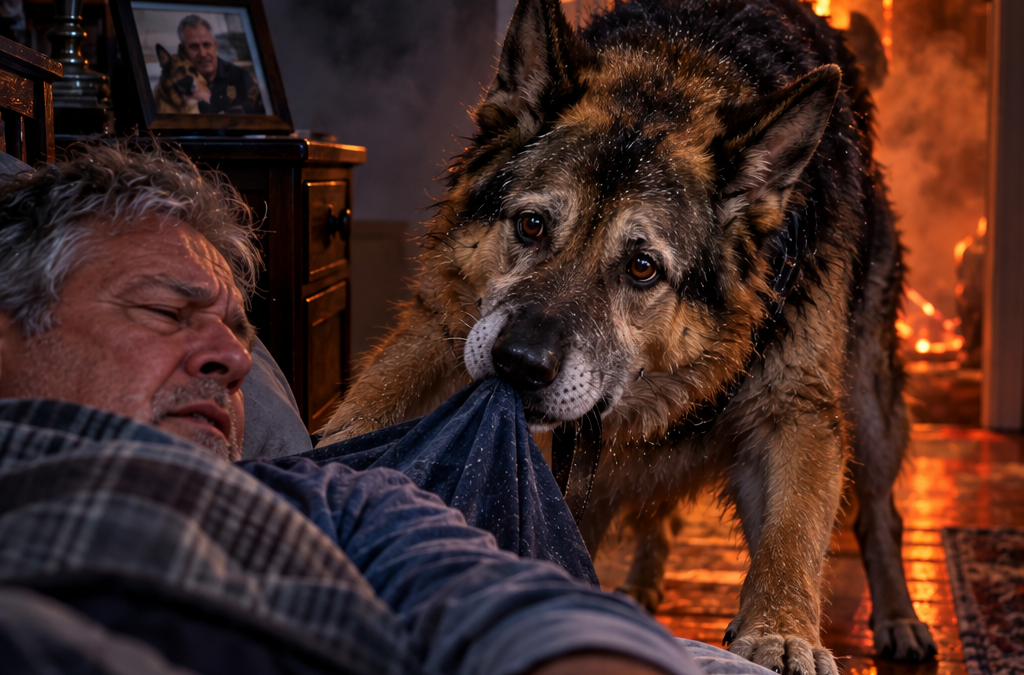
The next thing I remember was Bear pulling at my pajama sleeve.
I opened my eyes.
Smoke.
Darkness.
A flickering orange glow.
I tried to sit up.
Pain shot through my shoulder.
I gasped.
My head spun.
Bear coughed beside the bed.
Then pulled my sleeve again.
“Fire.”
The word escaped my mouth as barely a whisper.
I reached for my phone on the nightstand.
My hand missed it.
The medication had left me confused and unsteady.
I tried again.
This time, I caught it.
The screen lit up.
2:13 a.m.
I dialed 911.
My fingers shook so badly that I nearly dropped the phone.
A dispatcher answered.
“Nine-one-one. What’s the address of your emergency?”
I gave her my address.
Then coughed.
“House fire. Smoke everywhere.”
“Are you inside?”
“Yes.”
“Can you get out?”
I looked toward the bedroom doorway.
Smoke rolled across the ceiling.
The hall beyond was getting darker.
“I’m trying.”
“Stay low and get to an exit if you can do so safely. Don’t go toward the fire. If you can’t get out, close yourself in a room and tell me where you are.”
I nodded even though she couldn’t see me.
“My dog—”
“Sir, keep yourself moving toward safety.”
Bear was already near the bedroom door.
He looked back at me.
Waiting.
I swung my legs over the mattress.
My feet touched the floor.
The room tilted.
I tried to stand.
My knees buckled.
I fell hard against the nightstand.
Pain exploded through my injured shoulder.
The phone slid across the floor.
I heard the dispatcher calling my name.
Bear hurried toward me.
He pressed his nose against my face.
I tried to push myself up.
“Go, Bear.”
He didn’t move.
“Get out.”
He stood beside me.
His breathing was harsh.
His chest moved with desperate effort.
I pointed toward the bedroom doorway.
“Go!”
For the first time in our lives, he refused me completely.
He grabbed the fabric near my elbow.
Tugged.
Then released it and moved toward the door.
He stopped.
Looked back.
Coughed.
And waited.
I understood.
He wasn’t leaving without me.
I forced myself onto my hands and knees.
The floor was cooler.
I could breathe a little better beneath the worst of the smoke.
My shoulder burned with pain, but I began crawling.
Bear moved ahead.
Then returned.
He stayed close enough that I could touch his fur.
The hallway was almost completely dark.
Somewhere toward the kitchen, I heard glass shatter.
A sudden rush of heat followed.
I looked toward the orange glow.
Flames were spreading through the kitchen doorway.
The air had become thick and bitter.
I coughed so hard I nearly vomited.
“Bear!”
He was just ahead of me.
Moving toward the front entrance.
Our bedroom was on the first floor, separated from the kitchen by the living room and a short hallway.
The front door was only a few yards away.
It might as well have been a mile.
I crawled forward.
My injured arm gave out.
I collapsed onto the hardwood.
My head struck the floor.
For a moment, the world disappeared into darkness.
Then I heard Bear.
A strained cough.
A scraping of nails.
And a faint, broken bark.
He was beside me again.
His nose pressed against my cheek.
I opened my eyes.
“I’m here.”
My voice was barely audible.
Bear caught my sleeve.
He pulled.
I pushed myself forward with my good arm.
He stepped backward.
Then turned toward the front door.
I followed.
Inch by inch.
Smoke filled the hallway above us.
My eyes burned.
My throat felt raw.
Somewhere nearby, wood cracked loudly.
I heard the dispatcher through the phone I’d dropped, now far behind us.
I couldn’t make out her words.
Then a different sound reached me.
Sirens.
Distant.
Growing louder.
“Come on, buddy.”
Bear stopped at the front door.
He coughed violently.
His legs trembled.
I reached for the lock.
My fingers slipped.
I tried again.
The deadbolt turned.
I pulled the door.
It wouldn’t open.
For one horrifying second, I thought it was jammed.
Then I remembered the lower latch.
I reached down.
Released it.
Pulled again.
The door swung outward.
Cold February air rushed into the hallway.
Bear stepped onto the porch.
He turned immediately.
I crawled after him.
My injured shoulder struck the doorframe.
I cried out.
Then dragged myself across the threshold.
We made it down the porch ramp and onto the snowy front path.
I collapsed beside the railing.
Bear stood over me.
His chest heaved.
He tried to breathe.
A terrible rasp came from his throat.
I reached for him.
“We made it.”
He looked at me.
His tail moved once.
Then his legs folded beneath him.
“Bear?”
He collapsed onto his side.
I pulled myself toward him.
“Bear!”
His eyes were open.
But his breathing was shallow and uneven.
I wrapped my good arm around his neck.
“No. No, buddy. Stay with me.”
His body trembled.
I could hear fire engines turning onto our street.
Red lights flashed across the houses.
A firefighter ran toward us.
“Sir! Are you hurt?”
I barely looked at him.
“My dog.”
He knelt.
“We’ll help him.”
“He’s sick. His lungs—”
I started coughing.
The firefighter placed a hand on my shoulder.
“We need to get you away from the house.”
I shook my head.
“Not without him.”
Another firefighter approached carrying equipment.
I pointed toward Bear.
“Please.”
The first firefighter looked at his partner.
“Get the dog.”
They carefully lifted Bear and carried him farther from the smoke.
I tried to stand.
Couldn’t.
The firefighter supported me.
“Easy. We’ve got you.”
I watched them carry Bear toward the ambulance.
His head hung low.
His legs were limp.
The sight was unbearable.
I had watched that dog race across fields.
Leap through windows.
Pull toward danger without hesitation.
And now he couldn’t even lift his head.
I began crying.
“He’s a police dog.”
The firefighter looked at me.
“Sir?”
I swallowed.
“Retired K9. Nine years.”
The firefighter glanced toward Bear.
Then back at me.
His expression changed.
“What’s his name?”
“Bear.”
He nodded.
“Okay. We’re going to take care of Bear.”
Paramedics placed an oxygen mask over my face.
I tried to remove it.
“My dog.”
A woman beside the ambulance leaned closer.
“He’s right there. The firefighters are getting him help.”
I looked past her.
Bear lay on a blanket near the ambulance.
One firefighter was kneeling beside him, holding an oxygen mask close to his muzzle while another contacted an emergency veterinary hospital.
His body moved with each difficult breath.
I closed my eyes.
“Please.”
The paramedic placed her hand against my arm.
“Sir, you need oxygen too.”
I let her replace the mask.
Behind us, firefighters entered the house.
Flames were visible through the kitchen windows.
Thick black smoke poured from the roofline.
I stared at the place where Linda and I had spent thirty-six years building a life.
Our photographs.
Her books.
The dining room table where Emily had done her homework.
The Christmas decorations stored upstairs.
All of it was disappearing behind smoke and fire.
But I couldn’t think about any of those things.
I could only think about Bear.
The last thing I remembered before the ambulance doors closed was a firefighter calling out that the dog was still breathing.
Then the world became a blur of sirens, oxygen, and pain.
I woke in a hospital room several hours later.
Sunlight was coming through the window.
My throat felt as though I’d swallowed sand.
My injured shoulder ached.
A nurse stood beside my bed checking a monitor.
I tried to speak.
“Bear.”
She turned.
“Good morning, Mr. Turner.”
I swallowed.
“My dog.”
Her expression softened.
“Your daughter is here. She’s been waiting for you to wake up.”
I looked toward the doorway.
Emily hurried inside.
Her eyes were red.
“Dad.”
She wrapped her arms around me.
I winced.
“Easy. Shoulder.”
She immediately pulled back.
“Sorry.”
I looked into her face.
“Where’s Bear?”
She took a breath.
“He’s at the emergency veterinary hospital.”
My heart pounded.
“Is he alive?”
“Yes.”
I closed my eyes.
Relief washed through me.
Then I noticed Emily wasn’t smiling.
I opened my eyes again.
“What’s wrong?”
She sat beside my bed.
“Dad, he’s in critical condition.”
The room seemed to tilt.
“No.”
She took my hand.
“The smoke made his breathing much worse. They’re giving him oxygen and treating him.”
I stared at her.
“Can I see him?”
“You need to recover.”
“Emily.”
“Dad—”
“Please.”
She looked away.
Her voice broke.
“I almost lost you last night.”
I became quiet.
She covered her face.
“The fire department called me at three in the morning. They said your house was burning and you’d been taken to the hospital.”
Tears ran down her cheeks.
“For nearly an hour, nobody could tell me how bad it was.”
I reached for her hand.
“I’m sorry.”
She shook her head.
“I don’t want to hear that.”
I swallowed.
“Emily—”
“I asked you to get those alarms fixed.”
Her voice trembled.
I looked down.
“I know.”
“You promised me.”
“I know.”
She began crying harder.
“What if Bear hadn’t woken you?”
I stared at the blanket.
I didn’t have an answer.
Because we both knew.
If Bear hadn’t woken me, I probably wouldn’t have made it out.
Emily wiped her face.
“I’m not trying to punish you.”
I nodded.
“I know.”
“I’m scared.”
I looked at her.
She was forty years old.
A mother.
A wife.
A capable woman with her own life.
But at that moment, she looked like the little girl who used to run toward me whenever I came home from a night shift.
“I already lost Mom,” she whispered.
My throat tightened.
“I know, sweetheart.”
“I can’t lose you too.”
I reached for her.
She leaned carefully against my good shoulder.
We stayed like that for a long time.
Later that afternoon, the doctors cleared me to leave after treating my smoke exposure and evaluating my shoulder.
I wasn’t allowed to drive.
Emily took me straight to the emergency veterinary hospital.
During the drive, she told me what the firefighters had discovered.
The blaze appeared to have started in the kitchen near an electrical outlet behind the cabinetry.
The fire investigation was still underway.
The alarm system hadn’t activated.
Investigators suspected a combination of faulty wiring and a system that had not been properly restored after earlier repairs.
I listened without speaking.
I remembered the warning light.
The chirping.
The appointment I’d delayed.
I remembered Emily standing in my kitchen three weeks earlier, asking whether I’d fixed the alarms.
I felt sick.
“Dad?”
I looked toward her.
“Yeah?”
She hesitated.
“The fire marshal said most of the damage is concentrated downstairs.”
I nodded.
“Okay.”
“The house isn’t completely destroyed.”
I looked out the window.
Houses passed.
Trees.
Traffic lights.
People walking dogs along sidewalks.
The world looked absurdly normal.
I swallowed.
“I don’t care about the house right now.”
Emily reached over and squeezed my hand.
“I know.”
At the veterinary hospital, Dr. Bennett met us in a quiet room.
She looked exhausted.
That frightened me.
She had treated Bear for years.
I’d seen her worried before.
But never like this.
“Mike.”
I stood.
“How is he?”
She took a breath.
“Bear inhaled a significant amount of smoke. His lungs were already compromised, and the exposure has caused a severe worsening of his respiratory condition.”
I stared at her.
“Can he recover?”
She hesitated.
“We’re giving him supplemental oxygen and supportive treatment. He’s stable enough that I can take you to see him, but I’m very concerned.”
“Concerned about what?”
Her eyes softened.
“That his lungs may not have enough healthy function left to recover.”
I looked away.
“He got me out.”
Dr. Bennett nodded.
“I heard.”
My throat tightened.
“He barked.”
She became very still.
“What?”
“He hadn’t barked in months.”
I swallowed.
“But he did last night.”
She looked at me for a long time.
Then said softly, “That must have taken an extraordinary effort.”
I nodded.
Tears filled my eyes.
“I kept telling him he didn’t have to work anymore.”
Dr. Bennett placed a hand against my arm.
“Mike.”
I looked at her.
“He wasn’t responding to a police command.”
I swallowed.
She continued.
“He was responding to you being in danger.”
I covered my face.
“Can I see him?”
She nodded.
“Yes.”
Bear lay inside an oxygen-supported enclosure in the intensive care area.
His chest rose and fell rapidly.
His eyes were half closed.
Tubing and monitoring equipment surrounded him.
He looked so small.
That was the first thing that struck me.
My strong, fearless partner looked small.
Dr. Bennett arranged for me to sit close enough to touch him briefly while the veterinary team maintained his oxygen support.
I placed my hand against his head.
“Hey, buddy.”
His ear moved.
My eyes filled.
“It’s me.”
He opened his eyes.
Slowly.
Tiredly.
Then he lifted his muzzle toward my hand.
His tail moved faintly.
I smiled through tears.
“There he is.”
He tried to shift closer.
I gently stopped him.
“No. You rest.”
His breathing remained difficult.
I rubbed the gray fur between his ears.
“You did good.”
My voice broke.
“You did real good.”
I sat beside him for nearly an hour.
Sometimes I spoke.
Sometimes I simply watched him breathe.
I told him the house was still standing.
That Emily was okay.
That the firefighters had put out the fire.
That everyone was safe.
Then I leaned closer.
“You saved me, Bear.”
His eyes stayed on mine.
“Again.”
I swallowed.
“But you weren’t supposed to have to.”
Tears ran down my face.
“You were supposed to be retired.”
He rested his muzzle against my fingers.
I closed my eyes.
“I’m sorry.”
The next forty-eight hours were the longest of my life.
Bear remained hospitalized.
I stayed with Emily and her family.
I barely slept.
Every time I closed my eyes, I saw him standing beside my bed with smoke swirling around his head.
I heard the broken bark.
The desperate cough.
The scrape of his nails across the hallway floor.
I kept thinking about what might have happened if he’d been asleep in another room.
If he’d been too weak to stand.
If he hadn’t recognized the smoke.
If he’d given up after the first attempt to wake me.
There were too many possibilities.
Too many ways the night could have ended differently.
On the second afternoon, Emily found me sitting alone on her back porch.
I was holding Bear’s old collar.
One of the firefighters had recovered it from the house after the fire.
The leather smelled faintly of smoke.
Emily sat beside me.
“Dad?”
I looked at her.
“Yeah?”
“The veterinarian called.”
My heart stopped.
She took my hand.
“Bear’s oxygen needs have increased.”
I closed my eyes.
“No.”
Emily’s voice broke.
“She wants us to come.”
I stood too quickly.
Pain shot through my shoulder.
Emily caught my arm.
“Easy.”
I shook my head.
“We have to go.”
She nodded.
“I know.”
At the veterinary hospital, Dr. Bennett took us into a private consultation room.
I didn’t sit.
“Tell me.”
She looked at me with tears in her eyes.
“Mike, Bear’s lungs are failing.”
I stared at her.
“What can you do?”
“We’ve used the treatments available to support him, but he’s requiring more oxygen and is becoming increasingly exhausted.”
“Then give him more.”
My voice rose.
“Whatever he needs.”
She remained calm.
“I understand.”
“He’s strong.”
“I know.”
“He’s survived worse.”
Dr. Bennett took a slow breath.
“Mike, surviving dangerous situations doesn’t mean his body can overcome this.”
I looked away.
She continued gently.
“Bear is twelve years old. He has advanced chronic lung disease. The smoke exposure has caused severe additional injury.”
My throat tightened.
“How long?”
She paused.
“I think we need to talk about letting him go peacefully.”
I shook my head.
“No.”
Emily stepped closer.
“Dad.”
I looked at her.
“No.”
My voice broke.
“He just saved my life.”
Tears spilled down my face.
“He can’t die now.”
Emily began crying.
She wrapped her arms around me.
I stood there shaking.
“He got me out,” I whispered.
“I know.”
“He wouldn’t leave me.”
She held me tighter.
“I know, Dad.”
I pressed my face against her shoulder.
“I can’t leave him.”
Dr. Bennett waited quietly.
Then she spoke.
“You don’t have to leave him.”
I looked up.
Her voice was gentle.
“You can stay beside him. You can make sure he feels safe. But we need to think about what continuing treatment is asking of him.”
I stared at my hands.
She continued.
“Right now, every breath is a struggle. His condition is worsening despite treatment.”
I closed my eyes.
I thought about Bear standing beside my bed.
About how desperately he’d fought to make me wake up.
How he’d forced air through damaged lungs to produce one broken bark.
How he’d refused to leave me on the hallway floor.
He’d given everything he had.
And now I was asking him to keep fighting because I wasn’t ready to lose him.
I looked at Dr. Bennett.
“Is he scared?”
She hesitated.
“He’s exhausted. We’re doing everything we can to keep him comfortable, but he is struggling.”
I swallowed.
“Can I hold him?”
She nodded.
“We’ll arrange it.”
A little later, the veterinary team brought Bear into a quiet treatment room where they could continue supporting him.
I sat beside him.
Emily stood behind me.
Bear lay on a thick blanket.
His old collar rested in my lap.
Dr. Bennett gave us time.
I leaned forward.
“Hey, partner.”
His eyes moved toward me.
I smiled through tears.
“It’s your old man.”
His tail shifted faintly.
I stroked his face.
“You know, I spent thirty-two years being told to be brave.”
My voice trembled.
“Walk toward danger. Protect people. Don’t panic.”
I swallowed.
“And I thought I understood courage.”
Bear breathed slowly beneath the oxygen support.
I looked into his eyes.
“But you taught me more about courage than any badge ever did.”
I paused.
“You weren’t strong enough to bark.”
Tears ran down my face.
“You weren’t strong enough to run.”
I bent closer.
“But when you knew I needed you, you tried anyway.”
His eyes remained on mine.
“And because you tried, I’m alive.”
I rested my forehead gently against his.
“Thank you.”
The words seemed terribly small.
How do you thank someone for your life?
How do you explain what it means to wake up in a burning house and discover that the one creature you were supposed to protect is risking everything to save you?
I couldn’t.
So I simply stayed.
I rubbed his ears.
Told him stories about our patrol days.
About the first time he’d stolen my glove.
About the little girl beneath the porch.
About Linda feeding him chicken when she thought I wasn’t watching.
At the mention of Linda’s name, his ear moved.
I smiled sadly.
“You remember her.”
His breathing remained weak.
I looked down.
“She loved you so much.”
My voice broke.
“And you took care of her.”
I closed my eyes.
“Then you took care of me.”
For a long moment, the only sound was the quiet movement of the oxygen equipment.
I rested my hand against his chest.
“But you don’t have to take care of me anymore.”
His eyes stayed open.
I swallowed.
“I mean it, buddy.”
My voice trembled.
“You’ve done enough.”
Emily knelt beside us.
She gently touched Bear’s paw.
“Thank you for bringing Dad home.”
I began crying again.
She kissed the top of his head.
“We’ll take care of him now.”
Those words changed something inside me.
I looked at my daughter.
She was crying, but her voice was steady.
I remembered how stubbornly I’d insisted I could manage everything alone.
The house.
The medication.
The appointments.
The broken alarms.
My grief.
Bear’s illness.
I’d spent so much time trying to remain the strong one that I hadn’t noticed how much help I needed.
Bear had noticed.
Somehow, he always had.
I looked down at my old partner.
“You hear that?”
His ear moved faintly.
I smiled through tears.
“Emily’s got me.”
I took a slow breath.
“You can rest.”
Dr. Bennett returned and gently explained the next steps.
I listened.
Asked a few questions.
Then nodded.
Bear had trusted me for twelve years.
He had followed my voice into dangerous places.
He had protected strangers because I asked him to.
And when I was lying helpless in a smoke-filled hallway, he had refused to abandon me.
Now he needed me to make the decision that would spare him further suffering.
I placed his old collar beside his head.
Then leaned close.
“Ready, partner?”
His eyes rested on mine.
I swallowed.
“One last time.”
Dr. Bennett administered medication that allowed Bear to relax into a deep, peaceful sleep.
His struggling breaths eased.
The tension slowly left his body.
I kept my hand against his chest.
“Good boy.”
His eyes grew heavy.
“That’s it.”
My voice broke.
“You can sleep.”
When he was fully asleep, Dr. Bennett quietly asked whether I was ready.
I looked at Bear.
His face was peaceful.
For the first time in days, he wasn’t fighting for every breath.
I nodded.
“Yes.”
I stayed beside him as the final medication was given.
A few moments later, his heart stopped.
Dr. Bennett listened carefully.
Then looked at me.
“He’s gone, Mike.”
I kept stroking his fur.
For several seconds, I couldn’t move.
I waited for his chest to rise.
For his tail to shift.
For his ears to lift at the sound of my voice.
But Bear was gone.
I lowered my face against his neck.
And I cried.
I cried for the young German Shepherd who had dragged me through the mud.
For the brave K9 who had saved strangers.
For the gentle dog who had comforted Linda.
For every quiet evening we’d spent together after she died.
And for the night he’d forced one last bark from his damaged lungs because he refused to let me die alone.
I don’t know how long I stayed beside him.
Eventually, Emily rested her hand against my shoulder.
I looked up.
She was crying too.
“Dad.”
I nodded.
“Yeah.”
She swallowed.
“Let’s go home.”
I looked at Bear.
My heart broke all over again.
Because for years, those words had meant putting on his leash, opening the truck door, and watching him climb into the passenger seat.
Now there would be no familiar movement.
No paws on the seat.
No warm nose pressed against my elbow.
I leaned down and kissed his forehead.
“Goodnight, partner.”
Then I stood.
And for the first time in twelve years, I walked out of a veterinary clinic without him.
The fire had left our house uninhabitable.
Most of the kitchen was destroyed.
The living room had suffered extensive smoke damage.
The bedroom where Bear had woken me was blackened along the ceiling and walls.
But several rooms had survived.
Firefighters had managed to save photographs, important documents, and some of Linda’s belongings.
A week after Bear died, the fire marshal walked me through what remained.
We stood near the kitchen.
The air still smelled of wet ash.
He pointed toward the damaged wall behind the cabinets.
“The evidence is consistent with an electrical fault in this area.”
I nodded.
“And the alarms?”
His expression became serious.
“The system wasn’t functioning properly. The electrical work and lack of an operational backup contributed to the failure.”
I stared at the ruined ceiling.
“I knew it needed attention.”
He looked at me.
“You did?”
I swallowed.
“I kept putting it off.”
He was quiet.
I looked toward the hallway.
“My dog woke me.”
The fire marshal nodded.
“The firefighters told me.”
I closed my eyes.
“He died.”
The man lowered his head.
“I’m sorry.”
I stared at the blackened floor.
“If the alarms had worked, maybe he wouldn’t have had to breathe so much smoke.”
I could barely say the words.
The fire marshal didn’t offer easy reassurance.
He simply said, “We can’t know exactly how that night would have unfolded. But working alarms give people and animals a better chance.”
I nodded.
I appreciated that he didn’t pretend everything was fine.
Because it wasn’t.
Bear had saved my life.
But he should never have been our only warning.
I had failed to deal with a known problem.
And I would carry that regret for the rest of my life.
Still, I couldn’t change what had happened.
I could only decide what to do with the life Bear had given me.
Emily helped me find a temporary apartment near her house while repairs began.
At first, I resisted.
I didn’t want to leave Mill Creek.
Didn’t want to depend on my daughter.
Didn’t want to feel like an old man who couldn’t manage his own life.
But one evening, Emily sat beside me at her kitchen table.
“Dad, you don’t have to be alone to prove you’re strong.”
I looked at her.
She continued.
“Mom knew that.”
My throat tightened.
“Your mother was smarter than me.”
Emily smiled sadly.
“Yes. She was.”
I laughed.
Then began crying.
Emily reached across the table.
“We still need you.”
I looked at her.
She squeezed my hand.
“The kids need their grandpa.”
I swallowed.
“I know.”
“And I need my dad.”
I stared at our hands.
For years, I’d believed my job was to protect everyone else.
Linda.
Emily.
Bear.
My fellow officers.
Strangers who called 911.
But I was beginning to understand that being loved meant allowing other people to protect me too.
So I accepted Emily’s help.
I moved into the apartment.
Attended physical therapy.
Followed my doctors’ instructions.
And worked with licensed professionals to rebuild the damaged parts of the house and install a properly tested fire-detection system.
I made sure every alarm functioned.
Every electrical problem was addressed.
Every exit could be used safely.
I couldn’t go back and change the night of the fire.
But I refused to ignore another warning.
Three months later, the Mill Creek Police Department held a memorial service for Bear.
Frank Harris, who had become chief before retiring, organized it with several former K9 handlers.
The ceremony took place in the department’s training yard.
Bear had spent countless hours there.
Running through obedience drills.
Following scent trails.
Learning to trust me.
A large photograph stood beside the podium.
In it, Bear was five years old.
Strong.
Alert.
Wearing his black police harness.
His ears were raised, and his eyes were fixed on something outside the frame.
I knew exactly what he’d been watching.
Me.
The photograph had been taken during a training exercise.
I’d been standing several feet away, holding his reward toy.
Bear had been waiting for my signal.
Even in a photograph, I could see the trust in his eyes.
Several firefighters who had responded to the house fire attended.
So did the paramedics who had treated me.
Dr. Bennett came.
Emily sat beside me with her children.
And in the front row sat the little girl Bear had found beneath the collapsed porch years earlier.
Sophie.
She was a teenager now.
She brought a handwritten letter.
When she approached me, she looked nervous.
“Sergeant Turner?”
I smiled.
“Hello, Sophie.”
She handed me the envelope.
“My mom said I should give you this.”
I opened it.
Inside was a photograph of Sophie as a little girl standing beside Bear.
She was smiling with both arms wrapped around his neck.
On the back, she had written:
He found me when I was scared and alone. I’ll never forget him.
I stared at the photograph.
Tears filled my eyes.
Sophie spoke quietly.
“I’m sorry he died.”
I swallowed.
“Thank you, sweetheart.”
She looked toward Bear’s picture.
“He was really brave.”
I nodded.
“Yes.”
My voice broke.
“He was.”
During the ceremony, Frank spoke about Bear’s service.
His years on patrol.
The missing people he’d located.
The officers he’d protected.
The quiet dignity with which he’d carried out his work.
Then he looked toward me.
“Sergeant Michael Turner and K9 Bear served this community for nine years as partners.”
He paused.
“But Bear’s final act of service took place long after his retirement.”
The crowd became silent.
“He was old. He was sick. His lungs were failing.”
Frank looked toward the firefighters.
“Yet when his partner was trapped in a burning house, Bear did not abandon him.”
My eyes filled.
Frank continued.
“He did what he had always done.”
He looked at Bear’s photograph.
“He protected the person who trusted him.”
I covered my face.
Frank stepped away from the podium and placed a hand on my shoulder.
“He was one hell of a dog, Mike.”
I nodded.
“The best.”
When it was my turn to speak, I carried a folded piece of paper to the podium.
I’d written a speech the night before.
Five pages.
Stories.
Memories.
Things I wanted the world to know.
But when I looked at the audience, I couldn’t read it.
Instead, I folded the paper and placed it in my pocket.
I looked at Bear’s photograph.
“For nine years, I thought my job was to keep Bear safe.”
My voice trembled.
“I trained him. Fed him. Took him to the veterinarian. Made sure he came home after every shift.”
I paused.
“When he retired and became sick, I promised myself I would protect him from everything I could.”
I looked toward Emily.
“But I made mistakes.”
The crowd was quiet.
“I ignored warning signs in my own home. I believed I could manage every problem myself. And I kept putting off things that should have been done immediately.”
My throat tightened.
“Bear paid a terrible price that night.”
I looked down.
“I will always wish I’d done some things differently.”
For a moment, I couldn’t continue.
Then I took a breath.
“But I also want you to know what kind of dog he was.”
I looked at the photograph.
“When Bear was young, his bark could stop a grown man in his tracks.”
A few officers smiled.
“It was powerful. Confident. Impossible to ignore.”
I swallowed.
“But as his lungs failed, he lost that voice.”
The room became completely silent.
“For six months, he couldn’t bark.”
Tears ran down my face.
“And I kept telling him that was okay.”
I looked toward the firefighters.
“Then our house caught fire.”
My voice broke.
“The alarms didn’t work. I was asleep. And Bear knew something was terribly wrong.”
I paused.
“He couldn’t run the way he used to.”
I swallowed.
“He couldn’t breathe properly.”
My hands trembled against the podium.
“But he found enough strength to wake me.”
I closed my eyes.
“And when I fell in the hallway, he came back.”
Tears blurred my vision.
“He could have kept going.”
I shook my head.
“The door was right there.”
My voice became a whisper.
“But he wouldn’t leave me.”
For several seconds, I couldn’t speak.
Then I looked toward Bear’s photograph.
“He gave everything he had to bring me home.”
I took a breath.
“And now I have to make sure the life he saved means something.”
I stepped back from the podium.
Frank embraced me.
I cried against his shoulder.
The audience stood.
There was applause.
But the sound seemed far away.
In my mind, I heard only one thing.
A rough, broken bark in the darkness.
The sound that had saved my life.
After the memorial, the department presented me with Bear’s service badge and a framed photograph of our final patrol together.
I placed them beside Linda’s photograph when I eventually returned to the restored house.
I also kept Bear’s old collar.
The leather was cracked.
The brass plate scratched.
I could have replaced it.
But I didn’t want a new one.
I wanted the collar that had accompanied him through years of service.
The collar he’d worn when he came home.
The collar that had rested beside him in his final hours.
I hung it near the front door.
Not as a decoration.
As a reminder.
A reminder that courage can be quiet.
That loyalty isn’t measured by strength.
And that sometimes the bravest thing a person can do is admit they need help.
The following autumn, Emily and her children visited for the weekend.
The house was different.
New kitchen cabinets.
Repaired floors.
Fresh paint.
Working smoke alarms throughout the home.
But I’d kept the old recliner in the living room.
The upholstery still carried a faint discoloration from the fire.
I couldn’t bring myself to throw it away.
Bear used to sleep beside that chair.
I sat there every evening now.
Sometimes reading.
Sometimes watching television.
Sometimes simply looking at the empty space where his bed had been.
My grandson, Jacob, came into the room carrying a photograph.
He was nine.
Curious about everything.
“Grandpa?”
I looked up.
“Yeah, buddy?”
He held out the picture.
It showed Bear sitting beside my patrol car years earlier.
“Was Bear really a hero?”
I smiled sadly.
“Yes.”
Jacob sat beside me.
“Did he know?”
I considered the question.
“I don’t think he thought about it that way.”
“Then why did he save people?”
I looked at the photograph.
“Because that’s what he was trained to do.”
Jacob frowned.
“Even when he was old?”
My throat tightened.
I shook my head.
“That night, I don’t think it was about training anymore.”
He looked up.
“What was it about?”
I rested a hand on his shoulder.
“Love.”
Jacob considered that.
Then nodded.
“Like when Mom checks on me at night?”
I smiled.
“Something like that.”
He looked back at Bear’s photograph.
“I wish I could’ve said thank you.”
My eyes filled.
“Me too.”
Jacob placed the photograph on the table.
Then leaned against my shoulder.
For a long time, we sat together.
And I realized I was beginning to understand something Bear had spent his entire life trying to teach me.
Being needed wasn’t a burden.
It was a gift.
But allowing yourself to be loved was a gift too.
That winter, I began volunteering with a local organization that supported retired police dogs and their handlers.
I helped transport supplies.
Visited elderly officers who were struggling with their own retired K9s.
Raised money for veterinary care when families couldn’t afford it.
Sometimes I simply sat with people who were facing the same terrible decisions I’d faced with Bear.
I didn’t pretend to have answers.
I didn’t tell them everything would be fine.
I listened.
Because I’d learned that sometimes being present was more useful than having the right words.
On the first anniversary of the fire, I woke at 2:13 in the morning.
I hadn’t set an alarm.
My body simply remembered.
I lay in bed staring at the ceiling.
The house was quiet.
The air was clear.
A small green light glowed on the properly functioning alarm system.
For a moment, I could almost hear Bear breathing beside the bed.
The slow, familiar sound.
The faint movement of his paws against the blanket.
I turned my head toward the place where his mattress used to be.
Empty.
I felt the familiar ache.
Then I sat up.
Walked through the hallway.
And stopped beside the front door.
Bear’s collar hung on its hook.
I touched the worn leather.
“Hey, partner.”
My voice was quiet.
“One year.”
I looked toward the living room.
Everything was still.
I thought about the smoke.
The darkness.
The sound of his broken bark.
And the way he’d stood beside me when I couldn’t stand myself.
My eyes filled.
“I made it.”
I swallowed.
“I’m still here.”
Outside, a cold wind moved through the trees.
I rested my hand against the collar.
“Emily’s doing good. The kids are growing like weeds. I’ve been keeping my appointments.”
I smiled faintly.
“You’d be proud of me.”
Then the tears came.
Quietly.
Without warning.
I didn’t try to stop them.
I missed Bear more than I knew how to explain.
I missed his weight against my knee.
The way his ears lifted when I reached for the car keys.
The sound of his water bowl.
His slow footsteps through the hallway.
Even the coughing that had once frightened me.
I would have given anything to hear him breathing peacefully beside my chair one more time.
But I knew that wasn’t possible.
So I stood there and remembered.
Not only the fire.
Not only the night he saved me.
I remembered the young German Shepherd who had stolen my glove.
The brave K9 who had found Sophie beneath the porch.
The gentle companion who had sat beside Linda during her illness.
The aging dog who had followed me from room to room when grief made the house feel empty.
And the old partner who had lost his bark but never lost his heart.
I touched the brass nameplate.
“Good boy, Bear.”
Then I turned toward the kitchen.
Made myself a cup of tea.
Sat down in the old recliner.
And watched the first pale light of morning appear beyond the windows.
For years, I’d believed Bear’s greatest gift was his courage.
The way he ran toward danger.
The way he refused to abandon a search.
The way he trusted me even when the world around us was frightening.
But I understand now that his greatest gift was something simpler.
He made me feel worth protecting.
Even when I was old.
Even when I was stubborn.
Even when I was grieving.
Even when I had made mistakes.
He never stopped believing I was worth saving.
And now, every day I wake up, I try to live in a way that honors that belief.
Because on the worst night of my life, when the alarms failed and the house filled with smoke, Bear had almost nothing left to give.
His body was weak.
His lungs were failing.
His voice had been silent for months.
But when he realized I was in danger, he found one last way to reach me.
I used to think a police dog’s bark meant danger was coming.
Now, whenever I remember Bear’s final bark, I hear something different.
I hear a promise.
A promise made without words, years earlier, between a young officer and a restless German Shepherd on a muddy training field.
A promise that neither of us would be left behind.
Bear kept his.
And as long as I am alive, I will spend my remaining years trying to be worthy of it.
I looked toward the empty place beside my chair.
“All clear, partner,” I whispered.
“You can rest now.”
The morning sunlight filled the room.
And for the first time in a long while, I let myself smile through the tears.
I had lost my house for a time.
I had lost the last companion who had shared my life with Linda.
And I had lost the sound of those familiar paws following me down the hallway.
But Bear had given me something death could never take away.
The chance to live.
The chance to love my family better.
The chance to stop treating tomorrow as something guaranteed.
His final bark had lasted only a second.
But that single second gave me the rest of my life.