My 2-Year-Old Vanished Into a Freezing Forest—At Dawn, We Found Who Had Kept Him Alive
# My 2-Year-Old Vanished Into a Freezing Forest—At Dawn, We Found Who Had Kept Him Alive
My two-year-old son disappeared into 340 acres of freezing woods wearing nothing but thin pajamas and one sock, and by midnight the temperature had dropped so low that every person searching for him understood what nobody was willing to say out loud.
For eleven hours, I followed flashlights through frozen brush, listened to search dogs disappear into darkness, and watched a thermal drone sweep the forest again and again without finding the one small heat signature that mattered more to me than anything in the world.
When dawn finally came, the radio on a deputy’s shoulder crackled with six words that made every person around me stop moving.
My name is Travis Raines, and until November 9, 2023, I thought I understood what fear felt like.
I had been scared before. I had worried about bills, family illnesses, storms that knocked trees across our road, and those ordinary things every parent thinks are emergencies until a real emergency arrives and shows you how small your old fears actually were.
That Thursday had been painfully ordinary.
My wife and I were home with our son, Caleb, who was two years old and possessed the kind of endless curiosity that could turn a cardboard box into a fort, a wooden spoon into a drumstick, or a five-minute walk across the yard into a half-hour expedition because he had discovered a beetle, a rock, or a leaf that absolutely required investigation.
He was still young enough that we checked doors without thinking.
Still young enough that silence in the house usually meant trouble.
Still young enough that one missing sock could turn into a family mystery.
That evening, Caleb was wearing a pair of lightweight pajamas. At some point, one sock had come off. I remember noticing his bare foot earlier and thinking I would find the missing sock before bedtime.
That stupid little detail would torment me later.
Our home sat beside a large wooded property, roughly 340 acres of oak, brush, uneven ground, natural depressions, fallen timber, and trails that looked obvious in daylight but could vanish completely after dark.
The screen door had always been one of those things you had to pull firmly to make sure the latch caught.
That night, it didn’t.
At approximately 7:40 p.m., while our attention was elsewhere for a window of time that still feels impossible to me, Caleb pushed against that screen door.
It opened.
And my two-year-old son walked outside alone.
The temperature was already around 31 degrees Fahrenheit and falling.
He had no coat.
No hat.
No gloves.
One sock.
And no understanding that the woods behind our property could swallow an adult’s sense of direction in minutes.
We did not know any of that yet.
At first, the house seemed normal.
Then, sometime around 8:15, I noticed the door.
It was standing open just far enough for cold air to slide through the gap.
I stared at it for a second without understanding what I was seeing.
“Did you open this?” I asked my wife.
She looked over.
Her expression changed immediately.
“No.”
I called Caleb’s name.
Nothing.
I checked the living room.
Nothing.
Bedroom.
Bathroom.
Kitchen.
Behind the couch.
Under the table, because two-year-olds hide in ridiculous places and sometimes think being silent while their parents panic is the funniest game imaginable.
“Caleb?”
My voice became louder.
“Buddy?”
No answer.
I ran outside.
The cold hit me immediately.
I looked toward the porch, the driveway, the yard.
Nothing.
My wife came through the door behind me.
“Travis?”
There are moments when married people do not need to finish sentences.
I looked toward the dark tree line.
She followed my eyes.
And suddenly the entire world seemed to narrow to one black wall of forest.
I shouted his name.
Again.
Again.
Again.
The trees gave me nothing back.
I ran toward them without a coat.
My wife grabbed the phone.
By 8:52 p.m., county search-and-rescue teams were being mobilized.
Eleven volunteers eventually joined the search.
Two canine teams arrived.
A thermal-imaging drone was launched into the darkness.
Deputies began organizing sectors while flashlights spread through the woods like tiny moving stars.
And somewhere beyond all of us, a two-year-old boy in thin pajamas was walking, crawling, crying, or lying still in temperatures that continued sliding toward 27 degrees Fahrenheit.
That was when one of the rescuers put a hand on my shoulder and told me something I would hear several times that night.
“We’re going to keep looking.”
I nodded.
But what I heard was something else.
We have to find him before the cold does.
**[END OF FACEBOOK OPENING — 700–800 WORDS]**
**[FULL STORY CONTINUES]**
I wish I could say I remained calm after that.
I didn’t.
The first hour after search-and-rescue arrived felt like controlled chaos, and I was useless in the middle of it.
People who had never met my family pulled vehicles into our driveway, opened equipment cases, checked radios, strapped lights to their heads, unfolded maps, and began transforming the place where my son usually kicked a plastic ball across the grass into a command center.
One deputy asked me questions while another wrote down the answers.
“What was he wearing?”
“Pajamas.”
“What color?”
I told him.
“Shoes?”
“No.”
“Coat?”
“No.”
“Any medical conditions?”
“No.”
“When was he last seen?”
I looked at the clock.
That was the question that hurt.
Because parents want to believe they know exactly where their children are every second.
But that night I had to admit there was a window.
A short one.
Still long enough.
“Somewhere around seven-forty,” I said.
The deputy looked toward the forest.
He did not react dramatically.
That frightened me more than if he had.
Professionals become careful with their faces when the truth is bad.
My wife stood a few yards away wrapped in a blanket someone had brought her.
She kept looking at the porch as though Caleb might suddenly appear there, irritated that everyone had made such a fuss.
Every few minutes she called his name.
“Caleb!”
Then she waited.
Nothing.
Our cat, Boots, was nowhere around.
At the time, I barely noticed.
Boots was nine years old, gray and white, quiet, predictable, and almost absurdly domestic.
She was the kind of cat who considered the front porch a wilderness expedition.
In nine years, I had never known her to wander beyond the immediate area around the house.
She liked warm windows, the back of the couch, a certain corner of our bed, and Caleb’s habit of dropping food.
If someone had asked me that evening whether Boots would walk a mile into dark woods in subfreezing temperatures, I probably would have laughed.
But nobody asked.
Nobody was thinking about the cat.
We were thinking about Caleb.
The canine teams started from the house.
One handler brought a dog to the porch and let it work Caleb’s scent.
I watched the animal circle once, nose low, then pull hard toward the wooded area.
The handler followed.
My stomach dropped.
Until that moment, some irrational part of me had still hoped Caleb was hidden under the deck, inside a shed, behind a vehicle, somewhere close.
The dog’s movement erased that hope.
“He went that way?” I asked.
The handler glanced back.
“It looks like he may have.”
May have.
Two words designed to avoid certainty.
But I knew what they meant.
My son had gone into the woods.
I started after them.
A deputy stopped me.
“You need to stay where we can reach you.”
“He’s my son.”
“I know.”
“I know those woods.”
“So do some of these volunteers. We need you available in case they find something or need information.”
“I’m not standing here.”
He studied me for a moment.
Then another rescuer stepped over and said, “Put him with Team Three.”
That was how I ended up walking through the woods with three volunteers and a sheriff’s deputy, calling my child’s name into darkness.
“Caleb!”
We stopped.
Listened.
Wind.
Branches.
Leaves.
Sometimes something moved in the brush and all four of us turned at once.
A rabbit.
A raccoon.
Nothing.
We moved farther.
“Caleb!”
Every time I shouted, I pictured him answering.
“Daddy!”
But the sound never came.
The temperature kept falling.
At around ten o’clock, one of the volunteers checked his phone and quietly said it was below freezing.
I had already lost feeling in two fingers despite wearing gloves someone had given me.
That was when the image of Caleb’s bare foot hit me.
One sock.
I had seen it.
I had known it.
And somehow that detail became more unbearable than everything else.
One bare foot touching frozen ground.
I stopped walking.
The deputy beside me turned.
“You okay?”
“He doesn’t have a sock on one foot.”
“I know.”
“No, you don’t understand. He had one sock. I remember. I was going to find the other one.”
The words sounded insane even to me.
The deputy didn’t tell me to calm down.
I appreciated that.
He simply said, “Then we find him faster.”
We kept moving.
Around us, radios crackled.
Teams called in coordinates.
Searchers checked culverts, brush piles, low ground, logging paths, old fencing, and every depression where a small child might crawl for shelter.
The drone circled overhead.
Its thermal camera should have been our greatest advantage.
A human body in cold woods ought to stand out.
At least that was what I believed.
Every time I heard the drone operator speak over the radio, my heart stopped.
“Possible signature.”
Then a pause.
“Negative. Animal.”
Another.
“Heat source northeast sector.”
Pause.
“Search team checking.”
Then:
“Nothing.”
The night stretched.
Eleven p.m.
Midnight.
The temperature continued dropping.
At one point, I returned to the house because a deputy wanted me to drink something hot.
My wife was sitting at the kitchen table.
She had Caleb’s blanket in her hands.
I sat across from her.
Neither of us spoke for several seconds.
Then she whispered, “He hates being cold.”
That sentence broke something in me.
I stood immediately.
“I’m going back.”
She grabbed my hand.
“Find him.”
“I will.”
It was a promise I had no power to make.
But I made it anyway.
By one in the morning, the woods felt endless.
Search lights moved between trees.
Dogs worked until handlers rotated them.
Volunteers came back for water, changed batteries, adjusted gear, and went out again.
Nobody complained.
Nobody suggested stopping.
The temperature eventually reached about 27 degrees Fahrenheit.
Somewhere in those trees, Caleb had now been outside for more than five hours.
A search-and-rescue volunteer named Mark walked beside me for part of the night.
He had children of his own.
I knew because at one point, without looking at me, he said, “My youngest used to sleepwalk.”
I glanced over.
“He got outside once. Summer night. Made it two houses down.”
“What did you do?”
“Lost ten years off my life.”
He gave me a tired smile.
Then his expression hardened again.
“We’ll keep going.”
That became the rhythm of the night.
Hope.
Fear.
Movement.
Silence.
“Caleb!”
Wait.
Nothing.
Keep walking.
At approximately two-thirty, one canine team found what might have been a partial trail deeper into the wooded property.
The handler said the scent was difficult.
Cold air, damp leaves, changing wind, multiple people now moving through the area—everything complicated tracking.
We followed as far as the team leader allowed.
The ground became rougher.
Fallen oak trees lay across shallow depressions.
Leaves had collected thickly in low areas.
I remember looking at one narrow dark hollow and thinking a child could disappear there while standing ten feet away.
That thought stayed with me.
The forest was not a single place.
It was thousands of hiding places.
Thousands of wrong turns.
Thousands of places where a tiny body could stop moving.
At three in the morning, I began hearing things that were not there.
A child crying.
A branch breaking behind me.
A voice saying “Dad.”
Each time I stopped.
Each time the others stopped with me.
“What?”
“I thought I heard him.”
We listened.
Nothing.
Sleep deprivation and fear were beginning to play tricks on me.
My legs hurt.
My throat was raw from shouting.
But the pain felt almost offensive.
My son was somewhere without shoes.
I did not have the right to be tired.
Around four, a medic at the command post tried to get me to sit down.
“You’re shaking.”
“I’m fine.”
“You’re not.”
“My son is two years old.”
“I know.”
“He’s been outside for eight hours.”
“I know.”
“Then stop asking me to sit down.”
The medic said nothing else.
He handed me a cup.
I drank without tasting it.
My wife came outside.
The first trace of morning was still far away.
She looked smaller somehow.
“You need to tell me the truth,” she said to one of the rescue coordinators.
He hesitated.
That hesitation made me angry.
“Tell us.”
The coordinator looked from her to me.
“With these temperatures, this length of exposure is very dangerous.”
“How dangerous?”
He took a breath.
“Very.”
My wife covered her mouth.
I felt myself becoming furious at him, even though he had done nothing wrong.
I wanted certainty.
I wanted someone to tell me Caleb was alive.
Nobody could.
The coordinator continued.
“Small children lose heat faster than adults. We need to find him as soon as possible.”
“What happens if—”
My wife couldn’t finish.
The man’s expression softened.
“We’re not stopping.”
Again, that phrase.
We’re not stopping.
It was all anybody could give us.
By five in the morning, the darkness had changed.
Not lighter exactly.
Just thinner.
The black sky had begun turning deep blue at the horizon.
Frost coated parts of the ground.
My boots were soaked.
Branches had torn my jacket.
I had fallen twice.
None of it mattered.
The drone had continued scanning.
No clear human heat signature.
That became increasingly terrifying.
At first, the drone’s failure to find Caleb had seemed like bad luck.
By dawn, it suggested something worse.
If Caleb were alive, why wasn’t he warm enough to appear clearly?
I did not ask that question aloud.
I didn’t need the answer.
At 6:20 a.m., another canine team was sent toward an area roughly a kilometer from our property.
I was near the command post when the handler and dog disappeared into the woods.
The sky had become pale gray.
My wife stood beside me.
We were holding hands, but neither of us seemed aware of it.
At 6:40, a radio transmission came in.
Static.
Coordinates.
Then:
“Possible find.”
Every person within hearing distance froze.
The coordinator grabbed his radio.
“Repeat.”
The voice came back.
“Possible find. Stand by.”
My wife’s fingers crushed mine.
I could hear my heartbeat.
Nothing else.
Five seconds.
Ten.
Twenty.
Then the radio crackled again.
“Child located.”
My knees nearly gave out.
But the transmission wasn’t finished.
“Alive.”
My wife screamed.
Not a word.
Just a sound.
I remember grabbing her, both of us collapsing against each other while people around us began moving.
Then another message came.
“Severe hypothermia. Need medical team moving now.”
Alive.
That word repeated in my head.
Alive.
Alive.
Alive.
But we still did not know how close we were to losing him.
The handler who found Caleb later described the location to me.
It was a shallow natural depression between two fallen oak trunks, about three feet wide in places, carpeted with wet leaves.
Caleb was lying on his back.
His pajamas were damp.
His skin was pale.
His hands were stiff and nearly useless.
His uncovered foot showed signs of frostbite on three toes.
He was conscious.
Barely.
He could not speak.
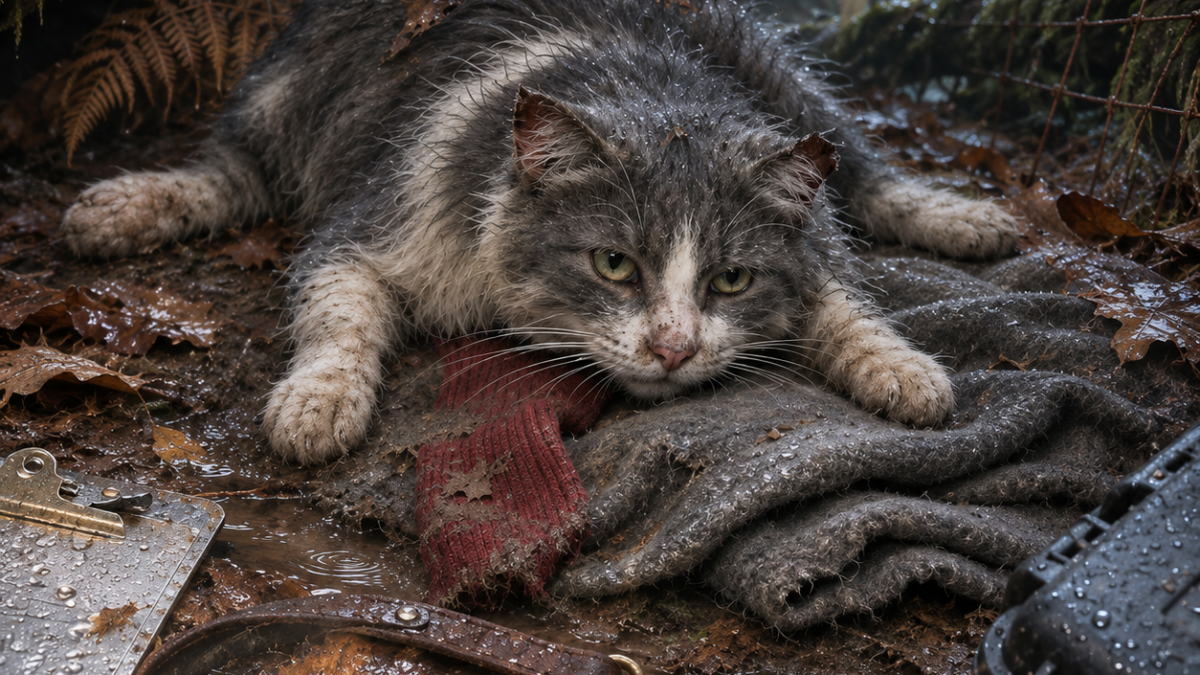
And lying directly across his chest and abdomen was Boots.
Our cat.
The same nine-year-old gray-and-white house cat who had never willingly traveled farther than the porch.
She was stretched across him with her body pressed tightly against his torso.
Her legs were extended outward, almost as if she had deliberately tried to cover as much of him as possible.
At first, the handler thought she might be dead.
She did not move when he approached.
His dog stopped.
He called out.
Caleb’s eyes shifted.
Boots stayed where she was.
The handler knelt beside them.
He reached toward the cat.
She still did not move.
When he tried to lift her, he discovered she was alive.
Weak.
Cold.
Rigid.
But alive.
And she did not voluntarily leave Caleb.
He had to physically pick her up.
Even then, she did not struggle.
She simply had no strength left.
The handler later told me, “It was like she’d decided that was where she needed to be.”
Caleb was transported immediately.
I rode with him.
My wife followed.
I remember almost nothing about that drive except the sight of my son under blankets.
His eyes were open.
I kept talking to him.
“Daddy’s here.”
No response.
“You’re okay, buddy.”
Nothing.
“You’re okay.”
I repeated it so many times that eventually I wasn’t sure whether I was speaking to him or to myself.
At Davis Medical Center, doctors and nurses took over.
His core temperature was 89.1 degrees Fahrenheit—31.7 degrees Celsius.
Hypothermic.
Dangerously cold.
But alive.
A doctor explained that they needed to rewarm him carefully.
His hands were so cold he could not move them properly.
He could not speak yet.
Three toes on his uncovered foot showed superficial frostbite.
I stood against a wall listening to medical language I barely understood.
Temperatures.
Circulation.
Cardiac monitoring.
Warming.
Fluids.
Risk.
My wife finally asked the question I could not.
“Is he going to live?”
The doctor looked at Caleb.
Then at us.
“We have reason to be hopeful.”
Not certainty.
But hope.
At that moment, hope was enough.
Hours later, once Caleb’s temperature had begun rising and he was responding better, the emergency physician asked us about the cat.
“What cat?” I said stupidly.
“The animal found with him.”
“Boots.”
“Was she lying on him when they found him?”
“Yes.”
The doctor nodded slowly.
“How long do you think she was there?”
“I don’t know.”
He asked about the timeline.
Caleb left at approximately 7:40 p.m.
Found at 6:47 a.m.
Eleven hours and seven minutes.
The doctor explained something that made me sit down.
A two-year-old child wearing thin pajamas in temperatures between roughly 27 and 31 degrees Fahrenheit, exposed for eleven hours without a meaningful heat source, would ordinarily be expected to cool much faster.
He said that after six or seven hours, a child in those conditions could potentially reach severe hypothermia, with a core temperature below approximately 82 degrees Fahrenheit, or 27.8 Celsius.
At those levels, cardiac complications become increasingly dangerous.
Caleb was cold.
Very cold.
But he was warmer than the circumstances suggested he should have been.
I stared at the doctor.
“So what are you saying?”
“I’m saying something slowed his heat loss.”
My wife looked at me.
The answer was sitting at another hospital.
Boots.
Our ordinary house cat was taken to Mountain State Animal Hospital later that morning.
When we received the first update about her condition, I understood for the first time what those eleven hours had cost her.
Her body temperature was 84 degrees Fahrenheit.
28.9 Celsius.
Lower than Caleb’s.
Far below the normal feline range.
The veterinarian told us she was severely hypothermic and dehydrated.
Her heart rate had dropped to approximately 110 beats per minute.
For a resting cat, that was dangerously slow.
But the worst visible damage was on her ears and paws.
The ends of both ears had suffered stage-two frostbite.
Tissue was already beginning to darken.
Three of the pads on her front paws had also been damaged.
The veterinarian believed the paw injuries were consistent with moving over frozen ground and then remaining exposed to freezing temperatures for a prolonged period.
I remember sitting beside Caleb’s hospital bed, listening to this on the phone.
My wife had one hand over her mouth.
“So she was colder than him?” I asked.
“Yes.”
The veterinarian paused.
“She appears to have lost a significant amount of body heat.”
I looked at my son.
Then I understood.
Boots had not merely found him.
She had stayed.
For hours.
Possibly most of the night.
Pressing her warm body against his.
Giving him whatever heat she still had.
Until she had almost none left for herself.
I had spent the night imagining my son alone.
That image had tortured me.
But Caleb had not been completely alone.
Somewhere in that forest, while searchers called his name and drones passed overhead, a nine-year-old cat who had never ventured beyond our porch had been lying on his chest.
And she stayed until she nearly froze.
Caleb began improving over the next several hours.
His speech returned.
Movement came back to his fingers.
The color in his skin improved.
His toes were watched closely, but the frostbite remained superficial.
Doctors told us there appeared to be no permanent tissue loss.
By the next day, he was asking for food.
Children are extraordinary that way.
Adults can be emotionally shattered by an event while a toddler begins asking for crackers.
I sat beside him and watched him eat.
At one point, he looked at me and said, “Boots?”
I nearly lost control.
“Boots is with the doctor.”
“Kitty?”
“Yeah, buddy.”
He accepted that answer.
I didn’t.
I wanted to see her.
I wanted proof she was alive.
When I finally visited the animal hospital, Boots looked smaller than I remembered.
She was wrapped in warm blankets.
Her ears were damaged.
The tips were dark.
One front paw was heavily protected.
An IV line ran into her.
I stood beside the cage.
“Hey, Boots.”
Her eyes opened.
That was all.
I put my hand near her.
She leaned her head forward slightly.
I started crying.
I had spent nine years feeding that cat, complaining when she scratched furniture, moving her off my chair, and occasionally stepping around her when she decided the center of a hallway was the perfect place to sleep.
I had never once looked at her and thought hero.
Now I couldn’t look at her without thinking it.
The veterinarian came beside me.
“She’s stable.”
“Will she make it?”
“We’re hopeful.”
There was that word again.
Hopeful.
Apparently my entire life now depended on people saying hopeful.
I looked at Boots.
“Was she really lying on him long enough to do that much damage?”
The veterinarian considered the question carefully.
“We can’t know exactly how long she remained in that position.”
“But her temperature?”
“Very low.”
“And his was higher.”
“Yes.”
“So she kept him warm.”
The veterinarian did not make a dramatic claim.
Professionals rarely do.
Instead she said, “Close body contact would have reduced heat loss. Given the circumstances, her presence may have been very important.”
May have been.
I nodded.
That was enough.
Ten days later, Boots underwent surgery.
The final several millimeters of both ears had become necrotic.
The tissue could not be saved.
The damaged tips were amputated.
One paw pad healed thick and pale.
The others recovered gradually.
When we brought her home, Caleb saw her carrier and ran toward it.
“Boots!”
She stepped out slowly.
Her ears were shorter now.
Her walk was careful.
Caleb dropped to his knees.
I held my breath because I was afraid he would grab her.
Instead he simply placed one small hand on her back.
Boots leaned into him.
My wife turned away because she was crying.
I didn’t bother turning away.
Caleb remembered almost nothing about the night in the woods.
No dark trees.
No cold.
No fear.
No moment of lying between fallen oaks while his temperature dropped.
Nothing.
Perhaps that was a mercy.
But sometimes I wonder whether some part of him remembers warmth.
Not consciously.
Not as a story.
Just as a feeling.
A small body pressed against his when everything else was cold.
After the story reached a local newspaper, a reporter asked me the question everyone wanted answered.
“How did Boots get out there?”
I still don’t know.
That is the strangest part.
Boots had never been an outdoor cat in any meaningful sense.
She occasionally stepped onto the porch.
Sometimes she sat near the door.
Nine years.
That was her world.
House.
Porch.
Windows.
Family.
The woods were not her territory.
They were not familiar.
She had never followed us deep into them.
She had never disappeared for hours.
She had never shown any interest in exploring.
Yet on the one night Caleb walked through that door, Boots apparently went after him.
Nobody called her.
Nobody trained her.
Nobody carried her.
Nobody told her a child was in danger.
The only explanation I have is simple.
She saw him leave.
And followed.
I have replayed that image in my mind hundreds of times.
Caleb pushing the screen door open.
Small bare foot touching the cold porch.
Walking into darkness without understanding danger.
Boots watching.
Perhaps waiting.
Perhaps confused.
Then stepping down from the porch.
Following the little boy who dropped food for her and sometimes pulled her tail until we stopped him.
Across the yard.
Toward the trees.
Into a world she had avoided for nine years.
A mile through frozen ground.
I don’t know whether she stayed behind him the entire way.
Maybe she lost him and searched.
Maybe Caleb carried her for a while.
Maybe she followed his scent.
Maybe he cried and she found him.
We will never know.
We only know where both of them ended up.
In a shallow hollow between fallen trees.
Together.
There was one more detail that I learned days later.
The drone.
All night, I had stared upward every time I heard it.
Thermal imaging was supposed to find warmth against cold terrain.
But the drone had nearly missed Caleb because his body temperature had fallen so close to the surrounding environment that his heat signature was weak.
The handler who eventually found them said the search team had almost passed the location.
The depression was easy to overlook.
Fallen oak trunks blocked part of the view.
Wet leaves covered the ground.
Then the thermal equipment picked up something faint.
Not enough to immediately look like a healthy human body.
Just a small area warmer than the surroundings.
They checked it.
That heat signature was Boots.
The cat we had not even realized was missing had helped keep my son alive—and may also have helped rescuers find him.
For a long time afterward, I struggled with guilt.
People told me not to.
That did not matter.
Parents do not need permission to blame themselves.
I replayed the door.
Why hadn’t I checked the latch?
Why hadn’t I noticed sooner?
Why hadn’t I found the missing sock?
Why had thirty-five minutes passed before we knew he was gone?
There are questions that do not improve with repetition.
I asked them anyway.
One night, a few weeks after Caleb came home, I sat on the kitchen floor after everyone else had gone to bed.
Boots walked in.
Her ear tips were still healing.
She crossed the room and sat beside me.
I looked at her.
“You did what I was supposed to do.”
She blinked.
I laughed through tears.
“You watched him.”
Boots began washing one paw.
Cats are not interested in human guilt.
Maybe that is another gift.
I put my hand on her back.
“I should have been there.”
She leaned against my leg.
For the first time since the accident, I allowed myself to say something different.
“But you were.”
That sentence changed something in me.
Not immediately.
Guilt does not disappear because you have one emotional revelation on a kitchen floor.
But it began to loosen.
Because the story was not only about the door I failed to secure.
It was about eleven volunteers who left their homes at night to search for someone else’s child.
Two dog teams working through freezing woods.
Deputies who refused to stop.
A drone operator scanning acre after acre.
A handler who checked one more faint heat signal.
Doctors warming a child back toward safety.
Veterinarians fighting to save an animal who had given too much of herself.
And a nine-year-old cat doing something none of us understood.
The night could have ended differently in a hundred ways.
Caleb could have wandered farther.
He could have fallen into water.
He could have become trapped under brush.
Searchers could have missed the hollow.
Boots could have stayed on the porch.
She could have turned back when the ground became cold.
She could have left him when her own temperature began falling.
She could have protected herself.
She didn’t.
The recovery became its own strange chapter.
Caleb returned to normal so quickly that it almost felt impossible.
Within days he was moving through the house with the same reckless energy he had always possessed.
We installed new locks high on the doors.
Then secondary locks.
Then alarms.
Then I checked them three times every night.
My wife joked once that I would eventually build a bank vault around the house.
I told her I was considering it.
She laughed.
It was the first real laugh either of us had shared since the night Caleb disappeared.
Boots recovered more slowly.
Her ears changed permanently.
Before, they had been pointed.
After surgery, the shortened tips gave them a rounded appearance.
People sometimes asked what happened.
I never knew how to answer briefly.
“She got frostbite.”
That sounded incomplete.
“She was in the woods.”
Still incomplete.
“She stayed with my son.”
Closer.
But the truth always required the full story.
One paw pad remained thicker and paler than before.
It never seemed to cause serious difficulty.
She walked normally.
Jumped onto furniture.
Slept in sunny windows.
Demanded food.
Ignored expensive cat beds in favor of cardboard boxes.
In other words, she returned to being Boots.
That mattered to me.
Heroes in stories are often transformed by what they do.
Boots wasn’t.
She did something extraordinary and then returned to her ordinary life.
Perhaps that was what made it so powerful.
She did not know she had become famous locally.
She did not understand why strangers sent toys.
She did not care that people called her brave.
She wanted her food bowl filled at the correct time.
She wanted sunlight.
She wanted Caleb nearby.
Sometimes I found them sleeping together.
The first time, I panicked.
I walked into Caleb’s room and saw Boots curled near his stomach.
For half a second I was back in the woods.
Cold leaves.
Gray dawn.
A child lying still.
Then Caleb moved.
Boots opened one eye.
Everything was fine.
I stood in the doorway for a long time.
My wife came behind me.
“You okay?”
“Yeah.”
She followed my gaze.
Boots was pressed against Caleb.
My wife smiled.
“She still watches him.”
I nodded.
“Apparently I’m not qualified.”
She elbowed me gently.
The humor helped.
So did time.
But some things never returned to normal.
Every November, when the air becomes sharp, I remember.
If the temperature drops below freezing at night, I think about my son’s bare foot.
When leaves collect under the oak trees, I imagine the hollow where they found him.
When a door fails to latch immediately, I feel adrenaline before I feel anything else.
Trauma stores itself in strange places.
But gratitude does too.
I cannot pass Boots asleep in a warm patch of sunlight without remembering her temperature at the animal hospital.
84 degrees.
Twenty-eight point nine Celsius.
Nearly five degrees colder than Caleb.
Seven degrees below the normal temperature for a cat.
She had given away heat until her own body was failing.
That is not metaphor.
That is what happened to her.
Her heart slowed.
Her tissues froze.
Her ears died at the tips.
Her paw pads were injured.
She became dangerously dehydrated.
She paid for those hours physically.
And she survived.
There is a photograph from several weeks later that remains my favorite.
Caleb is sitting on the floor.
Boots is beside him.
You can see the shortened ear tips clearly.
Caleb has one hand resting on her back.
Neither of them is looking at the camera.
He is focused on some toy.
Boots is staring off toward the window.
It looks completely ordinary.
If you did not know the story, you would never guess what those two had survived together.
That photograph taught me something.
The most important moments in our lives often do not look dramatic afterward.
Sometimes survival looks like a child playing with blocks while a cat sits beside him.
Sometimes a miracle looks like breakfast.
Sometimes the ending you prayed for is simply ordinary life returning.
Months after the incident, I met the canine handler who found Caleb and Boots.
We had spoken briefly before, but that morning had been chaos.
This time we sat down.
I asked him to tell me exactly what he saw.
He hesitated.
“You sure?”
“Yes.”
He looked at the table.
“My dog showed interest in the area first.”
“How close were you?”
“Not far.”
“You almost passed them?”
He nodded.
“The depression was hidden by the logs. From one angle, it just looked like leaf cover.”
“And the thermal signal?”
“Very weak.”
“From Caleb?”
He shook his head slightly.
“That’s the thing. We couldn’t say for sure at first. His body temperature was so low that he didn’t show like you’d expect a person to show.”
I knew that already, but hearing it from the man who stood there made my chest tighten.
“What did show?”
“The cat.”
Boots.
Again.
He continued.
“She was warmer than the ground, but not by much. Enough to make us check.”
I stared at him.
“So if she hadn’t been there…”
He did not finish the sentence.
Neither did I.
Some sentences do not need endings.
I asked, “What did she do when you came up?”
“Nothing.”
“Nothing?”
“She stayed on him.”
“Was she conscious?”
“Yes. Barely, I think.”
“And when you picked her up?”
“She didn’t fight. But she didn’t get off him herself.”
I looked away.
The handler gave me a moment.
Then he said something I have never forgotten.
“I’ve worked with trained search dogs for years. Animals do things we understand, and they do things we don’t. But that cat had a choice to move away from him.”
I looked back.
“She didn’t.”
“No.”
He shook his head.
“She stayed.”
For eleven hours, that is the part that matters.
She stayed.
Not because somebody commanded her.
Not because she expected food.
Not because she understood hypothermia or body temperature or cardiac risk.
She stayed because, for whatever reason existed inside that small animal mind, leaving him alone was not acceptable.
People sometimes ask whether I believe Boots knew she was saving Caleb.
I don’t know.
I am careful with that question.
I do not want to turn her into something magical because the truth is already remarkable enough.
Maybe she knew only that Caleb was cold.
Maybe she heard him crying.
Maybe he curled around her first.
Maybe she sought warmth from him and, in doing so, gave warmth back.
Maybe instinct kept her there.
Maybe attachment did.
Maybe cats understand more than we give them credit for.
The motive matters less to me than the result.
My son was alive.
Boots was on his chest.
Her body was colder than his.
Those facts are enough.
The local attention eventually faded.
That is what happens.
A story appears.
People talk about it.
Then another story arrives.
Life moves forward.
For us, it never became old news.
It became family history.
Caleb grew.
Boots aged.
Every time I looked at her ears, I remembered that night.
Those missing tips became the closest thing she had to medals.
She never wore a vest.
Never received formal training.
Never knew the meaning of the word rescue.
But she carried the evidence of it permanently.
One afternoon, when Caleb was older, he asked why Boots’ ears looked different from other cats.
My wife and I looked at each other.
We had always known the day would come when we would need to tell him.
I sat beside him.
“You know you got lost in the woods when you were little?”
He nodded.
He had heard pieces.
“You were very cold.”
“How cold?”
“Really cold.”
“Was I scared?”
“I don’t know.”
That question hurt.
He looked at Boots.
“What happened to her ears?”
I took a breath.
“She was with you.”
His face changed.
“In the woods?”
“Yes.”
“All night?”
“We think so.”
“Why?”
There it was.
The same question adults asked.
Why?
I smiled.
“I think she didn’t want you to be alone.”
Caleb looked at her for several seconds.
Then he walked over and hugged her.
Boots tolerated it with the exhausted patience of an older cat who had survived much worse.
He whispered something.
“What did you say?” I asked.
“Nothing.”
Children deserve secrets too.
But later he told my wife.
He had whispered:
“Thank you.”
That was enough to destroy me all over again.
There is no revenge in this story.
No villain receives punishment.
No cruel person is dragged into court.
No dramatic enemy gets what he deserves.
The only enemy that night was cold.
Cold and time.
And if you want to call what happened afterward revenge, perhaps it was this:
The night tried to take my son.
It failed.
The frost took pieces of Boots’ ears.
It did not take her life.
The woods hid them.
A tiny heat signature betrayed their location.
The temperature dropped until both of them were dangerously close to the edge.
And still, by morning, they were both breathing.
That is the only victory I need.
Years from now, Caleb may remember almost nothing about being two.
He will not remember the screen door.
He will not remember walking across frozen ground.
He will not remember the dark trees.
He will not remember the search lights.
He will not remember eleven strangers calling his name.
He will not remember the dog approaching.
He will not remember the medic lifting him.
He will not remember being wrapped in blankets.
But I will.
His mother will.
The people who searched will.
And every time Caleb sees the cat with the shortened ears in our old photographs, he will know that there was once a freezing November night when the world became enormous and dark, when his parents could not reach him, when trained rescuers could not see him, when a thermal drone nearly missed him, and when a small gray-and-white house cat followed him farther from home than she had ever gone before.
She found him.
Or stayed with him.
Or both.
Then she lay across his chest.
Hour after hour.
As the temperature dropped.
As her own body cooled.
As frost damaged her ears and paws.
As her heart slowed.
As her strength disappeared.
She did not leave.
At 6:47 the next morning, searchers finally found them between two fallen oak trunks.
Caleb’s temperature was 31.7 degrees Celsius.
Boots’ was 28.9.
He was colder than any child should ever be.
She was colder still.
And that difference has stayed with me more than any headline ever could.
Because it tells the story better than I can.
My son still had heat.
Boots had given away hers.
Today, when people ask me whether I believe animals can love us, I rarely argue.
I don’t need to.
I simply tell them about a little boy in one sock.
A freezing forest.
A cat who had never gone beyond the porch.
Eleven hours.
Two damaged ears.
One scarred paw.
And a dawn I will never forget.
Then I tell them the final thing the handler told me.
“When we found them, she was still lying on him.”
Still there.
Still covering him.
Still refusing, in the only way she could, to leave a two-year-old child alone in the cold.
And sometimes the quietest creature in the house turns out to be the bravest member of the family.