𝗙𝗨𝗟𝗟 𝗦𝗧𝗢𝗥𝗬 The Shop Owner Demanded $41,000 After I Refused to Drive Into a Frozen Alley During a Blizzard
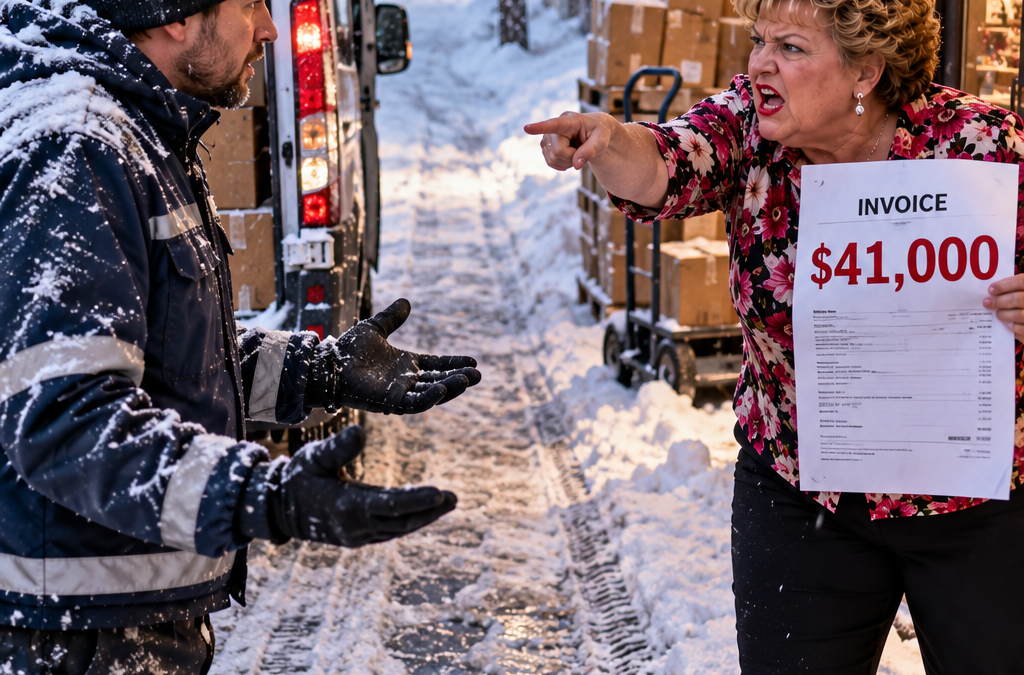
𝗙𝗨𝗟𝗟 𝗦𝗧𝗢𝗥𝗬
The box was wooden, about the size of a large suitcase.
A local glassblower had packed it with handblown ornaments surrounded by thick foam.
The destination was Hail House Gifts on Main Street.
Victoria Hail.
I knew the shop.
Everybody did.
Green awning.
Beautiful windows.
Expensive Christmas decorations.
The kind of place where you went in planning to spend twenty dollars and somehow left seventy-five dollars poorer.
A note on the delivery asked for the rear loading door.
Marcus leaned closer.
“Listen to me.”
“I am.”
“If the alley is bad, use the approved safe drop.”
“Okay.”
“If there’s a barricade, you stop.”
“Okay.”
“No package is worth you putting a van in a ditch.”
“I understand.”
He stared at me.
“I mean it.”
“So do I.”
I had another habit.
One that had started years earlier after a customer accused me of delivering something late.
I had known I was on time.
The customer said I wasn’t.
Neither of us had proof.
He won.
After that, I bought a small waterproof notebook.
Before every difficult route, I wrote down the date.
Temperature.
Weather.
Road conditions.
Anything unusual.
It was not official company documentation.
Just mine.
That evening I opened to a clean page.
December 12.
-26°F.
Heavy snow.
Strong wind.
Priority crate.
Hail House Gifts.
Then I put the notebook in my chest pocket.
I left the center shortly after seven.
The storm became worse almost immediately.
Outside town, snow moved horizontally across my headlights.
Three semitrailers sat along the highway shoulder with hazards flashing.
Their drivers had decided waiting until morning was smarter than continuing.
A pickup had slid nose-first into a drift.
Nobody was inside.
I kept both hands on the wheel.
No radio music.
No phone.
Nothing except engine noise and the weather.
At the top of Fourth Street Hill, I saw orange light reflecting through the snow.
A sheriff’s barricade.
I stopped.
A warning sign indicated severe ice and restricted local access.
The alley behind Main Street descended from that same hill.
I picked up the dispatch radio.
“Marcus?”
“Go.”
“I’m at Fourth Street Hill. Barricade’s up. Severe ice. The Main Street rear alley feeds off this grade.”
There was a pause.
Then Marcus answered carefully.
“Continue toward the approved safe drop near Hail House if conditions allow. Do not cross the barricade.”
“Copy.”
“And Jack?”
“Yeah?”
“If the alley isn’t safe, don’t force it.”
“Understood.”
That exchange mattered later.
At the time, it was simply two men trying not to make a bad night worse.
Hail House Gifts glowed ahead of me through the snow.
Warm yellow lights.
Green awning.
Artificial snowflakes painted on the windows.
The rear loading door sat at the bottom of a narrow alley sloping down from Fourth Street.
I turned into it slowly.
The van changed beneath me.
Anyone who drives in winter knows the feeling.
The wheels were still turning.
The engine was still working.
But the tires no longer felt connected to the ground.
The van floated.
I touched the brake.
The rear moved sideways.
Not much.
Enough.
I stopped.
My back tires were less than a yard from a drainage ditch buried beneath blown snow.
I sat still.
Then climbed out.
The wind hit my face immediately.
I tested the pavement with my boot.
A thin layer of powder concealed solid ice.
I took two steps.
My heel slipped.
That settled it.
There are moments when people call caution cowardice because they are not the ones sitting behind the wheel.
I had no interest in becoming courageous at the bottom of a frozen hill.
I backed out.
Slowly.
Inches at a time.
Then I drove around to Main Street.
The approved safe-drop location was a covered side entrance approximately one hundred feet from the loading door.
Flat sidewalk.
Deep awning.
Brick wall blocking most of the wind.
I parked legally.
Lowered the crate.
Carried it beneath the awning.
Checked every seal.
Dry.
Intact.
No visible damage.
I photographed the crate from three angles.
I deliberately included enough background to establish location.
Then I opened the notebook.
8:04 p.m.
Safe point.
Alley ice.
At 8:05, I marked the delivery complete on the company tablet.
The system immediately prompted me for a note.
My fingers were so cold that I mistyped “alley” the first time.
I corrected it.
ALLEY ICED. IMPASSABLE. DROPPED AT SAFE POINT, MAIN STREET SIDE ENTRANCE. CRATE SEALED.
At 8:06, the system transmitted confirmation to dispatch and an automatic delivery notice to the shop’s registered contact.
I radioed Marcus.
“Package secure at safe drop. Alley is impassable.”
“Understood.”
“Seals intact.”
“Copy.”
“Heading out.”
“Get home.”
I pulled away at 8:12.
I remember feeling almost proud of the decision.
Not heroic.
Responsible.
Exactly the kind of boring judgment a winter driver should make.
Then, at 8:31, my phone lit up through the dashboard system.
Victoria Hail.
I answered hands-free.
“This is Jack.”
Her voice was controlled.
That was one of Victoria’s gifts.
She almost never sounded angry.
She sounded disappointed.
That often worked better.
“Where is my crate?”
“Covered side entrance.”
“I requested rear delivery.”
“I couldn’t get the van safely down the alley.”
“You were given written instructions.”
“Yes.”
“The rear door.”
“I know.”
“Then why is my merchandise sitting somewhere else?”
“Because the alley is solid ice.”
She was quiet.
I continued.
“The crate is under the awning. Sealed. Dry. I photographed it.”
“You should have called me.”
“The delivery notice went to your phone.”
“That isn’t the same thing.”
“I also reported it to dispatch.”
“Jack, those ornaments are for an important client.”
“I understand.”
“They could be ruined.”
“They’re sheltered.”
“I never authorized you to leave them there.”
“The location is the approved safe drop when the primary point is inaccessible.”
Another pause.
Then her voice became even quieter.
“If anything is broken or this order is lost, you will be responsible.”
I tightened my hands around the steering wheel.
“Victoria—”
“You are going to pay for this.”
The call ended.
For the next twenty miles, those words traveled with me.
You are going to pay for this.
I told myself she was frightened about expensive merchandise.
Angry.
Maybe embarrassed that a delivery had not gone exactly as planned.
By morning, she would see the crate.
Everything would settle.
I drove home at fifteen miles per hour.
Mother had left soup on the stove.
I ate it standing at the counter.
“Delivery okay?” she asked from the sewing room.
“Customer’s angry.”
“Package damaged?”
“No.”
“Then why?”
“Because I wouldn’t drive into an icy alley.”
Mother looked toward me over her glasses.
“Then she can be angry.”
I smiled.
“That’s my position too.”
I believed the matter was finished.
While I slept, Victoria began creating another version of the night.
Friday morning dawned clear and bitterly cold.
The storm had blown east.
Snowbanks sparkled beneath a hard blue sky.
I reached the distribution center shortly before eight.
Marcus was standing in his office doorway before I had even removed my gloves.
“Come in.”
His face told me something had changed.
I closed the door.
“Victoria?”
He nodded.
“She’s called five times.”
“What happened?”
“She says you dumped the crate in a snowbank.”
I stared at him.
“What?”
“She says it sat exposed for almost two hours.”
“No.”
“Two ornaments are cracked.”
“Okay.”
“And she says Pinerest Lodge canceled a thirty-eight-thousand-dollar holiday order because the shipment was mishandled.”
That number hung between us.
Thirty-eight thousand dollars.
I sat.
“Marcus, I placed the crate under the side awning.”
“I know.”
“I have pictures.”
“I need them.”
I took out my phone.
Showed him.
Three photographs.
Crate against the wall.
Dry pavement immediately beneath the awning.
Street sign visible.
Timestamp.
Then the notebook.
Then the tablet record.
Marcus studied everything.
“The lodge canceled because of this?”
“That’s what she’s claiming.”
“I delivered at eight-oh-four.”
“She says it wasn’t secured until later.”
“She called me at eight-thirty-one already knowing exactly where it was.”
“I know.”
I watched him.
“Then what’s happening?”
Marcus placed both hands on the desk.
“The regional office is reviewing it.”
“Reviewing what?”
“Her claim.”
“What claim?”
“Everything.”
He would not meet my eyes.
That frightened me more than Victoria’s anger.
At seven that morning, Paul Sanders, our regional director, had called Marcus at home.
Victoria Hail mattered commercially.
She chaired committees.
She sat on the downtown merchants association.
Her shop and connected businesses sent significant annual volume through our center.
She was threatening to move all of it.
Sanders instructed Marcus not to admit fault either way.
Document everything.
Contain the situation.
That afternoon, rumor began moving.
I did not see it start.
Small-town stories rarely have a single starting point.
Someone told someone that I had abandoned expensive merchandise in the snow.
Someone else added that I had been too lazy to walk the package to the correct door.
By lunchtime, the story sounded finished.
Daniel Price, who owned the Main Street diner, heard it from a woman sitting at his counter.
Daniel had known me for years.
He reportedly set down the coffee pot and said:
“Jack Mercer once drove heating oil to Mrs. Lawson at midnight because her furnace failed. Doesn’t sound much like a man who’d dump someone’s Christmas order in a snowbank.”
The woman shrugged.
The conversation changed.
But the rumor continued.
Two customers canceled their weekend deliveries.
No accusations.
Just polite messages.
Thanks, but we’ve made other arrangements.
That was how reputation disappeared.
Quietly.
Monday afternoon, Marcus called me into his office.
Paul Sanders was on speakerphone.
His voice was polite.
Professional.
The company valued my work.
Nobody had reached conclusions.
However, because of the financial claim and customer allegations, I would be suspended from all delivery routes pending review.
Without pay.
I looked at Marcus.
“How long?”
Sanders answered.
“As long as necessary to establish the facts.”
“What facts aren’t established?”
“We’re not going to litigate this by telephone, Jack.”
“I’m not litigating.”
“We need calm.”
I almost laughed.
Calm.
People with salaries always seem very interested in calm when the person without income is someone else.
I looked toward the stain on Marcus’s office ceiling.
There was a small one there too.
For some reason it made me think about our roof.
No routes.
No income.
No roof deposit.
Another winter with buckets.
Marcus straightened papers that did not need straightening.
“I’m sorry.”
His voice was low.
I stood.
I wanted to say something angry.
I didn’t.
At home, Mother listened without interrupting.
When I finished, I said:
“Maybe I should just apologize.”
She looked at me.
“For what?”
“For the delivery not being where she wanted it.”
“Did you do something wrong?”
“The customer says I did.”
“That isn’t what I asked.”
I stared at the table.
“It might get me back to work.”
Mother lifted her teacup.
Then put it down carefully.
“A man who puts his name under something false doesn’t get to pretend later that he never said it.”
“I’m trying to save my job.”
“I know.”
“And the roof.”
“I know.”
“Then what do you want me to do?”
“Tell the truth.”
“Truth doesn’t pay the roofer.”
“No.”
Her eyes moved toward the sewing-room ceiling.
“But a lie collects interest.”
Then she went upstairs.
I sat alone.
The notebook was still in my jacket.
I opened it.
That was how I started.
Not with anger.
With time.
Victoria’s story said the crate had sat abandoned outside for nearly two hours.
Delivery: 8:04.
System confirmation: 8:05.
Customer notification: 8:06.
Departure: 8:12.
Victoria called me: 8:31.
Twenty-seven minutes after placement, she knew where the package was.
Two hours did not exist.
That was the first crack.
I could not afford a lawyer.
The first attorney I called quoted a $3,500 retainer before he would seriously review anything.
That was more than the roof deposit.
So I became my own investigator.
I bought a yellow legal pad.
One line for every minute I could account for.
I requested from Marcus everything drivers were entitled to see.
GPS history.
Radio logs.
Delivery receipt.
Tablet notes.
Customer instructions.
He gave them to me.
Reluctantly.
Not because he wanted to hide them.
Because every record complicated the company’s position.
I also went outside the company.
County emergency management was run by Julia Bennett.
Thirty-one.
Precise.
The kind of public employee who understood that facts become more useful when nobody decorates them.
I asked:
“What were road conditions downtown Thursday evening?”
She studied me.
“I’m not taking sides.”
“I’m not asking you to.”
“I won’t provide an opinion about whether you should or shouldn’t have driven.”
“I don’t want one.”
“What do you want?”
“The official log.”
That answer seemed to satisfy her.
She printed it.
At 5:52 p.m., the county issued a severe ice advisory covering downtown streets and alleys behind Main Street.
At 7:30, the sheriff’s office placed a barricade at Fourth Street Hill.
Then another entry caught my attention.
8:22 p.m.
Vehicle in ditch behind Main Street.
Tow requested.
Ortiz Auto and Towing.
Same alley.
Eighteen minutes after I placed Victoria’s crate at the safe location, someone else went into the ditch I had refused to drive beside.
I drove to Ortiz Auto.
Samuel Ortiz was fifty-eight and looked as though motor oil had permanently moved into the lines of his hands.
I described my van.
He thought.
Then nodded.
“I saw you.”
“When?”
“Around eight.”
“Where?”
“Coming backward out of Hail’s alley.”
“You remember?”
“Because I thought, smart man.”
I almost laughed.
“Why?”
“Road was glass.”
“Did we speak?”
He narrowed his eyes.
Then remembered.
“You asked whether county sanding was coming through.”
“What did you say?”
“Not until morning.”
He turned toward his office.
“Hang on.”
He returned with an invoice.
8:22.
Pickup recovery.
Rear alley, Main Street block.
I asked if he would give me a copy.
He did.
Then I asked if he would write only what he remembered seeing.
No opinion about Victoria.
No opinion about me.
Just facts.
He agreed.
At the door, he said:
“Ice doesn’t care who’s right.”
I looked at him.
“It only cares who’s careful.”
I wrote that down later.
The nights became long.
At three in the morning, I often found my mother awake beneath the sewing lamp.
She had quietly taken extra alterations.
Coats.
Dresses.
Pants.
Small jobs.
Small money.
She never said they were because I had lost work.
We both knew.
One morning I filled her tea.
“You don’t need to do all this.”
She kept sewing.
“Neither do you.”
That was the end of the conversation.
I brought my evidence back to Marcus.
Notebook.
Radio log.
County advisory.
Tow invoice.
GPS.
Tablet entry.
He read in silence.
When he reached the radio transcript, his face changed.
There it was.
His voice.
Continue to the safe drop.
Do not cross the barricade.
If conditions are unsafe, don’t force it.
He had instructed me to do exactly what I did.
Marcus looked up.
“This isn’t just your problem.”
“I’ve been trying to tell you.”
“No.”
He tapped the transcript.
“If they decide you abandoned the package, then I authorized the abandonment.”
“You authorized a safe delivery.”
“I know.”
That was the first moment I felt someone inside the company move from protecting the organization to protecting the truth.
Then Victoria’s formal claim arrived.
Cream-colored paper.
Beautiful printing.
$41,000.
Thirty-eight thousand for the canceled Pinerest Lodge order.
Approximately three thousand for damaged ornaments and injury to her business reputation.
I read it three times.
On the third reading, I noticed the attached Pinerest invoice.
The lodge event was Saturday.
The ornaments were not required until Saturday morning at ten.
I went back through dispatch records.
There was another note I had never seen.
Thursday.
4:40 p.m.
Dispatcher Denise Cole had called Hail House Gifts and offered to hold the crate because of deteriorating weather.
Delivery could be made Friday morning after plows cleared downtown.
The note read:
CUSTOMER DECLINED. INSISTS ON TONIGHT.
I sat in Marcus’s office staring at it.
Nobody had forced Victoria’s order onto the road during a blizzard.
She had been offered the safer choice.
She rejected it.
And she had an entire additional day before the lodge needed the merchandise.
That did not yet prove everything.
But it proved her $41,000 demand was not nearly as clean as she claimed.
Then her attorney wrote to me directly.
Gordon Ames.
Three pages.
Fourteen days to pay.
Negligent abandonment.
Commercial damages.
Business reputation.
Reckless disregard.
Mother read it over my shoulder.
Her face changed more than mine did.
She sat slowly.
“Forty-one thousand.”
“Yes.”
“We don’t have that.”
“No.”
“Can they take the house?”
“I don’t know.”
That was the first time I saw real fear in her.
The next day, Paul Sanders emailed Marcus questioning whether the company should continue working with me given the exposure.
Five longtime customers changed carriers.
One sent me a card wishing me well.
That somehow hurt more than anger.
Then Sanders offered a settlement.
I could return to work Monday.
All I had to do was sign a one-page acknowledgment stating that I failed to complete delivery to the designated location.
Accept a formal warning.
Contribute $4,000 from future earnings toward settlement.
No lawsuit.
No suspension.
No more trouble.
I held the phone against my ear.
The roof stain entered my mind immediately.
Three thousand two hundred dollars.
Mother’s sewing.
The bucket.
Work Monday.
Income.
Maybe peace.
“I need to think.”
“Of course,” Sanders said. “This is simply a practical resolution.”
Practical.
That word almost got me.
I told Mother.
She listened.
Then said something I did not expect.
“Maybe you should take it.”
I looked at her.
“You’ve spent days telling me not to sign a lie.”
“I told you not to destroy yourself for an easy lie.”
“This is a lie.”
“Yes.”
“But?”
She rubbed her hands.
“I don’t want pride to cost you your life.”
“It’s not pride.”
“I know.”
Silence.
Then she leaned toward me.
“But I also know this. If you let someone else sew a false ending onto your story, people only remember the finished seam.”
I smiled despite everything.
“You can turn anything into sewing.”
“Forty years. I earned it.”
“What do I do?”
“Don’t run.”
She paused.
“Don’t scream.”
Another pause.
“Do it carefully.”
So I declined the settlement.
Then I built a binder.
Tabs.
Timeline.
County advisory.
Sheriff barricade.
Samuel’s tow invoice.
GPS.
Radio transcript.
Tablet note.
Photographs.
Dispatch record showing Victoria refused Friday delivery.
Customer notification.
Every page in order.
On Tuesday morning, we met in the distribution-center breakroom.
Marcus.
Denise Cole.
Me.
Paul Sanders on speakerphone.
I did not accuse Victoria of lying.
Not once.
I walked through the night.
5:52.
County alert.
7:30.
Barricade.
7:52.
Van enters downtown.
7:58.
Van reaches alley.
8:04.
Safe drop.
8:05.
Delivery complete.
8:06.
Customer notified.
8:12.
Van leaves.
8:22.
Pickup enters same ditch.
8:31.
Victoria calls me already aware of the drop.
When I finished, Denise spoke.
Her hands were wrapped around a paper cup.
“I offered her Friday morning.”
Sanders said:
“Denise—”
“I’m just stating what happened.”
“Was the offer documented?”
“Yes.”
“Did she refuse?”
“Yes.”
“Why?”
“She said the package had to come Thursday.”
Marcus opened the radio transcript.
“I authorized Jack to use the safe point.”
Nobody spoke.
“I told him not to cross the barricade.”
Still nothing.
“If following my instructions is considered misconduct, then that’s my responsibility too.”
That changed the room.
Sanders reminded us Victoria was an important commercial customer.
More than $140,000 in annual shipping volume connected to the merchants association.
But he did not tell Marcus to stop reviewing.
That was enough.
Victoria learned about the binder.
North Haven was that kind of town.
She called Marcus.
Not angry.
Polite.
She reminded him how much downtown businesses spent with the company.
Other merchants, she said, were concerned.
It would be unfortunate if reliability questions caused them to explore competitors.
No threat.
She simply described consequences.
When Marcus told me, something inside me shifted.
This was no longer only about getting my job back.
There were younger drivers at the center.
Tyler Brooks was twenty-two.
Had a new baby.
Still drove too fast sometimes because youth believes skill can negotiate with physics.
If the company taught us that a powerful customer could punish a driver for refusing an icy road, eventually someone would drive when they should stop.
Someone would decide the complaint was more dangerous than the ditch.
One winter, somebody would not come home.
That night, Marcus pulled the driver handbook from the shelf.
At eleven, he called me.
“Jack.”
“Yeah?”
“I found something.”
He read:
“Driver Safety Authority. Any driver may decline any segment of a route at any time without penalty where conditions pose a direct danger to the driver or vehicle. The decision belongs to the driver.”
I stood in our dark kitchen.
“Read that again.”
He did.
The company had a written rule.
Not guidance.
Not suggestion.
Authority.
I had been suspended for doing exactly what the safety handbook authorized me to do.
For the first time since Victoria’s phone call, I felt solid ground beneath me.
But evidence inside the company did not automatically repair my name outside it.
People still believed the first story.
So I stopped trying to find one dramatic piece of proof.
The shop’s rear camera had been useless.
Snow had covered the view.
No miracle recording existed.
Instead, I built something stronger.
Independent clocks.
The county had one.
Samuel had one.
The company tablet.
GPS.
Dispatch radio.
Customer notification.
Tow invoice.
Each record had been created for some reason unrelated to defending me.
Together, they told the same story.
Julia certified the county advisory.
Samuel signed his statement.
Marcus aligned the GPS with the radio.
My van entered downtown at 7:52.
Stopped near the alley at 7:58.
Reversed out.
Reached Main Street at 8:04.
Departed at 8:12.
No mysterious two-hour abandonment.
No hidden gap.
No disappearance.
Just a delivery performed under dangerous conditions.
I also found a weakness in my own evidence.
My three photographs were close.
They showed the crate clearly.
They showed shelter.
But none showed the entire width of the awning.
I could have ignored that.
Instead, I wrote a note:
PHOTOGRAPHS CONFIRM CRATE POSITION AND IMMEDIATE COVER BUT DO NOT SHOW FULL AWNING WIDTH.
Marcus read it.
“Why’d you write this?”
“Because it’s true.”
“Doesn’t help you.”
“Doesn’t hurt the truth.”
He looked at me for a long moment.
Later, he told me that was when he stopped doubting me completely.
Someone manufacturing a case usually hides weaknesses.
I had documented mine.
Then Marcus understood the company’s danger.
He closed the breakroom door one afternoon.
“If we blame you, do you know what we’re saying?”
“What?”
“That we sent a driver into a severe-ice warning. That management told him not to cross a barricade. That our own safety policy let him refuse a dangerous route. And that after he followed all of that, we punished him because a customer complained.”
He looked pale.
“An insurance lawyer would destroy us with that.”
“Probably.”
“And if another driver gets hurt next winter?”
He did not finish.
He called Sanders.
Victoria kept pressing.
At another merchants association meeting, she said I was rewriting a night already written.
But this time the room did not simply accept it.
Rachel Kim owned the family pharmacy.
She stood.
“My pharmacy delivers insulin and cardiac medication during winter.”
People turned.
“If delivery drivers learn that refusing an icy road can get them sued or fired, eventually one of them is going to drive because they’re scared of the customer.”
She looked around the room.
“And someday the person in the ditch may be carrying somebody’s medication.”
Daniel Price heard that.
That evening, he came to my house.
Still wearing his diner apron beneath his coat.
“Tell me everything.”
I showed him the binder.
“I don’t want you taking sides.”
He shook his head.
“You don’t need to ask me to.”
At the door, he took Mother’s hand.
“Rhubarb pie’s on me for the rest of winter.”
Mother smiled.
“I’ll hold you to that.”
I did not campaign around town.
That mattered to me.
I did not knock on doors saying Victoria was evil.
I did not know whether she was evil.
I knew she was accusing me of something I had not done.
That was enough.
When someone asked, I showed them records.
If they wanted weather conditions, I gave them Julia’s office information.
If they wanted the ditch incident, Samuel’s.
Then another record appeared.
The county emergency-alert delivery log.
At 5:52 that Thursday, a severe ice warning had been sent to registered downtown business contacts.
The alert specifically mentioned Fourth Street Hill and the alleys behind Main Street.
Beside Hail House Gifts’ registered phone number was a response.
6:08 p.m.
ACKNOWLEDGED.
Victoria had known the alley was dangerous almost two hours before I arrived.
Her first complaint claimed nobody warned her.
Now we had a timestamp saying otherwise.
That shifted the question again.
Not just what happened.
What did Victoria know when she began accusing me?
The merchants association called a special meeting.
Harold Weiss, the lumberyard owner, chaired it.
He asked Victoria directly:
“Did you receive the county severe-ice alert Thursday evening?”
Victoria said businesses received many automated messages and she could not be expected to examine every one immediately.
Harold nodded.
Then:
“Did the courier company offer Friday-morning delivery?”
Victoria’s posture stiffened.
“That’s a private business matter.”
“Did they?”
“Yes.”
“Why did you refuse?”
“I needed control over my inventory schedule.”
“When did Pinerest Lodge need the ornaments?”
“Saturday.”
The room became quiet.
Victoria tried to explain.
She employed six people.
Her business supported families.
Holiday orders mattered.
Mistakes could damage a small shop.
All of that was true.
That was part of what made the situation sad.
People can be wrong without every part of their fear being imaginary.
But fear did not make her accusation true.
After that meeting, people began remembering other things.
Not crimes.
Patterns.
A flower-shop owner remembered Victoria holding payment for weeks before demanding a discount.
A milk-truck driver remembered being ordered away from her loading area during a storm.
Someone remembered a seventeen-year-old employee fired after calling out during dangerous winter weather.
Nobody organized against her.
Nobody needed to.
Daniel made his own decision.
Victoria had booked his diner to cater a sixty-person holiday dinner.
A valuable contract.
He called her.
“I can’t take the event.”
“Why?”
“Because I don’t want the work.”
“Is this about Jack Mercer?”
Daniel later told me he was shaking when he answered.
“It’s about how you treat people when you think they can’t fight you.”
He refunded her deposit.
Rachel Kim removed Victoria’s gift baskets from her pharmacy.
Found another regional supplier.
Returned the inventory politely.
The bookstore stopped ordering her holiday cards.
The lakeside inn changed suppliers.
A framing shop ended an account.
No signs.
No campaign.
No boycott committee.
Orders simply stopped.
People began walking past Hail House.
Victoria felt it quickly.
Retailers always do.
She called me one Tuesday night close to eleven.
I nearly ignored the call.
Then answered.
“Jack.”
“Victoria.”
Her voice was softer than I had ever heard it.
“We need to find a way to clear this up.”
“I agree.”
She proposed reducing the $41,000 demand by one-third.
In return, I would clarify some statements and withdraw some of the records I had gathered.
I listened until she finished.
Then said:
“I don’t want you destroyed.”
Silence.
“I want the accusation corrected.”
“You’ve turned the entire town against me.”
“I haven’t told anyone anything I can’t document.”
“You know exactly what you’re doing.”
“No.”
I thought about that.
Then said:
“I know what I’m not doing. I’m not signing something false.”
Her voice hardened.
“Then this will get uglier.”
“It already is.”
She hung up.
The company finally contacted Pinerest Lodge directly.
That should have happened at the beginning.
Their events director, Norah Whitfield, responded within a day.
She provided the original cancellation email.
I was at Marcus’s desk when he opened it.
He read.
Then looked at me.
“What?”
He turned the screen.
The cancellation had been sent Thursday.
6:58 p.m.
Almost an hour before I reached the alley.
Reason:
Missed design approvals.
Dispute regarding price changes.
Nothing about delivery.
Nothing about weather.
Nothing about me.
The lodge had already canceled Victoria’s $38,000 order before I ever touched the crate.
Yet her claim packet contained a later letter presenting the courier incident as the cause.
I sat slowly.
Marcus read the email again.
“Jack.”
“I see it.”
“This is over.”
I wanted to believe him.
Victoria still had a choice.
She could withdraw.
Apologize.
Say emotions had run high.
Blame confusion.
End it.
She did not.
The formal regional review took place on a gray Thursday morning.
Paul Sanders sat at the head of a conference table.
Marcus beside me.
Victoria across from us with Gordon Ames.
Claims adjuster.
Files.
No drama.
No audience.
I wore the only good jacket I owned.
Mother wanted to come.
I asked her to stay home.
I knew she would sit at the kitchen table watching the clock.
Marcus presented the evidence.
No accusations.
First, official weather advisory.
5:52.
Second, sheriff barricade.
Third, radio communication.
Fourth, safe-drop authorization.
Fifth, driver tablet note.
Sixth, GPS path.
Seventh, customer notification.
Eighth, tow invoice.
Ninth, Victoria’s acknowledgment of county warning at 6:08.
Tenth, dispatch offer of Friday delivery and her refusal.
Then Marcus placed Pinerest Lodge’s original cancellation email on the table.
6:58.
He said nothing.
The paper did enough.
Gordon Ames attempted to argue professionally.
The customer had requested rear-door delivery.
The courier owed service.
Expectation mattered.
Marcus opened the handbook.
Driver Safety Authority.
He slid it across.
Ames read.
Then read again.
He placed his expensive pen down very carefully.
Leaned toward Victoria.
Whispered something.
Victoria looked at the Pinerest email.
For the first time since I had known her, she did not look certain.
Paul Sanders cleared his throat.
His voice was flat.
Corporate.
But I will remember every word.
“The suspension of Jack Mercer is lifted effective immediately.”
I did not move.
“All withheld compensation will be restored.”
Marcus looked at me.
Sanders continued.
“No adverse finding will be placed in his work record.”
Then he paused.
“The driver acted in the manner the company would expect a driver to act under the documented conditions.”
That sentence mattered more than the money.
I had spent weeks being described as careless.
Lazy.
Negligent.
Now the company was saying the opposite.
Within an hour, Victoria’s claim against me was gone.
Two ornaments had apparently been cracked.
Roughly $900 in ordinary cargo damage.
Insurance handled it the ordinary way.
No fault assigned to me.
The $41,000 disappeared.
When I got home, Mother was standing in the kitchen doorway.
Reading glasses in her hair.
Sewing abandoned on the table.
I did not say anything.
She looked at my face.
Then came toward me.
My mother had not held me like that since Dad died.
She wrapped both arms around me.
Held tight.
Her chin against my shoulder.
Neither of us spoke.
After a long moment, she stepped back.
Smoothed the front of my jacket.
“Supper’s in twenty minutes.”
I laughed.
“That’s it?”
“You need more?”
“No.”
“Wash up.”
It remains one of the finest speeches anyone has ever given me.
I did not receive a prize.
There was no newspaper headline announcing my vindication.
No giant check.
No parade.
I got my routes back.
My back pay.
My income.
My name.
In a small town, sometimes that is everything.
Victoria did not go to jail.
She kept her shop.
Her house.
Her savings.
No authority officially punished her for what she had done.
What followed happened through something slower.
Individual choice.
Daniel did not restore his catering contract.
Rachel kept the new supplier.
The bookstore let its account expire.
The inn continued buying elsewhere.
Ordinary shoppers began passing her window.
Nobody stood outside with signs.
Nobody blocked her door.
Nobody formed a committee.
It was not an organized boycott.
It was simply a collection of people deciding separately what they wanted to support.
I did not participate.
I did not drive downtown to look through Victoria’s windows.
I did not celebrate the empty shop.
On the Monday after the review, I put on my blue delivery jacket.
Opened the waterproof notebook.
Temperature:
-11°F.
Roads plowed.
Light wind.
Then I went to work.
My first delivery was to a farmhouse outside town.
An old man opened the door.
“Cold one.”
“Could be worse.”
“You want coffee?”
I smiled.
“No, sir. Thank you.”
That was my victory.
Being ordinary again.
But reputation does not repair itself in one meeting.
I wondered whether customers would ever look at me the same way.
Slowly, they returned.
The picture framer left a note.
SORRY FOR THE MIX-UP. PLEASE RESUME DELIVERY.
That was enough.
Walter Haynes, a retired teacher who had canceled his standing service, waited for me at the end of his driveway wearing boots and a bathrobe.
“Jack.”
“Morning.”
“I owe you an apology.”
“You don’t have to—”
“I do.”
He looked embarrassed.
“I believed a story because it was told confidently.”
Snow crunched beneath our boots.
“I never checked.”
I nodded.
“I understand.”
“No. A man my age should know better.”
I handed him his package.
“I’ll see you Thursday.”
He smiled.
“I hope so.”
Marcus began assigning me the difficult winter routes.
He never announced why.
Farm lanes.
Lake cabins.
Elderly residents.
Places requiring judgment.
One morning he handed me a clipboard.
“North lake.”
“That’s ugly today.”
“I know.”
“You trying to kill me?”
“No.”
Then his face became serious.
“I know if you can’t make it, you’ll turn around.”
I nodded.
“And you’ll write down why.”
That was his way of telling me trust had returned.
A younger driver named Tyler Brooks started riding with me Wednesdays.
Twenty-two.
Quick learner.
Too much confidence.
He noticed the notebook.
“What’s that?”
“Memory.”
“What?”
I handed it to him.
Temperatures.
Road notes.
Times.
He flipped through.
“Company makes you do this?”
“No.”
“Then why?”
I thought about the answer.
“It’s not there to protect me from somebody.”
He looked confused.
“It’s there so I can tell the truth about a bad night after I’m tired and cold and everyone remembers it differently.”
Tyler did not say anything.
The following week, he arrived carrying his own waterproof notebook.
Before we left, he wrote down the temperature.
I pretended not to notice.
By February, I had enough back pay and wages for the roof deposit.
The roofer started with the half above Mother’s sewing room.
She stood in the driveway wearing her housecoat beneath a winter coat, watching him climb the ladder.
When the repair was finished, we waited through the first thaw.
No drip.
Mother carried the plastic bucket outside.
Turned it upside down.
Sat on it.
Stared at the sky.
“I hated that sound.”
“What sound?”
“Drip.”
I laughed.
“So did I.”
“I thought maybe I’d miss it.”
“You don’t.”
“No.”
We both laughed.
I did not become famous.
That was important.
People nodded at the post office.
Some touched my shoulder at church.
Others said nothing.
Silence can be respect too.
I went back to being Jack Mercer.
Blue jacket.
Van.
Notebook.
Packages.
Near the end of February, I walked into Halverson Hardware for ice melt.
At the end of the salt aisle, I saw Victoria.
Camel-colored coat.
Small bag of rock salt.
We stopped.
Looked at each other.
No speech.
No accusation.
No apology.
Nothing dramatic enough for a story.
She looked older.
Or maybe simply tired.
I could not tell whether the expression on her face was anger, embarrassment, or something else.
I will not pretend to know.
She placed her bag back on the shelf.
Walked out.
Through the front window, I saw her sit in her car.
She did not start the engine immediately.
I stood with my own bag of salt.
That was when I finally understood what I had won.
Not victory over Victoria.
I did not need one.
I had recovered the right to decide who I was.
That mattered because there had been another possible ending.
I could have forced the van down that alley.
Pressed the brake.
Lost traction.
Slid into the same drainage ditch as the pickup Samuel recovered at 8:22.
Maybe I would have climbed out.
Maybe not.
Maybe the crate would have shattered.
Maybe I would have spent the night waiting for help in twenty-six-below weather.
I would have done all of that because someone wanted ornaments delivered to a specific door.
There is a line between courage and foolishness.
In winter, sometimes that line is three feet of black ice.
What I lost was the belief that doing the right thing automatically makes the truth obvious.
Before that winter, I thought facts defended themselves.
They don’t.
A confident person can tell a false story faster than an ordinary person can gather records.
Reputation runs ahead.
Evidence walks.
Sometimes you have to carry the truth yourself.
Page by page.
Timestamp by timestamp.
Through weeks when nobody wants to hear it.
That requires a different kind of courage.
Not shouting.
Not revenge.
Patience.
In March, Marcus changed the distribution center’s extreme-weather procedure.
He called it the Safe Drop Rule.
A copy went above the breakroom coffee machine.
When severe weather advisories were active, customers booking deliveries had to acknowledge that approved safe-drop locations could replace requested primary delivery points if conditions became dangerous.
Drivers could not be penalized for using them.
Dispatch had to record every deviation.
No ambiguity.
No one customer could pressure a driver into choosing an unsafe road simply by threatening to complain.
Other regional carriers heard about the policy.
Two requested copies.
At least two adopted similar language.
I liked that more than anything else that came out of the whole mess.
Sometimes I imagine a driver years from now sitting at the top of an icy hill.
Twenty-two years old.
New baby at home.
Customer demanding delivery.
Road shining black beneath the headlights.
He remembers the rule.
Turns around.
Returns home alive.
He will never know my name.
He doesn’t need to.
That’s how good procedures should work.
They protect people who have no idea why the rule exists.
Mother still sews beneath the same lamp.
The roof no longer leaks.
Marcus still straightens papers when he is uncomfortable.
Daniel’s diner still serves terrible coffee and excellent pie.
Rachel’s pharmacy still delivers prescriptions in winter.
Samuel Ortiz still pulls vehicles from ditches.
Julia Bennett still writes times into county logs that nobody notices until suddenly those minutes matter.
Victoria’s shop remained open.
Smaller.
Quieter.
I do not know what happened inside her mind.
That part does not belong to me.
I hope she understood eventually.
Not because I wanted guilt to hurt her.
Because understanding is the only thing that keeps people from repeating the same mistake with someone else.
Last week, I woke before dawn.
Snow had fallen overnight.
Not a blizzard.
Just enough to turn North Haven white.
I dressed.
Made coffee.
Opened my notebook.
Date.
Temperature.
Four below.
Roads packed.
Light snow.
I started the van.
Past the grain elevator, plow lights moved through the darkness.
Snow tapped softly against the windshield.
My old fear was gone.
For a while after the accusation, every customer signature made me nervous.
Every phone call felt dangerous.
Every complaint sounded like the beginning of another disaster.
That passed.
Trust came back slowly.
Including trust in myself.
I know now that I made the right decision that night.
Not because Victoria’s claim failed.
Not because Pinerest Lodge had already canceled its order.
Not because the county alert proved she knew about the ice.
Those facts cleared my name.
But the decision had been right before any of those records existed.
The alley was unsafe.
I had a safe alternative.
I used it.
Sometimes doing the right thing is that simple.
What comes afterward is what becomes complicated.
People may accuse you.
Your employer may hesitate.
Friends may doubt.
Customers may disappear.
A powerful person may tell a better story than you can.
None of that changes what the road looked like beneath your tires.
That winter taught me that memory needs help.
So does truth.
My little notebook is still in my chest pocket.
Its cover is scratched now.
Pages wrinkled from snow.
I do not carry it because I expect another Victoria Hail.
I carry it because I am human.
Someday I will be tired.
Cold.
Confused.
Maybe frightened.
I want my own decisions written down while they are still clear.
Tyler does the same now.
Last Wednesday, we stood beside the vans before sunrise.
He opened his notebook.
“Seven below.”
“Wind?”
“Northwest. Fifteen.”
“Roads?”
“County says drifting.”
He wrote it down.
Then looked at me.
“You ever think one of these notebooks saves somebody?”
I thought about the storm.
The bucket.
The $41,000 letter.
My mother’s hands shaking over that legal notice.
Marcus reading his own radio instruction.
Samuel’s tow invoice.
Victoria’s 6:08 acknowledgment.
Pinerest Lodge’s 6:58 cancellation.
All those separate clocks.
All pointing in the same direction.
“Maybe,” I said.
Tyler closed the book.
“Ready?”
“Ready.”
We climbed into the van.
The heater began blowing warm air.
I turned onto the county road.
Snow moved through the headlights.
Somewhere behind me, North Haven was waking up.
And I no longer felt any need to convince the town who I was.
The records had done their work.
After that, I only had to keep doing mine.
𝗧𝗛𝗘 𝗘𝗡𝗗
The Shop Owner Demanded $41,000 After I Refused to Drive Into a Frozen Alley During a Blizzard
The woman on the phone told me I was going to pay for refusing to drive my delivery van down an alley covered in black ice, and four days later she put the price of my decision at $41,000.
What she did not know was that I had written down almost every minute of that night, and the deeper I went into the records, the less her story resembled what had actually happened.
My name is Jack Mercer.
I was thirty-nine years old the winter Victoria Hail almost convinced an entire town that I was the kind of man who abandoned a customer’s merchandise in a blizzard and walked away without caring what happened next.
Before that winter, I had never thought much about reputation.
I suppose most ordinary people don’t.
You work.
You pay your bills.
You try to answer the phone when your mother calls.
You return borrowed tools.
You show up when you tell someone you’ll show up.
After enough years, people form an opinion of you without either side ever discussing it.
That was how life worked in North Haven, Minnesota.
It was a small enough town that people knew what truck you drove but large enough that they did not necessarily know your middle name.
The kind of place where a rumor could travel from the diner to the pharmacy to the hardware store before lunch, and by supper somebody three streets away could tell you what you had supposedly done with more confidence than you could.
I had delivered packages around North Haven for six winters.
I knew which houses had dogs that hated uniforms.
I knew which elderly customers needed a few extra seconds to reach the door.
I knew where snowplows built drifts across driveways and which farm lanes disappeared completely when the wind came down from the north.
The work was not glamorous.
That was fine with me.
My mother, Elena, and I lived together in the same narrow two-story house where I had grown up.
Dad had died years earlier.
By then the house had reached the age when every season produced another expense.
Furnace.
Windows.
Plumbing.
Roof.
That winter, the roof was winning.
A brown water stain had spread across the ceiling above my mother’s sewing room since October.
At first it had been the size of my hand.
By December, it was almost as wide as the small table where she worked.
A plastic bucket sat beneath it.
Drip.
Pause.
Drip.
Pause.
The roofer wanted a $3,200 deposit before he would begin.
I did not have $3,200.
Not yet.
Storm routes paid extra.
Holiday routes paid extra.
So when the radio began warning about dangerous weather on the second Thursday in December, my mother knew exactly why I was still pulling on my work jacket.
She sat beneath her sewing lamp with a curtain across her lap.
“Radio says travel isn’t advised.”
“I heard.”
“Temperature’s twenty-two below already.”
“I know.”
“You don’t have to go.”
I zipped my jacket.
“I do if I want that roof fixed before spring.”
Her eyes moved toward the stain.
The bucket gave one soft metallic tap as another drop fell.
“Roofs can wait.”
“Water usually doesn’t.”
She looked at me for a moment.
Then returned to the curtain.
“Call me when you’re coming home.”
“I will.”
“And don’t be brave.”
I smiled.
“I’m never brave.”
“Good.”
That was my mother.
She did not trust heroics.
She trusted people who came home.
By the time I reached the North Haven distribution center, the temperature had fallen another four degrees.
The center sat beside the rail spur at the edge of town, a long steel building with overhead doors and a parking lot the plows had already cleared twice.
Snow was filling it again.
Inside, the dispatch board looked worse.
Seven drivers had been scheduled.
Four had refused their routes.
Two more were waiting to see whether conditions improved.
Marcus Reed, the center manager, stood beneath the board with a phone against his ear and a pen tucked behind it.
Marcus was fifty-one.
Careful.
Procedural.
The kind of manager who could tell you where the safety manual was without looking toward the shelf.
I respected him.
He respected reliable people.
Most of the time that was enough.
He waved me over.
“You sure?”
“I can take the town route.”
“Don’t be stupid.”
“That’s encouraging.”
“I’m serious.”
“So am I.”
He ended his phone call.
The regional office wanted as many holiday deliveries completed as possible before conditions worsened.
Marcus wanted his drivers alive.
Those two priorities were having an argument inside his head.
He pointed toward a crate on the sorting counter.
“Priority delivery.”
The box was wooden, about the size of a large suitcase.
A local glassblower had packed it with handblown ornaments surrounded by thick foam.
The destination was Hail House Gifts on Main Street.
Victoria Hail.
I knew the shop.
Everybody did.
Green awning.
Beautiful windows.
Expensive Christmas decorations.
The kind of place where you went in planning to spend twenty dollars and somehow left seventy-five dollars poorer.
A note on the delivery asked for the rear loading door.
Marcus leaned closer.
“Listen to me.”
“I am.”
“If the alley is bad, use the approved safe drop.”
“Okay.”
“If there’s a barricade, you stop.”
“Okay.”
“No package is worth you putting a van in a ditch.”
“I understand.”
He stared at me.
“I mean it.”
“So do I.”
I had another habit.
One that had started years earlier after a customer accused me of delivering something late.
I had known I was on time.
The customer said I wasn’t.
Neither of us had proof.
He won.
After that, I bought a small waterproof notebook.
Before every difficult route, I wrote down the date.
Temperature.
Weather.
Road conditions.
Anything unusual.
It was not official company documentation.
Just mine.
That evening I opened to a clean page.
December 12.
-26°F.
Heavy snow.
Strong wind.
Priority crate.
Hail House Gifts.
Then I put the notebook in my chest pocket.
I left the center shortly after seven.
The storm became worse almost immediately.
Outside town, snow moved horizontally across my headlights.
Three semitrailers sat along the highway shoulder with hazards flashing.
Their drivers had decided waiting until morning was smarter than continuing.
A pickup had slid nose-first into a drift.
Nobody was inside.
I kept both hands on the wheel.
No radio music.
No phone.
Nothing except engine noise and the weather.
At the top of Fourth Street Hill, I saw orange light reflecting through the snow.
A sheriff’s barricade.
I stopped.
A warning sign indicated severe ice and restricted local access.
The alley behind Main Street descended from that same hill.
I picked up the dispatch radio.
“Marcus?”
“Go.”
“I’m at Fourth Street Hill. Barricade’s up. Severe ice. The Main Street rear alley feeds off this grade.”
There was a pause.
Then Marcus answered carefully.
“Continue toward the approved safe drop near Hail House if conditions allow. Do not cross the barricade.”
“Copy.”
“And Jack?”
“Yeah?”
“If the alley isn’t safe, don’t force it.”
“Understood.”
That exchange mattered later.
At the time, it was simply two men trying not to make a bad night worse.
Hail House Gifts glowed ahead of me through the snow.
Warm yellow lights.
Green awning.
Artificial snowflakes painted on the windows.
The rear loading door sat at the bottom of a narrow alley sloping down from Fourth Street.
I turned into it slowly.
The van changed beneath me.
Anyone who drives in winter knows the feeling.
The wheels were still turning.
The engine was still working.
But the tires no longer felt connected to the ground.
The van floated.
I touched the brake.
The rear moved sideways.
Not much.
Enough.
I stopped.
My back tires were less than a yard from a drainage ditch buried beneath blown snow.
I sat still.
Then climbed out.
The wind hit my face immediately.
I tested the pavement with my boot.
A thin layer of powder concealed solid ice.
I took two steps.
My heel slipped.
That settled it.
There are moments when people call caution cowardice because they are not the ones sitting behind the wheel.
I had no interest in becoming courageous at the bottom of a frozen hill.
I backed out.
Slowly.
Inches at a time.
Then I drove around to Main Street.
The approved safe-drop location was a covered side entrance approximately one hundred feet from the loading door.
Flat sidewalk.
Deep awning.
Brick wall blocking most of the wind.
I parked legally.
Lowered the crate.
Carried it beneath the awning.
Checked every seal.
Dry.
Intact.
No visible damage.
I photographed the crate from three angles.
I deliberately included enough background to establish location.
Then I opened the notebook.
8:04 p.m.
Safe point.
Alley ice.
At 8:05, I marked the delivery complete on the company tablet.
The system immediately prompted me for a note.
My fingers were so cold that I mistyped “alley” the first time.
I corrected it.
ALLEY ICED. IMPASSABLE. DROPPED AT SAFE POINT, MAIN STREET SIDE ENTRANCE. CRATE SEALED.
At 8:06, the system transmitted confirmation to dispatch and an automatic delivery notice to the shop’s registered contact.
I radioed Marcus.
“Package secure at safe drop. Alley is impassable.”
“Understood.”
“Seals intact.”
“Copy.”
“Heading out.”
“Get home.”
I pulled away at 8:12.
I remember feeling almost proud of the decision.
Not heroic.
Responsible.
Exactly the kind of boring judgment a winter driver should make.
Then, at 8:31, my phone lit up through the dashboard system.
Victoria Hail.
I answered hands-free.
“This is Jack.”
Her voice was controlled.
That was one of Victoria’s gifts.
She almost never sounded angry.
She sounded disappointed.
That often worked better.
“Where is my crate?”
“Covered side entrance.”
“I requested rear delivery.”
“I couldn’t get the van safely down the alley.”
“You were given written instructions.”
“Yes.”
“The rear door.”
“I know.”
“Then why is my merchandise sitting somewhere else?”
“Because the alley is solid ice.”
She was quiet.
I continued.
“The crate is under the awning. Sealed. Dry. I photographed it.”
“You should have called me.”
“The delivery notice went to your phone.”
“That isn’t the same thing.”
“I also reported it to dispatch.”
“Jack, those ornaments are for an important client.”
“I understand.”
“They could be ruined.”
“They’re sheltered.”
“I never authorized you to leave them there.”
“The location is the approved safe drop when the primary point is inaccessible.”
Another pause.
Then her voice became even quieter.
“If anything is broken or this order is lost, you will be responsible.”
I tightened my hands around the steering wheel.
“Victoria—”
“You are going to pay for this.”
The call ended.
For the next twenty miles, those words traveled with me.
You are going to pay for this.
I told myself she was frightened about expensive merchandise.
Angry.
Maybe embarrassed that a delivery had not gone exactly as planned.
By morning, she would see the crate.
Everything would settle.
I drove home at fifteen miles per hour.
Mother had left soup on the stove.
I ate it standing at the counter.
“Delivery okay?” she asked from the sewing room.
“Customer’s angry.”
“Package damaged?”
“No.”
“Then why?”
“Because I wouldn’t drive into an icy alley.”
Mother looked toward me over her glasses.
“Then she can be angry.”
I smiled.
“That’s my position too.”
I believed the matter was finished.
While I slept, Victoria began creating another version of the night.
Friday morning dawned clear and bitterly cold.
The storm had blown east.
Snowbanks sparkled beneath a hard blue sky.
I reached the distribution center shortly before eight.
Marcus was standing in his office doorway before I had even removed my gloves.
“Come in.”
His face told me something had changed.
I closed the door.
“Victoria?”
He nodded.
“She’s called five times.”
“What happened?”
“She says you dumped the crate in a snowbank.”
I stared at him.
“What?”
“She says it sat exposed for almost two hours.”
“No.”
“Two ornaments are cracked.”
“Okay.”
“And she says Pinerest Lodge canceled a thirty-eight-thousand-dollar holiday order because the shipment was mishandled.”
That number hung between us.
Thirty-eight thousand dollars.
I sat.
“Marcus, I placed the crate under the side awning.”
“I know.”
“I have pictures.”
“I need them.”
I took out my phone.
Showed him.
Three photographs.
Crate against the wall.
Dry pavement immediately beneath the awning.
Street sign visible.
Timestamp.
Then the notebook.
Then the tablet record.
Marcus studied everything.
“The lodge canceled because of this?”
“That’s what she’s claiming.”
“I delivered at eight-oh-four.”
“She says it wasn’t secured until later.”
“She called me at eight-thirty-one already knowing exactly where it was.”
“I know.”
I watched him.
“Then what’s happening?”
Marcus placed both hands on the desk.
“The regional office is reviewing it.”
“Reviewing what?”
“Her claim.”
“What claim?”
“Everything.”
He would not meet my eyes.
That frightened me more than Victoria’s anger.
At seven that morning, Paul Sanders, our regional director, had called Marcus at home.
Victoria Hail mattered commercially.
She chaired committees.
She sat on the downtown merchants association.
Her shop and connected businesses sent significant annual volume through our center.
She was threatening to move all of it.
Sanders instructed Marcus not to admit fault either way.
Document everything.
Contain the situation.
That afternoon, rumor began moving.
I did not see it start.
Small-town stories rarely have a single starting point.
Someone told someone that I had abandoned expensive merchandise in the snow.
Someone else added that I had been too lazy to walk the package to the correct door.
By lunchtime, the story sounded finished.
Daniel Price, who owned the Main Street diner, heard it from a woman sitting at his counter.
Daniel had known me for years.
He reportedly set down the coffee pot and said:
“Jack Mercer once drove heating oil to Mrs. Lawson at midnight because her furnace failed. Doesn’t sound much like a man who’d dump someone’s Christmas order in a snowbank.”
The woman shrugged.
The conversation changed.
But the rumor continued.
Two customers canceled their weekend deliveries.
No accusations.
Just polite messages.
Thanks, but we’ve made other arrangements.
That was how reputation disappeared.
Quietly.
Monday afternoon, Marcus called me into his office.
Paul Sanders was on speakerphone.
His voice was polite.
Professional.
The company valued my work.
Nobody had reached conclusions.
However, because of the financial claim and customer allegations, I would be suspended from all delivery routes pending review.
Without pay.
I looked at Marcus.
“How long?”
Sanders answered.
“As long as necessary to establish the facts.”
“What facts aren’t established?”
“We’re not going to litigate this by telephone, Jack.”
“I’m not litigating.”
“We need calm.”
I almost laughed.
Calm.
People with salaries always seem very interested in calm when the person without income is someone else.
I looked toward the stain on Marcus’s office ceiling.
There was a small one there too.
For some reason it made me think about our roof.
No routes.
No income.
No roof deposit.
Another winter with buckets.
Marcus straightened papers that did not need straightening.
“I’m sorry.”
His voice was low.
I stood.
I wanted to say something angry.
I didn’t.
At home, Mother listened without interrupting.
When I finished, I said:
“Maybe I should just apologize.”
She looked at me.
“For what?”
“For the delivery not being where she wanted it.”
“Did you do something wrong?”
“The customer says I did.”
“That isn’t what I asked.”
I stared at the table.
“It might get me back to work.”
Mother lifted her teacup.
Then put it down carefully.
“A man who puts his name under something false doesn’t get to pretend later that he never said it.”
“I’m trying to save my job.”
“I know.”
“And the roof.”
“I know.”
“Then what do you want me to do?”
“Tell the truth.”
“Truth doesn’t pay the roofer.”
“No.”
Her eyes moved toward the sewing-room ceiling.
“But a lie collects interest.”
Then she went upstairs.
I sat alone.
The notebook was still in my jacket.
I opened it.
That was how I started.
Not with anger.
With time.
Victoria’s story said the crate had sat abandoned outside for nearly two hours.
Delivery: 8:04.
System confirmation: 8:05.
Customer notification: 8:06.
Departure: 8:12.
Victoria called me: 8:31.
Twenty-seven minutes after placement, she knew where the package was.
Two hours did not exist.
That was the first crack.
I could not afford a lawyer.
The first attorney I called quoted a $3,500 retainer before he would seriously review anything.
That was more than the roof deposit.
So I became my own investigator.
I bought a yellow legal pad.
One line for every minute I could account for.
I requested from Marcus everything drivers were entitled to see.
GPS history.
Radio logs.
Delivery receipt.
Tablet notes.
Customer instructions.
He gave them to me.
Reluctantly.
Not because he wanted to hide them.
Because every record complicated the company’s position.
I also went outside the company.
County emergency management was run by Julia Bennett.
Thirty-one.
Precise.
The kind of public employee who understood that facts become more useful when nobody decorates them.
I asked:
“What were road conditions downtown Thursday evening?”
She studied me.
“I’m not taking sides.”
“I’m not asking you to.”
“I won’t provide an opinion about whether you should or shouldn’t have driven.”
“I don’t want one.”
“What do you want?”
“The official log.”
That answer seemed to satisfy her.
She printed it.
At 5:52 p.m., the county issued a severe ice advisory covering downtown streets and alleys behind Main Street.
At 7:30, the sheriff’s office placed a barricade at Fourth Street Hill.
Then another entry caught my attention.
8:22 p.m.
Vehicle in ditch behind Main Street.
Tow requested.
Ortiz Auto and Towing.
Same alley.
Eighteen minutes after I placed Victoria’s crate at the safe location, someone else went into the ditch I had refused to drive beside.
I drove to Ortiz Auto.
Samuel Ortiz was fifty-eight and looked as though motor oil had permanently moved into the lines of his hands.
I described my van.
He thought.
Then nodded.
“I saw you.”
“When?”
“Around eight.”
“Where?”
“Coming backward out of Hail’s alley.”
“You remember?”
“Because I thought, smart man.”
I almost laughed.
“Why?”
“Road was glass.”
“Did we speak?”
He narrowed his eyes.
Then remembered.
“You asked whether county sanding was coming through.”
“What did you say?”
“Not until morning.”
He turned toward his office.
“Hang on.”
He returned with an invoice.
8:22.
Pickup recovery.
Rear alley, Main Street block.
I asked if he would give me a copy.
He did.
Then I asked if he would write only what he remembered seeing.
No opinion about Victoria.
No opinion about me.
Just facts.
He agreed.
At the door, he said:
“Ice doesn’t care who’s right.”
I looked at him.
“It only cares who’s careful.”
I wrote that down later.
The nights became long.
At three in the morning, I often found my mother awake beneath the sewing lamp.
She had quietly taken extra alterations.
Coats.
Dresses.
Pants.
Small jobs.
Small money.
She never said they were because I had lost work.
We both knew.
One morning I filled her tea.
“You don’t need to do all this.”
She kept sewing.
“Neither do you.”
That was the end of the conversation.
I brought my evidence back to Marcus.
Notebook.
Radio log.
County advisory.
Tow invoice.
GPS.
Tablet entry.
He read in silence.
When he reached the radio transcript, his face changed.
There it was.
His voice.
Continue to the safe drop.
Do not cross the barricade.
If conditions are unsafe, don’t force it.
He had instructed me to do exactly what I did.
Marcus looked up.
“This isn’t just your problem.”
“I’ve been trying to tell you.”
“No.”
He tapped the transcript.
“If they decide you abandoned the package, then I authorized the abandonment.”
“You authorized a safe delivery.”
“I know.”
That was the first moment I felt someone inside the company move from protecting the organization to protecting the truth.
Then Victoria’s formal claim arrived.
Cream-colored paper.
Beautiful printing.
$41,000.
Thirty-eight thousand for the canceled Pinerest Lodge order.
Approximately three thousand for damaged ornaments and injury to her business reputation.
I read it three times.
On the third reading, I noticed the attached Pinerest invoice.
The lodge event was Saturday.
The ornaments were not required until Saturday morning at ten.
I went back through dispatch records.
There was another note I had never seen.
Thursday.
4:40 p.m.
Dispatcher Denise Cole had called Hail House Gifts and offered to hold the crate because of deteriorating weather.
Delivery could be made Friday morning after plows cleared downtown.
The note read:
CUSTOMER DECLINED. INSISTS ON TONIGHT.
I sat in Marcus’s office staring at it.
Nobody had forced Victoria’s order onto the road during a blizzard.
She had been offered the safer choice.
She rejected it.
And she had an entire additional day before the lodge needed the merchandise.
That did not yet prove everything.
But it proved her $41,000 demand was not nearly as clean as she claimed.
Then her attorney wrote to me directly.
Gordon Ames.
Three pages.
Fourteen days to pay.
Negligent abandonment.
Commercial damages.
Business reputation.
Reckless disregard.
Mother read it over my shoulder.
Her face changed more than mine did.
She sat slowly.
“Forty-one thousand.”
“Yes.”
“We don’t have that.”
“No.”
“Can they take the house?”
“I don’t know.”
That was the first time I saw real fear in her.
The next day, Paul Sanders emailed Marcus questioning whether the company should continue working with me given the exposure.
Five longtime customers changed carriers.
One sent me a card wishing me well.
That somehow hurt more than anger.
Then Sanders offered a settlement.
I could return to work Monday.
All I had to do was sign a one-page acknowledgment stating that I failed to complete delivery to the designated location.
Accept a formal warning.
Contribute $4,000 from future earnings toward settlement.
No lawsuit.
No suspension.
No more trouble.
I held the phone against my ear.
The roof stain entered my mind immediately.
Three thousand two hundred dollars.
Mother’s sewing.
The bucket.
Work Monday.
Income.
Maybe peace.
“I need to think.”
“Of course,” Sanders said. “This is simply a practical resolution.”
Practical.
That word almost got me.
I told Mother.
She listened.
Then said something I did not expect.
“Maybe you should take it.”
I looked at her.
“You’ve spent days telling me not to sign a lie.”
“I told you not to destroy yourself for an easy lie.”
“This is a lie.”
“Yes.”
“But?”
She rubbed her hands.
“I don’t want pride to cost you your life.”
“It’s not pride.”
“I know.”
Silence.
Then she leaned toward me.
“But I also know this. If you let someone else sew a false ending onto your story, people only remember the finished seam.”
I smiled despite everything.
“You can turn anything into sewing.”
“Forty years. I earned it.”
“What do I do?”
“Don’t run.”
She paused.
“Don’t scream.”
Another pause.
“Do it carefully.”
So I declined the settlement.
Then I built a binder.
Tabs.
Timeline.
County advisory.
Sheriff barricade.
Samuel’s tow invoice.
GPS.
Radio transcript.
Tablet note.
Photographs.
Dispatch record showing Victoria refused Friday delivery.
Customer notification.
Every page in order.
On Tuesday morning, we met in the distribution-center breakroom.
Marcus.
Denise Cole.
Me.
Paul Sanders on speakerphone.
I did not accuse Victoria of lying.
Not once.
I walked through the night.
5:52.
County alert.
7:30.
Barricade.
7:52.
Van enters downtown.
7:58.
Van reaches alley.
8:04.
Safe drop.
8:05.
Delivery complete.
8:06.
Customer notified.
8:12.
Van leaves.
8:22.
Pickup enters same ditch.
8:31.
Victoria calls me already aware of the drop.
When I finished, Denise spoke.
Her hands were wrapped around a paper cup.
“I offered her Friday morning.”
Sanders said:
“Denise—”
“I’m just stating what happened.”
“Was the offer documented?”
“Yes.”
“Did she refuse?”
“Yes.”
“Why?”
“She said the package had to come Thursday.”
Marcus opened the radio transcript.
“I authorized Jack to use the safe point.”
Nobody spoke.
“I told him not to cross the barricade.”
Still nothing.
“If following my instructions is considered misconduct, then that’s my responsibility too.”
That changed the room.
Sanders reminded us Victoria was an important commercial customer.
More than $140,000 in annual shipping volume connected to the merchants association.
But he did not tell Marcus to stop reviewing.
That was enough.
Victoria learned about the binder.
North Haven was that kind of town.
She called Marcus.
Not angry.
Polite.
She reminded him how much downtown businesses spent with the company.
Other merchants, she said, were concerned.
It would be unfortunate if reliability questions caused them to explore competitors.
No threat.
She simply described consequences.
When Marcus told me, something inside me shifted.
This was no longer only about getting my job back.
There were younger drivers at the center.
Tyler Brooks was twenty-two.
Had a new baby.
Still drove too fast sometimes because youth believes skill can negotiate with physics.
If the company taught us that a powerful customer could punish a driver for refusing an icy road, eventually someone would drive when they should stop.
Someone would decide the complaint was more dangerous than the ditch.
One winter, somebody would not come home.
That night, Marcus pulled the driver handbook from the shelf.
At eleven, he called me.
“Jack.”
“Yeah?”
“I found something.”
He read:
“Driver Safety Authority. Any driver may decline any segment of a route at any time without penalty where conditions pose a direct danger to the driver or vehicle. The decision belongs to the driver.”
I stood in our dark kitchen.
“Read that again.”
He did.
The company had a written rule.
Not guidance.
Not suggestion.
Authority.
I had been suspended for doing exactly what the safety handbook authorized me to do.
For the first time since Victoria’s phone call, I felt solid ground beneath me.
But evidence inside the company did not automatically repair my name outside it.
People still believed the first story.
So I stopped trying to find one dramatic piece of proof.
The shop’s rear camera had been useless.
Snow had covered the view.
No miracle recording existed.
Instead, I built something stronger.
Independent clocks.
The county had one.
Samuel had one.
The company tablet.
GPS.
Dispatch radio.
Customer notification.
Tow invoice.
Each record had been created for some reason unrelated to defending me.
Together, they told the same story.
Julia certified the county advisory.
Samuel signed his statement.
Marcus aligned the GPS with the radio.
My van entered downtown at 7:52.
Stopped near the alley at 7:58.
Reversed out.
Reached Main Street at 8:04.
Departed at 8:12.
No mysterious two-hour abandonment.
No hidden gap.
No disappearance.
Just a delivery performed under dangerous conditions.
I also found a weakness in my own evidence.
My three photographs were close.
They showed the crate clearly.
They showed shelter.
But none showed the entire width of the awning.
I could have ignored that.
Instead, I wrote a note:
PHOTOGRAPHS CONFIRM CRATE POSITION AND IMMEDIATE COVER BUT DO NOT SHOW FULL AWNING WIDTH.
Marcus read it.
“Why’d you write this?”
“Because it’s true.”
“Doesn’t help you.”
“Doesn’t hurt the truth.”
He looked at me for a long moment.
Later, he told me that was when he stopped doubting me completely.
Someone manufacturing a case usually hides weaknesses.
I had documented mine.
Then Marcus understood the company’s danger.
He closed the breakroom door one afternoon.
“If we blame you, do you know what we’re saying?”
“What?”
“That we sent a driver into a severe-ice warning. That management told him not to cross a barricade. That our own safety policy let him refuse a dangerous route. And that after he followed all of that, we punished him because a customer complained.”
He looked pale.
“An insurance lawyer would destroy us with that.”
“Probably.”
“And if another driver gets hurt next winter?”
He did not finish.
He called Sanders.
Victoria kept pressing.
At another merchants association meeting, she said I was rewriting a night already written.
But this time the room did not simply accept it.
Rachel Kim owned the family pharmacy.
She stood.
“My pharmacy delivers insulin and cardiac medication during winter.”
People turned.
“If delivery drivers learn that refusing an icy road can get them sued or fired, eventually one of them is going to drive because they’re scared of the customer.”
She looked around the room.
“And someday the person in the ditch may be carrying somebody’s medication.”
Daniel Price heard that.
That evening, he came to my house.
Still wearing his diner apron beneath his coat.
“Tell me everything.”
I showed him the binder.
“I don’t want you taking sides.”
He shook his head.
“You don’t need to ask me to.”
At the door, he took Mother’s hand.
“Rhubarb pie’s on me for the rest of winter.”
Mother smiled.
“I’ll hold you to that.”
I did not campaign around town.
That mattered to me.
I did not knock on doors saying Victoria was evil.
I did not know whether she was evil.
I knew she was accusing me of something I had not done.
That was enough.
When someone asked, I showed them records.
If they wanted weather conditions, I gave them Julia’s office information.
If they wanted the ditch incident, Samuel’s.
Then another record appeared.
The county emergency-alert delivery log.
At 5:52 that Thursday, a severe ice warning had been sent to registered downtown business contacts.
The alert specifically mentioned Fourth Street Hill and the alleys behind Main Street.
Beside Hail House Gifts’ registered phone number was a response.
6:08 p.m.
ACKNOWLEDGED.
Victoria had known the alley was dangerous almost two hours before I arrived.
Her first complaint claimed nobody warned her.
Now we had a timestamp saying otherwise.
That shifted the question again.
Not just what happened.
What did Victoria know when she began accusing me?
The merchants association called a special meeting.
Harold Weiss, the lumberyard owner, chaired it.
He asked Victoria directly:
“Did you receive the county severe-ice alert Thursday evening?”
Victoria said businesses received many automated messages and she could not be expected to examine every one immediately.
Harold nodded.
Then:
“Did the courier company offer Friday-morning delivery?”
Victoria’s posture stiffened.
“That’s a private business matter.”
“Did they?”
“Yes.”
“Why did you refuse?”
“I needed control over my inventory schedule.”
“When did Pinerest Lodge need the ornaments?”
“Saturday.”
The room became quiet.
Victoria tried to explain.
She employed six people.
Her business supported families.
Holiday orders mattered.
Mistakes could damage a small shop.
All of that was true.
That was part of what made the situation sad.
People can be wrong without every part of their fear being imaginary.
But fear did not make her accusation true.
After that meeting, people began remembering other things.
Not crimes.
Patterns.
A flower-shop owner remembered Victoria holding payment for weeks before demanding a discount.
A milk-truck driver remembered being ordered away from her loading area during a storm.
Someone remembered a seventeen-year-old employee fired after calling out during dangerous winter weather.
Nobody organized against her.
Nobody needed to.
Daniel made his own decision.
Victoria had booked his diner to cater a sixty-person holiday dinner.
A valuable contract.
He called her.
“I can’t take the event.”
“Why?”
“Because I don’t want the work.”
“Is this about Jack Mercer?”
Daniel later told me he was shaking when he answered.
“It’s about how you treat people when you think they can’t fight you.”
He refunded her deposit.
Rachel Kim removed Victoria’s gift baskets from her pharmacy.
Found another regional supplier.
Returned the inventory politely.
The bookstore stopped ordering her holiday cards.
The lakeside inn changed suppliers.
A framing shop ended an account.
No signs.
No campaign.
No boycott committee.
Orders simply stopped.
People began walking past Hail House.
Victoria felt it quickly.
Retailers always do.
She called me one Tuesday night close to eleven.
I nearly ignored the call.
Then answered.
“Jack.”
“Victoria.”
Her voice was softer than I had ever heard it.
“We need to find a way to clear this up.”
“I agree.”
She proposed reducing the $41,000 demand by one-third.
In return, I would clarify some statements and withdraw some of the records I had gathered.
I listened until she finished.
Then said:
“I don’t want you destroyed.”
Silence.
“I want the accusation corrected.”
“You’ve turned the entire town against me.”
“I haven’t told anyone anything I can’t document.”
“You know exactly what you’re doing.”
“No.”
I thought about that.
Then said:
“I know what I’m not doing. I’m not signing something false.”
Her voice hardened.
“Then this will get uglier.”
“It already is.”
She hung up.
The company finally contacted Pinerest Lodge directly.
That should have happened at the beginning.
Their events director, Norah Whitfield, responded within a day.
She provided the original cancellation email.
I was at Marcus’s desk when he opened it.
He read.
Then looked at me.
“What?”
He turned the screen.
The cancellation had been sent Thursday.
6:58 p.m.
Almost an hour before I reached the alley.
Reason:
Missed design approvals.
Dispute regarding price changes.
Nothing about delivery.
Nothing about weather.
Nothing about me.
The lodge had already canceled Victoria’s $38,000 order before I ever touched the crate.
Yet her claim packet contained a later letter presenting the courier incident as the cause.
I sat slowly.
Marcus read the email again.
“Jack.”
“I see it.”
“This is over.”
I wanted to believe him.
Victoria still had a choice.
She could withdraw.
Apologize.
Say emotions had run high.
Blame confusion.
End it.
She did not.
The formal regional review took place on a gray Thursday morning.
Paul Sanders sat at the head of a conference table.
Marcus beside me.
Victoria across from us with Gordon Ames.
Claims adjuster.
Files.
No drama.
No audience.
I wore the only good jacket I owned.
Mother wanted to come.
I asked her to stay home.
I knew she would sit at the kitchen table watching the clock.
Marcus presented the evidence.
No accusations.
First, official weather advisory.
5:52.
Second, sheriff barricade.
Third, radio communication.
Fourth, safe-drop authorization.
Fifth, driver tablet note.
Sixth, GPS path.
Seventh, customer notification.
Eighth, tow invoice.
Ninth, Victoria’s acknowledgment of county warning at 6:08.
Tenth, dispatch offer of Friday delivery and her refusal.
Then Marcus placed Pinerest Lodge’s original cancellation email on the table.
6:58.
He said nothing.
The paper did enough.
Gordon Ames attempted to argue professionally.
The customer had requested rear-door delivery.
The courier owed service.
Expectation mattered.
Marcus opened the handbook.
Driver Safety Authority.
He slid it across.
Ames read.
Then read again.
He placed his expensive pen down very carefully.
Leaned toward Victoria.
Whispered something.
Victoria looked at the Pinerest email.
For the first time since I had known her, she did not look certain.
Paul Sanders cleared his throat.
His voice was flat.
Corporate.
But I will remember every word.
“The suspension of Jack Mercer is lifted effective immediately.”
I did not move.
“All withheld compensation will be restored.”
Marcus looked at me.
Sanders continued.
“No adverse finding will be placed in his work record.”
Then he paused.
“The driver acted in the manner the company would expect a driver to act under the documented conditions.”
That sentence mattered more than the money.
I had spent weeks being described as careless.
Lazy.
Negligent.
Now the company was saying the opposite.
Within an hour, Victoria’s claim against me was gone.
Two ornaments had apparently been cracked.
Roughly $900 in ordinary cargo damage.
Insurance handled it the ordinary way.
No fault assigned to me.
The $41,000 disappeared.
When I got home, Mother was standing in the kitchen doorway.
Reading glasses in her hair.
Sewing abandoned on the table.
I did not say anything.
She looked at my face.
Then came toward me.
My mother had not held me like that since Dad died.
She wrapped both arms around me.
Held tight.
Her chin against my shoulder.
Neither of us spoke.
After a long moment, she stepped back.
Smoothed the front of my jacket.
“Supper’s in twenty minutes.”
I laughed.
“That’s it?”
“You need more?”
“No.”
“Wash up.”
It remains one of the finest speeches anyone has ever given me.
I did not receive a prize.
There was no newspaper headline announcing my vindication.
No giant check.
No parade.
I got my routes back.
My back pay.
My income.
My name.
In a small town, sometimes that is everything.
Victoria did not go to jail.
She kept her shop.
Her house.
Her savings.
No authority officially punished her for what she had done.
What followed happened through something slower.
Individual choice.
Daniel did not restore his catering contract.
Rachel kept the new supplier.
The bookstore let its account expire.
The inn continued buying elsewhere.
Ordinary shoppers began passing her window.
Nobody stood outside with signs.
Nobody blocked her door.
Nobody formed a committee.
It was not an organized boycott.
It was simply a collection of people deciding separately what they wanted to support.
I did not participate.
I did not drive downtown to look through Victoria’s windows.
I did not celebrate the empty shop.
On the Monday after the review, I put on my blue delivery jacket.
Opened the waterproof notebook.
Temperature:
-11°F.
Roads plowed.
Light wind.
Then I went to work.
My first delivery was to a farmhouse outside town.
An old man opened the door.
“Cold one.”
“Could be worse.”
“You want coffee?”
I smiled.
“No, sir. Thank you.”
That was my victory.
Being ordinary again.
But reputation does not repair itself in one meeting.
I wondered whether customers would ever look at me the same way.
Slowly, they returned.
The picture framer left a note.
SORRY FOR THE MIX-UP. PLEASE RESUME DELIVERY.
That was enough.
Walter Haynes, a retired teacher who had canceled his standing service, waited for me at the end of his driveway wearing boots and a bathrobe.
“Jack.”
“Morning.”
“I owe you an apology.”
“You don’t have to—”
“I do.”
He looked embarrassed.
“I believed a story because it was told confidently.”
Snow crunched beneath our boots.
“I never checked.”
I nodded.
“I understand.”
“No. A man my age should know better.”
I handed him his package.
“I’ll see you Thursday.”
He smiled.
“I hope so.”
Marcus began assigning me the difficult winter routes.
He never announced why.
Farm lanes.
Lake cabins.
Elderly residents.
Places requiring judgment.
One morning he handed me a clipboard.
“North lake.”
“That’s ugly today.”
“I know.”
“You trying to kill me?”
“No.”
Then his face became serious.
“I know if you can’t make it, you’ll turn around.”
I nodded.
“And you’ll write down why.”
That was his way of telling me trust had returned.
A younger driver named Tyler Brooks started riding with me Wednesdays.
Twenty-two.
Quick learner.
Too much confidence.
He noticed the notebook.
“What’s that?”
“Memory.”
“What?”
I handed it to him.
Temperatures.
Road notes.
Times.
He flipped through.
“Company makes you do this?”
“No.”
“Then why?”
I thought about the answer.
“It’s not there to protect me from somebody.”
He looked confused.
“It’s there so I can tell the truth about a bad night after I’m tired and cold and everyone remembers it differently.”
Tyler did not say anything.
The following week, he arrived carrying his own waterproof notebook.
Before we left, he wrote down the temperature.
I pretended not to notice.
By February, I had enough back pay and wages for the roof deposit.
The roofer started with the half above Mother’s sewing room.
She stood in the driveway wearing her housecoat beneath a winter coat, watching him climb the ladder.
When the repair was finished, we waited through the first thaw.
No drip.
Mother carried the plastic bucket outside.
Turned it upside down.
Sat on it.
Stared at the sky.
“I hated that sound.”
“What sound?”
“Drip.”
I laughed.
“So did I.”
“I thought maybe I’d miss it.”
“You don’t.”
“No.”
We both laughed.
I did not become famous.
That was important.
People nodded at the post office.
Some touched my shoulder at church.
Others said nothing.
Silence can be respect too.
I went back to being Jack Mercer.
Blue jacket.
Van.
Notebook.
Packages.
Near the end of February, I walked into Halverson Hardware for ice melt.
At the end of the salt aisle, I saw Victoria.
Camel-colored coat.
Small bag of rock salt.
We stopped.
Looked at each other.
No speech.
No accusation.
No apology.
Nothing dramatic enough for a story.
She looked older.
Or maybe simply tired.
I could not tell whether the expression on her face was anger, embarrassment, or something else.
I will not pretend to know.
She placed her bag back on the shelf.
Walked out.
Through the front window, I saw her sit in her car.
She did not start the engine immediately.
I stood with my own bag of salt.
That was when I finally understood what I had won.
Not victory over Victoria.
I did not need one.
I had recovered the right to decide who I was.
That mattered because there had been another possible ending.
I could have forced the van down that alley.
Pressed the brake.
Lost traction.
Slid into the same drainage ditch as the pickup Samuel recovered at 8:22.
Maybe I would have climbed out.
Maybe not.
Maybe the crate would have shattered.
Maybe I would have spent the night waiting for help in twenty-six-below weather.
I would have done all of that because someone wanted ornaments delivered to a specific door.
There is a line between courage and foolishness.
In winter, sometimes that line is three feet of black ice.
What I lost was the belief that doing the right thing automatically makes the truth obvious.
Before that winter, I thought facts defended themselves.
They don’t.
A confident person can tell a false story faster than an ordinary person can gather records.
Reputation runs ahead.
Evidence walks.
Sometimes you have to carry the truth yourself.
Page by page.
Timestamp by timestamp.
Through weeks when nobody wants to hear it.
That requires a different kind of courage.
Not shouting.
Not revenge.
Patience.
In March, Marcus changed the distribution center’s extreme-weather procedure.
He called it the Safe Drop Rule.
A copy went above the breakroom coffee machine.
When severe weather advisories were active, customers booking deliveries had to acknowledge that approved safe-drop locations could replace requested primary delivery points if conditions became dangerous.
Drivers could not be penalized for using them.
Dispatch had to record every deviation.
No ambiguity.
No one customer could pressure a driver into choosing an unsafe road simply by threatening to complain.
Other regional carriers heard about the policy.
Two requested copies.
At least two adopted similar language.
I liked that more than anything else that came out of the whole mess.
Sometimes I imagine a driver years from now sitting at the top of an icy hill.
Twenty-two years old.
New baby at home.
Customer demanding delivery.
Road shining black beneath the headlights.
He remembers the rule.
Turns around.
Returns home alive.
He will never know my name.
He doesn’t need to.
That’s how good procedures should work.
They protect people who have no idea why the rule exists.
Mother still sews beneath the same lamp.
The roof no longer leaks.
Marcus still straightens papers when he is uncomfortable.
Daniel’s diner still serves terrible coffee and excellent pie.
Rachel’s pharmacy still delivers prescriptions in winter.
Samuel Ortiz still pulls vehicles from ditches.
Julia Bennett still writes times into county logs that nobody notices until suddenly those minutes matter.
Victoria’s shop remained open.
Smaller.
Quieter.
I do not know what happened inside her mind.
That part does not belong to me.
I hope she understood eventually.
Not because I wanted guilt to hurt her.
Because understanding is the only thing that keeps people from repeating the same mistake with someone else.
Last week, I woke before dawn.
Snow had fallen overnight.
Not a blizzard.
Just enough to turn North Haven white.
I dressed.
Made coffee.
Opened my notebook.
Date.
Temperature.
Four below.
Roads packed.
Light snow.
I started the van.
Past the grain elevator, plow lights moved through the darkness.
Snow tapped softly against the windshield.
My old fear was gone.
For a while after the accusation, every customer signature made me nervous.
Every phone call felt dangerous.
Every complaint sounded like the beginning of another disaster.
That passed.
Trust came back slowly.
Including trust in myself.
I know now that I made the right decision that night.
Not because Victoria’s claim failed.
Not because Pinerest Lodge had already canceled its order.
Not because the county alert proved she knew about the ice.
Those facts cleared my name.
But the decision had been right before any of those records existed.
The alley was unsafe.
I had a safe alternative.
I used it.
Sometimes doing the right thing is that simple.
What comes afterward is what becomes complicated.
People may accuse you.
Your employer may hesitate.
Friends may doubt.
Customers may disappear.
A powerful person may tell a better story than you can.
None of that changes what the road looked like beneath your tires.
That winter taught me that memory needs help.
So does truth.
My little notebook is still in my chest pocket.
Its cover is scratched now.
Pages wrinkled from snow.
I do not carry it because I expect another Victoria Hail.
I carry it because I am human.
Someday I will be tired.
Cold.
Confused.
Maybe frightened.
I want my own decisions written down while they are still clear.
Tyler does the same now.
Last Wednesday, we stood beside the vans before sunrise.
He opened his notebook.
“Seven below.”
“Wind?”
“Northwest. Fifteen.”
“Roads?”
“County says drifting.”
He wrote it down.
Then looked at me.
“You ever think one of these notebooks saves somebody?”
I thought about the storm.
The bucket.
The $41,000 letter.
My mother’s hands shaking over that legal notice.
Marcus reading his own radio instruction.
Samuel’s tow invoice.
Victoria’s 6:08 acknowledgment.
Pinerest Lodge’s 6:58 cancellation.
All those separate clocks.
All pointing in the same direction.
“Maybe,” I said.
Tyler closed the book.
“Ready?”
“Ready.”
We climbed into the van.
The heater began blowing warm air.
I turned onto the county road.
Snow moved through the headlights.
Somewhere behind me, North Haven was waking up.
And I no longer felt any need to convince the town who I was.
The records had done their work.
After that, I only had to keep doing mine.








