𝗙𝗨𝗟𝗟 𝗦𝗧𝗢𝗥𝗬 The Realtor Called 911 Over My Backyard Grill and Told Police a Story That Wasn’t True
𝗙𝗨𝗟𝗟 𝗦𝗧𝗢𝗥𝗬
Coming from Rochelle Cole, that was a Michelin star.
So that Saturday mattered.
To anyone looking over the fence, I was a middle-aged man grilling pork.
To Mom, we were setting a place for her husband again.
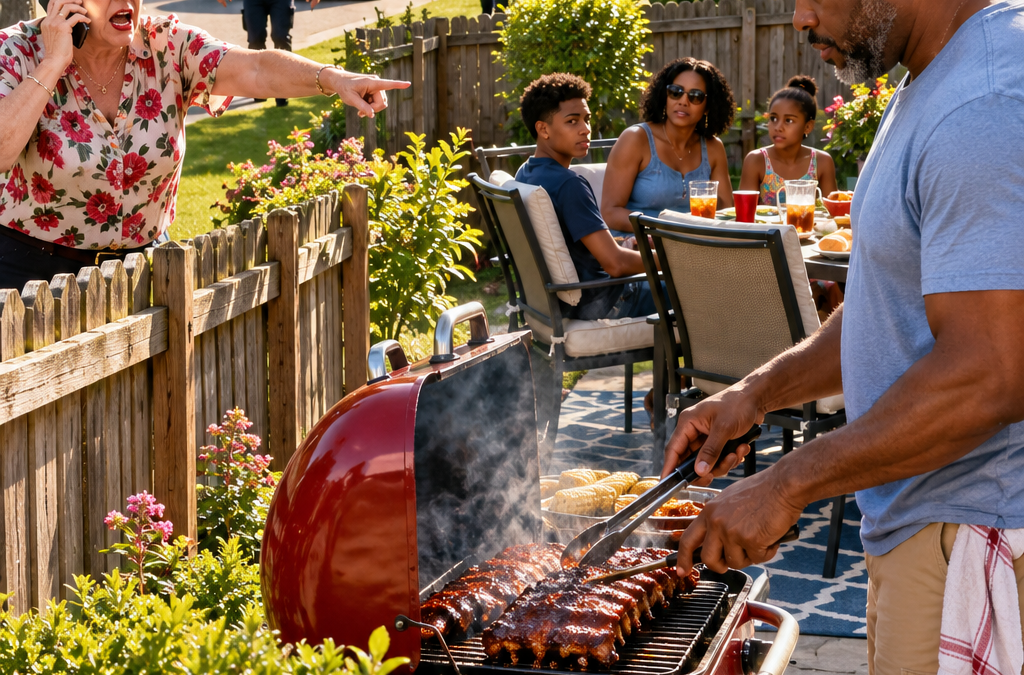
The grill itself later became the subject of police photographs, statements, and arguments, so I want to describe it clearly.
Standard four-burner propane grill.
Red lid.
Black frame.
Bought at a hardware store.
It sat on a flat stone patio.
About twelve feet from the rear fence.
Farther from the house.
Nothing overhead except sky.
No fire pit.
No wood pile.
No burn barrel.
No trash.
No lighter fluid.
No flames climbing into the air.
When the lid was closed, all anyone could see was an occasional ribbon of smoke coming from the rear vents.
I have responded to actual structure fires.
I have stood in yards while windows failed from heat.
I have watched people lose homes in minutes.
I know what dangerous fire looks like.
My grill was not dangerous.
About twenty minutes after the ribs went on, the side gate rattled.
I looked up.
Celeste Mercer stood on the other side.
Celeste lived two houses down.
Fifty-three.
Always dressed as if a client might appear unexpectedly.
She sold high-end real estate through a brokerage called Summit Crest Realty.
Her face appeared on signs all over the county.
Perfect hair.
Perfect smile.
Perfect little slogan beneath her photograph.
I had spoken to her maybe a dozen times in four years.
Weather.
Mail delivery.
Neighborhood construction.
Nothing more.
She was not on our HOA board.
She was not the association president.
She was not a fire marshal.
She was not code enforcement.
She had no authority over my backyard.
That did not stop her from saying:
“You need to shut that off.”
No hello.
I set down the tongs.
“Excuse me?”
“The grill.”
I looked behind me, as though perhaps another grill had appeared.
“This?”
“The smoke.”
I wiped my hands on a towel and walked toward the gate, stopping several feet away.
“It’s propane.”
“I can see that.”
“It’s on stone, clear of the house and fence.”
“That’s not the issue.”
“What is?”
She pointed toward the house behind ours.
The Whitaker house.
Harold and June Whitaker had moved several months earlier to live closer to their grandchildren.
The home was listed for sale.
That afternoon, I noticed for the first time that several cars were parked outside.
A folding OPEN HOUSE sign stood near the curb.
Celeste was the listing agent.
“I have buyers over there right now,” she said.
“Okay.”
“The smoke is going directly into that backyard.”
I glanced upward.
There was almost no wind.
“I’m sorry if they’re smelling it.”
“They are.”
She looked at the grill.
“The entire back of the property smells like a truck stop.”
Behind me, Terrence stopped talking.
I could feel everyone listening.
Celeste continued.
“My open house runs another two hours. I need you to stop cooking until it’s finished.”
There are situations where the easiest response is anger.
That is often the worst response.
So I tried to understand what she wanted.
Her livelihood depended on selling property.
Buyers were visiting.
She was worried the barbecue smell would distract them.
I could respect that concern without surrendering my backyard.
“How about this?”
I walked back to the grill.
Unlocked the wheels.
Rolled it several feet farther toward the center of the patio.
Then I turned down the two burners nearest the rear fence and closed the lid completely.
“The heavier smoke should be mostly finished in half an hour.”
Celeste stared at me.
“I didn’t ask you to negotiate.”
That sentence changed the feeling of the afternoon.
Until then, I had assumed we were two neighbors trying to solve an inconvenience.
Now I understood she did not want a solution.
She wanted obedience.
I looked at her.
“You’re asking me to stop cooking in my own backyard because you’re holding an open house behind me.”
“I’m asking you to act like a responsible neighbor.”
The back door opened.
Elise stepped out.
My wife works as a pediatric nurse.
She spends twelve-hour shifts dealing with frightened children and parents having the worst days of their lives.
Her voice rarely rises.
She came beside me.
“Is there a county rule we’re violating?”
Celeste looked at her.
“What?”
“If there’s a fire ordinance or HOA rule we’re violating, we’d want to know.”
“I know the regulations.”
“Which one?”
Celeste did not answer.
Instead, she looked back at me.
“I’ve asked you politely.”
I almost corrected that sentence.
I didn’t.
“If there’s an ordinance,” I said, “show it to me and I’ll follow it.”
Her jaw tightened.
Then she stepped away.
“If you won’t turn it off yourself, I’ll call someone who will make you.”
She walked away.
Terrence whistled quietly.
“Friendly neighborhood.”
Elise looked at me.
“Should we just turn it off?”
I glanced at Mom.
She sat with both hands around her glass.
She was pretending not to care.
I knew better.
“No.”
Mom looked at me.
“This isn’t about proving anything.”
“I know.”
“You sure?”
“Yes.”
I checked the grill temperature.
“Ribs have another few hours.”
Terrence grinned.
“Invite her over for a plate.”
Nadine elbowed him.
For about five minutes, everything went back to normal.
Then Malcolm Reyes called my name.
Malcolm lived next door.
Forty-two.
Electrician.
Quiet man.
Most evenings he was either working in his garage or tending a vegetable garden that produced enough tomatoes to feed three streets.
He stood beside his fence holding a garden hose.
“Darius.”
“Yeah?”
He nodded toward the street.
“I think she’s calling 911.”
I moved to a spot where I could see between the houses.
Celeste stood in the Whitakers’ driveway with her phone to her ear.
She was pointing toward my property.
For a second, I simply watched.
There are numbers you expect people to call during disagreements.
HOA management.
Code enforcement.
Fire prevention office.
Maybe the police non-emergency line if someone truly thinks there is a violation.
911 is different.
911 is for emergencies.
And because of my job, I knew exactly what happened once that call started.
A dispatcher does not see the scene.
The dispatcher sees it through the caller’s words.
Those words determine priority.
Those words determine how officers approach.
Those words decide whether an officer driving toward your house expects a confused neighbor or an aggressive suspect.
Celeste was speaking loudly enough that portions carried across the yards.
The first phrase I heard clearly was:
“There’s an open fire.”
I looked at my covered propane grill.
Then she said:
“He refuses to put it out.”
That was technically true only if you removed everything that had happened before it.
Then came:
“He’s getting aggressive.”
I went very still.
Elise joined me.
She had heard it too.
I had not raised my voice.
Had not insulted her.
Had not stepped through the gate.
I had moved the grill farther away.
Turned down the heat.
Offered compromise.
But vocabulary was changing the event.
A propane grill became an open fire.
Disagreement became refusal.
Calm became aggression.
I have taken calls that begin this way.
I know what happens next.
The dispatch note might read:
OPEN FIRE / MALE REFUSING TO COMPLY / CALLER REPORTS AGGRESSIVE BEHAVIOR.
An officer reading that on a vehicle computer does not get the luxury of assuming it is exaggerated.
He prepares for danger.
He should.
That is what bothered me.
Not that officers were coming.
What bothered me was that Celeste was building their first impression before I had spoken one word to them.
Elise put her hand on my arm.
“Don’t talk to her anymore.”
“I know.”
“Whatever she says.”
“I know.”
“Don’t give her anything she can use.”
She was right.
I turned off the small Bluetooth speaker on the patio.
The music had barely been audible.
I wanted silence.
Witnesses.
Clear words.
Terrence took the kids closer to the house.
I did not shut off the grill.
I had done nothing wrong.
Then Celeste returned.
Phone still at her ear.
She stopped at the gate.
“They’re on their way.”
“Okay.”
That was all I said.
Her expression changed.
She had expected fear.
Maybe apology.
Maybe surrender.
Some people use the words “I’ll call the police” as though police are their private enforcement service.
When that threat fails to produce obedience, they become confused.
“Why are you refusing to cooperate?”
“I’ll cooperate with the officers when they arrive.”
She stared at me.
“I’m not arguing with you anymore.”
She repeated part of that into the phone.
The tone made it sound different.
Then she reached over.
Lifted the latch on my gate.
Opened it.
I responded immediately.
“Celeste, do not come into my yard.”
She stepped through.
“I’m checking whether this fire is safe.”
“You’re not a fire inspector.”
She walked farther.
I stepped away.
That instinct came from eleven years of police work.
Do not close distance.
Do not touch.
Do not let anger create a photograph someone else can describe later.
“You don’t have permission to be here.”
She ignored me.
I said it again.
“Please leave my property.”
Malcolm had stopped watering his garden.
Elise stood in the doorway.
Mom had placed her sweet tea on the ground.
Celeste moved toward the patio.
Then she said into her phone:
“He’s blocking me now.”
My stomach dropped.
The gate was directly behind her.
Wide open.
Nothing between her and the exit.
I was eight feet to her left.
I was not blocking anything.
But she was not describing what existed.
She was creating the version she needed.
That was when I understood that anything I did could be narrated into something else.
If I moved closer, I was advancing.
If I raised my voice, I was threatening.
If I touched the gate, I was trapping her.
So I did the simplest thing.
I pointed toward the opening.
“Celeste. Leave my yard.”
She looked at me.
Then at my hand.
For several seconds, neither of us moved.
Finally, she backed through the gate.
I exhaled.
I thought we had reached the worst of it.
Then Celeste walked to the Whitakers’ backyard.
She grabbed their green garden hose.
Dragged it toward the fence.
I remember thinking:
She’s not going to do that.
She did.
A hard stream of water came over the fence.
It struck the closed grill lid.
Hot metal hissed.
Steam exploded upward.
Then the stream swept across the patio table.
Corn.
Potato salad.
Buns.
Paper napkins.
My mother’s plate.
Everything went over or became soaked.
Mom jumped from her chair.
Maya screamed.
Not from injury.
From surprise.
Elise moved instantly.
She pulled both kids toward the back door.
“Inside.”
“But Mom—”
“Inside now.”
Water continued across the stones.
I went to the propane tank and closed the valve.
Not because Celeste had proved anything.
Because the patio was wet.
The grill was hot.
My sixty-seven-year-old mother was standing on slick stone.
The situation had become unsafe because Celeste had made it unsafe.
The flames died.
From beyond the fence, she said loudly into the phone:
“See? Even he knows it was dangerous.”
I stood with my hand on the valve.
Water dripped from the grill.
Steam curled upward.
The ribs my mother had waited eighteen months to eat were sitting inside a wet metal box.
That was when something became painfully clear.
Celeste was no longer trying to solve a problem.
She was trying to win the story.
She had created chaos and was now pointing at the chaos as proof that she had been right to create it.
Mom stood near the doorway.
She said nothing.
Her silence hurt more than Celeste’s accusations.
Then I heard a siren.
Coming closer.
I stepped away from the fence.
Moved to the center of my patio.
Hands visible.
Empty.
I know how officers approach calls involving an allegedly aggressive male.
I was not going to make their job harder.
A county cruiser stopped in front of the house.
A woman stepped out.
Officer Tessa Howeran.
I had never met her.
That mattered.
No friend arrived.
No coworker.
No one who knew me.
She saw what any responding officer would see.
A wet backyard.
Several upset people.
A complainant claiming danger.
A man standing near a grill.
Celeste hurried toward her.
Talking before she reached the officer.
“He was burning an open fire. Smoke was pouring into the property I’m showing. I asked him to stop. He became aggressive.”
Howeran raised a hand.
“Ma’am. I’m going to speak with everyone separately.”
Celeste stopped.
Barely.
Howeran came to me.
“Name?”
“Darius Cole.”
“Identification?”
“My wallet is inside.”
Then I added:
“I need to let you know I’m law enforcement.”
Her expression did not change.
“What agency?”
I told her.
“Are you carrying?”
“No. Duty weapon is secured inside.”
“Okay.”
A second unit arrived.
Officer Pruitt.
Howeran asked him to accompany me inside while I retrieved identification.
Perfectly reasonable.
My children watched from the living room while a uniformed officer followed me into my own kitchen.
Jordan looked terrified.
That image stayed with me.
I took my wallet.
Returned outside.
Handed Howeran my driver’s license and department ID.
She checked both.
Across the yard, Celeste saw the second card.
Her eyebrows lifted.
Then she said:
“Of course he’s a cop.”
I expected the information might make her reconsider.
Instead, it gave her another accusation.
She turned toward Pruitt.
“See? Now he’s flashing his badge to get out of this.”
Howeran turned.
“Ma’am, I asked him for identification. He provided it.”
Eight words.
That was all.
No anger.
No humiliation.
Just fact.
For the first time all afternoon, I watched someone correct Celeste’s version immediately.
Howeran inspected the grill.
Propane tank.
Burners.
Placement.
Distance from structures.
Patio.
Fence.
There was no burn pile.
No scorched grass.
No damaged fence.
Nothing indicating an uncontrolled fire.
What there was, unmistakably, was water.
A soaked grill.
Wet food.
A drenched patio.
Ruined buns.
She asked Celeste:
“Did you spray water into this yard?”
“I was trying to put the fire out.”
“Did you enter his property?”
“No.”
Immediate.
Confident.
“No, I never went into his yard.”
I could have shouted.
Called her a liar.
I didn’t.
I said:
“Malcolm Reyes was next door. He saw the interaction. My wife was at the back door.”
Howeran wrote down Malcolm’s name.
Then went to speak with him.
Waiting while someone lies about you is one of the hardest forms of self-control.
You want to correct every sentence as it happens.
You want to grab the truth before somebody carries the wrong version away.
Instead, I stood.
Waited.
An unmarked sedan arrived.
Sergeant Owen Brener stepped out.
Gray at the temples.
Forty-seven.
Experienced enough that nothing about his movement was hurried.
Dispatch had sent a supervisor because the caller reported feeling threatened.
Celeste seemed pleased to see him.
She apparently interpreted rank as validation.
Brener spoke briefly with Howeran.
Then approached Celeste.
“You said he threatened you.”
“Yes.”
“What did he say?”
“He told me he could have me arrested.”
Something went cold inside me.
That was new.
Specific.
And completely false.
I had never said the word arrested.
Never mentioned my profession.
Never referenced law enforcement before Howeran arrived.
Brener wrote it down.
Then asked:
“Did he say that before or after you called 911?”
Celeste hesitated.
Half a second.
Maybe less.
“Before.”
That answer created a problem she did not yet understand.
Before she called 911, she had no idea I was a police officer.
She had learned only minutes earlier when Howeran looked at my ID.
I felt anger rise.
Not over the ribs.
Not the hose.
Not even the trespass.
She had attached my badge to a threat I never made.
For eleven years, I had been careful about that badge.
I had watched officers destroy public trust by using authority personally.
I had spent time on curbs talking teenagers down because they believed one mistake meant their lives were over.
I had worked hard to be the kind of officer who did not need people frightened of him to feel respected.
Now a stranger was telling another police officer that I had threatened to arrest her during a personal dispute.
Even false allegations have consequences.
Paperwork.
Supervisor notification.
Possible internal review.
Statements.
Interviews.
A word like intimidation beside your name until somebody determines what happened.
My children were still watching from inside.
My mother stood near the back door.
Dad’s ribs were cooling in the wet grill.
I felt my fists tightening.
Elise moved beside me.
Quietly:
“Don’t help her by getting angry.”
That sentence pulled me back.
Brener came over.
“Tell me what happened.”
So I gave him a timeline.
No insults.
No labels.
Twenty minutes after cooking started, Celeste approached.
Requested shutdown.
I explained the grill.
She revealed concern about the open house.
I moved the grill.
Reduced heat.
Closed lid.
She rejected compromise.
Threatened to call someone.
Called 911.
Returned.
Entered through the gate despite being told not to.
Claimed I blocked her.
Left.
Then sprayed water over the fence.
I shut the propane down for safety.
Brener took notes.
“Did you tell her she could be arrested?”
“No.”
“Did you identify yourself as an officer before our units arrived?”
“No, sir.”
He looked at me for a moment.
Then:
“Do you want a report taken regarding her entry onto your property and the water damage?”
“Yes.”
I did not answer because I wanted revenge.
I answered because records matter.
Celeste had already created one version of the afternoon inside the emergency system.
If I said nothing, the final report might become:
NEIGHBOR DISPUTE. BOTH PARTIES ADVISED.
Then months later, her allegations would exist.
Mine would not.
I asked that three things be documented.
She entered after permission was denied.
She sprayed water onto my patio and grill.
Property and food were damaged.
That was all.
Malcolm eventually came to the fence.
He looked miserable about being involved.
“I told them what I saw.”
“What’d you see?”
“You told her twice to leave.”
I nodded.
“She opened your gate herself.”
“Okay.”
“You never went near her.”
The knot beneath my ribs loosened slightly.
“And I told them she got the hose.”
“Thank you.”
He shrugged.
“I was ten feet away.”
That simple fact mattered enormously.
Celeste had been narrating the entire afternoon as though her certainty could replace reality.
Now another person existed in the record.
Independent.
No badge.
No family relationship.
No reason to protect me.
Just a man watering tomatoes.
Celeste heard him speaking with officers.
She approached the fence.
“You weren’t close enough to hear everything.”
Malcolm looked at her.
“I was ten feet away.”
Then returned to his garden.
No argument.
No performance.
Celeste changed tactics.
“The actual issue is the fire code.”
Brener asked:
“What fire-code provision?”
“Open flames aren’t allowed this close to another property.”
Howeran asked:
“Where does that regulation come from?”
Celeste lifted her chin.
“I’ve worked in real estate for a long time.”
Nobody laughed.
That silence did more than laughter could have.
Howeran finally said:
“Based on what we’ve observed, we don’t have grounds to require him to stop using a legal propane grill on private property.”
Celeste flushed.
“So because he’s a cop he gets special treatment?”
“No, ma’am.”
Howeran’s voice remained even.
“Because we have not established a violation.”
That was when I understood my profession had not protected me.
It had made everything more dangerous.
Celeste now had another story available.
Cop intimidates neighbor.
Cops protect cop.
Badge used as leverage.
Before the officers left, she looked directly at me.
“I’m filing a complaint with your department.”
“That’s your right.”
She waited.
Maybe she expected me to protest.
Warn her.
Ask her not to.
I said nothing else.
There was nothing in my answer she could reshape.
Monday morning, my lieutenant, Frank Donnelly, asked me into his office.
He closed the door.
We had worked together four years.
He knew me.
But procedure mattered more than personal familiarity.
“We received a citizen complaint over the weekend.”
“I expected that.”
He watched me.
“You know who?”
“Celeste Mercer.”
He nodded.
Then read the allegations.
Off-duty intimidation.
Misuse of police status.
Threat of arrest.
Improper influence over responding officers.
Favoritism from county law enforcement.
Hearing her accusations translated into official language was unsettling.
In my backyard, they had sounded absurd.
Inside a departmental complaint, they sounded serious.
That is one of the strange things about bureaucracy.
A false statement becomes heavier when placed on letterhead.
“You’re going to need to write a statement.”
“I understand.”
“No contact with the complainant about this.”
“Wasn’t planning any.”
Donnelly leaned back.
“For what it’s worth, I’m not making assumptions either direction.”
“That’s what you’re supposed to do.”
“I know.”
So I wrote.
Minute by minute.
I listed Malcolm.
Incident number.
Responding officers.
Sergeant Brener.
Then one fact I believed would matter later.
Celeste called 911 before she knew my occupation.
I signed the statement.
Turned it in.
Then did nothing.
I did not call Howeran.
Did not call Brener.
Did not ask friends in the county department to explain anything.
I knew people who knew people.
Police work is a small world.
But Celeste’s allegation was that I used my position for special treatment.
The only safe response was to demand none.
Elise hated that.
At dinner one night after the kids went upstairs, she folded her arms.
“So anyone can lie about you and the department has to investigate?”
“Anyone can file a complaint.”
“That’s ridiculous.”
“No.”
She stared at me.
“It protects people.”
“She’s lying.”
“I know.”
“But the process doesn’t know that yet.”
Elise looked away.
“How can you defend that?”
“Because if police departments only accepted complaints we liked, the complaint system wouldn’t mean anything.”
That answer did not comfort her.
I understood why.
The process was necessary.
Celeste was abusing it.
Those two facts could exist at the same time.
Tuesday night, Malcolm texted me.
Celeste had sent an email through the neighborhood mailing list.
Subject:
OFF-DUTY OFFICER THREATENS NEIGHBOR OVER ILLEGAL BACKYARD FIRE.
I read it once.
Then saved it.
No response.
No neighborhood-wide rebuttal.
No angry reply.
Some residents believed her.
Others who had heard parts of the confrontation pushed back.
I stayed silent.
Then my mother called Wednesday.
I was sitting in the station parking lot.
“Darius?”
“Hey, Mom.”
Her voice was small.
“Are you in trouble because of your father’s barbecue?”
That sentence broke something inside me.
Not because she doubted me.
Because our afternoon had been for Dad.
That was what Celeste had damaged that mattered most.
Mom had waited eighteen months to sit near that grill again.
Instead, she watched police cars arrive.
She watched a stranger accuse her son.
She watched food soak beneath a garden hose.
“I am not in trouble, Mom.”
“Someone at church showed me an email.”
“I know.”
“It says you threatened that woman.”
“I didn’t.”
“I know you didn’t.”
But she sounded frightened.
“It’ll get sorted out.”
“You promise?”
“Yes.”
I hoped I was telling the truth.
That afternoon, something important happened.
Sergeant Brener contacted my department through official channels.
Because Celeste’s later claims did not match what she had initially said at the scene, he requested preservation of the 911 recording.
That recording existed because Celeste herself had created it.
She had chosen the one communication system that automatically preserved her words and times.
Days later, Donnelly called me into his office.
He had the relevant incident documentation.
“Sit.”
I did.
He read from notes.
During the first portion of the emergency call, Celeste never identified me as law enforcement.
Not once.
At one point, frustrated that I would not shut off the grill, she said:
“I don’t know who this guy thinks he is.”
Donnelly looked at me.
We both understood.
If I had identified myself as a police officer and threatened her with arrest before the call, as she later claimed, then why did the recording show her saying she did not know who I was?
There was more.
Celeste initially told the dispatcher I was moving toward her.
Then the timeline showed she was at the Whitakers’ driveway.
She subsequently returned voluntarily to my gate.
Then entered my property.
Malcolm’s statement matched the sequence.
No initial specific threat of arrest.
No reference to a badge.
No statement that she knew I was an officer.
Her story evolved.
That did not automatically mean my complaint disappeared.
Investigators still had to finish.
Then Celeste made the worst decision available to her.
The department asked for a signed written statement.
She gave one.
In writing, she claimed I had identified myself as a police officer and threatened to have her arrested before she called 911.
Specific.
Signed.
Directly inconsistent with the recording.
When Donnelly told me, I expected satisfaction.
Instead, I felt exhausted.
She had been offered exit after exit.
She could have said she misheard.
Misremembered.
Felt afraid.
Got confused.
Anything.
Instead, at every stage, she made the accusation bigger.
Three weeks after the cookout, Donnelly called me in again.
He handed me a letter.
Complaint closed.
No evidence I used my position to intimidate Celeste.
No evidence of preferential treatment.
No evidence I threatened arrest.
No evidence of improper off-duty police conduct.
I read it twice.
Donnelly extended his hand.
I shook it.
“Go home,” he said.
That was the entire ceremony.
Exactly enough.
I walked to my car.
Texted Elise one word.
CLOSED.
Her reply came almost immediately.
GOOD. NOW FINISH THE RIBS SOMEDAY.
I laughed alone in the parking lot.
But my internal complaint ending did not finish the county matter.
Several days later, Brener called.
“You still want to proceed on the issues you reported?”
“Yes.”
“If you’re doing this because of the department complaint—”
“I’m not.”
“Then why?”
“Because she used 911 to force compliance in a private disagreement.”
He waited.
“Then she entered after I told her not to.”
“Yes.”
“Sprayed water onto my property.”
“Yes.”
“And gave statements that weren’t true.”
“Correct.”
I took a breath.
“If she’d just insulted me, I’d let it go.”
“Understood.”
Property damage came to around $340.
Food.
Serving tray.
Outdoor cushion.
Cleaning the grill burners.
Not millions.
No dramatic lawsuit.
The money was irrelevant.
Accountability wasn’t.
Then Harold and June Whitaker called.
The owners of the house Celeste had been showing.
They wanted to talk.
They came to our house on a Thursday.
June sat beside Elise.
Harold remained standing longer than necessary, like a man embarrassed on someone else’s behalf.
“We came by the open house that afternoon,” he said.
“I didn’t know.”
“Police were already there.”
June shook her head.
“We had no idea what was going on.”
They had gradually learned that their listing agent had abandoned their open house to confront a neighbor.
Called 911 over a propane grill.
Entered private property.
Used their garden hose to spray into the neighboring yard.
Then became part of an official police incident.
June asked:
“What actually happened?”
I could have given them the full story.
Instead I wrote down the incident number.
“Request this.”
Harold looked at the paper.
“That’s it?”
“It’s the official record.”
“You don’t want to tell us your side?”
“I can.”
I paused.
“But if you’re deciding what to do professionally, you should read something that doesn’t depend on me convincing you.”
He folded the paper.
“Fair enough.”
About a week later, Celeste’s real-estate sign disappeared from their front yard.
Later, June called.
They had ended their listing agreement under their contract terms.
They hired someone else.
That consequence struck me more than the police matter.
Everything had started because Celeste was afraid the smell of barbecue might hurt her open house.
She tried to control my backyard to protect her listing.
The grill did not cost her the listing.
I did not cost her the listing.
Her own conduct did.
The county process moved forward quietly.
No tactical team.
No handcuffs on the lawn.
No dramatic arrest.
The evidence concerning trespass, property damage, and false information associated with the emergency call was reviewed through ordinary procedure.
Celeste received notice to appear and address the matter through the local system like anyone else.
When I heard, I did not feel victorious.
I felt relief.
For weeks, I had been the person explaining myself.
Now the questions were no longer mine alone to answer.
Then one Thursday evening, Celeste came to my house.
I was in the garage.
Ironically, finally repairing the squeaky back door hinge.
The door itself was off its hinges and resting across sawhorses while I sanded the edge.
I looked toward the street.
Celeste stood at the end of my driveway.
On the public sidewalk.
Not one step onto the property.
That detail caught my attention immediately.
Weeks earlier, she had opened my gate like boundaries were something she could redefine.
Now she waited outside them.
“Can we talk?”
I put down the sandpaper.
Walked down the driveway.
Stopped several feet from her.
Elise was visible behind the front window.
Malcolm was watering tomatoes next door.
Neither of us was alone.
Celeste folded her hands.
“I didn’t think it would go this far.”
I considered that.
“It went this far because you kept pushing it.”
She looked down.
“The market has been terrible.”
I waited.
“The Whitaker listing mattered.”
“I understand.”
“That open house was the best opportunity I’d had in weeks.”
“You could’ve told me that.”
“I did.”
“No.”
Her head lifted.
“You told me to shut off the grill.”
“I explained why.”
“You gave me an order.”
Silence.
“I moved it.”
She said nothing.
“I closed the lid.”
Nothing.
“I turned down the burners.”
Still nothing.
“I offered you a compromise.”
“I was trying to do my job.”
“So was I when the police arrived.”
Her face tightened.
I softened my voice.
“You didn’t want compromise.”
She looked away.
“You wanted compliance.”
That was the heart of everything.
Not barbecue.
Not smoke.
Not real estate.
The moment I said no, my refusal became something she believed she was entitled to overcome.
She could have accepted inconvenience.
Instead she escalated.
Trespass.
Hose.
False statements.
Department complaint.
Neighborhood email.
Each step existed because the previous one had failed to make me obey.
Then she said:
“I never would’ve called if I’d known you were a police officer.”
Of everything she said that afternoon, that was the most revealing.
I shook my head.
“That shouldn’t matter.”
She looked confused.
“What?”
“If I were a teacher, would it have been okay?”
“That’s not what I meant.”
“An electrician like Malcolm?”
“No.”
“A bus driver?”
“Darius—”
“A grocery clerk?”
“I said that’s not what I meant.”
“Then what difference should the badge make?”
She had no answer.
I continued.
“You had no right to invent a threat because I said no.”
“I was afraid.”
“You walked into my yard.”
She looked down again.
“If you were afraid, you could have stayed at the open house and waited for police.”
Silence.
“The badge didn’t make me more deserving of honesty.”
I let that sit.
“It only made what you accused me of more dangerous.”
She nodded very slightly.
I did not ask for an apology.
She did not offer a perfect one.
I preferred that.
Perfect apologies delivered after consequences often sound rehearsed.
I told her one thing.
“If you ever have a concern about something happening on my property, talk to me like a neighbor.”
She looked at me.
“I’ll listen like one.”
“And if I can’t?”
“Then stay off my property.”
She nodded.
Turned.
Walked away.
No shouting.
No dramatic collapse.
Just a woman walking down a sidewalk after discovering that confidence alone could no longer control the people around her.
Two weeks later, we tried the barbecue again.
Same red grill.
Same patio.
Same recipe.
Terrence and Nadine returned.
Jordan and Maya chased each other through the yard with water guns.
Elise looked at them.
“Much better use of water.”
Terrence nearly dropped his drink laughing.
Mom arrived carrying a pie.
She put it on the patio table.
Looked at the grill.
Then looked at me with a perfectly straight face.
“Should we call the fire department before you start?”
For half a second, nobody knew whether to laugh.
Then Mom did.
That changed everything.
She laughed until her shoulders shook.
I had not heard her laugh about that first afternoon once.
Until then, Dad’s barbecue had become tangled with police lights and soaked food and fear.
Her joke gave part of it back.
I fired the grill.
Low heat.
Ribs on.
Lid closed.
No patrol cars.
No angry phone calls.
No one at the fence.
Around four, Malcolm came through the side gate.
He had been invited.
He carried a cooler.
He looked toward the grill.
“That looks dangerous.”
I pointed at him.
“Don’t call 911.”
He laughed so hard he had to put the cooler down.
The ribs cooked for hours.
While they did, I thought about what had really saved me.
It wasn’t my badge.
That badge nearly became another liability.
It gave Celeste a more serious accusation to make.
What saved me was restraint.
A witness.
A recorded call.
A timeline.
Officers willing to investigate instead of accepting whichever person spoke first.
A supervisor willing to follow procedure.
Elise reminding me not to become angry exactly when anger would have helped Celeste.
Malcolm standing beside his tomatoes and telling the truth.
The process did not move instantly.
That frustrated me.
But it moved.
And because I did not interfere with it, nobody could honestly say I had used my profession to get a result.
That mattered.
Being a police officer teaches you something strange about truth.
People often think the job is about knowing who is lying.
It isn’t.
At least not if you do it correctly.
It is about collecting enough independent facts that whether you personally believe someone matters less.
Where were people standing?
What time was the call?
What words were actually used?
Who had access?
What does the video show?
What does the recording show?
What can a neutral witness establish?
What changed between the first account and the later one?
That afternoon in my backyard, I became the person on the other side of those questions.
I hated it.
But I respected why the questions existed.
That was also why Celeste failed.
Her story needed memory to stay flexible.
The records did not.
She said I had threatened arrest before the 911 call.
The call preserved her saying she did not know who I was.
She said I blocked her from leaving.
Malcolm saw the open gate.
She said she never entered.
Malcolm watched her open it and walk through.
She said the grill was an uncontrolled fire.
Officers saw a legal propane grill on stone with no evidence of fire outside the equipment.
She said police favored me because of my badge.
Officer Howeran had asked for my ID and treated me like a stranger from the moment she arrived.
Her story kept changing.
The physical world did not.
That is what I mean when I say calm mattered.
Calm did not make me weak.
It kept the facts clean.
The first barbecue of that summer was supposed to honor my father.
For a while, I thought Celeste had ruined that permanently.
She hadn’t.
When the second batch of ribs was ready, I carried the cutting board to the table.
Everyone gathered.
Mom watched me slice the first rack.
I put one rib on her plate.
She studied it like an examiner.
Took a bite.
Chewed.
I waited.
“Well?”
She took another bite.
Then set it down.
“Your father’s were better.”
I stared at her.
Terrence laughed first.
Then Elise.
Then Mom.
I started laughing too.
“What am I missing?”
Mom smiled.
“I’m not telling you.”
“Celery salt?”
“No.”
“You already exposed that secret.”
“Then I suppose you’ll have to keep trying.”
Elise reached beneath the table and squeezed my hand.
That was the memory I wanted back.
My mother teasing me.
My children running barefoot across the grass.
My wife beside me.
My father’s recipe almost right.
Smoke in the summer air.
Not the patrol cars.
Not Celeste.
Not a department complaint.
Not the sound of water striking hot metal.
Just family.
A few months later, Malcolm replaced part of our shared fence.
Before he started, he knocked on my front door.
“I need to come into your yard for ten minutes.”
I stared at him.
He grinned.
“Thought I’d ask.”
“You’re learning.”
“Trauma does that.”
I let him in.
That moment made me smile because boundaries are not complicated when people respect one another.
Ask.
Listen.
Accept no.
That was all Celeste had needed to do.
Over time, the story faded.
New things replaced it.
A tree fell during a storm.
Someone’s teenager backed into a mailbox.
The pool pump failed.
Normal neighborhood life.
The Whitaker house sold through another agent.
A young family moved in.
Their children sometimes climb a playset high enough to look over our fence.
Once, their father apologized because his charcoal grill was smoking heavily.
I laughed.
“You’re fine.”
“You sure?”
“Very.”
He had no idea why that question was funny.
That was okay.
I never wanted the story to become my identity.
At work, the complaint remained part of the administrative record with its final disposition.
That was appropriate.
Closed.
No misconduct established.
Not erased.
Resolved.
Some officers might hate that.
I didn’t.
Accountability records should exist.
Even when they clear you.
The existence of a complaint system was never the injustice.
The false complaint was.
There is a difference.
I tried to explain that to Jordan one night.
He had overheard more than we realized.
“Dad?”
“What?”
“Why could that lady tell your boss you did something if she was lying?”
“Because people are allowed to complain about police.”
“Even if it’s not true?”
“We don’t always know whether something is true until someone checks.”
“That’s dumb.”
“Sometimes.”
He frowned.
“So anybody can get you in trouble?”
“They can cause questions.”
“That’s trouble.”
“Sometimes.”
He thought for a minute.
“Then why would you want people to be allowed to do that?”
That was a hard question for a ten-year-old.
“Because sometimes police officers really do something wrong.”
He watched me.
“And people need a way to say so.”
“What if nobody believes them?”
“Then the system fails.”
“What if they lie?”
“Then we investigate that too.”
He considered it.
“Sounds complicated.”
“It is.”
Then he went back to his game.
Kids have a gift for leaving moral complexity at the kitchen table when adults carry it for years.
I thought about his question later.
Celeste had tried to use systems against me.
Police response.
Internal accountability.
Neighborhood communication.
None of those systems were bad.
Every one existed for legitimate reasons.
Emergency calls save lives.
Police response protects people.
Citizen complaint processes restrain abusive officers.
Neighborhood communication helps communities function.
The problem was not the tools.
It was what she tried to do with them.
That distinction stayed with me.
Power does not only belong to officials.
Ordinary people can misuse institutions too.
A false emergency call can put someone at risk.
A dishonest complaint can threaten a career.
A confident lie on a community email can damage a reputation before the person being accused even knows the message exists.
That does not mean those systems should disappear.
It means truth matters inside them.
Years later, when I think about Celeste, I do not remember her as some larger-than-life villain.
That would be too easy.
She was a real estate agent afraid of losing an important sale.
She saw something interfering with her objective.
She expected another person to accommodate her.
When I did not comply completely, frustration became entitlement.
Entitlement became escalation.
Escalation became dishonesty.
Then pride prevented retreat.
That sequence is more frightening to me than if she had simply been evil.
Because ordinary people can follow it.
We all can.
The moment you start believing your goal is important enough to let you rewrite what someone else did, you are already farther down that road than you think.
Celeste once told me she would never have called 911 if she had known I was a cop.
For a long time, that sentence bothered me most.
Then I realized why.
It meant somewhere inside her, fairness had been conditional.
The person in the backyard needed the right status before restraint became necessary.
But rights are not supposed to depend on whether someone has a badge in his wallet.
If Malcolm had been grilling, he deserved the same honesty.
If Terrence had been alone in my yard, same.
If an unemployed stranger had rented my house the week before, same.
My profession did not make my property more private.
It did not make lies about me more wrong.
It simply gave me enough familiarity with the system to understand how dangerous her words could become.
That awareness helped me stay still when every instinct wanted me to fight back.
I have arrested people who screamed at me.
I have stood between angry families.
I have been cursed at from three feet away.
None of those situations required as much self-control as standing in my own backyard while someone told a dispatcher I was blocking her from leaving when the gate was open behind her.
Because uniformed Darius had training, procedures, partners, a radio.
Backyard Darius had his wife.
His children.
His mother.
And ribs on a grill.
There was nowhere to hide behind the job.
Maybe that was good.
It taught me that the discipline I valued in uniform had to exist without the uniform too.
A few summers have passed.
Mom still comes for the first warm Saturday barbecue.
The recipe is better now.
Not Dad’s.
Mine.
I finally accepted that difference.
Dad’s food belonged to Dad.
Trying to reproduce him perfectly had become another form of refusing to let him be gone.
So I kept the celery salt.
Changed the paprika.
Added more vinegar.
Mom complained.
Then ate two ribs.
Progress.
The red grill eventually rusted through one burner assembly.
I replaced it.
For a moment, I considered buying another red one.
Then chose black.
Elise noticed.
“Moving on?”
“It’s a grill.”
“Darius.”
“Maybe.”
We put the old one at the curb after removing the propane tank.
I stood there longer than necessary.
That piece of metal had somehow become connected to Dad, Mom, Celeste, officers, my department, and one summer afternoon when I almost learned how quickly a lie could outrun reality.
Then the sanitation truck took it away.
Good.
Objects do not need to become monuments to everything that happens around them.
I kept one thing.
The original handwritten copy of Dad’s recipe guesses from that summer.
Paprika amounts crossed out.
Notes from Mom.
MORE VINEGAR.
TOO SWEET.
ALMOST.
That is what sits in my kitchen drawer.
Not the complaint letter.
Not Celeste’s neighborhood email.
Those are stored where records belong.
The recipe stays close.
One evening, years later, I saw Celeste at a grocery store.
We were in different checkout lines.
She noticed me.
I noticed her.
She nodded.
I nodded back.
Nothing else.
That was enough.
I had no desire to punish her forever.
Accountability and permanent hatred are not the same thing.
She had faced the consequences of what she did.
Lost a listing.
Answered the county process.
Lost credibility with neighbors.
Had to confront the contradiction between what she claimed and what recordings showed.
I did not need more.
The better ending was that she stopped occupying space in my life.
That, to me, is real resolution.
Not victory.
Freedom.
At the next family barbecue, Maya asked why Grandma always got the first rib.
“Because she knows whether they’re right.”
Mom shook her head.
“Because I’m the oldest.”
Jordan said, “Dad’s older than Uncle Terrence.”
“Careful,” Terrence said.
Everyone started arguing.
Normal.
Wonderful.
The grill smoked lightly.
A summer breeze moved through the maple leaves.
Somewhere two houses down, a lawn mower started.
Nobody cared.
I carried the first plate to Mom.
She smelled it.
“Better.”
“Better than Dad?”
She looked offended.
“Don’t get arrogant.”
I laughed.
Then sat beside her.
For a few minutes, nobody mentioned the year before.
Nobody needed to.
That is what healing looked like in our family.
Not forgetting.
Not pretending nothing happened.
Letting the memory lose its authority.
Celeste had tried to control an afternoon because she believed her open house mattered more than my no.
Then when the police arrived, she tried to control the story because admitting she had gone too far would have cost her pride.
The strange thing is that the truth never needed me to defeat her.
It needed me not to damage it.
Stay calm.
Speak clearly.
Ask for documentation.
Let witnesses talk.
Let recordings exist.
Let procedure finish.
That sounds passive.
It wasn’t.
Sometimes holding still while somebody else is trying to provoke you is the most active thing you can do.
I have carried that lesson back into my work.
When someone is angry, I listen differently now.
When a caller and a subject give completely opposite stories, I remember my own patio.
The first speaker is not automatically the truthful one.
The calmer speaker isn’t automatically truthful either.
Confidence proves nothing.
Fear proves nothing.
A badge proves nothing.
What matters is what can be established.
Who saw it?
What was recorded?
What happened first?
What changed?
What facts stay still when the stories move?
That afternoon made me a better officer.
I wish it had found a gentler way.
But life rarely asks how you prefer to learn something.
I also learned something about my mother.
I had thought I was protecting her.
From grief.
From worry.
From the consequences of the dispute.
But during those weeks, she was watching me protect Dad’s memory in the only way I knew.
Not by winning an argument.
By refusing to let an ugly afternoon become the last meaning attached to his barbecue.
When she laughed the second time we cooked those ribs, something came back.
Not Dad.
Nothing brings someone back.
But the room he left in us stopped feeling quite so empty.
That mattered more than Celeste ever understood.
Maybe more than I understood at the time.
If I could return to that first Saturday and change one thing, I don’t think I would turn off the grill.
I don’t think I would argue harder either.
I might lock the gate.
That’s about it.
Everything else needed to remain simple.
A neighbor asked me to stop cooking.
I offered compromise.
She rejected it.
She called police.
I stayed calm.
The truth took longer than the lie.
But it arrived.
That is not a perfect system.
It is sometimes the best one we have.
And whenever I smell ribs cooking now, I no longer hear the siren first.
I hear my mother.
“Your father’s were better.”
I hear Terrence laughing.
I hear my kids arguing over who gets the last piece.
I hear Elise telling me I used too much sauce.
The memory belongs to us again.
That may be the part Celeste never understood.
She thought she was fighting over smoke drifting into an open house.
She believed she could call somebody with more authority and force the afternoon to become what she wanted.
Instead, she taught me exactly how much power there is in refusing to surrender the facts.
I did not need the badge to win my backyard back.
I needed patience.
Witnesses.
Records.
And enough self-control to let a lie collapse under the weight of its own contradictions.
The badge was in my wallet.
The truth was standing in the yard the entire time.








