𝗙𝗨𝗟𝗟 𝗦𝗧𝗢𝗥𝗬 The Night the Glass Floor Cracked, I Knew Someone Had Cut the Wrong Cables Beneath Our Mountain
𝗙𝗨𝗟𝗟 𝗦𝗧𝗢𝗥𝗬
The system was designed so no single lot existed in isolation.
That was the important part.
The ridge worked as a whole.
You didn’t remove an anchor because it was inconvenient to one property any more than you removed a beam from a bridge because you wanted more headroom.
The county understood that.
So it recorded a safety easement protecting the anchor field as shared stabilization infrastructure.
I installed almost half those anchors myself.
I knew their positions.
Their depths.
The angles.
I knew which ones hit competent rock on the first drilling run and which ones needed to be redrilled.
I knew which anchor head sat beneath what later became a flower bed.
I knew which cables crossed the empty cliff parcel.
And after the work was finished, the ridge stopped moving.
Not perfectly.
No slope is perfectly still.
Everything moves.
A fraction.
A millimeter.
Seasonal moisture.
Temperature.
Normal response.
But the dangerous movement stopped.
People repaired houses.
Driveways were repaved.
Landscaping returned.
Eventually, the fear faded.
That’s what happens when infrastructure works.
People stop thinking about it.
A generation of residents moved in who had never seen the ridge shift.
By the time I retired, most homeowners couldn’t have told you what a tieback anchor was.
I could.
That’s why I kept checking.
Every quarter, I walked the ridge with an inclinometer and a notebook.
No one paid me.
No HOA contract.
No county assignment.
Just habit.
Maybe obsession.
I had spent too many years learning what early movement looked like to pretend retirement had made the ground someone else’s problem.
Most readings were boring.
One millimeter.
Sometimes less.
A little more after heavy rain.
Then back to normal.
Boring readings are beautiful.
People who work around failure understand that.
Ranada Vos did not.
Ranada became HOA president two years before the Skyline Lounge project.
She liked visible success.
That was the best way I knew how to describe her at first.
New entrance landscaping.
Decorative streetlamps.
Updated clubhouse furniture.
Seasonal banners.
A redesigned community website.
If something could be photographed, announced, unveiled, or accompanied by a ribbon, Ranada wanted her name attached to it.
She wasn’t stupid.
That’s important.
I don’t believe she was.
She understood politics.
She understood presentation.
She understood how to stand in front of a room and make a project sound inevitable.
What she did not understand was uncertainty.
People like Ranada dislike uncertainty because it slows momentum.
Engineers live in uncertainty.
What’s the factor of safety?
How much does groundwater change after five days of rain?
What happens if this anchor is removed?
What happens if three are removed?
What happens if eleven disappear?
Ranada heard questions and saw obstruction.
I heard questions and saw survival.
The vacant cliff parcel had sat untouched since 1998.
It was beautiful land if you didn’t know why it was empty.
The view from there stretched across the valley.
Sunsets turned the horizon orange.
At night, the town lights below looked like another sky.
Developers had looked at it before.
Most walked away.
Too steep.
Too much stabilization infrastructure.
Too many restrictions.
Then Preston Lane arrived.
Preston ran Lane Development Group.
He had built restaurants, event spaces, high-end condominiums, and one rooftop club downtown that had somehow convinced people to pay fourteen dollars for sparkling water.
He had a talent for selling experience.
At the monthly HOA meeting, Ranada unveiled his proposal.
She called it the Skyline Lounge.
The rendering appeared on the screen behind her.
Glass walls.
Low lighting.
A long cantilevered deck projecting thirty feet over the cliff.
Transparent floor panels at the outer edge so guests could look straight into the ravine.
A private bar.
Small event space.
Members-only hours.
Rental income.
Prestige.
Three-point-seven million dollars.
The HOA would receive a share of revenue.
Ranada stood beside the image smiling like she had personally invented gravity.
“This,” she said, “puts our community on the map.”
People applauded.
I didn’t.
I was sitting in the third row.
My eyes were on the site plan.
The excavation line.
The foundation footprint.
A utility trench.
And the shaded area where the lounge foundation would cut directly through the old anchor field.
I raised my hand.
Ranada saw me.
She kept talking.
I raised it higher.
Eventually she sighed.
“Mr. Blake.”
“Has the anchor field been surveyed?”
She smiled politely.
“All engineering requirements have been reviewed.”
“By who?”
“Preston’s consultants.”
I looked toward Preston.
He sat near the board table wearing a dark jacket.
“Did they review the 1998 stabilization plan?”
He leaned toward the microphone.
“We reviewed all available site documentation.”
That was not an answer.
“Then you know your excavation path crosses the tiebacks.”
A few people turned.
Ranada’s expression tightened.
“Mr. Blake, this project has three engineering approvals.”
“What approvals?”
“Structural. Architectural. Site.”
“Geotechnical?”
Preston responded.
“Site conditions were considered.”
“That’s still not geotechnical.”
Ranada laughed lightly.
Not because anything was funny.
Because laughter tells a room the speaker doesn’t deserve seriousness.
“Mr. Blake, with respect, we don’t need a retired hobbyist telling licensed professionals how to build.”
Several people laughed.
I didn’t.
“Hobbyist?”
“You’ve been walking this ridge with that little measuring device for years.”
“Inclinometer.”
“Exactly.”
More laughter.
I looked at the rendering again.
Then at her.
“I installed the anchors you’re planning to excavate through.”
The room quieted slightly.
Ranada folded her arms.
“And I’m sure your experience was valuable in 1998.”
“It is the same bedrock.”
“No one is dismissing history.”
“You are literally building through it.”
Preston leaned forward.
“The anchors can be worked around.”
“Then show me the rerouting plan.”
He didn’t.
I continued.
“If those anchors are abandoned or removed without replacing capacity, you reduce restraint on the steepest section of the slope.”
Preston said, “We’re not discussing construction details tonight.”
“You should be.”
Ranada’s voice hardened.
“We are discussing community opportunity.”
“I’m discussing the ground holding the opportunity.”
That ended the pleasant tone.
“Thank you, Warren.”
“I haven’t finished.”
“You have.”
She turned back to the room.
I sat down.
No one asked another question about the anchors.
The next morning, I pulled the original county easement from my files.
I kept nearly everything.
Old habit.
Field records.
Design drawings.
Load-test sheets.
County correspondence.
There it was.
Recorded safety easement.
Anchor field protected as shared slope stabilization infrastructure.
No removal, obstruction, relocation, or interference without county geotechnical approval.
Clear.
Not interpretive.
Not vague.
I copied it.
Drove to the clubhouse.
Ranada’s assistant was at the front desk.
“Is she in?”
“Meeting.”
“Give her this.”
I wrote across the top:
PLEASE READ BEFORE ANY EXCAVATION.
The assistant promised she would.
Later, I learned Ranada never opened it.
What I didn’t know then was that Preston already knew exactly why the anchors were a problem.
Going around them would delay construction around six months.
It would require redesign.
Temporary stabilization.
New anchor locations.
Special sequencing.
Estimated additional cost:
roughly half a million dollars.
Five hundred thousand dollars.
That’s what the ridge’s safety became in Preston’s spreadsheet.
A problem column.
He and Ranada met privately.
Later, bank records and testimony would fill in parts of that conversation.
Not every word.
Enough.
They agreed the old anchors were conservative.
Outdated.
Overbuilt.
An inconvenience.
Three days after the board meeting, I woke before sunrise to the sound of a gasoline engine.
Not a vehicle.
Higher pitch.
Cutoff saw.
I know that sound.
I got out of bed.
Went to the kitchen window.
A flatbed truck sat near the cliff parcel.
Two contractors were unloading equipment.
My stomach dropped.
I didn’t bother changing.
Sweatpants.
Sweatshirt.
Slippers.
I went up the slope as fast as my knees allowed.
The ground was wet from overnight drizzle.
By the time I reached the parcel, three anchor heads had already been exposed.
Concrete chipped away.
Steel visible.
One worker was setting a saw near the first cable.
“Stop!”
The foreman looked up.
“Morning.”
“Shut that down.”
He frowned.
“Who are you?”
“Warren Blake.”
Nothing.
“I installed those anchors.”
That got his attention.
“We have a work order.”
“Show me.”
He didn’t.
“Sir, you need to clear the work area.”
“Those are load-bearing slope anchors.”
“We were told they’re abandoned.”
“They are not.”
A second worker looked uncertain.
I pulled my monitoring device from the bag I had brought.
The latest readings were already higher than normal.
Half a millimeter of creep in forty-eight hours.
Not catastrophic.
Not even alarming by itself.
But enough to make cutting restraint idiotic.
“See this?”
The foreman glanced.
“I don’t know what that means.”
“It means the slope has started moving more than baseline.”
“Talk to the client.”
“I’m talking to the man holding the saw.”
He put it down.
For a moment, I thought reason might win.
Then Ranada’s SUV arrived.
Fast.
Mud sprayed from the tires.
She stepped out wearing heels completely wrong for the terrain and a raincoat over office clothes.
“Warren.”
“Tell them to stop.”
“What are you doing here?”
“Your crew exposed three anchors.”
“They’re removing obsolete infrastructure.”
“They are active anchors.”
“According to you.”
“According to the county easement I left on your desk.”
She looked blank.
“I didn’t receive anything.”
“Your assistant did.”
Ranada looked toward the foreman.
“Are we within the excavation area?”
“Yes, ma’am.”
She nodded.
“Continue.”
I stepped between the saw and the anchor.
“Ranada.”
Her eyes narrowed.
“Move.”
“You cut these, you’re not clearing a lot. You’re pulling restraint from the ridge.”
“You’re being dramatic.”
“I’m being literal.”
I held up the inclinometer.
“The slope is already trending.”
She didn’t look.
“Half a millimeter of creep in forty-eight hours.”
“That means nothing to anyone except you.”
“It means this is the worst possible time to remove anchors.”
Preston arrived five minutes later.
By then, the argument had drawn workers from farther down the site.
I showed him the reading.
He barely glanced.
“Warren, these anchors were installed twenty-five years ago.”
“And?”
“Engineering practice changes.”
“Bedrock didn’t.”
“We have structural redundancy.”
“Where?”
He said nothing.
I pointed toward the exposed cable.
“Show me replacement capacity.”
Ranada cut in.
“Enough.”
Then she said the words I would replay for months.
“Cut them all.”
The foreman looked at her.
“Ma’am?”
“You heard me.”
I stared at her.
“Ranada, don’t.”
She turned toward me.
“You are trespassing on HOA-managed land.”
“This is protected safety infrastructure.”
“You are obstructing an authorized construction project.”
“I am warning you that removal could destabilize the ridge.”
She pulled out her phone.
Then, unbelievably, called the sheriff’s office.
A deputy arrived.
Young man.
I knew him by sight but not well.
Ranada told him I was interfering with construction.
I tried to explain.
He looked miserable.
“Warren, I can’t adjudicate engineering.”
“I’m not asking you to.”
“I need you to step off the site.”
“Those anchors—”
“I understand.”
“No, you don’t.”
I regretted the tone immediately.
He was doing his job.
The deputy lowered his voice.
“Please.”
I looked at Ranada.
Then the workers.
Then the saw.
I stepped back to my property line.
And watched.
The first blade hit steel.
Sparks sprayed against the gray morning.
The cable resisted.
Then gave.
The sound was not loud enough to justify what it meant.
A metallic snap.
Sharp.
Final.
I felt it through my chest.
Another.
Then another.
One by one.
Eleven anchors.
By noon, all eleven were cut.
I stood behind the fence like an old man watching someone dismantle a bridge while traffic still crossed it.
Powerless.
That feeling stayed with me longer than the anger.
I had installed some of those anchors with my own hands.
I remembered the drill rigs.
The mud.
The pressure gauges.
The 1998 rain.
Homeowners standing in yards asking whether their houses were safe.
We had told them:
We’re stabilizing the ridge.
And we did.
Twenty-five years later, people who had never felt the ground move decided the safety system was excessive.
That night, I woke at 1:17.
Not from noise inside the house.
From below it.
A low groan.
Deep.
Slow.
Almost like rock grinding against rock.
I sat up.
Listened.
There.
Again.
I put on boots.
Went outside with a flashlight.
Nothing obvious.
No collapse.
No dramatic crack opening.
Just rain beginning again.
The next morning, I found the foundation crack.
Hairline.
Maybe two feet long.
Near the rear corner.
I knew every old crack in that house.
You do after retirement when you have too much time and thirty years of professional paranoia.
This one was new.
I photographed it.
Measured it.
Timestamped it.
Logged weather.
Then called county building.
The inspector who answered sounded tired.
“Hairline cracks happen.”
“Not this one.”
“How old is the house?”
“Thirty-two years.”
“Then settlement—”
“The slope anchors were cut yesterday.”
Silence.
“What anchors?”
That was when I realized the county building department didn’t know.
I explained.
He said he’d check permits.
I called geological hazards.
Voicemail.
Public works.
Transferred twice.
No immediate response.
Construction continued.
Fast.
Too fast.
Within two weeks, the Skyline Lounge had a poured cantilevered slab.
Steel frame.
Glass panels.
Workers moved like they were racing the weather.
Maybe they were racing questions.
The lounge looked beautiful.
That’s the danger.
Unsafe things don’t always look unsafe.
The outer deck hung thirty feet over open air.
Glass floor panels near the edge gave a direct view into the ravine.
At sunset, it probably looked spectacular.
Ranada announced a private preview party before public opening.
Board members.
Selected residents.
Local press.
Champagne.
A toast to her “legacy project.”
Then the forecast changed.
Five days of heavy rain.
The same kind of slow, soaking system that worries people who understand slopes.
The first day, my readings increased.
The second, more.
By the third day, the inclinometer showed two centimeters of movement.
Two full centimeters.
In seventy-two hours.
I checked again.
Then a third time.
Instrument calibration.
Reference point.
Same result.
I stood in the rain staring at the numbers.
Twenty-five years.
I had never seen movement like that since the original stabilization.
I walked the ridge.
Mud flowed across one path.
Trees near the cliff edge leaned very slightly downhill.
Not from wind.
From ground displacement.
Then a section of the cliff broke away.
Not huge.
Maybe enough rock and soil to fill a pickup bed.
It crumbled into the ravine.
That was no longer a warning trend.
That was active failure.
I drove straight to the clubhouse.
Ranada’s assistant was at the desk.
“I need to see her.”
“She’s in meetings.”
“Get her out.”
The assistant blinked.
“Excuse me?”
“The slope is moving two centimeters in three days.”
She looked confused.
“Mr. Blake—”
“Two centimeters.”
I put the monitoring sheet on the desk.
“A chunk of the cliff just failed.”
“I’ll give this to her.”
“No. Call her.”
“She’s finalizing the party.”
I stared at the assistant.
“Party?”
“The preview.”
“In this weather?”
She looked offended.
“It’s indoors.”
I almost laughed.
Instead I left the readings on Ranada’s desk.
That afternoon, the HOA newsletter arrived electronically.
At the bottom was a cartoon.
An old man standing on a mountain holding a measuring device while ghosts rose from the ground.
Headline:
THE GHOST OF THE MOUNTAIN STRIKES AGAIN.
Ranada’s message beneath it referred to “fearmongering from those unable to let go of their former professions.”
I stared at the screen.
Then closed the email.
That hurt.
More than I expected.
Not because of the joke.
Because ridicule is efficient.
Once people laugh at the warning, they stop asking whether the warning is correct.
I spent my career around dangerous ground.
I had learned to respect people who spoke up early.
Ranada had turned caution into personality.
The old retired guy.
Obsessed with the mountain.
Can’t let go.
I started wondering whether maybe I was exactly what she said.
That’s how humiliation works.
Even when you have numbers in your hand, you start questioning yourself because everyone else appears relaxed.
So I recalibrated the instrument again.
Same movement.
Checked another monitoring point.
Same trend.
I wasn’t wrong.
The night before the preview, rain hammered the ridge sideways.
I barely slept.
Around midnight, I stood at the window with binoculars.
The tree line on the cliff parcel moved strangely.
Branches shifted in the storm, yes.
But trunks were changing angle.
Roots were moving with the soil.
At dawn, a maintenance worker found the first crack in the lounge slab.
I learned this later.
Foot-long.
Starting near the cliffside edge.
He reported it.
Ranada instructed him to seal it with epoxy before the party.
Epoxy.
On a structural crack over an actively moving slope.
When investigators later showed me the work order, I had to sit down.
By afternoon, cars were lining the access road.
Guests in cocktail clothes moved toward the glass building under umbrellas.
The storm had weakened temporarily.
Thirty people, maybe more.
Board members.
Neighbors.
Local press.
Ranada wore a red dress.
From the tree line outside the property boundary, I watched through binoculars.
I hadn’t been invited.
That was probably wise.
Champagne.
Music.
People taking photos on the glass floor.
The repaired crack lay beneath a table.
I could see the epoxy line.
Even from outside, something looked wrong.
Then the patch cracked again.
Thin at first.
I lowered the binoculars.
A low groan rolled through the ridge.
I heard it from outside.
Inside, glasses rattled.
People looked around.
Some laughed.
Thunder.
That’s what they thought.
I knew better.
I called the county emergency line.
“Active slope failure beneath an occupied structure.”
The dispatcher asked for address.
I gave it.
“How do you know it’s active?”
“I have two centimeters of measured movement in seventy-two hours, cliff loss, structural cracking, and eleven recently removed tieback anchors.”
That changed the tone.
“Are you an engineer?”
“Retired geotechnical stabilization contractor. I installed the original anchors.”
“Stay clear of the structure.”
I looked through the glass.
People were still drinking.
“No.”
“Sir—”
“I am not standing here while thirty people stay on a failing cantilever.”
I started up the access road.
Rain soaked me before I reached the entrance.
A staff member tried to stop me.
“Private event.”
“Call security later.”
I pushed through the door.
Music.
Warm air.
Perfume.
Wet wool.
Champagne.
Ranada saw me immediately.
Her face transformed.
“Warren.”
“Evacuate.”
Conversation nearby stopped.
She walked fast toward me.
“What are you doing?”
“Get everyone out.”
“You are not ruining this.”
“The slab is cracking.”
“It’s cosmetic.”
“The slope is moving.”
She grabbed my elbow and pulled me aside.
“Do you understand what the press is here for?”
I stared at her.
“Ranada, people could die.”
“Stop saying things like that.”
“The anchors are gone.”
“The engineers approved the structure.”
“The engineers did not approve active slope movement after you removed protected anchors.”
Her eyes flashed.
“You are about to humiliate me in front of everyone.”
That’s what mattered to her in that second.
Humiliation.
Not the floor.
Not the rain.
Not the ravine beneath us.
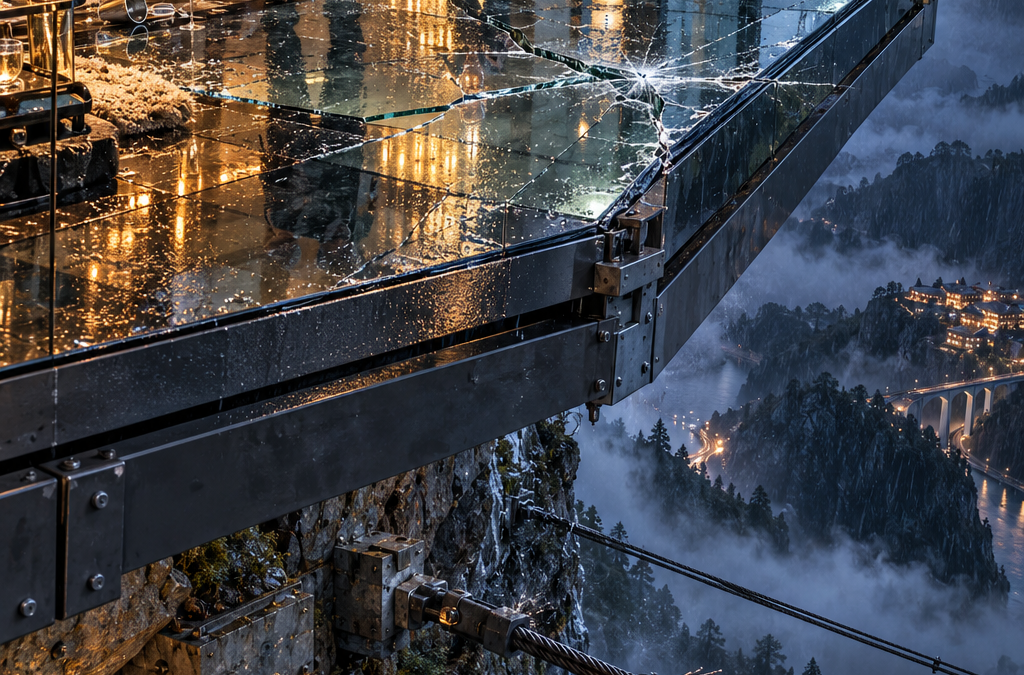
Then the crack opened.
Gunshot.
That’s what it sounded like.
A sharp explosive snap.
The epoxy line split wide.
A jagged crack tore across the glass flooring beneath the champagne table.
Someone screamed.
A tray fell.
I didn’t ask permission.
I grabbed the fire alarm.
Pulled.
Sirens cut through the music.
Red strobes flashed.
“Everybody inside!”
I shouted toward the interior exit.
“Move away from the cliff wall!”
Some people froze.
That’s normal.
People think panic looks like running.
Often it looks like stillness.
I moved toward the nearest group.
“Go!”
A board member finally reacted and started directing others.
Chairs scraped.
Guests rushed toward the exit.
The floor shifted.
Not dramatically.
Slowly.
A sickening lurch.
Everything tilted toward the cliff.
Glasses slid across the bar.
A chair moved by itself.
Then another.
People screamed.
Ranada stood near the center.
For one second, she looked at me.
Not angry.
Terrified.
“Move!”
She did.
The outer slab dropped six inches.
The sound came through the whole structure.
Deep concrete cracking.
Glass flexing.
A woman fell.
Someone grabbed her arm.
The last guests cleared the interior doorway.
Ranada was nearly last.
Then a section of the outer glass floor sheared away.
Metal framing twisted.
Glass exploded downward into the ravine.
The sound disappeared beneath the storm.
Everyone stood inside the safer interior section staring at the open hole where moments earlier they’d been standing with champagne.
No one laughed.
No one called me the ghost of the mountain.
County emergency crews arrived within the hour.
Sheriff’s deputies.
Building officials.
Geological hazard staff.
The entire cliff lot was cordoned off.
Nobody was allowed back into the lounge.
Deputy Sam Reyes walked the perimeter.
He stopped near the cut anchor field.
Mud had exposed several stubs.
Bright saw cuts.
Fresh steel.
He crouched.
Touched one.
Then looked at me.
“These were cut?”
“Eleven.”
“When?”
I gave him the date.
“Authorized?”
“Ask the county.”
He did.
By morning, Dr. Alice Mercer from the county geological hazard office was on site.
I’d known of her work.
Never met her.
She wore a yellow rain jacket and spent nearly twenty minutes examining the exposed anchor ends before speaking.
She ran one gloved finger along the saw cut.
Then said:
“This wasn’t a failure.”
Deputy Reyes looked at her.
“What do you mean?”
“These did not break.”
She pointed.
“They were removed.”
I handed her the easement.
Original 1998 stabilization plan.
Monitoring records.
Three months of readings.
Photos of my foundation crack.
Photos of the cliff loss.
Copies of the warnings I’d delivered.
The assistant confirmed she’d received them.
Everything timestamped.
Alice read the easement twice.
Then looked toward the damaged lounge.
“Who authorized anchor removal?”
That question changed the story.
Until then, Ranada kept describing what happened as an unforeseen geological event.
Historic rainfall.
Unexpected slope behavior.
Extreme weather.
Then the investigators found the shortcut.
The contractor foreman admitted Ranada had personally ordered the cables cut.
He remembered my warning.
Remembered the monitoring device.
Remembered me standing between the saw and the first anchor.
Then bank records arrived.
Deputy Reyes showed me nothing directly during the investigation.
He shouldn’t have.
I learned the details later through the case.
Lane Development Group had paid Ranada personally.
The payment came the same week the anchors were removed.
Description:
CONSULTING FEE.
The HOA had no record authorizing it.
No board vote.
No disclosed contract.
No conflict statement.
That changed the board’s mood faster than the collapsed floor had.
The emergency HOA session was packed.
I attended reluctantly.
Ranada sat at the front.
Preston did not.
One by one, board members asked questions.
“When did you become a paid consultant for Lane Development?”
“I provided advisory services.”
“What services?”
“Community liaison.”
“Why wasn’t the board told?”
“It was separate from my HOA role.”
“While you were negotiating the lounge?”
Silence.
Another member asked:
“Did you know rerouting around the anchors would cost more?”
Ranada said:
“The developer handled engineering decisions.”
Then she tried to blame me.
I remember the exact moment.
She looked across the room.
“Warren knew these anchors were important.”
The room quieted.
“He claims he understood the danger better than anyone.”
I stared at her.
“So why didn’t he physically stop the contractors?”
For a second, I thought I had misheard.
She continued.
“If the risk was really as immediate as he’s now saying, he had an ethical responsibility to prevent the work.”
Even her closest allies stopped looking at her.
I almost answered.
Deputy Reyes stood instead.
“Actually, we can address that.”
He placed a small recorder on the table.
The contractor foreman’s interview played.
His voice filled the room.
Mr. Blake told us the anchors were load-bearing. He told Ms. Vos directly that cutting them could destabilize the ridge.
Then the investigator’s question.
What did Ms. Vos say?
The foreman’s response:
She said, “Cut them all.”
No one moved.
Ranada stared at the table.
The recording continued.
Mr. Blake stood in front of the first anchor. Ms. Vos called for law enforcement and had him removed from the work area.
That ended her argument.
The next day, the county issued an emergency geological hazard order covering the entire ridge.
All construction frozen.
No excavation.
No alteration.
Mandatory monitoring.
Immediate engineering analysis.
And full slope restabilization.
The cost responsibility went to the HOA and associated project parties, not individual homeowners.
Ranada was charged with reckless endangerment and unauthorized removal of protected safety infrastructure.
She resigned as HOA president that afternoon.
No press conference.
No farewell statement.
Her attorney told her to stop talking publicly.
Preston’s investors pulled out within a week.
The Skyline Lounge project collapsed.
Not metaphorically.
Financially.
The damaged structure was condemned.
The $3.7 million vision became twisted glass and cracked concrete behind fencing.
The cost of repairing the ridge was worse.
Nearly five million dollars.
More than the lounge would likely have earned for years.
New tiebacks.
Original safety standards.
Full permitting.
Independent geotechnical oversight.
Redundant monitoring.
No shortcuts.
Dr. Mercer reviewed every anchor.
Every grout record.
Every proof test.
Every lock-off load.
And, to my surprise, the county asked me to serve as independent consultant.
I almost said no.
I was retired.
I had already spent months being mocked for not letting go of my old job.
Alice changed my mind.
She came to my porch.
Put a folder on the table.
“I want you on the restoration.”
“I’m seventy-three.”
“You know the ridge.”
“So do your people.”
“You installed the original system.”
“That was twenty-five years ago.”
“And your monitoring caught movement before any official system did.”
I looked at the folder.
“People called me a hobbyist.”
Alice smiled.
“I’ve met many professionals who would benefit from better hobbies.”
I laughed.
Then signed.
For the first time in years, my readings became official.
Not scraps in my personal notebook.
Not numbers Ranada could turn into a cartoon.
They became the baseline.
Construction crews were not allowed to tension a replacement anchor until readings were reviewed.
Every movement threshold was documented.
If the slope exceeded tolerance, work stopped.
No discussion.
No legacy project.
No ribbon cutting schedule.
Just ground behavior.
The way it should have been from the beginning.
Neighbors started apologizing.
That part was uncomfortable.
At the next community meeting, people lined up.
One man told me he’d laughed at the newsletter cartoon.
A woman admitted she’d repeated Ranada’s “ghost of the mountain” joke.
An older homeowner held both my hands.
“I’ll never sleep through a storm again without wondering what your readings say.”
I smiled.
“You should sleep.”
She looked confused.
“That’s the point of the anchors.”
“But you’ll keep checking?”
“Yes.”
“Then I’ll sleep.”
That stayed with me.
Not because I enjoyed being needed.
Because trust had been rebuilt around evidence instead of personality.
Months later, the restoration was complete.
I walked the ridge with my inclinometer.
New anchors beneath the ground.
New plates.
New records.
New monitoring points.
The cliff parcel was empty.
No glass walls.
No cantilever deck.
Grass had begun reclaiming the disturbed soil.
Wildflowers grew near the fenced-off foundation remnants.
I took the reading.
Nothing.
Not a millimeter.
I checked again.
Still nothing.
I stood there longer than necessary.
The valley below was beautiful.
I understood why Preston had wanted to build there.
Why Ranada had imagined photographs and headlines.
A $3.7 million view.
But a view is not support.
Money is not support.
Approval is not support.
Applause is not support.
The only thing that mattered beneath that ridge was what was physically holding it.
For twenty-five years, steel cables had done that work quietly enough for everyone to forget they existed.
Ranada’s mistake wasn’t wanting something beautiful.
Her mistake was believing that invisible infrastructure mattered less because nobody applauded it.
She looked at anchors and saw delay.
I looked at them and remembered houses cracking in 1998.
She saw half a million dollars in redesign costs.
I saw stored restraint.
She saw old steel.
I saw a slope that had already proved what it wanted to do when left unsupported.
That is the difference between experience and nostalgia.
She called me a man unable to let go of his old profession.
Maybe part of that was true.
I had not let go.
But mountains do not care whether the man reading an inclinometer is retired.
Ground movement doesn’t check employment status.
Physics doesn’t become obsolete because a board meeting finds it inconvenient.
The criminal case took time.
Longer than neighbors wanted.
Preston’s lawyers fought over responsibility.
Ranada’s attorneys argued about intent.
The HOA’s insurers argued about coverage.
That was their world.
Mine was simpler.
Anchor loads.
Groundwater.
Movement.
Stability.
The slope did not care which lawyer wrote the best letter.
It answered only to forces.
That’s what I kept telling people.
The ground doesn’t care about blame.
Fix it first.
Argue afterward.
The county did.
By the following winter, the new system had survived two heavy storms without meaningful movement.
My foundation crack was repaired after monitoring confirmed stabilization.
The clubhouse stopped publishing cartoons.
In fact, the new HOA president asked whether I would write a short quarterly safety note for residents.
I declined at first.
Then reconsidered.
Not engineering jargon.
Just plain language.
What the anchors do.
Why drainage matters.
What warning signs look like.
Who to call.
Where records are stored.
The first note began:
If safety infrastructure is invisible, that does not mean it is unnecessary.
I almost deleted the sentence because it sounded too pointed.
Alice told me to keep it.
So I did.
I never wanted to become the ridge’s prophet.
I still don’t.
I’m just a retired contractor with an old inclinometer and knees that complain on wet mornings.
But I learned something during those months.
People don’t always need more warnings.
Sometimes they need a reason to understand the warning.
In 1998, everyone understood.
They had watched yards move.
Seen cracks.
Heard foundations pop.
Twenty-five years later, safety had become abstract.
That made it easy to trade for convenience.
The Skyline Lounge changed that.
The broken glass became the new memory.
No one on the ridge forgot the sound.
I still hear it sometimes.
That crack racing beneath the champagne table.
The sudden silence after.
Then screaming.
I do not enjoy remembering it.
I am grateful everyone got out.
Six inches more movement at the wrong time and the story might have ended differently.
That’s the part I refuse to romanticize.
People nearly died.
Not because the science was unknown.
Not because the hazard couldn’t be predicted.
Because known safety infrastructure was deliberately removed after a direct warning.
That is what made the whole thing unforgivable to me.
Mistakes happen.
Engineers miss things.
Contractors miscalculate.
Unexpected conditions appear.
I spent thirty years around enough failures to know arrogance is easy in hindsight.
But this wasn’t hidden.
The anchor heads were exposed.
The easement existed.
I stood there holding the monitoring device.
The foreman hesitated.
Ranada looked at the cables.
Then ordered:
Cut them all.
Some sentences carry their own weight forever.
Months after the restoration, I saw her once.
Outside the courthouse.
No entourage.
No board members.
No red dress.
She looked older.
So did I.
She saw me.
For a second, I thought she would walk away.
Instead she stopped.
“Warren.”
“Ranada.”
She looked toward the courthouse steps.
Then said:
“You were right.”
I didn’t answer.
Maybe I had imagined wanting to hear that sentence.
When it came, it felt empty.
She continued.
“I thought Preston knew what he was doing.”
“He knew enough.”
She flinched.
“I didn’t know the slope would move that fast.”
“You didn’t need to.”
Her eyes lifted.
“What does that mean?”
“You knew the anchors were protected.”
Silence.
“You knew removing them created risk.”
She looked away.
“You told me.”
“Yes.”
“I thought you were exaggerating.”
“I know.”
“The approvals—”
“Didn’t authorize cutting them.”
She nodded.
Then said:
“I was trying to do something important.”
I looked back toward the ridge in the distance.
“You were.”
That confused her.
“The lounge would’ve changed this community.”
“Probably.”
“I wanted people to remember it.”
“They will.”
Her face tightened.
I regretted the cruelty as soon as the words left my mouth.
Not because they were false.
Because I didn’t need to say them.
I took a breath.
“Ranada, wanting something good does not make every shortcut toward it good.”
She looked at me.
No defense.
No argument.
For once.
Then she said:
“I should have opened your envelope.”
“Yes.”
That was all.
We walked in opposite directions.
I never spoke to her again.
Preston disappeared from the ridge even faster.
Without investors, the project was dead.
His company’s reputation took a hard hit.
The county began reviewing other projects where his firm had handled difficult sites.
I didn’t follow the details.
I had no interest in turning one failure into an obsession with his career.
My work was the ridge.
By spring, the cliff lot was green again.
The remaining glass structure had been dismantled.
The damaged cantilever slab removed.
Anchor heads buried beneath properly protected covers.
Drainage regraded.
Monitoring points marked discreetly.
There was no luxury lounge.
No bar.
No press.
Just grass.
Wildflowers.
And an empty view across the valley.
Some neighbors called that a waste.
Three-point-seven million dollars lost.
Five million spent on stabilization.
I understood why they said it.
But I didn’t see emptiness when I looked at that parcel.
I saw restraint.
Not the steel kind.
Human restraint.
A place where people had finally decided not every profitable view needed to be occupied.
That’s rarer than people think.
One evening, Alice joined me for the quarterly reading.
She carried the county instrument.
I carried mine.
“Race you,” she said.
“You’re thirty years younger.”
“Excuses.”
We took measurements independently.
Compared.
Same result.
Stable.
She smiled.
“Still think you’re retired?”
“Absolutely.”
“You walk the ridge every quarter.”
“Old habits.”
“The county pays you now.”
“Administrative error.”
She laughed.
Then looked toward the ravine.
“You know what bothers me?”
“What?”
“The system worked for twenty-five years.”
“That’s supposed to bother you?”
“No.”
She shook her head.
“The fact that success made people think the system wasn’t needed.”
I nodded.
That’s the paradox of safety.
When prevention works long enough, memory of the hazard fades.
A levee holds and people build closer.
A firebreak prevents disaster and someone wants to landscape over it.
A retaining wall survives decades and someone asks whether all that steel is really necessary.
Success looks like absence.
No collapse.
No flood.
No emergency.
And eventually someone asks why they’re paying for nothing.
The answer is that nothing is what they’re paying for.
Nothing moving.
Nothing failing.
Nobody dying.
That lesson became part of every quarterly note I wrote.
I never named Ranada.
Never named Preston.
Didn’t need to.
The facts were enough.
Residents began paying attention to drainage grates.
Retaining structures.
Anchor access zones.
People reported blocked outlets before storms.
The HOA added the 1998 easement to every resale packet so no future owner could say they didn’t know.
That may be the most useful thing to come from the whole mess.
Records only protect people if people can find them.
I had kept my copy.
Ranada never opened hers.
Future owners would have no excuse.
A year after the lounge failure, the HOA held its annual meeting.
No ribbon cutting.
No legacy project.
Budget.
Drainage maintenance.
Insurance.
Boring.
I sat in the back.
The new president reviewed emergency-preparedness procedures.
Then she asked me to stand.
I didn’t.
“Warren.”
“No.”
People laughed.
She smiled.
“Fine. Stay seated.”
Then she said:
“I want the minutes to reflect that Mr. Blake’s monitoring and warnings materially contributed to preventing serious injury during last year’s slope incident.”
I hated every second of the attention.
But I understood why she did it.
The previous board had put ridicule into the record.
The new one wanted correction there too.
So I nodded.
Nothing more.
Afterward, the same elderly woman who had once joked about the “ghost of the mountain” approached me.
She looked embarrassed.
“I was wrong about you.”
I smiled.
“You were wrong about the anchors.”
She nodded.
“That’s worse.”
“Probably.”
She looked toward the windows.
Rain had started.
“Are we okay?”
I understood the question.
Not socially.
Geologically.
“Readings are stable.”
“You’re sure?”
“No.”
Her eyes widened.
I continued.
“Engineering doesn’t give you sure. It gives you monitored, tested, maintained, and within limits.”
She frowned.
“That’s less comforting.”
“It’s more honest.”
She thought about it.
Then smiled.
“I’ll take honest.”
So will I.
Retirement looks different now.
I still drink coffee on my porch.
Still complain about my knees.
Still walk the ridge more than my doctor thinks is wise.
Sometimes I think about stopping the monitoring.
Let the county handle it.
They have professionals.
Better equipment.
Formal procedures.
Then rain starts.
And I find myself reaching for the inclinometer anyway.
Not fear.
Respect.
There’s a difference.
People who don’t understand mountains sometimes think fear is weakness.
It isn’t.
Fear becomes useful when it makes you observe.
Measure.
Prepare.
Runada called that fearmongering.
What she wanted was confidence.
Confidence sells projects.
Confidence wins votes.
Confidence cuts ribbons.
But confidence without verification is just a prettier form of risk.
The ridge taught that lesson once in 1998.
Then again twenty-five years later.
I don’t think it should need to teach us a third time.
The crack in my foundation is still faintly visible.
Repaired.
Stable.
I could cover it completely.
Paint.
Patch.
Make it disappear.
I haven’t.
Maybe that’s sentimental.
Maybe it’s professional superstition.
I like seeing it.
Not because I enjoy remembering danger.
Because it reminds me how failure begins.
Small.
Hairline.
Easy to explain away.
Someone says old houses crack.
Someone says the slope has always moved a little.
Someone says the anchor is probably conservative.
Someone says the engineer approved it.
Someone says the glass crack is cosmetic.
Someone says seal it with epoxy before the party.
Then the floor drops.
Catastrophe usually sends invitations before it arrives.
People just don’t like the invitations.
They interrupt schedules.
Budgets.
Celebrations.
Legacy projects.
So we ignore them.
That is what nearly happened on our ridge.
Not because nobody knew.
Because knowing was inconvenient.
When I walk the empty cliff parcel now, I sometimes stop at the place where the lounge stood.
Wildflowers grow there.
Purple in spring.
Yellow later.
The valley is still beautiful.
Maybe more beautiful without glass framing it.
I can stand thirty feet back from the edge and see the same view Preston wanted to sell.
Free.
No champagne.
No dress code.
No $3.7 million building.
Just wind.
Trees.
Distance.
Beneath my feet, new steel anchors disappear into bedrock.
You can’t see them.
That’s the point.
They’re doing their job.
No ribbon.
No applause.
No photographs.
Holding.
That’s enough.
People still tell the story as though it was about an HOA president losing five million dollars.
Or a developer’s vanity project collapsing.
Or an old engineer being vindicated.
Those things happened.
But that’s not how I remember it.
I remember the first saw blade.
Sparks.
The cable snapping.
I remember standing behind the property line while eleven anchors disappeared.
I remember the helplessness.
I remember wondering whether all my experience had become irrelevant because the people with authority didn’t want it.
Then I remember the party.
The cracked epoxy.
The floor moving.
Guests running.
Ranada clearing the doorway seconds before the outer slab fell.
That is the part I carry.
She almost became a victim of her own decision.
So did thirty other people who had nothing to do with it.
There is no satisfaction in being right about that.
None.
If I could trade every apology, every article, every consulting contract, every moment of vindication for the cables never having been cut, I would.
Immediately.
The best safety story is the one nobody tells because nothing happened.
Ours became a story because people nearly died.
That’s not victory.
It’s a warning that arrived one minute before disaster.
A few months ago, a new family moved onto the ridge.
Young couple.
Two children.
They invited me over because the realtor had mentioned “slope infrastructure” and they wanted someone to explain.
I brought the current map.
Showed them the anchor zones.
Monitoring points.
Drainage path.
The husband looked impressed.
“All this is under our yards?”
“Yes.”
“You can’t see any of it.”
“Mostly no.”
His daughter, maybe eight, asked:
“How does it hold the mountain?”
I thought about giving her a simple engineering explanation.
Instead I pointed toward a tree.
“Imagine the hill wants to slide downhill.”
She nodded.
“The cables reach deep into strong rock that doesn’t want to slide.”
“So they’re like seatbelts?”
I smiled.
“That’s pretty good.”
She looked at her father.
“Don’t cut the mountain seatbelts.”
I laughed harder than I had in months.
“Excellent rule.”
Maybe every HOA packet should say exactly that.
Don’t cut the mountain seatbelts.
Clearer than thirty pages of easement language.
But adults often need complicated paperwork to understand simple responsibilities.
The new family thanked me.
Before leaving, the husband asked:
“Is it safe?”
I gave him the answer I wish more people understood.
“It’s safe because we’re maintaining what makes it safe.”
Not because the mountain changed.
Not because risk disappeared.
Because the systems designed after failure remained intact.
Safety is often conditional.
That’s uncomfortable.
People want absolute guarantees.
There aren’t many in my line of work.
There is maintenance.
Monitoring.
Redundancy.
Respect.
That’s what you get.
And if someone offers certainty while asking you to remove those things, be suspicious.
The ridge hasn’t moved meaningfully since restoration.
Last quarter:
less than one millimeter.
Normal.
Beautifully boring.
I wrote the number in my notebook.
Closed it.
Stood at the cliff lot.
The sunlight was setting behind the valley.
For a second, I could almost see the ghost of the lounge.
Glass walls.
Lights.
People raising champagne.
Then I looked at the grass.
Better.
Some projects fail because they were badly built.
Ours failed before that.
It failed at the moment people decided infrastructure they couldn’t see was less important than the structure everyone would see.
The rest was just gravity collecting the debt.
Ranada wanted a legacy.
In a way, she got one.
Not the kind she expected.
The community now knows every anchor zone.
Every storm triggers monitoring.
Every board member receives the stabilization easement during orientation.
No developer touches that cliff parcel without county geological review.
People who once laughed at my inclinometer ask what the readings say.
That is a legacy.
A painful one.
An expensive one.
But useful.
The $3.7 million lounge is gone.
The ridge remains.
That’s the balance sheet that matters to me.
One structure built for applause lasted weeks.
Steel buried in mud for safety lasted twenty-five years until somebody deliberately cut it.
We replaced the steel.
We learned the lesson.
Now I walk the ridge and listen.
Not because I expect another failure.
Because listening is part of respecting what holds you up.
The ground rarely speaks loudly at first.
A millimeter.
A crack.
A groan beneath the rain.
A tree leaning the wrong way.
Small things.
If you’re arrogant, they look insignificant.
If you’ve been around failure long enough, they sound like someone knocking before entering.
You answer.
That’s what I do.
I take the reading.
Write the number.
Check the rain gauge.
Look at the drainage.
Then I go home.
Most days, nothing happens.
And after everything we nearly lost, I have learned to treasure nothing happening.
Because on a mountain held together by steel, drainage, bedrock, and memory, nothing happening means everything is still doing its job.
𝗧𝗛𝗘 𝗘𝗡𝗗
The Night the Glass Floor Cracked, I Knew Someone Had Cut the Wrong Cables Beneath Our Mountain
The rain had been falling for three days when a hairline crack appeared beneath the glass floor of a $3.7 million lounge hanging thirty feet over open air.
Everyone inside thought they were looking at a cosmetic defect, but I knew what was missing beneath that slab because twenty-five years earlier, I had helped drill the steel cables that kept the entire ridge from sliding downhill.
My name is Warren Blake.
For thirty years, I made a living keeping mountains where mountains were supposed to stay.
That sounds dramatic when I say it now.
At the time, most of the work felt ordinary.
Mud.
Core samples.
Rock bolts.
Drainage plans.
Anchor calculations.
Long days beneath gray skies while people in clean offices argued about budgets for slopes they had never walked.
I was a geotechnical stabilization contractor.
Not an architect.
Not a developer.
Not the man standing at the ribbon cutting when a project looked beautiful.
I was usually the man underneath it.
The one asking what the ground was doing.
How deep the bedrock sat.
Where water moved after rain.
Whether a retaining wall had enough drainage.
Whether a cut slope was actually stable or merely waiting for the right storm to prove everyone wrong.
You learn humility doing that kind of work.
Concrete cracks.
Steel corrodes.
Water finds weaknesses.
Rock remembers every fracture line it has ever had.
And gravity?
Gravity doesn’t negotiate.
People do.
Budgets do.
Boards do.
Developers do.
Gravity doesn’t.
That was the lesson Ranada Vos never understood until a glass floor dropped six inches beneath a room full of champagne glasses.
I retired to the ridge because I trusted it.
That may sound ironic now.
Twenty-five years earlier, I had helped save it.
In the winter of 1998, the entire hillside moved.
Four feet.
Not in one dramatic collapse.
That would almost have been easier to understand.
The ridge crept.
A retaining wall opened.
Driveways split.
Trees leaned.
Foundations cracked.
One house lost part of its rear patio overnight.
People woke up and discovered that the ground they had trusted for years had changed its mind.
The county brought in engineers.
Geologists.
Contractors.
I was thirty-eight then and still young enough to think working sixteen-hour days in freezing rain was proof of character.
The investigation found what we feared.
Weak weathered material sat above fractured bedrock.
Water had saturated the slope until the soil mass began moving along an old failure plane.
The solution was expensive.
And ugly.
Tieback anchors.
Dozens of them.
Steel cables drilled deep into competent rock.
Some crossed individual residential lots.
Some sat beneath landscaping.
Some were installed across an empty cliff parcel at the end of the road, the steepest and most dangerous section of the ridge.
We drilled.
Pressure-grouted.
Tested.
Tensioned.
Locked off anchor heads against reinforced structures.
The system was designed so no single lot existed in isolation.
That was the important part.
The ridge worked as a whole.
You didn’t remove an anchor because it was inconvenient to one property any more than you removed a beam from a bridge because you wanted more headroom.
The county understood that.
So it recorded a safety easement protecting the anchor field as shared stabilization infrastructure.
I installed almost half those anchors myself.
I knew their positions.
Their depths.
The angles.
I knew which ones hit competent rock on the first drilling run and which ones needed to be redrilled.
I knew which anchor head sat beneath what later became a flower bed.
I knew which cables crossed the empty cliff parcel.
And after the work was finished, the ridge stopped moving.
Not perfectly.
No slope is perfectly still.
Everything moves.
A fraction.
A millimeter.
Seasonal moisture.
Temperature.
Normal response.
But the dangerous movement stopped.
People repaired houses.
Driveways were repaved.
Landscaping returned.
Eventually, the fear faded.
That’s what happens when infrastructure works.
People stop thinking about it.
A generation of residents moved in who had never seen the ridge shift.
By the time I retired, most homeowners couldn’t have told you what a tieback anchor was.
I could.
That’s why I kept checking.
Every quarter, I walked the ridge with an inclinometer and a notebook.
No one paid me.
No HOA contract.
No county assignment.
Just habit.
Maybe obsession.
I had spent too many years learning what early movement looked like to pretend retirement had made the ground someone else’s problem.
Most readings were boring.
One millimeter.
Sometimes less.
A little more after heavy rain.
Then back to normal.
Boring readings are beautiful.
People who work around failure understand that.
Ranada Vos did not.
Ranada became HOA president two years before the Skyline Lounge project.
She liked visible success.
That was the best way I knew how to describe her at first.
New entrance landscaping.
Decorative streetlamps.
Updated clubhouse furniture.
Seasonal banners.
A redesigned community website.
If something could be photographed, announced, unveiled, or accompanied by a ribbon, Ranada wanted her name attached to it.
She wasn’t stupid.
That’s important.
I don’t believe she was.
She understood politics.
She understood presentation.
She understood how to stand in front of a room and make a project sound inevitable.
What she did not understand was uncertainty.
People like Ranada dislike uncertainty because it slows momentum.
Engineers live in uncertainty.
What’s the factor of safety?
How much does groundwater change after five days of rain?
What happens if this anchor is removed?
What happens if three are removed?
What happens if eleven disappear?
Ranada heard questions and saw obstruction.
I heard questions and saw survival.
The vacant cliff parcel had sat untouched since 1998.
It was beautiful land if you didn’t know why it was empty.
The view from there stretched across the valley.
Sunsets turned the horizon orange.
At night, the town lights below looked like another sky.
Developers had looked at it before.
Most walked away.
Too steep.
Too much stabilization infrastructure.
Too many restrictions.
Then Preston Lane arrived.
Preston ran Lane Development Group.
He had built restaurants, event spaces, high-end condominiums, and one rooftop club downtown that had somehow convinced people to pay fourteen dollars for sparkling water.
He had a talent for selling experience.
At the monthly HOA meeting, Ranada unveiled his proposal.
She called it the Skyline Lounge.
The rendering appeared on the screen behind her.
Glass walls.
Low lighting.
A long cantilevered deck projecting thirty feet over the cliff.
Transparent floor panels at the outer edge so guests could look straight into the ravine.
A private bar.
Small event space.
Members-only hours.
Rental income.
Prestige.
Three-point-seven million dollars.
The HOA would receive a share of revenue.
Ranada stood beside the image smiling like she had personally invented gravity.
“This,” she said, “puts our community on the map.”
People applauded.
I didn’t.
I was sitting in the third row.
My eyes were on the site plan.
The excavation line.
The foundation footprint.
A utility trench.
And the shaded area where the lounge foundation would cut directly through the old anchor field.
I raised my hand.
Ranada saw me.
She kept talking.
I raised it higher.
Eventually she sighed.
“Mr. Blake.”
“Has the anchor field been surveyed?”
She smiled politely.
“All engineering requirements have been reviewed.”
“By who?”
“Preston’s consultants.”
I looked toward Preston.
He sat near the board table wearing a dark jacket.
“Did they review the 1998 stabilization plan?”
He leaned toward the microphone.
“We reviewed all available site documentation.”
That was not an answer.
“Then you know your excavation path crosses the tiebacks.”
A few people turned.
Ranada’s expression tightened.
“Mr. Blake, this project has three engineering approvals.”
“What approvals?”
“Structural. Architectural. Site.”
“Geotechnical?”
Preston responded.
“Site conditions were considered.”
“That’s still not geotechnical.”
Ranada laughed lightly.
Not because anything was funny.
Because laughter tells a room the speaker doesn’t deserve seriousness.
“Mr. Blake, with respect, we don’t need a retired hobbyist telling licensed professionals how to build.”
Several people laughed.
I didn’t.
“Hobbyist?”
“You’ve been walking this ridge with that little measuring device for years.”
“Inclinometer.”
“Exactly.”
More laughter.
I looked at the rendering again.
Then at her.
“I installed the anchors you’re planning to excavate through.”
The room quieted slightly.
Ranada folded her arms.
“And I’m sure your experience was valuable in 1998.”
“It is the same bedrock.”
“No one is dismissing history.”
“You are literally building through it.”
Preston leaned forward.
“The anchors can be worked around.”
“Then show me the rerouting plan.”
He didn’t.
I continued.
“If those anchors are abandoned or removed without replacing capacity, you reduce restraint on the steepest section of the slope.”
Preston said, “We’re not discussing construction details tonight.”
“You should be.”
Ranada’s voice hardened.
“We are discussing community opportunity.”
“I’m discussing the ground holding the opportunity.”
That ended the pleasant tone.
“Thank you, Warren.”
“I haven’t finished.”
“You have.”
She turned back to the room.
I sat down.
No one asked another question about the anchors.
The next morning, I pulled the original county easement from my files.
I kept nearly everything.
Old habit.
Field records.
Design drawings.
Load-test sheets.
County correspondence.
There it was.
Recorded safety easement.
Anchor field protected as shared slope stabilization infrastructure.
No removal, obstruction, relocation, or interference without county geotechnical approval.
Clear.
Not interpretive.
Not vague.
I copied it.
Drove to the clubhouse.
Ranada’s assistant was at the front desk.
“Is she in?”
“Meeting.”
“Give her this.”
I wrote across the top:
PLEASE READ BEFORE ANY EXCAVATION.
The assistant promised she would.
Later, I learned Ranada never opened it.
What I didn’t know then was that Preston already knew exactly why the anchors were a problem.
Going around them would delay construction around six months.
It would require redesign.
Temporary stabilization.
New anchor locations.
Special sequencing.
Estimated additional cost:
roughly half a million dollars.
Five hundred thousand dollars.
That’s what the ridge’s safety became in Preston’s spreadsheet.
A problem column.
He and Ranada met privately.
Later, bank records and testimony would fill in parts of that conversation.
Not every word.
Enough.
They agreed the old anchors were conservative.
Outdated.
Overbuilt.
An inconvenience.
Three days after the board meeting, I woke before sunrise to the sound of a gasoline engine.
Not a vehicle.
Higher pitch.
Cutoff saw.
I know that sound.
I got out of bed.
Went to the kitchen window.
A flatbed truck sat near the cliff parcel.
Two contractors were unloading equipment.
My stomach dropped.
I didn’t bother changing.
Sweatpants.
Sweatshirt.
Slippers.
I went up the slope as fast as my knees allowed.
The ground was wet from overnight drizzle.
By the time I reached the parcel, three anchor heads had already been exposed.
Concrete chipped away.
Steel visible.
One worker was setting a saw near the first cable.
“Stop!”
The foreman looked up.
“Morning.”
“Shut that down.”
He frowned.
“Who are you?”
“Warren Blake.”
Nothing.
“I installed those anchors.”
That got his attention.
“We have a work order.”
“Show me.”
He didn’t.
“Sir, you need to clear the work area.”
“Those are load-bearing slope anchors.”
“We were told they’re abandoned.”
“They are not.”
A second worker looked uncertain.
I pulled my monitoring device from the bag I had brought.
The latest readings were already higher than normal.
Half a millimeter of creep in forty-eight hours.
Not catastrophic.
Not even alarming by itself.
But enough to make cutting restraint idiotic.
“See this?”
The foreman glanced.
“I don’t know what that means.”
“It means the slope has started moving more than baseline.”
“Talk to the client.”
“I’m talking to the man holding the saw.”
He put it down.
For a moment, I thought reason might win.
Then Ranada’s SUV arrived.
Fast.
Mud sprayed from the tires.
She stepped out wearing heels completely wrong for the terrain and a raincoat over office clothes.
“Warren.”
“Tell them to stop.”
“What are you doing here?”
“Your crew exposed three anchors.”
“They’re removing obsolete infrastructure.”
“They are active anchors.”
“According to you.”
“According to the county easement I left on your desk.”
She looked blank.
“I didn’t receive anything.”
“Your assistant did.”
Ranada looked toward the foreman.
“Are we within the excavation area?”
“Yes, ma’am.”
She nodded.
“Continue.”
I stepped between the saw and the anchor.
“Ranada.”
Her eyes narrowed.
“Move.”
“You cut these, you’re not clearing a lot. You’re pulling restraint from the ridge.”
“You’re being dramatic.”
“I’m being literal.”
I held up the inclinometer.
“The slope is already trending.”
She didn’t look.
“Half a millimeter of creep in forty-eight hours.”
“That means nothing to anyone except you.”
“It means this is the worst possible time to remove anchors.”
Preston arrived five minutes later.
By then, the argument had drawn workers from farther down the site.
I showed him the reading.
He barely glanced.
“Warren, these anchors were installed twenty-five years ago.”
“And?”
“Engineering practice changes.”
“Bedrock didn’t.”
“We have structural redundancy.”
“Where?”
He said nothing.
I pointed toward the exposed cable.
“Show me replacement capacity.”
Ranada cut in.
“Enough.”
Then she said the words I would replay for months.
“Cut them all.”
The foreman looked at her.
“Ma’am?”
“You heard me.”
I stared at her.
“Ranada, don’t.”
She turned toward me.
“You are trespassing on HOA-managed land.”
“This is protected safety infrastructure.”
“You are obstructing an authorized construction project.”
“I am warning you that removal could destabilize the ridge.”
She pulled out her phone.
Then, unbelievably, called the sheriff’s office.
A deputy arrived.
Young man.
I knew him by sight but not well.
Ranada told him I was interfering with construction.
I tried to explain.
He looked miserable.
“Warren, I can’t adjudicate engineering.”
“I’m not asking you to.”
“I need you to step off the site.”
“Those anchors—”
“I understand.”
“No, you don’t.”
I regretted the tone immediately.
He was doing his job.
The deputy lowered his voice.
“Please.”
I looked at Ranada.
Then the workers.
Then the saw.
I stepped back to my property line.
And watched.
The first blade hit steel.
Sparks sprayed against the gray morning.
The cable resisted.
Then gave.
The sound was not loud enough to justify what it meant.
A metallic snap.
Sharp.
Final.
I felt it through my chest.
Another.
Then another.
One by one.
Eleven anchors.
By noon, all eleven were cut.
I stood behind the fence like an old man watching someone dismantle a bridge while traffic still crossed it.
Powerless.
That feeling stayed with me longer than the anger.
I had installed some of those anchors with my own hands.
I remembered the drill rigs.
The mud.
The pressure gauges.
The 1998 rain.
Homeowners standing in yards asking whether their houses were safe.
We had told them:
We’re stabilizing the ridge.
And we did.
Twenty-five years later, people who had never felt the ground move decided the safety system was excessive.
That night, I woke at 1:17.
Not from noise inside the house.
From below it.
A low groan.
Deep.
Slow.
Almost like rock grinding against rock.
I sat up.
Listened.
There.
Again.
I put on boots.
Went outside with a flashlight.
Nothing obvious.
No collapse.
No dramatic crack opening.
Just rain beginning again.
The next morning, I found the foundation crack.
Hairline.
Maybe two feet long.
Near the rear corner.
I knew every old crack in that house.
You do after retirement when you have too much time and thirty years of professional paranoia.
This one was new.
I photographed it.
Measured it.
Timestamped it.
Logged weather.
Then called county building.
The inspector who answered sounded tired.
“Hairline cracks happen.”
“Not this one.”
“How old is the house?”
“Thirty-two years.”
“Then settlement—”
“The slope anchors were cut yesterday.”
Silence.
“What anchors?”
That was when I realized the county building department didn’t know.
I explained.
He said he’d check permits.
I called geological hazards.
Voicemail.
Public works.
Transferred twice.
No immediate response.
Construction continued.
Fast.
Too fast.
Within two weeks, the Skyline Lounge had a poured cantilevered slab.
Steel frame.
Glass panels.
Workers moved like they were racing the weather.
Maybe they were racing questions.
The lounge looked beautiful.
That’s the danger.
Unsafe things don’t always look unsafe.
The outer deck hung thirty feet over open air.
Glass floor panels near the edge gave a direct view into the ravine.
At sunset, it probably looked spectacular.
Ranada announced a private preview party before public opening.
Board members.
Selected residents.
Local press.
Champagne.
A toast to her “legacy project.”
Then the forecast changed.
Five days of heavy rain.
The same kind of slow, soaking system that worries people who understand slopes.
The first day, my readings increased.
The second, more.
By the third day, the inclinometer showed two centimeters of movement.
Two full centimeters.
In seventy-two hours.
I checked again.
Then a third time.
Instrument calibration.
Reference point.
Same result.
I stood in the rain staring at the numbers.
Twenty-five years.
I had never seen movement like that since the original stabilization.
I walked the ridge.
Mud flowed across one path.
Trees near the cliff edge leaned very slightly downhill.
Not from wind.
From ground displacement.
Then a section of the cliff broke away.
Not huge.
Maybe enough rock and soil to fill a pickup bed.
It crumbled into the ravine.
That was no longer a warning trend.
That was active failure.
I drove straight to the clubhouse.
Ranada’s assistant was at the desk.
“I need to see her.”
“She’s in meetings.”
“Get her out.”
The assistant blinked.
“Excuse me?”
“The slope is moving two centimeters in three days.”
She looked confused.
“Mr. Blake—”
“Two centimeters.”
I put the monitoring sheet on the desk.
“A chunk of the cliff just failed.”
“I’ll give this to her.”
“No. Call her.”
“She’s finalizing the party.”
I stared at the assistant.
“Party?”
“The preview.”
“In this weather?”
She looked offended.
“It’s indoors.”
I almost laughed.
Instead I left the readings on Ranada’s desk.
That afternoon, the HOA newsletter arrived electronically.
At the bottom was a cartoon.
An old man standing on a mountain holding a measuring device while ghosts rose from the ground.
Headline:
THE GHOST OF THE MOUNTAIN STRIKES AGAIN.
Ranada’s message beneath it referred to “fearmongering from those unable to let go of their former professions.”
I stared at the screen.
Then closed the email.
That hurt.
More than I expected.
Not because of the joke.
Because ridicule is efficient.
Once people laugh at the warning, they stop asking whether the warning is correct.
I spent my career around dangerous ground.
I had learned to respect people who spoke up early.
Ranada had turned caution into personality.
The old retired guy.
Obsessed with the mountain.
Can’t let go.
I started wondering whether maybe I was exactly what she said.
That’s how humiliation works.
Even when you have numbers in your hand, you start questioning yourself because everyone else appears relaxed.
So I recalibrated the instrument again.
Same movement.
Checked another monitoring point.
Same trend.
I wasn’t wrong.
The night before the preview, rain hammered the ridge sideways.
I barely slept.
Around midnight, I stood at the window with binoculars.
The tree line on the cliff parcel moved strangely.
Branches shifted in the storm, yes.
But trunks were changing angle.
Roots were moving with the soil.
At dawn, a maintenance worker found the first crack in the lounge slab.
I learned this later.
Foot-long.
Starting near the cliffside edge.
He reported it.
Ranada instructed him to seal it with epoxy before the party.
Epoxy.
On a structural crack over an actively moving slope.
When investigators later showed me the work order, I had to sit down.
By afternoon, cars were lining the access road.
Guests in cocktail clothes moved toward the glass building under umbrellas.
The storm had weakened temporarily.
Thirty people, maybe more.
Board members.
Neighbors.
Local press.
Ranada wore a red dress.
From the tree line outside the property boundary, I watched through binoculars.
I hadn’t been invited.
That was probably wise.
Champagne.
Music.
People taking photos on the glass floor.
The repaired crack lay beneath a table.
I could see the epoxy line.
Even from outside, something looked wrong.
Then the patch cracked again.
Thin at first.
I lowered the binoculars.
A low groan rolled through the ridge.
I heard it from outside.
Inside, glasses rattled.
People looked around.
Some laughed.
Thunder.
That’s what they thought.
I knew better.
I called the county emergency line.
“Active slope failure beneath an occupied structure.”
The dispatcher asked for address.
I gave it.
“How do you know it’s active?”
“I have two centimeters of measured movement in seventy-two hours, cliff loss, structural cracking, and eleven recently removed tieback anchors.”
That changed the tone.
“Are you an engineer?”
“Retired geotechnical stabilization contractor. I installed the original anchors.”
“Stay clear of the structure.”
I looked through the glass.
People were still drinking.
“No.”
“Sir—”
“I am not standing here while thirty people stay on a failing cantilever.”
I started up the access road.
Rain soaked me before I reached the entrance.
A staff member tried to stop me.
“Private event.”
“Call security later.”
I pushed through the door.
Music.
Warm air.
Perfume.
Wet wool.
Champagne.
Ranada saw me immediately.
Her face transformed.
“Warren.”
“Evacuate.”
Conversation nearby stopped.
She walked fast toward me.
“What are you doing?”
“Get everyone out.”
“You are not ruining this.”
“The slab is cracking.”
“It’s cosmetic.”
“The slope is moving.”
She grabbed my elbow and pulled me aside.
“Do you understand what the press is here for?”
I stared at her.
“Ranada, people could die.”
“Stop saying things like that.”
“The anchors are gone.”
“The engineers approved the structure.”
“The engineers did not approve active slope movement after you removed protected anchors.”
Her eyes flashed.
“You are about to humiliate me in front of everyone.”
That’s what mattered to her in that second.
Humiliation.
Not the floor.
Not the rain.
Not the ravine beneath us.
Then the crack opened.
Gunshot.
That’s what it sounded like.
A sharp explosive snap.
The epoxy line split wide.
A jagged crack tore across the glass flooring beneath the champagne table.
Someone screamed.
A tray fell.
I didn’t ask permission.
I grabbed the fire alarm.
Pulled.
Sirens cut through the music.
Red strobes flashed.
“Everybody inside!”
I shouted toward the interior exit.
“Move away from the cliff wall!”
Some people froze.
That’s normal.
People think panic looks like running.
Often it looks like stillness.
I moved toward the nearest group.
“Go!”
A board member finally reacted and started directing others.
Chairs scraped.
Guests rushed toward the exit.
The floor shifted.
Not dramatically.
Slowly.
A sickening lurch.
Everything tilted toward the cliff.
Glasses slid across the bar.
A chair moved by itself.
Then another.
People screamed.
Ranada stood near the center.
For one second, she looked at me.
Not angry.
Terrified.
“Move!”
She did.
The outer slab dropped six inches.
The sound came through the whole structure.
Deep concrete cracking.
Glass flexing.
A woman fell.
Someone grabbed her arm.
The last guests cleared the interior doorway.
Ranada was nearly last.
Then a section of the outer glass floor sheared away.
Metal framing twisted.
Glass exploded downward into the ravine.
The sound disappeared beneath the storm.
Everyone stood inside the safer interior section staring at the open hole where moments earlier they’d been standing with champagne.
No one laughed.
No one called me the ghost of the mountain.
County emergency crews arrived within the hour.
Sheriff’s deputies.
Building officials.
Geological hazard staff.
The entire cliff lot was cordoned off.
Nobody was allowed back into the lounge.
Deputy Sam Reyes walked the perimeter.
He stopped near the cut anchor field.
Mud had exposed several stubs.
Bright saw cuts.
Fresh steel.
He crouched.
Touched one.
Then looked at me.
“These were cut?”
“Eleven.”
“When?”
I gave him the date.
“Authorized?”
“Ask the county.”
He did.
By morning, Dr. Alice Mercer from the county geological hazard office was on site.
I’d known of her work.
Never met her.
She wore a yellow rain jacket and spent nearly twenty minutes examining the exposed anchor ends before speaking.
She ran one gloved finger along the saw cut.
Then said:
“This wasn’t a failure.”
Deputy Reyes looked at her.
“What do you mean?”
“These did not break.”
She pointed.
“They were removed.”
I handed her the easement.
Original 1998 stabilization plan.
Monitoring records.
Three months of readings.
Photos of my foundation crack.
Photos of the cliff loss.
Copies of the warnings I’d delivered.
The assistant confirmed she’d received them.
Everything timestamped.
Alice read the easement twice.
Then looked toward the damaged lounge.
“Who authorized anchor removal?”
That question changed the story.
Until then, Ranada kept describing what happened as an unforeseen geological event.
Historic rainfall.
Unexpected slope behavior.
Extreme weather.
Then the investigators found the shortcut.
The contractor foreman admitted Ranada had personally ordered the cables cut.
He remembered my warning.
Remembered the monitoring device.
Remembered me standing between the saw and the first anchor.
Then bank records arrived.
Deputy Reyes showed me nothing directly during the investigation.
He shouldn’t have.
I learned the details later through the case.
Lane Development Group had paid Ranada personally.
The payment came the same week the anchors were removed.
Description:
CONSULTING FEE.
The HOA had no record authorizing it.
No board vote.
No disclosed contract.
No conflict statement.
That changed the board’s mood faster than the collapsed floor had.
The emergency HOA session was packed.
I attended reluctantly.
Ranada sat at the front.
Preston did not.
One by one, board members asked questions.
“When did you become a paid consultant for Lane Development?”
“I provided advisory services.”
“What services?”
“Community liaison.”
“Why wasn’t the board told?”
“It was separate from my HOA role.”
“While you were negotiating the lounge?”
Silence.
Another member asked:
“Did you know rerouting around the anchors would cost more?”
Ranada said:
“The developer handled engineering decisions.”
Then she tried to blame me.
I remember the exact moment.
She looked across the room.
“Warren knew these anchors were important.”
The room quieted.
“He claims he understood the danger better than anyone.”
I stared at her.
“So why didn’t he physically stop the contractors?”
For a second, I thought I had misheard.
She continued.
“If the risk was really as immediate as he’s now saying, he had an ethical responsibility to prevent the work.”
Even her closest allies stopped looking at her.
I almost answered.
Deputy Reyes stood instead.
“Actually, we can address that.”
He placed a small recorder on the table.
The contractor foreman’s interview played.
His voice filled the room.
Mr. Blake told us the anchors were load-bearing. He told Ms. Vos directly that cutting them could destabilize the ridge.
Then the investigator’s question.
What did Ms. Vos say?
The foreman’s response:
She said, “Cut them all.”
No one moved.
Ranada stared at the table.
The recording continued.
Mr. Blake stood in front of the first anchor. Ms. Vos called for law enforcement and had him removed from the work area.
That ended her argument.
The next day, the county issued an emergency geological hazard order covering the entire ridge.
All construction frozen.
No excavation.
No alteration.
Mandatory monitoring.
Immediate engineering analysis.
And full slope restabilization.
The cost responsibility went to the HOA and associated project parties, not individual homeowners.
Ranada was charged with reckless endangerment and unauthorized removal of protected safety infrastructure.
She resigned as HOA president that afternoon.
No press conference.
No farewell statement.
Her attorney told her to stop talking publicly.
Preston’s investors pulled out within a week.
The Skyline Lounge project collapsed.
Not metaphorically.
Financially.
The damaged structure was condemned.
The $3.7 million vision became twisted glass and cracked concrete behind fencing.
The cost of repairing the ridge was worse.
Nearly five million dollars.
More than the lounge would likely have earned for years.
New tiebacks.
Original safety standards.
Full permitting.
Independent geotechnical oversight.
Redundant monitoring.
No shortcuts.
Dr. Mercer reviewed every anchor.
Every grout record.
Every proof test.
Every lock-off load.
And, to my surprise, the county asked me to serve as independent consultant.
I almost said no.
I was retired.
I had already spent months being mocked for not letting go of my old job.
Alice changed my mind.
She came to my porch.
Put a folder on the table.
“I want you on the restoration.”
“I’m seventy-three.”
“You know the ridge.”
“So do your people.”
“You installed the original system.”
“That was twenty-five years ago.”
“And your monitoring caught movement before any official system did.”
I looked at the folder.
“People called me a hobbyist.”
Alice smiled.
“I’ve met many professionals who would benefit from better hobbies.”
I laughed.
Then signed.
For the first time in years, my readings became official.
Not scraps in my personal notebook.
Not numbers Ranada could turn into a cartoon.
They became the baseline.
Construction crews were not allowed to tension a replacement anchor until readings were reviewed.
Every movement threshold was documented.
If the slope exceeded tolerance, work stopped.
No discussion.
No legacy project.
No ribbon cutting schedule.
Just ground behavior.
The way it should have been from the beginning.
Neighbors started apologizing.
That part was uncomfortable.
At the next community meeting, people lined up.
One man told me he’d laughed at the newsletter cartoon.
A woman admitted she’d repeated Ranada’s “ghost of the mountain” joke.
An older homeowner held both my hands.
“I’ll never sleep through a storm again without wondering what your readings say.”
I smiled.
“You should sleep.”
She looked confused.
“That’s the point of the anchors.”
“But you’ll keep checking?”
“Yes.”
“Then I’ll sleep.”
That stayed with me.
Not because I enjoyed being needed.
Because trust had been rebuilt around evidence instead of personality.
Months later, the restoration was complete.
I walked the ridge with my inclinometer.
New anchors beneath the ground.
New plates.
New records.
New monitoring points.
The cliff parcel was empty.
No glass walls.
No cantilever deck.
Grass had begun reclaiming the disturbed soil.
Wildflowers grew near the fenced-off foundation remnants.
I took the reading.
Nothing.
Not a millimeter.
I checked again.
Still nothing.
I stood there longer than necessary.
The valley below was beautiful.
I understood why Preston had wanted to build there.
Why Ranada had imagined photographs and headlines.
A $3.7 million view.
But a view is not support.
Money is not support.
Approval is not support.
Applause is not support.
The only thing that mattered beneath that ridge was what was physically holding it.
For twenty-five years, steel cables had done that work quietly enough for everyone to forget they existed.
Ranada’s mistake wasn’t wanting something beautiful.
Her mistake was believing that invisible infrastructure mattered less because nobody applauded it.
She looked at anchors and saw delay.
I looked at them and remembered houses cracking in 1998.
She saw half a million dollars in redesign costs.
I saw stored restraint.
She saw old steel.
I saw a slope that had already proved what it wanted to do when left unsupported.
That is the difference between experience and nostalgia.
She called me a man unable to let go of his old profession.
Maybe part of that was true.
I had not let go.
But mountains do not care whether the man reading an inclinometer is retired.
Ground movement doesn’t check employment status.
Physics doesn’t become obsolete because a board meeting finds it inconvenient.
The criminal case took time.
Longer than neighbors wanted.
Preston’s lawyers fought over responsibility.
Ranada’s attorneys argued about intent.
The HOA’s insurers argued about coverage.
That was their world.
Mine was simpler.
Anchor loads.
Groundwater.
Movement.
Stability.
The slope did not care which lawyer wrote the best letter.
It answered only to forces.
That’s what I kept telling people.
The ground doesn’t care about blame.
Fix it first.
Argue afterward.
The county did.
By the following winter, the new system had survived two heavy storms without meaningful movement.
My foundation crack was repaired after monitoring confirmed stabilization.
The clubhouse stopped publishing cartoons.
In fact, the new HOA president asked whether I would write a short quarterly safety note for residents.
I declined at first.
Then reconsidered.
Not engineering jargon.
Just plain language.
What the anchors do.
Why drainage matters.
What warning signs look like.
Who to call.
Where records are stored.
The first note began:
If safety infrastructure is invisible, that does not mean it is unnecessary.
I almost deleted the sentence because it sounded too pointed.
Alice told me to keep it.
So I did.
I never wanted to become the ridge’s prophet.
I still don’t.
I’m just a retired contractor with an old inclinometer and knees that complain on wet mornings.
But I learned something during those months.
People don’t always need more warnings.
Sometimes they need a reason to understand the warning.
In 1998, everyone understood.
They had watched yards move.
Seen cracks.
Heard foundations pop.
Twenty-five years later, safety had become abstract.
That made it easy to trade for convenience.
The Skyline Lounge changed that.
The broken glass became the new memory.
No one on the ridge forgot the sound.
I still hear it sometimes.
That crack racing beneath the champagne table.
The sudden silence after.
Then screaming.
I do not enjoy remembering it.
I am grateful everyone got out.
Six inches more movement at the wrong time and the story might have ended differently.
That’s the part I refuse to romanticize.
People nearly died.
Not because the science was unknown.
Not because the hazard couldn’t be predicted.
Because known safety infrastructure was deliberately removed after a direct warning.
That is what made the whole thing unforgivable to me.
Mistakes happen.
Engineers miss things.
Contractors miscalculate.
Unexpected conditions appear.
I spent thirty years around enough failures to know arrogance is easy in hindsight.
But this wasn’t hidden.
The anchor heads were exposed.
The easement existed.
I stood there holding the monitoring device.
The foreman hesitated.
Ranada looked at the cables.
Then ordered:
Cut them all.
Some sentences carry their own weight forever.
Months after the restoration, I saw her once.
Outside the courthouse.
No entourage.
No board members.
No red dress.
She looked older.
So did I.
She saw me.
For a second, I thought she would walk away.
Instead she stopped.
“Warren.”
“Ranada.”
She looked toward the courthouse steps.
Then said:
“You were right.”
I didn’t answer.
Maybe I had imagined wanting to hear that sentence.
When it came, it felt empty.
She continued.
“I thought Preston knew what he was doing.”
“He knew enough.”
She flinched.
“I didn’t know the slope would move that fast.”
“You didn’t need to.”
Her eyes lifted.
“What does that mean?”
“You knew the anchors were protected.”
Silence.
“You knew removing them created risk.”
She looked away.
“You told me.”
“Yes.”
“I thought you were exaggerating.”
“I know.”
“The approvals—”
“Didn’t authorize cutting them.”
She nodded.
Then said:
“I was trying to do something important.”
I looked back toward the ridge in the distance.
“You were.”
That confused her.
“The lounge would’ve changed this community.”
“Probably.”
“I wanted people to remember it.”
“They will.”
Her face tightened.
I regretted the cruelty as soon as the words left my mouth.
Not because they were false.
Because I didn’t need to say them.
I took a breath.
“Ranada, wanting something good does not make every shortcut toward it good.”
She looked at me.
No defense.
No argument.
For once.
Then she said:
“I should have opened your envelope.”
“Yes.”
That was all.
We walked in opposite directions.
I never spoke to her again.
Preston disappeared from the ridge even faster.
Without investors, the project was dead.
His company’s reputation took a hard hit.
The county began reviewing other projects where his firm had handled difficult sites.
I didn’t follow the details.
I had no interest in turning one failure into an obsession with his career.
My work was the ridge.
By spring, the cliff lot was green again.
The remaining glass structure had been dismantled.
The damaged cantilever slab removed.
Anchor heads buried beneath properly protected covers.
Drainage regraded.
Monitoring points marked discreetly.
There was no luxury lounge.
No bar.
No press.
Just grass.
Wildflowers.
And an empty view across the valley.
Some neighbors called that a waste.
Three-point-seven million dollars lost.
Five million spent on stabilization.
I understood why they said it.
But I didn’t see emptiness when I looked at that parcel.
I saw restraint.
Not the steel kind.
Human restraint.
A place where people had finally decided not every profitable view needed to be occupied.
That’s rarer than people think.
One evening, Alice joined me for the quarterly reading.
She carried the county instrument.
I carried mine.
“Race you,” she said.
“You’re thirty years younger.”
“Excuses.”
We took measurements independently.
Compared.
Same result.
Stable.
She smiled.
“Still think you’re retired?”
“Absolutely.”
“You walk the ridge every quarter.”
“Old habits.”
“The county pays you now.”
“Administrative error.”
She laughed.
Then looked toward the ravine.
“You know what bothers me?”
“What?”
“The system worked for twenty-five years.”
“That’s supposed to bother you?”
“No.”
She shook her head.
“The fact that success made people think the system wasn’t needed.”
I nodded.
That’s the paradox of safety.
When prevention works long enough, memory of the hazard fades.
A levee holds and people build closer.
A firebreak prevents disaster and someone wants to landscape over it.
A retaining wall survives decades and someone asks whether all that steel is really necessary.
Success looks like absence.
No collapse.
No flood.
No emergency.
And eventually someone asks why they’re paying for nothing.
The answer is that nothing is what they’re paying for.
Nothing moving.
Nothing failing.
Nobody dying.
That lesson became part of every quarterly note I wrote.
I never named Ranada.
Never named Preston.
Didn’t need to.
The facts were enough.
Residents began paying attention to drainage grates.
Retaining structures.
Anchor access zones.
People reported blocked outlets before storms.
The HOA added the 1998 easement to every resale packet so no future owner could say they didn’t know.
That may be the most useful thing to come from the whole mess.
Records only protect people if people can find them.
I had kept my copy.
Ranada never opened hers.
Future owners would have no excuse.
A year after the lounge failure, the HOA held its annual meeting.
No ribbon cutting.
No legacy project.
Budget.
Drainage maintenance.
Insurance.
Boring.
I sat in the back.
The new president reviewed emergency-preparedness procedures.
Then she asked me to stand.
I didn’t.
“Warren.”
“No.”
People laughed.
She smiled.
“Fine. Stay seated.”
Then she said:
“I want the minutes to reflect that Mr. Blake’s monitoring and warnings materially contributed to preventing serious injury during last year’s slope incident.”
I hated every second of the attention.
But I understood why she did it.
The previous board had put ridicule into the record.
The new one wanted correction there too.
So I nodded.
Nothing more.
Afterward, the same elderly woman who had once joked about the “ghost of the mountain” approached me.
She looked embarrassed.
“I was wrong about you.”
I smiled.
“You were wrong about the anchors.”
She nodded.
“That’s worse.”
“Probably.”
She looked toward the windows.
Rain had started.
“Are we okay?”
I understood the question.
Not socially.
Geologically.
“Readings are stable.”
“You’re sure?”
“No.”
Her eyes widened.
I continued.
“Engineering doesn’t give you sure. It gives you monitored, tested, maintained, and within limits.”
She frowned.
“That’s less comforting.”
“It’s more honest.”
She thought about it.
Then smiled.
“I’ll take honest.”
So will I.
Retirement looks different now.
I still drink coffee on my porch.
Still complain about my knees.
Still walk the ridge more than my doctor thinks is wise.
Sometimes I think about stopping the monitoring.
Let the county handle it.
They have professionals.
Better equipment.
Formal procedures.
Then rain starts.
And I find myself reaching for the inclinometer anyway.
Not fear.
Respect.
There’s a difference.
People who don’t understand mountains sometimes think fear is weakness.
It isn’t.
Fear becomes useful when it makes you observe.
Measure.
Prepare.
Runada called that fearmongering.
What she wanted was confidence.
Confidence sells projects.
Confidence wins votes.
Confidence cuts ribbons.
But confidence without verification is just a prettier form of risk.
The ridge taught that lesson once in 1998.
Then again twenty-five years later.
I don’t think it should need to teach us a third time.
The crack in my foundation is still faintly visible.
Repaired.
Stable.
I could cover it completely.
Paint.
Patch.
Make it disappear.
I haven’t.
Maybe that’s sentimental.
Maybe it’s professional superstition.
I like seeing it.
Not because I enjoy remembering danger.
Because it reminds me how failure begins.
Small.
Hairline.
Easy to explain away.
Someone says old houses crack.
Someone says the slope has always moved a little.
Someone says the anchor is probably conservative.
Someone says the engineer approved it.
Someone says the glass crack is cosmetic.
Someone says seal it with epoxy before the party.
Then the floor drops.
Catastrophe usually sends invitations before it arrives.
People just don’t like the invitations.
They interrupt schedules.
Budgets.
Celebrations.
Legacy projects.
So we ignore them.
That is what nearly happened on our ridge.
Not because nobody knew.
Because knowing was inconvenient.
When I walk the empty cliff parcel now, I sometimes stop at the place where the lounge stood.
Wildflowers grow there.
Purple in spring.
Yellow later.
The valley is still beautiful.
Maybe more beautiful without glass framing it.
I can stand thirty feet back from the edge and see the same view Preston wanted to sell.
Free.
No champagne.
No dress code.
No $3.7 million building.
Just wind.
Trees.
Distance.
Beneath my feet, new steel anchors disappear into bedrock.
You can’t see them.
That’s the point.
They’re doing their job.
No ribbon.
No applause.
No photographs.
Holding.
That’s enough.
People still tell the story as though it was about an HOA president losing five million dollars.
Or a developer’s vanity project collapsing.
Or an old engineer being vindicated.
Those things happened.
But that’s not how I remember it.
I remember the first saw blade.
Sparks.
The cable snapping.
I remember standing behind the property line while eleven anchors disappeared.
I remember the helplessness.
I remember wondering whether all my experience had become irrelevant because the people with authority didn’t want it.
Then I remember the party.
The cracked epoxy.
The floor moving.
Guests running.
Ranada clearing the doorway seconds before the outer slab fell.
That is the part I carry.
She almost became a victim of her own decision.
So did thirty other people who had nothing to do with it.
There is no satisfaction in being right about that.
None.
If I could trade every apology, every article, every consulting contract, every moment of vindication for the cables never having been cut, I would.
Immediately.
The best safety story is the one nobody tells because nothing happened.
Ours became a story because people nearly died.
That’s not victory.
It’s a warning that arrived one minute before disaster.
A few months ago, a new family moved onto the ridge.
Young couple.
Two children.
They invited me over because the realtor had mentioned “slope infrastructure” and they wanted someone to explain.
I brought the current map.
Showed them the anchor zones.
Monitoring points.
Drainage path.
The husband looked impressed.
“All this is under our yards?”
“Yes.”
“You can’t see any of it.”
“Mostly no.”
His daughter, maybe eight, asked:
“How does it hold the mountain?”
I thought about giving her a simple engineering explanation.
Instead I pointed toward a tree.
“Imagine the hill wants to slide downhill.”
She nodded.
“The cables reach deep into strong rock that doesn’t want to slide.”
“So they’re like seatbelts?”
I smiled.
“That’s pretty good.”
She looked at her father.
“Don’t cut the mountain seatbelts.”
I laughed harder than I had in months.
“Excellent rule.”
Maybe every HOA packet should say exactly that.
Don’t cut the mountain seatbelts.
Clearer than thirty pages of easement language.
But adults often need complicated paperwork to understand simple responsibilities.
The new family thanked me.
Before leaving, the husband asked:
“Is it safe?”
I gave him the answer I wish more people understood.
“It’s safe because we’re maintaining what makes it safe.”
Not because the mountain changed.
Not because risk disappeared.
Because the systems designed after failure remained intact.
Safety is often conditional.
That’s uncomfortable.
People want absolute guarantees.
There aren’t many in my line of work.
There is maintenance.
Monitoring.
Redundancy.
Respect.
That’s what you get.
And if someone offers certainty while asking you to remove those things, be suspicious.
The ridge hasn’t moved meaningfully since restoration.
Last quarter:
less than one millimeter.
Normal.
Beautifully boring.
I wrote the number in my notebook.
Closed it.
Stood at the cliff lot.
The sunlight was setting behind the valley.
For a second, I could almost see the ghost of the lounge.
Glass walls.
Lights.
People raising champagne.
Then I looked at the grass.
Better.
Some projects fail because they were badly built.
Ours failed before that.
It failed at the moment people decided infrastructure they couldn’t see was less important than the structure everyone would see.
The rest was just gravity collecting the debt.
Ranada wanted a legacy.
In a way, she got one.
Not the kind she expected.
The community now knows every anchor zone.
Every storm triggers monitoring.
Every board member receives the stabilization easement during orientation.
No developer touches that cliff parcel without county geological review.
People who once laughed at my inclinometer ask what the readings say.
That is a legacy.
A painful one.
An expensive one.
But useful.
The $3.7 million lounge is gone.
The ridge remains.
That’s the balance sheet that matters to me.
One structure built for applause lasted weeks.
Steel buried in mud for safety lasted twenty-five years until somebody deliberately cut it.
We replaced the steel.
We learned the lesson.
Now I walk the ridge and listen.
Not because I expect another failure.
Because listening is part of respecting what holds you up.
The ground rarely speaks loudly at first.
A millimeter.
A crack.
A groan beneath the rain.
A tree leaning the wrong way.
Small things.
If you’re arrogant, they look insignificant.
If you’ve been around failure long enough, they sound like someone knocking before entering.
You answer.
That’s what I do.
I take the reading.
Write the number.
Check the rain gauge.
Look at the drainage.
Then I go home.
Most days, nothing happens.
And after everything we nearly lost, I have learned to treasure nothing happening.
Because on a mountain held together by steel, drainage, bedrock, and memory, nothing happening means everything is still doing its job.








