𝗙𝗨𝗟𝗟 𝗦𝗧𝗢𝗥𝗬 The Night My Retired K9 Heard My Son Scream, I Learned What the Sheriff Had Never Understood
𝗣𝗔𝗥𝗧 𝟮
I stared at him.
He continued, “We’re running a law enforcement agency, not an assisted-living facility for dogs.”
A few deputies shifted uncomfortably.
Shadow lay beside my chair, his chin resting on his paws.
He didn’t understand the words.
Or perhaps he understood more than any of us realized.
When the sheriff pushed the report back toward me, Shadow lifted his head.
Vance looked down at him.
“He’s old, Miller. Slow. Useless in an actual confrontation. It’s time to stop pretending otherwise.”
For a moment, I couldn’t speak.
I’d stood in dangerous houses, chased armed suspects, and pulled injured people from wrecked vehicles.
I’d faced men carrying knives.
I’d watched a bullet strike the passenger side of my patrol car.
But something about that word hit harder than I expected.
Useless.
Eleven years of service reduced to a single word.
I reached down and rested my hand between Shadow’s ears.
“With respect, Sheriff, he deserves a better retirement than that.”
Vance shrugged.
“Then give him one.”
That was the conversation that ended Shadow’s career.
And, in a way, mine.
I had already been considering leaving the department.
My father had died two years earlier, leaving me the family ranch outside the small town of Briar Glen. The property needed attention, and my wife, Sarah, had been encouraging me to find work that didn’t require carrying a gun or answering calls at three in the morning.
I was tired in ways I didn’t admit.
Tired of seeing families on their worst days.
Tired of missing holidays.
Tired of coming home after midnight and watching my son sleep instead of hearing about his day.
Still, walking out of that station with Shadow’s leash in my hand felt less like retirement and more like surrender.
The department held a brief ceremony.
There was coffee, a sheet cake, and a framed certificate recognizing Shadow’s years of service.
Several deputies hugged me.
A few scratched Shadow behind the ears.
Sheriff Vance shook my hand and wished me luck.
He didn’t touch the dog.
When we reached the parking lot, Shadow stopped beside our old patrol SUV.
He sat automatically.
Waiting.
I looked down at him.
“No, buddy,” I whispered.
His ears tilted toward me.
“We’re not going out today.”
He watched the vehicle.
I crouched painfully on the asphalt and wrapped my arms around his neck.
“We’re going home.”
For the first time in eleven years, Shadow didn’t ride behind a police barrier.
He rode on a blanket across the back seat of my pickup.
Every few minutes, I glanced at him in the rearview mirror.
At first, he watched the road through the window.
Then he lowered his head.
And something inside me broke.
Because I realized I had no idea how to explain retirement to a creature whose entire life had been built around protecting others.
When we pulled into the ranch driveway, Caleb was waiting on the front porch.
He wore a gray hoodie, blue jeans, and white sneakers, and he had a piece of construction paper clutched in both hands.
The moment he saw Shadow, he came running.
“SHADOW!”
The old dog lifted his head.
His tail began thumping against the seat.
I opened the door, helped him down, and watched Caleb throw his arms around his neck.
“You’re home forever now!”
Shadow leaned his heavy head against my son’s shoulder.
Caleb held up his construction paper.
It was a drawing of a police dog wearing an enormous gold star.
Across the top, in crooked blue letters, he’d written:
MY HERO IS HOME.
I looked away before my son noticed my eyes.
That evening, Sarah found me sitting alone on the back steps.
Shadow slept beside my boots.
Caleb was inside, telling his stuffed animals about all the important things his dog had done.
Sarah sat beside me.
“You okay?”
I nodded.
She waited.
I finally said, “Vance called him useless.”
Her expression changed.
“He said that?”
“Right in front of the training officers.”
She looked at Shadow.
“He’s twelve years old, Daniel.”
“I know.”
“He’s tired.”
“I know that too.”
She took my hand.
“Then why are you so angry?”
I watched Shadow sleeping.
His paws twitched faintly, as though he were running through one more dream.
“Because he gave them everything, Sarah. And the moment he couldn’t give them any more, they acted like he didn’t matter.”
She rested her head against my shoulder.
“Then maybe it’s a good thing he’s here.”
I looked at her.
“Here, nobody needs him to prove anything.”
I wanted to believe that.
For the next several months, I tried to give Shadow the retirement he deserved.
Our ranch sat on forty acres of rolling pasture about twelve miles outside town.
The house was an old two-story farmhouse my grandfather had built after returning from military service.
It had white wooden siding, a wide front porch, and a kitchen that always smelled faintly of coffee and whatever Sarah had baked the night before.
There was a red barn behind the house, a fenced vegetable garden, and an ancient oak tree Caleb believed was older than dinosaurs.
Shadow quickly developed a routine.
Every morning, he followed me to the barn.
He watched while I fed the horses.
He inspected the chicken coop with the seriousness of a federal investigator.
And when his joints began aching, he lay beneath the porch swing and supervised the property from there.
But his favorite part of retirement was Caleb.
They became inseparable.
Caleb read books aloud to him, even though he was still learning some of the harder words.
He built towers of plastic blocks beside Shadow’s bed and pretended the dog was guarding a royal castle.
He shared pieces of his breakfast toast when he thought we weren’t looking.
And every afternoon after school, he sat on the living room rug with one hand buried in Shadow’s thick fur.
Some days they watched cartoons.
Other days they did nothing at all.
Just a little boy and an aging police dog, content to be near each other.
Shadow had always been gentle with children.
But with Caleb, that gentleness became something extraordinary.
When Caleb was four, he had suffered from terrible nightmares.
He would wake screaming, convinced something frightening was hiding in his room.
One night, while I was still working patrol, Sarah let Shadow sleep beside his bed.
The nightmares didn’t disappear completely.
But Caleb stopped waking alone.
After that, Shadow began climbing the stairs every evening at eight-thirty.
He would stand beside Caleb’s bedroom door until our son was tucked under his blanket.
Only then would he return downstairs.
Sometimes I watched him from the hallway.
He reminded me of an old soldier checking every window before allowing his family to sleep.
One evening, Caleb asked a question that caught me off guard.
“Daddy, does Shadow know he’s retired?”
“I think so.”
“Does that mean he’s not a police dog anymore?”
“Not officially.”
Caleb frowned.
“Then why does he still check the doors?”
I smiled.
“Old habits.”
He thought about that.
“Does he still want to protect people?”
I looked at Shadow, who was lying beside the bed with his eyes half-closed.
“I imagine he does.”
Caleb reached down and stroked his ears.
“That’s okay, Shadow. You can protect me.”
I chuckled.
“Buddy, Shadow doesn’t have to work anymore.”
Caleb looked up at me with the fierce certainty only a child can have.
“But protecting me isn’t work.”
I remember that sentence because of what happened later.
At the time, I simply kissed Caleb goodnight and turned out the light.
I didn’t understand that my son had just described something I’d spent fourteen years in uniform trying to explain.
Duty can end.
Love doesn’t.
As summer faded into fall, Shadow’s health became more unpredictable.
Some mornings, he trotted across the yard with surprising energy.
Other mornings, his hind legs trembled when he stood.
He needed daily medication for his arthritis, and I began placing rubber mats across the kitchen floor so he wouldn’t slip.
The stairs became difficult.
He started sleeping downstairs, where I’d moved his orthopedic bed beside the fireplace.
Caleb hated that change.
“Why can’t he sleep in my room?”
“Because the stairs hurt his hips.”
“I can help him.”
“You already do, buddy.”
Caleb lowered his eyes.
“He’s getting really old, isn’t he?”
I sat beside him.
“Yeah.”
“Is he going to die?”
There are questions parents spend their lives wishing they could protect their children from.
That was one of them.
I could have lied.
I could have told him not to worry.
Instead, I pulled him close.
“One day, yes. Just like every living thing.”
Caleb pressed his face into my shirt.
“But I don’t want him to.”
“Neither do I.”
“Can we make him better?”
“We can keep him comfortable. We can make sure he knows how much we love him.”
Caleb was quiet for a long time.
Then he walked over to Shadow, knelt beside his bed, and whispered something into his ear.
I couldn’t hear the words.
Later that night, while Sarah was folding laundry, I asked Caleb what he’d said.
He looked at me as though the answer should have been obvious.
“I told him he doesn’t have to leave until I’m brave enough.”
I didn’t know how to respond.
I only knew that someday, that little boy was going to have his heart broken.
And I desperately wanted to put that day as far into the future as possible.
The first warning came on a Wednesday afternoon in early November.
I was repairing a section of fence near the western pasture when I noticed an unfamiliar dark pickup parked along the county road.
It wasn’t unusual for people to stop near our property.
Hunters occasionally pulled over to check their maps.
Delivery drivers missed the turn toward Briar Glen.
Teenagers sometimes parked near the creek.
But this truck was different.
Its windows were dark.
Its engine was running.
And the driver appeared to be watching our house through the trees.
I stood beside the fence for a moment.
Then I started walking toward the road.
The truck pulled away before I reached the gate.
I couldn’t read the license plate.
It bothered me more than I wanted to admit.
That evening, I checked the outdoor cameras.
We had installed two after several equipment thefts in the surrounding county. One faced the driveway, the other covered the barn.
Neither camera had captured the truck clearly.
I mentioned it to Sarah.
“Probably someone looking for an address,” she said.
“Maybe.”
She studied me.
“You still have that cop look.”
“What cop look?”
“The one you get when you think somebody’s hiding something.”
I smiled faintly.
“Hard to turn it off.”
She kissed my cheek.
“Try.”
I did.
But the following Saturday, Caleb told me he’d seen a man standing near the edge of our property.
We were eating lunch when he mentioned it.
“Daddy, who was the guy by the trees?”
I put down my sandwich.
“What guy?”
“The one near the mailbox yesterday.”
Sarah looked up.
“When?”
“After the school bus came.”
“What did he look like?”
Caleb shrugged.
“Big. He had a hat.”
“Did he talk to you?”
“No. Shadow barked.”
I looked toward the back door.
Shadow lay on his bed, apparently asleep.
“What happened then?” I asked.
“The man went away.”
I checked every camera recording from Friday afternoon.
There was no clear image of anyone near our mailbox, which sat beyond the driveway camera’s view.
Still, I called the sheriff’s office and reported what we’d seen.
Deputy Luis Ortega answered.
Luis had worked beside me for years. He was one of the few men I trusted without hesitation.
“Daniel, you doing okay out there?”
“Yeah. Just something I want on record.”
I explained the truck and Caleb’s account.
Luis listened carefully.
“I’ll increase patrols on your road.”
“Thanks.”
Then he hesitated.
“Sheriff’s been pushing us to prioritize confirmed incidents. You know how he is.”
“I’m not asking you to launch a manhunt.”
“I know.”
“I just don’t like strangers watching my kid.”
“Neither would I.”
Before hanging up, Luis asked about Shadow.
“How’s the old man doing?”
“Still bossing everybody around.”
He laughed.
“Tell him I said hello.”
I did.
Shadow lifted his head when he heard Luis’s name.
His ears rose.
For a moment, I saw the dog he’d been at five years old.
Alert.
Ready.
Waiting for the door to open.
I scratched his neck.
“No more calls for us, partner.”
He nudged my hand.
I wish I’d understood that his attention wasn’t merely habit.
I wish I’d trusted the uneasiness that kept returning whenever I looked toward the road.
But people can’t live every day as though danger is waiting outside their doors.
Eventually, you have to let your children play.
You have to sleep.
You have to believe that home is different from the places you once patrolled.
So I repaired our fences, fed our horses, and tried to stop thinking like a deputy.
Three nights later, someone broke into my house.
And the only one there who understood what was happening was the old dog everyone thought had nothing left to give.
The night it happened began with something so ordinary that I still hate remembering it.
A broken gate.
That’s all.
A storm had been moving across the county since late afternoon. The weather service had warned of heavy rain, damaging winds, and localized flooding near low-lying creeks.
By eight o’clock, thunder was rolling over the hills.
Sarah was working an overnight shift at Briar Glen Memorial Hospital. She was a registered nurse in the emergency department, and storms usually meant she wouldn’t get home on time.
I had made Caleb spaghetti for dinner.
He’d complained that I put too much garlic in the sauce.
Shadow had waited hopefully beneath the table.
Afterward, Caleb insisted on helping me wash the dishes. He mostly splashed water across the counter, but I let him believe he was doing important work.
At nine, I helped him into his pajamas.
Shadow followed us as far as the staircase.
He stood at the bottom, looking upward.
“You coming, old man?” I asked.
He lifted one paw.
Then put it down again.
I could see the stiffness in his hips.
“No, buddy. Stay down here.”
Caleb leaned over the railing.
“Goodnight, Shadow!”
The dog wagged his tail.
I tucked Caleb into bed, checked his night-light, and left the door open a few inches.
“Daddy?”
I turned around.
“Yeah?”
“Can Shadow have pancakes tomorrow?”
“Dogs don’t need pancakes.”
“He likes them.”
“He likes anything you’re eating.”
Caleb smiled.
“Just one little pancake?”
“We’ll see.”
He grinned because he knew what that meant.
I kissed his forehead.
“Love you, buddy.”
“Love you more.”
“Impossible.”
“Possible.”
I shut off the hallway light.
When I came downstairs, Shadow was standing beside the front door.
His body was still.
His ears pointed toward the darkness outside.
I glanced through the window.
Nothing.
Just rain moving across the porch and branches shifting beneath the wind.
“Easy,” I told him.
He gave a low, uneasy rumble.
I checked the lock.
Then I checked the back door.
Both were secure.
At approximately ten-thirty, my phone rang.
It was our neighbor, Harold Bennett.
Harold’s property bordered the southern end of our pasture. He was seventy-one and had raised cattle for most of his life.
“Daniel, you awake?”
“Unfortunately.”
“Your lower gate’s come loose.”
I straightened.
“Which one?”
“Creek pasture. I saw it swinging when I checked my fence. Water’s rising fast down there.”
I looked at the rain.
“Any cattle near it?”
“Couldn’t tell in the dark. Thought you’d want to know before they wandered onto the road.”
I thanked him and hung up.
The creek pasture was less than half a mile from the house.
Ordinarily, checking the gate would take fifteen minutes.
I didn’t like leaving Caleb asleep, especially with Sarah working, but I also couldn’t risk livestock getting onto the county road in the middle of a storm.
I called Sarah.
She answered between patients.
“Everything okay?”
“Lower gate’s down. I’m going to check it.”
“How long?”
“Twenty minutes, maybe thirty if the creek’s high.”
“Take your phone.”
“Always do.”
“Daniel, don’t do anything stupid in that weather.”
I smiled.
“You married the wrong man if you wanted someone sensible.”
She didn’t laugh.
“I’m serious.”
“I know. Love you.”
“Love you too.”
I put on my rain jacket, pulled on my boots, and checked the monitor on the kitchen counter.
Caleb’s bedroom was quiet.
His night-light illuminated the edge of his bed.
He was asleep beneath his favorite blue blanket.
I left the hallway and stair lights on, made sure the exterior doors were locked, and placed the cordless house phone within easy reach on the upstairs landing.
Caleb knew how to call me and how to dial 911. We’d practiced more than once.
Still, I hesitated.
I considered waking him and taking him with me.
But the creek pasture was flooded, the wind was increasing, and the truck ride would expose him to a situation I didn’t think was safe.
I told myself I’d be right back.
That decision has followed me ever since.
Before leaving, I crouched beside Shadow.
He stood near the kitchen doorway.
“Look after the house, buddy.”
His tail moved once.
I scratched beneath his collar.
“Nothing exciting. Just keep Caleb company.”
Then I stepped into the rain.
I didn’t know there was already someone watching the property.
I didn’t know a truck had been parked beyond the tree line with its lights off.
And I certainly didn’t know that the moment my taillights disappeared down the pasture road, a man would begin walking toward our kitchen window.
If I had known any of those things, I would never have left.
But I didn’t.
And the worst thing about regret is that it gives you perfect knowledge only after the moment when that knowledge could have saved you.
The lower pasture was worse than Harold had described.
The creek had overflowed its banks.
One hinge had torn free from the gatepost, leaving the heavy metal gate swinging into the fence.
Three cattle stood near the opening, confused by the rain.
I parked on higher ground, grabbed a chain from the truck, and started working.
The mud sucked at my boots.
Water spilled over the pasture road.
The wind kept jerking the gate away from me.
I had just managed to pull the broken section against a wooden post when my phone vibrated.
Caleb.
I almost smiled.
I assumed he’d woken up and noticed I wasn’t there.
Then I answered.
And everything changed.
“Daddy, there’s a man in our house.”
At first, my mind refused to accept the words.
Children have nightmares.
Children hear strange noises during storms.
Children imagine shadows moving where nothing is there.
But the terror in Caleb’s voice wasn’t imagination.
“Where are you?” I demanded.
“In my room.”
“Lock the door. Right now.”
“I did.”
“What happened?”
“I heard glass break. I thought you came home.”
I abandoned the gate and started toward the truck.
My boots slid through the mud.
“Did you see him?”
Caleb began crying.
“Yes.”
“Listen to me. Don’t open that door for anybody except me or a police officer. Understand?”
“He’s downstairs.”
“Where’s Shadow?”
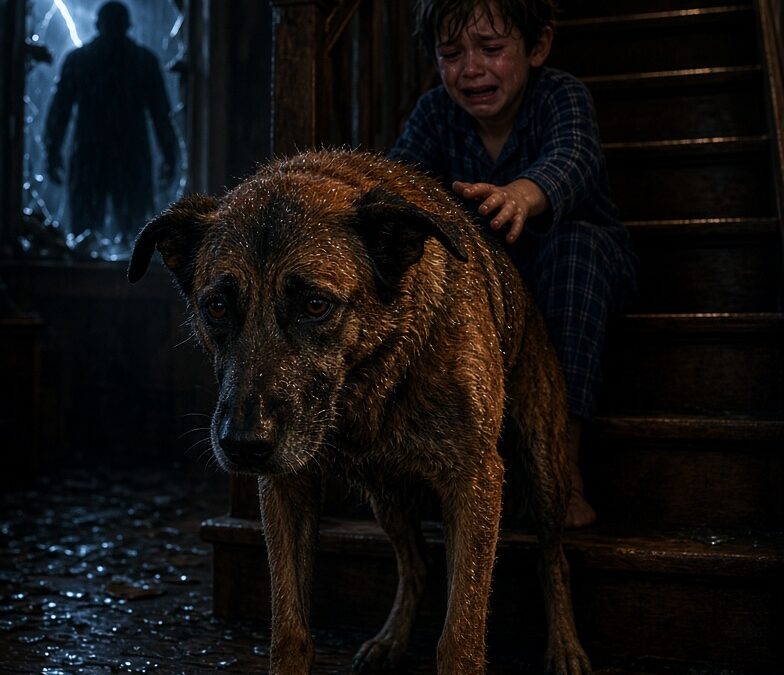
“Shadow won’t come upstairs, Daddy. He’s standing in front of the bad man.”
I could hear the growling.
It was unmistakable.
Deep.
Controlled.
Not the warning bark Shadow gave when a delivery driver approached the porch.
This was the sound he’d made during dangerous deployments.
It came from somewhere far down the hallway, beneath Caleb’s frightened breathing.
Then I heard a man shout.
“GET THAT DAMN DOG AWAY FROM ME!”
My stomach dropped.
“Caleb, stay quiet.”
Something struck the wall.
Shadow barked.
There was another crash.
Caleb screamed that the man was hurting him.
I reached my truck and turned the key.
The engine started.
I threw it into gear and pressed the accelerator.
The rear tires spun.
The truck lurched forward about ten feet before sinking into a section of washed-out road.
I tried again.
Nothing.
Water had carved a deep rut across the track, and one rear wheel was buried.
For one terrible second, I sat there with my hands gripping the steering wheel.
Then I heard Caleb whisper through the phone.
“Daddy, please come home.”
I abandoned the truck.
“I’m coming, son.”
I ran.
I told him to call 911 from the house phone and keep his bedroom door locked.
He begged me not to hang up.
I promised I would call the police too.
“I’m coming as fast as I can, Caleb. Shadow’s with you. Listen to me. You’re not alone.”
I ended the call and dialed 911 while stumbling through the pasture.
When the dispatcher answered, I gave our address, explained that my son was alone inside the house with an intruder, and told her there was a retired police dog defending him.
“Do you know whether the intruder is armed?” she asked.
“I don’t know.”
“Is your son somewhere secure?”
“Upstairs. Locked bedroom.”
“Units are being dispatched.”
“Tell them to hurry.”
“Sir, I need you to stay on the line.”
I nearly fell crossing a drainage ditch.
“Then stay with me while I run.”
She did.
Later, she told me she’d never heard anyone sound quite like I did that night.
She said I kept repeating the same thing between breaths.
“Please don’t let him reach my boy.”
Over and over.
As though saying it enough times could make it true.
I wasn’t there to see what happened inside the house.
Much of what I know came later from Caleb, from the police investigation, and from the emergency call recordings.
Some details still haunt me because I can picture them more clearly than things I actually witnessed.
Caleb had been asleep when the kitchen window shattered.
The sound woke him.
At first, he thought a tree branch had fallen against the house.
He sat up.
Then he heard footsteps downstairs.
Heavy footsteps.
Not mine.
He climbed out of bed and walked toward the hallway.
That’s when Shadow barked.
Caleb later described it as a sound that made the entire house seem to shake.
He reached the top of the stairs and looked down.
The kitchen light was on.
Broken glass covered the floor.
A man wearing a dark hooded jacket stood near the doorway, holding a flashlight.
He had a cloth bag slung across one shoulder.
Apparently, he’d expected the house to be empty.
When Caleb appeared at the top of the stairs, the man looked up.
For a brief moment, neither moved.
Then the stranger said, “Hey, kid.”
Caleb stepped backward.
“Where’s your dad?”
My son didn’t answer.
The man started toward the staircase.
“Come down here. I just need to talk to you.”
Caleb turned and ran.
He reached his bedroom, slammed the door, and twisted the lock.
Then he heard Shadow.
The old dog had been lying near the fireplace when the window broke.
By the time the intruder reached the stairs, Shadow was standing in front of them.
His head was lowered.
His ears were forward.
His lips had pulled back to reveal his teeth.
The man waved his flashlight.
“Get out of the way!”
Shadow didn’t move.
The intruder stepped sideways.
Shadow moved with him.
He tried the other direction.
Again, Shadow blocked him.
The man raised his voice.
“MOVE!”
Shadow lunged forward one step and barked.
The stranger stumbled backward.
Caleb heard something hit the kitchen cabinets.
Then he heard the man curse.
For a while, the intruder apparently tried to avoid the dog.
He moved around the kitchen, opening drawers, looking for something he could use.
Investigators later determined he’d taken cash from a drawer and removed several small valuables from the living room.
But after seeing Caleb, he made the decision that transformed a burglary into something far more dangerous.
He tried to reach my son’s room.
Maybe he wanted to stop Caleb from calling the police.
Maybe he intended to use him as a hostage.
We never learned exactly what he planned to do.
I’m grateful for that uncertainty.
There are some possibilities a father shouldn’t have to imagine.
What we know is that the man returned to the staircase holding a long metal screwdriver.
And Shadow was still there.
The intruder struck him.
Caleb heard the impact.
Then he heard Shadow cry out.
Not a bark.
Not a growl.
A sharp, painful sound that made him cover his ears.
“Don’t hurt him!” Caleb screamed from behind the bedroom door.
The man shouted back.
“Then tell him to move!”
Caleb didn’t know what to do.
He had seen Shadow stumble on our kitchen floor.
He had helped me give the dog his medication.
He knew his hips hurt.
He knew he was old.
And he knew that, when we took family walks, Shadow sometimes needed to stop and rest before we reached the end of the driveway.
But Caleb also knew something the intruder didn’t.
Shadow had been trained to stay between danger and the person he was protecting.
It didn’t matter that the dog had retired.
It didn’t matter that he was slower.
And it didn’t matter that he was hurting.
He had positioned himself at the bottom of those stairs for one reason.
There was a child upstairs who needed him.
The man hit Shadow again.
The dog staggered.
For one terrifying moment, Caleb heard his paws scraping against the hardwood floor.
Then came a snarl.
A scream.
And the sound of the metal screwdriver falling across the tiles.
Shadow had caught the man’s forearm in his jaws.
The intruder struggled to pull free.
Furniture scraped across the kitchen.
A chair overturned.
The man shouted threats.
Shadow held on.
Eleven years of training lived inside that aging body.
He had practiced controlled apprehensions hundreds of times.
He had faced violent resistance.
He knew how to maintain a grip while someone struggled against him.
But he was no longer the powerful young dog who could hold an armed suspect until backup arrived without showing signs of fatigue.
His rear legs were weak.
His breathing was labored.
And the intruder was much heavier than he was.
The man slammed Shadow against the side of the staircase.
The old dog released his grip.
Then, somehow, he dragged himself upright again.
Upstairs, Caleb was dialing 911.
The dispatcher later told us he spoke so quietly that she initially thought the line was disconnected.
“911. What’s your emergency?”
“Somebody’s in my house.”
“What’s your name, sweetheart?”
“Caleb Miller.”
“Okay, Caleb. Are you alone?”
“My daddy went to fix the fence.”
“Where are you right now?”
“In my bedroom.”
“Is your door locked?”
“Yes.”
“Good. Keep it locked. Can you tell me where the person is?”
Caleb began crying harder.
“He’s trying to come upstairs.”
“Is there anyone else in the house?”
“My dog.”
“Okay. Where’s your dog?”
The answer came through a trembling whisper.
“He’s protecting me.”
The dispatcher paused.
“What’s your dog’s name?”
“Shadow.”
“Is Shadow with you?”
“No.”
“Where is he?”
“At the stairs.”
Then Caleb said something that would later make the dispatcher cry when she listened to the recording.
“He’s really old. His legs don’t work good anymore. But he won’t let the man come up.”
The dispatcher kept him talking.
She asked him to move away from the bedroom door.
She told him to get behind his bed, stay low, and make as little noise as possible.
She reassured him that officers were coming.
But Caleb kept asking about Shadow.
“Can you make the bad man stop hurting him?”
“We’re getting help there as fast as we can.”
“Can you tell the police to save my dog too?”
“Yes, sweetheart. I’ll tell them.”
“Promise?”
“I promise we’ll tell them.”
At one point, Caleb whispered, “My daddy says Shadow doesn’t have to work anymore.”
The dispatcher answered gently.
“That’s okay, Caleb.”
“But he’s working right now.”
There was another loud crash.
And my son began screaming again.
Meanwhile, I was still running.
I had crossed the flooded lower pasture and was climbing the slope toward the equipment shed when lightning illuminated the farmhouse.
I could see its roof beyond the trees.
The porch light was on.
One upstairs window glowed faintly.
Every muscle in my body burned.
My chest felt like it was tearing apart.
I had already told dispatch that I was a former deputy and a retired K9 handler. I warned responding officers that the dog in the house was trained and might still be defending the child.
I was afraid they might mistake Shadow for a threat.
The dispatcher assured me she’d passed the information along.
Then she said, “Mr. Miller, deputies are approaching from County Road Six.”
“How far?”
“Please keep moving toward a safe location.”
“My son is inside that house.”
“I understand, sir.”
“No, you don’t.”
I immediately regretted the words.
She was trying to help.
But fear had stripped away every part of me that knew how to remain calm.
I had spent years responding to emergency calls.
I’d told frightened parents to wait outside.
I’d instructed people not to enter dangerous buildings.
I’d insisted they let trained officers do their jobs.
Now I was the father running toward the danger.
And I finally understood why people ignored those instructions.
There are rules you can follow when someone else’s child is in danger.
When it’s your own, every second feels like a betrayal.
As I reached the fence behind the barn, I heard Shadow bark.
It carried across the wet yard.
One sharp bark.
Then another.
I nearly collapsed with relief.
He was alive.
“Hold on, buddy,” I whispered.
I climbed the fence and dropped hard into the mud.
“Just hold on.”
The back porch came into view.
Then the kitchen window.
Broken.
A curtain moved in the wind.
I heard a man yelling inside.
And beneath the yelling, I heard the sound that frightened me most.
Shadow was struggling to breathe.
I pulled open the back door and stepped into my house.
The smell hit me first.
Rain-soaked wood.
Broken glass.
Blood.
The kitchen looked as though a storm had torn through it.
A chair lay on its side.
One cabinet door hung broken from its hinges.
The flashlight had rolled beneath the table, throwing a narrow beam across the floor.
And at the bottom of the staircase stood my partner.
Shadow’s hind legs were shaking.
His coat was darkened along his left shoulder and chest.
Blood dotted the floor beneath him.
His ears were still upright, but his breathing came in short, painful bursts.
The intruder stood a few feet away, holding a long kitchen knife.
When he saw me, he froze.
I froze too.
For the first time since my son called, I was no longer imagining what might happen.
I was looking directly at it.
The man glanced from me to the dog.
Then he raised the knife.
“Stay back!”
I held both hands where he could see them.
“Put it down.”
“Get that animal away from me!”
“Put the knife down.”
He backed toward the hallway.
Shadow shifted with him.
The movement was small.
Barely a step.
But the old dog was still positioning himself between the intruder and the stairs.
I could hear Caleb crying above us.
“Daddy?”
My knees almost gave way.
“I’m here, buddy!”
“Daddy, Shadow’s hurt!”
“I know. Stay in your room.”
The intruder glanced upward.
That single movement changed everything.
He looked at my son’s bedroom.
Then at me.
Then back at the stairs.
I recognized the calculation in his expression.
He was trapped between an angry father, a trained police dog, and the approaching possibility of law enforcement.
He wanted a way out.
And he was looking at my child.
“Don’t,” I warned.
He took one step toward the staircase.
Shadow growled.
The man raised his knife.
I moved forward.
“GET AWAY FROM THOSE STAIRS!”
The intruder swung toward me.
I caught his wrist with both hands.
We crashed into the kitchen counter.
Pain shot through my shoulder.
The knife struck the edge of a cabinet.
He drove his weight against me, trying to wrench his arm free.
I slammed backward into the refrigerator.
For a moment, all I could see was the blade moving between our faces.
Then the man shoved me sideways.
I lost my grip.
He stumbled toward the stairs.
And Shadow moved.
I still don’t know where he found the strength.
A minute earlier, he’d barely been able to stand.
But when that man turned toward my son, Shadow launched himself forward with a force I hadn’t seen in years.
His jaws closed around the intruder’s knife arm.
The man screamed.
The knife fell.
They crashed against the bottom stair.
I grabbed the man’s shoulders and pulled him away from the staircase.
He struggled violently.
We fell across the hallway floor.
I pinned one arm beneath my knee.
He tried to twist free.
Then the front door burst open.
“SHERIFF’S OFFICE! SHOW ME YOUR HANDS!”
Deputy Luis Ortega entered with another officer behind him.
For an instant, everything stopped.
I looked up.
Luis looked at me.
Then he saw the man beneath me.
“Daniel, move back!”
I released my grip and rolled away.
Luis and the other deputy secured the intruder.
Handcuffs clicked.
The man continued shouting about the dog.
I no longer heard him.
Because Shadow had fallen.
He lay sideways at the foot of the stairs, one front paw extended toward the hallway.
His breathing was shallow.
His eyes were open.
And when I crawled toward him, his tail moved once against the floor.
“Shadow?”
I dropped to my knees.
“Hey, buddy.”
His ears twitched.
I put my hand against his chest.
Warm blood soaked through my fingers.
“No. No, no, no.”
I pressed my jacket against the wound.
“Stay with me.”
Shadow looked toward the staircase.
Even then.
Even while he was bleeding on our floor, he was looking for Caleb.
I leaned close.
“He’s okay.”
Shadow blinked.
“Caleb’s okay, buddy. You did it.”
His breathing caught.
I swallowed hard.
“You saved him.”
From upstairs came a small voice.
“Daddy?”
I looked up.
Caleb stood at the top of the staircase in his blue pajamas, clutching his stuffed bear.
His face was pale.
“Is the bad man gone?”
I struggled to speak.
“Yeah, buddy.”
“Is he gone forever?”
Luis answered from the hallway.
“He can’t hurt you now, son.”
Caleb looked at Shadow.
His face changed.
He started downstairs.
“Shadow?”
I reached toward him.
“Caleb, wait.”
But he was already moving.
He stopped beside the dog and dropped to his knees.
For a moment, he just stared.
Then he put both small hands against Shadow’s face.
“Hey, boy.”
Shadow’s eyes shifted toward him.
Caleb leaned closer.
“It’s me.”
The dog tried to raise his head.
He couldn’t.
Caleb’s lower lip began trembling.
“Daddy, why won’t he get up?”
I had no answer.
My son began stroking Shadow’s ears.
“It’s okay, Shadow. The bad man’s gone.”
Shadow’s tail tapped the floor.
Once.
Then again.
Caleb looked at me through his tears.
“See, Daddy? He knows me.”
I nodded.
“Yeah.”
“He knows he saved me.”
I pressed harder against the wound.
My hands were shaking.
Luis was already calling for emergency veterinary assistance.
The other deputy took the handcuffed intruder outside.
Thunder rattled the windows.
And Caleb bent down until his forehead touched Shadow’s.
“You can stop now,” he whispered.
The old dog closed his eyes for a moment.
Caleb kissed the black fur between them.
“You don’t have to protect me anymore.”
I turned my face away.
Because I had seen terrible things in my career.
I had heard people say goodbye in hospital rooms.
I’d stood beside wrecked cars while families waited for news.
But nothing had ever hurt quite like watching my little boy try to give an injured dog permission to rest.
I pulled Caleb against my chest.
“We’re getting him help.”
My son wrapped one arm around Shadow’s neck.
“Promise?”
I looked at the blood spreading across my jacket.
I wanted to say yes.
I wanted to promise that a veterinarian could fix everything.
I wanted to tell my son that bravery was rewarded and good hearts always got another chance.
Instead, I kissed his hair.
“I promise we’ll do everything we can.”
And for the first time that night, I was afraid doing everything wouldn’t be enough.
Sheriff Vance arrived while we were carrying Shadow toward the front door.
I heard his vehicle before I saw him.
The siren cut through the storm, then stopped abruptly outside the house.
Luis had found a thick blanket in the laundry room. We slid it carefully beneath Shadow, trying not to move him more than necessary.
Even that small movement made him whimper.
I had heard Shadow cry in pain before.
Once, during a search, he’d torn a ligament while clearing a ditch.
Another time, a suspect had kicked him hard enough to fracture a rib.
He’d recovered from both injuries.
But this was different.
There was no anger left in his voice.
Only exhaustion.
And every sound reminded me how much strength he’d already spent protecting my son.
Sheriff Vance came through the doorway wearing a raincoat over his uniform.
“Where’s the suspect?”
“Secured,” Luis answered. “Deputy Carson has him outside.”
“Any civilian injuries?”
“Child’s unharmed. His father has some bruising.”
Then Vance saw Shadow.
He stopped walking.
The sheriff looked down at the dog lying in the bloodstained blanket.
For several seconds, he didn’t speak.
“Is that Miller’s old K9?”
Luis nodded.
“Yes, sir.”
Vance looked at me.
Then at Caleb, who was standing beside Shadow with one hand resting on the blanket.
“What happened?”
Luis’s jaw tightened.
“The suspect tried to reach the kid. Shadow kept him downstairs until Daniel and responding units arrived.”
The sheriff stared.
“He did that?”
I looked up at him.
I was kneeling in blood, soaked with rain, barely holding myself together.
“Yeah,” I said.
My voice came out rough.
“He did.”
Vance’s expression changed when he noticed the injury along Shadow’s chest.
“Jesus.”
Luis stepped forward.
“We need to get him to the emergency veterinary clinic. Now.”
Vance immediately removed his coat.
“Use my vehicle.”
Within minutes, we had Shadow in the rear cargo area of the sheriff’s SUV, lying on a blanket with his head resting against my thigh.
Caleb sat beside me, strapped into the rear seat, refusing to let go of Shadow’s leash.
Luis drove.
Vance followed in another patrol vehicle.
The emergency veterinary clinic was twenty-three miles away.
I remember every mile.
I remember the wipers struggling against the rain.
I remember the radio chatter coming from the dashboard.
I remember Luis glancing at us in the rearview mirror, saying nothing because there was nothing useful to say.
Mostly, I remember Shadow’s breathing.
I counted every breath.
At one point, his eyes drifted closed.
I leaned over him.
“Hey. Come on, partner.”
His ears twitched.
“Stay with me.”
He opened his eyes slightly.
I put my forehead against his.
“You hear me? You don’t get to quit on me yet.”
I knew those words weren’t fair.
He had already done more than anyone could have asked.
But I was terrified.
And I wasn’t ready to say goodbye.
Caleb sat very still.
His small fingers were wrapped around the leash so tightly that his knuckles had turned white.
After several minutes, he whispered, “Daddy?”
“Yeah, buddy?”
“Is Shadow gonna die?”
I looked at him.
There was no point pretending he hadn’t seen the blood.
“I don’t know.”
His face crumpled.
“He saved me.”
“I know.”
“Then somebody has to save him.”
The words struck me harder than anything that had happened inside our house.
Because that was exactly what I believed too.
After all the people Shadow had found, all the dangers he’d faced, all the years he’d spent serving a community that barely remembered his name, surely somebody could save him now.
Surely the world owed him that much.
But the world doesn’t make those kinds of promises.
We reached the emergency clinic shortly after midnight.
Two veterinary technicians were waiting with a rolling stretcher.
They moved quickly.
Shadow was lifted from the SUV and carried through a set of glass doors.
His head turned toward me as they took him inside.
I followed until a technician gently stopped me.
“We need to stabilize him.”
“I’m his handler.”
She nodded.
“I understand.”
“He’s a retired police dog.”
“We’ll take good care of him.”
I looked past her.
Shadow disappeared around the corner.
And suddenly there was nothing left for me to do.
No suspect to apprehend.
No radio to answer.
No command to give.
Just wait.
I stood in the hallway staring at the closed doors.
Then Caleb slipped his hand into mine.
“Daddy?”
I looked down.
“Did I do good?”
For a moment, I didn’t understand.
“What?”
“Did I do what you told me?”
I dropped to one knee.
“Oh, buddy.”
His eyes filled.
“I locked my door. I called the police. I stayed quiet like you said.”
I pulled him into my arms.
“You did everything right.”
His shoulders shook.
“I was scared.”
“I know.”
“I thought the man was gonna get me.”
My throat closed.
I held him tighter.
“He didn’t.”
“Because Shadow wouldn’t move.”
I nodded against his hair.
“Because Shadow wouldn’t move.”
Caleb began sobbing.
Not the frightened crying I’d heard through the phone.
This was different.
It was the sound of a little boy finally realizing he was safe enough to fall apart.
I held him until Sarah arrived.
She came through the clinic doors still wearing her blue nursing scrubs.
Her hair had come loose from its bun.
Her face was pale.
She saw Caleb first.
Then me.
Then the blood on my clothes.
“Daniel?”
I stood.
“He’s okay,” I said quickly. “Caleb’s okay.”
She hurried toward us and wrapped both arms around our son.
Caleb buried his face against her.
“Mommy, somebody broke our window.”
“I know, baby.”
“He had a knife.”
Sarah’s eyes met mine.
I couldn’t look away.
“Shadow stopped him,” Caleb whispered.
Sarah kissed the top of his head.
“Where is Shadow?” she asked.
I looked toward the treatment room.
And for the first time that night, I couldn’t answer.
We waited nearly forty minutes before the veterinarian came out.
Her name was Dr. Elaine Hart.
She had treated Shadow several times over the years and knew his medical history well.
That made her expression even harder to read.
She sat beside us.
“Daniel, we’ve stopped some of the external bleeding, but Shadow has suffered a very serious penetrating injury.”
I nodded.
I was afraid to speak.
“The wound extends into his chest. He’s lost a significant amount of blood, and his blood pressure is dangerously low.”
“Can you operate?”
“We’ve evaluated that option. His age and underlying health problems make anesthesia extremely risky, and we’re concerned about the amount of internal damage.”
I looked at Sarah.
She was holding Caleb against her chest.
“Can you save him?” I asked.
Dr. Hart paused.
That pause told me everything.
“We’re doing what we can to support him,” she said gently. “But I need you to understand that his prognosis is very poor.”
I stared at the floor.
I’d heard those words before.
From doctors.
From surgeons.
From emergency responders standing beside hospital beds.
But this time, I wanted to argue.
I wanted to tell her she’d made a mistake.
I wanted to remind her how strong Shadow was.
How he’d run through burning buildings.
How he’d crossed freezing streams.
How he’d spent ten minutes fighting a man half his age in order to protect my son.
Instead, I whispered, “He just saved an eight-year-old boy.”
Dr. Hart’s eyes softened.
“I know.”
“He shouldn’t die because of that.”
She didn’t answer.
There was no answer.
Sarah reached for my hand.
I pulled away, not because I was angry with her, but because I couldn’t bear being comforted.
I stood and walked into the hallway.
Sheriff Vance was waiting near the entrance.
He looked different without the confident expression he usually wore.
His raincoat hung open.
His hair was wet.
When he saw me, he straightened.
“Daniel.”
I kept walking.
“Daniel, wait.”
I stopped.
He approached slowly.
“I’ve spoken with Luis. I’ve reviewed what happened.”
I said nothing.
“The suspect has been taken into custody. The knife was recovered. Your son is safe.”
I looked at him.
“That’s what matters.”
Vance nodded.
“Of course.”
He hesitated.
Then he said, “I was wrong about Shadow.”
I stared at him.
He continued quietly.
“What I said at the station. It was disrespectful. And it was wrong.”
My hands curled into fists.
Not because I wanted to hit him.
Because six months earlier, those words might have meant something entirely different.
Now my dog was dying.
“You called him useless,” I said.
Vance lowered his eyes.
“I did.”
“He worked eleven years.”
“I know.”
“He searched for missing children in the snow. He tracked dangerous men through places none of us wanted to enter. He stood beside deputies when everybody else was running away.”
The sheriff swallowed.
“I know, Daniel.”
“No.”
My voice rose.
“You know his record. That’s not the same thing.”
Vance said nothing.
I stepped closer.
“You saw an old dog who couldn’t pass a physical test anymore. That’s all you saw.”
He looked toward the treatment room.
“I’m sorry.”
I was too tired to argue.
I wanted to tell him that his apology couldn’t change anything.
That regret was easy when the consequences belonged to somebody else.
But Shadow had never protected people for recognition.
He’d never cared who praised him.
And standing there, exhausted and terrified, I realized I didn’t want to spend another minute discussing the sheriff.
I wanted to be with my dog.
So I turned away.
Behind me, Vance spoke softly.
“What he did tonight was extraordinary.”
I stopped.
Then I answered without looking back.
“What he did tonight was what he always did.”
Dr. Hart came for us just before one in the morning.
Her expression told me the news before she spoke.
Shadow’s condition had continued to deteriorate.
His breathing was becoming more difficult, and despite medication and supportive treatment, his circulation wasn’t recovering.
The injury was too severe.
The treatment options that might ordinarily have offered hope were no longer realistic for him.
She explained everything carefully.
She didn’t rush.
She didn’t hide the truth.
And when she finally said we needed to consider letting him go peacefully, I felt something inside me collapse.
I had spent years making decisions under pressure.
I knew how to assess danger.
I knew how to act when lives depended on seconds.
But I’d never felt less capable of making a decision than I did in that small veterinary consultation room.
Sarah held my hand.
“We can’t let him suffer,” she whispered.
I nodded.
I knew she was right.
Knowing didn’t make it easier.
Caleb looked between us.
“What does that mean?”
I knelt beside him.
“It means Shadow’s body is hurt very badly.”
“Can he come home?”
My eyes burned.
“No, buddy. I don’t think he can.”
Caleb stared at me.
Then his face tightened.
“But he was supposed to have pancakes.”
I closed my eyes.
The words were so small.
So ordinary.
And they broke what was left of my composure.
He was supposed to have pancakes.
One little pancake.
A promise made only a few hours earlier in a warm bedroom while rain tapped gently against the window.
I pulled Caleb into my arms.
“I’m sorry.”
He shook his head against my chest.
“No.”
“Buddy—”
“No, Daddy. He has to come home.”
Sarah began crying.
Caleb pulled away and wiped his face with his sleeve.
“Can I see him?”
I looked at Dr. Hart.
She nodded gently.
“If you’d like, we can bring you into the room. We’ll make sure he’s comfortable.”
I asked Caleb if he wanted to stay with Shadow until the end.
He looked frightened.
Then he whispered, “Will he be scared if I leave?”
I put my hand on his shoulder.
“I don’t think so. But you can stay with us if you want.”
He nodded.
“I want him to know we’re here.”
We went together.
Shadow lay on a large padded blanket.
His injured chest was covered with clean bandaging.
An IV line ran from one of his front legs.
The room was quiet except for the soft sound of medical equipment.
When I approached, he opened his eyes.
I sat beside him.
“Hey, partner.”
His gaze settled on my face.
I had looked into those eyes thousands of times.
Through the metal barrier of our patrol SUV.
Across training fields.
Beside wrecked vehicles.
At the end of long shifts when we were both too tired to do anything except go home.
But I’d never seen them look so tired.
I placed my hand against his neck.
“It’s me.”
He moved his muzzle slightly toward my palm.
That was enough.
I bent down and pressed my forehead against his.
“I’ve got you.”
Sarah sat on the other side.
She stroked his back gently.
Caleb approached last.
He held the old black leash in his hands.
For a few seconds, he seemed afraid to touch Shadow.
Then he knelt.
“Hey, boy.”
Shadow’s eyes moved toward him.
Caleb smiled through his tears.
“It’s Caleb.”
I watched my son carefully place his little hand over Shadow’s paw.
“You did really good.”
Shadow’s ears shifted.
“The man didn’t get me.”
My throat tightened.
Caleb continued.
“I was really scared. But you stayed.”
He looked at me.
“Daddy, can he hear me?”
I nodded.
“I think he can.”
Caleb leaned closer.
“You’re the best dog in the whole world.”
Shadow moved his head slightly.
Then Caleb said something I hadn’t expected.
“I’m sorry you got hurt because of me.”
I reached for him immediately.
“No, Caleb.”
His eyes filled.
“If I wasn’t upstairs—”
“Listen to me.”
I put both hands on his shoulders.
“This is not your fault. None of it.”
“But Shadow—”
“Shadow protected you because he loved you. The man who broke into our house caused this. Not you.”
Caleb looked at the dog.
“Are you sure?”
I swallowed.
“I’m sure.”
Then I looked at Shadow.
“And I think he’d want you to know that too.”
My son bent down and kissed his forehead.
“I love you, Shadow.”
I wiped my face.
Sarah was crying quietly beside us.
I leaned close to my partner one last time.
For eleven years, I’d given him commands.
Sit.
Stay.
Search.
Track.
Hold.
Every word had a purpose.
Every command had meant something.
Now there was only one thing left to say.
And it wasn’t an order.
“You can rest, buddy.”
My voice broke.
“You don’t have to watch the doors anymore.”
I stroked the soft fur behind his ears.
“Caleb’s safe. Sarah’s safe. We’re all here.”
Shadow looked at me.
I could barely see through my tears.
“You took care of us.”
I kissed his head.
“Now I’m going to take care of you.”
Dr. Hart gave us another moment.
Then, with our hands resting gently against him, she administered the medication that would end his suffering.
Shadow’s breathing slowed.
His body relaxed.
Caleb kept one hand against his paw.
Sarah held me.
And I whispered the same words I’d said hundreds of times after a successful search.
“Good boy.”
A moment later, Shadow was gone.
He was twelve years old.
He had served eleven years as a police K9.
And his final act had been protecting the little boy who once told him that protecting family wasn’t work.
I don’t remember how long we stayed in that room.
I remember Caleb pressing his face against Sarah’s shoulder.
I remember the warmth slowly leaving Shadow’s ears.
I remember looking at his collar and seeing the tiny scratches in its metal buckle, marks accumulated over years of work and adventures.
And I remember feeling an emptiness so complete that I wondered how I would ever walk back into our house without him.
The man who broke into our farmhouse was identified as a repeat offender with a history of burglary and assault.
Investigators connected him to several recent property crimes in neighboring areas.
The unfamiliar truck I’d seen near our land was linked to him.
He had been watching the ranch.
He’d learned Sarah worked nights.
And when he saw my vehicle leave the house, he believed he’d found an easy target.
According to investigators, he expected to steal cash, tools, and valuables before anyone returned.
He hadn’t expected Caleb to be home.
And he certainly hadn’t expected Shadow.
The case eventually ended with a guilty plea and a prison sentence for the violent home invasion.
I attended the final hearing, but I didn’t feel the satisfaction I’d imagined.
The man was going to prison.
My son was alive.
Justice had done what it could.
But none of it brought Shadow back.
For weeks, the house felt wrong.
His bed remained beside the fireplace.
His water bowl sat in the kitchen.
The rubber mats I’d placed across the floor were still there.
I kept finding his fur on my clothes.
Sometimes, when I woke before sunrise, I would reach down automatically to scratch the head that used to rest beside my chair.
My hand would touch empty air.
And the grief would begin all over again.
Caleb struggled more than I expected.
He stopped sleeping through the night.
He became frightened whenever the wind rattled the windows.
He refused to go near the staircase alone.
Sometimes he woke crying, certain the man had returned.
Sarah and I arranged for him to speak with a counselor who worked with children after traumatic events.
We also spoke with her.
We needed help understanding how to support him without allowing our own fear to make his world smaller.
Healing was slow.
Some nights, Caleb wanted the hallway light left on.
Some nights, he asked me to sit beside his bed until he fell asleep.
And some nights, he simply wanted to talk about Shadow.
I never told him to stop.
We remembered the funny things.
How Shadow stole socks from the laundry basket.
How he disliked the vacuum cleaner but never moved when Caleb drove a toy truck across his paws.
How he once tried to carry an enormous fallen branch through the back door and couldn’t understand why it wouldn’t fit.
We remembered the pancakes he never got to eat.
We remembered the way he slept with his chin on Caleb’s sneakers.
We talked about his work.
And eventually, little by little, we learned to talk about his death without feeling that every word would destroy us.
One afternoon, Sheriff Vance came to the ranch.
He arrived alone.
No cameras.
No public relations officer.
No formal announcement.
He carried a small wooden box.
I met him on the porch.
“Daniel,” he said.
“Sheriff.”
He looked uncomfortable.
“I wanted to bring you something.”
He handed me the box.
Inside was Shadow’s official retirement badge, which the department had arranged to have mounted in a small velvet-lined display.
Beneath it was an engraved metal plate recognizing his eleven years of service.
Vance watched me examine it.
“I asked for his full service record,” he said.
I looked up.
“Why?”
“I wanted to read it. All of it.”
He paused.
“I saw the reports. The missing children. The search operations. The times he helped save another deputy.”
His voice grew quieter.
“I never really looked at any of that before.”
I closed the box.
For several moments, neither of us spoke.
Then Vance said, “I’ve been working with the county commissioners on a retirement assistance program for our K9s. Veterinary support. Medical expenses. A proper transition when they’re no longer fit for duty.”
I looked toward the yard.
“That’s good.”
“It won’t change what happened.”
“No.”
“I know that.”
He looked at the wooden box.
“I spent too much time thinking about what these dogs could still do for the department. I didn’t think enough about what the department owed them after their service.”
I nodded slowly.
“That would have mattered to Shadow.”
Vance swallowed.
“I wish I’d understood it sooner.”
For the first time, I believed he meant it.
It didn’t erase the cruelty of his words.
And it didn’t undo what happened.
But I understood that people sometimes learn important lessons too late to repair the thing that taught them.
The only choice left is whether they do something useful with what they’ve learned.
A month later, the sheriff’s office held a memorial for Shadow.
Not because I requested one.
Because Luis and several other deputies insisted.
They arranged a small ceremony outside the station where Shadow had spent most of his working life.
Former handlers attended.
Current deputies stood in uniform.
Several families came with children Shadow had helped locate during his career.
One elderly woman brought flowers.
She told me Shadow had found her husband after he wandered away from home during a winter storm six years earlier.
“He was confused,” she said, her eyes filling. “He couldn’t remember where he lived.”
I remembered the search.
I remembered Shadow picking up the scent near a wooded trail.
I remembered finding the man sitting against a tree, shivering beneath a thin jacket.
The woman squeezed my hand.
“Your dog gave me three more years with my husband.”
I couldn’t answer.
She placed her flowers beside Shadow’s photograph.
And suddenly I understood how many lives my partner had touched without ever knowing it.
Luis spoke briefly.
He told stories about Shadow’s stubbornness and his love of tennis balls.
He described a search during which Shadow refused to abandon a drainage ditch until deputies discovered an injured man hidden beneath a collapsed wooden platform.
Then he talked about our farmhouse.
“He was retired,” Luis said, looking out at the small crowd. “He was home. He wasn’t being paid, ordered, or asked to put himself in danger.”
His voice shook.
“But when a child needed him, Shadow did what he’d always done. He stood between that child and harm.”
I held Caleb’s hand.
Sarah stood beside us.
A framed photograph of Shadow rested near the podium.
It showed him sitting proudly in his K9 harness, his ears high, his eyes focused on something beyond the camera.
I recognized the photograph.
It had been taken years earlier after a training exercise.
Back then, I’d looked at him and seen a dog in his prime.
Now I saw something else.
I saw every morning we’d spent together.
Every cold night.
Every frightening call.
Every quiet drive home.
I saw a life built on trust.
When the ceremony ended, Sheriff Vance approached Caleb.
He crouched to his level.
“Your dad tells me Shadow loved you very much.”
Caleb nodded.
“I loved him too.”
“I know.”
Caleb looked at the photograph.
“Some people said he was too old to help anybody.”
Vance’s face tightened.
“Yes,” he said softly. “Some people did.”
Caleb turned back toward him.
“They were wrong.”
The sheriff lowered his eyes.
“Yes, Caleb. They were.”
My son didn’t smile.
He simply took my hand and walked with me toward the parking lot.
I think that conversation stayed with Sheriff Vance longer than anything I could have said.
It certainly stayed with me.
We buried Shadow beneath the old oak tree behind our farmhouse.
It was the place where Caleb loved to play during the summer.
From there, you could see the barn, the pastures, and the front porch.
You could also see the driveway.
I thought that was fitting.
Even in retirement, Shadow had always liked to watch people come home.
We placed a simple stone marker over his grave.
It had his name, his years of service, and the words:
FAITHFUL PARTNER. BELOVED FAMILY.
No long inscription.
No list of accomplishments.
Just the things that mattered.
That spring, Sarah planted wildflowers around the oak.
Caleb helped me build a small wooden bench nearby.
He wanted it painted blue.
I asked why.
“Because that’s the color of the blanket he liked.”
So we painted it blue.
Sometimes I sat there in the evenings, watching sunlight settle over the fields.
At first, I came because I missed him.
Later, I came because remembering him began to hurt a little less.
One afternoon, several months after the break-in, Caleb joined me.
He was carrying a folded sheet of construction paper.
He sat beside me on the bench and rested his head against my shoulder.
“Daddy?”
“Yeah?”
“Do you think Shadow knew he was a hero?”
I considered that.
“I don’t think dogs think about being heroes the way people do.”
“Then what did he think about?”
I looked toward the house.
“I think he knew who he loved.”
Caleb was quiet.
Then he unfolded the paper.
It was a new drawing.
This time, Shadow wasn’t wearing a police harness.
He wasn’t chasing a criminal or standing beside a patrol car.
He was lying beneath the oak tree, his tongue hanging out, with Caleb sitting next to him.
Above them, in the same crooked blue letters he’d used months earlier, my son had written:
MY HERO IS STILL HOME.
I stared at the drawing for a long time.
Then I put my arm around Caleb.
“That’s beautiful, buddy.”
He leaned against me.
“I don’t want to forget him.”
“You won’t.”
“What if I forget what he sounded like?”
I swallowed.
“Then we’ll watch the old videos.”
“What if I forget how his fur felt?”
I thought about the thousands of times I’d reached down to touch Shadow’s head.
About his warm ears.
His rough tongue.
The familiar weight of him leaning against my leg.
“Some memories might get harder to picture,” I said. “But you’ll remember how he made you feel.”
Caleb looked up.
“Safe?”
I nodded.
“Safe.”
He thought about that for a moment.
Then he looked at the grave beneath the tree.
“I think I’m brave enough now, Daddy.”
My eyes filled.
“You don’t have to be brave all the time, son.”
“I know.”
He slipped his hand into mine.
“Because you can be scared and still do something good.”
I looked at him.
“Who taught you that?”
He smiled a little.
“Shadow.”
I couldn’t speak.
I just held his hand and watched the wind move gently through the branches.
That evening, we took the drawing inside and placed it in a frame beside Shadow’s retirement badge.
It’s still there.
Sometimes visitors ask about the photograph of the Belgian Malinois standing proudly beside a patrol vehicle.
They ask whether he was a good police dog.
I always tell them yes.
He was one of the best.
But that isn’t the story I tell when someone asks who Shadow really was.
I tell them about a little boy who was frightened in his bedroom.
About a storm that kept his father from reaching him.
About an old dog with aching hips and trembling legs who stood at the bottom of a staircase and refused to let danger pass.
I tell them how Shadow stayed there until help arrived.
And how, in the final hours of his life, the only thing he seemed to care about was whether the little boy he’d protected was safe.
I spent eleven years giving that dog commands.
I taught him to follow a scent, hold his position, and respond without hesitation when somebody needed help.
But Shadow taught me something no training manual ever could.
A life doesn’t lose its worth when strength begins to fade.
Being unable to do what you once did doesn’t erase what you’ve given.
And growing old doesn’t make love any less powerful.
Sheriff Vance had looked at Shadow and seen everything the dog could no longer do.
My son had looked at him and seen everything he still was.
A friend.
A guardian.
Family.
For years after that night, Caleb kept Shadow’s old collar hanging beside his bedroom door.
Not because he was afraid.
He’d eventually learned to sleep without the hallway light.
The nightmares grew less frequent.
The broken kitchen window was replaced.
The scratches along the staircase were repaired.
And life, slowly and imperfectly, became ordinary again.
But whenever Caleb left for school, he would touch the collar with two fingers before walking downstairs.
One morning, I asked him why.
He smiled.
“Just saying good morning.”
I watched him run toward the waiting school bus.
Then I looked at the collar.
I could still remember the weight of the leash in my hand.
The sound of Shadow’s paws against the pavement.
The way he turned his head whenever I called his name.
For a moment, I closed my eyes.
And I was back in the station parking lot on the day we retired.
I could see him waiting beside the patrol SUV.
I could see the confusion in his eyes when I told him we weren’t going out anymore.
I wished I could return to that moment.
Not to change his retirement.
Not to ask him for one more year of service.
But to kneel beside him, take his face gently in my hands, and tell him what I know now.
That he had nothing left to prove.
That he had already given enough.
That he was loved long before that final terrible night, and he would be loved long after it.
And that when the world finally asked more of him than his tired body should ever have been asked to give, he answered with everything he had.
I opened my eyes and touched the worn leather collar.
“Good morning, partner,” I whispered.
Outside, the sun was rising over the pasture.
Caleb’s school bus disappeared around the bend.
Our house stood quiet beneath the old oak tree.
And although Shadow was no longer there to watch the driveway, the home he’d protected was still filled with the people he loved.
I rested my hand on his collar one last time.
“Your boy’s safe, Shadow.”
Then I went downstairs to begin another day in the life he’d given us.